

Global Biodegradable Silicone Esters Market Size and Forecast – 2026 To 2033
The global biodegradable silicone esters market is expected to grow from USD 3.45 Bn in 2026 to USD 8.20 Bn by 2033, registering a compound annual growth rate (CAGR) of 7.5% from 2026 to 2033. The global biodegradable silicone esters market is driven by Rising consumer interest in sustainable beauty products. On May 21, 2026, Croda International Plc announced the launch of Beauty of Zero, a bold new program underscoring its ambition for science-backed sustainability initiatives within the beauty industry.
Key Takeaways of the Global Biodegradable Silicone Esters Market
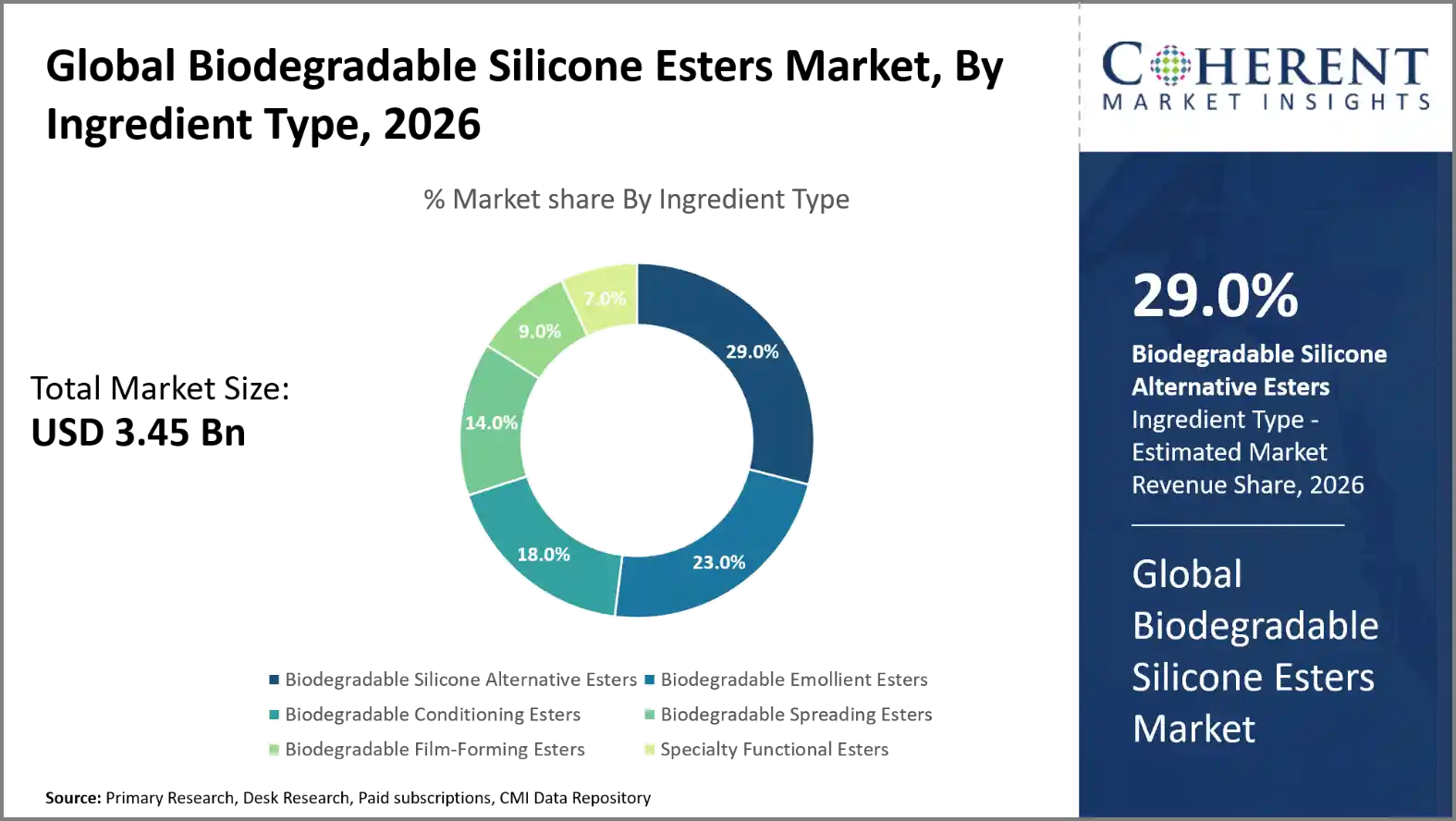
- The Biodegradable Silicone Alternative Esters segment is expected to account for 29.0% of the global biodegradable silicone esters market share in 2026. Increasing adoption of environmentally compatible haircare ingredients is driving the growth of the segment. On April 8, 2025, Nouryon introduced Armocare Aqua 12. The biodegradable, non-quat conditioning surfactant targets rinse-off and leave-in hair care formulations.
- The Plant-Derived Feedstocks segment is estimated to capture 41.0% of the market share in 2026. Growing demand for biodegradable skin conditioning agents is majorly driving the growth of the segment. On May 15, 2025, AAK highlighted Lipex SheaLuxe TR. The biodegradable emollient ester is derived from sustainably sourced shea butter.
- The Fatty Acid Esters segment is estimated to capture 38.0% of the market share in 2026. Expansion of premium clean beauty product formulations is majorly driving the growth of the segment. On February 12, 2025, Cellugy and Bioli introduced a sustainable moisturizing and protecting day cream. The formulation incorporates Cellugy's biofabricated cellulose ingredient, EcoFLEXY.
- Asia Pacific is expected to dominate the biodegradable silicone esters market in 2026 with a market share of 44.0%. Increasing regulatory attention toward cosmetic ingredient environmental persistence in Asia Pacific is driving the growth of the regional market. On February 25, 2026, Shiseido Company announced two artificial intelligence technologies. The first technology predicts cosmetic ingredient biodegradability using artificial intelligence-based quantitative structure–activity relationship modelling.
- North America is expected to account for 28.0% share in 2026 and is projected to record the fastest growth over the forecast period. Growing investment in specialty ester formulation technologies in North America is driving the growth of the regional market. On March 18, 2026, NYCO confirmed that its Newnan, Georgia, manufacturing facility was fully operational. The plant opened in mid-2025 and produces NYCOBASE synthetic ester base oils.
Segmental Insights
Why Does Biodegradable Silicone Alternative Esters Dominate the Global Biodegradable Silicone Esters Market?
The biodegradable silicone alternative esters segment is expected to account for 29.0% of the global biodegradable silicone esters market share in 2026. Biodegradable silicone alternative esters are leading the way as cosmetic makers increasingly seek sustainable substitutes for traditional silicone chemicals. These esters provide a smooth skin sensation, lubrication and conditioning characteristics. Biodegradability is a consideration in the production of environmentally sound products. Growing desires for clean beauty are also further driving their uptake in skin care, hair care, and personal care formulations. On October 26, 2026, LANXESS introduced Cosmelin, a new series of high-performance rapidly biodegradable esters for the cosmetics and personal care market. The products are aimed at manufacturers of skin and hair care, sun care, and decorative cosmetics. The Cosmelin range of readily biodegradable esters offers a large formulation flexibility. They were developed to deliver premium sensory performance in both silicone-containing and silicone-free formulations. In the latter case, they can be used as a high-performance alternative to silicone.
- Current Industry Events of 2026
- Market Size Estimation
- Regional Breakdown
- Competitive Landscape
- Customer Intelligence
- Segmental Analysis
- Pricing Analysis
- Key Market Drivers, Challenges & Future Trends
- Customized Insights Section
Why is Plant-Derived Feedstocks the Most Crucial Source?
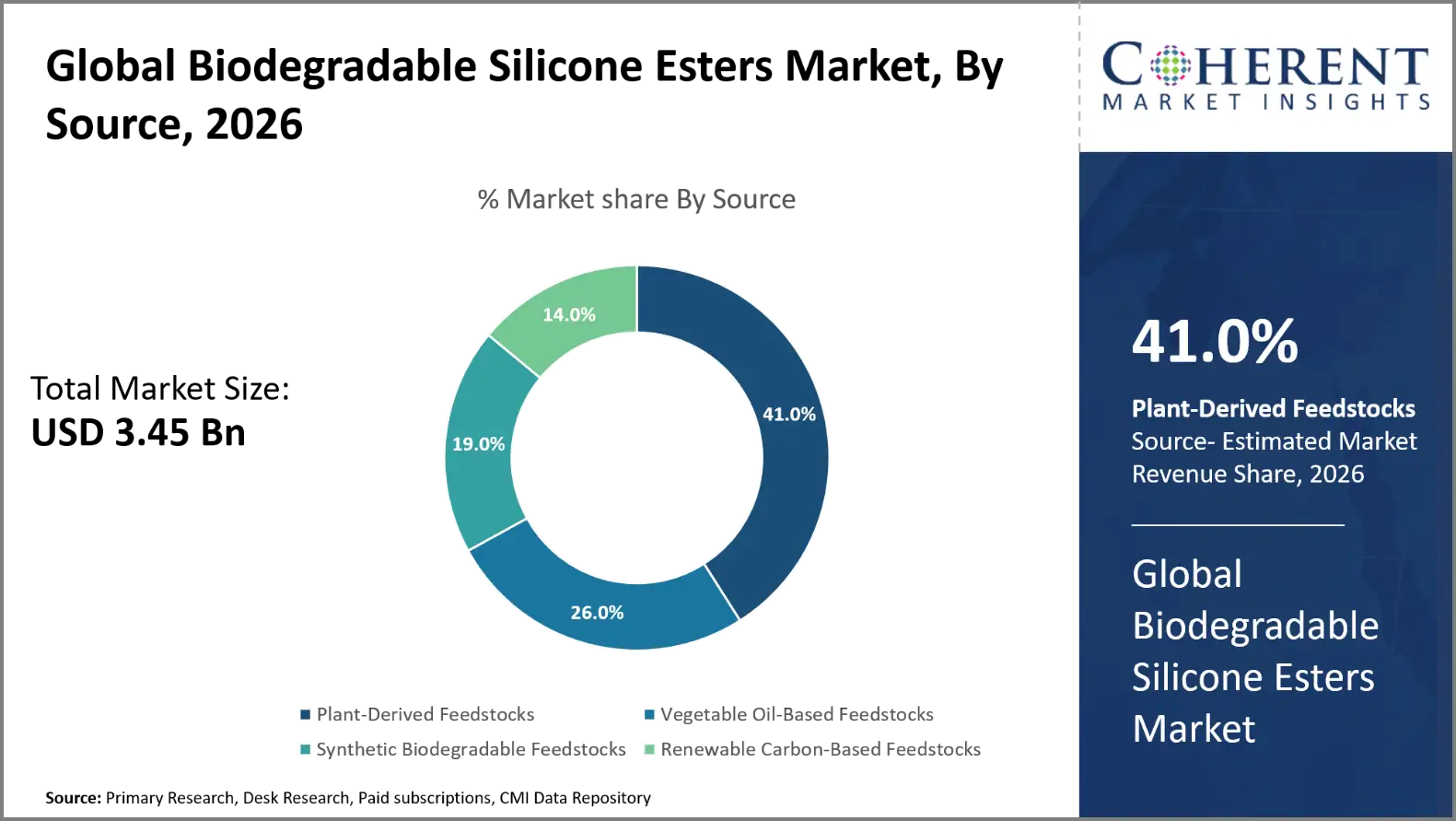
The plant-derived feedstocks segment is expected to account for 41.0% of the global biodegradable silicone esters market share in 2026. An important source is plant-derived feedstocks, which enable the manufacturing of renewable ingredients and help to minimize reliance on petroleum-based raw resources. Ester synthesis can be performed with vegetable oils and fatty acids obtained from the natural sources. Their availability allows for sustainable sourcing techniques and formulation innovation. The growing demand for bio-based cosmetics enhances the commercial significance. On September 5, 2025, Symrise redesigned their PCL-Solid emollient and launched PCL-Solid green. The new version is formulated using 100% natural-origin feedstocks as defined by ISO 16128. It is a vegan ester blend, has a neutral scent and a pleasant skin feel. The ingredient supports face care, body care, lip care, sunscreens, and color cosmetics. This development demonstrates how natural-origin raw materials can replace conventional petrochemical-derived emollients.
Fatty Acid Esters Dominates the Global Biodegradable Silicone Esters Market
The fatty acid esters segment is expected to account for 38.0% of the global biodegradable silicone esters market share in 2026. Fatty acid esters are most common because they have good emollience, spreading, lubricating, and sensory qualities. Their diversity in terms of chemical properties makes them applicable in skin care, hair care and decorative cosmetics. Fatty acids are combined by manufacturers to obtain desired formulation qualities. Compatible with renewable feedstocks, they further reinforce their position in the development of biodegradable silicone alternatives. On April 8, 2025, IOI Oleochemical introduced Softisan 650 at in-cosmetics Global 2025. The vegan film-forming ingredient helps retain moisture, resist water and provide barrier protection. The formulation technology is based on IOI Oleo’s expertise in natural fatty acid esters. The chemical provides light, non-sticky sensory characteristics in skin care, sun care and ornamental cosmetics.
Current Events and their Impact
Current Events | Description and its Impact |
European Union - Commission Regulation (EU) 2024/1328 |
|
European Union - Regulation (EC) No 1223/2009 on Cosmetic Products |
|
Biodegradable Silicone Esters Market Dynamics
Market Drivers
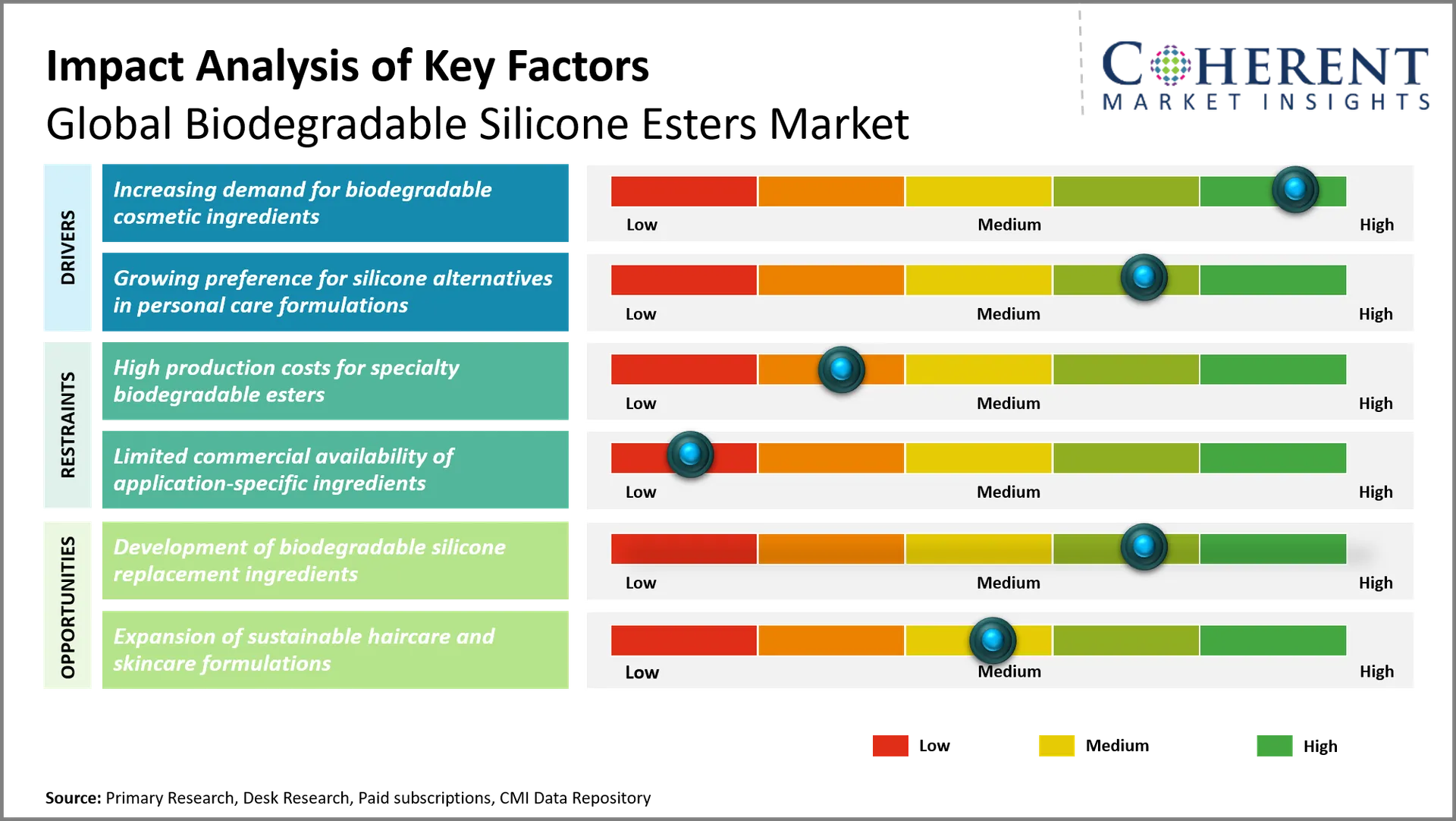
- Increasing demand for biodegradable cosmetic ingredients: Rising demand for biodegradable cosmetic ingredients is pushing the adoption of sustainable ester-based formulations across the global personal care industry. More and more consumers are choosing cosmetics whose contents are environmentally responsible and less persistent in the environment. Rising awareness of water contamination and chemical accumulation is prompting manufacturers to rethink conventional ingredient choices. This shift is further supported by regulatory changes, such as the European Union's limits on some cyclic siloxanes. Cosmetic makers are putting money into biodegradable emollients, conditioning agents and multifunctional ester compounds. These are formulated using feedstocks such as fatty acids from plants and renewable vegetable oils. Specialty chemical firms are working to develop ester technologies that give optimal sensory qualities and formulation stability. Sustainability goals are helped by biodegradable ingredients in premium skin care, hair care and sun care products.
- On May 16, 2025, Lubrizol announced a partnership with Suzano to develop Carbopol BioSense polymer, the first rapidly biodegradable component in the Carbopol range. It is a sustainable choice that is as effective as it is considerate of the needs of beauty product users, making it an eco-friendly option.
- Growing preference for silicone alternatives in personal care formulations: The growing installation of coal, biomass and waste to energy plants is significantly increasing demand for biodegradable silicone esters as these facilities generate large volumes of fly ash and particulate emissions that need to be effectively controlled before flue gasses are discharged into the atmosphere. Biodegradable Silicone Esters provide reliable operation in high temperature and high gas flow conditions and are the preferred emission control technology for utility scale boilers and modern waste to energy facilities seeking to meet environmental compliance while maintaining operational efficiency.
- On May 5, 2026, Pilot Chemical presented two sustainable emollient technologies, UpSyCal BA17 and UpSyCal BA14, at New York Society of Cosmetic Chemists Suppliers’ Day. The two substances are designed to replace silicones, mineral oils and conventional esters in personal care compositions. BA17 is made from renewable castor oil and recycled carbon from non-edible material.
Emerging Trends
- Development of Plant-Derived Silicone Alternative Esters: Manufacturers are creating bio-degradable ester constituents from renewable fatty acids and vegetable oils. These chemicals duplicate silicone-like spreading, lubricating, and emolliency qualities throughout personal care formulations.
- Impact: This discovery decreases reliance on traditional silicone compounds and promotes the use of renewable raw materials. It also stimulates innovation in sustainable cosmetic formulas.
- Relevance to the market: The Emogreen collection from Seppic highlights the increasing business interest in plant-based silicone replacements. These products offer potential for suppliers of biodegradable esters to target high-end skin care and hair care manufacturers.
- Rapid Transition Toward Methane-Fueled Rocket Engines: Cosmetic makers are using more biodegradable emollients in moisturizers, conditioners, sunscreens and ornamental cosmetics. In addition to environmental compatibility, sensory performance is gaining more importance in formulation innovation.
- Impact: Increased demand for versatile ester compounds with broader applications. Manufacturers may achieve sustainable formulations without compromising on texture, spreadability and enjoyment of the product for the consumer.
- Relevance to the market: The Cosmelin product line launched by LANXESS is focusing on skin care, hair care, sun protection and decorative cosmetics. This indicates the growing commercial applications of biodegradable ester technology.
Regional Insights

Why is Asia Pacific a Strong Market for Biodegradable Silicone Esters?
Asia Pacific is expected to account for a market share of 44.0% in 2026. Asia Pacific is gaining importance through expanding cosmetic ingredient manufacturing and the availability of plant-based raw materials. China, India, Japan and South Korea are bolstering their specialist cosmetic ingredients regional capacities. India is working on alternatives using biotechnology, with research on biosurfactants financed by the Department of Science & Technology. In April 2026, China’s National Medical Products Administration (NMPA) released five cosmetic ingredient standards. These criteria are for cosmetic ingredients that come from plants and are produced from biotechnology. They are to be put into effect in May 2027. Regional suppliers can leverage these developments to improve ingredient qualification and formulation innovation.
Why Does North America Biodegradable Silicone Esters Market Exhibit High Growth?
North America is expected to register the fastest growth with a CAGR of 7.6% over the forecast period. It is projected to account for 28.0% of the global biodegradable silicone esters market in 2026. The region benefits from specialty chemical innovation focused on biodegradable ingredients for sulfate-free cleansing and sustainable personal care formulations. Eastman launched Kalidex in April 2026 as a biodegradable foam enhancer and thickening Testing showed average gains in foam height of 30-45% in applicable formulas. In April 2026 Kensing launched Regenyl and Revolis biosurfactants, highlighting recycled feedstocks and palm-free production. These discoveries suggest a regional investment in biodegradable ingredient technology beyond the traditional silicone substitute. Such innovation creates opportunities for multifunctional ester suppliers targeting formulation performance and environmental compatibility.
Global Biodegradable Silicone Esters Market Outlook for Key Countries
Why is China Emerging as a Major Hub in the Biodegradable Silicone Esters Market?
China presents prospects through its large cosmetics manufacturing ecosystem and its growing ingredient registration process. National Medical Products Administration Announcement No. 34, 2026 on the Release of Five Recommended Standards for the Cosmetics Industry These include technical standards for cosmetic components produced from plants and biotechnology. Implementation is scheduled to commence May 1, 2027. A significant commercial example is Emogreen C69 from Seppic, a blend of plant-derived C15-19 alkane and coco-caprylate/caprate. The chemical is a biodegradable alternative to dimethicone and is China compliant. These innovations assist with ingredient localization, regulatory paperwork and sustainable formulation development.
Is U.S. the Next Growth Engine for the Biodegradable Silicone Esters Market?
The U.S. offers prospects in specialty ingredient research, clean beauty innovation and a growing need for distinct cosmetic feedstocks. In February 2026, Savor debuted its Personal Care and Beauty branch with the introduction of carbon-derived lipid compounds. The corporate release said that the emissions reductions were more than 90% compared with tropical oils. This is an indication that there is investment in alternate feedstock technologies away from conventional agriculture. The Modernization of Cosmetics Regulation Act of 2022 further increases the substantiation of cosmetic safety and control of products. Such advances promote supplier ingredient safety, traceability and environmental performance.
Germany Biodegradable Silicone Esters Market Analysis and Trends
The established specialty chemicals industry in Germany and strong technical expertise in the development of cosmetic esters are an advantage. In October 2026, LANXESS launched its Cosmelin line of biodegradable esters in Cologne. The portfolio includes skincare, haircare, suncare and decorative cosmetics. Its esters fulfilll the criteria for OECD 301 ready biodegradability. BASF also published research in 2025 on the issues of replacing silicone in personal care products. These advances show that German companies are engaged in the creation of biodegradable chemicals with improved sensory performance. Restrictions on cyclic siloxanes in Europe are spurring local formulations innovation.
Japan Biodegradable Silicone Esters Market Analysis and Trends
Japan offers chances for sophisticated research on cosmetic ingredients, precise formulation technology and established fatty acid ester manufacturing. Shiseido created AI-based technologies in February 2026 to evaluate the biodegradability of cosmetic ingredients and to find safety information. The invention allows for quicker ingredient evaluation and sustainability-focused research. DKS also produces sucrose fatty acid ester compounds for cosmetics purposes, through its COSMELIKE product range. In its 2025 sustainability report, the company promotes organically derived emulsifiers and tunable hydrophilic-lipophilic equilibrium qualities. These findings will further enhance Japan’s expertise in the evaluation of biodegradable ingredients and specialized ester formulation.
France Biodegradable Silicone Esters Market Analysis and Trends
France benefits from a well-established natural cosmetics ingredient business and from the specialized manufacture of renewable emollients. SOPHIM runs manufacturing plants in Peyruis, France and Almeria, Spain. The company makes sustainable vegetable-derived squalane, natural emollients and silicone alternatives. It is operated on the basis of sustainable raw resources and circular economy ideas established in 1996. Seppic also markets Emogreen C69, a plant-based emollient comprised of coco-caprylate/caprate. It is a biodegradable substitute for dimethicone for skin care, hair care and sun protection. These competencies improve the positioning of French suppliers in the creation of sustainable cosmetic formulations.
Global Biodegradable Silicone Esters Market - Regulatory and Sustainability Indicator
Indicator | Regulation / Standard | Requirement Guideline | Timeline |
Ready biodegradability | OECD Test Guideline 301 | 60% ThOD or ThCO₂ or 70% DOC removal | 28-day test with applicable 10-day window |
Natural-origin content | ISO 16128-1 and ISO 16128-2 | Natural-origin index calculated using ingredient composition | International voluntary standard |
Cyclic silicone restrictions | Commission Regulation (EU) 2024/1328 | 0.1% weight concentration threshold for D4 D5 and D6 under specified restrictions | General restriction applies after June 6 2026 with separate cosmetic transition dates |
D4, D5 and D6 in leave-on cosmetics | Commission Regulation (EU) 2024/1328 | 0.1% by weight | June 6 2027 |
D4 and D5 in wash-off cosmetics | REACH Regulation Annex XVII Entry 70 | 0.1% by weight | Applicable since February 2020 |
How is Development of Biodegradable Silicone Replacement Ingredients Creating New Growth Opportunities in the Biodegradable Silicone Esters Market?
The potential opportunities lie in the development of biodegradable silicone replacement components that allow cosmetic producers to replace selected conventional silicones without affecting formulation performance. In October 2026 LANXESS launched their Cosmelin portfolio, which is aimed toward skin care, hair care, sun protection and ornamental cosmetics. Its ingredients are OECD 301 ready biodegradable and provide manufacturers with established environmental performance. Emogreen C69 from Seppic is a blend of plant-derived alkane and coco-caprylate/caprate that can substitute dimethicone in cosmetic compositions. These advancements offer commercial prospects for specialty ester manufacturers offering multifunctional emollients, spreading agents and conditioning ingredients.
European limits on D4, D5 and D6 further speed this substitution possibility. Thus, vendors producing application-specific biodegradable esters can capture possibilities with premium cosmetic brands seeking compliance, high-performance silicone replacements.
Market Players, Key Development, and Competitive Intelligence
Key Developments
- On July 16, 2026, BASF inaugurated a new factory in Düsseldorf, Germany, to create specialist emollients, primarily for skin care and sun protection goods. BASF is deliberately expanding its capacity for these specialist goods to satisfy growing market demand with this investment in the mid double-digit million-euro range.
- On September 25, 2025, Corum introduced Ecokane 14 MB, a plant-based emollient ester that provides a light, silky-smooth feel with great spreadability. It provides a delicate, non-oily finish and delightful after-feel, from silky to soft-powdery.
- On September 3, 2024, Evonik officially inaugurated its new production plant for cosmetic emollients at its site in Steinau, Germany. These esters are manufactured using an enzymatic process. The plant will significantly increase Evonik’s production capacity which will cater to the growing customer demand for sustainable cosmetic emollients.
Competitive Landscape
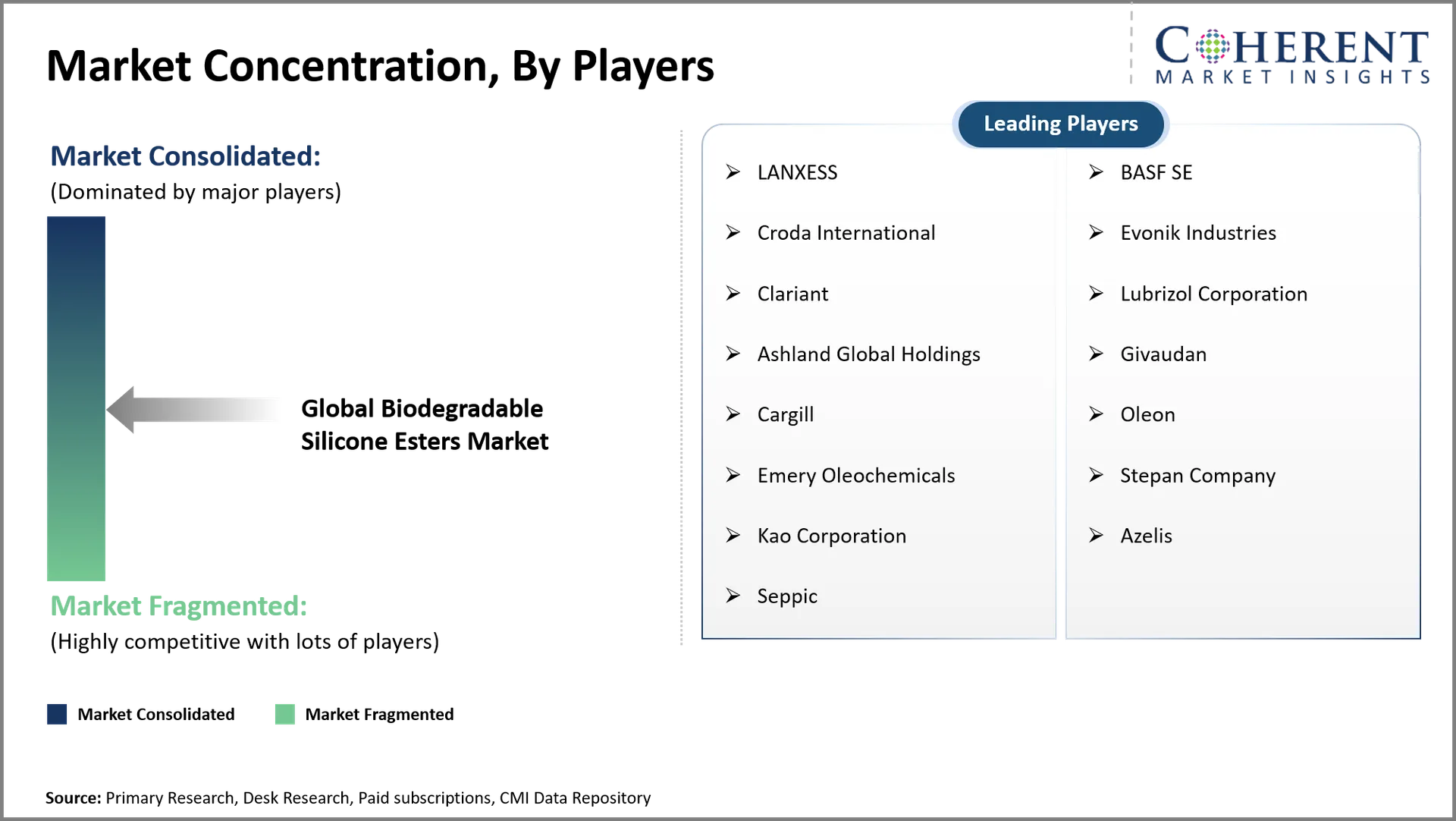
The global biodegradable silicone esters market features specialty chemical manufacturers developing sustainable ester technologies and silicone replacement ingredients. LANXESS strengthened its competitive position by introducing Cosmelin in October 2026. It offers monoesters, diesters, polyol esters and trimellitates for many cosmetic uses. The company specializes in sensory performance, formulation stability and OECD 301 biodegradability compliance. Seppic’s Emogreen portfolio, and specifically Emogreen C69, a plant-based alternative to dimethicone, is a differentiator. Inolex is targeting plant-based silicone substitutes with its LexFeel portfolio. LexFeel WOW DT is a replacement for cyclomethicone, and LexFeel Shine is a replacement for phenyl trimethicone. The companies are concentrating on renewable feedstocks, application-specific performance and proven environmental compatibility.
Top Manufacturers and Notable Products in the Biodegradable Silicone Esters Market
Manufacturer | Notable Product | INCI Name / Ingredient Type | Key features |
LANXESS | Cosmelin 5131 | Isononyl Isononanoate | Readily biodegradable, ultra-light dry-touch feel, excellent spreading, pigment wetting, silicone replacement |
Seppic | Emogreen C69 | C15-19 Alkane and Coco-Caprylate/Caprate | 100% vegetable-origin, readily biodegradable, dimethicone alternative, powdery after-feel, anti-frizz |
Inolex | LexFeel WOW DT | Plant-based silicone alternative blend | 100% plant-based, biodegradable, cyclomethicone replacement, soft powdery after-feel, pigment dispersion |
Croda International | Crodamol GTS | Specialty emollient ester | Readily biodegradable, silicone-like sensory performance, smoothness, shine, hair conditioning |
AAK | Lipex SheaLuxe TR | Shea-derived emollient ester | Plant-derived, lightweight spreading, silky skin feel, non-greasy finish, hair conditioning |
Market Report Scope
Global Biodegradable Silicone Esters Market Report Coverage | |||
Report Coverage | Details | ||
Base Year | 2025 | Market Size in 2026: | USD 3.45 Bn |
Historical Data For: | 2020 To 2024 | Forecast Period: | 2026 To 2033 |
Forecast Period 2026 To 2033 CAGR: | 7.50% | 2033 Value Projection: | USD 8.20 Bn |
Geographies covered: |
| ||
Segments covered: |
| ||
Companies covered: | LANXESS, BASF SE, Croda International, Evonik Industries, Clariant, Lubrizol Corporation, Ashland Global Holdings, Givaudan, Cargill, Oleon, Emery Oleochemicals, Stepan Company, Kao Corporation, Azelis, Seppic | ||
Growth Drivers: |
| ||
Restraints & Challenges: |
| ||
Analyst Opinion (Expert Opinion)
- The future of the biodegradable silicone esters market will depend on replacing specific silicone functionalities rather than simply introducing biodegradable ingredients. Manufacturers will increasingly develop esters matching silicone characteristics across spreading, conditioning, gloss, and film formation. LANXESS's Cosmelin portfolio demonstrates this direction through specialized ester chemistries for different cosmetic textures. Suppliers who can provide a combination of biodegradability and oxidation resistance, formulation stability and sensory consistency are likely to be of increased economic interest. Demand will especially favor chemicals that deliver measurable performance increases and environmental benefits.
- The maximum opportunity will emerge in biodegradable monoesters, diesters, and multifunctional specialty esters for premium personal care formulations. Sun care offers particularly attractive opportunities because ester ingredients can improve organic ultraviolet filter solubility and formulation spreadability. Hair care also offers chances in lightweight emollients to assist with detangling, gloss and frizz control. Opportunities exist for Germany and France in established specialty chemical firms and cosmetic ingredient developers. China is another desirable destination due to its large cosmetics production ecosystem and improving ingredient standards. Suppliers should focus on application-specific products, rather than compete only on renewable sourcing claims.
- Market players should focus on unique cyclomethicone, dimethicone and phenyl trimethicone patented ester combinations. They should have formulation agreements with sunscreen, hair conditioner, foundation and premium skincare brands. Companies have to increase biodegradation paperwork, traceability of raw materials and cosmetic safety dossiers. Regional technical support in China, Germany, France and the U.S. could accelerate customer qualification.” Suppliers should also show compatibility with ultraviolet filters, pigments, perfumes and many emulsifier systems. More and more differentiation will come from proven performance, reliable ingredient quality and application-specific formulation expertise.
Speak to the analyst
Want personalized insights?
Take the findings above to one of our principal consultants, or have the report rebuilt around the segments, geographies and competitors you actually track.
Market Segmentation
- Ingredient Type Insights (Revenue, USD Billion, 2021 - 2033)
- Biodegradable Silicone Alternative Esters
- Biodegradable Emollient Esters
- Biodegradable Conditioning Esters
- Biodegradable Spreading Esters
- Biodegradable Film-Forming Esters
- Specialty Functional Esters
- Source Insights (Revenue, USD Billion, 2021 - 2033)
- Plant-Derived Feedstocks
- Vegetable Oil-Based Feedstocks
- Synthetic Biodegradable Feedstocks
- Renewable Carbon-Based Feedstocks
- Chemical Composition Insights (Revenue, USD Billion, 2021 - 2033)
- Fatty Acid Esters
- Polyol Esters
- Alkyl Esters
- Ester-Based Silicone Alternatives
- Specialty Complex Esters
- Application Insights (Revenue, USD Billion, 2021 - 2033)
- Skin Care
- Hair Care
- Color Cosmetics
- Personal Care
- Bath and Body Care
- Deodorants and Antiperspirants
- Distribution Channel Insights (Revenue, USD Billion, 2021 - 2033)
- Direct Sales
- Specialty Chemical Distributors
- Online Platforms
- Regional Insights (Revenue, USD Billion, 2021 - 2033)
- North America
- U.S.
- Canada
- Latin America
- Brazil
- Argentina
- Mexico
- Rest of Latin America
- Europe
- Germany
- U.K.
- Spain
- France
- Italy
- Russia
- Rest of Europe
- Asia Pacific
- China
- India
- Japan
- Australia
- South Korea
- ASEAN
- Rest of Asia Pacific
- Middle East
- GCC Countries
- Israel
- Rest of Middle East
- Africa
- South Africa
- North Africa
- Central Africa
- North America
- Key Players Insights
- LANXESS
- BASF SE
- Croda International
- Evonik Industries
- Clariant
- Lubrizol Corporation
- Ashland Global Holdings
- Givaudan
- Cargill
- Oleon
- Emery Oleochemicals
- Stepan Company
- Kao Corporation
- Azelis
- Seppic
Sources
Primary Research Interviews
- Biodegradable Silicone Ester Manufacturers & Formulators
- Specialty Chemicals Distributors & Suppliers
- End-Use Industry Representatives (Personal Care, Pharmaceuticals & Agrochemicals)
- Environmental & Green Chemistry Regulatory Consultants
Magazines
- Specialty Chemicals Magazine
- Personal Care Magazine (PCM)
- Green Chemistry & Engineering Magazine
- HAPPI (Household and Personal Products Industry) Magazine
Journals
- Journal of Applied Polymer Science
- Green Chemistry Journal (Royal Society of Chemistry)
- Journal of Cleaner Production
Associations
- American Chemical Society (ACS)
- European Chemical Industry Council (CEFIC)
- Personal Care Products Council (PCPC)
- Society of Chemical Industry (SCI)
Public Domain Sources
- U.S. Environmental Protection Agency (EPA) - Green Chemistry Program
- European Chemicals Agency (ECHA)
- United Nations Environment Program (UNEP) - Chemicals & Biodegradability Reports
- National Institute of Standards and Technology (NIST) - Chemical Database
Proprietary Elements
- CMI Data Analytics Tool
- Proprietary CMI Existing Repository of Information for Last 10 Years
Get access to 250+ pages report
Every segment, forecast, competitor profile and data table behind the analysis above — available for instant download.
- ESOMAR Member
- ISO 9001:2015 Certified
- D-U-N-S Registered
- GDPR & CCPA Compliant
Frequently Asked Questions
The global biodegradable silicone esters market is expected to stand at USD 3.45 Bn in 2026 and is expected to reach USD 8.20 Bn by 2033.
The CAGR of the global biodegradable silicone esters market is projected to be 7.5% from 2026 to 2033.
Increasing demand for biodegradable cosmetic ingredients and Growing preference for silicone alternatives in personal care formulations are the major factors driving the growth of the global biodegradable silicone esters market.
High production costs for specialty biodegradable esters and Limited commercial availability of application-specific ingredients are the major factors hampering the growth of the global biodegradable silicone esters market.
In terms of ingredient type, biodegradable silicone alternative esters segment is estimated to dominate the market revenue share in 2026.
Biodegradable silicone esters are ester-based ingredients developed to replace selected conventional silicone functionalities in cosmetic formulations.
Biodegradable silicone alternative esters offer silicone-like functionality with different chemical structures and improved biodegradation characteristics.