

Global Biofactory Automation Market Size and Forecast – 2026 To 2033
The global biofactory automation market is expected to grow from USD 6.72 Bn in 2026 to USD 15.85 Bn by 2033, registering a compound annual growth rate (CAGR) of 13% from 2026 to 2033. The market for global biofactory automation is poised for significant expansion, fueled by the government investment in AI- and robotics-enabled biomanufacturing, which can improve production efficiency and reduce manufacturing costs.
In March 2025, the Government of Canada announced support for OmniaBio’s expanded cell and gene therapy manufacturing facility in Hamilton, Ontario, targeting a fivefold increase in manufacturing efficiency and a reduction in production and supply costs of up to 50%. The project focuses on AI- and robotics-enabled manufacturing, while the government reported that it had invested more than USD 1.62 billion (CAD 2.3 billion) since March 2020 to strengthen Canada’s vaccine, therapeutics, and biomanufacturing capacity, reinforcing policy support for advanced manufacturing automation.
Key Takeaways of the Global Biofactory Automation Market
- Hardware is projected to hold 43.6% of the global biofactory automation market share in 2026, making it dominant component segment, with North America maintaining a strong position due to its established biopharmaceutical manufacturing infrastructure and investment in advanced production technologies. For instance, the U.S. FDA’s Framework for Regulatory Advanced Manufacturing Evaluation (FRAME) initiative supports the development and evaluation of advanced pharmaceutical manufacturing approaches, encouraging innovation in production equipment and process-control technologies.
- Process automation is projected to hold 38.5% of the global biofactory automation market share in 2026, making it dominant automation type segment, with Europe representing a significant region due to its established biologics manufacturing base and stringent sterile-production requirements. For instance, the European Commission’s EU GMP Annex 1 explicitly recommends considering robotic systems and continuous monitoring technologies to strengthen contamination control in sterile manufacturing, supporting the relevance of automated process-control solutions.
- Downstream processing is projected to hold 35.5% of the global biofactory automation market share in 2026, making it dominant application segment, with Asia Pacific offering growth opportunities through expanding advanced-therapy manufacturing and increasingly stringent quality requirements. For instance, Singapore’s Health Sciences Authority (HSA) requires local facilities manufacturing cell, tissue, and gene therapy products that are more than minimally manipulated to obtain a manufacturer’s licence and comply with applicable GMP standards. These requirements reinforce the need for validated equipment, controlled processing, and reliable quality systems across complex biological manufacturing workflows.
- North America market maintains dominance with an expected share of 41.8% in 2026, bolstered by its established biopharmaceutical manufacturing ecosystem, advanced research infrastructure, and regulatory focus on modernizing production technologies. For instance, in October 2024. the U.S. FDA launched its BioFoundry project to develop a scalable, modular, automated, and closed medical-product manufacturing platform incorporating inline sensors and data-driven process monitoring. This government-backed initiative highlights the region’s focus on advancing automated manufacturing for cell therapies, recombinant proteins, monoclonal antibodies, and gene therapies.
- Asia Pacific is expected to exhibit the fastest growth in the global biofactory automation market, registering an estimated CAGR of 15.0% during 2026–2033, driven by expanding biomanufacturing capacity and government-backed biotechnology initiatives. For instance, India’s Department of Biotechnology is implementing the BioE3 Policy, which promotes biofoundries and biomanufacturing hubs to support pilot- and pre-commercial-scale production of biopharmaceuticals and other bio-based products. This initiative is expected to create opportunities for automated bioprocessing equipment, integrated process-control systems, and digital manufacturing technologies
Segmental Insights
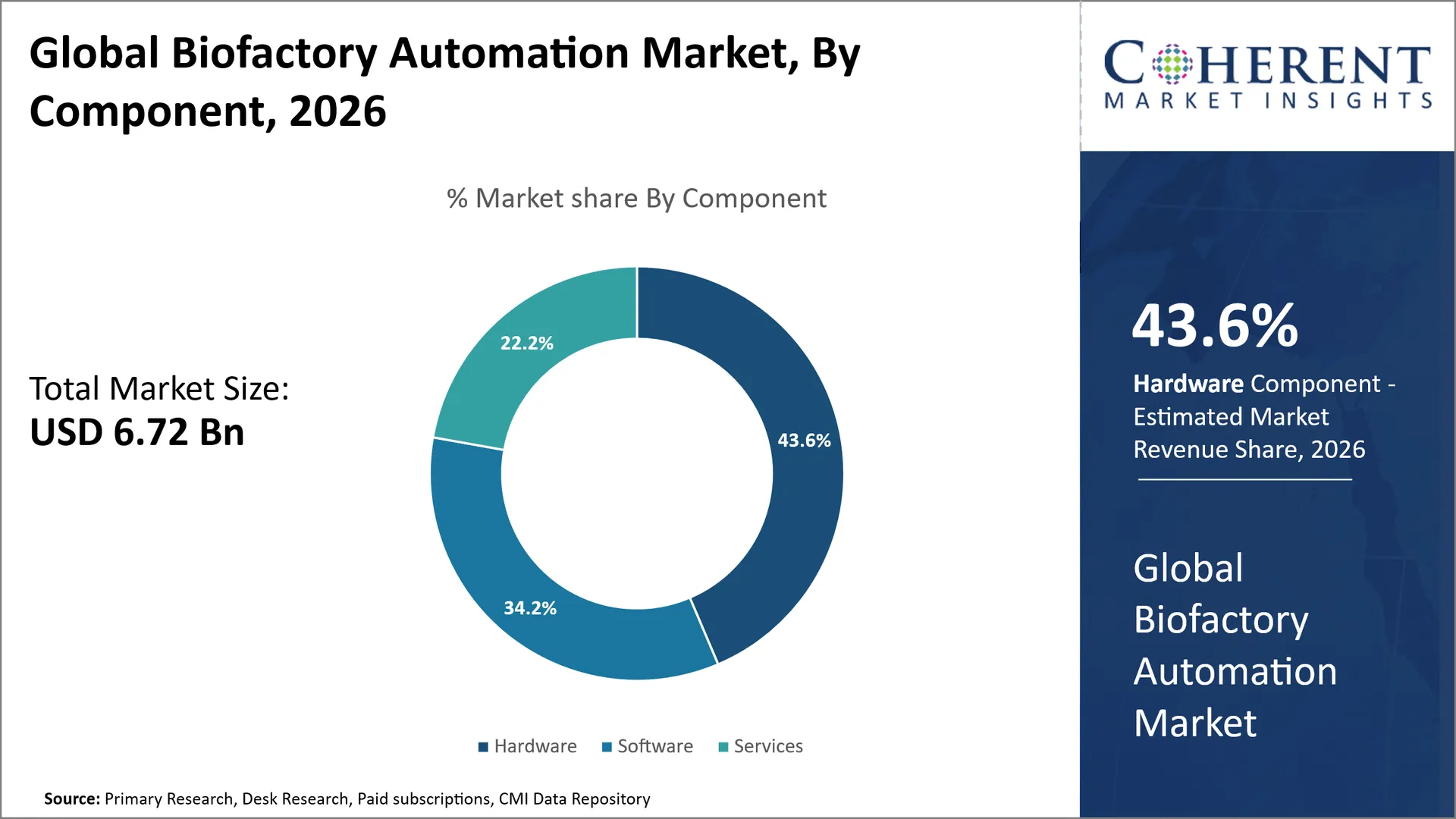
Why Do Hardware Dominate the Global Biofactory Automation Market?
Hardware is projected to hold the market share of 43.6% in 2026, owing to the presence of the physical foundation required for accurate and reproducible biomanufacturing that involves the use of bioreactors, sensors, pumps, valves, and control devices. In addition, scalable production capacity, validated machines, quality control equipment, and the need for the in-process critical parameter monitoring are expected to drive the demand for hardware. For instance, in September 2025, the Department of Biotechnology, India launched 21 Bio Enabler facilities, under the High-Performance Biomanufacturing program. The bio enabler facilities provide shared infrastructure for testing of technology, scale-up and commercialization. This government-backed program is expected to support the demand for bioreactors, process instrumentation and other hardware used in pilot- and pre-commercial scale biomanufacturing. (Source: Press Information Bureau)
- Current Industry Events of 2026
- Market Size Estimation
- Regional Breakdown
- Competitive Landscape
- Customer Intelligence
- Segmental Analysis
- Pricing Analysis
- Key Market Drivers, Challenges & Future Trends
- Customized Insights Section
Why Do Process Automation Represent the Largest Automation Type Segment in the Biofactory Automation Market?
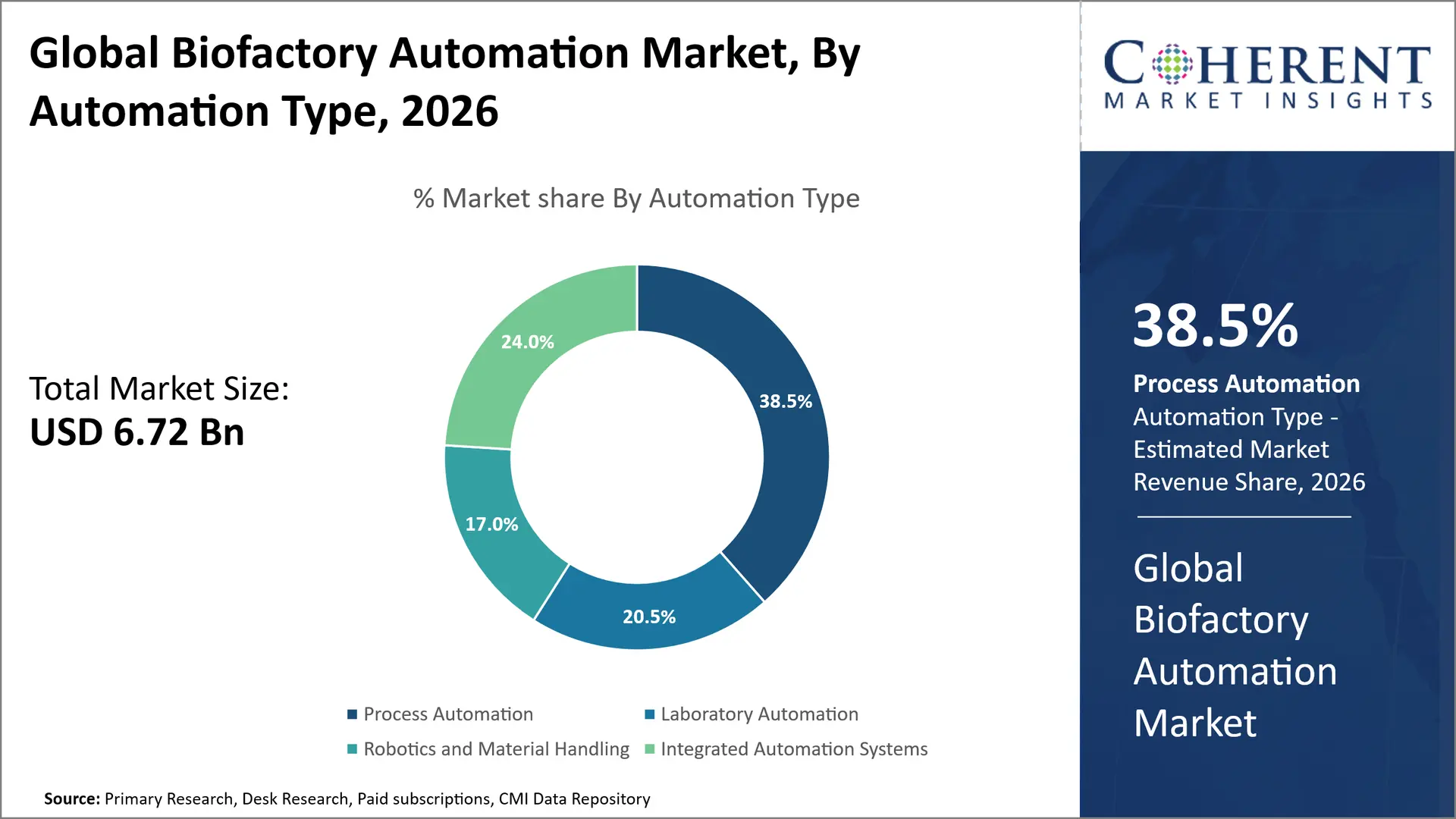
Process automation is projected to hold a market share of 38.5% in 2026, because it provides the ability to control and monitor key parameters of bioprocess operations. The use of process automation improves batch consistency and reduce manual intervention in upstream and downstream process steps, while its integration with real-time control supports reproducible production, process optimization, and efficient scale-up. For instance, the International Council for Harmonisation (ICH) Q13 guideline on Continuous Manufacturing has been adopted by the FDA and EMA and includes guidance on process control, equipment integration and monitoring of continuous manufacturing processes, including protein therapeutics. This ICH Q13 guideline enables regulators and industry to move forward with the implementation of automated process-control systems.
Downstream Processing Segment Dominates the Global Biofactory Automation Market
The downstream processing segment is projected to hold a market share of 35.5% in 2026, since purification, filtration, and chromatography are critical techniques in removing contaminants and achieving the high-quality standards expected of biopharmaceuticals. Automated downstream units potentially improve the accuracy of separation, reduce manual work and allow regular processing of complex biologics like monoclonal antibodies and therapeutic proteins. For instance, in June 2025, a study on autonomous continuous downstream processing of monoclonal antibodies published by ScienceDirect demonstrated over 98.5% average monomer content and more than 90% overall yield, illustrating the potential of automated purification to improve product consistency and process efficiency.
Current Events and their Impact
Current Events | Description and its Impact |
UK Innovate UK Announces USD 9.9 million (£7.5 Million) Funding for Automated Medicines Manufacturing (April 2026) |
|
India Advances BioE3 Policy Implementation and Biomanufacturing Infrastructure (March 2026) |
|
U.S. FDA Strengthens Support for Advanced Pharmaceutical Manufacturing Technologies (December 2025 update) |
|
Biofactory Automation Market Dynamics
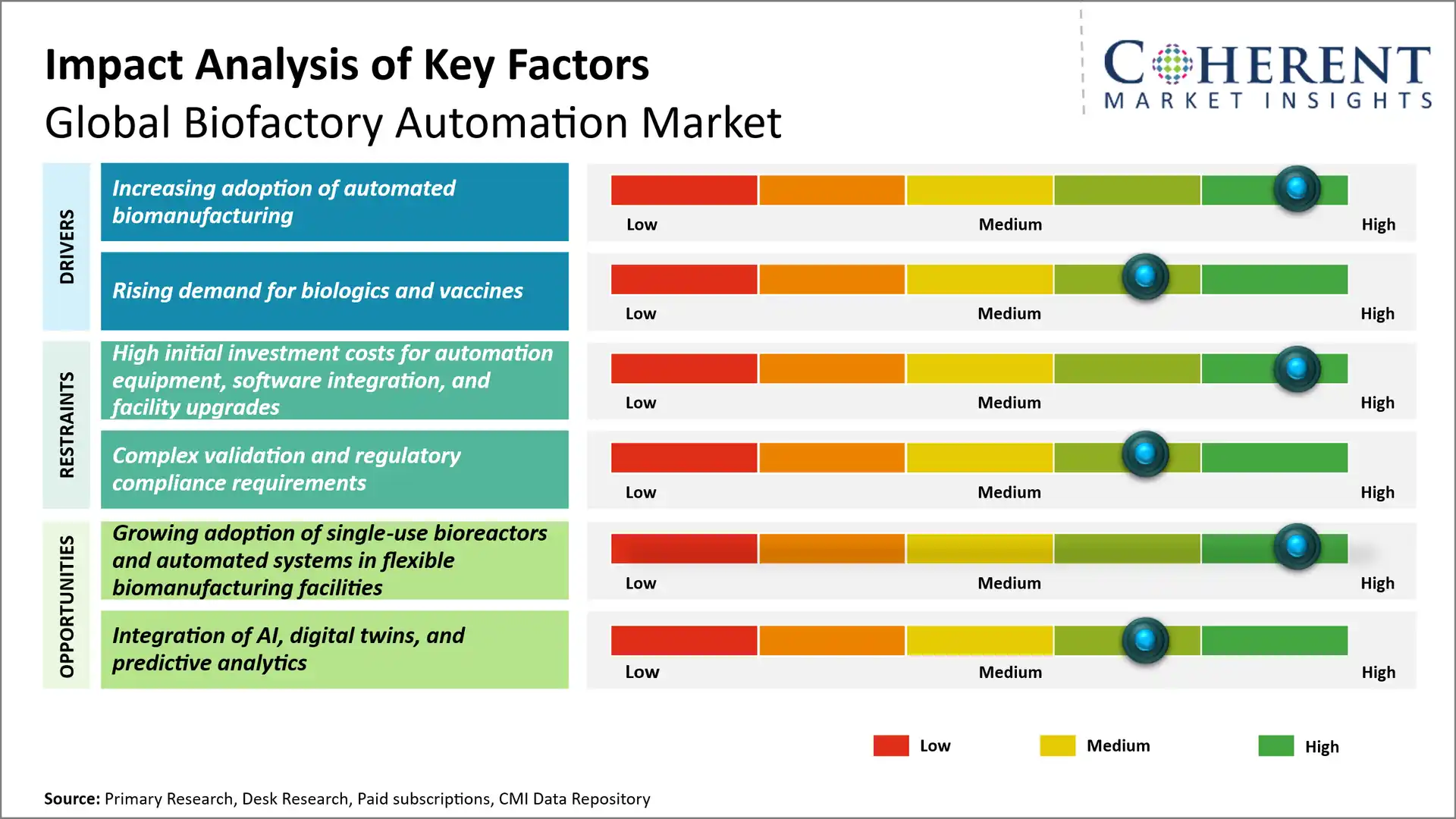
Market Drivers
- Increasing adoption of automated biomanufacturing: The increasing adoption of automated biomanufacturing is driving the global biofactory automation market as manufacturers seek to improve production efficiency, product consistency, and process control. Automated systems enable precise monitoring of critical manufacturing parameters, reduce manual intervention, and support compliance with stringent quality requirements. For instance, in September 2024, Lonza announced the expansion of its microbial manufacturing facility in Visp, Switzerland, incorporating advanced manufacturing capabilities to strengthen production efficiency and quality. This investment highlights the growing emphasis on modernized biomanufacturing infrastructure to support reliable and scalable production.
- Rising demand for biologics and vaccines: The rising demand for biologics and vaccines is driving the global biofactory automation market as manufacturers expand production capacity while maintaining stringent standards for product quality, sterility, and batch consistency. Automated bioreactors, process-control systems, and real-time monitoring technologies help improve manufacturing efficiency and scalability. For instance, in November 2024, Sanofi inaugurated its modular manufacturing facility in Singapore, backed by an investment of approximately USD 625 million (S$800 million), designed to manufacture up to four vaccines or biopharmaceutical products simultaneously. This investment highlights the growing need for flexible, advanced manufacturing infrastructure to meet increasing demand for biologics and vaccines.
- Increasing investment in biopharmaceutical manufacturing infrastructure: Increasing investment in biopharmaceutical manufacturing infrastructure is driving the global biofactory automation market as manufacturers seek to enhance production capacity, process efficiency, and product consistency. The integration of automated equipment and digital process-control systems enables reliable, scalable manufacturing of complex biologics. For instance, in January 2024, Eli Lilly and Company announced a USD 4.5 billion investment in its Lilly Medicine Foundry in Lebanon, Indiana, to expand advanced manufacturing and research capabilities. Such investments create opportunities for automation technologies across biopharmaceutical production.
Emerging Trends
- AI-enabled bioprocess optimization: Biofactory automation is increasingly incorporating artificial intelligence (AI), machine learning, and predictive analytics to optimize critical process parameters, detect anomalies, and improve batch consistency. These technologies enable data-driven decision-making and help reduce production variability and operational downtime.
- Modular and single-use automated manufacturing: The shift toward modular facilities and single-use bioreactors is enabling manufacturers to scale production and switch between products with less cleaning-related downtime. Integrating automated monitoring and process-control systems further supports flexible manufacturing of biologics, vaccines, and advanced therapies.
- Digital twins and real-time process monitoring: Biomanufacturers are increasingly adopting digital twins, connected sensors, and process analytical technology (PAT) to create virtual representations of manufacturing processes and monitor operations in real time. These solutions support process simulation, early identification of deviations, and improved control over product quality and manufacturing efficiency.
Regional Insights
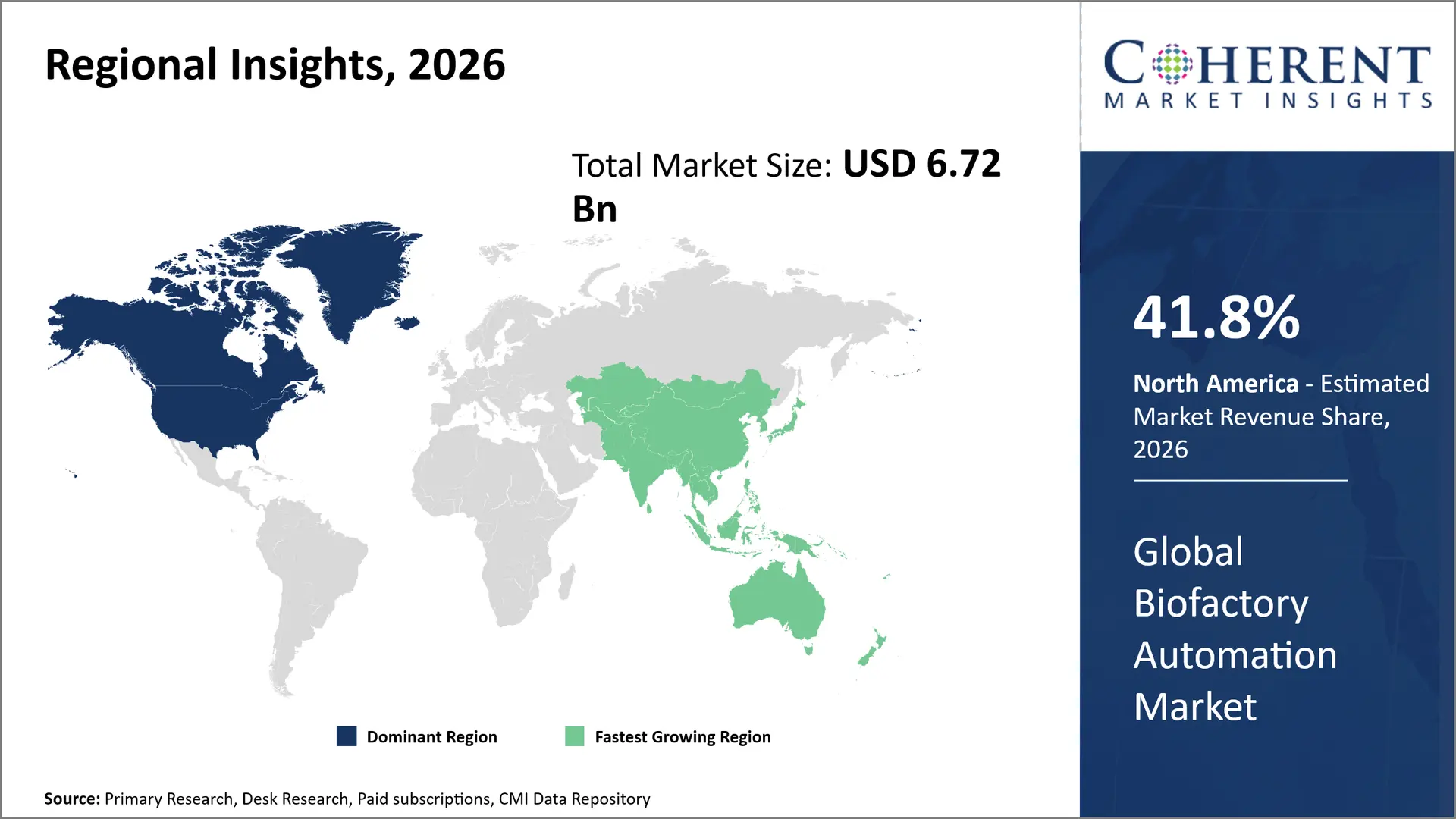
Why is North America a Strong Market for Biofactory Automation?
North America leads the global biofactory automation market, accounting for an estimated 41.8% share in 2026, owing to the extensive presence of biotech and pharmaceutical ecosystem, growing manufacturing base, high presence of robotics, IOT (internet of things), and analytic tools equipped with artificial intelligence. In addition, policies encouraging innovation, like government grants, tax breaks, and incentives and regulatory authorities accelerate biotechnology advancements.
For instance, in August 2026, National Institute for Innovation in Manufacturing Biopharmaceuticals (NIIMBL) announced USD 8 million project initiative to accelerate biopharmaceutical manufacturing technologies such as AI-enabled digitalization, advanced process control and real-time quality monitoring to help stimulate creativity in automated biomanufacturing. Moreover, high research capacity and biopharmaceutical ecosystem partnerships are expected to enhance the technology development, manufacturing efficiency, and regional market growth.
Why Does Asia Pacific Biofactory Automation Market Exhibit High Growth?
Asia Pacific is expected to exhibit the fastest growth in the global biofactory automation market, registering an estimated CAGR of 15.0% during 2026–2033. The region is projected to account for 23.1% of the global market in 2026, owing to the increasing adoption of automation in biopharmaceutical manufacturing, escalating industrialization, and rising global demand for biologics and biosimilars. Countries such as China, India, Japan, and South Korea are expanding their production infrastructure for biotechnological products and actively adopting automation to enhance efficiency, agility, and high-quality standards in biotechnological products.
Additionally, efforts of governments in the region to support the growth of biotechnology clusters, upgrade manufacturing infrastructure, and incentivize public-private partnerships is propelling the market in Asia Pacific. For instance, the Ministry of Commerce of China has enabled the growth of the biopharmaceutical industry in China by establishing industrial clusters and innovation platforms that enable the expansion of manufacturing capacity and technology. These initiatives can encourage the adoption of automated bioprocessing solutions.
Global Biofactory Automation Market Outlook for Key Countries
Why is the U.S. Leading Innovation and Adoption in the Biofactory Automation Market?
The U.S. leads the automation of biofactories with the Advanced Manufacturing Technologies Designation Program launched by the U.S. Food and Drug Administration that accelerates the access of new manufacturing technology in drug manufacturing. The regulatory system incentivizes manufacturers to invest in advanced process-control systems, real-time monitoring and integrated manufacturing systems to improve manufacturing reliability and product quality.
Is Japan a Favorable Market for Biofactory Automation Market?
Japan is a promising market for biofactory automation driven by country’s strong pharmaceutical industry, enhanced biotechnology research infrastructure and increasing adoption of regenerative medicines. The growth of the biofactory automation market in Japan is expected to be facilitated by increasing demand for biologics as well as cell and gene therapies which is driving the adoption of automated manufacturing.
Is China Emerging as a Key Growth Hub for the Biofactory Automation Market?
China is gradually emerging as the newest growth driver for the biofactory automation market acknowledged by its expanding biopharmaceutical manufacturing capacity, rising demand for biologics & vaccines, and rising investments by the government in biotechnology infrastructure. Increasing number of domestic biopharmaceutical firms along with contract development manufacturing organizations (CDMO's) in the country is further expected to fuel the adoption of automation in bioprocessing applications.
Why Does Germany Top the European Biofactory Automation Market?
Germany leads the European biofactory automation market driven by its burgeoning biotech and pharmaceutical industry, high-end industrial automation, and growing biopharmaceutical manufacturing capability. The country is emphasizing digital manufacturing, precision engineering, digital manufacturing, and Industry 4.0 technologies to ensure automation for bioprocessing operations are seamlessly integrated. Further, investments in biologics production and more stringent quality standards will accelerate the requirement for digitally-enabled automated biofactory operation.
Is Biofactory Automation Market Developing in India?
India represents an emerging biofactory automation market, attributable to its growing biopharma manufacturing, rising demand for vaccines and biologics and increased investments in biomanufacturing infrastructure. The adoption of automated bioprocessing and digital monitoring is increasing among the manufacturers to improving productivity, quality and efficiency of operations. Furthermore, support from the government for the advanced biomanufacturing is likely to drive the market.
Single-Use vs. Stainless-Steel Bioreactors: Manufacturing and Automation Implications
Comparison parameter | Single-use bioreactors | Stainless-steel bioreactors |
Initial capital investment | Generally lower equipment and facility infrastructure requirements | Generally higher capital investment |
Cleaning and sterilization | Reduced cleaning and sterilization requirements between batches | Requires validated cleaning and sterilization procedures |
Changeover flexibility | Faster changeovers for multiproduct manufacturing | Changeovers can require more time and preparation |
Automation integration | Compatible with automated monitoring, sensors, and process-control systems | Supports established process-control and automation systems |
Contamination management | Eliminates the need to clean and reuse the vessel, but disposable components still require quality controls | Requires effective cleaning, sterilization, and cross-contamination controls |
Key considerations | Consumable costs, plastic waste, and material compatibility | Cleaning validation, maintenance, and infrastructure costs |
How is the growing adoption of single-use bioreactors and automated systems in flexible biomanufacturing facilities creating new growth opportunities in the biofactory automation market?
The hybridization of single-use bioreactors and automation systems is expected to create new opportunities in the global biofactory automation market by enabling contamination-aware, flexible, and scalable biomanufacturing. These systems offer fast changeovers, high cleaning requirements, and online process monitoring, making them suitable for multiproduct facilities. For instance, Sartorius AG offers Flexact Modular platform that consists of single-use processing equipment and automated control systems, designed to produce numerous products and accelerate manufacturing campaign changes.
Market Players, Key Development, and Competitive Landscape
Key Developments
- In April 2026, Cellcraft announced the launch of Cellcraft IQ, an AI-powered operating system designed to improve bioreactor automation and optimization. The platform combines machine learning, physics-constrained modelling, and adaptive control to enable real-time process adjustments and optimize biomanufacturing performance. It’s hardware-agnostic design aims to integrate with existing bioreactors, addressing process inefficiencies and control limitations in biological manufacturing.
- In December 2025, Tetra Pak Processing Equipment SIA acquired Latvia-based Bioreactors.net, a specialist in bioreactor design and manufacturing. The acquisition strengthens Tetra Pak’s fermentation capabilities and expands its portfolio of bioreactor systems for biomass and precision fermentation, supporting scalable production of food proteins and ingredients. This development highlights growing investment in automated bioprocessing equipment and integrated fermentation systems.
- In July 2025, the Centre for Process Innovation (CPI) joined a Canada–UK collaboration led by Labman Automation to develop the BALANCE platform, integrating AI, bioreactor technologies, real-time biosensing, and automated process control. Supported by a USD 2 million grant from Innovate UK and Canada’s National Research Council IRAP, the initiative aims to improve bioprocess efficiency, increase yields, and enhance the scalability of biopharmaceutical manufacturing.
Competitive Landscape
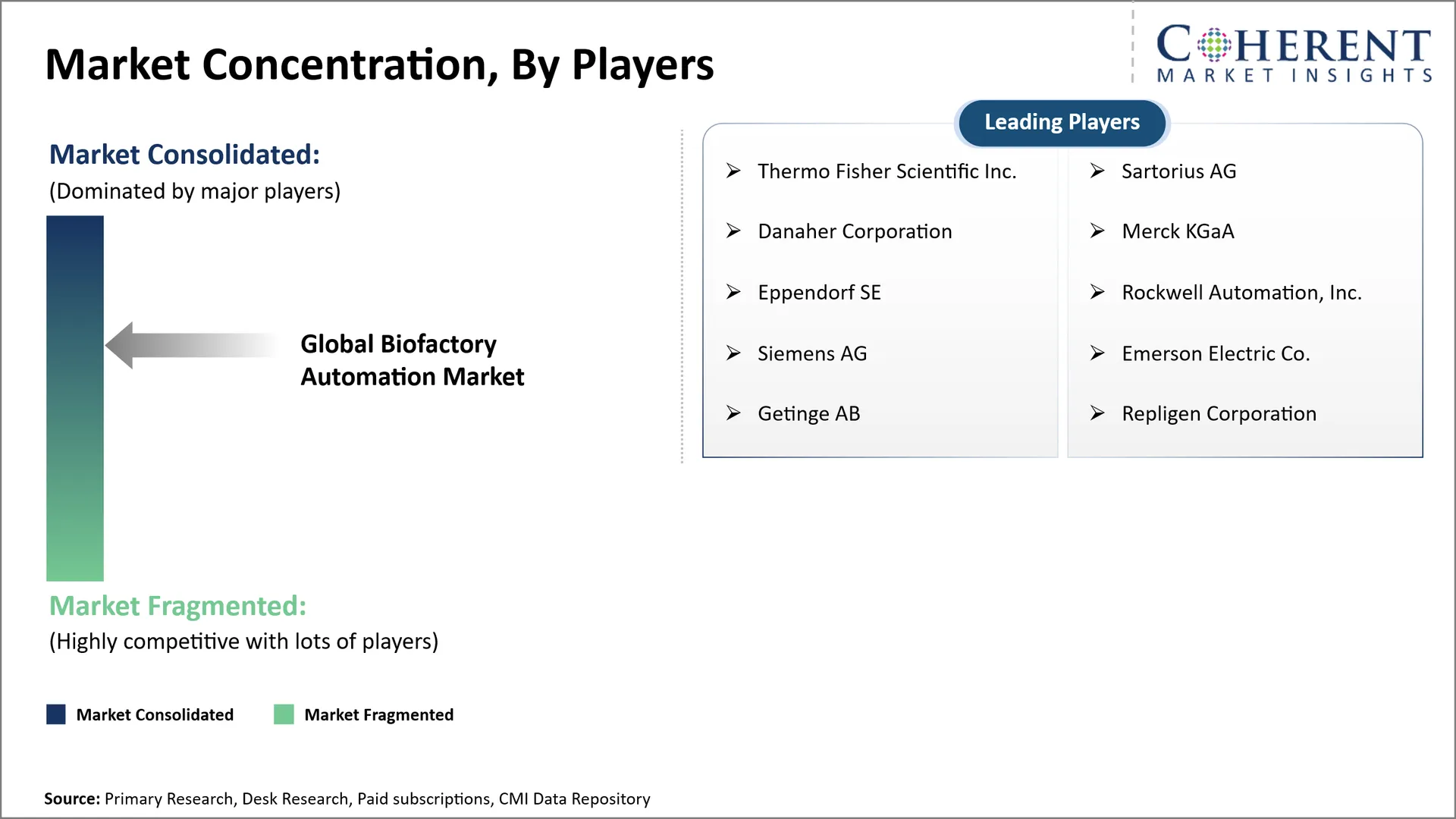
The global biofactory automation market is moderately competitive, with market dynamics shaped by advances in bioprocess automation, intelligent bioreactor systems, robotics, and digital manufacturing technologies. Market participants are increasingly focusing on enhancing process efficiency, improving production scalability, and integrating AI-driven control systems across biopharmaceutical and industrial biotechnology facilities. Key focus areas include:
- Development of AI-enabled bioreactors and intelligent process control systems
- Integration of robotics and automated liquid handling across biomanufacturing workflows
- Expansion of automated upstream and downstream bioprocessing solutions
- Advancement of real-time monitoring, predictive analytics, and digital twin technologies
- Enhancement of modular manufacturing platforms, system interoperability, and regulatory compliance
Market Report Scope
Biofactory Automation Market Report Coverage | |||
Report Coverage | Details | ||
Base Year | 2025 | Market Size in 2026: | USD 6.72 Bn |
Historical Data For: | 2020 To 2024 | Forecast Period: | 2026 To 2033 |
Forecast Period 2026 To 2033 CAGR: | 13% | 2033 Value Projection: | USD 15.85 Bn |
Geographies covered: |
| ||
Segments covered: |
| ||
Companies covered: | Thermo Fisher Scientific Inc., Sartorius AG, Danaher Corporation, Merck KGaA, Eppendorf SE, Rockwell Automation, Inc., Siemens AG, Emerson Electric Co., Getinge AB, Repligen Corporation | ||
Growth Drivers: |
| ||
Restraints & Challenges: |
| ||
Analyst Opinion (Expert Opinion)
- In the coming years, global biofactory automation market will be shaped by the transition from conventional, labor-intensive biological manufacturing toward intelligent, integrated, and increasingly autonomous production environments. The adoption of AI-enabled process control, automated bioreactors, robotics, and real-time monitoring is expected to improve batch consistency, optimize resource utilization, and reduce process variability. Over the long term, flexible and modular automation platforms that support multiple products and production scales are likely to gain traction, particularly as manufacturers seek to accommodate complex biologics, cell and gene therapies, and fermentation-derived products.
- The maximum opportunities are foreseen within AI-enabled process automation for biopharmaceutical manufacturing in the U.S. and China, where advanced manufacturing capabilities and demand for biologics create attractive conditions for investment. Within applications, upstream and downstream processing offer significant potential for automation through intelligent bioreactor control, automated media preparation, continuous monitoring, and automated purification systems. Cell and gene therapy manufacturing also presents a specialized opportunity for flexible, closed-system automation that minimizes manual handling and contamination risks.
- In order to gain a competitive advantage market players should prioritize interoperable automation platforms that integrate equipment, software, sensors, and manufacturing execution systems within a unified environment. Companies should also develop scalable solutions suitable for both established facilities and new manufacturing plants, while offering strong validation support, cybersecurity, and lifecycle services. Strategic partnerships with biopharmaceutical manufacturers and CDMOs, combined with application-specific solutions and demonstrated improvements in yield, batch consistency, and operating costs, will be essential to differentiate offerings and build long-term customer relationships.
Speak to the analyst
Want personalized insights?
Take the findings above to one of our principal consultants, or have the report rebuilt around the segments, geographies and competitors you actually track.
Market Segmentation
- Component Insights (Revenue, USD Bn, 2021 - 2033)
- Hardware
- Software
- Services
- Automation Type Insights (Revenue, USD Bn, 2021 - 2033)
- Process Automation
- Laboratory Automation
- Robotics and Material Handling
- Integrated Automation Systems
- Application Insights (Revenue, USD Bn, 2021 - 2033)
- Upstream Processing
- Downstream Processing
- Fill-Finish and Packaging
- Quality Control and Process Monitoring
- Others
- End User Insights (Revenue, USD Bn, 2021 - 2033)
- Pharmaceutical and Biotechnology Companies
- Contract Development and Manufacturing Organizations (CDMOs)
- Research Institutes and Laboratories
- Industrial Biotechnology Companies
- Others
- Regional Insights (Revenue, USD Bn, 2021 - 2033)
- North America
- U.S.
- Canada
- Latin America
- Brazil
- Argentina
- Mexico
- Rest of Latin America
- Europe
- Germany
- U.K.
- Spain
- France
- Italy
- Russia
- Rest of Europe
- Asia Pacific
- China
- India
- Japan
- Australia
- South Korea
- ASEAN
- Rest of Asia Pacific
- Middle East
- GCC Countries
- Israel
- Rest of Middle East
- Africa
- South Africa
- North Africa
- Central Africa
- North America
- Key Players Insights
- Thermo Fisher Scientific Inc.
- Sartorius AG
- Danaher Corporation
- Merck KGaA
- Eppendorf SE
- Rockwell Automation, Inc.
- Siemens AG
- Emerson Electric Co.
- Getinge AB
- Repligen Corporation
Sources
Primary Research Interviews
- Bioprocess engineers and automation specialists involved in automated bioreactor design, process control, and scale-up.
- Biomanufacturing facility managers and operations directors responsible for production automation and process optimization.
- Automation and control-system engineers specializing in sensors, programmable logic controllers (PLCs), distributed control systems (DCS), and supervisory control and data acquisition (SCADA).
- Biopharmaceutical manufacturing specialists working on monoclonal antibodies, recombinant proteins, vaccines, and other biologics.
- Process development scientists specializing in upstream processing, downstream purification, and continuous bioprocessing.
- Digital biomanufacturing specialists working on artificial intelligence, machine learning, digital twins, and real-time process monitoring.
Stakeholders
- Bioreactor and bioprocess equipment manufacturers.
- Industrial automation, robotics, and process-control technology providers.
- Bioprocess software, manufacturing execution system (MES), and process analytical technology (PAT) developers.
- Single-use bioprocessing equipment and consumables manufacturers.
- Contract development and manufacturing organizations (CDMOs) and contract manufacturing organizations (CMOs).
- Pharmaceutical, biotechnology, and industrial biotechnology companies.
- System integrators, engineering firms, and biomanufacturing facility design providers.
- End-use Sectors
- Pharmaceutical and Biotechnology Companies
- Contract Development and Manufacturing Organizations (CDMOs)
- Industrial Biotechnology Companies
- Research and Academic Institutions
- Vaccine and Biologics Manufacturers
- Food and Precision Fermentation Manufacturers
- Regulatory & Health Bodies
- U.S. Food and Drug Administration (FDA) — biologics manufacturing, process validation, current Good Manufacturing Practice (cGMP), and manufacturing technology.
- European Medicines Agency (EMA) — biological medicinal products, pharmaceutical manufacturing, and quality requirements.
- Medicines and Healthcare products Regulatory Agency (MHRA), UK — medicines manufacturing, GMP compliance, and regulatory oversight.
- Pharmaceuticals and Medical Devices Agency (PMDA), Japan — pharmaceutical quality, biologics, and manufacturing-related regulatory requirements.
- National Medical Products Administration (NMPA), China — drug manufacturing, biologics, and pharmaceutical quality regulation.
- Central Drugs Standard Control Organisation (CDSCO), India — drug manufacturing, biological products, and regulatory requirements in India.
Databases
- ClinicalTrials.gov — clinical studies involving biologics, vaccines, cell therapies, and gene therapies.
- FDA Drugs@FDA — approved drug products and regulatory information.
- FDA Biologics Products and Establishments — biologics-related regulatory and establishment information.
- European Clinical Trials Information System (CTIS) — clinical trial information for medicinal products in the European Union.
- WHO International Clinical Trials Registry Platform (ICTRP) — international clinical trial records.
- NCBI — biomedical research and biotechnology literature.
- U.S. National Institute of Standards and Technology (NIST) — measurement science, standards, automation, and manufacturing technology.
- U.S. Patent and Trademark Office (USPTO) — patent information on bioreactor systems, process automation, and related technologies.
- European Patent Office – Espacenet — international patent records for bioprocessing equipment and automation systems.
Associations
- International Society for Pharmaceutical Engineering (ISPE) — pharmaceutical manufacturing engineering, automation, and process technology.
- International Society for BioProcess Technology (ISBioTech) — bioprocessing technologies, biologics manufacturing, and industry collaboration.
- Bio-Process Systems Alliance (BPSA) — single-use technologies, bioprocessing equipment, and automation integration.
- BioPhorum — biopharmaceutical manufacturing practices, digital transformation, and operational excellence.
- Biotechnology Innovation Organization (BIO) — biotechnology industry development, biopharmaceutical innovation, and policy.
- International Society for Automation (ISA) — industrial automation, instrumentation, control systems, and standards.
- Association for the Advancement of Medical Instrumentation (AAMI) — healthcare technology standards and quality practices relevant to regulated manufacturing.
Public Domain Sources
- U.S. Food and Drug Administration (FDA) — cGMP requirements, process validation, pharmaceutical quality, and biologics manufacturing guidance.
- National Institutes of Health (NIH) — biomedical research, biotechnology development, and biomanufacturing-related research programs.
- National Center for Biotechnology Information (NCBI) — peer-reviewed biomedical literature and biotechnology research.
- National Institute of Standards and Technology (NIST) — automation standards, industrial measurement, process control, and manufacturing science.
- World Health Organization (WHO) — vaccine manufacturing, biological product quality, and global health guidance.
- European Medicines Agency (EMA) — pharmaceutical quality standards, biologics regulation, and manufacturing guidance.
Proprietary Elements
- CMI Data Analytics Tool, Proprietary CMI Existing Repository of information for last 10 years.
Get access to 250+ pages report
Every segment, forecast, competitor profile and data table behind the analysis above — available for instant download.
- ESOMAR Member
- ISO 9001:2015 Certified
- D-U-N-S Registered
- GDPR & CCPA Compliant
Frequently Asked Questions
The global biofactory automation market is estimated to be valued at USD 6.72 Bn in 2026 and is expected to reach USD 15.85 Bn by 2033.
Hardware dominates due to the essential role of automated bioreactors, sensors, controllers, and robotic equipment in enabling efficient and scalable biological manufacturing.
Biofactory automation is the use of automated equipment, software, and control systems to optimize and streamline biological manufacturing processes.
The CAGR of global biofactory automation market is projected to be 13% from 2026 to 2033.
Increasing adoption of automated biomanufacturing, and rising demand for biologics and vaccines are the major factors driving the growth of the global biofactory automation market.
High initial investment costs for automation equipment, software integration, and facility upgrades, and complex validation and regulatory compliance requirements are the major factors hampering the growth of the global biofactory automation market.
In terms of automation type, process automation is estimated to dominate the market revenue share in 2026.