

Global Birch Bark Coatings Market Size and Forecast – 2026 To 2033
The global birch bark coatings market is expected to grow from USD 138.0 Mn in 2026 to USD 287.0 Mn by 2033, registering a compound annual growth rate (CAGR) of 3.2% from 2026 to 2033. The global birch bark coatings market is driven by rising demand for alternatives to petroleum-based barrier coatings. On January 17, 2025, Smart Planet Technologies commercially launched EarthCoating-Bio. The coating combines polylactic acid resin with a specialized mineral blend. It targets paper cups and other barrier-coated paper packaging.
Key Takeaways of the Global Birch Bark Coatings Market
- The Suberin-Based Coatings segment is expected to account for 42.0% of the global birch bark coatings market share in 2026. Increasing utilization of forestry and pulp industry waste is driving the growth of the segment. On March 19, 2026, Estonian biomaterials company Fibenol and packaging manufacturer Kroonpak announced their Woodcell development. The technology uses crystalline cellulose produced from hardwood and plywood industry residues.
- The Aqueous Dispersion Coating segment is estimated to capture 38.0% of the market share in 2026. Growing demand for moisture-resistant biodegradable packaging is majorly driving the growth of the segment. On November 19, 2025, Cortec introduced EcoBio Barrier Paper. The product combines recycled paper stock with a bio-based biodegradable barrier coating. Its formulation contains 90–100% renewable organic carbon under ASTM D6866.
- The Water-Resistant Coatings segment is estimated to capture 31.0% of the market share in 2026. Expansion of circular bioeconomy initiatives is driving the growth of the segment. On October 3, 2025, Looop and Paques Biomaterials announced plans for a joint production facility. The proposed facility will convert organic food-processing residues into polyhydroxyalkanoate biopolymers.
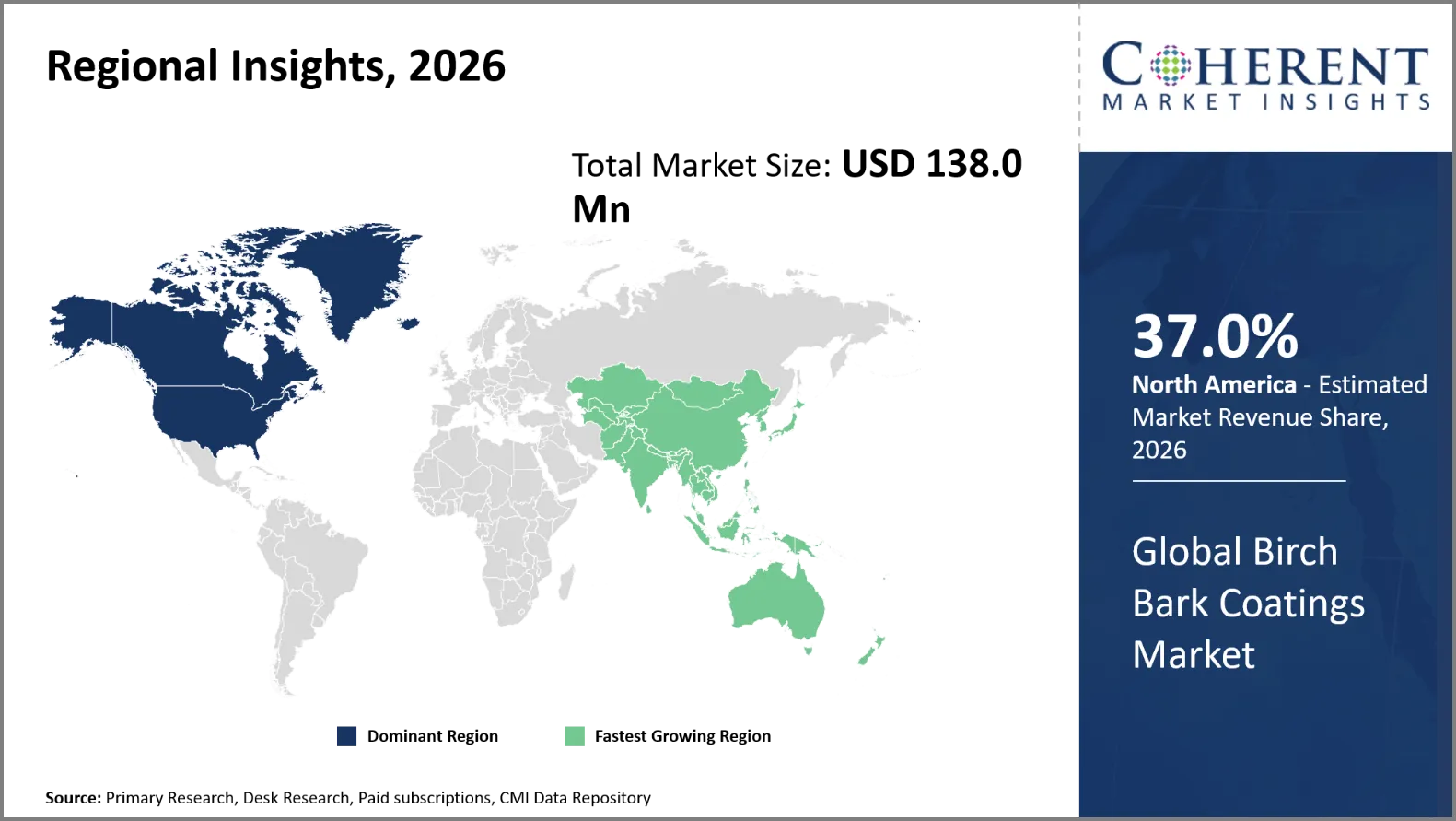
- North America is expected to dominate the birch bark coatings market in 2026 with a market share of 37.0%. Increasing development of suberin-based coating technologies in North America is driving the growth of the regional market. On January 20, 2025, Smart Planet Technologies commercially introduced EarthCoating-Bio. The formulation combines polylactic acid resin with a specialized mineral blend. It targets paper cups and other barrier-coated paper packaging.
- Asia Pacific is expected to account for 23.0% share in 2026. Growing investment in sustainable wood protection solutions in Asia Pacific is driving the growth of the regional market. On January 8, 2026, Remmers Gruppe SE collaborated with Indian wood coatings firm Teknovace to develop a worldwide manufacturing cluster. Remmers aims to buy a 50.01% share in Teknovace in two investment tranches.
Segmental Insights
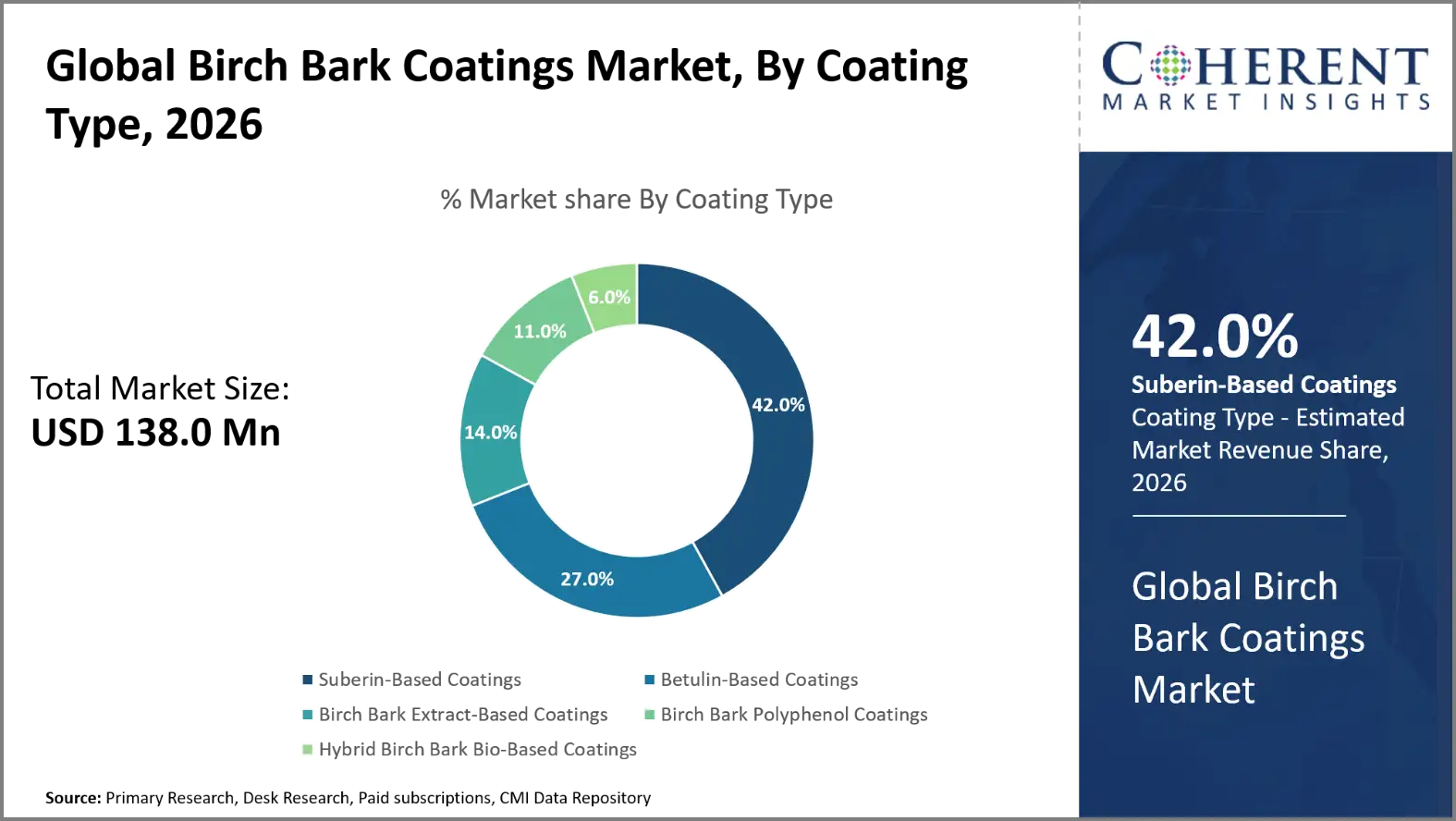
Why Does Suberin-Based Coatings Dominate the Global Birch Bark Coatings Market?
The suberin-based coatings segment is expected to account for 42.0% of the global birch bark coatings market share in 2026. Suberin-based coatings dominate because suberin provides natural hydrophobicity, flexibility, and protective barrier properties. It is the main protective biopolymer component of outer birch bark. The long chain fatty acids are good for moisture resistance and durable surface protection. Suberin also provides an opportunity to replace chemicals used in petroleum-derived coatings with renewable resources. It is also compatible with bio-based formulations, therefore a good candidate for sustainable packaging and wood protection. Recent study has demonstrated its efficiency for grease resistant and moisture resistant barrier applications. These properties make suberin a very significant material for the development of high-performance and ecologically friendly coatings.
On February 6, 2025, Finnish biomaterials company Innomost presented technical information on industrial applications of suberin. The company pointed out its hydrophobic structure and natural defensive characteristics. It listed adhesives, coatings and packaging as possible applications.
- Current Industry Events of 2026
- Market Size Estimation
- Regional Breakdown
- Competitive Landscape
- Customer Intelligence
- Segmental Analysis
- Pricing Analysis
- Key Market Drivers, Challenges & Future Trends
- Customized Insights Section
Why is Aqueous Dispersion Coating the Most Preferred Coating Technology?
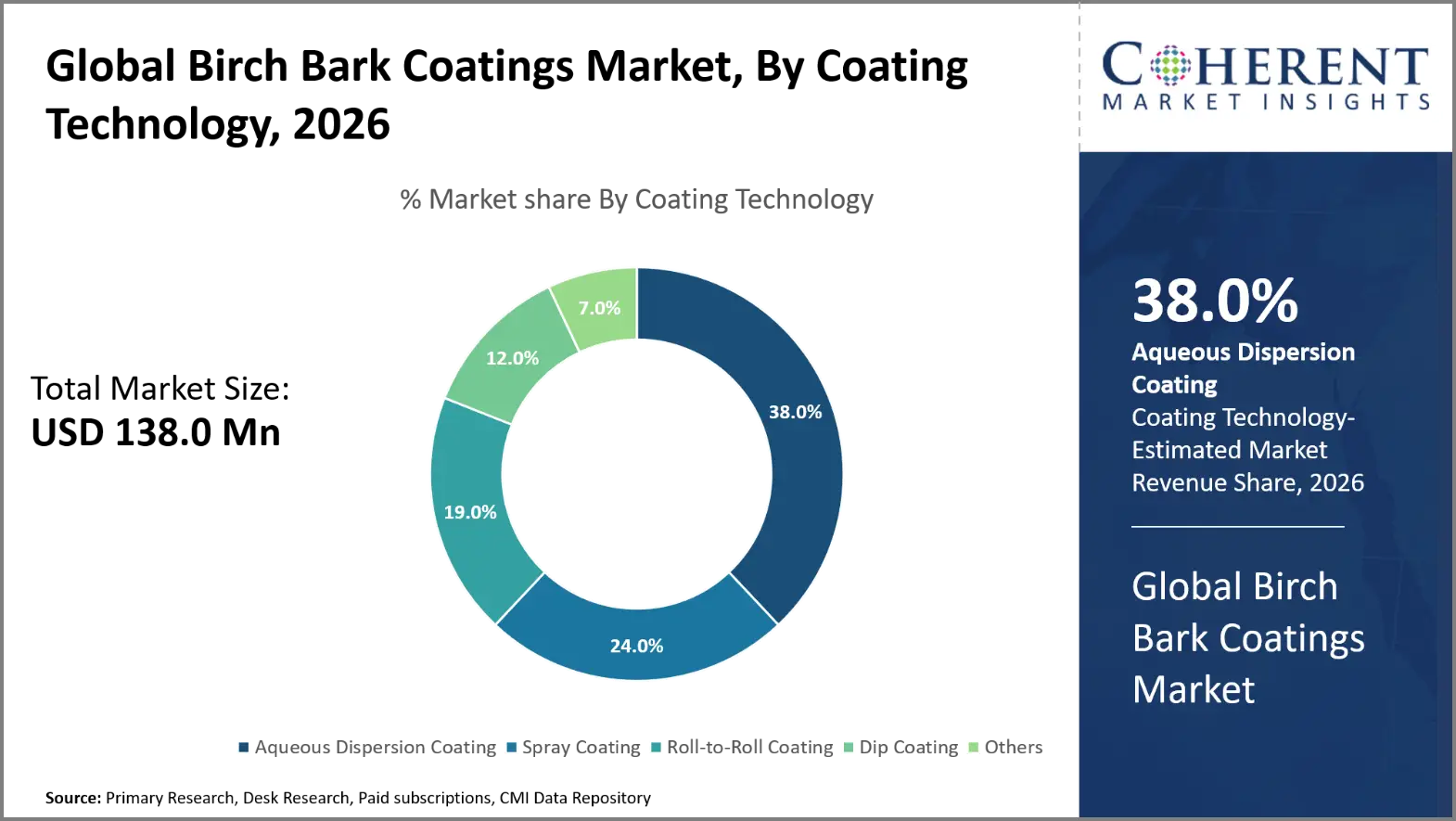
The aqueous dispersion coating segment is expected to account for 38.0% of the global birch bark coatings market share in 2026. Aqueous dispersion coating is favored because it permits water-based processing of suberin materials which are normally water insoluble. It decreases the dependency on organic solvents and supports lower emission coating compositions. Dispersing agents serve to stabilize the suberin particles and increase the homogeneity of the formulation. The method also provides compatibility with paper, paperboard and wood surfaces. Researchers have shown that birch bark suberin dispersions can be stable even at solid concentrations of up to 30%. The thermal curing further increases the film formation and water resistance. These processing advantages enhance the promise of aqueous dispersion technology for sustainable industrial coating applications.
On June 25, 2025, Kemira and Bluepha announced a partnership to produce entirely bio-based barrier coatings. The cooperation will focus on polyhydroxyalkanoate compounds for paper, board and molded fiber for three years. The companies want to bring renewable barrier materials to food packaging and paper labels. This partnership demonstrates commercial interest in water-compatible biopolymer coating systems.
Water-Resistant Coatings Dominates the Global Birch Bark Coatings Market
The water-resistant coatings segment is expected to account for 31.0% of the global birch bark coatings market share in 2026. Water-resistant coatings dominate because moisture protection represents a major functional requirement across packaging and wood protection applications. Water penetration is inhibited by hydrophobic components in the natural suberin of birch bark. These qualities protect surfaces against moisture absorption, swelling and degradation. Additionally, water-resistant formulations contribute to applications needing greater surface durability and enhanced product lifespan. A study published in Materials Horizons showed entirely bio-based coatings from bark with competing water resistance. Another investigation revealed water contact angles on treated wood surfaces temperatures exceeding 120°. These results reinforce the economic potential of birch bark coatings in moisture sensitive applications.
On March 23, 2026, UPM Specialty Materials and Paramelt jointly developed a bio-based and paper-based food packaging concept. It provides strong grease protection and improved end-of-life performance, making it particularly suitable for bakery, fast food and convenience applications. UPM’s advanced barrier base papers combined with Paramelt’s innovative bio-based heatseal and barrier technology deliver a recyclable paper-based solution with the grease barrier and sealing performance.
Current Events and their Impact
Current Events | Description and its Impact |
European Union - Packaging and Packaging Waste Regulation (PPWR) Regulation (EU) 2025/40 |
|
China - National Food Safety Standard for Food-Contact Coatings |
|
Birch Bark Coatings Market Dynamics
Market Drivers
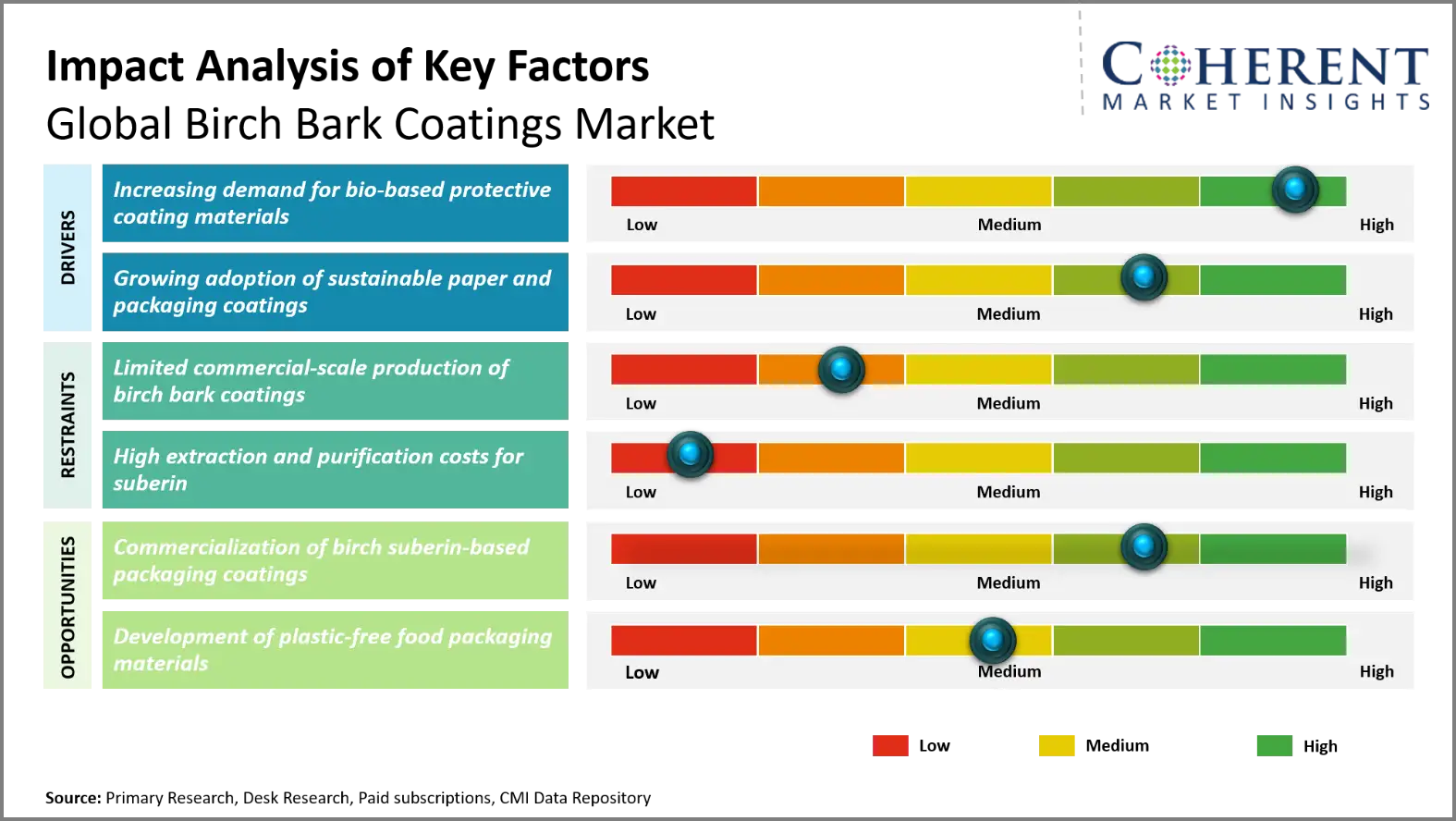
- Increasing demand for bio-based protective coating materials: The increasing environmental concerns are leading the manufacturers to substitute petroleum-based protective coatings with renewable ones. Industries are increasingly turning to surface protection technologies that are biodegradable, low-emission and resource efficient. Suberin is a naturally occurring hydrophobic biopolymer with protective barrier characteristics found in birch bark. Its moisture resistance opens doors in wood preservation, packaging and specific surface treatments. Suberin-based formulations can lessen dependence on traditional synthetic coating additives. Research into biopolymers from bark is also enhancing procedures for extraction, dispersion and film-forming. These advances raise the economic interest in birch bark as a sustainable feedstock for coatings. The increasing demand for environmentally friendly materials can increase the industrial applications of suberin-based protective coatings.
- On July 14, 2026, Cortec announced the launch of EcoLine 3860, Cortec’s first water-based acrylic paint including renewably produced polymers. EcoLine 3860 has 27% USDA certified biobased content and is intended industrial users that desire to boost their use of renewable material.
- Growing adoption of sustainable paper and packaging coatings: Increasing demand for sustainable packaging is driving manufacturers to develop bio-based barrier coatings for paper and paperboard. Traditional plastic laminates make recycling more difficult and increase reliance on fossil-based products. Birch bark suberin provides natural hydrophobicity and potential moisture barrier efficacy. These properties make it a good candidate for water-resistant and grease-resistant paper coatings. Suberin dispersions can also be used in aqueous coating procedures for specified packaging substrates. Potential areas of application include food-service packaging, paperboard containers and specialty wrapping materials. Sustainability standards in Europe for packaging further drive interest in recyclable fiber-based alternatives. These results open up prospects for commercialization of birch bark coatings in sustainable packaging applications.
- On February 26, 2026, Henkel introduced Loctite Liofol CS 7106 RE for recycled paper packaging. The coating ensures reliable cold sealing and avoids the use of high temperatures that can damage heat-sensitive products. It focuses on snacking, confectionery, ice cream and other packaging applications.
Emerging Trends
- Development of High-Performance Suberin-Based Barrier Coatings: Manufacturers and researchers are looking at pure birch bark suberin to develop renewable coatings with enhanced moisture resistance, grease resistance, and surface protection capabilities.
- Impact: Better suberin extraction and formulation processes may boost coating uniformity, barrier performance, and compatibility with industrial processing, while decreasing dependence on petroleum-derived coating materials.
- Relevance to the market: Research into suberin-rich birch bark extracts for wood protection and packaging indicates potential for transforming forestry leftovers into commercially viable coating materials.
- Advancement of Water-Based Birch Bark Coating Technologies: Researchers are working on aqueous suberin dispersions to enhance coating application, formulation stability, and compatibility with paperboard, wood, and other sustainable substrates.
- Impact: Water-based processing can reduce the use of organic solvents and facilitate lower-emission production while boosting the acceptability of bio-based coatings for industrial applications.
- Relevance to the market: Research showing birch bark suberin dispersions with solids content of up to 30% indicates prospects for scalable coating formulations and sustainable paper packaging applications.
Regional Insights
Why is North America a Strong Market for Birch Bark Coatings?
North America is expected to account for a market share of 37.0% in 2026. In North America there are prospects for the use of forestry residues, research on wood protection and development of specific bio-based materials. Canada possesses large quantities of paper birch, particularly in Quebec and Ontario. Its forestry business produces bark wastes that include naturally occurring suberin. Traditionally, birchbark was used to make containers, boxes and protective buildings, according to the Canadian Conservation Institute. This exhibits a knowledge of the materials and moisture resistance qualities. In the U.S., renewable barrier coatings could be used in the creation of sustainable packaging. Research into hydrophobic polymers produced from bark also provides prospects for wood preservation. Commercial adoption remains dependent on extraction economics, formulation performance, and industrial validation.
Why Does Asia Pacific Birch Bark Coatings Market Exhibit High Growth?
Asia Pacific is expected to register the fastest growth with a CAGR of 3.5% over the forecast period. Asia Pacific is projected to account for 23.0% of the global birch bark coatings market in 2026. Asia Pacific presents opportunities through expanding fiber-based packaging manufacturing and growing interest in renewable industrial materials. China has the potential for this as its northeastern provinces have abundant birch forest resources. Chinese food contact coating regulations, especially GB 4806.10-2025, have unique qualifying concerns for packaging applications. Japan and South Korea are potentially prospective markets for advanced paper coating and sustainable packaging technology. However, dedicated commercial birch bark coating production remains insufficiently documented across these countries. Regional opportunities therefore depend on developing reliable suberin extraction, aqueous dispersion stability, and application-specific performance. Food packaging manufacturers represent important prospective customers.
Global Birch Bark Coatings Market Outlook for Key Countries
Why is U.S. Emerging as a Major Hub in the Birch Bark Coatings Market?
The U.S. market opportunities include wood preservation research, specialty coatings development and sustainable packaging innovation. Renewable moisture-barrier compositions are promising products for paperboard makers. The hydrophobic fatty-acid structure of suberin presents opportunity for the development of alternatives to traditional synthetic surface treatments. These coatings may be of interest to U.S. package converters for fiber-based food containers and protective wrappers. Special attention needs to be paid to food contact migration testing and to the recyclability of coatings in commercial development. And formulation decisions are impacted by U.S. Environmental Protection Agency standards for volatile organic compounds. Nevertheless, there is little evidence of publicly acknowledged commercial manufacture of birch bark covering in the United States.
Is China the Next Growth Engine for the Birch Bark Coatings Market?
China has opportunities with its large paper manufacturing ecosystem, packaging conversion capabilities and interest in renewable material technologies. Northeastern provinces contain the relevant birch forestry resources for studying bark-derived chemical extraction. The country’s food-contact coating standard GB 4806.10-2025 sets out significant qualifying parameters for possible food-packaging uses. Domestic coating producers for paperboard moisture barriers and specialty packaging should research suberin dispersions. China’s current chemical processing infrastructure might potentially enable future extraction and formulation development. Little has been reported, however, on commercial manufacture of birch bark coating. Commercialization chances will be influenced by food-contact compliance and robust feedstock processing.
Germany Birch Bark Coatings Market Analysis and Trends
Germany presents prospects in its established industries of wood processing, specialty chemicals and paper converting. Renewable barrier coating technologies have potential users in packaging manufacturers. The European Union’s Packaging and Packaging Waste Regulation (EU) 2025/40 is driving demand for recyclable packaging solutions. Coating developers in Germany may be interested in suberin-based formulations for protection of fiberboard and moisture-resistant packaging. The country’s industrial chemical capabilities also provide prospects for the development of dispersants, binders, and functional additives. Commercial adoption will depend on compatibility with existing coating equipment. Recyclability testing and consistent coating performance will remain important purchasing considerations.
Finland Birch Bark Coatings Market Analysis and Trends
Finland represents one of the strongest documented development centers for birch bark coatings. The University of Oulu coordinates the COCOBIN project with VTT Technical Research Centre of Finland. Researchers extracted suberin from birch outer bark and developed water-based coating formulations. In semi-pilot testing, roughly 1200 to 1500 meters of coated paper were produced. Coating trials were made on UPM and Metsä Board substrates. The Sustainable Binders and Coatings project has also looked at suberin dispersions as packaging barriers. Controlled laboratory studies have shown transmission rates of below 20 g/m² for water vapor. These developments enhance Finland’s industrial commercialization capacity.
Sweden Birch Bark Coatings Market Analysis and Trends
Sweden has a solid scientific base for the conversion of birch bark to practical protective materials. Researchers at Stockholm University have made totally bio-based water-resistant wood coverings using suberinic acids from birch bark and polyphenols from spruce bark. A 2024 study showed 100 g/m2 of water absorption after 72 hours. The composition was 90% suberinic acids and 10% polyphenols. In 2025, researchers also showed reconstructed birch bark suberin polyester films for packaging purposes. One of the study associations was the Swedish company Cellfion AB. These advances indicate prospects in wood protection, renewable packaging films and recyclable coating materials.
Global Birch Bark Coatings Market - Packaging Application Opportunity Analysis
Packaging Application | Main Protection Requirement | Suberin Coating Performance | Application Suitability | Commercial Opportunity |
Dry food paper packaging | Moisture and water vapor resistance | WVTR of 18 g/m²/day at 23°C and 50% RH in pilot-coated paperboard | High potential | Paper pouches flour bags and cereal packaging |
Snack and confectionery packaging | Grease oil and moisture resistance | KIT grease rating of 12 and oil penetration resistance of 24–168 hours | High potential | Snack wrappers chocolate packaging and confectionery liners |
Bakery packaging | Grease resistance and oil penetration control | Most tested coatings maintained grease resistance during a 16-day laboratory assessment | High potential | Bakery bags pastry liners and paperboard trays |
Paperboard food containers | Water vapor and liquid water resistance | Suberin coatings showed water vapor barriers comparable to polyolefin references under ambient conditions | High potential | Takeaway boxes paperboard trays and food containers |
Flexible paper packaging | Barrier performance and converting compatibility | Pilot-scale reverse-gravure coating trials evaluated flexible form-fill-seal convertibility | Medium to high potential | Flexible paper pouches and roll-stock packaging |
How is Commercialization of Birch Suberin-Based Packaging Coatings Creating New Growth Opportunities in the Birch Bark Coatings Market?
Commercialization of birch suberin-based packaging coatings is offering potential opportunities in transforming forestry leftovers into higher value industrial products. The transition was shown by semi-pilot production in the COCOBIN project coordinated by the University of Oulu in Finland. The experiment generated 1,200-1,500 meters of coated paper from suberin derived from birch bark. The trials were carried out on paper substrates from UPM and Metsä Board. The water-based solution was compatible with semi-pilot coating equipment and traditional application process. In addition, more than 10 kg of suberin were created in preliminary experiments by the previous SUSBINCO initiative. The total reject of the coated materials in the repulpability test was less than 1.2%. These studies offer economic prospects for water-resistant food packaging, reusable paperboard coatings and industrial use of forestry residues.
On July 10, 2025, Innomost launched Suberinno Suberin, a functional biopolymer for packaging, adhesives and industrial coatings. The business cited its hydrophobic and lipophilic qualities for resistance to water and grease. It also described potential applications in paperboard coatings and flexible packaging films.
Market Players, Key Development, and Competitive Intelligence
Key Developments
- On January 22, 2026, Nokian Tyres launched the Nokian Tyres Betula concept tire containing groundbreaking raw material made from birch bark. The renewable material by Swedish company Reselo utilizes the residue of the global pulp, paper and plywood industry. The Nokian Tyres Betula represents the first time the material has been used in a tire.
- On October 28, 2024, Earthodic announced their expansion plans for the US following completion of an oversubscribed seed round. Earthodic’s certified recyclable coatings offer a sustainable alternative for global brands and packaging companies, mitigating the environmental impact of packaging waste that makes up approximately 30% of landfilled waste.
Competitive Landscape
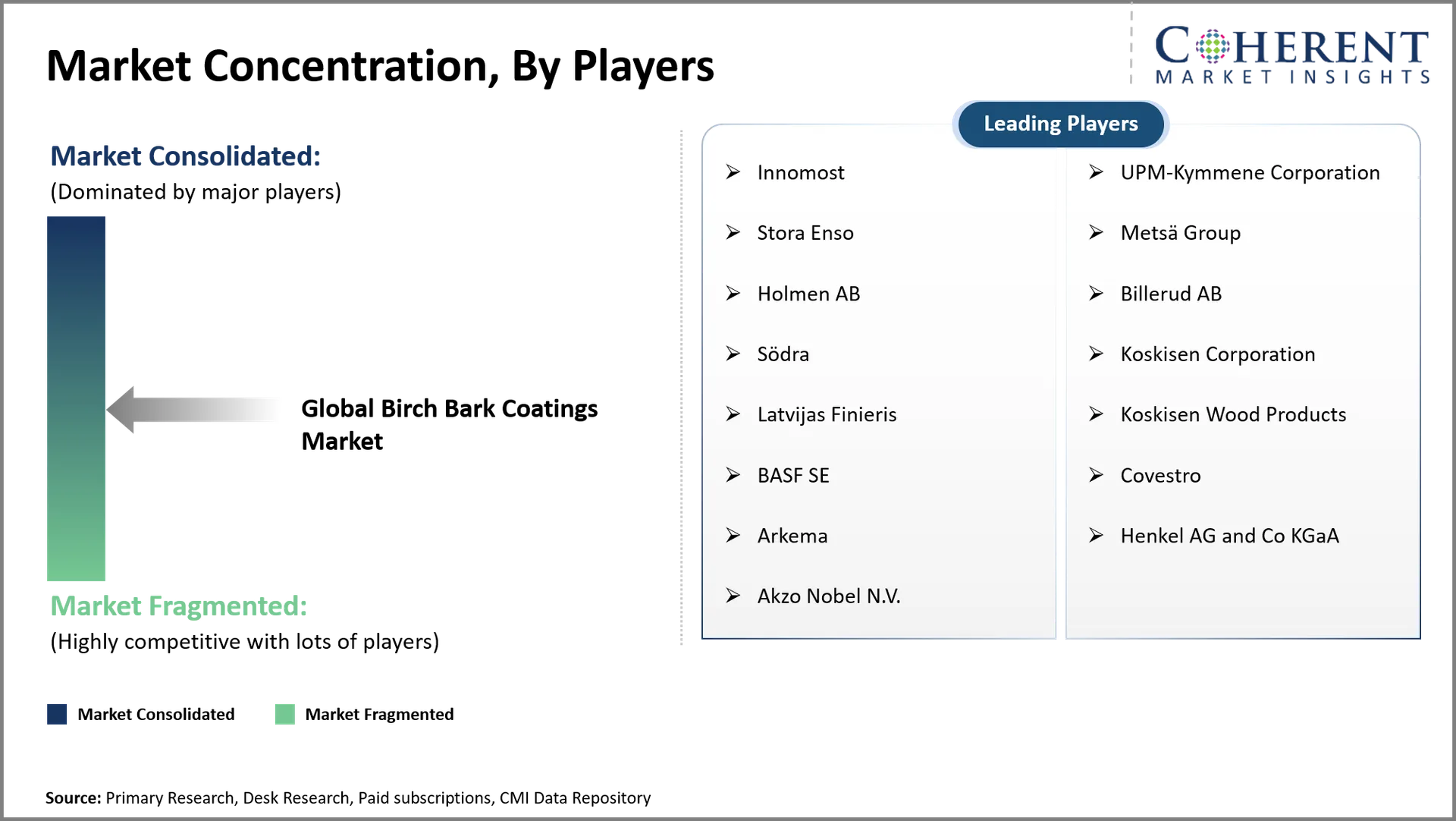
The competitive landscape is still evolving, with Finnish companies and research-industry alliances leading commercialization. Innomost is a significant commercial player in extracting useful chemicals from birch bark. Its range includes suberin, betulin, birch charcoal powder and birch bark powder. Metsä Spring funded the creation and finance of a trial facility in Kokkola, Finland. Teknos works on the development of bio-based binders and coatings for packaging, paints, adhesives and sealants. UPM and Metsä Board provide knowhow in packaging substrates and industrial applications. Extraction, formulation and application research are carried out at the University of Oulu, VTT Technical Research Center of Finland and Åbo Akademi University. These partnerships strengthen Finland's position in the emerging competitive ecosystem.
Top Manufacturers and Notable Products in the Birch Bark Coatings Market
Manufacturer | Notable Product | Key features |
Innomost | Suberinno Suberin | Moisture resistance grease resistance hydrophobicity adhesion durability and potential oxygen barrier performance |
Xampla | Morro Coating | Plastic-free formulation grease resistance water resistance oxygen barrier biodegradability compostability and recyclability |
Michelman | Nuvita Life 4002 and Nuvita Life 4605 | Heat sealing oil and grease resistance mineral oil barrier water resistance moisture barrier and 100% bio-based dry film |
UPM | UPM Solide Lucent | High strength smooth surface low coating-weight requirements food safety recyclability and compostability |
Henkel | Loctite Liofol CS 7106 RE | Strong permanent seals high-speed application adhesion mechanical recycling compatibility and suitability for snack and confectionery packaging |
Market Report Scope
Global Birch Bark Coatings Market Report Coverage | |||
Report Coverage | Details | ||
Base Year | 2025 | Market Size in 2026: | USD 138.0 Mn |
Historical Data For: | 2020 To 2024 | Forecast Period: | 2026 To 2033 |
Forecast Period 2026 To 2033 CAGR: | 3.20% | 2033 Value Projection: | USD 287.0 Mn |
Geographies covered: |
| ||
Segments covered: |
| ||
Companies covered: | Innomost, UPM-Kymmene Corporation, Stora Enso, Metsä Group, Holmen AB, Billerud AB, Sodra, Koskisen Corporation, Latvijas Finieris, Koskisen Wood Products, BASF SE, Covestro, Arkema, Henkel AG and Co KGaA, Akzo Nobel N.V. | ||
Growth Drivers: |
| ||
Restraints & Challenges: |
| ||
Analyst Opinion (Expert Opinion)
- The future industry will increasingly focus on converting forestry residues into functional coating ingredients. Birch bark suberin offers a distinctive opportunity because its natural chemistry provides hydrophobicity. Commercial development will be dependent on constant extraction quality, formulation stability and processing compatibility. Barrier performance will be a more important differentiator than bio-based material for manufacturers. Partnerships between forestry processors and coating manufacturers will become commercially important. The industry should gradually move beyond specialty research applications toward standardized industrial coating formulations.
- The strongest opportunities will emerge in aqueous suberin dispersion coatings and multifunctional barrier formulations. Paperboard packaging offers particularly attractive opportunities for moisture-resistant and grease-resistant applications. Food packaging converters are significant prospective customers. Finland has the best immediate commercialization environment since it has an established ecology for processing birch. Sweden offers more chances in wood conservation and development of bark derived materials. There are lucrative chances in specialized coatings manufacturing and sustainable packaging conversion in Germany. The focus has to be on fiber-based packaging, before moving into niche industrial surface treatments.
- Market participants are advised to conclude long-term agreements for birch bark procurement with forestry firms and pulp manufacturers. They need to invest in extraction facilities that ensure consistent suberin purity and formulation quality. Dispersions can be designed for specific applications to enhance compatibility with current paper coating equipment. Companies must concentrate on food-contact safety, repulpability and industrial processing validation. Working with packaging manufacturers as strategic partners helps speed up the client qualifying and product integration process. Proprietary extraction processes and reliable technical assistance can enhance competitive distinctiveness. Early commercial vendors should also create unique formulas for various paperboard grades and packaging requirements.
Speak to the analyst
Want personalized insights?
Take the findings above to one of our principal consultants, or have the report rebuilt around the segments, geographies and competitors you actually track.
Market Segmentation
- Coating Type Insights (Revenue, USD Million, 2021 - 2033)
- Suberin-Based Coatings
- Betulin-Based Coatings
- Birch Bark Extract-Based Coatings
- Birch Bark Polyphenol Coatings
- Hybrid Birch Bark Bio-Based Coatings
- Coating Technology Insights (Revenue, USD Million, 2021 - 2033)
- Aqueous Dispersion Coating
- Spray Coating
- Roll-to-Roll Coating
- Dip Coating
- Others
- Functional Property Insights (Revenue, USD Million, 2021 - 2033)
- Water-Resistant Coatings
- Moisture Barrier Coatings
- Oxygen Barrier Coatings
- Grease-Resistant Coatings
- Oil-Resistant Coatings
- Antimicrobial Coatings
- Protective Surface Coatings
- Application Insights (Revenue, USD Million, 2021 - 2033)
- Paper and Paperboard Packaging
- Food and Beverage Packaging
- Wood Surface Protection
- Construction Materials
- Furniture Coatings
- Industrial Packaging
- Consumer Product Packaging
- Regional Insights (Revenue, USD Million, 2021 - 2033)
- North America
- U.S.
- Canada
- Latin America
- Brazil
- Argentina
- Mexico
- Rest of Latin America
- Europe
- Germany
- U.K.
- Spain
- France
- Italy
- Russia
- Rest of Europe
- Asia Pacific
- China
- India
- Japan
- Australia
- South Korea
- ASEAN
- Rest of Asia Pacific
- Middle East
- GCC Countries
- Israel
- Rest of Middle East
- Africa
- South Africa
- North Africa
- Central Africa
- North America
- Key Players Insights
- Innomost
- UPM-Kymmene Corporation
- Stora Enso
- Metsa Group
- Holmen AB
- Billerud AB
- Sodra
- Koskisen Corporation
- Latvijas Finieris
- Koskisen Wood Products
- BASF SE
- Covestro
- Arkema
- Henkel AG and Co KGaA
- Akzo Nobel N.V.
Sources
Primary Research Interviews
- Birch Bark Coatings Manufacturers & Formulators
- Raw Material Suppliers (Birch Bark Extractors & Chemical Processors)
- Paint & Coatings Industry Distributors & Traders
- End-Use Industry Representatives (Construction, Automotive, Wood Finishing)
Magazines
- Coatings World Magazine
- Paint & Coatings Industry Magazine
- European Coatings Journal
- Surface Coatings International
Journals
- Progress in Organic Coatings (Elsevier)
- Journal of Coatings Technology and Research
- Industrial Crops and Products (Birch Bark Extracts Research)
Associations
- American Coatings Association (ACA)
- European Council of the Paint, Printing Ink and Artists' Colours Industry (CEPE)
- National Paint & Coatings Association (NPCA)
- Society for Protective Coatings (SSPC)
Public Domain Sources
- U.S. Environmental Protection Agency (EPA)
- European Chemicals Agency (ECHA)
- Food and Agriculture Organization (FAO)
- United Nations Environment Program (UNEP)
Proprietary Elements
- CMI Data Analytics Tool
- Proprietary CMI Existing Repository of Information for Last 10 Years
Get access to 250+ pages report
Every segment, forecast, competitor profile and data table behind the analysis above — available for instant download.
- ESOMAR Member
- ISO 9001:2015 Certified
- D-U-N-S Registered
- GDPR & CCPA Compliant
Frequently Asked Questions
The global birch bark coatings market is expected to stand at USD 138.0 Mn in 2026 and is expected to reach USD 287.0 Mn by 2033.
The CAGR of the global birch bark coatings market is projected to be 3.2% from 2026 to 2033.
Increasing demand for bio-based protective coating materials and Growing adoption of sustainable paper and packaging coatings are the major factors driving the growth of the global birch bark coatings market.
Limited commercial-scale production of birch bark coatings and High extraction and purification costs for suberin are the major factors hampering the growth of the global birch bark coatings market.
In terms of coating type, suberin-based coatings segment is estimated to dominate the market revenue share in 2026.
Birch bark coatings are protective surface treatments developed using natural compounds extracted from birch tree bark.
Birch bark provides a forestry residue feedstock that can be converted into valuable functional coating ingredients.