

Paper Packaging Market Size and Forecast – 2026 to 2033
The global paper packaging market is estimated at USD 472.92 Bn in 2026 and is expected to record a compound annual growth rate (CAGR) of 5.1% from 2026 to 2033, reaching USD 669.89 Bn by 2033
Key Takeaways from the Paper Packaging Market Report
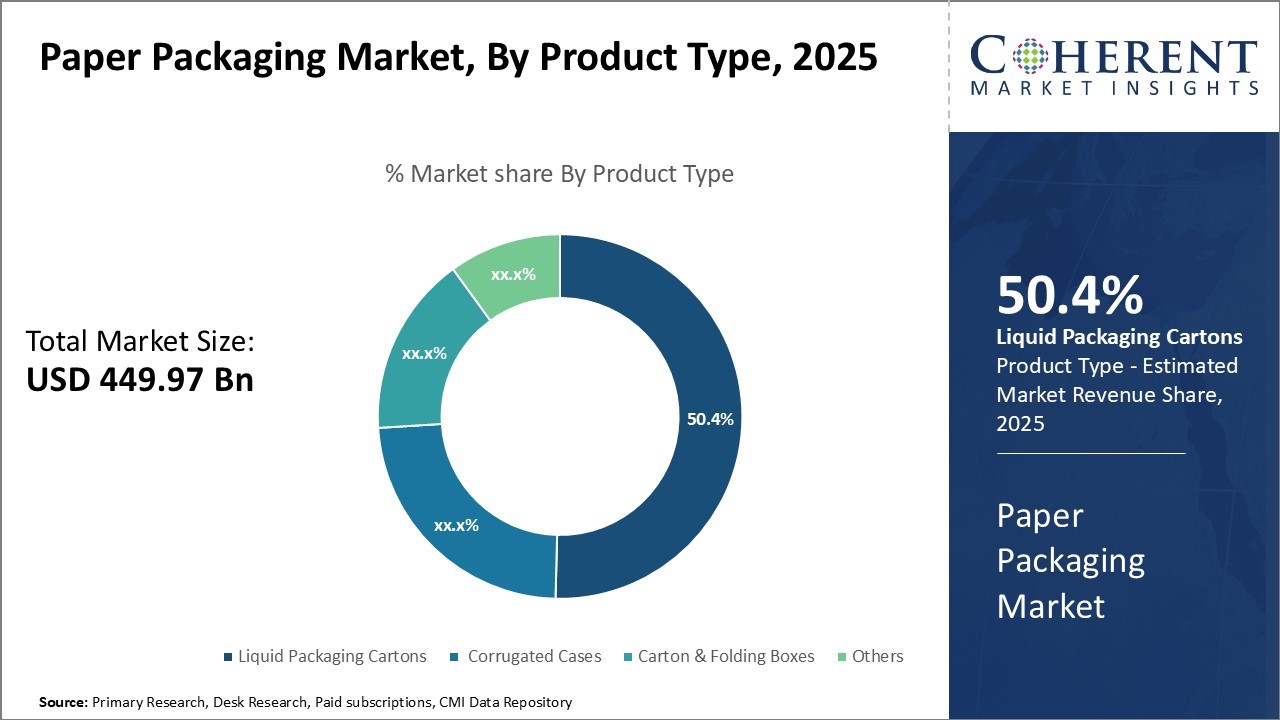
- Liquid packaging cartons are expected to remain the top-selling product type, accounting for 51.4 % of the global paper packaging market share by 2026.
- Food & beverage industry remains the leading consumer of paper packaging, capturing 54.7 % of the global market share in 2026.
- North America, with an estimated share of 45.1 % in 2026, is expected to lead the global market.
- Asia Pacific is poised to emerge as a hotbed for paper packaging manufacturers during the assessment period.
Paper Packaging Market Overview
The paper packaging market is expected to grow rapidly during the forecast period. This is attributable to rising demand for eco-friendly packaging solutions from food & beverages, pharmaceuticals, e-commerce, and personal care sectors.
There is a growing preference for sustainable packaging solutions globally. This is expected to provide impetus for paper packaging market growth during the forecast period. Increasing environmental concerns, coupled with government regulations regarding single-use plastics, are further expected to favor market growth.
Many companies are shifting towards paper-based packaging to lower their environmental impact and woo more and more customers. For instance, in September 2024, Nestlé launched paperboard canisters for its Vital Proteins brand in the U.S.
Nestle’s R&D team is also working with other companies and suppliers to develop next-generation of high-barrier paper packaging solutions across product categories. This transition towards sustainable packaging is expected to boost growth of the paper packaging market during the forecast period.
Current Events and Its Impact
Current Event | Description and its Impact |
E-commerce Boom and Changing Consumer Behavior |
|
Technological Innovation and Digital Transformation |
|
Segmental Insights
- Current Industry Events of 2026
- Market Size Estimation
- Regional Breakdown
- Competitive Landscape
- Customer Intelligence
- Segmental Analysis
- Pricing Analysis
- Key Market Drivers, Challenges & Future Trends
- Customized Insights Section
Paper Packaging Market Insights, By Product Type - Convenient Beverage Packaging Fuels Liquid Cartons’ Dominance
Liquid packaging cartons are projected to dominate the global market, accounting for a 51.4% share in 2026. This can be attributed to rising demand for convenient packaging solutions in the beverages sector.
Liquid packaging cartons are very versatile and can be used for many beverages and liquid products. They are lightweight, compact, and have excellent protective qualities. These features make them very popular with beverage manufacturers.
Growing demand for convenient and on-the-go packaging from food processors is driving liquid carton adoption. Likewise, shifting consumer preference toward packaged beverages fuels segment growth.
The rising consumption of packaged milk, juices, and liquid breakfasts has boosted the use of carton packaging in food and beverages. Liquid cartons protect contents from oxygen, moisture, and other factors, extending shelf life without extra plastic layers. This makes them an economical and sustainable option for manufacturers.
Rising health-consciousness among consumers has also augmented the demand for carton-packed nutritional drinks and dietary supplements. With growing urbanization and changing lifestyle patterns, liquid cartons have emerged as a staple packaging solution for ready-to-drink beverages.
Many manufacturers of beverages and dairy products are embracing liquid packaging cartons for their products. For instance, in September 2025, Berglandmilch became the first company in Austria to use SIG’s alu-free full-barrier aseptic cartons. The change is aimed at reducing the company’s CO₂ emissions.
Similarly, SIG opened its first aseptic carton plant in India in September 2025 to strengthen its presence in the region. These developments are expected to boost growth of the target segment during the assessment period.
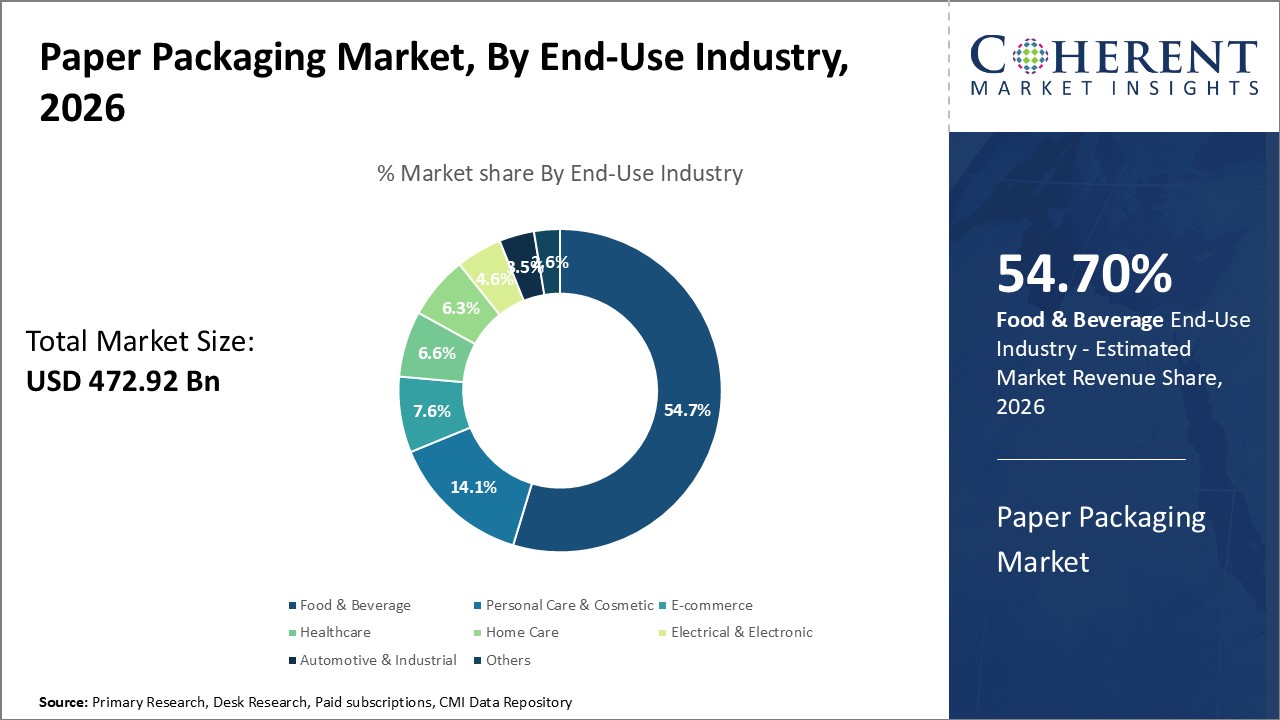
Paper Packaging Market Insights, By End-Use Industry - Food & Beverages Industry Remains Leading Consumer of Paper Packaging
The food and beverage segment is poised to account for 54.7% of the global paper packaging industry share in 2026. This is due to rising demand for corrugated boxes, cartons and paper wrappers from this sector.
The fast-growing processed food industry and expanding retail networks, especially in developing regions, are boosting the use of paper-based packaging. Paper packaging ensures safe transport of food items from dry groceries to frozen products. Its moisture resistance, printability, heat sealing, and freshness protection make it essential for food industry applications.
Consumer goods companies are preferring paper over plastic packaging owing to growing sustainability concerns. Expansion of quick service restaurants, food procession plants, and organized food retail has augmented the yearly packaging needs of food industry.
Paper packaging is a sustainable and cost-effective option for primary as well as secondary food packaging applications. Developing cold chain infrastructure has augmented the usage of corrugated boxes and Insulated packaging for temperature controlled transportation of food shipments.
In March 2025, Amcor launched the AmFiber Performance Paper stand-up pouch, a recyclable paper-based refill pack designed for instant coffee and dry beverages. This pouch, included in Amcor’s AmFiber Performance Paper range, contains 85% fiber and has been certified for recyclability by CEPI and Aticelca. It is also curbside recyclable in multiple European countries.
Regional Insights
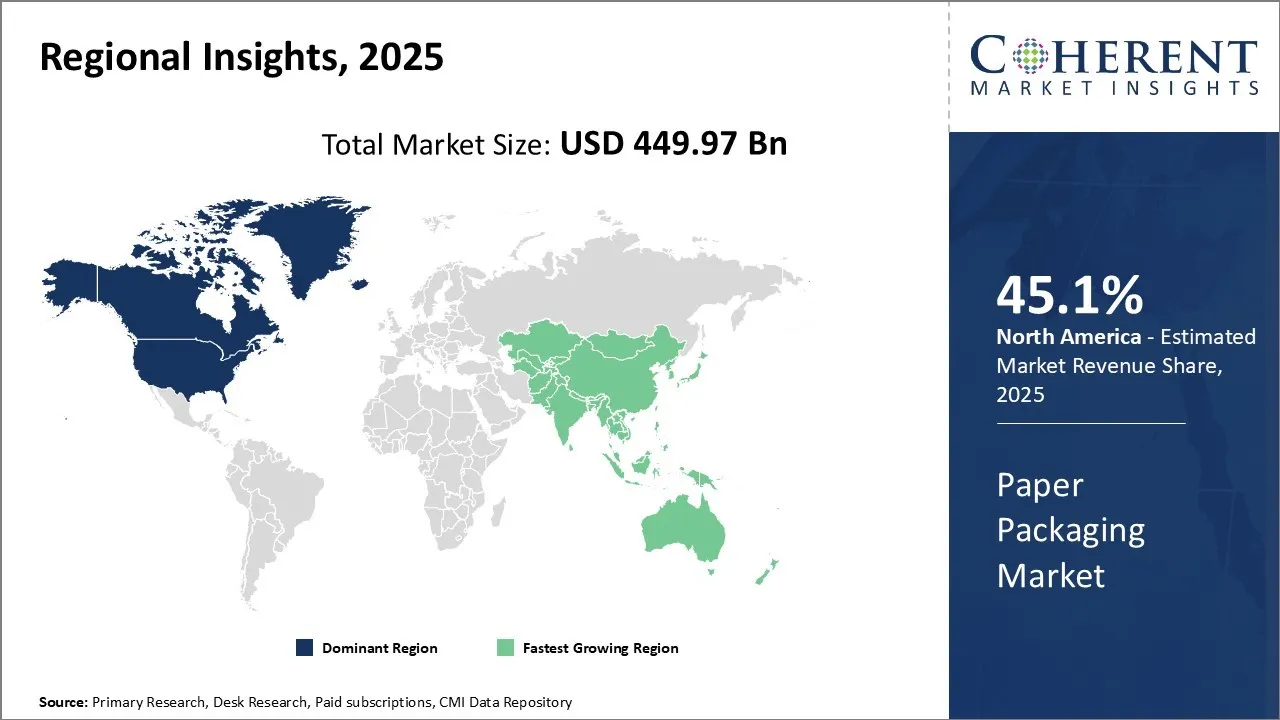
North America Remains at the Epicenter of Paper Packaging Market Growth
North America currently dominates the global paper packaging industry with 45.1% market share. This can be attributed to a strong presence of packaging manufacturers as well as key end-use industries.
The well-established consumer goods and food and beverages sectors contribute hugely to the packaging needs of the region. North American countries like the United States and Canada house many Fortune 500 companies involved in consumer packaged goods, who are the leading customers of paper packaging. This ensures a steady local demand for paper-based containers, boxes, bags, pouches, and other packaging solutions.
Furthermore, abundant resources and advanced manufacturing capabilities across the value chain strengthen North American packaging producers. This enables them to provide competitive prices while delivering high-quality products that meet regional needs.
In February 2026, Eco Guardian, a Canadian company specializing in sustainable packaging solutions, announced plans to open a new manufacturing plant in Ontario. The facility, expected to be fully operational by the fourth quarter of 2026, will concentrate on producing compostable and recyclable paper cups and bowls.
Asia Pacific Paper Packaging Market Analysis & Trends
Asia Pacific is emerging as the fastest growing market for paper packaging globally. Countries like China, India, Indonesia, Japan, and South Korea have exhibited impressive economic development over the past decades, resulting in a burgeoning consumer class with rising disposable incomes. This rapidly expanding consumer base needs all kinds of packaged goods, which is driving the demand for paper packaging from key end-use sectors.
The region is witnessing massive investments in industries like food processing, pharmaceuticals, personal care, and consumer durables, which present attractive opportunities for paper packaging suppliers. Asia Pacific also hosts a significant portion of the world's population, providing a huge local customer base for packaged goods. In addition, export opportunities from the Asia Pacific region open up the potential to serve customers abroad through competitive pricing and proximity benefits.
In March 2026, Oji India Packaging Pvt Ltd, part of Japan’s Oji Group, opened its fifth and largest manufacturing facility in Sri City, Andhra Pradesh. The 43,000-square-metre plant will produce corrugated boxes and packaging accessories, delivering sustainable, high-quality solutions to the South Indian market.
Paper Packaging Market Outlook – Country-wise
United States Leads in Sustainable Packaging Adoption
The United States is expected to remain a top user of paper packaging during the assessment period. This is because more consumers prefer eco-friendly products and strict rules on plastic usage.
Companies in the country are investing more in recyclable and biodegradable packaging to meet sustainability goals. For example, WestRock and International Paper have increased production of recycled paperboard to serve food as well as beverage brands that focus on green packaging.
Retailers like Walmart and Target are also pushing for more sustainable packaging from suppliers. This is expected to uplift driving overall paper packaging market demand in the U.S. during the forthcoming period.
Booming E-commerce and Manufacturing Expansion Driving Growth in China
China’s paper packaging market is growing rapidly due to the booming e-commerce sector and large-scale manufacturing activities. Rising online shopping has increased demand for corrugated boxes and shipping-friendly packaging solutions.
Local companies like Nine Dragons Paper and Lee & Man Paper are ramping up production to meet domestic demand. For instance, Nine Dragons recently launched a new high-capacity corrugated box plant, helping e-commerce companies ship products efficiently while using eco-friendly materials.
Market Concentration and Competitive Landscape
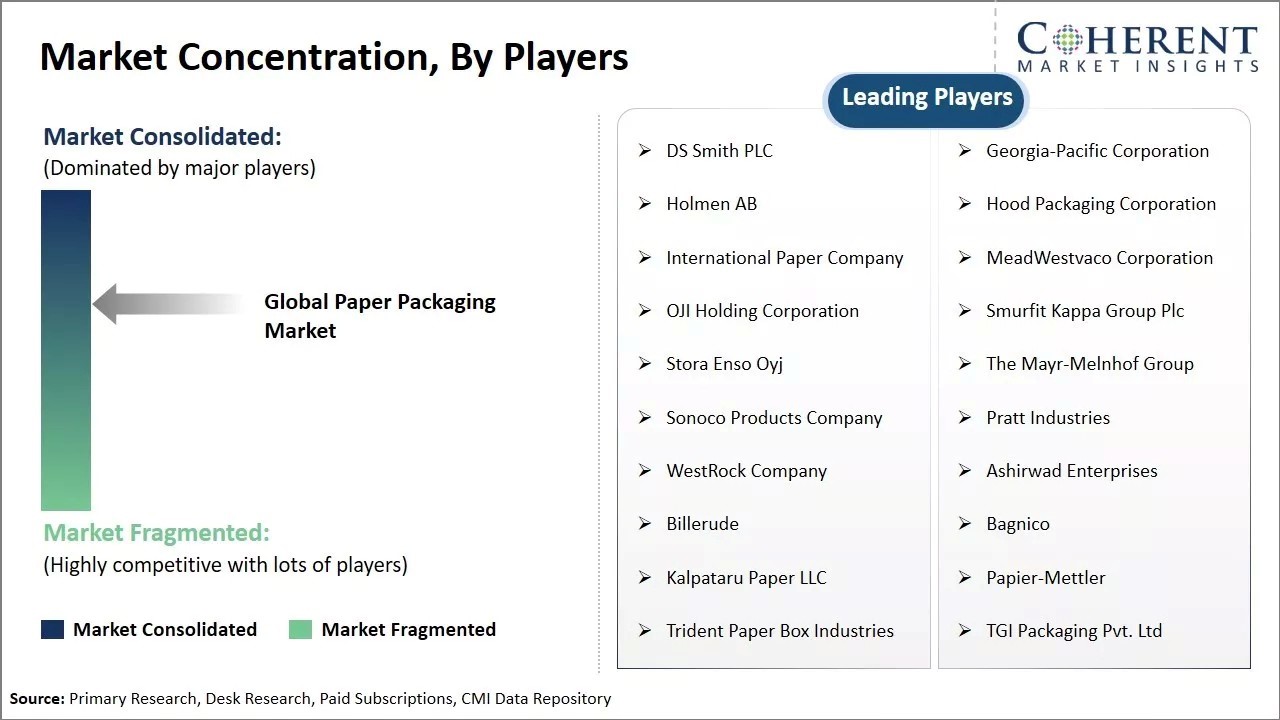
Research and development (R&D) remains a key focus for paper packaging companies. Innovations in sustainable materials, recyclable packaging, and automation are helping firms meet evolving customer demands as well as comply with environmental regulations.
Numerous packaging companies, suppliers, and technology providers are partnering to develop new eco-friendly and high-performance packaging solutions. Industry players are also expanding their regional footprint through partnerships, mergers, acquisitions, and collaborations to serve growing e-commerce and industrial demand.
Paper Packaging Industry News
- In August 2025, Mondi ramped up Functional Barrier Paper Ultimate to meet the rising demand for sustainable high-barrier paper-based packaging. The new paper-based solution offers exceptional protection against water vapour, oxygen, and grease.
- In February 2025, Huhtamaki expanded its innovative packaging portfolio with the launch of ProDairy, new recyclable single-coated paper cups. These sustainable cups are specifically designed for dairy and yogurt products.
- In March 2025, Ahlstrom expanded its LamiBak portfolio with the launch of a new base paper (LamiBak Flex) for flexible food packaging. This new base paper is specifically designed for flexible food packaging applications, including pouches, sachets, and flow wraps. LamiBak Flex’s launch will help the company address the growing need for safe, sustainable, and high-barrier packaging materials.
Market Report Scope
Paper Packaging Market Report Coverage
| Report Coverage | Details | ||
|---|---|---|---|
| Base Year: | 2025 | Market Size in 2026: | USD 472.92 Bn |
| Historical Data for: | 2020 To 2024 | Forecast Period: | 2026 To 2033 |
| Forecast Period 2026 to 2033 CAGR: | 5.1% | 2033 Value Projection: | USD 669.89 Bn |
| Geographies covered: |
| ||
| Segments covered: |
| ||
| Companies covered: | DS Smith PLC, Georgia-Pacific Corporation, Holmen AB, Hood Packaging Corporation, International Paper Company, MeadWestvaco Corporation, OJI Holding Corporation, Smurfit Kappa Group Plc, Stora Enso Oyj, The Mayr-Melnhof Group, Sonoco Products Company, Pratt Industries, WestRock Company, Ashirwad Enterprises, Billerude, Bagnico, Kalpataru Paper LLC, Papier-Mettler, Trident Paper Box Industries, TGI Packaging Pvt. Ltd | ||
| Growth Drivers: |
| ||
| Restraints & Challenges: |
| ||
Paper Packaging Market Dynamics
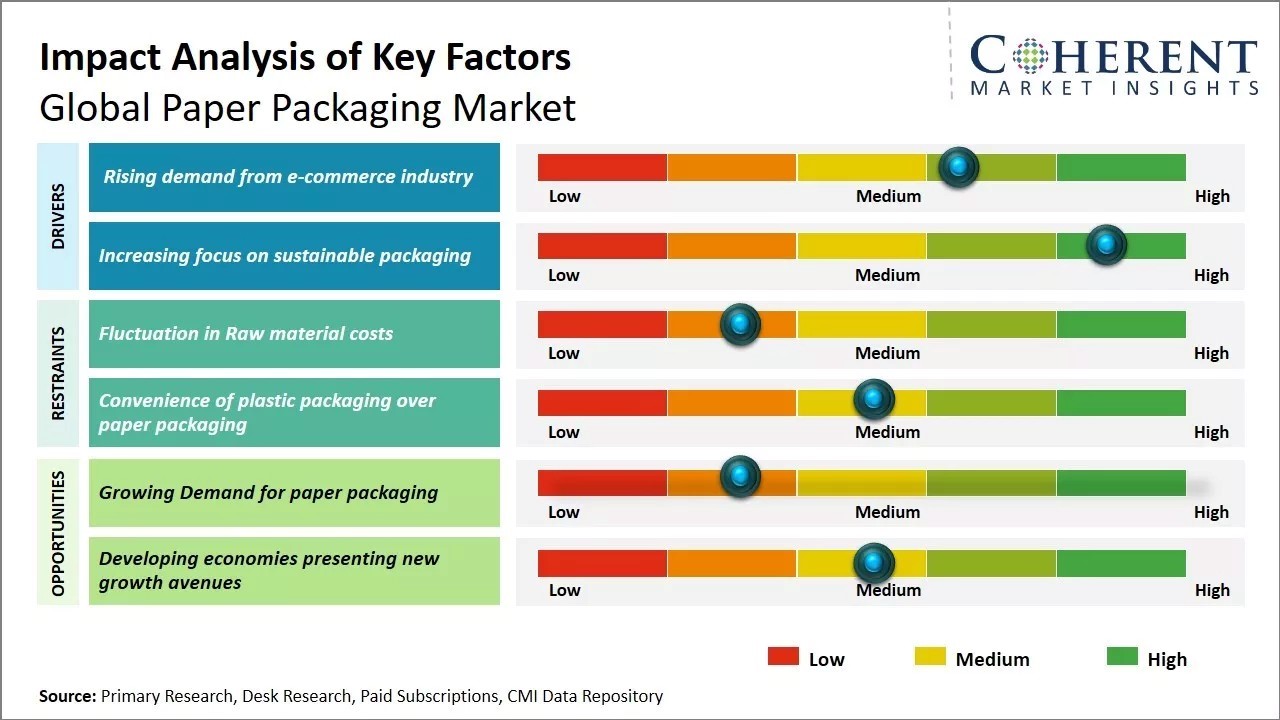
Paper Packaging Market Drivers
Rising Demand from E-commerce Industry
The e-commerce industry has witnessed tremendous growth over the past few years. This is mostly due to rising internet penetration and increasing preference of consumers towards online shopping. For instance, according to data by Invest India in 2023, the e-commerce industry in India is growing on levers such as increased smartphone penetration, increased affluence, and low data prices, providing impetus for e-retail growth.
With over 800 Mn users, India was the 2nd largest internet market in the world with 125.94 Lakh Cr UPI transactions in 2022. E-commerce businesses heavily depend on effective packaging of products to ensure safe delivery of items to customers. Paper packaging solutions like corrugated boxes, kraft paper boxes, paper bags, and envelopes are becoming popular with e-commerce companies. This is because they are eco-friendly and cheaper than plastic packaging.
The growing volumes of deliveries coupled with the need to package even small and fragile items securely have increased the demand for customized paper-based packaging solutions from e-commerce firms. Manufacturers are innovating with new paper packaging formats like paper mailers, unfoldable boxes, and shock-absorbent padded envelopes that provide protection against impacts during logistics and transit.
Additionally, e-commerce sellers require packaging materials that can be branded effectively for promotional purposes. Papers allow for multicolor printing of company logos and information, which enhances the unboxing experience of online shoppers. As e-commerce continues on its high growth trajectory, the need for sustainable yet cost-effective packaging will continue driving the market for paper packaging in the foreseeable future.
Increasing Focus on Sustainable Packaging
Rising concerns over plastic pollution and growing environmental awareness among both businesses and individuals have contributed significantly to the increased preference for paper-based packaging materials in recent years. Paper production involves the replanting of tree farms and relies majorly on sustainably harvested renewable wood resources. It also has higher recycling rates compared to plastic.
The natural decomposition properties of paper mean that it does not cause lasting damage to ecosystems even if not recycled. Meanwhile, regulatory push in many countries towards phasing out single-use plastics has put additional pressure on enterprises to opt for paper packaging for their products and supply chains.
Companies across end-use industries like food and beverages, personal care, pharmaceuticals, and consumer goods are focusing keenly on developing fully sustainable and recyclable paper packaging solutions. Even for applications that traditionally used plastics, such as flexible pouches and bubble wraps, paper manufacturers are devising innovative composite barrier materials that provide similar functionality while being greener.
Analyst Opinion (Expert Opinion)
- The paper packaging market is growing because of the urgent need for eco-friendly alternatives to plastics. Companies like Amazon, which replaced almost 15 billion plastic air pillows each year with recycled paper fillers, are setting an example that other companies must follow to stay competitive.
- Innovation in coatings and material technology is creating new growth avenues. Startups like Earthodic are developing recyclable protective coatings for paper and cardboard, offering eco-friendly solutions that older machinery and packaging lines cannot handle.
- Consumer demand for premium, sustainable packaging is influencing product design. Brands are increasingly adopting coated paperboards and specialty papers, with Europe holding a 34% share of the premium paper packaging segment, highlighting the willingness to pay more for environmentally responsible packaging.
Speak to the analyst
Want personalized insights?
Take the findings above to one of our principal consultants, or have the report rebuilt around the segments, geographies and competitors you actually track.
Market Segmentation
- Product Type Insights (Revenue, US$ Bn, 2026 - 2033) (Revenue, USD Bn, 2021 - 2033)
- Liquid Packaging Cartons
- Corrugated Cases
- Carton & Folding Boxes
- Others
- End-Use Industry Insights (Revenue, US$ Bn, 2026 - 2033) (Revenue, USD Bn, 2021 - 2033)
- Food & Beverage
- Personal Care & Cosmetic
- E-commerce
- Healthcare
- Home Care
- Electrical & Electronic
- Automotive & Industrial
- Others
- Regional Insights (Revenue, US$ Bn, 2026 - 2033) (Revenue, USD Bn, 2021 - 2033)
- North America
- U.S.
- Canada
- Latin America
- Brazil
- Argentina
- Mexico
- Rest of Latin America
- Europe
- Germany
- U.K.
- Spain
- France
- Italy
- Russia
- Rest of Europe
- Asia Pacific
- China
- India
- Japan
- Australia
- South Korea
- ASEAN
- Rest of Asia Pacific
- Middle East & Africa
- GCC Countries
- Israel
- South Africa
- Rest of Middle East & Africa
- Key Players Insights
- DS Smith PLC
- Georgia-Pacific Corporation
- Holmen AB
- Hood Packaging Corporation
- International Paper Company
- MeadWestvaco Corporation
- OJI Holding Corporation
- Smurfit Kappa Group Plc
- Stora Enso Oyj
- The Mayr-Melnhof Group
- Sonoco Products Company
- Pratt Industries
- WestRock Company
- Ashirwad Enterprises
- Billerude
- Bagnico
- Kalpataru Paper LLC
- Papier-Mettler
- Trident Paper Box Industries
- TGI Packaging Pvt. Ltd
Sources
Primary Research interviews
- Industry experts and key stakeholders from paper packaging manufacturing, distribution, and retail/end-user segments
- Technical specialists, product designers, and R&D teams focused on sustainable and innovative packaging solutions
- Procurement and supply chain managers from FMCG, food & beverage, and e-commerce companies
Databases
- UN Comtrade
- World Bank Data
- FAOSTAT
- Eurostat
- Indian Ministry of Commerce & Industry Data
- U.S. Census Bureau Trade Data
Magazines
- Packaging World
Packaging Digest - Paper & Packaging Magazine
- PrintWeek
- Packaging Strategies
Journals
- Journal of Packaging Technology and Research
- Packaging Technology and Science
- Journal of Industrial Ecology
- Materials Today: Proceedings
- International Journal of Sustainable Packaging
Newspapers
- The Economic Times (Business & Industry)
- Financial Times (Business & Industry)
- The Hindu Business Line
- The Wall Street Journal (Business & Industry)
Associations
- International Paperboard Packaging Association (IPPA)
- Confederation of Paper Industries (CPI)
- American Forest & Paper Association (AF&PA)
- European Carton Makers Association (ECMA)
- Sustainable Packaging Coalition (SPC)
Public Domain sources
- Government reports and whitepapers (EPA, Ministry of Environment, Forest & Climate Change, EU Packaging Directives)
- Patent filings and IP registries (USPTO, EPO)
- Press releases from leading paper packaging manufacturers
- Conference proceedings and trade exhibitions on packaging innovations
Proprietary Elements
- CMI Data Analytics Tool
- Proprietary CMI Existing Repository of information for last 8 years
Get access to 250+ pages report
Every segment, forecast, competitor profile and data table behind the analysis above — available for instant download.
- ESOMAR Member
- ISO 9001:2015 Certified
- D-U-N-S Registered
- GDPR & CCPA Compliant
Missing comfort of reading report in your local language? Find your preferred language:
Transform your Strategy with Exclusive Trending Reports
Frequently Asked Questions
The global market is estimated to be valued at USD 472.92 Bn in 2026.
The global market size is expected to reach USD 669.89 Bn by 2033.
Global demand for paper packaging solutions is poised to rise at a CAGR of 5.1%.
Rising demand from e-commerce industry and increasing focus on sustainable packaging are key growth factors.
Fluctuation in raw material costs and convenience of plastic packaging over paper packaging.
Liquid packaging cartons segment is estimated to dominate the market revenue share in 2026.
DS Smith PLC, Georgia-Pacific Corporation, Holmen AB, Hood Packaging Corporation, International Paper Company, MeadWestvaco Corporation, OJI Holding Corporation, Smurfit Kappa Group Plc, Stora Enso Oyj, The Mayr-Melnhof Group, Sonoco Products Company, Pratt Industries, WestRock Company, Ashirwad Enterprises, Billerude, Bagnico, Kalpataru Paper LLC, Papier-Mettler, Trident Paper Box Industries, and TGI Packaging Pvt. Ltd are the major players.