

Global Bluefin Tuna Market Size and Forecast – 2026 To 2033
The Global Bluefin Tuna Market is estimated to be valued at USD 1.39 Bn in 2026 and is expected to reach USD 2.32 Bn by 2033, growing at a compound annual growth rate (CAGR) of 7.60% from 2026 to 2033. This growth is supported by expanding premium seafood consumption, particularly through sushi restaurants, specialty seafood distributors, and international foodservice channels. Improvements in tuna ranching, cold-chain infrastructure, and science-based fisheries management are also expected to strengthen supply reliability.
In July 2026, the International Scientific Committee for Tuna and Tuna-Like Species in the North Pacific Ocean confirmed that Pacific bluefin tuna stocks had exceeded their second rebuilding target, highlighting progress in sustainable fisheries management and the potential for carefully regulated increases in commercial catches.
Key takeaways of the Global Bluefin Tuna Market
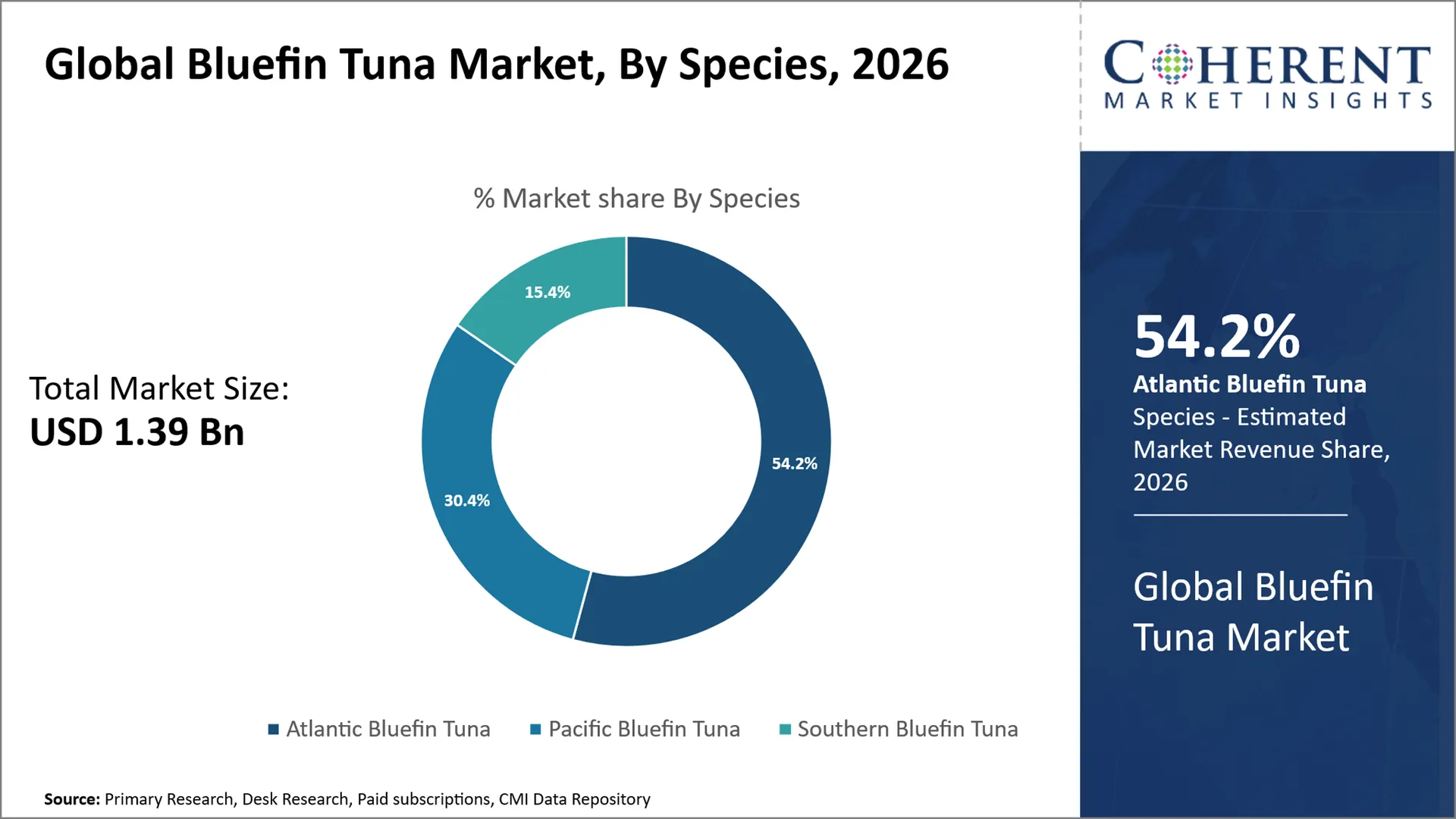
- Atlantic Bluefin Tuna is expected to register an estimated CAGR of 7.3% during 2026–2033, with a 54.2% global market share in 2026. Established Mediterranean fisheries, premium fat profiles, and high-value sushi applications underpin its commercial position. In May 2026, the UK Marine Management Organisation awarded 30 commercial bluefin tuna authorisations, widening regulated access for domestic fishing businesses.
- Wild Caught and Ranch Raised Bluefin Tuna is projected to grow at an estimated 8.1% CAGR during 2026–2033, accounting for 57.8% of the market in 2026. Ranching enables operators to improve fish weight, fat content, and harvesting flexibility, supporting premium seafood supply. In November 2025, authorization periods began for several Australian tuna ranching facilities registered with the Commission for the Conservation of Southern Bluefin Tuna, extending through October 2026.
- Fresh and Chilled is projected to grow at an estimated 7.9% CAGR during 2026–2033, accounting for 58.6% of the market in 2026. Sushi restaurants value its appearance, texture, and suitability for premium raw preparations, making refrigerated logistics commercially important. In March 2026, FAO GLOBEFISH documented seasonal trading peaks for premium fresh Atlantic and Pacific bluefin tuna in sashimi markets.
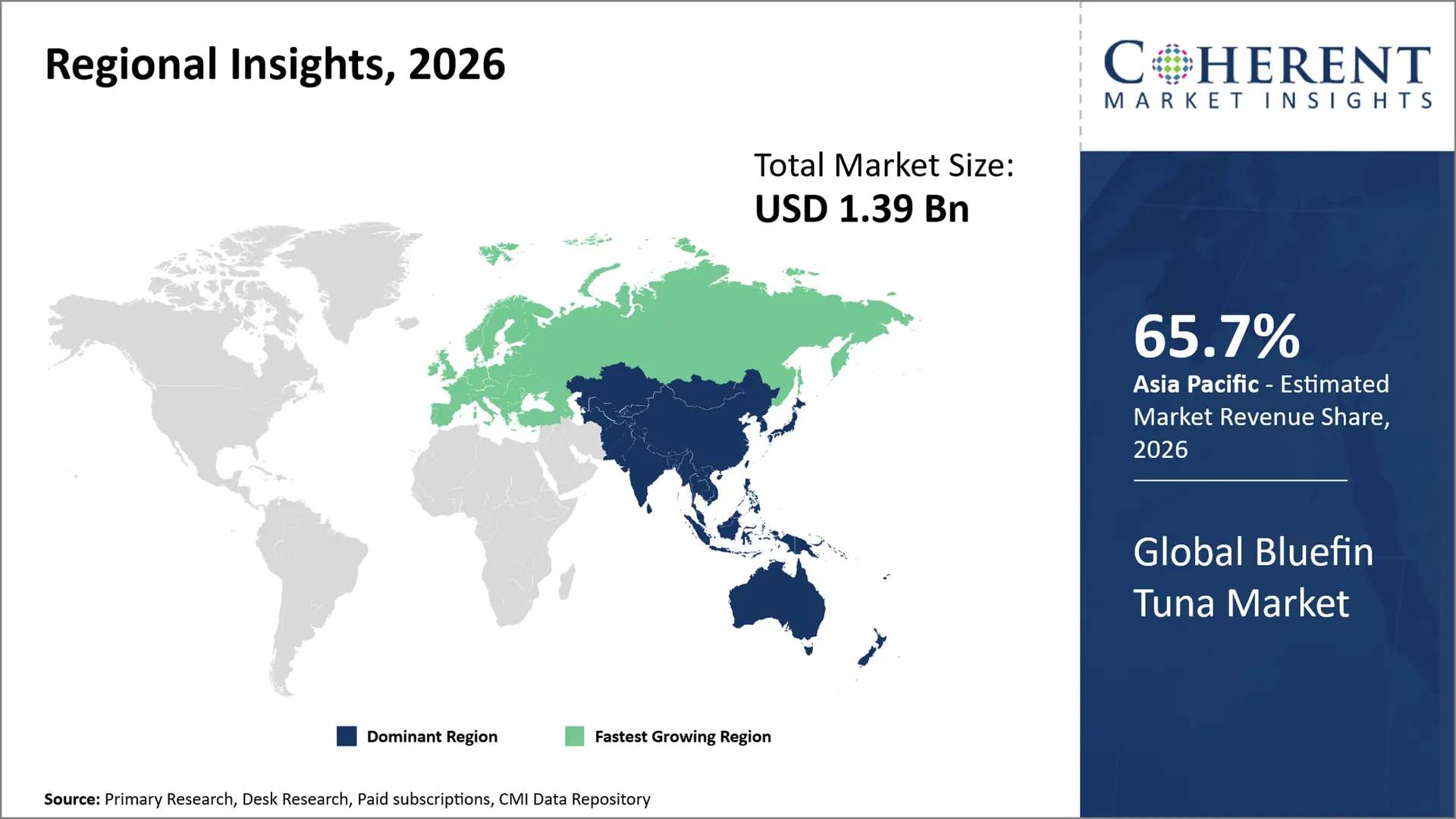
- Asia Pacific is anticipated to post an estimated 7.2% CAGR during 2026–2033 and retain 65.7% of global bluefin tuna market revenue in 2026. Japan's established wholesale auctions, specialist distributors, and sushi operators concentrate high-value purchasing within the region. In January 2026, Kiyomura acquired an Oma bluefin tuna at Tokyo's Toyosu auction, demonstrating how flagship purchases support restaurant brand positioning.
- Europe is estimated to deliver a 9.5% CAGR during 2026–2033, the fastest regional growth rate, while representing 20.5% of global revenue in 2026. Mediterranean fishing capacity, tuna ranching, and established export links offer scope for greater commercial throughput. In November 2025, the European Commission announced a 17% increase in the EU's eastern Atlantic and Mediterranean bluefin tuna fishing quota.
Segmental Insights
Why Does Atlantic Bluefin Tuna Dominate the Global Bluefin Tuna Market?
Atlantic Bluefin Tuna is expected to account for 54.2% of the global bluefin tuna market by species in 2026. Its commercial strength comes from established catch documentation across the eastern and western Atlantic and processing networks able to grade individual fish for different price tiers. Exporters can assemble consignments from regulated landings, while specialist buyers value reliable records of vessel origin, catch area, and handling. This also makes procurement sensitive to quota utilization. Once authorized catches approach their limits, buyers have less flexibility to secure additional supply during peak purchasing periods. In May 2026, NOAA Fisheries reported that the U.S. Atlantic bluefin General category landed 676.5 metric tons during 2025, equivalent to 99% of its adjusted quota. Such utilization highlights why compliance planning and early supplier contracting remain important for seafood traders and restaurant procurement teams.
- Current Industry Events of 2026
- Market Size Estimation
- Regional Breakdown
- Competitive Landscape
- Customer Intelligence
- Segmental Analysis
- Pricing Analysis
- Key Market Drivers, Challenges & Future Trends
- Customized Insights Section
Why Does Wild Caught and Ranch Raised Dominate the Production Method Segment of the Global Bluefin Tuna Market?
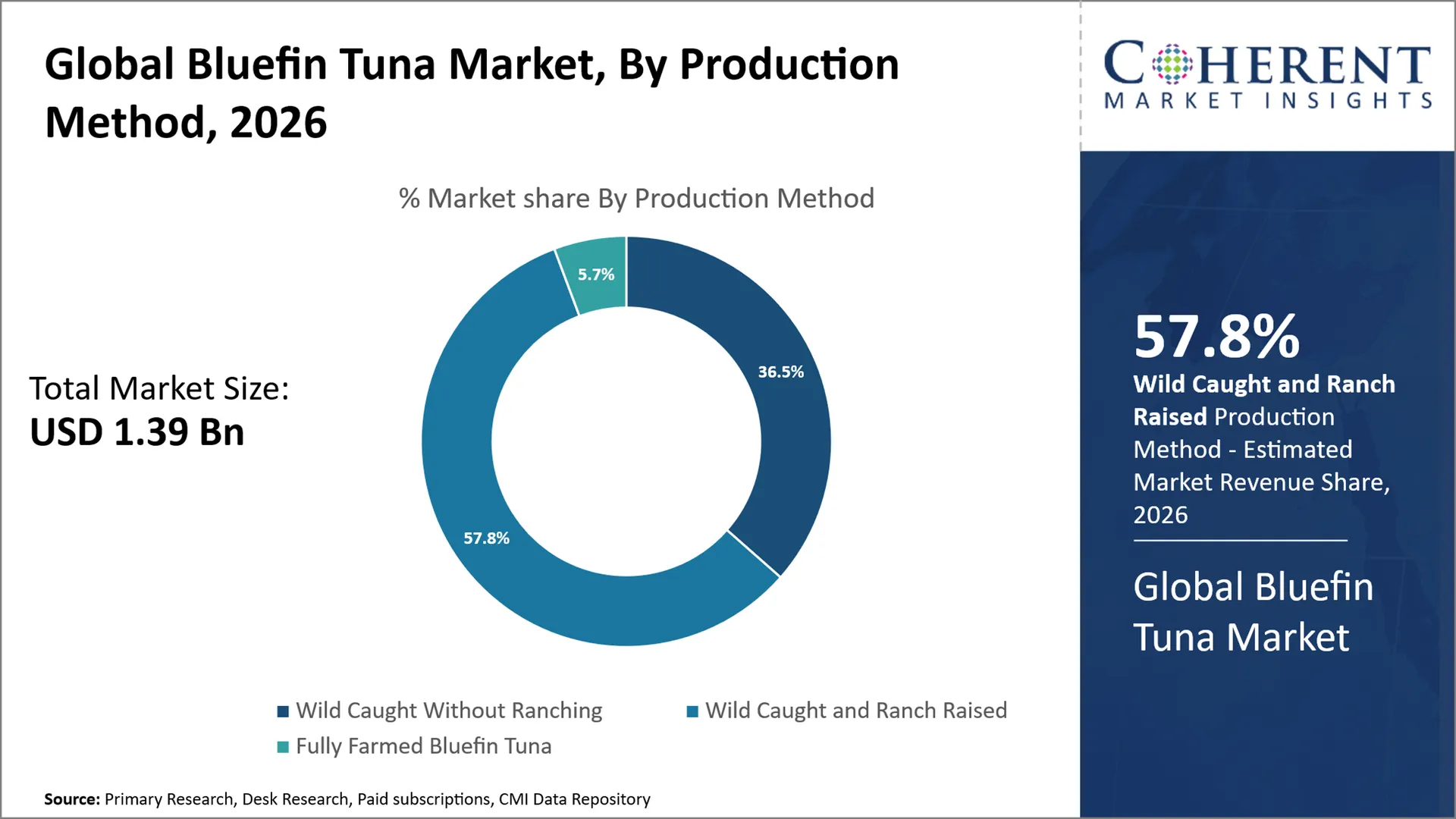
Wild Caught and Ranch Raised Bluefin Tuna is expected to account for 57.8% of the global bluefin tuna market by production method in 2026. This method combines regulated wild capture with controlled fattening, allowing producers to improve fish weight and maintain desirable fat characteristics before harvesting. Offshore holding facilities also provide greater flexibility in scheduling harvests and fulfilling export orders. Seafood importers and premium foodservice buyers benefit from more predictable product specifications and shipment planning. However, profitability depends on live fish procurement costs, feed efficiency, and survival rates during ranching. In November 2025, Malta's National Statistics Office reported that aquaculture operators spent EUR 59.8 million purchasing live bluefin tuna and other fish for fattening in 2024. This highlights the substantial working capital required for capture-based tuna aquaculture and the importance of efficient production management.
Why Does Fresh and Chilled Dominate the Product Form Segment of the Global Bluefin Tuna Market?
Fresh and Chilled is expected to command 58.6% of the global bluefin tuna market by product form in 2026. Unlike products held frozen for extended inventory periods, chilled fish gives professional purchasers an opportunity to examine texture, color consistency, and cutting characteristics before committing it to specific menu formats. This immediate quality assessment helps wholesalers separate higher-value portions from material better directed to other preparations, reducing disputes over grades and improving usable yield. The model particularly suits short-order cycles at specialist counters and restaurants where inventory turns rapidly, although careful handling and accurate delivery forecasts are essential to limit losses. In February 2026, Kyokuyo Co., Ltd. reported higher sales of domestically farmed bluefin tuna amid strong demand for fresh tuna in its third-quarter financial results. The disclosure underscores the commercial importance of fresh product availability.
Current Events and their Impact
Current Event | Description and Its Impact |
February 2025 – WCPFC Introduced Additional Pacific Bluefin Tuna Monitoring Requirements |
|
November 2025 – Australia Confirmed Southern Bluefin Tuna Catch Allocation |
|
April 2026 – South Korea Initiated Pacific Bluefin Tuna Aquaculture Research |
|
Global Bluefin Tuna Market Dynamics
Key Market Drivers
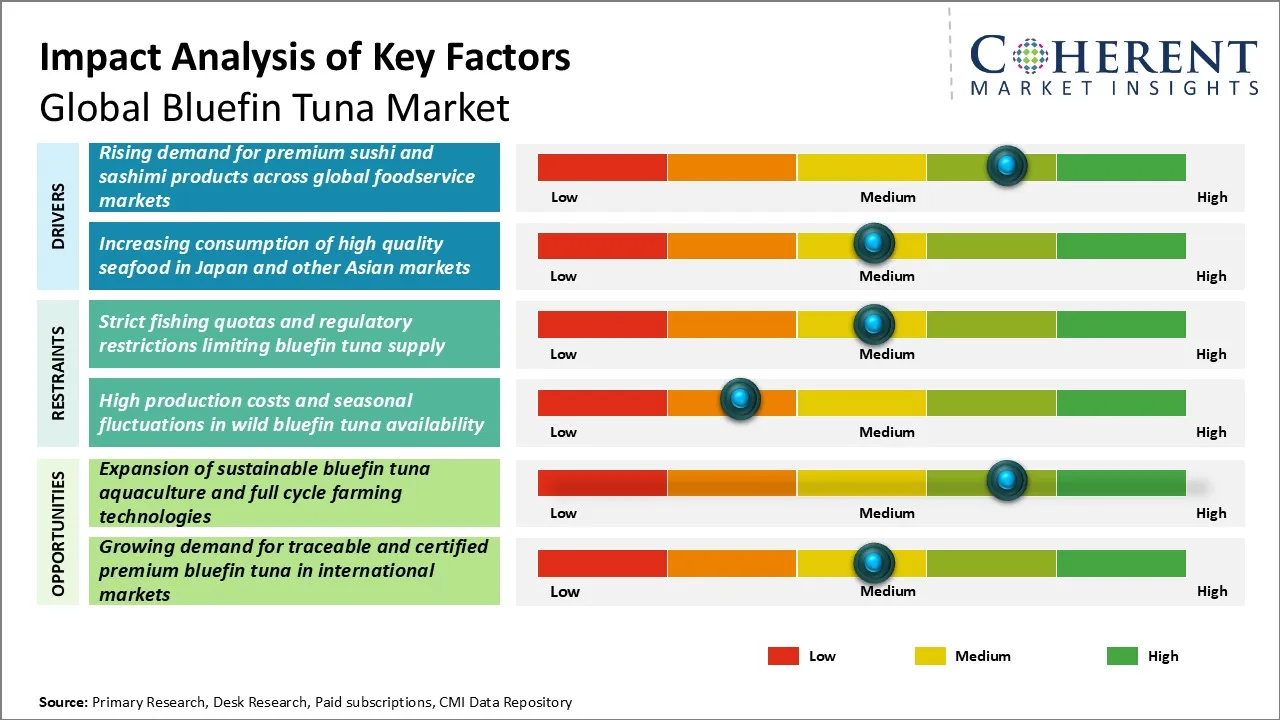
- Rising demand for premium sushi and sashimi products across global foodservice markets: Premium sushi and sashimi menus give bluefin tuna a commercial role beyond ordinary seafood procurement. Restaurants need dependable access to desirable cuts to maintain signature dishes and protect menu pricing, encouraging longer commitments between buyers and aquaculture partners. Integrated sourcing also reduces the risk of promotional menus being withdrawn when fish are scarce. In May 2025, Kura Sushi announced the first shipment of contract-farmed bluefin from its seafood farming initiative, intended for selected premium and flagship restaurants. The arrangement illustrates how foodservice operators can link supply planning directly to menu strategy.
- Increasing consumption of high quality seafood in Japan and other Asian markets: Japanese consumers distinguish lean akami from richer chutoro and otoro, allowing operators to sell separate eating experiences from a single bluefin tuna. That variety supports premium seafood purchasing without limiting sales to luxury restaurants; specialized retailers and regional Asian sushi chains can also design products around specific cuts. Consistent grading becomes important because customers compare taste and texture across visits. In December 2025, FOOD & LIFE COMPANIES reported that three bluefin-based offerings led menu sales at its Osaka Expo sushi restaurant. The result indicates commercially meaningful demand for different bluefin preparations.
Emerging Market Trends
- Feed Efficiency and Specialized Nutrition Are Reshaping Bluefin Ranching Economics: Feed efficiency is emerging as a purchasing and operational issue in bluefin ranching. Reliance on forage fish creates costs associated with feed procurement, storage, delivery, and variable nutritional composition. Better ration planning and gradual acceptance of specialized formulated diets, where technically feasible, could lower waste and improve predictability of fish condition. Feed suppliers and vertically integrated ranchers would benefit if nutritional consistency improves, while operators tied to inflexible bait supply would face higher working-capital demands. Adoption will remain constrained by bluefin feeding behavior and the need to demonstrate growth performance.
- Climate-Adaptive Harvesting and Aquaculture Site Management Are Becoming More Important: Climate-related uncertainty is encouraging a more flexible approach to harvesting and marine grow-out schedules. Operators exposed to abnormal water temperatures, storms, and changing fish distribution may need contingency harvesting plans rather than fixed seasonal assumptions. This could change how farms select sites, maintain holding capacity, schedule transport vessels, and finance live inventory. Businesses with diversified operating locations and responsive logistics would be better placed to honor customer commitments. Smaller producers may face higher insurance and working-capital requirements as operational resilience becomes a purchasing consideration.
Regional Insights
Why Does Asia Pacific Dominate the Global Bluefin Tuna Market?
Asia Pacific is expected to account for 65.7% of the global bluefin tuna market in 2026, reflecting the region's combination of established purchasing centers and active Pacific bluefin fisheries. Japan remains a major destination for high-value tuna, while coastal markets elsewhere in Asia also earn revenue from landings, auctions, and seafood-focused tourism. This regional structure allows bluefin to generate value before reaching export buyers, particularly when local businesses promote specific catch seasons and recognizable origins. In May 2026, Taiwan's Ministry of the Interior reported that the Donggang Bluefin Tuna Cultural and Tourism Festival had begun, coinciding with vessel arrivals, tuna unloading, and active seafood trading at Donggang Fishing Port. Such activity shows how fishing ports can combine wholesale transactions with hospitality income, strengthening the commercial ecosystem around this species.
Why Is Europe Emerging as the Fastest-Growing Region in the Global Bluefin Tuna Market?
Europe is projected to represent 20.5% of global bluefin tuna market revenue in 2026 and is identified as the fastest-growing region in the approved forecast. Its expansion potential is tied to the Mediterranean's established tuna-catching and fattening operations, specialist processing capacity, and access to both European foodservice buyers and overseas customers. Beyond existing farms, operators are exploring whether alternative Atlantic growing locations can widen production options while remaining within strict fisheries controls. In May 2025, the European Commission's Delegated Regulation 2025/837 extended provisions for a pilot bluefin tuna farming project in Spain's Cantabrian Sea through September 2025. The measure authorized a limited regulatory pathway rather than confirming commercial production. It nevertheless demonstrates how carefully controlled experimentation could diversify Europe's operating geography and create new opportunities for aquaculture services and logistics.
Global Bluefin Tuna Market Outlook for Key Countries
Why Is the U.S. a Key Market for the Global Bluefin Tuna Market?
The U.S. is commercially important to the global bluefin tuna market because it combines Atlantic fishing activity with a restaurant sector willing to pay for species-specific cuts. Established New England landing and dealer networks support domestic sourcing, while metropolitan sushi businesses can buy portioned bluefin from specialized distributors. A key opportunity lies in using modest servings of expensive cuts to create accessible premium menu items without requiring restaurants to purchase whole fish. In June 2026, New York's Rollcraft opened in the East Village with bluefin tuna among its highlighted hand-roll offerings. The restaurant's published menu lists both bluefin preparations and a separate chutoro offering, indicating differentiated selling opportunities within a compact dining format. For suppliers, consistent portion specifications and timely deliveries matter more in this channel than selling large whole-fish volumes.
Why Is India Important in the Global Bluefin Tuna Market?
India's position in the global bluefin tuna market is primarily that of an emerging, selective import destination rather than a large domestic harvesting base. The most credible demand comes from upscale Japanese restaurants in cities where consumers are prepared to purchase imported sashimi and chef-led tasting menus. Because bluefin commands a high landed cost, importers must match airfreight schedules, temperature control, and small-order distribution to comparatively narrow restaurant demand. In May 2025, the opening of Otoki, a Japanese izakaya in Mumbai's Colaba district, brought bluefin tuna cuts into a live sushi-bar format, as documented by Condé Nast Traveller India. This illustrates a practical route to market through specialist dining rather than mass retail. Growth will depend on reliable sourcing, trained chefs, and customers' willingness to pay for distinguishable cuts.
Why Does China Support Growth in the Global Bluefin Tuna Market?
China's role in the global bluefin tuna market is increasingly linked to imported premium fish rather than large-scale domestic bluefin production. Shanghai provides a gateway through which chilled Atlantic bluefin can reach restaurants and seafood distributors, while buyers must coordinate import inspection with rapid onward delivery. Building direct commercial relationships with approved European suppliers could broaden product choice and reduce dependence on single-origin procurement. In March 2026, Shanghai's state-owned assets regulator reported that Longmen Company, part of Bright Food Group's seafood operations, had completed its first import of chilled Atlantic bluefin tuna from Croatia. After airport inspection, the shipment was distributed to Shanghai and other Chinese markets. This demonstrates an operational route for Mediterranean farmed fish to enter China's premium refrigerated seafood supply chain.
Why Is Germany a Strategic Country in the Global Bluefin Tuna Market?
Germany occupies a specialized position in the global bluefin tuna market, with demand concentrated in premium restaurants rather than the country's mainstream canned-tuna trade. German chefs can use bluefin to offer distinctive raw seafood dishes, but the category faces limitations from high purchasing costs, sourcing scrutiny, and consumer expectations concerning responsible fisheries. Importers therefore need credible origin information and smaller, dependable deliveries suited to selective hospitality customers. In February 2026, Süddeutsche Zeitung described bluefin tuna sashimi on the menu at Hai Seafood Izakaya in Munich. This illustrates how bluefin can reach German diners through contemporary Japanese-inspired seafood restaurants, even without a substantial local production base. Commercial upside will depend on sustainable purchasing policies and the ability to preserve quality across international distribution, not broad supermarket penetration.
Why Is Brazil an Important Growth Market for the Global Bluefin Tuna Market?
Brazil is a developing premium-consumption outlet for the global bluefin tuna market, particularly through specialist Japanese restaurants and imported seafood distribution in São Paulo. Domestic tuna fishing does not provide the same established bluefin supply structure seen in the North Atlantic or Mediterranean, making overseas sourcing important for this niche. Working capital can be a challenge because importers must finance high-value refrigerated inventory before selling it to restaurants. In July 2026, São Paulo state's tax authority issued Portaria SRE 35, providing qualifying importers with a conditional suspension of ICMS assessment at customs clearance for specified seafood, explicitly including fresh or chilled bluefin tuna. The measure could ease import cash-flow timing without removing underlying tax liabilities, making compliance capability an important advantage for local seafood traders
Bluefin Tuna Production, Product Quality and Supply-Chain Technology Landscape
Technology | Adoption Landscape | Key Application | Commercial Implications |
Underwater Sonar and Acoustic Monitoring Systems | Commercially applied in selected tuna farming operations | Monitoring fish movement, estimating in-pen stock, and supporting biomass assessment | Improves stock visibility and enables operators to make better harvesting and inventory decisions. |
Smart Water Quality Monitoring Sensors | Established aquaculture technology with selective bluefin deployment | Monitoring dissolved oxygen, temperature, and other environmental conditions in farming cages | Supports earlier detection of adverse conditions and more responsive fish-health management. |
Near-Infrared Spectroscopy and Digital Fat Analysis | Selective adoption in seafood quality assessment | Estimating fat characteristics and supporting product grading where equipment is validated | May improve classification consistency and reduce disagreement over quality specifications. |
Electronic Catch Documentation and Digital Traceability | Established documentation frameworks with ongoing digital integration | Recording catch origin, farming transfers, processing, and distribution information | Supports regulatory documentation, supply-chain verification, and international buyer requirements. |
Ultra-Low-Temperature Freezing Systems | Established in premium frozen tuna handling | Preserving frozen bluefin tuna intended for high-quality foodservice and export channels | Extends inventory flexibility and supports long-distance trading, although energy and equipment costs remain important. |
Closed-Cycle Breeding and Hatchery Technology | Commercially demonstrated at limited scale with continuing development | Captive broodstock management, spawning, larval rearing, and juvenile production | Offers a potential alternative to dependence on wild-caught juveniles, but biological complexity and high operating costs constrain wider expansion. |
How Is the Commercialization of Underutilized Tuna Cuts Creating New Growth Opportunities in the Global Bluefin Tuna Market?
Underutilized bluefin tuna cuts offer an opportunity to expand the addressable customer base without depending on additional premium sashimi sales. Collar meat, cheek portions, smaller trim pieces, and offcuts can be developed into portion-controlled products for casual restaurants, gourmet ready-meal producers, and specialist retail counters. These applications need consistent specifications and careful separation of edible material from processing waste.
Suppliers could offer marinated preparations, cooking-ready packs, or frozen components designed for predictable kitchen yields. Capturing this opportunity requires skilled butchery, validated food-safety procedures, suitable packaging, and an ordering system that matches irregular cut availability to buyer requirements.
The strongest position is likely to belong to integrated processors and specialist distributors that can manage variability across individual fish. The commercial benefit is better recovery of value per carcass, although product development must avoid overprocessing scarce material or creating costs that exceed its achievable selling price, while preserving brand and origin integrity.
Market Players, Key Development, and Competitive Intelligence
Key Developments
- In March 2026, Fujitsu Limited announced a completed electronic traceability pilot involving farmed bluefin tuna from a Wakayama aquaculture site. Shoppers could access production history through smartphones. This demonstrates a potential way to strengthen product verification and retail confidence, although wider commercial deployment remains planned rather than completed.
- In February 2026, Nissui Corporation outlined plans to increase short-cycle bluefin tuna farming while reducing longer grow-out periods. Management identified mortality exposure and capital turnover as priorities. This approach could limit biological losses and release working capital sooner, provided adequate fish supply and suitable farm conditions are maintained.
- In December 2025, BlueNalu announced approximately USD 11 million in cash and stock proceeds to advance cell-cultivated bluefin tuna toro. It is targeting premium U.S. foodservice, subject to regulatory approval. The proposed product remains pending approval but could eventually challenge conventional supply models for premium tuna cuts.
Competitive Landscape
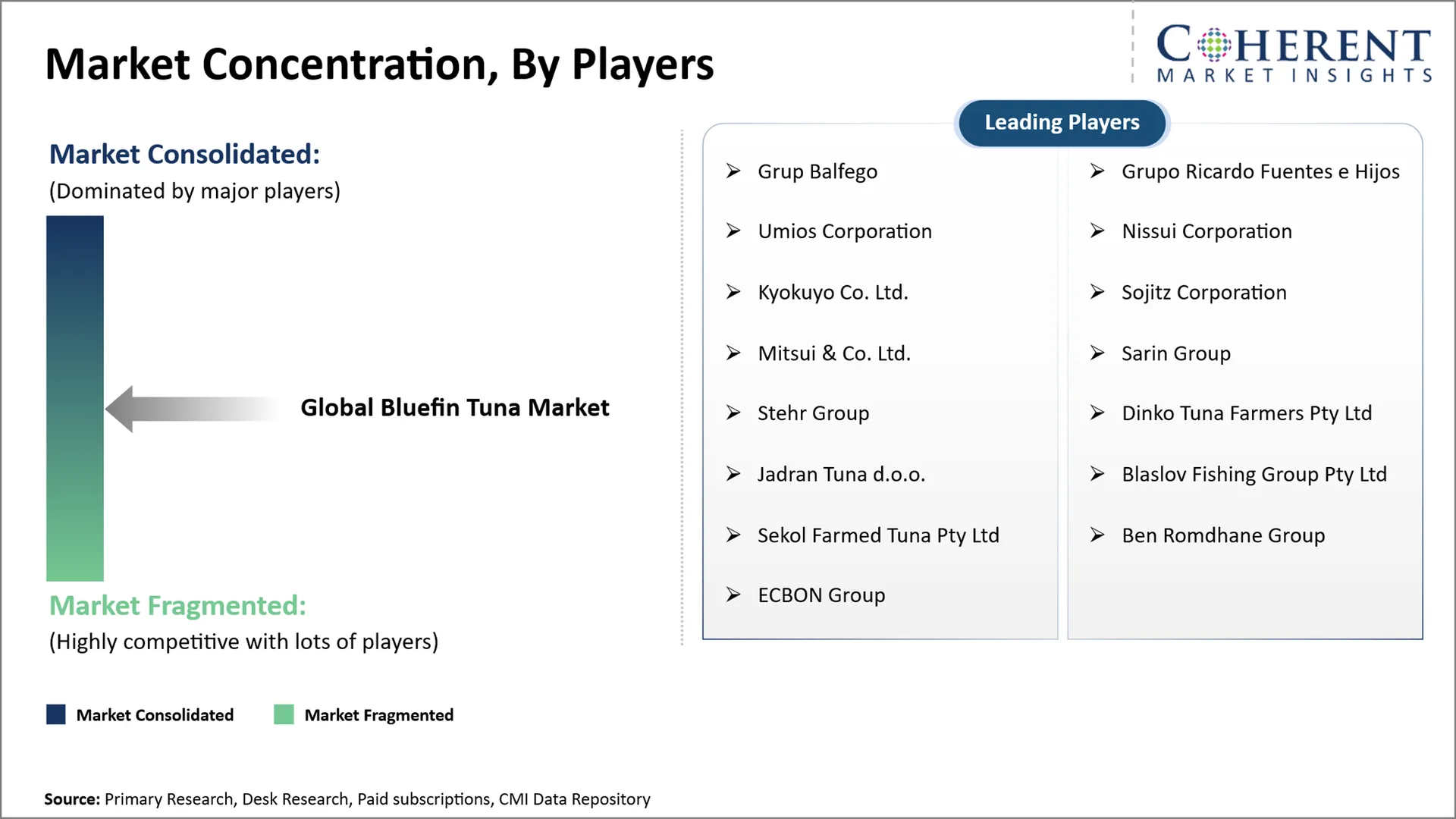
The global bluefin tuna market is moderately consolidated among integrated ranching and export businesses but remains fragmented across fishing fleets, regional traders, and specialist distributors. Competition reflects access to lawful supply, disciplined inventory financing, processing execution, and the ability to fulfill exact buyer specifications. Smaller operators can defend profitable niches through local landing relationships, while larger firms gain leverage from coordinated procurement and market access.
Key Competitive Factors
- Fishing Rights and Quota Access: Secure access to authorized catches influences production planning and supply commitments.
- Biological Risk Management: Controlling fish mortality and maintaining suitable farming conditions remain important to production economics.
- Processing Efficiency: Skilled cutting, controlled handling, and effective recovery of valuable portions influence realized margins.
- Product Quality Consistency: Reliable fat characteristics, texture, and presentation help suppliers maintain customer confidence.
- International Market Access: Established import relationships and distribution networks support access to higher-value export destinations.
- Inventory and Working-Capital Discipline: Effective management of biological assets and harvested stock reduces financing exposure.
- Regulatory Compliance: Reliable documentation, food-safety practices, and responsible sourcing help protect commercial market access.
Market Report Scope
Global Bluefin Tuna Market Report Coverage | |||
Report Coverage | Details | ||
Base Year | 2025 | Market Size in 2026: | USD 1.39 Bn |
Historical Data For: | 2020 To 2024 | Forecast Period: | 2026 To 2033 |
Forecast Period 2026 To 2033 CAGR: | 7.60% | 2033 Value Projection: | USD 2.32 Bn |
Geographies covered: |
| ||
Segments covered: |
| ||
Companies covered: | Grup Balfego, Grupo Ricardo Fuentes e Hijos, Umios Corporation, Nissui Corporation, Kyokuyo Co. Ltd., Sojitz Corporation, Mitsui & Co. Ltd., Sarin Group, Stehr Group, Dinko Tuna Farmers Pty Ltd, Jadran Tuna d.o.o., Blaslov Fishing Group Pty Ltd, Sekol Farmed Tuna Pty Ltd, Ben Romdhane Group, ECBON Group | ||
Growth Drivers: |
| ||
Restraints & Challenges: |
| ||
Analyst Opinion (Expert Opinion)
- Future leadership may depend less on owning the largest fishing fleet than on structuring profitable access to seasonal harvest rights. Firms able to finance purchase commitments, manage quota-linked exposure, and synchronize payment terms across fishing businesses and overseas buyers could become central market intermediaries. That would reward disciplined capital allocation as much as physical production capability.
- An important disruption could emerge if premium bluefin pricing becomes less dependent on public auction benchmarks. Private forward contracts, menu-linked supply commitments, and differentiated quality guarantees may increasingly determine the realized value of individual fish. Traders unable to price risk across contracts could find familiar spot-market margins unreliable, creating room for specialist commercial risk managers.
- Suppliers should prioritize margin visibility at the individual-fish level, stronger buyer credit checks, and processing flexibility that preserves alternative sales routes when preferred orders change. Targeted investment in quality control and practical contingency arrangements is preferable to indiscriminate increases in holding capacity. Major risks include quota uncertainty, biological losses, expensive inventory, and demand concentration among a narrow set of buyers.
Speak to the analyst
Want personalized insights?
Take the findings above to one of our principal consultants, or have the report rebuilt around the segments, geographies and competitors you actually track.
Market Segmentation
- Species Insights (Revenue, USD Bn, 2021 - 2033)
- Atlantic Bluefin Tuna
- Pacific Bluefin Tuna
- Southern Bluefin Tuna
- Production Method Insights (Revenue, USD Bn, 2021 - 2033)
- Wild Caught Without Ranching
- Wild Caught and Ranch Raised
- Fully Farmed Bluefin Tuna
- Product Form Insights (Revenue, USD Bn, 2021 - 2033)
- Fresh and Chilled
- Frozen
- Processed and Preserved
- Product Cut Insights (Revenue, USD Bn, 2021 - 2033)
- Whole Bluefin Tuna
- Loins and Fillets
- Steaks and Portions
- Other Cuts
- End User Insights (Revenue, USD Bn, 2021 - 2033)
- Restaurants and Foodservice
- Retail Consumers
- Food Processing Companies
- Distribution Channel Insights (Revenue, USD Bn, 2021 - 2033)
- Direct B2B Sales
- Seafood Wholesalers and Distributors
- Specialty Seafood Retailers
- Online Sales
- Regional Insights (Revenue, USD Bn, 2021 - 2033)
- North America
- U.S.
- Canada
- Latin America
- Brazil
- Argentina
- Mexico
- Rest of Latin America
- Europe
- Germany
- U.K.
- Spain
- France
- Italy
- Russia
- Rest of Europe
- Asia Pacific
- China
- India
- Japan
- Australia
- South Korea
- ASEAN
- Rest of Asia Pacific
- Middle East
- GCC Countries
- Israel
- Rest of Middle East
- Africa
- South Africa
- North Africa
- Central Africa
- North America
Sources
Primary Research Interviews
- Bluefin tuna fishing operators and ranching companies
- Seafood exporters, importers, wholesalers, and distributors
- Sushi restaurant operators, seafood procurement managers, and aquaculture experts
Stakeholders
- Commercial fishing fleets and tuna ranching operators
- Seafood processors, cold-chain providers, and exporters
- Seafood retailers, foodservice companies, and regulatory authorities
End-use Sectors
- Restaurants and foodservice
- Retail consumers
- Food processing companies
Regulatory and Industry Bodies
- International Commission for the Conservation of Atlantic Tunas (ICCAT)
- Commission for the Conservation of Southern Bluefin Tuna (CCSBT)
- Western and Central Pacific Fisheries Commission (WCPFC)
- Food and Agriculture Organization (FAO)
- National Oceanic and Atmospheric Administration (NOAA)
- Japan Fisheries Agency
Databases
- FAO FishStat and GLOBEFISH databases
- UN Comtrade international seafood trade database
- ICCAT and CCSBT catch and quota statistics
- NOAA Fisheries commercial landings statistics
- Eurostat international trade statistics
Magazines and Journals
- SeafoodSource
- IntraFish
- Fisheries Research
- Aquaculture
- Marine Policy
Associations
- Australian Southern Bluefin Tuna Industry Association (ASBTIA)
- Japan Fisheries Association
- National Fisheries Institute (NFI)
- Federation of European Aquaculture Producers (FEAP)
Public Domain Sources
- Bluefin tuna catch volumes, quotas, and stock assessments
- Wild-caught and ranch-raised tuna production statistics
- Fresh, chilled, and frozen bluefin tuna trade and pricing data
- Sushi and sashimi consumption and seafood import trends
- Tuna ranching, sustainability, and traceability developments
Key Standards and Regulations
- ICCAT Recommendation 24-16 – Electronic Bluefin Tuna Catch Documentation (eBCD)
- ICCAT Recommendation 24-07 – Bluefin Tuna Aquaculture Management
- CCSBT Catch Documentation Scheme – Southern Bluefin Tuna Traceability
- EU Regulation (EC) No. 1005/2008 – Illegal, Unreported, and Unregulated Fishing
- U.S. FDA 21 CFR Part 123 – Fish and Fishery Products HACCP
Proprietary Elements
- CMI Data Analytics Tool
- Proprietary CMI repository containing 10+ years of industry intelligence covering bluefin tuna production, fishing quotas, ranching practices, seafood trade flows, species-specific pricing, sushi and sashimi consumption, regional supply chains, sustainability regulations, and competitive intelligence.
Get access to 250+ pages report
Every segment, forecast, competitor profile and data table behind the analysis above — available for instant download.
- ESOMAR Member
- ISO 9001:2015 Certified
- D-U-N-S Registered
- GDPR & CCPA Compliant
Frequently Asked Questions
The CAGR of global bluefin tuna market is projected to be 7.60% from 2026 to 2033.
The global bluefin tuna market is estimated to be valued at USD 1.39 Bn in 2026 and is expected to reach USD 2.32 Bn by 2033.
Aquaculture supports bluefin tuna production through ranching and farming practices that help improve fish quality, manage harvesting schedules, and maintain commercial supply.
International trade connects bluefin tuna producers with premium seafood buyers, supporting cross-border distribution through specialized importers, exporters, and cold-chain logistics providers.
Traceability helps verify bluefin tuna origin, fishing documentation, and supply-chain compliance, supporting responsible sourcing and improving transparency for seafood buyers.
Cold-chain infrastructure helps preserve bluefin tuna freshness, texture, and product quality during storage and transportation, enabling reliable distribution to international seafood markets.
The growing demand for premium sushi and sashimi across global foodservice markets, along with increasing consumption of high-quality seafood in Japan and other Asian countries, is driving the growth of the global bluefin tuna market.