
Global Botanical Sweat-Control Actives Market Size and Forecast – 2026 To 2033
The Global Botanical Sweat-Control Actives Market is estimated to be valued at USD 24.5 Mn in 2026 and is expected to reach USD 85.8 Mn by 2033, exhibiting a compound annual growth rate (CAGR) of 19.60% during the forecast period. Market growth is being driven by increasing demand for plant-based ingredients in personal care formulations that provide sweat and moisture management, odor control, and skin-conditioning benefits. Manufacturers are looking to actives sourced from sage, horsetail complexes and other functional botanical extracts to create differentiated deodorant and freshness products.
Advances in botanical extraction, plant-cell biotechnology and ingredient standardization are also opening up opportunities for suppliers to offer higher value formulations. In November 2023 Vytrus Biotech announced that its Deobiome Noni botanical deodorant active, developed using noni plant stem-cell technology, had received NATRUE approval. This evolution mirrors the increasing commercial importance of botanical ingredients from biotechnology with acknowledged natural-cosmetic credentials
Key Takeaways of Global Botanical Sweat-Control Actives Market
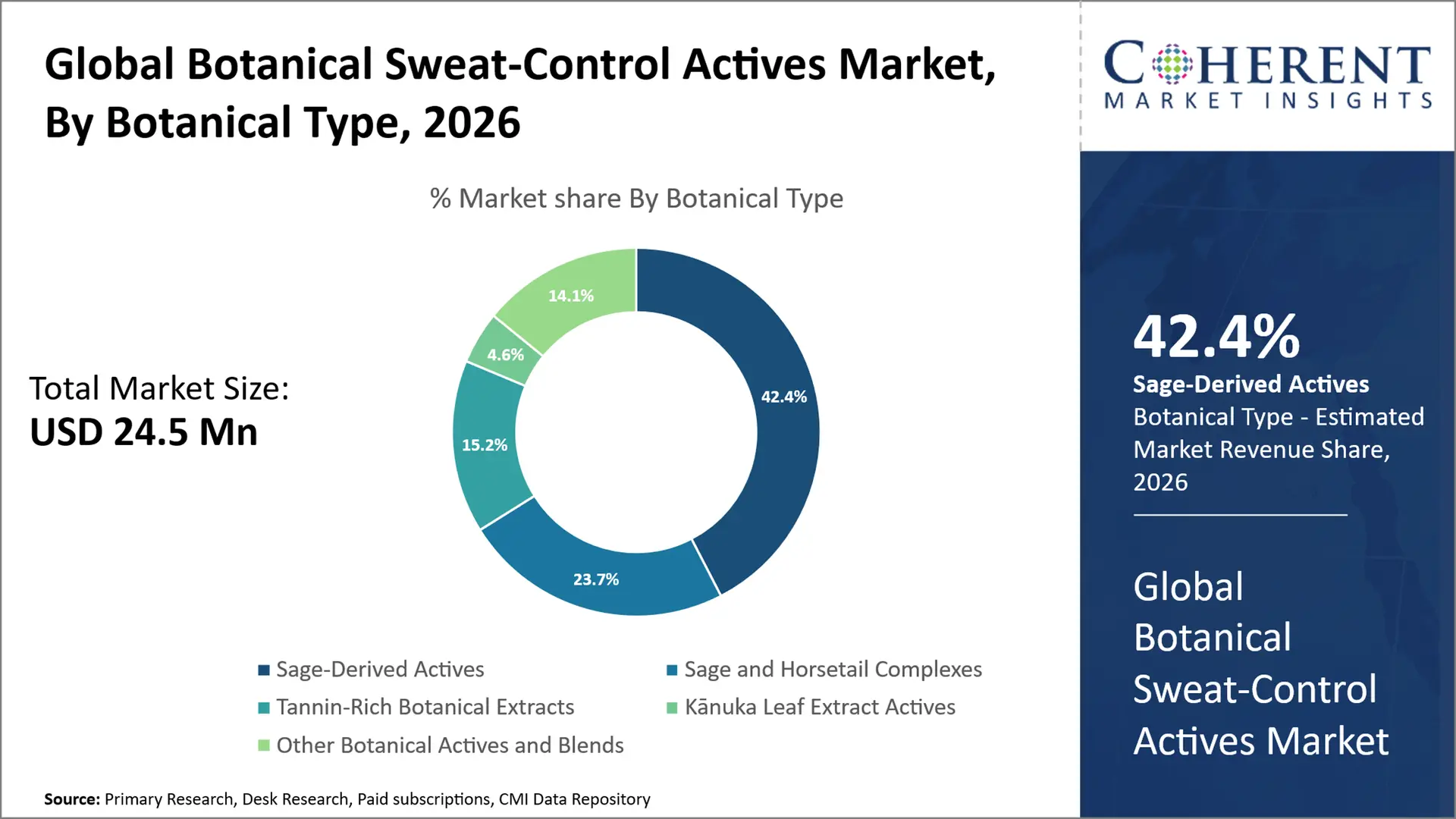
- Sage-Derived Actives are projected to post an estimated 18.7% CAGR during 2026–2033 and represent 42.4% of the global botanical sweat-control actives market in 2026. Their recognized astringent and deodorant functions support formulation interest, but safety documentation remains essential. In February 2026, a Cosmetic Ingredient Review assessment found six leaf- and oil-derived sage ingredients safe under specified, non-sensitizing use conditions.
- Liquid Extracts are anticipated to grow at a CAGR of 19.0% during the forecast period and account for a share of 56.2% of the global botanical sweat-control actives market in 2026. The pumpable concentrates are easily metered and blended into roll-ons, sprays and fluid deodorants, thereby increasing formulation efficiency. In April 2025 Naturalis launched DEO-MILD, a liquid deodorant active based on grapefruit extracts, targeting the microbial activity responsible for odor formation.
- Sweat and Moisture Management is estimated to expand at a 19.4% CAGR during 2026–2033 and account for 43.6% of the global botanical sweat-control actives market in 2026. Botanical absorbents help formulators control surface wetness without claiming to obstruct sweat glands. In April 2024, AKT detailed its Deo-Barrier Complex, which uses plant-derived arrowroot powder to absorb moisture while allowing normal perspiration.
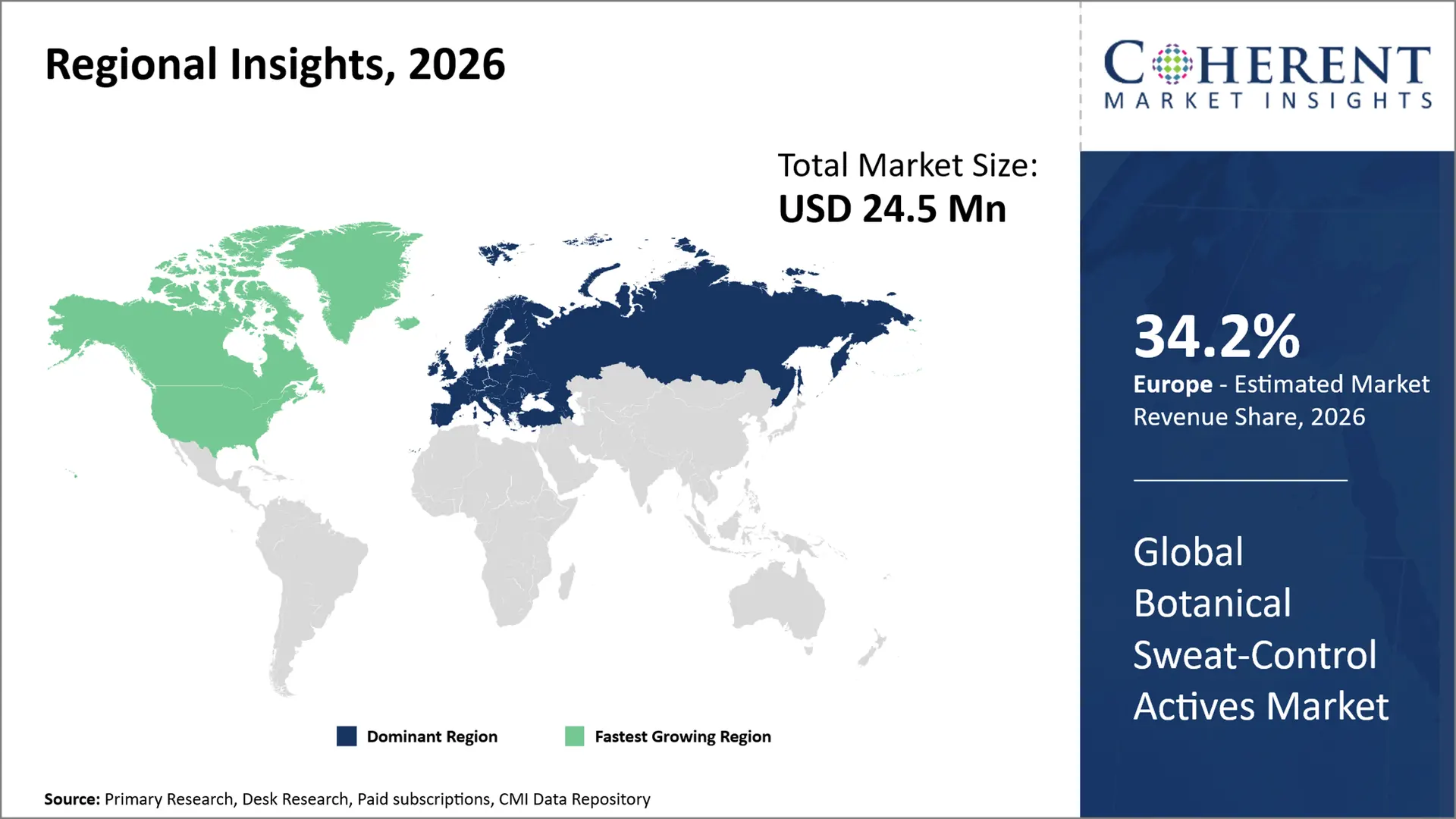
- Europe is anticipated to dominate the global botanical sweat-control actives market by holding a share of 34.2% with an estimated CAGR of 18.6% through 2033. Regional expertise in botanical extraction, ingredient traceability, and performance testing facilitates premium supplier relationships. In March 2024, French manufacturer SILAB launched DEOLYA, a meadowsweet-based deodorant active with traceable botanical raw materials from certified French organic suppliers.
- North America is anticipated to be the fastest-growing region, registering an estimated CAGR of 21.2% during the forecast period from 2023 to 2033, while accounting share for 31.4% of the global botanical sweat-control actives market in 2026. Its opportunity is in bringing botanical freshness formulations to mainstream retail and full-body care. US brand Cleo+Coco announced it will be launching in Whole Foods Market with its natural deodorant balms and plant-based body powders in June 2025.
Segmental Insights
Why Do Sage-Derived Actives Dominate the Global Botanical Sweat-Control Actives Market?
Sage-derived actives are estimated to account for 42.4% share of the global botanical sweat-control actives market in 2026. Their leadership demonstrates the flexibility of sage leaf extracts and oils in deodorant systems that combine botanical identity with odor-control functionality. Ingredient buyers must distinguish between standardized sage extracts and aromatic oils, because the two have different safety, stability and solubilization requirements. The flexibility means they can be used in clear sprays and underarm products, opening up opportunities for suppliers that can offer reproducible botanical specifications. In May 2025, Azelis-owned Glenn launched its Scenter Sage deodorant spray formulation with Salvia officinalis leaf extract and sage oil along with complementary deodorizing ingredients. The formulation shows the possibility of using sage-derived materials in technically defined deodorant concepts, which are not necessarily based on their functional properties.
- Current Industry Events of 2026
- Market Size Estimation
- Regional Breakdown
- Competitive Landscape
- Customer Intelligence
- Segmental Analysis
- Pricing Analysis
- Key Market Drivers, Challenges & Future Trends
- Customized Insights Section
Why Do Liquid Extracts Represent the Largest Product Form in the Global Botanical Sweat-Control Actives Market?
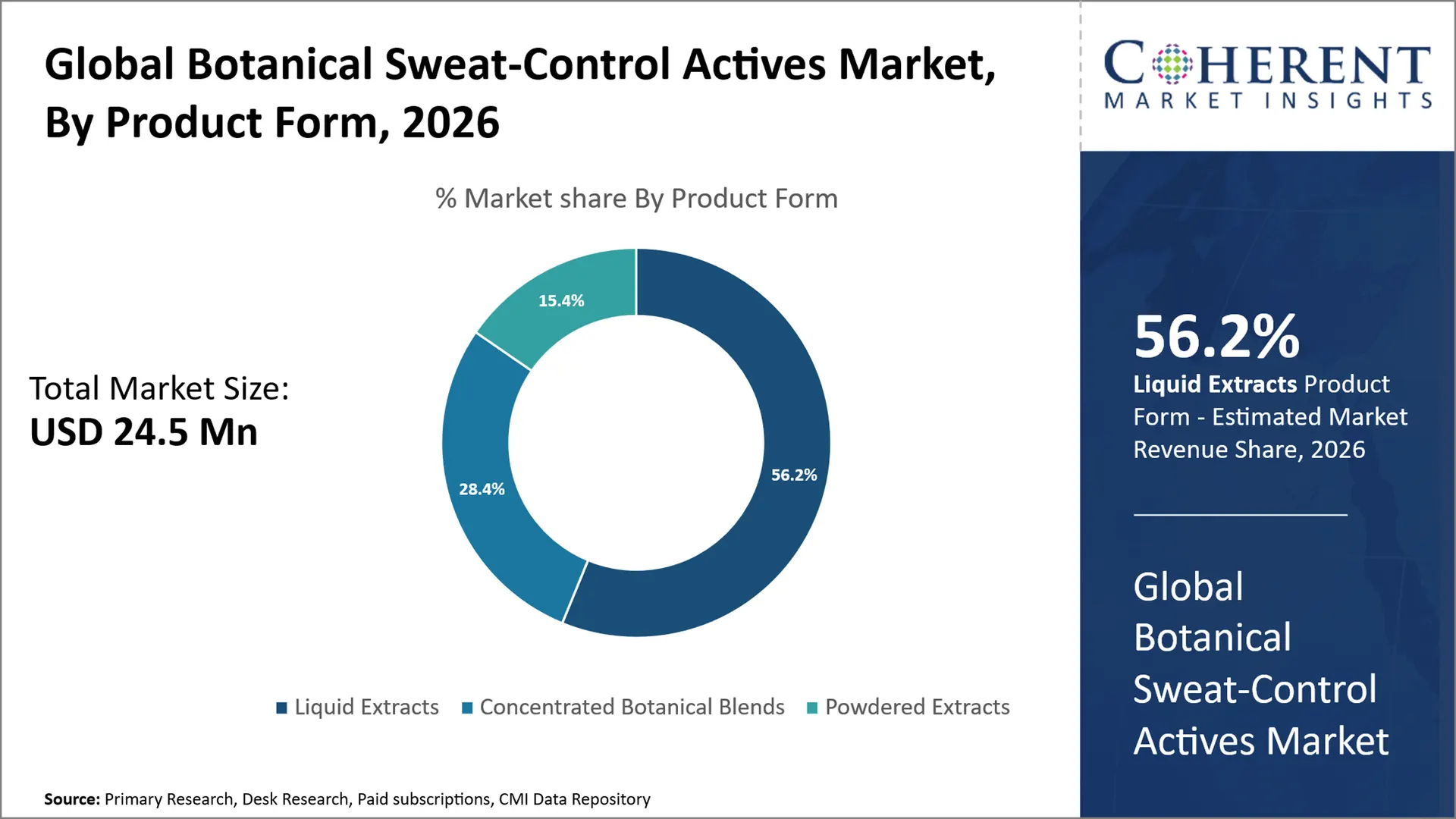
Liquid extracts are projected to lead the product-form category in 2026, accounting for 56.2% of the global botanical sweat-control actives market. Their principal commercial benefit is that they can be incorporated into high-water formulations. Manufacturers can add compatible liquid botanicals without first dispersing powders, thus decreasing the number of processing steps and the potential for sedimentation. For clear deodorant sprays and roll-ons, the solvent composition and color, odor, preservation and microbiological quality remain key purchasing criteria. Suppliers' documented batch specifications and consistent liquid grades can shorten formulation development cycles. In April 2024, Lipoid Kosmetik launched its Herbasol Plant Water range. These transparent plant liquids are made by steam distillation and are designed for cosmetic formulations. The range takes a practical approach to liquid-botanical sourcing but sweat-control efficacy needs validating at the individual ingredient level.
Why Does Sweat and Moisture Management Dominate the Function Segment of the Global Botanical Sweat-Control Actives Market?
Sweat and moisture management will be the largest functional category, accounting for 43.6% share in 2026 for the global market for botanical sweat-control actives. The commercial significance of this product is that consumers are seeking relief from surface dampness, stickiness and clothing discomfort and not just fragrance. Botanical powders may be able to absorb surface moisture in aluminum-free products, but should not be marketed as a replacement for antiperspirant actives that reduce sweat production. In particular, for underarm sticks for daily use, formulators have to balance absorption capacity, smooth application, low residue and skin comfort. In September 2025, Bayard Beard and Body launched a natural deodorant containing arrowroot powder alongside kaolin clay and diatomaceous earth for moisture absorption. This formulation illustrates the commercial application of botanical absorbents within multifunctional deodorant systems.
Current Events and their Impact
Current Event | Description and Its Impact |
April 2026 – European Commission Announces More Cosmetic Ingredient Restrictions |
|
July 2026 – EU Fragrance Allergen Labeling Requirements Reach Compliance Deadline |
|
July 2024 – U.S. FDA Deferred Cosmetic Registration Enforcement Period Ends |
|
Global Botanical Sweat-Control Actives Market Dynamics
Key Market Drivers
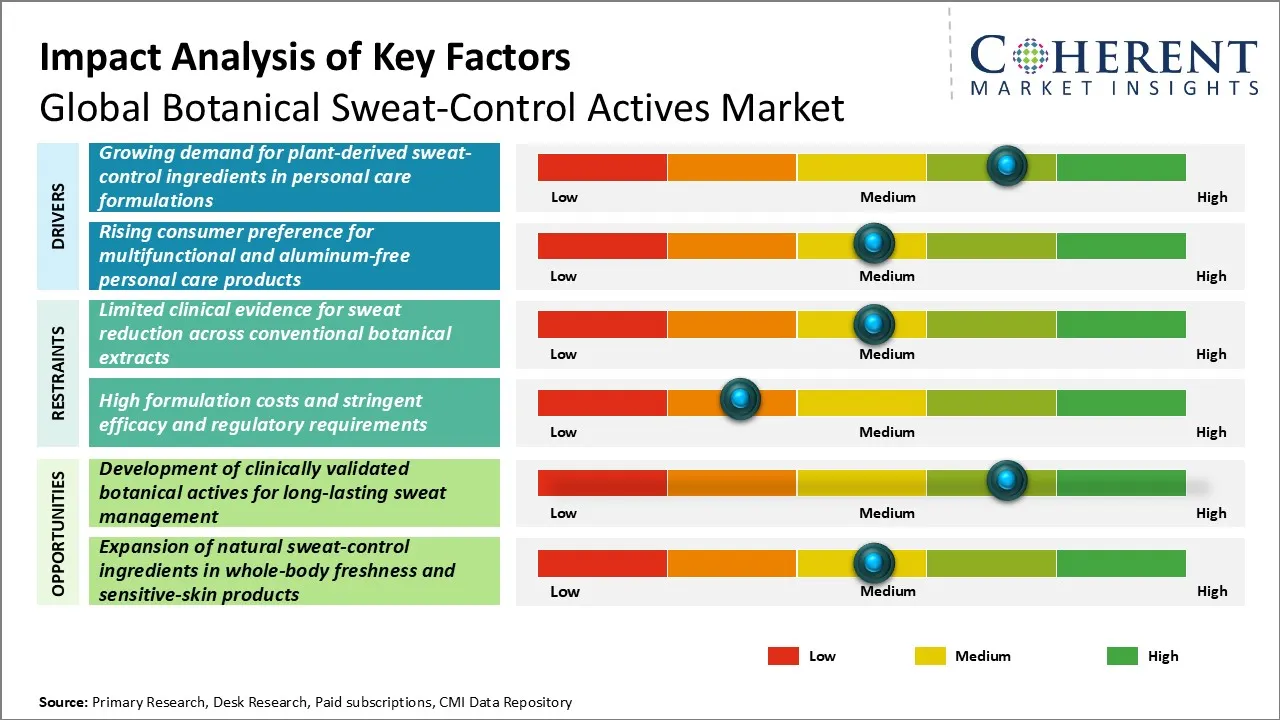
- Growing demand for plant-derived sweat-control ingredients in personal care formulations: plant-sweat-control ingredients in personal care formulations is increasing as personal care manufacturers look for botanical extracts that provide functional benefits beyond fragrance. Sage and other astringent botanicals provide formulation opportunities to help manage underarm freshness, while supporting ingredient suppliers with standardized extract portfolios. Manufacturers can distinguish their products by botanical functionality, skin compatibility and ingredient transparency. In July 2025, Speick Naturkosmetik introduced its Men Deo Roll-on, combining organic sage with a zinc complex in an aluminum-salt-free formulation. This development demonstrates the commercial integration of botanical ingredients into functional deodorant products.
- Rising consumer preference for multifunctional and aluminum-free personal care products: Aluminum-free deodorant formulations are combining skin-conditioning, moisture absorption and odor management in one product. This preference for buying opens up opportunities for botanical ingredient manufacturers that supply absorbent powders, plant oils and skin-supporting extracts that are compatible with mineral deodorizing agents. Brands that strike a balance of functionality can boost their premium perception and promote repeat business. Beauty by Earth launched the Magnesium Deodorant Collection in October 2025. It includes avocado oil, shea butter, coconut oil, and arrowroot powder. The formulation is an example of how manufacturers are blending botanical ingredients with aluminum-free deodorant technologies.
Emerging Market Trends
- Shift Toward Microbiome-Compatible Botanical Odor Management: Botanical deodorant development is moving toward targeted control of odor-causing microbial activity, rather than broad-spectrum antibacterial activity. This methodology requires knowledge of the interactions between plant derived compounds and skin microorganisms and their effect on the metabolic pathways involved in odor production.
Impact: There could be increased pressure for traditional broad-spectrum antimicrobial formulations to differentiate, and ingredient developers may focus on selective efficacy screening. More important will be evidence of skin compatibility.
Market Relevance: Suppliers of targeted botanical actives could gain stronger positions in sensitive-skin deodorants. During the forecast period, microbiome-compatible formulations may command greater customer interest where long-term skin comfort is important.
- Development of Format-Specific Botanical Active Delivery Systems: Instead of providing the same ingredients for all applications, manufacturers of botanical ingredients are moving toward the design of concentrates and stabilized extracts formulated for specific deodorant formats. Active delivery, solubility, sensory performance and storage stability are different issues for waterless sticks, lightweight sprays and compact freshness products.
Impact: Ingredient suppliers may need specialized formulation capabilities to enhance extract compatibility and prevent separation, discoloration or performance degradation.
Market Relevance: Customized delivery systems could strengthen relationships with contract manufacturers and specialty personal care brands. Suppliers offering format-specific ingredients may capture higher-value formulation projects during the forecast period.
Regional Insights
Why Does Europe Dominate the Global Botanical Sweat-Control Actives Market?
Europe is expected to account for 34.2% of the global botanical sweat-control actives market in 2026, driven by a strong natural cosmetics manufacturing ecosystem and expertise in specialized ingredient development. European formulators can find botanical processors, cosmetic testing laboratories and suppliers who have experience in developing standardized plant-derived ingredients. This infrastructure allows manufacturers to include functional botanicals in differentiated deodorant products while meeting formulation safety and ingredient documentation requirements. Alka, based in the Netherlands, expanded its natural deodorant portfolio with the launch of new fragrances, as well as a fragrance-free, hypoallergenic version, in August 2024. Its formulas contain vegetable-derived oils and emollients and mineral deodorizing ingredients. The diversification of this product is indicative of European personal care manufacturers expanding their natural deodorant portfolios and supporting opportunities for niche botanical ingredient suppliers.
Why Is North America Emerging as the Fastest-Growing Region in the Global Botanical Sweat-Control Actives Market?
North America botanical sweat-control actives market is projected to hold 31.4% of the global market share in 2026, and witness the fastest growth in the region through 2033. The commercial opportunity in the region lies in developing botanical ingredients that address measurable perspiration concerns, rather than just traditional odor-neutralizing solutions. Biotech firms and personal care pioneers are harnessing plant-based systems for better moisture management, opening the door to specialized ingredient research and performance validation. Chicago-based DelNova in October 2026 announced SECCO, a patent-pending aluminum-free deodorant concept with a proprietary blend of plant-sourced ingredients formulated to inhibit perspiration. The announcement is a signal that the region is pushing toward differentiated botanical-based sweat control technologies, though commercial performance is yet to be determined.
Global Botanical Sweat-Control Actives Market Outlook for Key Countries
Why Is the U.S. a Key Market for the Global Botanical Sweat-Control Actives Market?
The U.S. is one of the key botanical sweat-control actives market across the globe owing to the personal care brands developing specialized deodorants for unique age groups and skin requirements. Moisture absorption, application comfort and ingredient suitability are more likely to be considered by formulators when designing products for younger consumers. This creates opportunities for botanical starches and plant-based skin conditioning ingredients in gentle deodorant formulas. In August 2026, U.S. brand Siiiba launched a natural deodorant for preteens and teens that uses arrowroot to absorb moisture and coconut oil and cocoa butter to condition the skin. The launch demonstrates how the development of age-specific deodorants can offer further commercial opportunities for suppliers of botanical ingredients beyond traditional adult personal care products.
Why Is India Important in the Global Botanical Sweat-Control Actives Market?
India could be a growth market for global botanical sweat-control actives with the development of deodorant formulations for prolonged heat exposure, perspiration and frequent daily application. Domestic personal care manufacturers can utilize locally available botanical ingredients, with cost-effective processing, to provide products for consumers seeking freshness without an uncomfortable residue. The country’s growing direct-to-consumer personal care ecosystem also offers an opportunity to test niche formulations before they are distributed through wider retail channels. In October 2026, Indian brand The Bare Bar explained its deodorant formulations that use tapioca starch to absorb moisture, as well as shea butter, sunflower seed oil and spirulina extract. This formulation approach provides opportunities for botanical ingredient suppliers to the local, skin focused deodorant market.
Why Does China Support Growth in the Global Botanical Sweat-Control Actives Market?
China’s importance in the global botanical sweat-control actives market is due to its well-developed plant-extraction industry and its broad capacity to manufacture cosmetic ingredients. Domestic processors may be able to provide deodorant manufacturers with standardized botanical ingredients at competitive prices and in flexible volumes. But for higher value applications, reliable identification of constituents, testing for contaminants and documented methods of processing are required. China’s National Medical Products Administration issued recommended technical standards on biotechnology-derived and plant-derived cosmetic ingredients in April 2026, with implementation planned for May 2027. Such standards provide a clearer technical reference for quality management of ingredients. Therefore, suppliers with full analytical documentation and controlled botanical extraction processes can improve their position with domestic formulators and international cosmetic manufacturers.
Why Is Germany a Strategic Country in the Global Botanical Sweat-Control Actives Market?
Germany is strategically important due to existing natural cosmetics brands, niche botanical formulations and a focus on quality ingredients. In Germany, natural deodorants are increasingly being differentiated by defined botanical functions such as odor management, and complementary benefits for skin conditioning. Ingredient suppliers to this market must contend with extract consistency, fragrance compatibility, allergen documentation and performance testing. The German cosmetics manufacturer lavera is a good example of this. Its product range NATURAL & STRONG deodorants contain the botanical ingredient organic ginseng root extract, which is associated with deodorant protection. This product positioning reveals opportunities for plant-extract suppliers to support functional deodorant formulations. Germany's technical expertise is also a base to build value added botanical ingredients for international personal care customers.
Why Is Japan an Important Growth Market for the Global Botanical Sweat-Control Actives Market?
Japan is providing opportunities for global botanical sweat-control actives market with its highly specialized personal care formulations that target odor, skin stickiness, and seasonal discomfort associated with perspiration. Combining botanical extracts with sensory technologies and proven deodorizing agents can help manufacturers differentiate products. This opens up opportunities for suppliers developing plant-based ingredients that will complement lightweight body sprays and medicated freshness products. In April 2025, Natural Island, a Japanese company, released a medicated body deodorant mist that uses conventional deodorizing technology, combined with botanical ingredients and the fragrance of Japanese mint. The company's associated product information identifies bamboo grass, jasmine, and tea extracts within its freshness formulation approach. This illustrates Japan's interest in combining botanical ingredients with multifunctional body-care systems.
Botanical Sweat-Control Actives: Application and Commercial Landscape
Application Category | Botanical Active Requirements | Key Purchasing Considerations | Commercial Significance |
Underarm Roll-Ons and Sprays | Sage-derived actives, sage–horsetail complexes, and compatible liquid botanical extracts for freshness and odor-management formulations. | Solubility, color stability, skin compatibility, and low-residue application. | Supports recurring B2B ingredient demand from deodorant manufacturers seeking differentiated liquid formulations. |
Underarm Sticks and Balms | Tannin-rich botanical extracts, concentrated botanical blends, and compatible moisture-absorbing plant ingredients. | Absorption performance, formulation stability, smooth application, and ingredient compatibility. | Creates opportunities for specialty suppliers offering multifunctional ingredients for solid deodorant formulations. |
Foot Care Sprays and Creams | Botanical combinations developed for odor management, skin comfort, and moisture-related freshness. | Skin tolerance, compatibility with footwear use, application frequency, and performance under humid conditions. | Provides a specialized opportunity among sports-care, occupational hygiene, and foot-care product manufacturers. |
Foot Care Powders | Powdered botanical extracts and moisture-absorbing plant ingredients suitable for dry formulations. | Particle size, moisture absorption, powder flowability, and residue management. | Supports ingredient differentiation in products intended to manage surface dampness and footwear-related discomfort. |
Whole-Body Freshness Products | Kānuka leaf extract actives and other multifunctional botanical blends suitable for body-care formulations. | Skin compatibility, fragrance tolerance, application-area suitability, and documented odor-control performance. | Expands opportunities for ingredient suppliers serving whole-body deodorants, body mists, and freshness creams. |
Hand and Specialty Sweat-Management Products | Selected astringent botanical extracts and specialized actives evaluated for visible moisture-management benefits. | Rapid absorption, non-sticky finish, product safety, and substantiated performance claims. | Offers niche opportunities for suppliers developing ingredients for specialty hand-care and targeted freshness applications. |
How Can Specialized Footwear and Occupational Freshness Products Create New Growth Opportunities in the Global Botanical Sweat-Control Actives Market?
There is an opportunity for botanical sweat-control ingredient suppliers in specialized foot-care formulations, especially among consumers who wear enclosed footwear for long periods of time. Extended exposure to moisture, friction and odor build-up presents unique performance needs that traditional underarm formulations may not be able to fulfill.
Botanical extract suppliers can formulate special combinations of astringent substances, moisture-absorbing ingredients and skin-conditioning materials for use in foot sprays, powders and creams. Potential customers are brands in occupational hygiene, sports car manufacturers, footwear care and personal care for the pharmacy.
The commercial success will depend upon demonstrating moisture management performance in realistic footwear environments, maintaining stability of ingredients, and establishing adequate cosmetic claims. Suppliers should invest in application specific testing, low residue formulations and packaging compatibility. Specialty ingredient manufacturers with a history of botanical sourcing and formulation expertise may benefit the most, while newer entrants may compete through niche product development and partnerships with occupational care distributors.
Market Players, Key Development, and Competitive Intelligence
Key Developments
- In September 2026, Lucas Meyer Cosmetics by Clariant launched KanuFresh, a kānuka leaf-derived active designed to address visible perspiration, odor, and skin irritation. The development strengthens the commercial case for botanical ingredients supported by ingredient-specific efficacy testing, creating opportunities for differentiated sweat-control formulations beyond conventional deodorization.
- In September 2026, Salt of the Earth launched Aloe & Lime natural deodorant in refillable spray and roll-on formats, alongside dedicated refill products. This development highlights the integration of botanical-containing freshness formulations with reusable packaging, creating opportunities for recurring product purchases and ingredient suppliers capable of supporting stable refill formulations.
- In May 2026, Dr. Squatch and Jukebox introduced a limited-edition collaboration featuring natural-origin deodorants formulated with charcoal and arrowroot for moisture and odor management. The launch demonstrates how plant-based functional ingredients can support differentiated personal care collections, enabling brands to combine ingredient functionality with targeted merchandising and customer acquisition.
Competitive Landscape
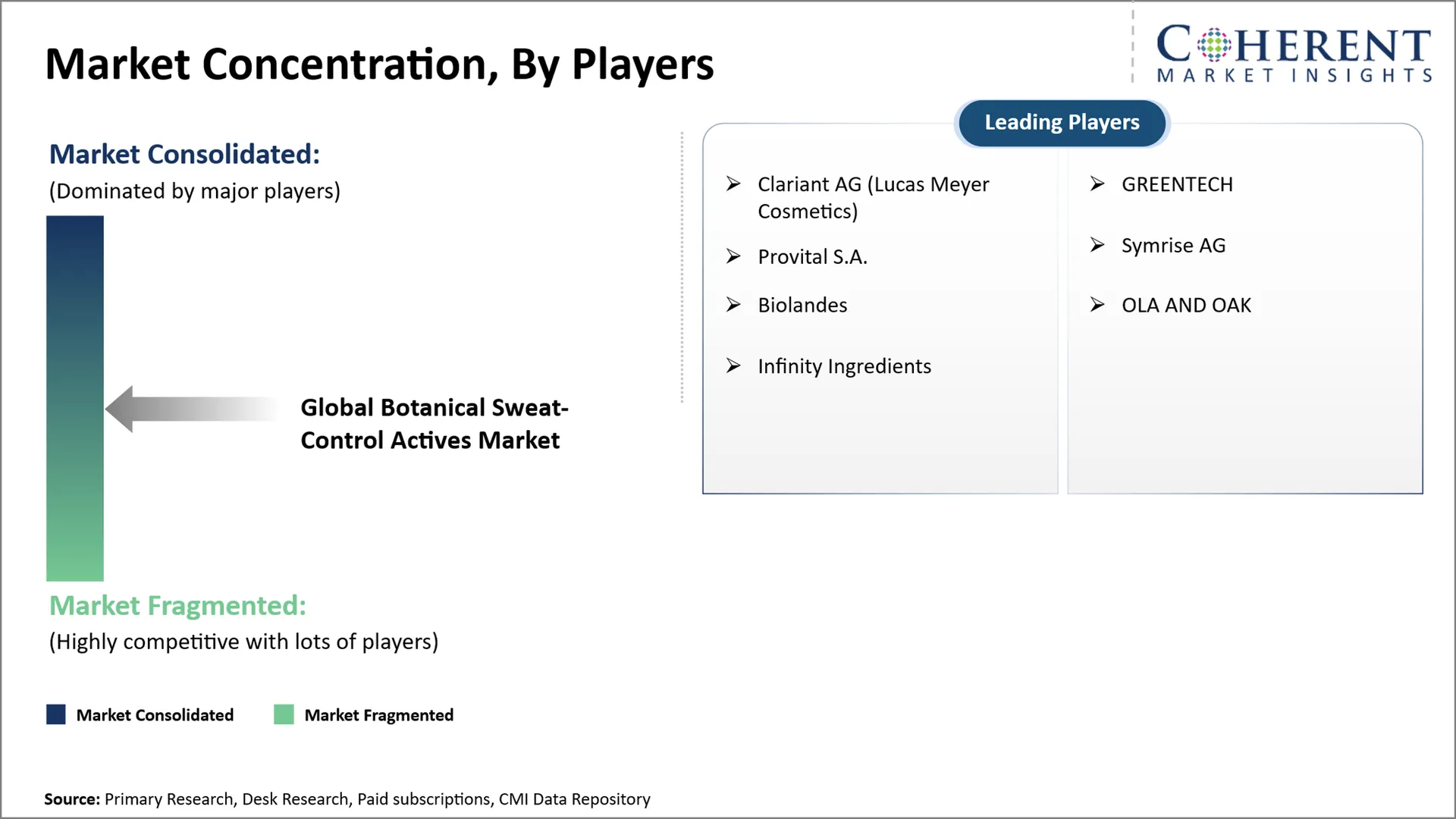
The global botanical sweat-control actives market appears fragmented at the ingredient-supply level, The competition will be judged on consistency of extracts, functional performance, quality of documentation, manufacturing economics and reliability of supply. Specialist suppliers can compete with their own extraction methods, whereas larger ingredient companies benefit from established quality systems, technical capabilities and relationships with international customers.
Key competitive factors
- Botanical Raw Material Consistency: Ensuring consistency of constituent profiles among differences of harvest conditions, plant varieties, and growing locations.
- Functional performance validation demonstrating measurable advantage through appropriate testing of the lab and the finished product.
- Cost Competitiveness: Extraction yield, processing cost and inclusion rate of ingredients to be balanced to protect formulation economics.
- Regulatory Compliance Deliver reliable safety documentation, allergen information and appropriate cosmetic ingredient specifications.
- Supply Chain Resilience: Reduce exposure to seasonal shortages, agricultural variability and concentrated sourcing of botanicals.
- Ingredient Modification: Tailored concentrations, solvent systems, and grades to meet the needs of different manufacturers.
- Customer Qualification: Maintaining consistent batches and technical responsiveness throughout customer evaluation and procurement cycles.
Market Report Scope
Global Botanical Sweat-Control Actives Market Report Coverage | |||
Report Coverage | Details | ||
Base Year | 2025 | Market Size in 2026: | USD 24.5 Mn |
Historical Data For: | 2020 To 2024 | Forecast Period: | 2026 To 2033 |
Forecast Period 2026 To 2033 CAGR: | 19.60% | 2033 Value Projection: | USD 85.8 Mn |
Geographies covered: |
| ||
Segments covered: |
| ||
Companies covered: | Clariant AG (Lucas Meyer Cosmetics), GREENTECH, Provital S.A., Symrise AG, Biolandes, OLA AND OAK, Infinity Ingredients | ||
Growth Drivers: |
| ||
Restraints & Challenges: |
| ||
Analyst Opinion (Expert Opinion)
- Competitive leadership in global botanical sweat-control actives market is likely to shift from supplying botanical extracts as individual raw materials toward offering application-ready ingredient solutions with defined performance specifications. Manufacturers capable of integrating ingredient selection, formulation guidance, and customer qualification support should gain greater influence over purchasing decisions. This transition could favor suppliers that establish long-term technical relationships rather than relying primarily on catalog-based ingredient sales.
- In the future, controlled botanical production through plant-cell cultivation and other alternative sources may compete with traditional agricultural extraction models. These approaches can decrease reliance on harvest cycles and provide more consistency for selected active compounds, if they can be made commercially viable. But the pace of adoption will be driven by production economics, biological equivalence and finished-product performance. This change could be good news for suppliers that can combine botanical know-how with scalable bioprocessing capabilities.
- Ingredient manufacturers should focus on validated efficacy, diverse raw material sourcing and disciplined product development. Investment decisions should consider extraction costs, qualification periods for customers and regulatory restrictions on cosmetic claims. Suppliers should build up relationships with formulators and regional distribution partners, and not over-spend on unproven botanical ingredients. Commercial expansion should follow demonstrated customer acceptance and repeatable manufacturing performance rather than unsupported premium positioning.
Speak to the analyst
Want personalized insights?
Take the findings above to one of our principal consultants, or have the report rebuilt around the segments, geographies and competitors you actually track.
Market Segmentation
- Botanical Type Insights (Revenue, USD Mn, 2021 - 2033)
- Sage-Derived Actives
- Sage and Horsetail Complexes
- Tannin-Rich Botanical Extracts
- Kānuka Leaf Extract Actives
- Other Botanical Actives and Blends
- Product Form Insights (Revenue, USD Mn, 2021 - 2033)
- Liquid Extracts
- Concentrated Botanical Blends
- Powdered Extracts
- Function Insights (Revenue, USD Mn, 2021 - 2033)
- Sweat and Moisture Management
- Astringent and Skin-Tightening Action
- Combined Sweat and Odor Management
- Application Insights (Revenue, USD Mn, 2021 - 2033)
- Underarm Deodorants and Sweat-Control Products
- Foot Care Products
- Whole-Body Freshness Products
- Hand and Other Specialty Products
- Sales Channel Insights (Revenue, USD Mn, 2021 - 2033)
- Direct Manufacturer Sales
- Specialty Ingredient Distributors
- Other B2B Channels
- Regional Insights (Revenue, USD Mn, 2021 - 2033)
- North America
- U.S.
- Canada
- Latin America
- Brazil
- Argentina
- Mexico
- Rest of Latin America
- Europe
- Germany
- U.K.
- Spain
- France
- Italy
- Russia
- Rest of Europe
- Asia Pacific
- China
- India
- Japan
- Australia
- South Korea
- ASEAN
- Rest of Asia Pacific
- Middle East
- GCC Countries
- Israel
- Rest of Middle East
- Africa
- South Africa
- North Africa
- Central Africa
- North America
- Key Players Insights
- Clariant AG (Lucas Meyer Cosmetics)
- GREENTECH
- Provital S.A.
- Symrise AG
- Biolandes
- OLA AND OAK
- Infinity Ingredients
Sources
Primary Research Interviews
- Botanical extract manufacturers, cosmetic active suppliers, and specialty ingredient distributors
- Deodorant formulators, personal care manufacturers, and cosmetic R&D specialists
Stakeholders
- Sage, horsetail, tannin-rich extract, and kānuka active suppliers
- Botanical ingredient processors, cosmetic brands, and contract manufacturers
End-use Sectors
- Personal care, cosmetics, and specialty skin care
- Underarm deodorants, foot care, whole-body freshness, and specialty sweat-control products
Regulatory and Industry Bodies
- U.S. Food and Drug Administration (FDA)
- European Chemicals Agency (ECHA) and European Commission
- Scientific Committee on Consumer Safety (SCCS)
Databases
- UN Comtrade and International Trade Centre (ITC) Trade Map
- Eurostat PRODCOM and U.S. Census Bureau
- European Commission CosIng database
Magazines and Journals
- International Journal of Cosmetic Science
- Journal of Cosmetic Dermatology
- Cosmetics and Molecules
Associations
- Cosmetics Europe
- Personal Care Products Council (PCPC)
- International Federation of Societies of Cosmetic Chemists (IFSCC)
- NATRUE and COSMOS-standard AISBL
Public Domain Sources
- Botanical extract specifications, technical data sheets, and safety data sheets
- Cosmetic ingredient safety assessments, clinical studies, and formulation performance data
- Botanical sourcing, cosmetic manufacturing, and ingredient innovation announcements
Key Standards and Regulations
- EU Cosmetics Regulation (EC) No 1223/2009
- EU REACH Regulation (EC) No 1907/2006
- U.S. Modernization of Cosmetics Regulation Act of 2022 (MoCRA)
- ISO 16128 – Guidelines on Natural and Organic Cosmetic Ingredients
- ISO 22716 – Cosmetics Good Manufacturing Practices
Proprietary Elements
- CMI Data Analytics Tool
- Proprietary research repository, supported by primary interviews, botanical ingredient demand estimates, formulation analysis, pricing assessments, and competitive intelligence.
Get access to 250+ pages report
Every segment, forecast, competitor profile and data table behind the analysis above — available for instant download.
- ESOMAR Member
- ISO 9001:2015 Certified
- D-U-N-S Registered
- GDPR & CCPA Compliant
Frequently Asked Questions
The CAGR of global botanical sweat-control actives market is projected to be 19.60% from 2026 to 2033.
The global botanical sweat-control actives market is estimated to be valued at USD 24.5 Mn in 2026 and is expected to reach USD 85.8 Mn by 2033.
Botanical sweat-control actives are mainly used for moisture absorption, astringency and odor control, while traditional antiperspirant ingredients are designed to decrease sweat secretion.
Major buyers include deodorant manufacturers, personal care brands, cosmetic formulators, contract manufacturers, and specialty body-care product developers.
The global botanical sweat-control actives market report covers botanical ingredient categories, product forms, functional applications, competitive benchmarking, pricing trends, supplier analysis, regulatory considerations, and commercial opportunities.
Key criteria include proven efficacy, ingredient purity, batch consistency, formulation compatibility, safety data, regulatory compliance, supply security and cost effectiveness.
The major factors driving growth in the global botanical sweat-control actives market are the increasing demand for plant-derived sweat-control ingredients in personal care formulations and growing consumer preference for multifunctional, aluminum-free personal care products.