

Global Building Materials Market Size and Forecast – 2026 To 2033
The Global Building Materials Market is estimated to be valued at USD 1,350.2 Bn in 2026 and is expected to reach USD 1,951.11 Bn by 2033, growing at a compound annual growth rate (CAGR) of 5.40% from 2026 to 2033. This steady expansion is supported by accelerating urban development, infrastructure modernization, housing demand, and increasing investment in residential, commercial, and industrial construction projects worldwide.
The Market is also being reshaped by the transition toward sustainable construction practices, encouraging manufacturers to develop low-carbon cement, energy-efficient materials, recycled construction inputs, and advanced building solutions. In February 2025, Dalmia Bharat announced an investment of approximately USD 36.71 Mn to expand cement manufacturing capacity in Maharashtra and Karnataka, including clinker and grinding capacity additions, strengthening regional supply capabilities for infrastructure and housing projects.
Key Takeaways of the Global Building Materials Market
- Cement and Concrete is projected to register an estimated CAGR of 5.1% and account for 38.6% of the global building materials market in 2026, supported by its essential role in foundations structural frameworks and large-scale infrastructure development. In April 2025, Heidelberg Materials expanded its cement and concrete portfolio through the acquisition of Giant Cement Holding and Midway Concrete businesses to strengthen construction material capabilities.
- Structural Materials is expected to achieve an estimated CAGR of 5.3% and represent 46.8% of the global building materials market in 2026, reflecting continued requirements for load-bearing components across residential, commercial and infrastructure projects. In March 2026, ArcelorMittal announced the foundation stone laying of its AM/NS India greenfield steel plant in Andhra Pradesh with planned 8.2 MTPA integrated steel capacity.
- Residential Construction is estimated to grow at a CAGR of 5.6% and hold 42.8% of the global building materials market in 2026, supported by housing development programs urban expansion and renovation activity. In August 2025, India’s Ministry of Housing and Urban Affairs highlighted PMAY-U 2.0 implementation to support construction purchase and rental housing for additional eligible urban beneficiaries through multiple housing delivery models.
- Asia Pacific is forecast to expand at an estimated CAGR of 5.7% and contribute 36.8% of the global building materials market in 2026, supported by infrastructure expansion, urbanization and rising construction activity across developing economies. In August 2026, India’s Ministry of Rural Development reported continued progress under PMAY-G with millions of rural houses sanctioned and completed using locally suitable construction materials and technologies.
- Europe is projected to record the fastest regional CAGR of 6.0% and account for 25.7% of the global building materials market in 2026, driven by building renovation programs, energy efficiency requirements and adoption of sustainable construction materials. In June 2025, the European Commission introduced support measures for National Building Renovation Plans under the revised Energy Performance of Buildings Directive to accelerate building modernization.
Segmental Insights
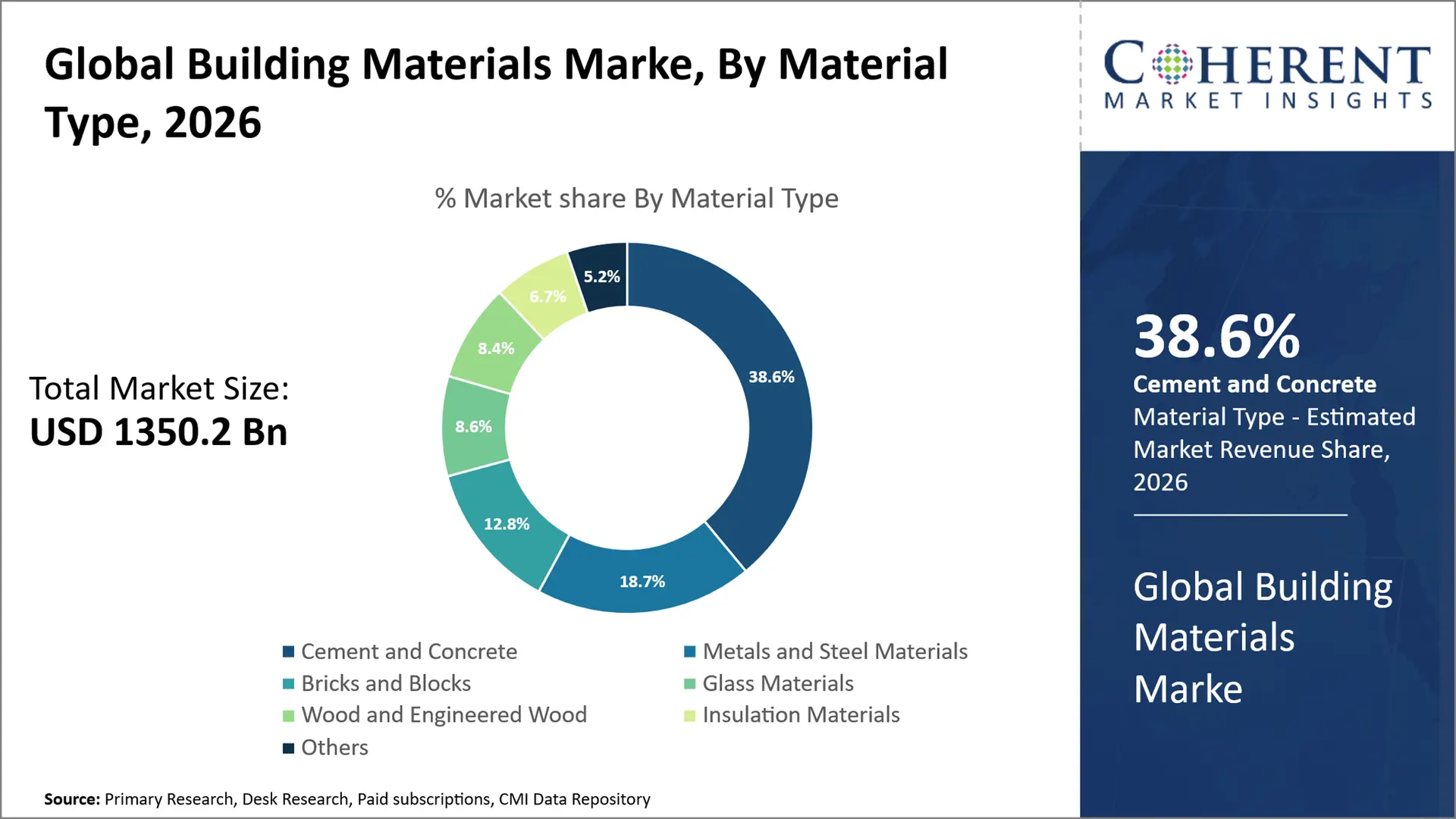
Why Does Cement and Concrete Dominate the Material Type Category of the Global Building Materials Market?
Cement and Concrete are expected to hold 38.6% share of the global building materials market in 2026, reflecting their critical role in foundations, structural frameworks, transportation infrastructure, commercial buildings, and large-scale development projects. The segment maintains strong market relevance due to its versatility, availability, engineering reliability, and suitability for diverse construction applications. Cement manufacturers are increasingly enhancing production capacity, improving logistics networks, and developing value-added solutions to address evolving construction requirements. Concrete solutions remain essential for contractors and infrastructure developers because they enable scalable construction across residential, commercial, and public infrastructure projects. In March 2025, UltraTech Cement completed the acquisition of Kesoram Industries’ cement business, adding 10.75 MTPA capacity and strengthening its manufacturing footprint and distribution capabilities across India’s construction market.
- Current Industry Events of 2026
- Market Size Estimation
- Regional Breakdown
- Competitive Landscape
- Customer Intelligence
- Segmental Analysis
- Pricing Analysis
- Key Market Drivers, Challenges & Future Trends
- Customized Insights Section
Why Do Structural Materials Growing the Global Building Materials Market?
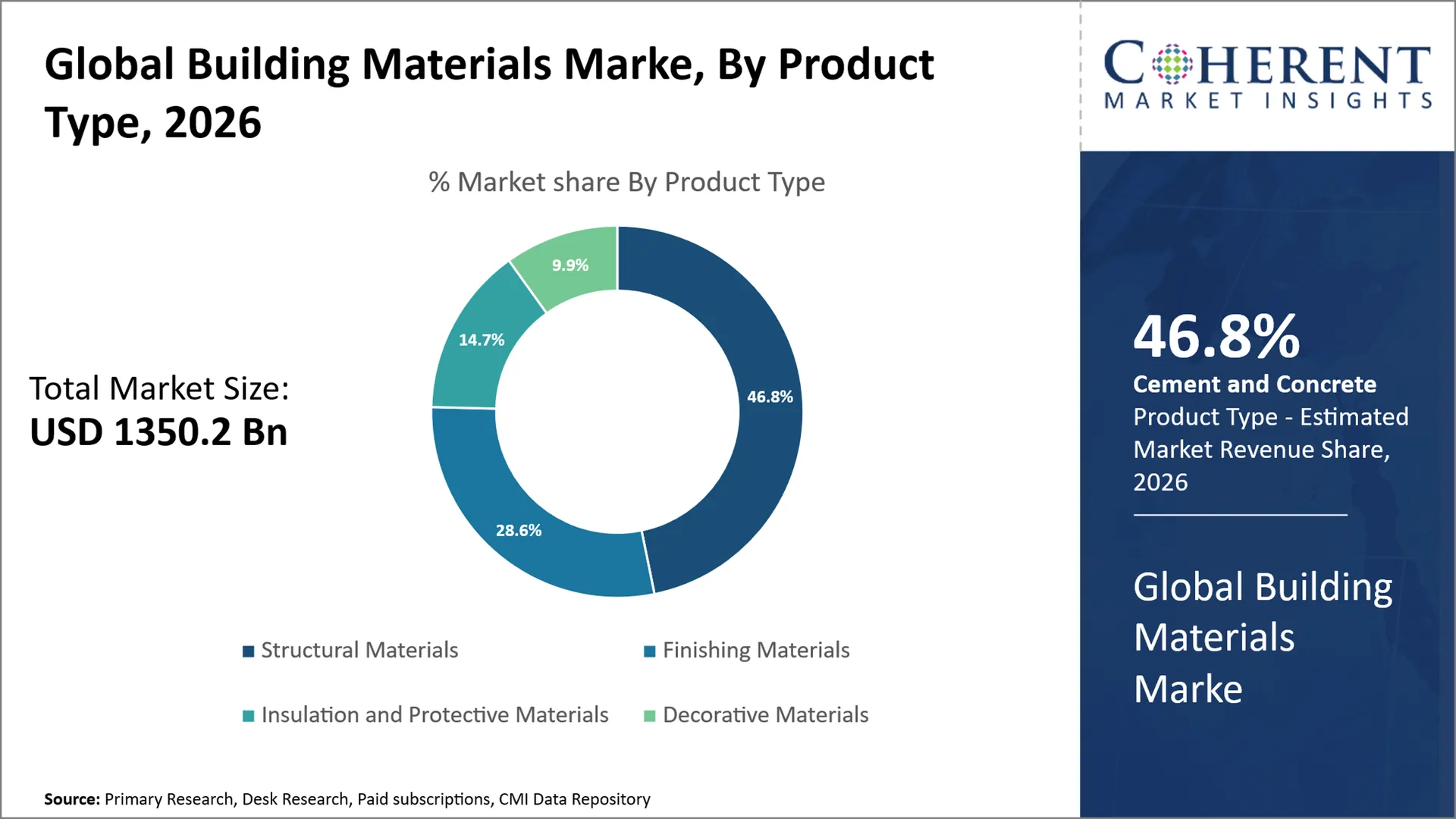
Structural Materials are expected to account for 46.8% share of the global building materials market in 2026, supported by their essential role in creating load-bearing frameworks for residential buildings, commercial complexes, industrial facilities, and infrastructure projects. Demand remains concentrated around steel, aggregates, concrete components, and engineered structural products that provide strength, durability, and long service life. The segment benefits from established manufacturing networks, large-scale production capacity, and extensive distribution channels serving contractors, developers, and infrastructure agencies. Increasing preference for high-performance materials is encouraging manufacturers to improve product quality, develop lightweight solutions, and optimize production efficiency. In March 2025, the U.S. Department of Transportation announced additional infrastructure investment allocations supporting bridge and transportation upgrades, strengthening requirements for structural construction materials across public projects.
Why Does Residential Construction Dominate the Application Segment of the Global Building Materials Market?
Residential Construction is expected to represent 42.8% share of the global building materials market in 2026, supported by ongoing housing development, urban expansion, renovation requirements, and demand for durable residential structures. The segment generates substantial consumption of cement, concrete, bricks, insulation materials, glass, wood-based products, and finishing solutions through new housing projects and refurbishment activities. Builders and developers are increasingly selecting materials that improve energy performance, reduce maintenance requirements, and enhance construction efficiency. The segment also benefits from government housing initiatives and private real estate investments that require reliable material supply chains. In June 2025, the U.S. Department of Housing and Urban Development announced research funding opportunities focused on housing affordability and building technology innovation, supporting the development of improved housing solutions and construction practices.
Current Events and their Impact
Current Event | Description and Its Impact |
EU Construction Products Regulation Revision – December 2024 |
|
UK Building Safety and Construction Material Regulatory Reforms – February 2025 |
|
Global Low-Carbon Cement Policy Push – 2025 |
|
Global building materials market Dynamics
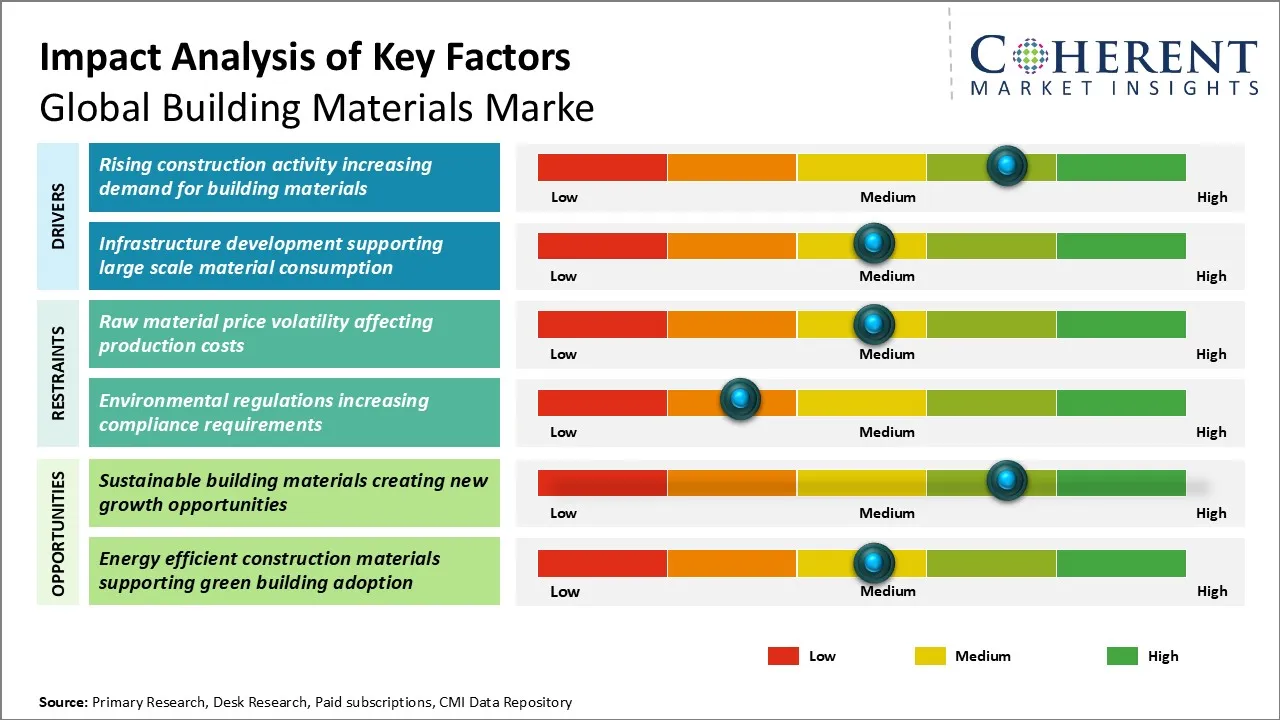
Key Market Drivers
- Rising Construction Activity Increasing Demand for Building Materials: Rising construction activity is strengthening demand for cement, concrete, steel aggregates and other essential building materials as residential, commercial and industrial projects continue expanding across developed and emerging economies. Construction companies, contractors, and material manufacturers benefit through higher project pipelines, improved capacity utilization and increased requirement for structural and finishing products. The growing need for durable energy-efficient and cost-effective materials is also encouraging suppliers to enhance product portfolios. In May 2025, Heidelberg Materials highlighted infrastructure expansion housing demand and energy transition projects as major factors supporting future demand for cement aggregates and concrete solutions.
- Infrastructure Development Supporting Large Scale Material Consumption: Infrastructure development programs are creating sustained consumption opportunities for building materials by increasing requirements for cement, concrete, steel and specialty construction products used in roads, bridges, transportation networks and public facilities. Government infrastructure spending benefits large manufacturers, contractors and distributors by creating long-term supply agreements and encouraging regional production investments. Demand is increasingly shifting toward performance-based materials that offer durability lower maintenance requirements and improved lifecycle value. In June 2025, the United Kingdom advanced major carbon capture infrastructure projects linked with industrial facilities including cement production sites demonstrating increasing integration of construction materials with national infrastructure transformation programs.
Emerging Market Trends
- Transition Toward Low Carbon and Circular Construction Materials: The building materials industry is gradually shifting from conventional material production toward low-carbon and circular solutions that reduce environmental impact while maintaining structural performance. Manufacturers are increasingly focusing on alternative raw materials, recycled aggregates, supplementary cementitious materials and carbon-efficient production processes. This transition is influencing procurement decisions as developers, contractors, and public-sector buyers increasingly evaluate sustainability credentials alongside price and performance. Over the forecast period companies with capabilities in sustainable manufacturing waste utilization and environmental certification are expected to strengthen their competitive positioning.
- Increasing Integration of Digital Tools Across Construction Material Supply Chains: Digital transformation is changing how building materials are manufactured, distributed and purchased by improving supply chain visibility, inventory management, and project coordination. Manufacturers, distributors and contractors are adopting digital platforms for demand forecasting procurement tracking and logistics optimization to reduce delays and improve operational efficiency. The trend is encouraging building material suppliers to move beyond traditional product selling models toward integrated service-based approaches that include technical support, data-driven planning, and customized solutions. Companies capable of combining material expertise with digital capabilities are likely to gain stronger relationships with construction stakeholders.
Regional Insights
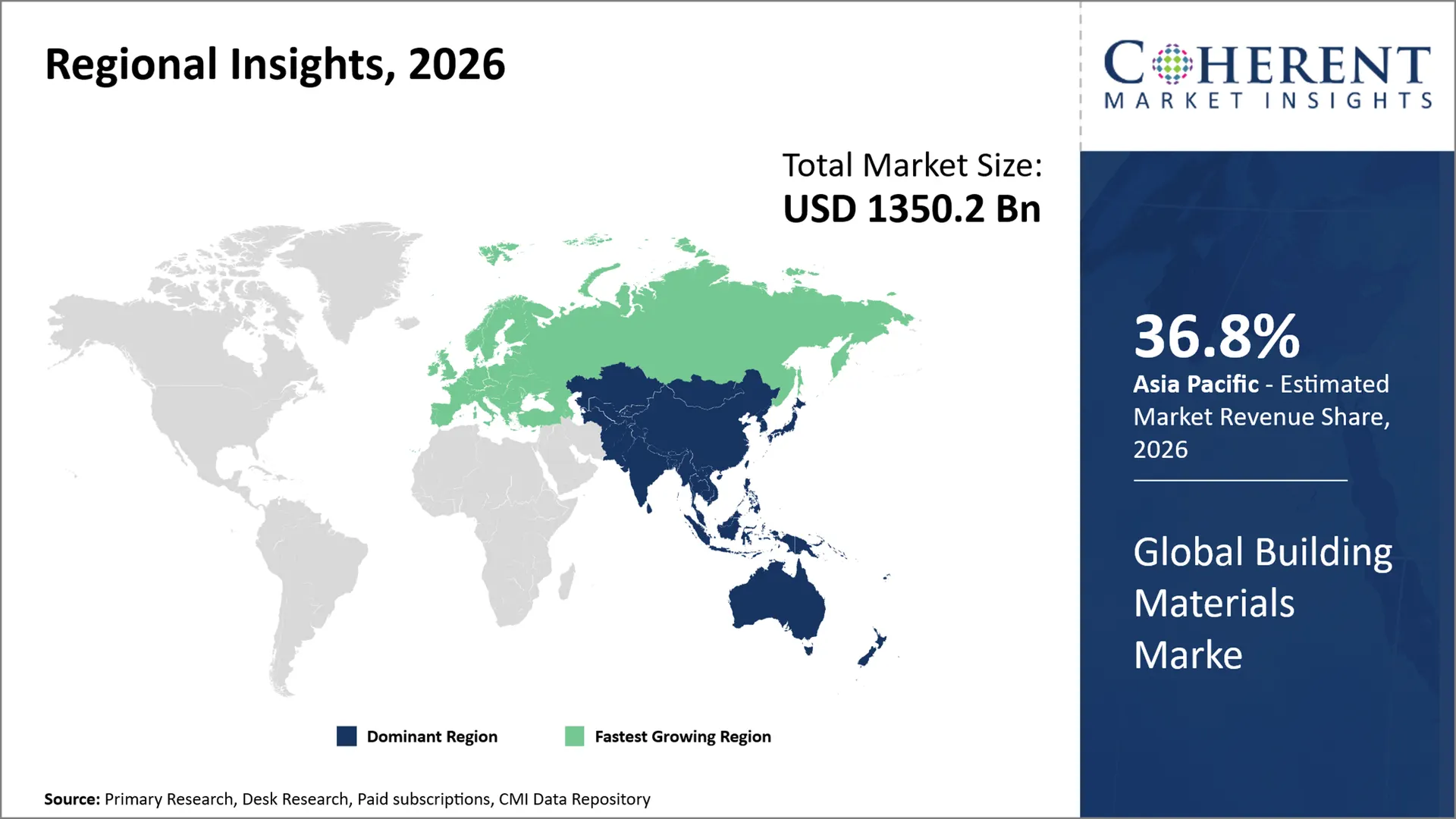
Why Does Asia Pacific Dominate the Global Building Materials Market?
Asia Pacific is expected to account for 36.8% share of the global building materials market in 2026, supported by large-scale urban development, infrastructure expansion, industrial construction, and increasing residential demand across China, India, Southeast Asia, and other developing economies. The region benefits from a strong manufacturing ecosystem for cement, steel, glass, bricks and engineered materials supported by extensive raw material availability and established supplier networks. Rapid urban population growth and government-led infrastructure modernization programs continue to create significant consumption opportunities for structural and finishing materials. In addition, expanding domestic production capabilities allow regional manufacturers to serve both local construction demand and export markets. In January 2025, China’s Ministry of Housing and Urban-Rural Development highlighted continued efforts to promote urban renewal projects, supporting demand for construction materials through redevelopment and infrastructure improvement initiatives.
Why Is Europe Emerging as the Fastest-Growing Region in the Global Building Materials Market?
Europe is projected to record the fastest growth in the global building materials market with an expected 25.7% share in 2026, driven by renovation activity, energy-efficient construction requirements, sustainability regulations, and increasing adoption of low-carbon building solutions. The region’s construction sector is undergoing a transformation from traditional material consumption toward environmentally optimized products including energy-efficient insulation materials, recycled construction inputs, and lower-emission cement alternatives. Strong regulatory frameworks related to building performance and carbon reduction are encouraging manufacturers to upgrade production technologies and develop sustainable product portfolios. In February 2025, the European Commission continued implementation activities related to the Energy Performance of Buildings Directive, supporting renovation strategies and improving building energy efficiency across member states.
Global Building Materials Market Outlook for Key Countries
Why Is the U.S. a Key Market for the Global Building Materials Market?
The U.S. represents a significant market for building materials due to its diversified construction ecosystem covering residential housing, commercial real estate, infrastructure modernization, and industrial facilities. Demand is supported by replacement construction, renovation projects, transportation infrastructure upgrades, and increasing preference for durable and energy-efficient materials. The country also maintains a strong domestic production base for cement, steel, glass, insulation products, and engineered construction materials, reducing dependence on imports for essential categories. Federal infrastructure investment programs continue influencing material demand through transportation, energy, and public facility projects. In April 2025, the U.S. Department of Transportation announced continued implementation of infrastructure funding programs supporting transportation improvements, creating downstream demand for concrete, steel, aggregates, and related construction materials.
Why Is India Important in the Global Building Materials Market?
India is becoming increasingly important in the global building materials market due to rapid urbanization, expanding housing requirements, infrastructure development, and growth of industrial and commercial construction. The country has a strong domestic manufacturing base for cement, steel, bricks, tiles, and other construction products supported by abundant raw materials and growing production capacity. Government initiatives focused on housing development, highways, rail infrastructure, and urban modernization are creating sustained demand across structural and finishing materials. India also benefits from cost-competitive manufacturing capabilities that support both domestic consumption and regional exports. In March 2025, the Ministry of Road Transport and Highways reported continued expansion of national highway development activities, supporting demand for cement, steel, aggregates, and construction-related materials.
Why Does China Support Growth in the Global Building Materials Market?
China plays a central role in the global building materials market due to its extensive manufacturing capacity, large construction industry, developed supply chain ecosystem, and significant consumption of cement, steel, glass, and engineered materials. The country has one of the world’s largest construction sectors supported by urban redevelopment, industrial infrastructure, transportation projects, and commercial development. China’s integrated manufacturing clusters provide advantages in raw material processing, production scale, and export capabilities. The country is also increasing focus on greener construction practices and energy-efficient buildings, influencing material innovation and production methods. In February 2025, China’s National Development and Reform Commission announced continued support for urban renewal and infrastructure-related investment priorities, supporting construction activity and material demand across multiple sectors.
Why Is Germany a Strategic Country in the Global Building Materials Market?
Germany holds strategic importance in the global building materials market due to its advanced construction industry, strong engineering capabilities, high sustainability standards, and demand for premium-quality building solutions. The country has a well-established manufacturing base across cement, glass, insulation materials, specialty construction products, and sustainable building technologies. German construction companies and material producers are increasingly focused on energy-efficient buildings, circular construction practices, and compliance with environmental performance requirements. The country’s emphasis on renovation of existing buildings creates additional opportunities for insulation materials, energy-saving solutions, and modern construction systems. In January 2025, Germany’s Federal Ministry for Housing Urban Development and Building continued promoting measures supporting climate-friendly construction and building modernization, strengthening demand for sustainable construction materials.
Why Is UAE an Important Growth Market for the Global Building Materials Market?
The UAE is an important growth market for building materials due to ongoing urban development, commercial construction, tourism infrastructure, residential projects, and large-scale industrial developments. The country’s position as a regional construction hub supports demand for cement, steel, glass, aggregates, and specialty materials used across high-value projects. Strong construction activity in Dubai and Abu Dhabi, combined with infrastructure investment and economic diversification programs, continues to support material consumption. The UAE also relies on efficient import networks and regional distribution channels to supply specialized construction products required for complex developments. In October 2025, the UAE Ministry of Energy and Infrastructure highlighted continued infrastructure development initiatives supporting construction activity and modernization of national facilities.
Innovation Production & Manufacturing Landscape in the Global Building Materials Market
Technology / Innovation | Current Adoption Status | Commercial Impact | Key Benefiting Participants |
Low-Carbon Cement Technologies | Emerging adoption through alternative binders, clinker reduction methods, and carbon capture integration | Enables manufacturers to reduce environmental impact while meeting stricter procurement and sustainability requirements | Cement producers, infrastructure suppliers, green construction developers |
Supplementary Cementitious Materials (SCMs) | Increasing use of fly ash, slag, calcined clay, and other alternatives to conventional clinker | Improves material efficiency and supports lower-emission cement formulations | Cement manufacturers, concrete producers, industrial waste processors |
Building Information Modeling (BIM) Integration | Expanding adoption across construction planning and project management workflows | Improves material forecasting, reduces waste, and enables better coordination between contractors and suppliers | Construction firms, architects, material distributors |
Advanced Prefabrication and Modular Construction | Growing deployment for residential, commercial, and infrastructure applications | Supports faster construction timelines, standardized quality, and reduced onsite material losses | Modular builders, component manufacturers, developers |
Recycled and Circular Construction Materials | Developing through increased focus on reuse of concrete, metals, glass, and construction waste | Creates new supply streams while reducing dependence on virgin raw materials | Recycling companies, material producers, sustainability-focused contractors |
Digital Manufacturing and Automation Systems | Increasing integration in large-scale material production facilities | Enhances production consistency, energy efficiency, predictive maintenance, and operational control | Large manufacturers, industrial technology providers, material processing companies |
How Are Low-Carbon Materials and Circular Construction Practices Creating New Growth Opportunities in the Global Building Materials Market?
Low-carbon materials and circular construction practices are creating a strategic growth opportunity for building material manufacturers by shifting demand toward environmentally optimized products with measurable lifecycle benefits. The opportunity extends across cement producers developing lower-emission binders, metal suppliers improving recycling capabilities, and manufacturers creating products using recovered construction waste. Developers, infrastructure agencies, and commercial builders are increasingly evaluating environmental performance alongside durability and cost, creating space for differentiated material solutions. Companies can capture this opportunity by investing in sustainable production processes, recycled input streams, environmental certifications, and customer-specific solutions. Established manufacturers with production scale may benefit from technology integration, while specialized suppliers can compete through niche sustainable materials and customized applications. Successful participation will require investment in process modernization, supply chain traceability, and collaboration with construction stakeholders.
Market Players, Key Development, and Competitive Intelligence
Recent Developments
- In June 2026, Holcim received conditional European Commission approval for its acquisition of Xella, a German manufacturer of walling systems and energy-efficient building solutions. This development is important for the global building materials market because it strengthens Holcim’s position in sustainable construction systems and expands its exposure beyond traditional cement into higher-value building solutions. The transaction also reflects increasing industry consolidation around energy-efficient construction products.
- In May 2026, Saint-Gobain announced plans to invest approximately US$1 billion in India over the next five years to expand its building materials operations. This is important for the global building materials market because the investment highlights the increasing strategic importance of emerging construction Markets and supports expansion of advanced materials including insulation, glass, and sustainable building solutions. The initiative strengthens localized manufacturing capabilities and regional supply networks.
- In May 2025, Heidelberg Materials outlined its strategic focus on infrastructure, energy transition, housing, and sustainable construction solutions as major growth areas through its Capital Markets Day communication. This is important for the global building materials market because it demonstrates how major material producers are aligning investment priorities toward higher-value construction applications, sustainable products, and long-term supply capabilities.
Competitive Landscape
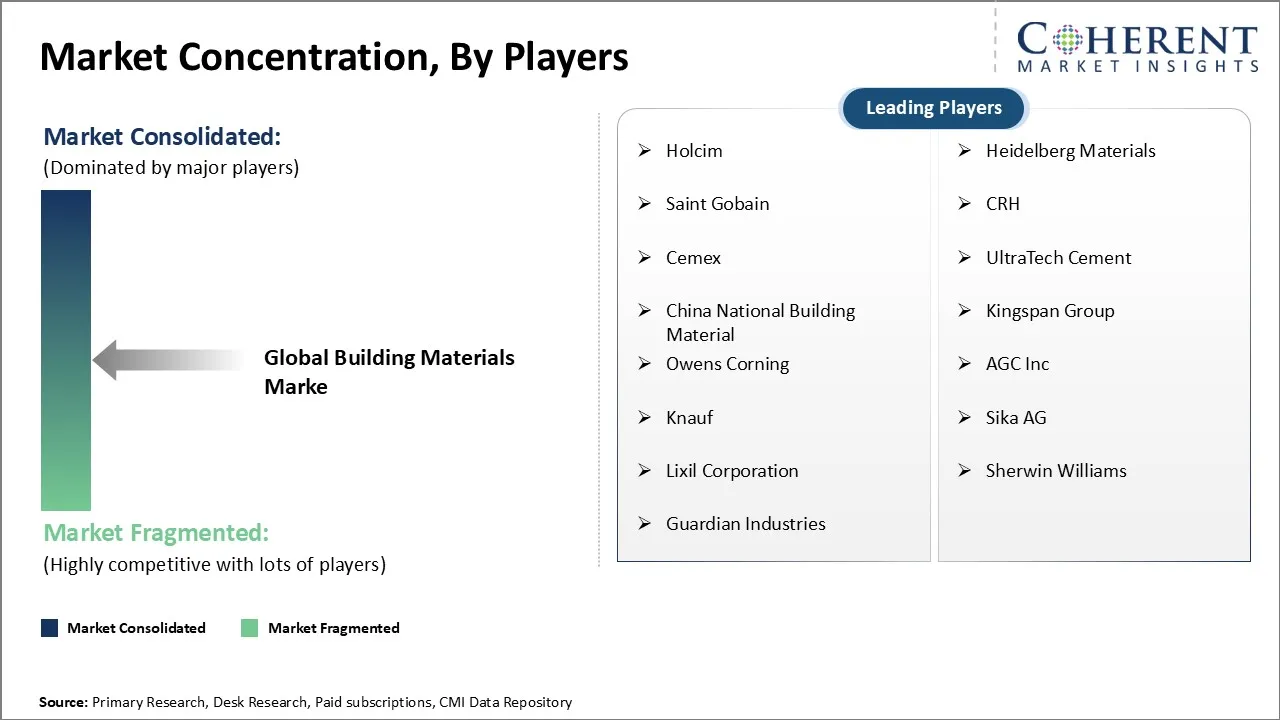
The global building materials market is moderately consolidated, with large multinational manufacturers competing alongside regional producers and specialized material suppliers. Competition is shaped by product performance, manufacturing efficiency, supply reliability, geographic reach, sustainability capabilities, and customer relationships. Large companies benefit from integrated production networks and research capabilities, while regional players compete through local distribution strength, cost advantages, and application-specific expertise. Increasing environmental requirements and demand for customized construction solutions are gradually shifting competition from commodity supply toward value-added material offerings.
Key Focus Areas Include
- Product quality, durability, and performance differentiation across structural and finishing materials
- Manufacturing capacity, operational efficiency, and supply reliability for large construction projects
- Sustainability capabilities including recycled materials, low-carbon production, and environmental certifications
- Pricing competitiveness and ability to manage raw material cost fluctuations
- Distribution network strength across contractors, builders, infrastructure developers, and dealers
- Product customization based on application requirements, climate conditions, and construction standards
- Technology adoption in manufacturing processes to improve efficiency and reduce production waste
- Technical support, project collaboration, and long-term relationships with construction stakeholders
Market Report Scope
Global Building Materials Market Repoet Coverage | |||
Report Coverage | Details | ||
Base Year | 2025 | Market Size in 2026: | USD 1,350.2 Bn |
Historical Data For: | 2020 To 2024 | Forecast Period: | 2026 To 2033 |
Forecast Period 2026 To 2033 CAGR: | 5.40% | 2033 Value Projection: | USD 1,951.11 Bn |
Geographies covered: |
| ||
Segments covered: |
| ||
Companies covered: | Holcim, Heidelberg Materials, Saint Gobain, CRH, Cemex, UltraTech Cement, China National Building Material, Kingspan Group, Owens Corning, AGC Inc, Knauf, Sika AG, Lixil Corporation, Sherwin Williams, Guardian Industries | ||
Growth Drivers: |
| ||
Restraints & Challenges: |
| ||
Analyst Opinion (Expert Opinion)
- The global building materials market is likely to move toward a solution-oriented competitive structure where suppliers increasingly differentiate through integrated offerings rather than individual material categories. Companies that combine material expertise with technical consultation, lifecycle assessment capabilities, project support, and customized solutions may strengthen relationships with large construction buyers.
- The most significant transformation will come from the convergence of sustainability requirements and manufacturing innovation. Traditional material suppliers may face increasing pressure to redesign production processes, while companies capable of delivering lower-impact materials, circular solutions, and digitally enabled supply chains could reshape competitive positioning across the construction ecosystem.
- Market participants should prioritize investments in sustainable manufacturing, supply chain resilience, and application-specific product development. Companies should carefully evaluate raw material volatility, regulatory changes, and regional demand differences while avoiding excessive dependence on commodity-based competition. Building partnerships with contractors, infrastructure developers, and technology providers will become increasingly important for long-term competitiveness.
Speak to the analyst
Want personalized insights?
Take the findings above to one of our principal consultants, or have the report rebuilt around the segments, geographies and competitors you actually track.
Market Segmentation
- Material Type Insights (Revenue, USD Bn, 2021 - 2033)
- Cement and Concrete
- Metals and Steel Materials
- Bricks and Blocks
- Glass Materials
- Wood and Engineered Wood
- Insulation Materials
- Others
- Product Type Insights (Revenue, USD Bn, 2021 - 2033)
- Structural Materials
- Finishing Materials
- Insulation and Protective Materials
- Decorative Materials
- Application Insights (Revenue, USD Bn, 2021 - 2033)
- Residential Construction
- Commercial Construction
- Infrastructure Development
- Industrial Construction
- End User Insights (Revenue, USD Bn, 2021 - 2033)
- Construction Companies
- Contractors and Builders
- Government Infrastructure Projects
- Individual Consumers
- Distribution Channel Insights (Revenue, USD Bn, 2021 - 2033)
- Direct Sales
- Dealers and Distributors
- Online Sales
- Regional Insights (Revenue, USD Bn, 2021 - 2033)
- North America
- U.S.
- Canada
- Latin America
- Brazil
- Argentina
- Mexico
- Rest of Latin America
- Europe
- Germany
- U.K.
- Spain
- France
- Italy
- Russia
- Rest of Europe
- Asia Pacific
- China
- India
- Japan
- Australia
- South Korea
- ASEAN
- Rest of Asia Pacific
- Middle East
- GCC Countries
- Israel
- Rest of Middle East
- Africa
- South Africa
- North Africa
- Central Africa
- North America
Sources
Primary Research Interviews
- Building material manufacturers, cement producers, steel producers, concrete suppliers, glass manufacturers, insulation material providers, and construction product companies
- Construction companies, contractors, builders, real estate developers, infrastructure developers, architects, engineers, procurement managers, and project consultants
Stakeholders
- Cement and concrete manufacturers, structural material producers, finishing material suppliers, insulation manufacturers, and engineered material companies
- Raw material suppliers, equipment manufacturers, distributors, dealers, logistics providers, construction service providers, and building material retailers
- Government infrastructure agencies, construction regulatory bodies, green building organizations, and sustainability certification authorities
End-use Sectors
- Residential construction and housing development projects
- Commercial buildings including offices, retail spaces, and hospitality infrastructure
- Infrastructure development including roads, bridges, transportation networks, and public facilities
- Industrial construction including manufacturing plants, warehouses, and energy infrastructure
Regulatory and Industry Bodies
- U.S. Department of Energy (DOE)
- European Commission construction and energy efficiency bodies
- International Energy Agency (IEA)
- World Green Building Council (WorldGBC)
- National construction ministries and building regulatory authorities
- Construction material associations and sustainability organizations
Databases
- Company annual reports, investor presentations, sustainability reports, and corporate disclosures
- Construction activity databases and infrastructure investment datasets
- Cement, steel, glass, wood, and insulation production databases
- Building permits, housing development, and construction expenditure databases
- Trade statistics, building material import-export datasets, and customs databases
- Raw material pricing and construction commodity databases
Magazines and Journals
- Construction materials and engineering publications
- Cement, concrete, steel, and advanced materials journals
- Sustainable construction and green building research publications
- Infrastructure development and urban planning journals
- Industrial manufacturing and construction technology publications
Associations
- World Cement Association (WCA)
- Global Cement and Concrete Association (GCCA)
- World Steel Association
- World Green Building Council (WorldGBC)
- International Union of Architects (UIA)
- Regional construction material and building industry associations
Public Domain Sources
- Infrastructure development programs and government construction initiatives
- Housing development and urban renewal projects
- Sustainable construction policies and green building initiatives
- Low-carbon cement and circular construction developments
- Building material manufacturing expansions and supply chain developments
Key Standards and Regulations
- Building codes and construction safety standards
- Energy efficiency requirements for buildings
- Green building certification frameworks
- Sustainable sourcing and responsible material procurement standards
- Carbon emission regulations for construction material manufacturing
- Product quality standards for cement, steel, concrete, insulation, and finishing materials
Proprietary Elements
- CMI Data Analytics Tool
- Proprietary CMI repository containing 10+ years of construction, infrastructure, building materials, industrial manufacturing, sustainability, and market intelligence data.
Get access to 250+ pages report
Every segment, forecast, competitor profile and data table behind the analysis above — available for instant download.
- ESOMAR Member
- ISO 9001:2015 Certified
- D-U-N-S Registered
- GDPR & CCPA Compliant
Frequently Asked Questions
The CAGR of global building materials market is projected to be 5.40% from 2026 to 2033.
The global building materials market is estimated to be valued at USD 1,350.2 Bn in 2026 and is expected to reach USD 1,951.11 Bn by 2033.
Building materials are primarily used across residential construction, commercial construction, infrastructure development, and industrial construction projects worldwide.
The global building materials market includes cement and concrete, metals and steel materials, bricks and blocks, glass materials, wood and engineered wood, insulation materials, and other construction materials.
Construction companies, contractors, builders, government infrastructure projects, and individual consumers are the major end users purchasing building materials for different construction requirements.
The market is being shaped by sustainable construction practices, demand for energy-efficient materials, digitalization of construction processes, and development of advanced building solutions.
Rising construction activity, coupled with increasing infrastructure development and large-scale material consumption, is driving the growth of the global building materials market.