

Global Carbon Capture Market Size and Forecast – 2026 To 2033
The global carbon capture market is estimated to be valued at USD 5,231.4 Mn in 2026 and is projected to reach USD 13,747.1 Mn by 2033, exhibiting a CAGR of 14.80% during 2026–2033. Pledges to decarbonize industry, the development of carbon storage infrastructure and better separation technologies are all helping drive investment in capture systems across power generation, cement, steel and chemical manufacturing. Government support for industrial-scale demonstration projects is also helping technology providers overcome commercialization barriers.
In March 2026, Australia's Department of Climate Change, Energy, the Environment and Water announced another round of funding under its Carbon Capture Technologies Program to support the development of emerging capture and carbon management technologies. This initiative promotes technological diversification and industrial applications.
Key Takeaways of the Global Carbon Capture Market
- Post-Combustion Capture is estimated to grow at a 13.8% CAGR during 2026–2033 and account for 42.5% of global carbon capture market revenue in 2026. Its retrofit compatibility allows operators to treat exhaust gases without replacing core production assets. In September 2024, Mitsubishi Heavy Industries confirmed the start of operations at Italy’s Ravenna post-combustion capture plant, treating natural gas turbine flue gas.
- Chemical Absorption is projected to advance at an indicative 13.6% CAGR through 2033 and hold 53.4% of the global carbon capture market in 2026. Regenerable solvents can accommodate variable flue-gas conditions, making energy efficiency a crucial purchasing criterion. In May 2025, BASF announced its OASE blue technology licensing agreement for Taiwan Power Company’s Taichung capture project.
- Carbon Capture Equipment & Systems could expand at an estimated 14.6% CAGR during 2026–2033 and represent 54.6% of global carbon capture market revenue in 2026. Buyers prioritize absorbers, compressors, and packaged capture trains because these systems determine processing capacity and installation complexity. In January 2025, SLB Capturi completed commissioning of a modular carbon capture plant for Twence’s waste-to-energy facility in the Netherlands.
- North America is projected to record an indicative 13.4% CAGR through 2033 and account for 40.2% of global carbon capture revenue in 2026. Established ammonia and gas-processing clusters support projects with concentrated carbon dioxide streams and storage access. In July 2025, CF Industries started its Donaldsonville compression facility in Louisiana, enabling geological sequestration associated with ammonia manufacturing.
- Europe is expected to register an indicative 17.2% CAGR during 2026–2033, alongside a 29.5% share of global carbon capture market revenue in 2026. Shared offshore storage can serve industrial emitters that lack dedicated sequestration sites, supporting cross-border project development. In August 2025, Equinor confirmed the first carbon dioxide injection at Norway’s Northern Lights third-party storage facility.
Segmental Insights
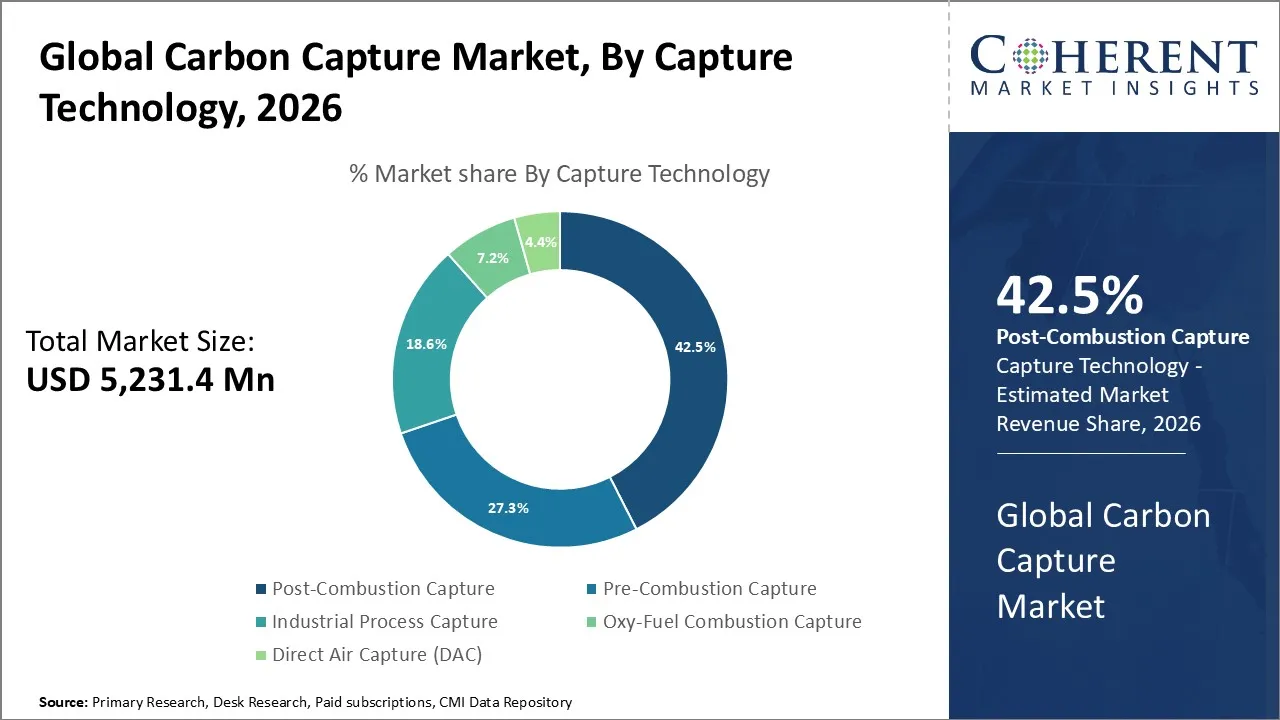
Why Does Post-Combustion Capture Dominate the Global Carbon Capture Market?
Post-Combustion Capture is expected to account for 42.5% of the global carbon capture market in 2026, leading the capture technology category because it can process large exhaust volumes while allowing energy requirements to be managed alongside electricity and heat production. Its commercial value is increasingly tied to facilities that can reuse process heat rather than to capture efficiency alone. Biomass-fired combined heat and power plants are particularly suitable, as recovered heat can support district-heating networks while a separate capture unit treats their exhaust. This allows utilities to assess capture costs against existing heat revenues. In September 2025, Capsol Technologies secured a feasibility study for its CapsolEoP system at a European biomass-fired combined heat and power plant, evaluating a configuration capable of removing more than 200,000 tons of CO₂ annually.
- Current Industry Events of 2026
- Market Size Estimation
- Regional Breakdown
- Competitive Landscape
- Customer Intelligence
- Segmental Analysis
- Pricing Analysis
- Key Market Drivers, Challenges & Future Trends
- Customized Insights Section
Why Does Chemical Absorption Represent the Largest Separation Method in the Global Carbon Capture Market?
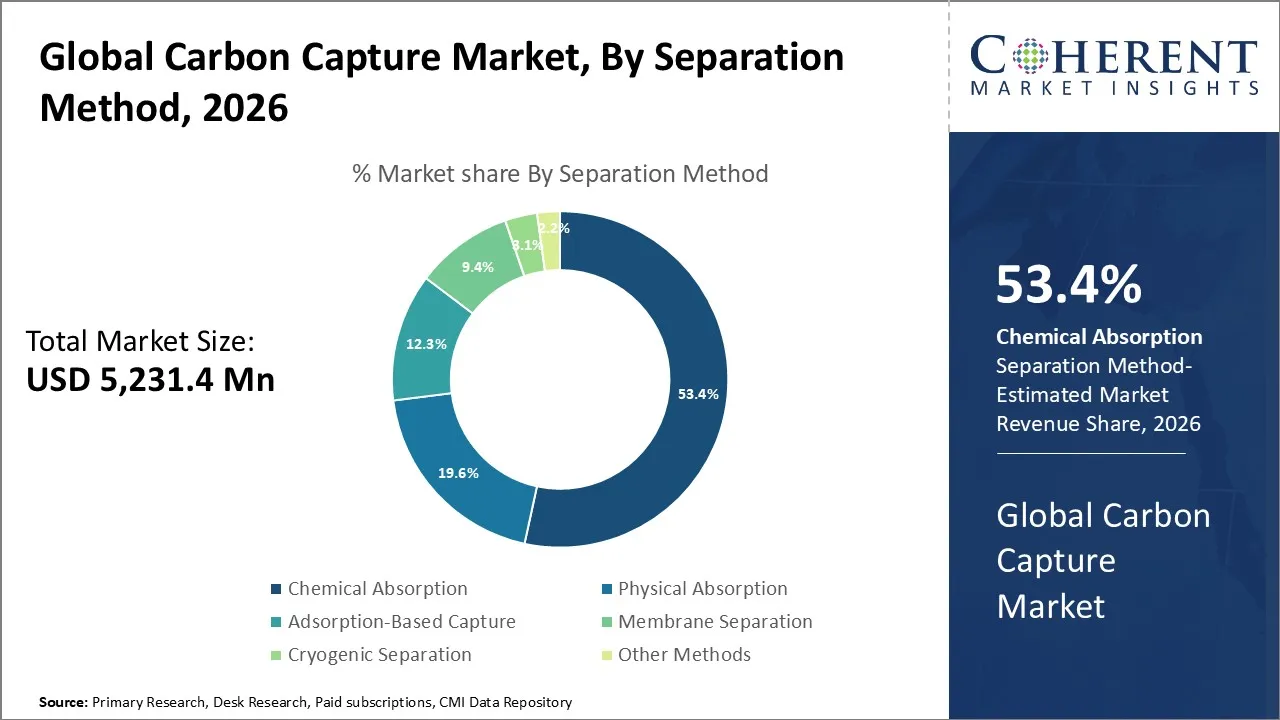
Chemical Absorption is expected to hold 53.4% of the global carbon capture market in 2026, making it the leading separation method because reactive liquid formulations can bind CO₂ even when its concentration in the feed gas is low. This chemistry provides an advantage in applications where pressure-dependent separation alternatives are less practical. For industrial buyers, established chemical handling equipment and solvent management capabilities also support long-term operational planning. The method serves industrial exhaust treatment and is being adapted for atmospheric carbon capture, although these applications have different cost profiles. In April 2025, AGC announced the development of a non-aqueous amine-based absorption solution using polypropylene glycol for direct air capture, with a demonstration planned for Expo 2025 Osaka. This development illustrates how specialized solvent formulations could expand the technical applications of chemical absorption.
Why Does Carbon Capture Equipment & Systems Dominate the Offering Category of the Global Carbon Capture Market?
Carbon Capture Equipment & Systems is expected to contribute 54.6% of global carbon capture market revenue in 2026. This is due to projects need specialized processing equipment in place before capture operations and recurring technical services can begin. In addition to separation units, the procurement process includes contactors, heat exchangers, control packages and CO2 conditioning equipment. The trend toward factory-integrated designs is growing, as it allows capacity expansion and minimizes field assembly, which is appreciated by industrial buyers with limited installation space. This reduces the need for large-scale construction on site and opens up possibilities for equipment manufacturers and modular system providers. In August 2025, Ionada demonstrated a production-scale hollow-fiber membrane contactor carbon capture system, integrating absorption and desorption in a single modular unit. The demonstration highlights the commercial opportunity for compact equipment configurations in space-constrained industrial facilities.
Current Events and their Impact
Current Event | Description and Its Impact |
June 2024 – European Union Net-Zero Industry Act |
|
June 2024 – Canada Introduces Carbon Capture Investment Tax Credits |
|
November 2025 – U.S. EPA Approves Texas Class VI Permitting Authority |
|
Global Carbon Capture Market Dynamics
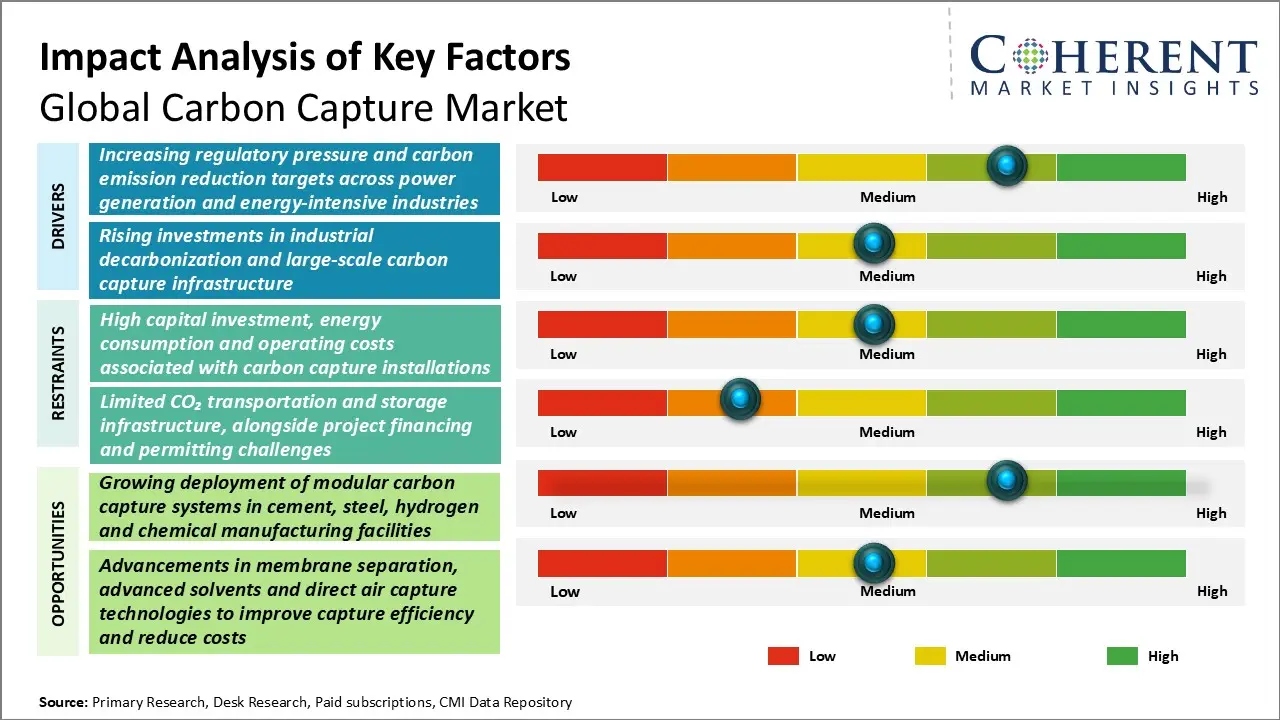
Key Market Drivers
- Increasing Regulatory Pressure and Carbon Emission Reduction Targets Across Power Generation and Energy-Intensive Industries: Stricter emission reduction requirements are encouraging cement, steel, chemical, and power producers to incorporate carbon capture into long-term decarbonization plans. Carbon capture enables manufacturers to address process-related emissions and meet applicable compliance obligations, while preserving existing industrial operations. This creates commercial opportunities for suppliers of industrial equipment, engineering contractors and licensors of capture technology. In June 2025, Heidelberg Materials opened its Brevik carbon capture plant in Norway, which is designed to capture around 400,000 tons of CO₂ annually. The project showcases how industrial manufacturers are integrating permanent carbon management into production strategies.
- Rising Investments in Industrial Decarbonization and Large-Scale Carbon Capture Infrastructure: Putting capital behind carbon capture infrastructure is helping industrial players address the financial challenges that come with developing capture, transport, and storage facilities. Public funding and structured revenue mechanisms can enhance investment certainty, which can help facilitate equipment purchase, engineering contract performance and long-term infrastructure. In October 2024, the UK government said it would provide USD 29.19 billion in funding over 25 years to carbon capture projects in Teesside and Merseyside. These commitments offer developers a more transparent investment pathway, while also helping to develop industrial decarbonization networks that are commercially connected.
Emerging Market Trends
- Transition Toward Product-Grade Captured CO₂: Carbon capture suppliers are expected to deliver CO₂ that meets impurity specifications suitable for downstream synthesis and mineralization. The focus shifts from just capture rates to the consistency of gas delivered, dehydration and trace impurities.
Impact: Additional project budgets may be secured for purification specialists and process integrators. Additional conditioning costs may be incurred by emitters with varying exhaust compositions.
Relevance to the Market: This trend can create a separate demand for modular polishing and quality-control systems. Over the forecast period, developers will have to weigh product-grade requirements against energy consumption and delivery contracts.
- Hybrid Separation Systems for Complex Industrial Emissions: Industrial emitters are currently considering configurations including membrane pre-concentration, solvent treatment, adsorption or cryogenic purification. Engineers may optimize a capture train by considering contaminants, moisture and pressure sensitivity, rather than selecting separation equipment independently.
Impact: Technology licensors can capitalize on complementary process packages but single-method suppliers will encounter tougher performance comparisons. EPC contractors will need to have more skills in process simulation and commissioning.
Relevance to the Market: It can widen the range of equipment specifications and create an additional revenue stream from integration. Performance testing will be more important for industrial streams that are mixed and variable during the forecast period.
Market Restraining Factors
- High Capital Costs and Energy Requirements: Carbon capture projects demand significant capital investment in separation equipment, compression facilities, energy supply, and associated infrastructure. When the facility’s carbon emissions are low or access to low-cost utilities is limited, the operating costs can reduce project feasibility.
- Storage Accessibility and Project Development Risks: Industrial emitters incur additional logistical costs because of the absence of appropriate geological storage or transportation networks. Where storage is permitted, commissioning of the infrastructure, specifications for carbon dioxide and long-term liability obligations can delay investment decisions and endanger the commercial viability of capture installations.
Regional Insights
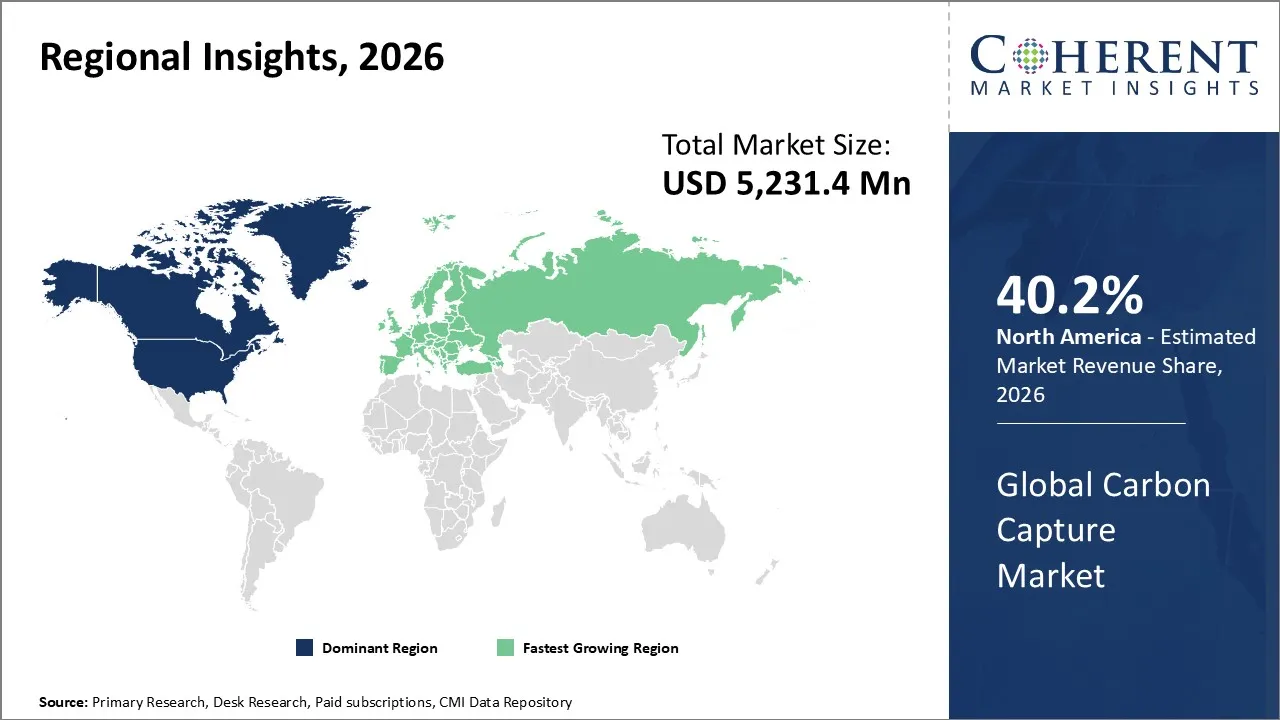
Why Does North America Dominate the Global Carbon Capture Market?
North America is expected to account for 40.2% of the global carbon capture market in 2026, supported by established refining, petrochemical, natural gas processing, and industrial infrastructure. The region benefits from engineering expertise, geological storage resources, and industrial facilities capable of supporting commercial-scale capture installations. Canada's integrated energy complexes are particularly important because capture facilities can be developed alongside dedicated storage infrastructure, improving project coordination and investment planning.
In June 2024, Shell announced final investment decisions for its Polaris carbon capture project and Atlas Carbon Storage Hub in Alberta. Polaris is designed to capture approximately 650,000 tons of CO₂ annually from the Scotford refinery and chemicals complex. This investment demonstrates the commercial relevance of integrated capture and geological storage developments for North American industrial operators.
Why Is Europe Emerging as the Fastest-Growing Region in the Global Carbon Capture Market?
Europe is projected to hold 29.5% of the global carbon capture market in 2026, with growth supported by industrial emissions compliance, carbon pricing, and investments in dedicated CO₂ infrastructure. The region's commercial momentum increasingly depends on securing financing for transportation and storage facilities before industrial customers commit to capture installations. This approach can reduce infrastructure uncertainty for manufacturers in established industrial clusters.
In April 2025, Eni reached financial close with the UK Government for the Liverpool Bay carbon capture and storage project, unlocking the transportation and storage infrastructure that will serve the HyNet industrial cluster, allowing it to move into construction. The development reinforces Europe’s project execution capabilities and offers a route to link industrial emitters with permanent geological storage.
Global Carbon Capture Market Outlook for Key Countries
Why Does China Support Growth in the Global Carbon Capture Market?
China is an important carbon capture market because its extensive coal-fired power generation and industrial manufacturing base creates opportunities for large-scale emission reduction systems. Domestic equipment manufacturing capabilities also support the development of absorption towers, CO₂ compressors, and associated separation infrastructure. Integrating capture operations with flexible power generation could improve the practicality of deployment across existing generating facilities.
In September 2025, China Huaneng commissioned a carbon capture demonstration facility at the Zhengning Power Plant in Gansu province, with an annual capture capacity of 1.5 Mn tonnes of CO₂. The project uses domestically manufactured technologies and equipment, demonstrating China's progress in industrial-scale capture systems and creating opportunities for local technology suppliers and engineering contractors.
Why Is Norway a Strategic Country in the Global Carbon Capture Market?
Norway has established a strong position in the global carbon capture market through its industrial engineering expertise, public investment support and experience in developing permanent carbon management infrastructure. The country’s emerging opportunity also includes municipal waste-to-energy facilities, where fossil and biogenic CO₂ capture can support emissions reduction and carbon removal services. This opens up additional commercial opportunities for waste management operators and technology providers.
In January 2025, Hafslund Celsio said that it would proceed with the Klemetsrud carbon capture project in Oslo. The facility, proposed to start operations in 2029, is designed to capture around 350,000 tons of CO2 per year. The investment demonstrates how municipal infrastructure may unlock commercial carbon capture projects and create potential sources of income from verified carbon removal.
Why Is India Important in the Global Carbon Capture Market?
India's carbon capture market is gaining relevance as steel, cement, power, and chemical manufacturers evaluate technologies for reducing industrial emissions. The country has a large direct reduced iron production base which provides opportunities to capture CO2 from industrial process streams. However, capture costs, energy requirements and availability of commercially viable utilization pathways continue to affect investment decisions. In-country engineering and equipment production capabilities could help make installations more cost effective.
India's Ministry of Power identified JSW Steel's carbon capture facility at Salav, Maharashtra as operational in April 2026 with a reported capture capacity of 500 tons per day from a direct reduced iron unit. This shows practical deployment in steel making and supports opportunities for specialized capture equipment suppliers and industrial technology developers.
Why Is the U.S. a Key Market for the Global Carbon Capture Market?
The U.S. has a big commercial carbon capture market due to its large fleet of natural gas power generators, industrial cogeneration plants, and existing carbon dioxide transport infrastructure. Federal tax incentives can make projects more economical and industrial electricity buyers are looking at solutions that can provide dependable power and steam supplies with lower emissions. This creates opportunities for capture developers and CO2 transportation service providers that specialize in this area.
ExxonMobil and Calpine have agreed to transport and permanently store as much as 2 Mn tons of CO2 per year from Calpine's Baytown Energy Center near Houston in April 2025. The project under development combines carbon capture with natural gas cogeneration to demonstrate how existing industrial energy infrastructure can support commercial investment in capture while maintaining power and steam output.
Why Is Australia an Important Growth Market for the Global Carbon Capture Market?
Australia has significant carbon capture market opportunities from natural gas processing facilities, mature hydrocarbon reservoirs, and geological storage resources. There are potential benefits from using the existing petroleum infrastructure to develop storage services. The country’s emissions safeguard framework incentivizes industrial operators to evaluate measurable emissions-abatement technologies, while the potential to generate verified carbon credits offers an additional revenue opportunity for eligible projects.
In Oct 2025, the Australian Clean Energy Regulator issued ~0.6 Mn Australian Carbon Credit Units to the Moomba carbon capture and storage project, South Australia. This represented the largest single issuance at that time. The development demonstrates how verified geological storage can support carbon credit generation and strengthen the commercial case for future capture projects.
Technology Deployment and Infrastructure Landscape for Global Carbon Capture Market
Technology | Primary Application | Adoption Landscape | Commercial Significance |
Advanced Amine-Based Capture Systems | Power generation, cement, refining, and industrial flue gases | Commercially established, with continuing improvements in solvent formulations and regeneration processes | Supports large industrial installations where capture efficiency, solvent stability, and equipment lifetime influence procurement decisions |
Membrane-Based CO₂ Separation | Natural gas processing, hydrogen production, and selected industrial gas streams | Commercial in selected applications, with hybrid configurations being evaluated for broader deployment | Offers compact process configurations, although economics depend strongly on gas composition, pressure, and separation requirements |
Pressure Swing and Temperature Swing Adsorption | Industrial gas separation and selected carbon capture applications | Established separation principles with application-specific commercialization in carbon capture | Creates opportunities for structured sorbents, adsorption vessels, regeneration equipment, and specialized process control systems |
Cryogenic CO₂ Separation | Concentrated CO₂ streams, hydrogen processing, and industrial gas purification | Commercially applied in suitable gas-processing configurations | Enables CO₂ purification and liquefaction, with energy requirements and feed-gas composition determining project suitability |
Oxy-Fuel Combustion and CO₂ Purification | Cement production, industrial furnaces, and selected combustion processes | Commercially relevant technology components, with integrated configurations progressing through project-specific deployment | Provides opportunities for oxygen supply systems, flue-gas recycling equipment, and carbon dioxide purification technologies |
Solid-Sorbent Direct Air Capture | Atmospheric carbon dioxide removal and permanent storage projects | Early commercial deployment with continued performance and cost optimization | Creates specialized opportunities for sorbent manufacturing, air contactors, regeneration systems, and dedicated carbon removal infrastructure |
How Are Biogenic Industrial CO₂ Streams Creating New Growth Opportunities in the Global Carbon Capture Market?
Biogenic carbon dioxide from fermentation, pulp processing, biomethane upgrading and waste streams offers an underdeveloped route to durable carbon removal when captured and permanently stored. These facilities can provide concentrated CO₂ streams, allowing suppliers to develop compact capture, dehydration and liquefaction packages rather than replicating utility installations.
The commercial opportunity extends beyond equipment sales: developers can combine engineering support, verified storage arrangements and removal-certificate delivery under customer agreements.
Producers may gain a second revenue stream while strengthening their low-carbon positioning, but only where accounting rules confirm biogenic origin, system boundaries and storage permanence.
Successful entrants will need feedstock measurements, access to transport infrastructure, contamination controls and credible verification partners. Specialists can serve dispersed facilities through standardized packages, while integrated providers may dominate projects requiring logistics and financing.
The strongest offerings will align plant-level capture economics with defensible claims of net atmospheric removal, rather than relying on carbon-credit expectations alone.
Market Players, Key Developments, and Competitive Intelligence
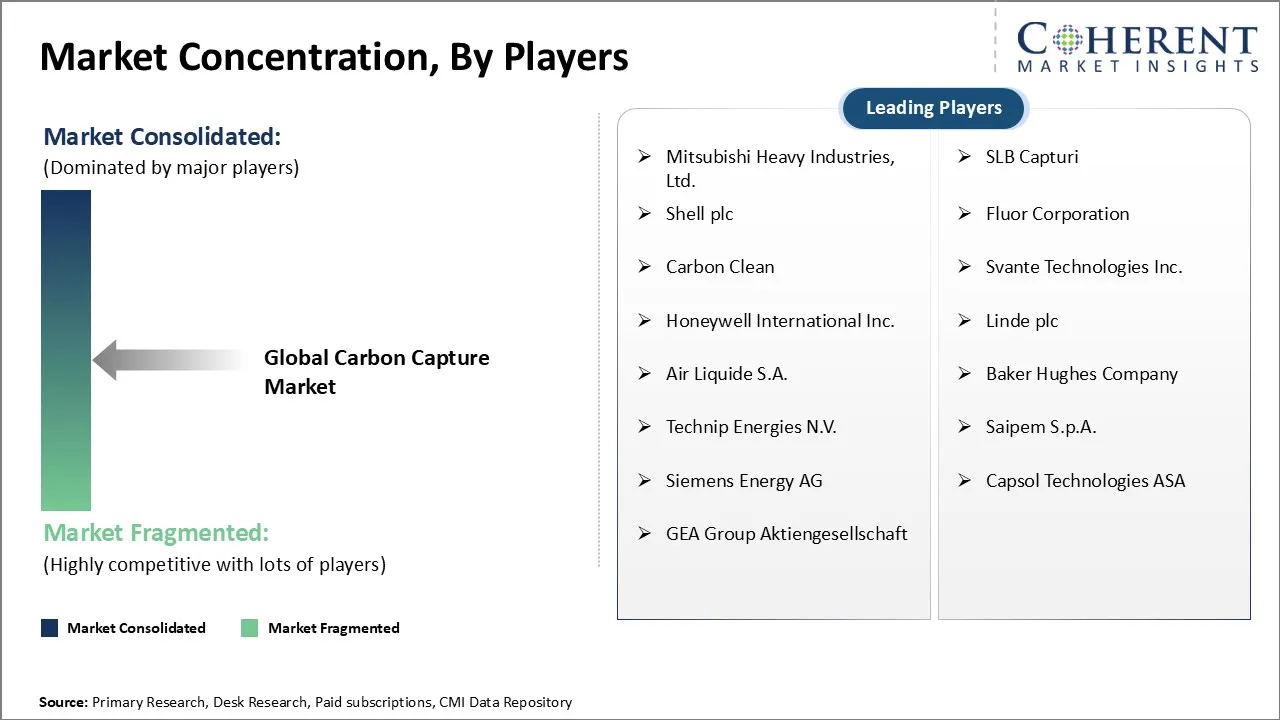
Key Developments
- In October 2026, Carbon Clean commissioned a two-ton-per-day carbon capture pilot plant at its Navi Mumbai innovation centre. The facility allows testing under different industrial flue-gas conditions. This advances the global carbon capture market by improving scale-up evidence before customers commit to commercial installations.
- In December 2025, Technip Energies secured a detailed engineering contract for the Arthit carbon capture and storage project in Thailand. The assignment covers processing and injection facilities alongside modifications to existing offshore infrastructure, demonstrating how engineering services can extend carbon capture deployment into established gas-production assets.
- In May 2025, Svante commissioned its Redwood manufacturing facility in Burnaby, Canada, dedicated to commercial-scale solid-sorbent carbon capture filters. This expansion is important for the global carbon capture market because standardized filter production can strengthen supply readiness and reduce reliance on individually fabricated capture components.
Competitive Landscape
The global carbon capture market remains fragmented across technology developers, engineering contractors, industrial gas suppliers, and equipment manufacturers, although some proprietary processes are controlled by established licensors. Competition is becoming more and more about demonstrated capture performance, life cycle costs, project execution and reliable technical support. Regional engineering firms provide installation expertise. Specialists compete with tailor-made separation packages and integration with existing industrial assets.
Key focus areas include
- Technology Licensing: Licensing revenue and differentiation are driven by proprietary separation processes and solvent formulations and process engineering capabilities.
- Total cost of ownership: cost of the equipment, energy use, maintenance costs, and operating life determine the commercial attractiveness of competing systems.
- Engineering and Project Execution: Detailed design capabilities, construction management, and commissioning reliability influence large-scale contract awards.
- Equipment Reliability: Corrosion resistance, material compatibility, and consistent component quality reduce unplanned maintenance and operating risks.
- Regional Service Capabilities: Local installation teams, spare-parts availability, and technical support improve responsiveness to industrial customers.
- Strategic Supply Agreements: Long-term relationships with equipment manufacturers, industrial gas suppliers, and engineering contractors support reliable project delivery.
Market Report Scope
Global Carbon Capture Market Report Coverage | |||
Report Coverage | Details | ||
Base Year | 2025 | Market Size in 2026: | USD 5231.4 Mn |
Historical Data For: | 2020 to 2024 | Forecast Period: | 2026 to 2033 |
Forecast Period 2026 To 2033 CAGR: | 14.80% | 2033 Value Projection: | USD 13,747.1 Mn |
Geographies covered: |
| ||
Segments covered: |
| ||
Companies covered: | Mitsubishi Heavy Industries, Ltd., SLB Capturi, Shell plc, Fluor Corporation, Carbon Clean, Svante Technologies Inc., Honeywell International Inc., Linde plc, Air Liquide S.A., Baker Hughes Company, Technip Energies N.V., Saipem S.p.A., Siemens Energy AG, Capsol Technologies ASA, GEA Group Aktiengesellschaft | ||
Growth Drivers: |
| ||
Restraints & Challenges: |
| ||
Analyst Opinion (Expert Opinion)
- The global carbon capture market technology providers are likely to come under increasing pressure to demonstrate that their solutions can be economically replicated across multiple industrial facilities. Standardized engineering, transparent installation costs and predictable operating performance may become keys to market leadership. Suppliers able to deliver repeatable solutions across customer portfolios may be in a stronger position than those that rely mostly on individual project contracts.
- The long-term economics of some carbon capture applications could be compromised by industrial process redesign and electrification. As manufacturers rethink their production technologies, capture-only suppliers may face greater competition from other decarbonization approaches. Those companies providing technology-neutral emission reduction assessments and flexible process solutions may be better positioned to protect customer relationships and find applications where carbon capture remains important.
- The carbon capture market participants should focus on industrial applications that have clear capture requirements, credible commercial commitments and viable pathways for managing carbon dioxide. The investment should be focused on tolerance to contaminants, robustness of equipment, corrosion control and practical maintenance needs. Suppliers should avoid over-investing in speculative facilities that lack guaranteed customers or downstream infrastructure, and should strengthen local engineering partnerships to control project execution costs and defend operating margins.
Speak to the analyst
Want personalized insights?
Take the findings above to one of our principal consultants, or have the report rebuilt around the segments, geographies and competitors you actually track.
Market Segmentation
- Capture Technology Insights (Revenue, USD Mn, 2021 - 2033)
- Post-Combustion Capture
- Pre-Combustion Capture
- Industrial Process Capture
- Oxy-Fuel Combustion Capture
- Direct Air Capture (DAC)
- Separation Method Insights (Revenue, USD Mn, 2021 - 2033)
- Chemical Absorption
- Physical Absorption
- Adsorption-Based Capture
- Membrane Separation
- Cryogenic Separation
- Other Methods
- Offering Insights (Revenue, USD Mn, 2021 - 2033)
- Carbon Capture Equipment & Systems
- Engineering, Procurement & Construction (EPC) Services
- Technology Licensing & Process Design
- Operations, Maintenance & Technical Services
- Capture Source Insights (Revenue, USD Mn, 2021 - 2033)
- Power Generation Facilities
- Natural Gas Processing
- Cement Manufacturing
- Chemical & Petrochemical Facilities
- Iron & Steel Manufacturing
- Hydrogen & Ammonia Production
- Waste-to-Energy & Other Industrial Sources
- Capture Capacity Insights (Revenue, USD Mn, 2021 - 2033)
- Below 100,000 Tons CO₂/Year
- 100,000–500,000 Tons CO₂/Year
- 500,000–1 Mn Tons CO₂/Year
- Above 1 Mn Tons CO₂/Year
- Regional Insights (Revenue, USD Mn, 2021 - 2033)
- North America
- U.S.
- Canada
- Latin America
- Brazil
- Argentina
- Mexico
- Rest of Latin America
- Europe
- Germany
- U.K.
- Spain
- France
- Italy
- Russia
- Rest of Europe
- Asia Pacific
- China
- India
- Japan
- Australia
- South Korea
- ASEAN
- Rest of Asia Pacific
- Middle East
- GCC Countries
- Israel
- Rest of Middle East
- Africa
- South Africa
- North Africa
- Central Africa
- North America
- Key Players Insights
- Mitsubishi Heavy Industries, Ltd.
- SLB Capturi
- Shell plc
- Fluor Corporation
- Carbon Clean
- Svante Technologies Inc.
- Honeywell International Inc.
- Linde plc
- Air Liquide S.A.
- Baker Hughes Company
- Technip Energies N.V.
- Saipem S.p.A.
- Siemens Energy AG
- Capsol Technologies ASA
- GEA Group Aktiengesellschaft
Sources
Primary Research Interviews
- Carbon capture technology developers, equipment manufacturers, solvent and sorbent suppliers
- Industrial CO₂ emitters, EPC contractors, carbon transportation and geological storage operators
Stakeholders
- Post-combustion, pre-combustion, direct air capture and industrial capture technology providers
- Power generation, cement, steel, oil and gas, chemical, hydrogen and petrochemical companies
- CO₂ pipeline operators, storage developers and carbon utilization companies
End-use Sectors
- Power generation, natural gas processing, cement, iron and steel, chemicals and petrochemicals
- Hydrogen and ammonia production, waste-to-energy, oil and gas, and direct air capture
- CO₂ utilization in synthetic fuels, chemicals, building materials and industrial applications
Regulatory and Industry Bodies
- International Energy Agency (IEA)
- U.S. Environmental Protection Agency (EPA)
- U.S. Department of Energy (DOE)
- European Commission (EC)
- Environment and Climate Change Canada
- Australia's Department of Climate Change, Energy, the Environment and Water (DCCEEW)
Databases
- IEA CCUS Projects Database
- Global CCS Institute project and facility database
- U.S. DOE Carbon Storage Atlas
- U.S. EPA Greenhouse Gas Reporting Program (GHGRP)
- Eurostat energy and industrial statistics
- National energy, industrial emissions and geological storage databases
Magazines and Journals
- International Journal of Greenhouse Gas Control
- International Journal of Carbon Capture Science and Technology
- Journal of CO₂ Utilization
- Applied Energy
- Energy & Environmental Science
Associations
- Global CCS Institute (GCCSI)
- Carbon Capture Coalition
- Carbon Capture and Storage Association (CCSA)
- CO₂ Value Europe
- Zero Emissions Platform (ZEP)
- Global Cement and Concrete Association (GCCA)
Public Domain Sources
- Carbon capture project feasibility studies, technical reports and environmental impact assessments
- Company annual reports, sustainability disclosures and carbon management strategies
- CO₂ capture capacity, pipeline infrastructure and geological storage project announcements
- Industrial emissions data, technology performance studies and carbon utilization research
- Government funding announcements, project permits and carbon storage assessments
Key Standards and Regulations
- EU CCS Directive (2009/31/EC)
- EU Net-Zero Industry Act (Regulation (EU) 2024/1735)
- U.S. EPA Underground Injection Control (UIC) Class VI regulations
- U.S. Section 45Q Carbon Oxide Sequestration Tax Credit
- ISO 27913 – CO₂ Pipeline Transportation Systems
- ISO 27914 – Geological Storage of CO₂
- ISO 27916 – CO₂ Storage Using Enhanced Oil Recovery
- ISO 14064 – Greenhouse Gas Quantification and Reporting
- ISO 14067 – Product Carbon Footprint
Proprietary Elements
- CMI Data Analytics Tool
- Proprietary research repository, supported by primary interviews, carbon capture capacity modeling, project pipeline assessment, technology benchmarking, CO₂ transportation and storage infrastructure analysis, capture cost assessment, and competitive intelligence.
Get access to 250+ pages report
Every segment, forecast, competitor profile and data table behind the analysis above — available for instant download.
- ESOMAR Member
- ISO 9001:2015 Certified
- D-U-N-S Registered
- GDPR & CCPA Compliant
Frequently Asked Questions
The CAGR of global carbon capture market is projected to be 14.80% from 2026 to 2033.
Carbon capture technology separates carbon dioxide from industrial emissions or ambient air, the captured CO₂ can then be transported for utilization or permanent geological storage.
Carbon capture and storage (CCS) involve capturing CO₂ and permanently storing it, whereas CCUS also includes converting or using captured CO₂ in industrial products and processes.
Carbon capture solutions are used across power generation, cement, iron and steel, oil and gas, chemicals, petrochemicals, hydrogen production, and waste-to-energy industries.
Businesses should evaluate capture efficiency, installation costs, energy requirements, compatibility with existing facilities, CO₂ transportation and storage availability, regulatory compliance, and long-term operating expenses.
The global carbon capture market estimated at USD 5,231.4 Mn in 2026 is projected to reach USD 13,747.1 Mn by 2033.
The major factors driving growth in the global carbon capture market include increasing regulatory pressure and carbon emission reduction targets across power generation and energy-intensive industries, as well as rising investments in industrial decarbonization and large-scale carbon capture infrastructure.