

Global Carbon Materials Market Size and Forecast – 2026 To 2033
The Global Carbon Materials Market is estimated to be valued at USD 34.62 Bn in 2026 and is expected to reach USD 61.68 Bn by 2033, growing at a compound annual growth rate (CAGR) of 8.6% from 2026 to 2033. Market growth is supported by increasing adoption of high-performance carbon materials across automotive, aerospace, electronics, energy storage, and industrial applications where lightweight strength, electrical conductivity, thermal stability, and durability are critical performance requirements.
The transition toward electric mobility, renewable energy storage, advanced manufacturing, and next-generation industrial technologies is further expanding demand for graphite, carbon fiber, carbon black, and specialty carbon solutions. The market is also benefiting from investments aimed at strengthening carbon material supply chains and developing sustainable production pathways. In January 2026, EIT RawMaterials invested in Nordic Bio-Graphite to advance low-carbon graphite production using renewable carbon sources, highlighting the industry shift toward sustainable and localized carbon material manufacturing.
Key Takeaways of the Global Carbon Materials Market
- Carbon Fiber is estimated to register a CAGR of 9.2% and account for 28.6% of the global carbon materials market in 2026, supported by increasing use in lightweight structures, aerospace components, hydrogen storage systems, and advanced mobility applications. In April 2026, Toray highlighted expansion opportunities for carbon fiber applications including aircraft, hydrogen tanks, and urban air mobility technologies.
- Powder is expected to register an estimated CAGR of 8.4% and account for 32.8% share of the global carbon materials market in 2026, supported by its extensive use in battery electrodes, conductive additives, coatings, and industrial formulations. Its processing flexibility and controlled particle characteristics make it suitable for diverse applications. In October 2025, Tokai Carbon expanded specialty carbon product capabilities to support advanced industrial requirements.
- Energy Storage is projected to achieve an estimated CAGR of 9.1% and represent 24.8% share of the global carbon materials market in 2026, driven by demand for graphite anodes and conductive carbon materials used in lithium-ion batteries and storage systems. Material consistency and performance requirements continue to influence supplier selection. In January 2025, the U.S. Department of Energy announced initiatives supporting domestic battery material supply chains.
- Asia Pacific is anticipated to expand at an estimated CAGR of 9.0% and account for 38.7% of the global carbon materials market in 2026, supported by strong battery manufacturing capacity, electronics production, automotive electrification, and industrial carbon material consumption. In November 2025, CATL and Stellantis commenced construction of a 50 GWh battery plant in Spain, reflecting broader global supply chain development linked with advanced carbon-based battery materials.
- Europe is expected to record an estimated CAGR of 8.7% and contribute 27.6% of the global carbon materials market in 2026, driven by strategic investments in battery-grade graphite, circular material solutions, and localized critical mineral supply chains. In December 2024, UP Catalyst received recognition through EIT RawMaterials initiatives for developing CO₂-derived sustainable graphite technologies aimed at supporting Europe’s battery ecosystem.
Segmental Insights
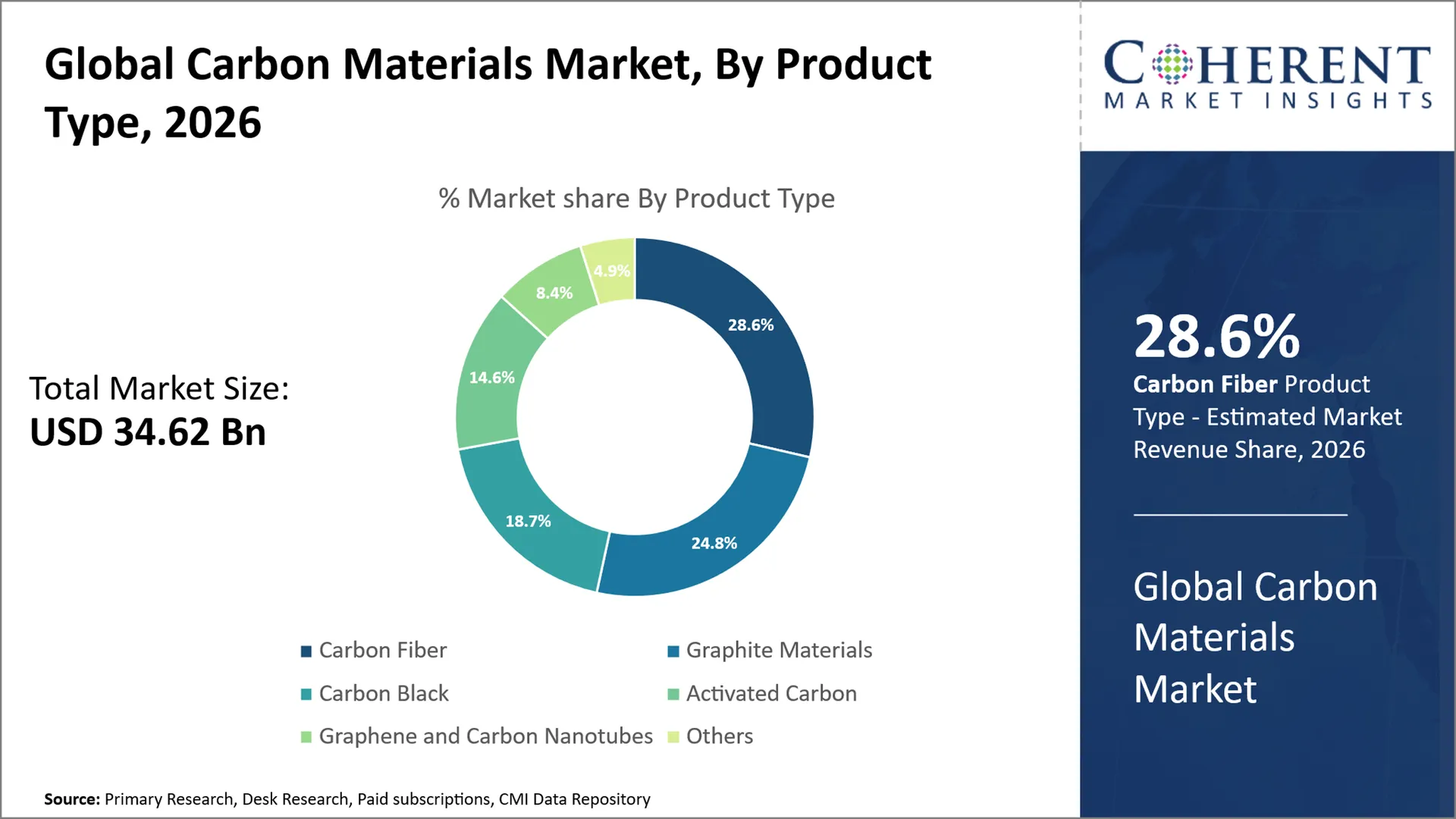
Why Does Carbon Fiber Dominate the Global Carbon Materials Market?
Carbon Fiber is expected to account for 28.6% of the global carbon materials market in 2026, supported by its critical role in applications requiring high strength-to-weight ratios, corrosion resistance, and structural durability. The segment maintains a leading position as automotive manufacturers, aerospace companies, and industrial equipment producers increasingly adopt lightweight composite solutions to improve efficiency and performance. Carbon fiber suppliers benefit from advancements in precursor materials, automated composite manufacturing, and expanding production capabilities that improve scalability. The material is particularly important in electric vehicles, aircraft structures, wind energy components, and hydrogen storage systems where weight reduction directly impacts operational efficiency. In March 2025, Mitsubishi Chemical Group announced the expansion of its carbon fiber intermediate material capabilities to strengthen supply for aerospace and mobility applications.
- Current Industry Events of 2026
- Market Size Estimation
- Regional Breakdown
- Competitive Landscape
- Customer Intelligence
- Segmental Analysis
- Pricing Analysis
- Key Market Drivers, Challenges & Future Trends
- Customized Insights Section
Why Does Powder Represent the Largest Form Category in the Global Carbon Materials Market?
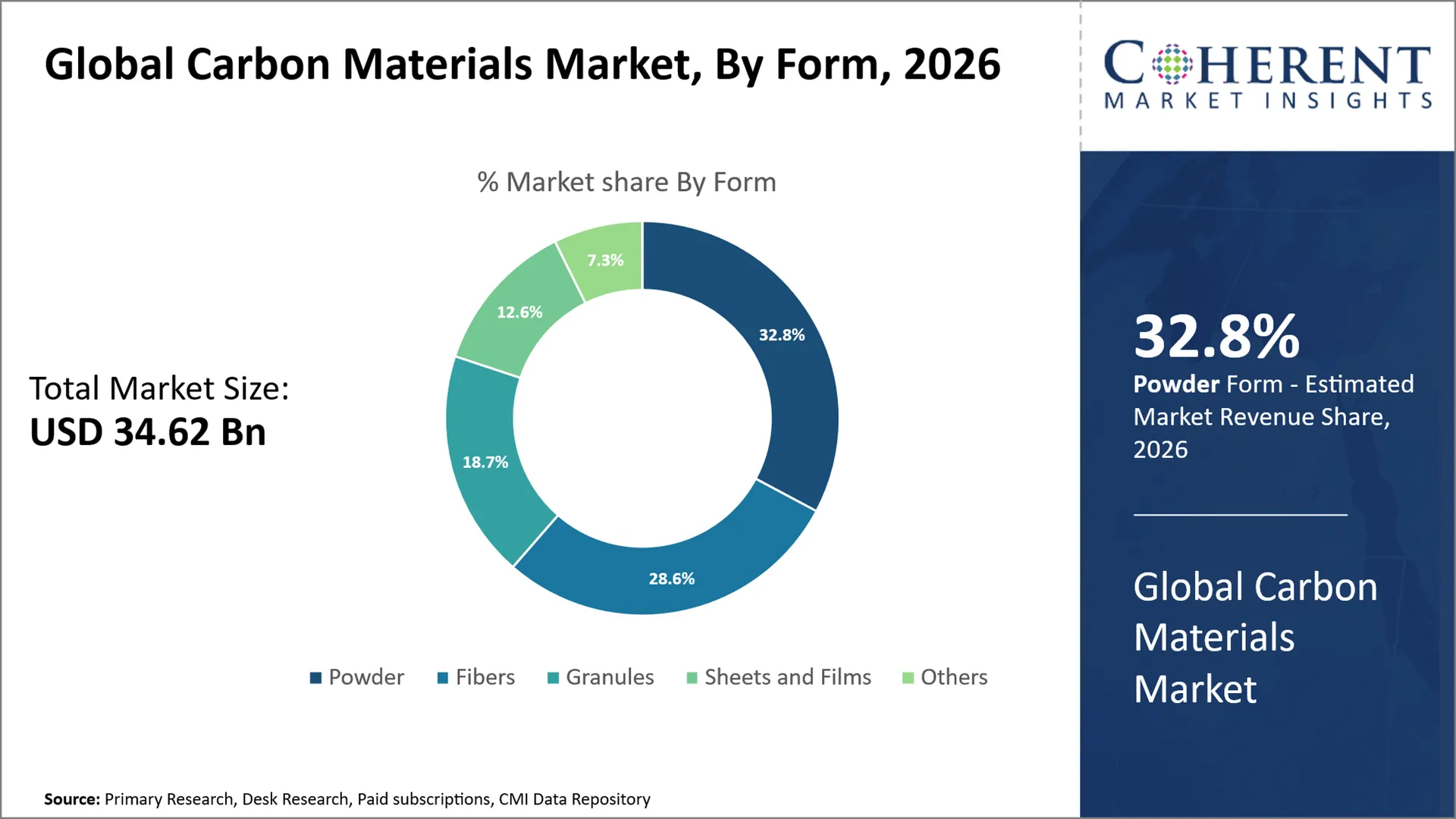
Powder carbon materials are projected to represent 32.8% of the global carbon materials market in 2026, making them the leading form category due to their broad industrial compatibility, processing flexibility, and suitability across multiple manufacturing environments. Carbon powders are extensively used in battery electrodes, conductive additives, coatings, metallurgy, filtration systems, and specialty chemical applications where controlled particle size and purity influence product performance. Manufacturers benefit from established production infrastructure, efficient transportation characteristics, and adaptability across different end-use formulations. The segment’s commercial relevance is strengthened by growing requirements for customized powder grades with specific conductivity, surface area, and thermal characteristics. In September 2025, Tokai Carbon announced investments to enhance production capabilities for specialty carbon products, supporting advanced industrial applications requiring precise carbon material specifications.
Why Does Energy Storage Dominate the Application Category of the Global Carbon Materials Market?
Energy Storage is expected to hold 24.8% of the global carbon materials market in 2026, driven by the increasing integration of carbon materials into lithium-ion batteries, supercapacitors, and next-generation storage technologies. Graphite anode materials, conductive carbon additives, and advanced carbon structures are essential for improving battery capacity, charging performance, cycle life, and electrical conductivity. The segment benefits from expanding battery manufacturing infrastructure, electric vehicle deployment, and renewable energy storage requirements. Carbon material producers are increasingly focusing on battery-grade specifications, supply consistency, and technological improvements to meet demanding energy-sector requirements. In November 2024, the U.S. Department of Energy announced funding support for domestic battery material supply chains, including initiatives focused on strengthening critical material processing capabilities required for energy storage manufacturing.
Current Events and their Impact
Current Event | Description and Its Impact |
February 2026 – Japan–Australia graphite anode supply chain development initiative |
|
July 2025 – International graphite supply chain concerns highlighted by energy security assessments |
|
2026 – Expansion of carbon-related sustainability and circular material policies |
|
Global Carbon Materials Market Dynamics
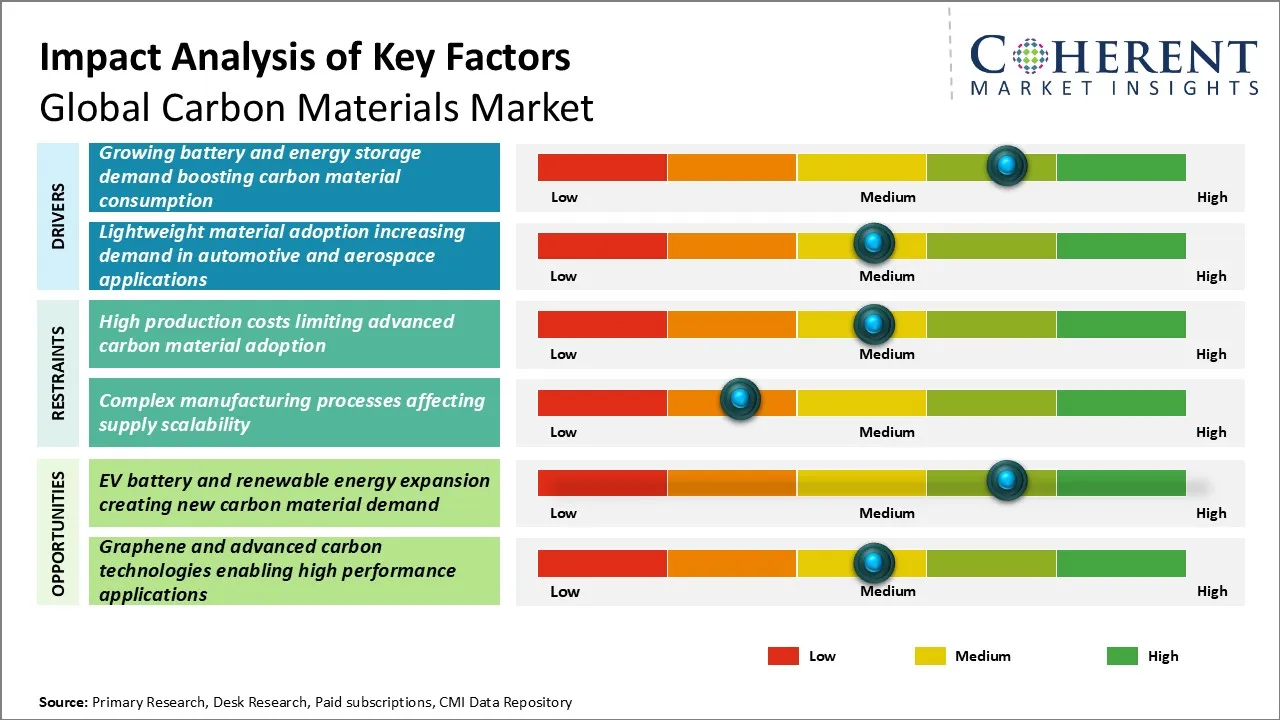
Key Market Drivers
- Growing battery and energy storage demand boosting carbon material consumption: The expansion of lithium-ion battery manufacturing is strengthening demand for graphite materials, carbon nanotubes, graphene additives, and specialty carbon structures used to improve conductivity, durability, and electrochemical performance. Battery manufacturers, graphite processors, and advanced material suppliers benefit as automakers and energy storage companies seek reliable material sources for electrification programs. The strategic importance of carbon materials is increasing as supply chain localization becomes a priority across major economies. In February 2026, Idemitsu Kosan partnered with Graphinex, Marubeni, and NSC to develop a Japan–Australia natural graphite anode supply chain to improve battery material security.
- Lightweight material adoption increasing demand in automotive and aerospace applications: The shift toward lightweight engineering materials is expanding carbon fiber and composite material adoption across automotive, aerospace, defense, and transportation industries. Carbon materials enable manufacturers to reduce vehicle weight, improve fuel efficiency, increase electric vehicle range, and enhance structural performance. Composite producers, fiber manufacturers, and end-use OEMs benefit from increasing integration of high-strength carbon solutions into next-generation platforms. In June 2026, Oak Ridge National Laboratory highlighted its collaboration with ACP Technologies to scale advanced pitch materials supporting domestic production capabilities for synthetic graphite and carbon fiber applications in transportation and defense supply chains.
Emerging Market Trends
- Transition toward sustainable and low-carbon carbon material production: Carbon material producers are increasingly shifting from conventional manufacturing routes toward lower-emission production technologies, recycled feedstocks, and carbon utilization pathways. Companies across graphite, carbon fiber, carbon black, and graphene value chains are evaluating methods that reduce energy intensity and improve environmental performance. This transition is expected to influence supplier selection, customer procurement standards, and long-term competitiveness. Producers capable of combining material quality with traceability and sustainability credentials are likely to gain stronger positioning as industrial buyers increasingly incorporate environmental considerations into sourcing decisions.
- Increasing customization of carbon materials for application-specific performance requirements: The carbon materials industry is moving toward specialized formulations designed for specific performance requirements rather than standardized commodity supply. Battery manufacturers, semiconductor companies, aerospace suppliers, and industrial users increasingly require customized grades with controlled conductivity, thermal properties, purity levels, and mechanical characteristics. This shift creates opportunities for specialist producers with advanced processing capabilities while increasing competitive pressure on traditional suppliers. Over the forecast period, companies that integrate material engineering, application support, and customer collaboration are expected to strengthen their market position compared with suppliers competing mainly on production volume and pricing.
Regional Insights
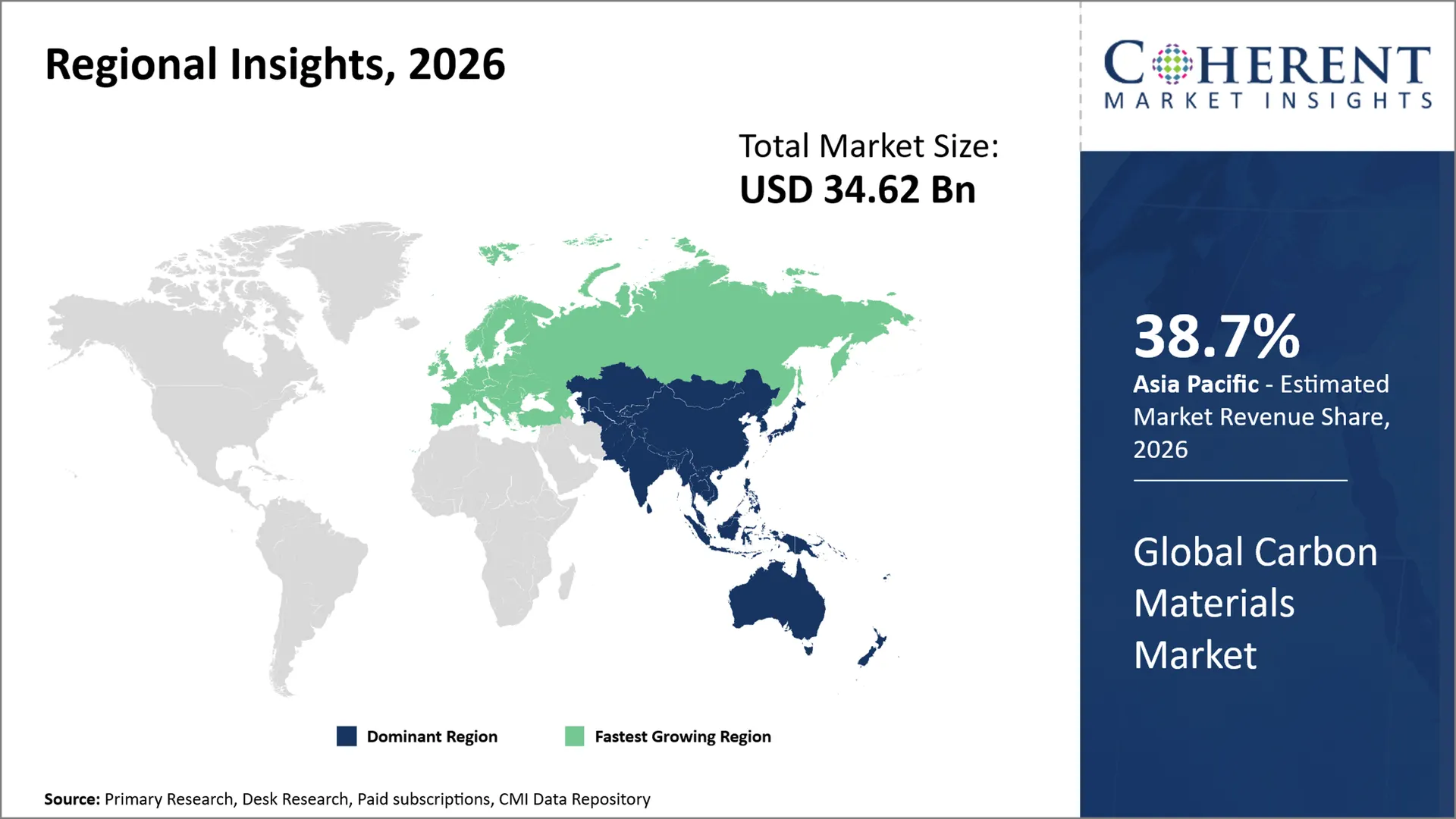
Why Does Asia Pacific Dominate the Global Carbon Materials Market?
Asia Pacific is expected to account for 38.7% of the global carbon materials market in 2026, supported by its strong position across battery manufacturing, graphite processing, electronics production, automotive supply chains, and industrial carbon consumption. The region benefits from extensive downstream infrastructure for lithium-ion batteries, electric vehicles, semiconductors, and specialty materials, creating consistent demand for graphite materials, carbon black, carbon fibers, and advanced carbon structures. China remains the largest manufacturing hub for graphite processing and battery materials, while Japan and South Korea contribute through advanced material technologies and high-performance applications. India is also strengthening its position through expanding electric mobility and industrial manufacturing capabilities. In March 2025, the International Energy Agency highlighted Asia Pacific’s continued dominance in global battery supply chains, reinforcing the region’s strategic importance for carbon-based energy materials.
Why Is Europe Emerging as the Fastest-Growing Region in the Global Carbon Materials Market?
Europe is projected to become the fastest-growing region with 27.6% share in 2026 in the global carbon materials market, supported by efforts to establish localized battery material supply chains, increase recycled material adoption, and reduce dependence on imported critical carbon resources. The region’s automotive transformation, particularly electric vehicle production, is encouraging investment in graphite anodes, carbon composites, and lightweight materials. European manufacturers are increasingly focusing on sustainable production methods, circular economy models, and low-carbon industrial processes. Germany, France, and the Nordic countries are emerging as important locations for advanced material development and battery ecosystem expansion. In May 2025, the European Commission identified graphite and other battery materials as strategic resources under its Critical Raw Materials framework, strengthening policy support for regional supply diversification and domestic processing capabilities.
Global Carbon Materials Market Outlook for Key Countries
Why Is the U.S. a Key Market for the Global Carbon Materials Market?
The U.S. represents a strategically important in global carbon materials market due to its growing demand from aerospace, defense, electric vehicles, renewable energy storage, semiconductor manufacturing, and advanced industrial applications. The country has strong consumption potential for carbon fiber composites, synthetic graphite, specialty carbon materials, and high-performance materials requiring strict quality standards. Government initiatives focused on domestic critical mineral security are encouraging investments in graphite processing, battery material production, and alternative supply chains. The presence of aerospace manufacturers, technology companies, and energy storage developers further supports demand for advanced carbon solutions. In January 2025, the U.S. Department of Energy announced funding initiatives under its battery materials programs to strengthen domestic production capabilities for critical battery supply chains, including graphite-related materials.
Why Is India Important in the Global Carbon Materials Market?
India is becoming an increasingly important in global carbon materials market due to expanding industrial manufacturing, electric mobility adoption, renewable energy deployment, steel production, and infrastructure development. Demand is supported by applications such as carbon electrodes, carbon black for automotive tires, graphite components, and advanced materials used in emerging energy technologies. The country’s growing automotive sector and government focus on battery manufacturing are encouraging development of domestic material capabilities while increasing requirements for imported high-quality graphite and specialty carbon products. India also benefits from its large industrial base, competitive manufacturing ecosystem, and rising investments in clean energy technologies. In February 2025, the Government of India approved additional initiatives under the National Critical Mineral Mission to strengthen domestic capabilities and reduce dependence on critical material imports.
Why Does China Support Growth in the Global Carbon Materials Market?
China plays a central role in the global carbon materials market due to its extensive graphite resources, processing capacity, battery manufacturing ecosystem, and dominance in downstream applications. The country has established integrated supply chains covering natural graphite processing, synthetic graphite production, battery anodes, carbon black manufacturing, and advanced carbon materials. Strong demand from electric vehicles, energy storage systems, electronics, and industrial manufacturing continues to support domestic consumption. Chinese manufacturers also maintain significant export capabilities, supplying carbon-based materials to global industries. In addition, government policies supporting new energy vehicles and strategic materials continue to influence investment decisions across the carbon value chain. In December 2024, China’s Ministry of Commerce introduced export control measures on certain graphite-related products, highlighting the strategic importance of graphite materials within global supply chains.
Why Is Germany a Strategic Country in the Global Carbon Materials Market?
Germany holds strategic importance in the global carbon materials market due to its advanced automotive industry, engineering capabilities, industrial manufacturing base, and growing focus on battery ecosystem development. The country represents a major demand center for carbon fiber composites, graphite materials, and specialty carbon solutions used in electric vehicles, lightweight components, industrial equipment, and energy technologies. Germany’s strong automotive supplier network creates opportunities for high-performance carbon materials that improve efficiency, durability, and product performance. The country is also investing in localized battery production and sustainable industrial technologies to strengthen its position within European supply chains. In October 2025, Germany’s Federal Ministry for Economic Affairs and Climate Action continued support for battery cell production projects through strategic industrial funding programs, strengthening demand for advanced battery material inputs.
Why Is Japan an Important Growth Market for the Global Carbon Materials Market?
Japan remains an important growth market for the global carbon materials market due to its advanced technology ecosystem, established electronics industry, automotive manufacturing expertise, and specialization in high-performance materials. Japanese companies have long-standing capabilities in carbon fiber, specialty graphite, carbon composites, and battery-related materials, supporting demand from aerospace, automotive, semiconductor, and energy storage applications. The country’s focus on high-quality manufacturing and technological precision creates opportunities for premium carbon materials rather than commodity-grade products. Japan is also strengthening supply chain resilience for critical materials through international partnerships and domestic innovation programs. In April 2025, Japan’s Ministry of Economy, Trade and Industry expanded initiatives supporting critical mineral supply security and industrial competitiveness, reinforcing the importance of stable carbon material availability for strategic industries.
Technology Innovation, Production & Manufacturing Landscape
Technology | Current Adoption Status | Commercial Applications | Strategic Impact |
Synthetic Graphite Production Technologies | High adoption in battery and industrial applications due to consistent purity and performance characteristics | Lithium-ion battery anodes, electrodes, semiconductor processing, industrial furnaces | Enables battery manufacturers to achieve predictable performance while reducing dependency on variable-quality natural graphite sources. |
Recycled Carbon Fiber Processing Technologies | Emerging commercial adoption supported by aerospace, automotive, and composite industries seeking circular material solutions | Automotive composites, aerospace components, sporting goods, industrial reinforcement materials | Helps reduce composite waste while providing lower-cost alternatives to virgin carbon fiber materials. |
Graphene and Carbon Nanotube Manufacturing Technologies | Early-to-medium commercialization with increasing focus on scalable production methods | Conductive additives, advanced coatings, batteries, electronics, composite reinforcement | Supports development of high-performance materials with improved electrical, thermal, and mechanical properties. |
Pitch-Based Carbon Material Processing | Established technology with specialized industrial usage | High-temperature applications, aerospace components, specialty graphite products | Provides advanced thermal resistance and performance advantages for demanding environments. |
Low-Emission Carbon Manufacturing Technologies | Developing adoption as producers focus on reducing energy intensity and environmental impact | Sustainable graphite, carbon black alternatives, circular carbon materials | Creates differentiation through lower carbon footprint products and improves alignment with sustainability-focused procurement requirements. |
Advanced Composite Manufacturing Technologies | Expanding adoption through automation and digital manufacturing methods | Aerospace structures, electric vehicles, hydrogen storage vessels, lightweight industrial components | Improves production efficiency, reduces manufacturing costs, and enables broader carbon fiber adoption beyond traditional premium applications. |
How Are Sustainable Carbon Production Technologies Creating New Growth Opportunities in the Global Carbon Materials Market?
Sustainable carbon production technologies are creating new opportunities for carbon material manufacturers by enabling low-emission, resource-efficient, and traceable solutions. Demand is shifting toward recycled carbon feedstocks, energy-efficient manufacturing processes, and alternative production pathways as battery, automotive, aerospace, and electronics industries increasingly prioritize sustainable material sourcing. The opportunity favors companies that can integrate recycling capabilities, advanced processing technologies, and reliable supply chains to deliver high-performance carbon materials. Suppliers with strong technical expertise, certification capabilities, and application-specific solutions are likely to capture premium opportunities. Over the forecast period, sustainability will evolve from a compliance requirement into a key competitive differentiator in the Global Carbon Materials Market.
Market Players, Key Development, and Competitive Landscape
Key Developments
- In August 2026, SGL Carbon announced a capacity expansion agreement with X-energy to double manufacturing capacity for medium-grain isotropic graphite (NBG-18), a specialized material used in advanced nuclear reactor applications. This development strengthens the company’s position in high-value graphite solutions by expanding supply capabilities for next-generation energy infrastructure and improving access to strategically important graphite markets.
- In August 2026, GrafTech International reported continued operational improvements and commercial actions focused on strengthening graphite electrode pricing, supply reliability, and customer relationships. The development supports the global carbon materials market by demonstrating how established graphite producers are adapting production strategies, improving margins, and prioritizing higher-value industrial applications amid changing steel industry dynamics.
Competitive Landscape
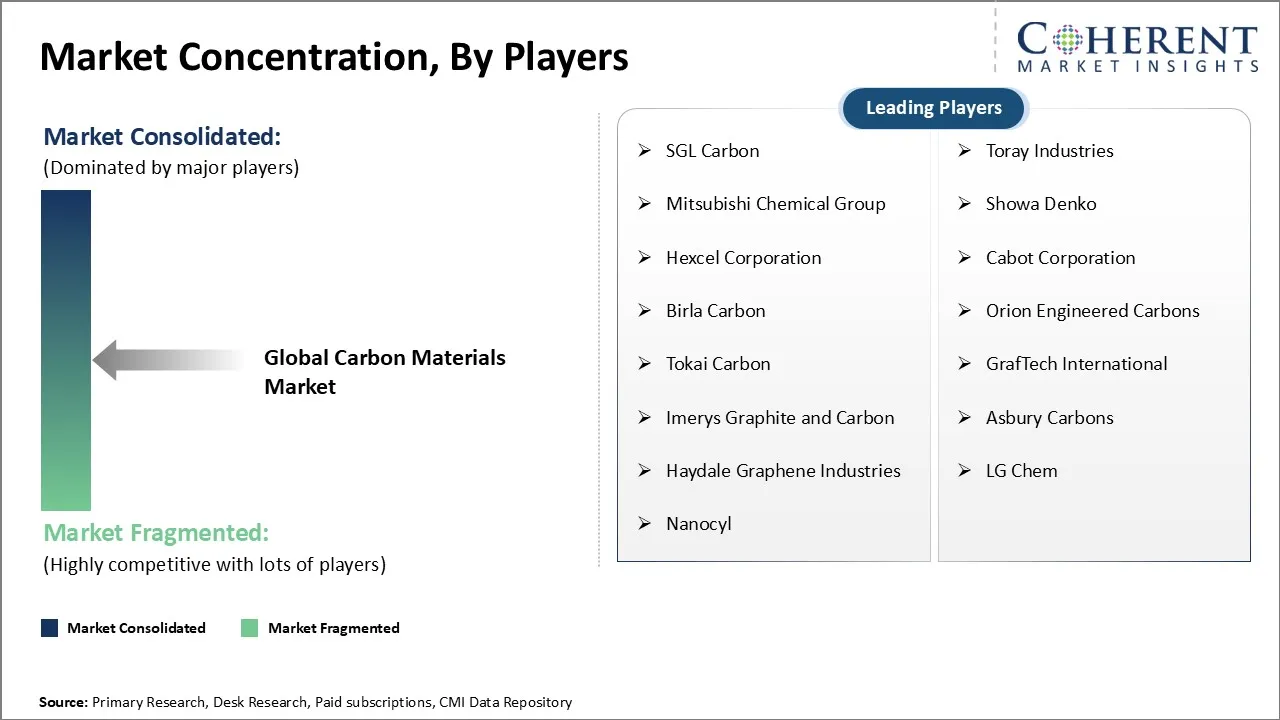
The global carbon materials market is moderately consolidated, with competition among integrated carbon material producers, specialty material manufacturers, graphite suppliers, and advanced carbon technology companies. Market participants compete through product performance, manufacturing scale, material quality, supply reliability, customization capabilities, sustainability positioning, and long-term customer relationships across battery, automotive, aerospace, electronics, and industrial applications. Key Focus Areas Include:
- Material quality and performance differentiation: Focus on purity, conductivity, strength, and thermal properties for advanced applications.
- Technology adoption and process efficiency: Investment in advanced processing, automation, and sustainable production methods.
- Manufacturing capacity and supply reliability: Expansion of production capabilities to ensure consistent supply for strategic industries.
- Product grade and customization capabilities: Development of application-specific carbon materials for batteries, composites, and industrial uses.
- Pricing and cost optimization: Improving production efficiency to maintain competitiveness across commodity and specialty segments.
- Sustainability and circular economy positioning: Adoption of recycling technologies and lower-emission manufacturing processes.
- Regional production and supply chain localization: Establishing localized manufacturing networks to reduce dependency risks.
- Customer partnerships and technical support: Strengthening collaboration with end users for material qualification and application development.
Market Report Scope
Carbon Materials Market Report Coverage | |||
Report Coverage | Details | ||
Base Year | 2025 | Market Size in 2026: | USD 34.62 Bn |
Historical Data For: | 2020 To 2024 | Forecast Period: | 2026 To 2033 |
Forecast Period 2026 To 2033 CAGR: | 8.6% | 2033 Value Projection: | USD 61.68 Bn |
Geographies covered: |
| ||
Segments covered: |
| ||
Companies covered: | SGL Carbon, Toray Industries, Mitsubishi Chemical Group, Showa Denko, Hexcel Corporation, Cabot Corporation, Birla Carbon, Orion Engineered Carbons, Tokai Carbon, GrafTech International, Imerys Graphite and Carbon, Asbury Carbons, Haydale Graphene Industries, LG Chem, Nanocyl | ||
Growth Drivers: |
| ||
Restraints & Challenges: |
| ||
Analyst Opinion (Expert Opinion)
- The Global Carbon Materials Market is likely to move from a volume-oriented commodity structure toward a performance-driven materials ecosystem. Competitive advantage will increasingly depend on application engineering, material customization, supply chain integration, and the ability to support customers through product qualification processes. Suppliers that combine manufacturing scale with technical collaboration capabilities are expected to capture greater value compared with companies competing only through production capacity and pricing.
- A major transformation in the market could emerge from the convergence of carbon materials with strategic industries such as advanced energy, artificial intelligence infrastructure, and next-generation transportation. Traditional graphite and carbon suppliers may face pressure if alternative production technologies achieve commercial maturity. Companies developing localized, traceable, and application-specific carbon material solutions are better positioned to benefit from changing industrial priorities.
- Market participants should prioritize investments in high-performance materials, recycling capabilities, and regional manufacturing resilience. Companies should strengthen partnerships with battery producers, aerospace manufacturers, semiconductor suppliers, and energy developers to secure long-term demand visibility. Key risks include raw material concentration, price volatility, technology commercialization challenges, and increasing sustainability requirements. Suppliers should avoid excessive dependence on commodity-grade products and focus on differentiated carbon solutions with stronger customer value propositions.
Speak to the analyst
Want personalized insights?
Take the findings above to one of our principal consultants, or have the report rebuilt around the segments, geographies and competitors you actually track.
Market Segmentation
- Product Type Insights (Revenue, USD Bn, 2021 - 2033)
- Carbon Fiber
- Graphite Materials
- Carbon Black
- Activated Carbon
- Graphene and Carbon Nanotubes
- Others
- Form Insights (Revenue, USD Bn, 2021 - 2033)
- Powder
- Fibers
- Granules
- Sheets and Films
- Others
- Application Insights (Revenue, USD Bn, 2021 - 2033)
- Energy Storage
- Automotive and Transportation
- Electronics and Semiconductors
- Aerospace and Defense
- Industrial Applications
- Others
- End User Insights (Revenue, USD Bn, 2021 - 2033)
- Automotive
- Electronics
- Energy and Power
- Aerospace and Defense
- Chemicals and Manufacturing
- Others
- Distribution Channel Insights (Revenue, USD Bn, 2021 - 2033)
- Direct Sales
- Indirect Sales
- Regional Insights (Revenue, USD Bn, 2021 - 2033)
- North America
- U.S.
- Canada
- Latin America
- Brazil
- Argentina
- Mexico
- Rest of Latin America
- Europe
- Germany
- U.K.
- Spain
- France
- Italy
- Russia
- Rest of Europe
- Asia Pacific
- China
- India
- Japan
- Australia
- South Korea
- ASEAN
- Rest of Asia Pacific
- Middle East
- GCC Countries
- Israel
- Rest of Middle East
- Africa
- South Africa
- North Africa
- Central Africa
- North America
- Key Players Insights
- SGL Carbon
- Toray Industries
- Mitsubishi Chemical Group
- Showa Denko
- Hexcel Corporation
- Cabot Corporation
- Birla Carbon
- Orion Engineered Carbons
- Tokai Carbon
- GrafTech International
- Imerys Graphite and Carbon
- Asbury Carbons
- Haydale Graphene Industries
- LG Chem
- Nanocyl
Sources
Primary Research Interviews
- Carbon material manufacturers, graphite producers, carbon fiber suppliers, specialty carbon material companies, battery material suppliers, and industrial users
- Material scientists, process engineers, procurement professionals, automotive OEMs, aerospace manufacturers, battery developers, and energy storage experts
Stakeholders
- Carbon fiber manufacturers, graphite producers, carbon black suppliers, graphene developers, and advanced carbon material companies
- Battery manufacturers, automotive companies, aerospace suppliers, electronics manufacturers, semiconductor companies, and industrial end users
- Raw material suppliers, distributors, technology providers, recycling companies, and carbon processing specialists
End-use Sectors
- Energy storage and battery applications
- Automotive and transportation components
- Aerospace and defense structures
- Electronics and semiconductor applications
- Industrial equipment and advanced manufacturing
Regulatory and Industry Bodies
- International Energy Agency (IEA)
- U.S. Department of Energy (DOE)
- European Commission critical raw material authorities
- National energy and industrial policy organizations
- Battery material and advanced manufacturing associations
Databases
- Company annual reports, investor presentations, and corporate filings
- Battery, graphite, carbon fiber, and advanced material industry databases
- Trade statistics and import-export datasets
- Manufacturing capacity and supply chain intelligence databases
- Technology development and patent databases
Magazines and Journals
- Advanced materials and carbon science publications
- Battery technology and energy storage journals
- Composite material and manufacturing publications
- Industrial technology and chemical industry publications
Associations
- International Energy Agency (IEA)
- International Graphite Association
- Composite material industry associations
- Battery industry associations
- Advanced materials and chemical industry organizations
Public Domain Sources
- Battery supply chain developments and energy transition trends
- Carbon fiber and composite material innovations
- Graphite processing and critical mineral developments
- Sustainable carbon production initiatives
- Industrial manufacturing and technology adoption trends
Key Standards and Regulations
- Critical mineral supply chain regulations
- Battery material sustainability requirements
- Environmental and carbon emission standards
- Industrial material quality and safety standards
- International trade regulations for carbon-based materials
Proprietary Elements
- CMI Data Analytics Tool and proprietary CMI repository containing 10+ years of industrial materials, chemicals, energy, automotive, and advanced manufacturing market intelligence.
Get access to 250+ pages report
Every segment, forecast, competitor profile and data table behind the analysis above — available for instant download.
- ESOMAR Member
- ISO 9001:2015 Certified
- D-U-N-S Registered
- GDPR & CCPA Compliant
Missing comfort of reading report in your local language? Find your preferred language:
Frequently Asked Questions
The CAGR of global carbon materials market is projected to be 8.6% from 2026 to 2033.
The global carbon materials market is estimated to be valued at USD 34.62 billion in 2026 and is expected to reach USD 61.68 billion by 2033.
The growth of the global carbon materials market is primarily supported by rising demand for carbon materials in battery and energy storage applications, along with increasing adoption of lightweight carbon-based materials in automotive and aerospace industries.
High production costs limiting advanced carbon material adoption and Complex manufacturing processes affecting supply scalability are the major factors hampering the growth of global carbon materials market.
In terms of product type, carbon fiber is estimated to dominate the market revenue share in 2026.
SGL Carbon, Toray Industries, Mitsubishi Chemical Group, Showa Denko, Hexcel Corporation, Cabot Corporation, Birla Carbon, Orion Engineered Carbons, Tokai Carbon, GrafTech International, Imerys Graphite and Carbon, Asbury Carbons, Haydale Graphene Industries, LG Chem, Nanocyl are the major players.
Asia Pacific is expected to lead the global carbon materials market in 2026.