

Global Cardan Shaft Market Size and Forecast – 2026 To 2033
The Global Cardan Shaft Market is estimated to be valued at USD 8.32 Bn in 2026 and is expected to reach USD 12.67 Bn by 2033, exhibiting a compound annual growth rate (CAGR) of 6.2% from 2026 to 2033. Market expansion is supported by commercial vehicle production, agricultural mechanization, industrial machinery installations, and demand for durable torque-transmission systems.
Manufacturers are also improving shaft geometry, balancing accuracy, fatigue resistance, and material efficiency to meet higher torque and operating-life requirements. In October 2025, Scania inaugurated a new industrial hub in Rugao, China, with licensed production capacity of 50,000 commercial vehicles annually. The facility will manufacture trucks for China and selected export markets, expanding the addressable supply base for cardan shafts and associated driveline components used in long-haul and heavy-duty vehicle platforms.
Key Takeaways of the Global Cardan Shaft Market
- The single piece cardan shafts segment is expected to hold 47.8 % of the global cardan shaft market in 2026 because its simpler architecture reduces joints, balancing complexity, installation time, and maintenance exposure, making it economical for standard-wheelbase vehicles and replacement programs. In June 2024, Dorman opened a 100,000-square-foot Virginia facility to expand production of precision steel and aluminum driveshafts.
- Alloy steel is projected to account for 58.4 % of the market share in 2026 because high torsional strength, fatigue resistance, weldability, and heat-treatment flexibility support durable shafts under cyclic torque, shock loads, and angular misalignment. In April 2026, Nippon Steel began testing its next-generation Nagoya hot-strip mill for stable, high-volume production of high-grade automotive steel.
- Commercial vehicles are expected to hold 31.6 % of the market share in 2026 because trucks and buses impose high torque, payload, mileage, and uptime requirements, creating recurring OEM and replacement demand for durable cardan shafts. In December 2024, Dana launched the Spicer AdvanTEK 40 Pro tandem axle system with higher torque capacity, payload capability, and downspeeded-powertrain compatibility.
- Asia Pacific is expected to account for 37.8 % of the global cardan shaft market in 2026 due to concentrated vehicle assembly, supplier localization, infrastructure-led freight activity, and broad demand from construction, agriculture, and industrial machinery. In April 2026, SIAM reported Indian sales of 4.64 million passenger vehicles and 1.08 million commercial vehicles during FY2025–26, confirming a substantial regional driveline demand base.
- Europe, with an expected 26.7 % share in 2026, is positioned as the fastest-growing region because suppliers are consolidating specialist expertise, modernizing heavy-duty industrial drives, and serving demanding steel, paper, energy, rail, and marine applications. In September 2024, RINGSPANN acquired Germany’s Kempf Universal Cardan Shafts, adding a German production site and expanding heavy-duty shaft capabilities across industrial markets.
Segmental Insights
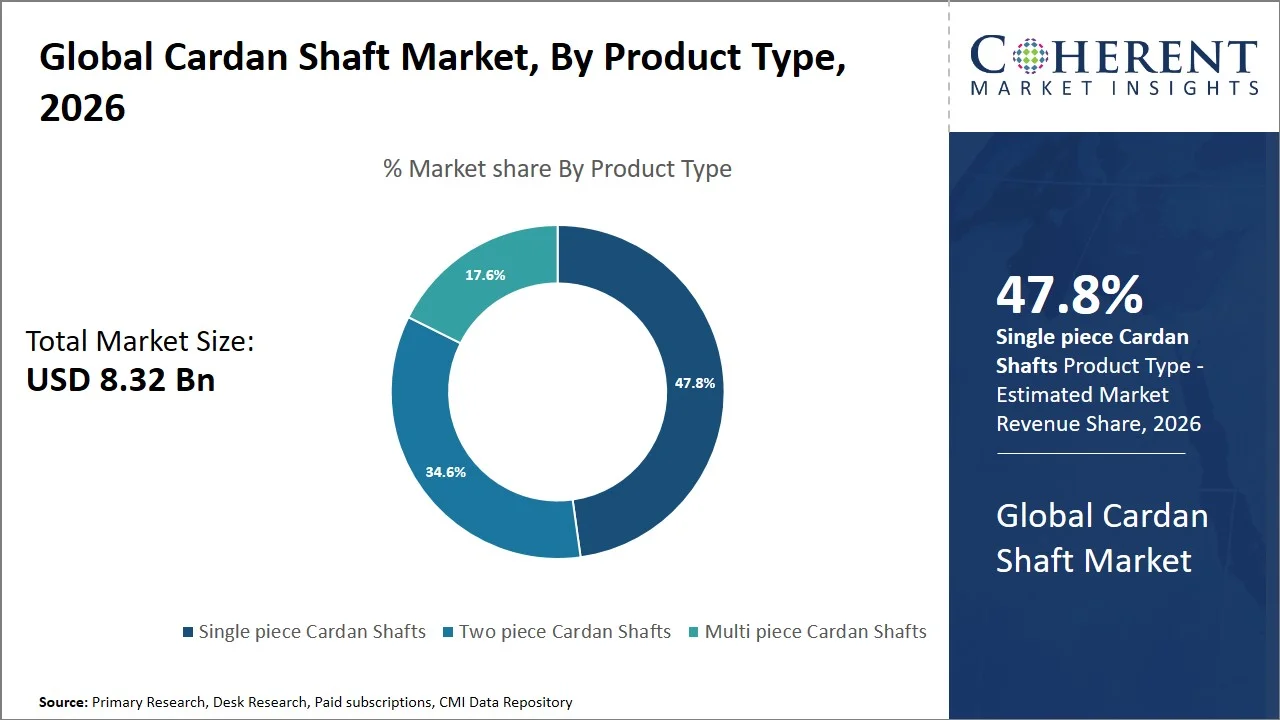
Why Do Single-piece Cardan Shafts Dominate the Global Cardan Shaft Market?
Single piece cardan shafts are expected to hold 47.8% of the global cardan shaft market in 2026 because they provide a compact torque-transfer layout for passenger vehicles, pickups, utility vehicles, and short-to-medium-wheelbase commercial platforms. Their integrated tube arrangement limits tolerance accumulation across intermediate supports and enables suppliers to standardize welding, straightening, and balancing operations across high-volume programs. OEMs benefit from fewer interfaces to package and validate, while workshops can replace the complete assembly without diagnosing multiple shaft sections or center-support components. This strengthens both first-fit purchasing and performance-oriented aftermarket demand. In June 2026, Action Machine published a product listing for a heavy-duty carbon-fiber one-piece driveshaft kit that converts specified Chevrolet and GMC Duramax truck applications from a factory two-piece arrangement to a one-piece 1480-series system, demonstrating continued commercial interest in simplified shaft architectures.
- Current Industry Events of 2026
- Market Size Estimation
- Regional Breakdown
- Competitive Landscape
- Customer Intelligence
- Segmental Analysis
- Pricing Analysis
- Key Market Drivers, Challenges & Future Trends
- Customized Insights Section
Why Does Alloy Steel Represent the Largest Material Segment in the Global Cardan Shaft Market?
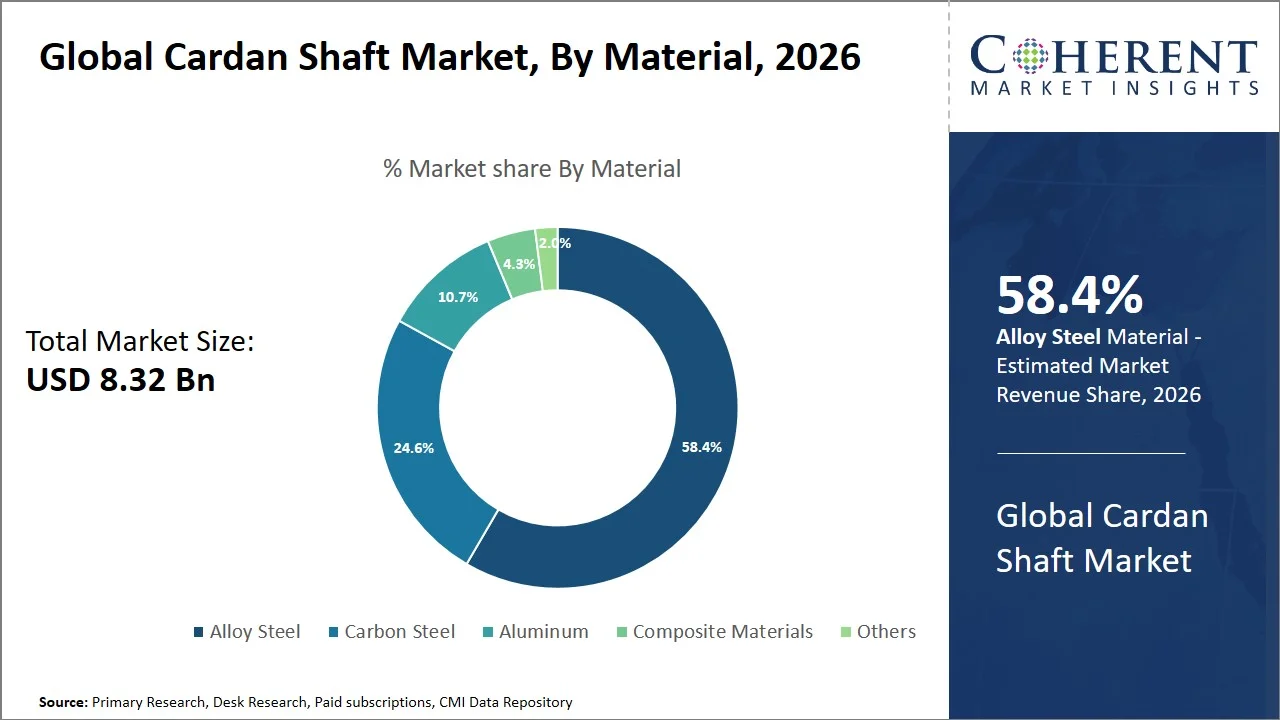
Alloy steel is projected to represent 58.4% of the global cardan shaft market in 2026 because it offers manufacturers a dependable balance of material cost, forgeability, machinability, heat-treatment response, and dimensional stability. These characteristics support yokes, splines, tubes, and joint interfaces that must retain geometry after welding and withstand repeated torque reversals. Its established supplier base also simplifies grade qualification, raw-material procurement, repair procedures, and production scaling across automotive and industrial applications. Cardan shaft producers can therefore serve standardized OEM programs and lower-volume heavy-duty orders without creating separate manufacturing ecosystems. In May 2025, Metallus reported spot-price increases for special bar quality steel and seamless mechanical tubing while identifying automotive and industrial applications among its served markets. The development indicates continuing commercial value for engineered alloy-steel inputs used in precision torque-transmission components.
Why Do Commercial Vehicles Dominate the Application Segment of the Global Cardan Shaft Market?
Commercial vehicles are expected to account for 31.6% of the global cardan shaft market in 2026 because longitudinal powertrains, rear-drive layouts, tandem axles, and application-specific wheelbases create substantial shaft content per platform. Trucks, buses, tippers, and special-purpose vehicles frequently require different tube lengths, flange patterns, slip allowances, and joint sizes even within the same model family. This configuration diversity expands engineering, tooling, and replacement opportunities for Cardan shaft suppliers while encouraging OEMs to retain qualified regional partners. Bodybuilders and fleet workshops further support demand by requiring readily identifiable assemblies and rapid replacement to return vehicles to service. In April 2026, Tata Motors rolled out the one-millionth commercial vehicle from its Lucknow facility after more than three decades of production. The milestone illustrates the manufacturing scale and installed fleet base that sustain first-fit sourcing and long-term driveline-service requirements.
Current Events and their Impact
Current Event | Description and Its Impact |
U.S. EPA Rescinds Highway-Vehicle GHG Standards – February 2026 |
|
EU CBAM Enters Its Definitive Regime – January 2026 |
|
EU Machinery Regulation Becomes Applicable – January 2027 |
|
Global Cardan Shaft Market Dynamics
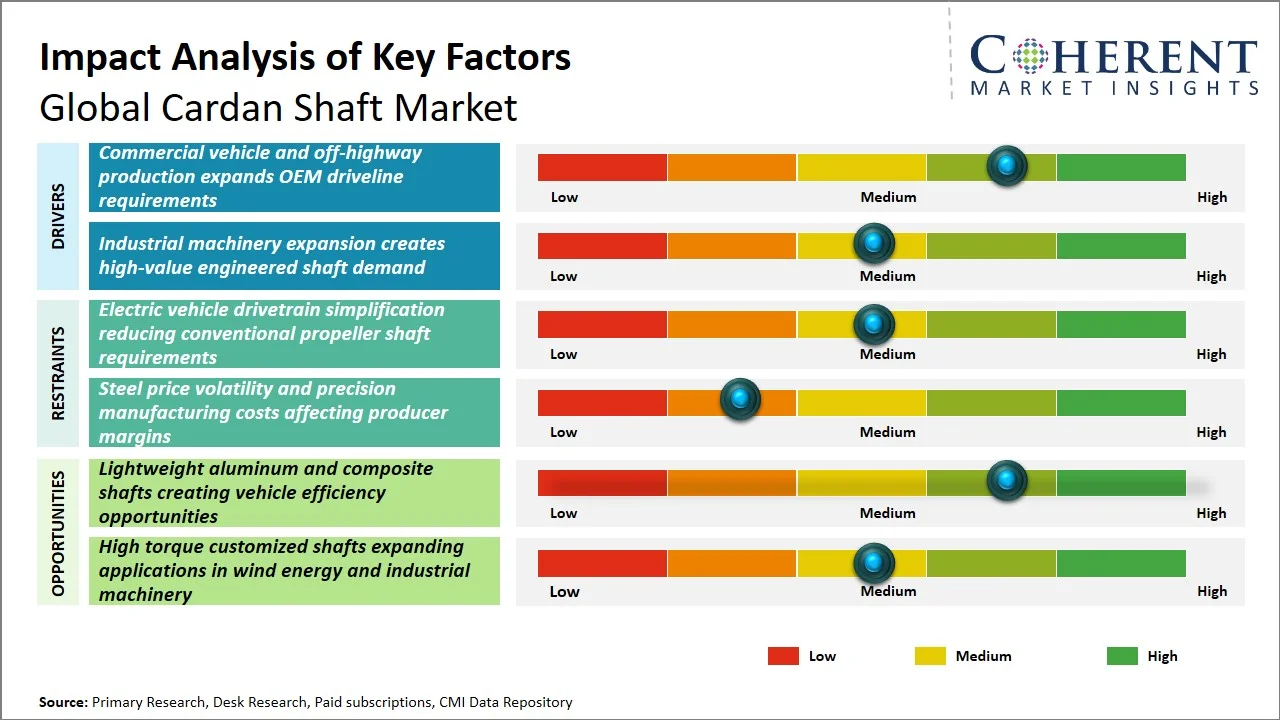
Key Market Drivers
- Commercial vehicle and off-highway production expands OEM driveline requirements: Commercial vehicle and off-highway equipment production enlarges the installed base requiring torque-transfer components between transmissions, axles, transfer cases, and driven implements. Each new truck, bus, tractor, loader, or articulated machine can generate OEM demand for application-specific tubes, yokes, universal joints, slip assemblies, and precision balancing, while subsequent fleet utilization creates replacement requirements. Cardan shaft manufacturers, forging suppliers, heat-treatment providers, and regional driveline assemblers benefit most when vehicle programs are localized because nomination decisions increasingly consider launch support and supply continuity. In August 2024, Volvo Group selected Monterrey for a new heavy-duty truck plant intended to supplement U.S. production and support Volvo and Mack growth across North America; the complete vehicle assembly facility is expected to become operational in 2026. This investment expands the addressable sourcing base for locally engineered commercial-vehicle driveline components.
- Industrial machinery expansion creates high-value engineered shaft demand: Expansion of rolling mills, paper machines, material-handling systems, and other continuous-process equipment supports demand for heavy-duty cardan shafts that transmit high torque while accommodating angular and axial movement. Unlike standard automotive units, industrial shafts are frequently engineered around machine layout, duty cycle, shock loading, and maintenance access, creating value in custom design, metallurgy, joint sizing, and field service. Industrial universal-joint manufacturers, precision machinists, steel forgers, balancing specialists, and rebuild providers can secure both project revenue and recurring overhaul work. In June 2025, Zhongshou Special Steel and Primetals Technologies completed installation of four high-reduction rolling stands for a new Arvedi ESP line in Hebei, with five finishing stands to follow. Projects of this type increase the number of high-load rotating interfaces requiring dependable torque transmission and strengthen demand for engineered cardan assemblies, spares, alignment support, and lifecycle inspection.
Emerging Market Trends
- Simulation-Led NVH and Fatigue Engineering: Cardan shaft development is shifting from catalogue selection to simulation-led design based on torque loads, joint angles, vibration, fatigue, and packaging constraints. Suppliers with multibody simulation, finite-element analysis, and test-validation capabilities can reduce development failures and secure earlier OEM involvement. This approach improves durability, noise control, and warranty performance while creating qualification challenges for manufacturers relying mainly on standard designs.
- Compact, High-Torque Shaft Architectures: Manufacturers are developing compact Cardan shafts capable of handling higher torque and rotational speeds within limited installation space. High-strength steels, optimized joint geometry, precision tubing, and compact spline systems are becoming central to product design. Suppliers with integrated forging, machining, heat treatment, and testing capabilities will gain an advantage as customers increasingly prioritize torque density, packaging efficiency, durability, and consistent manufacturing quality.
Regional Insights
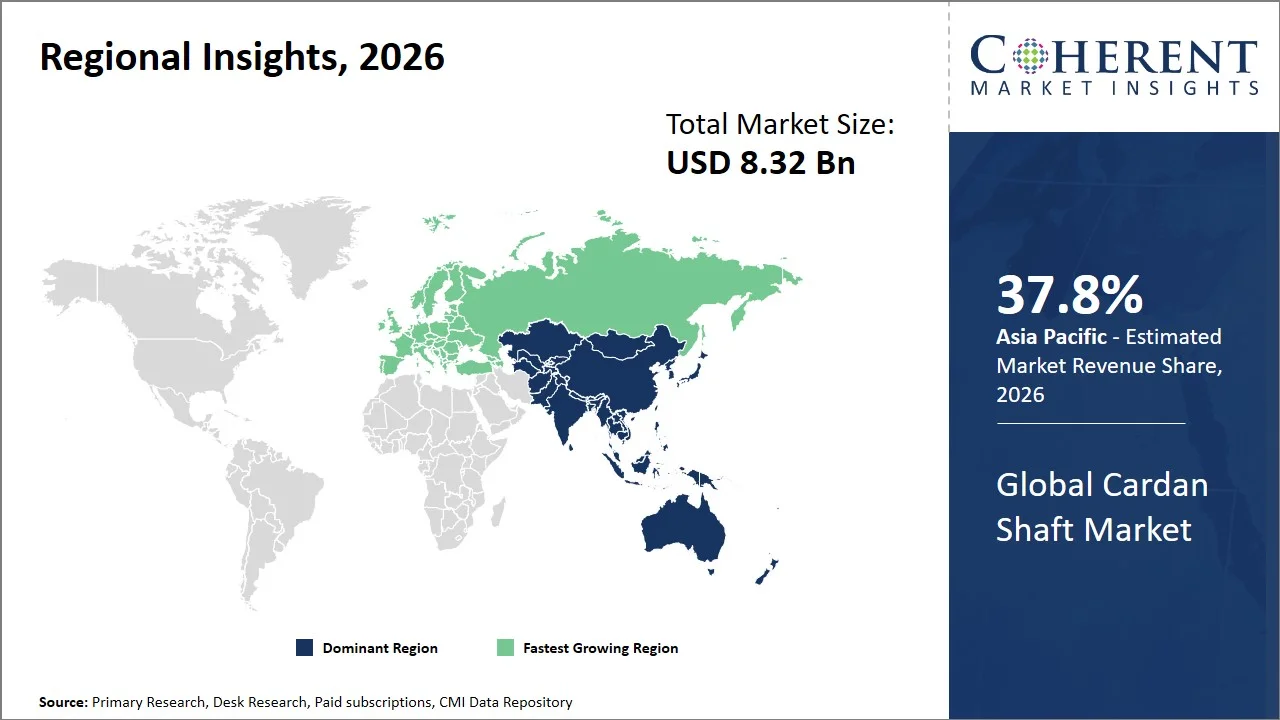
Why Does Asia Pacific Dominate the Global Cardan Shaft Market?
Asia Pacific is expected to hold 37.8% of the global cardan shaft market in 2026 because the region combines large-scale vehicle output with dense networks of tube processors, forging suppliers, universal-joint producers, and driveline assemblers. Demand spans rear-wheel-drive commercial vehicles, utility vehicles, agricultural machinery, construction equipment, and industrial systems, limiting dependence on any single application. Export-oriented production also rewards suppliers capable of high-volume balancing, localized engineering, and rapid platform launches. The continued coexistence of conventional, hybrid, and specialized off-highway powertrains preserves requirements for mechanical torque-transfer assemblies even as vehicle architectures diversify. In April 2026, OICA reported that Asia-Pacific produced approximately 59.2 million vehicles in 2025, representing more than 61% of global output. This concentration gives regional cardan shaft manufacturers scale advantages in procurement, tooling utilization, customer proximity, and aftermarket coverage.
Why is Europe Emerging as the Fastest-Growing Region in the Global Cardan Shaft Market?
Europe is projected to be the fastest-growing region, accounting for 26.7% of the global cardan shaft market in 2026. Expansion is supported by fleet replacement, renewed commercial-vehicle registrations, stringent vibration and durability expectations, and Europe’s concentration of premium vehicle, industrial machinery, rail, marine, and specialist driveline engineering. Buyers increasingly require shafts validated for specific torque cycles, joint angles, safety conditions, and maintenance intervals, supporting higher-value engineered assemblies rather than commodity supply. Regional manufacturers also benefit from established testing infrastructure and close collaboration with OEM development centres. In April 2026, ACEA reported that EU truck registrations increased 10.7% during the first quarter, including a 12.6% increase in heavy trucks. This recovery broadens near-term opportunities for OEM cardan shaft nominations, while Europe’s installed commercial fleet supports balancing, joint replacement, remanufacturing, and complete-shaft aftermarket demand.
Global Cardan Shaft Market Outlook for Key Countries
Why is the U.S. a Key Market for the Cardan Shaft Market?
The U.S. is a key Cardan Shaft Market because it combines substantial pickup, sport-utility, heavy-truck, vocational-vehicle, agricultural, and construction-equipment fleets. Long operating distances, high payload utilization, towing requirements, and demanding work cycles increase wear on universal joints, splines, center bearings, and complete propeller-shaft assemblies. This creates parallel opportunities across OEM supply, independent replacement distribution, fleet maintenance, and remanufacturing. Domestic customers also value short delivery times and technical support for application-specific balancing or shaft modification, encouraging regional production and stocking. In May 2025, John Deere outlined planned U.S. investment of USD 20 billion over the following decade and reported USD 100 million invested in American factories during 2025. Continued investment in domestic agricultural and utility-equipment manufacturing strengthens the addressable base for driveline components used in tractors, work vehicles, attachments, and other mechanically driven equipment.
Why Does China Support Growth in the Global Cardan Shaft Market?
China supports growth in the global cardan shaft market through unmatched vehicle-production scale, extensive commercial-vehicle and equipment manufacturing, and a highly integrated metals and machining supply chain. Domestic producers can source alloy steel, tubes, forgings, heat treatment, precision machining, welding, and balancing services within established industrial clusters, supporting cost-efficient high-volume production. Demand is not limited to passenger vehicles; trucks, buses, pickups, construction machinery, mining equipment, agricultural machines, and industrial installations require varied torque-transfer solutions. China’s export activity further expands requirements for globally compliant specifications and scalable aftermarket support. In January 2026, the Chinese government reported that national automobile output reached 34.531 million units in 2025, increasing 10.4% from 2024. Such production depth supports large OEM nomination volumes while allowing specialist suppliers to serve heavy-duty, customized, and replacement cardan shaft applications.
Why is Japan Important in the Global Cardan Shaft Market?
Japan is important in the global cardan shaft market because its automotive and machinery sectors emphasize durability, precision, low vibration, and long service life. The country supports demand from commercial trucks, buses, rear-wheel-drive vehicles, agricultural equipment, construction machinery, marine systems, and industrial motion applications. Japanese suppliers typically compete through process discipline, fatigue validation, metallurgy control, and close integration with OEM engineering programs, strengthening their position in premium and safety-critical applications. Export-oriented vehicle and equipment production also creates opportunities for standardized components that can be supported across overseas service networks. In June 2025, Daimler Truck, Mitsubishi Fuso, Hino Motors, and Toyota concluded definitive agreements to integrate Mitsubishi Fuso and Hino. The planned cooperation in commercial-vehicle development, procurement, and production can consolidate platform volumes and increase the importance of scalable, validated driveline supply relationships within Japan’s truck manufacturing ecosystem.
Why is Germany a Strategic Country in the Cardan Shaft Market?
Germany is a strategic country in the global cardan shaft market because it combines premium vehicle engineering with a broad base of commercial-vehicle, machinery, rail, marine, and industrial-system manufacturers. German customers impose demanding requirements for torsional durability, rotational balance, noise and vibration control, traceability, and consistent heat-treatment quality. These specifications favor suppliers offering co-development, testing, and low-volume customization alongside efficient series production. Germany’s export orientation also makes international certification, documentation, and service availability commercially important. In January 2026, BMW Group reported that its German plants produced more than one million vehicles during 2025, while operating flexible lines for internal-combustion, plug-in hybrid, and battery-electric models. This multi-powertrain manufacturing capability sustains a diverse engineering and supplier environment, supporting demand for specialized mechanical driveline components where platform layouts continue to require shaft-based torque transmission.
Why is Brazil an Important Growth Market for the Cardan Shaft Market?
Brazil is an important growth market for the global cardan shaft market because road freight, agricultural mechanization, mining, construction, and regional vehicle manufacturing create broad demand for heavy-duty torque-transfer components. Large operating territories and intensive equipment utilization increase the commercial importance of durability, field repairability, parts availability, and distributor reach. Tractors, harvesters, trucks, buses, off-highway equipment, and industrial processing systems support both original-equipment and replacement sales, while harsh operating conditions favor robust steel shafts and serviceable universal-joint designs. In December 2025, Brazil’s National Supply Company began distributing 1,272 agricultural machines under federal mechanization initiatives, including minitractors, harvesters, trailers, rotary implements, and planters, with deliveries scheduled across all states. This public-sector deployment expands the operating base of mechanized farm equipment and supports future requirements for driveline servicing, replacement joints, and shaft-related maintenance.
Technology Adoption Landscape in the Global Cardan Shaft Market
Technology | Adoption Level | Key Application Area | Business Impact |
Rotary friction welding | High | Joining steel tubes with yokes and shaft ends | Produces repeatable joints with limited distortion, supporting higher throughput and lower weld-rework requirements. |
Automated high-speed dynamic balancing | High | Completed automotive and industrial shaft assemblies | Reduces rotational vibration, bearing loads, cabin noise, machine wear, and warranty exposure. |
CNC spline and yoke machining | High | Slip members, flange yokes, splined interfaces, and joint components | Improves dimensional repeatability while enabling scalable production of application-specific connection geometries. |
Closed-loop induction hardening | High | Splines, journals, universal-joint components, and wear surfaces | Enhances wear and fatigue resistance while providing more consistent, traceable heat-treatment results. |
Magnetic-particle and ultrasonic inspection | Medium | Forged yokes, welded joints, tubes, and safety-critical assemblies | Detects surface and internal defects before assembly, strengthening quality assurance and customer acceptance. |
Filament-wound composite shaft tubes | Low | Lightweight, high-speed, and specialist torque-transfer systems | Offers mass and vibration advantages, but joining complexity, repairability, qualification costs, and production economics restrict broader adoption. |
How are Hybrid-Material Architectures Creating New Growth Opportunities in the Global Cardan Shaft Market?
Hybrid-material architectures represent an underdeveloped opportunity for cardan shaft suppliers seeking value growth beyond conventional steel assemblies. Combining metallic yokes and splines with aluminum or composite center tubes can reduce rotating mass and inertia while improving corrosion resistance and selected vibration characteristics. The strongest initial prospects lie in specialty commercial vehicles, high-speed industrial equipment, rail auxiliaries, marine systems, and applications where weight or start-stop energy losses carry a measurable operating cost. Commercial capture requires validated joining methods, galvanic isolation, fatigue testing, repair procedures, and design rules that account for different thermal expansion behavior. Suppliers should build application-specific test capability, co-develop interfaces with material specialists, and provide customers with total-cost evidence rather than promoting weight reduction alone. Established driveline companies have an advantage through OEM qualification and test infrastructure, but composite specialists and focused engineering entrants can participate through partnerships. Investment should remain selective until repeatable manufacturing, field repairability, and dependable volume economics are demonstrated.
Market Players, Key Development, and Competitive Landscape
Key Developments
- In March 2026, Neapco completed its acquisition of IFA Group, combining the companies’ driveline engineering, manufacturing, and customer-support networks across Europe, North America, and Asia. This is important for the global cardan shaft market because the enlarged organization brings together extensive propshaft capabilities and can compete for multinational vehicle platforms requiring coordinated engineering, production, quality, and delivery across several regions.
- In April 2025, Welte Group implemented real-time inventory visibility for cardan-shaft trading customers, enabling stock information to be viewed directly through customer systems and supporting rapid fulfilment of urgent requirements. This is important for the global cardan shaft market because accurate digital availability can reduce ordering errors across numerous shaft configurations, improve distributor planning, and shorten equipment or vehicle downtime when replacements are required.
- In March 2024, GKN Automotive announced the transfer of all North American propshaft manufacturing to Mexico as part of a broader restructuring of its regional operations, with completion targeted for the fourth quarter of that year. This is important for the global cardan shaft market because concentrating production can alter OEM sourcing routes, manufacturing economics, cross-border logistics, and supplier requirements across the North American vehicle-driveline ecosystem.
Competitive Landscape
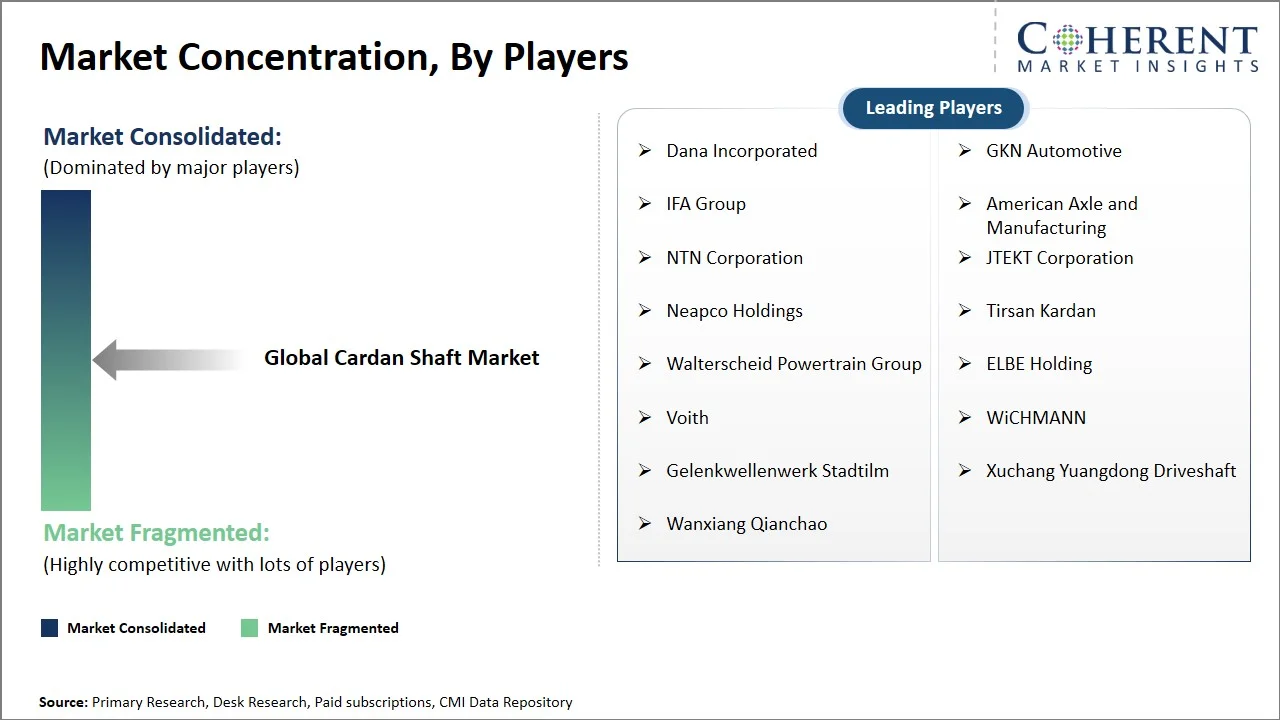
The global cardan shaft market is moderately fragmented, comprising multinational automotive driveline suppliers, industrial universal-joint specialists, regional shaft manufacturers, aftermarket rebuilders, and application-focused engineering companies. Competition varies by customer group: vehicle OEM programs emphasize platform validation, global delivery, and quality consistency, while industrial buyers place greater weight on customization, load engineering, repair turnaround, and technical support. Regional suppliers remain important in replacement and low-volume applications, but must continually improve traceability and process control to compete for safety-critical contracts.
Key focus areas include
- Application engineering: Ability to translate torque, speed, joint-angle, and operating-cycle data into validated shaft configurations.
- Process integration: Control over forging, heat treatment, tube preparation, welding, machining, and balancing improves cost and quality consistency.
- Durability performance: Fatigue life, joint wear, spline reliability, and resistance to shock loading influence procurement and warranty decisions.
- Total ownership cost: Buyers compare maintenance intervals, replacement availability, machine downtime, and service requirements rather than unit price alone.
- Manufacturing flexibility: Rapid changeovers and modular tooling support high-mix commercial vehicle and industrial equipment programs.
- Quality assurance: Material certificates, serialized inspection records, dimensional control, and non-destructive testing strengthen customer qualification.
- Market access: OEM engineering relationships, distributor coverage, workshop support, and application databases determine customer reach.
- Supply reliability: Raw-material continuity, regional inventory, production redundancy, and launch readiness are increasingly important during sourcing decisions.
Market Report Scope
Cardan Shaft Market Report Coverage
| Report Coverage | Details | ||
|---|---|---|---|
| Base Year: | 2025 | Market Size in 2026: | USD 8.32 Bn |
| Historical Data for: | 2020 To 2024 | Forecast Period: | 2026 To 2033 |
| Forecast Period 2026 to 2033 CAGR: | 6.2% | 2033 Value Projection: | USD 12.67 Bn |
| Geographies covered: |
| ||
| Segments covered: |
| ||
| Companies covered: | Dana Incorporated, GKN Automotive, IFA Group, American Axle and Manufacturing, NTN Corporation, JTEKT Corporation, Neapco Holdings, Tirsan Kardan, Walterscheid Powertrain Group, ELBE Holding, Voith, WiCHMANN, Gelenkwellenwerk Stadtilm, Xuchang Yuangdong Driveshaft, and Wanxiang Qianchao | ||
| Growth Drivers: |
| ||
| Restraints & Challenges: |
| ||
Analyst Opinion (Expert Opinion)
- Market leadership is likely to depend less on maximum production volume and more on the economics of serving multiple shaft variants efficiently. Suppliers that combine common manufacturing platforms with rapid tooling changes, configurable interfaces, and disciplined low-volume production will capture specialty vehicle and industrial programs that large standardized plants often struggle to serve profitably.
- Serialized manufacturing genealogy could become a decisive procurement requirement. Linking each shaft to material heats, machining results, heat-treatment records, weld parameters, balance readings, and inspection outcomes would change quality assurance from periodic auditing to unit-level evidence. Suppliers without integrated manufacturing-data systems may gradually lose access to demanding OEM and safety-critical machinery contracts.
- Manufacturers should prioritize torque and fatigue test capacity, metallurgical expertise, flexible balancing equipment, modular tooling, and secure quality-data infrastructure. Commercial attention should extend to specialty fleets, industrial retrofits, and applications where downtime carries high financial consequences. Steel-price volatility requires index-linked contracts or disciplined surcharge mechanisms, while excessive investment in capacity dedicated to one customer platform should be avoided.
Speak to the analyst
Want personalized insights?
Take the findings above to one of our principal consultants, or have the report rebuilt around the segments, geographies and competitors you actually track.
Market Segmentation
- Product Type Insights (Revenue, USD Bn, 2021 - 2033)
- Single piece Cardan Shafts
- Two-piece Cardan Shafts
- Multi piece Cardan Shafts
- Material Insights (Revenue, USD Bn, 2021 - 2033)
- Alloy Steel
- Carbon Steel
- Aluminum
- Composite Materials
- Others
- Application Insights (Revenue, USD Bn, 2021 - 2033)
- Commercial Vehicles
- Passenger Vehicles
- Off highway Equipment
- Industrial Machinery
- Rail and Marine
- Others
- Sales Channel Insights (Revenue, USD Bn, 2021 - 2033)
- Original Equipment Manufacturers
- Aftermarket
- Regional Insights (Revenue, USD Bn, 2021 - 2033)
- North America
- U.S.
- Canada
- Latin America
- Brazil
- Argentina
- Mexico
- Rest of Latin America
- Europe
- Germany
- U.K.
- Spain
- France
- Italy
- Russia
- Rest of Europe
- Asia Pacific
- China
- India
- Japan
- Australia
- South Korea
- ASEAN
- Rest of Asia Pacific
- Middle East
- GCC Countries
- Israel
- Rest of Middle East
- Africa
- South Africa
- North Africa
- Central Africa
- North America
- Key Players Insights
- Dana Incorporated
- GKN Automotive
- IFA Group
- American Axle and Manufacturing
- NTN Corporation
- JTEKT Corporation
- Neapco Holdings
- Tirsan Kardan
- Walterscheid Powertrain Group
- ELBE Holding
- Voith
- WiCHMANN
- Gelenkwellenwerk Stadtilm
- Xuchang Yuangdong Driveshaft
- Wanxiang Qianchao
Sources
Primary Research Interviews
- Cardan shaft, propeller shaft, PTO shaft, universal-joint, slip-yoke, center-bearing, and drivetrain component manufacturers
- Alloy steel, carbon steel, aluminum, composite tube, forged-yoke, spline, bearing, seal, lubricant, and coating suppliers
- Passenger vehicle, commercial vehicle, agricultural machinery, construction equipment, mining, rail, marine, and industrial machinery manufacturers
- Distributors, importers, exporters, rebuilders, balancing workshops, fleet operators, testing laboratories, and certification providers
- Product development, engineering, procurement, production, quality, maintenance, logistics, marketing, and sales executives
Stakeholders
- Cardan shaft assemblers, universal-joint manufacturers, PTO shaft specialists, and contract manufacturers
- Steel tube, forging, flange, spline, bearing, grease, and protective-coating suppliers
- Forging, welding, heat-treatment, CNC machining, spline-cutting, balancing, and inspection-equipment providers
- Automotive OEMs, commercial vehicle manufacturers, axle and transmission producers, and off-highway equipment companies
- Distributors, service centres, remanufacturers, repair workshops, laboratories, and logistics providers
End-use Sectors
- Passenger cars, pickups, SUVs, utility vehicles, and specialty vehicles
- Light, medium, and heavy commercial vehicles, buses, coaches, and vocational trucks
- Tractors, harvesters, agricultural implements, and PTO-driven equipment
- Construction, mining, material-handling, and earthmoving machinery
- Steel mills, paper machines, cement plants, conveyors, machine tools, and industrial processing equipment
- Rail, marine, fleet maintenance, replacement, rebuilding, and dynamic balancing applications
Regulatory and Government Bodies
- U.S. NHTSA, EPA, OSHA, FMCSA, Census Bureau, and USITC
- Transport Canada, Statistics Canada, Environment and Climate Change Canada, and CBSA
- European Commission, UNECE WP.29, ECHA, Eurostat, and national type-approval authorities
- UK VCA, DVSA, HSE, Department for Transport, and ONS
- China MIIT, SAMR, Ministry of Ecology and Environment, China Customs, NBS, and SAC
- Japan MLIT, METI, Japan Customs, and JISC
- India MoRTH, ARAI, BIS, CPCB, DGFT, and MOSPI
- Brazil SENATRAN, INMETRO, IBAMA, MDIC, Receita Federal, and IBGE
- ISO, SAE International, ASTM International, and accredited testing laboratories
Databases
- UN Comtrade, ITC Trade Map, WTO Statistics, Eurostat, USITC DataWeb, World Bank, OECD, and UNIDO
- OICA, ACEA, VDA, CAAM, JAMA, SIAM, ANFAVEA, and national automotive statistics
- U.S. Census Bureau, Statistics Canada, Destatis, China NBS, Japan Statistics Bureau, India MOSPI, and Brazil IBGE
- China Customs, Japan Trade Statistics, India Export Import Data Bank, and Brazil Comex Stat
- Vehicle-registration, fleet, off-highway equipment, agricultural machinery, mining, rail, and marine databases
- WIPO PATENTSCOPE, Espacenet, company filings, product catalogues, shipment data, pricing records, and material certificates
Magazines and Journals
- SAE Automotive Engineering, Automotive World, Power Transmission Engineering, and Gear Technology
- Forging Magazine, Industrial Heating, Modern Machine Shop, and Tube & Pipe Journal
- Construction Equipment, International Mining, World Highways, and Farm Equipment
- Engineering Failure Analysis, Journal of Sound and Vibration, Tribology International, Wear, Materials & Design, and International Journal of Fatigue
- Journal of Manufacturing Processes and Mechanical Systems and Signal Processing
Associations
- SAE International
- International Organization of Motor Vehicle Manufacturers
- European Automobile Manufacturers’ Association
- European Association of Automotive Suppliers
- Motor & Equipment Manufacturers Association
- Association of Equipment Manufacturers
- American Gear Manufacturers Association
- German Association of the Automotive Industry
- VDMA Power Transmission Engineering
- Japan Automobile Manufacturers Association
- China Association of Automobile Manufacturers
- Society of Indian Automobile Manufacturers
- Automotive Research Association of India
- Brazilian Association of Automotive Vehicle Manufacturers
Public Domain Sources
- Product catalogues, technical data sheets, maintenance manuals, service bulletins, and OEM specifications
- Data on torque capacity, rotational speed, operating angle, shaft length, tube diameter, spline configuration, and flange dimensions
- Material, heat-treatment, hardness, fatigue, vibration, balancing, weld-strength, corrosion, and inspection data
- Automotive, agricultural, construction, mining, rail, marine, and industrial machinery production statistics
- Import-export records, customs classifications, tariffs, shipment data, and trade decisions
- Recalls, safety notices, warranty records, annual reports, press releases, investments, product launches, patents, and trade-fair announcements
Key Standards and Regulations
- SAE J901 and SAE Universal Joint and Driveshaft Design Manual
- ISO 21940 series for rotor balancing and balancing-machine performance
- ISO 500-1, ISO 5673-2, ISO 8759-1, and ISO 789-1 for agricultural PTO systems
- ISO 12100 for machinery risk assessment and safety
- ASTM A519 and ASTM A513 for mechanical steel tubing
- ASTM E709, ASTM E1444/E1444M, and ASTM E213 for non-destructive inspection
- ISO 6508-1, ISO 6892-1, and ISO 9227 for hardness, tensile, and corrosion testing
- IATF 16949, ISO 9001, ISO 14001, ISO 45001, and ISO/IEC 17025
- EU Machinery Regulation, REACH, and applicable vehicle type-approval requirements
- U.S. OSHA power-transmission guarding and NHTSA vehicle-safety requirements
- Indian AIS and Central Motor Vehicles Rules
- Applicable Chinese GB, Japanese vehicle-safety, and Brazilian CONTRAN and INMETRO requirements
Proprietary Elements
- CMI Data Analytics Tool, Proprietary CMI Existing Repository of information for last 10 years.
Get access to 250+ pages report
Every segment, forecast, competitor profile and data table behind the analysis above — available for instant download.
- ESOMAR Member
- ISO 9001:2015 Certified
- D-U-N-S Registered
- GDPR & CCPA Compliant
Missing comfort of reading report in your local language? Find your preferred language:
Transform your Strategy with Exclusive Trending Reports
Frequently Asked Questions
The CAGR of the global cardan shaft market is projected to be 6.2% from 2026 to 2033.
The global cardan shaft market is estimated to be valued at USD 8.32 billion in 2026 and is expected to reach USD 12.67 billion by 2033.
Alloy steel leads the material segment because of its strength, durability, fatigue resistance, and suitability for high-torque applications.
Commercial vehicles lead the application segment due to their high torque requirements, intensive operating cycles, and recurring replacement needs.
Original equipment manufacturers dominate the sales channel because cardan shafts are commonly designed and supplied directly for new vehicle and machinery platforms.
In terms of product type, single piece cardan shafts are estimated to dominate the market revenue share in 2026.
Commercial vehicle and off highway equipment production increasing drivetrain component demand and industrial automation and machinery expansion supporting heavy duty cardan shaft installations are the major factors driving the growth of the global cardan shaft market.