

Global Cargo Handling Equipment Market Size and Forecast – 2026 To 2033
The global cargo handling equipment market is expected to grow from USD 28.10 Bn in 2026 to USD 44.25 Bn by 2033, registering a compound annual growth rate (CAGR) of 7.0% from 2026 to 2033. The global cargo handling equipment market is driven by growth of e-commerce logistics. On June 26, 2025, Amazon announced the launch of 5 new fulfilment centers (FCs), adding to its robust operations network in India. The expansion brings the very first Amazon FCs in Indore, Bhubaneshwar, Kochi and Rajpura and another one in Delhi-NCR.
Key Takeaways of the Global Cargo Handling Equipment Market
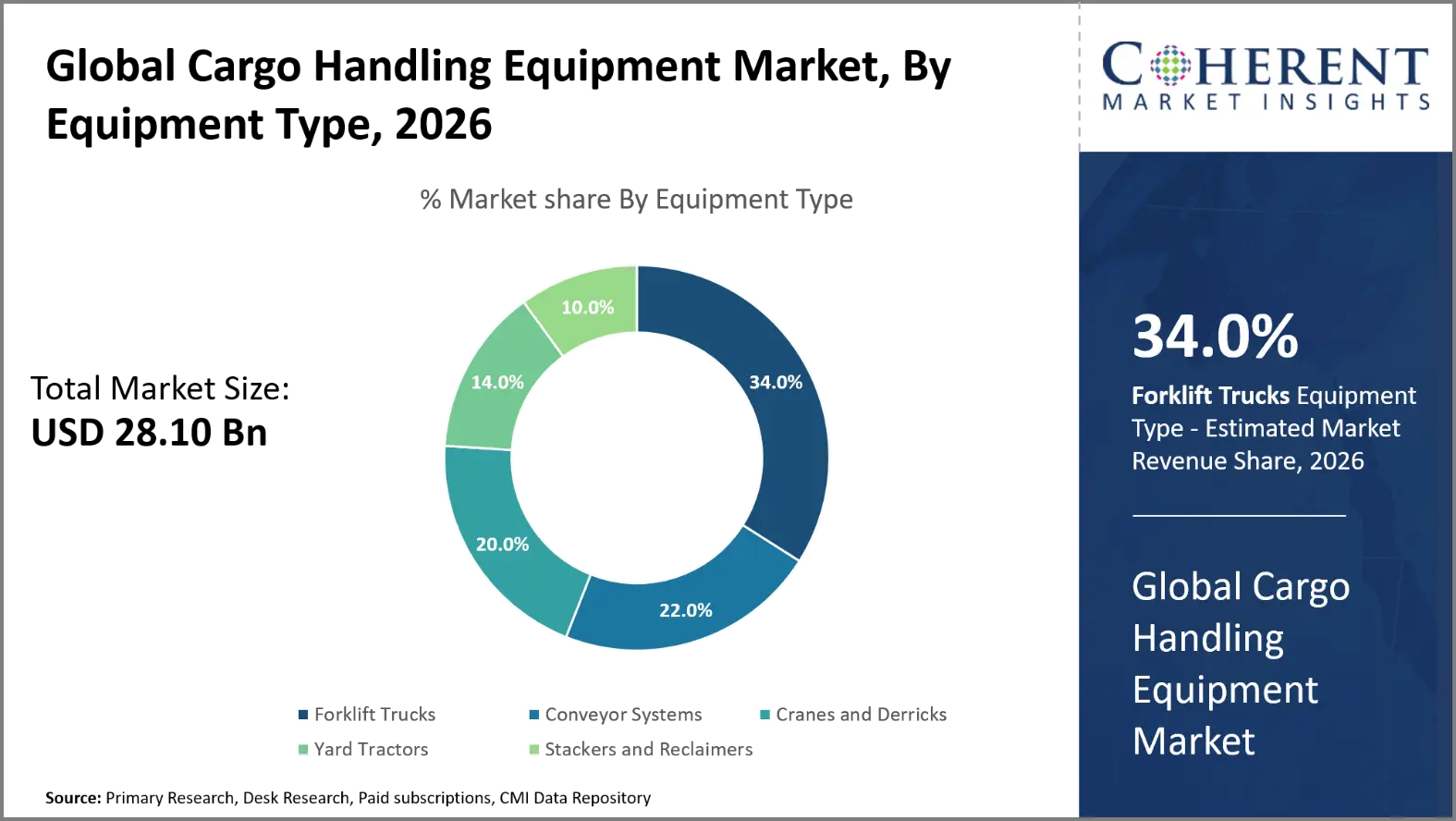
- The Forklift Trucks segment is expected to account for 34.0% of the global cargo handling equipment market share in 2026. Expansion of port infrastructure modernization is driving the growth of the segment. On December 2, 2025, DP World approved a USD 296 million investment cycle to further strengthen Brazil’s trade capacity and enhance terminal operations at the Port of Santos, increasing total handling capacity by 25% to 2.1 million TEUs by 2028.
- The Industrial segment is estimated to capture 41.0% of the market share in 2026. Increasing warehouse automation is majorly driving the growth of the segment. On March 17, 2025, Exotec announced that Oxford Industries, Inc. selected Exotec to automate its new, large-scale distribution center in Lyons, Georgia, U.S.
- The Manual segment is estimated to capture 58.0% of the market share in 2026. Growing requirement of precise operational efficiency is majorly driving the growth of the segment. On pril 28, 2025, Honeywell introduced cloud-based warehouse execution software. The platform coordinates picking, routing, order management, and capacity planning in real time.
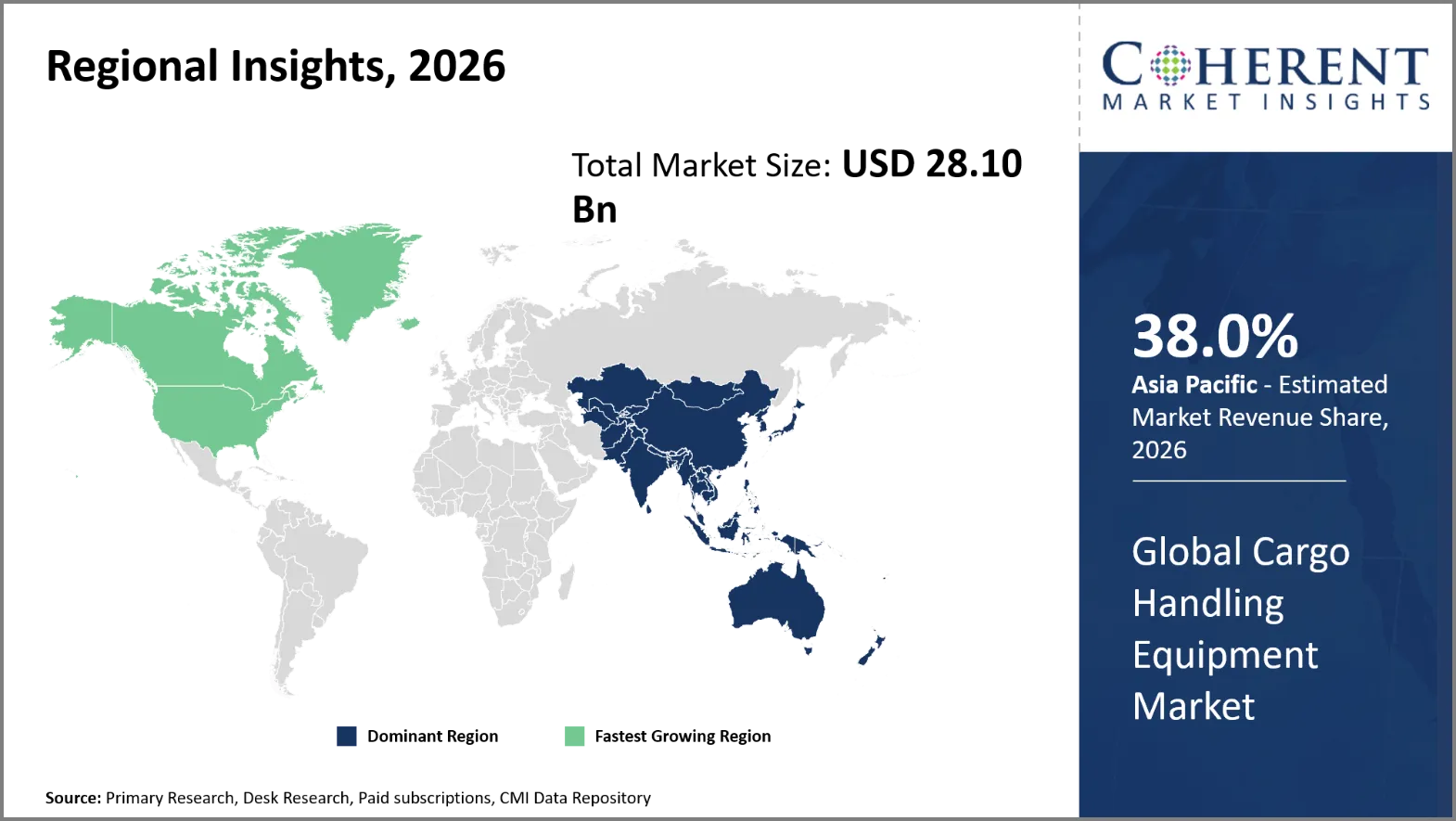
- Asia Pacific is expected to dominate the cargo handling equipment market in 2026 with a market share of 38.0%. Growing adoption of automated guided vehicles in Asia Pacific is driving the growth of the regional market. On December 3, 2025, DHL Supply Chain launched Singapore’s first Autonomous Vehicle (AV) designed specifically for supply chain operations at its Asia Pacific Advanced Regional Centre (ARC).
- North America is expected to account for 25.0% share in 2026 and is projected to record the fastest growth over the forecast period. Rising demand for electric handling equipment in North America is driving the growth of the regional market. On May 1, 2025, Mitsubishi Logisnext Americas announced the completion of a major expansion at its Houston manufacturing campus with the 73,500-square-foot electrification fabrication facility.
Segmental Insights
Why Does Forklift Trucks Dominate the Global Cargo Handling Equipment Market?
The forklift trucks segment is expected to account for 34.0% of the global cargo handling equipment market share in 2026. Forklift trucks are dominant because they provide diverse options for lifting, carrying, stacking and loading cargo. They serve warehouses, manufacturing plants, distribution centers, ports & logistical operations. Their varying capacities cater for different cargo weights and handling requirements. Electric variants also enable operations indoors with minimal pollutants and noise. They have a maintenance infrastructure for reliable functioning in several industries. These benefits allow the forklift trucks to be used in a variety of conditions for handling cargo.
On February 10, 2026, Bobcat Company introduced a new line of high-performance lithium-ion battery packs, specifically engineered for Class I forklifts. Arriving in North America in the first quarter of 2026, with earlier availability in select global markets, the batteries the batteries are built to deliver consistent, dependable power for demanding material‑handling environments.
- Current Industry Events of 2026
- Market Size Estimation
- Regional Breakdown
- Competitive Landscape
- Customer Intelligence
- Segmental Analysis
- Pricing Analysis
- Key Market Drivers, Challenges & Future Trends
- Customized Insights Section
Why is Industrial the Most Widespread Application?
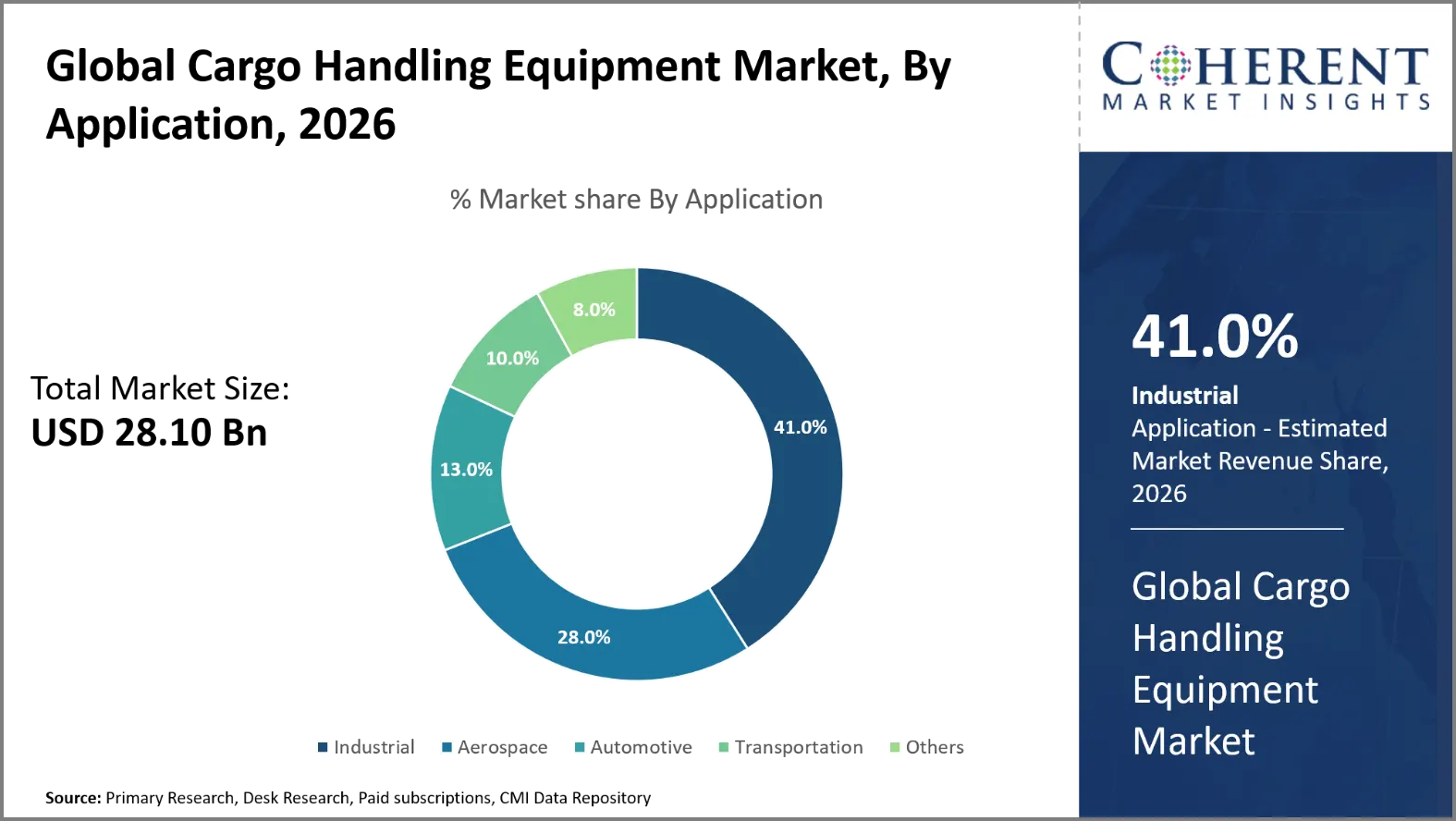
The industrial segment is expected to account for 41.0% of the global cargo handling equipment market share in 2026. Industrial applications need raw materials, components, work-in-progress materials and final products to be moved often. Cargo handling equipment facilitates the flow of cargo from production sites to storage areas, loading docks and distribution hubs. Industrial plants also have to deal with cargo of different sizes, weights and packaging styles. Forklift trucks, cranes, conveyors and stackers meet varied material handling requirements. As manufacturing expands, the need for efficient internal cargo movement increases. These factors are the reason for the wide use of the equipment in industrial plants.
On May 6, 2026, Konecranes secured an order to supply nine overhead cranes to PT Tata Metal Lestari’s facility in Sadang, Indonesia, to support material handling requirements across all stages of the processing center. The order includes two 30-ton Konecranes CXT overhead cranes, one 16-ton CXT overhead crane, one 12-ton CXT overhead crane, one 10-ton CXT overhead crane and three 10-ton Konecranes S-series overhead cranes, all with TRUCONNECT Remote Monitoring.
Manual Dominates the Global Cargo Handling Equipment Market
The manual segment is expected to account for 58.0% of the global cargo handling equipment market share in 2026. Manual equipment is widespread, since it generally requires less investment than automated handling systems. Businesses can implement manual equipment without having to make major changes to their infrastructure or incorporate complicated technologies. Manual pallet jacks, hand trucks and stackers are good for normal cargo movement. Solutions like these are perfect for smaller warehouses and facilities with moderate handling volumes. Manual gear also gives operating flexibility for a range of cargo handling jobs. Simpler maintenance required further supports adoption by cost-conscious operators.
On August 6, 2025, The Raymond Corporation announced the launch of three new electric walkie stackers; the 6310 Walkie Straddle Stacker, 6410 Walkie Reach Stacker and 6510 Walkie Counterbalanced Stacker. The stackers are powered by lithium-ion batteries and may be integrated with the iWAREHOUSE Intelligent Warehouse Solutions suite to provide smarter fleet management, remarkable mobility in small places and a lower cost per move than standard stand-up counterbalanced forklifts.
Current Events and their Impact
Current Events | Description and its Impact |
European Union Regulation (EU) 2023/1230 On Machinery |
|
European Union Regulation (EU) 2025/14 on Non-Road Mobile Machinery |
|
Cargo Handling Equipment Market Dynamics
Market Drivers
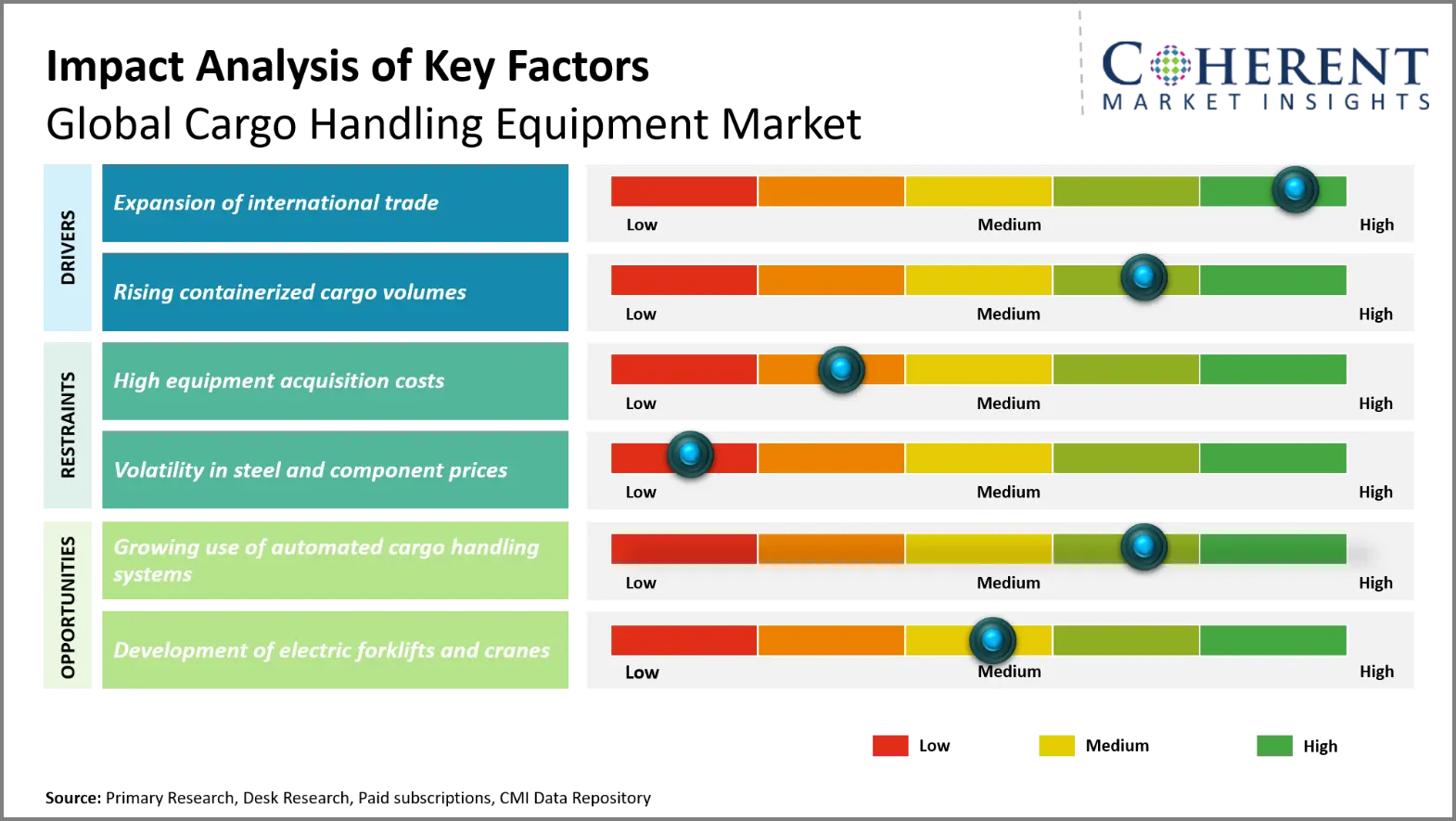
- Expansion of international trade: Growth in international trade results in more cargo passing through ports, airports, warehouses, and distribution facilities. Merchandise trade volume increased 4.6% in 2025, the World Trade Organization said. World merchandise exports in 2025 were worth USD 26.26 trillion. By volume, more than 80% of the goods traded in the world are transported by sea. Increased cross-border shipments therefore boost the demand for cranes, forklifts, conveyors, loaders and other cargo handling equipment. Port operators and logistics businesses are also investing in infrastructure to adapt to shifting trade routes and cargo flows. These innovations facilitate equipment replacement, capacity expansion and modernization in important logistics hubs.
- On July 28, 2026, the CMA CGM Group and Stonepeak announced the completion of the formation of UNITED PORTS LLC, following receipt of all required regulatory approvals. UNITED PORTS LLC brings together 9 major CMA CGM-operated port terminals in the United States, Brazil, Spain, Taiwan and Vietnam, including Fenix Marine Services in Los Angeles, Port Liberty in New York and Bayonne, Santos, CSP Valencia and Bilbao, TTI Algeciras, Kaohsiung Terminal, and Gemalink.
- Rising containerized cargo volumes: Increasing containerized cargo quantities boost demand for equipment used for loading, unloading, stacking and moving containers. UN Trade and Development says containerized trade grew more than 6% in 2024. Trans-Pacific eastbound container volumes grew 14.7% in 2024. Flows from East Asia to Europe in the same period grew 10.2%. The larger the container volumes, the bigger the number of ship-to-shore cranes, rubber-tired gantry cranes, reach stackers and terminal tractors deployed. Port operators are investing in automated handling technologies for increased throughput and operational uniformity. The UN Trade and Development expects containerized trade to rise at an average 2.3% annually over 2026-2030. For instance, Hapag-Lloyd’s container shipping volumes climbed 8% in 2025. The business carried over 13.5 million TEUs vs 12.5 million TEUs during 2024. Strong worldwide trade and the Gemini co-operation fostered higher transport volumes.
Emerging Trends
- AI-Enabled Automation: Cargo terminals are progressively integrating AI, Internet of Things sensors, robotics and autonomous guided vehicles. These solutions enhance crane operations, cargo tracking, equipment usage, predictive maintenance and overall terminal productivity.
- Electrification of Handling Equipment: Ports and industrial facilities are progressively embracing electric forklifts, cranes, terminal tractors and other battery-powered equipment. Electrification is key to achieving targets for emission reduction, boosting energy efficiency and connecting cargo activities to overall energy-transition goals.
- Predictive Maintenance and Digital Twins: Interconnected sensors are increasingly enabling real-time equipment monitoring and predictive maintenance across cargo handling operations. Digital twins also allow for the simulation of terminal infrastructure, which can help operators detect faults, optimize deployment of equipment and help enhance operational decision-making.
- Advanced Battery Technologies: The growing use of electric forklifts and other battery-powered handling equipment makes lithium-ion batteries increasingly important. Increasingly, EU battery regulations are focusing on lifetime management, material recovery, and ethical sourcing across industrial battery supply chains.
Regional Insights
Why is Asia Pacific a Strong Market for Cargo Handling Equipment?
Asia Pacific is expected to account for a market share of 38.0% in 2026. Rapid port expansion, manufacturing trade and automated terminal investment underpin growth in Asia Pacific. In 2025, China handled 354 million TEUs and Japan handled 22.36 million TEUs. Japan has also introduced new guidelines aimed at helping automated and remotely operated container handling equipment. By 2025, China had 60 automated terminals operating, including 30 automated container terminals. Also, growth in transshipment operations is boosting demand for equipment along Southeast Asian trade channels. These developments support demand for ship-to-shore cranes, automated stacking cranes, reach stackers, terminal tractors, and electric forklifts across regional logistics hubs.
Why Does North America Cargo Handling Equipment Market Exhibit High Growth?
North America is expected to register the fastest growth with a CAGR of 7.7% over the forecast period. It is projected to account for 25.0% of the global cargo handling equipment market in 2026. North American growth is strongly supported by major container gateway modernization and resilient trans-Pacific cargo flows. The Port of Los Angeles handled 10.2 million TEUs in 2025, its third consecutive year over 10 million TEUs. The port is also in the midst of infrastructural investment under its build-bigger, build-smarter program. Such expansion drives demand for ship-to-shore cranes, yard tractors, automated stacking systems and container-handling vehicles. Further, intermodal links between marine terminals and inland distribution centers add to the equipment needs. Smarter infrastructure focus further supports use of digitally connected and lower emission cargo handling equipment.
Global Cargo Handling Equipment Market Outlook for Key Countries
Why is China Emerging as a Major Hub in the Cargo Handling Equipment Market?
China is a prominent growth location with unusually big port volumes and fast terminal automation. In 2025, Chinese ports had cargo throughput of 18.3 billion tons and container throughput of 354 million TEUs. Shanghai Port processed more than 55 million TEUs in 2025, making it the world's busiest container port for the 16th consecutive year. The Yangshan Deepwater Port handled 28.71 million TEUs. China also had 30 automated container terminals and increased berths for large vessels as part of its infrastructure expansion. These developments increase requirements for automated cranes, electric yard equipment, autonomous vehicles, and intelligent terminal-control systems.
Is U.S. the Next Growth Engine for the Cargo Handling Equipment Market?
Sustained container traffic at major Pacific gateways and ongoing terminal infrastructure modernization are supporting U.S. development. The Port of Los Angeles moved 10.2 million container units in 2025, its third-best yearly total. The port has also highlighted key infrastructure projects focusing on capacity, efficiency and sustainability. The flow of cargo through Los Angeles and surrounding Long Beach provides robust demand for container cranes, terminal tractors, yard equipment and automated handling systems. And an increasing emphasis on operational resilience is spurring equipment updates and digital cargo-management systems. These investments pave the way for electric and automated handling equipment throughout key logistics corridors.
Germany Cargo Handling Equipment Market Analysis and Trends
Hamburg’s heavy container activity and growing commercial linkages with Asian markets are a boon for Germany. The Port of Hamburg handled 8.3 million TEUs in 2025, up 7.3% year on year. Traffic with China climbed 6.5% and traffic with India increased 49.2%. In 2025 Hamburg also handled 114.6 million tons of total maritime freight. Rail transported 2.6 million TEUs in 2024, reinforcing inland cargo connections. These advances make it attractive to invest in quay cranes, automated terminal equipment, rail-handling systems and low emission cargo machines.
Japan Cargo Handling Equipment Market Analysis and Trends
The growth of Japan’s cargo handling equipment more and more hinges on personnel shortages and port automation. Japanese ports handled 22.36 million TEUs in 2025, up 1.8% from 2024. International containers increased 1.8% to 17.8 million TEUs. In September 2026 the Ministry of Land, Infrastructure, Transport and Tourism announced recommendations on the support of automated and remotely operated cargo handling equipment. Advanced container-terminal gates were supported in Tokyo, Yokohama and Tomakomai. Optical character recognition cameras will improve container identification and exterior inspection. These are directly supporting the deployment of automation and intelligent cargo handling equipment.
Italy Cargo Handling Equipment Market Analysis and Trends
Robust transshipment activities in the Mediterranean and increasing containerized freight buoy drive Italy’s cargo handling equipment demand. In 2024, Italian ports handled more than 488 million tons of merchandise. Containerized cargo comprised 22% of all port movements and rose 5.6%. Gioia Tauro’s throughput in 2024 was around 4 million TEUs, up 11% year-on-year. Some EUR 140 million have been granted by the Ministry of Infrastructure and Transport of Italy for infrastructure, electrification, intramodality and digitalization in Gioia Tauro. Investments to support container cranes, terminal tractors, yard equipment, electric machinery and digital cargo-handling systems.
Global Cargo Handling Equipment Market - Forklift Fleet Size by Country (2025)
Country | Estimated Forklift Fleet Size in Units | Share of Global Fleet Size |
China | 4,000,000 | 26.7% |
U.S. | 2,500,000 | 16.7% |
Japan | 1,000,000 | 6.7% |
Germany | 900,000 | 6.0% |
India | 750,000 | 5.0% |
United Kingdom | 550,000 | 3.7% |
France | 500,000 | 3.3% |
Italy | 450,000 | 3.0% |
South Korea | 420,000 | 2.8% |
Brazil | 350,000 | 2.3% |
Canada | 300,000 | 2.0% |
Spain | 270,000 | 1.8% |
Mexico | 250,000 | 1.7% |
Australia | 220,000 | 1.5% |
The Netherlands | 200,000 | 1.3% |
How is Growing Use of Automated Cargo Handling Systems Creating New Growth Opportunities in the Cargo Handling Equipment Market?
The use of automated cargo handling systems is growing, leading to opportunities in automated guided vehicles, automated stacking cranes, intelligent terminal controls and electric handling equipment. Qingdao Port’s productivity reached 62.62 TEUs per hour per crane in May 2025, driven by artificial intelligence and automated equipment. Hamburg's Container Terminal Burchardkai has commissioned three automated storage blocks, adding some 6,000 TEUs of capacity. Konecranes will supply 42 lithium-ion automated guided vehicles (AGVs) to the Euromax terminal in Rotterdam, the Netherlands. Hamburger Hafen und Logistik is also deploying 116 lithium-ion automated guided vehicles at Burchardkai. These deployments create replacement and retrofit opportunities for automated cranes, autonomous vehicles, charging systems, sensors, control software, and equipment-management platforms.
On May 19, 2026, ABB introduced its Waterside Automation solution which enables quay cranes to perform a larger share of container handling operations automatically. By automating operations over the vessel and reducing the need for continuous manual control, the solution addresses a key bottleneck in container terminal efficiency and enables a gradual transition toward autonomous quay crane operations.
Market Players, Key Development, and Competitive Intelligence
Key Developments
- On August 5, 2026, Toyota Material Handling North America, the industry leader in forklift sales, officially opened a new manufacturing facility at the company’s Columbus, Indiana campus. The factory is dedicated to producing electric forklifts for both the Toyota and Raymond brands.
- On June 23, 2026, Jungheinrich AG announced it is taking a stake in Navflex Inc., a technology company specializing in Physical AI and the automation of truck loading and unloading. The investment strengthens the partnership between the two companies, with the goal of bringing an autonomous solution for one of the last non-automated core processes in intralogistics to market.
- On May 19, 2026, Hyster announced the launch of the XTLG integrated lithium-ion forklift series in the Americas. The XTLG series is built on an established internal combustion engine (ICE) chassis and comes in three product ranges with lifting capacities from 4,000 to 15,500 pounds; J40-70XTLG, J80-110XTLG and J110-155XTLG.
Competitive Landscape
Leading players are shifting competition toward automation, electrification, digital controls, and integrated fleet management. Konecranes is supplying 42 lithium-ion automated guided vehicles and charging stations to Rotterdam's Euromax terminal. Its system integrates battery management, routing, diagnostics, ship-to-shore cranes, and automated stacking cranes. Liebherr is emphasizing digitalization, electrification, and safety, including all-electric ship cranes and its LHM unplugged mobile harbor crane. Kalmar is developing autonomous terminal tractors with Forterra and plans commercial availability from 2027. Toyota Industries is expanding logistics automation through autonomous forklifts, autonomous tow tractors, and warehouse-management software capabilities.
Market Report Scope
Global Cargo Handling Equipment Market Report Coverage | |||
Report Coverage | Details | ||
Base Year | 2025 | Market Size in 2026: | USD 28.10 Bn |
Historical Data For: | 2020 To 2024 | Forecast Period: | 2026 To 2033 |
Forecast Period 2026 To 2033 CAGR: | 7.0% | 2033 Value Projection: | USD 44.25 Bn |
Geographies covered: |
| ||
Segments covered: |
| ||
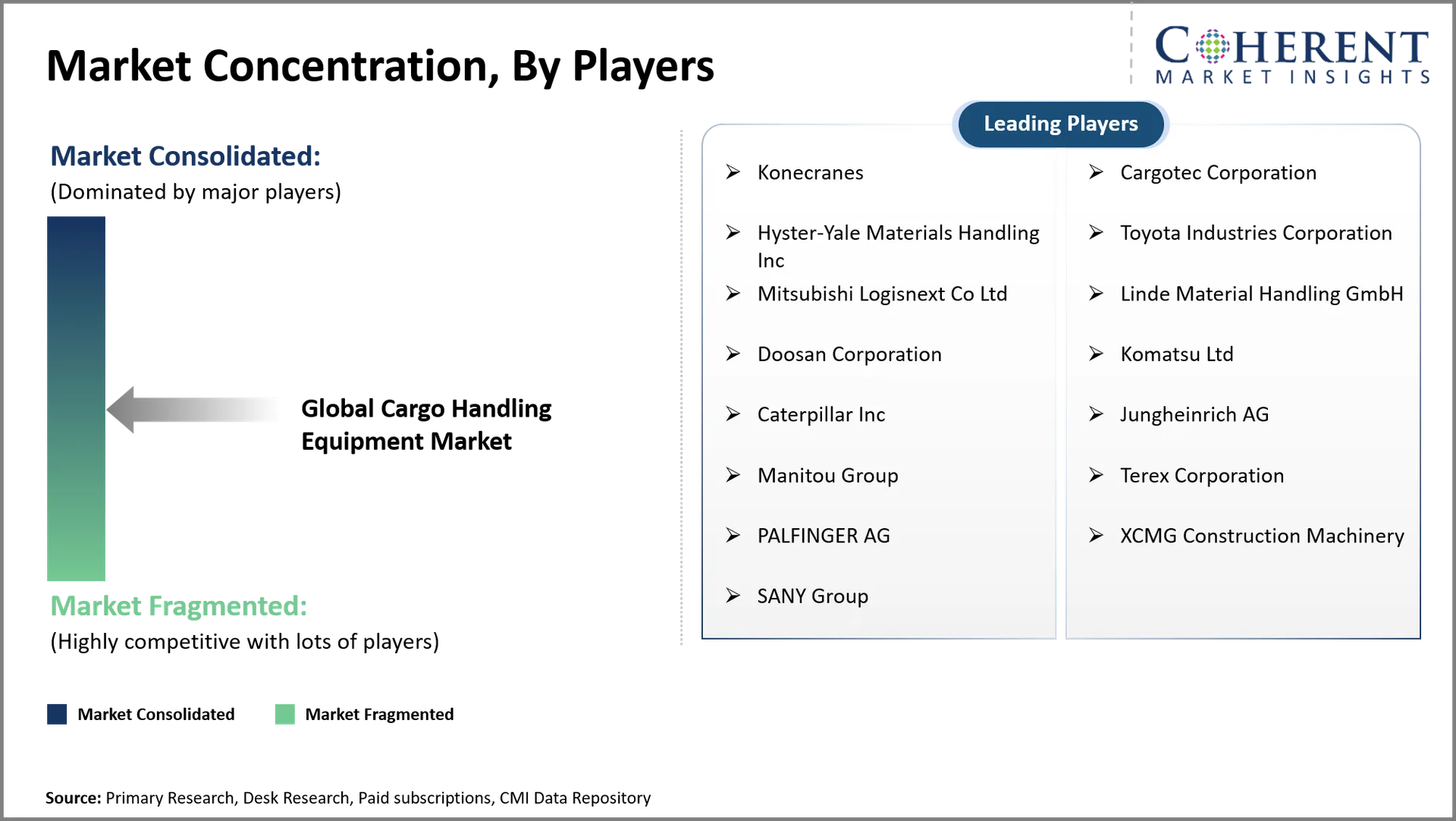
Companies covered: | Konecranes, Cargotec Corporation, Hyster-Yale Materials Handling Inc, Toyota Industries Corporation, Mitsubishi Logisnext Co Ltd, Linde Material Handling GmbH, Doosan Corporation, Komatsu Ltd, Caterpillar Inc, Jungheinrich AG, Manitou Group, Terex Corporation, PALFINGER AG, XCMG Construction Machinery, SANY Group | ||
Growth Drivers: |
| ||
Restraints & Challenges: |
| ||
Analyst Opinion (Expert Opinion)
- The industry is moving toward connected, electric, and increasingly autonomous cargo handling fleets. Equipment will increasingly combine onboard sensors, fleet software, automated routing, and remote monitoring. Brownfield automation will remain important because terminals cannot always replace existing fleets simultaneously. Konecranes' automated retrofit approach at Hamburg demonstrates this transition.
- The strongest prospects should be linked to automated horizontal transport, electric terminal tractors, automated stacking cranes and intelligent forklifts. Asia Pacific is a big opportunity since massive container ports are fast-tracking automation. “In Europe there are more opportunities because of electrification requirements and existing automated terminal infrastructure. China, Japan, Germany and the U.S. will remain major deployment markets.
- Market players should design interoperable gear, not stand-alone machines to gain an advantage. Modular automation platforms enable the connection of equipment from different manufacturers and provide for staggered implementation. A good example of this approach is Kalmar’s equipment-agnostic Kalmar One platform. Manufacturers should also focus on battery management, autonomous safety systems, predictive diagnostics, retrofit kits and lifecycle service contracts.
Speak to the analyst
Want personalized insights?
Take the findings above to one of our principal consultants, or have the report rebuilt around the segments, geographies and competitors you actually track.
Market Segmentation
- Equipment Type Insights (Revenue, USD Billion, 2021 - 2033)
- Forklift Trucks
- Conveyor Systems
- Cranes and Derricks
- Yard Tractors
- Stackers and Reclaimers
- Application Insights (Revenue, USD Billion, 2021 - 2033)
- Industrial
- Aerospace
- Automotive
- Transportation
- Others
- Automation Level Insights (Revenue, USD Billion, 2021 - 2033)
- Manual
- Semi-Automated
- Fully Automated
- Propulsion Insights (Revenue, USD Billion, 2021 - 2033)
- ICE
- Electric
- Hybrid
- End User Insights (Revenue, USD Billion, 2021 - 2033)
- Ports and Terminals
- Airports
- Manufacturing
- Warehousing and Distribution
- Construction
- Mining and Quarrying
- Oil and Gas
- Agriculture
- Others
- Regional Insights (Revenue, USD Billion, 2021 - 2033)
- North America
- U.S.
- Canada
- Latin America
- Brazil
- Argentina
- Mexico
- Rest of Latin America
- Europe
- Germany
- U.K.
- Spain
- France
- Italy
- Russia
- Rest of Europe
- Asia Pacific
- China
- India
- Japan
- Australia
- South Korea
- ASEAN
- Rest of Asia Pacific
- Middle East
- GCC Countries
- Israel
- Rest of Middle East
- Africa
- South Africa
- North Africa
- Central Africa
- North America
Sources
Primary Research Interviews
- Cargo Handling Equipment Manufacturers
- Port and Terminal Operators
- Logistics and Freight Forwarding Companies
Magazines
- Cargo Facts
- Air Cargo World
- Port Technology International
- Logistics Management Magazine
Journals
- Journal of Transport Geography
- International Journal of Logistics Research and Applications
- Journal of Air Transport Management
Associations
- International Air Transport Association (IATA)
- International Association of Ports and Harbors (IAPH)
- Federation of Freight Forwarders' Associations (FIATA)
- Material Handling Industry (MHI)
Public Domain Sources
- International Maritime Organization (IMO) Reports
- United Nations Conference on Trade and Development (UNCTAD) Transport Reports
- World Customs Organization (WCO) Publications
- U.S. Bureau of Transportation Statistics (BTS)
Proprietary Elements
- CMI Data Analytics Tool
- Proprietary CMI Existing Repository of information for last 10 years
Get access to 250+ pages report
Every segment, forecast, competitor profile and data table behind the analysis above — available for instant download.
- ESOMAR Member
- ISO 9001:2015 Certified
- D-U-N-S Registered
- GDPR & CCPA Compliant
Frequently Asked Questions
The global cargo handling equipment market is expected to stand at USD 28.10 Bn in 2026 and is expected to reach USD 44.25 Bn by 2033.
The CAGR of the global cargo handling equipment market is projected to be 7.0% from 2026 to 2033.
Expansion of international trade and Rising containerized cargo volumes are the major factors driving the growth of the global cargo handling equipment market.
High equipment acquisition costs and Volatility in steel and component prices are the major factors hampering the growth of the global cargo handling equipment market.
In terms of equipment type, forklift trucks segment is estimated to dominate the market revenue share in 2026.
Cargo handling equipment includes machinery used for loading, unloading, moving, stacking, and storing cargo.
Automation enables remote operation, autonomous movement, optimized routing, and continuous equipment monitoring.