
Global Causal AI Market Size and Forecast – 2026 To 2033
The global causal AI market is expected to grow from USD 53.00 Bn in 2026 to USD 757.25 Bn by 2033, registering a compound annual growth rate (CAGR) of 38% from 2026 to 2033. Expansion of artificial intelligence adoption in healthcare and life sciences drives the market growth. On September 9, 2025, Eli Lilly and Company announced the launch of Lilly TuneLab, an artificial intelligence and machine learning platform that provides biotech companies access to drug discovery models trained on years of Lilly's research data.
Key Takeaways of the Global Causal AI Market
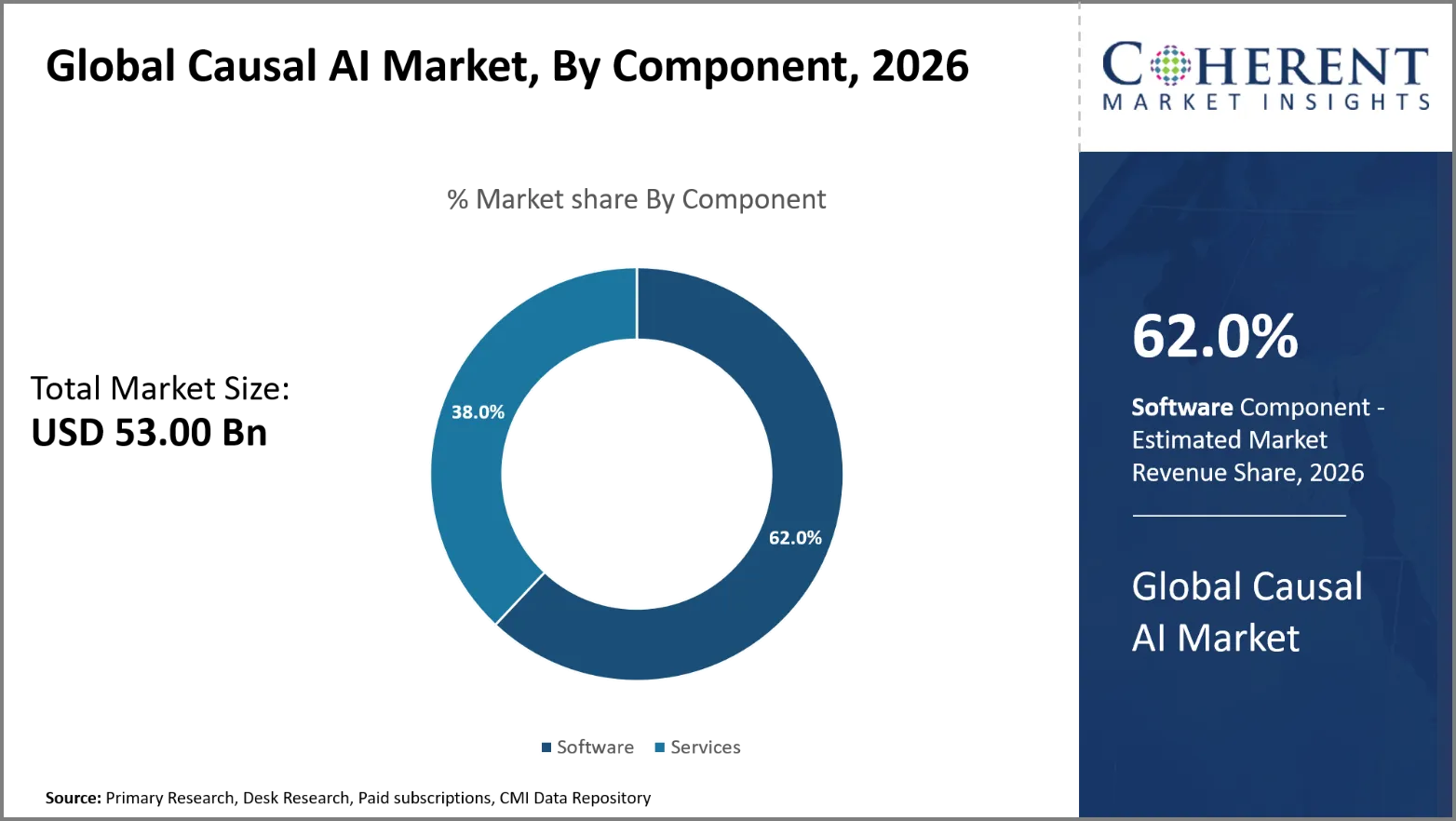
- The Software segment is expected to account for 62.0% of the global causal AI market share in 2026. Rising demand for reliable forecasting and scenario analysis is driving the growth of the segment. In August 2026, Optimal Blue launched its Virtual Economist forecasting tool. Optimal Blue made its artificial intelligence and machine learning forecasting tool generally available to eligible clients.
- The Cloud segment is estimated to capture 71.0% of the market share in 2026. Growing enterprise investment in data-driven decision intelligence is majorly driving the growth of the segment. In November 2025, Accenture Ventures invested in Alembic and established a strategic partnership to improve marketing measurement. The collaboration combines cross-channel marketing data with sales information to estimate campaign contributions.
- The Causal Inference segment is estimated to capture 43.0% of the market share in 2026. Increasing use of causal inference in risk management is driving the growth of the segment. On July 17, 2025, Tala launched a patent-pending artificial intelligence model, InSight, using causal inference to personalize individual credit limits.
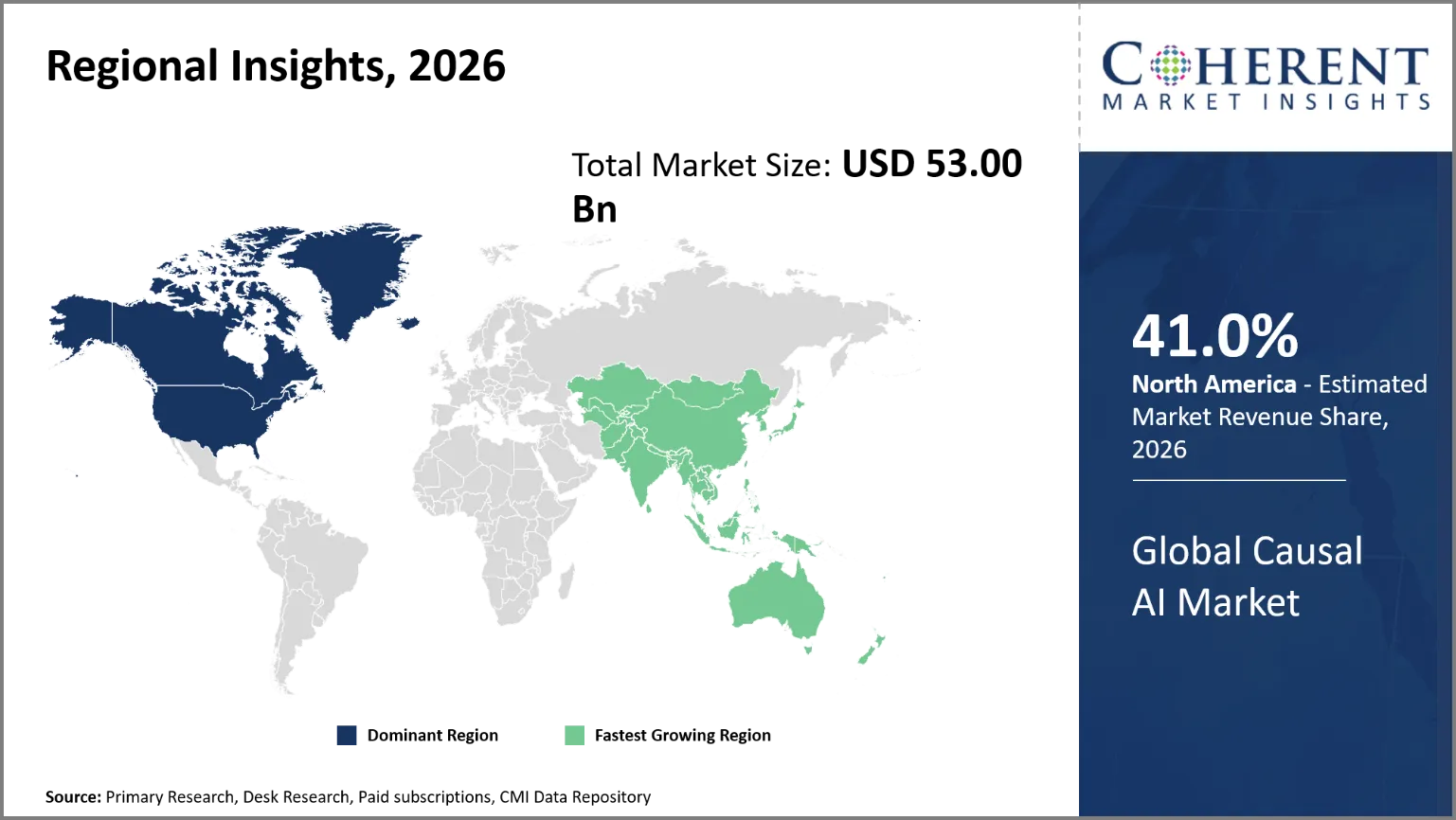
- North America is expected to dominate the causal AI market in 2026 with a market share of 41.0%. Development of causal systems for industrial process optimization in North America is driving the growth of the regional market. On February 25, 2026, Augmentir launched new artificial intelligence agents for manufacturing operations, including a Root Cause Investigator, a 5 Why Coach, and a Data Analyst.
- Asia Pacific is expected to account for 22.0% share in 2026. Growing use of causal inference in supply chain planning in Asia Pacific is driving the growth of the regional market. On October 13, 2026, Kao Corporation announced Kao-MIKOMIL, an artificial intelligence agent that incorporates planned promotions, pricing, sales channels, and other commercial measures into demand forecasts.
Segmental Insights
Why Does Software Dominate the Global Causal AI Market?
The software segment is expected to account for 62.0% of the global causal AI market share in 2026. Software leads because it allows firms to find cause-and-effect correlations inside large data sets. Causal AI software lets companies make better forecasts, diagnose operational problems, optimize actions and assess future outcomes. It is made practical by integrations with existing analytics platforms, enterprise applications and machine learning systems. The software solutions also offer scalable deployment in banking, healthcare, manufacturing, retail and supply chain management. Organizations can update their causal models as new data comes in, enhancing both the accuracy of decision-making and the flexibility of operations.
On April 9, 2025, causaLens announced the availability of its Snowflake Native App on Snowflake Marketplace, enabling partner customers to install effortlessly. causaLens and Snowflake, the AI Data Cloud firm, are helping organizations move past dashboards and analytics tools.
- Current Industry Events of 2026
- Market Size Estimation
- Regional Breakdown
- Competitive Landscape
- Customer Intelligence
- Segmental Analysis
- Pricing Analysis
- Key Market Drivers, Challenges & Future Trends
- Customized Insights Section
Why is Cloud the Most Preferred Deployment Type?
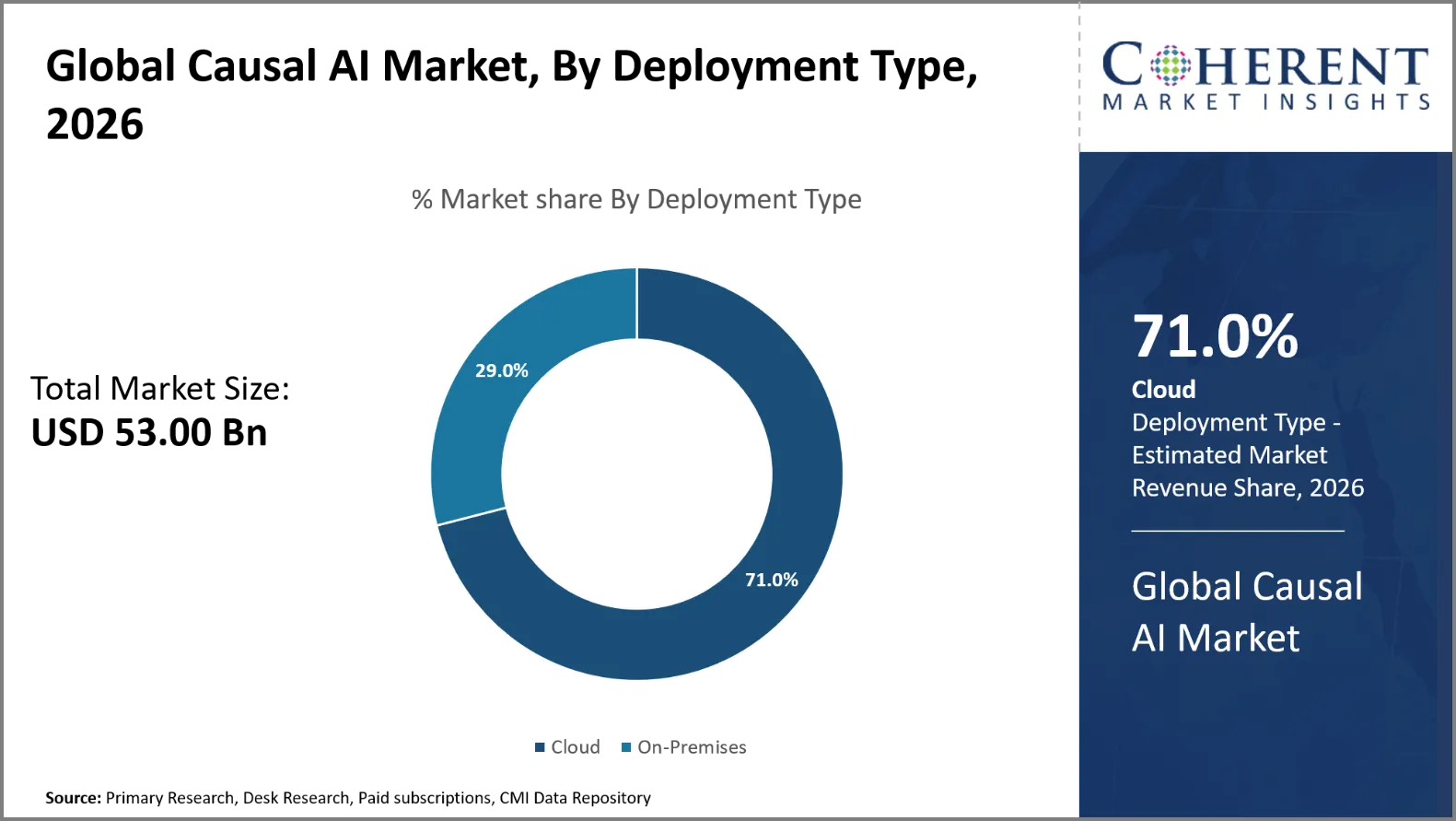
The cloud segment is expected to account for 71.0% of the global causal AI market share in 2026. Flexible access to analytical tools and scalable computer resources make cloud implementation favored. Causal models can be computationally expensive to process, especially when working with huge datasets or several situations, or when complicated linkages exist. With cloud architecture enterprises may scale up and down computing resources to match changing workloads without having to make large up-front hardware investments. It also supports software updates, connection with enterprise data platforms and cooperation across geographically distributed teams. Managed cloud services can reduce infrastructure maintenance requirements and speed up installation.
On November 6, 2025, Causely released a Model Context Protocol (MCP) server that allows developers to automatically diagnose, comprehend and correct complex issues in Kubernetes and application code using natural language prompts from inside their integrated developer environment (IDE).
Causal Inference Dominates the Global Causal AI Market
The causal inference segment is expected to account for 43.0% of the global causal AI market share in 2026. Causal inference is leading as it allows firms to find real causal correlations as opposed to mere statistical associations. This allows firms to see how certain activities, regulations or external changes impact measurable results. Causal inference is applied by companies for marketing attribution, clinical research, fraud detection, price optimization and operational risk management. It also allows for counterfactual analysis, where decision-makers can evaluate what would happen under alternative situations. These insights improve intervention planning and reduce reliance on correlation-based predictions alone.
On May 15, 2025, BeeKeeperAI, Inc. and cStructure announced a collaboration for advancing causal AI to speed up the ability of scientists, health data stewards and AI algorithm developers to build and train AI models that can be trusted for scientific advancement and healthcare innovation.
Current Events and their Impact
Current Events | Description and its Impact |
European Union Artificial Intelligence Act |
|
India Digital Personal Data Protection Act, 2023 |
|
Causal AI Market Dynamics
Market Drivers
Growing demand for explainable artificial intelligence decisions
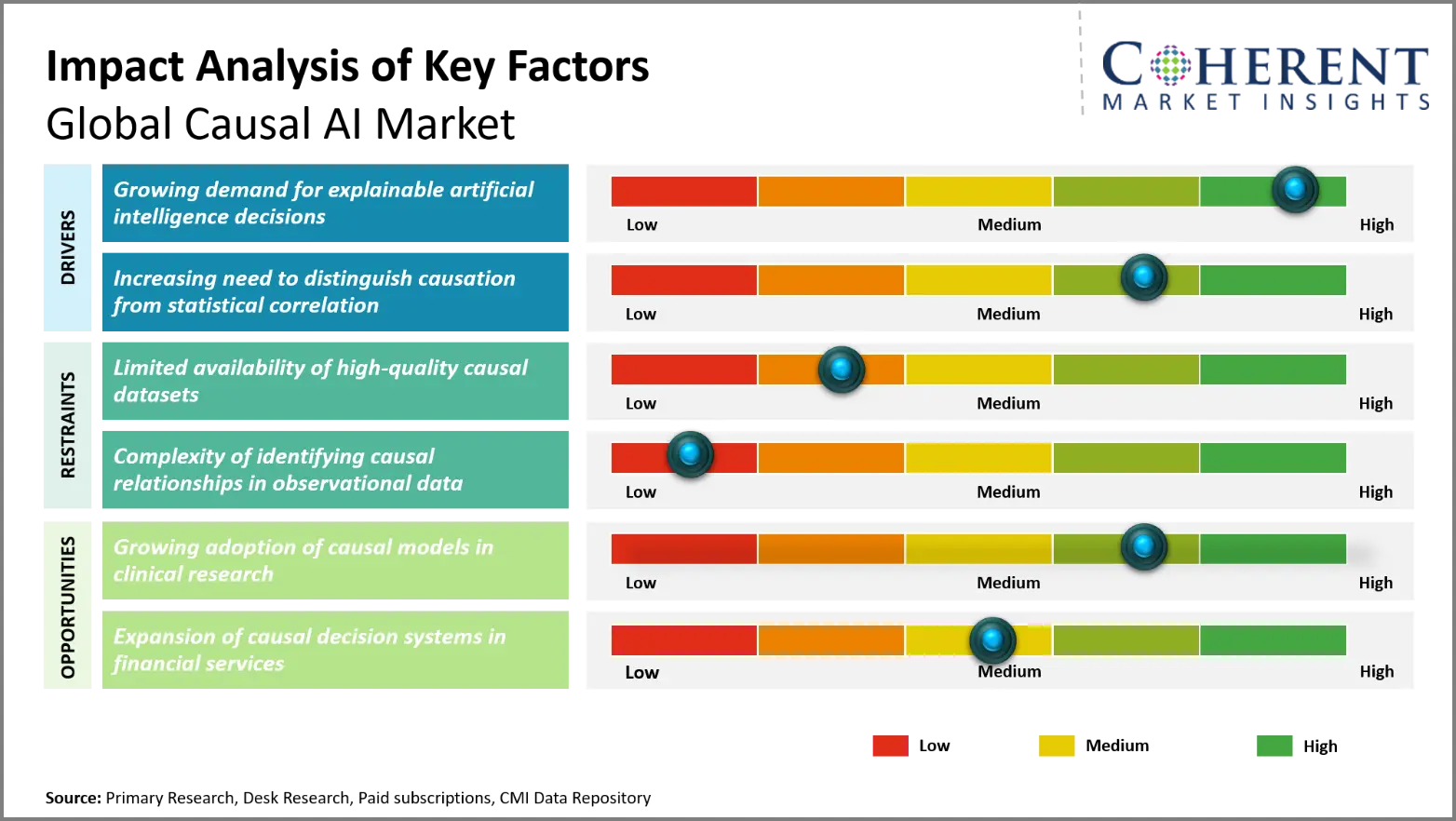
Increasing demand for explainable artificial intelligence judgments is one of the major factors driving the growth of causal artificial intelligence market across industries. Organizations are requiring increased transparent explanations of computerized suggestions, projections and operational judgments. Traditional AI models can often discover trends, but they don’t explain which factors are responsible for the results. Causal artificial intelligence is overcoming this constraint by finding cause-and-effect links and examining how various elements impact results. Financial organizations employ these skills for credit decision explanations and assessing fraud risk. Causal analysis is used by healthcare providers to analyze the results of treatments and to inform clinical decisions. Increased regulatory scrutiny and need for responsible artificial intelligence further bolster the market driver.
On March 16, 2026, Dataiku, the Platform for AI Success, announced Kiji Inspector, one of the first open-source explainability frameworks created specifically for enterprise AI agents. The first model family to get supported in Kiji Inspector is NVIDIA Nemotron open models.
Increasing need to distinguish causation from statistical correlation
The growing requirement to differentiate cause from statistical correlation is driving demand for causal artificial intelligence solutions. Traditional analytical models are capable of identifying correlations between variables, but not if there is a direct effect of one variable on another. This restriction can result in poor corporate decisions, inefficient interventions, and inaccurate forecasts. Causal artificial intelligence explores causal mechanisms using causal graphs, controlled experiments, and counterfactual analysis. Businesses use these tools to test the efficacy of their marketing, improve their pricing strategies, spot operational bottlenecks and assess policy changes. In an era where companies are more concerned with evidence-based decisions, causal techniques offer more robust bases for understanding outcomes and selecting treatments that work. In October 2026, Google released Meridian GeoX, an open-source library enabling marketers to experiment with geography. The program enables to measure additional lift from advertising across platforms and sales channels. It blends the results of experiments with Google’s Meridian marketing mix modeling framework.
Emerging Trends
- Integration of Causal Artificial Intelligence with Generative AI: Companies are merging causal reasoning with generative artificial intelligence to enhance analytical accuracy and contextual awareness. The integration enables systems to consider various scenarios, explain possible consequences, and provide recommendations based on cause-effect links in complicated corporate environments.
- Growing Adoption of Causal Digital Twins: Companies are adopting causal models into digital twins for simulating operational changes and assessing their effects. Manufacturers, healthcare providers and energy firms can test interventions, uncover system vulnerabilities, and optimize operations before the cost of real-world changes.
- Expansion of Causal Artificial Intelligence in Healthcare: Healthcare organizations are studying causal artificial intelligence to evaluate treatment success, detect risk factors for disease and assist individualized healthcare. These applications enable researchers to study underlying mechanisms and to measure the effects of interventions on patient outcomes across different populations.
- Increasing Focus on Automated Causal Discovery: Organizations are leveraging automated causal discovery techniques to explore potential causality correlations in big data. Advances in machine learning and statistical modeling let analysts generate causal graphs, explore latent linkages and develop evidence-based judgments with less manual work.
Regional Insights
Why is North America a Strong Market for Causal AI?
North America is expected to account for a market share of 41.0% in 2026. The demand for causal AI in healthcare research, financial risk assessment and industrial decision intelligence is beneficial for North America. Technology vendors are embedding causal inference in enterprise data in order to find root causes and test interventions. Causal approaches are used by researchers in healthcare to estimate the effectiveness of treatments and the differences between groups of patients. Financial institutions are using causal models to detect fraud tendencies and to understand how their customers are behaving differently. The region also benefits from established cloud platforms, specialist artificial intelligence businesses and advanced data engineering capabilities. Growing interest in auditable automated decisions creates opportunities for solutions that explain business outcomes and test alternative strategies.
Why Does Asia Pacific Causal AI Market Exhibit High Growth?
Asia Pacific is expected to register the fastest growth with a CAGR of 38.6% over the forecast period. The region is projected to account for 22.0% of the global causal AI market in 2026. Smart manufacturing, digital finance and government-led artificial intelligence industrialization are unique opportunities for the Asia Pacific region. China’s manufacturing policies promote industrial artificial intelligence, high-quality data sets and intelligent production applications. The automotive and robotics sectors in Japan offer possibilities to study equipment failures and assess changes in output. The digital financial services ecosystem in Singapore allows for data-driven methods to fraud investigation and client behavior. Causal models can be used by semiconductor manufacturers in South Korea to identify process variances and improve yield control. Regional adoption will depend on quality of industrial data, competence and interaction with existing systems. Such applications are particularly suitable in the causal study of sectors in the different economies of Asia Pacific.
Global Causal AI Market Outlook for Key Countries
Why is U.S. Emerging as a Major Hub in the Causal AI Market?
U.S. market benefits from sophisticated healthcare analytics, drug research, and complex financial decision-making. A 2025 study published in npj Digital Medicine analyzed causal machine learning in the Kaiser Permanente Northern California health care system. Researchers randomized 9,959 patients across 19 hospitals to evaluate targeted post-discharge care coordination. The intervention group had a readmission rate of 7.7%, versus 8.2% for standard care, which was not statistically significant. This study provides a practical use of causal techniques in healthcare delivery. Pharmaceutical companies, insurers and hospital networks also have the chance to better analyze the effectiveness of treatments and to more precisely target resources.
Is China the Next Growth Engine for the Causal AI Market?
China’s causal artificial intelligence opportunities are directly related to industrial automation, manufacturing optimization and smart production systems. In January 2026, eight government departments announced an action strategy for integrating artificial intelligence in manufacturing. The plan focuses on industrial applications, high-quality datasets and intelligent agents in production contexts. Causal models can assist firms evaluate equipment failures, separate process flaws from related operational circumstances, and assess changes to production parameters. Applications of relevance include semiconductor fabrication, automotive production and electronics assembly. The large industrial supply chains in China also provide possibilities to track the impact of component shortages and production disruptions on downstream manufacturing performance.
Germany Causal AI Market Analysis and Trends
Automotive engineering, industrial machinery, and precision manufacturing are the pillars of Germany’s causal artificial intelligence sector. Causal models can help manufacturers discern between root causes of equipment failures and symptoms created by complex production systems. Car businesses can study the effects of material qualities, assembly circumstances and component tolerances on the quality of vehicles. Providers of industrial automation can use causal analysis to solve persistent problems and to evaluate maintenance activities. Germany’s established engineering ecosystem offers realistic venues to combine sensor data, industrial records and engineering knowledge. The country’s emphasis on industrial competitiveness and trustworthy AI also promotes applications that require traceable judgments and measurable operational benefits.
U.K. Causal AI Market Analysis and Trends
U.K. enables causal AI through financial services, medical research and advanced analytical tools. London's financial institutions can use causal models to detect real fraud signals from fortuitous transaction patterns. Causal inference can be used in healthcare research to assess therapy efficacy and explore heterogeneity among patient populations. The Alan Turing Institute is involved in the country’s broader artificial intelligence research ecosystem. The government policy has been focused on the research capacities, the commercial use and the effective governance of artificial intelligence. These capabilities increase the demand for decision systems that explain results, evaluate treatments and improve accountability. Especially significant application areas include financial compliance and evidence-based healthcare.
Canada Causal AI Market Analysis and Trends
Canada’s causal artificial intelligence market is aided by strong machine learning research and increasing healthcare data initiatives. The country’s three national artificial intelligence institutes are Mila, the Alberta Machine Intelligence Institute and the Vector Institute. Healthcare is a key area of practical uptake in Canada’s national artificial intelligence policy for 2026. Its planned Health Sector Data Space would link standardized data sets for research and health system performance monitoring. Causal models can be useful to researchers for testing therapy routes, investigating avoidable hospital visits, and evaluating interventions across patient groups. The Canadian experience in responsible artificial intelligence also enables applications that require strict data control and transparent analytical procedures.
Global Causal AI Market - Automated Causal Discovery
Component | Method | Data requirements | Business application | Key limitation |
Causal graph generation | Constraint-based algorithms such as Peter–Clark and Fast Causal Inference | Sufficient observations, measurable variables, and reliable conditional dependence estimates | Identifying relationships among transactions, customer behavior, and fraud | Results depend on assumptions and available variables |
Score-based discovery | Bayesian information criterion scoring and Bayesian network structure search | Structured datasets with adequate sample sizes | Mapping drivers of credit defaults and financial losses | Computational costs can increase as variables grow |
Continuous optimization | Differentiable structure learning methods such as NOTEARS | Numerical data and assumptions about the underlying causal structure | Discovering relationships among manufacturing variables | Nonlinear relationships and noise can complicate discovery |
Time-series causal discovery | Temporal causal discovery and Granger-based methods | Time-stamped observations and suitable temporal resolution | Identifying potential drivers of equipment failures and demand changes | Temporal precedence alone does not establish causation |
Hidden confounder analysis | Fast Causal Inference and latent-variable methods | Multiple observed variables and plausible assumptions about unobserved factors | Investigating relationships affected by unmeasured customer or patient characteristics | Hidden confounders may remain undetected |
Expert validation | Domain review, causal diagram assessment, and sensitivity analysis | Subject-matter expertise, documentation, and supporting evidence | Validating proposed relationships before operational deployment | Expert assumptions can introduce bias |
Experimental validation | Randomized experiments, controlled interventions, and natural experiments | Intervention data or a credible quasi-experimental design | Testing whether a proposed intervention changes fraud rates or business outcomes | Experiments can be costly, slow, or ethically impractical |
Model robustness | Bootstrap stability, alternative model specifications, and sensitivity tests | Adequate samples and repeatable analysis pipelines | Checking whether discovered relationships remain stable across datasets | Stable results do not automatically prove causality |
How is Growing Adoption of Causal Models in Clinical Research Creating New Growth Opportunities in the Causal AI Market?
The increased use of causal models in clinical research offers new prospects for growth since they allow drug companies to separate the effect of treatment from differences in patients and other external factors. Causal inference can be used by researchers to analyze real-world evidence, compare therapy routes and find patient groups with most benefit from certain medicines. Such skills are especially important when randomized clinical studies exclude diverse patient populations or are unable to capture long-term results. Causal models can also be applied to target-trial emulation, adverse-event research, and treatment-effect estimation using electronic health data and insurance claims. Pharmaceutical developers could use these tools to improve trial design, increase evidence for regulatory submissions and select attractive drug prospects.
A significant regulatory avenue for assessing such evidence is the U.S. Food and Drug Administration’s guidance on electronic health records and medical claims data issued in July 2024. It addresses the relevance and dependability of evidence in making regulatory decisions on the effectiveness or safety of pharmacological and biological products. This opens potential for causal AI developers that provide proven analytical methods, explicit assumptions, and reproducible clinical evidence.
Market Players, Key Development, and Competitive Landscape
Key Developments
- On September 17, 2026, Causaly announced an extension of its partnership with Microsoft to bring agentic scientific research straight into Microsoft Copilot. Enterprise life sciences R&D now has native access to Causaly from their existing Microsoft 365 workflows, Copilot app and Microsoft Teams.
- On September 2, 2026, Ono Pharmaceutical Co., Ltd. announced that it has signed into a drug discovery partnership agreement with Aitia, Inc. Under the partnership, Aitia will use its REFS technology to generate Gemini Digital Twins (GDTs) for neurological illnesses and discover new treatment targets and biomarkers.
- On March 19, 2026, Alembic Technologies introduced Version 3.0 of its Causal AI platform, enabling real-time enterprise simulation driven by NVIDIA DGX SuperPOD infrastructure and NVIDIA Grace Blackwell systems. This release is a huge milestone in enterprise decision intelligence, giving multinational corporations the ability to model the financial implications of strategic decisions in real time before they make their investments.
Competitive Landscape
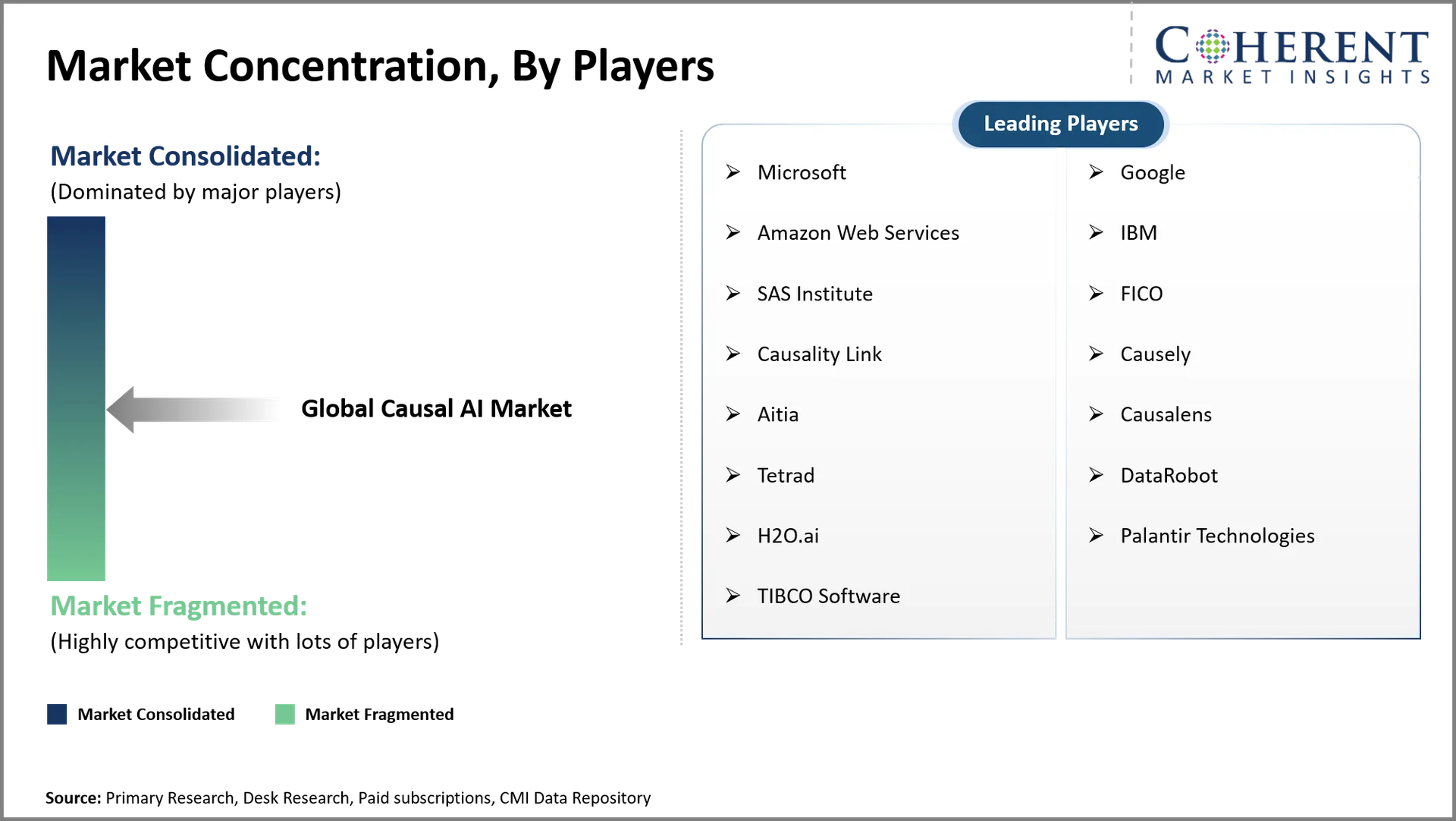
Decision intelligence, scientific research, and enterprise analytics make up the worldwide causal AI market, where niche developers are vying with major technology vendors. What differentiates Causalens is its decisionOS platform that integrates causal discovery, explainable models, counterfactual analysis and decision optimization. Causaly is a platform for biomedical intelligence and pharmaceutical research that helps scientists examine biological pathways, rank drug targets, and assess evidence from scholarly papers and internal data sets. International Business Machines Corporation researches causal reasoning, explainability, fairness and strong artificial intelligence systems. Causely targets infrastructure operations by building causal models from telemetry, service dependencies, logs, and alerts. Competitive differentiation increasingly depends on industry-specific models, trusted data integration, interpretable outputs, and measurable improvements in business decisions.
Top Market Players and Notable Products/Offerings in the Causal AI Market
Market Players | Notable Product/Offering | Key features |
CausaLens | decisionOS | Automated causal discovery, editable causal graphs, explainable models, root-cause analysis, counterfactual analysis, and time-series causal modeling |
Alembic | Alembic Causal AI Platform | Real-time causal graphs, incremental impact measurement, scenario simulation, cross-functional analysis, and revenue optimization |
Microsoft Research | EconML | Machine learning-based causal effect estimation, heterogeneous treatment effects, observational and experimental data analysis, and interpretable models |
Bayesia | BayesiaLab | Bayesian network modeling, causal inference, probabilistic reasoning, simulation, risk analysis, and decision support |
Causely | Causely Platform | Live causal models, root-cause identification, dependency graphs, incident diagnosis, deployment risk analysis, and explainable operational recommendations |
Causal AI Market Report Coverage | |||
Report Coverage | Details | ||
Base Year | 2025 | Market Size in 2026: | USD 53.00 Bn |
Historical Data For: | 2020 To 2024 | Forecast Period: | 2026 To 2033 |
Forecast Period 2026 To 2033 CAGR: | 38% | 2033 Value Projection: | USD 757.25 Bn |
Geographies covered: |
| ||
Segments covered: |
| ||
Companies covered: | Microsoft, Google, Amazon Web Services, IBM, SAS Institute, FICO, Causality Link, Causely, Aitia, Causalens, Tetrad, DataRobot, H2O.ai, Palantir Technologies, TIBCO Software | ||
Growth Drivers: |
| ||
Restraints & Challenges: |
| ||
Analyst Opinion (Expert Opinion)
- The future of the causal AI market will depend on moving beyond predictive insights toward measurable decision improvement. Causal models will increasingly complement generative artificial intelligence, predictive analytics, and autonomous enterprise agents. The strongest opportunities will emerge where organizations must understand why outcomes occur before changing business processes. Healthcare research, pharmaceutical development, financial risk management, and industrial root-cause analysis offer particularly promising applications. Vendors should prioritize systems that connect causal graphs with real operational data and explain the likely effects of proposed interventions.
- The best opportunities will vary by application and geography. Pharmaceutical research in the UK and the US presents opportunities for cause discovery, therapy impact estimation and biological mechanism research. Germany offers chances in factory diagnostics, process optimization, and equipment reliability. There’s room for semiconductor fabrication, electronics manufacturing and industrial automation in China. India could see demand for causal decision systems in digital banking, healthcare delivery and operational analytics. Attention should be given to software that supports causal inference, counterfactual simulation and automated cause discovery in these marketplaces.
- Market participants should differentiate themselves by focusing on measurable industry challenges, rather than selling generic causal AI platforms. Developers should develop proven workflows for certain jobs, such as for discovering production errors, or assessing the effectiveness of treatments. They should build domain expertise, explainable causal graphs, data lineage and human evaluation into their products. Partnerships with hospitals, pharmaceutical companies, manufacturers, and financial organizations can help supply relevant data sets and realistic deployment environments. Vendors must also implement transparent model validation, privacy protections, and deployment-specific metrics for performance. These skills can increase consumer confidence and differentiate genuine solutions from traditional analytics offerings.
Speak to the analyst
Want personalized insights?
Take the findings above to one of our principal consultants, or have the report rebuilt around the segments, geographies and competitors you actually track.
Market Segmentation
- Component Insights (Revenue, USD Billion, 2021 - 2033)
- Software
- Services
- Deployment Type Insights (Revenue, USD Billion, 2021 - 2033)
- Cloud
- On-Premises
- Technology Type Insights (Revenue, USD Billion, 2021 - 2033)
- Causal Inference
- Causal Discovery
- Structural Causal Models
- Counterfactual Analysis
- Bayesian Networks
- Application Insights (Revenue, USD Billion, 2021 - 2033)
- Decision Intelligence
- Predictive Analytics
- Risk Management
- Root Cause Analysis
- Clinical Research and Drug Discovery
- Supply Chain Optimization
- Industrial Process Optimization
- End User Insights (Revenue, USD Billion, 2021 - 2033)
- BFSI
- Healthcare and Life Sciences
- IT and Telecommunications
- Manufacturing
- Retail and E-commerce
- Energy and Utilities
- Government and Public Sector
- Others
- Regional Insights (Revenue, USD Billion, 2021 - 2033)
- North America
- U.S.
- Canada
- Latin America
- Brazil
- Argentina
- Mexico
- Rest of Latin America
- Europe
- Germany
- U.K.
- Spain
- France
- Italy
- Russia
- Rest of Europe
- Asia Pacific
- China
- India
- Japan
- Australia
- South Korea
- ASEAN
- Rest of Asia Pacific
- Middle East
- GCC Countries
- Israel
- Rest of Middle East
- Africa
- South Africa
- North Africa
- Central Africa
- North America
- Key Players Insights
- Microsoft
- Amazon Web Services
- IBM
- SAS Institute
- FICO
- Causality Link
- Causely
- Aitia
- Causalens
- Tetrad
- DataRobot
- H2O.ai
- Palantir Technologies
- TIBCO Software
Sources
Primary Research Interviews
- AI/ML Solution Providers & Vendors
- Enterprise Data Scientists & AI Architects
- Healthcare & Pharmaceutical Industry Executives
- Financial Services & Risk Analytics Professionals
Magazines
- MIT Technology Review
- AI Business Magazine
- Analytics India Magazine
- Wired (AI & Technology Edition)
Journals
- Journal of Artificial Intelligence Research (JAIR)
- Nature Machine Intelligence
- IEEE Transactions on Neural Networks and Learning Systems
Associations
- Association for the Advancement of Artificial Intelligence (AAAI)
- Partnership on AI
- AI Now Institute
- International Association for Artificial Intelligence and Law (IAAIL)
Public Domain Sources
- U.S. National Institute of Standards and Technology (NIST) – AI Risk Management Framework
- European Commission – AI Policy & Regulatory Documents
- World Economic Forum (WEF) – AI & Emerging Technology Reports
- OECD AI Policy Observatory
Proprietary Elements
- CMI Data Analytics Tool
- Proprietary CMI Existing Repository of Information for the last 10 years
Get access to 250+ pages report
Every segment, forecast, competitor profile and data table behind the analysis above — available for instant download.
- ESOMAR Member
- ISO 9001:2015 Certified
- D-U-N-S Registered
- GDPR & CCPA Compliant
Frequently Asked Questions
The global causal AI market is expected to stand at USD 53.00 Bn in 2026 and is expected to reach USD 757.25 Bn by 2033.
The CAGR of the global causal AI market is projected to be 38% from 2026 to 2033.
Growing demand for explainable artificial intelligence decisions and Increasing need to distinguish causation from statistical correlation are the major factors driving the growth of the global causal AI market.
Limited availability of high-quality causal datasets and Complexity of identifying causal relationships in observational data are the major factors hampering the growth of the global causal AI market.
In terms of component, software segment is estimated to dominate the market revenue share in 2026.
Predictive AI estimates likely outcomes, whereas causal AI investigates why outcomes occur and how interventions change them.
Causal AI helps researchers evaluate treatment effectiveness, compare patient groups, and analyze real-world clinical evidence.