

Global Cloud Security Market Size and Forecast – 2026 To 2033
The global cloud security market is expected to grow from USD 43.80 Bn in 2026 to USD 97.90 Bn by 2033, registering a compound annual growth rate (CAGR) of 12.0% from 2026 to 2033. The global cloud security market is driven by growing demand for identity and access management solutions. On May 28, 2025, Cisco unveiled its Duo Identity and Access Management (IAM), a new security solution that transforms how organizations combat persistent identity-based attacks that are accelerating in the AI era.
Key Takeaways of the Global Cloud Security Market
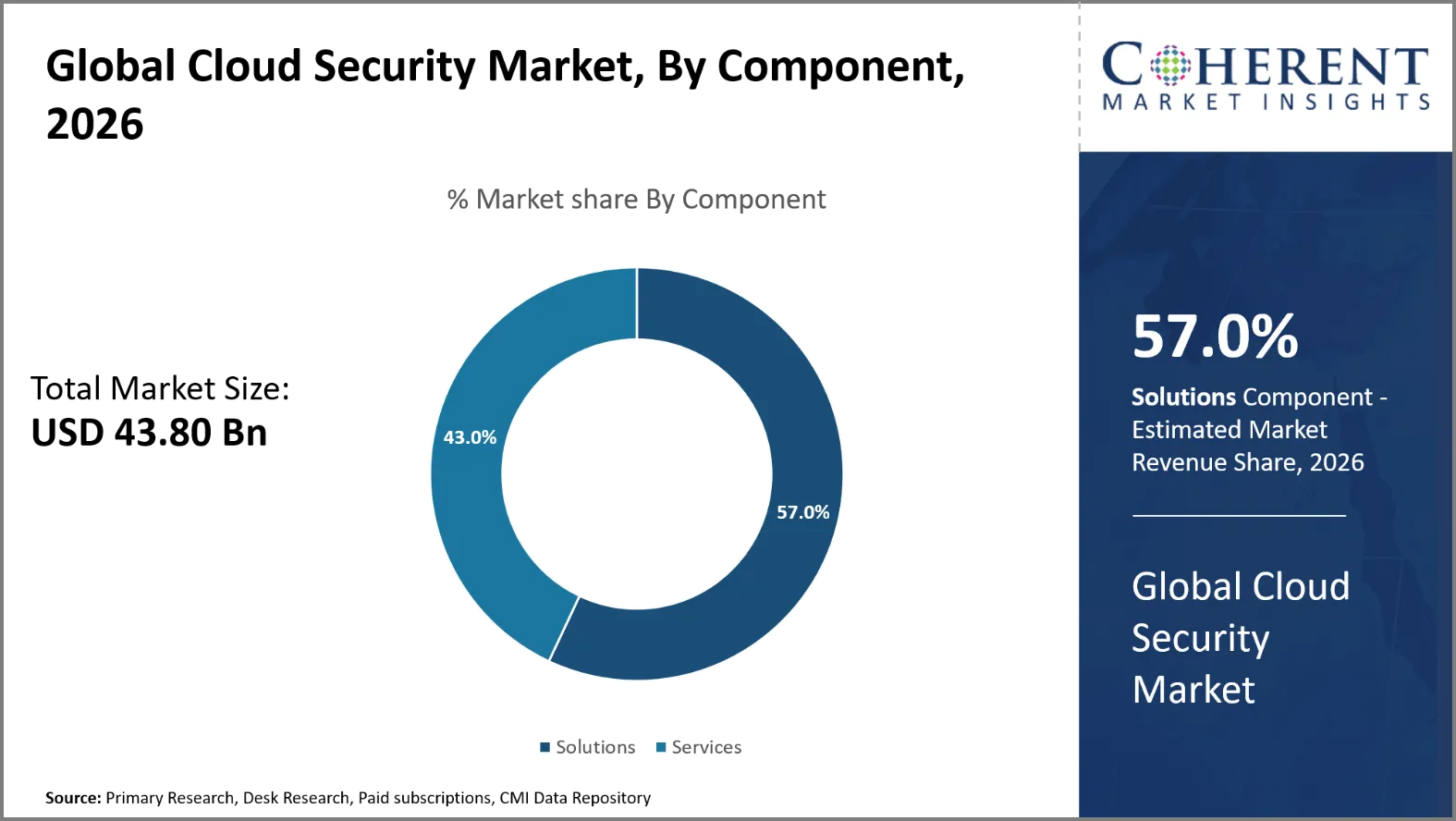
- The Solutions segment is expected to account for 57.0% of the global cloud security market share in 2026. Expansion of artificial intelligence powered threat detection is driving the growth of the segment. On February 20, 2025, OpenText launched Core Threat Detection and Response as part of its next-generation Cybersecurity Cloud.
- The Public Cloud segment is estimated to capture 49.0% of the market share in 2026. Stricter data protection and cybersecurity compliance requirements is majorly driving the growth of the segment. On June 3, 2025, Cloudflare announced that it has been certified under the Global Cross-Border Privacy Rules and Global Privacy Recognition for Processors systems. These certificates indicate compliance with established privacy principles for the processing of personal information in the jurisdictions involved.
- The Large Enterprises segment is estimated to capture 66.0% of the market share in 2026. Increasing enterprise adoption of multi-cloud environments is driving the growth of the segment. On March 5, 2025, Google Cloud announced AI Protection to safeguard artificial intelligence workloads and sensitive data across different clouds and models.
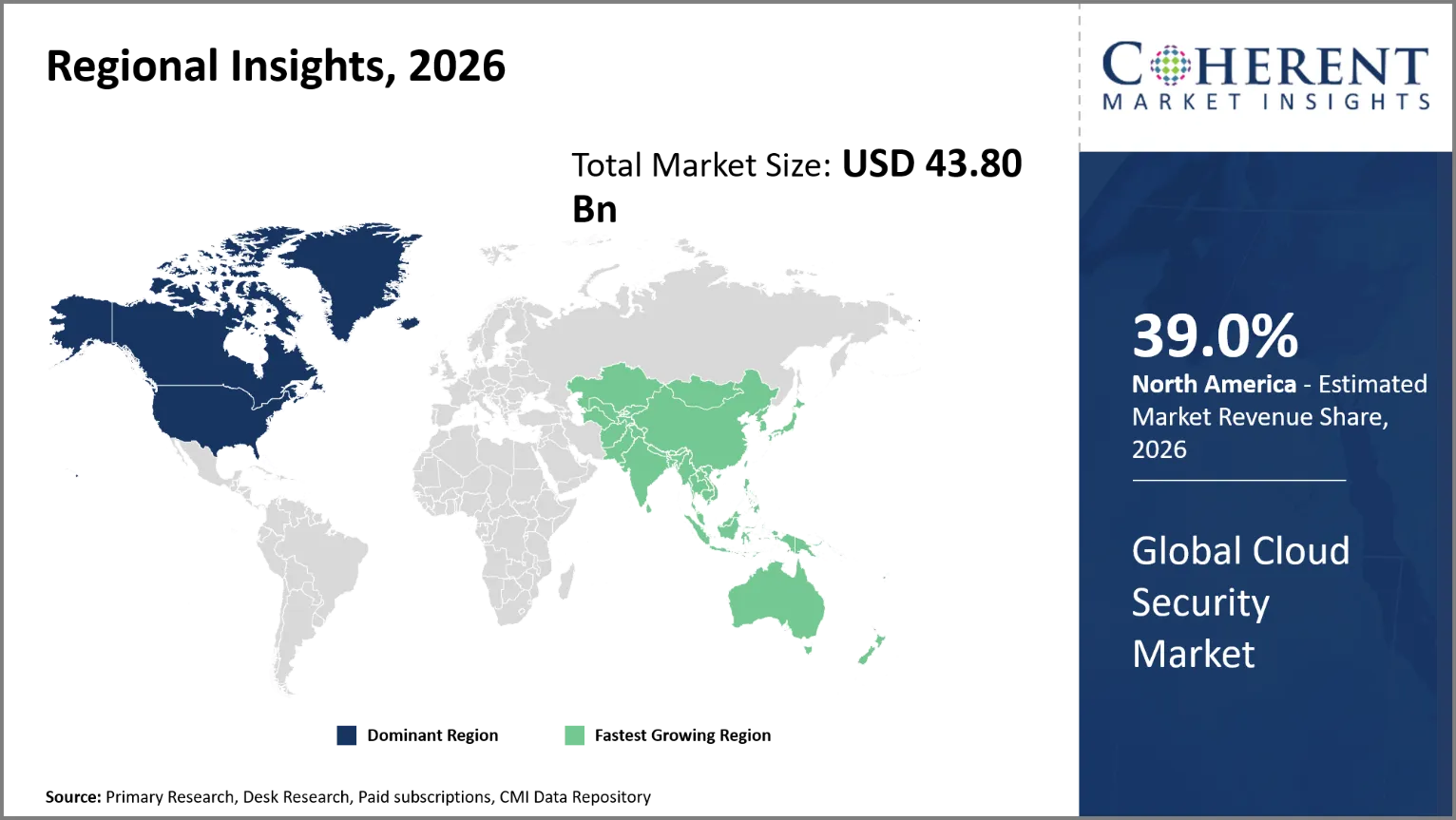
- North America is expected to dominate the cloud security market in 2026 with a market share of 39.0%. Increasing adoption of zero-trust security architectures in North America is driving the growth of the regional market. In June 2025, Zscaler introduced new Zero Trust Everyplace solutions, extending security to branch offices, factories, remote settings and multi-cloud infrastructure. The release introduced unified branch security appliances, improved segmentation for operational technology and Internet of Things devices, and secure, time-limited access for contractors.
- Asia Pacific is expected to account for 24.0% share in 2026. Rising demand for cloud workload protection and posture management in Asia Pacific is driving the growth of the regional market. In March 2025, Palo Alto Networks announced new cloud infrastructure investments in Asia Pacific and Japan. India, Indonesia, Japan, Singapore, and Australia were added to the expansion. It integrated Prisma Access Browser into existing regional infrastructure to support data residency and secure access requirements.
Segmental Insights
Why Does Solutions Dominate the Global Cloud Security Market?
The solutions segment is expected to account for 57.0% of the global cloud security market share in 2026. Organizations need integrated technologies to secure cloud workloads, applications, networks and sensitive data and solutions are out in front. Cloud security solutions offer capabilities like as threat detection, identity and access management, data encryption, vulnerability evaluation, and automated incident response. These features allow enterprises to respond to complex cyberattacks, restrict illegal access and stay compliant with regulations. And the increasing usage of artificial intelligence, hybrid cloud environments and multi-cloud infrastructure is increasing need for scalable security solutions. Organizations also recognize the importance of centralized visibility and real-time threat detection in improving protection across scattered digital environments.
On May 27, 2026, Google Cloud announced its autonomous cybersecurity platform, Google AI Threat Defense. The solution integrates continuous security analysis, attack path prediction, risk prioritization, and fast repair.
- Current Industry Events of 2026
- Market Size Estimation
- Regional Breakdown
- Competitive Landscape
- Customer Intelligence
- Segmental Analysis
- Pricing Analysis
- Key Market Drivers, Challenges & Future Trends
- Customized Insights Section
Why is Public Cloud the Most Preferred Deployment Type?
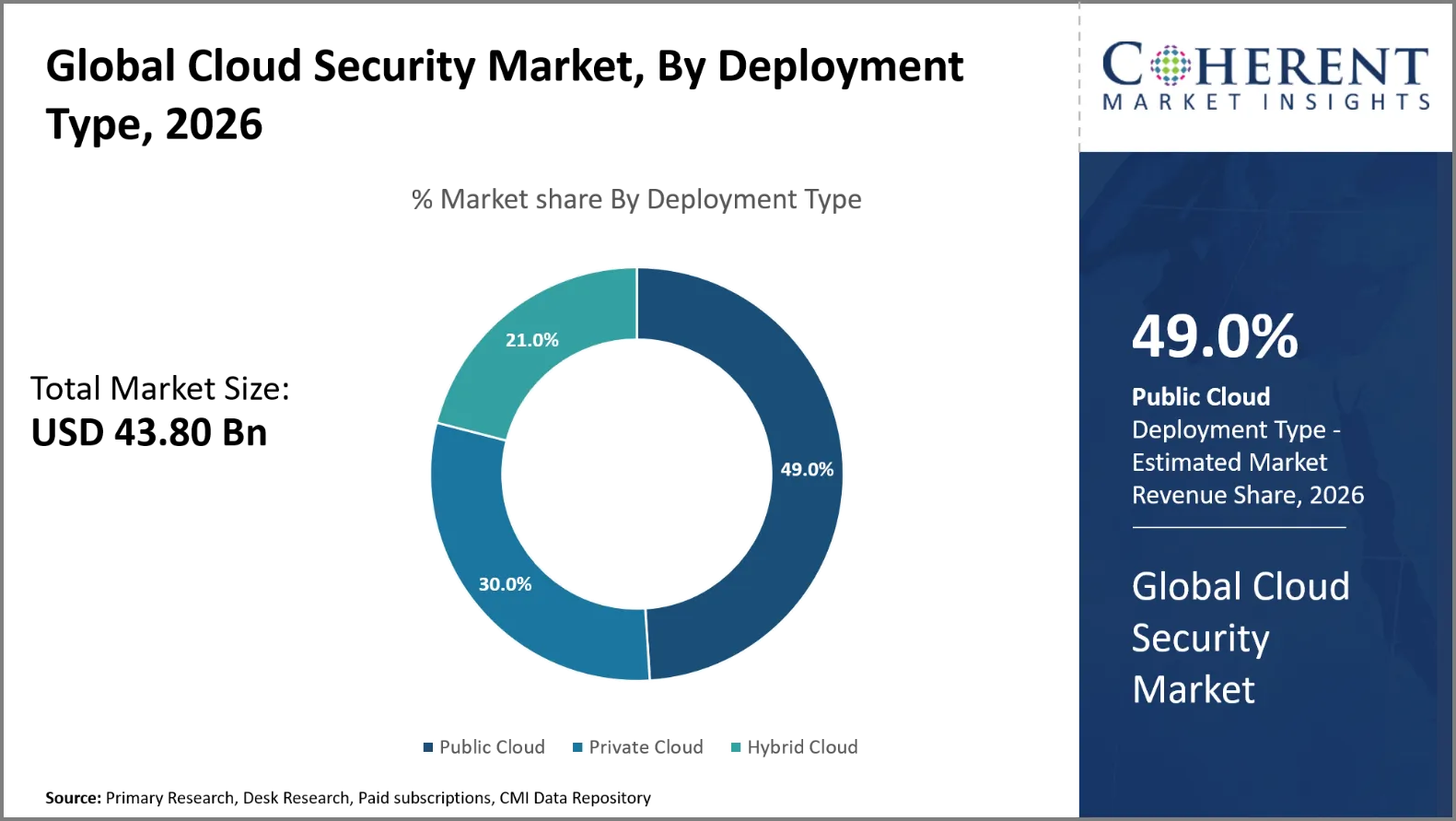
The public cloud segment is expected to account for 49.0% of the global cloud security market share in 2026. Public cloud is the most desired deployment choice as it is scalable, cost-efficient, and allows easy access to sophisticated security features. Organizations can use cloud security services without making a large investment in on-premise infrastructure or acquiring special-purpose hardware. Public cloud providers enable rapid provisioning, automatic updates, centralized management, and geographically dispersed infrastructure. These features assist firms in responding to changing workloads and emerging cybersecurity threats. Subscription pricing also allows enterprises to align security spending with operational needs. The implementation of public cloud security is being driven by the continued acceptance of software applications, remote employment, and cloud-native development.
On June 17, 2025, Amazon Web Services announced a new suite of security tools to help customers of all sizes bolster their digital defenses. As cyber assaults becoming more sophisticated for enterprises, AWS introduced a dozen new features to help make managing security easier, and deliver even broader protection.
Large Enterprises Dominates the Global Cloud Security Market
The Large Enterprises segment is expected to account for 66.0% of the global cloud security market share in 2026. Large organizations dominate because they own large digital infrastructures, sophisticated application environments and large volumes of sensitive information. They demand enhanced protection against ransomware, data breaches, insider threats and supply chain attacks. Large enterprises also have strict compliance obligations across many jurisdictions and business units. So, they deploy full security platforms, specialized cybersecurity teams, constant monitoring and automated threat intelligence. The industry’s transition to hybrid cloud and multi-cloud architectures boosts the demand for centralized security management.
On August 4, 2026, ServiceNow announced an acceleration of its autonomous security vision with six unified solutions to deliver prevention-first, AI-native cyber defense across unified exposure management, continuous vulnerability detection, cyber-physical security, identity and access security, and agentic incident response, and cyber risk and compliance.
Current Events and their Impact
Current Events | Description and its Impact |
European Union Network and Information Security Directive (EU) 2022/2555 |
|
European Union Digital Operational Resilience Act Regulation (EU) 2022/2554 |
|
Cloud Security Market Dynamics
Market Drivers
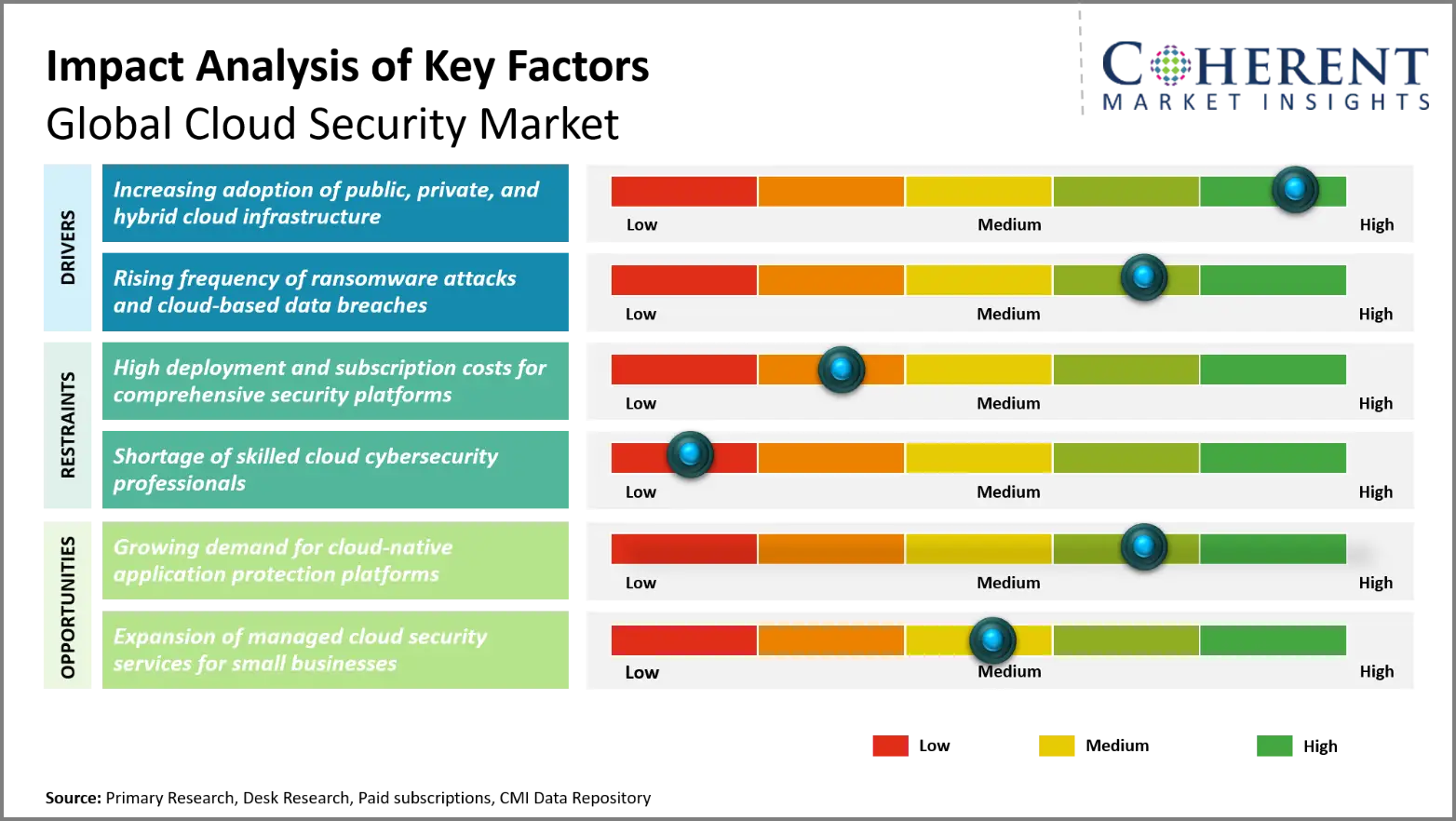
- Increasing adoption of public, private, and hybrid cloud infrastructure: The growing adoption of public, private, and hybrid cloud infrastructure is expected to boost the demand for advanced cloud security solutions. Organizations deploy apps, workloads and sensitive data across different cloud environments to boost scalability and operational agility. This dispersal complicates security and presents issues in managing access, visibility of data and consistently enforcing policy. For public cloud, ongoing tracking of workloads is required. For private cloud systems, stringent internal restrictions over access are required. Hybrid cloud architectures require security policies that are consistent between on-premises infrastructure and the cloud. Therefore, companies are investing more into centralized security administration, encryption, identity protection and automatic threat detection.
- On February 17, 2026, Amazon Web Services India Private Limited (AWS India) announced that it will work with Yotta Data Services to build AWS Outposts for the National Informatics Centre’s (NIC) Meghraj 2.0 project. The initiative will be able to leverage AWS services and generative AI capabilities to meet data residency and security requirements.
- Rising frequency of ransomware attacks and cloud-based data breaches: The increasing number of ransomware attacks and cloud data breaches requires comprehensive cloud security solutions. Cybercriminals go after misconfigured storage, compromising passwords, exposed application programming interfaces and inadequately protected workloads. Successful attacks may interrupt business operations, compromise sensitive information and lead to costly recovery expenditures. To address these risks, companies are increasingly implementing continuous threat monitoring, multi-factor authentication, endpoint security and automated incident response. Cloud security services also detect suspicious activities, discover vulnerabilities and secure critical data. Business continuity and regulatory compliance issues continue to drive organizations to ramp up spending in cloud security.
- On August 27, 2025, Microsoft Threat Intelligence detected the financially driven threat actor Storm-0501 consistently upgrading their campaigns to sharpen focus on cloud-based tactics, methods, and procedures (TTPs). The threat actor has been known to target hybrid cloud setups but its primary purpose has moved from deploying on-premises endpoint ransomware to cloud-based ransomware methods.
Emerging Trends
- Artificial Intelligence-Powered Threat Detection: Vendors in the cloud security space are increasingly integrating artificial intelligence and machine learning capabilities to detect malicious activity, uncover new attack patterns, and automate threat investigations. These features assist security teams improve incident response, decrease human labor and secure remote cloud environments.
- Zero Trust Security Architecture: Organizations are more and more adopting zero trust architectures that constantly validate user, device, application, and access requests. This strategy decreases dependency on traditional network boundaries and increases protection from compromised credentials, insider attacks and illegal movement between cloud workloads.
- Cloud-Native Application Protection: With the increased popularity of containers, microservices and serverless computing, the demand for cloud-native application protection systems is increasing. These solutions incorporate security into the development and deployment process, assisting enterprises in finding vulnerabilities, monitoring workloads, and protecting applications during their entire operational lifecycle.
- Unified Multi-Cloud Security Management: Enterprises are leveraging various cloud providers for flexibility and to prevent vendor lock-in. Unified security platforms allow enterprises the ability to safeguard complex infrastructures with centralized visibility, consistent policy enforcement, and coordinated compliance monitoring across disparate environments.
Regional Insights
Why is North America a Strong Market for Cloud Security?
North America is expected to account for a market share of 39.0% in 2026. North America has a mature cloud infrastructure, significant investment in the security sector, and a strong demand to protect critical digital services. Financial organizations safeguard distributed banking applications using cloud access security brokers and identity management solutions. Cloud security measures are used by healthcare organizations to secure electronic health records and to ensure compliance with the Health Insurance Portability and Accountability Act. The region also has developed cybersecurity ecosystems such as Microsoft, Amazon Web Services, Google Cloud and Cisco. Increasing adoption of artificial intelligence infrastructure creates additional requirements for workload protection, privileged access controls, and sensitive data governance across enterprise cloud environments.
Why Does Asia Pacific Cloud Security Market Exhibit High Growth?
Asia Pacific is expected to register the fastest growth with a CAGR of 12.8% over the forecast period. The region is projected to account for 24.0% of the global cloud security market in 2026. The growth in cloud security in Asia Pacific is a reflection of the fast digitalization across industries, telecommunications, electronic commerce and digital payments. Singapore’s Cyber Security Agency provides recommendations on cloud security and Japan’s Information System Security Management and Assessment Program rates cloud services for government procurement purposes. India’s Digital Personal Data Protection framework is paying more attention to safeguards for personal information. South Korea’s finTech firms also need tight authentication and fraud monitoring across cloud-hosted services. More and more regional manufacturers are locking down their linked factories, production data and industrial Internet of Things platforms. These different needs are driving the adoption of cloud security posture management, encryption, identity governance and industry-specific compliance technologies.
Global Cloud Security Market Outlook for Key Countries
Why is U.S. Emerging as a Major Hub in the Cloud Security Market?
The U.S. market benefits from federal cloud procurement rules, robust financial technology infrastructure and advanced cybersecurity procedures. The government Risk and Authorization Management Program standardizes the security assessment of cloud services utilized by government agencies. The Cybersecurity and Infrastructure Security Agency also issued recommendations on cloud security, identity protection and secure configuration. Healthcare providers should take the Health Insurance Portability and Accountability Act into account when safeguarding electronic health information housed in cloud environments. Financial organizations are increasingly using automated threat detection and privileged access management. These criteria allow specific cloud security services for government contractors, hospitals, banks and critical infrastructure operators.
Is China the Next Growth Engine for the Cloud Security Market?
The Chinese cloud security market is influenced by data sovereignty requirements, homegrown technological ecosystems and massive industrial digitization. The Cybersecurity Law, Data Security Law and the Personal Information Protection Law set out duties on network security, data processing and personal information protection. The Network Data Security Management Regulations went into force on 1 January 2025, tightening the limits on activities of network data processing. Alibaba Cloud, Tencent Cloud and others are helping enterprises meet their needs for data classification, access governance and security monitoring. China cloud deployments require controls to meet Chinese regulatory requirements and address cross-border data transfers.
Germany Cloud Security Market Analysis and Trends
Demand for cloud security is highly driven in Germany by industrial cybersecurity, sensitive engineering information, and assurance needs of the cloud service provider. The Federal Office for Information Security has developed the Cloud Computing Compliance Criteria Catalog (C5) to verify the security controls of cloud services by means of independent audits. Automotive manufacturers, industrial automation providers and engineering enterprises need to protect product designs, manufacturing data and connected production systems. For cloud providers serving these customers, it's crucial to show adequate control of access, incident management and security governance. The requirements are driving the adoption of confidential computing, privileged access control, and security monitoring for industrial workloads.
U.K. Cloud Security Market Analysis and Trends
The U.K. government regulations on cloud adoption, financial services oversight and national instructions on how to assess cloud providers all assist the market. The National Cyber Security Center has published fourteen Cloud Security Principles that address encryption, customer isolation, operational security, identity management and incident monitoring. The Government’s Cloud First policy is also driving the use of cloud services when the public sector buys technology. Banks, insurance businesses and public bodies therefore require written security procedures and reliable audit evidence. These goals assist cloud security evaluations, configuration monitoring, identity governance and third-party risk management.
Japan Cloud Security Market Analysis and Trends
The cloud security industry in Japan is propelled by government cloud procurement requirements, digital administration efforts and enterprise modernization. The Information System Security Management and Assessment Program examines cloud services against government security standards before they are registered for procurement by the public sector. Japan’s Digital Agency kept revising its cloud service lists appraised in 2026. This paradigm incentivizes cloud providers to prove their security procedures and keep adequate assessment evidence. Japanese manufacturers also need to protect proprietary designs, robotics systems, and operational technology data. Demand therefore extends to secure cloud integration, industrial access controls, supply chain monitoring, and protection of connected manufacturing environments.
Global Cloud Security Market - Cloud Security for Artificial Intelligence Infrastructure
Key Metric | Reported Data |
Artificial intelligence cloud security strategy | 77% updated cloud security strategies for artificial intelligence |
Artificial intelligence security enforcement | 26% reported architecture capable of enforcing artificial intelligence security policies |
Enterprise artificial intelligence agent experimentation | 85% of surveyed enterprise customers experimented with artificial intelligence agents |
Artificial intelligence agent production deployment | 5% of surveyed enterprise customers deployed agentic technology into production |
Production artificial intelligence inference on private cloud | 56% ran or planned production inference on private cloud |
Production artificial intelligence inference on public cloud | 41% used or planned public cloud production inference, down from 56% in 2025 |
Public cloud workload repatriation | 83% considered moving workloads from public to private cloud |
Completed public-to-private cloud repatriation | 50% had already repatriated some workloads |
How is Growing Demand for Cloud-Native Application Protection Platforms Creating New Growth Opportunities in the Cloud Security Market?
The growing demand for cloud-native application protection platforms is opening up new business prospects by embedding security into the very fabric of containers, microservices, application programming interfaces and serverless workloads. Organizations that run Kubernetes and continuous integration and continuous delivery pipelines during software development need real-time vulnerability screening, workload protection and automated configuration checks. Platforms like Palo Alto Networks Prisma Cloud, Microsoft Defender for Cloud, and Aqua Security are designed to discover exposed workloads, find unsecured setups, and prioritize vulnerabilities before they can be exploited. The increasing deployment of AI applications and application programming interfaces leads to a requirement for runtime protection and secrets management. Security suppliers may grab more opportunity by incorporating protection into developer workflows, decreasing remediation delays, and offering consistent visibility across Amazon Web Services, Microsoft Azure and Google Cloud environments.
On April 23, 2026, Thales announced the controlled availability of Imperva for Google Cloud, delivering the industry’s most trusted application security technology directly into Google Cloud. The new product is built to work within Google Cloud, and enables enterprises to safeguard web applications and APIs using Google Cloud’s Service Extension traffic while still maintaining existing pipelines, connectors and monitoring procedures.
Market Players, Key Development, and Competitive Intelligence
Key Developments
- On September 1, 2026, CrowdStrike announced new Falcon platform capabilities across Google Cloud’s enterprise AI ecosystem to help support organizations building, deploying, and operating enterprise AI on Google Cloud. CrowdStrike expanded Falcon Guardian through Google Agent Gateway, bringing AI runtime protection to enterprise AI applications built on Google Cloud.
- On March 18, 2025, Google LLC announced it has signed a definitive agreement to acquire Wiz, Inc., a leading cloud security platform headquartered in New York, for USD 32 billion. This acquisition represents an investment by Google Cloud to accelerate two large and growing trends in the AI era.
- On February 13, 2025, Palo Alto Networks introduced Cortex Cloud by combining cloud detection and response capabilities with cloud-native application protection. Cortex Cloud is the next version of Prisma Cloud merged with best-in-class Cortex CDR to deliver real-time cloud security.
Competitive Landscape
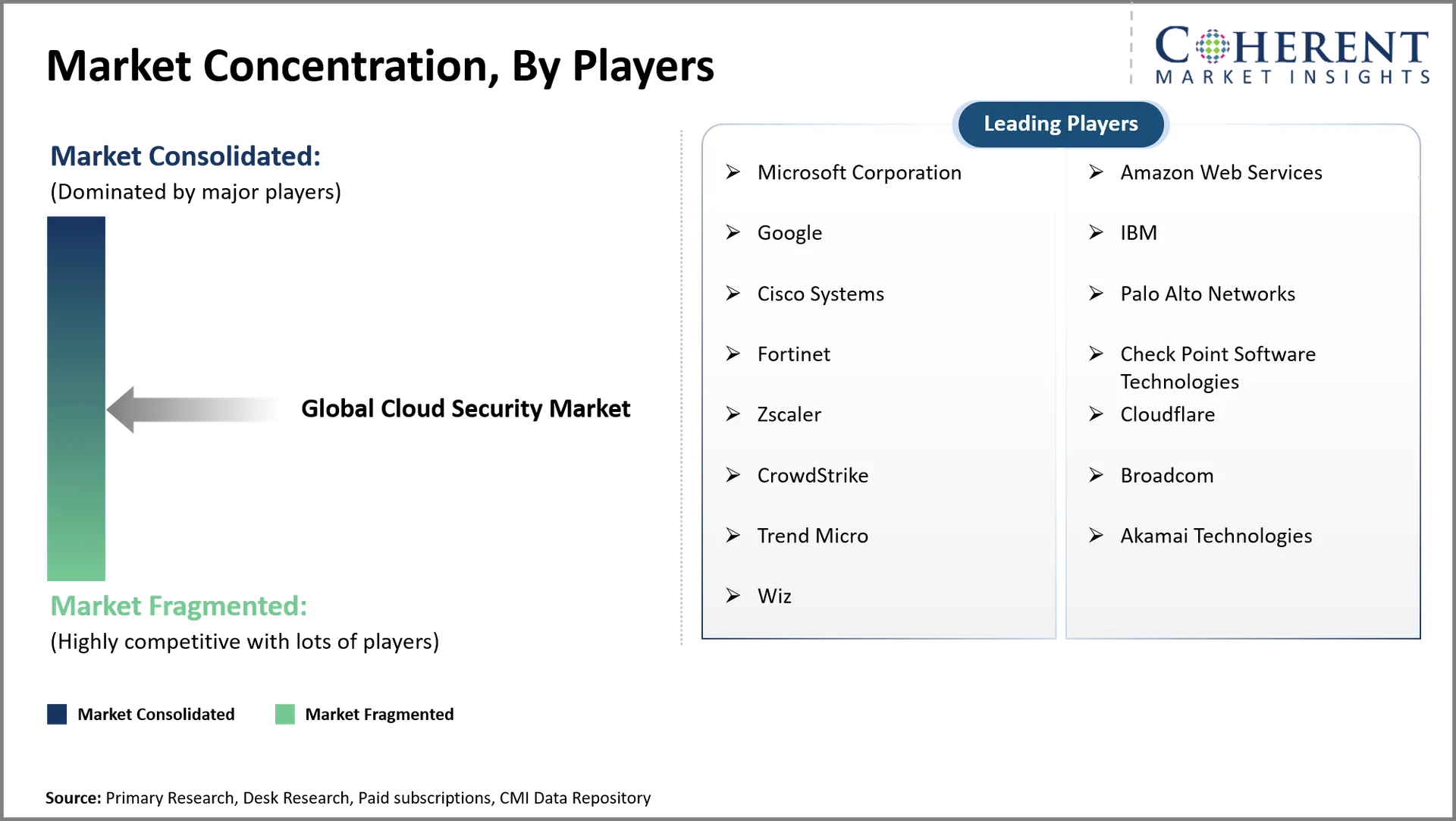
The global cloud security industry is fueled by the competition between hyperscale cloud providers and niche cybersecurity suppliers. Microsoft is focusing on Microsoft Defender for Cloud, which unifies cloud posture management, workload protection and security integrations across Microsoft Azure, Amazon Web Services and Google Cloud. AWS Security Hub aggregates security discoveries and promotes interfaces with third-party platforms, strengthening Amazon Web Services’ ecosystem. Palo Alto Networks is focused on Prisma Cloud, which protects applications, workloads and data from development to deployment. CrowdStrike focuses on detecting threats in real time and coordinating protection across cloud workloads, identities and security operations. Google Cloud combines threat intelligence, cloud-native security controls, and incident investigation capabilities. Competitive differentiation increasingly depends on cross-cloud visibility, automated remediation, artificial intelligence workload protection, and reduced security management complexity.
Top Market Players and Notable Products/Offerings in the Cloud Security Market
Manufacturer | Notable Product/Offerings | Key features |
Microsoft | Microsoft Defender for Cloud | Multi-cloud security posture management, workload protection, vulnerability assessment, regulatory compliance monitoring, and threat detection |
Palo Alto Networks | Cortex Cloud | Cloud-native application protection, runtime threat detection, cloud posture management, vulnerability prioritization, and code-to-cloud security |
CrowdStrike | Falcon Cloud Security | Cloud workload protection, agentless discovery, runtime threat detection, identity risk monitoring, and attack path analysis |
Google Cloud | Wiz Cloud Security Platform | Agentless cloud visibility, attack path analysis, vulnerability prioritization, cloud misconfiguration detection, and artificial intelligence security |
Check Point Software Technologies | CloudGuard | Cloud network security, threat prevention, cloud posture management, workload protection, and automated security policy enforcement |
Market Report Scope
Global Cloud Security Market Report Coverage | |||
Report Coverage | Details | ||
Base Year | 2025 | Market Size in 2026: | USD 43.80 Bn |
Historical Data For: | 2020 To 2024 | Forecast Period: | 2026 To 2033 |
Forecast Period 2026 To 2033 CAGR: | 12.00% | 2033 Value Projection: | USD 97.90 Bn |
Geographies covered: |
| ||
Segments covered: |
| ||
Companies covered: | Microsoft Corporation, Amazon Web Services, Google, IBM, Cisco Systems, Palo Alto Networks, Fortinet, Check Point Software Technologies, Zscaler, Cloudflare, CrowdStrike, Broadcom, Trend Micro, Akamai Technologies, Wiz | ||
Growth Drivers: |
| ||
Restraints & Challenges: |
| ||
Analyst Opinion (Expert Opinion)
- The future of the global cloud security market will depend on protecting dynamic workloads rather than relying primarily on perimeter security and periodic configuration checks. Artificial intelligence applications, containerized services, and automated software deployment create risks that require continuous monitoring throughout application lifecycles. Vendors should prioritize cloud-native application protection platforms that connect development security, workload runtime protection, identity governance, and data security. Solutions need to detect attack pathways that can be exploited and prioritize cleanup based on real exposure. For complex enterprise contexts, security platforms that can correlate code vulnerabilities, excessive permissions, and suspect runtime activity might offer more proactive protection.
- The biggest possibilities will be in multi-cloud security, AI workload protection, and cloud-native application security. Opportunities exist in the U.S., with federal contractors, financial institutions and healthcare organizations that require particular security measures. Germany offers opportunities to safeguard industrial cloud environments and sensitive manufacturing information. Japan is promising in government cloud assurance, as well as connected manufacturing security. Opportunities for the growth of digital enterprises include in personal data protection, digital payments and cloud security services in India. Instead of rolling out the same solutions globally, vendors need to customize solutions to suit local regulatory needs, cloud adoption patterns and industry-specific workloads.
- Market participants should gain an advantage by building security controls into developer workflows and automating remediation of high-risk vulnerabilities. They need to enable hybrid infrastructure, Microsoft Azure, Google Cloud and Amazon Web Services without forcing consumers to keep unconnected security tools. Vendors can distinguish their solutions through prioritizing clearly, pricing predictably, deploying with little overhead and alerting with meaningful information. Partnering with managed security service providers and cloud consulting businesses helps increase the reach to smaller organizations that don’t have dedicated security teams. Providers also must implement protections for artificial intelligence models, application programming interfaces, service identities and sensitive training data. These skills can improve client retention and fulfill the new security needs of enterprises.
Speak to the analyst
Want personalized insights?
Take the findings above to one of our principal consultants, or have the report rebuilt around the segments, geographies and competitors you actually track.
Market Segmentation
- Component Insights (Revenue, USD Billion, 2021 - 2033)
- Solutions
- Services
- Deployment Type Insights (Revenue, USD Billion, 2021 - 2033)
- Public Cloud
- Private Cloud
- Hybrid Cloud
- Organization Size Insights (Revenue, USD Billion, 2021 - 2033)
- Large Enterprises
- Small and Medium-Sized Enterprises
- Security Type Insights (Revenue, USD Billion, 2021 - 2033)
- Identity and Access Management
- Data Loss Prevention and Data Security
- Network Security
- Application Security
- Cloud Security Posture Management
- Cloud Workload Protection
- Cloud Access Security Broker
- Security Information and Event Management
- End User Insights (Revenue, USD Billion, 2021 - 2033)
- BFSI
- IT and Telecommunications
- Healthcare
- Retail and E-commerce
- Manufacturing
- Government and Public Sector
- Energy and Utilities
- Education
- Others
- Regional Insights (Revenue, USD Billion, 2021 - 2033)
- North America
- U.S.
- Canada
- Latin America
- Brazil
- Argentina
- Mexico
- Rest of Latin America
- Europe
- Germany
- U.K.
- Spain
- France
- Italy
- Russia
- Rest of Europe
- Asia Pacific
- China
- India
- Japan
- Australia
- South Korea
- ASEAN
- Rest of Asia Pacific
- Middle East
- GCC Countries
- Israel
- Rest of Middle East
- Africa
- South Africa
- North Africa
- Central Africa
- North America
Sources
Primary Research Interviews
- Cloud Security Architects & Engineers
- Chief Information Security Officers (CISOs)
- Cloud Service Providers & Vendors
- IT Security Consultants & Analysts
Magazines
- SC Magazine (Cybersecurity)
- Cloud Computing Magazine
- Information Security Magazine
- Dark Reading
Journals
- Journal of Cloud Computing (Springer)
- IEEE Transactions on Cloud Computing
- International Journal of Information Security
Associations
- Cloud Security Alliance (CSA)
- International Information System Security Certification Consortium (ISC²)
- Information Systems Security Association (ISSA)
- National Institute of Standards and Technology (NIST)
Public Domain Sources
- U.S. Cybersecurity and Infrastructure Security Agency (CISA) – Official Reports
- European Union Agency for Cybersecurity (ENISA) Publications
- National Institute of Standards and Technology (NIST) Cloud Computing Guidelines
- World Economic Forum (WEF) – Global Cybersecurity Reports
Proprietary Elements
- CMI Data Analytics Tool
- Proprietary CMI Existing Repository of Information for the Last 10 Years
Get access to 250+ pages report
Every segment, forecast, competitor profile and data table behind the analysis above — available for instant download.
- ESOMAR Member
- ISO 9001:2015 Certified
- D-U-N-S Registered
- GDPR & CCPA Compliant
Frequently Asked Questions
The global cloud security market is expected to stand at USD 43.80 Bn in 2026 and is expected to reach USD 97.90 Bn by 2033.
The CAGR of the global cloud security market is projected to be 12.0% from 2026 to 2033.
Increasing adoption of public, private, and hybrid cloud infrastructure and Rising frequency of ransomware attacks and cloud-based data breaches are the major factors driving the growth of the global cloud security market.
High deployment and subscription costs for comprehensive security platforms and Shortage of skilled cloud cybersecurity professionals are the major factors hampering the growth of the global cloud security market.
In terms of component, solutions segment is estimated to dominate the market revenue share in 2026.
Zero trust strengthens protection by continuously evaluating user identities, device conditions, permissions, and access requests before granting resource access.
A cloud-native application protection platform combines security capabilities to protect cloud applications throughout development, deployment, and runtime operations.