

Global Cold-Wash Detergent Additives Market Size and Forecast – 2026 To 2033
The global cold-wash detergent additives market is expected to grow from USD 580.0 Mn in 2026 to USD 990.0 Mn by 2033, registering a compound annual growth rate (CAGR) of 7.9% from 2026 to 2033. The global cold-wash detergent additives market is driven by increasing consumer preference for sustainable laundry products. On February 2, 2026, Nouryon announced the launch of FinnFix PB MAX, the cleaning industry’s first carboxymethylcellulose (CMC) with a 100% renewable carbon index score. This enables laundry detergent consumer brands to significantly reduce the carbon footprint of their products without compromising cleaning performance for consumers.
Key Takeaways of the Global Cold-Wash Detergent Additives Market
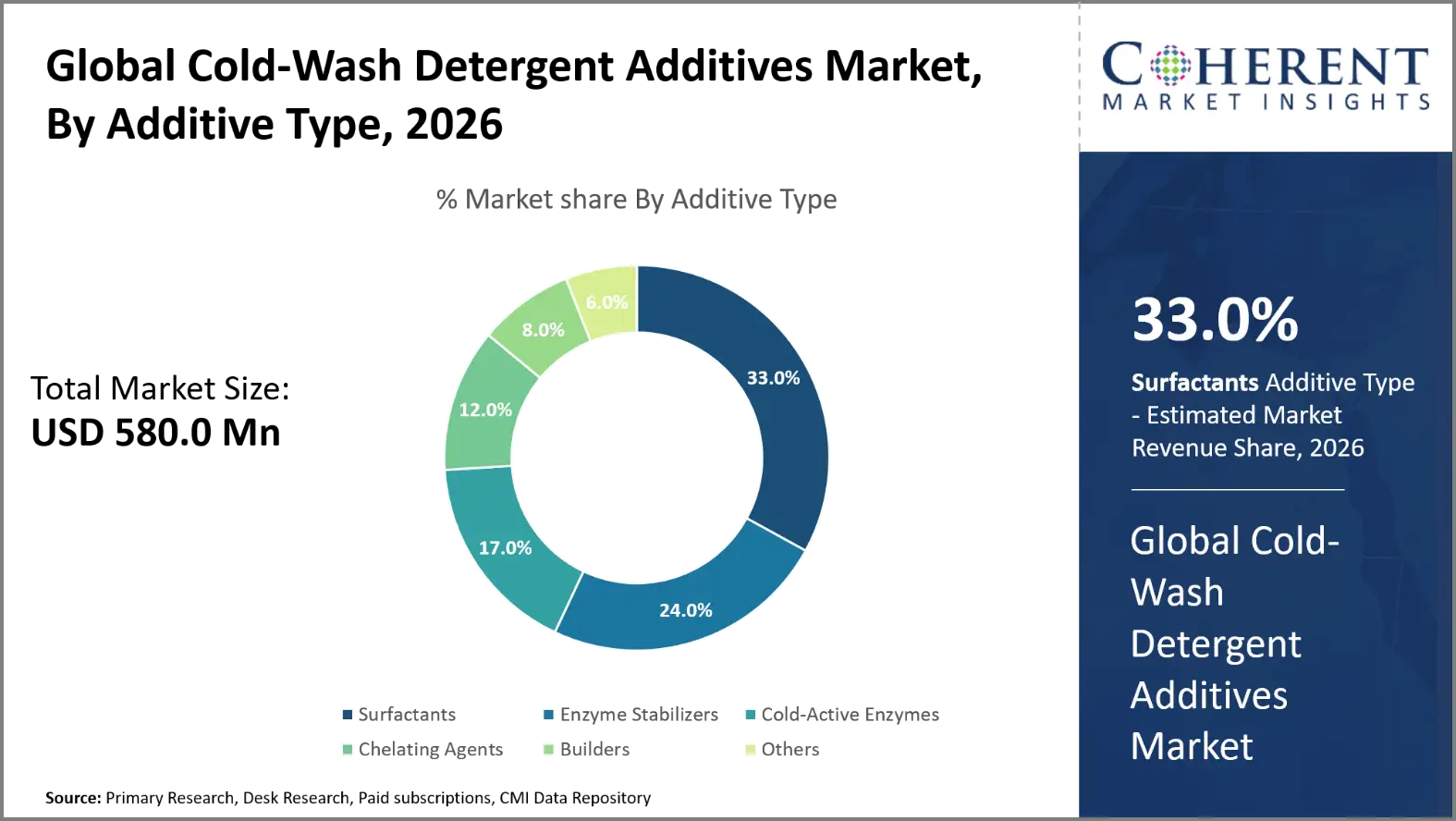
- The Surfactants segment is expected to account for 33.0% of the global cold-wash detergent additives market share in 2026. Rising demand for fabric protection and color retention is driving the growth of the segment. On February 10, 2025, Lion Corporation introduced Acron Yasashisa Premium, a detergent designed for delicate clothing. Its formula contains fabric-softening ingredients that protect against wrinkles, stretching, shrinking, fading, and pilling.
- The Protease segment is estimated to capture 38.0% of the market share in 2026. Expanding use of enzyme-based detergent formulations is majorly driving the growth of the segment. On January 7, 2025, Norwex launched PowerZyme, an ultra-concentrated laundry detergent featuring enzymes and plant-based surfactants. The formulation carries United States Department of Agriculture certification for 91% bio-based content.
- The Polyols and Sugars segment is estimated to capture 42.0% of the market share in 2026. Increasing adoption of concentrated liquid laundry detergents is majorly driving the growth of the segment. On February 3, 2026, Bionetix presented nature-inspired enzyme solutions for detergent manufacturers addressing fabric fading and pilling. Its portfolio includes five enzymes produced using non-pathogenic bacteria and fungi.
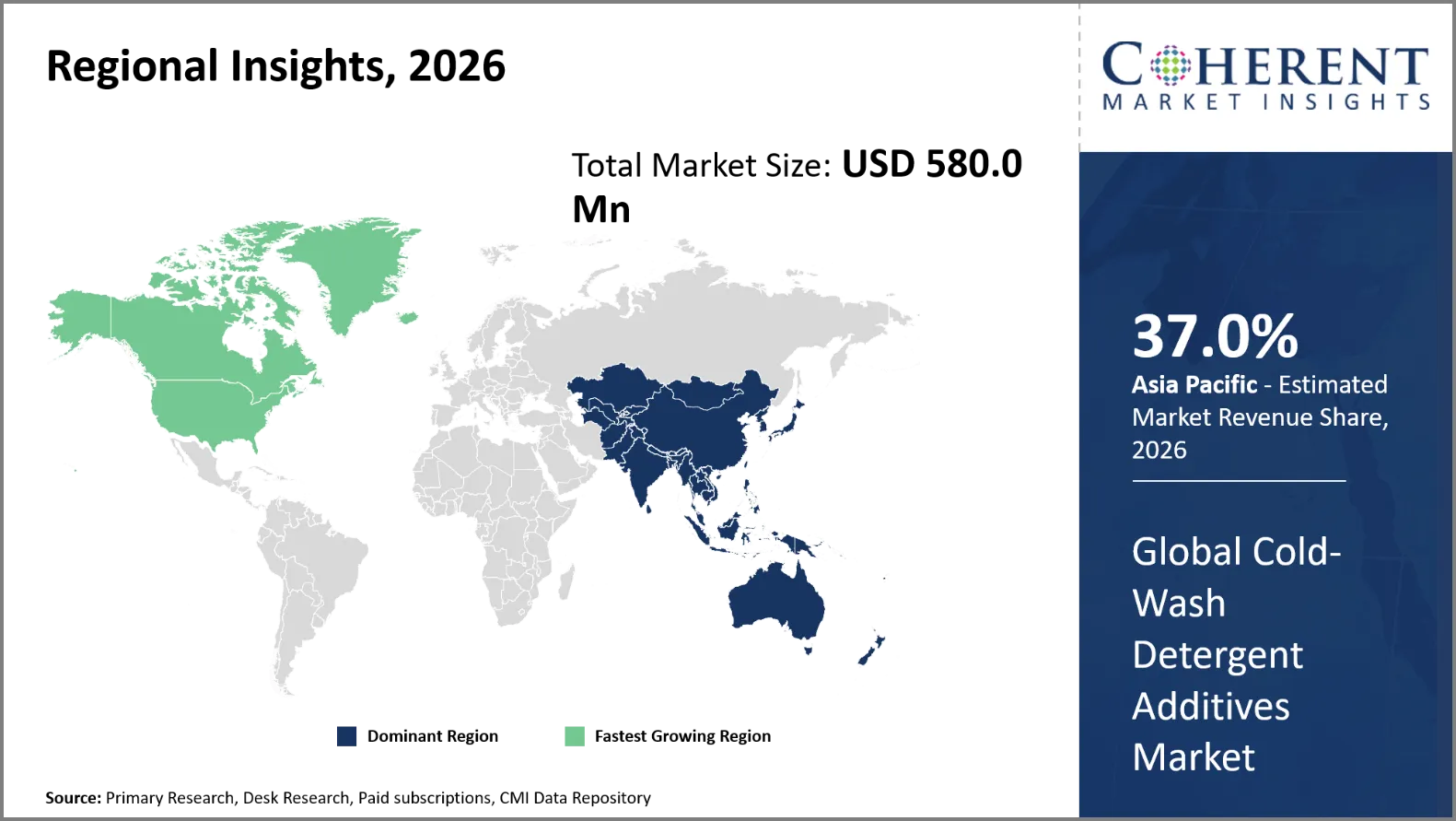
- Asia Pacific is expected to dominate the cold-wash detergent additives market in 2026 with a market share of 37.0%. Growing demand for detergents suitable for short washing cycles in Asia Pacific is driving the growth of the regional market. On September 3, 2025, Hindustan Unilever Limited expanded its Indian laundry portfolio with Surf Excel Matic Express. The detergent uses Pro-S Technology, combining fast-acting ingredients that activate immediately during washing.
- North America is expected to account for 26.0% share in 2026 and is projected to record the fastest growth over the forecast period. Development of multifunctional additives for low-temperature washing in North America is driving the growth of the regional market. On February 17, 2026, Procter & Gamble introduced Tide evo, a concentrated, waterless laundry tile designed to activate instantly in cold water.
Segmental Insights
Why Does Surfactants Dominate the Global Cold-Wash Detergent Additives Market?
The surfactants segment is expected to account for 33.0% of the global cold-wash detergent additives market share in 2026. Surfactants play a key role as they remove greasy stains and particle dirt at lower washing temperatures. They decrease the surface tension of water and enhance the penetration of detergent into cloth fibers. Special nonionic and anionic surfactants retain wash efficacy in cold-water washing. Their compatibility with enzymes and other detergent additives adds to the versatility of the composition. The increasing need for energy-efficient washing solutions is also boosting the demand for surfactants. Manufacturers are making more low temperature surfactant blends that clean better without heating.
On January 27, 2025, Pilot Chemical Company signed an exclusive agreement with Kao Corporation to develop Bio IOS bio-based internal olefin sulfonates. Pilot will produce the surfactants at its Middletown, Ohio, factory. Bio IOS is water soluble, surface active and can be used as main and secondary surfactant.
- Current Industry Events of 2026
- Market Size Estimation
- Regional Breakdown
- Competitive Landscape
- Customer Intelligence
- Segmental Analysis
- Pricing Analysis
- Key Market Drivers, Challenges & Future Trends
- Customized Insights Section
Why is Protease the Most Crucial Enzyme Type?
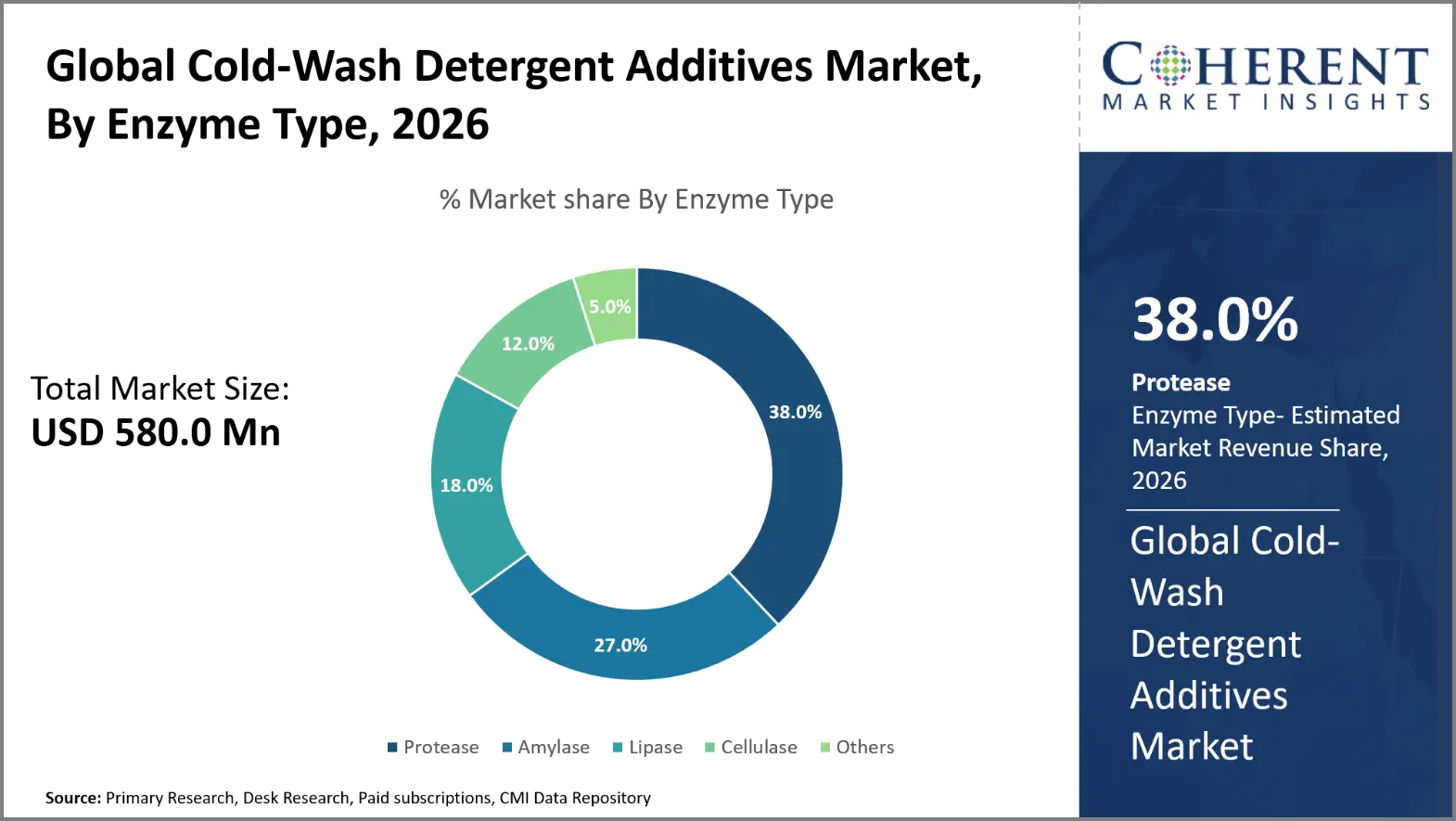
The protease segment is expected to account for 38.0% of the global cold-wash detergent additives market share in 2026. Protease is important as protein stains are still hard to get out when washing in cold water. These enzymes break down the residues of blood, perspiration, food and grass protein into smaller soluble bits. Cold-active protease formulations have catalytic activity at temperatures below standard washing conditions. They enhance cleaning and decrease the need for higher wash temperature. They are compatible with surfactants to improve the overall performance of the detergent. The increasing need for liquid detergents in concentrated form further favors the use of protease in formulations for cold washing.
On March 31, 2025, Novonesis launched Progress Beyond and Progress Go for makers of liquid laundry detergents. These designed proteases attack protein-based stains at varying washing temperatures and formulation conditions. The company specifically designed them for increasingly popular quick-wash and cold-water cycles.
Polyols and Sugars Dominates the Global Cold-Wash Detergent Additives Market
The polyols and sugars segment is expected to account for 42.0% of the global cold-wash detergent additives market share in 2026. Polyols and sugars dominate because they provide formulation stability and protect temperature-sensitive detergent ingredients. Glycerol, sorbitol and related polyols increase the stability of enzymes during storage and handling. They also help retain moisture and decrease the chance of substance deterioration. Some chemicals produced from sugar help stabilize proteins and preserve the functioning of enzymes. Compatibility with aqueous detergent formulations means wider commercial applicability Their importance is further increased by the growing need for concentrated and liquid cold-wash detergents.
On May 1, 2026, Brenntag Specialties launched a liquid automatic dishwashing pod formulation with 49.3% propylene glycol. The composition also comprises surfactants and a silicone antifoam, protease and amylase enzymes. This concentrated system mostly comprises propylene glycol as the liquid formulation component.
Current Events and their Impact
Current Events | Description and its Impact |
European Union - Regulation (EU) 2026/405 on Detergents and Surfactants |
|
European Union - REACH Regulation (EC) No 1907/2006 |
|
Cold-Wash Detergent Additives Market Dynamics
Market Drivers
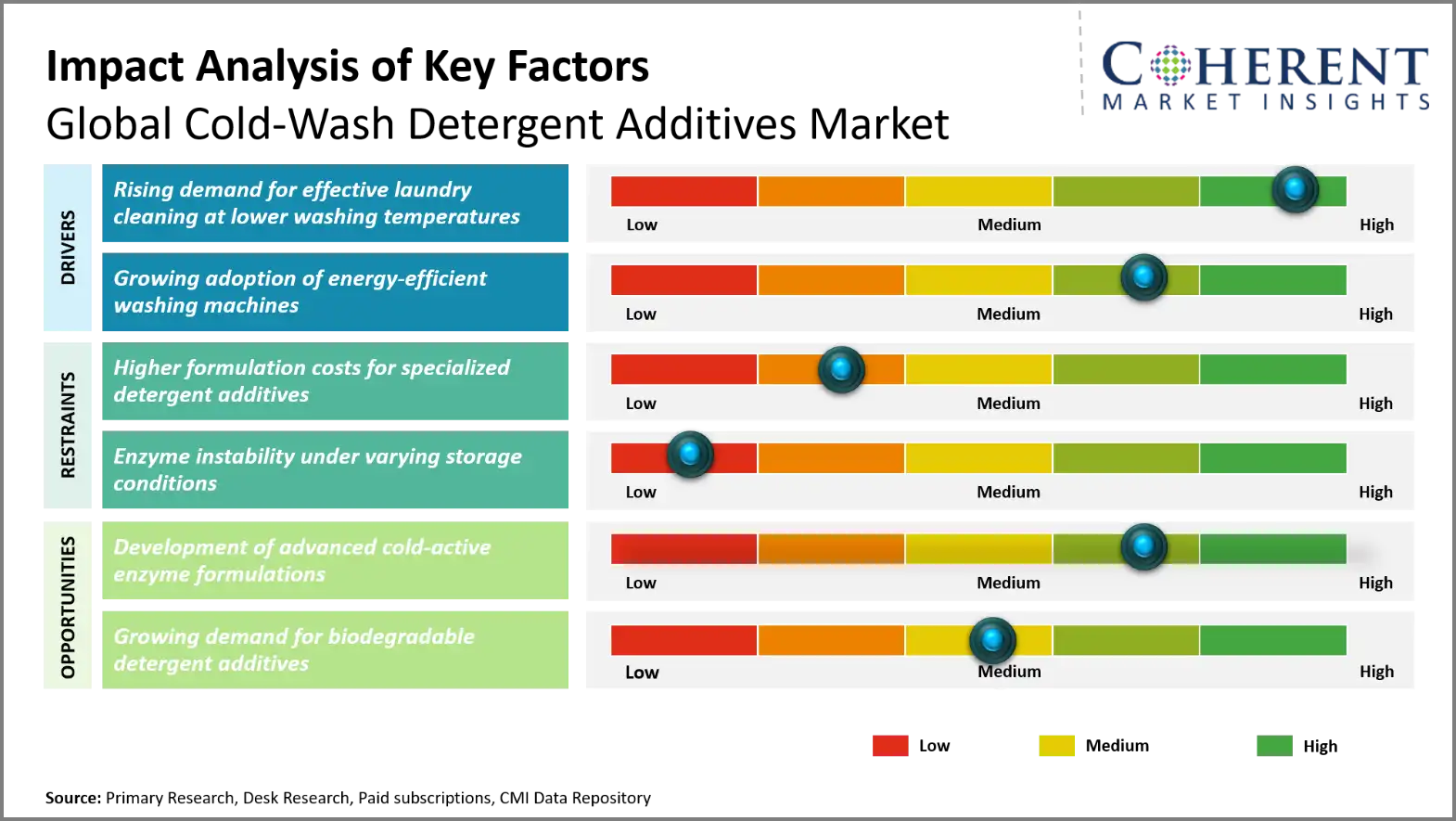
- Rising demand for effective laundry cleaning at lower washing temperatures: The rising demand for efficient laundry cleaning at lower temperatures is propelling the adoption of specialist detergent additives. Consumers are increasingly demanding formulas that can remove tough stains without the need for hot water. Surfactants promote soil removal by increasing wetting, emulsification, and detergent penetration. Cold-active enzymes decompose protein, carbohydrate and fat-based stains at lower temperatures. Chelating agents and builders are added to decrease water hardness and enhance cleaning performance. These additives enable producers to keep washing performance at the same level whilst reducing energy usage. The growing emphasis on fabric care and ecological laundry techniques also propels the demand for enhanced cold-wash additives.
- On July 14, 2025, Dr. Beckmann announced it is expanding its detergent portfolio with a high-performance liquid detergent especially optimized for short wash cycles. Dr. Beckmann Quick Wash helps modern homes with fast-paced lifestyles to wash linen perfectly in just 15 minutes.
- Growing adoption of energy-efficient washing machines: Growing adoption of energy-efficient washing machines is driving demand for detergents for low-temperature cleaning cycles. Washing machines are increasingly incorporating eco-wash programs that run at lower temperatures. These programs allow for additives that can maintain cleaning efficacy without the typical heating requirements. Cold-active enzymes help to remove stains during shorter, cooler wash cycles. Special surfactants improve detergency and performance across a range of water conditions. The manufacturers’ emphasis on lower energy use also motivates detergent firms to optimize formulations. This is the relationship that commercial demand for enzyme blends, surfactants and other cold wash performance additives is built on.
- On March 27, 2025, Miele announced a complete overhaul of their laundry equipment portfolio. Its new EnergyHero washing machine uses 40% less energy than the European Class A criteria. The company also launched better entry-level models with better energy efficiency.
Emerging Trends
- Development of Cold-Active Enzyme Technologies: Manufacturers are developing cold-active enzyme technologies, including cold-active proteases, lipases and amylases that retain cleaning performance at temperatures below traditional washing settings. The enzymes eat at protein, grease and starch stains.
- Impact: Increased enzyme activity at low temperatures cuts heating costs and enables shorter washing cycles. Formulators can boost stain removal without hurting fabric protection or detergent efficacy.
- Relevance to the market: Novonesis develops enzyme technologies for laundry detergents including low temperature cleaning applications. Its enzyme portfolio provides options for specific cold wash additive compositions.
- Development of Concentrated and Biodegradable Surfactant Formulations: There is a growing interest on the part of detergent makers in concentrated surfactant blends and readily biodegradable chemicals. These formulations are designed to preserve detergency while lowering the chemical loading and persistence in the environment.
- Impact: Advanced surfactants improve soil removal, grease emulsification and formulation efficiency. Concentrated chemicals also allow detergent manufacturers to cut container needs and shipping difficulties.
- Relevance to the market: BASF portfolio has biodegradable surfactant technology such as its Plantapon and Dehypon product lines. These compounds offer formulation potential for producers making environmentally conscious laundry detergents.
Regional Insights
Why is Asia Pacific a Strong Market for Cold-Wash Detergent Additives?
Asia Pacific is expected to account for a market share of 37.0% in 2026. A number of rising economies in the Asia Pacific region have adopted cold water laundry methods. Households in Southeast Asia typically wash clothing using ambient temperature water. This generates a need for surfactants that keep detergency without heating. Novonesis has created enzyme technologies that can withstand cold in an effort to meet these cleaning requirements. Key cold-water laundry markets identified by industry reports are China, India, Southeast Asia and Japan. Amylases, proteases and lipases provide opportunities to remove starch, protein and grease stains. Formulators also have to accommodate variations in washing machine and water conditions. These requirements support specialized enzyme blends and temperature-compatible surfactant systems.
Why Does North America Cold-Wash Detergent Additives Market Exhibit High Growth?
North America is expected to register the fastest growth with a CAGR of 8.3% over the forecast period. It is projected to account for 26.0% of the global cold-wash detergent additives market in 2026. The region benefits from established cold-water detergent brands and growing corporate sustainability commitments. Procter & Gamble has reformulated Tide products to improve cleaning performance during cold-water cycles. The American Cleaning Institute reports that approximately 90% of washing machine energy heats water. Research cited by the American Chemical Society identifies approximately 30 billion annual laundry loads across the U.S. and Canada. This opens up great formulation potential for cold-active enzymes and surfactants. Brenntag has launched its Perforzyme enzyme portfolio for residential and institutional cleaning applications in North America. Its range includes proteases, amylases, lipases, and cellulases.
Global Cold-Wash Detergent Additives Market Outlook for Key Countries
Why is China Emerging as a Major Hub in the Cold-Wash Detergent Additives Market?
China offers opportunities through the transition toward premium automatic washing machines and advanced laundry formulations. Domestic appliance manufacturers are promoting drum washing machines with specialized washing programs. Consumers were used to impeller machines and washing at ambient temperature. Changing attitudes are increasingly in favor of modern washing technologies and specific detergents. American Chemical Society research highlights a key factor in a behavioral shift, driven by Chinese marketing campaigns pushing drum washing machines. This shift opens up potential for low temperature enzymes and suitable surfactant systems. Manufacturers can manufacture additives for varied machine designs, detergent concentrations and wash times.
Is U.S. the Next Growth Engine for the Cold-Wash Detergent Additives Market?
Consumer awareness efforts and product advancements that address cold-water washing performance are helping to support the U.S. market. Cotton Incorporated’s 2022 customer survey found 44% of washing loads were in cold water. But the American Cleaning Institute predicted that 41% of consumers surveyed used hot water predominantly to wash clothing in 2025. It indicates that there are still chances for improving the performance of cold-wash cleaning. 2024: Procter & Gamble introduced enhanced Tide pod compositions. In 2026, Tide evo was launched, a concentrated laundry tile that activated instantaneously in cold water.
Germany Cold-Wash Detergent Additives Market Analysis and Trends
Germany offers opportunities through established environmental washing practices and strong demand for resource-efficient laundry formulations. The German Environment Agency recommends 20–30°C washing for lightly and normally soiled colored clothing. Its guidance identifies approximately 35–40% energy savings when washing at 40°C instead of 60°C. The agency also recognizes modern detergents' ability to deliver effective cleaning at reduced temperatures. These recommendations encourage manufacturers to develop low-temperature surfactants and enzyme combinations. Suppliers can target proteases, lipases, and stabilizing additives that maintain cleaning performance during shorter washing cycles.
Japan Cold-Wash Detergent Additives Market Analysis and Trends
Japan represents a specialized market because household laundry commonly operates at comparatively low water temperatures. Industry reporting identifies approximately 15°C as an average Japanese washing temperature. Novozymes introduced its cold-tolerant Amplify Prime amylase technology in 2016. The enzyme met the starch-removal standards in Japan’s cooler washing conditions. Its commercial success since then illustrates the demand for temperature-adapted enzyme additives. The Amplify Prime now covers a wider range of washing applications because it performs well at a variety of temperatures. Japanese detergent makers stand to gain from sophisticated amylases, proteases and liquid enzyme stabilizers.
India Cold-Wash Detergent Additives Market Analysis and Trends
India provides huge prospects with increased penetration of washing machines and consumption of premium liquid detergents. In 2018, 16% had a washing machine, and Unilever projects this to almost reach 29% in 2025. The business forecasts penetration to be above 37% by 2030. Its 2026 Surf Excel Matic Liquid development includes an artificial intelligence-designed enzyme created in partnership with Arzeda. This enzyme offers cleaning, fabric care and aroma benefits. Unilever also stated that more than 90% of Indian detergent users desired effective cleaning with longer-lasting fragrance. Unilever also reported that over 90% of Indian detergent users wanted powerful cleaning with longer-lasting fragrance. These developments support demand for multifunctional enzymes and liquid-compatible stabilizers.
Global Cold-Wash Detergent Additives Market - Cold-Wash Additives for Household Liquid Detergents
Additive Category | Representative Ingredient | Primary Function | Cold-Wash Contribution | Key Formulation Requirement | Commercial Example |
Anionic surfactants | Sodium laureth sulfate | Detergency foaming and soil removal | Removes particulate and oily soils | Maintain solubility and performance in cold water | Purex Coldwater |
Anionic surfactants | Sodium alkylbenzene sulfonate | Grease removal and detergency | Supports removal of oily and particulate stains | Compatibility with nonionic surfactants and enzymes | Tide PRO Coldwater |
Nonionic surfactants | Alcohol ethoxylates and Pareth compounds | Wetting and oily-soil removal | Improves fabric wetting and grease removal | Maintain low-temperature solubility | Purex Coldwater and Tide PRO Coldwater |
Protease enzymes | Liquid protease | Protein-stain degradation | Targets blood sweat milk and food stains | Storage stability and surfactant compatibility | IFF PREFERENZ P 400 |
Amylase enzymes | Liquid amylase | Starch-stain removal | Breaks down food-based starch residues | Resistance to protease degradation | IFF PREFERENZ S 210 |
How is Development of Advanced Cold-Active Enzyme Formulations Creating New Growth Opportunities in the Cold-Wash Detergent Additives Market?
The development of sophisticated cold-active enzyme formulations is offering chances for expansion by enabling effective stain removal at temperatures as low as 15-20°C. Novonesis introduced Progress Beyond protease for cold washing and compatibility with multi-enzyme detergents with powerful chelators. Its Amplify Prime amylase combats starch stains and enables quicker wash cycles. BASF’s Lavergy M Ace mannanase boosts cleaning efficiency on gum-based stains at 15°C. International Flavors & Fragrances produces PREFERENZ stable liquid enzymes that can function below 20°C without additional chemical stabilizers. These methods allow detergent makers to formulate concentrated formulas, minimize surfactant requirements and increase cleaning performance.
On July 10, 2025, BASF added Lavergy L Pace lipase, Lavergy C Care cellulase and Lavergy A Star amylase to its portfolio of liquid enzymes. Lavergy L Pace is good on fat and oil stains at low temperatures. Lavergy A Star eliminates starch stains in lower wash temperatures.
Market Players, Key Development, and Competitive Intelligence
Key Developments
- On October 12, 2026, Solvay announced the launch of Solsys Care Max, a new laundry performance solution to help detergent formulators address one of the biggest shifts in home care: more and more consumers want to wash clothes faster, at lower temperatures and with lower energy consumption, while maintaining excellent cleaning results.
- On April 10, 2026, Unilever and Samsung collaborated to introduce the first-ever laundry detergent and conditioner for auto dosage washing machines. Samsung recommends Persil Smart Series Advanced Clean Non-Bio and Comfort Smart Series Azure Bliss which may be used in any auto reservoir dose washing machines.
- On April 30, 2025, HeiQ Chrisal launched a new laundry liquid based on future generation biosurfactants for deep, long-lasting cleaning performance and little environmental footprint. Combining HeiQ’s proven synbiotics, a powerful combination of beneficial probiotics and prebiotics, with fermentation-derived biosurfactants, the new laundry liquid penetrates textile fibers to lift dirt, oils, and stains, while breaking down odor molecules for long-lasting freshness.
Competitive Landscape
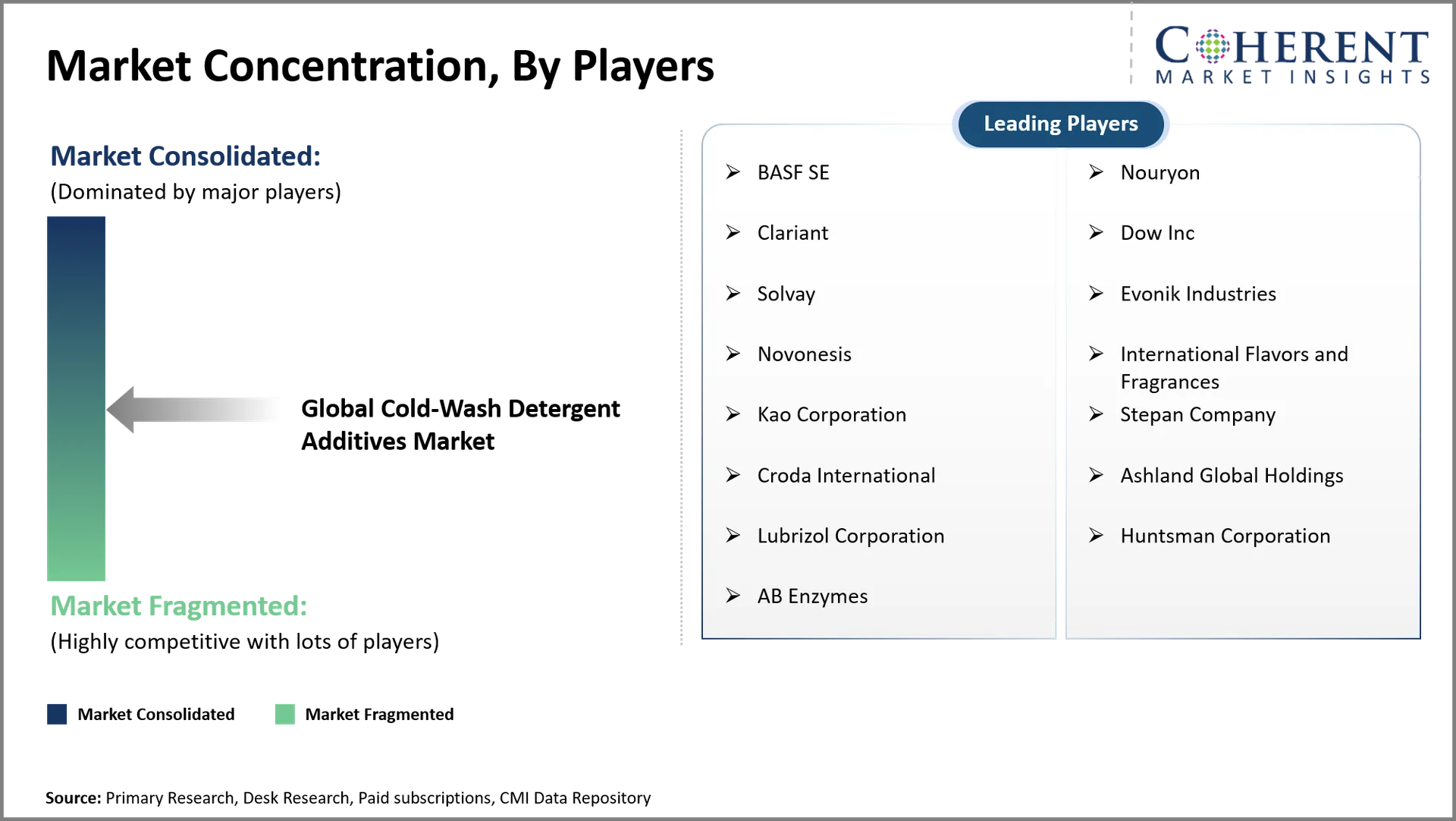
The global cold-wash detergent additives market features competition among enzyme specialists and integrated chemical manufacturers. Novonesis is strengthened by improved protein engineering and cold-active protease. Its Progress Beyond and Progress Go products are designed to target protein stains and are compatible with multi-enzyme formulas. BASF is expanding liquid enzyme technologies with its Lavergy range. Lavergy L Pace lipase works on grease stains while Lavergy A Star deals with starch residues. International Flavors & Fragrances has a PREFERENZ liquid enzyme range that stands out for its stability, compatibility and cold-wash performance below 20°C. Procter & Gamble is focused on consumer-facing formulation innovation such as Tide Coldwater and Tide evo. Its strategies include rapid cold-water activation, concentrated cleaning technologies, and washing-machine partnerships. Competitive differentiation increasingly depends on enzyme stability, surfactant compatibility, formulation efficiency, and measurable performance under low-temperature conditions.
Top Manufacturers and Notable Products in the Cold-Wash Detergent Additives Market
Manufacturer | Notable Product | Key features |
Procter & Gamble | Tide PRO Coldwater | Cold-temperature enzymes anionic and nonionic surfactants water softeners and soil-control polymers |
BASF | Lavergy L Pace Lavergy C Care Lavergy A Star | Lipase for grease removal cellulase for fabric care and amylase for starch stains |
Novonesis | Progress Beyond Progress Go Lipex Evity 200 L | Advanced proteases and cold-active lipases with formulation stability |
International Flavors & Fragrances | PREFERENZ P 400 PREFERENZ S 210 PREFERENZ M 200 | Protease amylase and mannanase with detergent stability |
Barentz | BioNat 102L BioNat 104L BioNat 400L | Bio-based enzymes nonionic surfactants and pre-stabilized enzyme blends |
Market Report Scope
Global Cold-Wash Detergent Additives Market Report Coverage | |||
Report Coverage | Details | ||
Base Year | 2025 | Market Size in 2026: | USD 580.0 Mn |
Historical Data For: | 2020 To 2024 | Forecast Period: | 2026 To 2033 |
Forecast Period 2026 To 2033 CAGR: | 7.90% | 2033 Value Projection: | USD 990.0 Mn |
Geographies covered: |
| ||
Segments covered: |
| ||
Companies covered: | BASF SE, Nouryon, Clariant, Dow Inc, Solvay, Evonik Industries, Novonesis, International Flavors and Fragrances, Kao Corporation, Stepan Company, Croda International, Ashland Global Holdings, Lubrizol Corporation, Huntsman Corporation, AB Enzymes | ||
Growth Drivers: |
| ||
Restraints & Challenges: |
| ||
Analyst Opinion (Expert Opinion)
- The future of this industry will increasingly depend on enzyme engineering rather than conventional detergent ingredient optimization. Manufacturers will prioritize additives that deliver reliable cleaning at 15-20°C. Proteases, lipases, amylases, and mannanases will become important formulation components. Liquid enzyme stability will remain a critical development priority. Suppliers capable of combining multiple enzyme functions will gain stronger commercial opportunities. Surfactant manufacturers will also need to improve grease removal without compromising enzyme activity. The strongest opportunities will emerge from integrated ingredient technologies rather than isolated additive improvements.
- The maximum opportunities will concentrate around cold-active proteases, liquid enzyme blends, and biodegradable nonionic surfactants. Liquid laundry detergents represent an attractive application because enzyme stability directly influences product shelf life. China and India provide potential for low-cost enzyme blends and concentrated detergent compositions. Premium cold-water cleaning technologies find appealing potential in the U.S. Germany and Japan have specialized prospects for sophisticated enzyme systems for short wash cycles. Suppliers should focus on removing protein stains, breaking down grease and eliminating starch. Combinations of multifunctional enzymes can cover numerous stain categories in individual detergent compositions.
- Market players should concentrate on application-specific research and not sell uniform enzyme ingredients to all detergent categories. Enzyme suppliers should design formulations that are compatible with powerful chelators, high concentrations of surfactants and changing water hardness. Surfactant producers should test the cleaning effectiveness with protease and lipase. Companies should work in conjunction with detergent brands and washing-machine manufacturers. Technical laboratories in the regions can speed testing at various temperatures and washing times. Suppliers should also give proven shelf-life performance and unambiguous information on ingredient compatibility. These features have the potential to improve client retention and provide distinction beyond ingredient pricing.
Speak to the analyst
Want personalized insights?
Take the findings above to one of our principal consultants, or have the report rebuilt around the segments, geographies and competitors you actually track.
Market Segmentation
- Additive Type Insights (Revenue, USD Million, 2021 - 2033)
- Surfactants
- Enzyme Stabilizers
- Cold-Active Enzymes
- Chelating Agents
- Builders
- Others
- Enzyme Type Insights (Revenue, USD Million, 2021- 2033)
- Protease
- Amylase
- Lipase
- Cellulase
- Others
- Stabilizer Type Insights (Revenue, USD Million, 2021 - 2033)
- Polyols and Sugars
- Chelants and Sequestrants
- Polymer and Protein Stabilizers
- Salt Systems and Buffering Agents
- Application Insights (Revenue, USD Million, 2021 - 2033)
- Household Laundry
- Commercial Laundry
- Industrial Laundry
- Institutional Laundry
- Healthcare Laundry
- Hospitality Laundry
- Regional Insights (Revenue, USD Million, 2021 - 2033)
- North America
- U.S.
- Canada
- Latin America
- Brazil
- Argentina
- Mexico
- Rest of Latin America
- Europe
- Germany
- U.K.
- Spain
- France
- Italy
- Russia
- Rest of Europe
- Asia Pacific
- China
- India
- Japan
- Australia
- South Korea
- ASEAN
- Rest of Asia Pacific
- Middle East
- GCC Countries
- Israel
- Rest of Middle East
- Africa
- South Africa
- North Africa
- Central Africa
- North America
- Key Players Insights
- BASF SE
- Nouryon
- Clariant
- Dow Inc
- Solvay
- Evonik Industries
- Novonesis
- International Flavors and Fragrances
- Kao Corporation
- Stepan Company
- Croda International
- Ashland Global Holdings
- Lubrizol Corporation
- Huntsman Corporation
- AB Enzymes
Sources
Primary Research Interviews
- Detergent Additive Manufacturers
- Surfactant & Enzyme Suppliers
- Textile & Laundry Industry Professionals
- Retail & Consumer Goods Distributors
Magazines
- Household & Personal Care Today
- Soap, Perfumery & Cosmetics (SPC) Magazine
- HAPPI (Household and Personal Products Industry) Magazine
- Chemical Week Magazine
Journals
- Journal of Surfactants and Detergents
- Journal of Cleaner Production
- Tenside Surfactants Detergents Journal
Associations
- American Cleaning Institute (ACI)
- European Cleaning Products Association (ECPA)
- International Association for Soaps, Detergents and Maintenance Products (AISE)
- Society of Chemical Manufacturers and Affiliates (SOCMA)
Public Domain Sources
- U.S. Environmental Protection Agency (EPA)
- European Chemicals Agency (ECHA)
- United Nations Environment Program (UNEP)
- U.S. Census Bureau
Proprietary Elements
- CMI Data Analytics Tool
- Proprietary CMI Existing Repository of information for last 10 years
Get access to 250+ pages report
Every segment, forecast, competitor profile and data table behind the analysis above — available for instant download.
- ESOMAR Member
- ISO 9001:2015 Certified
- D-U-N-S Registered
- GDPR & CCPA Compliant
Frequently Asked Questions
The global cold-wash detergent additives market is expected to stand at USD 580.0 Mn in 2026 and is expected to reach USD 990.0 Mn by 2033.
The CAGR of the global cold-wash detergent additives market is projected to be 7.9% from 2026 to 2033.
Rising demand for effective laundry cleaning at lower washing temperatures and Growing adoption of energy-efficient washing machines are the major factors driving the growth of the global cold-wash detergent additives market.
Higher formulation costs for specialized detergent additives and Enzyme instability under varying storage conditions are the major factors hampering the growth of the global cold-wash detergent additives market.
In terms of additive type, surfactants segment is estimated to dominate the market revenue share in 2026.
Cold-wash detergent additives are specialized ingredients that improve stain removal and cleaning performance at reduced washing temperatures.
Cold-active enzymes maintain catalytic activity at reduced temperatures and improve stain removal without intensive water heating.