

Global Commercial Auto Insurance Market Size and Forecast – 2026 To 2033
The global commercial auto insurance market is expected to grow from USD 270 Bn in 2026 to USD 532 Bn by 2033, registering a compound annual growth rate (CAGR) of 9.2% from 2026 to 2033. The global commercial auto insurance market is driven by increasing road accident risks. On January 8, 2026, Motive reported that collision risk remained concentrated during specific operating conditions, with collision risk peaking around 3 A.M. at nearly three times midday levels. The company identified seven near-collisions for every recorded collision, strengthening demand for predictive fleet safety and commercial insurance risk monitoring.
Key Takeaways of the Global Commercial Auto Insurance Market
- The Third Party Liability Coverage segment is expected to account for 39.0 % of the global commercial auto insurance market share in 2026. Expansion of last mile delivery fleets is driving the growth of the segment. On July 24, 2025, DHL announced the addition of 2,400 Ford Pro electric vans to its Post & Parcel Germany operations. The deployment increased its German electric vehicle fleet to approximately 35,000 vehicles.
- The Light Commercial Vehicles segment is estimated to capture 43.0 % of the market share in 2026. Increasing adoption of fleet telematics is majorly driving the growth of the segment. On August 24, 2026, Ford introduced Ford Pro AI within its commercial telematics platform. The system analyzes vehicle speed, seat-belt activity, engine health, and other fleet data.
- The Logistics and Transportation segment is estimated to capture 32.0 % of the market share in 2026. Growth of small logistics business vehicle ownership is driving the growth of the segment. In February 2025, Rivian opened its commercial electric delivery van sales to fleets of all sizes. The move ended its earlier Amazon exclusivity and specifically expanded access for smaller U.S. fleet operators.
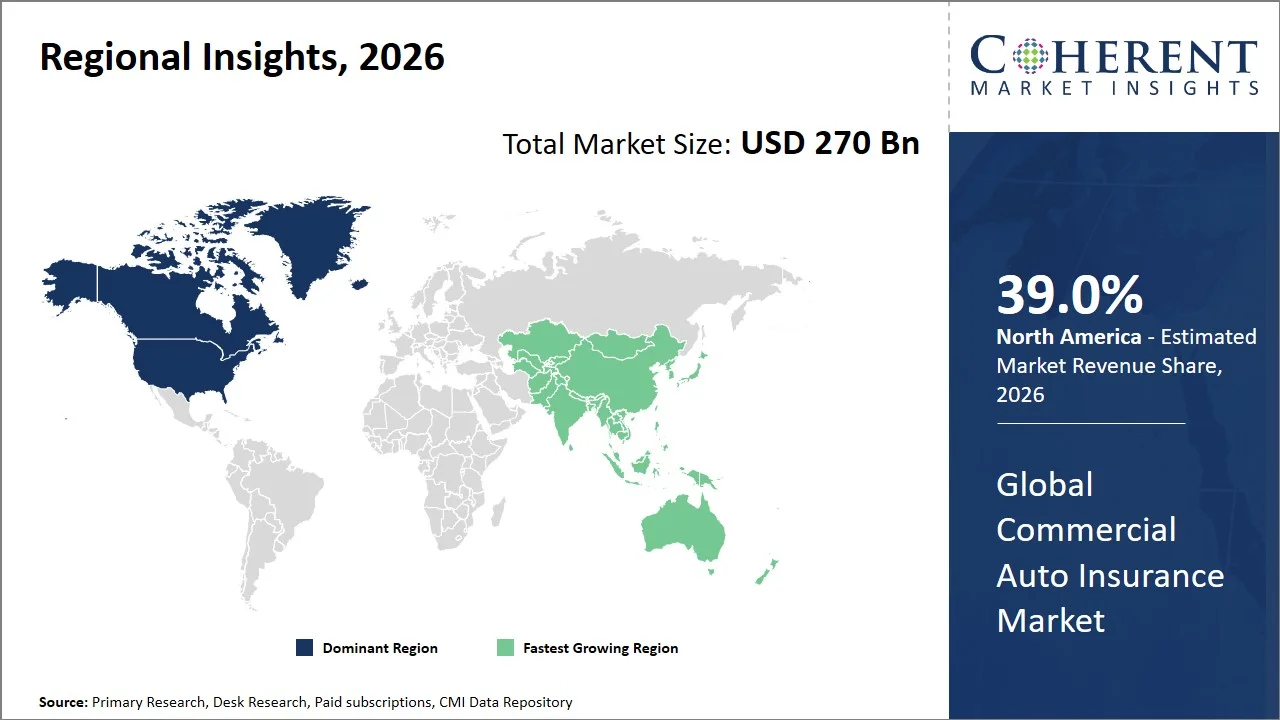
- North America is expected to dominate the commercial auto insurance market in 2026 with a market share of 39.0 %. Increasing need of electric commercial vehicle insurance in North America is driving the growth of the regional market. On November 25, 2025, FedEx ordered 53 Harbinger electric trucks and participated in the company's USD 160 million Series C financing.
- Asia Pacific is expected to account for 26.0 share in 2026. Increasing usage-based insurance products in Asia Pacific is driving the growth of the regional market. On April 16, 2026, Sompo Holdings joined Zego’s USD 28 million funding round and signed a strategic collaboration. The companies are developing telematics-based motor insurance products for Japan.
Segmental Insights
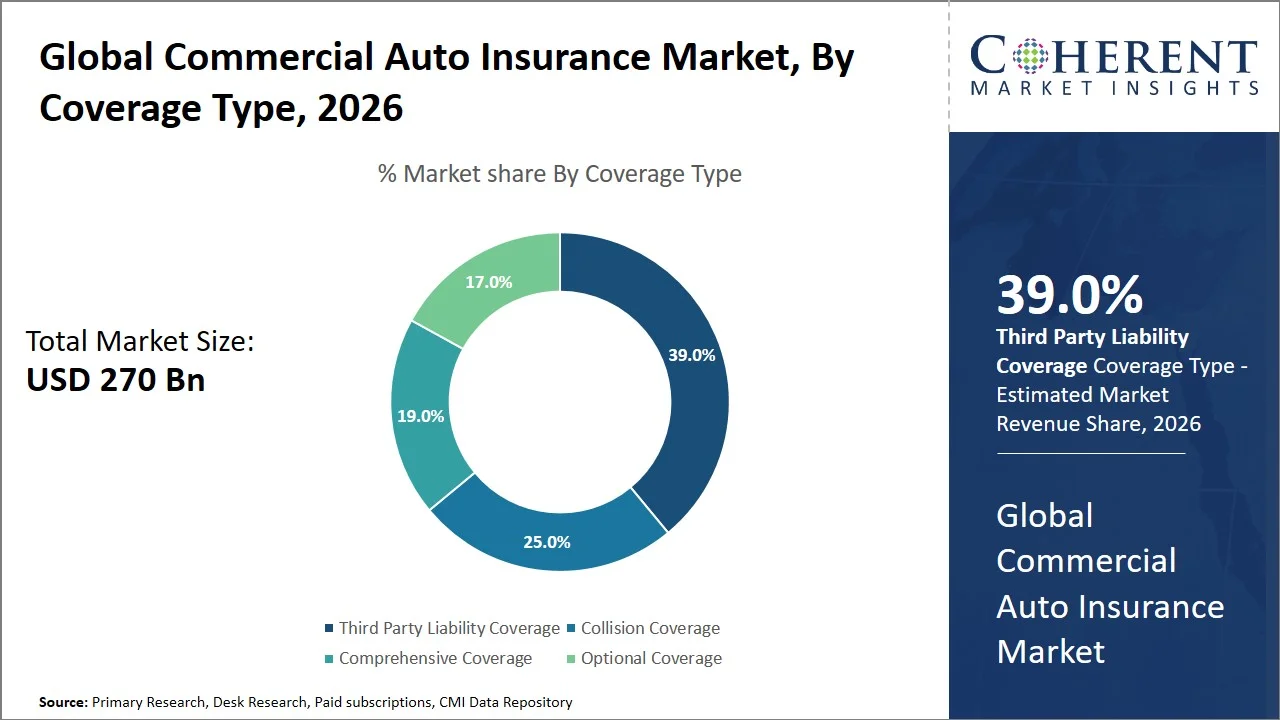
Why Does Third Party Liability Coverage Dominate the Global Commercial Auto Insurance Market?
The third party liability Coverage segment is expected to account for 39.0% of the global commercial auto insurance market share in 2026. In a number of nations, the obligation to have insurance for business vehicles is helping to improve third party liability coverage. Commercial fleet operators need to defend against claims of personal injury and property damage. The coverage therefore remains essential for logistics, transportation, construction, and delivery businesses. This protection is hard for business to evade or to substitute with regulatory compliance. This broad regulatory need drives ongoing demand throughout the wide range of commercial vehicle fleets. For example, HDFC ERGO offers separate third-party liability plans for business vehicles. The package covers legal liability for injury, death and damage to third party property. It is still sold commercially, an indicator of the extent to which insurers retain specialist products under India’s compulsory liability regime.
- Current Industry Events of 2026
- Market Size Estimation
- Regional Breakdown
- Competitive Landscape
- Customer Intelligence
- Segmental Analysis
- Pricing Analysis
- Key Market Drivers, Challenges & Future Trends
- Customized Insights Section
Why is Light Commercial Vehicles the Most Crucial Vehicle Type?
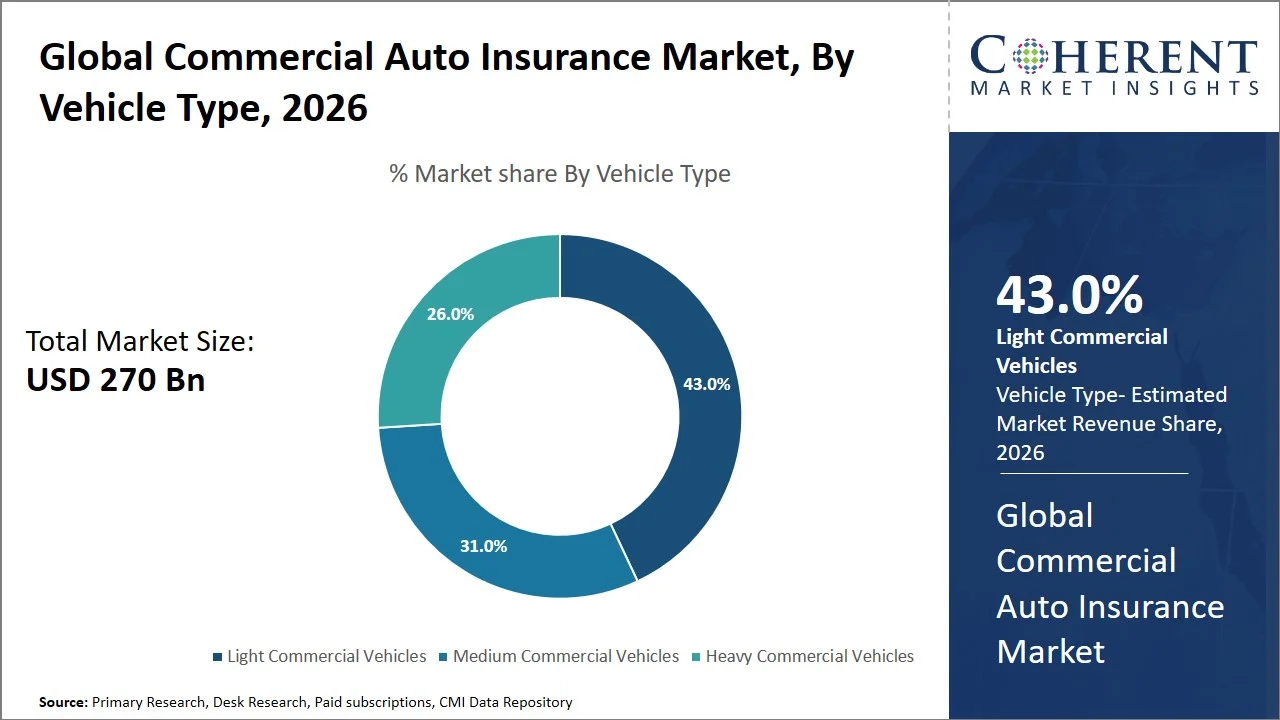
The light commercial vehicles segment is expected to account for 43.0% of the global commercial auto insurance market share in 2026. Light commercial vehicles are extensively utilized for last-mile delivery, service activities, and the movement of goods for small businesses. Their high utilization raises their susceptibility to accidents, theft and third-party liability claims. The increase in e-commerce has also led to more light commercial vehicle fleets among delivery operators. These trucks are becoming more and more important for small enterprises to move items flexibly and more often. This broad range of operations provides a steady demand for commercial auto insurance coverage. On March 14, 2025, Stellantis and IVECO announced on March 14, 2025 the signing of an agreement to deliver two all-electric light commercial vehicles to IVECO for the European market. They will be based on the Stellantis Pro One mid-size and large van all-electric platforms, ranging from 2.8 to 4.25 gross vehicle weight.
Logistics and Transportation Dominates the Global Commercial Auto Insurance Market
The logistics and transportation segment is expected to account for 32.0% of the global commercial auto insurance market share in 2026. Logistics and transportation companies have big fleets of vehicles that run often and for great distances. High vehicle utilization raises exposure to collision, cargo losses and third party liability concerns. E-commerce growth has increased delivery volumes and deployment of commercial fleet. Fleet operators need comprehensive coverage to protect cars, drivers, cargo and their business. Recurring insurance needs from transport companies are still being driven by the growth of logistics operations. As of May 2026, FedEx had about 82,000 motorized vehicles in service worldwide. Independent service providers added an estimated 100,000 motorized trucks to support linehaul and pickup-and-delivery activities. This extensive fleet exposure increases requirements for vehicle liability, collision, cargo, and third-party protection.
Current Events and their Impact
Current Events | Description and its Impact |
U.S Federal Motor Carrier Safety Administration Insurance Filing Requirements, 2026 |
|
U.S Broker and Freight Forwarder Financial Responsibility Rule, 2026 |
|
Commercial Auto Insurance Market Dynamics
Market Drivers
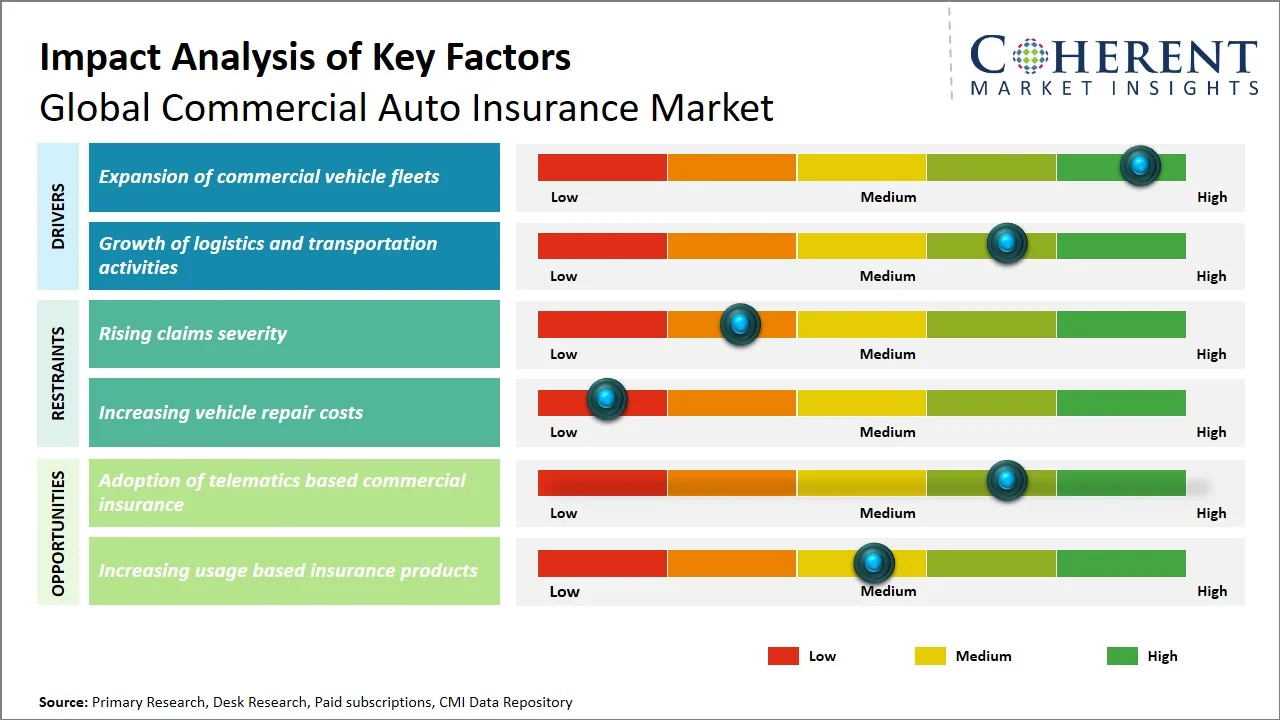
- Expansion of commercial vehicle fleets: The growth of commercial vehicle fleets is increasing the number of insured vehicles internationally. Businesses are acquiring vans, trucks and specialty vehicles to meet expanding operational needs. More fleet means more vulnerability to collisions, property damage, theft and third-party liability. Every new commercial vehicle put into service generates increased demand for mandated and broad insurance coverage. Fleet operators are also seeking broader regulations to address increasing operational and financial risks. On June 4, 2026, Amazon stated it planned to expand its electric delivery van fleet to 100,000 cars globally by 2030. The company also wants to roll out over 1,000 electric trucks in India. That growth will increase the number of commercially run vehicles that need liability, collision and specialty electric-vehicle coverage.
- Growth of logistics and transportation activities: Logistics and transportation activities are boosting commercial vehicle utilization in major economies. E-commerce growth has boosted delivery volumes and increased need for dedicated transportation fleets. The more frequent the shipments the greater the risk of accidents, liability and cargo damage to vehicles. Therefore, insurance protection is needed by transportation businesses for vehicles, drivers and third-party liabilities. Ongoing logistical expansion should support repeat business auto insurance demand. On May 4, 2026, Amazon began creating one of the most reliable and efficient supply chains, from freight that transfers merchandise across air, land and sea, to fulfillment centers that pick and pack millions of orders a day. Its success demanded long-term thought, advanced technology and unrelenting attention on execution.
Emerging Trends
- Telematics-Based Insurance Expansion: Commercial insurers are increasingly adopting telematics devices at a rapidly increasing rate to allow real time monitoring of vehicle speed, braking, mileage and driver conduct. This allows for risk-based pricing, encourages safer driving and helps fleet operators discover accident-prone trends and reduce unnecessary claims.
- Artificial Intelligence-Powered Claims Processing: Insurers are increasingly using artificial intelligence for automated damage assessment, fraud detection, claims triage and settlement recommendations. Such capabilities can help speed up claims resolution, while decreasing administrative burdens and improving consistency across big commercial car insurance portfolios.
- Usage-Based Insurance Adoption: Commercial vehicle fleet operators are adopting usage-based insurance models that offer rates based on real-time vehicle utilization. Mileage and operation hours, driving patterns and route characteristics can increasingly be used to impact pricing, especially for light commercial vehicle fleets.
- Electric Commercial Vehicle Insurance Development: With the increased adoption of electric vehicles, insurers are re-evaluating commercial vehicle policies with an emphasis on battery systems, charging equipment, software and unique service needs. The growth of electric delivery vans and commercial trucks is presenting chances for bespoke coverage for new technology-related hazards.
Regional Insights
Why is North America a Strong Market for Commercial Auto Insurance?
North America is expected to account for a market share of 39.0% in 2026. The U.S., Canada and Mexico's cross-border haulage and freight corridors is a big factor in North American commercial auto insurance. In 2025, cross-border freight between the U.S., Canada, and Mexico totaled USD 1.6 trillion. Trucks moved 55.7% of U.S.-Canada trade and 73.6% of U.S.-Mexico trade. Such transfers increase exposures to collision, cargo loss, liability claims, and multi-jurisdictional insurance obligations. Nearshoring is also increasing vehicle movements around manufacturing corridors connecting Mexico with U.S. distribution networks. Commercial insurers are responding with telematics, fleet safety programs, and higher-risk underwriting strategies.
Why Does Asia Pacific Commercial Auto Insurance Market Exhibit High Growth?
Asia Pacific is expected to register the fastest growth with a CAGR of 9.7% over the forecast period. Asia Pacific is projected to account for 26.0% of the global commercial auto insurance market in 2026. The region is seeing a rapid shift with expanded logistics networks, connected automobiles and mandated insurance structures. China is expected to have 50.2 million commercial auto insurance by 2033, and Japan could have 25.5 million. India will go from 6.2 million insurance in 2023 to 13.5 million in 2033. Regional growth is also being supported by factory-installed connectivity, usage-based insurance, and e-commerce delivery fleets. OEM-installed connectivity is increasingly becoming standard across commercial vehicles.
Global Commercial Auto Insurance Market Outlook for Key Countries
Why is U.S. Emerging as a Major Hub in the Commercial Auto Insurance Market?
Severe claims, transportation activity, and increasingly sophisticated fleet-risk management are reshaping the U.S. commercial vehicle insurance environment. Commercial auto direct written premiums were USD 72.2 billion in 2024. As witnessed, the sector came in at a combined ratio of 107.2, and there has been much stricter underwriting on the higher risk operations. Significant exposure also comes from interstate freight. Trucking accounts for much of the cross-border trade with Canada and Mexico. Telematics, dash cameras, driver scoring, and automated claims assessment are consequently becoming important loss-control tools.
Is China the Next Growth Engine for the Commercial Auto Insurance Market?
China has a very big commercial vehicle fleet and its logistics are going digital very fast. The country is predicted to have 50.2 million business auto insurance by 2033. In 2025, China sold 871,000 new-energy commercial vehicles, up 63.7% on the year. This electrification is creating new insurance needs involving batteries, charging systems, software and specialized repairs. Telematics is also taking hold in logistics fleets, fueled by connected cars and government smart-transportation efforts.
Japan Commercial Auto Insurance Market Analysis and Trends
Japan’s commercial auto insurance market is mature, and it has well-established freight networks and sophisticated fleet management systems. Commercial auto policies are expected to reach over 25.5 million by 2033. The elderly population of drivers in Japan is also driving demand for driver monitoring and safety systems. Large fleets are increasingly employing connected systems, digital tachographs and video telematics to monitor driver behavior. Insurance companies can utilize these datasets to improve risk assessment, claims processing and driver safety programs.
Canada Commercial Auto Insurance Market Analysis and Trends
In Canada, demand for commercial auto insurance is intimately linked to trucking, resource transportation and cross-border trade. Freight between the U.S. and Canada fell 6.4% to USD 712.8 billion in 2025 Trucks accounted for 55.7% of this bilateral trade, showing the importance of road transport. Canadian fleets also suffer from major driver shortages, putting pressure to improve driver monitoring and safety management. Telematics, dash cameras, GPS tracking and fleet safety analytics allow insurers to evaluate driver behavior and avoid preventable losses.
India Commercial Auto Insurance Market Analysis and Trends
Commercial vehicle connection is still much below mature market standards, therefore there is a lot of development opportunity in India. Commercial auto policies are predicted to increase from 6.2 million in 2023 to 13.5 million in 2033. Truck telematics penetration increased from 15-20% in FY21 to 30-35% in FY24. The AIS-140 framework has also hastened the use of location monitoring and emergency-alerts. E-commerce, dedicated freight routes, multimodal logistics parks and quick-commerce delivery networks are fueling demand for digitally managed commercial fleets.
Global Commercial Auto Insurance Market - Artificial Intelligence in Commercial Auto Claims
AI Application | AI Application | Estimated Adoption |
Damage Image Assessment | Vehicle photos are analyzed to identify damaged components and estimate repair requirements | 70% current AI or machine learning claims usage |
Automated Claims Triage | Claims are classified according to severity, complexity, and investigation requirements | 80% including systems under construction |
Fraud Detection | Artificial intelligence identifies suspicious accident patterns, documents, images, and claim histories | Increasing deployment across property and casualty claims |
Claims Settlement Support | Artificial intelligence estimates settlement values using historical claims and damage information | 70% current usage among surveyed auto insurers |
Document Processing | Artificial intelligence extracts information from accident reports, invoices, and claim submissions | Growing commercial insurance adoption |
Accident Reconstruction | Artificial intelligence combines photographs, video, telematics, and accident records | Emerging commercial auto application |
Predictive Claims Severity | Machine learning predicts potential claim costs using historical and incident-level information | Increasing insurer deployment |
Generative AI Assistance | Large language models summarize claims documents and provide adjuster recommendations | Emerging enterprise application |
Automated Customer Communication | Artificial intelligence provides claim status updates and answers routine customer questions | Increasing digital claims adoption |
Predictive Loss Prevention | Artificial intelligence identifies recurring accident patterns before additional losses occur | Emerging fleet insurance application |
How is Adoption of Telematics Based Commercial Insurance Creating New Growth Opportunities in the Commercial Auto Insurance Market?
Telematics-based commercial insurance creates new prospects for growth, allowing insurers to price fleet risk based on real-world driving behavior, not static classifications. Progressive's Smart Haul uses electronic logging device data from owner-operators and small fleets, while Snapshot ProView serves commercial customers without electronic logging devices. Both programs are available in nearly all U.S. states. Telematics can capture mileage, speeding, hard braking, acceleration, cornering, driving time, and location, giving insurers more detailed underwriting variables. The opportunity is particularly relevant as 88% of fleets now utilize telematics for safety, but just 30% exchange data with insurance. This presents an unexplored opportunity for insurers to share data and develop risk-based pricing, fleet management services, driver coaching and tailored loss prevention initiatives.
On May 15, 2025, Cable Insurance selected TruckerCloud as its telematics partner. The effort combines data from several telemetry and video providers into Cable’s underwriting and claims processes. This enables the insurer to use real-time fleet information for risk assessment and claims data gathering.
Market Players, Key Development, and Competitive Landscape
Key Developments
- On February 12, 2026, Admiral Group announced that it has reached an agreement to acquire Flock, a digital commercial fleet insurance provider with an innovative telemetry-based proposition. Flock has built a digital platform that uses proprietary AI-driven risk models trained on hundreds of millions of miles of real-world driving data to reward commercial motor customers demonstrating improved safety throughout the lifetime of a policy.
- On November 18, 2025, Motive and GEICO announced a partnership to improve driver safety and lower insurance costs for businesses that operate commercial fleets. As GEICO expands its presence in the commercial auto space, the partnership underscores its commitment to delivering innovative solutions, competitive rates, and exceptional service.
Competitive Landscape
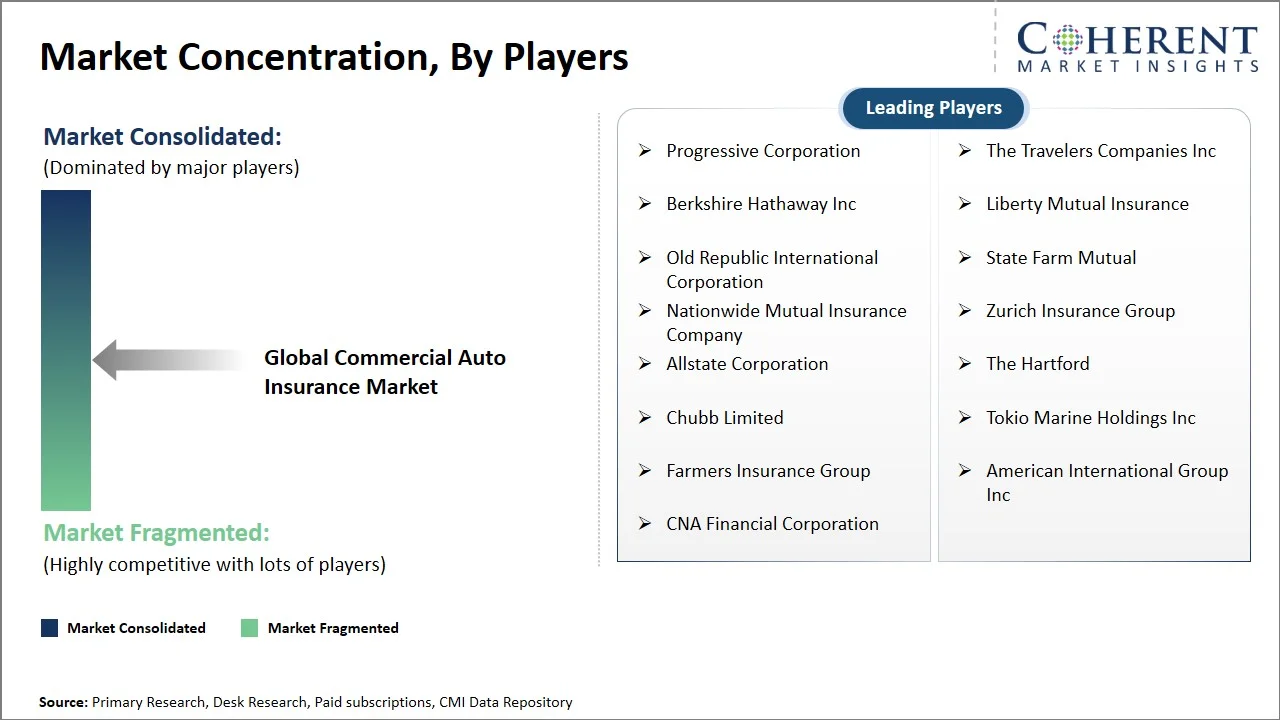
Progressive is the leading commercial auto insurer and has ranked first in the U.S. since 2015. Its strategy centers on granular pricing, telematics, small fleets, transportation operators, and connected risk management. Smart Haul uses electronic logging device data from Geotab, Motive, and Omnitracs to adjust premiums according to driving performance. Snapshot ProView extends usage-based insurance to customers without electronic logging devices. Progressive also launched its 8.3 commercial auto pricing model across 11 states during 2025. The company expanded Cargo Plus coverage across 49 states for for-hire transportation customers. Travelers focuses on telematics-enabled fleet safety, driver coaching, route optimization, and operational efficiency. Zurich emphasizes telematics alongside claims automation, artificial intelligence, predictive analytics, and fleet-risk management.
Market Report Scope
Commercial Auto Insurance Market Report Coverage
| Report Coverage | Details | ||
|---|---|---|---|
| Base Year: | 2025 | Market Size in 2026: | USD 270 Bn |
| Historical Data for: | 2020 To 2024 | Forecast Period: | 2026 To 2033 |
| Forecast Period 2026 to 2033 CAGR: | 9.2% | 2033 Value Projection: | USD 532 Bn |
| Geographies covered: |
| ||
| Segments covered: |
| ||
| Companies covered: | Progressive Corporation, The Travelers Companies Inc, Berkshire Hathaway Inc, Liberty Mutual Insurance, Old Republic International Corporation, State Farm Mutual, Nationwide Mutual Insurance Company, Zurich Insurance Group, Allstate Corporation, The Hartford, Chubb Limited, Tokio Marine Holdings Inc, Farmers Insurance Group, American International Group Inc, CNA Financial Corporation | ||
| Growth Drivers: |
| ||
| Restraints & Challenges: |
| ||
Analyst Opinion (Expert Opinion)
- The future of commercial auto insurance will increasingly depend on continuous risk measurement rather than annual policy assessment. Telematics should become particularly valuable for trucking, delivery vans, and medium-sized fleets. Insurers can use electronic logging device records, camera feeds, mileage, braking, and route information to adjust risk decisions. Progressive's Smart Haul demonstrates how driving data can already influence renewal pricing.
- The strongest opportunities should emerge in small fleets, light commercial vehicles, and technology-enabled logistics operations. India and China offer particularly attractive opportunities because expanding delivery networks are increasing connected commercial vehicle deployment. Electric delivery fleets should create another specialized opportunity around battery damage, charging equipment, and repair costs. Insurers should develop products combining vehicle coverage with telematics, roadside assistance, fleet monitoring, and automated claims services.
- Players need to establish proprietary risk-data ecosystems to get an edge, not just rely on traditional underwriting variables. Partnerships with providers of electronic logging devices, fleet-management platforms, vehicle manufacturers and logistics operators can broaden access to real-time exposure data. Insurers should also merge telemetry with AI-powered claims assessment and driving coaching. Zurich's experience shows that combining telematics with fleet-risk management can materially improve safety and claims outcomes.
Speak to the analyst
Want personalized insights?
Take the findings above to one of our principal consultants, or have the report rebuilt around the segments, geographies and competitors you actually track.
Market Segmentation
- Coverage Type Insights (Revenue, USD Billion, 2021 - 2033)
- Third Party Liability Coverage
- Collision Coverage
- Comprehensive Coverage
- Optional Coverage
- Vehicle Type Insights (Revenue, USD Billion, 2021 - 2033)
- Light Commercial Vehicles
- Medium Commercial Vehicles
- Heavy Commercial Vehicles
- End User Insights (Revenue, USD Billion, 2021 - 2033)
- Logistics and Transportation
- Construction
- Retail and E Commerce
- Passenger Transportation
- Manufacturing
- Others
- Regional Insights (Revenue, USD Billion, 2021 - 2033)
- North America
- US.
- Canada
- Latin America
- Brazil
- Argentina
- Mexico
- Rest of Latin America
- Europe
- Germany
- U.K.
- Spain
- France
- Italy
- Russia
- Rest of Europe
- Asia Pacific
- China
- India
- Japan
- Australia
- South Korea
- ASEAN
- Rest of Asia Pacific
- Middle East
- GCC Countries
- Israel
- Rest of Middle East
- Africa
- South Africa
- North Africa
- Central Africa
- North America
- Key Players Insights
- Progressive Corporation
- The Travelers Companies Inc
- Berkshire Hathaway Inc
- Liberty Mutual Insurance
- Old Republic International Corporation
- State Farm Mutual
- Nationwide Mutual Insurance Company
- Zurich Insurance Group
- Allstate Corporation
- The Hartford
- Chubb Limited
- Tokio Marine Holdings Inc
- Farmers Insurance Group
- American International Group Inc
- CNA Financial Corporation
Sources
Primary Research Interviews
- Commercial Auto Insurance Underwriters & Actuaries
- Fleet Management Companies & Transportation Firms
- Insurance Brokers & Agents specializing in Commercial Lines
- Risk Management Officers of Large Enterprises
Magazines
- Insurance Journal
- Business Insurance Magazine
- Risk & Insurance Magazine
- Commercial Risk Magazine
Journals
- Journal of Risk and Insurance
- Geneva Papers on Risk and Insurance
- Journal of Insurance Regulation
Associations
- Insurance Information Institute (III)
- American Insurance Association (AIA)
- National Association of Insurance Commissioners (NAIC)
- Commercial Vehicle Safety Alliance (CVSA)
Public Domain Sources
- U.S. Federal Highway Administration (FHWA) Reports
- World Bank Transport & Logistics Data
- OECD Insurance Statistics
- European Insurance and Occupational Pensions Authority (EIOPA) Reports
Proprietary Elements
- CMI Data Analytics Tool
- Proprietary CMI Existing Repository of Information for the last 10 years
Get access to 250+ pages report
Every segment, forecast, competitor profile and data table behind the analysis above — available for instant download.
- ESOMAR Member
- ISO 9001:2015 Certified
- D-U-N-S Registered
- GDPR & CCPA Compliant
Missing comfort of reading report in your local language? Find your preferred language:
Frequently Asked Questions
The global commercial auto insurance market is expected to stand at USD 270 Bn in 2026 and is expected to reach USD 532 Bn by 2033.
The CAGR of the global commercial auto insurance market is projected to be 9.2% from 2026 to 2033.
Expansion of commercial vehicle fleets and growth of logistics and transportation activities are the major factors driving the growth of the global commercial auto insurance market.
Rising claims severity and increasing vehicle repair costs are the major factors hampering the growth of the global commercial auto insurance market.
In terms of coverage type, third party liability coverage segment is estimated to dominate the market revenue share in 2026.
Commercial auto insurance protects businesses against vehicle-related liability, collision, property damage, and operational risks.
Usage-based insurance can align premiums more closely with actual vehicle utilization and observed driving behavior.