

Global Conductive Textile Market Size and Forecast – 2026 To 2033
The global conductive textile market is expected to grow from USD 4.50 Bn in 2026 to USD 7.30 Bn by 2033, registering a compound annual growth rate (CAGR) of 7.4% from 2026 to 2033. The global conductive textile market is driven by expansion of textile-based healthcare monitoring. On November 19, 2025, Hexoskin announced that the Hexoskin Medical System (HMS) has received 510(k) clearance from the U.S. Food and Drug Administration (FDA).
Key Takeaways of the Global Conductive Textile Market
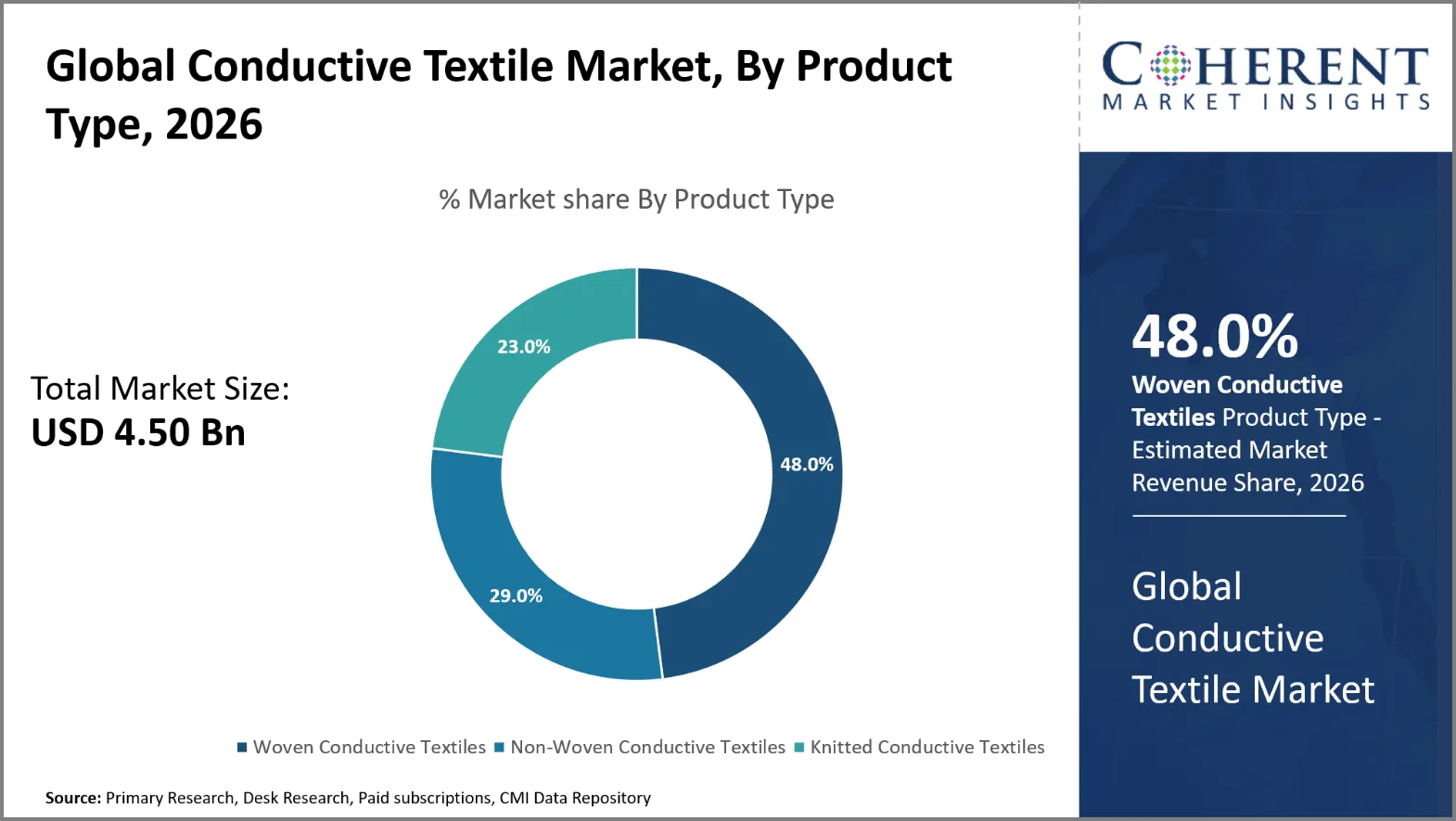
- The Woven Conductive Textiles segment is expected to account for 48.0% of the global conductive textile market share in 2026. Rising military demand for conductive protective clothing is driving the growth of the segment. On May 6, 2025, UNIFI launched Fortisyn, an abrasion-resistant yarn engineered for military uniforms, first-responder clothing, and tactical equipment.
- The Nylon segment is estimated to capture 38.0% of the market share in 2026. Growing use of flexible electronic components is majorly driving the growth of the segment. On February 12, 2026, Henkel announced new functional material developments for printed electronics at LOPEC 2026. Its portfolio included silver-plated copper conductive ink designed to reduce material costs and exposure to silver-price volatility.
- The Metal-Based Materials segment is estimated to capture 41.0% of the market share in 2026. Increasing integration of sensors into fabrics is driving the growth of the segment. On June 12, 2026, Applied Sensor Company announced U.S. Patent 12,612,720 for its embroidered textile pressure-sensing platform. The patented architecture combines conductive elements, sensing pads, signal traces, and electrical connections within an embroidered fabric structure.
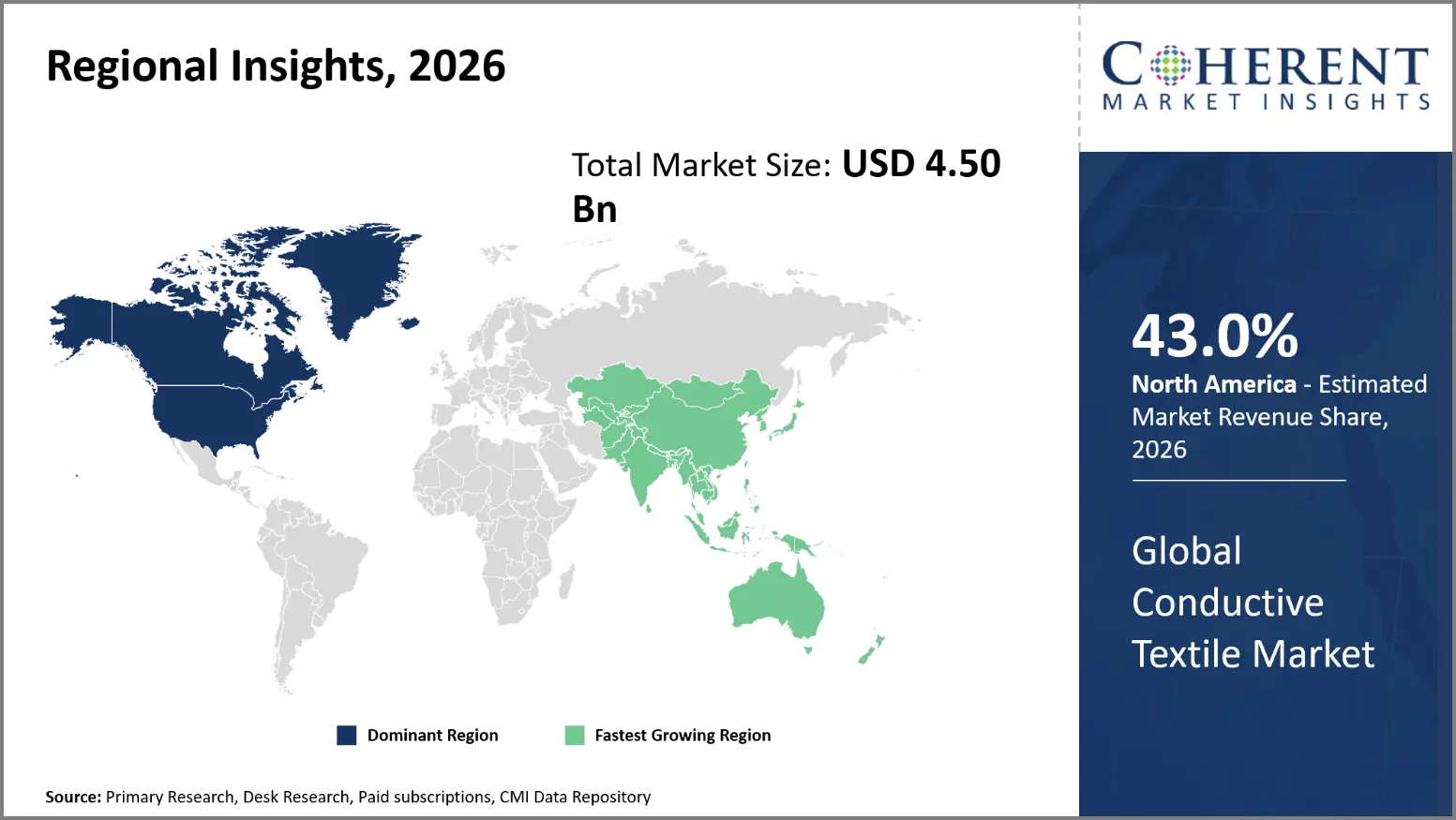
- North America is expected to dominate the conductive textile market in 2026 with a market share of 43.0%. Increasing demand for wearable health monitoring in North America is driving the growth of the regional market. On October 28, 2025, Makalot Industrial announced expanded Americas supply-chain facilities and showcased smart textile technologies ahead of Functional Fabric Fair 2025 in Portland, Oregon, U.S.
- Asia Pacific is expected to account for 21.0% share in 2026. Integration of conductive textiles into automotive interiors in Asia Pacific is driving the growth of the regional market. On October 9, 2025, Jiangsu Changshu Automotive Trim Group and Dutch technology company Brighter Signals announced a joint venture to create fabric-based tactile sensing systems for vehicle interiors. The system can sense pressure, weight, closeness, movement and position, allowing chairs and interior surfaces to respond to interaction with occupants.
Segmental Insights
Why Does Woven Conductive Textiles Dominate the Global Conductive Textile Market?
The woven conductive textiles segment is expected to account for 48.0% of the global conductive textile market share in 2026. Woven conductive fabrics are extensively employed for their electrical performance combined with the structural strength and dimensional stability. Interwoven warp and weft yarns form interconnected conductive channels for dependable signal transmission. This architecture can be used for electromagnetic interference shielding, wearable sensors, textile antennas and industrial electronics. Manufacturers can manipulate the weave density, yarn composition, and fabric thickness to create conductivity and flexibility suited to the application. Woven structures are also durable and compatible with traditional textile manufacturing processes. Bally Ribbon Mills featured its E-WEBBINGS product platform in August 2026. These designed narrow fabrics are woven from normal textile fibers in combination with conductive elements and incorporated electronic components. They can perform power transmission, data communication, sensing and shielding tasks. The company envisions applications in healthcare monitoring, industrial safety, aerospace, defense and wearable electronics.
- Current Industry Events of 2026
- Market Size Estimation
- Regional Breakdown
- Competitive Landscape
- Customer Intelligence
- Segmental Analysis
- Pricing Analysis
- Key Market Drivers, Challenges & Future Trends
- Customized Insights Section
Why is Nylon the Most Preferred Fabric Material?
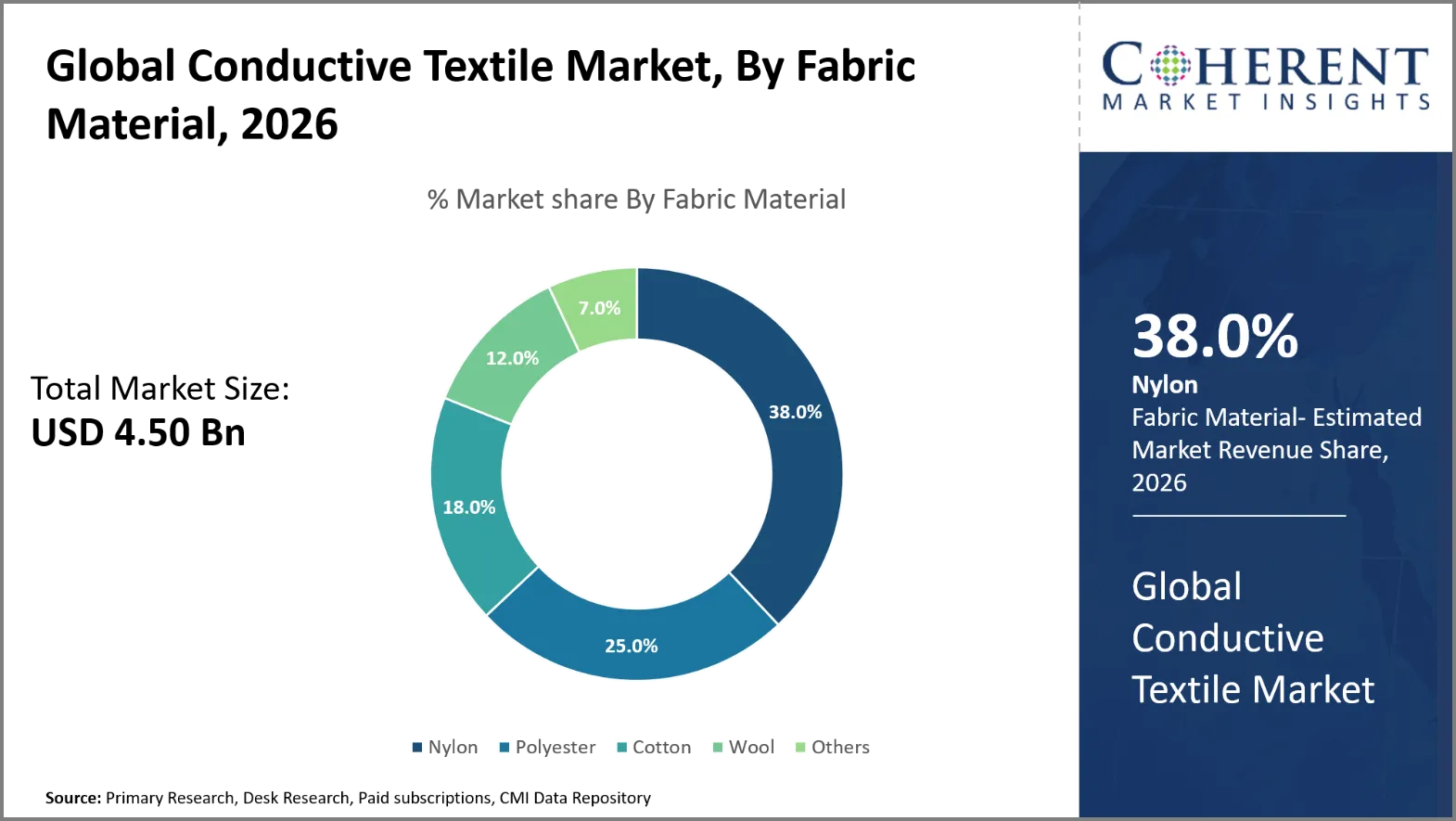
The nylon segment is expected to account for 38.0% of the global conductive textile market share in 2026. Nylon is the chosen fabric for conductive textiles because of its flexibility, tensile strength, abrasion resistance and low weight. The synthetic fibers provide a good base for conductive coatings such as silver, copper and nickel. Metalcoated nylon strands can provide electrical conductivity while yet providing the flexibility needed for wearable electronics. Nylon fabrics are also used to make sensors, smart clothes, flexible electrodes and motion tracking systems. Their flexible surface and textile processing capability enable producers to create various conductive structures. Taiwan-based firm Yuang Hsian Metal Industrial launched its AB6F conductive yarn in September 2026. The business has created a copper-alloy-based yarn that has a lower electrical resistance than its older AB65 offering. The design is geared on conductivity, adaptability, manufacturing compatibility and cost effectiveness.
Metal-Based Materials Dominate the Global Conductive Textile Market
The metal-based materials segment is expected to account for 41.0% of the global conductive textile market share in 2026. Metal-based materials have been the dominant choice for conductive textile applications due to their strong electrical conductivity and efficient electromagnetic interference shielding. Silver, copper, nickel or stainless steel are often used to make conductive yarns, textile coatings and metallic fabric structures. Silver is used for sensitive wearable sensors. Copper is an economical choice for electrical conduits. Nickel and stainless steel give electrical conductivity and functional longevity in several industrial applications. Deposition of metals also enables traditional fabrics to be used as electrodes, heating elements, antennas and shielding layers.
On February 17, 2025, Tech Etch, a global leader in EMI/RFI shielding solutions, announced the debut of their 2591 Conductive Fabric Over Foam Series. The revolutionary addition to the D Connector Gasket range provides unrivaled performance, environmental compliance, and versatility for shielding applications across industries.
Current Events and their Impact
Current Events | Description and its Impact |
Ecodesign for Sustainable Products Regulation (EU) 2024/1781 |
|
Revised European Union Waste Framework Directive 2008/98/EC, as amended by Directive (EU) 2025/1892 |
|
Conductive Textile Market Dynamics
Market Drivers
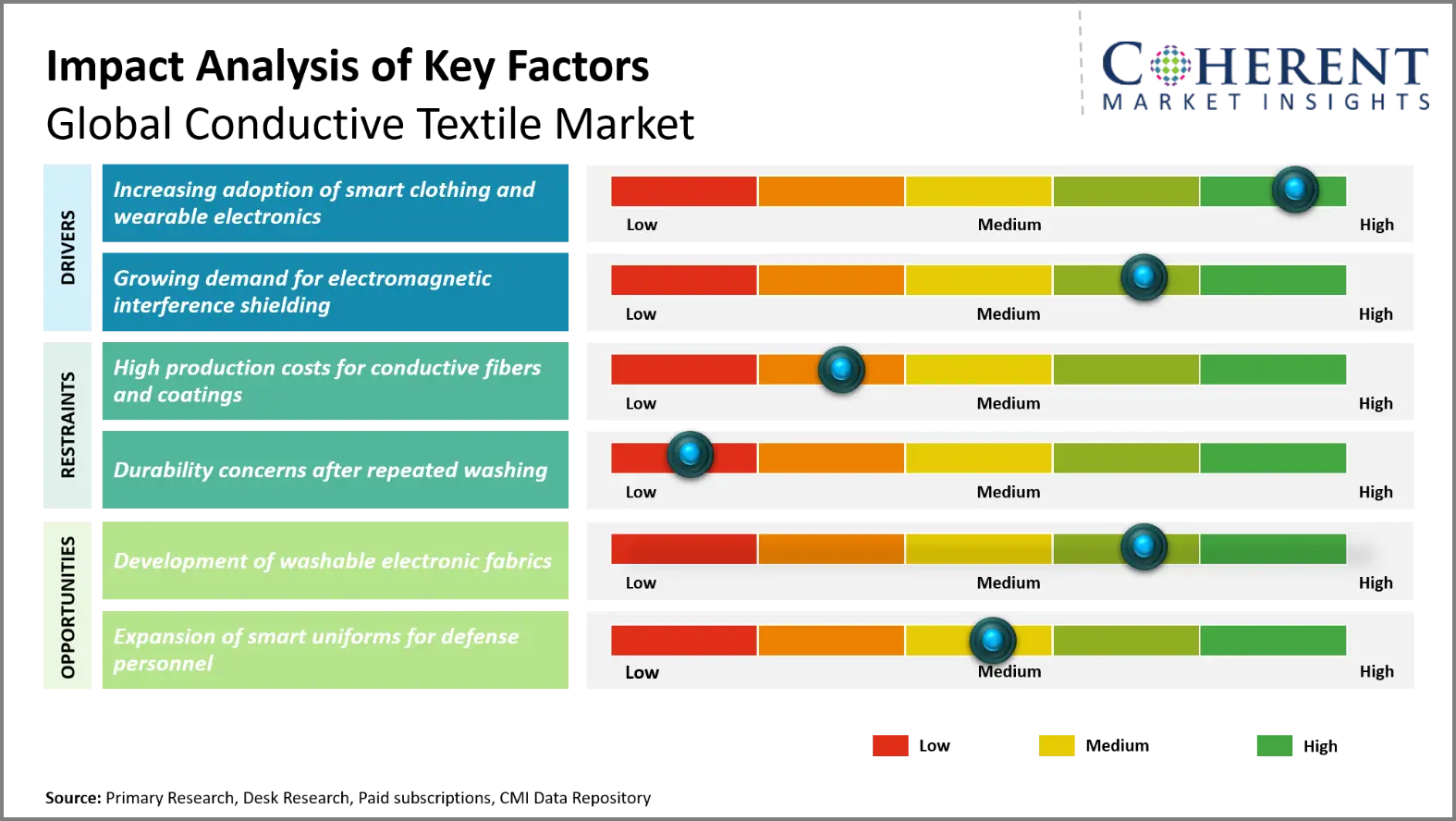
- Increasing adoption of smart clothing and wearable electronics: Growing adoption of smart clothes and wearable electronics is expected to boost the need for conductive textiles in healthcare, sports, defense and consumer electronics. These materials provide the flexibility and comfort but also enable electrical connections to be made between sensors, processors and power sources. Medical professionals are using conductive clothing to continuously monitor heart activity, muscle performance and mobility of the body. Sportswear producers incorporate conductive fibers into performance-tracking gear and physiological monitoring devices. The advances in washable conductive coatings and flexible materials are improving the use and longevity of the products. Such discoveries are driving manufacturers to extend the use of conductive textiles to connected clothing and next-generation wearables. In January 2025, Myant exhibited its SKIIN Generation 2 smart clothing at the Consumer Electronics Show. The clothing uses sensing technology based on textiles to monitor health in an ongoing way. This includes heart monitoring and gathering of physiological information during normal activity.
- Growing demand for electromagnetic interference shielding: The growing demand for electromagnetic interference shielding is driving the use of conductive textile in telecommunications, automobile electronics, aerospace, healthcare, and industrial equipment. More and more electronic devices packed together mean higher hazards of electromagnetic interference impacting signal quality and equipment performance. Silver, copper, nickel and stainless-steel conductive fabrics limit undesired electromagnetic radiation and offer lightweight, flexible shielding options. These materials enable protective enclosures, electronic packing, wearable devices and specific workwear. Increasing penetration of connected vehicles, wireless communication infrastructure and tiny electronic devices acts as a catalyst for the demand of efficient shielding materials. In February 2025, Vollebak introduced its Shielding Suit. The garment uses silver-integrated fabric developed with textile specialist Shieldex. Its design targets electromagnetic shielding and protection against selected radio-frequency signals. Vollebak reported shielding effectiveness of approximately 60 decibels across frequencies from 0.2 to 10 gigahertz.
Emerging Trends
- Development of Stretchable and Washable Conductive Fabrics: The manufacturers are producing conductive fabrics which can sustain electrical performance while stretched, washed repeatedly and used in everyday life. Advances in elastic conductive yarns, robust metal coatings and protective surface treatments are making smart clothes, medical monitoring garments and flexible wearable electronics possible.
- Integration of Conductive Textiles with Healthcare Monitoring Systems: Healthcare technology innovators are integrating conductive fabrics into wearable sensors, rehabilitative garments, and continuous physiological monitoring systems. These materials allow for skin contact measurements and provide comfort and flexibility. The increasing interest in remote patient monitoring further promotes textile-based sensing technologies.
- Advancement of Sustainable Conductive Materials: Textile makers are exploring the use of recyclable conductive fibers and low-impact coating methods, as well as alternatives to resource-intensive metallic treatments. Efforts to lessen environmental concerns are supported by research on conductive polymers and bio-based substrates. Design is going in the direction of material recovery and longer product life.
- Expansion of Lightweight Electromagnetic Shielding Solutions: Electronics manufacturers are adopting the use of light-weighted conductive fabrics for electromagnetic interference shielding in connected devices, cars, aircraft equipment and communication systems. Advancements in multilayer textile architectures and hybrid metal-polymer coatings enhance shielding performance while maintaining flexibility, breathability and application-specific mechanical qualities.
Regional Insights
Why is North America a Strong Market for Conductive Textile?
North America is expected to account for a market share of 43.0% in 2026. Aerospace engineering and healthcare monitoring research, as well as defense-funded electronic textiles, bolster North America. The United States Intelligence Advanced Research Projects Activity has established the SMART ePANTS program, aimed at developing practical apparel for intelligence and emergency workers. The National Institute for Occupational Safety and Health is investigating the use of wearable textile sensors for monitoring workplace exposures and physiology. Canada is also contributing through research on “smart textiles” that can be used for health and wellness, such as wearable sensors and actuators to help elderly people. These specialized applications are creating a demand for conductive yarns, flexible electrodes and robust electronic textile components. Regional growth particularly benefits from defense modernization and advanced medical wearable development.
Why Does Asia Pacific Conductive Textile Market Exhibit High Growth?
Asia Pacific is expected to register the fastest growth with a CAGR of 8.0% over the forecast period. The region is projected to account for 21.0% of the global conductive textile market in 2026. Asia Pacific has high volume textile production, electronics manufacturing and sophisticated functional fiber research. China, Japan and South Korea are contributing through research institutions and technology businesses working on textile-integrated sensors, flexible circuits and wearable systems. Fudan University and Tsinghua University are researching fiber-shaped energy systems, functional yarns and wearable monitoring technologies. Japan’s electronics industry backs connectors that can bend and devices that are woven into fabrics. South Korean research institutes are looking on cutting-edge coating and wearable energy technologies. Regional producers can integrate conductive materials into existing textile manufacturing lines, enabling applications in consumer electronics, automobile components, industrial shielding, and linked apparel.
Global Conductive Textile Market Outlook for Key Countries
Why is U.S. Emerging as a Major Hub in the Conductive Textile Market?
Defense modernization and incorporation of electronics in protective garments drive U.S. conductive textile business. It’s the SMART ePANTS initiative, administered by the Intelligence Advanced Research Projects Activity, and it’s all about clothes that can collect audio, video and GPS data. The National Aeronautics and Space Administration has funded the development of conductive-fiber textiles for spacesuit protection and electrostatic dust avoidance. Prototype research has reported 25% weight reduction target and more than 50% lower dust adhesion. These initiatives offer niche prospects for lightweight conductive fabrics, integrated wiring, charge dissipative coatings and high-performance textile architectures. Defense and aerospace applications are still a significant source of specialized demand.
Is China the Next Growth Engine for the Conductive Textile Market?
China’s conductive textile industry benefits from mature textile supply chains and a relatively robust domestic electronics manufacturing base. Fudan University is carrying out studies on fiber-shaped energy storage and harvesting systems. Tsinghua University is working in functional fibers, wearable health monitoring and fiber-based computing. These areas of research enable conductive yarns, flexible textile electrodes and fabric-integrated electronics. Existing Chinese expertise in yarn production, fabric finishing and electronics assembly can help industrial scale-up. Demand from connected consumer gadgets and industrial electronics presents prospects for conductive fabrics in electromagnetic shielding, flexible interconnections, wearable sensing and smart clothes.
Germany Conductive Textile Market Analysis and Trends
Germany has advantages in the form of technical textile expertise, industrial engineering skills and an established machinery manufacturing sector. Statex and similar companies manufacture Shieldex conductive textile materials, including conductive textiles and threads, for shielding purposes. Furthermore, German suppliers of smart textile technology demonstrate embroidered electronic integration, in which conductive yarns connect sensors, light-emitting components and circuit parts directly to fabrics. These functionalities are applicable for industrial electromagnetic compatibility, automobile interior components, medical electrodes and functional workwear. Germany’s unique chance is in designing conductive textiles for harsh industrial conditions. The purchasing criteria are always the same: electrical performance, mechanical reliability and compatibility with automated production processes.
Japan Conductive Textile Market Analysis and Trends
Japan’s conductive textile business is propelled by research into novel materials and the integration of electronics into flexible, body-compatible goods. At the University of Tokyo, researchers have been studying soft electronics and flexible systems that are meant to fit very closely to the human body. Japanese enterprises also exemplify the teamwork between textile makers and electronics professionals. For example, Xenoma and Japan Aviation Electronics Industry developed connecting technologies for smart clothes using flexible wiring. These developments address a critical engineering challenge; maintaining reliable electrical connections during garment movement. Such capabilities support rehabilitation clothing, motion capture, wearable health monitoring, and electronically connected apparel.
South Korea Conductive Textile Market Analysis and Trends
South Korea benefits from research synergies between its electronics industry, advanced materials laboratories, and wearable technology developers. Research groups associated with Seoul National University and the Korea Advanced Institute of Science and Technology investigate flexible textile electronics, advanced conductive coatings, and wearable energy devices. These technologies are for clothing with sensors, flexible electrodes and textile-integrated power components. South Korea’s mature proficiency in electronic components opens up potential for conductive fabrics for electromagnetic shielding and integration into small devices. Further developments in stretchable conductive materials could provide linked clothing, sports monitoring garments and light electronic interfaces that require frequent bending and reliable electrical contact.
Global Conductive Textile Market - Electromagnetic Shielding Performance by Material and Fabric Construction:
Conductive material | Fabric construction | Test frequency | Measured shielding effectiveness | Performance interpretation |
Silver-coated fabric | Dense woven fabric | X-band, approximately 8–12 GHz | Approximately 82 dB | Very high shielding in the tested configuration |
Copper-coated fabric | Dense woven fabric | X-band, approximately 8–12 GHz | Approximately 74 dB | High shielding with a copper-based conductive layer |
Copper-core yarn | Woven cotton-sheath fabric | 200–4,000 MHz | 20–66 dB | Performance varies with frequency and construction |
Stainless-steel/polyester yarn | Woven plain, twill, or leno fabric | 8–18 GHz | Approximately 31 dB | Moderate shielding across the tested high-frequency range |
Stainless-steel/polyester yarn | Knitted fabric | 300 kHz–3 GHz | 1–26 dB | Shielding varies with yarn arrangement and fabric structure |
Silver-coated polyamide | Needle-punched nonwoven fabric | 15 MHz–3 GHz | 11–36.5 dB | Flexible nonwoven construction with moderate shielding |
Stainless-steel conductive yarn | Woven fabric | 0.9 GHz | 7.20 dB | Lower shielding at this frequency than at higher tested frequencies |
Stainless-steel conductive yarn | Woven fabric | 1.8 GHz | 14.33 dB | Greater shielding than at 0.9 GHz in the same sample |
Stainless-steel conductive yarn | Woven fabric | 2.1 GHz | 15.58 dB | Shielding increased further at this frequency |
Stainless-steel conductive yarn | Woven fabric | 2.4 GHz | 17.60 dB | Highest measured value among these four frequencies |
How is Development of Washable Electronic Fabrics Creating New Growth Opportunities in the Conductive Textile Market?
Washable electronic fabrics are providing the growth potential and are overcoming a fundamental commercial obstacle in smart clothing -- the ability to preserve electrical function after repeated washing. Researchers and manufacturers are designing encapsulating conductive yarns, stretchable interconnects, and water-resistant coatings that shield electrical paths from detergents, moisture, and mechanical agitation. Conductive stitching and removable electronic connectors let manufacturers put sensors into sportswear without affecting garment upkeep. Washable monitoring garments that can be reused over multiple patients can also help healthcare providers. Such developments open up prospects for suppliers of conductive textiles to approach workwear manufacturers, developers of rehabilitation technology, athletic brands and manufacturers of connected uniforms that require consistent electrical performance over repeated washing cycles.
On February 26, 2025, Nottingham Trent University, Helmholtz-Zentrum Dresden-Rossendorf, and Free University of Bozen-Bolzano researchers developed washable magnetic-sensing textiles. This approach embeds small magneto resistive sensors in braided textile yarns for use in standard manufacture. Textile controls can be activated by a small magnet on a ring or glove.
Market Players, Key Development, and Competitive Landscape
Key Developments
- On January 28, 2025, Dexmat announced the availability of Galvorn C. The product is available as twisted yarn and fiber tow. DexMat positioned it for electrostatic discharge protection and antistatic clothing, offering manufacturers an alternative to conventional conductive materials. The company stated that Galvorn C costs approximately 80% less than its high-strength Galvorn material. This launch creates opportunities for lightweight conductive yarns in protective garments and electronic textile production.
- On November 6, 2024, Shieldex published developments on multispectral shielding and infrared protection for soldiers. The company highlighted textile-based approaches designed to help reduce detection across multiple sensing methods. These applications extend conductive and metallized textile technology beyond conventional electromagnetic interference shielding.
Competitive Landscape
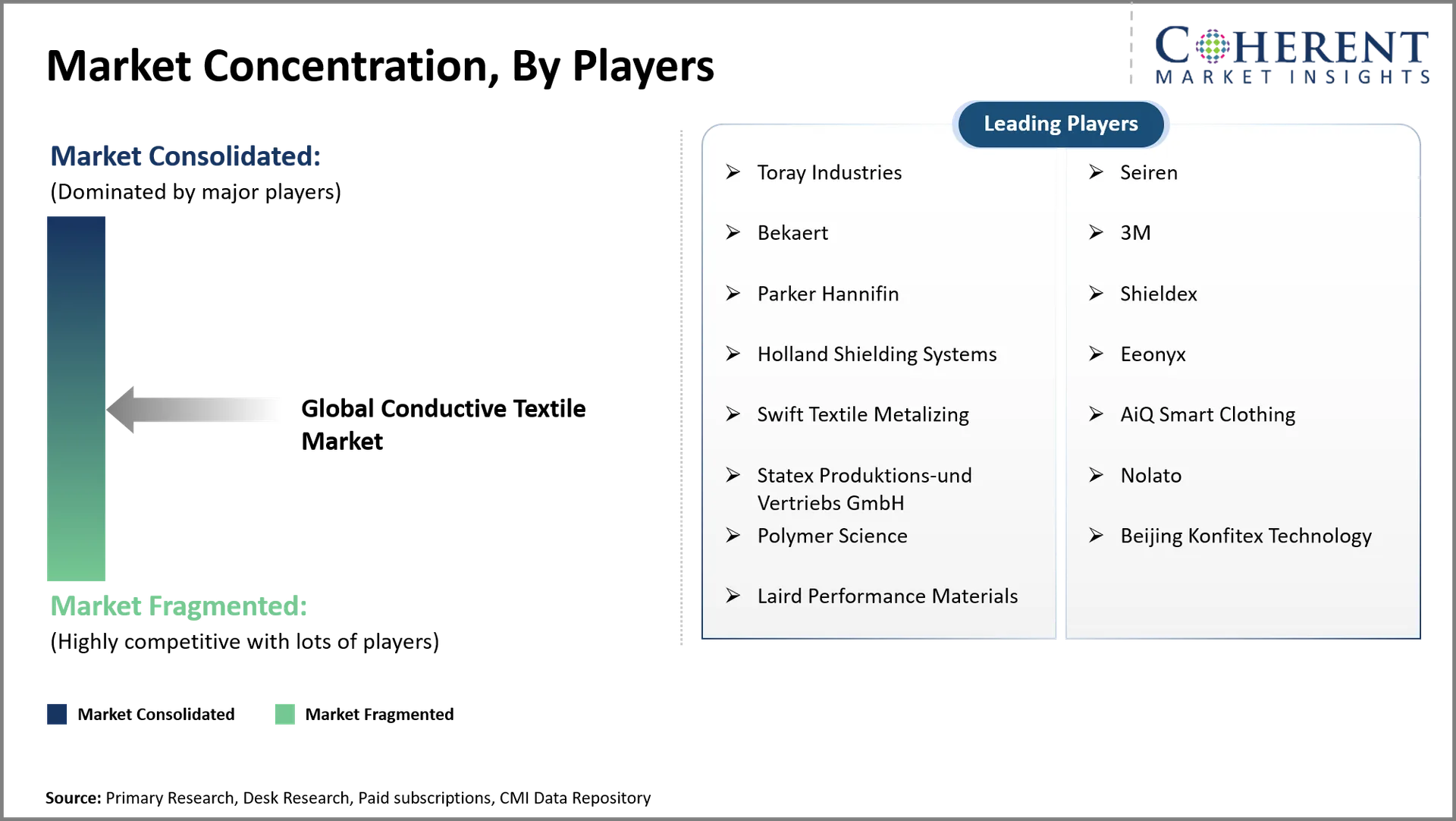
The global conductive textile market is the collection of specialized producers competing on the basis of metal coated fabrics, conductive yarns, electromagnetic shielding and wearable electronics materials. Shieldex from Statex provides silver coated yarns, woven fabrics, knitted fabrics, and nonwoven shielding materials for medical, aeronautical, and electromagnetic compatibility applications. Bekaert specializes in Bekinox stainless steel fibers and yarns for washable smart clothes, radio-frequency identification tags and electrostatic discharge protection. Laird produces nickel-copper metalized textiles and flexible shielding tapes for electronic enclosures and electromagnetic interference protection. Eeonyx specializes in customizable conductive coatings for fabrics, fibers, pressure sensors, touchscreen gloves, and defense applications. Competitive differentiation increasingly depends on conductivity retention, wash durability, coating consistency, and application-specific customization.
Top Manufacturers and Notable Products in the Conductive Textile Market
Manufacturer | Notable Product | Key features |
Shieldex | Shieldex Balingen | Silver-metallized knitted nylon fabric, electrical and thermal conductivity, smart textile compatibility, sensor integration, electromagnetic shielding |
Bekaert | Bekinox stainless steel fibers and yarns | High conductivity, corrosion resistance, wash durability, electromagnetic shielding, compatibility with woven and knitted fabrics |
Laird Technologies | Nickel-copper conductive fabric series 3050525-STD | Lightweight nylon ripstop construction, nickel-copper metallization, electromagnetic interference shielding, flexibility, abrasion resistance |
Statex Produktions- und Vertriebs GmbH | Shieldex 78/20 + OA conductive yarn | Silver, copper, nickel, and tin metallization, nylon base, antistatic performance, electromagnetic shielding, compatibility with weaving and knitting |
Eeonyx | EeonTex conductive fabrics | Conductive polymer-coated textiles, flexible electrical properties, sensor integration, wearable electronics applications |
Market Report Scope
Report Coverage | Details | ||
Base Year | 2025 | Market Size in 2026: | USD 4.50 Bn |
Historical Data For: | 2020 To 2024 | Forecast Period: | 2026 To 2033 |
Forecast Period 2026 To 2033 CAGR: | 7.4% | 2033 Value Projection: | USD 7.30 Bn |
Geographies covered: |
| ||
Segments covered: |
| ||
Companies covered: | Toray Industries, Seiren, Bekaert, 3M, Parker Hannifin, Shieldex, Holland Shielding Systems, Eeonyx, Swift Textile Metalizing, AiQ Smart Clothing, Statex Produktions-und Vertriebs GmbH, Nolato, Polymer Science, Beijing Konfitex Technology, Laird Performance Materials | ||
Growth Drivers: |
| ||
Restraints & Challenges: |
| ||
Analyst Opinion (Expert Opinion)
- The future of the conductive textile industry will depend on converting specialized materials into dependable, commercially scalable textile products. Washable smart garments, textile-based medical electrodes, and flexible electromagnetic shielding materials offer distinct growth opportunities. Manufacturers that maintain conductivity after repeated washing and bending can address practical limitations in everyday electronic clothing. Suppliers should focus on measurable performance qualities such as electrical resistance, corrosion resistance, skin compatibility, and durability through repeated laundering. These parameters will assist buyers in comparing materials to real application requirements.
- The best prospects will be found in application specific materials, not in universal conductive fabrics. Silver-coated polyamide yarns are suited for sensitive electrodes and antimicrobial textile applications, whereas stainless steel fibers are used for robust industrial clothing and electrostatic discharge protection. Nickel-copper textiles are still useful for electromagnetic shielding of electronic enclosures. In defense equipment and medical wearables, the U.S. has prospects. China has manufacturing scale and electronics integration expertise. There is potential for industrial textiles in Germany. Japan and South Korea have potential in advanced materials and connected electronics.
- Before increasing production, market participants should form collaborations with garment manufacturers, inventors of electronic devices, hospitals and suppliers of industrial equipment. They must confirm conductivity after washing, rubbing, stretching, exposure to perspiration and repeated connector attachment. Companies could also build uniform testing processes and give application-specific technical documentation to shorten client qualification time. Flexible manufacturing capabilities can support prototypes and smaller orders before larger production commitments.
Speak to the analyst
Want personalized insights?
Take the findings above to one of our principal consultants, or have the report rebuilt around the segments, geographies and competitors you actually track.
Market Segmentation
- Product Type Insights (Revenue, USD Billion, 2021 - 2033)
- Woven Conductive Textiles
- Non-Woven Conductive Textiles
- Knitted Conductive Textiles
- Fabric Material Insights (Revenue, USD Billion, 2021 - 2033)
- Nylon
- Polyester
- Cotton
- Wool
- Others
- Conductive Material Insights (Revenue, USD Billion, 2021 - 2033)
- Metal-Based Materials
- Carbon-Based Materials
- Conductive Polymers
- Others
- Application Insights (Revenue, USD Billion, 2021 - 2033)
- Military and Defense
- Healthcare
- Sports and Wearables
- Consumer Electronics
- Automotive
- Industrial Applications
- Aerospace
- Regional Insights (Revenue, USD Billion, 2021 - 2033)
- North America
- U.S.
- Canada
- Latin America
- Brazil
- Argentina
- Mexico
- Rest of Latin America
- Europe
- Germany
- U.K.
- Spain
- France
- Italy
- Russia
- Rest of Europe
- Asia Pacific
- China
- India
- Japan
- Australia
- South Korea
- ASEAN
- Rest of Asia Pacific
- Middle East
- GCC Countries
- Israel
- Rest of Middle East
- Africa
- South Africa
- North Africa
- Central Africa
- North America
- Key Players Insights
- Toray Industries
- Seiren
- Bekaert
- 3M
- Parker Hannifin
- Shieldex
- Holland Shielding Systems
- Eeonyx
- Swift Textile Metalizing
- AiQ Smart Clothing
- Statex Produktions-und Vertriebs GmbH
- Nolato
- Polymer Science
- Beijing Konfitex Technology
- Laird Performance Materials
Sources
Primary Research Interviews
- Conductive Textile Manufacturers & Producers
- Smart Textile & Wearable Technology Developers
- Defense & Military Textile Procurement Specialists
- Healthcare & Medical Wearable Device Manufacturers
Magazines
- Textile World Magazine
- Smart Textiles & Wearables Magazine
- Advanced Materials & Processes Magazine
- Wearable Technologies Magazine
Journals
- Journal of Applied Polymer Science
- Advanced Functional Materials Journal
- Journal of Materials Chemistry C
Associations
- International Textile Manufacturers Federation (ITMF)
- Smart Fabrics Alliance (SFA)
- Textile Exchange
- American Apparel & Footwear Association (AAFA)
Public Domain Sources
- U.S. Patent and Trademark Office (USPTO) – Conductive Textile Patents
- European Commission – E-Textile & Smart Fabric Research Reports
- National Institute of Standards and Technology (NIST)
- World Trade Organization (WTO) – Textile Trade Data
Proprietary Elements
- CMI Data Analytics Tool
- Proprietary CMI Existing Repository of Information for the last 10 years
Get access to 250+ pages report
Every segment, forecast, competitor profile and data table behind the analysis above — available for instant download.
- ESOMAR Member
- ISO 9001:2015 Certified
- D-U-N-S Registered
- GDPR & CCPA Compliant
Frequently Asked Questions
The global conductive textile market is expected to stand at USD 4.50 Bn in 2026 and is expected to reach USD 7.30 Bn by 2033.
The CAGR of the global conductive textile market is projected to be 7.4% from 2026 to 2033.
Increasing adoption of smart clothing and wearable electronics and Growing demand for electromagnetic interference shielding are the major factors driving the growth of the global conductive textile market.
High production costs for conductive fibers and coatings and Durability concerns after repeated washing are the major factors hampering the growth of the global conductive textile market.
In terms of product type, woven conductive textiles segment is estimated to dominate the market revenue share in 2026.
Conductive textiles help reduce unwanted electromagnetic interference that can disrupt electronic equipment, wireless communications, and sensitive instrumentation.
Healthcare applications include electrocardiogram electrodes, rehabilitation garments, physiological monitoring systems, and textile-based patient monitoring devices.