

Global Container Security Market Size and Forecast – 2026 To 2033
The global container security market is expected to grow from USD 3.80 Bn in 2026 to USD 20.00 Bn by 2033, registering a compound annual growth rate (CAGR) of 15.4% from 2026 to 2033. The global container security market is driven by expansion of microservices architectures. On March 3, 2025, AWS announced the preview of new AWS Outposts racks designed specifically for on-premises high throughput, network-intensive workloads. With these new Outposts racks, telecom service providers can extend AWS infrastructure and services to telco locations, enabling them to deploy on-premises network functions requiring low latency, high throughput, and real-time performance.
Key Takeaways of the Global Container Security Market
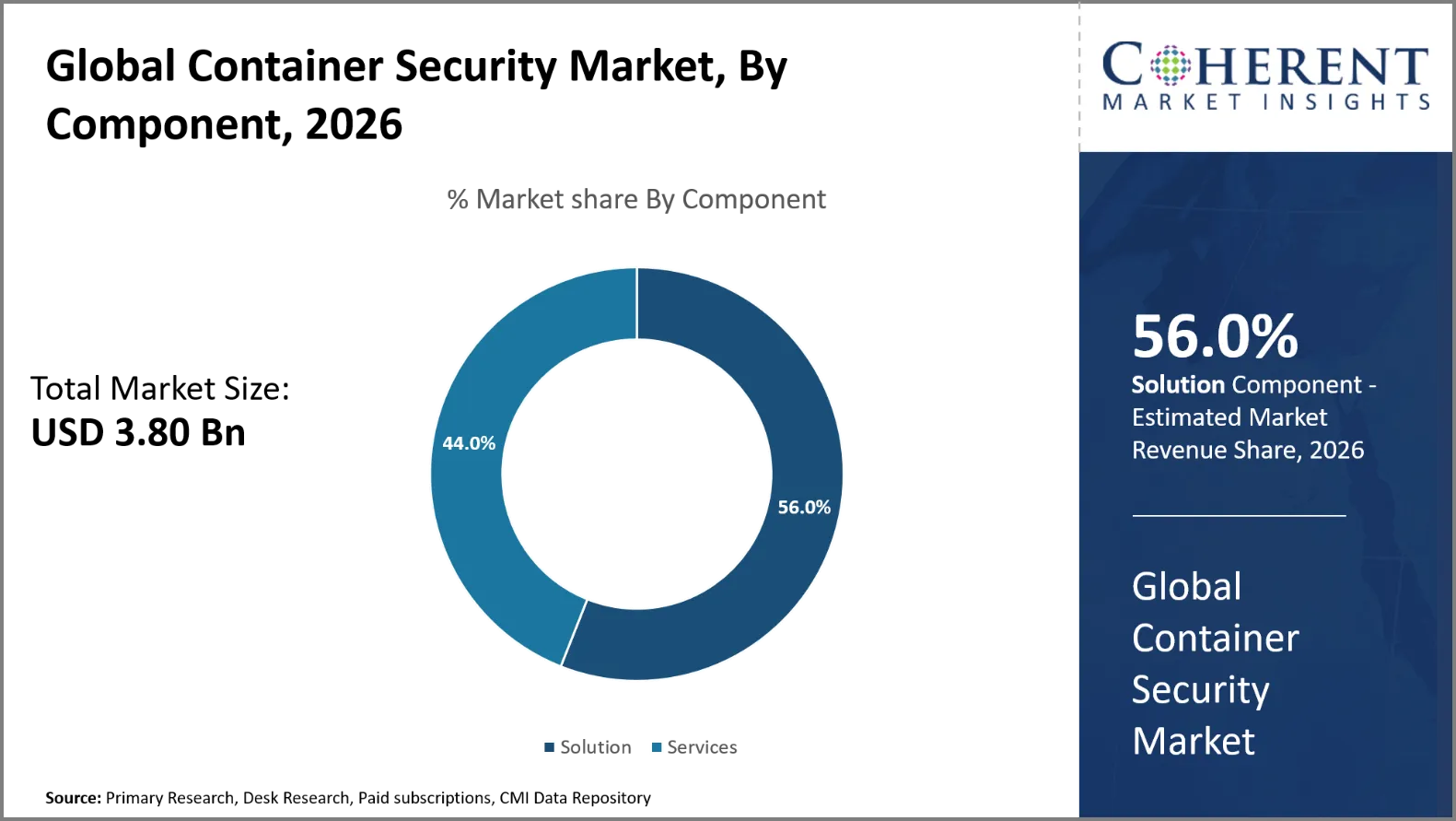
- The Solution segment is expected to account for 56.0% of the global container security market share in 2026. Rising software supply chain attacks is driving the growth of the segment. In March 2026, Sonatype identified two hijacked npm packages that delivered malware after a trusted maintainer account was compromised. The packages were designed to exfiltrate secrets from affected systems.
- The Cloud segment is estimated to capture 63.0% of the market share in 2026. Growing demand for runtime protection is majorly driving the growth of the segment. On April 23, 2025, Aqua Security launched its Container Security Risk Assessment for production container environments. The assessment tests actual runtime behavior, not just static image scans.
- The Vulnerability Management segment is estimated to capture 39.0% of the market share in 2026. Increasing container vulnerability risks is driving the growth of the segment. On January 13, 2026, RapidFort announced Red Hat Vulnerability Scanner Certification for RapidFort Analyzer. The certification validates container analysis and vulnerability management across Red Hat environments.
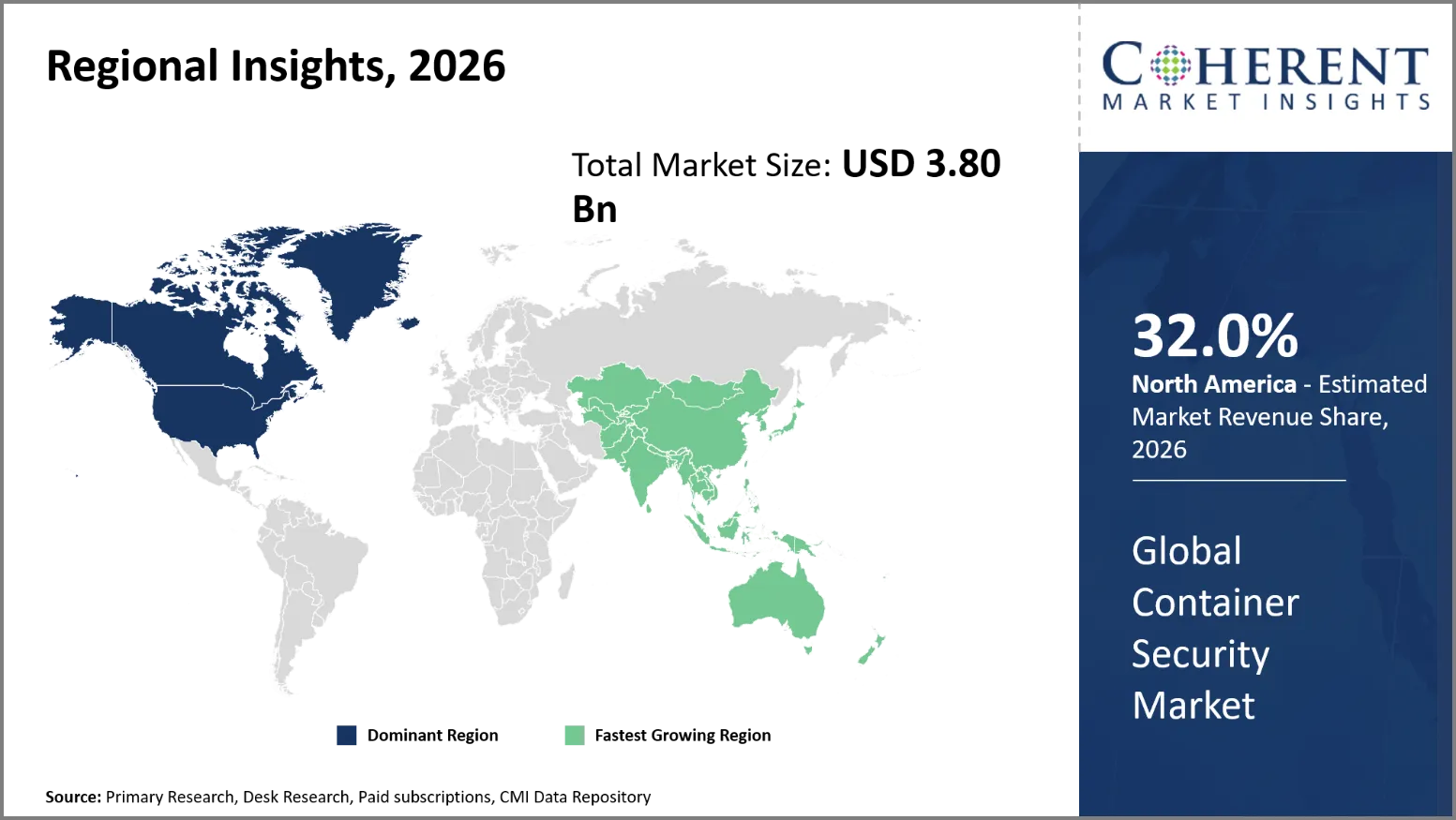
- North America is expected to dominate the container security market in 2026 with a market share of 32.0%. Expansion of DevSecOps practices in North America is driving the growth of the regional market. On August 6, 2025, GitLab Inc. that it signed a three-year strategic collaboration agreement with Amazon Web Services (AWS). The agreement expands access to GitLab Dedicated, a single-tenant offering that allows organizations in highly regulated industries and the public sector to leverage cloud infrastructure while adhering to severe compliance standards.
- Asia Pacific is expected to account for 24.0% share in 2026. Growing cloud infrastructure adoption in Asia Pacific is driving the growth of the regional market. On January 7, 2025, Amazon Web Services launched the AWS Asia Pacific Thailand Region with three Availability Zones. The company planned more than USD 5 billion of investment in Thailand.
Segmental Insights
Why Does Solution Dominate the Global Container Security Market?
The solution segment is expected to account for 56.0% of the global container security market share in 2026. Demand for integrated security solutions across enterprise systems is being driven by containerized workloads. These technologies enable for continuous scanning of container images and settings to identify vulnerabilities. They also provide automated threat detection of cloud native apps and K8s clusters. DevSecOps pipeline integration helps organizations uncover security problems earlier in the development process. Growing software supply chain vulnerabilities for enterprises are further driving need for automated container security solutions. In May 2025, Palo Alto Networks issued the DevSecGuide to Kubernetes, which focuses on the security of clusters and control planes, pods and containers, and application code. The recommendation calls for automated security controls across infrastructure configuration, image vulnerabilities, workload behavior and Kubernetes policy.
- Current Industry Events of 2026
- Market Size Estimation
- Regional Breakdown
- Competitive Landscape
- Customer Intelligence
- Segmental Analysis
- Pricing Analysis
- Key Market Drivers, Challenges & Future Trends
- Customized Insights Section
Why is Cloud the Most Preferred Deployment Type?
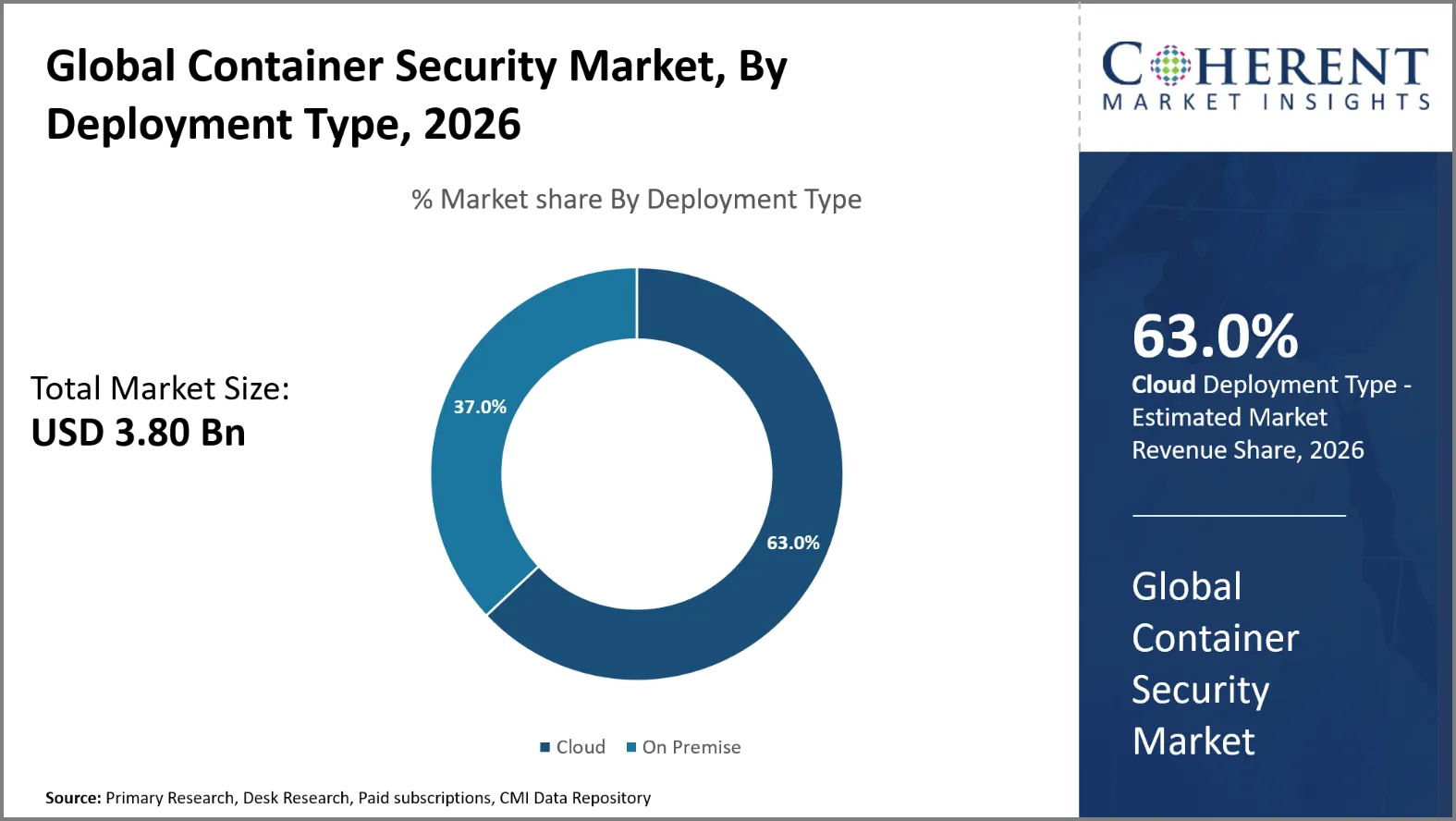
The cloud segment is expected to account for 63.0% of the global container security market share in 2026. Enterprises are increasingly adopting cloud deployment as they run more distributed containerized workloads across numerous cloud environments. Cloud platforms deliver a scalable security architecture that can rapidly react to application workload changes. Centralized security management also makes it easier to monitor across containers, clusters and development environments. It integrates with cloud-native security solutions for automatic vulnerability discovery and policy enforcement. The growing use of hybrid and multi-cloud architectures further drives need for cloud-based container security capabilities. On March 10, 2026, Amazon Web Services announced that AWS Security Hub is now available on multi-cloud. The solution will bring together security signals, posture management, exposure analysis, and risk prioritization across many cloud environments. Amazon Inspector will also extend vulnerability scanning to container images not running on AWS workloads.
Vulnerability Management Dominates the Global Container Security Market
The vulnerability management segment is expected to account for 39.0% of the global container security market share in 2026. Container vulnerabilities are being identified and remediated more and more as threats to the software supply chain rise.” Increasingly, companies are scanning container images prior to deployment for obsolete libraries and security holes. Security teams can use automated vulnerability assessment to prioritize risk across big container environments. Integrating with continuous integration and continuous deployment pipelines can let security checks be performed earlier in application development. Increased regulatory focus on software security also provides another incentive to control vulnerabilities systematically across containerized applications. On November 19, 2025, Red Hat launched Project Hummingbird, an early access program for Red Hat subscription subscribers which offers a portfolio of minimal, hardened container images. Project Hummingbird is designed to help IT organizations address the constantly growing demand for better software with minimal attack surfaces, delivered more swiftly without compromising production security.
Current Events and their Impact
Current Events | Description and its Impact |
European Union Cyber Resilience Act Regulation (EU) 2024/2847 |
|
European Union NIS2 Directive (EU) 2022/2555 |
|
Container Security Market Dynamics
Market Drivers
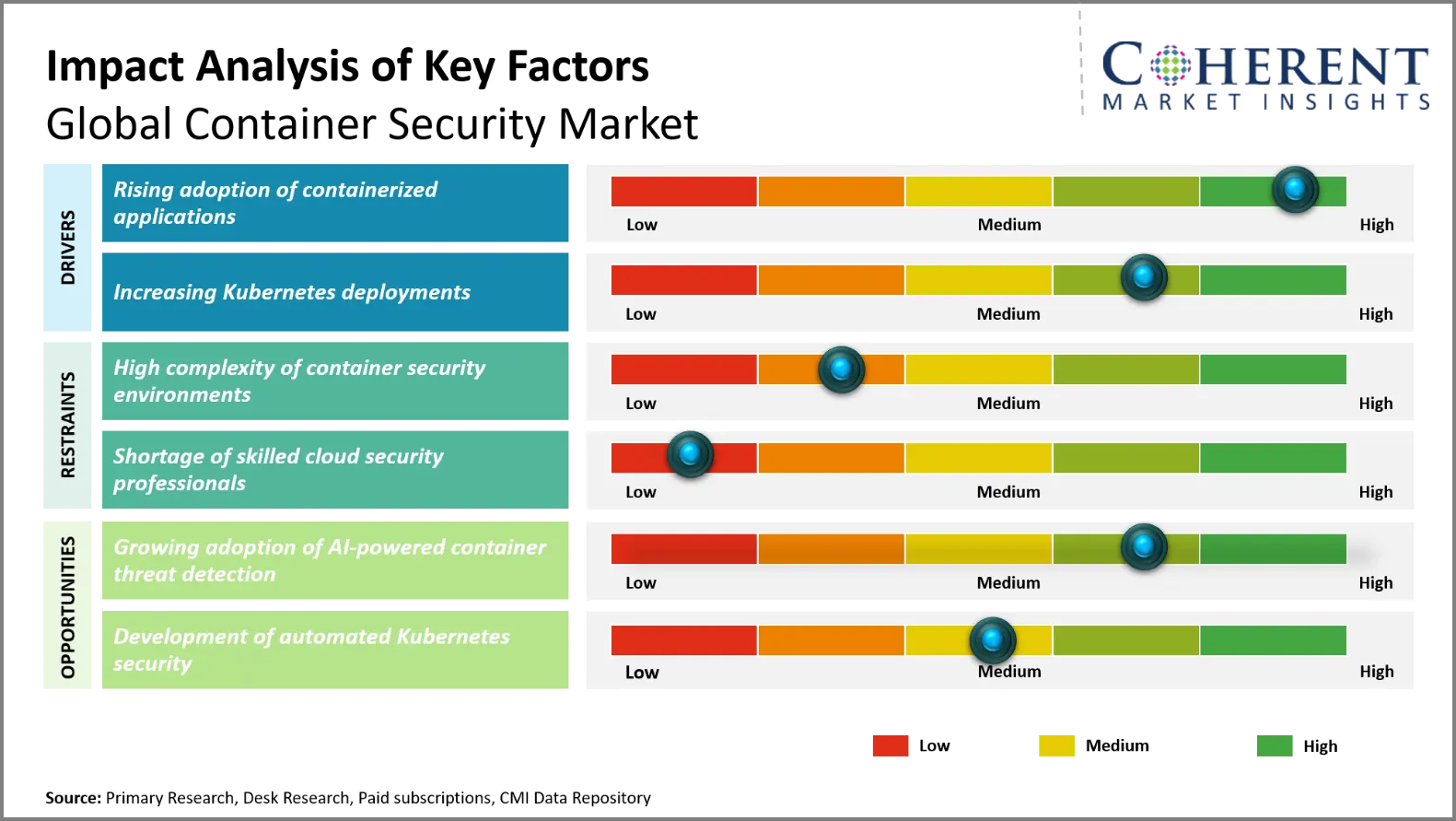
- Rising adoption of containerized applications: More organizations are leveraging containers to accelerate application development and deployment. Containers provide predictable application contexts across development, testing and production infrastructure. Enterprises are also using containers to enable applications to run on any cloud or on premise system. Increasing number of containerized workloads that need continuous security monitoring as microservices adoption grows. These changes lead to a greater necessity for vulnerability management, runtime protection and container image security. On March 3, 2025, Red Hat, Inc announced that Safaricom, a leading integrated communications solutions provider in Kenya, has deployed Red Hat OpenShift as a shared cloud platform for applications including the M-PESA system.
- Increasing Kubernetes deployments: Enterprises are adopting Kubernetes as they manage more containerized applications. Organizations utilize Kubernetes to automate container orchestration, scalability, scheduling and resource management. Adoption is also expanding across dispersed infrastructure as hybrid and multicloud deployments grow. Kubernetes environments introduce new security needs for workloads, configurations, identities and network connectivity. Such requirements are fueling demand for specific Kubernetes security and ongoing monitoring capabilities. On May 21, 2025, AWS announced the launch of Amazon Elastic Kubernetes Service (Amazon EKS) Dashboard, a single pane of glass view that helps cloud architects and cluster admins to keep organization-wide visibility of their Kubernetes clusters.
Emerging Trends
- AI-Driven Container Threat Detection: Artificial intelligence is being used more and more to help with container security by spotting anomalous workload behavior, prioritizing vulnerabilities, and recognizing complicated attacks. Automating analysis allows security teams to spend less time on investigations and improve detection skills across evolving cloud-native application environments.
- Runtime Security Automation: Runtime protection is becoming more automated as enterprises monitor active containers for suspicious processes, unauthorized actions and configuration changes. Automated response capabilities can isolate compromised workloads, enforce security standards and decrease exposure during constantly changing application operations.
- Software Supply Chain Security: Increasing number of third-party components being included in container images and organizations improving software supply chain controls. Adoption of a Software Bill of Materials and procedures such as image signing, provenance verification and continuous vulnerability scanning are increasingly critical to improve component transparency and security.
- Kubernetes Security Integration: Security features are being integrated directly into Kubernetes environments to secure clusters, workloads, identities, and network traffic. For more complicated Kubernetes deployments, enterprises are using centralized policy enforcement, configuration monitoring, vulnerability assessment and runtime protection.
Regional Insights
Why is North America a Strong Market for Container Security?
North America is expected to account for a market share of 32.0% in 2026. In North America, financial institutions, technology, healthcare and telecoms are all using large-scale Kubernetes deployments. KubeCon + CloudNativeCon North America 2025 drew more than 9,300 attendees in Atlanta. Also, there is high demand from enterprises in the region for automated container vulnerability management. In 2025, Amazon Inspector enabled container-image-to-running-workload mapping for Amazon Elastic Container Registry. Google Cloud also introduced Kubernetes security policies supporting Center for Internet Security benchmarks. These developments strengthen demand for runtime monitoring, image scanning, configuration assessment, and automated remediation across large cloud environments.
Why Does Asia Pacific Container Security Market Exhibit High Growth?
Asia Pacific is expected to register the fastest growth with a CAGR of 17.1% over the forecast period. Asia Pacific is projected to account for 24.0% of the global container security market in 2026. Asia Pacific is supported by rapid cloud-native adoption across China, India, Japan, Australia, Singapore, and South Korea. The region is gaining traction in artificial intelligence infrastructure and managed Kubernetes services. In 2025, security capabilities were added to the Alibaba Cloud Container Service for Kubernetes. These featured vulnerability repair, policy governance, confidential containers and runtime security checks. Enterprise-scale container deployments supporting digital commerce and artificial intelligence workloads are also extensive in China. Japan and Singapore are building cloud-native infrastructure for telecommunications and financial applications. These developments create demand for Kubernetes security, workload isolation, and software supply-chain protection.
Global Container Security Market Outlook for Key Countries
Why is U.S. Emerging as a Major Hub in the Container Security Market?
Technology, financial services and cloud infrastructure organizations are widely adopting containers and Kubernetes, benefiting the U.S. enterprise. A 2025 poll by the Cloud Native Computing Foundation indicated that 82% of global container users were running Kubernetes in production. Amazon Web Services enhanced container vulnerability management using Amazon Inspector in May 2025. The service maps vulnerable Amazon Elastic Container Registry images to running Amazon Elastic Kubernetes Service pods. Google Cloud also supports Center for Internet Security benchmark enforcement through organization policies for Google Kubernetes Engine. These advances facilitate automated vulnerability prioritization and remediation.
Is China the Next Growth Engine for the Container Security Market?
There is high demand for container security in China and large-scale deployments of cloud-native and artificial intelligence. Alibaba Cloud Container Service for Kubernetes provides image scanning, image signing, runtime security checks and secret encryption. In 2025, Alibaba Cloud introduced vulnerability remediation for Kubernetes node pools and Kubernetes-native policy enforcement. Its technology also provides confidential container capabilities using remote attestation. Alibaba Cloud's cloud-native gateway supports major Chinese services including Alipay, DingTalk, Taobao, Tmall, Youku, and Fliggy. These deployments increase requirements for runtime protection and workload isolation.
Germany Container Security Market Analysis and Trends
Germany benefits from growing use of managed Kubernetes within regulated industrial and enterprise environments. SysEleven’s managed Kubernetes platform has been certified by the Federal Office for Information Security with certificate number BSI-IGZ-0671-2025. The certification includes managed Kubernetes, OpenStack cloud and managed hosting services. Germany also offers cyber security testing environments using Kubernetes-based 5G platforms. The Federal Office for Information Security’s 5G Security Lab 2025 has featured Kubernetes-based platforms from Ericsson and Nokia. This deployment creates demand for hardened clusters, restriction of access, monitoring and security testing for vulnerabilities.
Japan Container Security Market Analysis and Trends
Japan’s demand for container security is underpinned by the modernization of telecommunications infrastructure and Kubernetes-based network services. The Federal Office for Information Security’s 2025 security laboratory showcased 5G solutions based on Kubernetes from Ericsson and Nokia. Japanese companies are also building cloud-native architectures for applications that need resilience and automated scaling. Kubernetes increasingly supports distributed workloads that require stronger identity, network, and workload controls. The broader Cloud Native Computing Foundation ecosystem reports that 82% of container users now operate Kubernetes in production. This indicates Japan's focus on trusted digital infrastructure enabling specific Kubernetes security and runtime protection.
India Container Security Market Analysis and Trends
India’s container security growth is highly correlated with its fast-growing developer and artificial intelligence environment. As per the Cloud Native Computing Foundation, India would have 2.25 million cloud-native developers by Q1 2026. Hybrid cloud adoption was at 44%, which is higher than the estimated global average of 34%. 42% of backend developers in India use Kubernetes. Airtel’s cloud plan 2025: Containerization with Docker and Kubernetes, vulnerability scanning and security updates. This combination emphasizes the significance of container security in the telecommunications and digital services industry.
Global Container Security Market - Kubernetes Cluster Security Adoption (2025)
Kubernetes Cluster Security Adoption Indicator | Adoption Share |
Kubernetes production usage among container users | 82% |
Kubernetes adoption for artificial intelligence inference | 66% |
Organizations using cloud native practices | 98% |
Organizations with much or nearly all development cloud native | 59% |
Organizations citing security as a container challenge | 36% |
Organizations using extensive GitOps among cloud native innovators | 58% |
Organizations using extensive GitOps among cloud native adopters | 23% |
Organizations using Kubernetes production workloads | 80% |
How is Growing adoption of AI-Powered Container Threat Detection Creating New Growth Opportunities in the Container Security Market?
AI-powered container threat detection is offering options by analyzing runtime behavior across evolving Kubernetes workloads. Amazon GuardDuty Runtime Monitoring uses behavioral analysis to detect suspicious behavior in Amazon Elastic Kubernetes Service workloads. There is also Cloud Threat Detection for threat detection backed by AI for Google Kubernetes Engine environments on Google Cloud. These characteristics can detect abnormal processes, unexpected network connections and suspect container behavior without relying entirely on recognized signatures. The increasing use of artificial intelligence workloads creates additional security requirements because containers can scale rapidly and generate highly variable runtime behavior. This creates opportunities for platforms combining behavioral analytics, automated investigation, workload context, and real-time response.
On April 28, 2025, NVIDIA announced it is bringing runtime cybersecurity to every AI factory with a new NVIDIA DOCA software framework, part of the NVIDIA cybersecurity AI platform. Running on the NVIDIA BlueField networking platform, NVIDIA DOCA Argus operates on every node to immediately detect and respond to attacks on AI workloads.
Market Players, Key Development, and Competitive Landscape
Key Developments
- On April 7, 2026, Snyx announced the General Availability (GA) of Container Registry Sync and a suite of powerful new enhancements. With the GA launch of Container Registry Sync, Snyk is delivering a massive improvement that streamlines inventory management.
- On March 3, 2026, RapidFort, the leader in end-to-end software supply chain security, announced a strategic partnership with Nutanix, a leader in hybrid multi-cloud computing, to address a growing challenge for enterprises adopting Kubernetes at scale in maintaining speed and agility without expanding security and compliance risk.
- On December 1, 2025, Wiz.io announced the general availability of WizOS to help teams eliminate inherited container image risk and build on a foundation that is minimal, secure, and trusted. According to Wiz research, container base images account for nearly 40% of critical and high severity CVE findings on containers.
Competitive Landscape
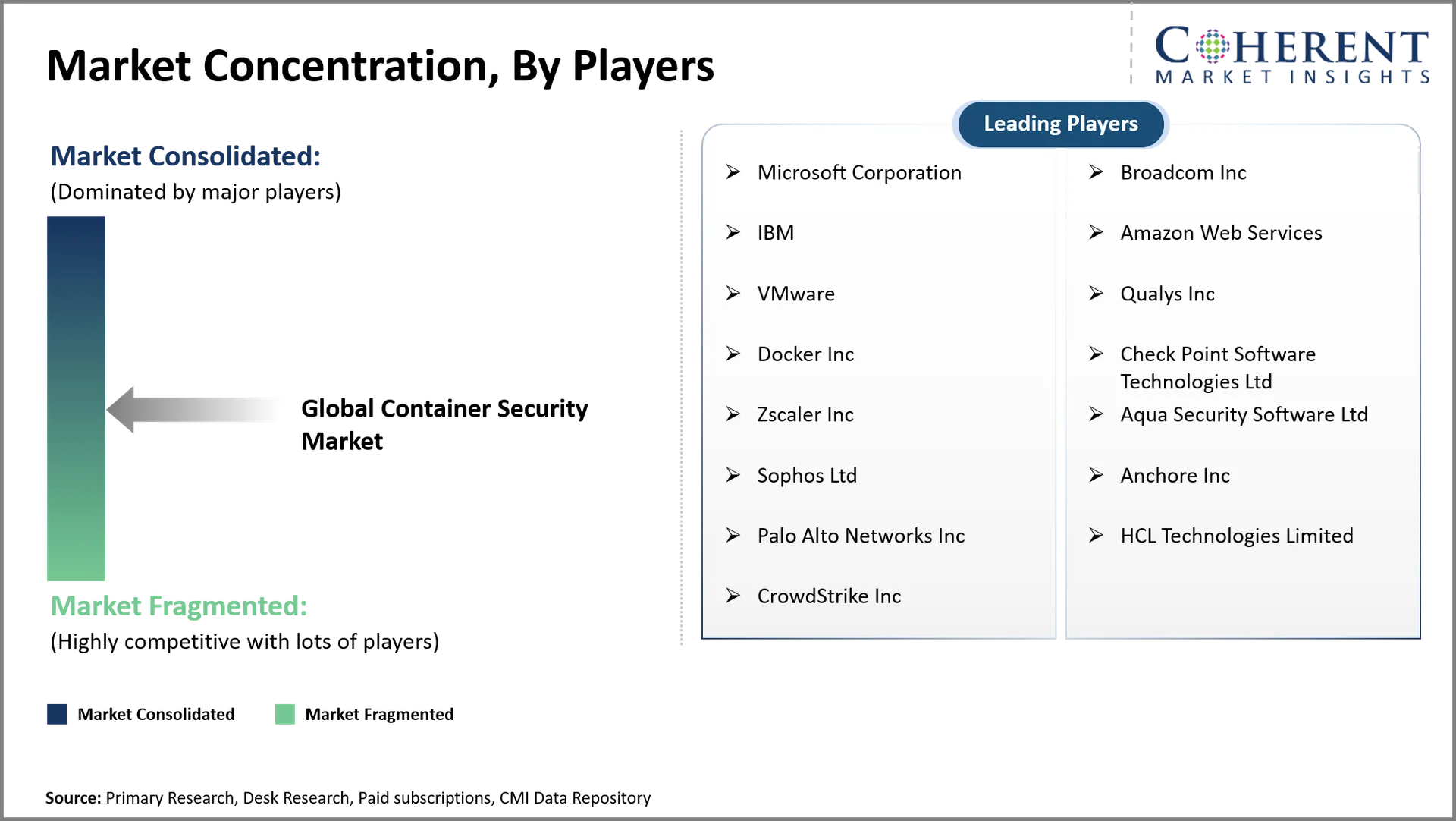
The container security market is moving toward integrated security across development, cloud, Kubernetes and runtime environments. Microsoft’s comprehensive container security offering is Defender for Containers, which offers image scanning, deployment controls, vulnerability assessment, and runtime protection across Azure Kubernetes Service, Amazon Elastic Kubernetes Service, and Google Kubernetes Engine. Palo Alto Networks focuses on defense-in-depth, including runtime protection, image security, network management, and application security. Red Hat is bolstering the secure container supply chain with hardened images, announcing more than 45 images and 150 variants in 2026. IBM, Red Hat, and Palo Alto Networks are also combining vulnerability discovery, virtual patching, and remediation through Project Lightwell.
Market Report Scope
Report Coverage | Details | ||
Base Year | 2025 | Market Size in 2026: | USD 3.80 Bn |
Historical Data For: | 2020 To 2024 | Forecast Period: | 2026 To 2033 |
Forecast Period 2026 To 2033 CAGR: | 15.4% | 2033 Value Projection: | USD 20.00 Bn |
Geographies covered: |
| ||
Segments covered: |
| ||
Companies covered: | Microsoft Corporation, Broadcom Inc, IBM, Amazon Web Services, VMware, Qualys Inc, Docker Inc, Check Point Software Technologies Ltd, Zscaler Inc, Aqua Security Software Ltd, Sophos Ltd, Anchore Inc, Palo Alto Networks Inc, HCL Technologies Limited, CrowdStrike Inc | ||
Growth Drivers: |
| ||
Restraints & Challenges: |
| ||
Analyst Opinion (Expert Opinion)
- The future of container security will center on continuous runtime protection rather than isolated vulnerability scanning. Security platforms will increasingly connect workload behavior, identities, configurations, images, and runtime telemetry. This shift will favor platforms supporting Kubernetes environments across multiple cloud providers and private infrastructure. Agentless discovery and automated controls should become important because they reduce deployment friction across distributed container environments.
- The largest opportunities should emerge in runtime security, Kubernetes security, and software supply chain protection. Post deployment runtime security can detect anomalous processes, network traffic and container modifications. Opportunities for Kubernetes security exist in areas including admission restrictions, workload hardening, privileged-container detection, and configuration governance. Supply chain protection should include signed findings, hardened images, vulnerability prioritization, and deployment gates. The geographically larger North American market should provide considerable prospects as cloud-native security ecosystems are strongly embedded.
- Players seeking an edge should turn to unified platforms rather than independent scanning devices. Microsoft illustrates this technique by combining vulnerability findings with rules for deploying to Kubernetes and runtime protection. Vendors can also beef up integrations with Amazon Elastic Kubernetes Service, Google Kubernetes Engine, Azure Kubernetes Service and private clusters. They should be automating remediation, tying security discoveries back to the developers and security ops teams. Partnerships may push differentiation further, as seen with IBM, Red Hat and Palo Alto Networks combining detection, protection and remediation capabilities.
Speak to the analyst
Want personalized insights?
Take the findings above to one of our principal consultants, or have the report rebuilt around the segments, geographies and competitors you actually track.
Market Segmentation
- Component Insights (Revenue, USD Billion, 2021 - 2033)
- Solution
- Services
- Deployment Type Insights (Revenue, USD Billion, 2021 - 2033)
- Cloud
- On Premise
- Security Function Insights (Revenue, USD Billion, 2021 - 2033)
- Vulnerability Management
- Runtime Management
- Compliance Management
- Authentication Management
- Infrastructure Security Management
- Access Management
- End User Insights (Revenue, USD Billion, 2021 - 2033)
- BFSI
- IT and Telecom
- Retail
- Healthcare
- Manufacturing
- Government
- Others
- Regional Insights (Revenue, USD Billion, 2021 - 2033)
- North America
- U.S.
- Canada
- Latin America
- Brazil
- Argentina
- Mexico
- Rest of Latin America
- Europe
- Germany
- U.K.
- Spain
- France
- Italy
- Russia
- Rest of Europe
- Asia Pacific
- China
- India
- Japan
- Australia
- South Korea
- ASEAN
- Rest of Asia Pacific
- Middle East
- GCC Countries
- Israel
- Rest of Middle East
- Africa
- South Africa
- North Africa
- Central Africa
- North America
- Key Players Insights
- Microsoft Corporation
- Broadcom Inc
- IBM
- Amazon Web Services
- VMware
- Qualys Inc
- Docker Inc
- Check Point Software Technologies Ltd
- Zscaler Inc
- Aqua Security Software Ltd
- Sophos Ltd
- Anchore Inc
- Palo Alto Networks Inc
- HCL Technologies Limited
- CrowdStrike Inc
Sources
Primary Research Interviews
- Container Terminal Operators
- Port Authority Officials & Security Managers
- Logistics & Supply Chain Service Providers
- Customs & Border Protection Officers
Magazines
- Container Management Magazine
- Port Technology International
- Lloyd's List
- Supply Chain Digital
Journals
- Journal of Transportation Security
- International Journal of Shipping and Transport Logistics
- Journal of Maritime Research
Associations
- World Shipping Council (WSC)
- International Association of Ports and Harbors (IAPH)
- Container Security Initiative (CSI) – U.S. Customs and Border Protection
- International Maritime Organization (IMO)
Public Domain Sources
- U.S. Department of Homeland Security (DHS) – Container Security Reports
- United Nations Conference on Trade and Development (UNCTAD)
- World Customs Organization (WCO) Official Publications
- European Maritime Safety Agency (EMSA) Reports
Proprietary Elements
- CMI Data Analytics Tool
- Proprietary CMI Existing Repository of Information for the Last 10 Years
Get access to 250+ pages report
Every segment, forecast, competitor profile and data table behind the analysis above — available for instant download.
- ESOMAR Member
- ISO 9001:2015 Certified
- D-U-N-S Registered
- GDPR & CCPA Compliant
Missing comfort of reading report in your local language? Find your preferred language:
Frequently Asked Questions
The global container security market is expected to stand at USD 3.80 Bn in 2026 and is expected to reach USD 20.00 Bn by 2033.
The CAGR of the global container security market is projected to be 15.4% from 2026 to 2033.
Rising adoption of containerized applications and Increasing Kubernetes deployments are the major factors driving the growth of the global container security market.
High complexity of container security environments and Shortage of skilled cloud security professionals are the major factors hampering the growth of the global container security market.
In terms of component, solution segment is estimated to dominate the market revenue share in 2026.
Container security protects container images, workloads, orchestration platforms, networks, identities, and runtime environments from cyber threats.
Kubernetes security protects clusters, workloads, application programming interfaces, configurations, identities, and control-plane components.