

Global Cooling Blanket Market Size and Forecast – 2026 To 2033
The Global Cooling Blanket Market is estimated to be valued at USD 2.72 Bn in 2026 and is projected to reach USD 4.63 Bn by 2033, registering a CAGR of 7.90% during 2026–2033. As consumer demand for temperature-regulating bedding continues to rise, along with the strong demand for moisture-wicking and breathable fabrics, advanced cooling materials like phase-change materials (PCM) and cool-touch fibers are helping to expand the market.
Adoption across residential, hospitality, senior-living, and wellness applications is creating opportunities for manufacturers to introduce differentiated cooling solutions. In January 2026, researchers at Lawrence Berkeley National Laboratory published a study evaluating a low-power cooling blanket incorporating an electrocaloric heat pump. The research demonstrated its capacity to reduce occupant heat stress during extreme indoor temperatures, pointing to emerging opportunities for energy-efficient personal thermal-management solutions.
Key takeaways of the Global Cooling Blanket Market
- Residential End Use is projected to grow at an analyst-estimated CAGR of 7.8% during 2026–2033 and account for 87.6% of the cooling blanket market in 2026. Its lead reflects blankets’ accessibility as household sleep-comfort products that do not require mattress replacement or powered cooling systems. In March 2024, Bedsure introduced its Breescape Cooling Series, including a cooling blanket and comforter.
- Lightweight Cooling Blankets are expected to record an analyst-estimated CAGR of 8.3% through 2033 and capture 50.4% of the cooling blanket market in 2026. Their low-bulk construction provides coverage without the insulation of conventional bedding, making them suitable for warm sleepers and seasonal use. In August 2026, Good Housekeeping’s testing of 68 cooling blankets included the Luxome Lightweight Cooling Blanket among its recommended picks.
- Online Retail & Direct-to-Consumer is estimated to grow at a CAGR of 8.5% over 2026–2033 and hold 46.8% share of the cooling blanket market in 2026. Digital storefronts enable brands to communicate fabric performance, to compare product formats, and to directly target niche hot sleeper audiences. Dream Valley has introduced its cooling comforter with Outlast technology in March 2024 via its official website and Amazon.
- North America is projected to post an analyst-estimated CAGR of 7.2% during 2026–2033 while retaining 39.2% of global cooling blanket market revenue in 2026. Favorable factors for its lead are its well-established bedding retail base, wide e-commerce access and high consumer familiarity with specialized sleep-comfort products. The company SweetNight announced in August 2026 that they will launch CoolNest cooling pillow and comforter in the U.S. market.
- Europe is expected to hold the second-largest regional share 27.6% of the cooling blanket market in 2026, and will see the highest growth rate in the region at 8.7% CAGR till 2033. Expansion is enabled by need for warm seasons and development of functional textile. In February 2025, German manufacturer IBENA introduced a cooling summer blanket made with high-tech fibers that absorb and release moisture.
Segmental Insights
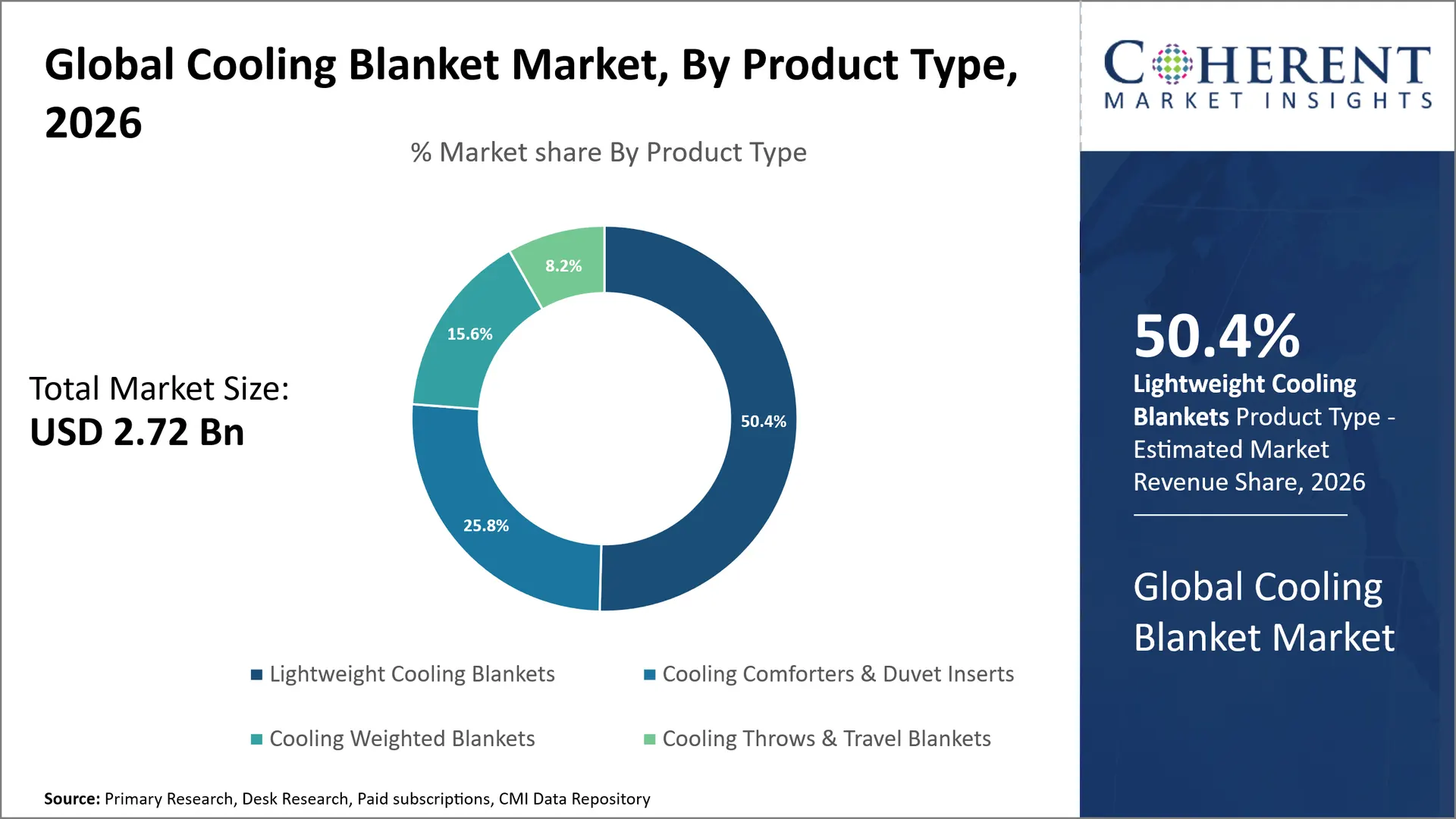
Why Do Lightweight Cooling Blankets Dominate the Product-Type Segment in the Global Cooling Blanket Market?
Lightweight Cooling Blankets are expected to account for 50.4% of the global cooling blanket market in 2026, They have the benefit of offering the cooling effect without the bulk or insulation of traditional comforters or weighted blankets. Consumers can simply layer them over their current bedding or on sofas to expand sales opportunities, and to not need to replace an entire bedding set. Single-layer or low-fill constructions can make manufacturing easier for manufacturers, decrease material waste, and offer a variety of sizes to suit different price points. The structure also works well for seasonal merchandising and compact storage, adding to its desirabilities for home-comfort and sleep-oriented consumers looking for flexibility in their home. In May 2026, Elegear reported that its single-layer Silver-Ion Cooling Blanket received Gold at the American Good Design Award, highlighting the commercial relevance of lightweight, easy-to-use cooling coverage.
- Current Industry Events of 2026
- Market Size Estimation
- Regional Breakdown
- Competitive Landscape
- Customer Intelligence
- Segmental Analysis
- Pricing Analysis
- Key Market Drivers, Challenges & Future Trends
- Customized Insights Section
Why Do Moisture-Wicking & Breathable Fabrics Lead the Cooling-Technology Segment in the Global Cooling Blanket Market?
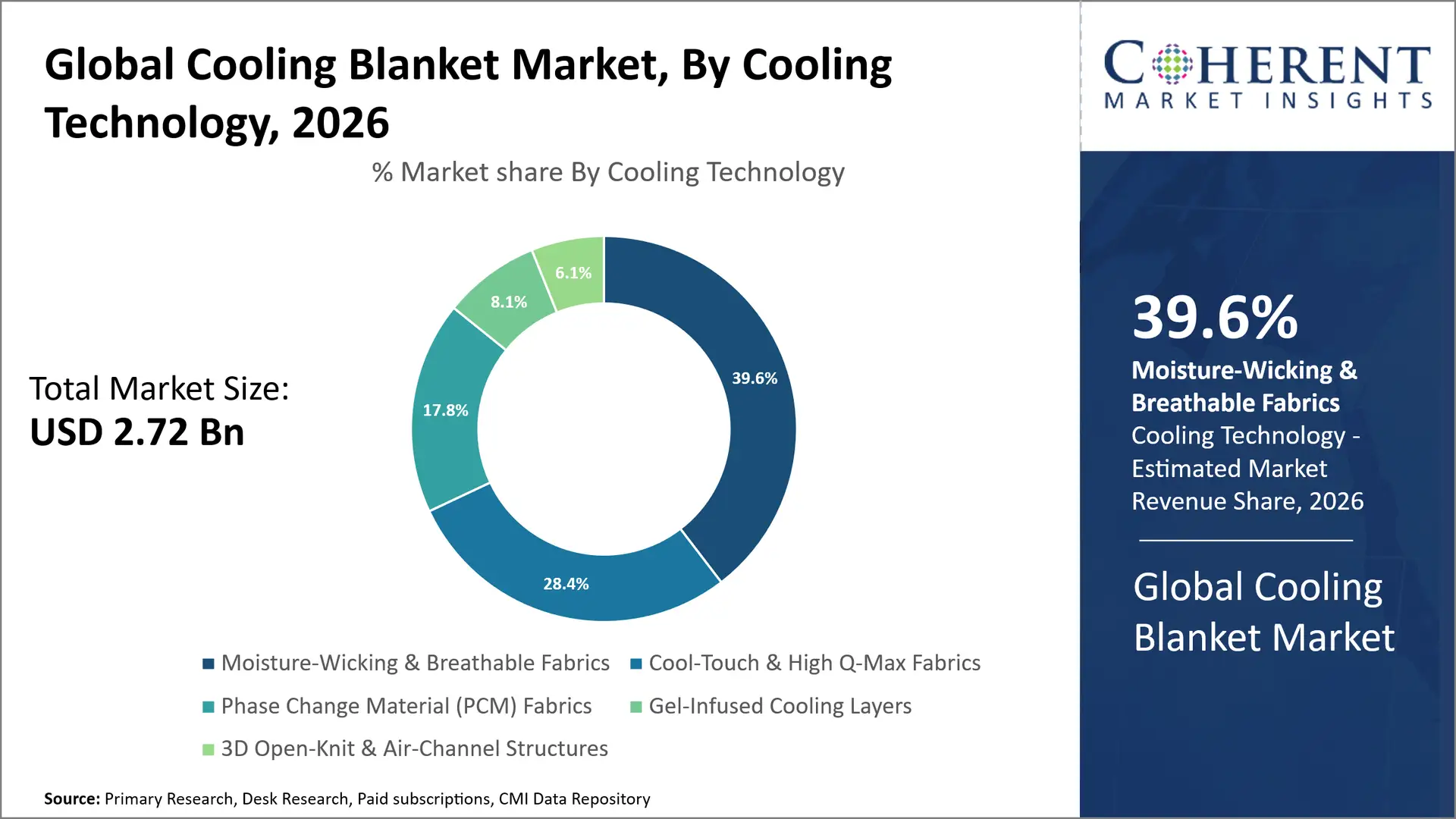
Moisture-Wicking & Breathable Fabrics are expected to hold 39.6% of the global cooling blanket market by cooling technology in 2026, reflecting the importance of sustained moisture control rather than a brief cool-touch effect. These fabrics help to wick sweat away from the body and help it to spread out and dry, which will help to minimize dampness and heat accumulation during long periods of sleep. Their benefits are functional versatility – wicking finishes and breathable structures can be used with a number of Fiber bases and blankets constructions, providing the converter with flexibility in sourcing and production. This technology is applicable to residential bedding and hospitality products that are laundered regularly and need to be comfortable throughout their use. ADVANSA launched Suprelle fiberfill, which uses CiCLO fibers, in September 2026, and a partnership with HeiQ opened the door to making home textile products with cooling and moisture-management properties.
Why Do Nylon & Polyethylene Cooling Fibers Dominate the Material-Type Segment in the Global Cooling Blanket Market?
Nylon & Polyethylene Cooling Fibers are expected to represent 24.8% of the global cooling blanket market by material type in 2026. These synthetic fibers provide a controllable way to provide surface coolness, strength, dimensional stability and repeatable fabric construction to the manufacturers. Polyethylene provides fast heat transfer at skin contact, and nylon provides abrasion resistance, smoothness and structural strength in knitted or woven surfaces. This combination is commercially useful for blanket faces and other high-contact layers that must retain their feel through regular handling and washing. It also gives Fiber producers an opportunity to differentiate through yarn engineering, cooling-performance validation, and branded material supply. In May 2025, Huvis announced stronger authentication measures for Duraron-Cool, its polyethylene-based cooling Fiber used by major Korean bedding brands, responding to imitation products and reinforcing the value of material traceability.
Current Events and their Impact
Current event | Description and its impact |
October 2025 – EU Revised Waste Framework Directive (EU) 2025/1892 |
|
June 2024 – EU Ecodesign for Sustainable Products Regulation (ESPR) |
|
Global Cooling Blanket Market Dynamics
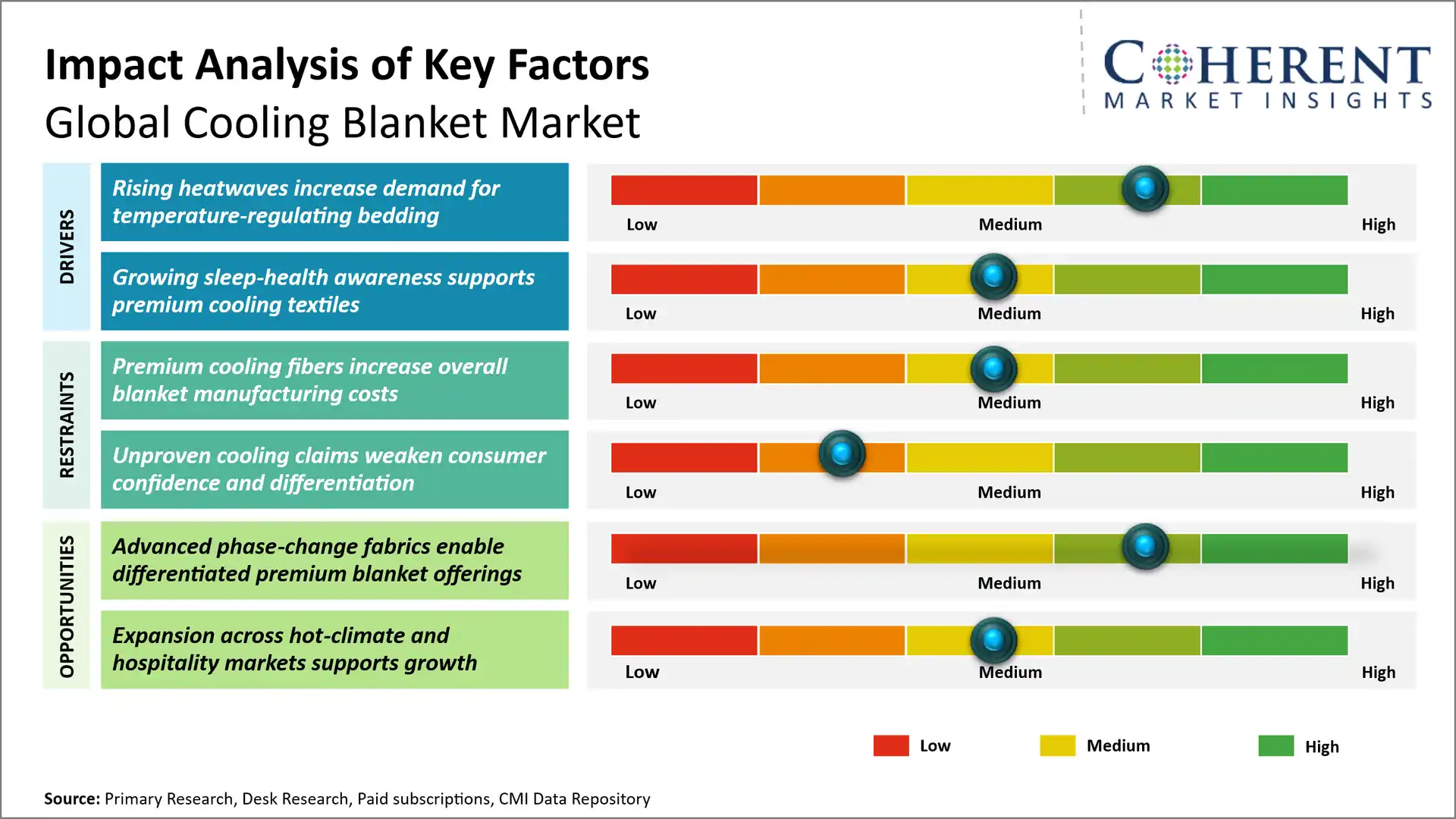
Key Market Drivers
- Rising Heatwaves Increase Demand for Temperature-Regulating Bedding: Increasing nighttime temperatures are making conventional bedding less suitable for consumers who experience overheating during sleep. Lightweight cooling blankets, moisture-wicking fabrics and phase-change material (PCM) bedding offer manufacturers an opportunity to address thermal discomfort without requiring consumers to invest in powered cooling equipment. This creates commercial opportunities for bedding manufacturers, specialty fabric developers and home-textile brands to develop climate-responsive product collections. NOAA’s confirmation in January 2025 that 2024 was the warmest year on record in its global temperature record further highlights the long-term relevance of heat-adaptive household products.
- Growing Sleep-Health Awareness Supports Premium Cooling Textiles: Growing consumer awareness of sleep quality is boosting demand for premium cooling textiles. Consumers are more inclined to think about the performance of bedding rather than esthetics and comfort. The change now enables manufacturers to take advantage of the opportunity to offer breathable constructions, moisture management and temperature regulation materials. Luxury bedding brands can differentiate themselves through fabrics that deliver measurable thermal comfort and skin-contact durability. A study in November 2024 in Building and Environment investigated bedroom environmental conditions and sleep performance; an association was found between the increase of room temperature and decrease of sleep efficiency.
Emerging Market Trends
- Integration of Multi-Functional Cooling and Comfort Properties: Cooling blankets are moving up the ladder to become high-performance bedding products with comfort features like thermal regulation, moisture management, softness, and durability. Fabrics are being developed to give long-term comfort, not just short-term relief. This gives the premium bedding manufacturers and textile suppliers a chance to provide quality, practical textiles.
- Impact: The multi-functional construction of the product increases its differentiation and allows it to be priced at premium. It also broadens the application of products to a wide range of consumer markets and climates.
- Relevance of Market: Manufacturers with state-of-the-art textile engineering and testing capabilities are better positioned to capitalize on this trend. Durability and cooling performance can be shown to improve competitiveness in the residential and hospitality sectors.
- Development of Sustainable and Circular Cooling Bedding: Advanced texture engineering and testing facilities will be able to better capitalize on this trend. Cool ability and durability can be demonstrated and improve the competitiveness in residential and hospitality markets. This supports greater adoption of bamboo-derived viscose, lyocell, recycled synthetic fibers and responsibly sourced blends.
- Impact: Using sustainable materials helps to differentiate the product. It can also enhance the credibility of a brand and meet growing environmental expectations of retailers and consumers.
- Relevance of Market: Suppliers capable of combining cooling performance with recyclable materials may improve their competitive positioning. Investing in responsible sourcing and sustainable product design can also increase readiness to meet changing textile regulations.
Regional Insights
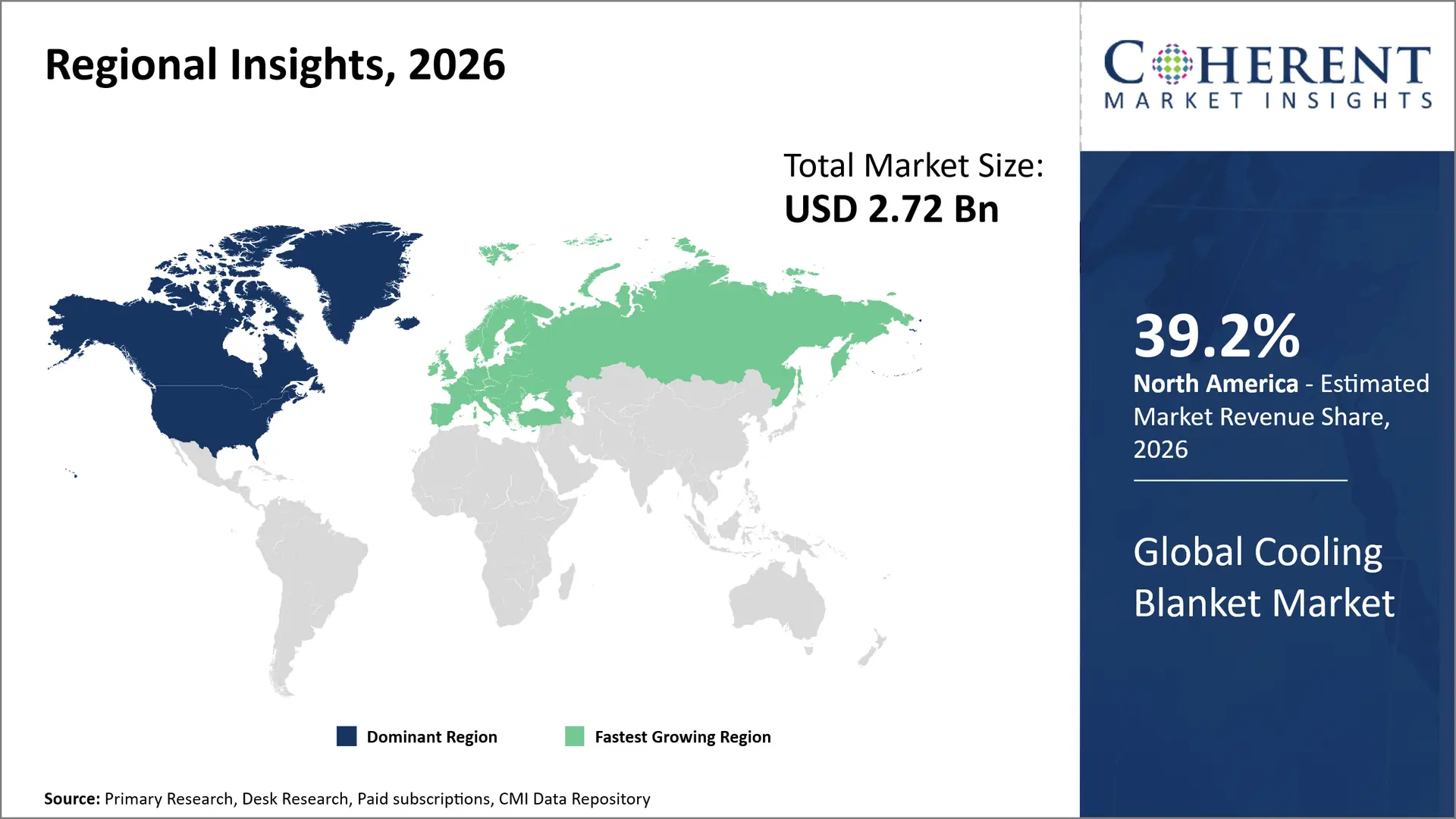
Why Does North America Dominate the Global Cooling Blanket Market?
North America is expected to account for 39.2% of global cooling blanket market revenue in 2026, supported by a mature bedding retail ecosystem, broad consumer access to specialty sleep products, and strong uptake of functional home textiles. The region combines established home-furnishing chains, online-first bedding brands, and specialist sleep retailers, allowing cooling blankets to reach both value-conscious households and premium buyers. Demand also benefits from varied climatic conditions and interest in bedding that manages heat and moisture without active room cooling. In March 2025, U.S.-based BEDGEAR launched its BEDGEAR Home collection, including a Cooling Performance Throw made with cooling fibers designed to absorb and dissipate heat. This illustrates how sleep brands are extending performance fabrics into everyday home bedding.
Why Is Europe Emerging as the Fastest-Growing Region in the Global Cooling Blanket Market?
Europe is the fastest growing region and is expected to hold 27.6% of the global cooling blanket market in 2026. The growth potential is boosted by recurring summer heat, increased focus on sleep microclimates and a regional textile base capable of producing moisture-regulating, breathable and temperature-responsive bedding. Manufacturers can market cooling blankets as seasonal sleep comfort products, differentiating them with material traceability, durability and sustainability credentials that European retailers value. The Copernicus Climate Change Service and the World Meteorological Organization said in April 2025, the Copernicus Climate Change Service and the World Meteorological Organization reported that 2024 was Europe's warmest year on record, with record temperatures across central, eastern, and southeastern Europe. This reinforces the relevance of heat-adaptive bedding across the region.
Global Cooling Blanket Market Outlook for Key Countries
Why Is the U.S. a Key Market for the Global Cooling Blanket Market?
The U.S. is a major market for national cooling blankets because of the availability of a wide variety of specialty bedding brands, large home-furnishing retailers and well-established online shopping platforms for consumers. This distribution structure aids cooling blanket suppliers to communicate technical features such as Q-Max performance, phase change materials and moisture management to both premium and mass market buyers. The country is also a large seasonal and year-round market for sleep-comfort products. In March 2026, the U.S. Census Bureau reported retail e-commerce sales of US$1.2337 trillion in 2025, up 5.4% over 2024, or 16.4% of total retail sales. This wider channel expansion assists niche bedding with product discovery and direct-to-consumer access.
Why Is India Important in the Global Cooling Blanket Market?
India is of note as a textile manufacturing base and as a market for consumer cooling blankets. Warm conditions across many regions create use cases for lightweight, breathable bedding. Local sourcing, private label production and cost-conscious product development are underpinned by established cotton and man-made Fiber capabilities, home-textile clusters and export-oriented suppliers. Affordability, awareness about functional fabrics and availability through e-commerce and organized retail will determine the wider adoption of advanced cooling blankets. In March 2026, India’s Ministry of Textiles announced that textile and readymade-garment exports reached US$35.988 billion in FY2024–25, with significant cotton and man-made textile categories. This reflects the industry base available to support cooling bedding supply and product development.
Why Does China Support Growth in the Global Cooling Blanket Market?
China supports the Global Cooling Blanket Market with large scale textile conversion, integrated Fiber sourcing and OEM/ODM relationships with international bedding brands. It has manufacturing clusters capable of producing a variety of product constructions, from cool-touch fabrics to PCM-filled blankets. Export networks connect producers with North American, European and Asia-Pacific buyers. The competition is increasingly moving beyond low cost output to material innovation, product testing and customized specifications. At the 139th Canton Fair in May 2026, Hangzhou-based home-textile maker SNUG showcased cooling blankets with purported Q-Max values of 0.38-0.40, along with a phase-change-material series. The presentation emphasized China’s role in the development and supply of technically differentiated cooling bedding.
Why Is Germany a Strategic Country in the Global Cooling Blanket Market?
Germany is strategically important thanks to its technical-textile know-how, applied research institutes and quality-conscious home-textile producers. Its role is not limited to domestic consumption but also involves the development and validation of advanced bedding constructions that could be sold in wider European markets. There is a pathway for universities, sleep researchers and textile producers to work together to convert material ideas into commercially viable products. In July 2025, the German Federal Ministry for Economic Affairs and Energy supported the development of a duvet made from three-dimensional spacer fabrics in a project with Hof University of Applied Sciences, the Sleep Medicine Center of the University of Regensburg and industry partners. The construction is made to improve moisture transport and control microclimate of bedding without any electronic components.
Why Is Brazil an Important Growth Market for the Global Cooling Blanket Market?
Brazil is a relevant opportunity given its relevant textile and apparel industry, domestic cotton supply and large household market in warm and humid climate zones. These conditions provide a potential customer base for lightweight blankets and breathable cotton-blend products, and local textile producers have the capacity for fabric sourcing, finishing, and downstream conversion. However, sophisticated cooling constructions may require additional investment in functional finishes, testing and specialized Fiber sourcing. In September 2025, the Cotton Sector Chamber of Brazil’s Ministry of Agriculture released industry indicators showing that textile production rose 11.2% in January–July 2025 compared to the same period in 2024. This points to an active manufacturing base that could support product localization.
Consumer Preference and Product Evolution Landscape in the Global Cooling Blanket Market
Product Development | Operating Principle | Market Application | Commercial Significance |
Moisture-Wicking Fabric Engineering | Uses hydrophilic and moisture-management Fiber structures to move perspiration away from the skin. | Lightweight cooling blankets and everyday bedding. | Supports all-night comfort and differentiation through moisture-management performance. |
High Q-Max Cool-Touch Fabrics | Uses materials with high thermal effusivity to create an immediate cool-to-touch sensation. | Premium cooling blankets and comforters. | Enables measurable fabric-performance positioning and premium product development. |
Phase Change Material (PCM) Integration | Contains materials that absorb, store and release thermal energy during phase change. | High-tech bedding layers and temperature regulating blankets. | Allows for technology led product differentiation and extended life thermal management. |
Gel-Infused Cooling Layers | Incorporates cooling gel components into textile or composite structures to improve heat absorption and distribution. | Layered bedding products and cooling weighted blankets. | Promotes the use of specific constructions for consumers looking for greater thermal comfort. |
3D Open-Knit and Air-Channel Construction | It creates linked spaces in textile structures for air circulation and reduced heat retention. | Lightweight blankets, travel blankets, breathable bedding. | Lets manufacturers offer better ventilation without having to rely on chemical cooling treatments alone. |
Bio-Based and Recycled Cooling Fibers | Uses textile constructions of renewable or recycled fiber inputs, intended to provide thermal and moisture comfort. | Encourages the establishment of sustainability requirements, circularity targets and material differentiation. | Supports material differentiation, circularity objectives and evolving sustainability requirements. |
How Are Hospitality-Specific Thermal Comfort Solutions Creating New Growth Opportunities in the Global Cooling Blanket Market?
The commercial potential for hospitality-focused cooling bedding is largely untapped by manufacturers looking to move beyond the single household purchase. “Bedding for hotels, serviced apartments, resorts and premium accommodation providers needs to ensure guest comfort in a range of climatic conditions and occupancy patterns. Institutional use cooling blankets may also have durable fabric constructions, washable materials, consistent thermal performance and standardized product specifications.
Manufacturers may capitalize on this by partnering with hotel furnishing distributors, through bulk procurement agreements and by creating tailored hospitality collections. If products are developed with replaceable components, clear care instructions and documented performance characteristics, institutional buyers may be more confident in their purchases.
The biggest winners will likely be suppliers with established distribution networks, quality control and scalable production. Smaller specialists can also consider private-label manufacturing and customized product development. The commercial success of the product, however, will depend on the ability to balance the cooling performance with the operational durability, procurement budgets and replacement cycles.
Market Players, Key Developments, and Competitive Intelligence
Key Developments
- In February 2025, Polygiene Group introduced StayCool, a textile treatment designed to provide cooling functionality through interaction with moisture and heat. Its compatibility with cotton, synthetic and recycled fibers create opportunities for bedding manufacturers to integrate additional thermal-comfort properties into existing textile production processes.
- In July 2024, HEST introduced its Cooling Bedding Collection, featuring jade-infused cooling fabric designed to dissipate heat and improve sleeping comfort. This development extends functional cooling bedding into outdoor recreation and portable sleep applications, creating additional product opportunities beyond conventional residential bedding.
Competitive Landscape
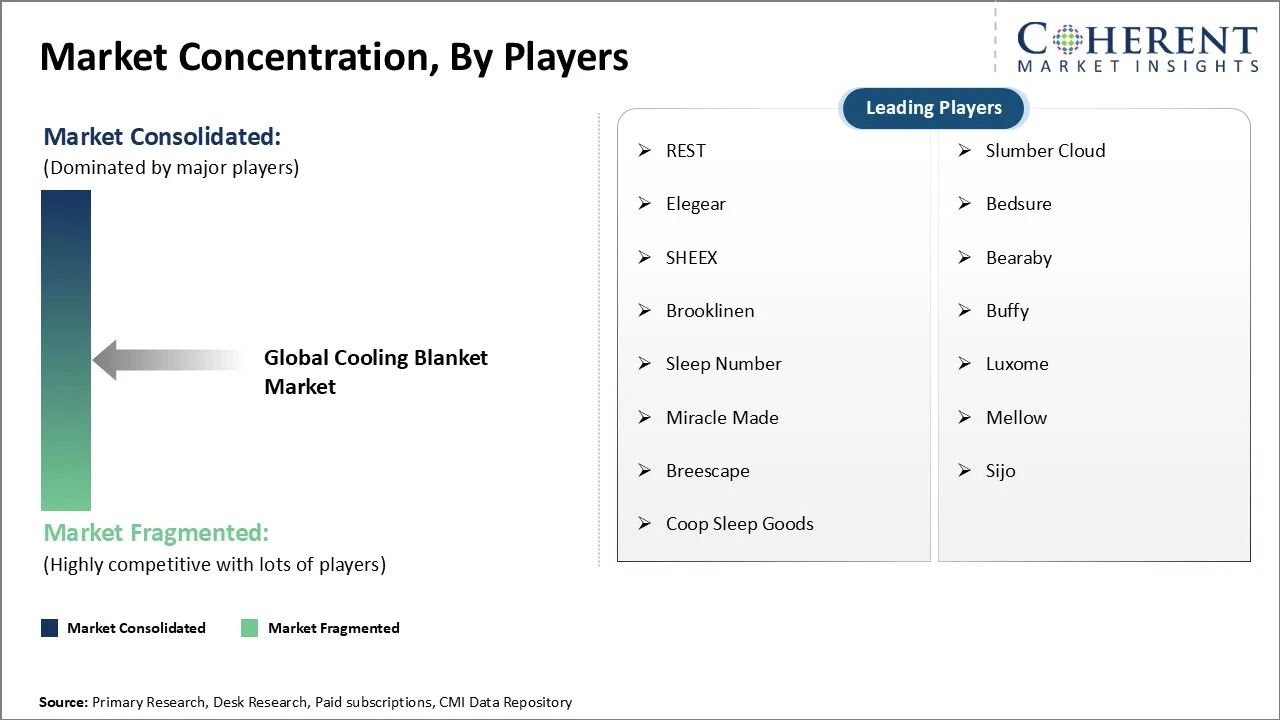
The global cooling blanket market is moderately fragmented, with established home-textile manufacturers, specialty bedding brands, functional-fabric developers and emerging direct-to-consumer companies. The competition is increasingly based on the efficiency of cooling, the choice of materials, the durability of products, the pricing and the positioning of brands. Specialist suppliers compete on the basis of advanced thermal-management technology and proprietary treatments of the textile, while regional manufacturers benefit from local sourcing and access to retail.
Key Competitive Focus Areas
- Cooling performance and measurable thermal efficiency.
- Fabric quality, softness and moisture management.
- Proprietary PCM and cool-touch material technologies.
- Product durability, washability and construction quality.
- Sustainable Fiber sourcing and material traceability.
- Manufacturing scalability and supply-chain reliability.
- E-commerce presence and direct consumer engagement.
- Hospitality procurement and private-label partnerships.
Market Report Scope
Global Cooling Blanket Market Report COverage | |||
Report Coverage | Details | ||
Base Year | 2025 | Market Size in 2026: | USD 2.72 Bn |
Historical Data For: | 2020 to 2024 | Forecast Period: | 2026 to 2033 |
Forecast Period 2026 To 2033 CAGR: | 7.90% | 2033 Value Projection: | USD 4.63 Bn |
Geographies covered: |
| ||
Segments covered: |
| ||
Companies covered: | REST, Slumber Cloud, Elegear, Bedsure, SHEEX, Bearaby, Brooklinen, Buffy, Sleep Number, Luxome, Miracle Made, Mellow, Breescape, Sijo, Coop Sleep Goods | ||
Growth Drivers: |
| ||
Restraints & Challenges: |
| ||
Analyst Opinion (Expert Opinion)
- Future Market Direction: The global cooling blanket market is likely to transition from conventional bedding differentiation toward performance-engineered sleep products. Manufacturers that establish strong capabilities in material customization, thermal testing and product development are likely to gain an advantage over companies competing primarily through price and design.
- Transformative Trend or Disruption: The integration of passive thermal regulation with adaptive textile structures could reshape the competitive environment. Manufacturers capable of developing fabrics that respond to changing body temperature and humidity may challenge conventional cooling blanket designs. This could also increase the importance of partnerships between textile chemical developers, Fiber producers and bedding brands.
- Strategic Priorities, Risks and Recommendations: Companies should prioritize proprietary cooling formulations, Fiber diversification, wash-performance testing and scalable manufacturing. Greater attention should be given to hospitality procurement and customized product specifications. However, manufacturers should avoid excessive investment in expensive cooling technologies without demonstrating meaningful performance improvements. Material sourcing risks, production costs and product durability should remain central to investment decisions.
Speak to the analyst
Want personalized insights?
Take the findings above to one of our principal consultants, or have the report rebuilt around the segments, geographies and competitors you actually track.
Market Segmentation
- Product Type Insights (Revenue, USD Bn, 2021 - 2033)
- Lightweight Cooling Blankets
- Cooling Comforters & Duvet Inserts
- Cooling Weighted Blankets
- Cooling Throws & Travel Blankets
- Cooling Technology Insights (Revenue, USD Bn, 2021 - 2033)
- Moisture-Wicking & Breathable Fabrics
- Cool-Touch & High Q-Max Fabrics
- Phase Change Material (PCM) Fabrics
- Gel-Infused Cooling Layers
- 3D Open-Knit & Air-Channel Structures
- Material Type Insights (Revenue, USD Bn, 2021 - 2033)
- Nylon & Polyethylene Cooling Fibers
- Bamboo-Derived Viscose
- TENCEL & Lyocell Fibers
- Cotton & Cotton Blends
- Polyester & Microfiber
- Other Material Blends
- End Use Insights (Revenue, USD Bn, 2021 - 2033)
- Residential
- Hospitality & Hotels
- Senior Living & Wellness Facilities
- Distribution Channel Insights (Revenue, USD Bn, 2021 - 2033)
- Online Retail & Direct-to-Consumer
- Specialty Bedding & Home Stores
- Mass Merchandisers & Department Stores
- Other Distribution Channels
- Regional Insights (Revenue, USD Bn, 2021 - 2033)
- North America
- U.S.
- Canada
- Latin America
- Brazil
- Argentina
- Mexico
- Rest of Latin America
- Europe
- Germany
- U.K.
- Spain
- France
- Italy
- Russia
- Rest of Europe
- Asia Pacific
- China
- India
- Japan
- Australia
- South Korea
- ASEAN
- Rest of Asia Pacific
- Middle East
- GCC Countries
- Israel
- Rest of Middle East
- Africa
- South Africa
- North Africa
- Central Africa
- North America
- Key Players Insights
- REST
- Slumber Cloud
- Elegear
- Bedsure
- SHEEX
- Bearaby
- Brooklinen
- Buffy
- Sleep Number
- Luxome
- Miracle Made
- Mellow
- Breescape
- Sijo
- Coop Sleep Goods
Sources
Primary Research Interviews
- Cooling blanket manufacturers, bedding brands, and specialty textile producers
- Cooling fibre developers, functional fabric manufacturers, and textile technology suppliers
- Product development managers, sourcing executives, and procurement specialists
- E-commerce retailers, specialty bedding distributors, and hospitality procurement managers
- Textile testing experts and thermal-comfort research specialists
Stakeholders
- Cooling blanket and comforter manufacturers
- Nylon, polyethylene, bamboo viscose, lyocell, cotton, and polyester fibre suppliers
- Phase-change material (PCM), gel-infused material, and cool-touch fabric developers
- Moisture-wicking textile manufacturers and functional fabric processors
- Textile finishers, bedding component suppliers, and contract manufacturers
- Packaging providers, testing laboratories, and home-textile distributors
End-use Sectors
- Residential: Household bedding, lightweight cooling blankets, cooling comforters, and weighted blankets
- Hospitality & Hotels: Hotel bedding, guest-room blankets, and premium sleep-comfort products
- Senior Living & Wellness Facilities: Temperature-regulating bedding and specialized comfort products
- Other Applications: Travel blankets, portable cooling blankets, and specialized sleep-comfort products
Regulatory and Industry Bodies
- U.S. Consumer Product Safety Commission (CPSC)
- U.S. Federal Trade Commission (FTC)
- European Commission and European Chemicals Agency (ECHA)
- U.S. Environmental Protection Agency (EPA)
- Bureau of Indian Standards (BIS)
- Ministry of Textiles, India
- China National Textile and Apparel Council (CNTAC)
- International Organization for Standardization (ISO)
Databases
- UN Comtrade and ITC Trade Map
- Eurostat COMEXT and PRODCOM
- U.S. Census Bureau Foreign Trade Statistics
- USITC DataWeb
- India TradeStat and Directorate General of Commercial Intelligence and Statistics (DGCI&S)
- China Customs Trade Statistics
- World Bank Open Data
Magazines and Journals
- Textile Research Journal
- Journal of Industrial Textiles
- Textile Research and Technology
- Journal of Engineered Fibers and Fabrics
- Journal of Materials Science
- Fibers and Polymers
- Textile World
- Home Textiles Today
- Sleep Review
- Technical Textiles International
Associations
- International Textile Manufacturers Federation (ITMF)
- European Apparel and Textile Confederation (EURATEX)
- National Council of Textile Organizations (NCTO), U.S.
- The Home Furnishings Association (HFA)
- American Home Furnishings Alliance (AHFA)
- Cotton Incorporated
- Textile Exchange
- International Textile and Apparel Association (ITAA)
- Indian Technical Textile Association (ITTA)
Public Domain Sources
- Cooling blanket product catalogues, technical datasheets, and material specifications
- Fibre composition, thermal conductivity, Q-Max values, moisture-wicking performance, and breathability specifications
- Company annual reports, product launches, patents, manufacturing investments, and capacity expansions
- Retail product listings, pricing information, customer reviews, and distribution-channel disclosures
- Research publications covering phase-change materials, thermal-regulating textiles, cooling fibers, and moisture-management technologies
- Import-export statistics, textile production data, and household textile consumption indicators
Key Standards and Regulations
- EU Regulation (EU) 2024/1781 – Ecodesign for Sustainable Products Regulation (ESPR)
- EU Directive (EU) 2025/1892 – Revised Waste Framework Directive and Textile EPR
- EU Regulation (EC) No. 1907/2006 – REACH
- EU Regulation (EC) No. 1272/2008 – Classification, Labelling and Packaging (CLP)
- U.S. Consumer Product Safety Improvement Act (CPSIA), where applicable
- U.S. Textile Fiber Products Identification Act – Textile Fibre Labelling Requirements
- U.S. Flammable Fabrics Act (FFA), where applicable
- India Bureau of Indian Standards (BIS) – Applicable textile product standards
- China GB/T National Standards – Applicable textile safety and performance requirements
- ISO 3758 – Textiles: Care Labelling Code Using Symbols
- ISO 12947 – Textiles: Determination of Abrasion Resistance
- ISO 11092 – Measurement of Thermal and Water-Vapour Resistance
- ISO 139 – Standard Atmospheres for Conditioning and Testing Textiles
Proprietary Elements
- CMI Data Analytics Tool
- Proprietary research repository, supported by primary interviews, cooling fibre cost and composition analysis, thermal-performance benchmarking, manufacturing capacity assessment, market sizing, average selling price (ASP) analysis, trade evaluation, distribution-channel assessment, and competitive intelligence.
Get access to 250+ pages report
Every segment, forecast, competitor profile and data table behind the analysis above — available for instant download.
- ESOMAR Member
- ISO 9001:2015 Certified
- D-U-N-S Registered
- GDPR & CCPA Compliant
Frequently Asked Questions
The CAGR of the global cooling blanket market is projected to be 7.90% from 2026 to 2033.
The global cooling blanket market is estimated to be valued at USD 2.72 Bn in 2026 and is projected to reach USD 4.63 Bn by 2033.
Common technologies include moisture-wicking fabrics, cool-touch Q-Max materials, phase-change materials (PCM), gel-infused layers, and 3D open-knit structures.
Manufacturers commonly use nylon, polyethylene, bamboo-derived viscose, TENCEL, lyocell, cotton blends, polyester, and microfiber.
Consumers should evaluate cooling performance, breathability, fabric softness, moisture management, durability, washability, and suitability for their sleeping environment.
Major end users include residential households, hotels and hospitality businesses, and senior-living and wellness facilities.
Rising heatwaves are increasing demand for temperature-regulating bedding, while growing awareness of sleep health is encouraging consumers to invest in premium cooling textiles. Together, these factors are supporting the growth of the global cooling blanket market.