

Global Corporate Performance Management Market Forecast – 2026 To 2033
The global corporate performance management market is expected to grow from USD 13.40 Bn in 2026 to USD 26.00 Bn by 2033, registering a compound annual growth rate (CAGR) of 8.0% from 2026 to 2033. The global corporate performance management market is driven by Growing use of predictive analytics and artificial intelligence. On April 3, 2024, Vena announced that it is bringing state-of-the-art generative artificial intelligence (AI) capabilities to financial planning and analysis (FP&A) teams with Vena Copilot. Vena Copilot for FP&A combines Vena’s category-leading FP&A expertise with Microsoft Azure OpenAI Service large language models, including GPT-4, to help FP&A teams and their collaborators increase productivity, operational efficiency, and business agility.
Key Takeaways of the Global Corporate Performance Management Market
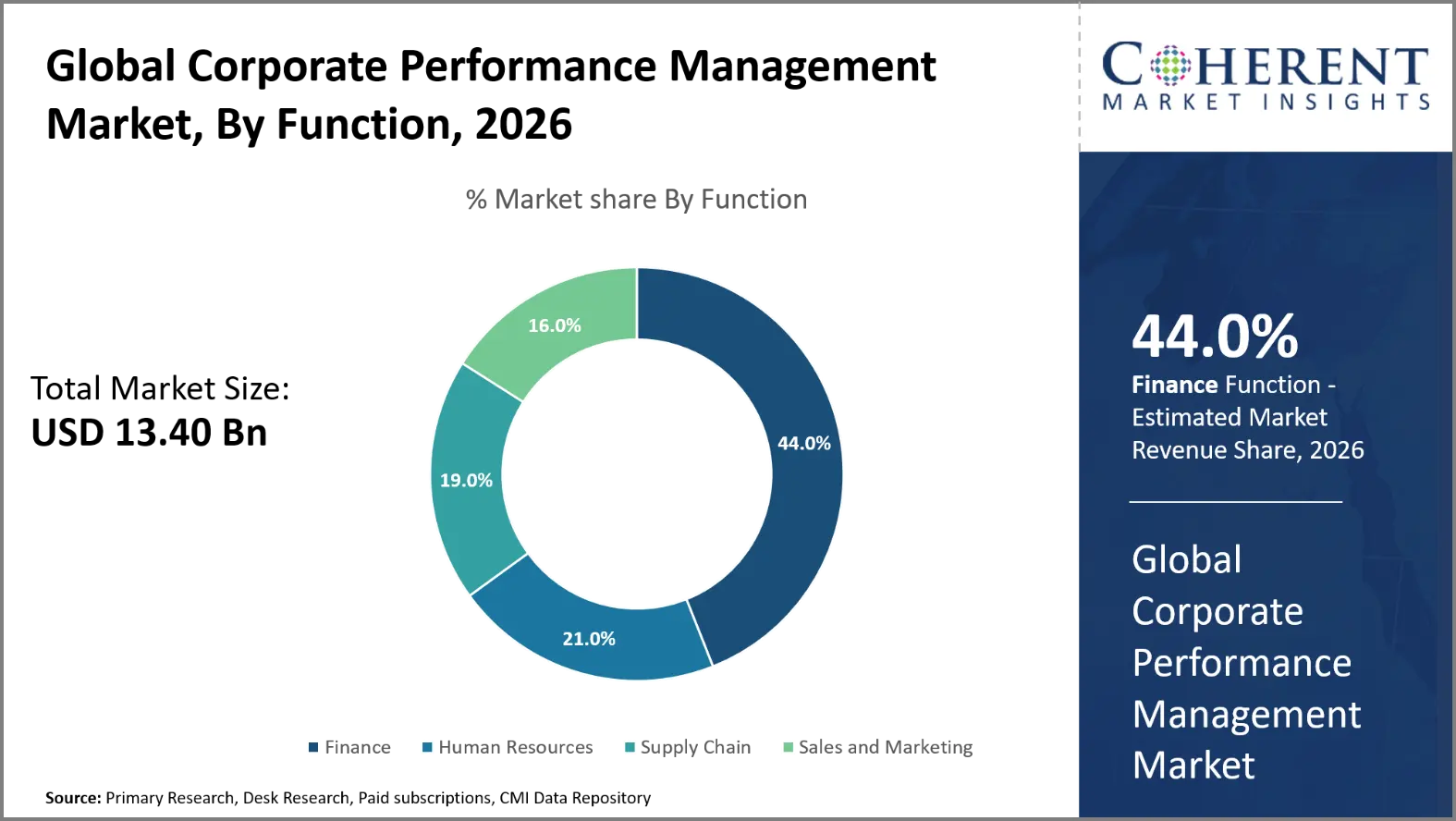
- The Finance segment is expected to account for 44.0% of the global corporate performance management market share in 2026. Increasing complexity of enterprise data is driving the growth of the segment. SAP expanded SAP Business Data Cloud to unify data from SAP applications and external sources in 2025. The platform provides governed data products for analytics and artificial intelligence.
- The Cloud segment is estimated to capture 68.0% of the market share in 2026. Rising need for real time performance monitoring is majorly driving the growth of the segment. Microsoft expanded real-time intelligence capabilities within Microsoft Fabric. The capabilities allow organizations to process streaming information and monitor changing business conditions.
- The BFSI segment is estimated to capture 29.0% of the market share in 2026. Growing demand for connected operational planning is driving the growth of the segment. In June 2026, Anaplan announced its Agentic Enterprise strategy covering finance, supply chain, sales, and human resources.
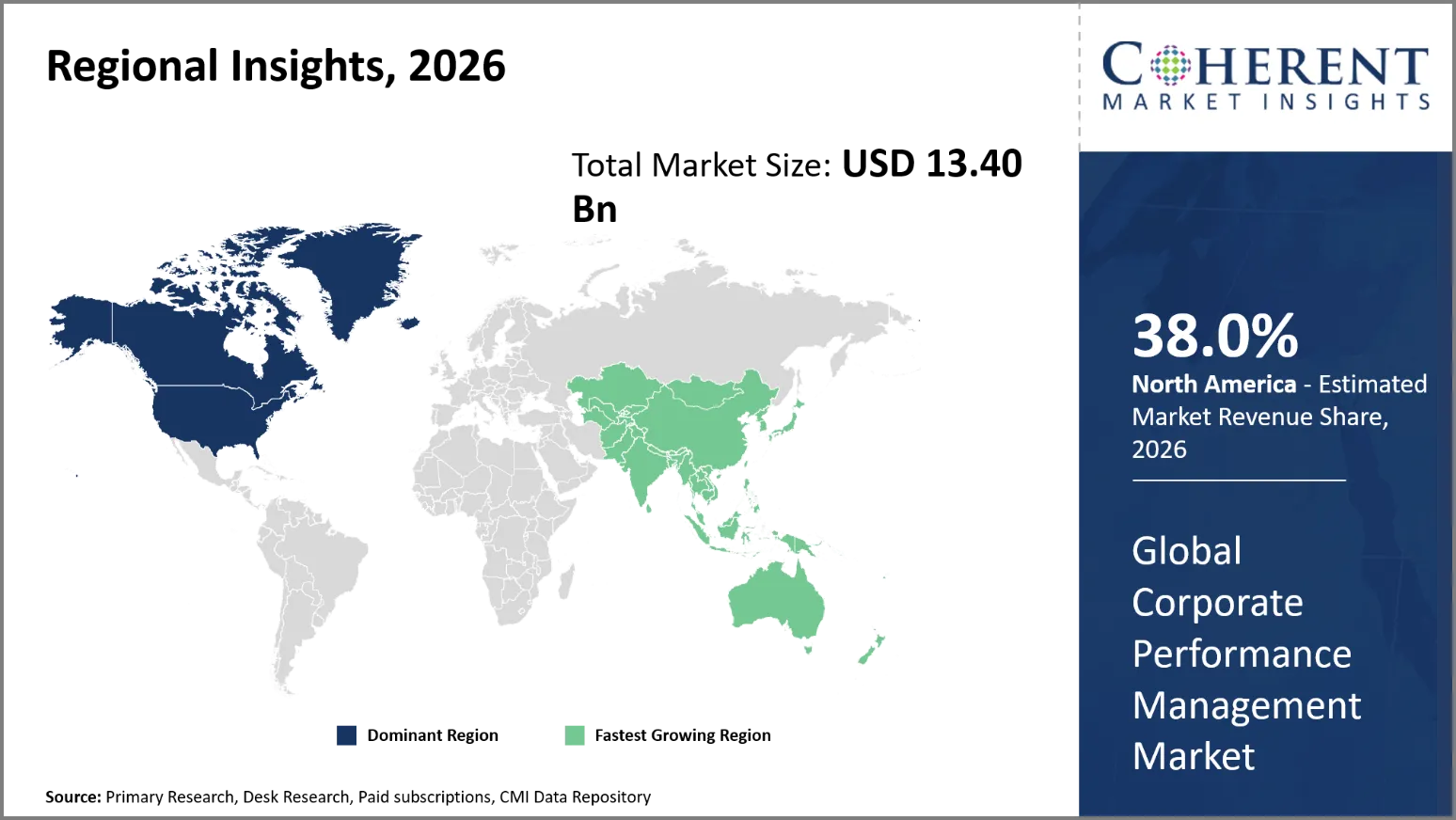
- North America is expected to dominate the corporate performance management market in 2026 with a market share of 38.0%. Expansion among small and medium enterprises in North America is driving the growth of the regional market. On May 6, 2025, Board announced an expanded collaboration with Microsoft to drive its expansion in North America. The deal included collaborative go-to-market strategies and deeper Microsoft Azure integration.
- Asia Pacific is expected to account for 21.0% share in 2026. Increasing adoption across emerging economies in Asia Pacific is driving the growth of the regional market. On April 8, 2025, Oracle NetSuite introduced Enterprise Performance Management in Singapore. The offering combines planning, budgeting, forecasting, account reconciliation, and financial reporting.
Segmental Insights
Why Does Finance Dominate the Global Corporate Performance Management Market?
The finance segment is expected to account for 44.0% of the global corporate performance management market share in 2026. Finance takes the lead because corporate performance management is tightly integrated with fundamental financial planning and control procedures. Finance teams are responsible for budgeting, forecasting, consolidation, reporting, profitability analysis and evaluation of financial performance. These efforts support the adoption of Corporate Performance Management throughout organizations. Integrated platforms link financial strategies with operational data and strategic objectives. This allows financial teams to compare actual performance against budgets, forecasts and strategic aims. Financial consolidation also creates strong demand because organizations require accurate and controlled financial reporting.
On May 13, 2025, OneStream, announced the release of new SensibleAI capabilities at its Splash 2025 user conference; SensibleAI Agents, SensibleAI Studio and SensibleAI Account Reconciliations and the most advanced SensibleAI Forecast. The SensibleAI solutions are infused throughout the OneStream platform across planning & forecasting, close & consolidations, and reporting & analytics processes.
- Current Industry Events of 2026
- Market Size Estimation
- Regional Breakdown
- Competitive Landscape
- Customer Intelligence
- Segmental Analysis
- Pricing Analysis
- Key Market Drivers, Challenges & Future Trends
- Customized Insights Section
Why is Cloud the Most Preferred Deployment Type?
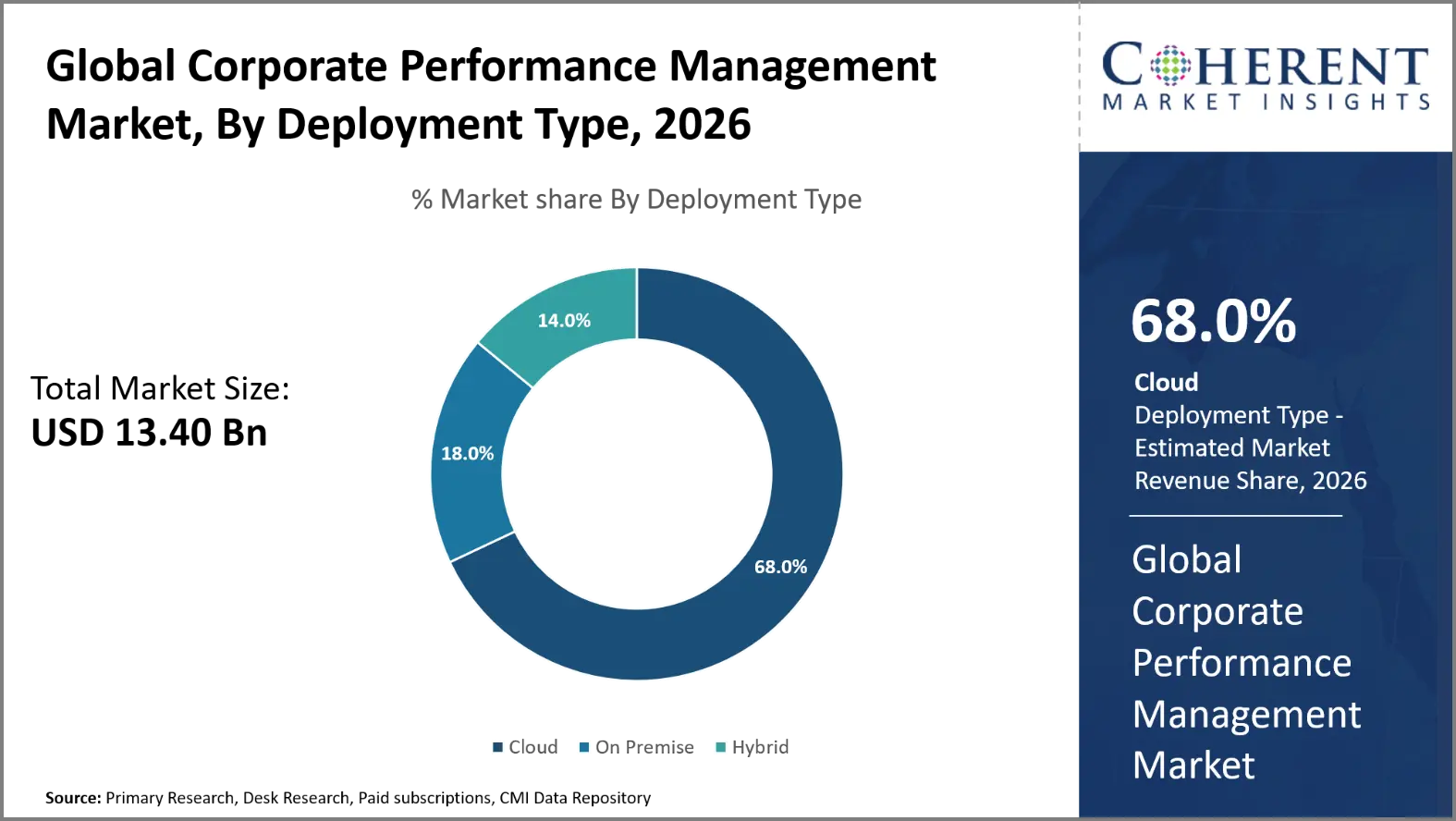
The cloud segment is expected to account for 68.0% of the global corporate performance management market share in 2026. Cloud is the most favored method of deployment as it enables scalability, accessibility, integration and deployment flexibility. Cloud systems offer finance teams access to planning and performance information from remote company processes. They also make software updates easier and lessen the need to manage infrastructure in-house. This enables firms with centralized cloud systems to connect financial planning to operational planning. Cloud adoption enables faster adjustments of forecasts and scenario modeling as business conditions change. In addition, connection with enterprise resource planning systems ensures data consistency throughout planning and reporting processes.
On January 14, 2025, Prophix announced immediate availability of Prophix One FP&A Plus, the newest financial planning and analysis application for Prophix One, a Financial Performance Platform. This redefines the standard for financial planning solutions by bringing together the latest in cloud computing and superior database technology with a seamless user experience to empower finance teams to work quicker, plan better and dream bigger than ever before.
BFSI Dominates the Global Corporate Performance Management Market
The BFSI segment is expected to account for 29.0% of the global corporate performance management market share in 2026. Banking, financial services, and insurance organizations have complex financial structures and large performance requirements. The organizations assess profitability, liquidity, capital requirements, risk-adjusted performance and financial exposures on an ongoing basis. Banks need to prepare their balance sheets, income statements, funding circumstances, assets, liabilities and lending activities in detail. Corporate performance management platforms can connect such financial planning needs with broader organizational objectives. The demand for reliable financial information, the supervision of reporting and the standardization of consolidation processes is also driven by regulatory restrictions. Insurance companies also need to be able to plan financially, measure profitability, assess risk and report to authorities.
On March 3, 2025, OCBC, Southeast Asia’s second largest financial services company by assets, selected Oracle Fusion Cloud Enterprise Resource Planning (ERP) to help achieve its mission to empower people and communities to reach their ambitions. As OCBC grows its network across ASEAN and Greater China, it has linked its global finance platform with Oracle Cloud ERP to drive efficiency and better decision-making.
Current Events and their Impact
Current Events | Description and its Impact |
European Union Artificial Intelligence Act Regulation (EU) 2024/1689 |
|
European Union Corporate Sustainability Reporting Amendment Directive (EU) 2026/470 |
|
Corporate Performance Management Market Dynamics
Market Drivers
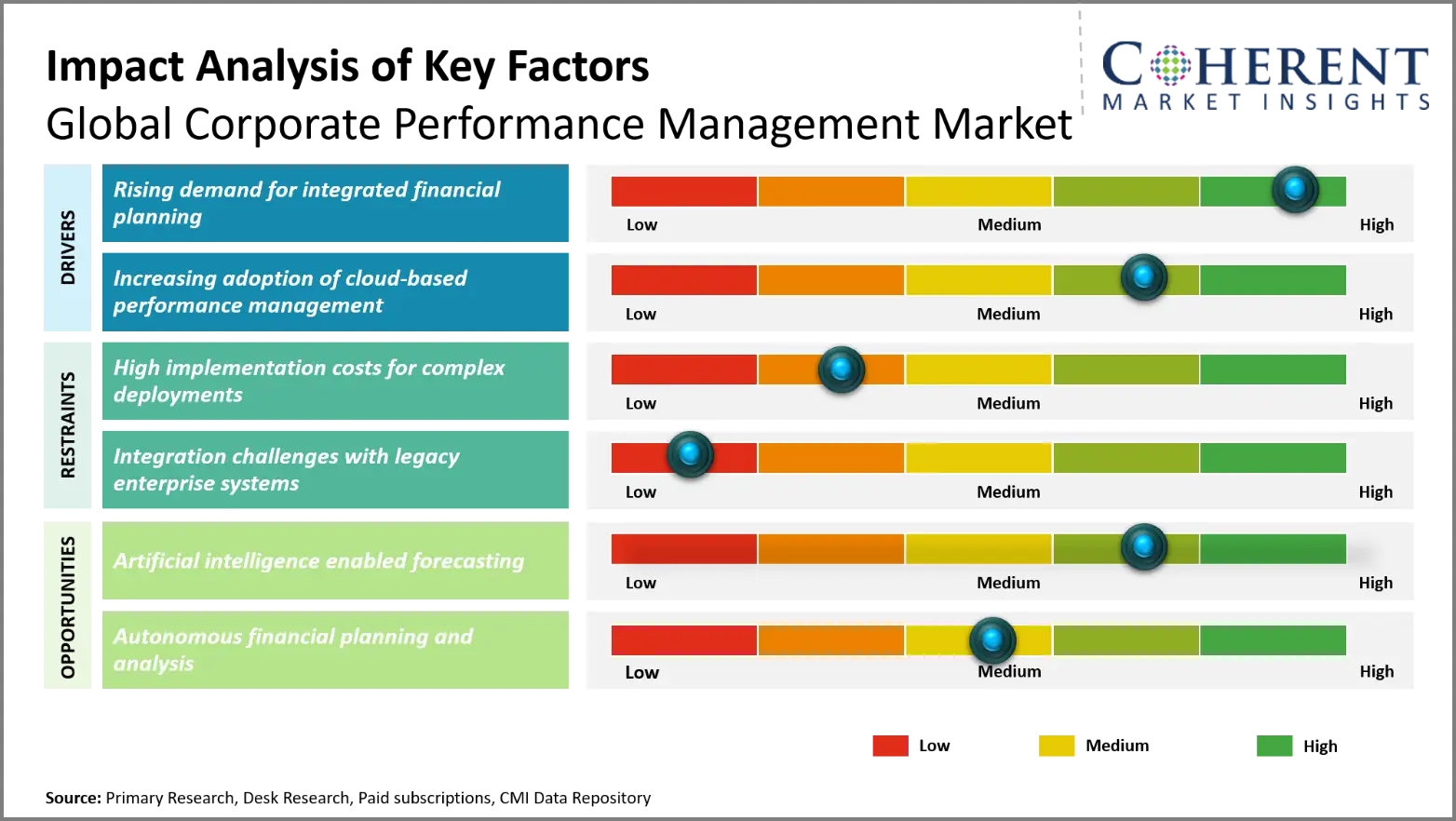
- Rising demand for integrated financial planning: Organizations are demanding more integrated financial planning linking budgets, projections, financial statements and operational goals. In order for finance teams to improve the accuracy of planning and resource allocation, they need precise data from other departments. Integrated systems centralize planning by collecting financial and operational data. They also assist in the implementation of scenario analysis when economic conditions, costs or business priorities change. It breaks down silos and drives collaboration between finance and business through connected planning. As organizations’ systems get more complicated, the demand for integrated planning functionality grows. These are some of the reasons firms are adopting corporate performance management for faster, more coordinated financial decision making.
- On June 3, 2026, Anaplan announced that Indiana University (IU) selected Anaplan to transform its core financial planning processes and deliver a single source of truth for planning across the university. With nine campuses and more than 400 users, IU had an operational budget of USD 4.5 billion and major problems with its outdated technologies.
- Increasing adoption of cloud-based performance management: Cloud platforms provide scalable and accessible planning environments, and enterprises are increasingly adopting cloud-based performance management. Finance teams can collaborate across locations with minimal to no internal infrastructure. Cloud platforms also make it easier to update software, maintain systems and integrate with enterprise applications. They provide a centralized access to budget, forecast, report and performance information. The increasing need for real-time analytics makes it more likely for enterprises to go to cloud systems.
- On April 29, 2026, Planful Inc., a leader in cloud software for financial performance management, announced the general availability of Planful AI Planner Assistant. This conversational interface gives information for future thinking planning and forecasting.
Emerging Trends
- Artificial Intelligence-Enabled Forecasting: Corporate performance management solutions are making greater use of artificial intelligence to do predictive forecasting, anomaly detection, scenario modeling, and automated suggestions. These features help finance teams analyze complex facts, find changing business trends and accelerate planning decisions across corporate processes.
- Continuous Planning and Forecasting: Businesses are shifting from periodic budgets toward ongoing planning models that incorporate operational and financial data updated at short timeframes. This allows finance teams to update projections, assess new risks and reallocate assets when business conditions change.
- Integrated Financial and Operational Planning: Companies are increasingly combining financial planning with sales, personnel, supply chain and operational planning. These tools combined provide a greater understanding of performance and assist organizations to examine the impact of operational changes on financial performance, profitability, resource requirements and strategic objectives.
- Sustainability Performance Management: The growing number of reporting requirements and stakeholder expectations have pushed organizations to embed sustainability indicators in broader performance management frameworks. More and more systems are tying environmental and social data to financial planning, so that businesses may measure sustainability targets alongside standard economic metrics.
Regional Insights
Why is North America a Strong Market for Corporate Performance Management?
North America is expected to account for a market share of 38.0% in 2026. Large scale investment in cloud infrastructure and established enterprise finance technologies helps North America. The U.S. Bureau of Economic Analysis issued a slew of data on data-center investment in 2025. The move comes as infrastructure for artificial intelligence and cloud computing expands. Canada also enhanced unified cloud procurement through Shared Services Canada. Its cloud services served 91 entities including 43 federal partners. Cloud usage has reached high levels by FY 2022-2023. These developments are fueling demand for integrated planning, financial consolidation, forecasting and performance analytics. The region also benefits from sophisticated enterprise software ecosystems and strong adoption among multinational corporations.
Why Does Asia Pacific Corporate Performance Management Market Exhibit High Growth?
Asia Pacific is expected to register the fastest growth with a CAGR of 8.7% over the forecast period and is projected to account for 21.0% of the global corporate performance management market in 2026. Asia Pacific is expanding corporate performance management adoption through accelerated enterprise digitalization and financial technology investment. China reported 15.2% growth in information technology investment among above-scale enterprises during 2023. Moreover, 37.6% of these firms adopted cloud computing. More than 90% used digital tools in the areas of finance, human resources, decision making and security. In India, the Reserve Bank of India established initiatives supporting cloud infrastructure for financial institutions. The platform includes infrastructure, software, storage, disaster recovery, and application performance services. These developments strengthen demand for integrated financial planning and digital performance management.
Global Corporate Performance Management Market Outlook for Key Countries
Why is U.S. Emerging as a Major Hub in the Corporate Performance Management Market?
The U.S. corporate performance management market benefits from extensive adoption of advanced enterprise technologies and data-intensive financial operations. Adoption of artificial intelligence is closely linked to the usage of cloud computing and specialized software, according to research by the U.S. Census Bureau. 86% of artificial intelligence users also used cloud computing. Adoption is higher in large firms. Integration expenses are in favor of larger organizations. The U.S. Bureau of Economic Analysis is separately tracking business investment in data centers. These facilities support cloud computing, artificial intelligence, networking, and data storage. This infrastructure upgrade offers advanced forecasting, analytics, consolidation and enterprise planning applications.
Is China the Next Growth Engine for the Corporate Performance Management Market?
The strong demand for corporate performance management is driven by the enterprise-wide digital transformation in China. In 2023, the number of surveyed corporate entities totaled 1.482 million, according to the Fifth National Economic Census. Above-scale enterprises’ investment in information technology rose by 15.2% year-on-year. Adoption of cloud computing was 37.6% and 97.2% used information management systems. Digital technology was also widely used in financial management and decision making. Another key application base is China's financial sector with 107,000 finance businesses employing 12.355 million people. These developments support integrated budgeting, financial analysis, operational planning and performance monitoring inside large enterprises.
Germany Corporate Performance Management Market Analysis and Trends
The modernization of finance and accounting with cloud solutions is a key enabler for the adoption of corporate performance management in Germany. According to Destatis, 54% of German firms used paid cloud services in 2025. Adoption reached 86% among enterprises employing at least 250 people. Finance and accounting software represented a particularly important cloud application, used by 58% of enterprises purchasing cloud services. Enterprise resource planning software was used by 23% of those enterprises. Germany also recorded 26% enterprise artificial intelligence adoption in 2025. These developments support demand for connected budgeting, forecasting, financial reporting, and performance analytics.
U.K. Corporate Performance Management Market Analysis and Trends
The UK Government driven cloud modernization and more advanced performance management methods are supporting the business performance management sector. The Government’s Cloud First policy mandates enterprises to examine cloud computing solutions before considering other delivery options. The 2026 UK Business Data Survey indicated that 31% of enterprises used public cloud providers. Large enterprises demonstrated 60% public-cloud use, indicating enhanced enterprise digitization. Third-party software and web-based data management was a particular favorite among finance and insurance organizations at 52%. Companies House is also migrating its corporate finance solution to the cloud. These developments directly strengthen demand for cloud-based planning and financial performance systems.
India Corporate Performance Management Market Analysis and Trends
India is developing a distinctive corporate performance management ecosystem through financial digitalization and public digital infrastructure. The Reserve Bank of India reported increasing adoption of artificial intelligence, big data, application programming interfaces, and cloud computing across financial institutions. India’s cloud initiative addresses security, scalability, privacy and business continuity for workloads in the financial sector. As of March 2025, the Unified Lending Interface has 44 collaborating lenders and more than 60 data services. These skills give rise to broad requirements for financial planning, risk analysis, operational monitoring and automated decision support. India’s burgeoning technology services ecosystem is another boon for business performance management deployment.
Global Corporate Performance Management Market - Continuous Planning and Rolling Forecast Adoption (2025)
Planning and Forecasting Metric | Adoption Share |
Monthly reforecasting | 46% |
Quarterly reforecasting | 40% |
On-demand or daily reforecasting | 7% |
Rolling forecasts | 46% |
Rolling or continuously adaptive annual budget | 5% |
Last-year-plus planning | 38% |
How is Artificial Intelligence Enabled Forecasting Creating New Growth Opportunities in the Corporate Performance Management Market?
Artificial intelligence enabled forecasting is creating new opportunities by moving corporate performance management beyond historical trend extrapolation toward driver-based predictions. Oracle’s Cloud Enterprise Performance Management now supports multivariate predictions using multiple input drivers and machine learning algorithms. This means finance teams can now factor in a variety of company characteristics rather than just a single measure of past records. Oracle also provides predictive cash forecasting for short to medium-term treasury planning. Forecasting, scenario updates, anomaly detection and explainable summaries are built into planning workflows in IBM Planning Analytics. On June 3, 2025, Pigment released its Predictions capabilities for automatic forecasting. The feature is based on statistical and machine learning algorithms that blend previous data with external drivers. Available models include Prophet, AutoETS, and seasonal differencing.
Market Players, Key Development, and Competitive Intelligence
Key Developments
- On May 20, 2026, OneStream announced at the OneStream Splash User Conference, new solutions that allow Finance to move from periodic planning to real-time decision making. These innovations include a Line-Item Modeling engine and three prepackaged planning solutions; Workforce Planning, Fixed Term Planning, and Duration-Based Contract Planning to connect operational activity to financial outcomes.
- On April 9, 2026, Oracle announced the launch of Fusion Agentic Applications for finance and supply chain operations. The new agentic applications are powered by coordinated teams of specialized AI agents that are outcome-driven, proactive, reasoning-based, and engineered for enterprise execution.
- On March 25, 2026, Anaplan, a leading AI-driven scenario planning and analysis platform, announced new AI innovations, including the availability of Anaplan CoModeler, Custom Analyst, and Agent Studio, alongside the launch of 12 new purpose-built, out-of-the-box applications.
Competitive Landscape
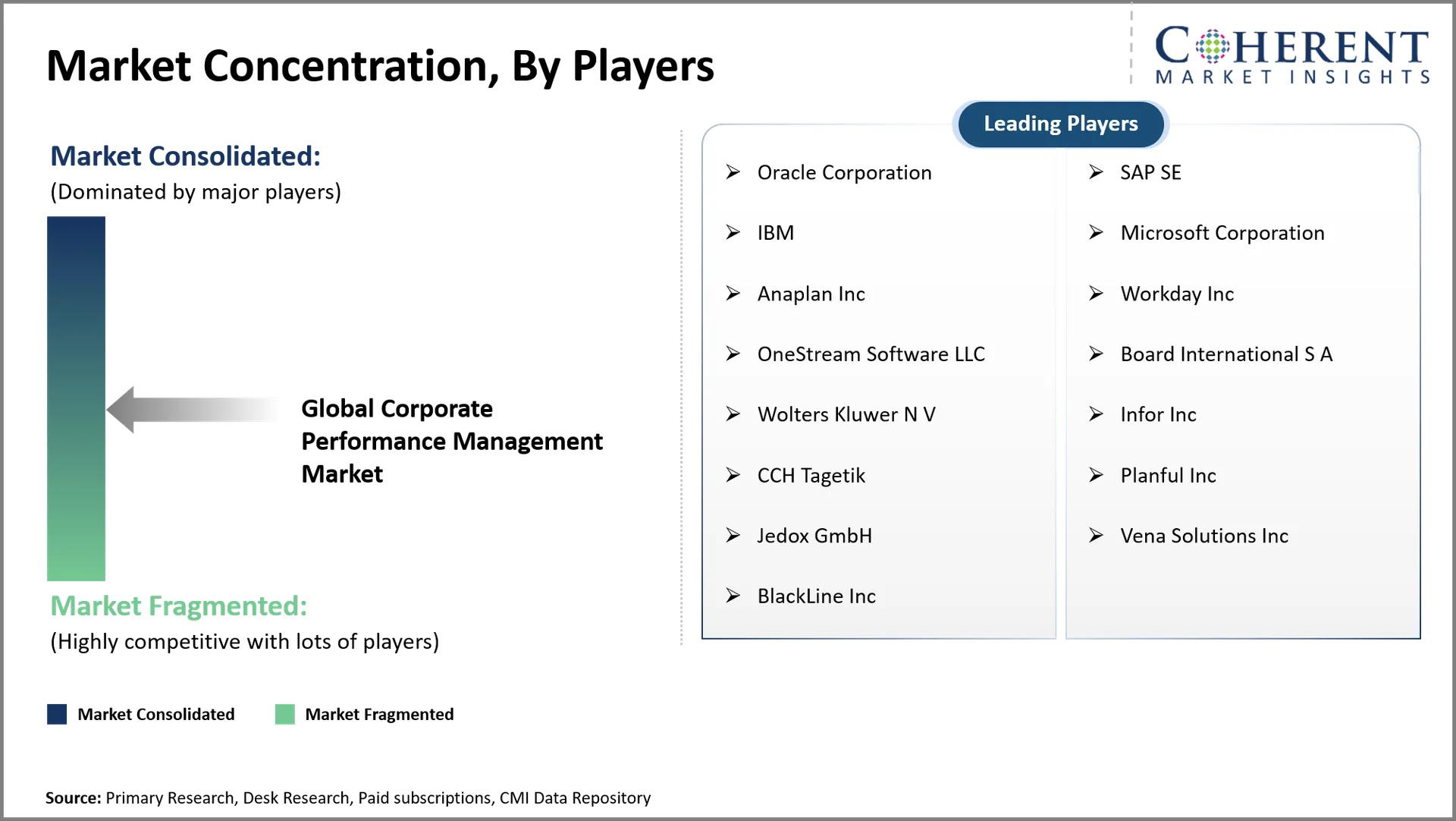
The corporate performance management market is led by vendors expanding beyond budgeting into connected planning, artificial intelligence, and automated decision support. Oracle is embedding advanced predictions, auto predict, intelligent performance management insights, and artificial intelligence assistants across cloud enterprise performance management. Its 2026 capabilities include machine-learning forecasting, anomaly detection, narrative generation, and agent-driven workflow automation. SAP combines finance, operations and strategic planning in SAP Analytics Cloud. Its concentration is on predictions about artificial intelligence, modeling scenarios, regulated data and AI-assisted planning. Anaplan is doubling down on AI-enabled scenario planning and industry-specific applications. Its 2026 product expansion includes CoModeler, Custom Analyst, Agent Studio, and twelve purpose-built applications. OneStream is strengthening predictive analytics around historical forecasting, scenario evaluation, and statistical modeling.
Market Report Scope
Global Corporate Performance Management Market Report Coverage | |||
Report Coverage | Details | ||
Base Year | 2025 | Market Size in 2026: | USD 13.40 Bn |
Historical Data For: | 2020 To 2024 | Forecast Period: | 2026 To 2033 |
Forecast Period 2026 To 2033 CAGR: | 8.00% | 2033 Value Projection: | USD 26.00 Bn |
Geographies covered: |
| ||
Segments covered: |
| ||
Companies covered: | Oracle Corporation, SAP SE, IBM, Microsoft Corporation, Anaplan Inc, Workday Inc, OneStream Software LLC, Board International S A, Wolters Kluwer N V, Infor Inc, CCH Tagetik, Planful Inc, Jedox GmbH, Vena Solutions Inc, BlackLine Inc | ||
Growth Drivers: |
| ||
Restraints & Challenges: |
| ||
Analyst Opinion (Expert Opinion)
- The industry is moving toward autonomous planning rather than standalone forecasting software. The strongest platforms will combine predictive models, generative artificial intelligence, workflow agents, and governed enterprise data. Oracle already connects forecasting, anomaly detection, narratives, and agents within its Enterprise Performance Management environment. SAP is similarly connecting financial and operational planning with artificial intelligence-assisted scenarios. This implies that the future of competitiveness will be based more and more on decision automation that is built directly in planning workflows.
- The biggest opportunity will be in cloud-based connected planning, especially financial planning and operational scenario management. Vendors need to focus on solutions that connect finance to sales, workforce, supply chain and profitability factors. SAP already offers unified financial, supply chain, and operational planning capabilities. Anaplan is addressing revenue planning, account segmentation, staff alignment, territories and quotas. Further country-level expansion should focus on large digitalizing economies with complex enterprise structures, in particular the U.S., India, Germany, China and the U.K.
- Players wanting a competitive edge should construct customized artificial intelligence models for specific banking procedures, not offer generic helpers. Predictive cash forecasting, anomaly identification, variance analysis, consolidation monitoring and driver-based forecasting are application-level potential that are evident. Oracle has predictive cash forecasting and machine-learning-based advanced predictions. Vendors also want to see stronger explainability, human approval controls, data lineage and security for AI outputs. These capabilities can differentiate platforms as enterprises move artificial intelligence from experimentation into controlled financial decision workflows.
Speak to the analyst
Want personalized insights?
Take the findings above to one of our principal consultants, or have the report rebuilt around the segments, geographies and competitors you actually track.
Market Segmentation
- Function Insights (Revenue, USD Billion, 2021 - 2033)
- Finance
- Human Resources
- Supply Chain
- Sales and Marketing
- Deployment Type Insights (Revenue, USD Billion, 2021 - 2033)
- Cloud
- On Premise
- Hybrid
- End User Insights (Revenue, USD Billion, 2021 - 2033)
- BFSI
- Retail and E-Commerce
- Manufacturing
- Healthcare and Life Sciences
- IT and Telecommunications
- Energy and Utilities
- Government and Public Sector
- Others
- Regional Insights (Revenue, USD Billion, 2021 - 2033)
- North America
- U.S.
- Canada
- Latin America
- Brazil
- Argentina
- Mexico
- Rest of Latin America
- Europe
- Germany
- U.K.
- Spain
- France
- Italy
- Russia
- Rest of Europe
- Asia Pacific
- China
- India
- Japan
- Australia
- South Korea
- ASEAN
- Rest of Asia Pacific
- Middle East
- GCC Countries
- Israel
- Rest of Middle East
- Africa
- South Africa
- North Africa
- Central Africa
- North America
Sources
Primary Research Interviews
- Chief Financial Officers (CFOs) and Finance Directors
- Corporate Strategy and Planning Managers
- Enterprise Software Solution Providers and Vendors
- Business Intelligence and Analytics Consultants
Magazines
- CFO Magazine
- Harvard Business Review
- Forbes Technology
- CIO Magazine
Journals
- Journal of Corporate Finance
- International Journal of Business Performance Management
- Journal of Management Information Systems
Associations
- Association for Financial Professionals (AFP)
- Institute of Management Accountants (IMA)
- Financial Executives International (FEI)
- Association of Chartered Certified Accountants (ACCA)
Public Domain Sources
- U.S. Securities and Exchange Commission (SEC) Filings
- World Bank Open Data
- OECD Data Portal
- European Commission Digital Economy Reports
Proprietary Elements
- CMI Data Analytics Tool
- Proprietary CMI Existing Repository of information for last 10 years
Get access to 250+ pages report
Every segment, forecast, competitor profile and data table behind the analysis above — available for instant download.
- ESOMAR Member
- ISO 9001:2015 Certified
- D-U-N-S Registered
- GDPR & CCPA Compliant
Frequently Asked Questions
The global corporate performance management market is expected to stand at USD 13.40 Bn in 2026 and is expected to reach USD 26.00 Bn by 2033.
The CAGR of the global corporate performance management market is projected to be 8.0% from 2026 to 2033.
Rising demand for integrated financial planning and Increasing adoption of cloud-based performance management are the major factors driving the growth of the global corporate performance management market.
High implementation costs for complex deployments and Integration challenges with legacy enterprise systems are the major factors hampering the growth of the global corporate performance management market.
In terms of function, finance segment is estimated to dominate the market revenue share in 2026.
Corporate performance management is a technology-driven approach for planning, budgeting, forecasting, consolidation, reporting, and performance analysis.
It combines historical information, operational drivers, and predictive analytics to generate more dynamic financial forecasts.