

Global Corrugated Boxes Market Size and Forecast – 2026 To 2033
The Global Corrugated Boxes Market is estimated to be valued at USD 188.54 Bn in 2026 and is expected to reach USD 270.65 Bn by 2033, growing at a compound annual growth rate (CAGR) of 5.30% from 2026 to 2033. This growth is supported by increasing packaging requirements across ecommerce, food and beverage, consumer goods, and industrial sectors, where corrugated boxes are preferred for their durability, recyclability, lightweight structure, and suitability for efficient transportation.
The shift toward circular packaging systems is further encouraging manufacturers and end users to adopt fiber-based solutions that reduce dependence on conventional packaging materials. In 2025, the European Union advanced implementation activities under the Packaging and Packaging Waste Regulation (PPWR), reinforcing requirements for recyclable and resource-efficient packaging solutions. This regulatory shift is expected to strengthen demand for sustainable corrugated packaging formats and encourage manufacturers to invest in improved recycling, material optimization, and circular production capabilities.
Key Takeaways of the Global Corrugated Boxes Market
- Recycled Corrugates segment is projected to record an estimated CAGR of 5.1% and hold 68.6% of the global corrugated boxes market in 2026, supported by circular packaging strategies and increasing use of recovered fibers in containerboard production. In April 2025, Mondi successfully started its recycled containerboard machine at the Duino mill in Italy, adding recycled fiber capacity for sustainable packaging solutions.
- Slotted Boxes segment is estimated to achieve a CAGR of 5.4% and account for 52.8% of the global corrugated boxes market in 2026, as standard slotted designs remain widely preferred for shipping, storage, and automated handling applications due to their versatility and cost efficiency. In July 2026, FEFCO highlighted corrugated packaging solutions tailored for e-commerce logistics through new box design innovations.
- Single Wall Corrugated Boxes segment is expected to register an estimated CAGR of 5.0% and represent 58.6% of the global corrugated boxes market in 2026, reflecting its suitability for lightweight transportation packaging across consumer goods, food, and retail supply chains. In April 2025, Pratt Industries announced a major investment initiative supporting its recycled paper and corrugated box manufacturing network in the U.S.
- Asia Pacific is projected to achieve an estimated CAGR of 5.8% and contribute 53.2% of the global corrugated boxes market in 2026, supported by expanding manufacturing activity, consumer goods distribution networks, and rising packaging requirements across emerging economies. In 2025, SCG Packaging expanded its corrugated packaging footprint in Indonesia through the acquisition of PT Prokemas Adhikari Kreasi to strengthen regional packaging capabilities.
- Europe is anticipated to record an estimated CAGR of 6.0% while representing 21.7% of the global corrugated boxes market in 2026, supported by strong recycling infrastructure, circular economy initiatives, and sustainable packaging adoption. In June 2025, Containerboard Europe published a roadmap emphasizing industry transition efforts and resource efficiency across the European containerboard sector.
Segmental Insights
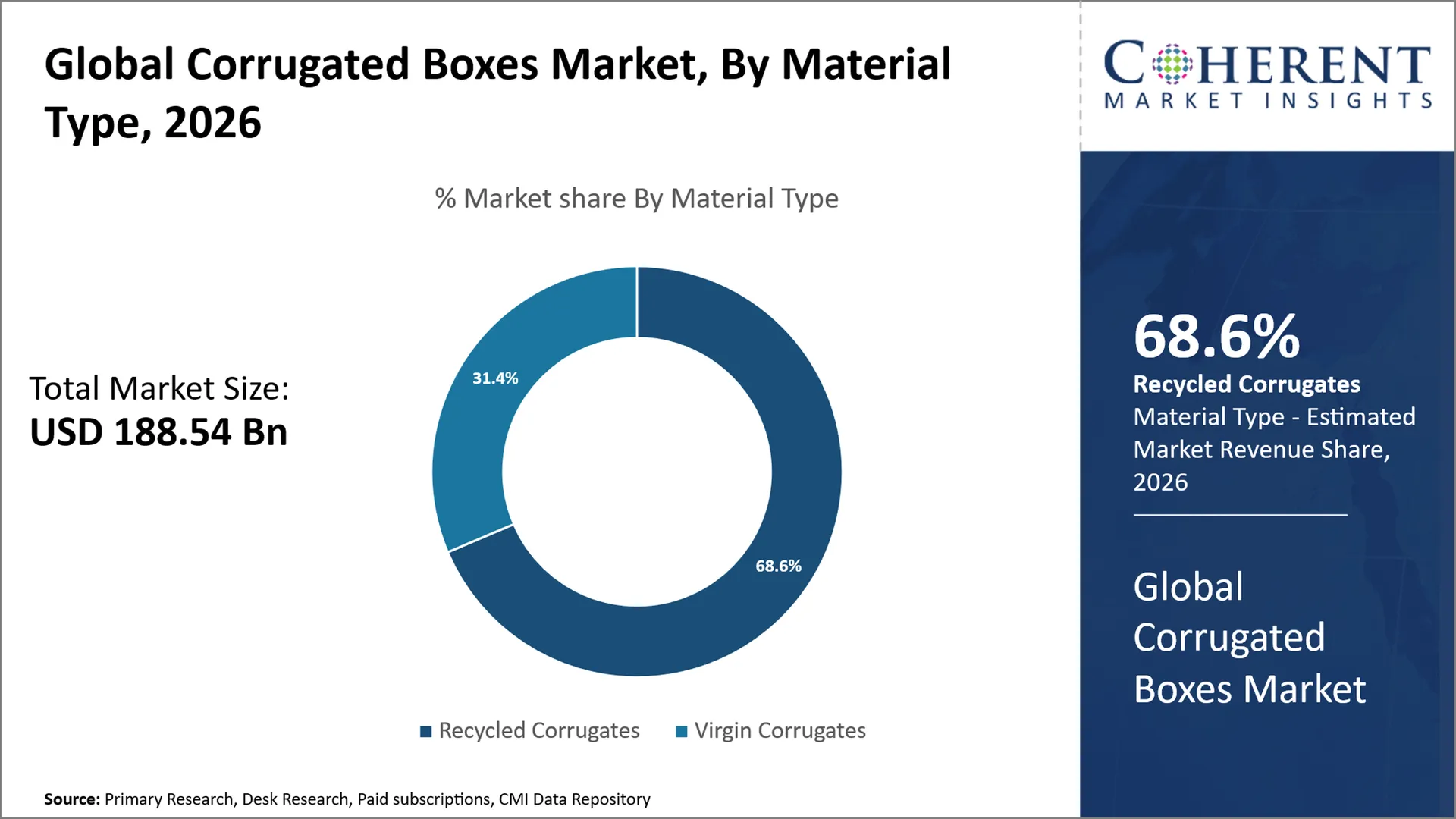
Why Does Recycled Corrugates Dominate the Global Corrugated Boxes Market?
Recycled Corrugates are expected to account for 68.6% of the global corrugated boxes market in 2026 due to strong material availability, established recovery systems, and increasing preference for circular packaging solutions. The segment benefits from lower dependency on virgin fiber resources and supports manufacturers seeking cost control while meeting sustainability requirements. Demand is particularly strong among food producers, retailers, logistics companies, and consumer goods brands requiring recyclable secondary packaging. On the supply side, improvements in paper recovery infrastructure and recycled containerboard production enable consistent availability for box converters. In January 2025, International Paper announced its continued investment in enhancing fiber-based packaging solutions and recycling capabilities through its circular packaging strategy, supporting greater utilization of recovered materials across packaging operations.
- Current Industry Events of 2026
- Market Size Estimation
- Regional Breakdown
- Competitive Landscape
- Customer Intelligence
- Segmental Analysis
- Pricing Analysis
- Key Market Drivers, Challenges & Future Trends
- Customized Insights Section
Why Do Slotted Boxes Represent the Largest Box Type Category in the Global Corrugated Boxes Market?
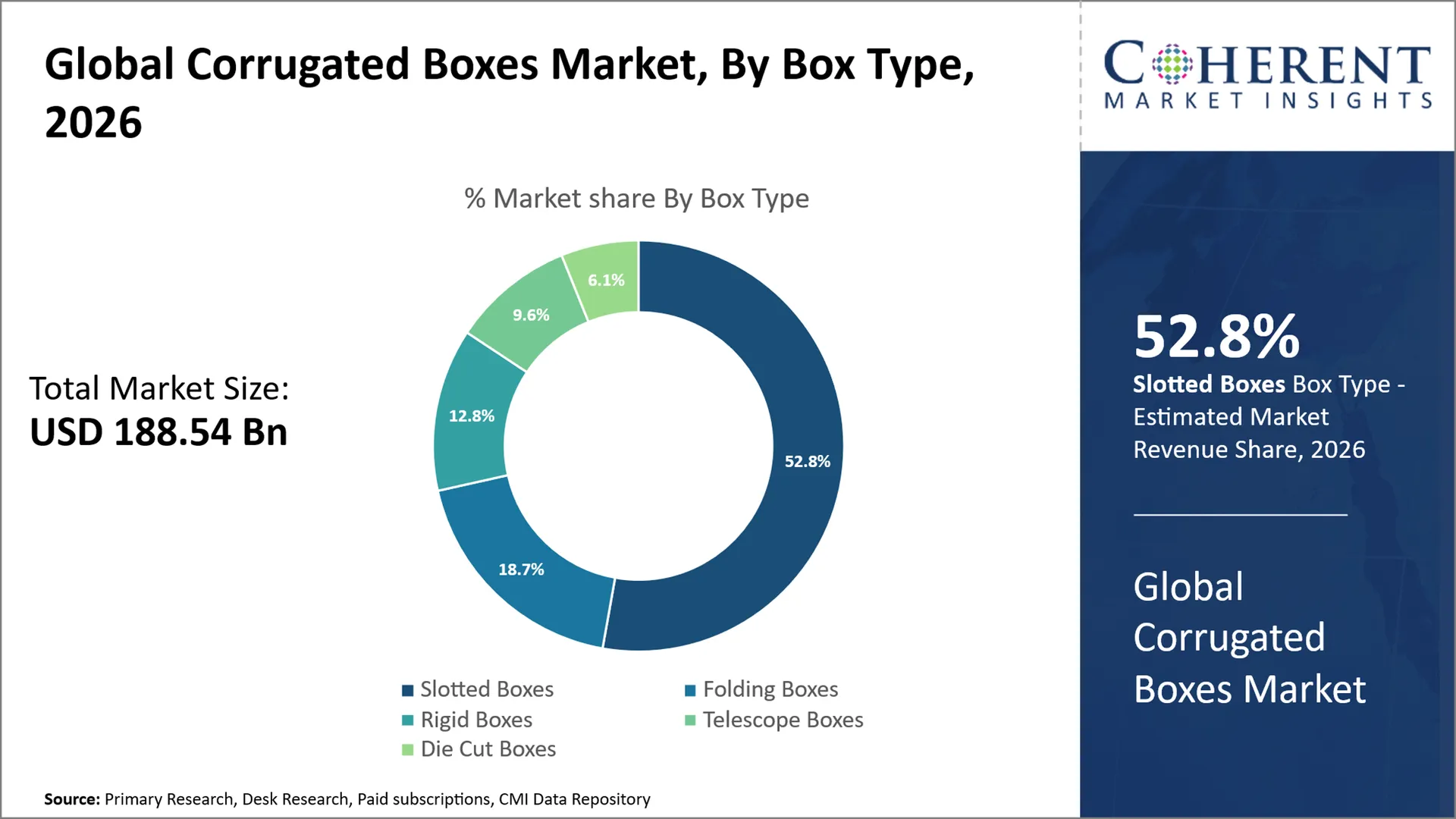
Slotted Boxes are expected to hold 52.8% of the global corrugated boxes market in 2026 because of their standardized structure, broad compatibility with automated packing systems, and suitability across shipping-intensive industries. Their simple design enables efficient manufacturing, economical material usage, and easy handling throughout distribution networks. The segment is widely adopted in ecommerce fulfillment, industrial shipments, food transportation, and retail replenishment due to its adaptability across different product sizes. Corrugated converters benefit from scalable production processes and flexible customization options for different customer requirements. In March 2025, Smurfit WestRock introduced updated packaging design capabilities focused on optimizing box performance and customer-specific solutions, strengthening the role of adaptable corrugated formats in supply chains.
Why Does Single Wall Corrugated Boxes Dominate the Wall Construction Category of the Global Corrugated Boxes Market?
Single Wall Corrugated Boxes are projected to represent 58.6% of the global corrugated boxes market in 2026 as they provide an effective balance between strength, material efficiency, and transportation cost optimization. The segment is preferred for lightweight consumer products, packaged foods, household goods, and general industrial shipments where moderate protection is sufficient. Manufacturers favor single wall construction due to lower material consumption, faster production cycles, and easier conversion processes compared with multi-wall alternatives. The widespread availability of standard board grades further supports adoption among regional converters and packaging users. August 2025, Packaging Corporation of America highlighted continued modernization of its corrugated packaging operations to improve production efficiency and serve diverse customer packaging requirements, supporting the commercial relevance of single wall solutions.
Current Events and their Impact
Current Event | Description and Its Impact |
April 2024 – European Union Packaging and Packaging Waste Regulation (PPWR) legislative approval process |
|
January 2025 – United States Environmental Protection Agency Recycling Infrastructure Initiatives |
|
June 2025 – United Kingdom Extended Producer Responsibility Packaging Reform Implementation |
|
Global Corrugated Boxes Market Dynamics
Key Market Drivers
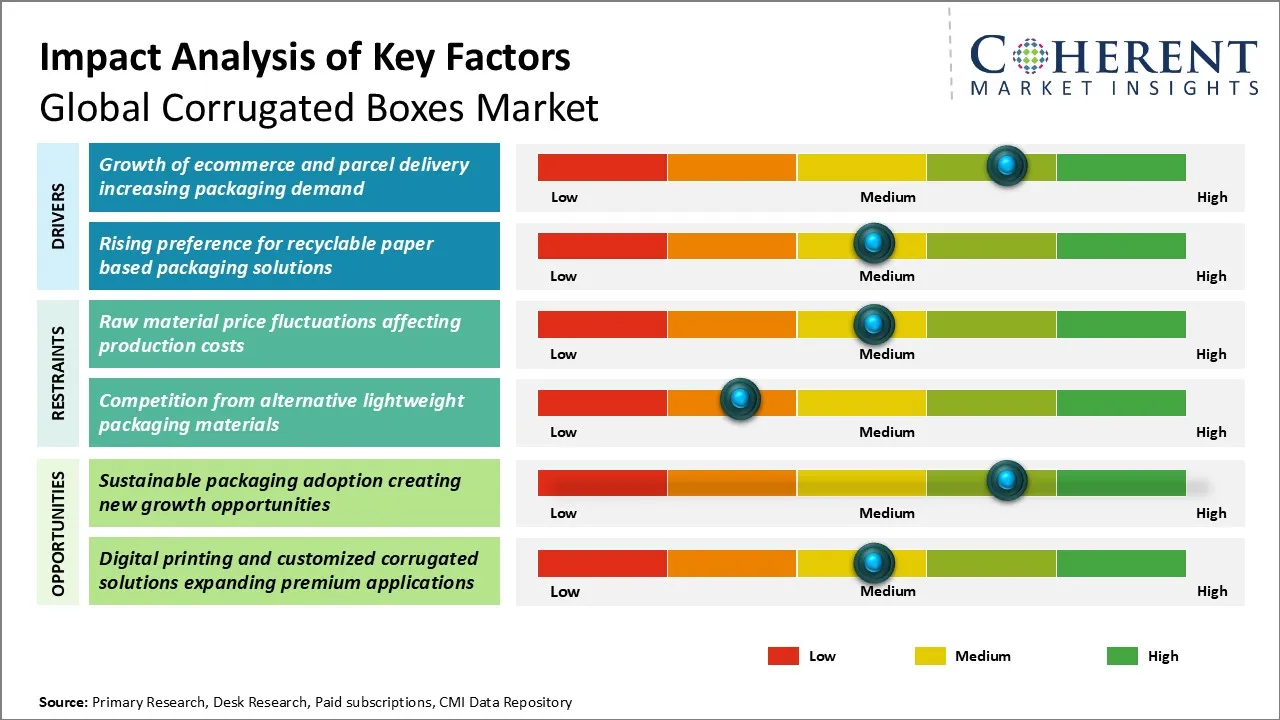
- Growth of Ecommerce and Parcel Delivery Increasing Packaging Demand: The expansion of online retail ecosystems is strengthening demand for corrugated boxes as they provide lightweight protection, stacking efficiency, and cost-effective transportation across fulfilment networks. E-commerce companies, logistics providers, and packaging converters benefit from optimized box formats that support automated warehouses and last-mile delivery requirements. The shift toward frequent smaller shipments is also increasing demand for customizable box solutions. In February 2025, DHL announced continued expansion of its automated parcel processing capabilities in Germany, supporting higher throughput requirements for e-commerce logistics operations and reinforcing the need for efficient secondary packaging solutions.
- Rising Preference for Recyclable Paper Based Packaging Solutions: The transition away from difficult-to-recycle packaging materials is accelerating adoption of corrugated boxes among food producers, consumer goods manufacturers, and retailers seeking circular packaging alternatives. Recycled fiber utilization, improved recovery systems, and sustainability commitments are encouraging converters to invest in efficient paper-based packaging production. This driver benefits integrated paper companies, corrugated manufacturers, and brands aiming to reduce packaging-related environmental impact. In March 2025, the European Commission continued implementation activities related to the Packaging and Packaging Waste Regulation, increasing focus on recyclable packaging formats and circular material use across industries.
Emerging Market Trends
- Smart Packaging Integration and Data-Enabled Corrugated Solutions: Corrugated packaging is gradually evolving from a passive transport material into an information-enabled packaging format. Manufacturers are exploring integration of QR codes, digital identifiers, tracking features, and interactive printing technologies to improve supply chain visibility and customer engagement. This transformation is influencing packaging converters to combine traditional box manufacturing capabilities with digital solutions. Brands, logistics providers, and retailers are expected to increasingly evaluate packaging based on traceability, inventory management capability, and consumer interaction potential rather than only physical protection.
- Lightweighting and Advanced Structural Design Optimization: Corrugated box producers are increasingly focusing on material optimization to reduce fiber consumption while maintaining strength and performance requirements. Advanced structural engineering, simulation tools, and improved board combinations are enabling manufacturers to design lighter packaging formats suited for transportation efficiency. This trend is changing procurement decisions as customers increasingly evaluate packaging suppliers based on material efficiency, sustainability performance, and cost optimization. Companies with strong design capabilities and integrated manufacturing processes are likely to gain advantage as buyers seek packaging solutions that balance durability with reduced material usage.
Regional Insights
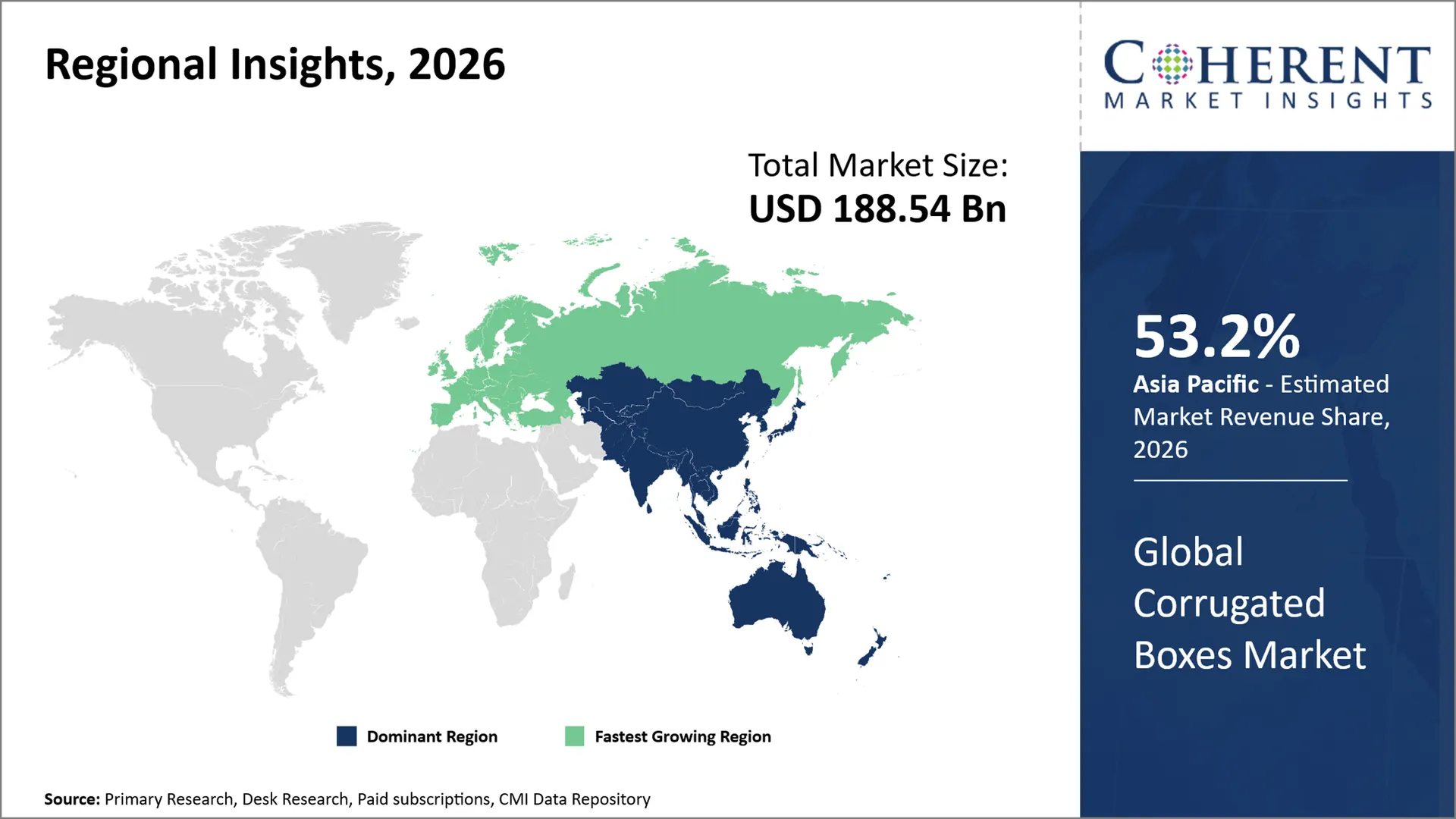
Why Does Asia Pacific Dominate the Global Corrugated Boxes Market?
Asia Pacific is expected to account for 53.2% share of the global corrugated boxes market in 2026, supported by its extensive manufacturing ecosystem, large consumer base, and strong presence of packaging-intensive industries. The region benefits from high-volume production of consumer goods, electronics, processed foods, and industrial products that require reliable secondary packaging solutions. China and India contribute significantly through expanding manufacturing activities, export-oriented supply chains, and growing domestic distribution networks. The availability of recycled paper resources, established corrugated converting infrastructure, and increasing automation adoption further strengthen regional competitiveness. Demand from ecommerce fulfillment and organized retail channels is encouraging packaging suppliers to develop customized box formats and efficient production systems. In May 2025, the Asian Development Bank highlighted continued expansion of Asia’s manufacturing and trade activity, supporting industrial supply chains that rely heavily on efficient packaging infrastructure.
Why Is Europe Emerging as the Fastest-Growing Region in the Global Corrugated Boxes Market?
Europe is projected to represent 21.7% share of the global corrugated boxes market in 2026 and is expected to experience faster expansion due to strong sustainability regulations, circular economy adoption, and increasing preference for recyclable packaging formats. The region’s mature food processing sector, pharmaceutical distribution networks, and premium consumer goods industry create consistent demand for high-performance corrugated solutions. European manufacturers are increasingly focusing on lightweight packaging designs, recycled fiber utilization, and resource-efficient production methods to comply with evolving environmental requirements. The shift toward replacing plastic-based packaging with fiber alternatives is creating opportunities for converters offering sustainable solutions. In February 2025, the European Parliament continued implementation activities related to the Packaging and Packaging Waste Regulation framework, reinforcing requirements around recyclable packaging systems and circular material management.
Global Corrugated Boxes Market Outlook for Key Countries
Why Is the U.S. a Key Market for the Global Corrugated Boxes Market?
The U.S. remains a strategically important market for the global corrugated boxes market due to its large-scale retail ecosystem, advanced logistics infrastructure, and high consumption of packaged goods. Corrugated boxes are extensively used across ecommerce fulfillment, food distribution, beverage transportation, and industrial shipments due to their durability and recyclability. The country’s strong presence of food processors, manufacturers, and third-party logistics providers creates diversified demand across multiple end-use industries. Investment in automated warehouses and faster delivery networks is encouraging demand for packaging formats that support efficient handling and transportation. Domestic paper recovery systems also support recycled containerboard availability for box production. In March 2025, the U.S. Environmental Protection Agency announced continued efforts under its recycling infrastructure initiatives to improve material recovery systems, supporting long-term availability of recovered paper resources for packaging applications.
Why Is India Important in the Global Corrugated Boxes Market?
India represents an important growth market for the global corrugated boxes market due to expanding manufacturing activity, rising organized retail penetration, and increasing demand from food, pharmaceuticals, electronics, and ecommerce sectors. The country’s growing industrial base is increasing requirements for protective and economical transportation packaging across domestic and export supply chains. Corrugated box manufacturers are benefiting from rising demand for customized packaging solutions from small and medium enterprises as well as large consumer brands. Growth in agricultural processing and packaged food distribution is also creating additional opportunities for corrugated packaging adoption. In January 2025, the Government of India continued implementation of the Production Linked Incentive schemes across manufacturing sectors, supporting industrial capacity expansion that generates downstream packaging requirements.
Why Does China Support Growth in the Global Corrugated Boxes Market?
China plays a central role in the global corrugated boxes market due to its extensive manufacturing base, export-oriented industries, and highly developed packaging conversion ecosystem. The country’s position as a major producer of electronics, consumer goods, machinery, and processed products creates substantial demand for corrugated transportation packaging. Integrated paper producers and packaging converters benefit from established supply chains, large-scale production capabilities, and proximity to manufacturing clusters. Increasing automation within factories and logistics operations is also supporting demand for standardized and efficient packaging formats. Export activity further strengthens the need for reliable corrugated solutions capable of protecting goods during international transportation. In April 2025, China’s Ministry of Industry and Information Technology continued initiatives supporting industrial modernization and advanced manufacturing development, strengthening sectors that generate significant packaging demand.
Why Is Germany a Strategic Country in the Global Corrugated Boxes Market?
Germany holds strategic importance in the global corrugated boxes market because of its advanced industrial sector, strong export economy, and emphasis on sustainable packaging practices. The country’s automotive, machinery, chemicals, food processing, and consumer goods industries require high-quality transportation packaging with consistent performance standards. German packaging users increasingly prioritize recyclable materials, efficient logistics solutions, and packaging optimization to reduce environmental impact. The country also benefits from advanced recycling infrastructure and technologically developed converting operations. Strong manufacturing standards encourage adoption of customized corrugated solutions designed for industrial applications. In October 2025, Germany’s Federal Ministry for the Environment continued initiatives supporting circular economy practices and resource efficiency, reinforcing the importance of recyclable packaging materials across industrial value chains.
Why Is Brazil an Important Growth Market for the Global Corrugated Boxes Market?
Brazil represents an important growth market for the global corrugated boxes market due to its large agricultural sector, expanding food processing industry, and regional distribution requirements. Corrugated boxes are widely used for transporting agricultural products, beverages, processed foods, and manufactured goods because they provide protection during storage and logistics operations. The country’s position as a major exporter of agricultural commodities creates demand for efficient packaging solutions supporting domestic and international supply chains. Growth in retail distribution networks and consumer product consumption is further supporting packaging requirements beyond traditional industrial applications. Local availability of forestry resources and paper production capabilities strengthens the domestic packaging ecosystem. In June 2025, Brazil’s Ministry of Development Industry Trade and Services highlighted continued efforts to strengthen industrial competitiveness and productive sector development, supporting industries dependent on efficient packaging systems.
Innovation, Production & Manufacturing Landscape in the Global Corrugated Boxes Market
Technology / Innovation | Adoption Level | Commercial Impact | Strategic Importance |
Automated Corrugated Converting Systems | High | Improves production speed, accuracy, and labor efficiency | Enables manufacturers to meet customized packaging demand |
Digital Printing Technology | Growing | Supports short-run production and personalized packaging | Helps converters serve e-commerce and branded packaging needs |
AI-Based Packaging Design Optimization | Emerging | Reduces material usage through improved structural design | Supports lightweighting and cost reduction strategies |
Robotic Handling and Warehouse Automation | Growing | Improves manufacturing and logistics efficiency | Enhances operational scalability |
Advanced Recycling and Fiber Recovery Technologies | High | Improves recycled material availability | Strengthens circular packaging models |
Smart Packaging Identification Technologies | Emerging | Enables traceability and supply chain visibility | Creates additional value beyond physical packaging |
How Are Lightweight Packaging Designs and Circular Material Innovations Creating New Growth Opportunities in the Global Corrugated Boxes Market?
Lightweight packaging engineering represents a significant opportunity for corrugated box manufacturers as customers increasingly seek solutions that reduce material usage without compromising protection. This opportunity is expanding across e-commerce, food distribution, electronics, and industrial applications where transportation efficiency directly influences operating costs. Manufacturers capable of combining structural design expertise, recycled fiber utilization, and advanced converting capabilities can differentiate through lower material consumption and improved sustainability performance. The opportunity particularly benefits integrated producers, specialized packaging designers, and converters with strong customer collaboration capabilities. Companies investing in digital design tools, testing capabilities, and flexible manufacturing systems will be better positioned to develop customized packaging formats. However, successful participation requires technical expertise, reliable raw material sourcing, and close alignment with evolving customer sustainability requirements.
Market Players, Key Development, and Competitive Intelligence
Key Developments
- In June 2025, Green Bay Packaging announced Project PowerPack, a major investment program to modernize its Arkansas paper mill operations. This is important for the global corrugated boxes market because increased containerboard manufacturing efficiency supports future raw material availability for corrugated packaging production.
- In February 2025, DS Smith continued development of circular packaging solutions focused on reducing material usage and improving recyclability across customer supply chains. This is important for the global corrugated boxes market because packaging converters are increasingly competing through sustainable design capabilities and resource-efficient solutions.
- In July 2024, Smurfit Westrock announced initiatives focused on expanding sustainable packaging capabilities following the completion of its combination between Smurfit Kappa and WestRock. This is important for the global corrugated boxes market because the combined organization strengthens global production capabilities and expands access to integrated paper-based packaging solutions.
Competitive Landscape
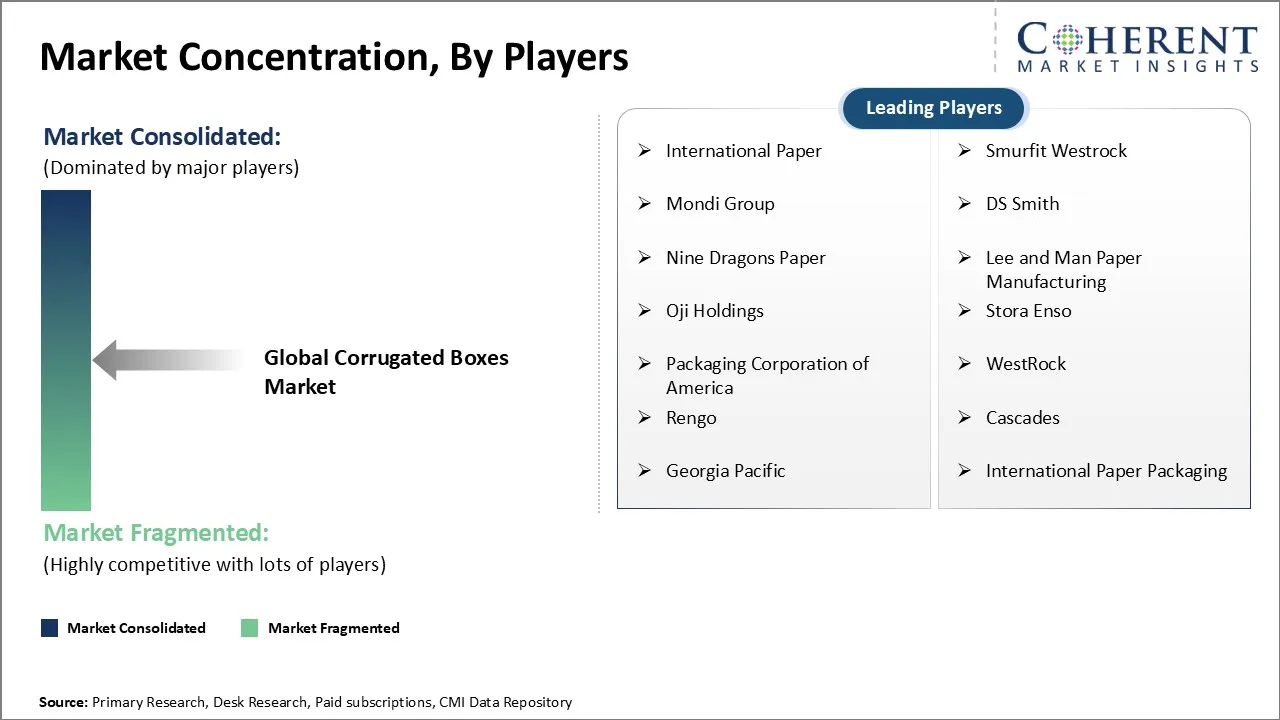
The global corrugated boxes market is moderately consolidated, with large integrated paper and packaging companies competing alongside regional converters and specialized packaging manufacturers. Competition is primarily based on manufacturing efficiency, material sourcing capability, product customization, sustainability performance, and customer service reliability. Large players benefit from integrated paper production networks, while regional companies compete through flexibility, local relationships, and customized solutions.
Key focus areas include
- Integrated paper manufacturing and recycled fiber availability
- Production capacity and geographic manufacturing footprint
- Customized box design and structural engineering capabilities
- Sustainability certifications and circular packaging solutions
- Digital printing and short-run customization capabilities
- Supply reliability and customer delivery performance
- Cost efficiency through automation and process optimization
- Long-term relationships with industrial and retail customers
Market Report Scope
Global Corrugated Boxes Market Report Coverage | |||
Report Coverage | Details | ||
Base Year | 2025 | Market Size in 2026: | USD 188.54 Bn |
Historical Data For: | 2020 to 2024 | Forecast Period: | 2026 To 2033 |
Forecast Period 2026 To 2033 CAGR: | 5.30% | 2033 Value Projection: | USD 270.65 Bn |
Geographies covered: |
| ||
Segments covered: |
| ||
Companies covered: | International Paper, Smurfit Westrock, Mondi Group, DS Smith, Nine Dragons Paper, Lee and Man Paper Manufacturing, Oji Holdings, Stora Enso, Packaging Corporation of America, WestRock, Rengo, Cascades, Georgia Pacific, International Paper Packaging | ||
Growth Drivers: |
| ||
Restraints & Challenges: |
| ||
Analyst Opinion (Expert Opinion)
- The corrugated boxes market is likely to move beyond conventional box supply toward integrated packaging partnerships where manufacturers provide design optimization, sustainability consulting, and supply chain solutions. Companies capable of supporting customers from packaging development through recovery systems may create stronger commercial relationships than suppliers competing only on production volume.
- The most significant transformation will come from the convergence of automation, digital design, and circular material management. Packaging producers that successfully combine manufacturing intelligence with sustainability capabilities may reshape competitive positioning, while companies relying only on standardized box production could face increasing pressure from customized and efficiency-focused competitors.
- Market participants should prioritize investments in automation, recycled fiber management, structural design capabilities, and customer-specific packaging solutions. Supply chain volatility in paper materials and changing sustainability requirements remain important risks. Companies should avoid overinvestment in undifferentiated capacity and instead focus on higher-value packaging services and operational flexibility.
Speak to the analyst
Want personalized insights?
Take the findings above to one of our principal consultants, or have the report rebuilt around the segments, geographies and competitors you actually track.
Market Segmentation
- Material Type Insights (Revenue, USD Bn, 2021 - 2033)
- Recycled Corrugates
- Virgin Corrugates
- Box Type Insights (Revenue, USD Bn, 2021 - 2033)
- Slotted Boxes
- Folding Boxes
- Rigid Boxes
- Telescope Boxes
- Die Cut Boxes
- Wall Construction Insights (Revenue, USD Bn, 2021 - 2033)
- Single Wall Corrugated Boxes
- Double Wall Corrugated Boxes
- Triple Wall Corrugated Boxes
- Component Insights (Revenue, USD Bn, 2021 - 2033)
- Linerboard
- Corrugating Medium
- Others
- End Use Industry Insights (Revenue, USD Bn, 2021 - 2033)
- Food and Beverages
- Ecommerce and Parcel Delivery
- Industrial Goods
- Electrical and Electronics
- Personal Care and Household Products
- Agriculture
- Others
- Printing Technology Insights (Revenue, USD Bn, 2021 - 2033)
- Flexographic Printing
- Digital Printing
- Lithographic Printing
- Others
- Distribution Channel Insights (Revenue, USD Bn, 2021 - 2033)
- Direct Sales
- Indirect Sales
- Regional Insights (Revenue, USD Bn, 2021 - 2033)
- North America
- U.S.
- Canada
- Latin America
- Brazil
- Argentina
- Mexico
- Rest of Latin America
- Europe
- Germany
- U.K.
- Spain
- France
- Italy
- Russia
- Rest of Europe
- Asia Pacific
- China
- India
- Japan
- Australia
- South Korea
- ASEAN
- Rest of Asia Pacific
- Middle East
- GCC Countries
- Israel
- Rest of Middle East
- Africa
- South Africa
- North Africa
- Central Africa
- North America
Sources
Primary Research Interviews
- Corrugated box manufacturers, containerboard producers, paper mills, packaging converters, and integrated packaging companies
- Procurement managers, packaging buyers, supply chain professionals, logistics providers, retailers, ecommerce companies, food and beverage manufacturers, and industrial end users
- Packaging engineers, sustainability specialists, material scientists, recycling experts, and corrugated board technology professionals
Stakeholders
- Corrugated packaging manufacturers, paper and containerboard producers, recycled paper suppliers, and private-label packaging suppliers
- Raw material suppliers, pulp and paper companies, printing technology providers, converting equipment manufacturers, distributors, and logistics partners
- Ecommerce platforms, food and beverage companies, consumer goods manufacturers, electronics companies, agricultural businesses, and industrial packaging users
End-use Sectors
- Ecommerce and parcel delivery packaging applications
- Food and beverage packaging and distribution
- Consumer goods and retail packaging
- Industrial goods and manufacturing shipments
- Electronics and electrical product packaging
- Agriculture and fresh produce transportation
- Pharmaceutical and healthcare product distribution
Regulatory and Industry Bodies
- Packaging and recycling regulatory authorities
- Environmental protection agencies and circular economy organizations
- Paper and packaging industry associations
- Forestry and sustainable sourcing organizations
- Waste management and recycling authorities
- Trade organizations representing packaging manufacturers and converters
Databases
- Company annual reports, investor presentations, sustainability reports, and corporate filings
- Paper, pulp, packaging, and recycling industry databases
- Packaging trade statistics and import-export datasets
- Ecommerce shipment and logistics databases
- Manufacturing production databases and industrial output statistics
- Containerboard, recycled fiber, and paper commodity databases
- Packaging product portfolio and competitive intelligence databases
Magazines and Journals
- Packaging industry publications
- Paper and pulp industry journals
- Corrugated packaging technology publications
- Recycling and circular economy journals
- Logistics and supply chain industry publications
- Manufacturing and industrial packaging research journals
Associations
- Fibre Box Association (FBA)
- International Corrugated Case Association (ICCA)
- European Federation of Corrugated Board Manufacturers (FEFCO)
- Confederation of Paper Industries (CPI)
- Paper and packaging industry associations
- Recycling and waste management associations
- Regional packaging and converting industry organizations
Public Domain Sources
- Ecommerce and parcel delivery expansion trends
- Sustainable packaging adoption and recycling developments
- Corrugated box manufacturing capacity expansion
- Paper recycling infrastructure developments
- Packaging automation and digital printing adoption
- Retail and industrial supply chain transformation
- Circular economy initiatives and sustainable material usage
Key Standards and Regulations
- Packaging waste reduction and recycling requirements
- Sustainable forestry and responsible fiber sourcing standards
- Paper and board product quality standards
- Packaging material safety and compliance requirements
- Environmental regulations related to waste management and recycling
- International trade regulations for paper-based packaging products
- Labeling and product information requirements for packaging materials
Proprietary Elements
- CMI Data Analytics Tool, Proprietary CMI repository containing 10+ years of packaging, paper & pulp, industrial materials, supply chain, and consumer goods market intelligence.
Get access to 250+ pages report
Every segment, forecast, competitor profile and data table behind the analysis above — available for instant download.
- ESOMAR Member
- ISO 9001:2015 Certified
- D-U-N-S Registered
- GDPR & CCPA Compliant
Missing comfort of reading report in your local language? Find your preferred language:
Frequently Asked Questions
The CAGR of global corrugated boxes market is projected to be 5.30% from 2026 to 2033.
The global corrugated boxes market is estimated to be valued at USD 188.54 Bn in 2026 and is expected to reach USD 270.65 Bn by 2033.
Corrugated boxes are widely used for ecommerce shipments, food and beverage packaging, consumer goods transportation, industrial product handling, agricultural packaging, and retail distribution due to their strength, recyclability, and cost efficiency.
End users primarily consider factors such as packaging durability, product protection, recyclability, customization options, transportation efficiency, supplier reliability, and compatibility with storage and handling systems.
Sustainability trends are encouraging businesses to adopt recyclable paper-based packaging solutions, improve material efficiency, and increase the use of recovered fibers in packaging production to support circular economy objectives.
Companies entering the corrugated boxes market evaluate factors such as raw material availability, manufacturing capabilities, customer base, sustainability compliance, technology adoption, and supply chain efficiency.
Increasing ecommerce and parcel delivery activities along with the growing preference for recyclable paper-based packaging solutions are the major factors driving the growth of the global corrugated boxes market.