

Global Creatine Gummies Market Size and Forecast – 2026 To 2033
The Global Creatine Gummies Market is estimated to be valued at USD 53.95 Mn in 2026 and is expected to reach USD 122.28 Mn by 2033, registering a compound annual growth rate (CAGR) of 12.40% during 2026–2033. Market expansion is supported by growing consumer preference for convenient, ready-to-consume creatine supplements, increasing participation in fitness activities, and product diversification beyond conventional sports nutrition.
Manufacturers are developing specialized formulations to meet consumer demand for sugar-free and plant-based supplements while improving product availability. In October 2026, Biopharma Group announced the availability of its new line of sugar-free, pectin-based supplements, such as creatine gummies, under the Fine's brand. This development demonstrates manufacturers' emphasis on product formulations that are plant-based and offer more convenient supplement formats to meet changing consumer tastes.
Key Takeaways of the Global Creatine Gummies Market
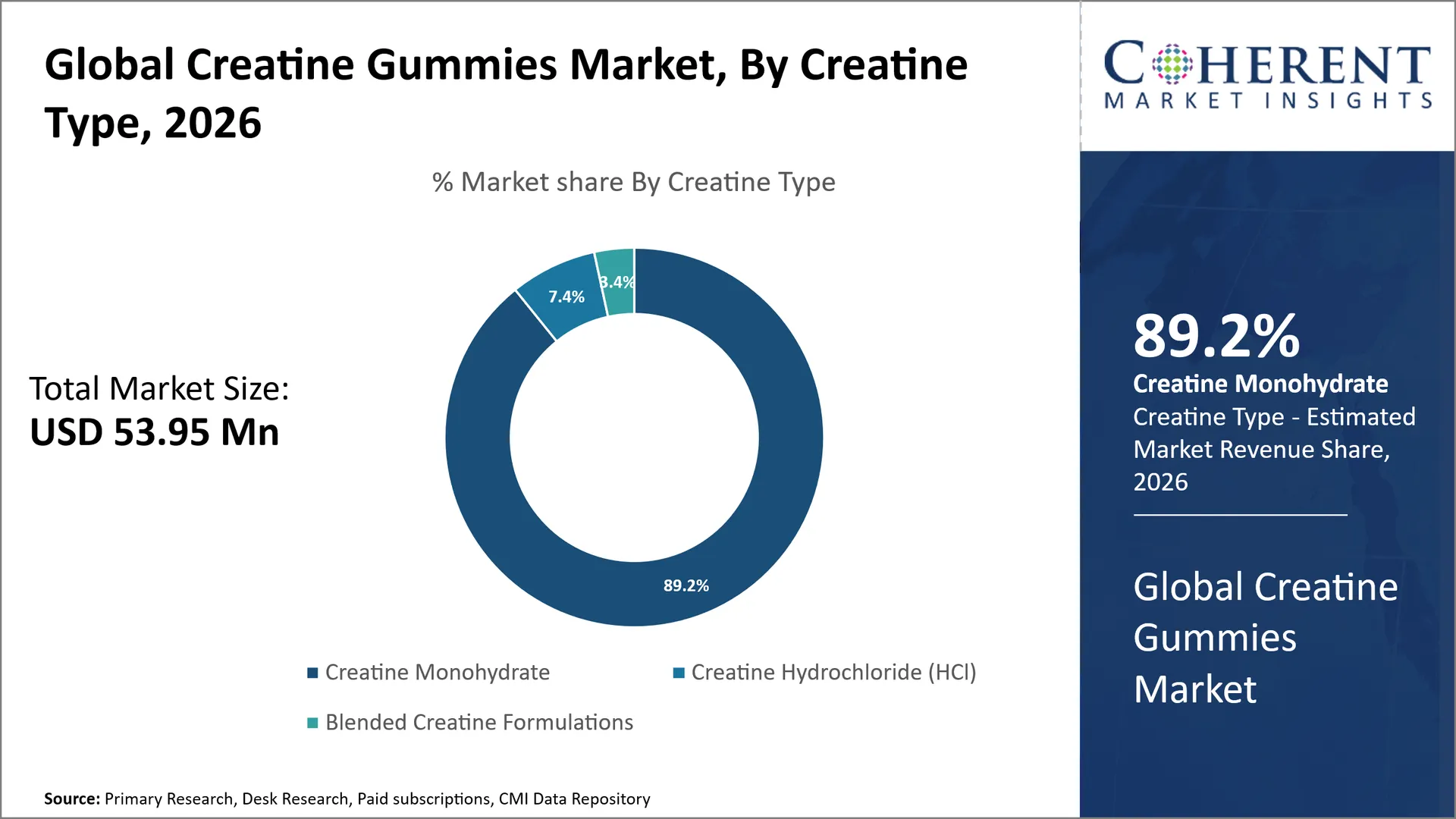
- Creatine Monohydrate is projected to grow at an estimated CAGR of 12.0% through 2033 and capture 89.2% of the global creatine gummies market in 2026. Its established research base simplifies ingredient selection and consumer communication across performance and wellness products. In January 2026, Lemme introduced NSF-certified creatine gummies containing micronized creatine monohydrate, extending the ingredient into women's wellness.
- Pectin-Based Gummies are projected to register an estimated CAGR of 13.6% through 2033 and will be 65.1% of the market in 2026. The plant-based gelling systems enable the production of vegan products and help manufacturers control gel formation and ingredient loading. In May 2025, Gino Gums launched a pectin system that was developed to specifically accommodate higher creatine loadings, providing formulation flexibility for manufacturers.
- Above 3–5 g per Serving gummies is estimated to expand at a CAGR of 13.2% through 2033, securing 58.6% of the global creatine gummies market in 2026. This dosage range enables practical daily supplementation without requiring the consumer to measure powder. In April 2026, Optimum Nutrition launched creatine gummies that contain 5 g of creatine monohydrate in 3 pieces, following the theme of dose-centric product design.
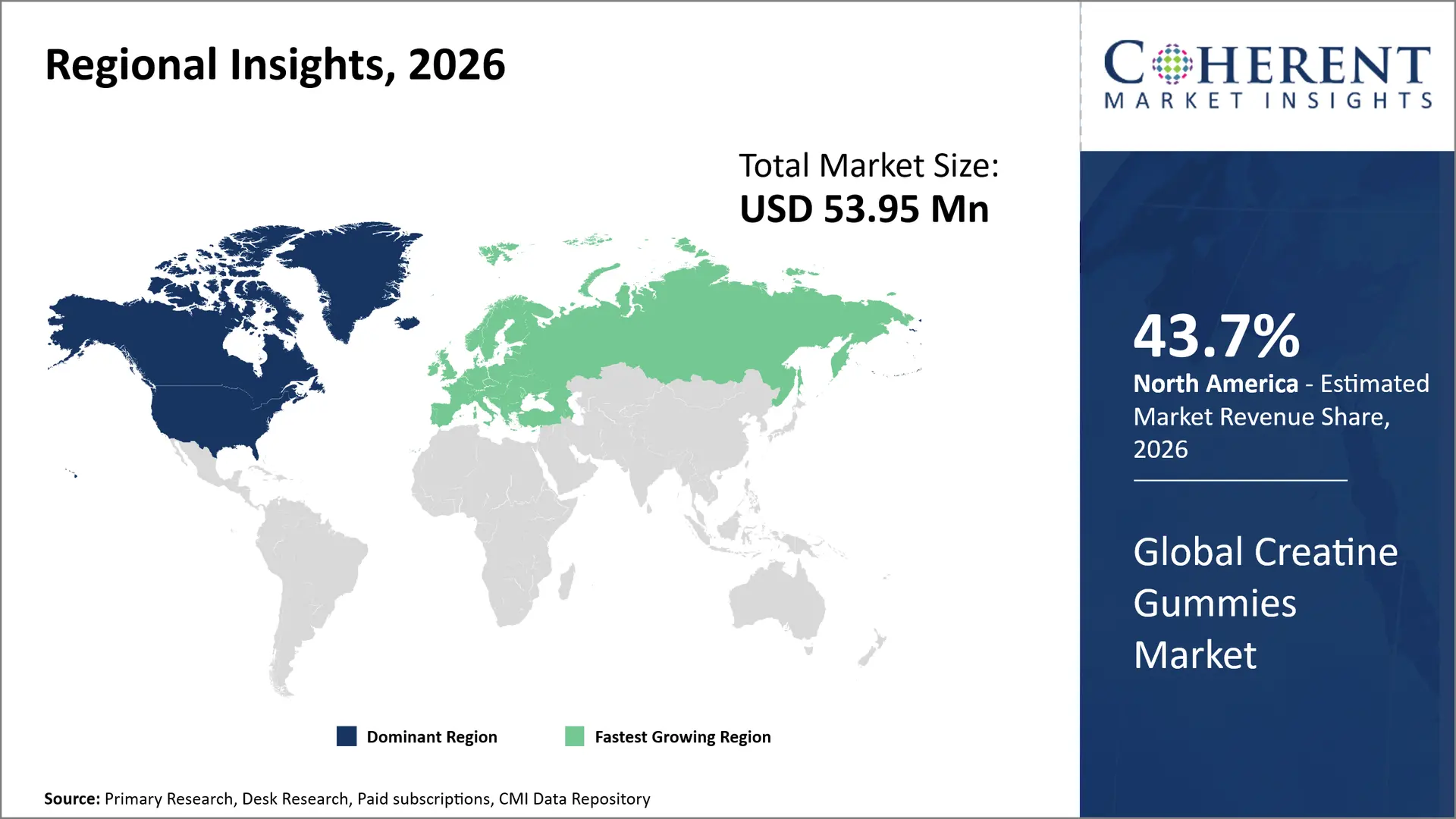
- North America is projected to achieve an estimated CAGR of 11.1% till 2033, accounting for 43.7% of the global creatine gummies market revenue in 2026. It possesses the broadest supplement retailing base, allowing gummy products to penetrate beyond fitness specialists. Create Wellness launched its creatine gummies in the Target stores across the country and Target.com in October 2025, making it more accessible to the mainstream retail market in the U.S.
- Europe is expected to grow at an estimated CAGR of 15.3%, and will account for 28.1% of the global creatine gummies market in 2026. A regional contract manufacturing capability provides the ability to produce differentiated formulations for new wellness applications. Germany-based SIRIO Europe launched a portfolio of creatine with magnesium, zinc and vitamin D in September 2026.
Segmental Insights
Why Does Creatine Monohydrate Dominate the Global Creatine Gummies Market?
Creatine Monohydrate is projected to represent 89.2% of the global creatine gummies market in terms of creatine type in 2026. It has a commercial benefit in that it has well-established supply chains, and that multiple flavors and packaging variants can be developed with one common active ingredient. This helps to diversify product while avoiding alternative creatine chemistries. Consumers will also benefit from clearly marked monohydrate products because they can easily compare supplement brands, especially when quality and consistency of ingredients are important factors in making purchasing decisions. In the half-year trading update in February 2025, Applied Nutrition highlighted creatine gummies in the additions to its product portfolio, coinciding with the expansion of its retail distribution network. The official details of the company's products confirm that creatine monohydrate is the active ingredient. These are portfolio extensions, allowing sports nutrition companies to launch a new product category (gummies) but benefiting from existing ingredient sourcing.
- Current Industry Events of 2026
- Market Size Estimation
- Regional Breakdown
- Competitive Landscape
- Customer Intelligence
- Segmental Analysis
- Pricing Analysis
- Key Market Drivers, Challenges & Future Trends
- Customized Insights Section
Why Do Pectin-Based Gummies Represent the Largest Gummy Base Segment in the Global Creatine Gummies Market?
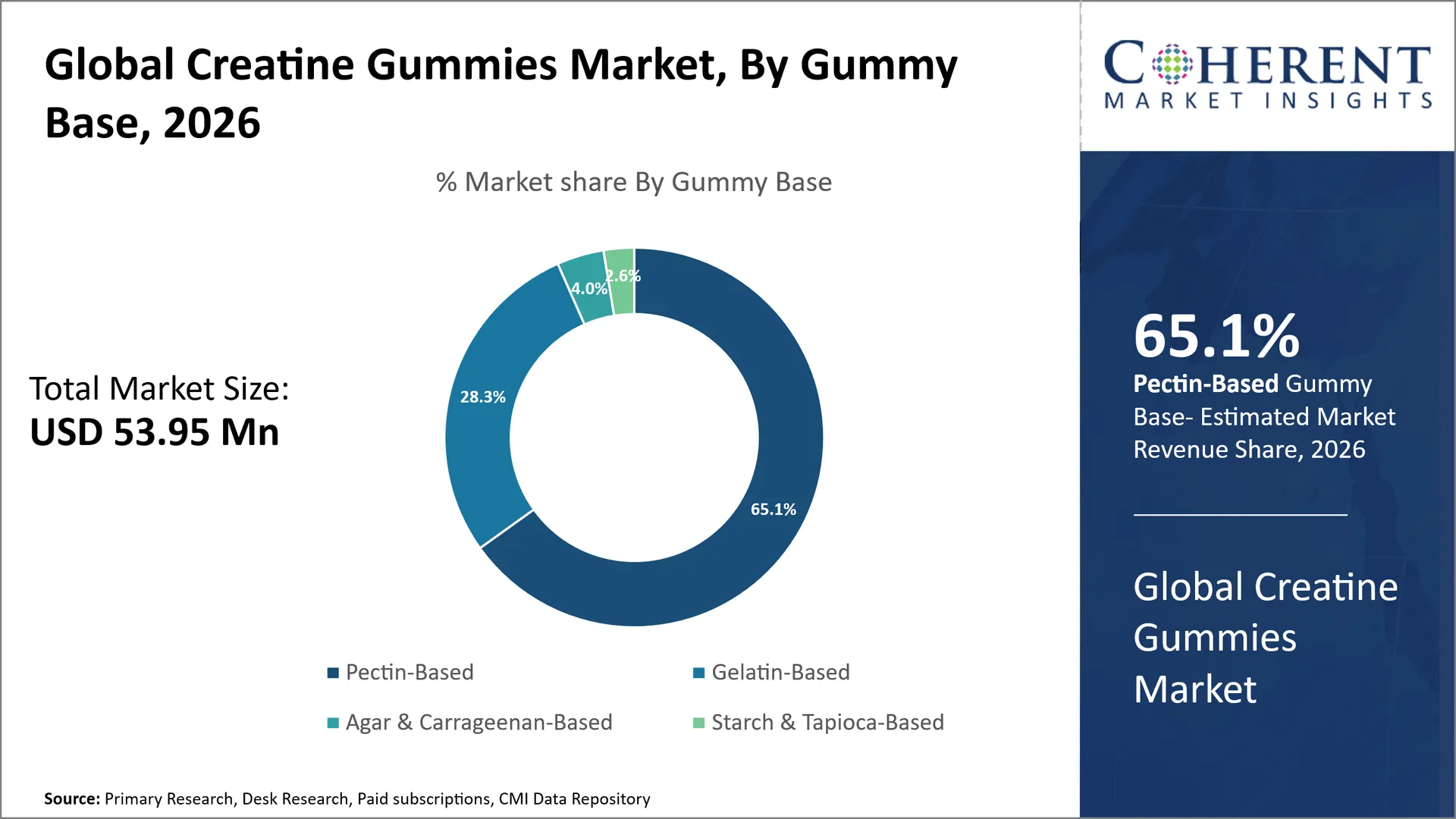
Pectin Based gummies are expected to dominate the gummy base category with a 65.1% share of the global creatine gummies market in 2026. The technical advantage is the control of the formulation acidity which is necessary as creatine may be transformed to creatinine during inappropriate formulation and storage. Specialized pectin systems are used to achieve gel formation at relatively higher pH levels which helps in the stability of the ingredients and desirable firmness and flavors. This is especially critical for contract manufacturers with product specifications, batch consistency and formulation costs. Technical data were released by Herbstreith & Fox for its Pectin Amid CS 025-B, stating that it will gel at a pH range of 4.1–4.5 for high load creatine gummies in October 2025. The development illustrates the ways in which the development of specialized gelling systems can enhance formulation flexibility and offer ingredient suppliers technical differentiation.
Why Does Above 3–5 g per Serving Dominate the Creatine Dosage Category of the Global Creatine Gummies Market?
Above 3-5 g per Serving Gummies segment is anticipated to hold 58.6% of the global creatine gummies market by dosage in 2026. This concentration range is convenient for brands to deliver a fixed daily amount of creatine, allowing consumers to compare products based on cost per dose, rather than simply price per package. This segment is particularly applicable to resistance-training enthusiasts and recreational athletes who follow structured supplementation protocols. This focus demands manufacturers to carefully balance active ingredient loading, gummy size, texture, and serving consistency without compromising consumer acceptance. In April 2025, Seattle Gummy Company released Power Up Creatine Gummies, which deliver 5 g of creatine monohydrate per serving, plus betalains from beets. The introduction illustrates how defined creatine dosages can support differentiated and multi-ingredient sports nutrition formulations and can reinforce manufacturers positioning among performance-focused consumers.
Current Events and their Impact
Current Event | Description and Its Impact |
April 2024 – New York Implements Age Restrictions on Muscle-Building Supplements |
|
January 2025 – FDA Revokes Authorization for FD&C Red No. 3 |
|
February 2026 – FDA Revises Its Approach to Artificial-Color Labeling Claims |
|
Global Creatine Gummies Market Dynamics
Key Market Drivers
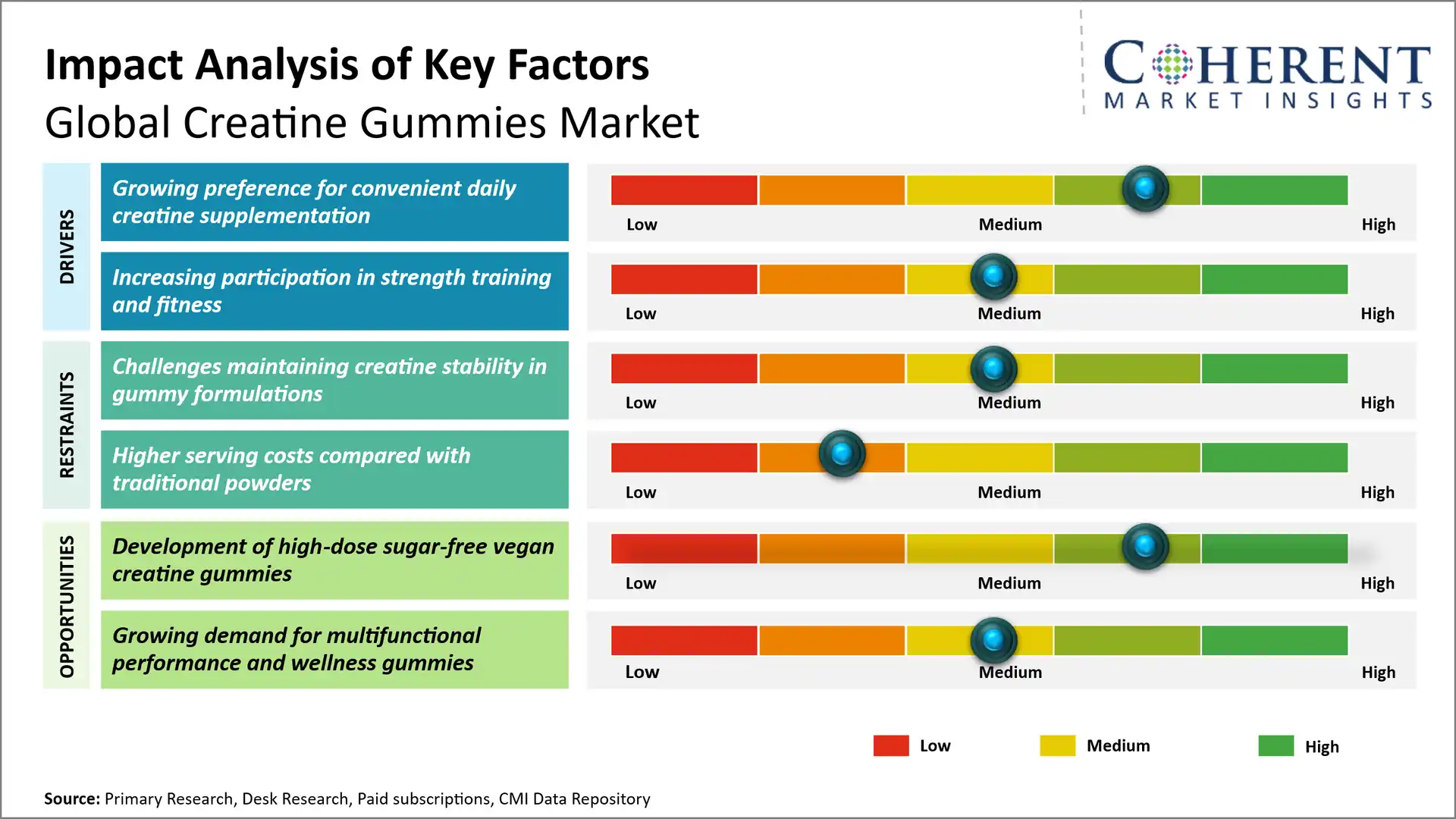
- Growing Preference for Convenient Daily Creatine Supplementation: Convenience is influencing creatine purchasing decisions by removing the need to prepare, mix and store powders. The gummies are ready to consume so consumers can continue their supplementation regimen at work, when traveling or participating in recreational activities. These drives repeat purchases, and enables the rise of subscription-based nutrition brands and direct-to-consumer retailers. In April 2024, Le-Vel introduced THRIVE PRO Gummies as part of its fitness-focused PRO Line, demonstrating how established supplement companies are incorporating creatine into portable formats to broaden product accessibility and strengthen customer retention.
- Increasing Participation in Strength Training and Fitness: To support the consumption of creatine gummies, it is essential to increase the number of people participating in strength training exercises and fitness. Manufacturers can reach this audience by offering products, which are accurately dosed, and fit into existing performance nutrition product portfolios. It opens up business opportunities for specialised formulators and contract manufacturers to fitness companies. In October 2025, TopGum unveiled its Active Lifestyle collection, featuring creatine gummies containing 1,500 mg of Creapure creatine per piece. Development shows that high-ingredient loadings can be used to help performance-based gummy formulations.
Emerging Market Trends
- Shift Toward Batch-Level Quality Transparency and Verified Product Performance: Batch-level transparency in the amount of creatine in the finished product, and product performance verified over the product shelf-life, is a challenge to the manufacturers of creatine gummies. Test results for each batch and certificates of analysis may become a key product differentiation.
Impact: Greater verification could lead to higher spends on quality control, but could boost retailers' confidence and minimize commercial risk of using inconsistent formulations.
Market Relevance: The advantage for established manufacturers with proven analytical capabilities may lie over low-cost private suppliers. During the forecast period, there is the potential for consistency to be more important than packaging claims when making a purchase.
- Evolution Toward Adult-Oriented Gummy Design and Sensory Differentiation: Creatine gummies are gradually shifting away from traditional confectionery positioning, and towards formulations specifically for adult supplement users. Texture, sweetness intensity, aftertaste and ease of chewing are starting to be playing an important role during product development.
Impact: Manufacturers now may be more inclined to research into sensory evaluation and dedicated flavour systems to enhance consumer acceptance, while maintaining ingredient loadings.
Market Relevance: This transition could create opportunities for premium ingredient suppliers and formulation specialists. Products that combine acceptable taste with practical daily consumption are likely to secure stronger differentiation as the category becomes more crowded.
Regional Insights
Why Does North America Dominate the Global Creatine Gummies Market?
The U.S. and Canada have well developed distribution networks, formulation knowledge and facilities to develop and test products for creatine into chewable products. In addition, Canada’s definition of a natural health product, and the regulatory framework, provides a clear pathway for the commercialization of supplements that meet the criteria. April 2025 Canadian supplement company MAYSENSE announced the launch of Creatine Monohydrate Gummies, with Natural Product Number 80132434, in its official release. The move highlights the push by regional manufacturers to add creatine into niche gummy portfolios. The availability to consumers of well-known North American brands and wide product distribution offer a strong potential for continued product diversification. However, formulation stability and labeling issues need to be addressed.
Why Is Europe Emerging as the Fastest-Growing Region in the Global Creatine Gummies Market?
The Europe creatine gummies market is expected to witness the highest CAGR of 28.1% in 2026. It has developed manufacturing capabilities in the nutraceutical industry, differentiated supplements and a number of ways to sell its offerings in various domestic markets. European brands are also focusing on verified creatine content and product consistency to help alleviate formulation quality concerns. In December 2025, German sports nutrition brand ESN expanded its UK portfolio with Ultrapure Creatine Gummies, containing stabilized creatine monohydrate. The product was also ready for marketing in other European markets. This cross-border commercialization can enable existing manufacturers to extend their product range, taking advantage of regional brand awareness and sales platforms, enhancing Europe's competitiveness in niche performance supplements.
Global Creatine Gummies Market Outlook for Key Countries
Why Is the U.S. a Key Market for the Global Creatine Gummies Market?
The U.S. is an essential world creatine gummies market as the specialty supplement retail sector is able to gauge the market demand for novel formats and instantly transform product searches into merchandising choices. The fitness consumer has a choice of well-known sports nutrition brands and even online comparison sites can show the quantities of ingredients, testing credentials and daily cost before the purchase. The Vitamin Shoppe had reported in June 2025 that there was over a 1,300% surge in website visits for creatine gummies during that year. This is a retailer-specific indicator of a great interest in the format but not an equivalent sales growth. The commercial potential for gummy manufacturers is the ability to then encourage repeat sales based on trusted potency claims, suitable variety, and economic appeal in comparison to creatine powders.
Why Is Germany a Strategic Country in the Global Creatine Gummies Market?
Germany is also playing a strategic role upstream in the creatine gummies market, as it is a key producer in the country for high-purity creatine, which is a key ingredient in supplement formulations. Local ingredient production is an alternative procurement route for European brands to the Asian suppliers and helps with supply-chain planning for products that demand consistent active-content specifications. Germany's based Alzchem has given the thumbs up to an investment programme of around USD 132.27 million, to increase the production of creatine and its precursors, with a phased commissioning starting in the second half of 2027. The investment is for the capacity to produce creatine ingredients not for a specific gummy production facility but it may increase the creatine supplies available to European gummy makers. German suppliers can therefore compete on the basis of traceability, technical documentation and reliable supply of ingredients, instead of finished product volume.
Why Does China Support Growth in the Global Creatine Gummies Market?
China supports the global creatine gummies market through its functional-ingredient processing capabilities and contract manufacturing ecosystem. Domestic suppliers can offer formulation development, gelling ingredients and private label production services to international supplement brands looking for different speculations. In March of 2026, Foodmate, a China-based company, launched a creatine gummy product that carries the OEM creatine monohydrate (1.5 g/4 g gummy) label and a sugar-free version. The offering is a testament to the growing relevance of active loading in the concentrated product development of export-oriented products. The commercial hurdle for Chinese manufacturers is to support potency and shelf-life claims and ensure that the product labels, documentation, and quality standards comply with those in the destination markets. Brands that purchase from China might find themselves having the flexibility to make various manufacturing arrangements, but they will have to analyze on their own the consistency of their production.
Why Is India Important in the Global Creatine Gummies Market?
India is an emerging global creatine gummies market as domestic sports nutrition companies test products designed for consumers who want alternatives to traditional powders. Competitive pricing remains important because achieving a meaningful daily creatine quantity can require several gummies, increasing serving costs. The credibility of ingredient-content claims is therefore a practical differentiator for local sellers. In December 2024, independent testing organization Unbox Health published its evaluation of Man Matters Creatine Gummies, reporting 0.89 g of creatine per gummy against a labeled claim of 1 g. The historical rating expired in December 2025 and should not be treated as current certification. This example demonstrates how independent analysis can inform formulation standards and consumer confidence in India's developing category.
Why Is Japan an Important Growth Market for the Global Creatine Gummies Market?
Japan represents an early-stage opportunity for the creatine gummies market, where established supplement purchasing habits and interest in convenient health products create room for specialized launches. Brands will need to clarify the difference between creatine formats, serving amounts and the expense of taking it every day, but they will need to do this to be able to compete with traditional creatine powders and tablets. Japanese wellness firm RELAXIA promoted a limited preorder for its locally made creatine hydrochloride gummies loaded with B vitamins and vitamin C to start shipping from later in November 2026. The notice is more of a product experiment than a mass-market adoption. Japanese companies looking to get more product into the market must have dosage instructions printed on their labels, proper claims, and proof that their product will not be affected by storage conditions.
Creatine Gummy Formulation and Quality Assurance Landscape in the Global Creatine Gummies Market
Manufacturing Approach | Application in Creatine Gummies | Commercial Significance | Key Implementation Considerations |
Micronized Creatine Processing | Creatine Gummies are meant for oral consumption. | Can improve texture consistency and support acceptable sensory characteristics at higher ingredient concentrations. | Particle distribution, moisture exposure, and formulation compatibility require validation. |
Temperature-Controlled Active Incorporation | Adds creatine at the appropriate times in the production process to avoid unnecessary heat exposure. | Can assist manufacturers in the development of processing conditions that will maintain the integrity of the active ingredients. | The manufacturers need to set appropriate processing temperatures and verify product stability after processing. |
Precision Depositing and Mixing Systems | Uses controlled mixing and depositing equipment to distribute creatine-containing formulations across individual gummies. | Ensures uniformity of pieces, process repeatability and more efficient production. | Uniformity of suspension, equipment calibration and variations in active content should be monitored. |
Water Activity and pH Optimization | Modifies formulation characteristics to control moisture and acidity in the gummy matrix. | May minimize creatine loss in stored product and retain acceptable texture of product. | Formulation adjustments need to be supported by stability and sensory evaluation. |
Moisture-Barrier Packaging Systems | Uses suitable packaging barrier techniques for storage and transport to minimize moisture exposure. | Can assist in shelf-life management and in reducing product deterioration in a distribution environment. | In choosing packaging, permeability, environmental conditions and validated storage conditions must be considered. |
HPLC-Based Potency and Degradation Testing | Uses high performance liquid chromatography to quantify creatine and monitor the formation of creatinine. | Provides analytical data for batch release, label claim verification and shelf life studies. | Testing requires validated analytical methods, representative sampling and appropriate acceptance criteria. |
How Are Institutional Fitness Partnerships Creating New Growth Opportunities in the Global Creatine Gummies Market?
An underdeveloped commercial opportunity lies in supplying validated creatine gummies through structured fitness and wellness programs rather than relying entirely on individual retail purchases. Guided supplementation within fitness studios, corporate wellness programs, sports clubs, and specialized nutrition practices might integrate gummies into these programs.
Such buyers demand uniform specifications, traceability of ingredients, instructions on how to consume and timely replenishment. This can be realized by co-branded packaging, institutional supply agreements and flexible wholesale arrangements, to name a few options.
Competitive cost-per-serving economics, reliable production capacity, and marketing claims in line with the local regulations for supplements will be key factors in commercial success. Companies that want to participate may require special batch documentation, packaging systems, and inventory systems to support institutional procurement.
Existing specialist contract manufacturers or nutrition brands may be well-equipped to leverage their manufacturing and compliance systems. Smaller companies can also compete via local distribution deals and tailored contracts, provided they can demonstrate product quality and refrain from making unsupported health claims.
Market Players, Key Developments, and Competitive Intelligence
Key Developments
- In October 2026, Wild Gainz launched Wild Peach Creatine Gummies, expanding its sugar-free supplement portfolio. The product delivers 5 g of creatine monohydrate per serving and uses a plant-based gummy formulation. This launch strengthens the company's flavor portfolio while targeting consumers seeking convenient, sugar-free sports nutrition products.
- In March 2026, QUOR Science introduced its creatine hydrochloride (HCl) gummies, featuring specialized formulations for physical performance, cognitive focus, and recovery. The development expands the availability of alternative creatine formats and supports product differentiation through functional ingredient combinations.
- In September 2025, Bloom Nutrition expanded the availability of its creatine gummies through its official website and Target stores, introducing the Orange Squeeze flavor. The development strengthened the company's omnichannel distribution strategy and increased retail accessibility for consumers seeking convenient creatine supplementation.
Competitive Landscape
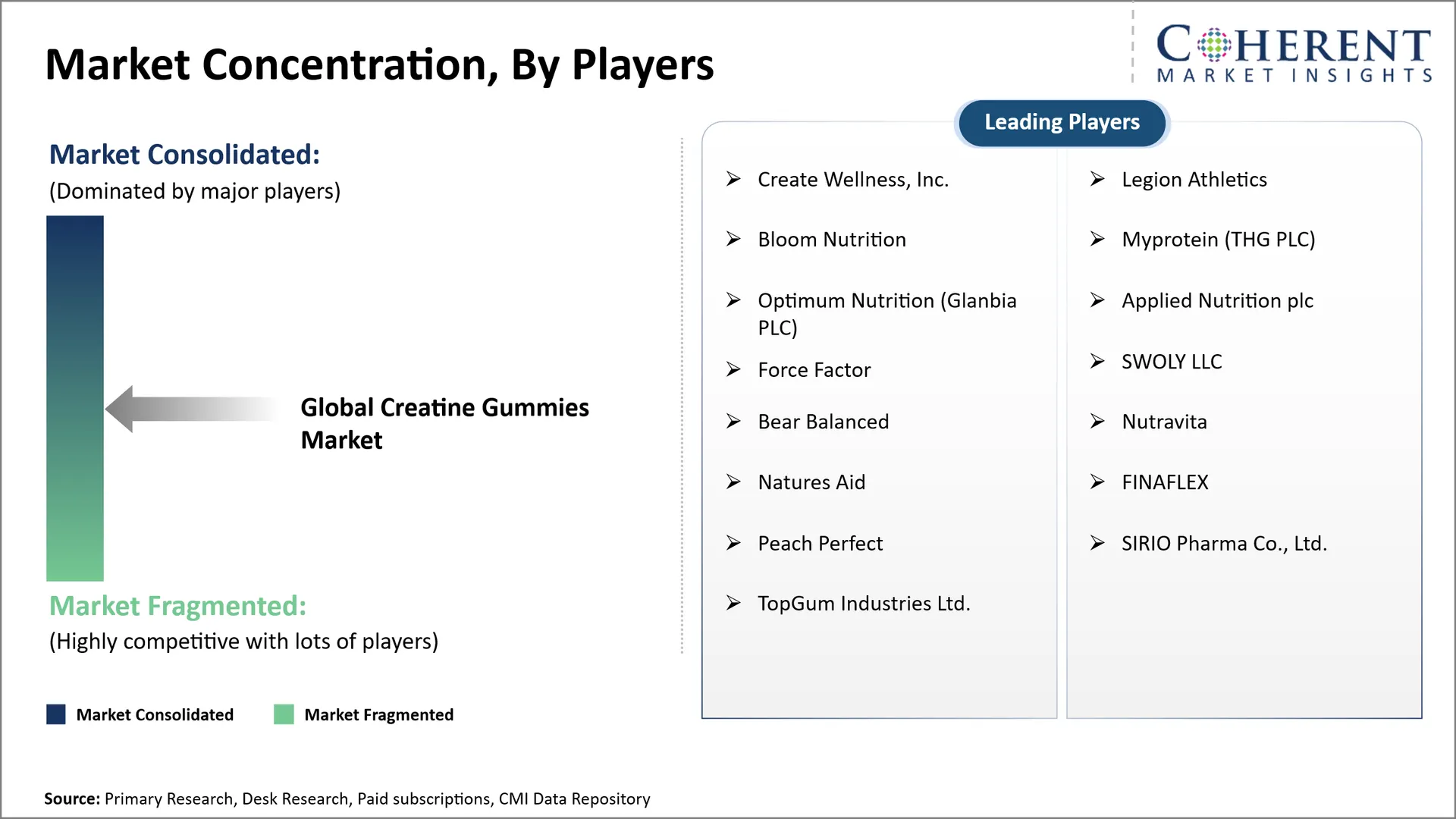
The global creatine gummies market is expected to be characterized as a fragmented market with a number of established sports nutrition companies, rising wellness brands, niche gummy companies, and private label suppliers. Competition is focused on the ingredient specifications, consistency in production, costs of production and ease of channel access. Flexibility in production, plus established brands or brands with greater relationships with retailers and marketing tools are ways regional producers can compete. Compliance expertise and reliable sourcing of ingredients are still significant factors in commercial relationships.
Key focus areas include
- Product Differentiation: The forms, flavours, convenience of serving and the formulation characteristics communicated by manufacturers are the means of competition.
- Ingredient Sourcing: It is essential to be able to source suitable creatine raw materials reliably to ensure consistency of product specifications.
- Manufacturing Economics: Batch sizes, yields, and ingredient use impact costs and wholesale pricing flexibility.
- Regulatory Compliance: Companies are required to have proper supplement labels, ingredient statements and substantiated claims.
- Distribution Strategy: Brands compete through retail placement, online marketplaces, and access to specialist nutrition channels.
- Private-Label Manufacturing: Contract manufacturers can strengthen commercial relationships through formulation customization, flexible order quantities, and dependable supply agreements.
- Pricing and Profitability: Brands must balance acceptable retail prices with formulation, production, fulfillment, and customer-acquisition expenditures.
Market Report Scope
Global Creatine Gummies Market Report Coverage | |||
Report Coverage | Details | ||
Base Year | 2025 | Market Size in 2026: | USD 53.95 Mn |
Historical Data For: | 2020 to 2024 | Forecast Period: | 2026 to 2033 |
Forecast Period 2026 To 2033 CAGR: | 12.40% | 2033 Value Projection: | USD 122.28 Mn |
Geographies covered: |
| ||
Segments covered: |
| ||
Companies covered: | Create Wellness, Inc., Legion Athletics, Bloom Nutrition, Myprotein (THG PLC), Optimum Nutrition (Glanbia PLC), Applied Nutrition plc, Force Factor, SWOLY LLC, Bear Balanced, Nutravita, Natures Aid, FINAFLEX, Peach Perfect, SIRIO Pharma Co., Ltd., TopGum Industries Ltd. | ||
Growth Drivers: |
| ||
Restraints & Challenges: |
| ||
Analyst Opinion (Expert Opinion)
- Future Market Direction: The global creatine gummies market is likely to develop a clearer separation between premium, specification-led manufacturers and lower-priced consumer brands. Long-term competitive strength may increasingly depend on the ability to provide repeatable manufacturing solutions across multiple product portfolios. Companies that combine formulation expertise with scalable contract manufacturing could capture greater value than brands relying primarily on individual product launches.
- Transformative Trend or Disruption: More collaboration between creatine ingredient makers and gummy companies could reshape the market's supply structure. Companies that have reliable access to raw materials and dedicated manufacturing capacity may be able to achieve better production planning and cost predictability. This in turn may put pressure on independent supplement brands to establish long-term manufacturing partnerships rather than merely sourcing from interchangeable third parties.
- Strategic Priorities, Risks, and Recommendations: Manufacturers should focus on formulation stability, reproducible production processes and diversified raw-material procurement. Reducing commercial and regulatory exposure can be achieved by investing in proven shelf life performance and compliant product communication. Companies should also weigh the cost of customer acquisition before scaling distribution, and steer clear of over-proliferation of flavors or unsupported cognitive-health claims that could eat into margins and increase compliance risk.
Speak to the analyst
Want personalized insights?
Take the findings above to one of our principal consultants, or have the report rebuilt around the segments, geographies and competitors you actually track.
Market Segmentation
- Creatine Type Insights (Revenue, USD Mn, 2021 - 2033)
- Creatine Monohydrate
- Creatine Hydrochloride (HCl)
- Blended Creatine Formulations
- Gummy Base Insights (Revenue, USD Mn, 2021 - 2033)
- Pectin-Based
- Gelatin-Based
- Agar & Carrageenan-Based
- Starch & Tapioca-Based
- Creatine Dosage Insights (Revenue, USD Mn, 2021 - 2033)
- Up to 3 g per Serving
- Above 3–5 g per Serving
- Above 5 g per Serving
- Sugar Content Insights (Revenue, USD Mn, 2021 - 2033)
- Regular Sugar Gummies
- Reduced-Sugar Gummies
- Sugar-Free Gummies
- Application Insights (Revenue, USD Mn, 2021 - 2033)
- Sports Performance
- General Wellness & Healthy Aging
- Cognitive Support
- Muscle Recovery & Management
- Age Group Insights (Revenue, USD Mn, 2021 - 2033)
- 18–30 Years
- 31–40 Years
- Above 40 Years
- Distribution Channel Insights (Revenue, USD Mn, 2021 - 2033)
- Online Retail & DTC
- Specialty Nutrition Stores
- Supermarkets & Hypermarkets
- Pharmacies & Health Stores
- Regional Insights (Revenue, USD Mn, 2021 - 2033)
- North America
- U.S.
- Canada
- Latin America
- Brazil
- Argentina
- Mexico
- Rest of Latin America
- Europe
- Germany
- U.K.
- Spain
- France
- Italy
- Russia
- Rest of Europe
- Asia Pacific
- China
- India
- Japan
- Australia
- South Korea
- ASEAN
- Rest of Asia Pacific
- Middle East
- GCC Countries
- Israel
- Rest of Middle East
- Africa
- South Africa
- North Africa
- Central Africa
- North America
- Key Players Insights
- Create Wellness, Inc.
- Legion Athletics
- Bloom Nutrition
- Myprotein (THG PLC)
- Optimum Nutrition (Glanbia PLC)
- Applied Nutrition plc
- Force Factor
- SWOLY LLC
- Bear Balanced
- Nutravita
- Natures Aid
- FINAFLEX
- Peach Perfect
- SIRIO Pharma Co., Ltd.
- TopGum Industries Ltd.
Sources
Primary Research Interviews
- Creatine gummy manufacturers, nutraceutical formulators, and contract manufacturers
- Sports nutrition brands, ingredient suppliers, distributors, and retail buyers
Stakeholders
- Creatine monohydrate, pectin, gelatin, and functional ingredient suppliers
- Supplement manufacturers, private-label producers, and packaging companies
End-use Sectors
- Sports performance, muscle recovery, and general wellness
- Fitness enthusiasts, recreational athletes, and healthy aging consumers
Regulatory and Industry Bodies
- U.S. Food and Drug Administration (FDA)
- European Food Safety Authority (EFSA)
- Food Safety and Standards Authority of India (FSSAI)
- Health Canada
Databases
- UN Comtrade and ITC Trade Map
- Eurostat and U.S. Census Bureau trade statistics
- NIH Dietary Supplement Label Database (DSLD)
- PubMed and ClinicalTrials.gov
Magazines and Journals
- Journal of the International Society of Sports Nutrition
- Nutrients
- Journal of Dietary Supplements
- Food Hydrocolloids
Associations
- Council for Responsible Nutrition (CRN)
- International Society of Sports Nutrition (ISSN)
- International Alliance of Dietary/Food Supplement Associations (IADSA)
- Natural Products Association (NPA)
Public Domain Sources
- Creatine formulation studies, product datasheets, and clinical research
- Supplement labeling, ingredient pricing, and product specifications
- Company annual reports, product launches, patents, and manufacturing announcements
Key Standards and Regulations
- U.S. FDA Dietary Supplement Regulations – 21 CFR Part 111
- U.S. FDA Food Labeling Regulations – 21 CFR Part 101
- EU Nutrition and Health Claims Regulation (EC) No 1924/2006
- EU Food Information Regulation (EU) No 1169/2011
- FSSAI Health Supplements and Nutraceuticals Regulations, 2016, as amended
- ISO 22000 – Food Safety Management Systems
- NSF/ANSI 173 – Dietary Supplements
Proprietary Elements
- CMI Data Analytics Tool
- Proprietary research repository, supported by primary interviews, creatine gummy consumption modeling, formulation analysis, dosage-based demand assessment, ingredient pricing, distribution channel analysis, and competitive intelligence.
Get access to 250+ pages report
Every segment, forecast, competitor profile and data table behind the analysis above — available for instant download.
- ESOMAR Member
- ISO 9001:2015 Certified
- D-U-N-S Registered
- GDPR & CCPA Compliant
Frequently Asked Questions
The CAGR of global creatine gummies market is projected to be 12.40% from 2026 to 2033.
The global creatine gummies market is estimated to be valued at USD 53.95 Mn in 2026 and is expected to reach USD 122.28 Mn by 2033.
The report profiles the major creatine gummy players in terms of competitive positioning, product portfolio, pricing strategy, distribution, and recent strategic developments.
The report addresses creatine stability, ingredient consistency, formulation compatibility, shelf life management and the cost associated with gummy manufacturing.
The report delves into dietary supplement regulations, product labeling requirements, ingredient safety, quality testing, and compliance considerations relevant to creatine gummy manufacturers.
The report provides business intelligence for sports nutrition brands, dietary supplement manufacturers, contract manufacturers, ingredient suppliers, distributors, retailers, and investors evaluating the creatine gummies industry.
Growing preference for convenient daily creatine supplementation and increasing participation in strength training and fitness are the major factors supporting growth of global creatine gummies market.