
Global Deinking Ink Binders Market Size and Forecast – 2026 To 2033
The global deinking ink binders market is expected to grow from USD 860.0 Mn in 2026 to USD 1,750.0 Mn by 2033, registering a compound annual growth rate (CAGR) of 11.2% from 2026 to 2033. The global deinking ink binders market is driven by growing use of sustainable printing inks. On July 29, 2025, Sun Chemical launched SunCure Advance ECO UV sheetfed inks for folding carton applications. Created to run on high-speed presses, these inks feature excellent press color stability, fast curing and low misting, helping to reduce paperboard waste during make-ready processes and after press stops.
Key Takeaways of the Global Deinking Ink Binders Market
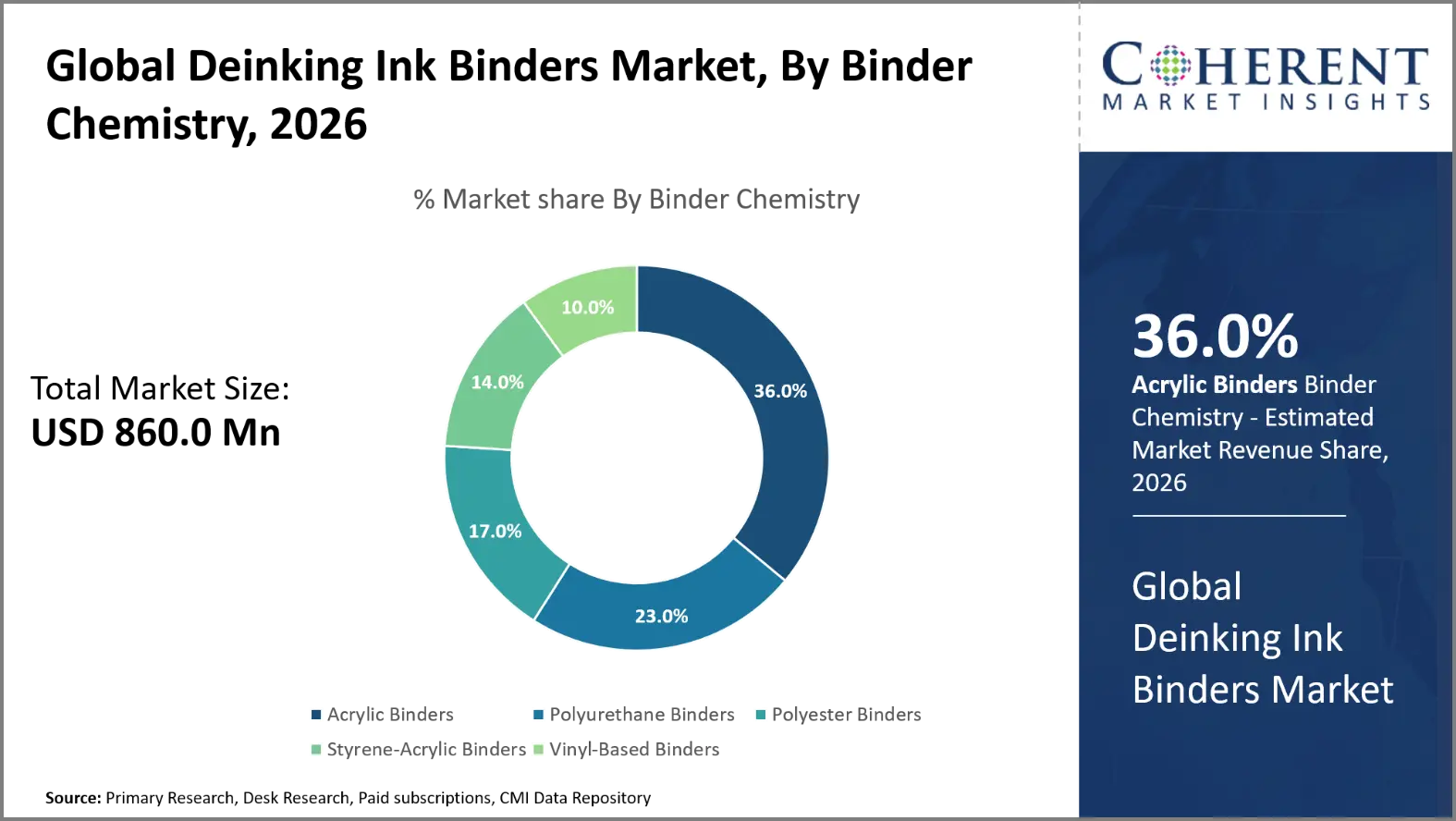
- The Acrylic Binders segment is expected to account for 36.0% of the global deinking ink binders market share in 2026. Expansion of recycled fiber production is driving the growth of the segment. On May 19, 2026, Essity officially opened its upgraded Unifibres recycled-fiber processing facility at Prudhoe, Northumberland. The investment strengthened the company's recycled-fiber supply for tissue manufacturing.
- The Ink Adhesion Binders segment is estimated to capture 41.0% of the market share in 2026. Increasing demand for high-quality recycled paper products is majorly driving the growth of the segment. On January 24, 2025, Mondi expanded its NAUTILUS ProCycle portfolio through additional paper grammages and reel formats. The product contains 100% post-consumer recycled material. Its expanded portfolio offers brightness, whiteness, and printing performance for demanding applications.
- The Water-Based Formulations segment is estimated to capture 37.0% of the market share in 2026. Growing adoption of circular packaging initiatives is majorly driving the growth of the segment. On May 12, 2025, Amcor and the Metsä Group announced a collaboration to produce molded-fiber packaging for food applications. The agreement will combine Amcor’s high barrier film technology with Metsä Spring’s Muoto wood-based molded fiber material.
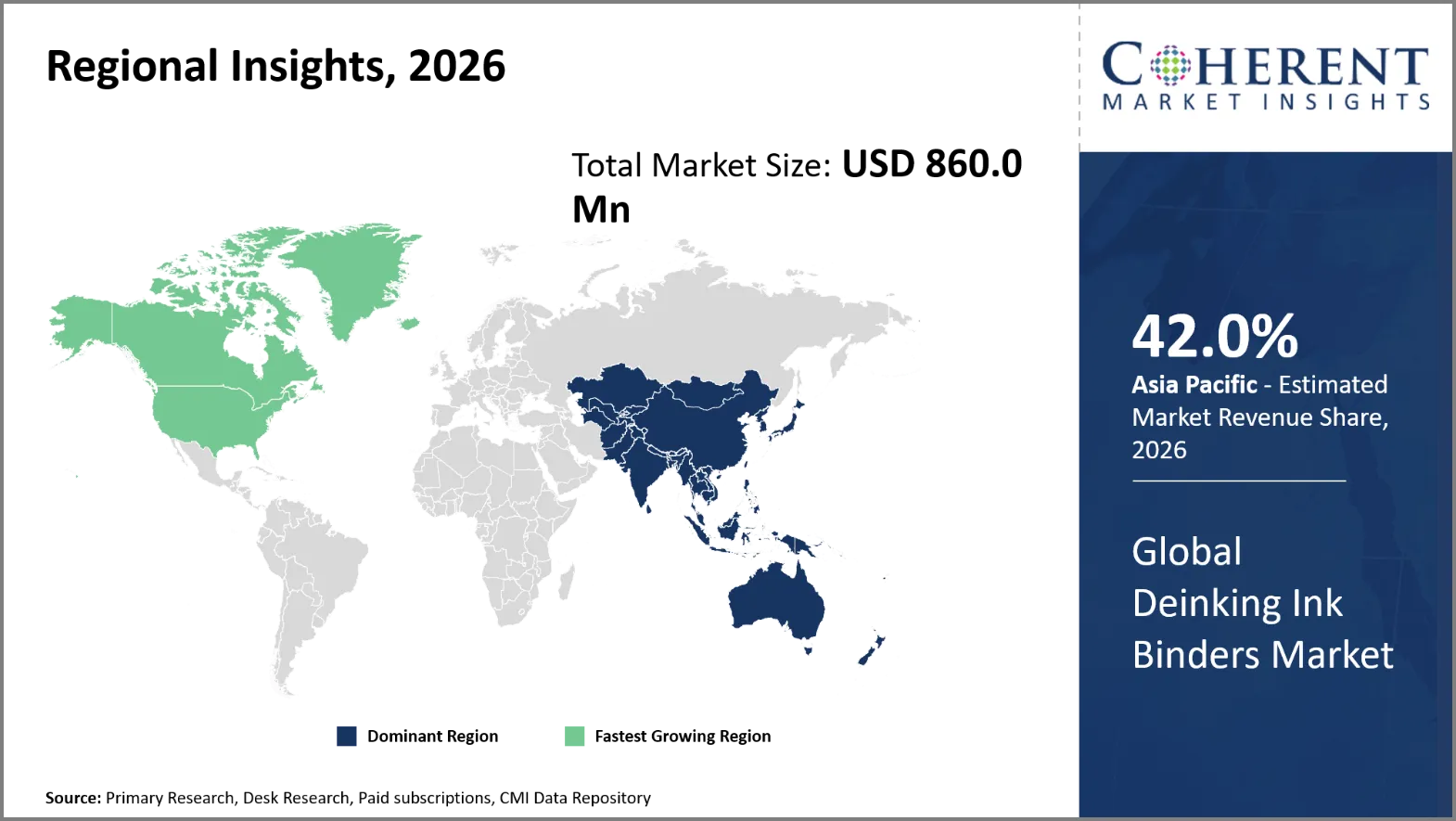
- Asia Pacific is expected to dominate the deinking ink binders market in 2026 with a market share of 42.0%. Rising demand for recyclable printed packaging materials in Asia Pacific is driving the growth of the regional market. On February 24, 2025, Tetra Pak introduced carton packaging materials containing 5% certified recycled polymers in India. The company became the first food and beverage packaging company in India to introduce this solution.
- North America is expected to account for 29.0% share in 2026 and is projected to record the fastest growth over the forecast period. Expansion of water-based and bio-based ink technologies in North America is driving the growth of the regional market. On October 1, 2025, FUJIFILM North America Corporation launched the ACUITY TR roll-fed printer for the U.S. market. The 1.6-meter system uses Fujifilm's AQUAFUZE water-based UV ink technology.
Segmental Insights
Why Does Acrylic Binders Dominate the Global Deinking Ink Binders Market?
The acrylic binders segment is expected to account for 36.0% of the global deinking ink binders market share in 2026. Acrylic binders are by far the most widely used because of their balanced adhesion and pigment compatibility, and regulated film formation. They offer formulation versatility for a number of printing surfaces and ink formulations. Acrylic polymers present a good performance in the printing and in the subsequent paper recycling. Their chemical qualities also allow manufacturers to alter the water resistance, flexibility and drying characteristics. These benefits make acrylic binders perfect for packaging, publishing and commercial printing applications. The growing demand for printed materials that may be recycled further propels the development of acrylic binders.
On March 20, 2025, Lubrizol announced the availability of a new binder that enables the formulation of advanced jettable inks for digital printing. Lubrijet N440 is an anionically stabilized, aliphatic polyurethane dispersion suitable for the formulation of water-based pigmented inkjet inks. With excellent adhesion to vinyl, metal, paper and plastic substrates, it is a robust new resin consideration for jetting applications either as an ink binder or in specific primer and pre-coat applications.
- Current Industry Events of 2026
- Market Size Estimation
- Regional Breakdown
- Competitive Landscape
- Customer Intelligence
- Segmental Analysis
- Pricing Analysis
- Key Market Drivers, Challenges & Future Trends
- Customized Insights Section
Why is Ink Adhesion Binders the Most Crucial Binder Function?
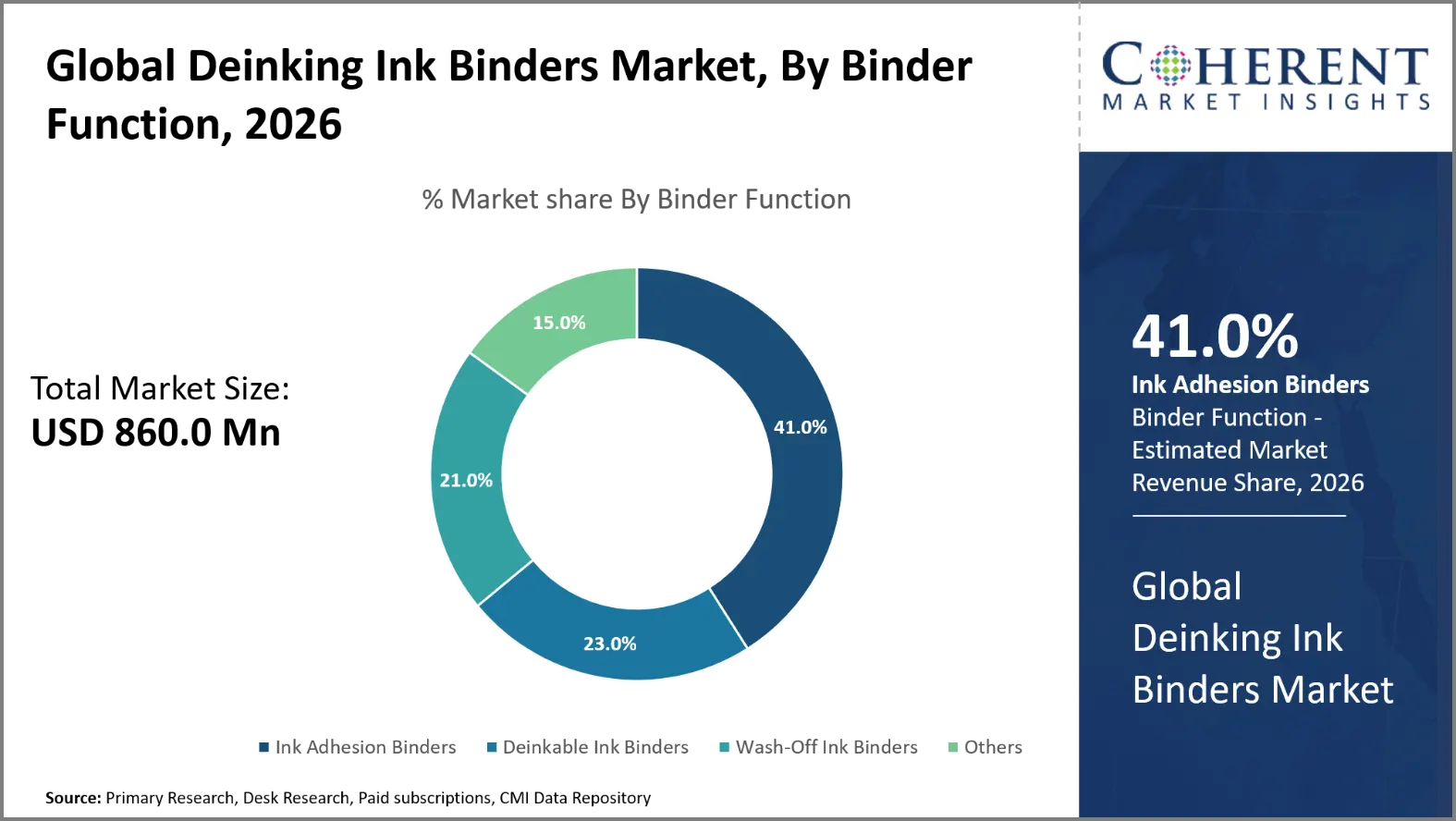
The ink adhesion binders segment is expected to account for 41.0% of the global deinking ink binders market share in 2026. Ink adhesion binders are crucial because they maintain pigment attachment to printed substrates. Strong adherence eliminates the transfer of ink, smearing and premature deterioration of the coating. Such qualities retain the quality of the printed picture in handling, shipping and storage. However, deinking formulas must also be compatible with effective ink detachment during paper recycling. Manufacturers consequently balance the printing stickiness with regulated ink release during recycling. This balance directly affects the quality of the recovered fiber and the performance of the recycled paper.
On November 27, 2025, RecyClass announced positive recycling test results for several nitrocellulose-free printing ink technologies. The evaluation covered four polyurethane-based technologies and one acrylic-based ink technology. Testing assessed their compatibility with polyethylene and polypropylene flexible packaging recycling streams. The tested inks showed no negative impact on recycled pellet or film quality.
Water-Based Formulations Dominates the Global Deinking Ink Binders Market
The water-based formulations segment is expected to account for 37.0% of the global deinking ink binders market share in 2026. Water-based formulations are predominant because they limit the need of volatile organic solvents. Their lower solvent concentration leads to better working conditions and less pollutants. These formulations also meet the increasing environmental standards of the printing and packaging industries. Water-based acrylic and other polymer binders provide good adherence and pigment dispersion. Their interoperability with paper-based printing applications further boosts commercial usage. Growing need for recyclable packaging is further pushing manufacturers to develop water-compatible binder solutions.
On July 25, 2025, hubergroup Print Solutions released HYDRO-X CONTACT, a modular series of water-based inks and overprint varnishes. The system is targeted for direct food-contact packaging applications and enables flexographic printing on paper and film-based substrates.
Current Events and their Impact
Current Events | Description and its Impact |
European Union - Packaging and Packaging Waste Regulation (PPWR), Regulation (EU) 2025/40 |
|
China - Limits of Volatile Organic Compounds (VOCs) in Printing Ink, GB 38507-2020 |
|
Deinking Ink Binders Market Dynamics
Market Drivers
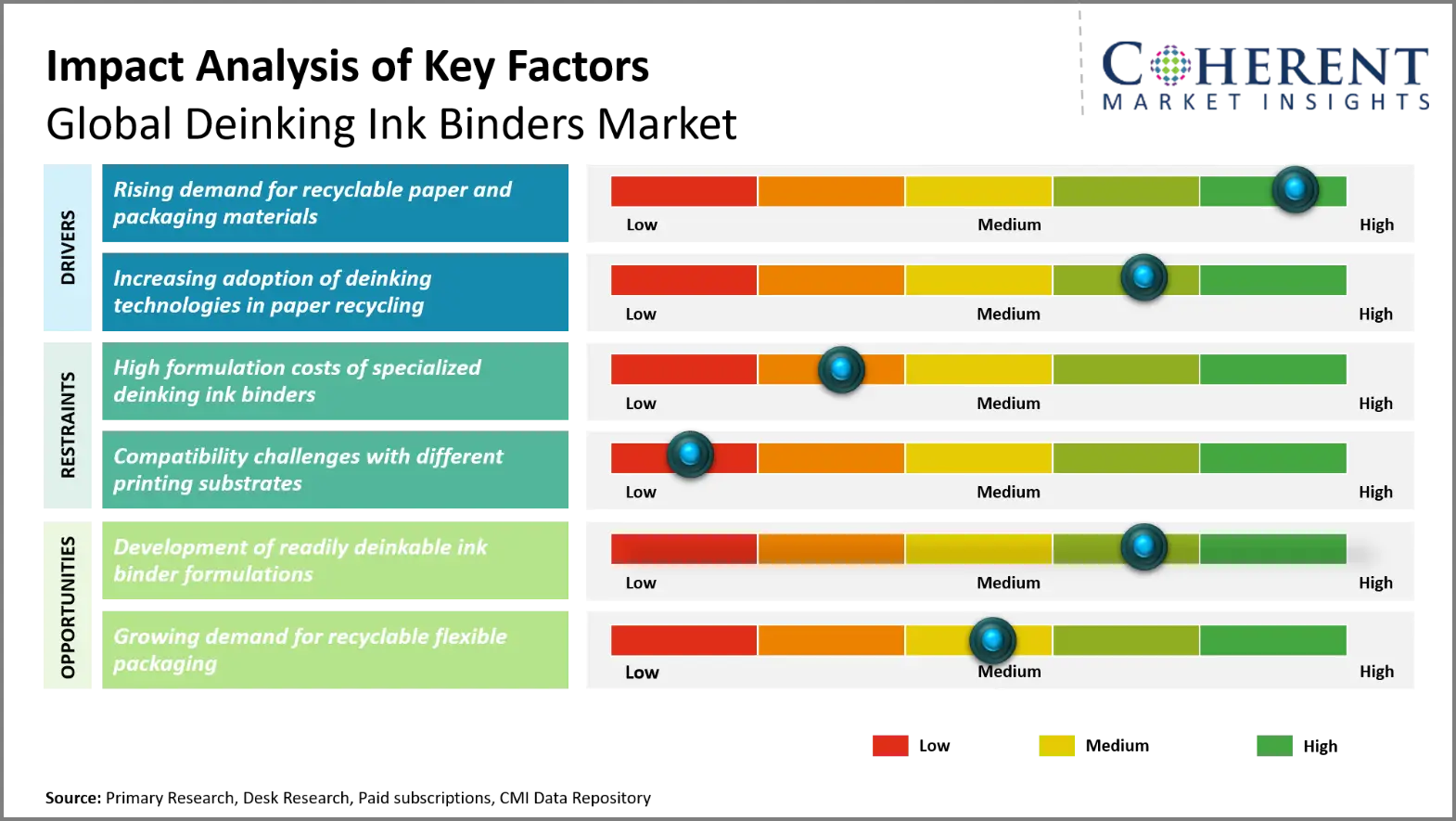
- Rising demand for recyclable paper and packaging materials: The growing demand for recyclable paper and packaging materials is increasing the importance of deinking-compatible ink binders. Packaging makers are moving away from traditional plastics and towards recyclable paperboard and fiber-based alternatives. The change demands printing inks that deliver the image quality but do not hinder efficient recycling. There are binder producers working on acrylic and water-based polymers with regulated adhesion properties. These compounds help printing inks to release during recycling and enhance recovered fiber quality. Sustainability pledges growing in packaging firms also drives investment in recyclable printing technologies. Hence, the demand for specialized deinking ink binders is growing in packaging applications.
- On February 28, 2025, Huhtamaki launched ProDairy, a recyclable single-coated paper cup series for yogurt and dairy products. All its products have packaging that is less than 10% plastic. Its design preserves the barrier and food-safety performance needed in dairy applications.
- Increasing adoption of deinking technologies in paper recycling: Growing adoption of advanced deinking technologies is creating opportunities for specialized ink binder makers. Paper recycling plants are investing in flotation, washing and enzymatic de-inking. These systems require printing inks with known detachment characteristics when the fiber is recovered. Binder manufacturers are working on polymers that have good printing performance yet are easy to remove from ink. Water-based formulations and modified acrylic dispersions are getting more development focus. Improved deinking efficiency allows paper mills to cut down ink contamination, and improve recycled pulp brightness. The increasing output of recycled paper is creating demand for appropriate binder technologies.
- On July 24, 2025, Lenzing Papier announced investment in a major deinking factory. The facility has an enhanced water recycling and treatment system. The new set-up enhances the removal of printing ink from recovered paper. The system is aimed to improve recycled-fibre quality and to help alternative recovered-fibre sources.
Emerging Trends
- Development of Recycling-Compatible Water-Based Acrylic Binders: Manufacturers are developing water-based acrylic binders that have regulated adhesion, better pigment dispersion, and quicker ink removal during paper recycling.
- Impact: This improvement increases the printing performance and enables effective ink removal, resulting in lower residual contamination and higher quality recovered paper.
- Relevance to the market: BASF and Dow offer acrylic polymer technology that facilitate water-based printing formulations. Their polymer development capabilities provide prospects for customized recycling-compatible binder solutions.
- Growing Adoption of Deinking-Friendly Printing Ink Technologies: Printing ink makers are focusing on binder chemistries to create a balance between substrate adherence and successful separation of ink during flotation and washing operations.
- Impact: These formulas improve deinking efficiency, produce higher quality recycled pulp, and lessen the processing challenges of stubborn ink remnants.
- Relevance to the market: INGEDE assessment methodologies, including Method 11, are applicable to assess deinkability of printed products. This testing promotes binder vendors to demonstrate recycling compatibility during formulation development.
Regional Insights
Why is Asia Pacific a Strong Market for Deinking Ink Binders?
Asia Pacific is expected to account for a market share of 42.0% in 2026. Asia Pacific has a strong base in recycled-fibre manufacturing and its paper packaging production is growing. Recovered-paper processing industries have developed in China, Japan, South Korea and India. In 2024, the output of recycled pulp in China reached 63.18 million tons. Japan had a recovered-paper utilization rate of 67% in 2025. The Indian paper industry derives about 74-76% of its production from wastepaper and recycled fiber. These improvements are favorable to the use of special deinking agents and appropriate binder formulations. Regional manufacturers increasingly require polymers supporting flotation efficiency, fiber cleanliness, and consistent pulp brightness. Packaging converters also favor recyclable paper substrates requiring improved printing compatibility.
Why Does North America Deinking Ink Binders Market Exhibit High Growth?
North America is expected to register the fastest growth with a CAGR of 11.0% over the forecast period. The region is projected to account for 29.0% of the global deinking ink binders market in 2026 and benefits from established recovered-paper collection networks and large-scale recycled packaging manufacturing. Around 45 million tons of paper were recycled in 2025, according to the American Forest and Paper Association. U.S. mills absorbed 31.4 million tons of reclaimed paper for new goods. A large share of the gathered fiber is consumed by containerboard manufacture. Canada meets regional need with manufacture of recycled newsprint, tissue and packaging. For these applications, it is necessary to effectively remove printing inks, coatings and adhesive residues. Binder suppliers can address this requirement through controlled adhesion and improved ink-release characteristics.
Global Deinking Ink Binders Market Outlook for Key Countries
Why is China Emerging as a Major Hub in the Deinking Ink Binders Market?
Demand for China deinking ink binders is driven by the large-scale production of recycled pulp and the domestic paper making industry. China Paper Association stated that paper and paperboard production reached 136.25 million tons in 2024. Recycled pulp production reached 63.18 million tons, representing 55% of total pulp usage. Recovered wastepaper for domestic consumption also stood at 69.71 million tons. These data highlight the significance of recovered-fiber processing for Chinese paper mills. Demand for packaging paperboard and for recycled printing grades is encouraging greater ink separation. For binders, manufacturers can target acrylic polymers suitable for flotation and low-residue formulations.
Is U.S. the Next Growth Engine for the Deinking Ink Binders Market?
The U.S. market benefits from domestic recovered-paper consumption and an established recycled-fiber manufacturing infrastructure. Data from the American Forest and Paper Association showed around 45 million tons of recycled paper in 2025. Cardboard amounted to more than 33 million tons. About half the paper that was recovered was used to make containerboard. This concentration increases chances for binders in recyclable printed packaging. Consistent ink removal from mixed recovered-paper streams is also required by paper mills. Suppliers may formulate products to address adhesive contamination, ink fragmentation and flotation performance. These standards promote cooperation between printer ink manufacturers, chemical suppliers and recycling facilities.
Germany Deinking Ink Binders Market Analysis and Trends
The German market is characterized by widespread use of recovered paper and high demands on the quality of materials. In 2024, the German Environment Agency stated that recovered paper made up about 84 percent of the paper industry’s raw material use. However, printing inks, adhesives and paper additives are progressively complicating recycling operations. This allows for customized binders that allow for controlled ink separation. In packaging and graphic-paper applications, German paper makers are required to deliver recovered-fiber quality. It also pushes the government to develop better flotation and washing technologies, given it has the recycling infrastructure already. Low-residue chemistry and compatibility with existing recycling procedures in Europe allow binder suppliers to differentiate their products.
Japan Deinking Ink Binders Market Analysis and Trends
Japan's market benefits from advanced recovered-paper collection networks and a high level of engagement in recycling. The Japan Paper Association stated that the recovered-paper utilization rate was 67% in 2025. Its paper and paperboard recovery rate reached 81.3% during the same year. Printing and communication paper generated substantial recovered-fiber streams requiring effective deinking. Japanese mills increasingly prioritize recovered-paper quality and resource efficiency. This leads to potential for binders that separate predictably during floating and washing. Suppliers might focus on formulations for recycled printing paper, office paper and coated-paper recovery applications.
India Deinking Ink Binders Market Analysis and Trends
Recycled-fiber-based paper manufacturing and increasing packaging-grade production are the major factors that are benefitting the market in India. The Department for Promotion of Industry and Internal Trade has disclosed a heavy dependence on recovered paper. Wastepaper-based mills account for around 74-76% of the domestic paper production. Packaging paper and paperboard use rose by 7.68 per cent in the financial year 2024-25. Consumption of recycled duplex board also saw a growth of 6.50%. Such improvements create chances for specific binders technologies that are suitable with deinking. Indian paper mills need formulas that are cost-effective, enhance the brightness of recovered fiber and help in efficient removal of contaminants. Domestic chemical suppliers can develop acrylic dispersions suited to regional paper recycling conditions.
Global Deinking Ink Binders Market - Acrylic Versus Polyurethane Binders in Deinking Applications
Performance Metric | Acrylic Binders | Polyurethane Binders |
Polymer chemistry | Acrylic and styrene-acrylic polymers | Polyester-based or polyether-based polyurethane polymers |
Typical binder application | Water-based flexographic, gravure, and offset printing inks | Flexible packaging, gravure, flexographic, and selected water-based printing inks |
Ink-film adhesion | Good adhesion to paper and selected coated substrates | Strong adhesion to paper, films, and non-porous substrates |
Film flexibility | Moderate to high, depending on polymer composition | High, particularly with flexible polyurethane grades |
Film hardness | Adjustable through polymer composition and glass transition temperature | Adjustable through hard-segment and soft-segment chemistry |
How is Development of Readily Deinkable Ink Binder Formulations Creating New Growth Opportunities in the Deinking Ink Binders Market?
The development of readily deinkable ink binder formulations is creating opportunities for polymer manufacturers targeting high-quality recovered paper production. Conventional binders can form persistent ink films that resist detachment during flotation and washing. New acrylic dispersions and redesigned polymer systems overcome this problem with regulated adhesion, reduced film resistance and enhanced ink particle separation. The International Association of the Deinking Industry examines printed items with its Deinkability Scorecard and INGEDE Method 11. These assessments push ink manufacturers to refine binder chemistry prior to launch. BASF, Dow and other polymer manufacturers can focus on specialized binder technologies that support recycled graphic paper, printed packaging and recovered fiber applications.
On May 6, 2025, Siegwerk received U.S. Patent No. 12,291,051 for its deinking primer formulation. The patented composition comprises a polymeric binder with chemically modified functional groups. These alterations enable the primer layer to dissolve in an aqueous alkaline solution.
Market Players, Key Development, and Competitive Intelligence
Key Developments
- On April 16, 2026, Siegwerk launched UniLEAF, a new acrylic-free ink for water-based flexo printing on paper and board. It provides considerable gains in renewable content, significant reductions in carbon footprint, increased energy efficiency and good alignment with market and regulatory requirements in a novel formulation strategy.
- On March 24, 2026, ACTEGA announced the market availability of ACTExact UV Black Algae Ink, the first UV flexographic ink produced with the carbon-negative Algae Black pigment. The innovation was sponsored and supported by Waiākea, which earlier this year revealed it would be the first food and beverage brand internationally to commercialize algae-based inks on its labels across its supply chain.
- On March 18, 2025, Evonik introduced TEGO Res 1100, a methacrylate copolymer co-binder that accelerates deinking of printed plastic sheets. The product allows users to remove the ink more quickly and is compatible with the existing solvent-based printing ink formulas.
Competitive Landscape
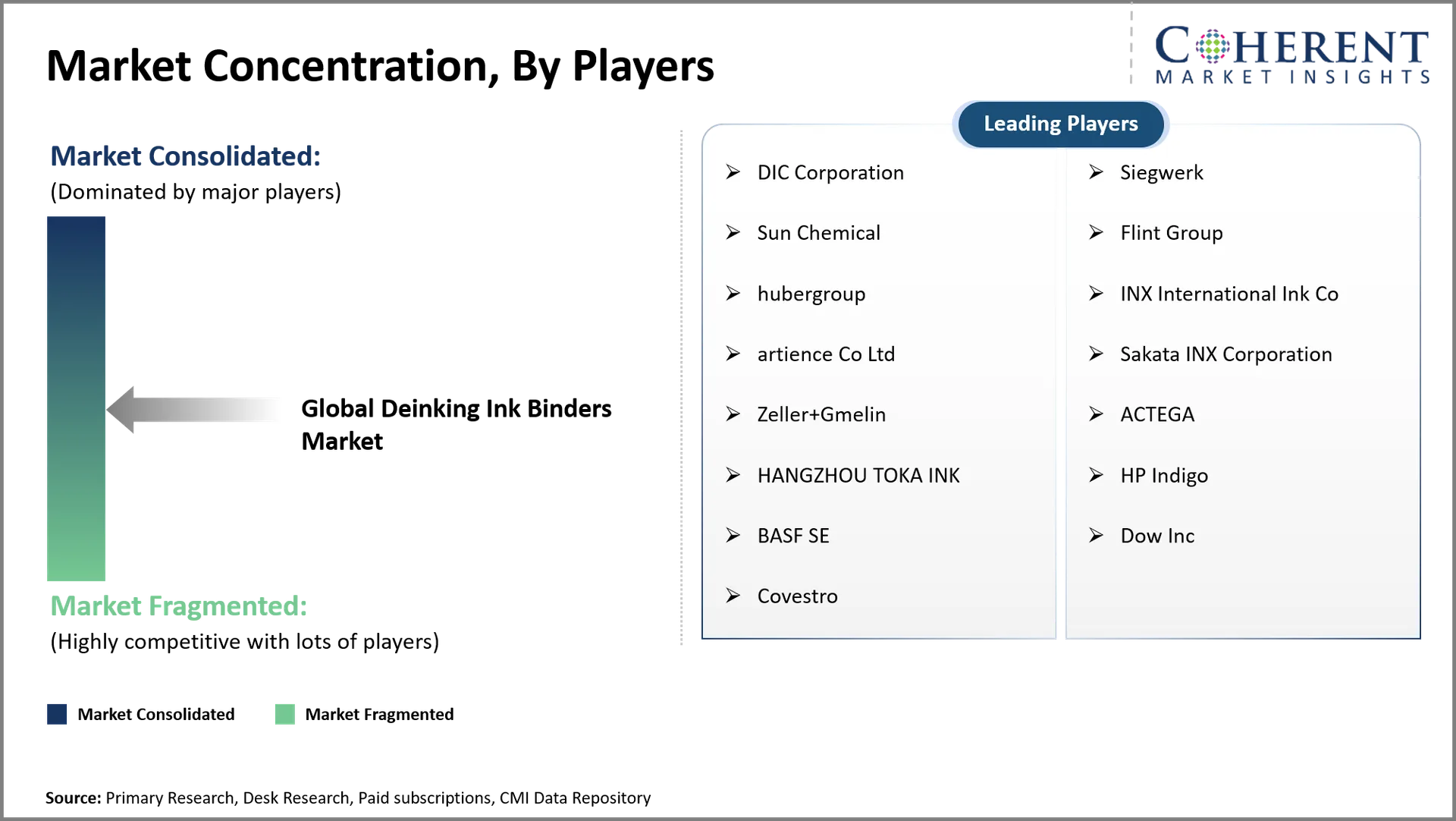
Established specialty chemical manufacturers compete on the basis of polymer innovation, formulation flexibility and printing performance to dominate the global deinking ink binders market. The line of Joncryl acrylic resins from BASF SE is well positioned in a competitive environment. Joncryl 633 is appropriate for water-based inks with good opacity on paper substrates while Joncryl 1698 has great resolubility for printing on paperboard. Its Joncryl BRC line provides renewable-content binders with at least 50% bio-based content. Dow Inc. increases its position with acrylic polymer technologies and sustainable paper packaging coatings. Its BLUEWAVE technology enables recyclable paper packaging, and RHOBARR 320 increases fiber recovery in recycled packaging applications. BASF, Dow, and other specialty polymer suppliers increasingly focus on water-based chemistry, controlled adhesion, resolubility, and renewable raw materials. Competitive differentiation depends on delivering printing durability alongside improved recycling compatibility.
Top Manufacturers and Notable Products in the Deinking Ink Binders Market
Manufacturer | Binder chemistry | Notable Product | Key features |
BASF | Acrylic | Joncryl 633 | High opacity, good resolubility, water resistance, rub resistance, and printability |
Dow | Acrylic | RHOPLEX I-2350 | High heat resistance, gloss, stiffness, and low blocking characteristics |
Covestro | Acrylic | NeoCryl BT-26 | Pigment wetting, compatibility, and suitability for water-based printing formulations |
Lubrizol | Polyurethane | Lubrijet N440 | Strong substrate adhesion, narrow particle-size distribution, reliable jetting, and chemical resistance |
Manipal Specialty Chemicals | Polyurethane | WesttCryl MPU 504 | Designed as a waterborne polyurethane binder for printing inks |
Market Report Scope
Global Deinking Ink Binders Market Report Coverage | |||
Report Coverage | Details | ||
Base Year | 2025 | Market Size in 2026: | USD 860.0 Mn |
Historical Data For: | 2020 To 2024 | Forecast Period: | 2026 To 2033 |
Forecast Period 2026 To 2033 CAGR: | 11.20% | 2033 Value Projection: | USD 1,750.0 Mn |
Geographies covered: |
| ||
Segments covered: |
| ||
Companies covered: | DIC Corporation, Siegwerk, Sun Chemical, Flint Group, hubergroup, INX International Ink Co, artience Co Ltd, Sakata INX Corporation, Zeller+Gmelin, ACTEGA, HANGZHOU TOKA INK, HP Indigo, BASF SE, Dow Inc, Covestro | ||
Growth Drivers: |
| ||
Restraints & Challenges: |
| ||
Analyst Opinion (Expert Opinion)
- The future of the deinking ink binders industry will depend on polymer designs balancing printing performance with controlled ink removal. Conventional high-adhesion formulations will increasingly face competition from recycling-compatible acrylic dispersions and modified polymer systems. Water-based technologies will gain strategic importance across paperboard printing and recycled graphic-paper applications. Manufacturers capable of controlling ink detachment without sacrificing pigment retention will develop stronger commercial differentiation. Bio-based acrylic binders and low-residue formulations will also be in more focus.
- Water-based acrylic binders for recycled paperboard, corrugated packaging and graphic paper recycling will offer the most prospects. Suppliers looking for recycled-fiber-based paper production prospects may consider China and India. Opportunities exist for technically improved formulations on recovered-paper cleanliness and processing uniformity with Germany and Japan. Another key consumer category is flexible packaging converters who are looking for recyclable printed paper alternatives. The suppliers should target acrylic emulsions which have predictable flotation behavior and compatibility with different printing techniques.
- Instead of providing commodity binders with modest formulation tweaks, market players should engage in the creation of application-specific polymers. Companies should build technical collaborations with paper mills, ink formulators and deinking equipment suppliers. Pilot scale flotation testing should be a significant part of product certification. Suppliers should show measurable improvements in ink removal, pulp brightness, residual ink content and fiber recovery. On-site technical support and the creation of region-specific formulations can help to increase client retention. And companies should also look for renewable monomers and low-residue additions to diversify future product lineups.
Speak to the analyst
Want personalized insights?
Take the findings above to one of our principal consultants, or have the report rebuilt around the segments, geographies and competitors you actually track.
Market Segmentation
- Binder Chemistry Insights (Revenue, USD Million, 2021 - 2033)
- Acrylic Binders
- Polyurethane Binders
- Polyester Binders
- Styrene-Acrylic Binders
- Vinyl-Based Binders
- Binder Function Insights (Revenue, USD Million, 2021 - 2033)
- Ink Adhesion Binders
- Deinkable Ink Binders
- Wash-Off Ink Binders
- Others
- Formulation Type Insights (Revenue, USD Million, 2021 - 2033)
- Water-Based Formulations
- Solvent-Based Formulations
- UV-Curable Formulations
- Bio-Based Formulations
- Printing Process Insights (Revenue, USD Million, 2021 - 2033)
- Flexographic Printing
- Gravure Printing
- Offset Printing
- Digital Printing
- Screen Printing
- Substrate Insights (Revenue, USD Million, 2021 - 2033)
- Paper and Paperboard
- Flexible Plastic Films
- Polyester Films
- Polyolefin Films
- Labels and Sleeves
- Others
- Application Insights (Revenue, USD Million, 2021 - 2033)
- Food and Beverage Packaging
- Consumer Goods Packaging
- Flexible Packaging
- Labels and Shrink Sleeves
- Folding Cartons
- Commercial Printing
- Paperboard Packaging
- Regional Insights (Revenue, USD Million, 2021 - 2033)
- North America
- U.S.
- Canada
- Latin America
- Brazil
- Argentina
- Mexico
- Rest of Latin America
- Europe
- Germany
- U.K.
- Spain
- France
- Italy
- Russia
- Rest of Europe
- Asia Pacific
- China
- India
- Japan
- Australia
- South Korea
- ASEAN
- Rest of Asia Pacific
- Middle East
- GCC Countries
- Israel
- Rest of Middle East
- Africa
- South Africa
- North Africa
- Central Africa
- North America
- Key Players Insights
- DIC Corporation
- Siegwerk
- Sun Chemical
- Flint Group
- hubergroup
- INX International Ink Co
- artience Co Ltd
- Sakata INX Corporation
- Zeller+Gmelin
- ACTEGA
- HANGZHOU TOKA INK
- HP Indigo
- BASF SE
- Dow Inc
- Covestro
Sources
Primary Research Interviews
- Ink Binder Manufacturers
- Paper Recycling Plant Operators
- Raw Material Suppliers (Resins & Polymers)
- Packaging & Printing Industry Professionals
Magazines
- Pulp & Paper International Magazine
- Paper360° Magazine
- TAPPI Journal Magazine
- Ink World Magazine
Journals
- Journal of Pulp and Paper Science
- BioResources Journal (Lignocellulosic Materials & Pulping)
- Journal of Cleaner Production (Recycling & Deinking Studies)
Associations
- Technical Association of the Pulp and Paper Industry (TAPPI)
- European Recovered Paper Association (ERPA)
- National Council for Air and Stream Improvement (NCASI)
- Confederation of Paper Industries (CPI)
Public Domain Sources
- U.S. Environmental Protection Agency (EPA)
- European Environment Agency (EEA)
- Food and Agriculture Organization of the United Nations (FAO)
- World Bank - Industrial Sustainability & Recycling Reports
Proprietary Elements
- CMI Data Analytics Tool
- Proprietary CMI Existing Repository of Information for Last 10 Years
Get access to 250+ pages report
Every segment, forecast, competitor profile and data table behind the analysis above — available for instant download.
- ESOMAR Member
- ISO 9001:2015 Certified
- D-U-N-S Registered
- GDPR & CCPA Compliant
Frequently Asked Questions
The global deinking ink binders market is expected to stand at USD 860.0 Mn in 2026 and is expected to reach USD 1,750.0 Mn by 2033.
The CAGR of the global deinking ink binders market is projected to be 11.2% from 2026 to 2033.
Rising demand for recyclable paper and packaging materials and Increasing adoption of deinking technologies in paper recycling are the major factors driving the growth of the global deinking ink binders market.
High formulation costs of specialized deinking ink binders and Compatibility challenges with different printing substrates are the major factors hampering the growth of the global deinking ink binders market.
In terms of binder chemistry, acrylic binders segment is estimated to dominate the market revenue share in 2026.
Deinking ink binders are polymeric materials that hold pigments together and control ink adhesion during printing and recycling.
Their chemical properties influence ink detachment, residual contamination, pulp brightness, and recovered fiber cleanliness.