

Global Denatured Ethanol Market Size and Forecast – 2026 To 2033
The Global Denatured Ethanol Market is estimated to be valued at USD 84.62 Bn in 2026 and is expected to reach USD 120.67 Bn by 2033, growing at a compound annual growth rate (CAGR) of 5.20% from 2026 to 2033. This growth is supported by increasing utilization of denatured ethanol across transportation fuels, pharmaceuticals, personal care products, chemical processing, and industrial solvent applications. Rising focus on renewable feedstocks, lower-carbon fuel alternatives, and sustainable chemical inputs is encouraging producers and end users to adopt ethanol-based solutions across multiple industries.
In August 2025, the Government of India announced continued measures to accelerate ethanol blending through expanded production capacity, diversified feedstock availability, development of ethanol plant infrastructure, and support for advanced biofuel projects. These initiatives are strengthening ethanol supply ecosystems while creating additional demand visibility for denatured ethanol used in fuel blending and industrial applications.
Key takeaways of the Global Denatured Ethanol Market
- Methanol Denatured Ethanol is expected to register an estimated CAGR of 5.0% and account for 46.8% of the global denatured ethanol market in 2026, supported by its broad industrial compatibility and established use in fuel and solvent formulations. In April 2025, the U.S. EPA continued implementation of renewable fuel standards supporting ethanol blending activities across transportation markets.
- Bio Based Ethanol is projected to achieve an estimated CAGR of 5.3% and represent 86.7% of the market in 2026, reflecting strong preference for renewable feedstocks across fuel and industrial applications. In August 2025, Brazil increased the anhydrous ethanol blending requirement in gasoline from 27% to 30%, strengthening bioethanol utilization within its transportation fuel system.
- Fuel and Fuel Blending is expected to expand at an estimated CAGR of 5.4% and hold 42.8% share of the global denatured ethanol market in 2026, driven by ethanol’s role in reducing fossil fuel dependence and meeting renewable fuel mandates. In June 2025, the U.S. EPA proposed renewable fuel standards for 2026 and 2027 covering expanded renewable fuel obligations.
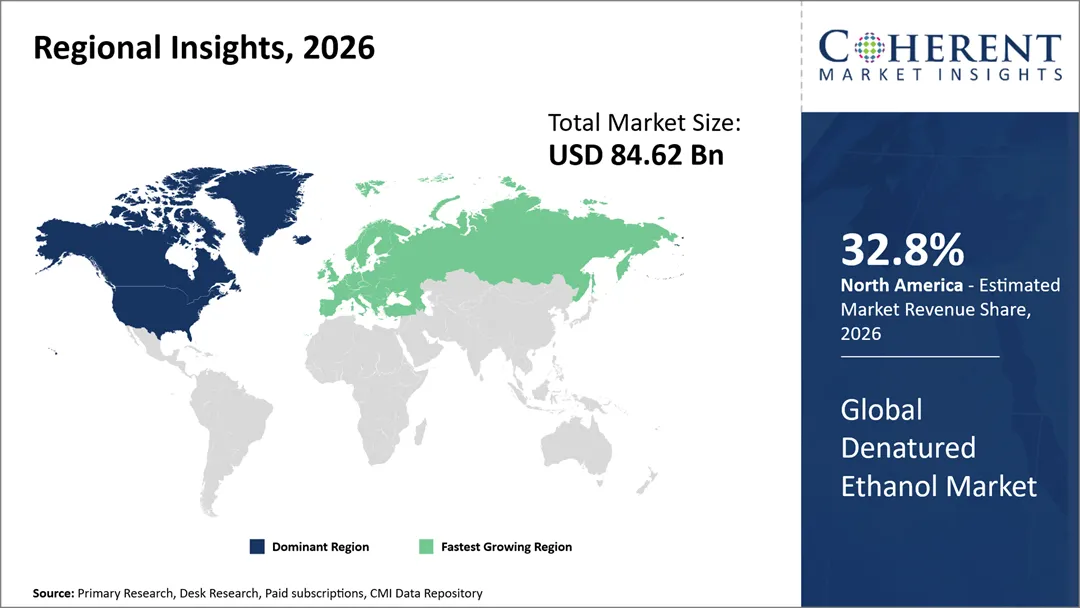
- North America is anticipated to record an estimated CAGR of 5.2% and contribute 32.8% of the global denatured ethanol market in 2026, supported by established ethanol production infrastructure, regulatory blending programs, and fuel market integration. In May 2025, the U.S. Department of Energy updated its bioenergy modeling framework to support broader alternative fuel production pathways.
- Europe is forecast to achieve an estimated CAGR of 5.8% and account for 24.7% of the global denatured ethanol market in 2026, supported by renewable transport policies and sustainability requirements influencing ethanol adoption. In November 2024, the European Commission launched the Union Database for renewable and recycled carbon fuels to improve traceability across certified fuel supply chains.
Segmental Insights
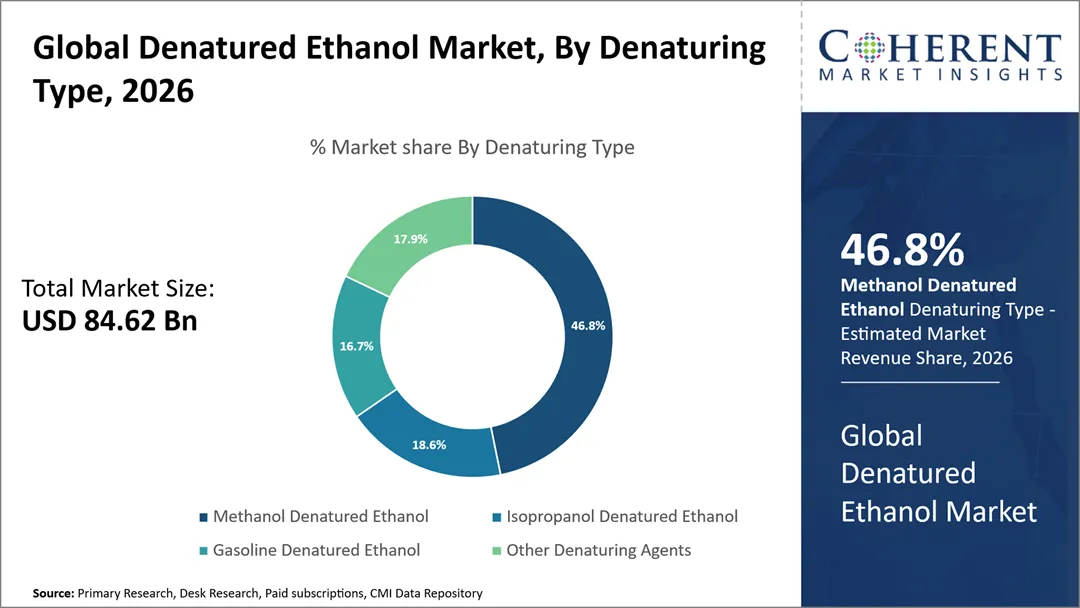
Why Does Methanol Denatured Ethanol Dominate the Denaturing Type Segment of the Global Denatured Ethanol Market?
Methanol Denatured Ethanol is expected to account for 46.8% of the global denatured ethanol market in 2026, supported by its established role in creating ethanol formulations unsuitable for beverage consumption while maintaining performance characteristics required for industrial applications. The segment benefits from strong compatibility with solvent-based manufacturing processes, chemical formulations, and fuel-related applications where cost-effective denaturation is required. Manufacturers continue to prefer methanol-based solutions due to established handling infrastructure, availability of raw materials, and integration with existing ethanol supply chains. Its adoption is particularly relevant among chemical producers, industrial solvent users, and fuel suppliers requiring consistent product specifications. Commercial opportunities remain concentrated around suppliers capable of ensuring reliable methanol availability, regulatory compliance, and optimized blending capabilities. In March 2025, the U.S. Environmental Protection Agency maintained regulatory pathways allowing approved denatured fuel ethanol formulations under renewable fuel compliance programs.
- Current Industry Events of 2026
- Market Size Estimation
- Regional Breakdown
- Competitive Landscape
- Customer Intelligence
- Segmental Analysis
- Pricing Analysis
- Key Market Drivers, Challenges & Future Trends
- Customized Insights Section
Why Does Bio Based Ethanol Represent the Largest Source Type Segment in the Global Denatured Ethanol Market?
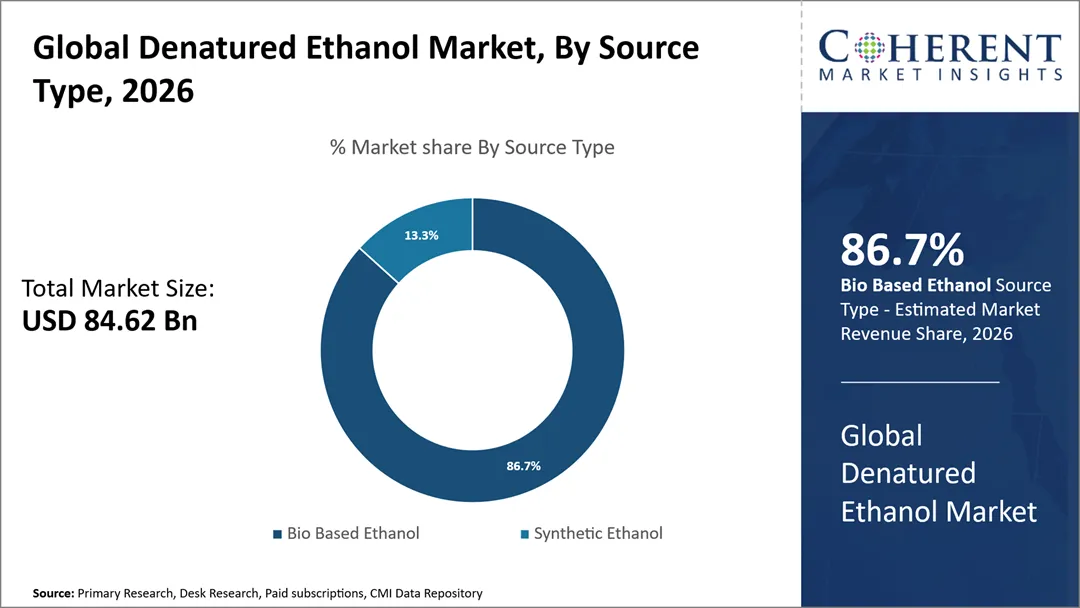
Bio Based Ethanol is projected to represent 86.7% of the global denatured ethanol market in 2026, reflecting the strong integration of renewable ethanol production systems across fuel, chemical, and industrial value chains. The segment leads because producers increasingly utilize agricultural feedstocks such as corn, sugarcane, and other biomass sources to meet sustainability objectives while supporting domestic energy security. Expanding fermentation technologies, improved distillation efficiency, and broader feedstock flexibility have strengthened production scalability. Bio based ethanol is widely adopted by fuel blenders, chemical manufacturers, and companies seeking lower-carbon alternatives for industrial formulations. For suppliers and investors, this segment creates opportunities through capacity expansion, feedstock diversification, and partnerships across agricultural and energy ecosystems. In August 2025, India highlighted continued expansion of ethanol production capacity and progress toward higher blending targets through its Ethanol Blended Petrol programmer.
Why Do Fuel and Fuel Blending Dominate the Application Segment of the Global Denatured Ethanol Market?
Fuel and Fuel Blending is expected to hold 42.8% of the global denatured ethanol market in 2026, supported by its direct connection with transportation fuel systems and government-led renewable fuel adoption programs. The segment maintains leadership as fuel producers and distributors increasingly incorporate ethanol into gasoline blends to improve renewable content and reduce dependence on conventional petroleum sources. Demand is strengthened by established blending infrastructure, refinery compatibility, and long-term procurement arrangements between ethanol producers and fuel suppliers. The commercial ecosystem includes ethanol manufacturers, fuel retailers, oil marketing companies, and logistics providers supporting large-scale distribution. Unlike industrial applications, fuel blending benefits from policy-driven demand visibility and standardized consumption channels. In July 2026, India’s Ministry of Petroleum and Natural Gas reported continued implementation of the Ethanol Blended Petrol programme, with ethanol blending reaching 20% during ESY 2025–26.
Current Events and their Impact
Current Event | Description and Its Impact |
July 2026 – India Ethanol Blended Petrol Programme Update |
|
June 2025 – European Union Suspension of GSP+ Ethanol Tariff Preferences for Pakistan |
|
September 2026 – European Union Renewable Ethanol Import Surveillance Extension |
|
Global Denatured Ethanol Market Dynamics
Key Market Drivers
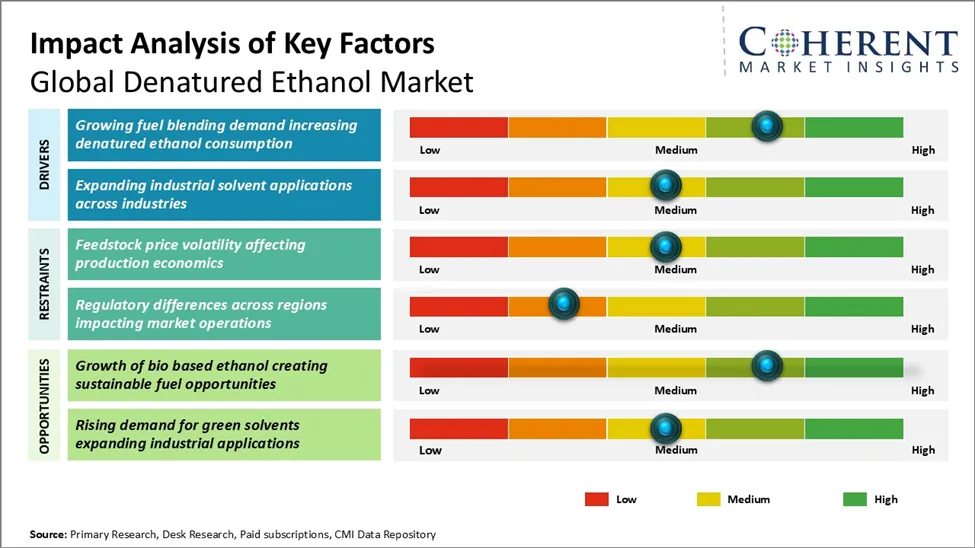
- Growing Fuel Blending Demand Increasing Denatured Ethanol Consumption: Growing fuel blending demand increasing denatured ethanol consumption is strengthening procurement from ethanol producers, fuel blenders, and oil marketing companies as transportation systems incorporate renewable fuel components into gasoline supply chains. Denatured ethanol provides the required non-potable formulation for large-scale blending while supporting compliance with renewable fuel programs. Producers benefit from stable offtake arrangements, while fuel distributors gain access to standardized renewable blending components. In March 2025, the Government of India highlighted continued expansion of ethanol blending under the Ethanol Blended Petrol programmer, with blending progressing toward the national E20 target through increased domestic ethanol supply capacity.
- Expanding Industrial Solvent Applications Across Industries: Expanding industrial solvent applications across industries are creating additional demand opportunities for denatured ethanol in chemical processing, pharmaceutical manufacturing, personal care formulations, coatings, and cleaning applications. Industrial users prefer ethanol-based solvents due to their formulation flexibility, availability, and compatibility with diverse manufacturing processes. Suppliers with capabilities in quality consistency, customized denaturation methods, and regulatory compliance can capture higher-value industrial applications beyond conventional fuel markets. Demand is also supported by manufacturers seeking solvent solutions that align with evolving environmental and workplace safety requirements. In September 2024, the European Chemicals Agency (ECHA) updated guidance related to chemical safety assessment and substance information requirements under REACH, reinforcing the importance of compliance documentation for companies supplying ethanol-based industrial chemicals.
Emerging Market Trends
- Shift Toward Lower-Carbon Ethanol Production Pathways: The denatured ethanol market is gradually moving toward production models that prioritize lower-carbon feedstocks, improved process efficiency, and traceable sustainability credentials. Producers are increasingly evaluating waste-based feedstocks, advanced fermentation methods, and energy-efficient processing systems to differentiate supply offerings. This transition may influence purchasing decisions among fuel companies, chemical manufacturers, and multinational industrial users seeking stronger environmental performance. Suppliers capable of combining reliable ethanol quality with transparent sustainability documentation are likely to gain stronger positioning as procurement criteria evolve.
- Increasing Importance of Supply Flexibility and Feedstock Diversification: Feedstock flexibility is becoming a strategic priority as ethanol producers seek to manage agricultural availability, commodity price volatility, and regional supply constraints. Companies are increasingly developing production systems capable of utilizing multiple feedstocks rather than depending on a single agricultural source. This approach can improve supply continuity, reduce exposure to seasonal fluctuations, and support regional production strategies. Over the forecast period, competitive advantage may shift toward producers that combine flexible sourcing models with efficient logistics networks and consistent product specifications.
Regional Insights
Why Does North America Dominate the Global Denatured Ethanol Market?
North America is expected to account for 32.8% of the global denatured ethanol market in 2026, supported by its mature ethanol production ecosystem, extensive fuel blending infrastructure, and strong integration between agricultural feedstock suppliers, ethanol producers, and fuel distributors. The region benefits from large-scale corn-based ethanol availability, established transportation fuel markets, and regulatory frameworks that encourage renewable fuel utilization. The U.S. particularly supports regional demand through widespread ethanol blending across gasoline networks and strong industrial consumption from solvent, chemical, and manufacturing users. Advanced production technologies, including improved fermentation efficiency and process optimization, further strengthen supply competitiveness. In April 2025, the U.S. Department of Agriculture announced additional support for biofuel infrastructure investments through its Biofuel Producer Relief Payment Program, supporting producers affected by market conditions and strengthening domestic ethanol supply resilience.
Why Is Europe Emerging as the Fastest-Growing Region in the Global Denatured Ethanol Market?
Europe is projected to represent 24.7% of the global denatured ethanol market in 2026 and is emerging as a high-growth region due to stronger sustainability requirements, renewable fuel adoption policies, and increasing demand for lower-carbon industrial inputs. The region’s ethanol market is shaped by regulatory emphasis on greenhouse gas reduction, renewable energy targets, and traceability requirements across fuel and chemical applications. European producers are increasingly focusing on certified renewable ethanol pathways and improved production efficiency to serve transportation and industrial customers. The region also benefits from demand from chemical manufacturers, pharmaceutical companies, and specialty solvent users requiring consistent-quality ethanol supplies. In January 2025, the European Commission continued implementation of the Renewable Energy Directive framework, reinforcing renewable fuel certification and sustainability requirements across European markets.
Global Denatured Ethanol Market Outlook for Key Countries
Why Is the U.S. a Key Market for the Global Denatured Ethanol Market?
The U.S. remains a key market for the global denatured ethanol market due to its integrated ethanol production infrastructure, large agricultural feedstock base, and extensive gasoline blending network. The country has a strong ecosystem connecting corn producers, ethanol manufacturers, fuel distributors, and industrial consumers. Denatured ethanol demand is supported by transportation fuel blending requirements as well as applications in solvents, coatings, cleaning formulations, and chemical processing. The presence of established ethanol producers and advanced biorefinery technologies enables consistent supply availability and product quality. Industrial users also benefit from domestic production capacity, reducing dependence on imported ethanol supplies. In June 2025, the U.S. Environmental Protection Agency released proposed renewable fuel volume obligations for future compliance years, influencing ethanol blending demand expectations among fuel suppliers and producers.
Why Is India Important in the Global Denatured Ethanol Market?
India is becoming an important market for denatured ethanol due to rapid expansion of ethanol blending programs, growing domestic production capacity, and increasing demand from transportation fuel and industrial sectors. The country benefits from diverse feedstock availability, including sugarcane derivatives, grains, and other agricultural resources, enabling producers to expand ethanol output while supporting energy security objectives. Beyond fuel applications, denatured ethanol demand is also connected with chemical processing, pharmaceuticals, cleaning products, and manufacturing industries. Government-led blending targets have encouraged investment in ethanol plants, storage infrastructure, and supply-chain development. In February 2025, India’s Ministry of Petroleum and Natural Gas highlighted continued progress toward ethanol blending objectives through increased domestic ethanol availability and expanded participation from producers across multiple feedstock categories.
Why Does China Support Growth in the Global Denatured Ethanol Market?
China supports growth in the global denatured ethanol market through its extensive chemical manufacturing base, industrial solvent consumption, and expanding bio-based chemical initiatives. The country’s large downstream industries, including chemicals, coatings, pharmaceuticals, and manufacturing sectors, create sustained demand for ethanol-based formulations. China’s industrial clusters provide advantages through integrated supply chains, domestic raw material availability, and efficient distribution networks. Although transportation fuel blending remains more regulated compared with some other markets, industrial applications continue to represent important demand channels for denatured ethanol suppliers. Domestic producers are also investing in cleaner production methods and resource-efficient manufacturing approaches. In December 2024, China’s National Energy Administration released guidance highlighting continued development of renewable energy and bioenergy-related industries, supporting broader adoption of renewable resource-based industrial solutions.
Why Is Germany a Strategic Country in the Global Denatured Ethanol Market?
Germany plays a strategic role in the global denatured ethanol market due to its advanced chemical industry, strong manufacturing base, and high requirements for quality-certified industrial inputs. The country’s demand is supported by pharmaceutical manufacturing, specialty chemicals, coatings, cleaning solutions, and other precision-oriented industries requiring reliable ethanol specifications. German companies increasingly prioritize sustainable sourcing, lifecycle transparency, and compliance with European environmental standards, influencing procurement decisions for renewable ethanol products. The country also serves as an important industrial hub within Europe, connecting regional supply chains and export-oriented manufacturing networks. In March 2025, Germany’s Federal Ministry for Economic Affairs and Climate Action continued supporting industrial decarbonization initiatives, encouraging adoption of lower-emission production approaches across manufacturing sectors.
Why Is Brazil an Important Growth Market for the Global Denatured Ethanol Market?
Brazil represents an important growth market for the global denatured ethanol market due to its globally significant sugarcane-based ethanol ecosystem, established fuel blending infrastructure, and strong renewable fuel integration. The country benefits from abundant agricultural resources, experienced ethanol producers, and a mature supply chain connecting feedstock cultivation, processing facilities, fuel distributors, and consumers. Brazil’s ethanol industry supports both domestic fuel requirements and international trade opportunities, creating a strong foundation for denatured ethanol supply. The country’s renewable fuel policies continue to influence producer investments, operational efficiency improvements, and technology adoption across ethanol facilities. In June 2025, Brazil’s Ministry of Mines and Energy announced continued advancement of renewable fuel policies, reinforcing ethanol’s role within the national energy transition strategy.
Sustainability and Production Evolution Landscape
Production & Sustainability Approach | Current Adoption Level | Commercial Importance | Market Impact |
Conventional Grain and Sugar-Based Ethanol Production | High | Remains the primary production pathway due to established agricultural supply chains, large-scale fermentation infrastructure, and proven commercial viability | Ensures consistent denatured ethanol availability for fuel blending and industrial applications while maintaining cost competitiveness |
Advanced Feedstock Diversification | Medium | Enables producers to utilize multiple feedstocks including grains, agricultural residues, and alternative biomass sources to improve supply flexibility | Reduces dependence on single raw material sources and improves resilience against feedstock price fluctuations |
Low-Carbon Ethanol Production Pathways | Emerging | Supports development of ethanol with improved lifecycle emission profiles through optimized energy use and cleaner production processes | Strengthens market positioning among fuel suppliers and industrial customers seeking sustainable chemical inputs |
Integrated Biorefinery Models | Medium | Allows ethanol producers to maximize value from co-products such as distillers grains, carbon dioxide, and other bio-based outputs | Improves plant economics and creates additional revenue streams beyond ethanol sales |
Energy-Efficient Processing and Plant Optimization | High | Focuses on improving fermentation efficiency, reducing energy consumption, and increasing production reliability | Enhances operating margins and supports competitive pricing for large-volume ethanol suppliers |
Circular Feedstock and Waste-to-Ethanol Approaches | Emerging | Utilizes waste materials and residual biomass to create alternative ethanol supply pathways | Expands future production opportunities while supporting circular economy objectives |
How Are Low-Carbon Production Technologies Creating New Growth Opportunities in the Global Denatured Ethanol Market?
Low-carbon production technologies are creating new opportunities for ethanol producers to differentiate beyond conventional volume-based competition. Advanced processing routes, waste-derived feedstocks, and carbon management solutions can help suppliers address growing requirements from fuel companies, chemical manufacturers, and multinational users seeking improved sustainability credentials. The opportunity is particularly relevant for producers that can integrate renewable feedstock sourcing with efficient manufacturing systems and transparent environmental documentation. Companies investing in flexible production platforms can serve multiple applications, including transportation fuels, industrial solvents, and specialty chemical formulations. Established producers with infrastructure advantages may benefit from upgrading existing facilities, while specialized technology providers can support modernization through process improvements. Successful participation will require investment in production optimization, regulatory compliance capabilities, and supply-chain partnerships.
Market Players, Key Development, and Competitive Intelligence
Key Developments
- In May 2026, POET expanded its focus on renewable ethanol production solutions and sustainable biofuel pathways. This is important for the global denatured ethanol market because producers with improved sustainability positioning can strengthen supply relationships with fuel and industrial customers.
- In April 2025, CropEnergies announced strategic activities supporting renewable ethanol production and sustainable fuel solutions. This is important for the global denatured ethanol market because European producers are adapting operations toward lower-carbon fuel and industrial applications.
Competitive Landscape
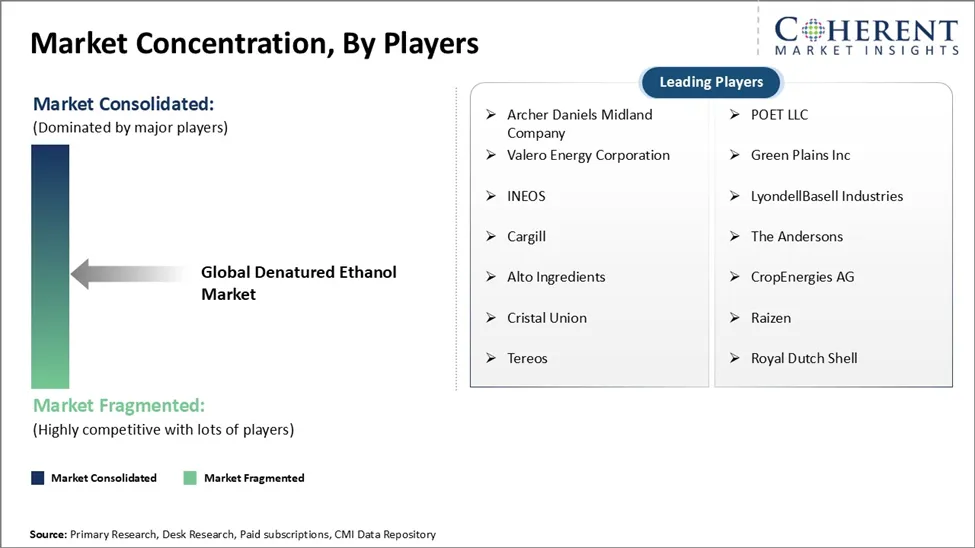
The global denatured ethanol market is moderately consolidated, with competition shaped by production scale, feedstock access, regulatory compliance, distribution networks, and application-specific quality requirements. Large ethanol producers compete through manufacturing capacity and supply reliability, while regional specialists differentiate through customer proximity, customized formulations, and flexible sourcing strategies.
Key focus Areas include
- Feedstock availability and production cost management
- Manufacturing capacity and operational efficiency
- Ethanol purity standards and quality consistency
- Regulatory compliance across regional markets
- Renewable and low-carbon production capabilities
- Long-term supply agreements with fuel and industrial buyers
- Distribution infrastructure and logistics capabilities
- Ability to provide customized denatured ethanol formulations
Market Report Scope
Global Denatured Ethanol Market Report Coverage | |||
Report Coverage | Details | ||
Base Year | 2025 | Market Size in 2026: | USD 84.62 Bn |
Historical Data For: | 2020 To 2024 | Forecast Period: | 2026 To 2033 |
Forecast Period 2026 To 2033 CAGR: | 5.20% | 2033 Value Projection: | USD 120.67 Bn |
Geographies covered: |
| ||
Segments covered: |
| ||
Companies covered: | Archer Daniels Midland Company, POET LLC, Valero Energy Corporation, Green Plains Inc, INEOS, LyondellBasell Industries, Cargill, The Andersons, Alto Ingredients, CropEnergies AG, Cristal Union, Raizen, Tereos, Royal Dutch Shell | ||
Growth Drivers: |
| ||
Restraints & Challenges: |
| ||
Analyst Opinion (Expert Opinion)
- The denatured ethanol market is likely to evolve from a commodity-driven business toward a differentiated solutions market where producers compete through sustainability credentials, supply reliability, formulation capability, and customer-specific offerings. Companies that integrate production flexibility with stronger technical support may achieve greater resilience against pricing pressure.
- The most significant transformation may come from the convergence of renewable feedstocks, carbon management technologies, and digital manufacturing systems. Traditional producers may face pressure if they cannot demonstrate lifecycle advantages, while technologically advanced suppliers could create new value propositions across fuel and industrial applications.
- Market participants should prioritize flexible feedstock strategies, regulatory readiness, and customer-specific product development. Key risks include raw material volatility, policy changes, and international trade restrictions. Companies should avoid relying only on volume expansion and instead strengthen operational efficiency, sustainability capabilities, and regional supply partnerships.
Speak to the analyst
Want personalized insights?
Take the findings above to one of our principal consultants, or have the report rebuilt around the segments, geographies and competitors you actually track.
Market Segmentation
- Denaturing Type Insights (Revenue, USD Bn, 2021 - 2033)
- Methanol Denatured Ethanol
- Isopropanol Denatured Ethanol
- Gasoline Denatured Ethanol
- Other Denaturing Agents
- Source Type Insights (Revenue, USD Bn, 2021 - 2033)
- Bio Based Ethanol
- Synthetic Ethanol
- Application Insights (Revenue, USD Bn, 2021 - 2033)
- Fuel and Fuel Blending
- Industrial Solvents
- Cleaning and Disinfectants
- Paints Coatings and Adhesives
- Personal Care and Cosmetics
- Chemical Processing and Others
- End Use Industry Insights (Revenue, USD Bn, 2021 - 2033)
- Transportation
- Chemical Manufacturing
- Pharmaceuticals
- Personal Care
- Paints and Coatings
- Others
- Distribution Channel Insights (Revenue, USD Bn, 2021 - 2033)
- Direct Sales
- Indirect Sales
- Regional Insights (Revenue, USD Bn, 2021 - 2033)
- North America
- U.S.
- Canada
- Latin America
- Brazil
- Argentina
- Mexico
- Rest of Latin America
- Europe
- Germany
- U.K.
- Spain
- France
- Italy
- Russia
- Rest of Europe
- Asia Pacific
- China
- India
- Japan
- Australia
- South Korea
- ASEAN
- Rest of Asia Pacific
- Middle East
- GCC Countries
- Israel
- Rest of Middle East
- Africa
- South Africa
- North Africa
- Central Africa
- North America
Sources
Primary Research Interviews
- Ethanol producers, biofuel manufacturers, fuel blending companies, and industrial solvent suppliers
- Chemical manufacturers, pharmaceutical companies, personal care product formulators, and industrial users of ethanol-based solutions
- Biofuel experts, chemical industry specialists, sustainability professionals, and regulatory consultants
- Distributors, ethanol traders, fuel suppliers, and supply-chain partners
Stakeholders
- Ethanol producers, bio-refineries, chemical manufacturers, and solvent solution providers
- Agricultural feedstock suppliers including corn, sugarcane, grain, and biomass suppliers
- Fuel retailers, oil marketing companies, transportation fuel suppliers, and industrial buyers
- Distributors, logistics providers, chemical suppliers, and trading companies
End-use Sectors
- Transportation fuels including gasoline blending and renewable fuel applications
- Industrial solvents including chemicals, coatings, adhesives, and cleaning formulations
- Pharmaceuticals and healthcare applications requiring ethanol-based formulations
- Personal care, cosmetics, food processing, and specialty chemical applications
- Industrial manufacturing sectors using ethanol as a processing ingredient
Regulatory and Industry Bodies
- Renewable fuel regulatory authorities and government energy agencies
- Biofuel industry associations and ethanol trade organizations
- Chemical safety and environmental compliance authorities
- Fuel quality and sustainability certification organizations
- Agricultural and energy policy institutions
Databases
- Company annual reports, investor presentations, regulatory filings, and corporate disclosures
- Ethanol production capacity and biofuel industry databases
- Import-export trade databases for ethanol and chemical products
- Renewable energy and agricultural commodity databases
- Patent databases covering ethanol processing, fermentation, and biofuel technologies
Magazines and Journals
- Biofuel industry publications
- Chemical processing and industrial solvent journals
- Renewable energy and sustainability research publications
- Agricultural technology and fermentation science journals
- Energy transition and fuel technology publications
Associations
- Renewable Fuels Association (RFA)
- European Renewable Ethanol Association (ePURE)
- International Energy Agency (IEA)
- Global Biofuels Alliance (GBA)
- Regional ethanol and biofuel industry organizations
Public Domain Sources
- Ethanol production capacity expansions and biofuel infrastructure developments
- Renewable fuel blending policies and sustainability initiatives
- Industrial solvent adoption and chemical manufacturing trends
- Agricultural feedstock availability and supply-chain developments
- Low-carbon ethanol technologies and bio-refinery advancements
Key Standards and Regulations
- Renewable fuel blending mandates and compliance frameworks
- Fuel quality standards for ethanol-blended fuels
- Chemical handling, safety, and transportation regulations
- Environmental compliance requirements including sustainability certification frameworks
- International trade regulations and ethanol import-export requirements
Proprietary Elements
- CMI Data Analytics Tool
- Proprietary CMI repository containing 10+ years of biofuels, ethanol, chemicals, renewable energy, industrial solvents, and sustainability market intelligence.
Get access to 250+ pages report
Every segment, forecast, competitor profile and data table behind the analysis above — available for instant download.
- ESOMAR Member
- ISO 9001:2015 Certified
- D-U-N-S Registered
- GDPR & CCPA Compliant
Missing comfort of reading report in your local language? Find your preferred language:
Frequently Asked Questions
The CAGR of Global Denatured Ethanol Market is projected to be 5.20% from 2026 to 2033.
The Global Denatured Ethanol Market is estimated to be valued at USD 84.62 Bn in 2026 and is expected to reach USD 120.67 Bn by 2033.
Denatured ethanol is widely used in fuel blending, industrial solvents, cleaning formulations, chemical processing, paints and coatings, pharmaceuticals, and personal care applications.
Sustainability initiatives are encouraging producers to adopt renewable feedstocks, improve production efficiency, and develop lower-carbon ethanol solutions for fuel and industrial applications.
Major end-use industries include transportation fuels, chemical manufacturing, pharmaceuticals, personal care, coatings, adhesives, and industrial cleaning sectors.
Companies typically evaluate product quality, regulatory compliance, supply reliability, feedstock source, formulation requirements, logistics capability, and supplier consistency while purchasing denatured ethanol.
The global denatured ethanol market growth is primarily supported by increasing fuel blending requirements and the expanding use of denatured ethanol as an industrial solvent across chemical, pharmaceutical, personal care, and manufacturing applications.