

Global Digital Adoption Platform Market Size and Forecast – 2026 To 2033
The global digital adoption platform market is expected to grow from USD 1.60 Bn in 2026 to USD 3.85 Bn by 2033, registering a compound annual growth rate (CAGR) of 13.5% from 2026 to 2033. The global digital adoption platform market is driven by growing adoption of cloud-based enterprise applications. On January 15, 2025, Microsoft announced it is introducing Microsoft 365 Copilot Chat, a new offering that adds pay-as-you-go agents to the existing free chat experience for Microsoft 365 commercial customers.
Key Takeaways of the Global Digital Adoption Platform Market
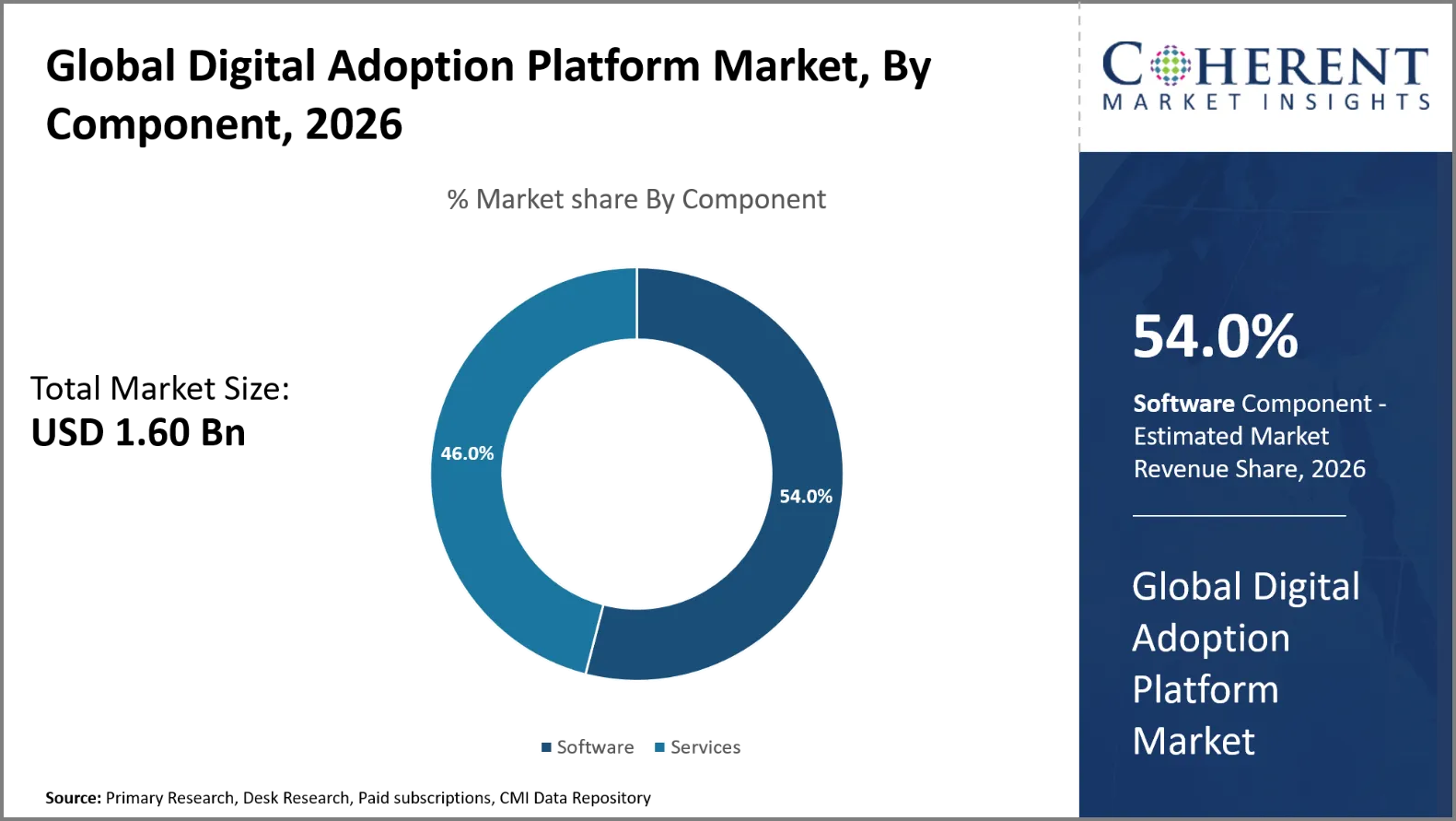
- The Software segment is expected to account for 54.0% of the global digital adoption platform market share in 2026. Increasing demand for personalized digital experiences is driving the growth of the segment. On March 18, 2025, Adobe Inc. introduced Adobe Experience Platform Agent Orchestrator. The platform enables businesses to build, manage, and coordinate artificial intelligence agents.
- The Cloud-Based segment is estimated to capture 61.0% of the market share in 2026. Rising implementation of artificial intelligence in workplace software is majorly driving the growth of the segment. On April 30, 2025, UiPath launched its next-generation agentic automation platform. The platform integrates artificial intelligence agents, software robots, and human workers.
- The User Onboarding segment is estimated to capture 33.0% of the market share in 2026. Growing need to improve software utilization and productivity is driving the growth of the segment. On November 4, 2025, Celonis announced major platform innovations. The enhancements strengthen its Process Intelligence Platform and Process Intelligence Graph.
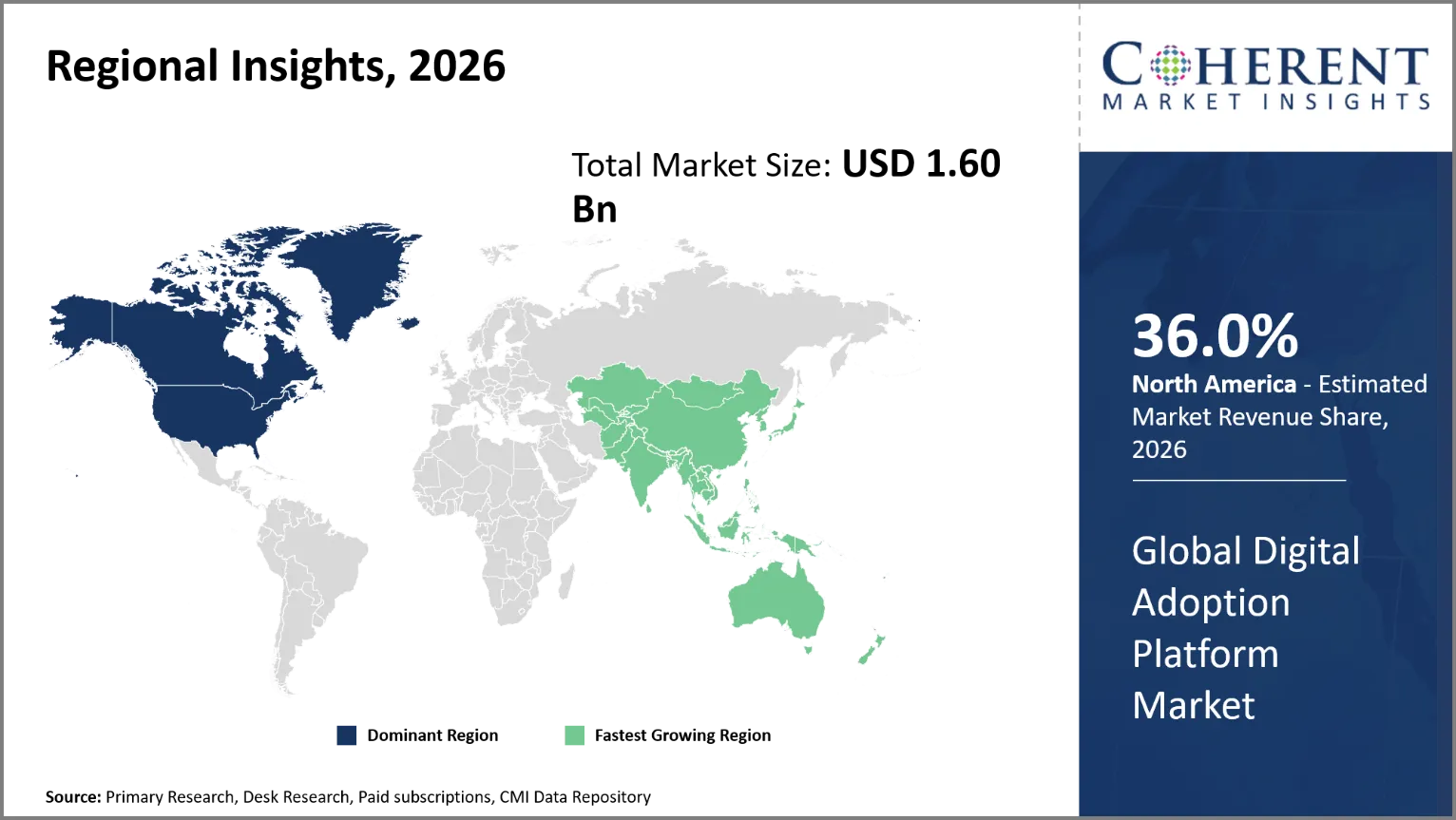
- North America is expected to dominate the digital adoption platform market in 2026 with a market share of 36.0%. Expansion of customer onboarding automation in North America is driving the growth of the regional market. On April 29, 2025, Socure launched Advanced Pre-Fill. The solution operates within its RiskOS platform and automatically populates customer applications using verified identity information.
- Asia Pacific is expected to account for 25.0% share in 2026. Development of personalized in-application guidance in Asia Pacific is driving the growth of the regional market. On January 29, 2025, ShareChat announced its first Southeast Asia Artificial Intelligence Center of Excellence in Singapore. The center focuses on recommendation systems, advertising personalization, and content moderation.
Segmental Insights
Why Does Software Dominate the Global Digital Adoption Platform Market?
The software segment is expected to account for 54.0% of the global digital adoption platform market share in 2026. Software dominates because enterprises require scalable options for improving the usability of applications. Digital adoption software offers interactive walkthroughs, contextual coaching, automatic training and in-app support. These characteristics assist employees to navigate complex business systems with less blunders. Businesses can use software platforms to increase productivity and accelerate technology adoption. Software demand is increasing, as is integration with customer relationship management and enterprise resource planning systems. Continuous software updates support changing business processes and application requirements.
On April 8, 2025, Nexthink introduced Nexthink Adopt on Infinity, the only DEX-powered digital adoption solution that goes beyond the surface to eliminate every application disruption employees face. Adopt propels enterprise-wide productivity forward owing to the most advanced AI-powered analytics, communication, and automation tools optimizing the digital employee experience.
- Current Industry Events of 2026
- Market Size Estimation
- Regional Breakdown
- Competitive Landscape
- Customer Intelligence
- Segmental Analysis
- Pricing Analysis
- Key Market Drivers, Challenges & Future Trends
- Customized Insights Section
Why is Cloud-Based the Most Preferred Deployment Type?
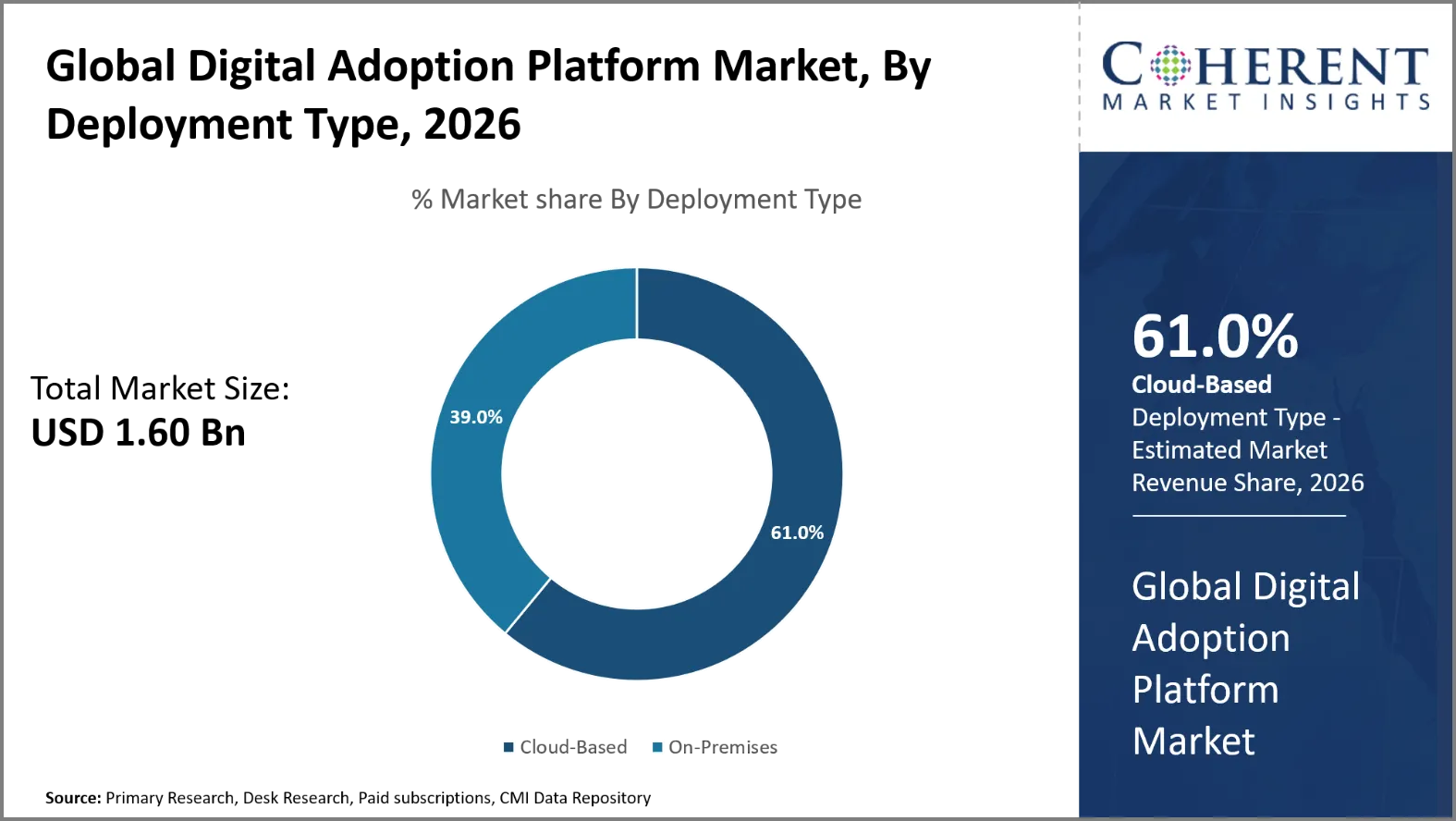
The cloud-based segment is expected to account for 61.0% of the global digital adoption platform market share in 2026. Cloud based connectivity leads the deployment type as it is easy to roll out across distributed company environments. Companies can deploy digital solutions without having to maintain a large on-prem infrastructure. Cloud solutions allow for remote employees, centralized management and real-time software updates. And the price on subscription basis means less upfront cost for setup. The operation is more accessible and flexible to use with integration with the enterprise software stored in the cloud. These characteristics make cloud deployment an attractive alternative for organizations seeking scalable digital adoption solutions.
On march 2, 2025, Unit4 announces major success in client cloud migrations across multiple industries. The company also began offering services to help organizations move from legacy enterprise systems to cloud-based applications. Its initiatives included enhanced cloud migration support and additional service offerings.
User Onboarding Dominates the Global Digital Adoption Platform Market
The user onboarding segment is expected to account for 33.0% of the global digital adoption platform market share in 2026. The focus is on user onboarding as organizations are seeking faster application adoption and better user experiences. Digital adoption platforms give new users interactive training, guided processes and contextual guidance. The characteristics ease training effort and simplify complex software applications. Businesses are turning to automated onboarding to speed up employee training and to more effectively engage with customers. Personalized coaching leads to fewer mistakes in essential activities. This has led to firms placing more emphasis on onboarding skills as a key element when utilizing digital adoption platforms.
On May 7, 2026, Ashby launched People Workflows to link recruitment with employee onboarding. The program can automatically trigger workflows when candidates accept employment offers It maps tasks between recruiters, HR, IT and hiring managers.
Current Events and their Impact
Current Events | Description and its Impact |
European Union Artificial Intelligence Act, 2024 |
|
India Digital Personal Data Protection Act, 2023, and Rules, 2025 |
|
Digital Adoption Platform Market Dynamics
Market Drivers
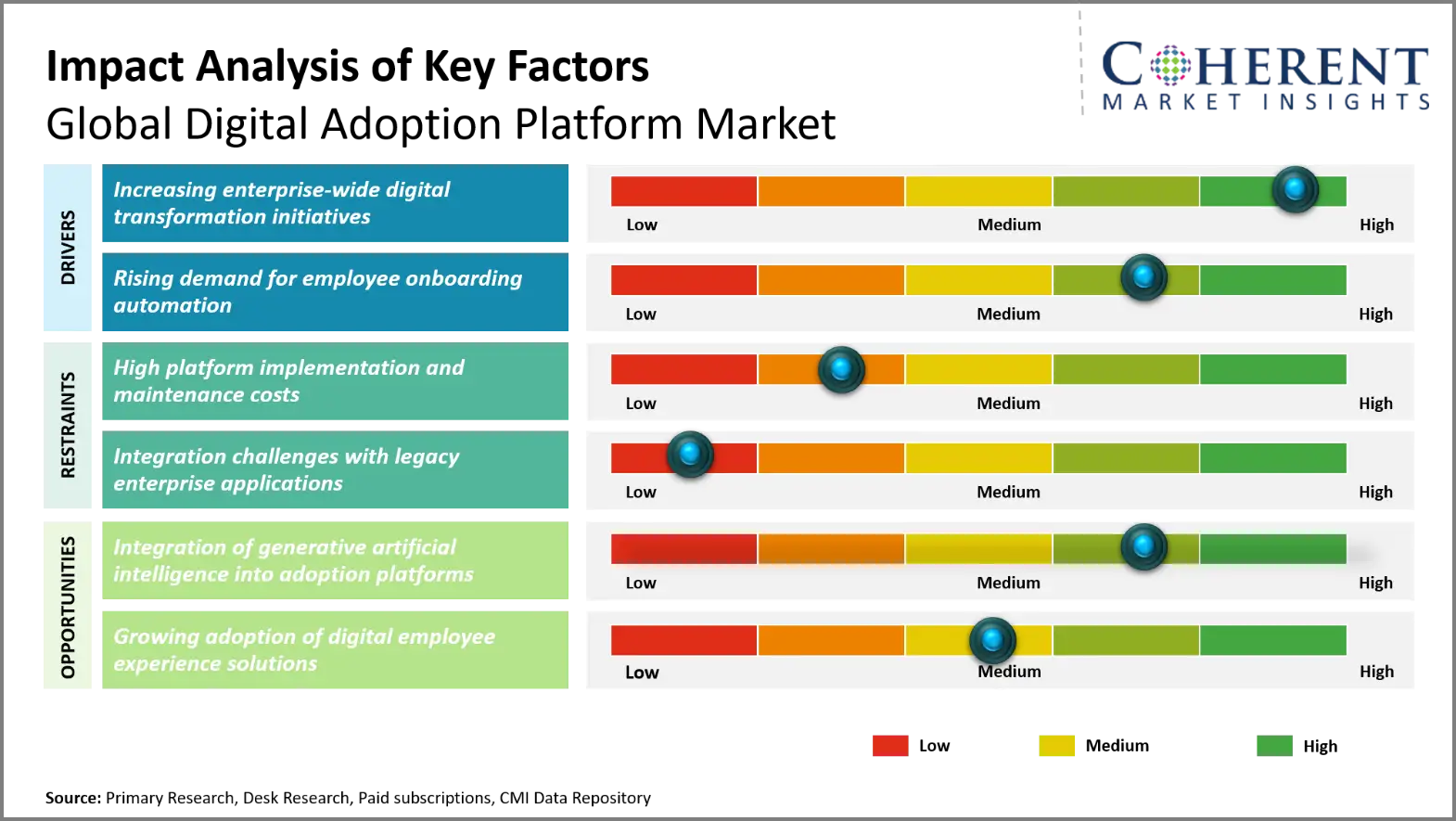
Increasing enterprise-wide digital transformation initiatives
Expanding enterprise-wide digital transformation initiatives are boosting demand for digital adoption platforms across industries. Enterprise resource planning, customer relationship management and cloud-based business software are being deployed by organizations. These technologies demand workers to learn complex procedures and changing software environments. Digital adoption platforms are straightforward to deploy with interactive walkthroughs and contextual coaching. They increase application usage and reduce staff resistance to technology change. Companies are increasingly utilizing these solutions to make the most of their IT expenditures and improve operational efficiency. With the rise of artificial intelligence, there’s greater need for customized digital experiences.
On August 19, 2025, Tata Projects initiated a company-wide digital transformation, including SAP Business Suite and RISE with SAP. This includes project planning, procurement, finance, human resources, compliance, and analytics. A cloud first design delivers superior operational information and allows faster decision making.
Rising demand for employee onboarding automation
Many firms are developing digital adoption platforms in response to the growing demand for employee onboarding automation. Businesses are automating employee training in growing numbers to cut down on administrative cost and boost workforce readiness. Digital adoption systems offer real-time interactive training, automated procedures and in-app guidance. These characteristics allow new employees to become skilled with company software without a lot of classroom instruction. Automation of onboarding process also helps with remote recruiting and distributed workforces. Software is more like a continuum. Companies learn more quickly. Which is why staff onboarding automation is a key procurement decision for workplace digital adoption solutions.
On May 20, 2025, Nintex, a global leader in AI-powered process automation and application development, announced the launch of Nintex Employee Onboarding. This new pre-built solution significantly reduces the time necessary to execute employee onboarding processes which results in a faster ramp to productivity for new hires, fewer costs to the business due to onboarding delays and less administrative burden on HR, Finance and IT departments.
Emerging Trends
- Integration of Generative Artificial Intelligence and Intelligent Assistance: Digital adoption platforms are combining generative AI capabilities to provide tailored advice, conversational assistance, and automated workflow recommendations. They enable employees to answer questions on the application and do sophisticated tasks with little training or outside help.
- Impact: Generative artificial intelligence boosts employee productivity, lowers training needs, and speeds up software adoption. Automated assistance also allows firms to provide customized educational experiences in increasingly complicated enterprise application environments.
- Relevance to the market: Examples of this trend are WalkMe’s artificial intelligence capabilities and Whatfix’s AI-driven recommendations. Their solutions reflect increased company demand in contextual assistance, automated content generation and personalized staff support.
- Expansion of Digital Adoption Across Customer-Facing Applications: Digital adoption platforms are being extended from training staff to customer onboarding, self-service support and product engagement. With enterprises increasingly adopting customer-facing software, contextual assistance is being employed to assist in application navigation and enhance the digital experience.
- Impact: This trend drives customer activation, decreases support calls and promotes application engagement. Usage analytics can also help businesses to discover navigational problems and to optimize digital experiences.
- Relevance to the market: Pendo and Appcues with product analytics, user onboarding and in-app assistance are a reflection of this trend. The products reflect the increased need for customer-centric digital adoption capabilities for software companies.
Regional Insights
Why is North America a Strong Market for Digital Adoption Platform?
North America is expected to account for a market share of 36.0% in 2026. North America is a big market for enterprise software, and there’s increasing need for application-level staff productivity. Canadian companies are progressively migrating to cloud-based systems, industry-specific software and connected technologies. 48% of firms are using cloud computing in 2023, reports Statistics Canada. In fact, 26% of smart gadgets were being used with internet connections, a sign of growing connectedness in business environments. This leads to a demand for systematic software training and application guidance. Financial institutions, professional services firms and technology corporations need uniform workflows across connected applications. Digital adoption platforms help organizations improve software utilization and reduce employee difficulties during technology transitions.
Why Does Asia Pacific Digital Adoption Platform Market Exhibit High Growth?
Asia Pacific is expected to register the fastest growth with a CAGR of 14.6% over the forecast period. The region is projected to account for 25.0% of the global digital adoption platform market in 2026. It is strong in digital adoption with government funded corporate transformation and industry focused technology projects. Singapore is a wonderful example, for instance. The Infocomm Media Development Authority reported that 95.1% of small and medium-sized companies had used digital technology in 2024. Moreover, 97% put into place at least one digital solution specific to their industry. Artificial intelligence was also increasingly being adopted in customer service, accounting and human resources. Australia, Singapore and Japan have big prospects for enterprise cloud adoption and digital workforce development. These developments increase requirements for contextual software guidance and multilingual application support across diverse business environments.
Global Digital Adoption Platform Market Outlook for Key Countries
Why is U.S. Emerging as a Major Hub in the Digital Adoption Platform Market?
Increasing adoption of artificial intelligence across business divisions and knowledge-intensive industries is driving the U.S. market. According to the U.S. Census Bureau, 18% of businesses used artificial intelligence in November 2025-January 2026. Adoption was 32% employment-weighted, showing stronger adoption by larger enterprises. Information, professional services and financial businesses posted notable gains. Businesses increasingly look to employees for advice on how to integrate artificial intelligence into sales, marketing, strategy, and information technology operations. Digital adoption platforms can facilitate these changes with contextual advice and workflow-based learning. This creates opportunity for solutions that address the changing role of the employee and the complexity of applications.
Is China the Next Growth Engine for the Digital Adoption Platform Market?
China’s digital adoption platform market is driven by the large-scale industrial digitalization and integration of information management systems. The National Bureau of Statistics of China stated that 97.2% of companies over the designated size used information management systems in 2023. Production management, equipment monitoring and enterprise software are increasingly embraced by manufacturing companies. These environments create a requirement for guided workflows and standardized interactions for employees. Digital adoption platforms can simplify industrial software processes. China's increasing artificial intelligence infrastructure also provides chances for intelligent application support and automated workplace supervision.
Germany Digital Adoption Platform Market Analysis and Trends
Germany’s market is benefiting from the digitalization of production, the integration of industrial software and the growing use of artificial intelligence by small companies. According to the Federal Statistical Office of Germany, 54% of firms bought cloud computing services in 2025. Large organizations saw much higher adoption at 86%. More than 23% of businesses used cloud-based enterprise resource planning apps. More and more German enterprises rely on production planning, inventory management and industrial automation software. These applications demand rigorous training of operators and strict compliance with processes. Digital adoption platforms can help factory workers navigate enterprise processes. Growing artificial intelligence adoption also increases requirements for structured employee training.
U.K. Digital Adoption Platform Market Analysis and Trends
The U.K. market is being assisted by the rising digitalization in small and medium-sized organizations and the increase in cloud application adoption. In 2023, 69% of enterprises employed cloud-based computer systems and apps, according to the Office for National Statistics. The government’s Longitudinal Small Business Survey found that in 2025, 74% of SME employers were using business management or customer-facing software. Applications for digital compliance, client relationship management and reporting are becoming important to financial services firms. Professional services firms also require uniform protocols for handling customer information. Digital adoption platforms can help employees to engage with such specialized applications with ease. Increasing demands for digital governance provide more chances for automated software assistance.
India Digital Adoption Platform Market Analysis and Trends
India’s market is benefiting from a growing digital public infrastructure and a rising digitization of corporate administration. The Unified Payments Interface completed almost 241.62 billion transactions in the fiscal year 2025-2026, the Ministry of Finance reported. The National Single Window System has enabled getting permissions from central agencies and state governments. Also, almost 3.84 crore files were made on the Ministry of Corporate Affairs’ MCA21 platform in 2021-2025. These technologies help firms orchestrate ever more complicated digital workflows. Solutions for digital adoption can facilitate the use of compliance apps, standard monetary systems, and enterprise portals for employees. Expanding technology services employment further strengthens demand for structured application training.
Global Digital Adoption Platform Market - Expansion of Digital Adoption In Regulated Industries
Industry | Metric | Adoption Share |
Banking and financial services | Financial firms initiating generative AI proof-of-concept projects | 74% |
Banking and financial services | Financial firms deploying generative AI in production | 11% |
Banking and financial services | Financial firms allocating budgets toward AI initiatives | 42% |
Banking and financial services | Banks identifying cloud computing and AI as widely adopted emerging technologies | 76% |
Banking and financial services | Banks outsourcing at least one emerging technology | 80% |
Banking and financial services | Banks allocating less than 10% of IT budgets to emerging technologies | 61% |
Financial services and insurance | Enterprises using artificial intelligence | 62.5% |
Financial services and insurance | Enterprises using big data analytics | 63.9% |
Compliance-intensive businesses | Organizations using technology for at least 11 compliance activities | 49% |
Compliance-intensive businesses | Organizations planning increased compliance technology investment | 82% |
How is Integration of Generative Artificial Intelligence into Adoption Platforms Creating New Growth Opportunities in the Digital Adoption Platform Market?
The use of generative AI is driving new development potential by turning digital adoption platforms into intelligent workflow aides. The platforms may automatically create walkthroughs for apps, translate recorded operations to training materials and provide conversational responses from enterprise-specific information. For instance, WalkMe's AI capabilities offer intelligent guidance and automatic content development within workplace apps. Whatfix provides AI-powered content creation and contextual help for complex software environments. These capabilities can eliminate manual generation of instructional content and facilitate modifications to software configuration. Generative artificial intelligence also helps suppliers to create custom offerings for ERP migrations, software deployment projects and multilingual workforce training. That means providers can go from traditional onboarding to automated enterprise knowledge management and continual workflow optimization.
On July 29, 2025, Userlane announced it is collaborating with Microsoft to create an AI Design program to help deliver proactive, cross-platform AI solutions. Building on this cooperation, Userlane announced the debut of its enterprise-grade Userlane Assistant integrated with Microsoft 365 Copilot.
Market Players, Key Development, and Competitive Landscape
Key Developments
- On March 9, 2026, Whatfix, the world’s first AI-native platform for corporate technology adoption, announced the formal introduction of AI Roleplay training in Mirror, an AI-first training platform that prepares customer-facing teams for real-life performance, not just system usage.
- On February 10, 2026, Whatfix announced the official launch of its Healthcare Industry Vertical, aimed on transforming the clinician experience by leveraging AI to decomplexify complex Electronic Health Record (EHR) and clinical software systems.
- On October 14, 2025, Pendo announced Pendo for Agentforce, along with a new suite of capabilities that will amplify Salesforce impact across the enterprise. The new capabilities embed Pendo’s behavioral intelligence and in-app guidance directly into Salesforce, helping enterprises drive smarter revenue, faster support, and more effective AI agents across every cloud.
Competitive Landscape
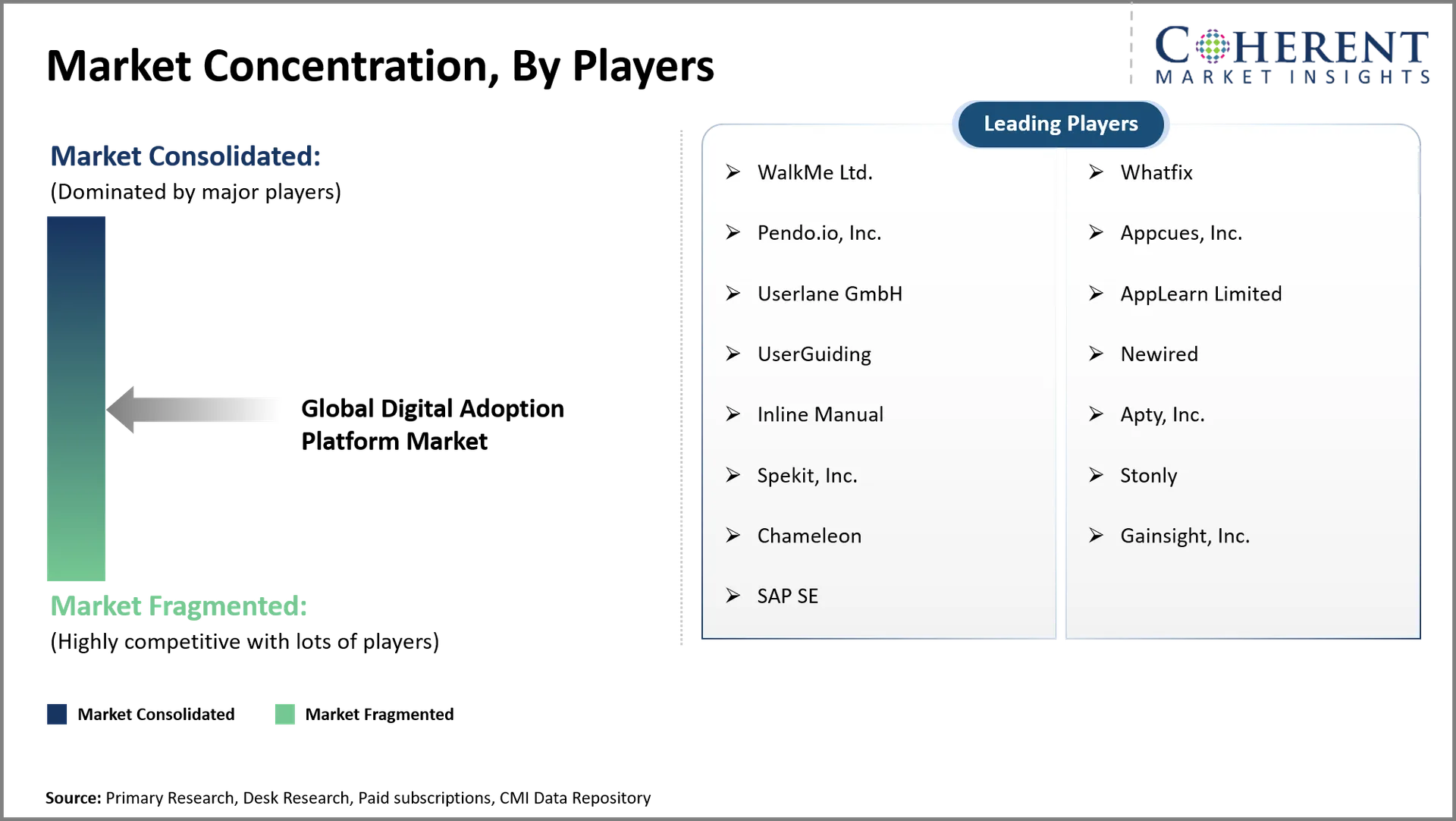
The global digital adoption platform market features competition between enterprise-focused providers and product analytics specialists. SAP’s WalkMe gets stronger with cross-application assistance, process automation and enterprise software connectivity Integration with SAP solutions helps employees to adopt it for complex business procedures. Whatfix specializes on enterprise training, in-app advice, simulation-based learning and adoption analytics. Pendo stands apart with product analytics, user feedback, and personalized onboarding. Oracle Guided Learning helps Oracle drive adoption across its product ecosystem. Nexthink blends information on employee experience with capabilities on application adoption. These strategies demonstrate increasing competition around artificial intelligence, enterprise integration, and measurable workflow improvements.
Top Manufacturers and Notable Products/Solutions in the Digital Adoption Platform Market
Manufacturer | Notable Product/Solution | Key features |
SAP SE (WalkMe) | WalkMe Digital Adoption Platform | Interactive walkthroughs, contextual guidance, workflow automation, employee onboarding, application analytics, and cross-application support |
Whatfix | Whatfix Digital Adoption Platform | In-app guidance, interactive walkthroughs, AI-powered assistance, product analytics, simulation-based training, and performance tracking |
Pendo | Pendo Platform | Product analytics, in-app guides, user segmentation, onboarding workflows, feedback collection, and feature adoption tracking |
Oracle | Oracle Guided Learning | Contextual application guidance, interactive learning journeys, embedded help, process instructions, and employee onboarding |
Userlane | Userlane Digital Adoption Platform | Interactive guides, contextual assistance, application intelligence, user behavior analytics, and automated software training |
Digital Adoption Platform Market | |||
Report Coverage | Details | ||
Base Year | 2025 | Market Size in 2026: | USD 1.60 Bn |
Historical Data For: | 2020 To 2024 | Forecast Period: | 2026 To 2033 |
Forecast Period 2026 To 2033 CAGR: | 13.5% | 2033 Value Projection: | USD 3.85 Bn |
Geographies covered: |
| ||
Segments covered: |
| ||
Companies covered: | WalkMe Ltd., Whatfix, Pendo.io, Inc., Appcues, Inc., Userlane GmbH, AppLearn Limited, UserGuiding, Newired, Inline Manual, Apty, Inc., Spekit, Inc., Stonly, Chameleon, Gainsight, Inc., SAP SE | ||
Growth Drivers: |
| ||
Restraints & Challenges: |
| ||
Analyst Opinion (Expert Opinion)
- The future of the global digital adoption platform market will depend on transforming conventional software guidance into intelligent workflow execution. Platforms will increasingly identify employee difficulties, recommend corrective actions, and automate repetitive application interactions. Artificial intelligence should become a practical operational layer rather than simply another onboarding feature. Providers who can combine contextual help with business application permissions will be more differentiated. Solutions must also show gains in task completion, application utilization and staff productivity.
- Best possibilities will be in enterprise-grade software platforms for banking, manufacturing, healthcare and professional services. SAP-centric enterprises are appealing application segments as complicated enterprise resource planning operations demand constant staff assistance. Customer relationship management applications also represent opportunities in the form of automated sales coaching and process validation. Opportunities at the country level are favorable in the U.S., Germany and India. When growing across these areas, providers should focus on multilingual onboarding and regional compliance capabilities.
- Market participants could differentiate themselves by developing deeper integrations with Salesforce, SAP, Microsoft Dynamics 365 and Oracle apps. They need to build AI assistants who know the context of the app and recommend exactly what to do next. Vendors should also provide measurable process metrics, role-based assistance, and automatic content maintenance. Working with implementation experts for enterprise software can help get customers. Flexible pricing depending on apps, user volumes and functional modules might be attractive to different sizes of enterprises. Companies that bring measurable operational improvement will see improved client retention and competitive positioning.
Speak to the analyst
Want personalized insights?
Take the findings above to one of our principal consultants, or have the report rebuilt around the segments, geographies and competitors you actually track.
Market Segmentation
- Component Insights (Revenue, USD Billion, 2021 - 2033)
- Software
- Services
- Deployment Type Insights (Revenue, USD Billion, 2021 - 2033)
- Cloud-Based
- On-Premises
- Application Insights (Revenue, USD Billion, 2021 - 2033)
- User Onboarding
- Employee Onboarding
- Customer Support
- Product Training
- Change Management
- User Engagement
- Performance Support
- End User Insights (Revenue, USD Billion, 2021 - 2033)
- BFSI
- IT and Telecommunications
- Healthcare
- Retail and Consumer Goods
- Manufacturing
- Government and Public Sector
- Education
- Others
- Regional Insights (Revenue, USD Billion, 2021 - 2033)
- North America
- U.S.
- Canada
- Latin America
- Brazil
- Argentina
- Mexico
- Rest of Latin America
- Europe
- Germany
- U.K.
- Spain
- France
- Italy
- Russia
- Rest of Europe
- Asia Pacific
- China
- India
- Japan
- Australia
- South Korea
- ASEAN
- Rest of Asia Pacific
- Middle East
- GCC Countries
- Israel
- Rest of Middle East
- Africa
- South Africa
- North Africa
- Central Africa
- North America
- Key Players Insights
- WalkMe Ltd.
- Whatfix
- Pendo.io, Inc.
- Appcues, Inc.
- Userlane GmbH
- AppLearn Limited
- UserGuiding
- Newired
- Inline Manual
- Apty, Inc.
- Spekit, Inc.
- Stonly
- Chameleon
- Gainsight, Inc.
- SAP SE
Sources
Primary Research Interviews
- Digital Transformation Managers
- Enterprise Software Solution Providers
- Chief Information Officers (CIOs)
- HR & Employee Training Specialists
Journals
- Journal of Information Technology
- International Journal of Human-Computer Studies
- Journal of Digital Transformation & Innovation
Associations
- Association for Information Systems (AIS)
- Digital Analytics Association (DAA)
- Computing Technology Industry Association (CompTIA)
- International Association of Software Architects (IASA)
Public Domain Sources
- U.S. Bureau of Labor Statistics (BLS)
- World Economic Forum (WEF) Reports
- European Commission Digital Economy Reports
- OECD Digital Transformation Reports
Proprietary Elements
- CMI Data Analytics Tool
- Proprietary CMI Existing Repository of Information for the last 10 years
Get access to 250+ pages report
Every segment, forecast, competitor profile and data table behind the analysis above — available for instant download.
- ESOMAR Member
- ISO 9001:2015 Certified
- D-U-N-S Registered
- GDPR & CCPA Compliant
Frequently Asked Questions
The global digital adoption platform market is expected to stand at USD 1.60 Bn in 2026 and is expected to reach USD 3.85 Bn by 2033.
The CAGR of the global digital adoption platform market is projected to be 13.5% from 2026 to 2033.
Increasing enterprise-wide digital transformation initiatives and Rising demand for employee onboarding automation are the major factors driving the growth of the global digital adoption platform market.
High platform implementation and maintenance costs and Integration challenges with legacy enterprise applications are the major factors hampering the growth of the global digital adoption platform market.
In terms of component, software segment is estimated to dominate the market revenue share in 2026.
A digital adoption platform is software that helps users navigate applications through interactive guidance, tutorials, and contextual assistance.
Machine learning identifies user behavior patterns and application difficulties to recommend targeted interventions and improve software engagement.