

Global Digital Textile Market Size and Forecast – 2026 To 2033
The global digital textile market is expected to grow from USD 3.15 Bn in 2026 to USD 5.20 Bn by 2033, registering a compound annual growth rate (CAGR) of 5% from 2026 to 2033. The global digital textile market is driven by growing adoption of short-run textile production. On February 26, 2025, Mimaki USA announced the launch of Tx330-1800 and Tx330-1800B direct textile inkjet printers that offer versatility for producing bespoke and on-demand custom textile printing on a wide variety of fabrics.
Key Takeaways of the Global Digital Textile Market
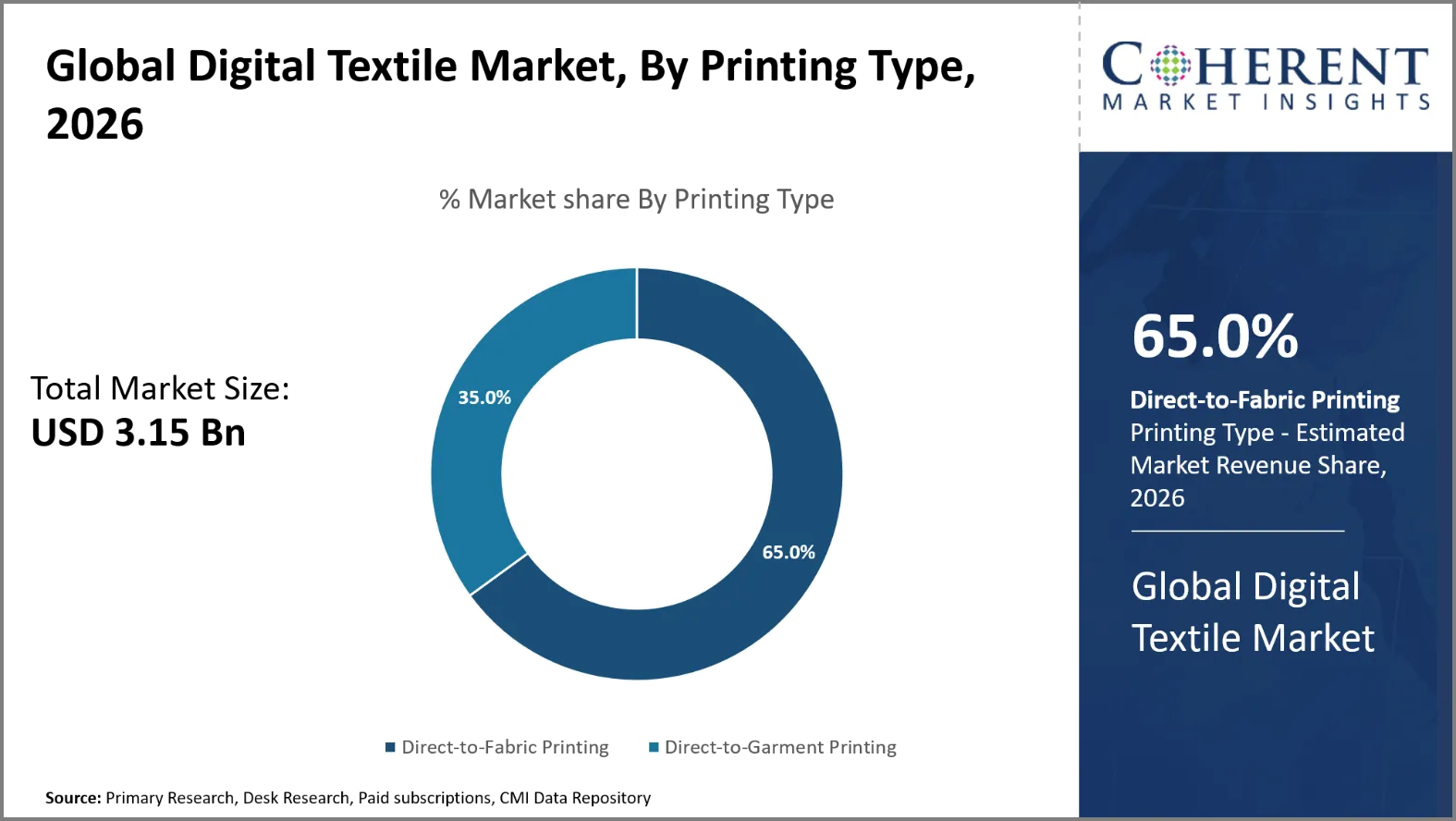
- The Direct-to-Fabric Printing segment is expected to account for 65.0% of the global digital textile market share in 2026. Demand for faster design-to-market cycles is driving the growth of the segment. On April 28, 2025, Durst presented the P5 500 TEX iSUB at FESPA 2025. The 5.2-metre-wide sublimation printer includes integrated inline fixation.
- The Single-Pass Printing segment is estimated to capture 57.0% of the market share in 2026. Increasing preference for on-demand manufacturing is majorly driving the growth of the segment. On April 12, 2026, Kornit Digital announced the acquisition of PrintFactory. PrintFactory specializes in cloud-based workflow, color management, and production automation software.
- The Reactive Ink segment is estimated to capture 36.0% of the market share in 2026. Advancements in digital printing equipment and ink formulations is majorly driving the growth of the segment. On January 27, 2026, Konica Minolta launched O’ROBE inline pretreatment ink. The formulation aims to combine pretreatment and printing operations for reactive dye applications.
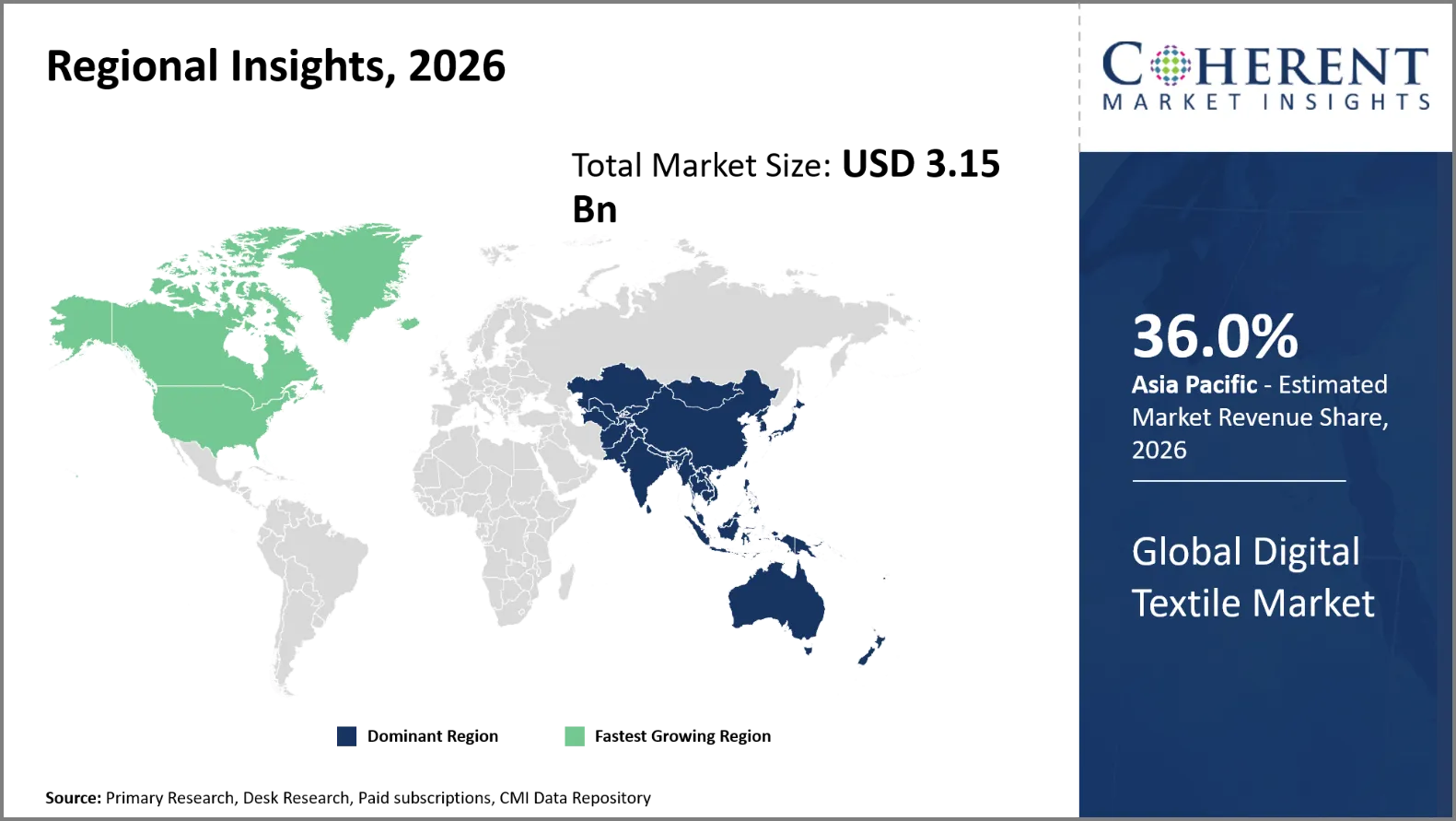
- Asia Pacific is expected to dominate the digital textile market in 2026 with a market share of 36.0%. Increasing adoption of direct-to-fabric printing in Asia Pacific is driving the growth of the regional market. In December 2025, Embee Group launched its Sapphire and Emerald digital textile printers at ITMA Asia 2025. The Indian textile machinery company entered digital textile printing with two direct-to-fabric systems.
- North America is expected to account for 29.0% share in 2026 and is projected to record the fastest growth over the forecast period. Development of high-speed industrial digital printers in North America is driving the growth of the regional market. On July 9, 2026, EFI Reggiani and Duggal Visual Solutions announced the first North American installation of the Reggiani NEXT Plus. The eight-color system was installed at Duggal's New York production facilities.
Segmental Insights
Why Does Direct-to-Fabric Printing Dominate the Global Digital Textile Market?
The direct-to-fabric printing segment is expected to account for 65.0% of the global digital textile market share in 2026. Direct application of the design to the cloth without the use of any transfer paper, makes direct-to-fabric printing the leader in the global digital textile market. It is capable of complicated designs, photographic pictures, rapid design revisions and creation of unique fabrics. Manufacturers can eliminate the need for setup and material waste associated with traditional screen preparation. Direct printing works well on different types of fabrics too, with the right ink compositions and pretreatment processes. Such benefits enable applications in fashion garments, home furnishings and tailored materials. Industrial printers are increasingly integrating the capabilities of precise inkjet deposition with automated fabric handling, improving production consistency and flexibility of operation.
On April 14, 2025, Kyocera Document Solutions Inc. announced the launch of FOREARTH Experience Studio in Milan, Italy. In this showroom guests can experience textile printing with the ecologically friendly inkjet textile printer, FOREARTH.
- Current Industry Events of 2026
- Market Size Estimation
- Regional Breakdown
- Competitive Landscape
- Customer Intelligence
- Segmental Analysis
- Pricing Analysis
- Key Market Drivers, Challenges & Future Trends
- Customized Insights Section
Why is Single-Pass Printing the Most Preferred Operation Type?
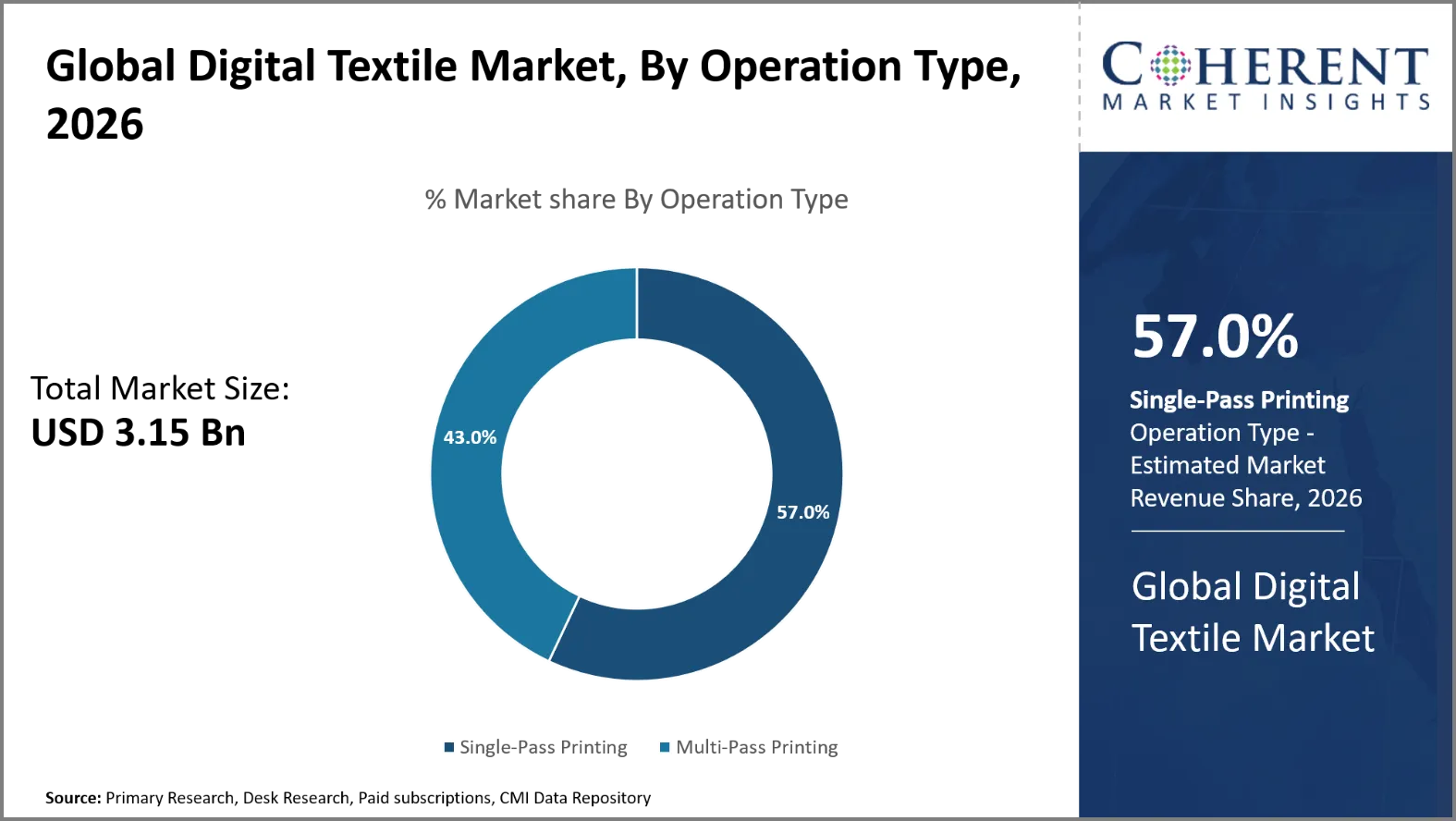
The single-pass printing segment is expected to account for 57.0% of the global digital textile market share in 2026. Single-pass printing is significant because fixed printheads are depositing several colors when fabric is moving continually through the machine. This architecture does not need the printer carriage to travel back and forth, and provides a better throughput than conventional scanning systems. Faster production cycles, consistent positioning of patterns and better adaptability for large textile orders are their benefits. Single pass method also enables industrial automation and continuous fabric handling. These characteristics make it perfect for textile companies that need to balance manufacturing volume, design complexity and delivery timeframes. Consistent production relies on precise fabric feeding, dependable ink supply and coordinated finishing activities. In August 2025, Atexco India launched Vega One single-pass digital textile printing machine. Its single-pass architecture targets faster output and consistent printing across extended fabric runs.
Reactive Ink Dominates the Global Digital Textile Market
The reactive ink segment is expected to account for 36.0% of the global digital textile market share in 2026. Reactive ink dominates many digital textile printing applications involving cotton and other cellulosic fabrics. During fixation, the dye molecules establish chemical connections with cellulose, which results in brilliant colors and good wash fastness. The technology can accommodate fine drawings, smooth gradients of color and soft textures of fabric. These qualities make reactive inks ideal for use in clothes and fashion fabrics, bed linens and high-end home textiles. But for successful printing, the proper pretreatment, controllaed steaming and complete washing off of unfixed color are necessary. Therefore, reactive inks remain particularly relevant in those purchase selections where compatibility with natural fibers, color performance and fabric comfort are factors.
On January 9, 2026, HONGSAM released ReactoMe reactive dye ink for industrial printheads. Developed by the company’s research and development department, the formulation is designed for stable operation in demanding, high-speed digital textile printing conditions. HONGSAM displayed bright colors, a wide color gamut and compatibility with printheads from Ricoh, Kyocera and Epson.
Current Events and their Impact
Current Events | Description and its Impact |
European Union Waste Framework Directive Amendment Directive (EU) 2025/1892 |
|
European Union Ecodesign for Sustainable Products Regulation (EU) 2024/1781 |
|
Digital Textile Market Dynamics
Market Drivers
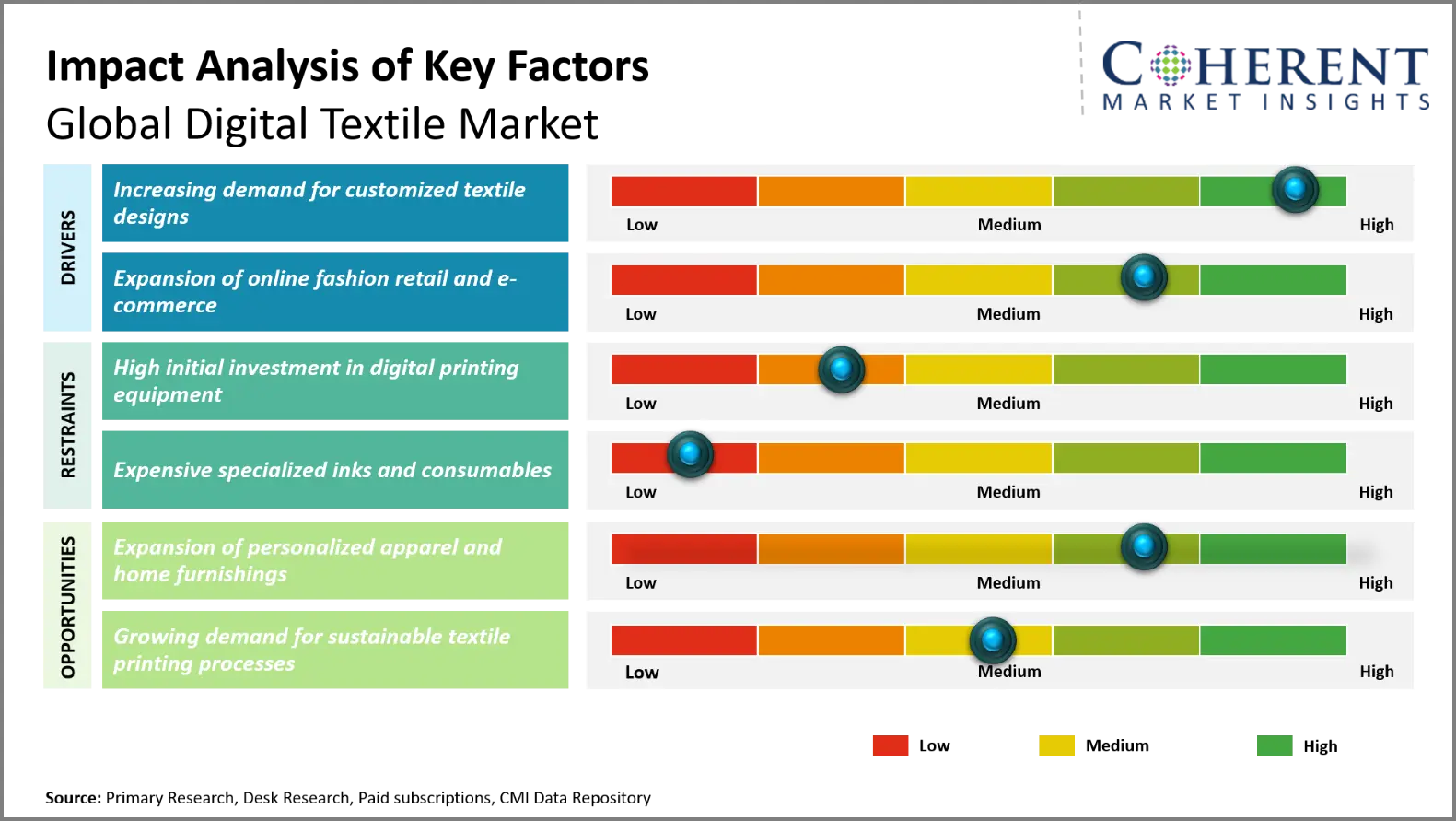
Increasing demand for customized textile designs
The rising demand for customized textile designs is pushing the adoption of digital printing in fashion, home furnishings, and promotional textiles. Consumers are increasingly requesting bespoke patterns, limited-edition collections, unusual color combinations and made-to-order products. Digital textile printing allows companies to create complex designs without the need to prepare a distinct screen for each motif. Flexibility provides faster design changes, fewer production runs and reduced inventory risk. These benefits are encouraging textile manufactures to employ digital printing for made-to-order and high-end fabric applications, as fashion companies can respond to changing tastes and offer improved product differentiation.
On February 27, 2026, ColorJet Group announced the debut of VastraJet Elite, a powerful and cost-effective digital textile printer that will empower entrepreneurs, startups and job workers to start their fabric printing adventure with cheap investment and great versatility.
Expansion of online fashion retail and e-commerce
The expansion of online fashion retail and e-commerce is driving the need for speedy product launches and flexible textile production. Many online firms create seasonal collections, attempt new designs or have exclusive products for certain groups of consumers. Digital textile printing also allows for shorter runs and faster changes of patterns without the considerable lead time of preparing screens. They help organizations manage with unpredictable demand and reduce excess stock. Smaller fashion companies can use e-commerce platforms to sell specialty designs to buyers internationally. This has raised the significance of digital printing for on-demand manufacturing, tailored clothing and responsive fashion supply chains.
On July 23, 2025, Gelato announced the official launch of GelatoConnect for Apparel after months of successful early access by pioneering customers. With this launch, the fast-growing print-on-demand apparel business has the full weight of GelatoConnect behind it.
Emerging Trends
- Adoption of AI-Powered Textile Design and Color Management: Artificial intelligence is revolutionizing digital textile design with automated pattern creation, color matching and print file optimization. Manufacturers are embedding smart software to speed up sampling, cut down design errors and guaranty color uniformity between production batches. Such capabilities allow rapid product development and custom assortments of textiles.
- Development of Sustainable Digital Printing Technologies: Textile manufacturers are using water-based inks, improved pretreatment methods, and efficient fixation technologies to reduce environmental impacts. Equipment makers are working on printing processes that require less ink and energy. These improvements assist manufacturers in complying with increasing environmental requirements and meeting their sustainability goals.
- Expansion of Industrial Single-Pass Printing Systems: Industrial single-pass printing systems are gaining attention due to high-speed output with fixed printheads. Manufacturers are creating automated fabric feeding, consistent ink distribution and built-in quality control. These advancements enhance manufacturing consistency, and allow shortened turn-around times for commercial textile applications.
- Growth of On-Demand and Personalized Textile Manufacturing: On-demand textile and apparel production is growing in popularity as fashion companies look for greater flexibility in their manufacturing options and want to lower their inventory risks. With digital printing, producers can produce small runs, limited editions and personalized patterns without spending much time setting up screens.
Regional Insights
Why is Asia Pacific a Strong Market for Digital Textile?
Asia Pacific is expected to account for a market share of 36.0% in 2026. Asia Pacific is well positioned with China, India, Japan, and Southeast Asia being home to textile mills, garment exporters and printing equipment and chemical suppliers. China is a big fan of fabric printing on a large scale, whereas India has huge networks for cotton processing and apparel-making. Japan brings inkjet engineering through businesses like Seiko Epson and Mimaki Engineering. Demand from export-oriented garment companies in Vietnam and Bangladesh seeking shorter production cycles also adds to the mix. The unique growth driver of the region is the tight integration of digital printing equipment into existing textile production ecosystems. The integration allows producers to test designs, handle frequent product modifications and serve multinational fashion supply chains efficiently.
Why Does North America Digital Textile Market Exhibit High Growth?
North America is expected to register the fastest growth with a CAGR of 5.7% over the forecast period. It is projected to account for 29.0% of the global digital textile market in 2026. The region benefits from the expansion of print-on-demand services, personalized merchandise, and nearshore apparel production. Digital textile printing allows firms to print in lower quantities, without having to stockpile pre-printed materials. Custom graphics and short production runs are the focus of digital processes used by sportswear companies, promotional goods suppliers and home décor businesses. Frequent design modifications for independent designers and online retailers are also catered to by regional vendors. What’s different about the growth driver is the business infrastructure around customized orders, such as online stores, fulfillment providers and distributed printing facilities. This ecosystem allows the use of digital printing to reduce inventory exposure and swiftly respond to changing consumer demands.
Global Digital Textile Market Outlook for Key Countries
Why is China Emerging as a Major Hub in the Digital Textile Market?
Textile printing clusters have been set up in China’s Shaoxing, Shengze and Guangzhou, a great boost for the country. The Keqiao district of Shaoxing is an important textile commercial center, linking together suppliers of cloth, printing companies, dyeing workshops and clothing makers. These integrated processes allow digital printers to access fabrics, inks, finishing services and customers in existing industrial networks. Domestic equipment makers and foreign vendors also serve plants switching from conventional printing to digitally controlled output. What is special about China as a development driver is the combination of digital printing with large-scale textile manufacturing and supply-chain infrastructure. This setup permits rapid sampling, quick pattern changes, and production for both the home and international markets.
Is U.S. the Next Growth Engine for the Digital Textile Market?
The U.S. digital textile market is growing due to demand for customized clothes, licensed items, sportswear, and direct-to-garment printing. Digital printing allows companies that serve internet creators and independent businesses to make designs without having to keep large inventory of finished products. Kornit Digital and Brother Industries offer printing technology for apparel decorating and custom textile production. Digital sublimation is also suitable for polyester sportswear, teamwear, flags and promotional materials. The unique growth driver is the proven print-on-demand business model that connects online product listings to made-to-order manufacturing and fulfillment. This concept allows companies to test designs and extend product lines with minimal upfront manufacturing commitments.
Italy Digital Textile Market Analysis and Trends
Italy has its high fashion sector and specialized textile districts in Como, Prato and the greater Lombardy region. Como is famous for silk fabrics and printed scarves, Prato for textile processing and fabric recycling. Complex motifs, complex color gradients and limited-edition patterns for luxury garments and accessories may be reproduced owing to digital printing. For professional textile printing applications, equipment suppliers like Epson and Mimaki are available. The unique growth factor is the need for design distinction in high-value fashion and furnishing textiles. Italian manufacturers can leverage digital workflows to make seasonal collections, create original designs and eliminate dependency on time-consuming screen preparation.
Japan Digital Textile Market Analysis and Trends
Japan benefits from advanced inkjet engineering, precision manufacturing, and demand for detailed textile customization. Seiko Epson, Mimaki Engineering, and Roland DG develop digital printing technologies serving different industrial and commercial applications. The Japanese manufacturers focus on faithful color reproduction, dependability of the print head and consistent output from one manufacturing run to the next. Digital printing also supports decorative fabrics, synthetic sportswear, interior materials, tailored clothing. The unique growth driver is the country's technology-led equipment ecosystem that enhances printing precision and production control. Partnership between printer makers, ink producers and textile processors helps to satisfy particular demands that include fabric compatibility, intricate patterns and consistent print quality.
India Digital Textile Market Analysis and Trends
The national market gains from India’s enormous base in cotton textiles, traditional printing centers and growing capabilities in technical garment manufacture. Surat is known for synthetic fabrics and sarees while Tiruppur has a large cluster of knitwear and export goods. The textile industry of Jaipur also includes printed cotton fabrics, block-printing traditions and current fashion products. Digital printing allows manufacturers to reproduce complex classical designs, generate exclusive collections and eliminate screen preparation. The textile printing sector in the country is served by equipment vendors such as ColorJet. The unique growth element is the opportunity to integrate traditional local designs with scalable digital manufacturing for local fashion, home textiles and international orders.
Global Digital Textile Market - Country-Level Adoption and Manufacturing Clusters (2025)
Country | Digital Textile Printing Adoption Indicator | Major Manufacturing Clusters |
China | Keqiao's modern textile industry recorded output value of RMB 271.5 billion in 2025; national digital-printing penetration was not verified | Shaoxing and Keqiao, Shengze, Zhejiang, Guangdong |
India | 461 million square meters of fabric were digitally printed in 2025; direct-to-fabric printing represented 69% of digital output | Surat, Tiruppur, Ahmedabad, Jaipur, Karur |
Italy | Prato's textile district includes approximately 7000 fashion businesses, including over 2000 textile businesses; digital-printing penetration was not verified | Como, Prato, Biella, Florence |
How is Expansion of Personalized Apparel and Home Furnishings Creating New Growth Opportunities in the Digital Textile Market?
Digital textile printers can find chances in the tailored apparel and home furnishings market for customized orders without significant inventory. Modern consumers look out for bespoke T-shirts, customized sportswear, printed drapes, cushion covers and coordinated bedding designs. Digital printing allows manufacturers to develop customer-specific graphics, photographic patterns and limited-edition designs with minimal screen preparation. This adaptability helps manage short production runs while allowing small firms, interior designers and internet retailers to provide differentiated items. There are additional potential for growth in custom event products and made to order interior materials. Equipment suppliers are responding with accessible printing systems and technologies that offer flexible output across a variety of fabric kinds.
On July 14, 2026, ColorJet Group, India's largest manufacturer of digital textile printing technologies, was announced as the Official Technology Partner for Bharat Tex, the flagship annual textile event supported by the Ministry of Textiles, Government of India, and organized by the consortium of Textile Export Promotion Councils (EPCs).
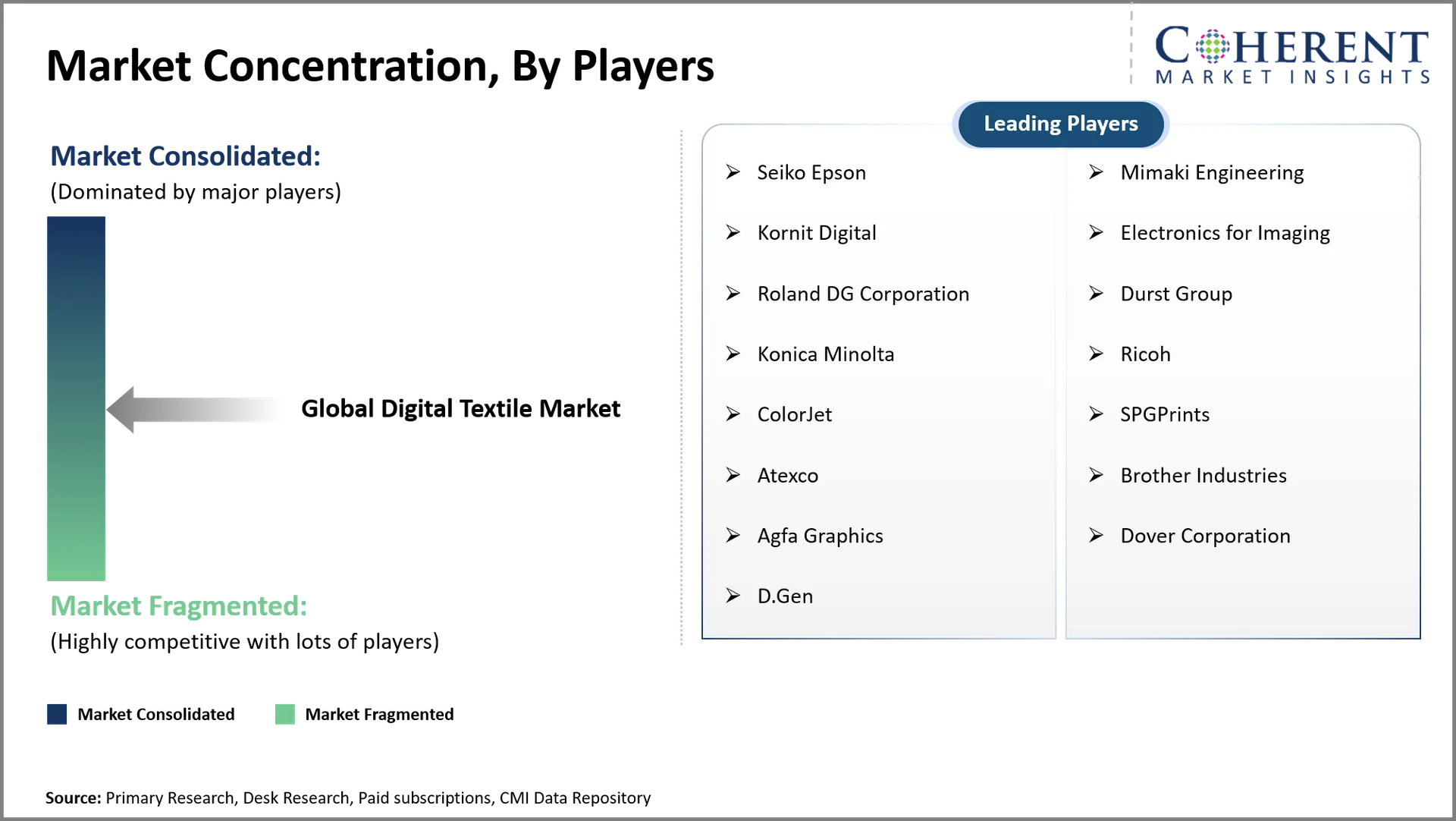
Market Players, Key Development, and Competitive Landscape
Key Developments
- On September 23, 2026, Epson introduced the new SureColor F370, a purpose-built dye-sublimation printer designed to make high-quality personalization more accessible for makers, small businesses, schools and growing customization shops. Epson also introduced its new Sublimation Primer for Cotton, a liquid solution that enables sublimation on white and light-colored cotton garments, expanding customization opportunities beyond traditional polyester applications.
- On April 12, 2026, Kornit Digital Ltd. unveiled its Atlas MATRIX at Konnections 2026, redefining apparel production in the on-demand era. Atlas MATRIX is the first unified digital production system designed to deliver true demand-driven manufacturing with complete flexibility across cotton, polyester, and blended fabrics, with no compromise on quality, durability, or efficiency.
Competitive Landscape
The global digital textile market features competition among equipment manufacturers, ink developers, and integrated printing solution providers. Kornit Digital is focused on industrial direct-to-garment and direct-to-fabric printing, including their Atlas MATRIX platform for cotton, polyester and blends. Its acquisition of PrintFactory in 2026 improves process automation and color management capabilities. Epson’s SureColor dye-sublimation, direct-to-garment and direct-to-film solutions are aimed at the clothing decorator and textile market. Mimaki Engineering is committed to industrial textile printing, such as sublimation and direct printing on textiles. Manufacturers increasingly differentiate through production speed, fabric compatibility, color consistency, automation, and ink efficiency. Companies combining printing hardware, compatible inks, workflow software, and technical support can address broader customer requirements.
Top Manufacturers and Notable Products in the Digital Textile Market
Manufacturer | Notable Product | Key features |
Epson | Monna Lisa ML-16000JQ | Eight-color direct-to-fabric printing, 16 PrecisionCore printheads, real-time pattern matching, supports jacquard and embroidered fabrics, reactive and pigment ink options |
Mimaki | Tx330-1800 | Hybrid direct-to-fabric and transfer-paper printing, maximum fabric print width of 1910 mm, pigment and sublimation inks, water-efficient processing, supports fashion and interior textiles |
EFI Reggiani | BOLT XS | Single-pass industrial printing, maximum fabric width of 71 inches, rated productivity up to 1615 square feet per minute, resolution up to 600 × 4800 dpi, four to eight colors |
Kornit Digital | Presto MAX PLUS | Roll-to-roll digital pigment printing, single-step processing, supports multiple fabric types, eliminates prewashing and post washing, designed for on-demand textile production |
ColorJet | FabJet Pro | Wide-format direct-to-fabric printing, supports textile pigment and disperse printing applications, suited to home furnishings and customized fabric production |
Digital Textile Market Report Coverage | |||
Report Coverage | Details | ||
Base Year | 2025 | Market Size in 2026: | USD 3.15 Bn |
Historical Data For: | 2020 To 2024 | Forecast Period: | 2026 To 2033 |
Forecast Period 2026 To 2033 CAGR: | 5% | 2033 Value Projection: | USD 5.20 Bn |
Geographies covered: |
| ||
Segments covered: |
| ||
Companies covered: | Seiko Epson, Mimaki Engineering, Kornit Digital, Electronics for Imaging, Roland DG Corporation, Durst Group, Konica Minolta, Ricoh, ColorJet, SPGPrints, Atexco, Brother Industries, Agfa Graphics, Dover Corporation, D.Gen | ||
Growth Drivers: |
| ||
Restraints & Challenges: |
| ||
Analyst Opinion (Expert Opinion)
- The future of digital textile printing will depend on integrating high-speed equipment with automated design preparation and demand-driven production. Single-pass systems should attract investment from textile mills replacing conventional printing processes for recurring commercial designs. Direct-to-fabric pigment printing also offers opportunities where manufacturers seek simpler processing across varied materials. Equipment suppliers should prioritize reliable printhead performance, consistent color reproduction, and efficient fabric handling. These capabilities can help manufacturers reduce rework while maintaining output quality across changing production schedules.
- The strongest opportunities are likely to emerge in personalized apparel, performance sportswear, and customized home furnishings. China and India offer opportunities for industrial adoption because of their established textile manufacturing ecosystems. The U.S. presents opportunities in print-on-demand apparel, licensed merchandise, and customized sportswear. Italy offers specialized opportunities in premium fashion fabrics and decorative textiles. Japan remains relevant for precision printing equipment and advanced inkjet technology. Suppliers should tailor their offerings to local fabric preferences, production volumes, and technical requirements instead of pursuing identical product strategies across countries.
- Market players need to design application-specific printing solutions, rather than only focusing on machine speed or headline specs. Ink makers have to enhance wash endurance, color vibrancy and compatibility with cotton and polyester and hybrid materials. Equipment providers need to improve automated maintenance, remote diagnostics and color management systems. Software vendors should integrate online ordering with artwork validation, production scheduling and fulfillment systems. Before bringing a product to market, manufacturers should also verify wastewater performance, energy consumption, and material compatibility. These criteria can separate by reliable manufacturing quality, lesser operational complexity and higher client retention.
Speak to the analyst
Want personalized insights?
Take the findings above to one of our principal consultants, or have the report rebuilt around the segments, geographies and competitors you actually track.
Market Segmentation
- Printing Type Insights (Revenue, USD Billion, 2021 - 2033)
- Direct-to-Fabric Printing
- Direct-to-Garment Printing
- Operation Type Insights (Revenue, USD Billion, 2021 - 2033)
- Single-Pass Printing
- Multi-Pass Printing
- Ink Type Insights (Revenue, USD Billion, 2021 - 2033)
- Reactive Ink
- Acid Ink
- Sublimation Ink
- Pigment Ink
- Direct-Dispersion Ink
- Others
- Substrate Material Insights (Revenue, USD Billion, 2021 - 2033)
- Cotton
- Polyester
- Nylon
- Wool
- Silk
- Others
- Application Insights (Revenue, USD Billion, 2021 - 2033)
- Clothing and Apparel
- Home Décor
- Soft Signage
- Industrial Textiles
- Others
- Regional Insights (Revenue, USD Billion, 2021 - 2033)
- North America
- U.S.
- Canada
- Latin America
- Brazil
- Argentina
- Mexico
- Rest of Latin America
- Europe
- Germany
- U.K.
- Spain
- France
- Italy
- Russia
- Rest of Europe
- Asia Pacific
- China
- India
- Japan
- Australia
- South Korea
- ASEAN
- Rest of Asia Pacific
- Middle East
- GCC Countries
- Israel
- Rest of Middle East
- Africa
- South Africa
- North Africa
- Central Africa
- North America
- Key Players Insights
- Seiko Epson
- Mimaki Engineering
- Kornit Digital
- Electronics for Imaging
- Roland DG Corporation
- Durst Group
- Konica Minolta
- Ricoh
- ColorJet
- SPGPrints
- Atexco
- Brother Industries
- Agfa Graphics
- Dover Corporation
- D.Gen
Sources
Primary Research Interviews
- Digital Textile Printing Machine Manufacturers
- Textile & Fabric Producers
- Ink & Consumables Suppliers
- Fashion & Apparel Brand Representatives
Magazines
- Textile World Magazine
- Digital Textile Magazine
- Apparel Magazine
- Screen Printing & Digital Imaging Magazine
Journals
- Journal of Textile Science & Engineering
- International Journal of Fashion Design, Technology and Education
- Journal of Applied Polymer Science
Associations
- Textile Exchange
- Digital Textile Printing Association (DTPA)
- American Apparel & Footwear Association (AAFA)
- European Apparel and Textile Confederation (EURATEX)
Public Domain Sources
- U.S. International Trade Commission (USITC) Reports
- World Trade Organization (WTO) – Textile Trade Data
- European Commission – Textile Industry Reports
- United Nations Industrial Development Organization (UNIDO)
Proprietary Elements
- CMI Data Analytics Tool
- Proprietary CMI Existing Repository of Information for Last 10 Years
Get access to 250+ pages report
Every segment, forecast, competitor profile and data table behind the analysis above — available for instant download.
- ESOMAR Member
- ISO 9001:2015 Certified
- D-U-N-S Registered
- GDPR & CCPA Compliant
Frequently Asked Questions
The global digital textile market is expected to stand at USD 3.15 Bn in 2026 and is expected to reach USD 5.20 Bn by 2033.
The CAGR of the global digital textile market is projected to be 5% from 2026 to 2033.
Increasing demand for customized textile designs and Expansion of online fashion retail and e-commerce are the major factors driving the growth of the global digital textile market.
High initial investment in digital printing equipment and expensive specialized inks and consumables are the major factors hampering the growth of the global digital textile market.
In terms of printing type, direct-to-fabric printing segment is estimated to dominate the market revenue share in 2026.
The global digital textile market covers digital printing equipment, inks, software, and services used to print designs directly onto textiles or transfer them onto fabrics.
Digital printing deposits ink according to digital artwork, whereas screen printing transfers color through prepared screens for individual design elements.