

Global Dry-Electrode Processing Equipment Market Size and Forecast – 2026 To 2033
The Global Dry-Electrode Processing Equipment Market is estimated to be valued at USD 921.4 Mn in 2026 and is expected to reach USD 3,539.7 Mn by 2033, growing at a compound annual growth rate (CAGR) of 21.2% from 2026 to 2033. The growth is driven by the increased focus of battery manufacturers on solvent-free electrode production, which has the potential to reduce the complexity of manufacturing, energy-intensive drying requirements and solvent recovery costs.
Equipment suppliers are also developing precision calendering, dry powder mixing and film formation technologies to enable industrial scale production of batteries. In February 2026, IBU-tec announced that its ProLiT research project had developed a production plant concept with an annual capacity of 1 GWh and a scalable dry-coating process with IBUvolt LFP400 cathode material. This is a sign that we might see more money for specialized processing equipment, and that we’re getting closer to industrial scale dry-electrode production.
Key Takeaways of the Global Dry-Electrode Processing Equipment Market
- Dry Film Formation and Coating Equipment is projected to expand at an estimated CAGR of 23.5% during 2026–2033, representing 30.4% of the global dry-electrode processing equipment market in 2026. Its commercial appeal lies in forming uniform solvent-free electrode layers without lengthy drying infrastructure. In June 2025 Koenig & Bauer announced that the dry-coating system passed the proof-of-concept testing with PowerCo.
- The standalone processing equipment is projected to witness a 53.6% share in the 2026 global dry-electrode processing equipment market revenue. The standalone processing equipment is anticipated to grow at an estimated CAGR of 18.9% from 2026 to 2033. Individual mixers and processing modules let battery producers qualify dry formulations while limiting investment in fully integrated lines. In April 2025, Bühler announced a continuous mixer supporting both dry and slurry applications at the UK Battery Industrialisation Centre.
- Cathode Processing Equipment is expected to advance at an estimated CAGR of 22.3% through 2033 and secure 51.8% of global dry-electrode processing equipment market. Handling high-loading cathode formulations requires controlled powder distribution and consistent film adhesion, raising equipment complexity. In January 2026, Tesla disclosed production of 4680 cells using dry-processed cathodes and anodes at its Austin facility.
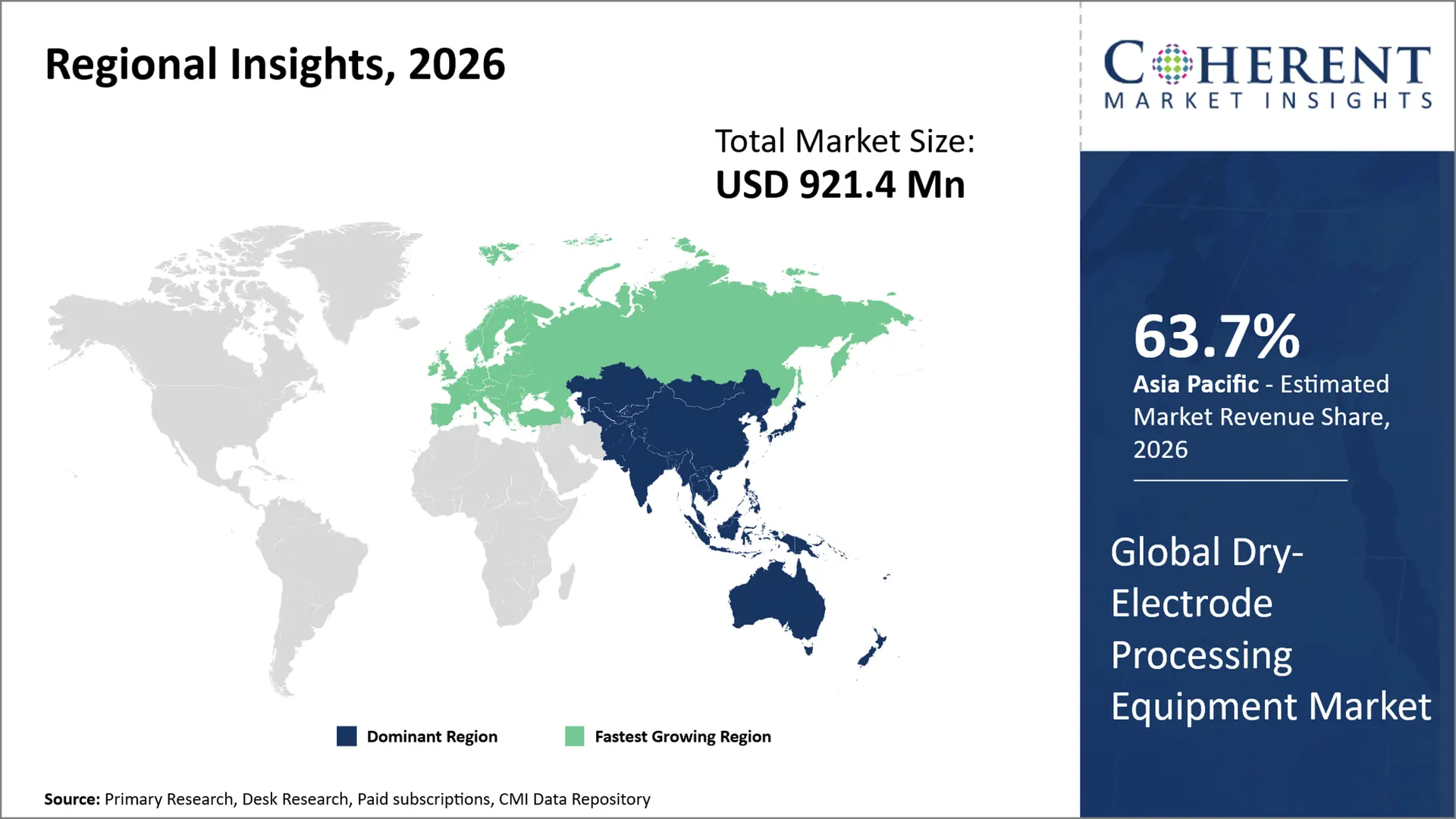
- Asia Pacific is projected to grow at an estimated 20.7% CAGR through 2033 while holding 63.7% of the global dry-electrode processing equipment market in 2026. Concentrated battery-cell manufacturing and local machinery supply chains support faster qualification of dry-electrode processes. In June 2026, LG Energy Solution confirmed that its Ochang plant in South Korea had established a dry-electrode pilot line.
- Europe is anticipated to post an estimated 24.8% CAGR during 2026–2033, the fastest regional pace, and capture 18.4% of the global dry-electrode processing equipment market in 2026. Manufacturers are prioritizing processes that reduce energy-intensive drying while allowing industrial qualification. In November 2025, Fraunhofer IWS inaugurated its DRYplatform in Germany to support dry-coating validation and scale-up.
Segmental Insights
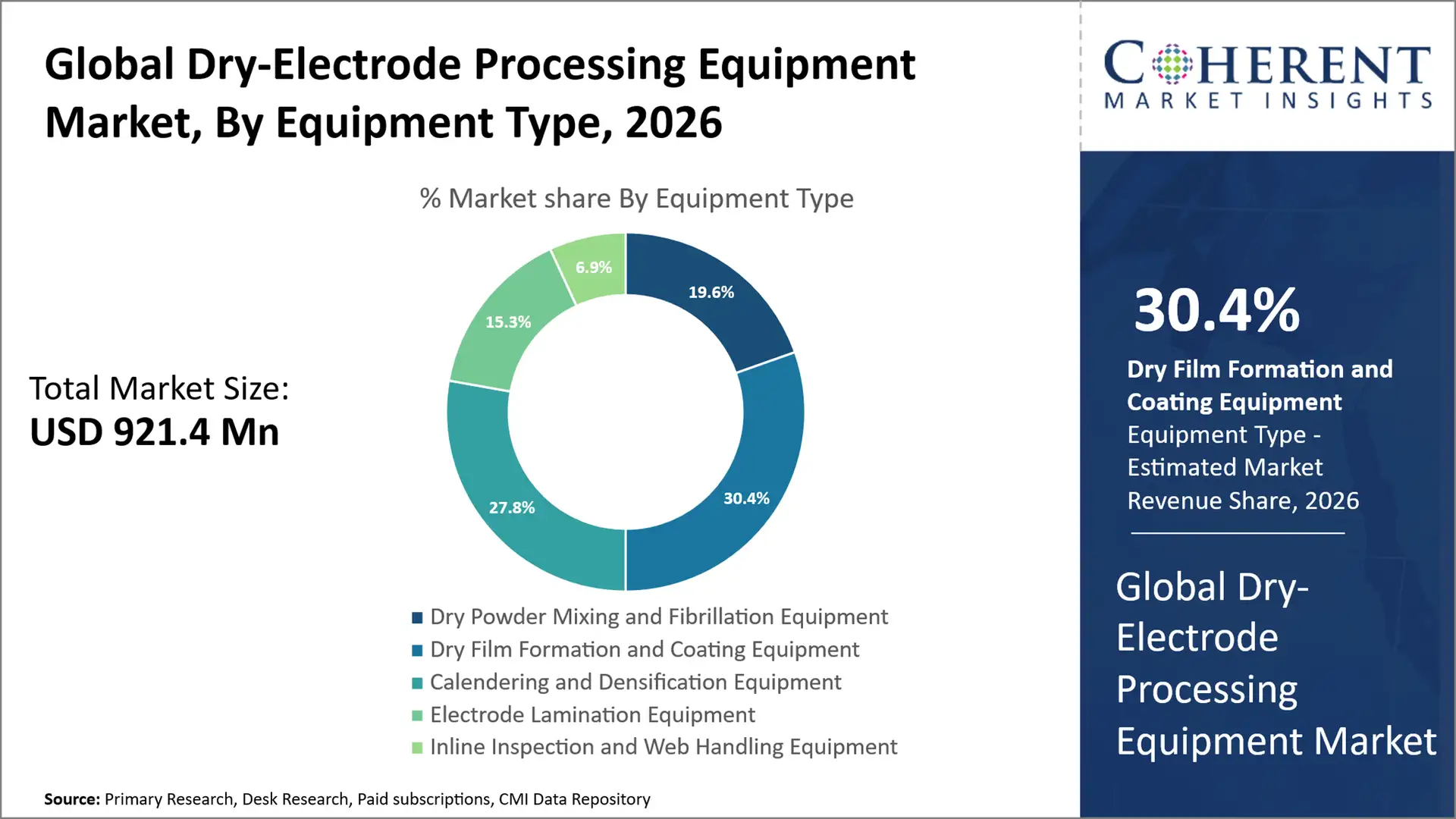
Why Do Dry Film Formation and Coating Equipment Dominate the Global Dry-Electrode Processing Equipment Market?
Dry Film Formation and Coating Equipment is expected to account for 30.4% of the global dry-electrode processing equipment market in 2026, leading the equipment-type category because film quality is determined when dry powder becomes a continuous electrode layer. Battery-cell producers require precise control of roll gaps, film thickness, and two-sided transfer to avoid defects that can reduce usable output during downstream cell assembly. This makes film-forming systems a critical qualification investment for electric vehicle and energy storage battery production. In April 2025, BREYER announced a contract to supply its IONDry 600 dry-coating calender to Fraunhofer FFB. The equipment is designed to form dry electrode films through controlled roll gaps and laminate them onto both sides of current-collector foil. Such orders demonstrate the commercial importance of production-representative coating machinery.
- Current Industry Events of 2026
- Market Size Estimation
- Regional Breakdown
- Competitive Landscape
- Customer Intelligence
- Segmental Analysis
- Pricing Analysis
- Key Market Drivers, Challenges & Future Trends
- Customized Insights Section
Why Does Standalone Processing Equipment Represent the Largest System Type in the Global Dry-Electrode Processing Equipment Market?
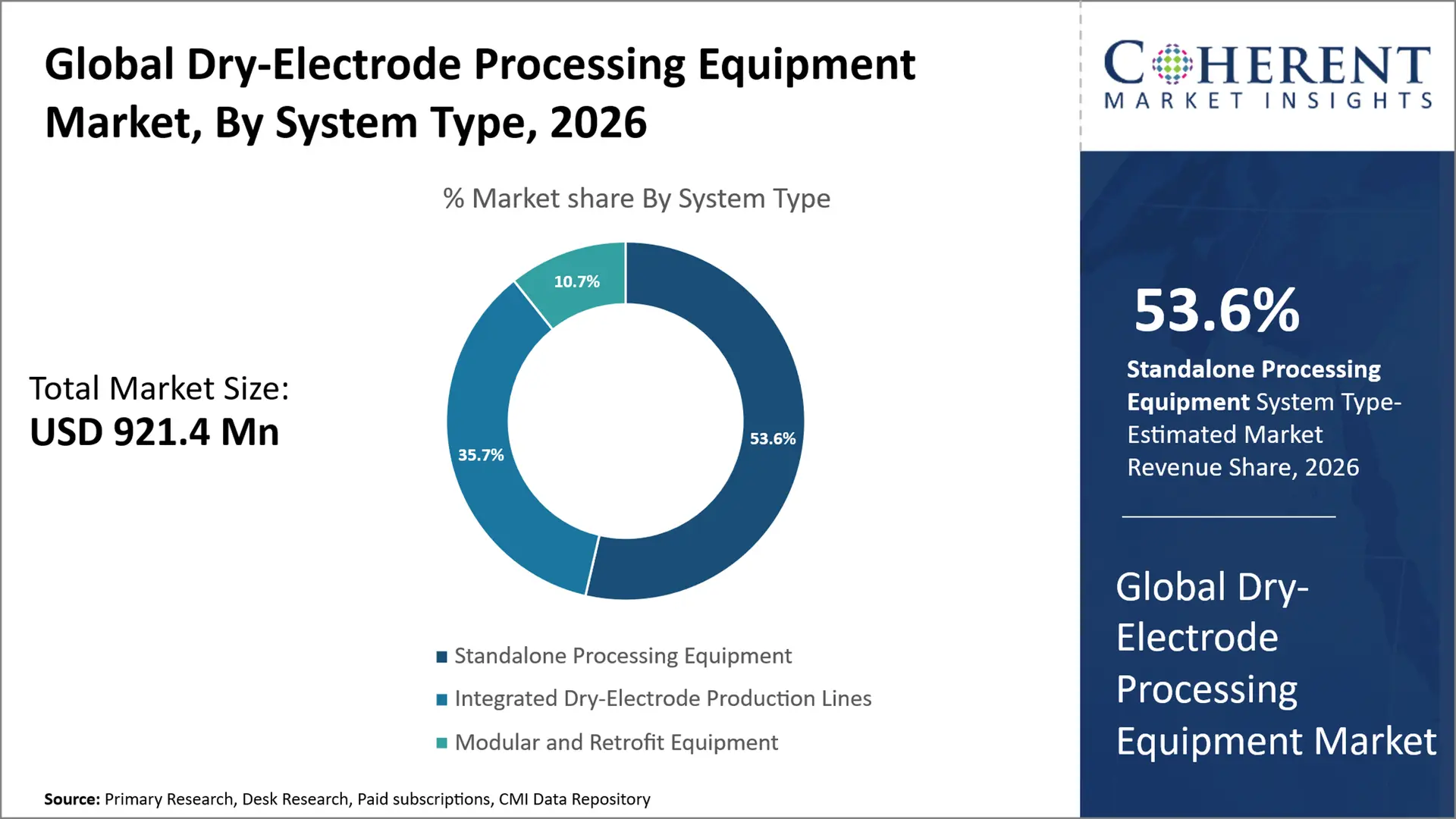
Standalone Processing Equipment is expected to represent 53.6% of the global dry-electrode processing equipment market in 2026, making it the largest system-type category. Buyers can specify independent feeders, mixers, or calender modules around existing machinery rather than accepting a single supplier's process architecture. More importantly, separately qualified machines allow engineers to isolate problems in powder flow, dosing accuracy, or material handling without redesigning an entire line. This is particularly valuable for cell manufacturers and pilot facilities comparing electrode formulations and machine settings. In March 2026, Coperion introduced its K-Tron RF400 roller feeder for dry-electrode coating. Designed for laboratory and pilot-scale use, the equipment delivers powder blends directly to the calender gap through adjustable, gravimetrically controlled feeding. Such specialization supports procurement from component-focused machinery suppliers.
Why Does Cathode Processing Equipment Dominate the Electrode Type Segment of the Global Dry-Electrode Processing Equipment Market?
Cathode Processing Equipment is expected to secure 51.8% of the global dry-electrode processing equipment market in 2026, leading the electrode-type category as battery manufacturers confront different processing requirements for lithium iron phosphate and nickel-rich cathodes. Fine LFP particles and complex conductive-additive networks can cause dry coating sensitivity to formulation and mechanical stresses. That means manufacturers need equipment that can maintain electrode integrity but also chemistry-specific preparation and coating settings, especially for electric vehicle and stationary storage cells. Anaphite reported UK government-backed funding for Project SAVI to scale dry coating of LFP electrodes in August 2026. The project is targeted at larger precursor batches and double-sided electrode production at manufacturing representative speeds. The initiative demonstrates why cathode-specific processing capabilities and industrial qualification remain important considerations when buying future equipment.
Current Events and their Impact
Current Event | Description and Its Impact |
June 2024 – U.S. EPA Proposed NMP Risk Management Requirements |
|
June 2024 – European Union Net-Zero Industry Act Entered into Force |
|
July 2026 – European Commission Advanced Battery Passport Infrastructure |
|
Global Dry-Electrode Processing Equipment Market Dynamics
Key Market Drivers
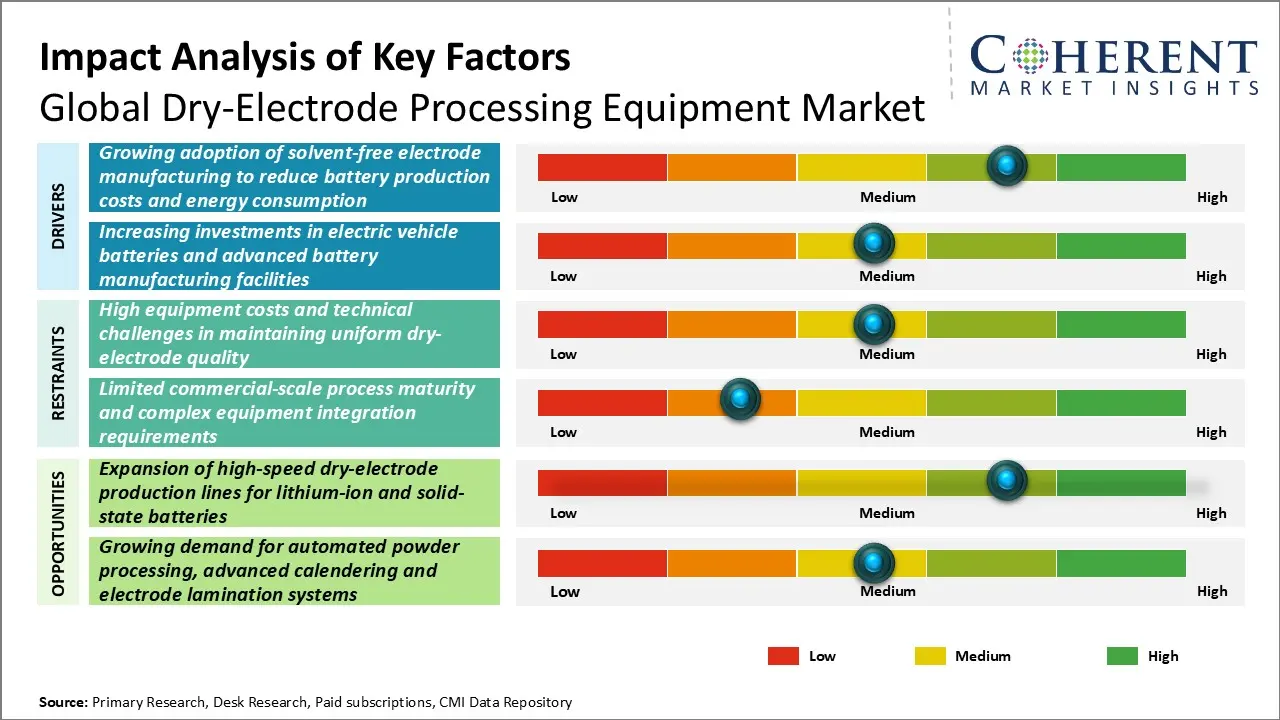
- Growing Adoption of Solvent-Free Electrode Manufacturing to Reduce Battery Production Costs and Energy Consumption: Replacing solvent-based slurry coating with dry powder processing can reduce expenditure on drying ovens, solvent recovery systems, and associated utilities. This changes equipment procurement priorities toward precision mixing, fibrillation, film formation, and lamination systems. Battery manufacturers are looking at the costs of manufacturing over the life cycle. Equipment makers capable of providing uniform electrode quality on a commercial basis should stand to gain. In August 2025, Nissan partnered with LiCAP Technologies to develop dry cathode processing for all-solid-state batteries, targeting improved manufacturing efficiency and lower production costs.
- Increasing Investments in Electric Vehicle Batteries and Advanced Battery Manufacturing Facilities: Investment in advanced battery manufacturing facilities, especially where manufacturers are looking to commercialize alternative electrode designs, is creating procurement opportunities for dry-electrode machinery. These projects require installation of specialized powder-handling systems, exacting coating equipment and production-scale process validation prior to full equipment installation. Longer-term contracts may be available for suppliers who can support plant commissioning and the manufacturing qualification. AM Batteries announced in August 2026 that it joined USD 50 million effort led by Coreshell Technologies and sponsored by the U.S. Department of Energy to incorporate dry cathode manufacturing into expected domestic battery production capacity.
Emerging Market Trends
- Shift Toward Chemistry-Specific Process Qualification: Battery manufacturers are developing dry-electrode equipment that is specific to certain electrode chemistries, taking into consideration particle characteristics, binder distribution, and material compatibility. This shift is driving the need for equipment suppliers to offer flexible processing configurations that can consistently deliver electrode quality across a range of battery chemistries.
- Impact: Generates a need for adaptable production sites, chemistry-specific validation services and specialized equipment, helping suppliers to boost their customer qualification success and stand out in the market.
- Relevance to Market: It generates business opportunities for manufacturers of specialized equipment to support the production of lithium-ion and solid-state batteries, especially in industrial-scale process qualification and formulation development.
- Integration of Localized Atmosphere Control into Dry-Processing Equipment: Dry-electrode equipment manufacturers are investigating local humidity and atmosphere control systems to protect moisture-sensitive electrode materials during processing. Airlocks, controlled processing chambers and enclosed powder transfer modules can be incorporated to reduce the need for extensive environmental conditioning across the facility.
- Impact: It can lower the cost of environmental control, enhance the stability of materials, and increase the demand for smaller equipment with integrated atmospheric control capabilities.
- Relevance to Market: Allows equipment vendors to develop proprietary processing systems for moisture sensitive battery chemistries, enabling production of specialty cells and more versatile factory configurations.
Regional Insights
Why Does Asia Pacific Dominate the Global Dry-Electrode Processing Equipment Market?
Asia Pacific is projected to hold a 63.7% share of the global dry-electrode processing equipment market by 2026, driven by its established lithium-ion battery production capacity and existing electrode machinery supply chains. The concentration of battery producers, precision equipment makers and advanced materials suppliers allows for quicker equipment customization, production testing and industrial deployment. Regional machinery manufacturers also profit from existing customer relationships and the capacity to support overseas battery manufacturing projects. In September 2026, China-based Lead Intelligent delivered its next-generation dry-electrode coating equipment to a major global lithium-ion battery manufacturer. The system is suitable for continuous production due to adjustable roll pressure, temperature, speed and gap controls. Deliveries of such equipment further cement Asia Pacific’s role as a manufacturing and export hub for industrial dry-electrode processing technologies.
Why Is Europe Emerging as the Fastest-Growing Region in the Global Dry-Electrode Processing Equipment Market?
Europe is expected to have 18.4% share of the global dry-electrode processing equipment market by 2026 and register the fastest regional growth through 2033. Regional equipment demand is increasingly tied to the modernization of battery manufacturing, publicly supported industrial research, and efforts to develop competitive domestic production technologies. European manufacturers are looking at equipment that can cope with advanced electrode materials but will also allow for future conversion of the production line. In October 2026, The European Commission-funded DRY-SENSE project has started work on solvent-free manufacturing processes for solid-state batteries, including multi-material extrusion, roll-to-roll coating and automated process control. The initiative focuses on pilot-line validation and selective retrofitting of existing lithium-ion production equipment.
Global Dry-Electrode Processing Equipment Market Outlook for Key Countries
Why Is the U.S. a Key Market for the Global Dry-Electrode Processing Equipment Market?
The U.S. represents an important global dry-electrode processing equipment market because battery technology developers are converting laboratory coating methods into machinery suitable for customer qualification. Domestic interest extends beyond conventional electric vehicle cells to alternative chemistries and specialized energy-storage applications. For equipment buyers, demonstrable electrode performance, modular scale-up and the ability to work with existing foil-handling systems are most important. California-based Sakuu said in August 2025 it was working to fulfilll the first orders for its Kavian dry-electrode manufacturing platform and had supplied dry-produced electrode material to customers in the battery-cell and electric vehicle industries. Its platform prints cathode and anode materials directly onto current collectors, showing a unique equipment path that could potentially allow future manufacturing investments without traditional slurry coating lines.
Why Does China Support Growth in the Global Dry-Electrode Processing Equipment Market?
China is an important player in the global dry-electrode processing equipment market due to its ability to manufacture precision machinery near large battery-cell and electric vehicle manufacturing clusters. Local equipment makers have been turning the preparation of dry powders, the formation of continuous films, and the double-sided lamination into reproducible manufacturing processes. This enables battery makers to check the coating uniformity, operating speed and commissioning requirements of equipment manufactured in the domestic market before committing to larger production lines. In July 2025, Tsingyane and its affiliated Tsingyanak project provided high-speed, wide-format dry-electrode film-forming equipment to a domestic automaker. “This delivery shows the power of direct engagement with automotive customers to accelerate equipment development and improve the industrial validation capabilities of Chinese suppliers.
Why Is Japan a Strategic Market for the Global Dry-Electrode Processing Equipment Market?
Japan’s expertise in high-precision machinery, advanced material handling, and battery process engineering makes the global dry electrode processing equipment market strategically relevant to Japan. Japanese suppliers can combine industrial robotics, precision coating and extrusion capabilities into systems that are tailored for continuous electrode production. So the country’s equipment opportunity is in the difficult processing steps such as uniform powder mixing, controlled film formation, precise lamination and not the factory capacity. Shibaura Machine published its Integrated Report in November 2025, detailing its R&D on continuous electrode mixing by twin-screw extrusion, as well as high-speed lamination and electrostatic coating technologies. These research priorities indicate that as battery developers advance in the qualification of dry electrodes, Japanese manufacturers might be able to offer specialized production modules and integrated engineering services.
Why Is South Korea Important in the Global Dry-Electrode Processing Equipment Market?
South Korean battery-cell makers have gained control of the costs and consistency of electrode production, making them a major player in the dry-electrode processing equipment market. In pilot-line testing, the country’s existing equipment supply base enables collaboration between cell manufacturers, materials developers and machinery specialists. The procurement opportunities are particularly relevant for systems that can maintain electrode adhesion and quality in spite of repeated process adjustments. Samsung SDI said in its corporate update in November 2024 that it completed its DryEV pilot line in Cheonan in September 2024 and started test production. Although a pilot operation is not itself a full commercial deployment, the development does establish a domestic testing environment for equipment performance and enables subsequent industrial qualification.
Why Is Germany a Strategic Country in the Global Dry-Electrode Processing Equipment Market?
Germany has a strong industrial engineering base which helps in the design of continuous manufacturing systems, controlled rolling and high precision mixing, making it a major European global dry-electrode processing equipment market. If you are a battery manufacturer looking for consistent electrode quality, you may utilize the industrial automation expertise already possessed by machinery suppliers to set up repeatable process configurations. The cooperation of specialized machine builders and cell manufacturers, who are committed to the conversion of laboratory processes into pilot and series production, also supports the development of German equipment. In April 2026, IKA and UniverCell signed a joint development agreement to scale the production of dry electrodes by using IKA’s CONTERNA continuous kneading technology. The partnership highlights the contribution of Germany in the evolution of upstream powder processing equipment and the integration of process engineering know-how with the requirements of domestic battery cell production.
Dry-Electrode Equipment Procurement and Commercialization Landscape
Market Focus | Key Buyer Requirements | Current Market Scenario | Commercial Significance |
Commercial-Scale Equipment Investment | A constant quality of electrodes, reliable operation of the equipment and a high production capacity. | The battery manufacturers are now assessing the move from pilot installations to industrial production lines. | Increases the chances of long-term supplier contracts, large equipment purchases and production-line installations. |
Equipment Qualification and Validation | Robust continuous operation. Acceptable yield of production. Proven performance of electrodes. | Purchases of equipment must be thoroughly tested for compatibility with specific battery chemistries. | Suppliers that offer qualification support and proven manufacturing performance can strengthen customer relationships and secure repeat business. |
Efficiency of Investment & Manufacturing Cost | Low capital investment, competitive equipment life cycle costs and low operating expenditures. | Buyers are balancing the economics of solvent-free manufacturing with the long-established slurry-based electrode manufacturing. | Cost competitiveness can affect the financial viability of factory investments, procurement budgets and equipment selection. |
Existing Factory Modernization | Compatible with existing manufacturing systems, manageable installation requirements and minimal disruption to production. | The established battery makers are considering both phased modernization and investments in entirely new manufacturing facilities. | Provides opportunities for equipment upgrades, engineering services and retrofit projects that show technical compatibility. |
Reliability of Supply and Production Capacity | Reliable availability of components and sufficient manufacturing capacity. Consistent delivery of machinery. | Coordinated machinery procurement, scheduling of installation and planning of production ramp-up is required for large battery projects. | Suppliers that have built up networks for supplying components and reliable manufacturing operations may be preferred in major equipment tenders. |
After-Sales Services and Customer Support | Operator training, spare parts, maintenance services and local commissioning support. | After equipment installation and manufacturing process qualification, industrial customers need continuous technical support. | Generates recurring revenue from long term service agreements, technical support, equipment upgrades and maintenance contracts. |
How Are Silicon-Rich Anode Processing Requirements Creating New Growth Opportunities in the Global Dry-Electrode Processing Equipment Market?
The global dry-electrode processing equipment market has an underdeveloped opportunity in the manufacture of silicon-rich anodes due to the challenges in processing high-capacity formulations into durable, uniform films. The particle expansion during battery cycling and the variations in binder behavior make the electrode structure and adhesion crucial, and the powder segregation can compromise the consistency of manufacturing.
These barriers can be overcome by the supplier through application-specific electrode validation, controlled bonding of current collectors, tunable densification systems, and dedicated powder dispersion modules. Potential customers include automotive battery developers, premium consumer electronics manufacturers and high-end battery research facilities.
Equipment vendors could profit from feasibility testing and custom engineering before converting validated processes into commercial machinery orders. To participate, you must have the ability to perform electrochemical testing, material expertise and proven manufacturing controls. Companies that prematurely invest in fixed, chemistry-specific production lines may risk commercialization. Specialist equipment manufacturers working closely with battery developers may have an edge.
Market Players, Key Development, and Competitive Landscape
Key Developments
- In June 2026, Matthews Engineering announced the operational readiness of its Vreden Development Center in Germany following the commissioning of the MEODEO dry-electrode demonstration line. The facility enables customers to evaluate industrial-scale calendering and lamination processes, supporting the transition from laboratory development to commercial manufacturing.
- In September 2025, Arkema inaugurated a dedicated dry-electrode research laboratory at its Serquigny facility in France. The laboratory includes powder mixing, electrode deposition testing, and pilot calendaring capabilities, supporting the joint development of compatible binder materials and processing equipment for future battery electrode manufacturing.
Competitive Landscape
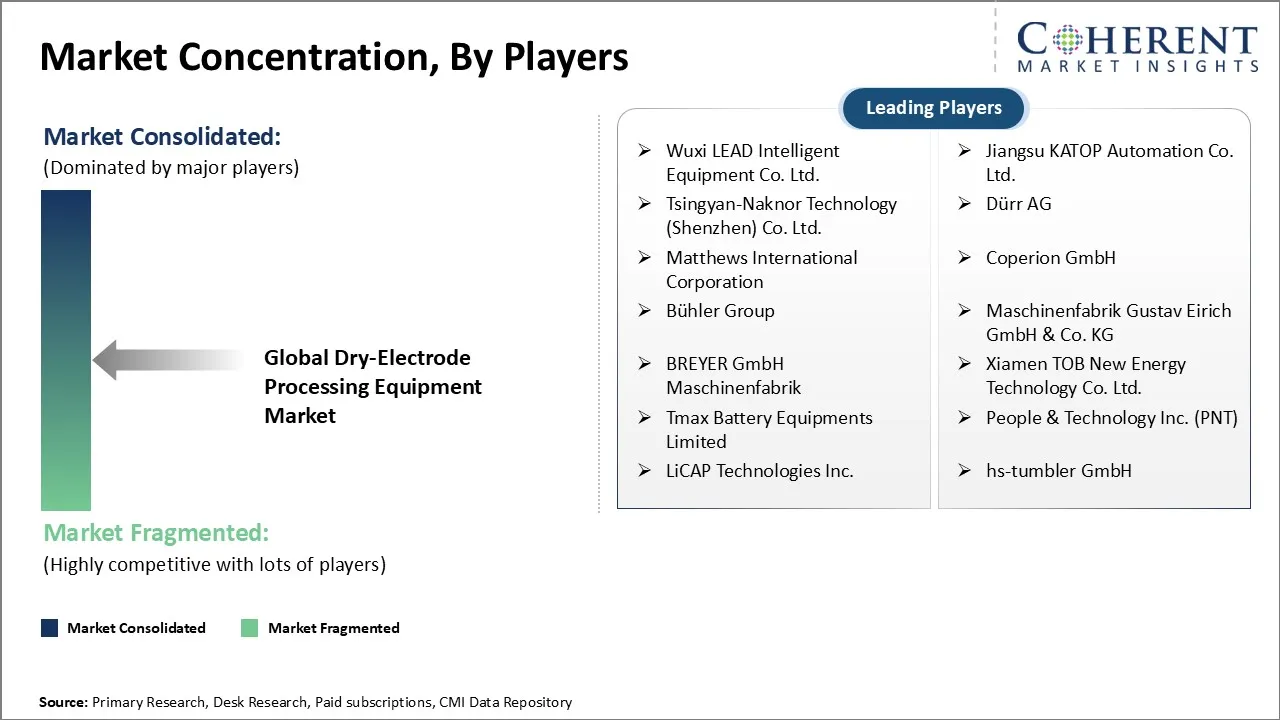
The global dry-electrode processing equipment market is moderately fragmented with a mix of established battery machinery manufacturers, precision roller specialists, powder processing equipment providers and emerging process technology developers. The competitiveness of the market is more and more determined by the reliability of the equipment, the flexibility of the production, the proprietary processing capabilities and the technical customer services. Specialized manufacturers compete based on proven production capabilities and intellectual property and regional suppliers compete based on commercial responsiveness and customization.
Key competitive factors include
- Equipment precision: Uniform electrode thickness, reliable film formation and controlled porosity under a variety of production conditions.
- Process flexibility: Equipment setups that can be adapted to a wide range of electrode materials, binder systems and production requirements.
- Intellectual property: Proprietary dry-film formation, powder deposition, calendering and lamination technologies.
- Production reliability: Predictable maintenance needs, durability of industrial equipment and consistent component performance.
- Customer qualification: Structured testing support and demonstration facilities to reduce uncertainty in the procurement of industrial equipment.
- Commercial competitiveness: Transparent equipment pricing, installation expenditure, spare-parts availability, and lifecycle service costs.
- Technical service networks: Local engineering teams, commissioning assistance, operator training, and responsive aftermarket support.
Market Report Scope
Dry-Electrode Processing Equipment Market Report Coverage | |||
Report Coverage | Details | ||
Base Year | 2025 | Market Size in 2026: | USD 921.4 Mn |
Historical Data For: | 2020 To 2024 | Forecast Period: | 2026 To 2033 |
Forecast Period 2026 To 2033 CAGR: | 21.2% | 2033 Value Projection: | USD 3,539.7 Mn |
Geographies covered: |
| ||
Segments covered: |
| ||
Companies covered: | Wuxi LEAD Intelligent Equipment Co. Ltd., Jiangsu KATOP Automation Co. Ltd., Tsingyan-Naknor Technology (Shenzhen) Co. Ltd., Dürr AG, Matthews International Corporation, Coperion GmbH, Bühler Group, Maschinenfabrik Gustav Eirich GmbH & Co. KG, BREYER GmbH Maschinenfabrik, Xiamen TOB New Energy Technology Co. Ltd., Tmax Battery Equipments Limited, People & Technology Inc. (PNT), LiCAP Technologies Inc., hs-tumbler GmbH | ||
Growth Drivers: |
| ||
Restraints & Challenges: |
| ||
Analyst Opinion (Expert Opinion)
- The global dry-electrode processing equipment market is likely to develop into two distinct commercial models: flexible development systems for manufacturers testing emerging electrode architectures and highly standardized industrial systems for established battery producers. Equipment suppliers that structure their offerings around these different purchasing requirements may strengthen customer retention and create opportunities for recurring engineering, maintenance, and equipment upgrade revenue.
- Direct-on-collector powder deposition could materially change the economics of dry-electrode equipment manufacturing if it achieves reliable industrial performance. These processes may replace separate free-standing film formation and transfer steps, placing pressure on traditional multi-step machinery arrangements. Suppliers with expertise in precision deposition and flexible processing platforms could stand to gain, while manufacturers relying on traditional mechanical film-handling architectures may need to diversify.
- Equipment makers need to focus on commercially proven processing platforms, flexible machine configurations and dependable industrial support capabilities. The report said investment decisions must consider technology licensing restrictions, precision-component supply risks, customer qualification periods, and competitive equipment pricing. Suppliers should pursue closer relationships with battery producers and materials specialists while avoiding premature capacity expansion into manufacturing technologies that lack demonstrated production reliability.
Speak to the analyst
Want personalized insights?
Take the findings above to one of our principal consultants, or have the report rebuilt around the segments, geographies and competitors you actually track.
Market Segmentation
- Equipment Type Insights (Revenue, USD Mn, 2021 - 2033)
- Dry Powder Mixing and Fibrillation Equipment
- Dry Film Formation and Coating Equipment
- Calendering and Densification Equipment
- Electrode Lamination Equipment
- Inline Inspection and Web Handling Equipment
- System Type Insights (Revenue, USD Mn, 2021 - 2033)
- Standalone Processing Equipment
- Integrated Dry-Electrode Production Lines
- Modular and Retrofit Equipment
- Electrode Type Insights (Revenue, USD Mn, 2021 - 2033)
- Cathode Processing Equipment
- Anode Processing Equipment
- Dual-Electrode Processing Equipment
- Production Scale Insights (Revenue, USD Mn, 2021 - 2033)
- Laboratory and R&D Equipment
- Pilot-Scale Equipment
- Commercial-Scale Equipment
- Battery Type Insights (Revenue, USD Mn, 2021 - 2033)
- Conventional Lithium-Ion Batteries
- All-Solid-State Batteries
- Semi-Solid-State Batteries
- Application Insights (Revenue, USD Mn, 2021 - 2033)
- Electric Vehicle Batteries
- Energy Storage System Batteries
- Consumer Electronics Batteries
- Industrial and Other Batteries
- Sales Channel Insights (Revenue, USD Mn, 2021 - 2033)
- Direct Manufacturer Sales
- System Integrators and Engineering Partners
- Equipment Distributors
- Regional Insights (Revenue, USD Mn, 2021 - 2033)
- North America
- U.S.
- Canada
- Latin America
- Brazil
- Argentina
- Mexico
- Rest of Latin America
- Europe
- Germany
- U.K.
- Spain
- France
- Italy
- Russia
- Rest of Europe
- Asia Pacific
- China
- India
- Japan
- Australia
- South Korea
- ASEAN
- Rest of Asia Pacific
- Middle East
- GCC Countries
- Israel
- Rest of Middle East
- Africa
- South Africa
- North Africa
- Central Africa
- North America
- Key Players Insights
- Wuxi LEAD Intelligent Equipment Co. Ltd.
- Jiangsu KATOP Automation Co. Ltd.
- Tsingyan-Naknor Technology (Shenzhen) Co. Ltd.
- Dürr AG
- Matthews International Corporation
- Coperion GmbH
- Bühler Group
- Maschinenfabrik Gustav Eirich GmbH & Co. KG
- BREYER GmbH Maschinenfabrik
- Xiamen TOB New Energy Technology Co. Ltd.
- Tmax Battery Equipments Limited
- People & Technology Inc. (PNT)
- LiCAP Technologies Inc.
- hs-tumbler GmbH
Sources
Primary Research Interviews
- Battery manufacturing equipment suppliers, dry-electrode process engineers, and battery production specialists
- Battery cell manufacturers, gigafactory operators, system integrators, and equipment procurement managers
Stakeholders
- Dry-electrode machinery manufacturers, equipment OEMs, and component suppliers
- Battery producers, automotive OEMs, energy storage manufacturers, and battery R&D facilities
End-use Sectors
- Electric vehicle batteries and stationary energy storage systems
- Consumer electronics, industrial batteries, and solid-state battery manufacturing
Regulatory and Industry Bodies
- U.S. Department of Energy (DOE)
- U.S. Environmental Protection Agency (EPA)
- European Commission
- International Energy Agency (IEA)
Databases
- IEA Global EV Outlook and battery demand datasets
- UN Comtrade, Eurostat, and USITC trade statistics
- WIPO PATENTSCOPE and EPO Espacenet patent databases
- Battery manufacturing capacity, equipment pricing, and production investment databases
Magazines and Journals
- Journal of Power Sources
- Energy Storage Materials
- Journal of Energy Chemistry
- Advanced Energy Materials
Associations
- Batteries European Partnership Association (BEPA)
- NAATBatt International
- EUROBAT
- China Industrial Association of Power Sources (CIAPS)
Public Domain Sources
- Battery gigafactory investments, equipment orders, and production capacity announcements
- Dry-electrode pilot-line developments, manufacturing efficiency, and commercialization data
- Battery machinery pricing, industrial partnerships, and government-funded research projects
Key Standards and Regulations
- Regulation (EU) 2023/1542 – Batteries and Waste Batteries
- Regulation (EU) 2023/1230 – Machinery Regulation
- ISO 12100 – Machinery Safety and Risk Assessment
- IEC 60204-1 – Electrical Equipment of Machines
- EPA TSCA Requirements – N-Methylpyrrolidone (NMP), as applicable
Proprietary Elements
- CMI Data Analytics Tool and proprietary research repository, supplemented by equipment-level pricing, primary interviews, manufacturing capacity assessments, technology qualification analysis, supplier benchmarking, and competitive intelligence.
Get access to 250+ pages report
Every segment, forecast, competitor profile and data table behind the analysis above — available for instant download.
- ESOMAR Member
- ISO 9001:2015 Certified
- D-U-N-S Registered
- GDPR & CCPA Compliant
Frequently Asked Questions
The CAGR of global dry-electrode processing equipment market is projected to be 21.2% from 2026 to 2033.
The global dry-electrode processing equipment market is estimated to be valued at USD 921.4 million in 2026 and is expected to reach USD 3,539.7 million by 2033.
Dry-electrode processing equipment enables solvent-free electrode production through powder mixing, film formation, calendering, and lamination, helping manufacturers reduce drying requirements and improve production efficiency.
Important factors are production throughput, uniformity of electrode quality, equipment compatibility, capital investment, operating costs, process scalability and after-sales technical support.
Opportunities range from commercial-scale equipment supply, pilot-line installations, factory modernization, custom processing solutions to equipment integration services for battery makers.
Key challenges include maintaining uniform electrode thickness and binder distribution, ensuring film adhesion, integrating equipment, and validating performance all at industrial manufacturing speeds.
The major factors driving growth in the global dry-electrode processing equipment market are the increasing adoption of solvent-free electrode manufacturing to reduce production costs and energy consumption, along with growing investments in electric vehicle batteries and advanced battery manufacturing facilities.