

Global Electronic Films Market Size and Forecast – 2026 To 2033
The Global Electronic Films Market is estimated to be valued at USD 41.62 Bn in 2026 and is expected to reach USD 75.11 Bn by 2033, exhibiting a compound annual growth rate (CAGR) of 8.8% from 2026 to 2033. Market growth is supported by the rising use of electronic films in display panels, semiconductor packaging, printed circuit boards, flexible circuits, solar modules, and electronic components. Demand is increasing as manufacturers require lightweight, durable, thermally stable, optically clear, and electrically functional films for next-generation devices.
Conductive films, PET films, polyimide films, optical films, adhesive films, and insulating films are becoming critical in OLED displays, automotive cockpits, wearable devices, 5G electronics, and high-density chip packaging. For instance, in February 2025, LG Display’s mass production of ultra-large automotive display solutions, including a 57-inch pillar-to-pillar LCD and 32.6-inch slidable OLED highlighted growing electronic film demand in advanced vehicle displays. (Source: LG Display Newsroom)
Key Takeaways of the Global Electronic Films Market
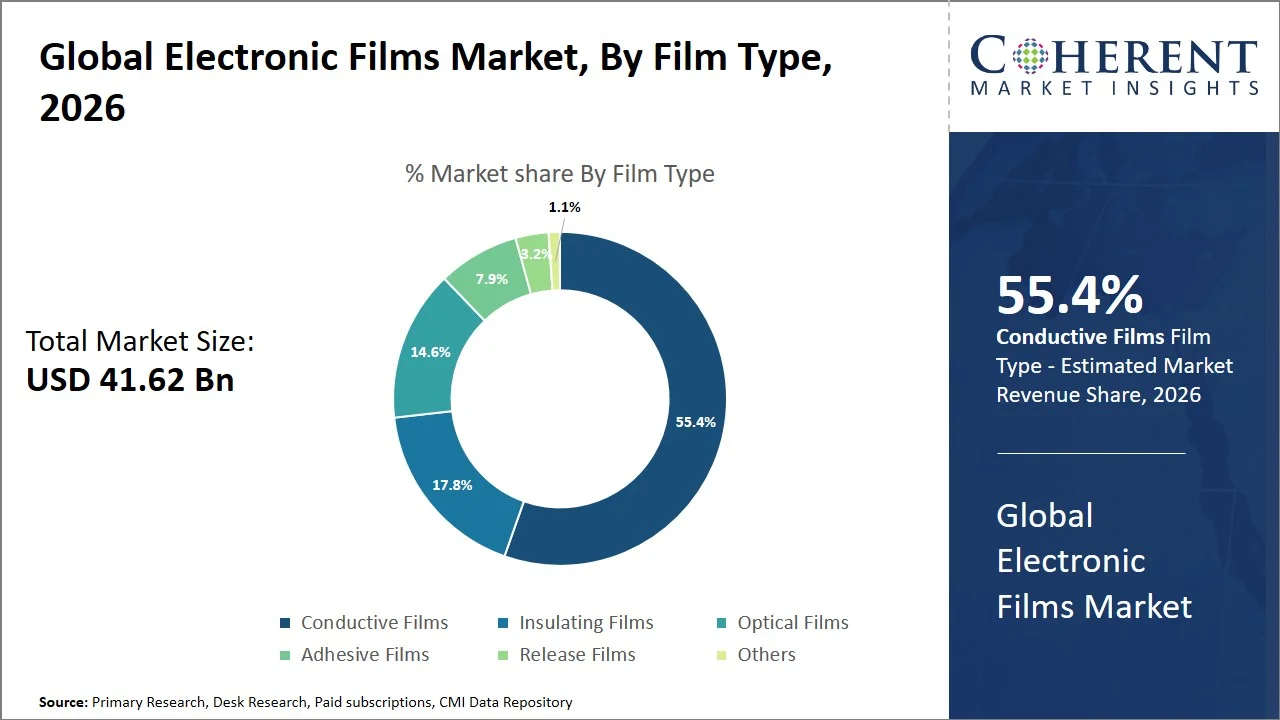
- Conductive films are expected to account for 55.4 % of the market share in 2026, making them the largest film type as electronics OEMs require high conductivity, transparency, and thin form factors for touch, sensing, heating, and antenna functions. In April 2025, Canatu signed a DENSO JDA to improve CNT sheet resistance-to-transmittance for ADAS heaters and new applications. (Source: Canatu)
- Polyethylene terephthalate films are expected to hold 31.8 % share in 2026, supported by their cost-performance balance, durability, dimensional stability, and suitability for LCD polarizer protection and display films. In February 2025, Toyobo announced a 30% capacity boost for COSMOSHINE SRF PET films, with mass production scheduled in fiscal 2026 for wider display panels. (Source: TOYOBO CO., LTD)
- Display panels are expected to command 49.7 % share in 2026, reflecting the strong linkage between electronic films and OLED/LCD performance, optical management, and encapsulation needs. In February 2026, Samsung Display launched QD-OLED Penta Tandem, improving luminous efficiency by 1.3 times and lifespan by 2 times while expanding across monitor and TV panel sizes. (Source: SAMSUNG DISPLAY Co.,Ltd)
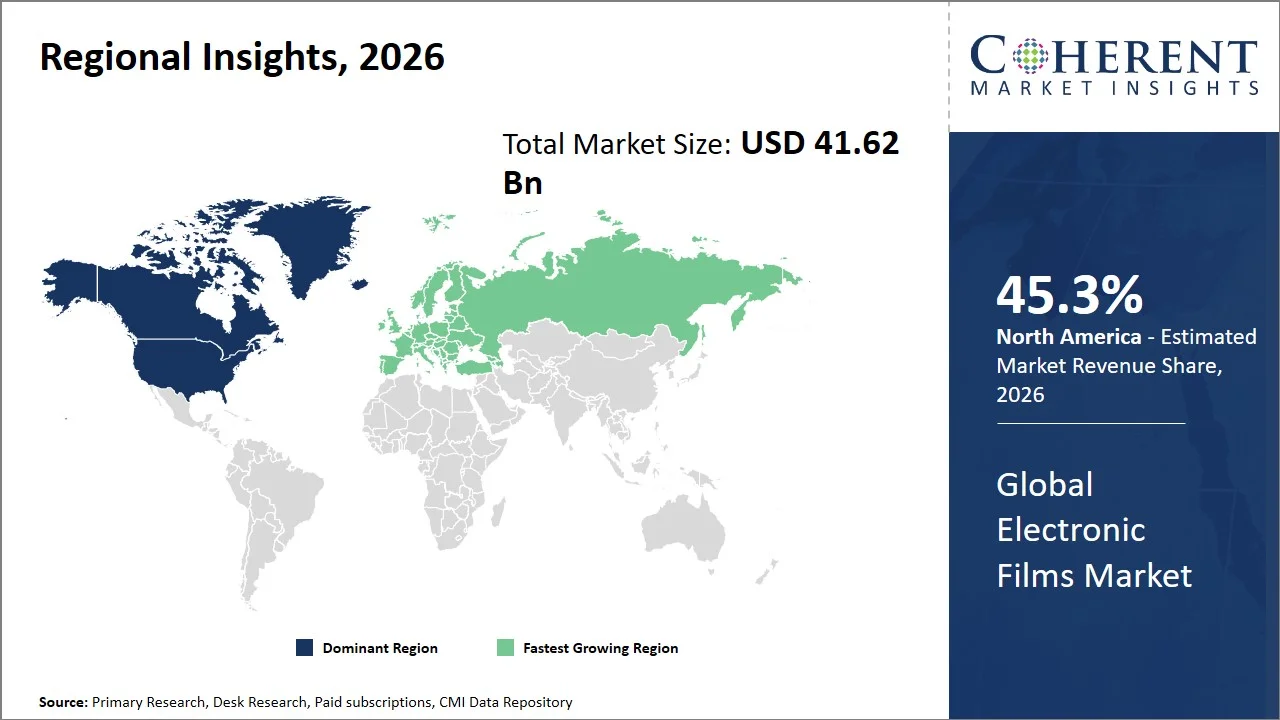
- North America is expected to hold 45.3 % share in 2026, supported by semiconductor localization, advanced packaging, and high-value electronics manufacturing For instance, TSMC Arizona’s CHIPS-backed project highlights the scale of U.S. semiconductor investment, with NIST noting that up to USD 6.6 billion in direct funding is supporting more than USD 65 billion in investment to build three leading-edge fabs in Phoenix. (Source: National Institute of Standards and Technology)
- Europe is expected to account for 24.6 % share in 2026, with momentum linked to semiconductor sovereignty, power electronics, electromobility, and industrial electronics. In May 2025, Infineon received final funding approval for its Dresden Smart Power Fab, where it will invest over USD 5.8 billion and create up to 1,000 jobs. (Source: Infineon Technologies AG)
- Large-Area OLED Manufacturing Gains Momentum: Advanced display makers are moving toward larger glass substrates and higher-yield OLED production, supporting the demand for specialty electronic films used in deposition, encapsulation, and optical stacks. In November 2024, Applied Materials introduced MAX OLED designed to scale OLED manufacturing from Gen 6 to Gen 8 substrates and improve brightness, efficiency, and lifetime. (Source: Applied Materials, Inc.)
- Advanced Packaging Materials Become Strategic: Film-based materials are moving beyond displays into semiconductor packaging, inspection, and high-density interconnect applications, strengthening the market’s long-term value pool. NIST’s CHIPS NAPMP awarded Arizona State University USD 100 million to develop FOWLP and panel-level packaging, including domestically produced build-up films for AI, HPC, ADAS, IoT, and 5G/6G applications.
Segmental Insights
Why Do Conductive Films Dominate the Film Type Segment?
Conductive films segment is expected to account for 55.4% of the market share in 2026 in the global electronic films market as they act as the electrical interface layer in advanced displays, touch sensors, transparent antennas, EMI shielding films, heaters, and automotive human-machine interfaces. Their strong position is linked to the need for thinner, lighter, and more flexible electronic surfaces that can carry signals without compromising optical transparency. On the demand side, growth is supported by premium consumer electronics, in-vehicle displays, wearable devices, and connected industrial interfaces. On the supply side, metal mesh and roll-to-roll conductive film technologies are improving resistance control, transparency, and design flexibility. A recent instance is Panasonic’s FineX transparent conductive film, which is positioned for transparent heaters, antennas, EMC shielding, and flexible touch sensors using double-sided wiring and roll-to-roll manufacturing. (Source: Panasonic Corporation of North America)
- Current Industry Events of 2026
- Market Size Estimation
- Regional Breakdown
- Competitive Landscape
- Customer Intelligence
- Segmental Analysis
- Pricing Analysis
- Key Market Drivers, Challenges & Future Trends
- Customized Insights Section
Why Do Polyethylene Terephthalate Films Represent the Largest Material Type Segment with 31.8% Share in 2026?
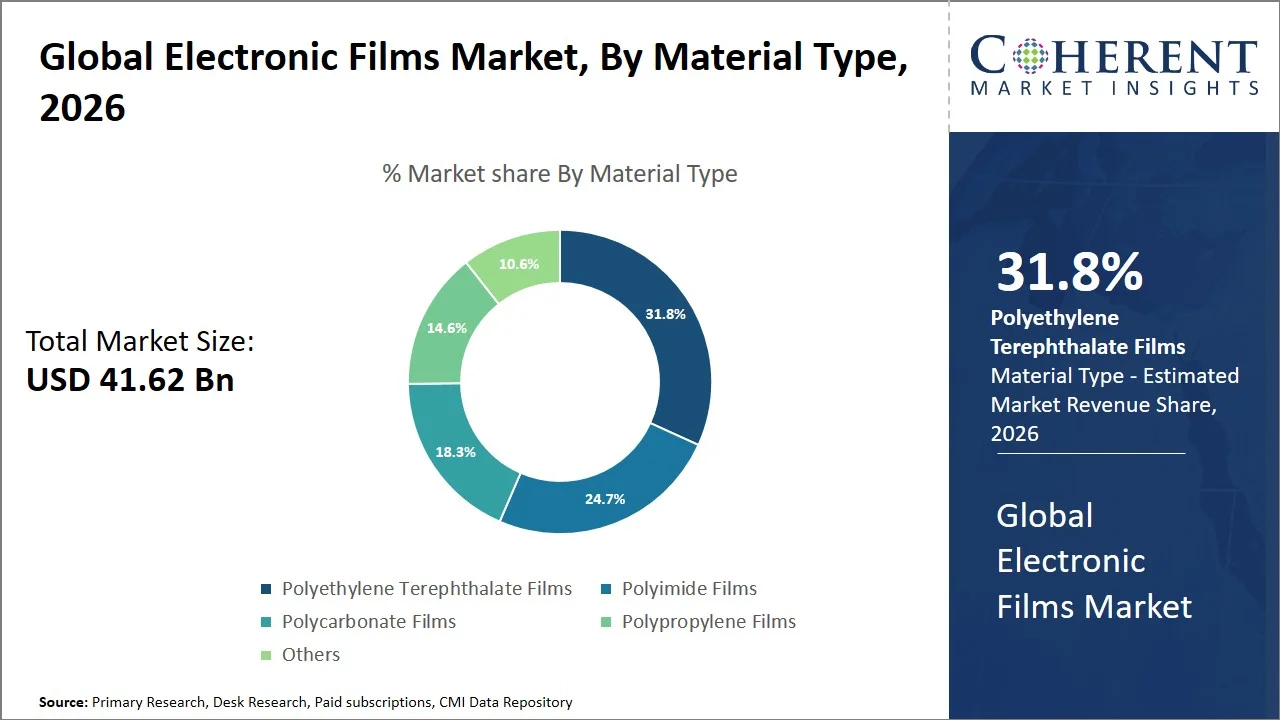
Polyethylene terephthalate films segment is expected to account for 31.8% of the market share in 2026 because PET offers a practical combination of optical clarity, dimensional stability, mechanical strength, surface smoothness, and cost efficiency. In electronic films, PET is widely used as a substrate, carrier, release, and protective film across display components, semiconductor processes, printed circuit boards, and multilayer ceramic capacitor manufacturing. Demand is supported by compact electronics, high-density components, and precision manufacturing where films must remain clean, uniform, and stable during processing. Supply-side maturity also favors PET, as large-scale roll-to-roll production enables consistent quality and broad availability. Toray’s September 2024 digital innovation materials update highlighted polyester Lumirror films for MLCCs and dry film resist, along with release films for semiconductor molding, showing PET’s relevance in miniaturized electronic component production. (Source: Toray Group)
Why Do Display Panels Dominate the Application Segment?
Display panels segment is expected to account for 49.7% of the market share in 2026 because electronic films are essential to the performance and manufacturability of LCD, OLED, mini-LED, and next-generation monitor panels. These films support optical enhancement, conductivity, insulation, adhesion, release, protection, and encapsulation, making them central to brightness, durability, thinness, resolution, and production yield. Demand is strongest from televisions, smartphones, tablets, gaming monitors, automotive displays, and professional screens, where users expect higher refresh rates, better contrast, lower power consumption, and thinner designs. Technology advancement is also increasing the value of specialized films in panel stacks. In June 2025, LG Display began mass production of a 27-inch OLED monitor panel using fourth-generation Primary RGB Tandem OLED technology, achieving peak brightness of 1,500 nits for premium gaming displays. (Source: LG DISPLAY CO., LTD)
Currents Events and their Impact
Current Events | Description and its Impact |
EU Ecodesign for Sustainable Products Regulation Enters Force (July 2024 onward) |
|
U.S. CHIPS Program Expands Advanced Packaging and Substrate Support (November 2024 onward) |
|
U.S. EPA Extends PFAS Reporting Requirements under TSCA (May 2025 onward) |
|
(Source: European Commission/EUR-Lex, U.S. Environmental Protection Agency)
Global Electronic Films Market Dynamics
Key Market Drivers
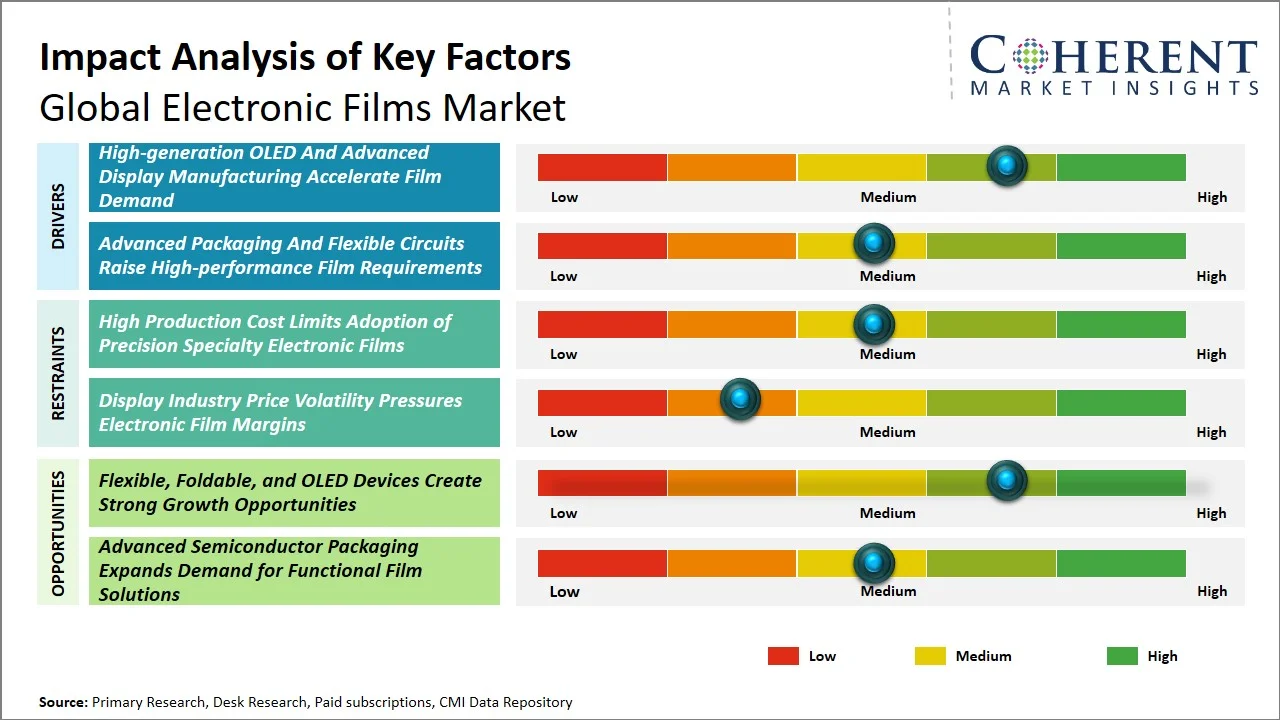
- High-Generation OLED and Advanced Display Manufacturing Accelerate Film Demand: Growing adoption of OLED, flexible AMOLED, automotive displays, smartphones, televisions, and wearable devices is increasing the use of conductive, optical, insulating, adhesive, and protective electronic films. These films are critical for touch response, transparency, brightness control, encapsulation, and thin-panel durability. The demand impact is strongest as display makers move to larger substrates and higher-performance panels for IT devices, vehicles, and premium consumer electronics. In December 2025, BOE powered up China’s first Gen 8.6 AMOLED production line ahead of schedule, targeting high-end mid-size OLED panels and strengthening demand for film materials used in advanced display stacks. (Source: BOE Technology Group Co., Ltd)
- Advanced Packaging and Flexible Circuits Raise High-Performance Film Requirements: Increasing demand for semiconductor packaging, flexible circuits, and miniaturized electronic components is lifting the need for films with strong dielectric performance, heat resistance, adhesion control, and dimensional stability. Polyimide films, insulating films, adhesive films, and release films are becoming more important as chips move toward higher-density RDL structures, fan-out packaging, power semiconductors, AI processors, and compact electronic modules. In May 2026, Fujifilm presented its ZEMATES product lineup for advanced semiconductor packaging, including liquid-type and film-type polyimide materials used for redistribution layers and protective films across power semiconductors and high-performance AI applications. (Source: FUJIFILM Europe GmbH)
Emerging Market Trends
- Shift Toward Ultra-Thin and Flexible Electronic Films: Manufacturers are increasingly developing thinner, lighter, and bendable electronic films to support foldable displays, wearable devices, flexible printed circuits, and compact consumer electronics. This trend is improving design flexibility, reducing device weight, and enabling next-generation electronics with higher durability and better processing efficiency.
- Rising Focus on Sustainable and Traceable Film Materials: Electronic film suppliers are increasingly focusing on recyclable substrates, low-emission production, restricted-substance compliance, and stronger chemical traceability. This trend is becoming important as electronics manufacturers seek cleaner material inputs, improved supply-chain transparency, and compliance-ready films for displays, semiconductor packaging, printed circuit boards, and electronic components.
Regional Insights
Why is North America a Strong Market for Electronic Films?
North America is expected to account for 45.3% of the market share in 2026. The dominance of the region can be attributed to its strong semiconductor, advanced packaging, display technology, automotive electronics, and defense electronics ecosystem. The region benefits from high demand for conductive, insulating, adhesive, and release films used in advanced packaging, printed circuit boards, sensors, and high-performance electronic components. Market leadership is further strengthened by technology localization under semiconductor supply-chain programs, high R&D intensity, and the presence of major chip, materials, and electronics companies. For Instance, U.S. Department of Commerce’s January 2025 finalization of USD 1.4 billion in CHIPS NAPMP awards to support next-generation advanced packaging and scale domestic manufacturing validation.
Why Does the Europe Electronic Films Market Exhibit High Growth?
Europe is expected to account for 24.6% of the market share in 2026 as the region is supported by semiconductor sovereignty programs, power electronics manufacturing, electromobility, industrial automation, and demand from automotive electronics. The region is strengthening its local semiconductor and advanced electronics ecosystem through the EU Chips Act, which has helped mobilize more than EUR 52 billion in public and private semiconductor investment and created an estimated 46,000 direct and indirect jobs.
Electronic films are increasingly used across semiconductor packaging, power devices, flexible circuits, sensors, printed circuit boards, and automotive electronics. Growth is also supported by large-scale fab investments. For instance, in May 2025, Infineon received final funding approval for its Dresden Smart Power Fab, where the company is projected to create up to 1,000 jobs, strengthening Europe’s power semiconductor and industrial electronics base.
Global Electronic Films Market Outlook for Key Countries
Why is China a Major Demand Hub for Electronic Films?
China is important in the global electronic films market due to its large-scale electronic information manufacturing industry, strong display panel ecosystem, semiconductor capacity expansion, and massive end-use demand from smartphones, computers, consumer electronics, and industrial electronics. The country’s demand for PET films, conductive films, optical films, adhesive films, and insulating films is supported by high-volume manufacturing of displays, integrated circuits, printed circuit boards, and electronic components. China also remains a key production and procurement hub for films used in OLED, LCD, semiconductor packaging, and flexible electronics. In 2025, China produced 1.27 billion smartphones, 332 million microcomputer units, and 484.3 billion integrated circuits, while electronic information manufacturing revenues reached 17.4 trillion yuan, highlighting the scale of downstream consumption for electronic film materials. (Source: The State Council, China)
Why are the U.S. Leading Innovation and Adoption in the Electronic Films Market?
The U.S. is a strategic country in the global electronic films market because of its leadership in advanced semiconductor design, packaging innovation, AI infrastructure, defense electronics, and high-value electronic component manufacturing. Demand for insulating films, adhesive films, release films, and high-performance polymer films is rising as chip packaging shifts toward heterogeneous integration, advanced substrates, and domestic manufacturing resilience. The country also supports electronic film demand through strong automotive electronics, data centers, aerospace, and industrial automation applications. In March 2025, TSMC announced plans to expand its U.S. investment to USD 165 billion, including three new fabrication plants, two advanced packaging facilities, and an R&D center. This directly strengthens demand for packaging films, dielectric layers, and precision electronic materials. (Source: Taiwan Semiconductor Manufacturing Company Limited TSMC)
Is Japan a Favorable Market for High-Performance Electronic Films?
Japan is a key country in the Electronic Films Market because of its strong position in specialty polymers, semiconductor materials, precision film coating, display components, MLCC-related films, and high-performance electronics supply chains. Japanese suppliers are important in PET films, polyimide films, release films, optical films, and process films used in semiconductor packaging, flexible circuits, and electronic components. Demand is supported by the country’s focus on next-generation semiconductors, advanced packaging, automotive electronics, and high-reliability industrial devices. In February 2026, Rapidus announced US$ 1.67 billion in funding from the Japanese government and private companies to progress toward mass production of 2nm logic semiconductors by 2027. This reinforces Japan’s long-term demand for advanced electronic materials and precision film technologies. (Source: Rapidus Corporation)
Why is South Korea Important for Display and Semiconductor Electronic Films?
South Korea is highly important in the global electronic films market due to its leadership in OLED displays, memory semiconductors, advanced materials, and high-volume electronics exports. The country creates strong demand for optical films, conductive films, adhesive films, insulating films, and polyimide-based films used in display panels, semiconductor packaging, and flexible electronics. Its ecosystem is supported by Samsung, LG, SK Hynix, and a deep base of equipment and materials suppliers. Invest KOREA notes that South Korea accounts for around 20% of global semiconductor production capacity and held a 16.6% share of the semiconductor materials market in 2024. The same source highlights strong expansion by materials and equipment firms, reinforcing South Korea’s relevance for electronic film suppliers. (Source: Invest KOREA)
Why is Germany a Strategic Market for Electronic Films in Europe?
Germany is a key country in the global electronic films market because of its strong automotive electronics, industrial automation, power semiconductor, sensor, and microelectronics base. Demand is supported by electric vehicles, renewable energy systems, industrial power electronics, and advanced manufacturing, where insulating films, adhesive films, release films, and high-temperature polymer films are used in semiconductor devices, printed circuit boards, and electronic modules. Germany also benefits from Europe’s policy push to localize semiconductor production and reduce dependency on external supply chains. In December 2025, the European Commission approved US$ 721.09 million in German state aid to support two new semiconductor manufacturing facilities, strengthening Europe’s microelectronics ecosystem and creating additional demand for advanced electronic materials and films. (Source: European Commission)
Technology Adoption Landscape for Global Electronic Films Market
Technology Area | Adoption Level | Market Relevance and Business Impact |
Advanced Display Films | High Adoption | Display-related films are the most commercially adopted technology area, supported by OLED, LCD, mini-LED, automotive cockpit displays, gaming monitors, smartphones, televisions, and wearables. Optical films, conductive films, adhesive films, and protective films are increasingly used to improve brightness, touch performance, durability, thinness, and viewing quality. LG Display’s 2025 mass production of ultra-large automotive display solutions highlights the increasing use of advanced film stacks in vehicle interiors. |
PET-Based Optical and Protective Films | Mature and expanding | PET films remain widely adopted due to their cost efficiency, optical clarity, water resistance, durability, and process stability. Their use is strong in LCD polarizer protection, display films, release films, and electronic component manufacturing. Toyobo’s 2025 decision to boost COSMOSHINE SRF PET film capacity by 30% for LCD screens shows continued technology adoption in larger display formats and high-quality polarizer protection films. |
Polyimide Films for Flexible Electronics | Fast Scaling | Polyimide films are gaining adoption in flexible printed circuit boards, foldable displays, wearable electronics, battery systems, thermal management, and compact smart devices. Their value comes from high heat resistance, mechanical strength, flexibility, and insulation performance. PI Advanced Materials’ production of a 4 μm ultra-thin non-stretched polyimide film shows how suppliers are moving toward thinner, lighter, and flexible film formats for miniaturized electronics. |
Semiconductor Packaging Films | Rapidly Advancing | Films used in semiconductor packaging are shifting from supporting materials to performance-critical layers. Polyimide films, PBO films, dielectric insulating films, adhesive films, and release films are increasingly used in redistribution layers, protective films, power semiconductors, AI chips, and high-density packaging. Fujifilm’s 2026 ZEMATES lineup includes liquid-type and film-type polyimide materials used as insulating layers in semiconductor packaging, covering power semiconductors to high-performance AI applications. |
PFAS-Free and Sustainable Film Materials | Emerging but Strategic | Sustainability is becoming a technology adoption driver as electronics manufacturers evaluate materials based on chemical safety, traceability, recyclability, and regulatory readiness. Film producers are developing PFAS-free coatings, cleaner release materials, and more transparent documentation systems. The EU Digital Product Passport framework is expected to improve product-level visibility around materials, environmental impact, substances of concern, and disposal information, which will influence electronic film supplier qualification. |
How are technological advancements in high-performance electronic films creating new growth opportunities in the global electronic films market ?
Technological advancements in electronic films are creating strong growth opportunities by enabling thinner, lighter, more flexible, and higher-performance electronic devices. Advanced conductive films, optical films, polyimide films, insulating films, adhesive films, and release films are becoming essential in OLED displays, foldable devices, semiconductor packaging, flexible circuits, and compact electronic components. Manufacturers are focusing on films with improved thermal stability, dielectric strength, optical clarity, bending durability, and clean processing performance to support next-generation consumer electronics, automotive displays, AI chips, and high-density packaging. For instance, in December 2024, PI Advanced Materials, an Arkema affiliate, launched the world’s first 4 μm non-stretched ultra-thin polyimide film, designed for lightweight smartphones, high-performance displays, wearable technology, and flexible display panels. This highlights how advanced film innovation can expand adoption across premium electronics and create higher-value opportunities for film suppliers. Source: Arkema
Market Players, Key Development, and Competitive Intelligence
Key Developments
- In January 2026, Toray Industries Inc unveiled a 160°C resistant polypropylene release film intended to reduce fluorinated film use in IC substrate and advanced processing applications.
- In December 2025, Nitto Denko Corporation announced construction of a new factory at its Toyohashi Plant with an investment of approximately US$ 0.24 billion to expand capacity for next generation high end devices including optical films circuit materials optical transparent adhesive sheets and component fixing tapes.
- In November 2025, Mitsui Kinzoku and GEOMATEC announced enhanced collaboration and the start of a second dedicated HRDP line for specialty carriers used in next generation semiconductor packaging increasing capacity from 110,000 m² to 160,000 m².
Competitive Landscape
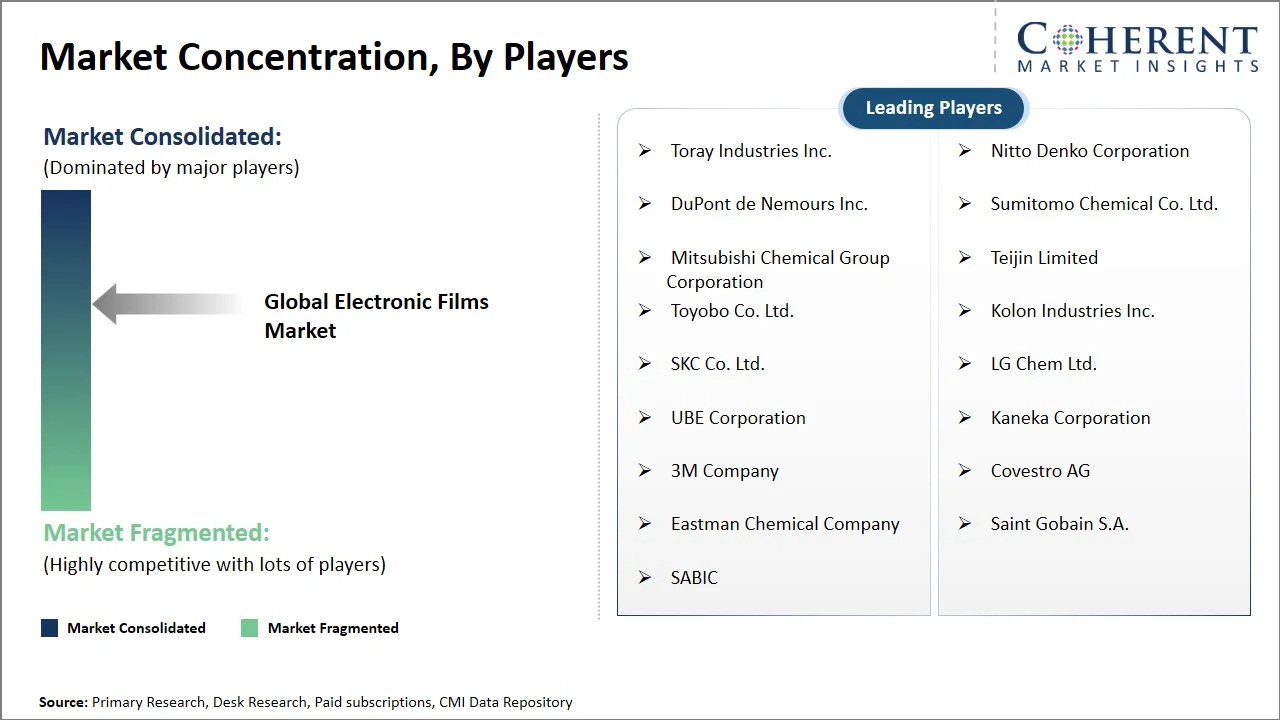
The global electronic films market is moderately fragmented, with global specialty material companies and regional film manufacturers competing on product performance, coating precision, customization, cost efficiency, and supply reliability. Competition is shaped by demand from display panels, semiconductor packaging, printed circuit boards, flexible circuits, electronic components, and automotive electronics. Leading companies are focusing on ultra-thin films, polyimide materials, high-performance PET films, optical films, conductive films, adhesive films, and release films to support next-generation electronics. Strategic focus is also shifting toward sustainability, chemical compliance, advanced packaging compatibility, and local supply-chain security.
Key focus areas include
- Development of ultra-thin and flexible electronic films for foldable displays, flexible printed circuits, wearable devices, and compact consumer electronics.
- Innovation in high-performance polyimide and PET films to improve heat resistance, dimensional stability, dielectric strength, optical clarity, and clean processing performance.
- Expansion of semiconductor packaging film solutions for redistribution layers, advanced substrates, chiplet integration, AI chips, power semiconductors, and high-density electronic modules.
- Strengthening of optical and conductive film portfolios to support OLED displays, automotive cockpit displays, touch sensors, transparent antennas, and EMI shielding applications.
- Focus on sustainable and compliant film materials through recyclable substrates, restricted-substance control, PFAS traceability, lower-emission production, and stronger customer documentation.
- Capacity expansion and regional supply-chain localization to serve electronics manufacturing hubs in North America, Asia Pacific, and Europe with faster qualification and reliable material availability.
Market Report Scope
Electronic Films Market Report Coverage
| Report Coverage | Details | ||
|---|---|---|---|
| Base Year: | 2025 | Market Size in 2026: | USD 41.62 Bn |
| Historical Data for: | 2020 To 2024 | Forecast Period: | 2026 To 2033 |
| Forecast Period 2026 to 2033 CAGR: | 8.8% | 2033 Value Projection: | USD 75.11 Bn |
| Geographies covered: |
| ||
| Segments covered: |
| ||
| Companies covered: | Toray Industries Inc., Nitto Denko Corporation, DuPont de Nemours Inc., Sumitomo Chemical Co. Ltd., Mitsubishi Chemical Group Corporation, Teijin Limited, Toyobo Co. Ltd., Kolon Industries Inc., SKC Co. Ltd., LG Chem Ltd., UBE Corporation, Kaneka Corporation, 3M Company, Covestro AG, Eastman Chemical Company, Saint Gobain S.A., and SABIC | ||
| Growth Drivers: |
| ||
| Restraints & Challenges: |
| ||
Analyst Opinion (Expert Opinion)
- The global electronic films market is expected to witness steady long-term growth due to rising adoption of advanced display technologies, semiconductor packaging, flexible circuits, and miniaturized electronic components. Demand for conductive films, PET films, optical films, polyimide films, adhesive films, and insulating films is likely to remain strong as consumer electronics, automotive displays, telecom devices, and industrial electronics continue to require thinner, lighter, and higher-performance material solutions.
- The maximum opportunities are expected to emerge in display panels and semiconductor packaging applications, where electronic films directly support brightness, durability, insulation, conductivity, thermal stability, and device miniaturization. North America is expected to remain a strong market due to its advanced semiconductor and electronics ecosystem, while Asia Pacific is likely to record faster growth owing to large-scale electronics manufacturing, display production, and expanding semiconductor investments in China, Japan, and South Korea.
- To gain a competitive advantage, market participants should focus on developing ultra-thin, flexible, heat-resistant, and sustainability-compliant electronic films for OLED displays, flexible printed circuits, advanced packaging, and high-density electronic components. Companies with strong coating technologies, cleanroom-grade film production, regulatory traceability, and close relationships with display manufacturers, semiconductor packaging companies, and electronics OEMs are expected to strengthen their market position.
Speak to the analyst
Want personalized insights?
Take the findings above to one of our principal consultants, or have the report rebuilt around the segments, geographies and competitors you actually track.
Market Segmentation
- Film Type Insights (Revenue, USD Bn, 2021 - 2033)
- Conductive Films
- Insulating Films
- Optical Films
- Adhesive Films
- Release Films
- Others
- Material Type Insights (Revenue, USD Bn, 2021 - 2033)
- Polyethylene Terephthalate Films
- Polyimide Films
- Polycarbonate Films
- Polypropylene Films
- Others
- Application Insights (Revenue, USD Bn, 2021 - 2033)
- Display Panels
- Semiconductor Packaging
- Printed Circuit Boards
- Electronic Components
- Others
- End-use Industry Insights (Revenue, USD Bn, 2021 - 2033)
- Consumer Electronics
- Automotive Electronics
- Industrial Electronics
- Telecommunication Devices
- Others
- Regional Insights (Revenue, USD Bn, 2021 - 2033)
- North America
- U.S.
- Canada
- Latin America
- Brazil
- Argentina
- Mexico
- Rest of Latin America
- Europe
- Germany
- U.K.
- Spain
- France
- Italy
- Russia
- Rest of Europe
- Asia Pacific
- China
- India
- Japan
- Australia
- South Korea
- ASEAN
- Rest of Asia Pacific
- Middle East
- GCC Countries
- Israel
- Rest of Middle East
- Africa
- South Africa
- North Africa
- Central Africa
- North America
- Key Players Insights
- Toray Industries Inc.
- Nitto Denko Corporation
- DuPont de Nemours Inc.
- Sumitomo Chemical Co. Ltd.
- Mitsubishi Chemical Group Corporation
- Teijin Limited
- Toyobo Co. Ltd.
- Kolon Industries Inc.
- SKC Co. Ltd.
- LG Chem Ltd.
- UBE Corporation
- Kaneka Corporation
- 3M Company
- Covestro AG
- Eastman Chemical Company
- Saint Gobain S.A.
- SABIC
Sources
Primary Research Interviews
- Materials engineers, R&D heads, and product managers from electronic film manufacturers
- Display panel and semiconductor packaging specialists
- Electronics OEMs and consumer electronics manufacturers
- Industrial electronics and automotive electronics design teams
- Regulatory affairs and quality assurance professionals within material companies
Stakeholders
- Electronic film manufacturers and component suppliers
- Contract manufacturers serving semiconductor and display industries
- End-use sectors
- Consumer electronics OEMs
- Automotive electronics manufacturers
- Industrial electronics companies
- Semiconductor foundries and OSATs
- Display panel fabrication centers
- Regulatory and standards bodies
- U.S. FDA (for electronics-related chemical compliance and materials safety)
- European Chemicals Agency (ECHA) and EU REACH regulations
- China National Center for Standardization of Electronics Materials
- Japanese Ministry of Economy, Trade, and Industry (METI)
Databases
- OECD Manufacturing and Trade Statistics
- World Bank Industrial and Manufacturing Data
- United Nations COMTRADE (for trade flows of electronic films and polymers)
- National statistics on electronics, displays, and semiconductor production
Magazines and Journals
- Electronic Design
- Display Daily
- Semiconductor Digest
- Journal of Electronic Materials
- IEEE Transactions on Components, Packaging, and Manufacturing Technology
Associations
- SEMI (Semiconductor Equipment and Materials International)
- International Electrotechnical Commission (IEC)
- Society for Information Display (SID)
- Electronics Industries Association (EIA)
Public Domain Sources
- OECD Industrial Reports
- World Bank industrial and electronics production data
- Government export-import statistics
- National semiconductor and display production reports
Proprietary Elements
- CMI Data Analytics Tool, Proprietary CMI Existing Repository of information for last 10 years.
Get access to 250+ pages report
Every segment, forecast, competitor profile and data table behind the analysis above — available for instant download.
- ESOMAR Member
- ISO 9001:2015 Certified
- D-U-N-S Registered
- GDPR & CCPA Compliant
Missing comfort of reading report in your local language? Find your preferred language:
Transform your Strategy with Exclusive Trending Reports
Frequently Asked Questions
The CAGR of global electronic films market is projected to be 8.8% from 2026 to 2033.
The global electronic films market is expected to be valued at USD 41.62 billion in 2026 and is projected to reach USD 75.11 billion by 2033.
China is the largest production hub for the electronic films industry.
Yes, the global electronic films market is profitable, especially in specialty films for OLED displays, semiconductor packaging, flexible circuits, and automotive electronics where performance-based margins are higher.
Growing adoption of advanced display technologies in smartphones televisions automotive displays and wearable devices and increasing demand for high performance films in semiconductor packaging flexible circuits and electronic component manufacturing are the major factors driving the growth of the global electronic films market.
High production cost of specialty electronic films with strict optical thermal and dielectric performance requirements and price pressure in display related films due to panel industry cyclicality and intense supplier competition are the major factors hampering the growth of the global electronic films market.
In terms of film type, conductive films are estimated to dominate the market revenue share in 2026.