

Global Electrostatic Precipitator Market Size and Forecast – 2026 To 2033
The global electrostatic precipitator market is expected to grow from USD 9.75 Bn in 2026 to USD 14.90 Bn by 2033, registering a compound annual growth rate (CAGR) of 6% from 2026 to 2033. The global electrostatic precipitator market is driven by increasing investments in cement steel and mining industries. On March 20, 2025, JSW Group announced plans to set up a 500,000 metric ton capacity copper smelter in the eastern state of Odisha, India by 2028-2029 with feedstock of copper concentrate from Peru and Chile.
Key Takeaways of the Global Electrostatic Precipitator Market
- The dry electrostatic precipitators segment is expected to account for 57.0 % of the global electrostatic precipitator market share in 2026. Expansion of industrial pollution control infrastructure is driving the growth of the segment. On February 4, 2025, ANDRITZ announced it has acquired LDX Solutions, a leading provider of emission reduction technologies and related services in the North American industrial market, with annual revenues of about USD 100 million.
- The power generation segment is estimated to capture 36.0 % of the market share in 2026. Higher demand for high efficiency particulate removal systems is majorly driving the growth of the segment. On June 11, 2025, Valmet is introduced its new carbon capture (CC) pre-treatment solution, designed to significantly reduce emissions and enhance the carbon capture process efficiency for power plants and various industrial facilities.
- Asia Pacific is expected to dominate the electrostatic precipitator market in 2026 with a market share of 42.0 %. Adoption of smart monitoring and predictive maintenance technologies in Asia Pacific is driving the growth of the regional market. On September 29, 2025, ANDRITZ received an order from Century Pulp and Paper in India to supply a recovery boiler equipped with the ANDRITZ Metris digital automation platform.
- North America is expected to account for 24.0% of the market share in 2026 and is projected to record the fastest growth over the forecast period. Expansion of waste incineration and biomass power projects in North America is driving the growth of the regional market. On March 11, 2026, Clean Energy Technologies (CETY) and METIS Power signed a commercialization agreement to develop modular waste-to-energy power systems for North America.
Segmental Insights
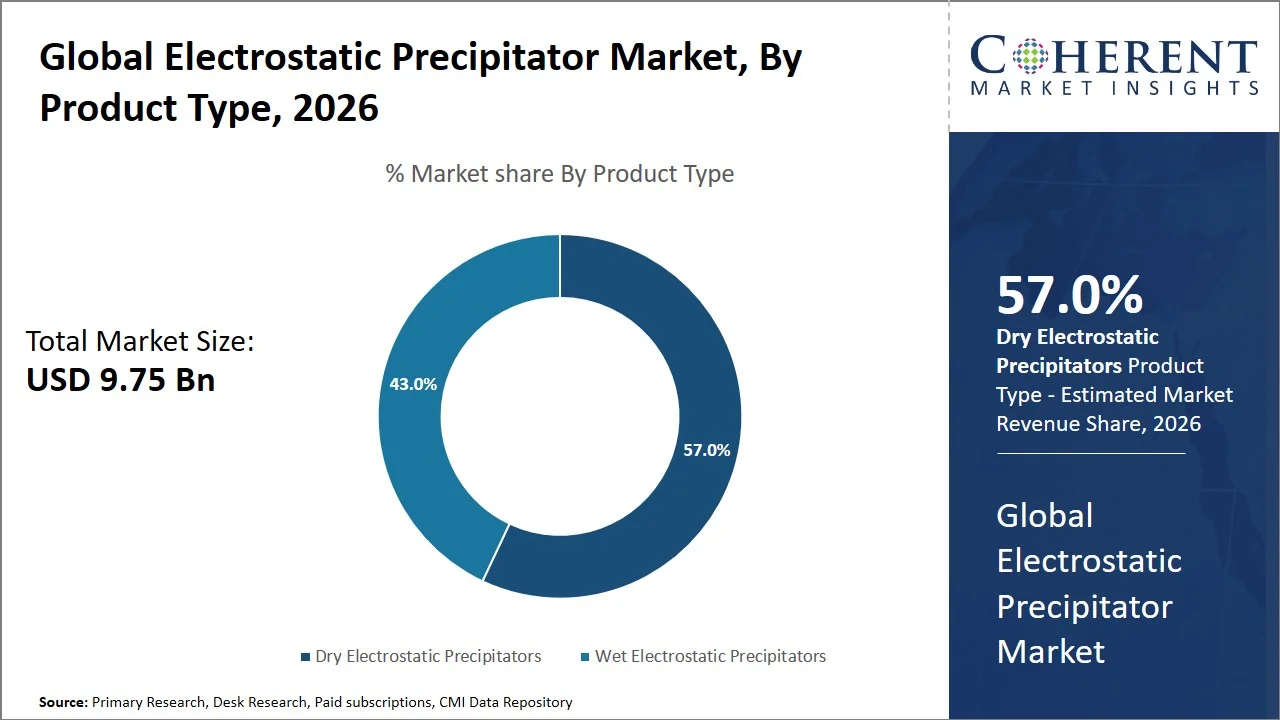
Why Do Dry Electrostatic Precipitators Dominate the Global Electrostatic Precipitator Market?
The dry electrostatic precipitators segment is expected to account for 57.0% of the global electrostatic precipitator market share in 2026. The dry electrostatic precipitators segment is expected to continue to dominate the worldwide electrostatic precipitator market on account of the extremely efficient particle matter removal as well as cheap operating costs for large scale industrial applications. Because they can continually capture fine ash, dust and industrial emissions without the need for water, they are particularly ideal for use in coal fueled power plants, cement manufacture, steel production and mining facilities where large gas volumes and elevated temperatures are the norm. Their demonstrated long service life and reliable performance under hard operating circumstances, as well as their compatibility with ever tightening emission laws have led to their wide use across both developed and rising industrial economies. On May 28, 2026, ANDRITZ was awarded by Double A Group’s National Power deliver Public Company Limited (NPS) to deliver a recovery boiler and evaporation plant for a new bioenergy power plant in Tha-Toom, Thailand. The technologies are being implemented at Double A Group’s pulp and paper mill to recover chemicals and provide renewable energy.
- Current Industry Events of 2026
- Market Size Estimation
- Regional Breakdown
- Competitive Landscape
- Customer Intelligence
- Segmental Analysis
- Pricing Analysis
- Key Market Drivers, Challenges & Future Trends
- Customized Insights Section
Why is Power Generation the Most Crucial End User?
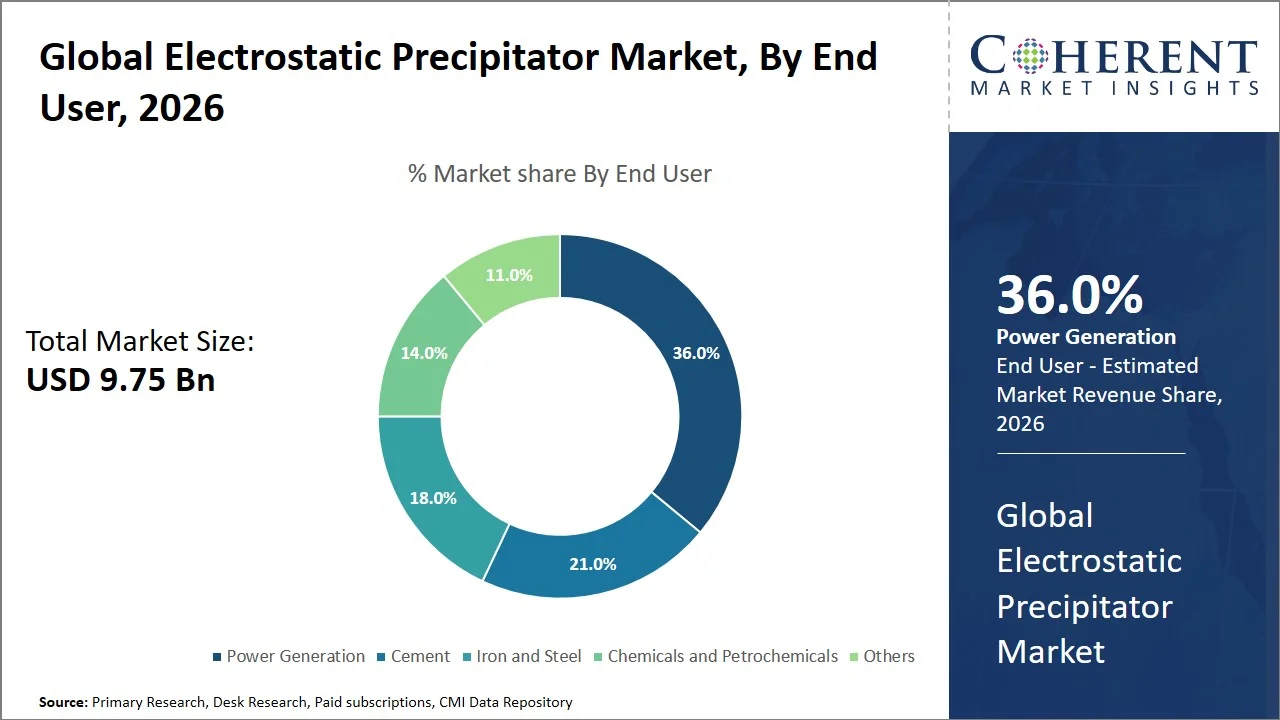
The power generation segment is expected to account for 36.0% of the global electrostatic precipitator market share in 2026. Power generation represents the most crucial end user because thermal power plants generate extremely large volumes of flue gas containing fly ash and fine particulate matter that must be removed before atmospheric release. Electrostatic precipitators are a crucial part of the emission control systems of coal fueled, biomass and waste to energy facilities. They offer excellent collection efficiency and can cope with continuous high temperature and high flow rate exhaust streams. The increasing compliance with strict environmental laws and the continuing upgrading of existing power production equipment further bolsters the sector’s need for improved electrostatic precipitation technology. On June 8, 2026, Babcock & Wilcox resumed its work on modernization efforts at coal-fired utility power plants, with upgrades to dry electrostatic precipitators using advanced controls and high-frequency power supply technologies.
Current Events and their Impact
Current Events | Description and its Impact |
European Union - Industrial Emissions Directive (IED) Recast (Directive (EU) 2024/1785) |
|
United States - EPA National Emission Standards for Hazardous Air Pollutants (NESHAP) Amendments for Coal and Oil Fired Power Plants |
|
Global Electrostatic Precipitator Market Dynamics
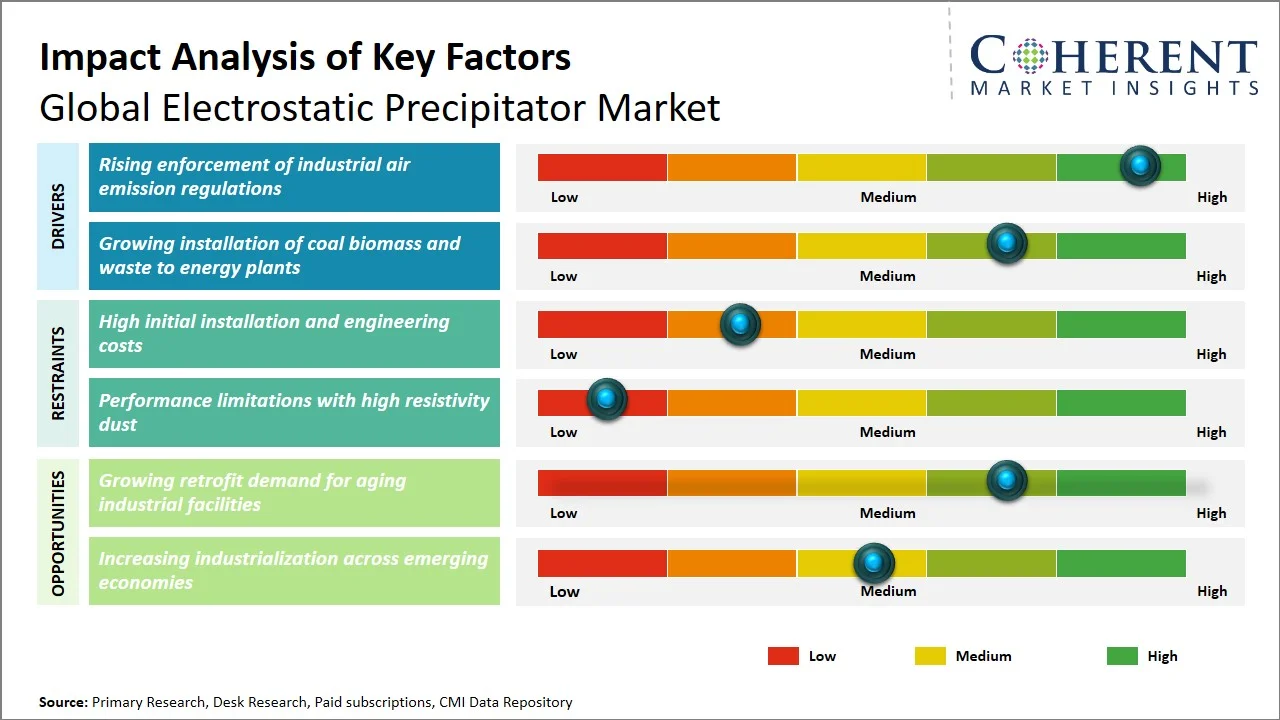
Market Drivers
- Rising enforcement of industrial air emission regulations
Increasing enforcement of industrial air emission regulations is a major driver for the growth of the global electrostatic precipitator market. Governments are increasingly imposing stricter limits on particulate matter emissions from power plants and heavy industries. Regulations in Europe, North America, China and India now require industrial facilities to use high efficiency dust collection technologies to meet environmental standards. This is creating new installations and retrofitting of existing electrostatic precipitator systems across many sectors including power generation, cement, steel, chemicals and waste incineration.
On April 28, 2025, Valmet announced that it has installed an electrostatic precipitator at Olvi Group's brewery in Finland to comply with tougher industrial pollution rules. The new ESP system will allow the facility to meet more stringent environmental compliance requirements and improve flue gas particulate removal efficiency.
- Growing installation of coal biomass and waste to energy plants
The increased installation of coal, biomass and waste to energy plants is significantly increasing demand for electrostatic precipitators as these facilities produce large volumes of fly ash and particulate emissions that need to be effectively controlled before releasing flue gases into the atmosphere. Electrostatic precipitators are reliable in high temperature and high gas flow conditions and are the preferred emission control technology for utility scale boilers and modern waste to energy facilities that want to meet environmental compliance while maintaining operational efficiency.
On March 30, 2026, Clean Energy Technologies, Inc. announced that it has entered into a non-binding Letter of Intent with Hoppy Power Ltd., to investigate and potentially deploy CETY’s unique High Temperature Ablative Pyrolysis technology for waste-to-energy applications. This effort is a critical stage in the near-term deployment and early commercialization, with milestones in 2026 including engineering validation, permitting and movement toward formal agreements.
Emerging Trends
- Integration of intelligent monitoring and predictive maintenance technologies: Industrial internet of things sensors, artificial intelligence based diagnostics and cloud connected monitoring platforms are being added to electrostatic precipitators by manufacturers. These systems offer real-time performance tracking, predictive maintenance, reduced unexpected downtime and enhanced particle collection efficiency while reducing operational expenses.
- Growing adoption of hybrid and high efficiency electrostatic precipitation systems: Industrial facilities are investing in hybrid electrostatic precipitator technologies that combine electrostatic collection with modern filtration systems to achieve extremely low particulate emissions. These systems are gaining popularity in cement, steel and waste to energy industries where tighter environmental requirements demand increased dust removal efficiency.
- Expansion of retrofit projects for aging industrial facilities: One of the biggest trends in the industry is the retrofitting of existing electrostatic precipitator installations rather than a total equipment replacement. Industry is replacing transformer rectifier units, discharge electrodes, digital control systems and collecting plates to increase efficiency, extend equipment life and meet changing emission requirements.
- Increasing deployment across biomass and waste to energy power generation: The growing number of biomass fueled power plants and municipal waste to energy facilities are offering new growth prospects for electrostatic precipitator manufacturers. The need for consistent particle control under varied fuel characteristics in these applications is driving the development of improved electrostatic precipitators that can handle diverse combustion conditions and provide greater operating flexibility.
Regional Insights
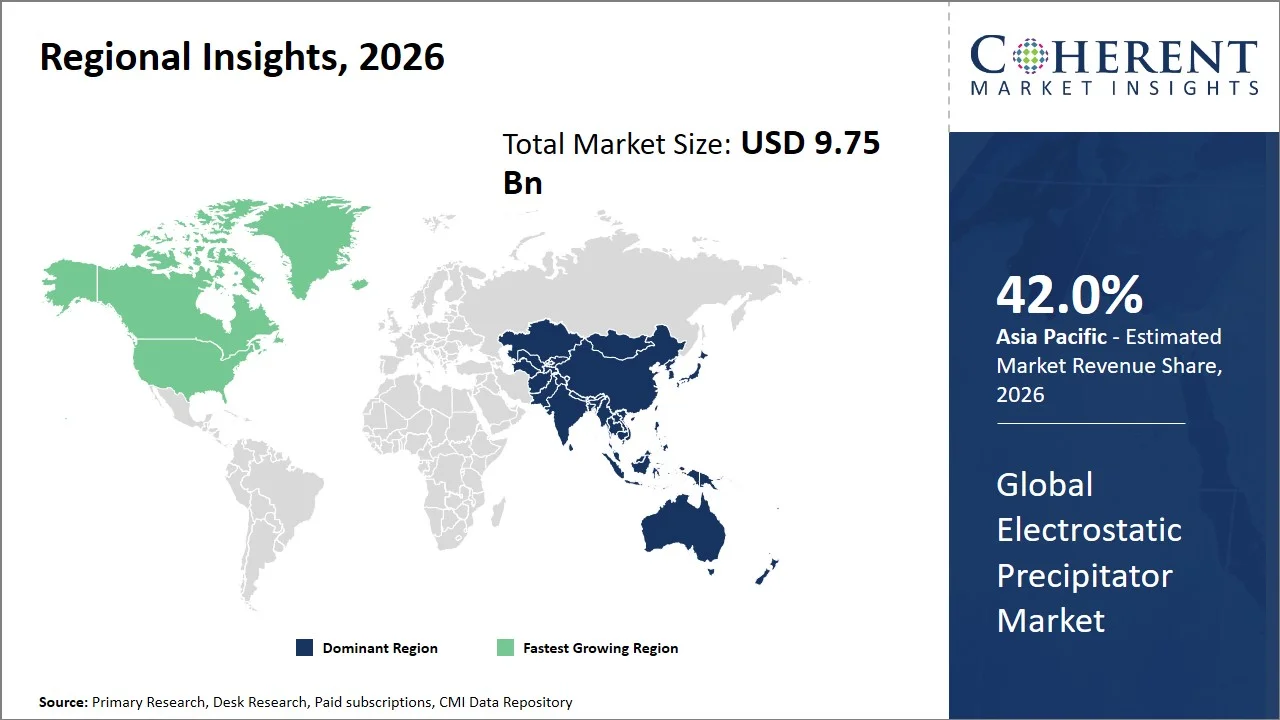
Why is Asia Pacific a Strong Market for Electrostatic Precipitators?
Asia Pacific is expected to account for a market share of 42.0% in 2026. Asia Pacific is the leading regional market due to the concentration of coal fired power stations, cement production, steel manufacturing, waste incineration, and heavy industrial activities. China continues to upgrade its thermal power plants with ultra-low emission retrofits, while India is upgrading its electrostatic precipitators in state owned and commercial coal based generating stations to meet tougher particulate pollution regulations. Japan and South Korea are upgrading ageing systems with digitally-monitored electrostatic precipitators at municipal waste incineration plants, while Southeast Asian countries such as Indonesia and Vietnam are adding new emissions control systems at major cement and power projects. Regional manufacturers such as Fujian Longking, KC Cottrell, and Thermax are actively supplying advanced dry electrostatic precipitator solutions for utility and industrial applications.
Why Does the North America Electrostatic Precipitator Market Exhibit High Growth?
North America is projected to account for 24.0% of the global electrostatic precipitator market in 2026 and is expected to register the fastest growth. North America remains a significant market because of continuous retrofitting of existing emission control infrastructure in fossil fuel power plants, pulp and paper mills, mining operations, and cement facilities. In the U.S., utilities are upgrading transformer rectifier units, discharge electrodes, and digital controllers to comply with strengthened environmental standards issued by the environmental protection agency. Canada continues to invest in particulate emission control systems for mining, metallurgical processing and biomass power production. Waste to energy plants are increasingly integrating high efficiency electrostatic precipitators with continuous emissions monitoring systems. Retrofit activity is particularly strong because many industrial facilities continue operating legacy equipment that requires modernization rather than complete replacement.
Global Electrostatic Precipitator Market Outlook for Key Countries
Why is China Emerging as a Major Hub in the Electrostatic Precipitator Market?
China represents the largest market owing to its extensive thermal power generation capacity and the world's largest steel and cement manufacturing industries. The country is still pursuing ultra-low emission initiatives for coal powered power stations which require modern electrostatic precipitators to achieve very low particulate emissions. Major domestic manufacturers such as Fujian Longking and Zhejiang Feida have increased production capacity to meet the requirements of power utilities, cement makers and metallurgical industries. Electrostatic precipitators are also widely deployed in municipal waste incineration projects and large petrochemical complexes as part of national air quality improvement initiatives.
Is the U.S. the Next Growth Engine for the Electrostatic Precipitator Market?
The U.S. electrostatic precipitator market is driven primarily by modernization of existing industrial facilities rather than large scale greenfield construction. Investment in electrostatic precipitator modifications to improve particulate collection efficiency and minimize maintenance costs continues at coal fueled generating stations, biomass facilities, cement plants and industrial boilers. Companies such as Babcock and Wilcox and Ducon Technologies are actively involved in supplying retrofit solutions, digital control systems, and performance optimization services. Waste to energy plants across several states are also upgrading emission control equipment to comply with increasingly stringent environmental requirements for particulate and hazardous pollutant emissions.
Germany Electrostatic Precipitator Market Analysis and Trends
Germany remains a major European market because of its highly developed industrial manufacturing base and stringent environmental compliance requirements. Electrostatic precipitators are extensively used in cement production, steel manufacturing, waste incineration, chemical processing, and biomass energy facilities. Industry operators are progressively replacing conventional control units with sophisticated monitoring platforms that enable predictive maintenance and ongoing optimisation of collection efficiency. Companies are also coupling electrostatic precipitators with larger flue gas treatment systems to aid in industrial decarbonization and make operations more reliable.
Japan Electrostatic Precipitator Market Analysis and Trends
Japan maintains sustained demand through the ongoing development of industrial pollution control systems in the power generation, waste incineration, chemicals and steel manufacturing sectors. Municipal waste incineration facilities widely utilize advanced electrostatic precipitators because of strict particulate emission standards and limited landfill availability. Japanese engineering companies continue developing compact, energy efficient, and digitally controlled electrostatic precipitators designed for high reliability and reduced maintenance. The market also benefits from increasing replacement of aging installations with high voltage power supply systems and automated process monitoring technologies.
India Electrostatic Precipitator Market Analysis and Trends
India is one of the fastest growing electrostatic precipitator markets due to the large scale modernization of coal fired thermal power plants and expanding industrial manufacturing capacity. State owned utilities including NTPC and several state electricity generation companies are upgrading electrostatic precipitators to meet revised particulate emission standards under the environment protection framework. Domestic manufacturers such as Thermax are executing retrofit projects involving high efficiency electrodes, advanced transformer rectifier systems, and intelligent controllers for power stations, cement plants, and steel facilities. Increasing investments in waste to energy projects, biomass power generation and integrated steel manufacturing are fueling demand for sophisticated electrostatic precipitation technology.
Global Electrostatic Precipitator Market - Retrofit Demand By Industry and Country (2025)
Industry | Leading Country | Estimated Retrofit Demand |
Coal-fired Power Generation | China | 24% |
Coal-fired Power Generation | India | 20% |
Cement Manufacturing | China | 16% |
Steel Manufacturing | Japan | 13% |
Cement Manufacturing | India | 12% |
Mining & Mineral Processing | Australia | 7% |
Pulp & Paper | U.S. | 4% |
Waste-to-Energy | Germany | 4% |
How is the Growing Retrofit Demand for Aging Industrial Facilities Creating New Growth Opportunities in the Global Electrostatic Precipitator Market?
Thousands of power plants, cement kilns, steel mills, pulp and paper mills and waste incineration plants built in the 1980s and 1990s still operate with outdated electrostatic precipitator systems that do not meet modern emission standards and the growing demand to retrofit aging industrial facilities provides significant growth opportunities in the electrostatic precipitator market. Plant operators are upgrading transformer rectifier units with high frequency power supplies, installing intelligent rapper control systems, replacing discharge electrodes and collecting plates and integrating continuous emissions monitoring and predictive maintenance software to improve particulate collection efficiency while minimizing capital expenditure and production downtime, instead of replacing entire installations. To meet this demand, utilities in India are undertaking major retrofit projects, coal fired power stations in China are being upgraded and industrial facilities across the United States and Europe are being retrofitted, all of which are creating recurring revenue opportunities for equipment manufacturers and aftermarket service providers.
On November 13, 2024, Valmet announced it will deliver a Valmet Exergy Pre-evaporator for the Mercer Rosenthal mill in Germany. The solution increases the mill’s energy efficiency and brings savings in the feedwater treatment. The new system is planned to be taken into operation during the fourth quarter of 2025.
Market Players, Key Development, and Competitive Landscape
Key Developments
- On July 3, 2026, Suzano, a leading global pulp producer, awarded international technology group ANDRITZ a contract to modernize electrostatic precipitators (ESPs) of recovery boilers at its Aracruz plant in Espírito Santo, Brazil.
- On September 14, 2024, Thermax Babcock & Wilcox Energy Solutions Limited, a wholly owned subsidiary of Thermax, received a repeat order worth USD 54.1 million for setting up another 300 MW energy project from an industrial conglomerate in Botswana.
Competitive Landscape
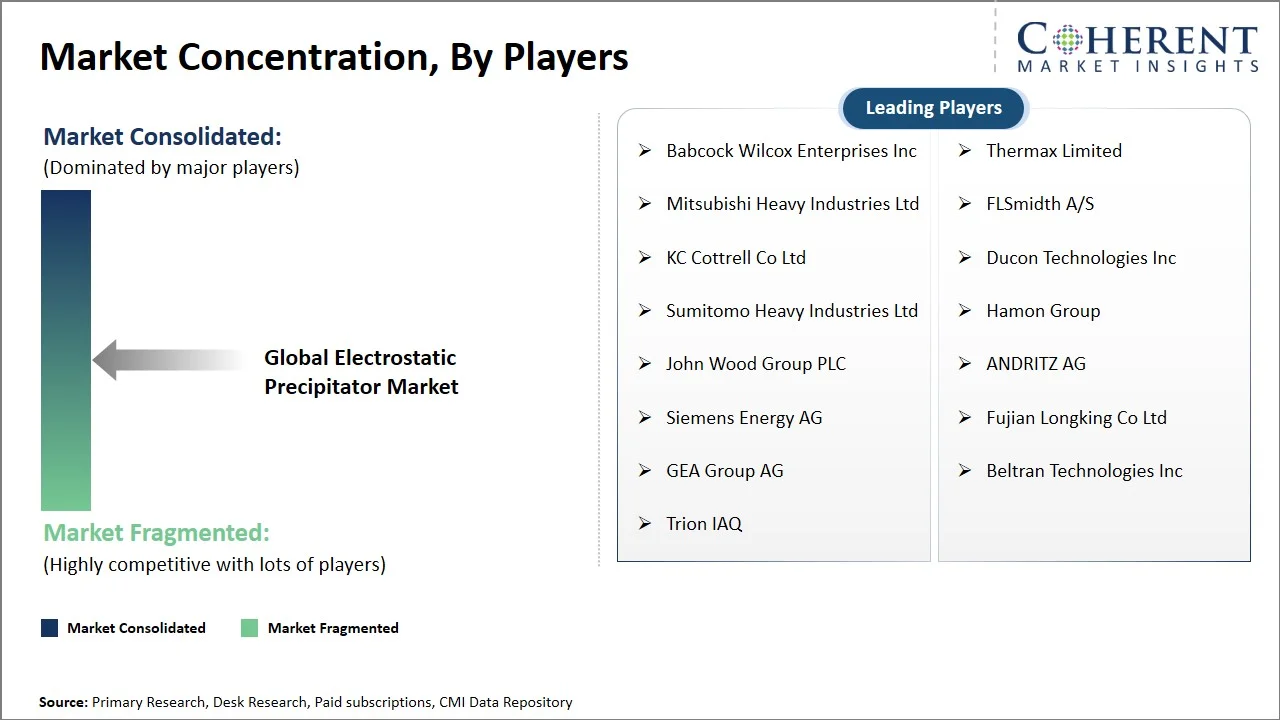
The global electrostatic precipitator market is headed by established engineering firms such as Fujian Longking, Thermax Limited, Babcock & Wilcox Enterprises, KC Cottrell, Mitsubishi Heavy Industries, ANDRITZ and FLSmidth which primarily compete on retrofit capabilities, digital monitoring technologies and industry specific emission control solutions rather than on price alone. Fujian Longking has also increased its market share with ultra-low emission electrostatic precipitators for large coal fired power and steel projects throughout China. Thermax has also grown its retrofit portfolio for thermal power stations and cement plants in India by installing high frequency transformer rectifiers and intelligent control systems. Babcock & Wilcox continues to target utility boiler electrostatic precipitator modernization in North America, while FLSmidth targets the worldwide cement industry with integrated air pollution control packages that combine electrostatic precipitators with process optimization services. KC Cottrell has expanded its presence in Southeast Asia and the Middle East through turnkey engineering, procurement, and commissioning projects for power generation and industrial manufacturing facilities.
Market Report Scope
Electrostatic Precipitator Market Report Coverage
| Report Coverage | Details | ||
|---|---|---|---|
| Base Year: | 2025 | Market Size in 2026: | USD 9.75 Bn |
| Historical Data for: | 2020 To 2024 | Forecast Period: | 2026 To 2033 |
| Forecast Period 2026 to 2033 CAGR: | 6% | 2033 Value Projection: | USD 14.90 Bn |
| Geographies covered: |
| ||
| Segments covered: |
| ||
| Companies covered: | Babcock Wilcox Enterprises Inc, Thermax Limited, Mitsubishi Heavy Industries Ltd, FLSmidth A/S, KC Cottrell Co Ltd, Ducon Technologies Inc, Sumitomo Heavy Industries Ltd, Hamon Group, John Wood Group PLC, ANDRITZ AG, Siemens Energy AG, Fujian Longking Co Ltd, GEA Group AG, Beltran Technologies Inc, and Trion IAQ | ||
| Growth Drivers: |
| ||
| Restraints & Challenges: |
| ||
Analyst Opinion (Expert Opinion)
- The future of the industry is expected to be shaped more by modernization projects than by completely new installations. Aging coal fired power stations, cement plants, steel mills, and waste incineration facilities across Asia and North America will increasingly require high efficiency electrostatic precipitator upgrades incorporating digital diagnostics, automated voltage control, and predictive maintenance platforms to comply with tightening particulate emission standards.
- The greatest commercial opportunity is expected to emerge from dry electrostatic precipitators for power generation and cement applications in China and India, where extensive fleets of existing industrial facilities continue to undergo emission control upgrades. Additional high value opportunities are likely to develop in municipal waste incineration projects in Japan and Europe, where increasingly stringent particulate emission limits are encouraging the adoption of advanced electrostatic precipitation technologies.
- Market players should consider whole lifecycle service offers, rather than just selling equipment. Companies that combine retrofit engineering, continuous emissions monitoring, artificial intelligence enabled performance optimization, high frequency power supply upgrades, and long term maintenance contracts will be better positioned to secure recurring revenues and strengthen customer retention in highly regulated industrial sectors.
Speak to the analyst
Want personalized insights?
Take the findings above to one of our principal consultants, or have the report rebuilt around the segments, geographies and competitors you actually track.
Market Segmentation
- Product Type Insights (Revenue, USD Billion, 2021 - 2033)
- Dry Electrostatic Precipitators
- Wet Electrostatic Precipitators
- End User Insights (Revenue, USD Billion, 2021 - 2033)
- Power Generation
- Cement
- Iron and Steel
- Chemicals and Petrochemicals
- Others
- Regional Insights (Revenue, USD Billion, 2021 - 2033)
- North America
- U.S.
- Canada
- Latin America
- Brazil
- Argentina
- Mexico
- Rest of Latin America
- Europe
- Germany
- U.K.
- Spain
- France
- Italy
- Russia
- Rest of Europe
- Asia Pacific
- China
- India
- Japan
- Australia
- South Korea
- ASEAN
- Rest of Asia Pacific
- Middle East
- GCC Countries
- Israel
- Rest of Middle East
- Africa
- South Africa
- North Africa
- Central Africa
- North America
- Key Players Insights
- Babcock Wilcox Enterprises Inc
- Thermax Limited
- Mitsubishi Heavy Industries Ltd
- FLSmidth A/S
- KC Cottrell Co Ltd
- Ducon Technologies Inc
- Sumitomo Heavy Industries Ltd
- Hamon Group
- John Wood Group PLC
- ANDRITZ AG
- Siemens Energy AG
- Fujian Longking Co Ltd
- GEA Group AG
- Beltran Technologies Inc
- Trion IAQ
Sources
Primary Research Interviews
- EPC Contractors Specializing In Flue Gas Treatment Systems
- Electrostatic Precipitator Design and Application Engineers
- Boiler And Power Plant Maintenance Managers
- Waste-To-Energy Plant Technical Directors
Magazines
- International Cement Review
- Global Mining Review
- Mining Magazine
- Steel Times International
- Pollution Engineering
Journals
- Journal of Electrostatics
- Atmospheric Environment
- Journal of Hazardous Materials
- Environmental Technology
Associations
- International Society for Electrostatic Precipitation (ISESP)
- Air & Waste Management Association (A&WMA)
- American Society of Mechanical Engineers (ASME)
- Institute of Electrical and Electronics Engineers (IEEE)
Public Domain Sources
- United States Environmental Protection Agency (EPA)
- European Environment Agency (EEA)
- European Commission
- United States Department of Energy (DOE)
Proprietary Elements
- CMI Data Analytics Tool
- Proprietary CMI Existing Repository of Information for the Last 10 Years
Get access to 250+ pages report
Every segment, forecast, competitor profile and data table behind the analysis above — available for instant download.
- ESOMAR Member
- ISO 9001:2015 Certified
- D-U-N-S Registered
- GDPR & CCPA Compliant
Missing comfort of reading report in your local language? Find your preferred language:
Transform your Strategy with Exclusive Trending Reports
Frequently Asked Questions
The global electrostatic precipitator market is expected to stand at USD 9.75 Bn in 2026 and is expected to reach USD 14.90 Bn by 2033.
The CAGR of the global electrostatic precipitator market is projected to be 6% from 2026 to 2033.
Rising enforcement of industrial air emission regulations and growing installation of coal biomass and waste to energy plants are the major factors driving the growth of the global electrostatic precipitator market.
High initial installation and engineering costs and performance limitations with high resistivity dust are the major factors hampering the growth of the global electrostatic precipitator market.
In terms of product type, the dry electrostatic precipitators segment is estimated to dominate the market revenue share in 2026.
Retrofits enable older industrial plants to achieve stricter emission standards without replacing complete systems.
Stricter particulate emission standards encourage industries to install or upgrade electrostatic precipitators.