

Global Emergency Lighting Market Size and Forecast – 2026 To 2033
The Global Emergency Lighting Market is estimated to be valued at USD 7.81 Bn in 2026 and is expected to reach USD 11.67 Bn by 2033, exhibiting a compound annual growth rate (CAGR) of 5.9% from 2026 to 2033. Market expansion is supported by stricter fire-safety obligations, construction of commercial and public infrastructure, and the replacement of conventional fixtures with LED-based, self-testing, and remotely monitored emergency-lighting systems.
Building owners must also regularly inspect, test, maintain, and document emergency escape lighting, creating recurring demand for luminaires, batteries, control equipment, installation, and maintenance services. In January 2025, the UK Home Office updated its statutory fire-safety guidance for small non-domestic premises to reflect new legal requirements introduced under Section 156 of the Building Safety Act 2022. The guidance states that emergency-lighting adequacy must be assessed through fire-risk evaluations and that installed systems must be regularly tested and maintained, reinforcing compliance-led market demand.
Key Takeaways of the Global Emergency Lighting Market
- Emergency luminaires are expected to hold 51.8 % of the global emergency lighting market in 2026 because they provide direct illumination across escape routes, open areas, stairways, and high-risk work zones, making them indispensable beyond directional signage alone. In March 2024, Eaton unveiled new emergency luminaires and SignEdge safety fixtures designed to simplify maintenance, support upgrades, and integrate more effectively into building schemes.
- Self contained systems are expected to account for 64.7 % of the market share in 2026, supported by decentralized batteries, straightforward installation, easier system extension, and reduced dependence on dedicated central cabling. In June 2024, Lighting Europe formally addressed the classification of batteries used in self-contained emergency luminaires under the EU Battery Regulation, highlighting the growing compliance focus surrounding this widely deployed architecture.
- LED is expected to capture 78.6 % of the market share in 2026 because its low power consumption, long operating life, compact form factor, and compatibility with battery-backed electronics improve emergency runtime economics and product flexibility. In March 2024, Aleddra introduced three-color-temperature emergency LED T8 and T5 tubes combining normal illumination with integrated backup functionality, expanding retrofit options for facility operators.
- Asia Pacific is expected to represent 32.6 % of the global emergency lighting market in 2026 as extensive commercial construction, transport infrastructure, industrial capacity additions, and stricter facility-safety practices expand the installed base requiring compliant backup illumination. In June 2025, Signify launched its wireless Interact emergency lighting portfolio first in Australia and New Zealand, enabling cloud-based testing, monitoring, and compliance reporting.
- Europe is expected to hold 29.2 % of the market share in 2026, with expansion supported by building renovation programmers, lifecycle-efficiency requirements, digital compliance management, and replacement of ageing safety-lighting assets. In April 2024, the European Union adopted the recast Energy Performance of Buildings Directive, establishing a pathway toward a zero-emission building stock and reinforcing renovation-led demand for efficient building systems.
Global Emergency Lighting Market Dynamics
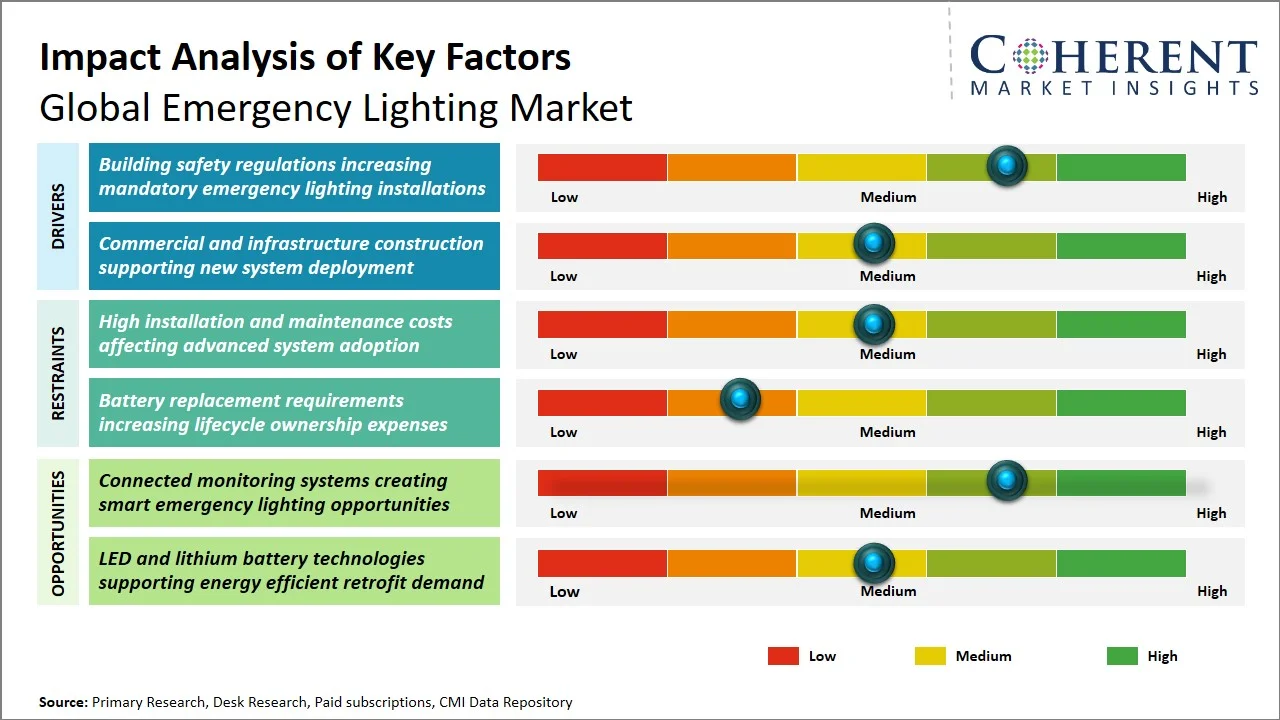
Key Market Drivers
- Building Safety Regulations Increasing Mandatory Emergency Lighting Installations: Emergency-lighting expenditure is anchored by enforceable building-safety duties rather than discretionary lighting budgets. When regulations require illuminated common areas, evacuation routes, fire-safety equipment locations, and documented maintenance, owners must install compliant systems and keep them operational throughout the building lifecycle. This mechanism generates initial product demand, but it also creates recurring work for electrical contractors, inspection providers, battery suppliers, distributors, and facility-management companies. Manufacturers with certified products, accessible test records, and reliable replacement components gain an advantage because buyers are purchasing audit readiness as well as illumination. In April 2025, Ireland’s Department of Housing updated its minimum-standards guidance for rented accommodation, reaffirming that multi-unit buildings must provide emergency lighting in common areas and that local authorities can inspect properties and enforce breaches. This strengthens the commercial case for compliant installations, periodic testing, and corrective replacement across rental portfolios.
- Commercial and Infrastructure Construction Supporting New System Deployment: New commercial and public-infrastructure projects enlarge the installed base of emergency luminaires, exit signs, central power equipment, controls, and commissioning services. Airports, rail terminals, hospitals, logistics facilities, data centers, and mixed-use developments have long operating hours, complex circulation paths, and large occupancies, making emergency lighting an early-stage life-safety specification rather than a late construction accessory. Every new facility therefore creates opportunities for lighting designers, system integrators, electrical contractors, component manufacturers, and maintenance providers, while later renovations generate replacement and interoperability demand. In January 2025, the U.S. Department of Transportation announced more than USD 332 million through 171 airport grants across 32 states for terminal expansion, baggage systems, runway-safety work, planning, and other modernization projects. Such capital programs expand the project pipeline for emergency-lighting suppliers because upgraded passenger buildings and operational spaces require coordinated egress illumination, approved equipment, testing, and handover documentation.
Emerging Market Trends
- Adaptive Evacuation Guidance Replacing Fixed Route Indication: Adaptive evacuation systems are moving emergency lighting beyond fixed exit signs. By linking addressable indicators with fire-detection and building-control systems, unsafe routes can be blocked and alternative escape directions displayed. This shifts procurement toward integrated evacuation platforms rather than standalone luminaires. Demand is expected to grow across airports, hospitals, high-rise buildings, transport facilities, and entertainment venues. Fire-alarm manufacturers, control-system providers, and system integrators will benefit, although wider adoption will depend on regulatory acceptance, interoperability, cybersecurity, and reliable fail-safe operation.
- Repairable and Modular Products Reshaping Lifecycle Procurement: Building owners are increasingly selecting emergency-lighting products with replaceable batteries, drivers, control modules, and indicators. Modular designs reduce waste, simplify maintenance, and extend product life while creating recurring revenue through spare parts and service contracts. This trend is particularly relevant for institutional buildings and multi-site operators focused on total ownership cost. Manufacturers must provide accessible components, long-term spare-part availability, and reliable technical documentation. Suppliers offering sealed, non-serviceable products may face pressure as lifecycle performance becomes more important in procurement decisions.
- Current Industry Events of 2026
- Market Size Estimation
- Regional Breakdown
- Competitive Landscape
- Customer Intelligence
- Segmental Analysis
- Pricing Analysis
- Key Market Drivers, Challenges & Future Trends
- Customized Insights Section
Segmental Insights
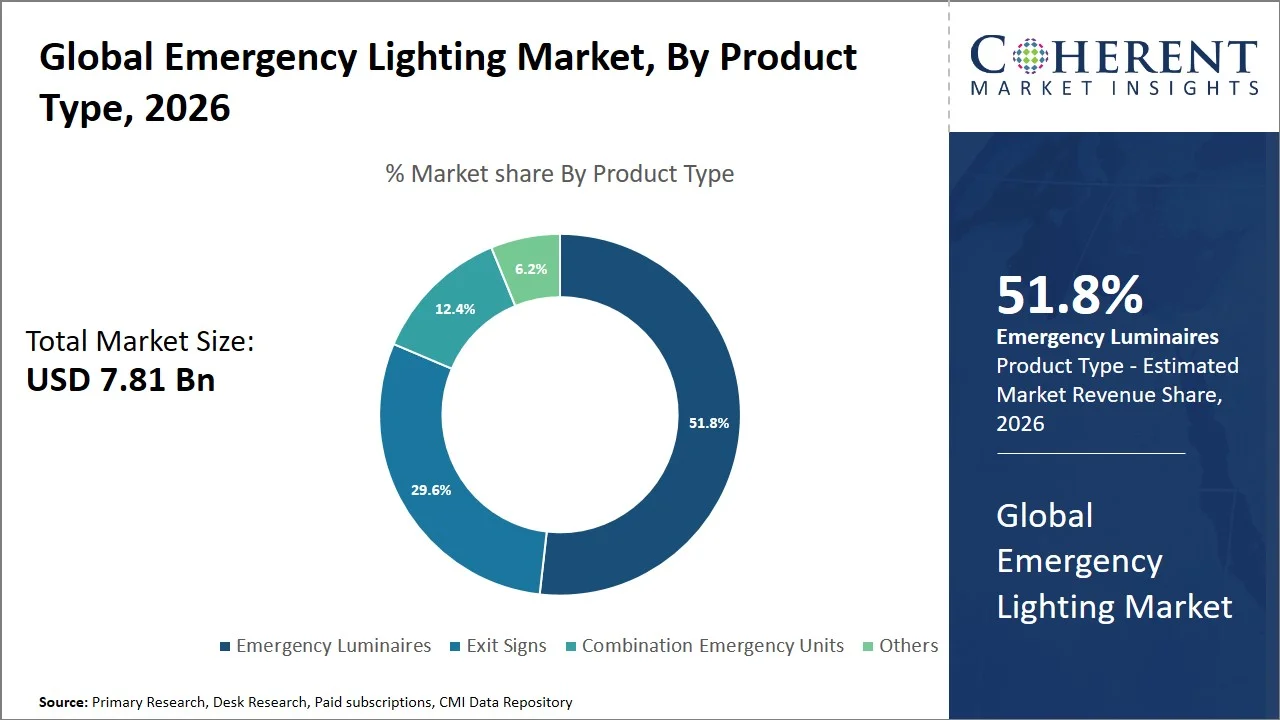
Why Do Emergency Luminaires Dominate the Global Emergency Lighting Market?
Emergency luminaires are expected to lead the product type category with an estimated market share of 51.8% in 2026 because they deliver the required illumination directly along escape routes, stairwells, corridors, open areas, and high-risk workspaces during a mains failure. Compared with exit signs, they address a broader life-safety function by supporting movement, obstacle recognition, and anti-panic visibility. Their availability in recessed, surface-mounted, architectural, weatherproof, and high-output formats also allows specifiers to match photometric performance with varied ceiling heights and environmental conditions. Manufacturers benefit from repeat demand across new construction, refurbishment, and mandatory replacement cycles, while distributors can serve multiple building classes through standardized product families. In November 2024, Lithonia Lighting reorganized its emergency-lighting portfolio into four application-led families covering small, large, high-end, and industrial spaces, illustrating how suppliers are simplifying luminaire selection for diverse projects.
Why Do Self Contained Systems Represent the Largest Power System Segment in the Global Emergency Lighting Market?
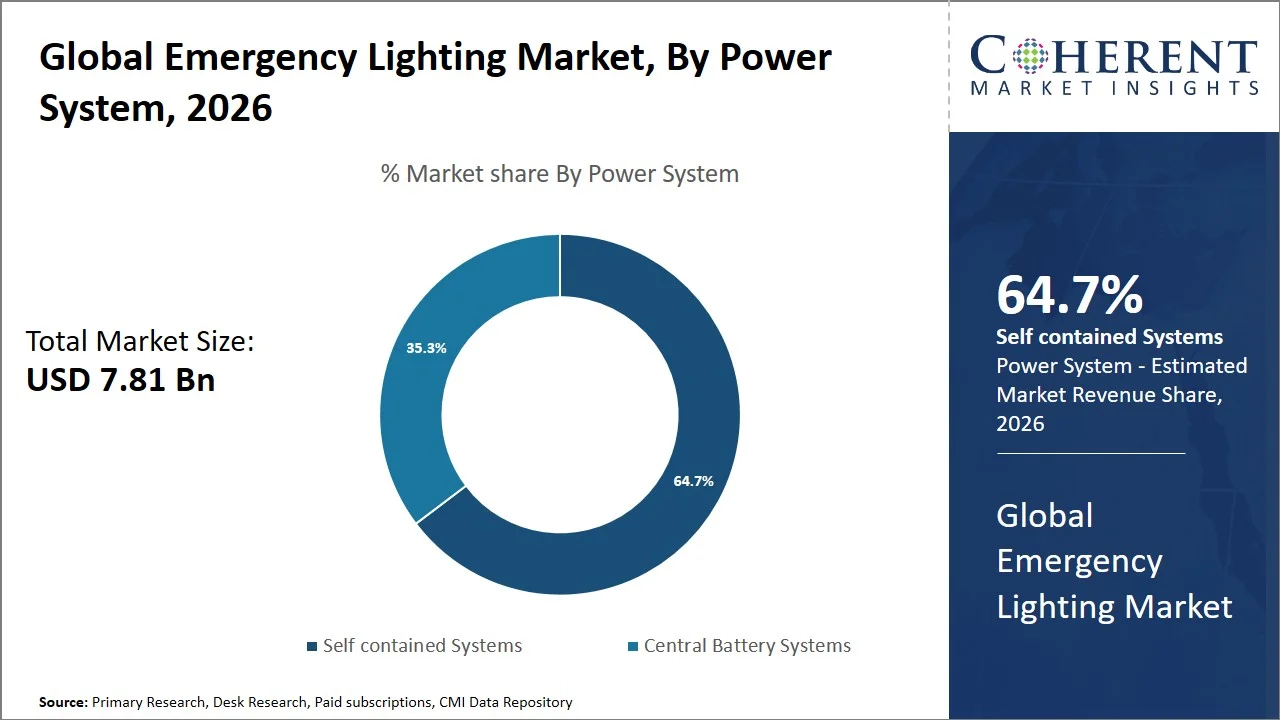
Self contained systems remain the largest power system segment with an expected market share of 64.7% in 2026 because each luminaire carries its own battery and emergency control electronics, avoiding the dedicated central-battery rooms, fire-rated distribution circuits, and extensive cabling required by centralized architectures. This decentralized design is particularly attractive for small and medium commercial buildings, schools, hospitality facilities, retail outlets, and retrofit projects were installation speed and limited disruption influence purchasing decisions. Local battery autonomy also supports phased deployment and reduces dependence on a single central power source. For suppliers, modular battery-driver combinations widen compatibility across luminaire designs and create recurring replacement demand for batteries and control gear. In March 2025, HEP introduced DALI-2 emergency-lighting devices for self-contained applications, featuring automatic testing, three-hour operation, LiFePO4 batteries, and compatibility with multiple LED drivers, demonstrating how decentralized systems are gaining smarter monitoring without losing installation flexibility.
Why Does LED Dominate the Light Source Segment of the Global Emergency Lighting Market?
LED is expected to dominate the light source category with an expected market share of 78.6% in 2026 because its high luminous efficacy enables emergency fixtures to deliver required illumination while drawing less battery power. Lower wattage can support longer emergency duration, smaller battery packs, reduced heat generation, and more compact luminaire designs than fluorescent, incandescent, or halogen alternatives. Directional LED optics also help manufacturers control beam distribution for escape routes and open-area coverage, potentially reducing the number of fittings needed in a project. Building owners benefit from long service life and fewer lamp-replacement interventions, which lowers maintenance exposure in continuously monitored life-safety installations. In August 2025, LEDVANCE released a new exit and emergency-lighting range using energy-efficient LEDs, with selected models offering energy savings of up to 97%, power ratings up to 2 W, and optional self-diagnostic capability, reinforcing LED’s commercial advantage in low-energy, maintenance-conscious emergency-lighting specifications.
Current Events and their Impact
Current Event | Description and Its Impact |
United Kingdom Revises Emergency-Lighting Standard – November 2025 |
|
Singapore Revises Exit-Sign Requirements – September 2024, Effective March 2025 |
|
Australia Releases NCC 2025 Preview – February 2026 |
|
Regional Insights
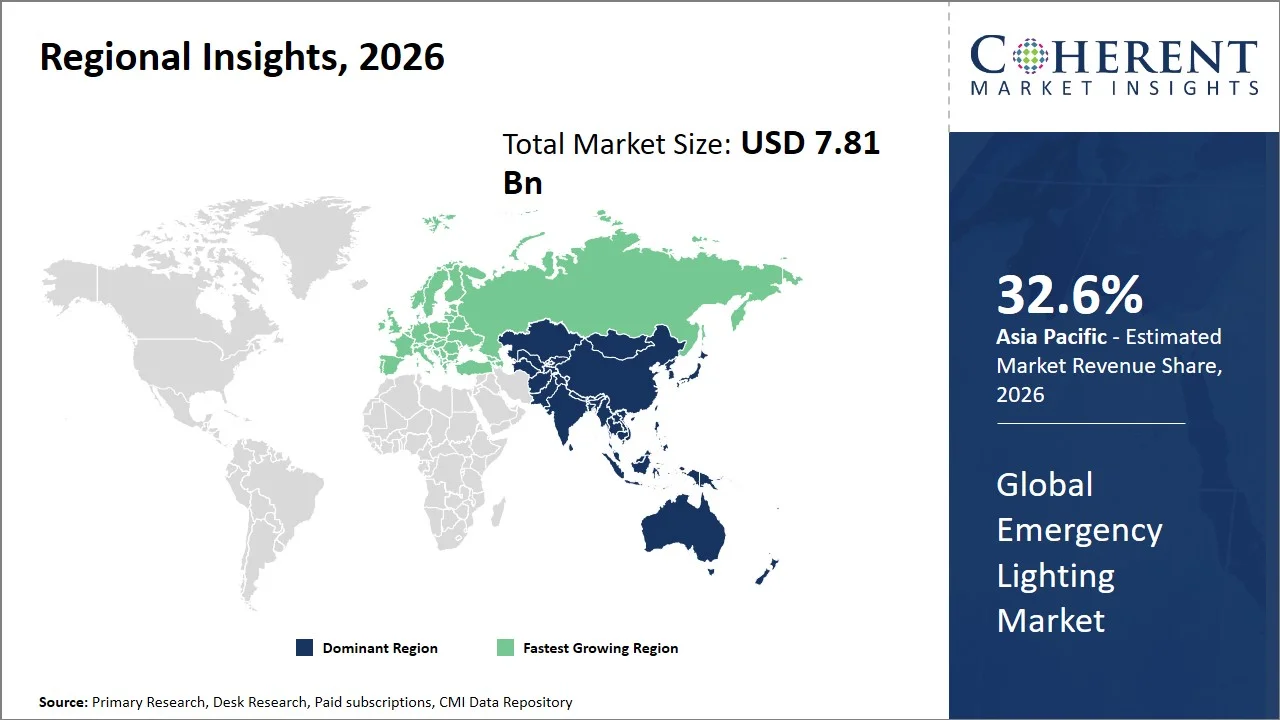
Why Does Asia Pacific Dominate the Global Emergency Lighting Market?
Asia Pacific is expected to hold the leading position with 32.6% of the market share in 2026 because the region combines rapid urban construction, large transport and industrial projects, dense commercial occupancies, and extensive local production of LED luminaires, batteries, drivers, and electronic controls. Emergency-lighting demand is reinforced by the continued development of airports, metro systems, hospitals, factories, shopping centers, data centers, and high-rise buildings, where uninterrupted escape-route visibility is a core fire-safety requirement. Regional suppliers also benefit from cost-efficient manufacturing clusters and broad distributor networks that support both new installations and replacement demand. China, India, Japan, South Korea, Australia, and Southeast Asian economies provide multiple demand centers rather than reliance on one national market. In May 2025, China implemented GB 17945-2024 for fire emergency lighting and evacuation-indicating systems, replacing the previous national standard and strengthening product-compliance requirements across a major Asia Pacific market.
Why is Europe Emerging as the Fastest-Growing Region in the Global Emergency Lighting Market?
Europe is expected to record the fastest expansion with 29.2% share in 2026 as building owners move from basic standalone fixtures toward connected emergency-lighting systems that automate testing, fault reporting, maintenance records, and compliance documentation. The region’s large stock of offices, hospitals, schools, hotels, public buildings, and transport facilities creates a sizeable refurbishment opportunity, while strict workplace and building-safety requirements sustain recurring inspection and replacement activity. Suppliers are responding with wireless controls, DALI-based monitoring, lithium-battery systems, and integrated building-management platforms that reduce manual testing costs. Harmonised standards and sustainability requirements also encourage higher-efficiency, longer-life products rather than simple like-for-like replacement. In September 2025, Signify began making its Interact wireless emergency-lighting solution available in Europe, enabling cloud-based monitoring, automated function and duration testing, and consolidated compliance reporting. This rollout demonstrates how digital retrofits are broadening the region’s addressable market beyond conventional luminaire replacement.
Global Emergency Lighting Market Outlook for Key Countries
Why is the U.S. a Key Market for the Global Emergency Lighting Market?
The U.S. is a key emergency-lighting market because life-safety requirements are embedded across commercial, industrial, institutional, hospitality, healthcare, education, and multifamily construction. Demand is supported by a large installed base requiring periodic battery replacement, functional testing, code-driven renovation, and upgrades during tenant improvements. Buyers place strong emphasis on UL-listed equipment, reliable illumination of means of egress, compatibility with emergency power systems, and documented compliance with building, fire, and electrical codes. The country also has a developed ecosystem of lighting manufacturers, certification laboratories, electrical contractors, distributors, and facility-management providers, enabling rapid product commercialization and nationwide servicing. In September 2024, the National Electrical Manufacturers Association published NEMA LS 20028-2024, an updated guide covering emergency-lighting systems, equipment operation, relevant codes, and regulatory considerations. The publication supports clearer specification and reinforces continuing demand for compliant emergency luminaires and exit-sign equipment.
Why is India Important in the Global Emergency Lighting Market?
India is important to the global emergency lighting market because urban construction, hospital expansion, metro and airport development, manufacturing investment, warehouses, educational campuses, and organized retail are widening the number of facilities requiring dependable evacuation lighting. Demand is particularly strong where dense occupancy, complex floor plans, and intermittent power quality increase the operational value of automatic battery-backed illumination. Domestic luminaire manufacturing and a broad electrical distribution network support competitive pricing, while mandatory product registration and formal testing requirements favour compliant suppliers over unorganized products. The market also benefits from replacement of low-output units with LED luminaires offering improved autonomy and lower maintenance. In June 2026, the Bureau of Indian Standards added the first revision of IS 10322 Part 5 Section 8:2026 for emergency-lighting luminaires to its laboratory testing scope. This strengthens technical validation and raises the commercial importance of certified products for Indian projects.
Why Does China Support Growth in the Global Emergency Lighting Market?
China supports growth in the global emergency lighting market through its scale in construction, industrial production, public infrastructure, electronics manufacturing, and component supply. Local producers have access to established clusters for LEDs, batteries, printed circuit boards, drivers, plastic housings, and control systems, enabling wide product availability across basic, centralized, and intelligent emergency-lighting configurations. Domestic demand extends from residential towers and commercial complexes to metros, factories, logistics facilities, and hazardous industrial sites, while manufacturing scale supports exports to other Asian and global markets. Regulatory modernization is also pushing suppliers toward more specialized systems for demanding environments. In April 2026, China issued GB/T 47438.2-2026, specifying fire emergency lighting and evacuation-indicating requirements for hazardous-chemical workplaces, with implementation scheduled for May 2027. The new standard expands the technical focus on high-risk industrial applications and creates opportunities for certified manufacturers, system integrators, and testing providers.
Why is Germany a Strategic Country in the Global Emergency Lighting Market?
Germany is a strategic emergency-lighting market because buyers prioritize engineered performance, precise photometric planning, dependable self-testing, and compatibility with advanced building-control systems. Demand is concentrated across industrial plants, offices, hospitals, universities, hotels, rail facilities, warehouses, and public buildings, where safety documentation and lifecycle reliability strongly influence procurement. Germany’s electrical engineering base supports high-value development in DALI controls, central power systems, battery monitoring, adaptive escape-route solutions, and architecturally integrated luminaires. The market also benefits from a large renovation base, as older installations must be assessed against updated technical requirements and modern maintenance expectations. In March 2025, DIN published DIN EN 1838, the German version of EN 1838:2024 for emergency lighting in buildings. The updated standard provides a current technical reference for designers, installers, inspectors, and manufacturers, supporting specification upgrades and replacement demand across German building projects.
Why is Brazil an Important Growth Market for the Global Emergency Lighting Market?
Brazil is an important growth market because emergency-lighting demand is distributed across shopping centers, hospitals, schools, residential towers, entertainment venues, industrial plants, warehouses, hotels, public buildings, and infrastructure facilities. Large urban centers create recurring needs for fire-safety licensing, renovation, inspection, and equipment replacement, while power interruptions and extensive building footprints increase the importance of reliable battery-backed evacuation lighting. Domestic suppliers and regional distributors offer a broad range of autonomous LED luminaires and high-output emergency blocks, enabling adoption across both small premises and large public-access facilities. State-level fire departments play an important role in translating safety rules into project and maintenance requirements. In April 2026, Paraná’s public-security authority instructed operators of nightclubs, cinemas, and theatres to maintain emergency lighting and other fire-safety systems in fully functioning condition. The guidance reinforces ongoing servicing and replacement demand in high-occupancy Brazilian venues.
Technology Adoption Landscape in the Global Emergency Lighting Market
Technology | Adoption Level | Key Application Area | Business Impact |
Automatic Function and Duration Testing | High | Self-contained luminaires in offices, schools, retail buildings, and hotels | Automatically identifies lamp, battery, charging, and operating-duration failures, reducing dependence on manual testing and supporting maintenance records. |
DALI-2 Emergency-Lighting Communication | Medium | Hospitals, campuses, commercial buildings, and public infrastructure | Enables device-level addressing, standardized communication, fault reporting, and integration with compatible lighting-management platforms. |
Lithium Iron Phosphate Battery Systems | Medium | Compact luminaires, industrial facilities, warehouses, and high-temperature applications | Supports longer cycle life, reduced maintenance frequency, and smaller product formats, although battery-management and certification requirements remain important. |
Wireless Mesh Monitoring and Reporting | Medium | Existing buildings, multi-site estates, and retrofit projects | Reduces the requirement for new control cabling and allows remote testing, fault notification, and portfolio-level maintenance planning. |
Adaptive Exit-Sign Control | Low | Airports, hospitals, tunnels, high-rise buildings, and entertainment venues | Allows escape directions to change in response to hazard information, creating premium system-integration opportunities but requiring fail-safe control logic. |
Central Battery Systems with Circuit Monitoring | Medium | Transport terminals, industrial plants, large campuses, and high-occupancy buildings | Centralizes battery maintenance and supports large connected loads, while circuit monitoring improves fault visibility and operational control. |
How are Managed Compliance Services Creating New Growth Opportunities in the Global Emergency Lighting Market?
A major underdeveloped opportunity lies in converting emergency lighting from a periodic equipment purchase into a managed compliance service. Multi-site retailers, hotel groups, healthcare networks, universities, logistics operators, and property managers often operate mixed estates with different product generations, maintenance contractors, and inspection records. Suppliers can address this fragmentation through portfolio audits, photometric surveys, installation, commissioning, scheduled functional and duration testing, digital logbooks, battery replacement, fault escalation, and evidence packs delivered under a service-level agreement. Commercial capture requires interoperable monitoring software, trained field technicians, regional spare-parts availability, secure data handling, and the ability to support third-party devices rather than only proprietary hardware. The model creates recurring revenue and strengthens customer retention while helping buyers budget compliance as an operating service. Established manufacturers with service networks are well placed, although specialist testing companies and system integrators can compete through open-platform partnerships. Entrants should avoid offering software alone; defensible participation requires verified field execution, standards expertise, and clear responsibility for closing identified faults.
Market Players, Key Development, and Competitive Landscape
Key Developments
- In May 2026, Panasonic Fire & Security Europe expanded its addressable emergency and exit-lighting portfolio with a new high-ceiling emergency luminaire and black- and white-finish options. the range includes self-contained backup configurations and application-specific products for corridors, open areas, and elevated installations. this is important for the global emergency lighting market because it demonstrates a move toward application-engineered portfolios that combine life-safety performance with architectural integration and addressable system control.
- In January 2026, Thorlux Lighting introduced the Firefly Surface emergency luminaire for industrial and other locations where recessed mounting is unsuitable. The product combines a rugged enclosure, multiple optical distributions, optional wireless testing and reporting, and lithium iron phosphate battery technology. This is important for the global emergency lighting market because it integrates durability, wider luminaire spacing, digital maintenance, and lifecycle performance within one surface-mounted platform, improving its suitability for industrial retrofits and demanding operating environments.
- In September 2025, Keystone Technologies launched the Ova Surface Mount EMRG downlight and upgraded its AdvantaEMRG emergency downlight platform. The products combine the luminaire, driver, and emergency backup within an integrated configuration, while offering selectable lighting parameters and installation options for new construction and retrofit projects. this is important for the global emergency lighting market because integrated designs reduce component-compatibility concerns, simplify contractor installation, and extend emergency-lighting capability into mainstream architectural downlight specifications.
Competitive Landscape
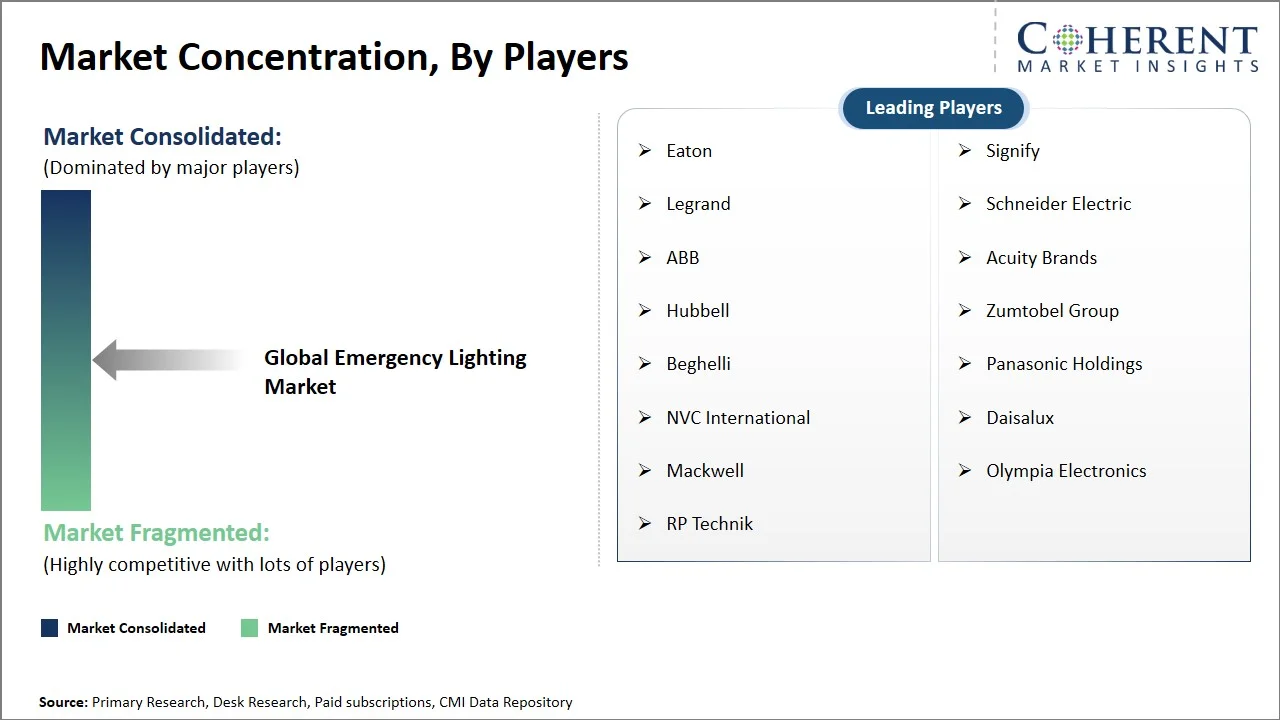
The global emergency lighting market remains fragmented, with multinational electrical-equipment groups, specialist life-safety manufacturers, regional lighting companies, battery and control-system suppliers, and private-label providers competing across different price and technical tiers. Market access depends heavily on local certification, building-code familiarity, consultant acceptance, and electrical-distributor relationships. Basic standalone products compete primarily on price and availability, whereas institutional and infrastructure projects place greater weight on photometric performance, battery reliability, system interoperability, documentation, commissioning, and after-sales support. Regional specialists remain influential because they can adapt product portfolios to national standards, provide on-site engineering assistance, and respond quickly to replacement requirements.
Key focus areas include
- Compliance credibility: Valid certifications, test reports, and complete technical documentation are central to consultant and contractor approval.
- Photometric efficiency: Better optics and wider compliant spacing can reduce fixture quantities and installed project costs.
- Battery reliability: Battery life, charging performance, temperature tolerance, and replacement accessibility affect ownership cost.
- System interoperability: Compatibility with fire alarms, lighting controls, and building-management systems supports premium positioning.
- Project support: Layout design, product selection, commissioning, training, and inspection assistance influence specification success.
- Distribution reach: Product availability through electrical wholesalers and specialist fire-safety channels strengthens replacement sales.
- Supply continuity: Local inventory and alternative sourcing for batteries, drivers, and electronic components reduce project delays.
Market Report Scope
Emergency Lighting Market Report Coverage
| Report Coverage | Details | ||
|---|---|---|---|
| Base Year: | 2025 | Market Size in 2026: | USD 7.81 Bn |
| Historical Data for: | 2020 To 2024 | Forecast Period: | 2026 To 2033 |
| Forecast Period 2026 to 2033 CAGR: | 5.9% | 2033 Value Projection: | USD 11.67 Bn |
| Geographies covered: |
| ||
| Segments covered: |
| ||
| Companies covered: | Eaton, Signify, Legrand, Schneider Electric, ABB, Acuity Brands, Hubbell, Zumtobel Group, Beghelli, Panasonic Holdings, NVC International, Daisalux, Mackwell, Olympia Electronics, and RP Technik | ||
| Growth Drivers: |
| ||
| Restraints & Challenges: |
| ||
Analyst Opinion (Expert Opinion)
- Competitive leadership is likely to shift from broad luminaire catalogues toward application-engineered life-safety platforms. Suppliers that combine optical design, compliance support, commissioning, interoperable controls, replacement planning, and field service will be better positioned than companies relying mainly on unit sales. This transition will increase the commercial value of project engineering and lifecycle customer relationships.
- Building-level evacuation-performance validation could materially change purchasing criteria. Digital building models, photometric simulations, equipment-status data, and fire-system inputs may eventually allow owners to evaluate whether the complete evacuation environment remains functional under different failure conditions. This would pressure catalogue-only business models and make accurate product data, software integration, simulation capability, and performance documentation essential competitive assets.
- The global emergency lighting market participants should invest in modular product platforms, advanced optics, battery traceability, regional certification, open communication interfaces, and qualified field-support networks. Critical electronic and battery components should be sourced through resilient regional supply arrangements. Manufacturers should avoid excessive investment in undifferentiated entry-level fixtures, where price competition can weaken margins, and instead prioritize demanding applications where compliance assistance, maintainability, and technical performance support defensible pricing.
Speak to the analyst
Want personalized insights?
Take the findings above to one of our principal consultants, or have the report rebuilt around the segments, geographies and competitors you actually track.
Market Segmentation
- Product Type Insights (Revenue, USD Bn, 2021 - 2033)
- Emergency Luminaires
- Exit Signs
- Combination Emergency Units
- Others
- Power System Insights (Revenue, USD Bn, 2021 - 2033)
- Self contained Systems
- Central Battery Systems
- Light Source Insights (Revenue, USD Bn, 2021 - 2033)
- LED
- Fluorescent
- Incandescent and Halogen
- Others
- Application Insights (Revenue, USD Bn, 2021 - 2033)
- Commercial Buildings
- Industrial Facilities
- Residential Buildings
- Public Infrastructure
- Others
- Installation Type Insights (Revenue, USD Bn, 2021 - 2033)
- New Installation
- Retrofit and Replacement
- Regional Insights (Revenue, USD Bn, 2021 - 2033)
- North America
- U.S.
- Canada
- Latin America
- Brazil
- Argentina
- Mexico
- Rest of Latin America
- Europe
- Germany
- U.K.
- Spain
- France
- Italy
- Russia
- Rest of Europe
- Asia Pacific
- China
- India
- Japan
- Australia
- South Korea
- ASEAN
- Rest of Asia Pacific
- Middle East
- GCC Countries
- Israel
- Rest of Middle East
- Africa
- South Africa
- North Africa
- Central Africa
- North America
- Key Players Insights
- Eaton
- Signify
- Legrand
- Schneider Electric
- ABB
- Acuity Brands
- Hubbell
- Zumtobel Group
- Beghelli
- Panasonic Holdings
- NVC International
- Daisalux
- Mackwell
- Olympia Electronics
- RP Technik
Sources
Primary Research Interviews
- Emergency luminaire, exit-sign, central battery, inverter, emergency driver, and control-system manufacturers
- LED, battery, charger, optical, housing, wiring, circuit-board, and electronic-component suppliers
- Commercial, industrial, residential, healthcare, education, hospitality, transport, and public-infrastructure operators
- Architects, MEP consultants, fire-safety engineers, electrical contractors, system integrators, distributors, laboratories, and certification providers
- Product development, engineering, procurement, production, quality, compliance, maintenance, marketing, and sales executives
Stakeholders
- Emergency-lighting and exit-sign manufacturers, central battery suppliers, and contract manufacturers
- LED, battery, driver, charger, PCB, enclosure, cable, and fire-resistant material suppliers
- Electronics assembly, injection-molding, die-casting, photometric-testing, and inspection-equipment providers
- Architects, lighting designers, MEP consultants, fire engineers, building-control specialists, and contractors
- Property developers, hospitals, hotels, schools, industrial plants, transport operators, and public authorities
- Electrical wholesalers, fire-safety distributors, maintenance providers, laboratories, and logistics companies
End-use Sectors
- Offices, retail stores, malls, hotels, restaurants, entertainment venues, and mixed-use buildings
- Factories, warehouses, logistics centers, power plants, mining sites, and hazardous facilities
- Apartments, residential towers, student housing, and assisted-living facilities
- Hospitals, clinics, schools, universities, laboratories, and government buildings
- Airports, railway stations, metro systems, tunnels, ports, stadiums, and transport infrastructure
- Data centers, telecom facilities, banks, control rooms, and mission-critical buildings
- New installation, retrofit, renovation, testing, maintenance, and battery replacement applications
Regulatory and Government Bodies
- U.S. OSHA, Department of Energy, NFPA, ICC, UL Solutions, and state fire authorities
- Standards Council of Canada, CSA Group, and provincial building authorities
- European Commission, CEN, CENELEC, ECHA, and national fire-safety regulators
- UK Home Office, HSE, Building Safety Regulator, and BSI
- China SAMR, SAC, Ministry of Emergency Management, and MIIT
- Japan MLIT, Fire and Disaster Management Agency, METI, and JISC
- India BIS, Ministry of Housing and Urban Affairs, CPWD, and state fire departments
- Brazil INMETRO, ABNT, and state military fire departments
- Australian Building Codes Board, Standards Australia, and WorkSafe authorities
- ISO, IEC, CIE, DALI Alliance, and accredited testing laboratories
Databases
- UN Comtrade, ITC Trade Map, WTO, Eurostat, USITC, World Bank, OECD, and UNIDO
- National construction, infrastructure, housing, industrial-output, and building-permit databases
- Airport, railway, hospital, education, data-center, and commercial real-estate project databases
- Fire-incident, inspection, product-recall, workplace-safety, and regulatory-enforcement records
- UL Product iQ, DALI-certified product records, ENEC, BIS, and other conformity databases
- WIPO PATENTSCOPE, Espacenet, company filings, tenders, catalogues, pricing, and shipment records
Magazines and Journals
- LEDs Magazine, Electrical Construction & Maintenance, Consulting-Specifying Engineer, and Electrical Contractor
- Lighting Research & Technology, Leukos, Journal of Building Engineering, and Building and Environment
- Fire Safety Journal, Fire Technology, Safety Science, and Journal of Fire Sciences
- Facilities, Airport World, Railway Gazette International, and Data Center Dynamics
- Journal of Energy Storage, Journal of Power Sources, and relevant IEEE publications
Associations
- LightingEurope
- DALI Alliance
- Illuminating Engineering Society
- International Commission on Illumination
- National Electrical Manufacturers Association
- National Fire Protection Association
- Lighting Industry Association
- Euralarm
- UL Standards & Engagement
- Fire and Security Association of India
- Japan Lighting Manufacturers Association
- China Association of Lighting Industry
- Australian Lighting Council
- Brazilian Lighting Industry Association
Public Domain Sources
- Product catalogues, data sheets, installation manuals, wiring diagrams, spacing tables, and BIM files
- Data on lumen output, emergency duration, recharge time, battery type, viewing distance, IP rating, and operating temperature
- Automatic testing, remote monitoring, DALI, wireless control, and building-management integration specifications
- Product certificates, conformity declarations, laboratory reports, and fire-safety approvals
- Building codes, fire regulations, tenders, procurement notices, and infrastructure-development plans
- Construction, renovation, commercial-floor-space, industrial-output, and transport-infrastructure statistics
- Import-export records, product recalls, annual reports, investments, product launches, patents, and trade-fair announcements
Key Standards and Regulations
- IEC 60598-2-22 – Emergency-lighting luminaires
- ISO 30061 – Emergency-lighting performance requirements
- IEC 62386-202 – DALI emergency-lighting control gear
- ISO 7010 and ISO 3864 – Safety signs and markings
- NFPA 101, NFPA 70 Article 700, NFPA 1, and UL 924
- OSHA 29 CFR 1910.37 – Exit-route illumination requirements
- International Building Code and International Fire Code
- EN 1838, EN 50172, EN 62034, EN 50171, and BS 5266-1
- AS/NZS 2293 series
- IS 10322 Part 5 Section 8 and National Building Code of India
- GB 17945-2024
- SS 563 and Singapore Fire Code
- ABNT NBR 10898
- EU Low Voltage, EMC, RoHS, WEEE, REACH, Ecodesign, and Batteries regulations
- ISO 9001, ISO 14001, ISO 45001, and ISO/IEC 17025
Proprietary Elements
- CMI Data Analytics Tool, Proprietary CMI Existing Repository of information for last 10 years.
Get access to 250+ pages report
Every segment, forecast, competitor profile and data table behind the analysis above — available for instant download.
- ESOMAR Member
- ISO 9001:2015 Certified
- D-U-N-S Registered
- GDPR & CCPA Compliant
Missing comfort of reading report in your local language? Find your preferred language:
Transform your Strategy with Exclusive Trending Reports
Frequently Asked Questions
The CAGR of the global emergency lighting market is projected to be 5.9% from 2026 to 2033.
The global emergency lighting market is estimated to be valued at USD 7.81 billion in 2026 and is expected to reach USD 11.67 billion by 2033.
Self-contained systems lead the market due to easier installation, decentralized operation, and suitability for new construction and retrofit applications.
LED is the most widely used light source because of its energy efficiency, long operating life, compact design, and lower maintenance requirements.
Adaptive evacuation guidance, automatic testing, remote monitoring, wireless controls, and repairable modular emergency-lighting products are key market trends.
Building safety regulations increasing mandatory emergency lighting installations and commercial and infrastructure construction supporting new system deployment are the major factors driving the growth of the global emergency lighting market.
High installation and maintenance costs affecting advanced system adoption and battery replacement requirements increasing lifecycle ownership expenses are the major factors hampering the growth of the global emergency lighting market.