

Global EV Thermal Management Market Size and Forecast – 2026 To 2033
The global EV thermal management market is expected to grow from USD 25.40 Bn in 2026 to USD 69.20 Bn by 2033, registering a compound annual growth rate (CAGR) of 13.3% from 2026 to 2033. The global EV thermal management market is driven by growing demand for faster charging. On March 6, 2026, BYD unveiled the second generation of its Blade Battery alongside its new ultra-fast FLASH charging technology. This announcement is a huge leap forward in electric car innovation, making EVs even more appealing in markets that have high adoption rates.
Key Takeaways of the Global EV Thermal Management Market
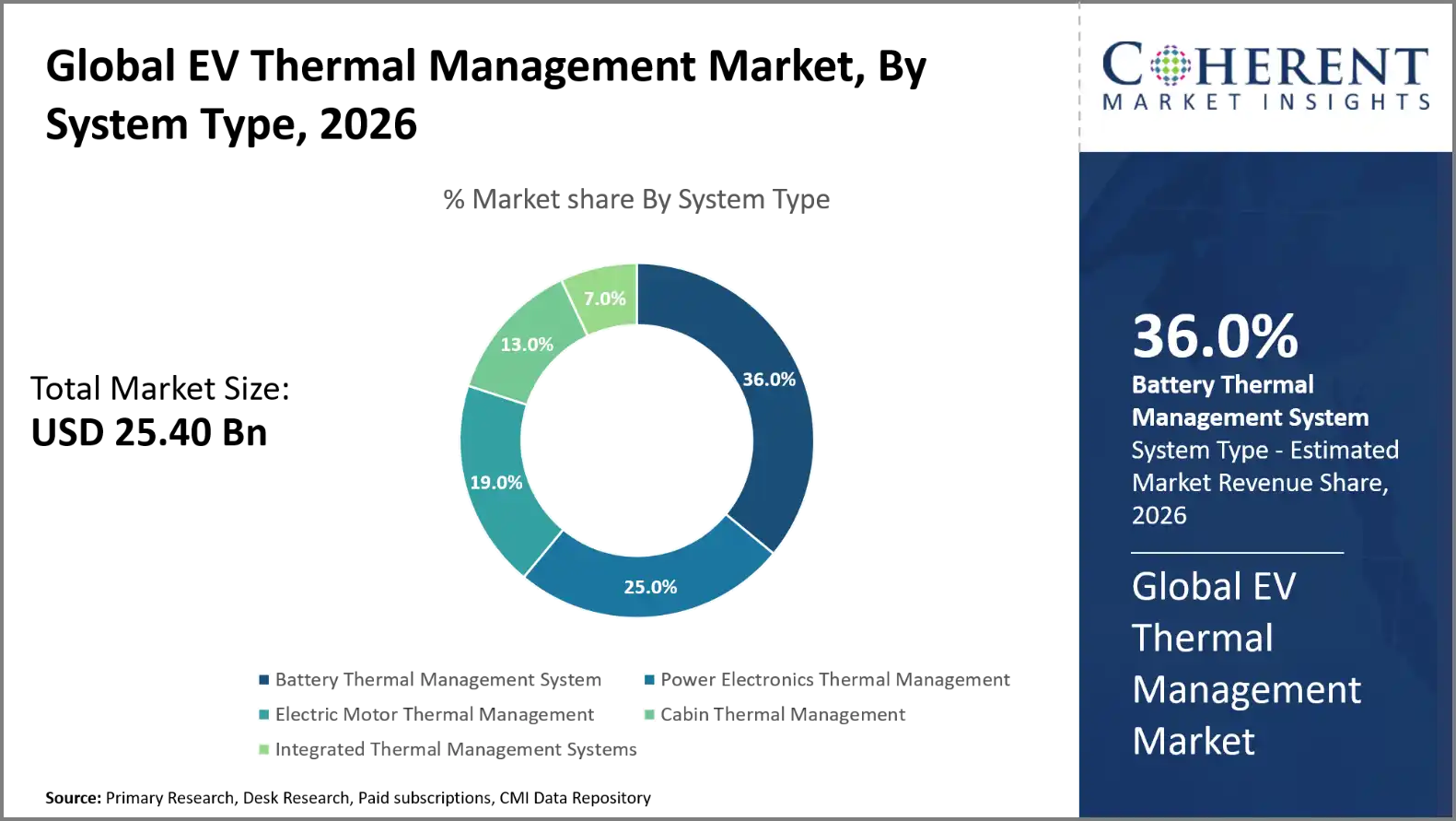
- The Battery Thermal Management System segment is expected to account for 36.0% of the global EV thermal management market share in 2026. Rising emphasis on battery safety is driving the growth of the segment. On August 26, 2026, Hyundai introduced Thermal Runaway Protection for upcoming Genesis vehicles. The system blocks heat transfer between adjacent battery cells.
- The Air Cooling segment is estimated to capture 41.0% of the market share in 2026. Increasing adoption of integrated thermal architectures is majorly driving the growth of the segment. On November 6, 2025, Valeo introduced a compact five-way refrigerant valve for electric vehicle heat pumps. The valve replaces three solenoid valves and one check valve.
- The Compressor segment is estimated to capture 29.0% of the market share in 2026. Growing use of heat pumps in electric vehicles is majorly driving the growth of the segment. On May 13, 2026, DENSO brought an advanced heat pump thermal management system to market. Its defrosting technology uses vehicle waste heat during driving.
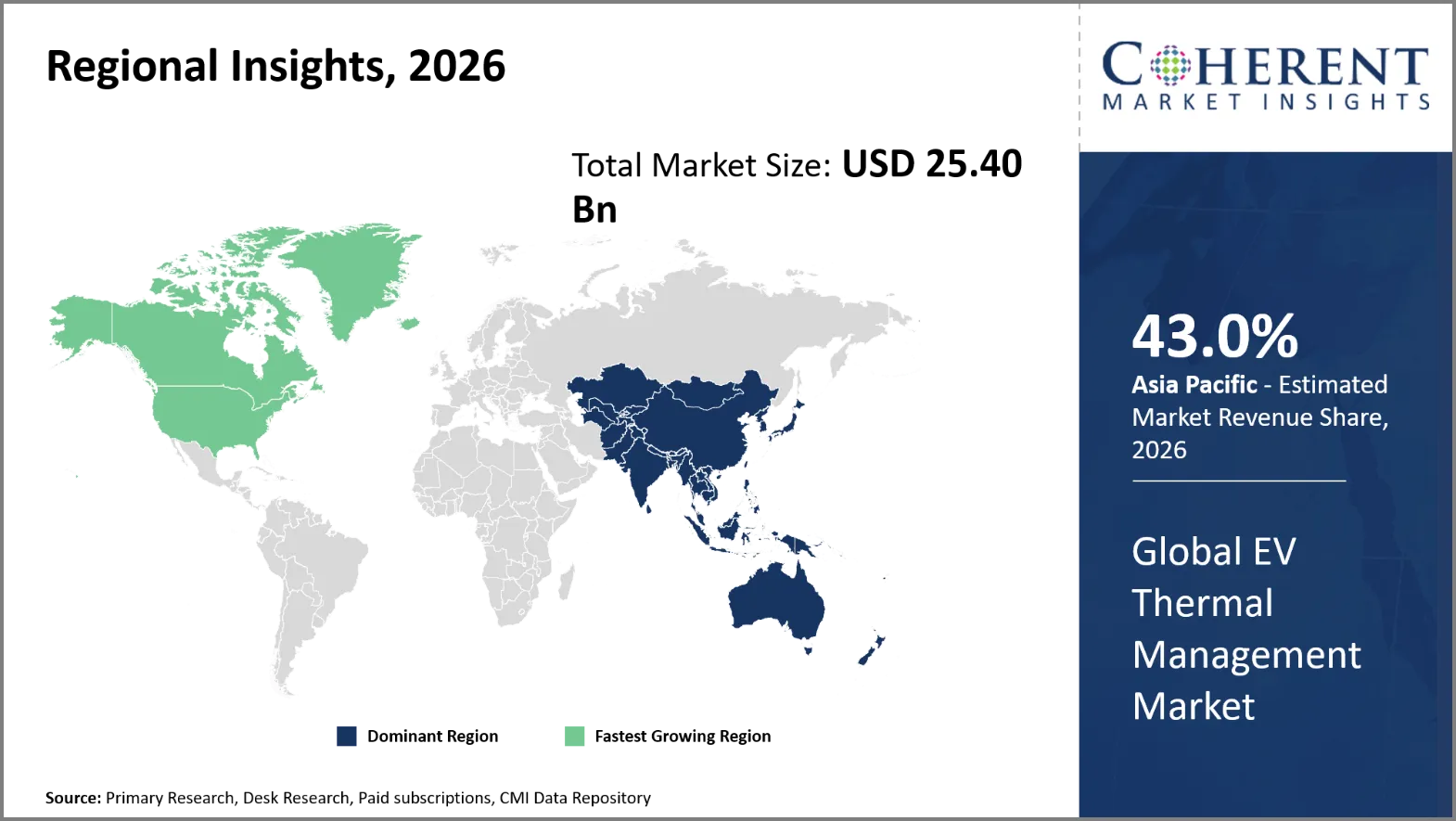
- Asia Pacific is expected to dominate the EV thermal management market in 2026 with a market share of 43.0%. Growing adoption of thermal management for ultra-fast charging in Asia Pacific is driving the growth of the regional market. On April 21, 2026, CATL introduced its third-generation Shenxing Superfast Charging Battery in Beijing, China. The battery supports a 10C charging rate and reaches 10% to 80% charge in 3 minutes and 44 seconds.
- North America is expected to account for 24.0% share in 2026 and is projected to record the fastest growth over the forecast period. Expansion of AI-based thermal optimization in North America is driving the growth of the regional market. In June 2026, General Motors expanded artificial intelligence and virtual simulation across vehicle development. Its co-simulation environment connects physics-based models with virtual controllers before physical hardware becomes available.
Segmental Insights
Why Does Battery Thermal Management System Dominate the Global EV Thermal Management Market?
The battery thermal management system segment is expected to account for 36.0% of the global EV thermal management market share in 2026. Battery thermal management solutions are dominant as battery temperature directly impacts safety, performance, charging and useful capacity. Li-ion cells like to be operated within a rather small temperature range. Higher temperatures speed up degradation and raise the risk of thermal runaway. Low temperatures diminish power output, charging capabilities and energy efficiency. Battery thermal management systems ensure consistent temperature across battery packs. Liquid cooling effectively removes heat from high-energy battery packs. Rising battery capacities further increase heat generation during driving and rapid charging. Fast-charging vehicles therefore require increasingly sophisticated battery cooling architectures.
On September 8, 2025, CATL's Naxtra received the certification of China’s GB 38031-2025 Electric Vehicles Traction Battery Safety Requirements (New National Standard), becoming the first sodium-ion battery in the world to pass the certification. The new national standard will officially be implemented on July 1, 2026, and aims to eliminate the risk of electric car fires at the source.
- Current Industry Events of 2026
- Market Size Estimation
- Regional Breakdown
- Competitive Landscape
- Customer Intelligence
- Segmental Analysis
- Pricing Analysis
- Key Market Drivers, Challenges & Future Trends
- Customized Insights Section
Why is Air Cooling the Most Crucial Technology Type?
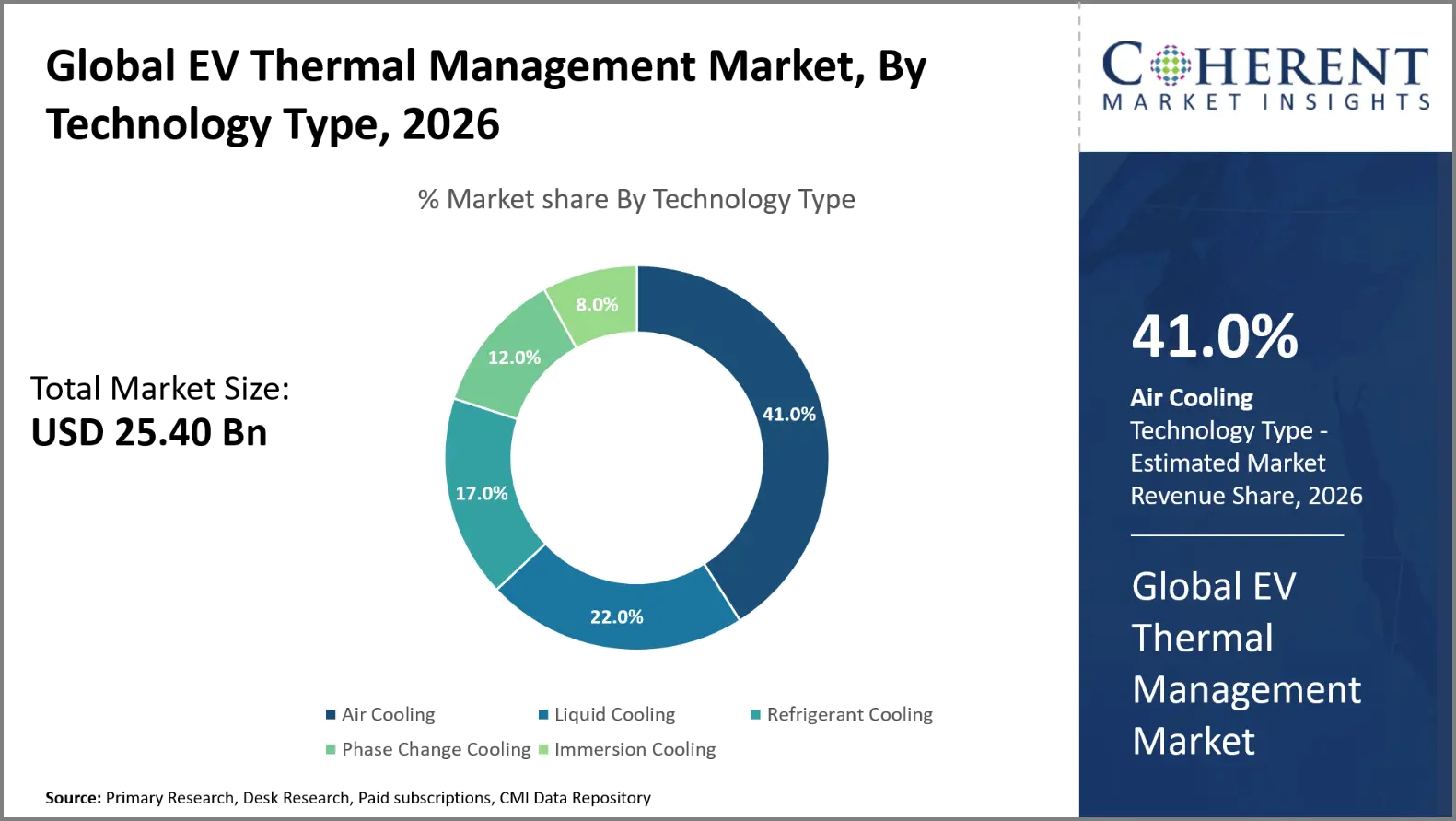
The air cooling segment is expected to account for 41.0% of the global EV thermal management market share in 2026. The importance of air-cooling persists with its basic architecture, lower component complexity and comparatively straightforward maintenance. The method removes heat from specific electric car components using ambient or conditioned air. Air-based solutions can help minimize cooling system weight and avoid liquid leakage concerns. They still look attractive for smaller battery packs and cars under modest thermal loads. Air channels can also be designed into battery enclosures by the manufacturer. But, air cooling has less heat-transfer capability than liquid systems. Its effectiveness decreases when battery energy density and charging power increase significantly.
On May 16, 2025, Astemo, Ltd. announced it has developed a 12-inch air-cooled direct-drive system for in-wheel EVs, which are gaining attention as the next-generation mobility with the enhanced EV performance, convenience and the ability to be installed in compact vehicles such as Kei cars.
Compressor Dominates the Global EV Thermal Management Market
The compressor segment is expected to account for 29.0% of the global EV thermal management market share in 2026. Compressors dominate because they provide the pressure difference required for refrigerant circulation within vehicle thermal circuits. They cool passenger cabins, batteries and other temperature sensitive components. Electric compressors are not dependent on the vehicle’s internal combustion engine. This architecture is a key enabler for battery electric vehicles. The compressors can vary their speed to match the cooling capacity to the actual thermal load. Efficient compressors can help to reduce auxiliary electricity use and maintain driving range. In addition, they enable heat-pump functioning in cold-weather heating.
On January 24, 2024, Hanon Systems announced that its car compressor factory in Palmela, Portugal, has exceeded the milestone of producing more than 500,000 electric compressors for R744, an environmentally benign refrigerant.
Current Events and their Impact
Current Events | Description and its Impact |
European Union Battery Regulation |
|
China Electric Vehicle Battery Safety Standard |
|
EV Thermal Management Market Dynamics
Market Drivers
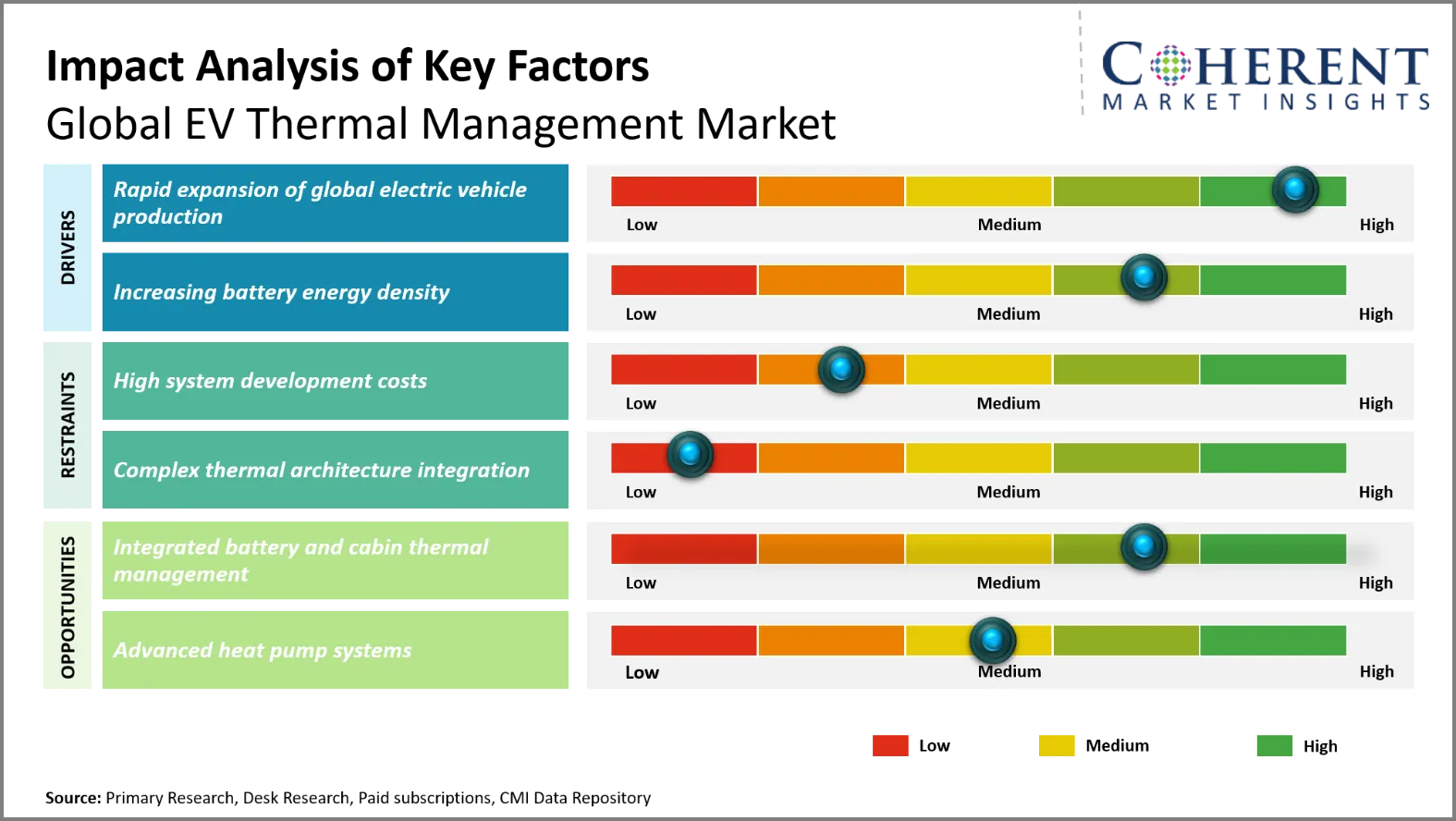
Rapid expansion of global electric vehicle production
The increasing production of electric vehicles is creating a demand for integrated thermal management systems. Passenger and commercial markets are seeing more battery electric and plug-in hybrid cars from global manufacturers. The demand for standardized cooling modules that may be used on many vehicle platforms stems from growing manufacturing numbers. When working, battery packs, electric motors, inverters and onboard chargers generate a lot of heat. Thermal management systems keep these components cool enough to work safely. Because fast charging generates more heat in the batteries, it makes the need for cooling even greater. This has caused manufacturers to develop pumps, compressors, heat exchangers, valves and sensors in to centralized thermal structures. This manufacturing ramp is providing ongoing possibilities for specialized thermal component vendors and system integrators.
On February 9, 2026, the Volkswagen Group reached a milestone in producing five million electric drive units worldwide. This collective achievement underscores the performance capabilities of the Group-wide technology and production alliance as well as the systematic scale-up of e-mobility across the different brands and regions.
Increasing battery energy density
Increasing battery energy density is intensifying thermal management requirements across electric vehicle platforms. Higher energy density allows manufacturers to increase driving range without proportionally increasing battery-pack size. But smaller battery packs concentrate more energy into less physical space. Such concentration may lead to increased heat generation and temperature gradients under heavy driving conditions. Fast charging may significantly increase thermal loads in individual cells and modules. This makes effective cooling a must in terms of performance, longevity, and safety. Liquid cooling is being adopted by manufacturers, along with improved cooling plates and improved temperature sensor technology. In addition, higher energy densities drive closer integration of battery management software and thermal management systems.
On August 11, 2026, SAMSUNG SDI announced the company has signed a new deal with General Motors (GM) to jointly develop next-generation prismatic battery cell for potential future EV applications. As part of the deal, the two companies will jointly develop prismatic batteries with high energy density and fast charging ability.
Emerging Trends
- Integrated Thermal Management Architectures: Automakers are increasingly combining battery, cabin, power electronics and motor cooling into a single thermal circuit. Integrated architectures eliminate the duplication of components, enhance heat usage, and reduce energy consumption. They also allow for a more compact packing of the car and a longer driving range.
- Advanced Heat Pump Systems: Heat pumps are becoming more important since they offer efficient cabin heating with lower battery energy consumption. New architectures reclaim waste heat from batteries, motors and power electronics This method enhances winter driving range and the overall efficiency of the vehicle.
- Immersion Cooling for High-Performance Batteries: Immersion cooling is being used for very high charging and power requirements of electric vehicles. Dielectric fluids that ensure uniform heat dissipation directly surround the battery cells. The technology may allow for faster charging, more power density and better thermal stability.
- Software-Defined Thermal Management: Thermal management increasingly relies on predictive software, coupled sensors and intelligent control algorithms. The systems automatically regulate cooling and heating based on driving circumstances, battery temperature, charging needs, and the surroundings. This method improves efficiency, durability and thermal safety.
Regional Insights
Why is Asia Pacific a Strong Market for EV Thermal Management?
Asia Pacific is expected to account for a market share of 43.0% in 2026. The Asia Pacific region has a dense battery production landscape and growing usage of electric two-wheelers. China, Korea, Japan and India are the anchors of regional supply chains. Southeast Asian electric car sales more than treble in 2025. Growth in production was also robust in the region beyond China. In 2025, battery deployment in China accounted for 60% of the global deployment. Manufacturing investments in Southeast Asia are increasing thermal component localization. Chinese companies are building overseas assembly facilities in Thailand and Indonesia. These facilities require localized battery cooling, refrigerant circuits, compressors, and power electronics cooling. Regional battery suppliers also support integrated thermal architectures for increasingly compact vehicle platforms.
Why Does North America EV Thermal Management Market Exhibit High Growth?
North America is expected to register the fastest growth with a CAGR of 14.0% over the forecast period. It is projected to account for 24.0% of the global EV thermal management market in 2026. The region’s growth is increasingly driven by domestic electric vehicle and battery production. In 2025, electric car production in North America climbed by 10%. Korean automakers contributed heavily by increasing manufacturing at U.S. sites. Imports still accounted for about 40% of U.S. electric car sales throughout 2025. Battery production capacity in the United States also expanded rapidly. The expansion supports demand for localized battery cooling plates, coolant pumps and thermal sensors. Another major opportunity is electric commercial vehicles, as larger batteries generate more heat loads. Regional manufacturers are consequently developing thermal architectures suited to high-capacity packs and demanding operating cycles.
Global EV Thermal Management Market Outlook for Key Countries
Why is China Emerging as a Major Hub in the EV Thermal Management Market?
China represents the strongest individual growth center because electric vehicle manufacturing is deeply integrated with battery production. In 2025, China industries made some 16 million electric cars. That year, electric vehicles accounted for roughly 55% of domestic car sales. Battery deployment has reached 60% of the deployment of worldwide electric vehicles. China also represented over 80% of worldwide battery manufacturing capacity. Electric truck sales increased to more than 200,000 units by 2025. These heavy-duty applications demand a much higher cooling capacity than a regular passenger car. Chinese manufacturers are therefore advancing liquid cooling, integrated thermal circuits, and high-power charging thermal controls.
Is U.S. the Next Growth Engine for the EV Thermal Management Market?
Domestic battery manufacture and larger battery pack configurations are shaping the U.S. EV heat management market. The average battery capacity of U.S. battery electric cars was about 90 kilowatt-hours in 2025. That number was far greater than the average in China. Bigger packs need more cooling while users are driving hard and charging fast. U.S. battery deployment accounted for almost 10% of global electric car battery deployment in 2025. Korean manufacturers are likewise ramping up domestic output to shore up local supply chains. The combination is supporting demand for high-capacity coolant loops, electric compressors, heat pumps and advanced battery monitoring systems.
Germany EV Thermal Management Market Analysis and Trends
Germany’s thermal management market is driven by the concentration of luxury vehicle manufacturing and European battery production. Sales of electric cars in Europe rose by more than 30% in 2025. Germany is also home to CATL’s European battery production business in Thuringia. German battery manufacturing requires local cooling and thermal safety solutions. Efficient heat pumps for cabin conditioning and winter operation are in growing demand in premium electric vehicles. German suppliers are also concentrating on pumps, valves, compressors and heat exchangers. The country’s robust automotive engineering ecosystem allows for intricate thermal integration across batteries, motors, power electronics and passenger interiors.
Japan EV Thermal Management Market Analysis and Trends
Japan’s well-developed expertise in car air-conditioning, hybrid systems, batteries and power electronics helps its market. Japanese battery makers are still major suppliers to the worldwide electric vehicle production. In addition, Japanese corporations have large scale battery manufacturing operations outside their home country. The country’s thermal knowledge forms the basis for advanced compressor, heat-pump and refrigerant technology. Also, expertise with hybrid vehicles gives another engineering background for the control of different heat sources. Japanese firms are rapidly making efficient heating systems with less auxiliary power use. Their technology portfolios support applications ranging from battery cooling and cabin conditioning to electric motor and inverter temperature control.
South Korea EV Thermal Management Market Analysis and Trends
South Korea is gaining thermal management demand through rapidly increasing electric vehicle adoption and battery manufacturing strength. Korean electric car sales increased approximately 65% during 2025. Sales topped 200,000 automobiles, with electric vehicles accounting for 11% of domestic car sales. Korean battery businesses supply cells to many worldwide car programs. The worldwide manufacturing footprint drives the need for uniform thermal layouts across numerous manufacturing locations. High-performance batteries require accurate temperature regulation during high-rate charging and severe driving cycles. Korean automotive suppliers therefore have opportunities in cooling plates, refrigerant systems, heat pumps, and thermal control electronics.
Global EV Thermal Management Market - Battery Cooling Plate Production Capacity (2025)
Region | Estimated Production Capacity, (Million Plates/Year) | Share of Global Capacity |
Asia Pacific | 220 | 65% |
Europe | 55 | 16% |
North America | 40 | 12% |
Rest of World | 25 | 7% |
Global | 340 | 100% |
Global EV Thermal Management Market - Electric Compressor Production Capacity (2025)
Region | Estimated Production Capacity, (Million Units/Year) | Share of Global Capacity |
Asia Pacific | 9.5 | 53% |
Europe | 4.0 | 22% |
North America | 3.0 | 17% |
Rest of World | 1.5 | 8% |
Global | 18.0 | 100% |
How is Integrated Battery and Cabin Thermal Management Creating New Growth Opportunities in the EV Thermal Management Market?
Integrated battery and cabin thermal management is creating growth opportunities by allowing vehicles to reuse heat across previously separate thermal circuits. Waste heat from batteries, inverters and electric motors can be used for heating the cabin in chilly weather. If the component temperatures are still not sufficient, recovered heat can then be supplemented by heat pumps. This layout lowers the reliance on resistive heaters that burn a lot of battery juice. It also supports synchronized cooling for fast charging and high load driving. This enables manufacturers to reduce the size of individual thermal components while enhancing overall system efficiency. Sophisticated valves and software-driven coolant loops allow quick changeover between heating and cooling modes. The integration is especially useful for large battery cars running in harsh temperatures. Automakers are thus designing centralized thermal modules that integrate compressors, pumps, heat exchangers, valves and electronic controls.
On December 2, 2025, Webasto introduced the Heated Chiller, a pioneering innovation for electric vehicles. The new 3-in-1 solution combines the classic chiller function, active battery temperature control, and interior heating in a single device.
Market Players, Key Development, and Competitive Landscape
Key Developments
- On August 27, 2026, MAHLE became the first company to establish an e-compressor production facility in India. E-compressors are important for the thermal management in electric vehicles and crucial for battery life, high charging speed and driving range. The new production line meets international manufacturing and quality standards, ensuring world-class product quality and reliability.
- On March 31, 2026, Hanon Systems, a leading global automotive thermal management supplier, announced the company is supplying its innovative highly integrated cooling entity for electric vehicles. The very compact and multifunctional thermal management module is designed to integrate several components into a single high power-density solution that reduces system complexity, improves thermal performance, and enhances energy utilization, contributing to extended driving range.
Competitive Landscape
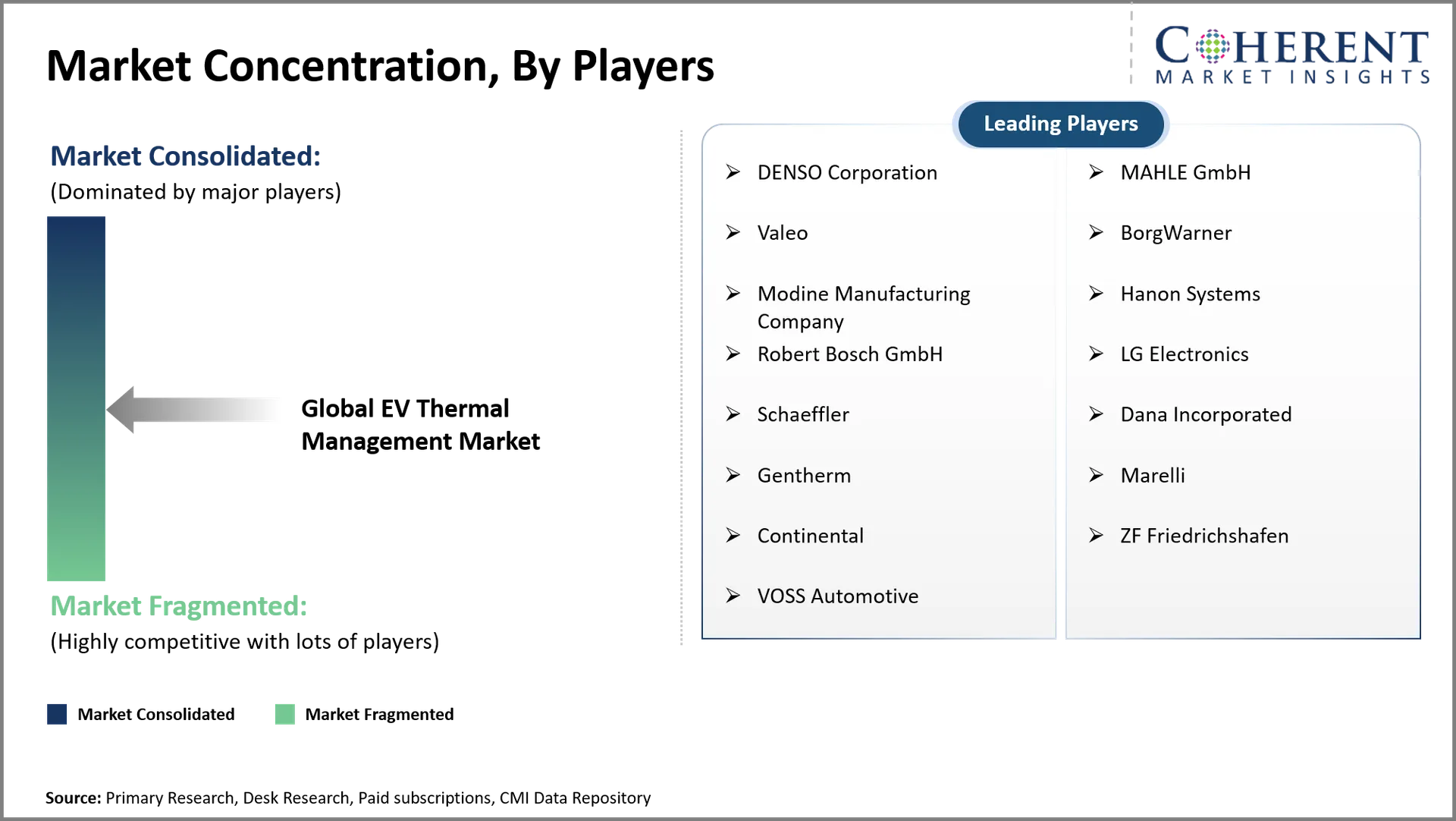
The competitive landscape is shifting toward integrated hardware and software rather than individual thermal components. Robert Bosch GmbH is developing pre-integrated thermal units combining pumps, valves, sensors, and coolant circuits. Its heat-pump unit can condition both batteries and vehicle cabins. Bosch also demonstrates dual-chiller and single-chiller architectures with predictive energy management. Valeo focuses on battery cooling, electric compressors, heat pumps, and cooling solutions for different cell formats. Its portfolio covers air, liquid, and refrigerant-based cooling architectures. Suppliers are increasingly competing around system integration, fast-charging cooling, refrigerant flexibility, software control, and compact packaging.
Top Manufacturers and Notable Products in the EV Thermal Management Market
Manufacturer | Notable Product | Key features |
Hanon Systems | R1234yf/R290 eCompressor | 33cc and 45cc modular designs, up to 800V operation, high-speed performance, support for R1234yf and R290 refrigerants |
MAHLE GmbH | Electric Air Conditioning Compressor | Up to 18 kW output, up to 900V operation, up to 57 cm³ displacement, refrigerant-cooled motor and electronics |
Valeo | Electrical Compressor 45cc 800V | 800V operation, high-efficiency inverter and motor, compact packaging, low weight, battery and cabin cooling support |
DENSO Corporation | Electric Compressor | Compact construction, high efficiency, quiet operation, strong reliability, optimized thermal-system performance |
BorgWarner Inc. | eBooster Electrically Driven Compressor | Integrated power electronics, compact design, high-speed electric motor, 12V and 48V options, rapid boost response |
Market Report Scope
Report Coverage | Details | ||
Base Year | 2025 | Market Size in 2026: | USD 25.40 Bn |
Historical Data For: | 2020 To 2024 | Forecast Period: | 2026 To 2033 |
Forecast Period 2026 To 2033 CAGR: | 13.3% | 2033 Value Projection: | USD 69.20 Bn |
Geographies covered: |
| ||
Segments covered: |
| ||
Companies covered: | DENSO Corporation, MAHLE GmbH, Valeo, BorgWarner, Modine Manufacturing Company, Hanon Systems, Robert Bosch GmbH, LG Electronics, Schaeffler, Dana Incorporated, Gentherm, Marelli, Continental, ZF Friedrichshafen, VOSS Automotive | ||
Growth Drivers: |
| ||
Restraints & Challenges: |
| ||
Analyst Opinion (Expert Opinion)
- The future of EV thermal management will center on coordinated heat-flow management across batteries, cabins, motors, and power electronics. Integrated thermal modules will increasingly replace fragmented component architectures. Predictive controls will become important because vehicles must manage numerous thermal operating modes simultaneously. Bosch already offers predictive software supporting battery preconditioning and waste-heat recovery.
- The strongest opportunities should emerge in battery electric vehicles using high-voltage batteries and high-power charging systems. Battery cooling, electric compressors, heat pumps, and integrated chillers should receive particular attention. China should remain a major opportunity because its battery manufacturing and electric vehicle production ecosystems are deeply integrated. Commercial electric vehicles also offer attractive opportunities because larger batteries create higher thermal loads.
- Market players should prioritize modular thermal platforms that support multiple vehicle architectures. Suppliers should combine pumps, valves, sensors, heat exchangers, compressors, and software into configurable systems. Bosch's flexible thermal units demonstrate this direction by combining multiple coolant components within compact modules. Companies should also develop refrigerant-flexible systems and predictive controls. These capabilities can improve platform scalability while reducing integration effort for vehicle manufacturers.
Speak to the analyst
Want personalized insights?
Take the findings above to one of our principal consultants, or have the report rebuilt around the segments, geographies and competitors you actually track.
Market Segmentation
- System Type Insights (Revenue, USD Billion, 2021 - 2033)
- Battery Thermal Management System
- Power Electronics Thermal Management
- Electric Motor Thermal Management
- Cabin Thermal Management
- Integrated Thermal Management Systems
- Technology Type Insights (Revenue, USD Billion, 2021 - 2033)
- Air Cooling
- Liquid Cooling
- Refrigerant Cooling
- Phase Change Cooling
- Immersion Cooling
- Component Insights (Revenue, USD Billion, 2021 - 2033)
- Compressor
- Heat Exchanger
- Cooling Plates
- Pumps And Valves
- Thermal Interface Materials
- Temperature Sensors
- Control Units
- Propulsion Type Insights (Revenue, USD Billion, 2021 - 2033)
- Battery Electric Vehicles
- Hybrid Electric Vehicles
- Fuel Cell Electric Vehicles
- Vehicle Type Insights (Revenue, USD Billion, 2021 - 2033)
- Passenger Vehicles
- Commercial Vehicles
- Regional Insights (Revenue, USD Billion, 2021 - 2033)
- North America
- U.S.
- Canada
- Latin America
- Brazil
- Argentina
- Mexico
- Rest of Latin America
- Europe
- Germany
- U.K.
- Spain
- France
- Italy
- Russia
- Rest of Europe
- Asia Pacific
- China
- India
- Japan
- Australia
- South Korea
- ASEAN
- Rest of Asia Pacific
- Middle East
- GCC Countries
- Israel
- Rest of Middle East
- Africa
- South Africa
- North Africa
- Central Africa
- North America
- Key Players Insights
- DENSO Corporation
- MAHLE GmbH
- Valeo
- BorgWarner
- Modine Manufacturing Company
- Hanon Systems
- Robert Bosch GmbH
- LG Electronics
- Schaeffler
- Dana Incorporated
- Gentherm
- Marelli
- Continental
- ZF Friedrichshafen
- VOSS Automotive
Sources
Primary Research Interviews
- EV Thermal System Engineers & OEM Representatives
- Battery Management System (BMS) Manufacturers
- Automotive HVAC Component Suppliers
- Electric Vehicle Fleet Operators & End Users
Magazines
- SAE Automotive Engineering Magazine
- Electric & Hybrid Vehicle Technology International
- Automotive World Magazine
- Battery Technology Magazine
Journals
- Journal of Power Sources (Elsevier)
- Applied Thermal Engineering Journal
- Journal of Energy Storage
Associations
- Electric Drive Transportation Association (EDTA)
- Society of Automotive Engineers (SAE International)
- European Automobile Manufacturers' Association (ACEA)
- Zero Emission Transportation Association (ZETA)
Public Domain Sources
- U.S. Department of Energy (DOE) – Alternative Fuels Data Center
- European Environment Agency (EEA) – EV & Emissions Data
- International Energy Agency (IEA) – Global EV Outlook Reports
- National Renewable Energy Laboratory (NREL) Publications
Proprietary Elements
- CMI Data Analytics Tool
- Proprietary CMI Existing Repository of information for last 10 years
Get access to 250+ pages report
Every segment, forecast, competitor profile and data table behind the analysis above — available for instant download.
- ESOMAR Member
- ISO 9001:2015 Certified
- D-U-N-S Registered
- GDPR & CCPA Compliant
Frequently Asked Questions
The global EV thermal management market is expected to stand at USD 25.40 Bn in 2026 and is expected to reach USD 69.20 Bn by 2033.
The CAGR of the global EV thermal management market is projected to be 13.3% from 2026 to 2033.
Rapid expansion of global electric vehicle production and Increasing battery energy density are the major factors driving the growth of the global EV thermal management market.
High system development costs and Complex thermal architecture integration are the major factors hampering the growth of the global EV thermal management market.
In terms of system type, battery thermal management system segment is estimated to dominate the market revenue share in 2026.
EV thermal management controls temperatures across batteries, motors, power electronics, charging systems, and passenger cabins.
An electric compressor circulates refrigerant within cooling and heating circuits serving cabins and other thermal loads.