

Global Fire Sprinkler Market Size and Forecast – 2026-2033
The global fire sprinkler market is estimated to be valued at USD 8.44 Bn in 2026 and is expected to reach USD 12.53 Bn by 2033, exhibiting a compound annual growth rate (CAGR) of 5.8% from 2026 to 2033.
Key Takeaways of the Sprinkler Market
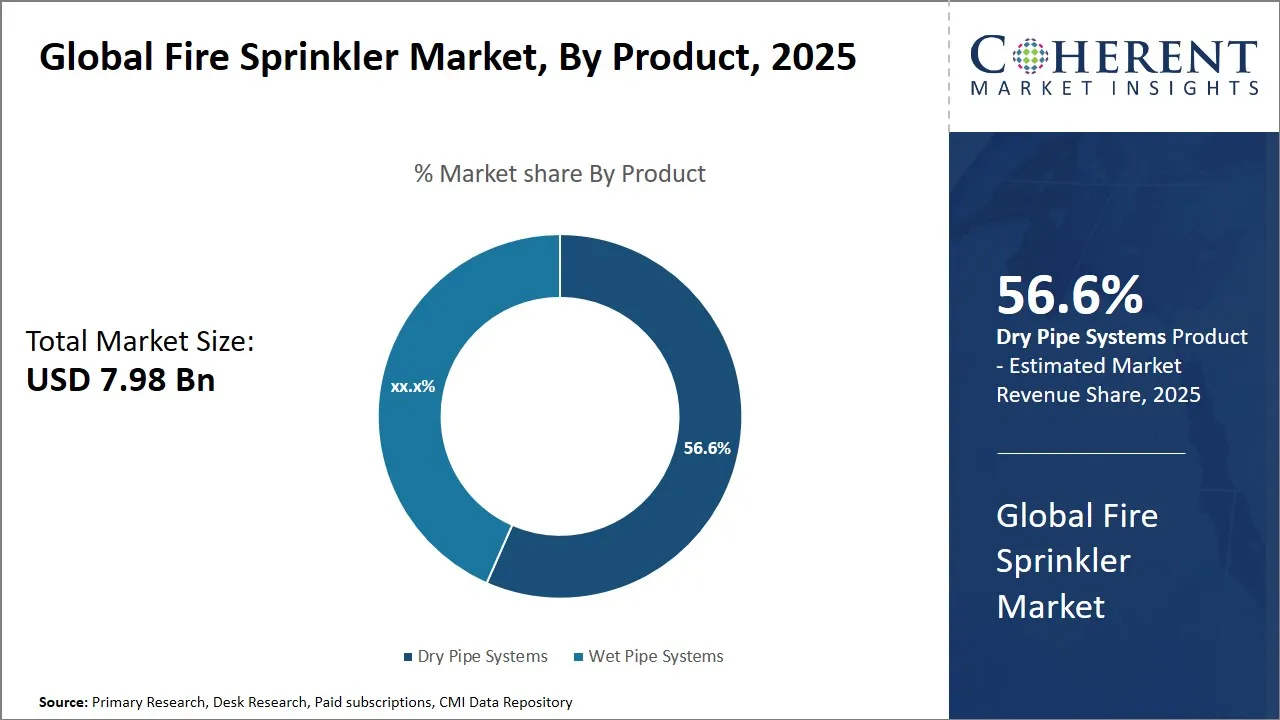
- Dry pipe systems segment is expected to dominate the global fire sprinkler market with a 57.6 % share in 2026.
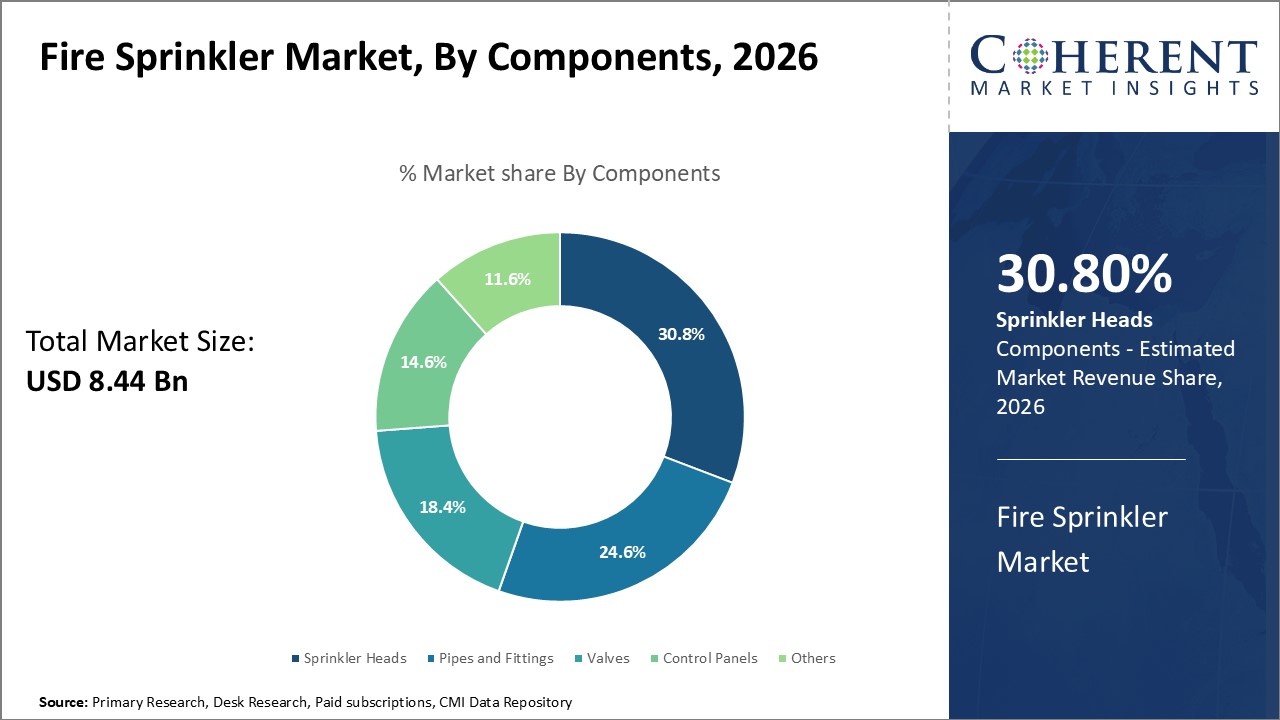
- The sprinkler heads segment is projected to hold a 30.8 % of the market share in 2026.
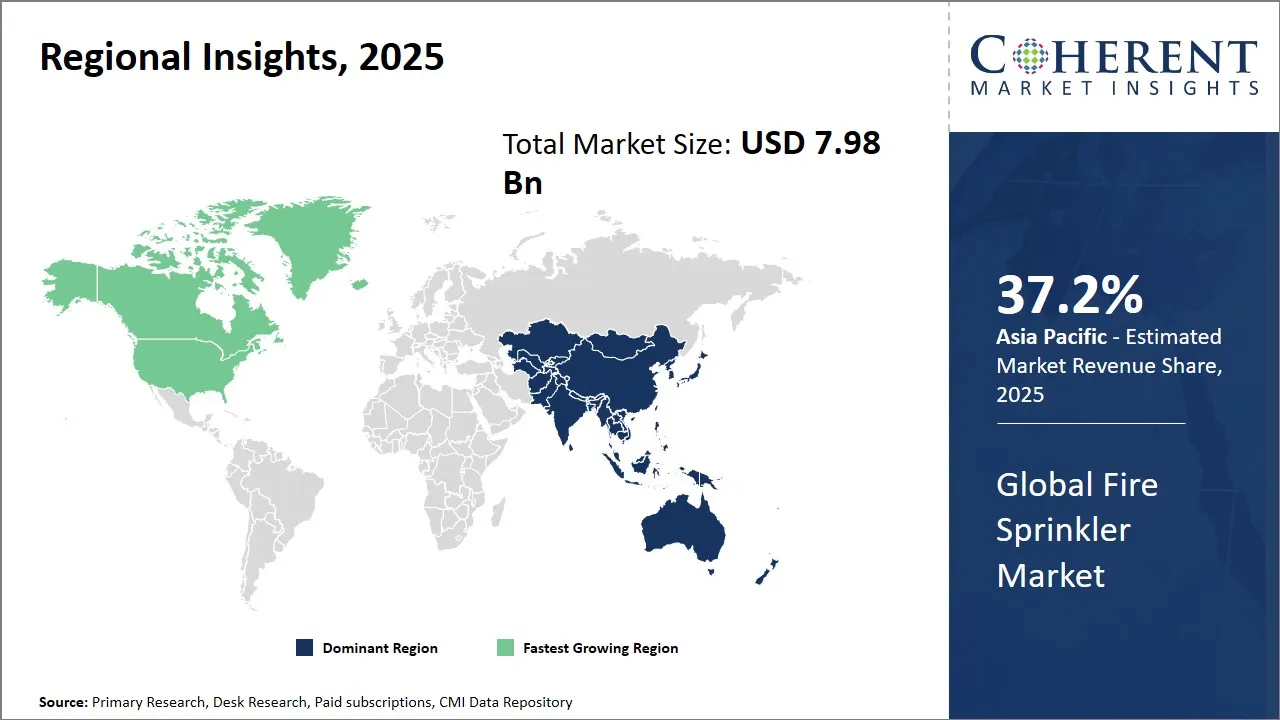
- Asia Pacific is set to lead the global fire sprinkler market in 2026 with a 37.2 % share. North America, with an estimated share of 19.5% in 2026, and it is projected to be the fastest-growing region.
Market Overview
According to market trends, there is a considerable tendency to convert the fire sprinkler systems to the use of smart technologies to provide a high level of real-time monitoring and response. Also, environmental friendly and water efficient fire suppression systems are in growing demand as sustainability becomes a priority. Increasing urbanization, safety standards, and use of superior materials are also influencing the concept of innovation and making the market shift towards affordable and more secure fire protection materials in the world.
Current Events and Its Impact
Current Events | Description and its Impact |
Integration of IoT and Smart Technologies in Fire Sprinklers |
|
Advancements in Fire Sprinkler Components and Materials |
|
Segmental Insights
- Current Industry Events of 2026
- Market Size Estimation
- Regional Breakdown
- Competitive Landscape
- Customer Intelligence
- Segmental Analysis
- Pricing Analysis
- Key Market Drivers, Challenges & Future Trends
- Customized Insights Section
Fire Sprinkler Market Insights, By Product - Dry Pipe Systems Segment Dominates the Market Driven by Enhanced Safety in Cold and Hazard-Prone Environments
The dry pipe systems hold the 57.6% of the global fire sprinkler market share in 2026. Attributable to the systems of freezing-prone environment or in an environment where a collection of water may be harmful. The wet pipe systems store water in the pipes, whereas dry pipe systems store pressurized air or nitrogen in the pipes until a fire triggers the sprinklers to discharge the water. This design includes in it the reduction of risk of freezing and bursting of pipes during cold weather or in unheated buildings, so dry pipe systems are more likely to be used in places of residence or facilities whereby temperature cannot be maintained.
For example, of dry pipe systems in action can be found in cold-storage facilities. These facilities, which house temperature-sensitive products like pharmaceuticals or frozen food, rely on dry pipe systems to ensure that sprinklers won't freeze during harsh winter conditions, providing continuous protection without the risk of water damage or disruption in the event of a fire.
Fire Sprinkler Market Insights, By Components - Sprinkler Heads Segment Dominates the Market Fueled by Technological Innovation and Fire Protection Standards
Sprinkler heads segment holds 30.8% of the market share in 2026. This domination can be greatly explained by the fact that sprinkler heads occupy the middle positions in fire detection and suppression, and they are constantly sustaining improvements and diversification to make them more efficient and able to adapt to a greater variety of needs and purposes. Sprinkler heads serve as the initial line of fire suppression systems in that they respond to changes in temperature and spray water directly over a source of fire. The design variability of pendant designs to upright designs to sidewall designs enables proper coverage of a large spectrum of architectural space and ceiling types. This flexibility renders sprinkler heads to be inevitable in nearly all fire sprinkler systems.
Fire Sprinkler Market Insights, By Application – Commercial Segment Leads the Market Driven by Urbanization and Regulatory Mandates
The commercial segment holds 35.7% of the global fire sprinkler market share in 2026. This dominance can be attributed to the speedy urbanization, increase in commercial property development and very strict fire safety laws that safeguard overcrowded and over-occupied premises. Offices, hotels, warehouses, and factories, as well as other commercial buildings, have a greater likelihood of fire occurrences because of various reasons, such as the use of more electrical equipment, storage of inflammable material, and the density of occupancy. These reasons bring fire protection solutions higher to the agenda, and fire sprinklers become essential safety measures.
Regional Insights
Asia Pacific Fire Sprinkler Market Analysis and Trends
The Asia Pacific region is projected to lead the market with a 37.2% share in 2026, due to rapid urbanization, increased industrialization as well as increasing investments in infrastructure development in the emerging economies. There is also an increasing focus on fire safety in countries such as China, India, Japan and the Southeast Asian countries where governments amend their regulations to ensure new construction and retrofit projects comply with fire safety.
Due to the increased construction works particularly in commercial complexes, residential towers, and warehouses, the need of advanced fire sprinkler solutions is aroused. The local market forces like Minimax Viking Group located in China, Yongxing Fire and the local subsidiaries of international companies are increasing their manufacturing capacity and services they provide, which assists in the offset of supply-demand gap. Trade forces prefer higher imports of sophisticated sprinklers and parts that will be complemented by production locally, to satisfy the rising demands.
North America Fire Sprinkler Market Analysis and Trends
The North America region is expected to exhibit the fastest growth in the market contributing 19.5% share in 2026, with well-established construction and industrial infrastructure, strict fire safety standard and widespread use of better fire protection technologies. The area is enjoying a comprehensive government policy that requires fire sprinklers to be installed in all commercial and household developments and this has gained the market a lot of penetration.
With continuing innovation in sprinkler technologies and large service networks, the ecosystem is further reinforced by the presence of the key industry players like Tyco SimplexGrinnell (a section of Johnson Controls), Viking Group Inc. and AMEREX Corporation. Moreover, the developed supply chain and trade relations in North Americas support stable supply and supply of the product and its acceptance in the United States and Canada, which strengthens the position of this country in the world market.
Global Fire Sprinkler Market Outlook for Key Countries
U.S. Fire Sprinkler Market Analysis and Trends
The U.S. fire sprinkler market is being defined by a rather high level of fire safety norm and a wide understanding of the advantages of fire sprinklers on the commercial and the residential market. The market is governed by key companies such as Tyco SimplexGrinnell and Viking Group Inc. who have large product range and service networks. The presence of strict regulations by organizations such as NFPA (National Fire Protection Association) increases the demand of high-tech sprinklers that are technology-enabled. The strong construction industry and the retrofit activities of the old buildings keep the market on the go.
China Fire Sprinkler Market Analysis and Trends
The high growth rate of the Chinese economy drives the growth of fire safety infrastructures hence making it a very important market within the Asian Pacific. The governments that are paying more attention to the safety of their cities and altered the fire regulations by enforcing the use of sprinklers in the new structures are significant drivers of demand. The major competitors like Minimax Viking Group and Yongxing Fire have increased local manufacturing and implemented new sprinkler technologies that meet the local requirements. The increasing industrial foundation and commercial construction equates to the increasing chances of the international company and domestic company.
India Fire Sprinkler Market Analysis and Trends
The market of fire sprinkler in India is rapidly changing along with the increasing urbanization and the development of the industrial sector. The rationale of government programs with the focus on fire safety requirements in urban-centers and intensive construction of IT parks, residential complexes and commercial properties are the crucial drivers in the market. Market entry entails international companies which come in through joint ventures and local organizations which result in low-cost, compliant sprinkler systems. The modernization drive in all industries and the general infrastructure in the population enhances the call to have a stable fire protection system.
Germany Fire Sprinkler Market Analysis and Trends
Germany, as a representative of Europe’s mature market, maintains steady growth through rigorous fire protection standards and high safety awareness. The country's robust industrial base, presence of advanced manufacturing, and retrofitting of older infrastructures sustain demand for quality fire sprinkler systems. Players like Bosch Security Systems and GTEC GmbH contribute significantly through innovation and customized solutions, supported by favorable trade environments within the European Union.
Brazil Fire Sprinkler Market Analysis and Trends
Brazil fire sprinkler market reflects growing awareness and regulatory enforcement related to fire safety, particularly within its expanding commercial and industrial sectors. Infrastructure investments and urban growth primarily in regions like São Paulo and Rio de Janeiro drive adoption of fire sprinklers. The market includes a mix of international companies such as Tyco and Viking, alongside Brazilian firms catering to local demand with region-specific requirements. Challenges like regulatory variations and economic fluctuations influence buying patterns but the overall outlook remains strongly positive amidst ongoing urban expansion.
Macro and Micro Economic Factors Impacting on Fire Sprinkler Market Growth
Macroeconomic Factors
- Urbanization and Infrastructure Expansion: Rapid urbanization and construction growth globally drive the installation of fire sprinklers in high-rise buildings, industrial parks, and public infrastructure. Smart city initiatives across nations such as the U.S., India, and China have intensified the integration of fire safety systems into urban planning frameworks.
- Regulatory Frameworks and Building Codes: Stringent government regulations mandating the use of sprinkler systems in new and existing structures significantly propel market demand. Standards like the U.S. NFPA 13, European EN 12845, and national construction codes in Asia Pacific underpin mandatory compliance.
- Economic and Construction Investment Cycles: The market’s health is tied to macro construction trends—economic slowdowns or real estate contractions can delay installations, while infrastructure stimulus programs create large-scale procurement opportunities for fire safety systems.
- Raw Material Inflation and Currency Volatility: Metal price fluctuations, geopolitical instability, and currency exchange rate shifts affect production costs, particularly for copper, steel, and brass fittings used in sprinkler manufacturing.
Microeconomic Factors
- Technological Advancements: Integration of IoT sensors, wireless monitoring, and AI-based fire detection systems has transformed product functionality, leading to a competitive advantage for manufacturers offering smart sprinklers.
- Product Innovation and Portfolio Diversification: Companies such as Johnson Controls, Viking Group, and Carrier are focusing on hybrid and modular sprinkler systems adaptable to multiple environments, enhancing both safety and cost-efficiency.
- Cost Structure and Profit Margins: High initial capital costs for installation and maintenance pose barriers in cost-sensitive markets. Manufacturers are investing in modular and retrofittable solutions to widen accessibility in developing economies.
Market Players, Key Development, and Competitive Intelligence
Key Developments
- In February 2024, Senju Sprinkler, California, a U.S.-based fire systems manufacturer, introduced specialized Pressure Gauges tailored for fire sprinkler systems, guaranteeing optimal safety and efficiency. Available in sizes of 2 inches and 3.5 inches with NPT (National Pipe Thread) sizes of ¼ inch and ½ inch, these gauges integrate with both residential and commercial fire systems. Additionally, 3.5-inch Pressure Gauges with ¼ inch NPT come standard with UL (Underwriters Laboratories) and FM (Factory Mutual) approvals, affirming their reliability and compliance with industry standards.
- In January 2022, Johnson Controls, Wisconsin, a U.S.-based fire protection manufacturer and a globally recognized leader in building solutions introduced its latest advancement: the Tyco Series LFII Residential 4.9 K-factor Lead-Free for 13D Sprinkler. Engineered with a polymeric material esteemed for its anti-heat and anti-corrosion properties, this concealed pendent sprinkler provides robust and enduring fire protection for residential environments.
Top Strategies Followed by Global Fire Sprinkler Market Players
- Established Players: The existing market players invest heavily in research and development to provide innovation in the high-performance fire sprinkler products. These companies are concentrating on the creation of more sophisticated technologies to enhance better detection, water conservation, and integration of systems with building management systems, resulting in high safety and adherence to the changing regulatory regulations.
- For example, the Tyco Fire Protection Products (since acquired by Johnson Controls) has been on the leading edge of technology and has created water-saving sprinkler systems as well as implemented IoT to provide real-time monitoring. Their WATERmist system is popular with commercial and industrial applications and is equipped with sophisticated detection, enhanced water consumption, thereby enhancing safety and minimizing damage.
- The mid-level fire sprinkler market players take a new but complementary strategy whereby their main orientation is to offer cheaper solutions that come up with optimum balance in terms of quality and price. The company’s focus on groups of consumers who are price-sensitive such as small to medium-sized businesses and residential projects, which allows a broader implementation of fire protection systems without affecting the vital performance indicators.
- As an illustration, Kidde Fire Systems is hitting the middle ground between the cost and functionality. They provide small business, school, and residential property fire sprinklers thereby expanding the scope of fire protection to a larger number of consumers.
- The small players in the world market of fire sprinklers have differentiation aimed at the niche markets or creation of more specialized and innovative products to suit specific customer needs. With the help of the latest technologies, including smart sensors, wireless connection and sustainable materials, these companies can create special features that their bigger rivals might overlook. The small players can offer tailored solutions to unique challenges by focusing on specific fire detection situations, like sensitive buildings, heritage buildings, or small residential apartments.
- For example, Firetrace International, a small firm that deals with specialized suppression systems, has come up with Firetrace Pre-Engineered Fire Suppression Systems, a system that is used in high-risk areas such as electrical room and machinery rooms. They employ the early-detection technologies in order to reduce the risk in the areas where the traditional systems might be less efficient.
Market Report Scope
Fire Sprinkler Market Report Coverage
| Report Coverage | Details | ||
|---|---|---|---|
| Base Year: | 2025 | Market Size in 2026: | USD 8.44 Bn |
| Historical Data for: | 2020 To 2024 | Forecast Period: | 2026 To 2033 |
| Forecast Period 2026 to 2033 CAGR: | 5.8% | 2033 Value Projection: | USD 12.53 Bn |
| Geographies covered: |
| ||
| Segments covered: |
| ||
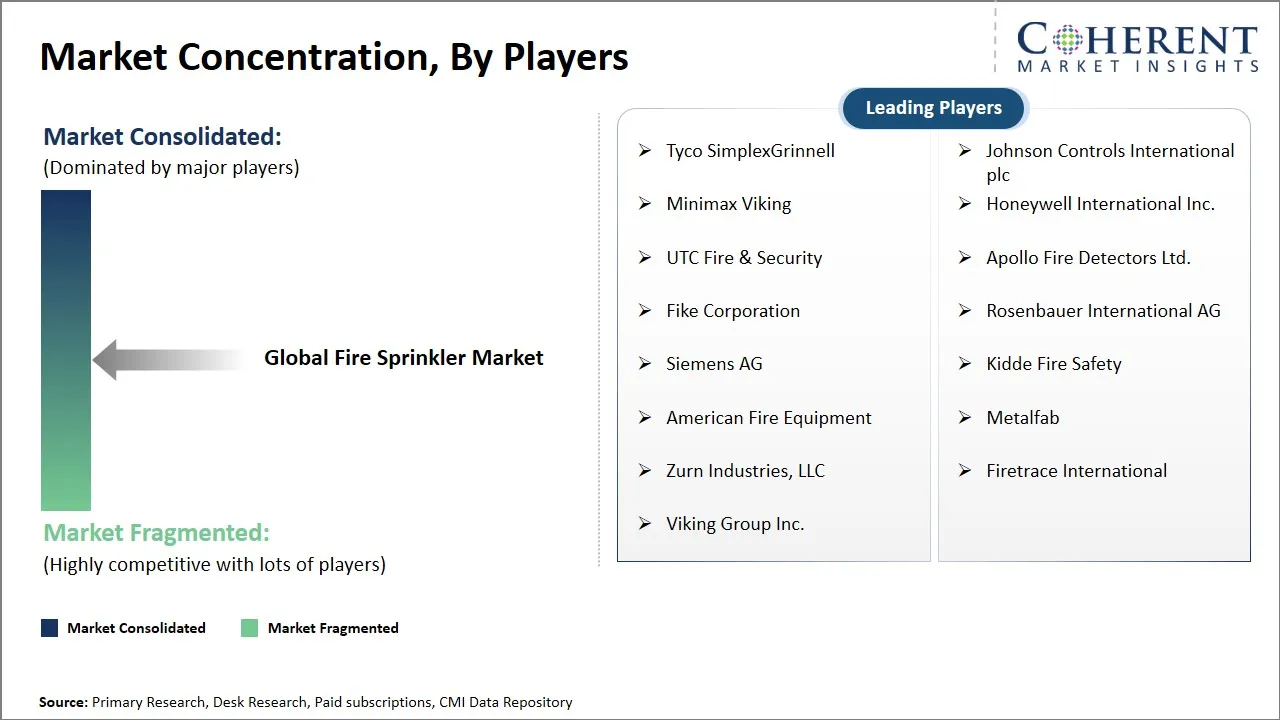
| Companies covered: | Tyco SimplexGrinnell, Johnson Controls International plc, Minimax Viking, Honeywell International Inc., UTC Fire & Security, Apollo Fire Detectors Ltd., Fike Corporation, Rosenbauer International AG, Siemens AG, Kidde Fire Safety, American Fire Equipment, Metalfab, Zurn Industries, LLC, Firetrace International, and Viking Group Inc. | ||
| Growth Drivers: |
| ||
| Restraints & Challenges: |
| ||
Fire Sprinkler Market Dynamics
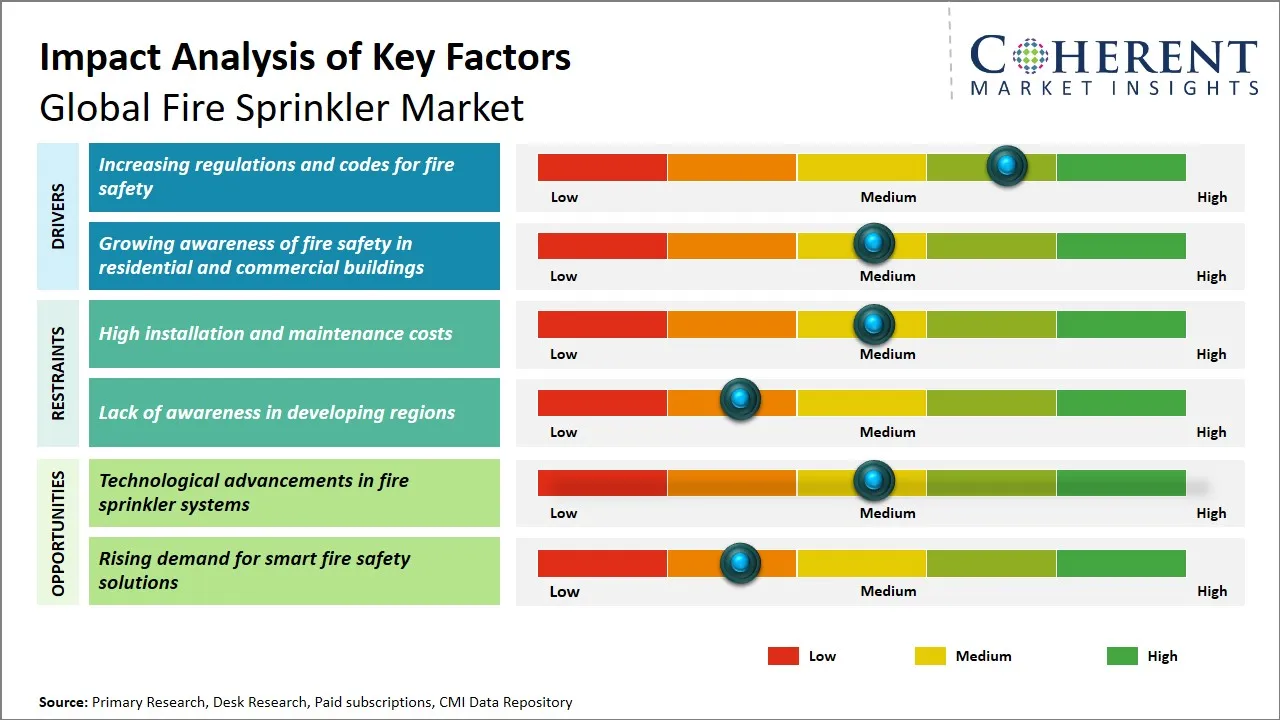
Fire Sprinkler Market Driver - Increasing Regulations and Codes for Fire Safety
The growing interest in strict fire safety regulations and building codes in the world is a major fuel to the fire sprinkler market. The governments and the regulatory authorities have been revising and implementing thorough fire safety laws which require residents, businesses, and industries to install and maintain fire sprinkler systems. These changing codes should minimize fire-related losses and damage property through provision of early fire detection and suppression capacity. The process of urbanization and the rise of high-rise buildings is another reason why the fire safety standards should be followed more stringently, and the construction companies and house owners are forced to invest in the sophisticated sprinkler systems.
As an example, the American fire safety organization of the National Fire Protection Association (NFPA) periodically revises its fire code documents such as the NFPA 13, which required the installation of automatic fire sprinkler systems in different building categories. In Europe, the European Union directives on fire safety have also provided strict conditions on new buildings and new buildings being renovated. These regulations have caused the demand of fire sprinklers to rise since the construction companies and property owners are required to adhere to these legal requirements.
Fire Sprinkler Market Opportunity - Technological Advancements in Fire Sprinkler Systems
The global fire sprinkler market is also recording a high growth due to the high growth in the technology which is transforming the conventional fire protection practices. Smart fire sprinkler systems with IoT (Internet of Things) sensor and other advanced detection systems are innovations that are improving the responsiveness and accuracy of the systems. The smart systems have the capability to read the environmental condition and only receive water when a sprinkler is set on when there is need to save water and false alarms. As well, building management systems allow smooth communication and coordination in case of fire incidents and can enhance the overall result of safety.
One of them is the creation of intelligent sprinkler systems that make use of Internet of Things (IoT) technologies. Other companies such as Siemens and Johnson Controls have designed modern fire safety systems, which make use of IoT sensors to be real-time monitors of the environment within the building.
Analyst Opinion (Expert Opinion)
- The global fire sprinkler market is witnessing a strong growth due to the rising levels of regulatory requirements and the growing levels of fire sensitivity both in the homes and in the commercial aspects. The National Fire Protection Association Conference (2023) and the Fire Safety Summit (2022) outlined a notable range of progress, including such companies as Tyco Fire Protection Products and Victaulic that drive the improvement of the sprinkler technology.
- The recent case of Tycos launching a smart sprinkler system with IoT capability can be seen as the example of the strategic step towards the increase of fire detection and response times to meet the increasing demand of the intelligent safety solutions. The talks in such conferences highlighted the importance of retrofitting the current buildings to have modern sprinkler systems in order to stay afloat with the changing safety codes.
- The barriers to adoption that were mentioned most often were the cost of installation and the necessity to employ skilled workers. Those companies, which emphasize on installer and end user training and education, are likely to enhance the market penetration. Also, collaborations with construction companies may lead to integration into new constructions. Finally, the future of the global fire sprinkler market will be based on how it is able to innovate and comply with the certification laws, as well as, respond to the needs of the various safety-conscious consumers.
Speak to the analyst
Want personalized insights?
Take the findings above to one of our principal consultants, or have the report rebuilt around the segments, geographies and competitors you actually track.
Market Segmentation
- Product Insights (Revenue, USD Bn, 2021 - 2033)
- Dry Pipe Systems
- Wet Pipe Systems
- Component Insights (Revenue, USD Bn, 2021 - 2033)
- Sprinkler Heads
- Pipes and Fittings
- Valves
- Control Panels
- Others
- Application Insights (Revenue, USD Bn, 2021 - 2033)
- Commercial
- Residential
- Regional Insights (Revenue, USD Bn, 2021 - 2033)
- North America
- U.S.
- Canada
- Latin America
- Brazil
- Argentina
- Mexico
- Rest of Latin America
- Europe
- Germany
- U.K.
- Spain
- France
- Italy
- Russia
- Rest of Europe
- Asia Pacific
- China
- India
- Japan
- Australia
- South Korea
- ASEAN
- Rest of Asia Pacific
- Middle East
- GCC Countries
- Israel
- Rest of Middle East
- Africa
- South Africa
- North Africa
- Central Africa
- North America
- Key Players Insights
- Tyco SimplexGrinnell
- Johnson Controls International plc
- Minimax Viking
- Honeywell International Inc.
- UTC Fire & Security
- Apollo Fire Detectors Ltd.
- Fike Corporation
- Rosenbauer International AG
- Siemens AG
- Kidde Fire Safety
- American Fire Equipment
- Metalfab
- Zurn Industries, LLC
- Firetrace International
- Viking Group Inc.
Sources
Primary Research Interviews
- Fire Protection Engineer – Leading Commercial Fire Sprinkler System Manufacturer
- Procurement Head – Construction and Real Estate Developer (Commercial Projects)
- Safety Compliance Manager – Industrial Plant Operator
- Standards & Certification Officer – Fire Safety Regulation Authority
Stakeholders
- Manufacturers (Wet Pipe, Dry Pipe, Pre-action, Deluge System Producers)
- End-use Sectors
- Commercial Buildings (offices, warehouses, retail, data centers)
- Industrial Facilities (manufacturing plants, chemical processing units)
- Residential and Mixed-use Developments
- Oil & Gas and Energy Infrastructure Projects
- Construction Companies and Building Contractors
- Fire Safety Regulatory and Certification Bodies (NFPA, UL, FM, ISO)
- Smart Building and IoT Integration Companies
Databases
- UN Comtrade Database
- India EXIM (Import–Export) Database
- Global Trade Atlas – Fire Protection Systems Data
Magazines
- Fire Protection Engineering Magazine – Advances in fire sprinkler design and standards
- Fire Safety Journal – Technological innovation in automatic suppression systems
- Industry Today – Market developments for industrial and commercial fire systems
- Building & Construction Review – Adoption of smart sprinklers and regulatory impact
Journals
- Fire Technology Journal – Performance studies of fire suppression systems
- Journal of Fire Sciences – Comparative research on fire extinguishing and sprinkler performance
- Safety Science Journal – Risk analysis and compliance studies for fire safety
- Fire Protection Engineering Review – System optimization and design improvements
Newspapers
- The Financial Times – Market analysis of fire protection and safety infrastructure
- The Guardian – Construction sector investments in safety systems
- The Economic Times – Growth of India’s fire safety and sprinkler market
- South China Morning Post – Fire safety reforms and adoption in Asia-Pacific real estate
Associations
- National Fire Protection Association (NFPA)
- Fire Suppression Systems Association (FSSA)
- European Fire Sprinkler Network (EFSN)
- British Automatic Fire Sprinkler Association (BAFSA)
- International Code Council (ICC)
Public Domain Sources
- NFPA – Codes and Standards (NFPA 13, 25, 72) for fire sprinklers
- Occupational Safety and Health Administration (OSHA) – Fire suppression requirements
- International Organization for Standardization (ISO 6182) – Fire protection standards
- European Commission – Construction Products Regulation for fire safety systems
Proprietary Elements
- CMI Data Analytics Tool, Proprietary CMI Existing Repository of information for last 8 years.
Get access to 250+ pages report
Every segment, forecast, competitor profile and data table behind the analysis above — available for instant download.
- ESOMAR Member
- ISO 9001:2015 Certified
- D-U-N-S Registered
- GDPR & CCPA Compliant
Missing comfort of reading report in your local language? Find your preferred language:
Transform your Strategy with Exclusive Trending Reports
Frequently Asked Questions
The global fire sprinkler market is estimated to be valued at USD 8.44 Bn in 2026 and is expected to reach USD 12.53 Bn by 2033.
The CAGR of the global fire sprinkler market is projected to be 5.8% from 2026 to 2033.
Fire sprinkler installers typically require certifications such as NICET Level I–IV in Water-Based Systems Layout, ASSE 15010 for inspection and testing, or NFPA certifications in Inspection, Testing, and Maintenance (ITM), depending on their specific roles and responsibilities.
Yes, eco-friendly fire sprinkler options include water mist systems, clean agent systems, and biodegradable foams, which reduce water usage, eliminate ozone-depleting substances, and minimize environmental impact.
Increasing regulations and codes for fire safety and growing awareness of fire safety in residential and commercial buildings are the major factors driving the growth of the global fire sprinkler market.
High installation and maintenance costs and lack of awareness in developing regions are the major factors hampering the growth of the global fire sprinkler market.
Tyco SimplexGrinnell, Johnson Controls International plc, Minimax Viking, Honeywell International Inc., UTC Fire & Security, Apollo Fire Detectors Ltd., Fike Corporation, Rosenbauer International AG, Siemens AG, Kidde Fire Safety, American Fire Equipment, Metalfab, Zurn Industries, LLC, Firetrace International, and Viking Group Inc. are the major players.