

Cement Grinding Aids Market Size and Share Analysis - 2026 To 2033
The cement grinding aids market is anticipated to grow at a CAGR of 5.8% with USD 3.56 Bn in 2026 and is expected to reach USD 5.25 Bn in 2033. The primary drivers are largely defined by rising cement production, increasing demand for energy-efficient grinding operations, growing use of blended cement, and the need to improve mill productivity and cement strength performance. Growth in construction (U.S. construction USD 2.25 trillion in 2026) and infrastructure activity increases cement consumption, which in turn supports demand for grinding aids used to improve mill efficiency, cement flowability, and strength consistency. The growing usage of blended cement, Portland limestone cement, slag cement, and supplementary cementitious material is emerging as a key growth driver for the cement grinding aids market.
Key Takeaways
- Amine-based Grinding Aids is expected to account the largest share of 42% in 2026, due to its strong performance, proven technology, broad adoption. Global cement production is above 4 Bn tonnes annually, making a strong demand for additives that improve grinding efficiency, reduce energy use, as well as increase mill output.
- Portland cement will dominate with 55% in 2026, widely produced and consumed cement type for residential construction, commercial buildings, infrastructure projects, and industrial applications. Residential construction is expected to grow by 1.1% in 2026.
- Ball mills will dominate with 45% in 2026, rapid construction activity along with expansion of cement capacity in emerging economies continue to support ball mill usage. Construction spending in May 2026 was estimated at an annual rate of USD 2.21 trillion in the United States. This was 0.1% higher than April 2026, reflecting a little increase in construction activity.
- Construction will dominate with 55% in 2026, used in residential buildings, commercial buildings, infrastructure projects, as well as industrial construction. As of 2026, India is tracking 1,941 major infrastructure projects worth ₹41.5 lakh crore. These projects include large government projects costing ₹150 crore or more. Around 391 projects are still in the early stage, with 0–20% completion.
- Asia Pacific is expected to acquire the dominant share of 46% in 2026, high cement production, urbanization, infrastructure investment. Jakarta has nearly 42 million residents, making it one of the world’s largest urban areas.
Segmental Insights
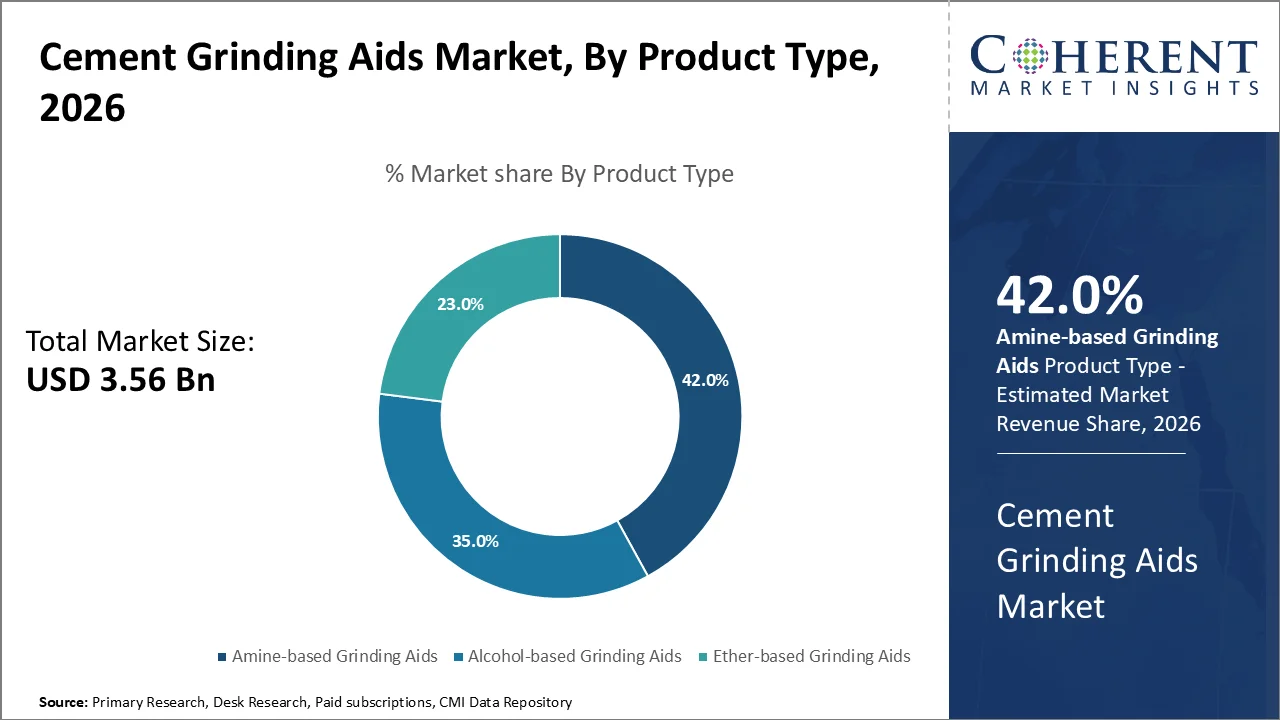
Why is Amine-based Grinding Aids Acquiring the Largest Market Share?
Amine-based grinding aids is projected to account for the largest share of product type in 2026, representing approximately 42% of the total volume. With to their well-established chemical compatibility with clinker minerals is propelling the market. Their ability to lower electrostatic agglomeration during the grinding process, as well as their long-standing commercial use across cement manufacturing facilities globally is further stimulating the growth.
The market is augmenting due to the chemistry of cement production along with the operational demands of modern grinding mills, making amine-based compounds the go-to product type for a vast majority of cement producers.
Amine-based Grinding Aids, particularly Triethanolamine (TEA) and Triisopropanolamine (TIPA), have held their stronghold in the cement grinding aids market owing to their multifunctional nature.
- Current Industry Events of 2026
- Market Size Estimation
- Regional Breakdown
- Competitive Landscape
- Customer Intelligence
- Segmental Analysis
- Pricing Analysis
- Key Market Drivers, Challenges & Future Trends
- Customized Insights Section
Portland Cement holds the Largest Market Share
Based on cement type, Portland cement dominates the market, accounting for a significant 55% share in 2026. Its unparalleled dominance in global construction activities, widespread regulatory acceptance, as well as its deeply embedded position across both developed and developing construction ecosystems are the growth inducing factors. Portland cement makes up only 12% to 15% of concrete, but it contributes around 90% of the total carbon emissions (embodied carbon) from concrete production.
The construction sector in Malaysia continued to surge in the first quarter of 2026, with the value of completed construction work reaching RM46.5 billion, an 8.5% increase compared with the previous year.
The high adoption of grinding aids in Portland Cement production is fueled by the need to improve the efficiency of the grinding process, lower energy consumption, as well as improve particle size distribution all of which directly translate into cost savings as well as improved cement quality for manufacturers.
Portland Cement remains the cornerstone of the global construction industry, and this foundational status is the primary reason it commands the leading share within the Cement Grinding Aids Market. According to the Portland Cement Association (PCA), Portland Cement is the most widely produced as well as consumed cement type across the globe, used in virtually every form of concrete construction, from residential buildings to large-scale infrastructure projects.
Ball Mills holds the Largest Market Share
Based on application, ball mills dominates the market, accounting for a significant 45% share in 2026. Owing to their high entrenched position in global cement manufacturing infrastructure, global cement production reached approximately 3.3 billion metric tons, high operational familiarity among plant engineers, as well as remarkable compatibility with a broad spectrum of grinding aid chemistries.
The dominance of ball mills is rather a consequence of decades of industrial investment, standardization, as well as continuous incremental improvement that has made this technology the backbone of cement grinding operations across both developed and developing economies.
Ball Mills have maintained their position as the leading application segment within the Cement Grinding Aids Market primarily because of the sheer volume of installed capacity worldwide. According to data published by the World Cement Association (WCA), the majority of global cement plants continue to operate ball mill systems as their primary grinding technology, in regions including Asia-Pacific, the Middle East, Africa, as well as Latin America, where large-scale cement production facilities were set during industrial expansion phases spanning from the 1970s through the 2000s.
Construction holds the Largest Market Share
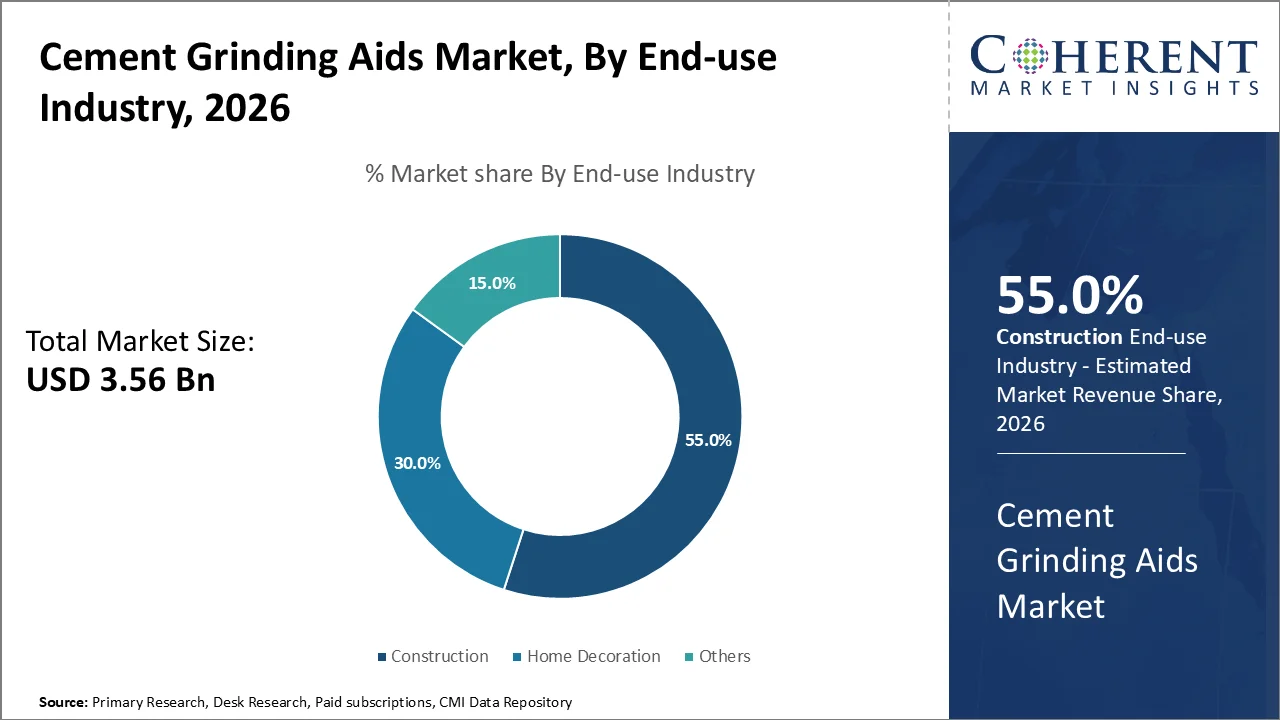
Based on end-use industry, construction dominates the market, accounting for a significant 55% share in 2026. The deeply entrenched dependency on high-performance cement products across a wide array of structural and civil engineering applications is stimulating the market.
The use of cement grinding aids in construction ensures optimized particle size distribution, enhanced early and final strength of cement, and improved flowability of the final product all of which are non-negotiable parameters when constructing buildings, bridges, dams, highways, and other critical infrastructure. According to the United Nations Environment Programme (UNEP), the buildings and construction sector represents 11% to 13% of global GDP.
The sheer scale at which construction activity operates globally makes this segment the undisputed leader in driving demand for cement grinding aids, along with several macroeconomic, regulatory, as well as policy-driven forces continue to sustain this dominance.
The commanding position of the construction sector is firmly rooted in the unprecedented surge in urbanization experienced across emerging as well as developed economies alike. According to the United Nations Human Settlements Programme (UN-Habitat), more than 68% of the population of the world is projected to live in urban areas by 2050, necessitating a massive expansion in housing stock, transportation networks, commercial buildings, and public utilities.
Market Drivers
Glycol-Based Grinding Aids is transforming the Cement Grinding Aids Industry
Glycol-based grinding aids are one of the oldest and most commonly used types of cement grinding additives. They work by sticking to the surface of clinker particles, lowering surface energy as well as preventing particles from sticking together. Common glycol-based chemicals include Diethylene Glycol (DEG), Propylene Glycol (PG), Monoethylene Glycol (MEG), Triethylene Glycol (TEG), etc. DEG is broadly used as it is cost-effective, while PG provides higher performance with lower environmental impact.
These grinding aids aid improve cement production by rising mill output, lowering energy use, as well as improving cement fineness (Blaine value). Glycol-based grinding aids can fuel mill output by around 5–15%, lower energy consumption by 3–8%, as well as improve grinding efficiency by making a more stable particle size distribution.
Rising Blended Cement and SCM Usage: A major breakthrough in Cement Grinding Aids
The growing usage of blended cement, Portland limestone cement, slag cement, and supplementary cementitious material is emerging as a key growth driver for the Cement Grinding Aids Market. In many cases, blended cements will have better particle-size distribution, fineness, and strength, and hence a greater requirement for grinding aids in the cement industry as well as in grinding plants.
According to the U.S. Geological Survey Mineral Commodity Summaries 2026, blended cement accounted for 63% of total cement shipments during the first nine months of 2025, and 95% of blended cement shipments were estimated to be portland-limestone cement Type IL.
In November 2025, Heidelberg Materials North America announced a binding agreement to acquire Walan Specialty Construction Products in Delaware. The acquired business includes a three-year-old slag grinding plant with a 150,000 tons/year vertical mill capacity.
Current Events and Their Impact on the Cement Grinding Aids Market
Current Event | Description and its Impact |
Global cement decarbonization policies as well as low-carbon cement initiatives (2025–2026) |
|
Stricter environmental regulations for cement emissions and energy consumption (2025–2030) |
|
Cement Grinding Aids Market Trends
- The most transformative trend reshaping the cement grinding aids market is the escalating pivot toward eco-friendly, low-VOC (volatile organic compound), as well as bio-based grinding aid formulations.
- The market is witnessing a decisive shift from conventional single-function grinding aids to advanced multifunctional performance enhancers (PEs) that simultaneously improve grinding efficiency, cement strength (early and late), workability, and clinker factor reduction.
- With the cement industry responsible for approximately 7–8% of global CO₂ emissions, producers face mounting pressure from governments, investors, as well as customers to reduce their carbon footprint. global GHG emissions increased by 1.3% compared to 2023, reaching 53.2 Gt CO2eq.
- The global transition from traditional ball mills to energy-efficient vertical roller mills as well as high-pressure grinding roll (HPGR) systems is impacting grinding aid formulation requirements. According to the CII-Green Business Centre 2025 energy benchmarking study, the average electrical energy required for a metric ton of cement produced at Indian cement facilities was about 73 kWh.
Regional Insights
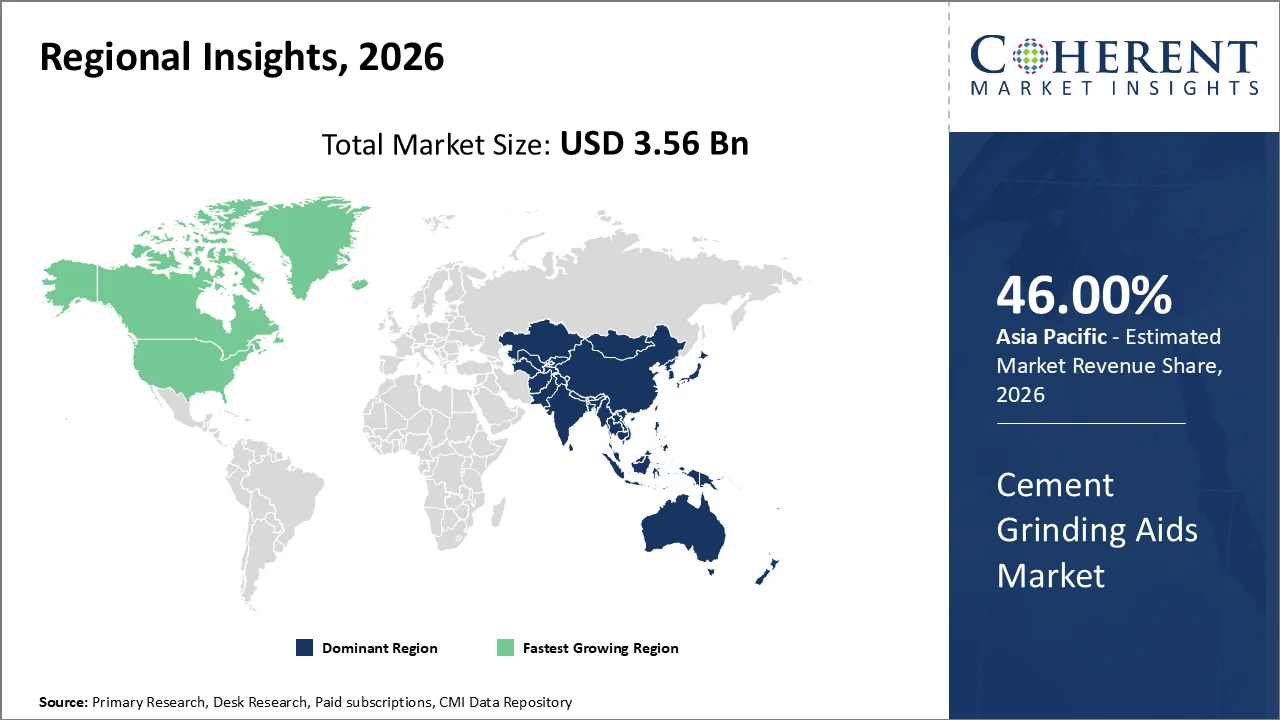
Asia Pacific dominates owing to owing to the extraordinary scale of cement manufacturing infrastructure
Asia Pacific account 46% market share in 2026, owing to the extraordinary scale of cement manufacturing infrastructure, rapid urbanization, and sustained government-backed construction activity across key economies including China, India, Japan, South Korea, and Southeast Asian nations. According to Atradius, the Asia Pacific region accounts for 45% of the world's construction output.
China alone has more than half of global cement production, according to a data published by the Global Cement and Concrete Association (GCCA), making it the single largest consumer of cement grinding aids globally.
The continued emphasis by the Chinese government authorities on infrastructure investment under its 14th Five-Year Plan (2021–2026), which assign major capital toward transportation networks, urban housing, as well as industrial zones, has created an uninterrupted demand pipeline for cement and associated chemical additives including grinding aids.
In January 2026, Dalmia Bharat announced the commissioning of a 3.6 MnTPA clinker Line 2 at its Umrangsho plant in Assam, India. The company also highlighted its 2.4 MnTPA cement grinding unit at Lanka, Assam, commissioned in 2025, strengthening cement production in Northeast India.
North America Cement Grinding Aids Market Trends
The North America region is poised to be the fastest-growing region through 2026-2033, expanding at a CAGR of approximately 6.8%. A surge in construction activity, infrastructure renewal programs, as well as sustainability-focused initiatives are the factors propelling the market. According to Construction Coverage, the U.S. construction market was valued at about USD 2.2 trillion in 2025. The construction industry also contributed 4.4% of the U.S. GDP, showing its major role in the economy of the country.
The passage of the Infrastructure Investment and Jobs Act in the United States allocated approximately USD 1.2 trillion toward rebuilding roads, bridges, airports, and utilities, making an unprecedented downstream demand for cement that has compelled manufacturers to maximize grinding efficiency using chemical aids.
This legislative push has directly incentivized cement producers to scale their production output while handling energy-efficient operations, making grinding aids a major component of their operational strategy. The United States Geological Survey (USGS) has documented consistent surges in cement shipments in multiple consecutive quarters, showing the high production pressure that manufacturers are managing through the adoption of grinding aid technologies.
The Deeply Entrenched Industrial Infrastructure is Accelerating the Cement Grinding Aids Market Demand in China
China contributes the highest share in the cement grinding aids market in Asia Pacific, the extraordinarily dominant position in global cement manufacturing as well as its deeply entrenched industrial infrastructure supporting large-scale cement production operations are augmenting the market growth. National Bureau of Statistics of China has consistently reported that the country produces more than half of the total cement output of the world annually, making it the undisputed epicenter of cement manufacturing activity across the globe.
This high production volume makes an exceptionally high as well as sustained demand for cement grinding aids, which are integral to enhancing mill efficiency, reducing energy consumption during the grinding process, and improving the overall quality of the final cement product.
The continued push by Chinese government through policy frameworks such as the "14th Five-Year Plan for Green Industry Development" has actively supported cement manufacturers to adopt energy-efficient additives and grinding technologies, directly propelling grinding aid adoption rates across the country.
U.S. Cement Grinding Aids Market Trends
The U.S. contributes the highest share in the cement grinding aids market in North America, its deeply entrenched cement manufacturing infrastructure, robust construction activity, in line with the well-established industrial chemical supply chains that collectively drive consistent demand for performance-enhancing additives.
The U.S. cement industry, as reported by the Portland Cement Association (PCA), operates over 90 cement plants across the country, making it one of the largest cement-producing nations in the Western Hemisphere. This expansive manufacturing base inherently necessitates the high use of grinding aids to improve mill efficiency, lower energy consumption, as well as optimize particle size distribution during clinker grinding.
Furthermore, the Biden administration's Infrastructure Investment and Jobs Act, which committed over USD 1.2 trillion to infrastructure renewal including roads, bridges, airports, as well as public transit systems, has majorly bolstered cement consumption volumes across the country.
Who are the Major Companies in Cement Grinding Aids Industry
Some of the major key players in Cement Grinding Aids market include, Ashtech India Pvt. Ltd, BASF SE, CHRYSO SAS, Ecmas Group, GCP Applied Technologies Inc., KMCO LLC, MYK Schomburg, PROQUICESA, Shalimar Tar Products, Sika AG, Thermax Global, and Unisol
Key News
- In July 2026, Nuvoco Vistas Corp. Ltd., a leading building materials company in India, announced its financial results for the quarter ended June 30, 2026. The company opened a new cement grinding unit with a capacity of 2 million metric tonnes per year (MMTPA) at its Limla Cement Plant in Surat, ahead of schedule. This shows the strong ability of the company to complete projects on time.
- In October 2025, Shree Digvijay Cement Company Limited has doubled its annual cement production capacity from 1.5 million tonnes to 3.0 million tonnes by starting a new cement grinding plant at its Sikka-Digvijaygram facility in Jamnagar, Gujarat. The expanded capacity became operational on October 1, 2025.
Market Report Scope
Cement Grinding Aids Market Report Coverage
| Report Coverage | Details | ||
|---|---|---|---|
| Base Year: | 2025 | Market Size in 2026: | USD 3.56 Bn |
| Historical Data for: | 2020 To 2024 | Forecast Period: | 2026 To 2033 |
| Forecast Period 2026 to 2033 CAGR: | 5.8% | 2033 Value Projection: | USD 5.25 Bn |
| Geographies covered: |
| ||
| Segments covered: |
| ||
| Companies covered: | Ashtech India Pvt. Ltd, BASF SE, CHRYSO SAS, Ecmas Group, GCP Applied Technologies Inc., KMCO LLC, MYK Schomburg, PROQUICESA, Shalimar Tar Products, Sika AG, Thermax Global, and Unisol | ||
| Growth Drivers: |
| ||
| Restraints & Challenges: |
| ||
Analyst Opinion
- The cement grinding aids market is experiencing high momentum, primarily driven by the construction industry's increasing demand for high-performance and energy-efficient cement production processes.
- Grinding aids play a major role in lower energy consumption during the clinker grinding process, making them indispensable for cement manufacturers looking for operational cost optimization.
- The high infrastructure development activities across emerging economies, particularly in Asia-Pacific as well as the Middle East, are majorly propelling the demand for advanced grinding aid formulations.
- However, the market faces certain restraints, including stringent environmental regulations governing chemical additives in construction materials as well as volatility in raw material prices, which can challenge profit margins for manufacturers. Additionally, limited awareness about the long-term performance benefits of grinding aids among small-scale cement producers poses a major adoption barrier.
- On the opportunity front, the high focus on sustainable construction practices is encouraging manufacturers to develop eco-friendly, bio-based grinding aid solutions.
- The escalating trend toward blended cement production, incorporating supplementary cementitious materials like fly ash and slag, presents substantial opportunities for innovative grinding aid formulations.
Speak to the analyst
Want personalized insights?
Take the findings above to one of our principal consultants, or have the report rebuilt around the segments, geographies and competitors you actually track.
Market Segmentation
- By Product Type (Revenue, USD Bn, 2021-2033)
- Amine-based Grinding Aids
- Monoethanolamine (MEA)
- Diethanolamine (DEA)
- Treiethanolamine (TEA)
- Triisopropanolamine (TIPA)
- Alcohol-based Grinding Aids
- Ethylene Glycol (EG)
- Diethylene Glycol (DEG)
- Ether-based Grinding Aids
- Poly Carboxylate Ether (PCE)
- Amine-based Grinding Aids
- By Cement Type (Revenue, USD Bn, 2021-2033)
- Blended Cement
- Hydraulic Cement
- Portland Cement
- Others
- By Application (Revenue, USD Bn, 2021-2033)
- Ball Mills
- Vertical Mills
- Ground-granulated Blast-furnace Slag (GGBS) Grinding
- By End-Use Industry (Revenue, USD Bn, 2021-2033)
- Construction
- Home Decoration
- Others
- By Region (Revenue, USD Bn, 2021-2033)
- North America
- U.S.
- Canada
- Latin America
- Brazil
- Mexico
- Argentina
- Rest of Latin America
- Europe
- Germany
- U.K.
- France
- Italy
- Spain
- Russia
- Rest of Europe
- Asia Pacific
- China
- India
- Japan
- Australia
- South Korea
- ASEAN
- Rest of Asia Pacific
- Middle East
- GCC
- Israel
- Rest of Middle East
- Africa
- South Africa
- Central Africa
- North Africa
- North America
Sources
Primary Research Interviews
- Cement Manufacturers & Producers
- Chemical Additives & Grinding Aid Suppliers
- Construction Industry Professionals & End-Users
- Cement Plant Operations & Process Engineers
- Others
Databases
- S&P Global Market Intelligence
- ICIS Chemical Business Database
- Global Cement Trade & Production Database (ITC Trade Map)
- Others
Magazines
- Global Cement Magazine
- World Cement Magazine
- International Cement Review
- Construction Chemicals & Materials Magazine
- Others
Journals
- Cement and Concrete Research Journal
- Journal of Construction and Building Materials
- Journal of Chemical Engineering & Industrial Chemistry
- Others
Newspapers
- The Economic Times (Infrastructure & Industry Section)
- Financial Times (Commodities & Materials)
- The Wall Street Journal (Industrial Markets)
- Others
Associations
- Portland Cement Association (PCA)
- European Cement Association (CEMBUREAU)
- World Cement Association (WCA)
- Global Cement and Concrete Association (GCCA)
- Others
Public Domain Sources
- U.S. Geological Survey (USGS) – Mineral Resources Data
- United Nations Industrial Development Organization (UNIDO)
- World Bank – Infrastructure & Construction Reports
- European Commission – Chemical Industry Regulatory Reports
- Others
Proprietary Elements
- CMI Data Analytics Tool
- Proprietary CMI Existing Repository of information for last 10 years
Get access to 250+ pages report
Every segment, forecast, competitor profile and data table behind the analysis above — available for instant download.
- ESOMAR Member
- ISO 9001:2015 Certified
- D-U-N-S Registered
- GDPR & CCPA Compliant
Missing comfort of reading report in your local language? Find your preferred language:
Transform your Strategy with Exclusive Trending Reports
Frequently Asked Questions
The cement grinding aids market is expected to reach USD 5.25 Bn in 2033.
Major players operating in the global cement grinding aids market include Ashtech India Pvt. Ltd, BASF SE, CHRYSO SAS, Ecmas Group, GCP Applied Technologies Inc., KMCO LLC, MYK Schomburg, PROQUICESA, Shalimar Tar Products, Sika AG, Thermax Global, and Unisol.
Strict chemical handling and environmental regulations, compatibility issues with different cement compositions, raw material price volatility, and performance variation across blended cement systems is one of the major factors that is expected to hamper growth of the market over the forecast period.
Increasing demand for energy-efficient cement grinding operations, rising use of blended cement and Portland-limestone cement, growing cement consumption in construction and infrastructure, and the need to improve mill throughput are driving growth of the global Cement Grinding Aids market.
The cement grinding aids market is anticipated to grow at a CAGR of 5.8% between 2026 and 2033.
Among regions, Asia Pacific is expected to account for a largest market share in the global cement grinding aids market over the forecast period.
The cement grinding units not only reduce the particles of feeding materials, but also help to produce cracks and flaws inside the particles, which largely increase the production capacity of cement mill, and reduce energy consumption.