

Global Fish Glue Market Size and Forecast – 2026 To 2033
The global fish glue market is estimated to be valued at USD 24.8 Mn in 2026 and is expected to reach USD 36.8 Mn by 2033, exhibiting a compound annual growth rate (CAGR) of 5.8% from 2026 to 2033. Growth is supported by increasing adoption of natural and biodegradable adhesives across woodworking, bookbinding, furniture restoration, leather bonding, paper repair, and art conservation applications. Fish glue is preferred in these niche uses because it offers strong tack, good adhesion on porous materials, reversibility, and compatibility with delicate substrates.
The market is also benefiting from the growing use of fish-processing by-products, including bones, skins, scales, and swim bladders, which improves sustainability and raw material utilization. In June 2024, Greener Journals published a study on glue production from catfish bones, evaluating fish bones as a value-added adhesive raw material and highlighting waste-to-value opportunities in fish glue manufacturing.
Key Takeaways of the Global Fish Glue Market
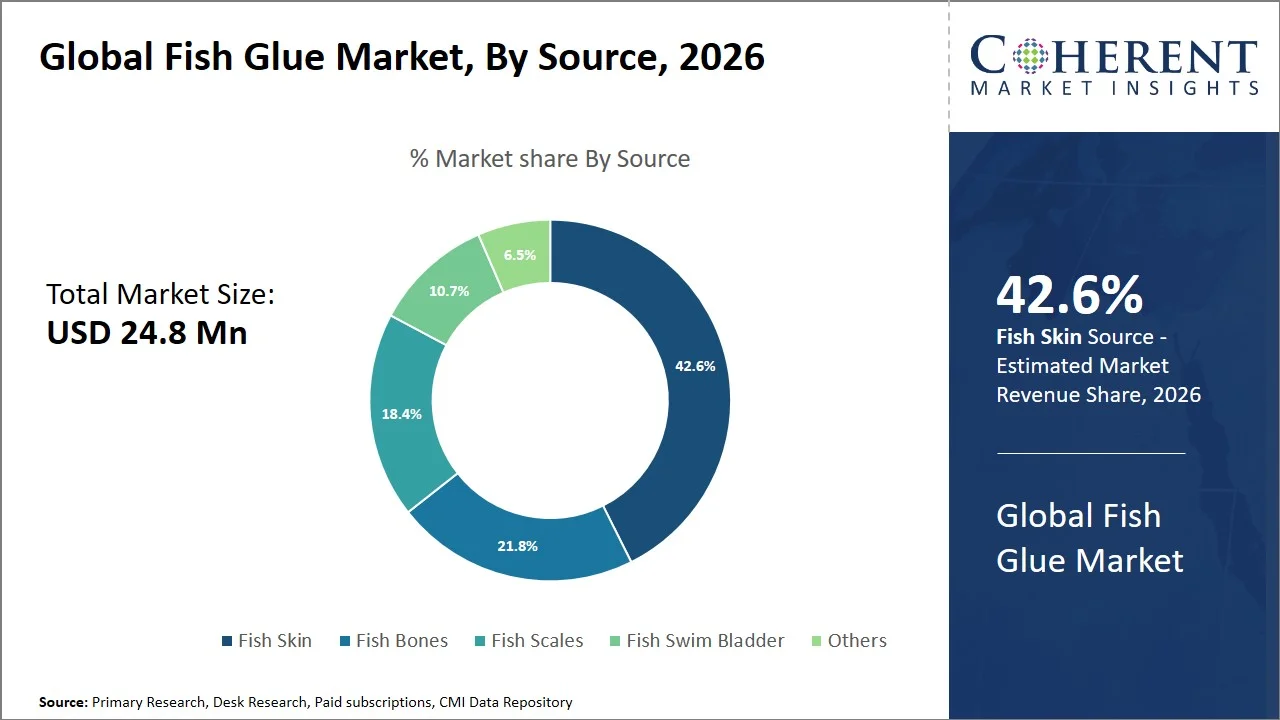
- Fish skin is expected to dominate the global fish glue market with 42.6 % share in 2026, as it offers a collagen-rich input stream for adhesive and gelatin-based formulations. In 2024, the National Livestock Mission (NLM) highlighted fish skin as a promising gelatin source due to its high protein and collagen content, supporting by-product valorization. (Source: National Livestock Mission NLM)
- Liquid fish glue is expected to hold 39.5 % share in 2026, supported by easier application, long open time, and suitability for wood, cardboard, leather, and repair uses. Norland Products’ 2025 technical sheet lists its high tack fish glue as a brush-on liquid with one-minute tack and reactivation properties. (Source: Norland Products)
- Woodworking and Furniture Adhesives are expected to account for 31.2% share in 2026, as fish glue is widely used in wood bonding, furniture restoration, veneering, and heritage furniture repair due to its strong tack, reversibility, and compatibility with porous wood surfaces. A 2025 study developed a fish glue reinforced filler for Ming Qing lacquer furniture, achieving 1.61 MPa dry adhesive strength and 85.32% waterproof rate, supporting its relevance in furniture restoration applications. (Source: Springer Nature Limited)
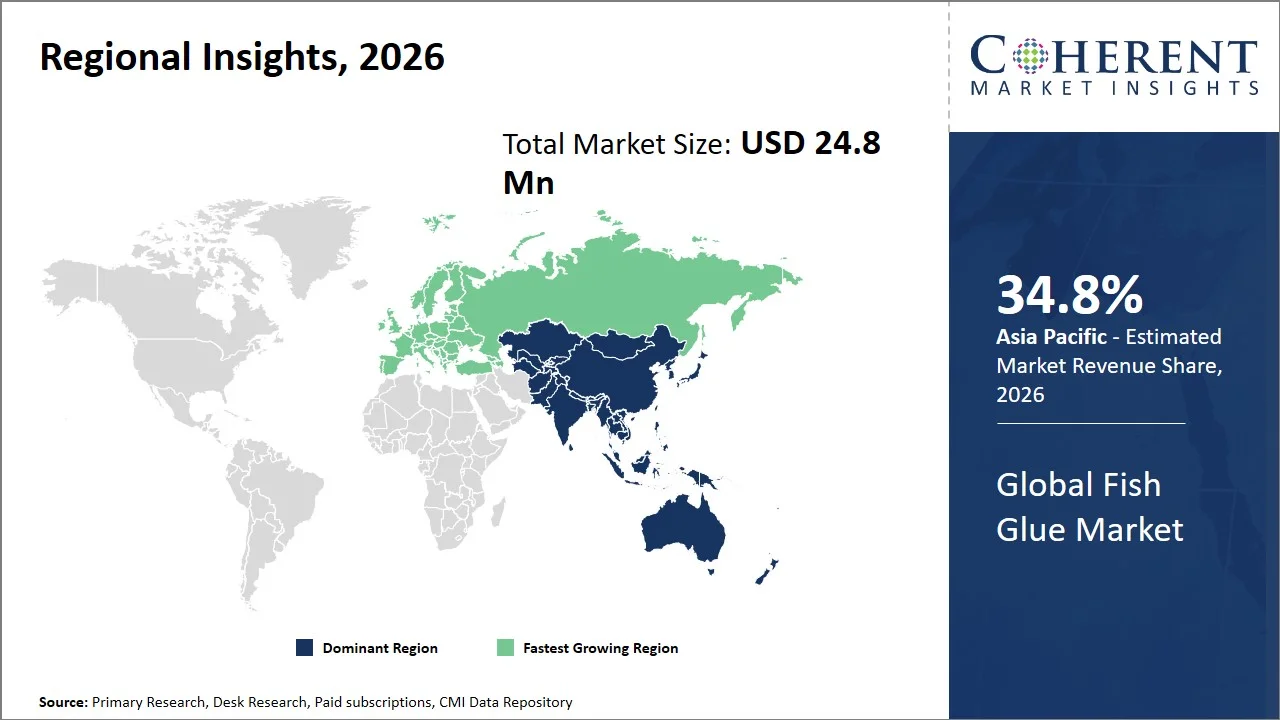
- Asia Pacific is expected to dominate the market with 34.8 % share in 2026, supported by large fish-processing output and stronger availability of collagen-rich by-products. According to : Food and Agriculture Organization (FAO), Asian countries produced 70% of global aquatic animal output, with China, India, Indonesia, and Vietnam among the leading producers. (Source: Food and Agriculture Organization)
- Europe is projected to be the fastest-growing regional segment, anticipated to capture a 29.6% share in 2026, driven by rising conservation-related demand and increased regulatory scrutiny on emissions from synthetic adhesives. Fraunhofer WKI noted that stricter EU formaldehyde emission limits for wood-based materials and furniture will apply from August 6, 2026, improving interest in low-emission alternatives. (Source: Fraunhofer WKI)
- Circular by-product utilization gains momentum: Fish glue producers are positioned to benefit from circular blue economy models that convert skins, bones, and scales into higher-value collagen-based materials. A 2024 Marine Drugs review assessed collagen extraction from fish by-products using acid, enzyme, ultrasound, deep eutectic solvent, and supercritical fluid methods, widening technical pathways for commercialization.
- Conservation-grade performance is improving: Fish glue is gaining relevance in heritage restoration where reversibility, compatibility, and traditional material matching are valued. In 2025, a Heritage Science study developed a fish glue-reinforced lacquer filler for Ming-Qing furniture, achieving 1.61 MPa dry bonding strength and 85.32% waterproof rate, outperforming commercial epoxy-based fillers.
Segmental Insights
Why Does Fish Skin Dominate the Global Fish Glue Market by Source?
Fish skin is expected to dominate the source segment with 42.6% share in 2026, as it provides a collagen-rich and relatively easier-to-process input compared to bones, scales, and swim bladder. Demand is the strongest from adhesive formulators requiring consistent viscosity, tack strength, and clean film formation for paper bonding, restoration, and specialty adhesive uses. From the supply side, fish skin is widely generated during filleting and seafood processing, making it commercially accessible for collagen extraction. In 2026, Multidisciplinary Digital Publishing Institute (MDPI) published a study in Polymers on milkfish skin collagen and polyvinylpyrrolidone biohybrid adhesive for sustainable paper bonding, demonstrating the conversion of fish skin waste into functional adhesive materials.(Source: Multidisciplinary Digital Publishing Institute MDPI)
- Current Industry Events of 2026
- Market Size Estimation
- Regional Breakdown
- Competitive Landscape
- Customer Intelligence
- Segmental Analysis
- Pricing Analysis
- Key Market Drivers, Challenges & Future Trends
- Customized Insights Section
Why Does Liquid Fish Glue Represent the Largest Product Form Segment in the Global Fish Glue Market?
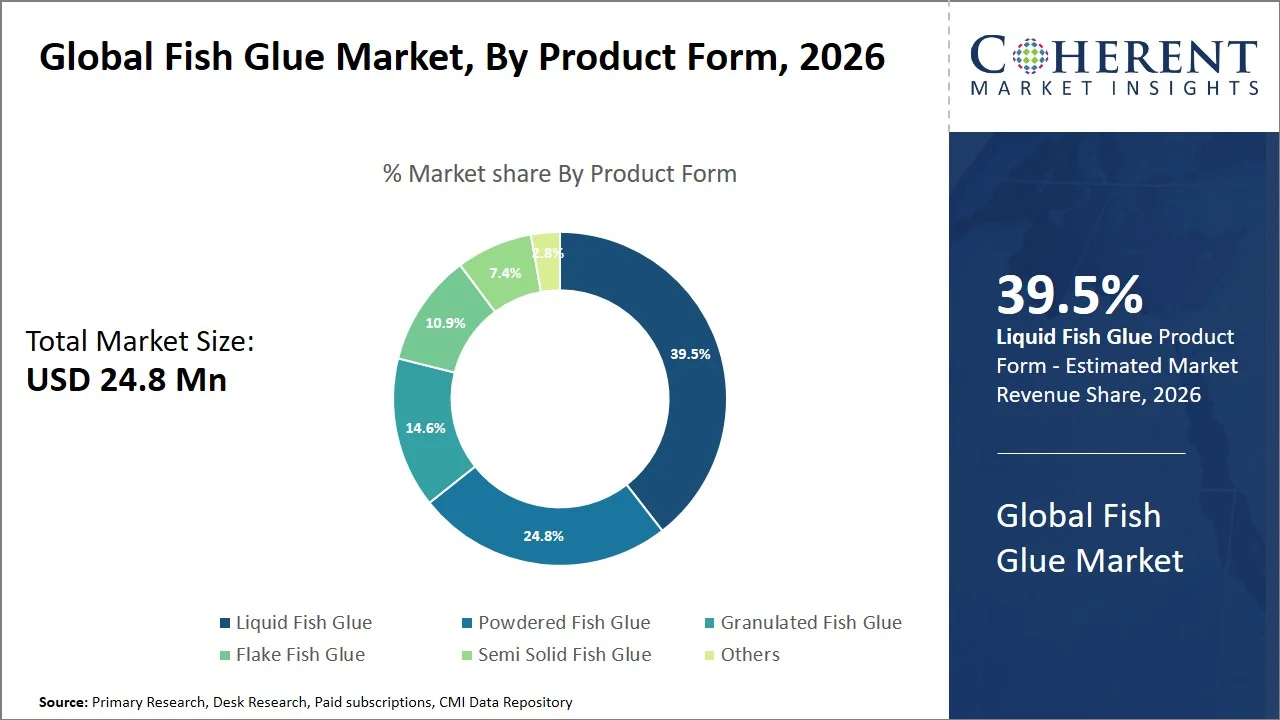
Liquid fish glue is expected to lead the product form segment with 39.5% share in 2026, mainly because it is ready to use, easy to brush, and suitable for precision applications where heating or pre-dissolving dry glue is inconvenient. Demand is concentrated among restorers, artists, bookbinders, and small-scale woodworking users who value controlled application, flexibility after drying, and reversibility. From a technology standpoint, liquid formulation reduces preparation time and supports use on paper, gesso, gilding, and delicate repair surfaces. A relevant commercial instance is L. Cornelissen & Son’s Seccotine, listed as a refined liquid fish glue for gilding, paper gluing, and raised illumination gesso applications. (Source: Cornelissen & Son)
Why Do Woodworking and Furniture Adhesives Dominate the Global Fish Glue Market by End-use Application?
Woodworking and furniture adhesives are expected to dominate the market, accounting for with 31.2% of the market share in 2026, as fish glue offers strong adhesion, elasticity, and compatibility with wood, veneer, joinery, and repair work. Demand is supported by furniture restoration, premium woodworking, and applications where natural bonding systems are preferred over synthetic adhesives. Supply-side innovation is also improving moisture stability, which has traditionally limited wider industrial use. In August 2024, MDPI’s Polymers journal published a study on fish protein-based adhesives modified with iron, copper, and zeolite powders, evaluating their bonding performance on beech lap joints and highlighting improved stability under high-humidity conditions for wood-based applications.
Currents Events and their Impactp
Current Events | Description and its Impact |
China implements GB 4806.15 2024 for food contact adhesives in February 2025 |
|
India updates food packaging compliance framework (April 2025) |
|
Japan strengthens positive list compliance for food contact materials June 2025 |
|
(Source: Keller and Heckman LLP., TÜV SÜD, Food Safety and Standards Authority of India, Ministry of Health)
Global Fish Glue Market Dynamics
Key Market Drivers
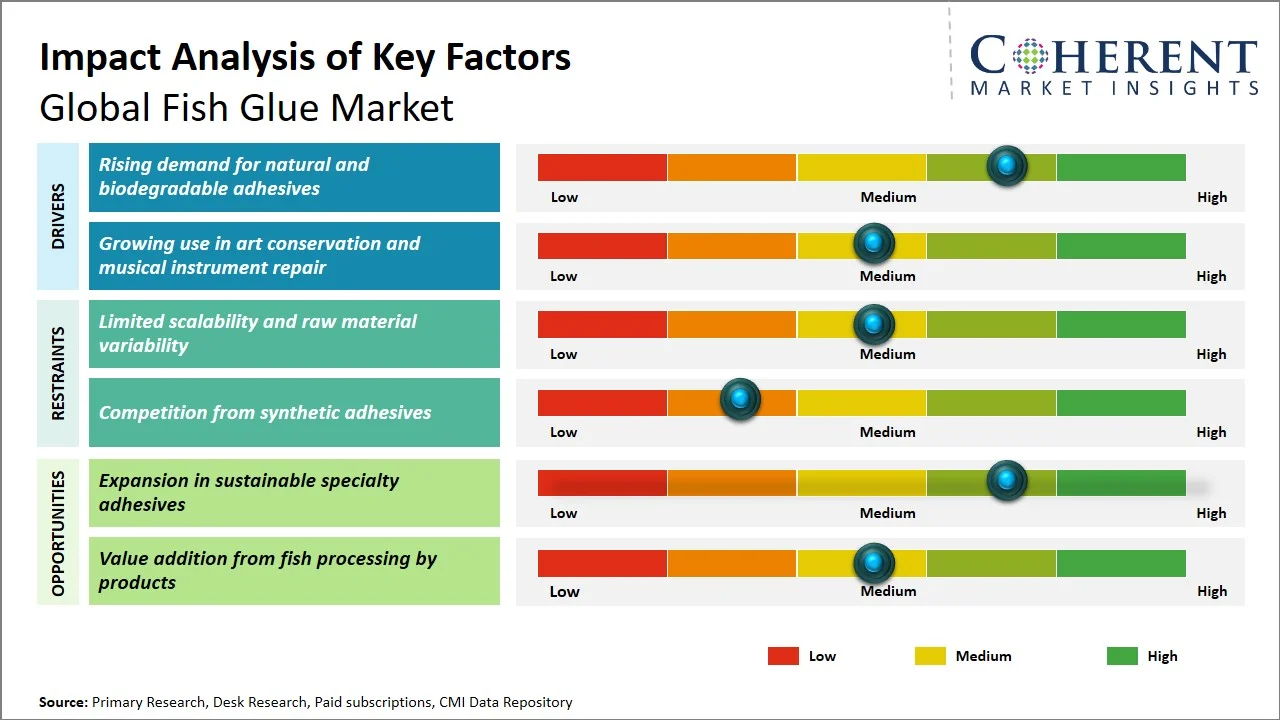
- Rising demand for natural and biodegradable adhesives: Fish glue is gaining stronger relevance as manufacturers and specialty users look for collagen-based, water-compatible, and biodegradable adhesive options for woodworking, paper bonding, craft, and restoration use. Unlike synthetic adhesive systems, fish glue can be positioned as a natural-value product made from fish-processing residues, supporting both sustainability and material circularity. A recent instance is a 2024 study on catfish-bone glue production, which evaluated fish glue as a natural adhesive derived from fish-processing by-products and highlighted its binding performance for practical adhesive applications. This supports commercial interest in converting underused fish residues into value-added bonding materials.
- Growing use in art conservation and musical instrument repair: Fish glue demand is supported by conservators, restorers, luthiers, and premium repair specialists that require adhesives with high tack, long working time, reversibility, and compatibility with wood, paper, leather, and delicate restoration surfaces. Its commercial relevance is strongest in specialist channels where performance on sensitive substrates matters more than low-cost mass bonding. University Products lists fish glue as a high-tack adhesive commonly used in furniture restoration where long drying times are preferred, with solvent and heat resistance and permanent remoisten ability with water. This supports its continued use in conservation, repair, and restoration-led adhesive applications. (Source: University Products)
Emerging Market Trends
- Conversion of Fishery Waste into Functional Adhesives: A key emerging trend in the global fish glue market is the conversion of fish-processing by-products into higher-value collagen-based adhesive materials. Fish skin, bones, scales, and swim bladders are increasingly being viewed as commercial raw materials rather than low-value waste. This trend supports circular economy practices while improving raw material utilization for manufacturers. For fish glue producers, by-product valorization can reduce input cost pressure, improve sustainability positioning, and create differentiated products for paper bonding, packaging, restoration, woodworking, and craft applications. It also supports seafood processors by opening additional revenue streams from processing residues.
- Performance improvement of moisture-resistant fish adhesives: Another emerging trend is the technical improvement of fish glue formulations to overcome traditional limitations such as moisture sensitivity, short shelf life, and variable bonding performance. Manufacturers and researchers are focusing on modified fish protein adhesives, stabilizing agents, additives, and composite formulations to improve humidity resistance, bonding strength, and application consistency. This trend is commercially important because improved performance can expand fish glue beyond niche restoration and craft applications into more demanding woodworking, furniture repair, paper products, and specialty adhesive uses. Better moisture resistance also improves buyer confidence and supports wider adoption in semi-industrial applications.
Regional Insights
Why Does Asia Pacific Dominate the Global Fish Glue Market?
Asia Pacific is expected to dominate the global fish glue market with 34.8% share in 2026, supported by the region’s strong fisheries, aquaculture, and fish-processing base. The region generates large volumes of fish skin, bones, scales, and swim bladders, which are key feedstocks for collagen-based fish glue. Demand is also supported by traditional art materials, woodworking, paper restoration, food processing, and specialty adhesive uses across China, Japan, India, and Southeast Asia. FAO reported in 2024 that global fisheries and aquaculture production reached a record 223.2 million tons in 2022, with Asian countries playing a leading role in aquatic animal production, reinforcing raw material availability for fish-derived adhesive inputs.
Why Does Europe Exhibit the Fastest Growth in the Global Fish Glue Market?
Europe is expected to be the fastest-growing region in the global fish glue market, with 29.6% share in 2026, supported by strong demand from conservation studios, museums, book restoration, musical instrument repair, and premium woodworking. Growth is further supported by increasing preference for reversible, natural, and low-emission adhesive systems in heritage and specialty applications. The region’s regulatory direction also supports interest in alternatives to high-emission synthetic bonding materials. For instance, Commission Regulation EU 2023 1464 restricts formaldehyde and formaldehyde releasers under REACH and sets limits for furniture and wood-based articles, with applicability from 2026 for several article categories.
Global Fish Glue Market Outlook for Key Countries
Why is China a Key Production Hub in the Global Fish Glue Market?
China is important in the global fish glue market due to its large fish-processing base and strong use of traditional natural adhesives in wooden artifact restoration, lacquer furniture conservation, and cultural heritage repair. Fish glue has relevance in China’s restoration ecosystem because it supports compatibility with historical materials, controlled adhesion, and reversibility in conservation work. From the supply side, China’s large aquaculture and seafood-processing activity improves access to collagen-rich raw materials such as skin, bones, and swim bladders. A recent instance is a 2025 Heritage Science study that developed a fish glue-reinforced filler for Ming-Qing lacquer furniture. The optimized filler improved waterproof and adhesive performance, showing direct relevance for conservation-grade fish glue applications in China. (Source: Springer Nature Limited)
Why is the U.S. a Strong Specialty Adhesive Market for Fish Glue?
The U.S. is a key market for fish glue due to its established base of specialty adhesive suppliers, woodworking users, packaging converters, restoration professionals, and conservation material distributors. Demand is concentrated in applications where users value long open time, remoistening properties, repairability, and adhesion to wood, paper, leather, and cardboard. The country is also important from a commercialization perspective, as fish glue is offered through technical-grade adhesive suppliers for industrial and craft use. A relevant instance is Norland Products’ 2025 High Tack Fish Glue technical sheet, which lists applications in remoisten able gummed paper packaging tapes, wood gluing, heavy boxboard paper bonding, identification tags, and water-based leather finishing. (Source: Norland Products)
Why Does Japan Show Strong Demand for Fish Glue in Traditional Art and Restoration Applications?
Japan is strategically relevant in the fish glue market due to its strong traditional art materials ecosystem, where animal glue is used in painting, paper sizing, gilding, and pigment binding. Fish glue is especially relevant in Japanese-style art applications because it can provide transparency, strong adhesion, and compatibility with paper and silk surfaces. Demand is supported by artists, restoration studios, specialty art material stores, and cultural preservation users. A recent instance is PIGMENT TOKYO’s 2025 technical article on binders and animal glue, which explains that animal glue, including fish-derived glue, is used as a pigment binder, gilding glue, and dosa sizing solution for paper. This reflects continued specialist demand in Japan’s art and restoration channels. (Source: Pigment Tokyo)
Why is India Emerging as a Fish By-product Valorization Opportunity in the Fish Glue Market?
India is important in the global fish glue market because of its large freshwater fish base and growing focus on fish-processing waste valorization. Species such as Rohu, Catla, and Tilapia create potential feedstock streams for collagen extraction from swim bladders, scales, skin, and other by-products. Demand potential is linked to woodworking, art conservation, craft adhesives, and sustainable material development. In 2024, researchers from Government Degree & PG College (A), Siddipet, affiliated to Osmania University, published a study in Inventum Biologicum on preparing fish glue from Tilapia, Rohu, and Catla swim bladders. The study highlighted fish swim bladders as a fishing industry by-product that can be used for sustainable adhesive production, supporting India’s opportunity to convert freshwater fish waste into higher-value glue applications. (Source: Inv Bio)
Why is Germany Leading Conservation and Technical Glue Applications in Europe?
Germany is an important country in the global fish glue market due to its strong base of specialty adhesive suppliers, restoration material companies, woodworking users, and musical instrument makers. The country supports both industrial and conservation-grade demand, particularly where transparent bonding, long working time, reversibility, and heat or solvent resistance are required. German suppliers also strengthen Europe’s distribution base for fish glue used in bookbinding, leather finishing, gilding, instrument making, restoration fish products. A relevant instance is Hellmann Leim GmbH, which lists fish glue made from wild-caught fish skins and positions it for instrument making, woodworking, bookbinding, leather finishing, paper bonding, restorations, and gouache gilding applications. (Source: Hellmann Leim)
Regulatory Landscape of the Global Fish Glue Market
Region / Jurisdiction | Regulation / Authority | Applicability | Compliance Requirement |
European Union | EC No 1069/2009 Animal By-products | Fish glue from skins, bones, scales, or swim bladders not for human consumption | Traceability, hygiene, and approved processing |
European Union | EC No 1935/2004 Food Contact Materials | Fish glue used in food-contact packaging, paper, labels | Safety documentation and migration testing |
U.S. | FDA 21 CFR 175.105 Adhesives | Adhesives in food packaging or contact materials | Indirect food-contact compliance |
India | FSSAI Packaging Regulations 2018 | Food packaging adhesives derived from fish products | Food-grade certification and lab testing |
China | GB 4806.15 2024 Food Contact Adhesives | Adhesives for food-contact materials | Raw material control, migration, and labeling compliance |
Japan | MHLW Positive List System | Adhesives in food-contact articles | Compliance with approved substances list |
European Union | EU 2023/1464 under REACH | Low-emission adhesives for furniture and wood-based articles | REACH conformity, low-formaldehyde standards |
European Union | EC No 1223/2009 Cosmetic Products | Fish glue in cosmetic formulations | Safety, traceability, and documentation |
U.S. | FDA Modernization of Cosmetics Regulation Act | Cosmetic-grade fish glue ingredients | Facility registration and product listing |
How are fish by-product biorefinery technologies creating new growth opportunities in the global fish glue market?
Fish by-product biorefinery technologies are creating growth opportunities in the global fish glue market by improving the commercial use of fish skin, bones, scales, and other collagen-rich residues as adhesive inputs. These technologies support cleaner extraction, better raw material recovery, and more consistent collagen quality, allowing manufacturers to develop natural adhesive products for woodworking, paper bonding, restoration, packaging, and specialty industrial uses. This is important because fish glue can move from a small traditional adhesive category toward a higher-value sustainable materials segment. A relevant recent instance is the EU-funded EcoeFISHent project, which is developing biomass pretreatment and extraction technologies to valorize fish-processing side streams into bioactives, gelatin, and biodegradable food-packaging barrier layers (Source: cordis.europa.eu)
Market Players, Key Development, and Competitive Intelligence
Key Developments
- In October 2025, Nature published a study on a fish glue-reinforced lacquer filler for Ming-Qing furniture restoration. The research introduced a fish glue-based composite filler, where the optimized formulation used 15 wt% fish glue and achieved 1.61 MPa dry adhesive strength and 85.32% waterproof rate, strengthening the relevance of conservation-grade fish glue in heritage furniture restoration.
- In September 2024, International Biological and Biomedical Journal published research on preparing fish glue from Tilapia, Rohu, and Catla swim bladders. The study highlighted the use of freshwater fish swim bladders as fishery by-products for sustainable adhesive production, supporting wider application potential in woodworking, art conservation, and culinary uses.
- In August 2024, MDPI published a Polymers study on modified fish protein-based adhesives for high-humidity applications. The research incorporated iron, copper, and zeolite powders into fish protein adhesives to reduce hygroscopicity, with the iron-modified adhesive achieving 13.8 MPa tensile shear strength and improved humidity stability.
Competitive Landscape
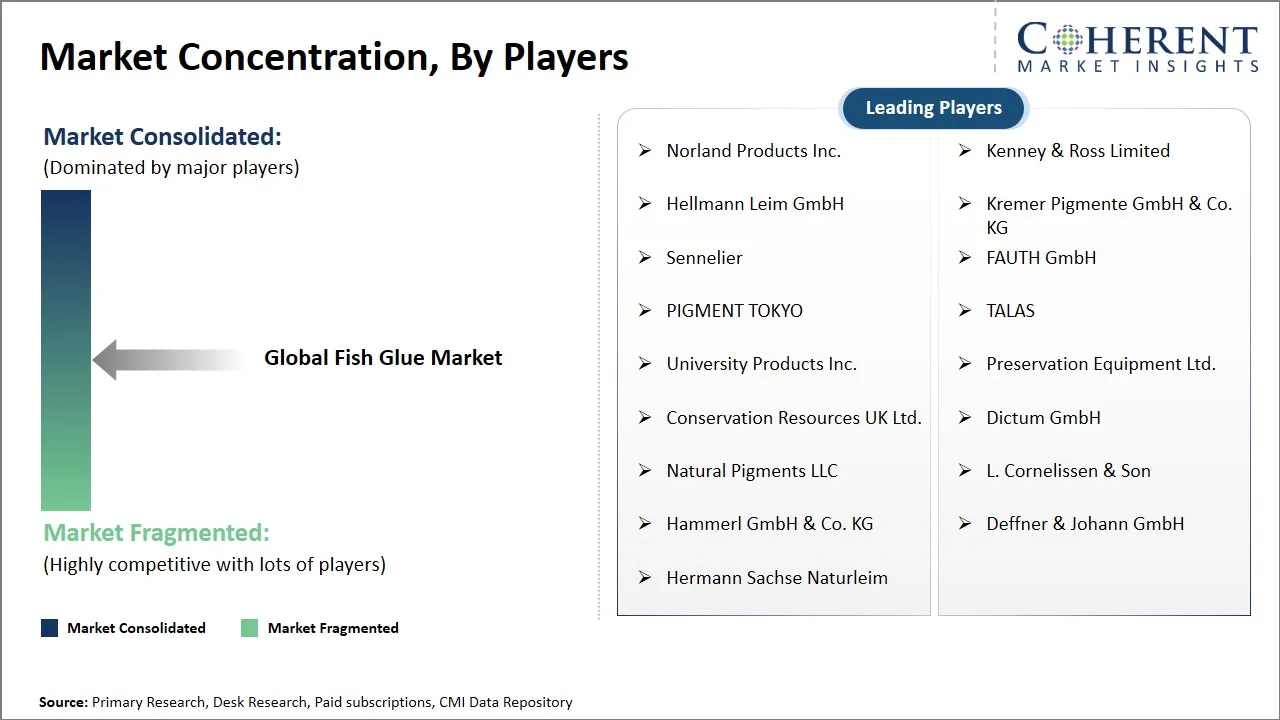
The global fish glue market is highly niche and moderately fragmented, with competition concentrated among specialized natural adhesive manufacturers, conservation material suppliers, fish gelatin producers, and restoration-grade glue distributors. Market players compete based on adhesive purity, tack strength, reversibility, raw material quality, application consistency, and suitability for woodworking, bookbinding, art conservation, musical instrument repair, and food-contact uses. Companies are also focusing on sustainable sourcing from fish-processing by-products and improved formulations that address traditional limitations such as moisture sensitivity and shelf-life stability.
Key focus areas include
- High-tack liquid fish glue for woodworking, paper repair, and furniture restoration
- Sustainable sourcing using fish skin, bones, scales, and swim bladders
- Conservation and restoration-grade products for museums, archives, and luthiers
- Improved moisture resistance, viscosity, drying, and storage stability
- Strengthened specialty distribution via conservation suppliers, art stores, and online channels
- Product differentiation through natural origin, low emissions, reversibility, and delicate substrate compatibility
- Food-grade and cosmetic-grade fish glue for binding, clarification, and film-forming applications
Market Report Scope
Fish Glue Market Report Coverage
| Report Coverage | Details | ||
|---|---|---|---|
| Base Year: | 2025 | Market Size in 2026: | USD 24.8 Mn |
| Historical Data for: | 2020 To 2024 | Forecast Period: | 2026 To 2033 |
| Forecast Period 2026 to 2033 CAGR: | 5.8% | 2033 Value Projection: | USD 36.8 Mn |
| Geographies covered: |
| ||
| Segments covered: |
| ||
| Companies covered: | Norland Products Inc., Kenney & Ross Limited, Hellmann Leim GmbH, Kremer Pigmente GmbH & Co. KG, Sennelier, FAUTH GmbH, PIGMENT TOKYO, TALAS, University Products Inc., Preservation Equipment Ltd., Conservation Resources UK Ltd., Dictum GmbH, Natural Pigments LLC, L. Cornelissen & Son, Hammerl GmbH & Co. KG, Deffner & Johann GmbH, and Hermann Sachse Naturleim | ||
| Growth Drivers: |
| ||
| Restraints & Challenges: |
| ||
Analyst Opinion (Expert Opinion)
- The global fish glue market is expected to witness steady long-term growth due to increasing preference for natural, biodegradable, and low-emission adhesive solutions across woodworking, bookbinding, restoration, and specialty paper applications. Fish glue will remain a niche but high-value adhesive category, supported by its strong tack, reversibility, compatibility with delicate substrates, and use of fish-processing by-products.
- The maximum opportunities are likely to emerge in Asia Pacific, where strong fish-processing output supports raw material availability, while demand from woodworking, packaging, food processing, and traditional art applications continues to expand. Europe is expected to offer strong growth potential due to its advanced conservation ecosystem, museum restoration activities, musical instrument repair sector, and regulatory push toward safer and lower-emission materials.
- To gain a competitive advantage, market participants should focus on improving moisture resistance, shelf stability, viscosity control, and application consistency of fish glue formulations. Companies should also strengthen specialty distribution networks targeting conservation studios, woodworking suppliers, art material retailers, and online channels, while positioning fish glue as a sustainable collagen-based adhesive made from valorized fish by-products.
Speak to the analyst
Want personalized insights?
Take the findings above to one of our principal consultants, or have the report rebuilt around the segments, geographies and competitors you actually track.
Market Segmentation
- Source Insights (Revenue, USD Mn, 2021 - 2033)
- Fish Skin
- Fish Bones
- Fish Scales
- Fish Swim Bladder
- Others
- Product Form Insights (Revenue, USD Mn, 2021 - 2033)
- Liquid Fish Glue
- Powdered Fish Glue
- Granulated Fish Glue
- Flake Fish Glue
- Semi Solid Fish Glue
- Others
- Grade Insights (Revenue, USD Mn, 2021 - 2033)
- Industrial Grade
- Food Grade
- Conservation Grade
- Cosmetic Grade
- Pharmaceutical Grade
- Others
- End-use Application Insights (Revenue, USD Mn, 2021 - 2033)
- Woodworking and Furniture Adhesives
- Bookbinding and Paper Restoration
- Art Conservation and Musical Instrument Repair
- Food and Beverage Processing
- Pharmaceutical and Cosmetic Binding
- Others
- Sales Channel Insights (Revenue, USD Mn, 2021 - 2033)
- Direct Sales
- Indirect Sales (via Distributors)
- Regional Insights (Revenue, USD Mn, 2021 - 2033)
- North America
- U.S.
- Canada
- Latin America
- Brazil
- Argentina
- Mexico
- Rest of Latin America
- Europe
- Germany
- U.K.
- Spain
- France
- Italy
- Russia
- Rest of Europe
- Asia Pacific
- China
- India
- Japan
- Australia
- South Korea
- ASEAN
- Rest of Asia Pacific
- Middle East
- GCC Countries
- Israel
- Rest of Middle East
- Africa
- South Africa
- North Africa
- Central Africa
- North America
- Key Players Insights
- Norland Products Inc.
- Kenney & Ross Limited
- Hellmann Leim GmbH
- Kremer Pigmente GmbH & Co. KG
- Sennelier
- FAUTH GmbH
- PIGMENT TOKYO
- TALAS
- University Products Inc.
- Preservation Equipment Ltd.
- Conservation Resources UK Ltd.
- Dictum GmbH
- Natural Pigments LLC
- Cornelissen & Son
- Hammerl GmbH & Co. KG
- Deffner & Johann GmbH
- Hermann Sachse Naturleim
Sources
Primary Research Interviews
- Fish glue manufacturers and natural adhesive producers
- Fish gelatin and collagen producers using fish skin, bones, scales, and swim bladders
- Woodworking adhesive formulators and specialty glue suppliers
- Bookbinding, paper restoration, and conservation professionals
- Musical instrument makers and luthiers using animal-based glues
- Food processing and beverage clarification experts using fish-derived binders or isinglass
- Distributors and wholesalers of conservation, restoration, and specialty adhesive products
Stakeholders
- Fish glue manufacturers
- Fish gelatin and collagen producers
- Seafood processors and fish by-product suppliers
- Natural adhesive formulators
- Conservation material suppliers
- Art material and restoration product distributors
- Woodworking and furniture adhesive suppliers
End-use Sectors
- Woodworking and furniture manufacturing
- Bookbinding and paper restoration
- Art conservation and museum restoration
- Musical instrument manufacturing and repair
- Food and beverage processing
- Pharmaceutical and cosmetic binding applications
- Leather, textile, and specialty adhesive applications
Regulatory and Government Bodies
- U.S. Food and Drug Administration FDA
- European Commission
- European Chemicals Agency ECHA
- Food Safety and Standards Authority of India FSSAI
- Ministry of Health, Labour and Welfare Japan
- National Health Commission China
- U.S. Environmental Protection Agency EPA
Databases
- FAOSTAT
- FAO Fisheries and Aquaculture Statistics
- UN Comtrade Database
- Eurostat
- World Bank Data
- OECD Data
- U.S. International Trade Commission DataWeb
- India APEDA and MPEDA databases
Magazines and Trade Media
- Adhesives and Sealants Industry
- European Coatings
- Specialty Chemicals Magazine
- SeafoodSource
- IntraFish
- The Fish Site
- Conservation News
- Woodworking Network
Journals
- International Journal of Adhesion and Adhesives
- Polymers
- Marine Drugs
- Food Hydrocolloids
- Journal of Cleaner Production
- Heritage Science
- Journal of Cultural Heritage
- ACS Sustainable Chemistry and Engineering
News Sources
- Reuters
- Bloomberg
- Chemical and Engineering News
- Packaging Europe
- FoodNavigator
- SeafoodSource
- BioBased World News
Associations
- Association for Preservation Technology International
- American Institute for Conservation
- International Institute for Conservation
- European Confederation of Conservator-Restorers’ Organisations
- The Adhesive and Sealant Council
- European Adhesive and Sealant Industry Association
- FAO Fisheries and Aquaculture Division
Public Domain Sources
- FAO fisheries and aquaculture reports
- European Commission REACH and food contact material regulations
- FDA food contact substance and adhesive regulations
- FSSAI packaging regulations
- Japan MHLW food contact material positive list
- China GB food contact adhesive standards
- EPA formaldehyde emission standards
Proprietary Elements
- CMI Data Analytics Tool, Proprietary CMI Existing Repository of information for last 10 years.
Get access to 250+ pages report
Every segment, forecast, competitor profile and data table behind the analysis above — available for instant download.
- ESOMAR Member
- ISO 9001:2015 Certified
- D-U-N-S Registered
- GDPR & CCPA Compliant
Missing comfort of reading report in your local language? Find your preferred language:
Transform your Strategy with Exclusive Trending Reports
Frequently Asked Questions
The CAGR of the global fish glue market is projected to be 5.8% from 2026 to 2033.
Yes, the fish glue market is a profitable niche business supported by sustainable adhesive demand.
The global fish glue market is estimated to be valued at USD 24.8 million in 2026 and is expected to reach USD 36.8 million by 2033.
Rising demand for natural and biodegradable adhesives and growing use in art conservation and musical instrument repair are the major factors driving the growth of the global fish glue market.
Limited scalability and raw material variability and competition from synthetic adhesives are the major factors hampering the growth of the global fish glue market.
In terms of source, fish skin in estimated to dominate the market revenue share in 2026.
Asia Pacific is expected to lead the global fish glue market in 2026.