

India De Aromatic Solvents Market Analysis & Forecast: 2026-2033
India De Aromatic Solvents Market is estimated to be valued at USD 0.2 Mn in 2026 and is expected to reach USD 0.3 Mn in 2033, exhibiting a compound annual growth rate (CAGR) of 6.3% from 2026 to 2033.
Key Takeaways
- By Grade, Medium Flash Point (41°C – 80°C) de-aromatic solvents hold the largest share of 47.7% in the India De-Aromatic Solvents Market in 2026. This dominance is attributed to their balanced solvency, lower toxicity, and wide applicability across industrial sectors such as coatings, metalworking, and cleaning.
- By Application, the Paints, Coatings, and Inks segment leads the market, driven by rising infrastructure development, growing automotive demand, and increased use of solvent-based formulations.
- By Boiling Point, Type 2 (185°C – 240°C) solvents are expected to maintain a dominant position in 2026, owing to their optimal volatility and widespread adoption in industrial applications requiring controlled evaporation rates.
- By Region, Western India is projected to command the largest regional share, supported by strong manufacturing infrastructure, a high concentration of industrial consumers, and accessibility to raw materials.
Market Overview
Rapid expansion in India's industrial and household sectors is fueling demand for de‑aromatic solvents—particularly for paints, coatings, insecticides, and cleaning agents. These solvents offer low‑VOC content and reduced toxicity, making them an eco‑friendlier alternative to conventional aromatic solvents. Growth in the paints and coatings industry, coupled with rising use in household insecticide and mosquito repellent products, is boosting market uptake. However, volatility in crude oil prices—due to disruptions like geopolitical tensions—and a rising preference for bio‑based, environmentally sustainable alternatives are tempering growth to some extent.
Current Events and their Impact on the India De Aromatic Solvents Market
Current Events | Description and its impact |
India's Green Chemistry Initiative and Environmental Regulations |
|
Global Supply Chain Disruptions and Raw Material Volatility |
|
Technological Advancements in Solvent Purification |
|
End-user Feedback and Unmet Needs in the India De Aromatic Solvents Market
- Need for Safer and Eco-Friendly Alternatives: Industrial users increasingly seek solvents with lower toxicity and minimal VOC emissions. While de-aromatic solvents are a safer alternative to traditional aromatics, end users continue to demand formulations that further reduce environmental impact and align with India’s evolving green manufacturing policies.
- Desire for Improved Performance in Extreme Conditions: Manufacturers in sectors like metalworking and industrial cleaning report a need for solvents that maintain efficacy under high-temperature or high-stress environments. Current offerings may underperform in heavy-duty applications, highlighting the need for improved thermal stability and solvency power.
- Demand for Consistent Quality and Supply Stability: End users, especially in Western and Southern India, emphasize the importance of consistent product quality and uninterrupted supply. Fluctuating crude oil prices and supply chain disruptions have led to variability in solvent performance and availability, underlining the need for domestic capacity expansion and supply assurance.
- Current Industry Events of 2026
- Market Size Estimation
- Regional Breakdown
- Competitive Landscape
- Customer Intelligence
- Segmental Analysis
- Pricing Analysis
- Key Market Drivers, Challenges & Future Trends
- Customized Insights Section
Segmental Insights
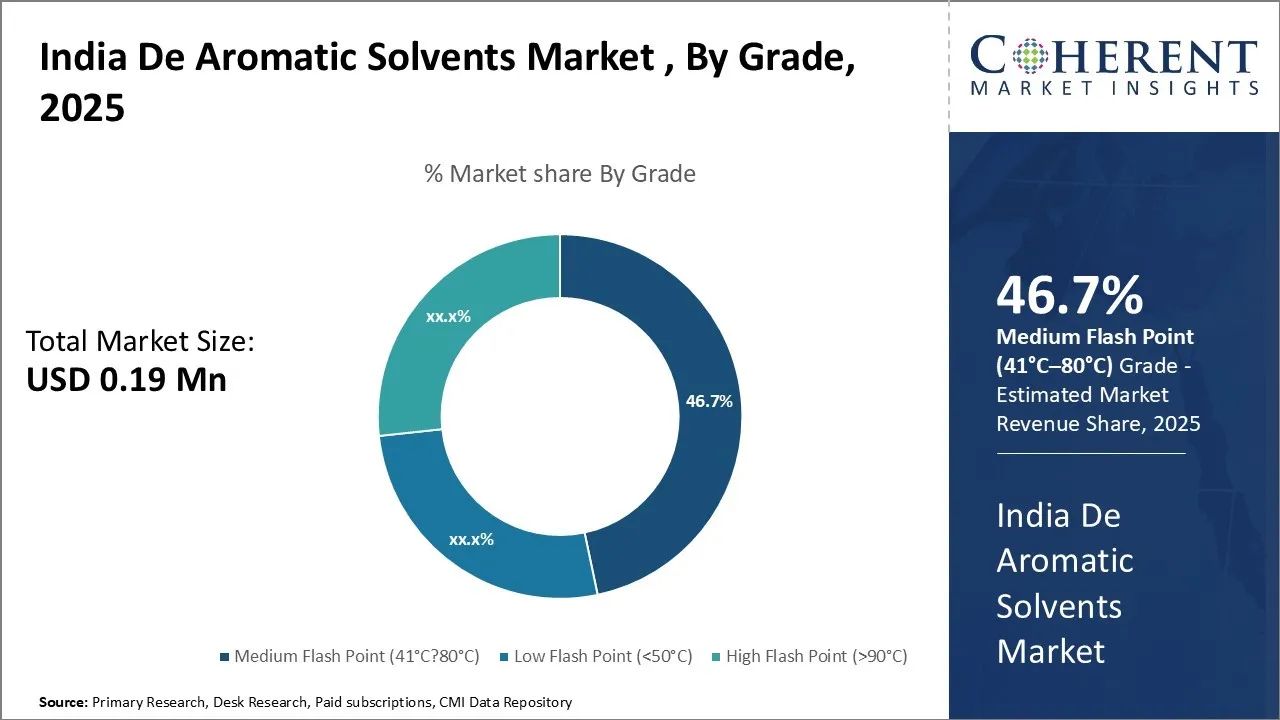
India De-Aromatic Solvents Market Insights, By Grade: Medium Flash Point solvents contribute the highest share of the market owing to their balanced performance and safety
Medium Flash Point (41°C – 80°C) solvents contribute the highest share of the market, accounting for 47.7% in 2026, owing to their balanced performance and broad industrial usability. These solvents are particularly valued for their moderate volatility, making them safer to handle while still delivering effective solvency for applications in metalworking fluids, coatings, and industrial cleaning. Their compatibility with regulatory standards around low VOC emissions further boosts their market presence amid tightening environmental regulations. Industries across paints, adhesives, and consumer products increasingly prefer medium flash point variants due to reduced fire hazards and improved workplace safety. For instance, several Indian manufacturers have scaled production of medium flash point de-aromatic solvents in response to VOC restrictions imposed under India’s Green Chemistry Initiative.
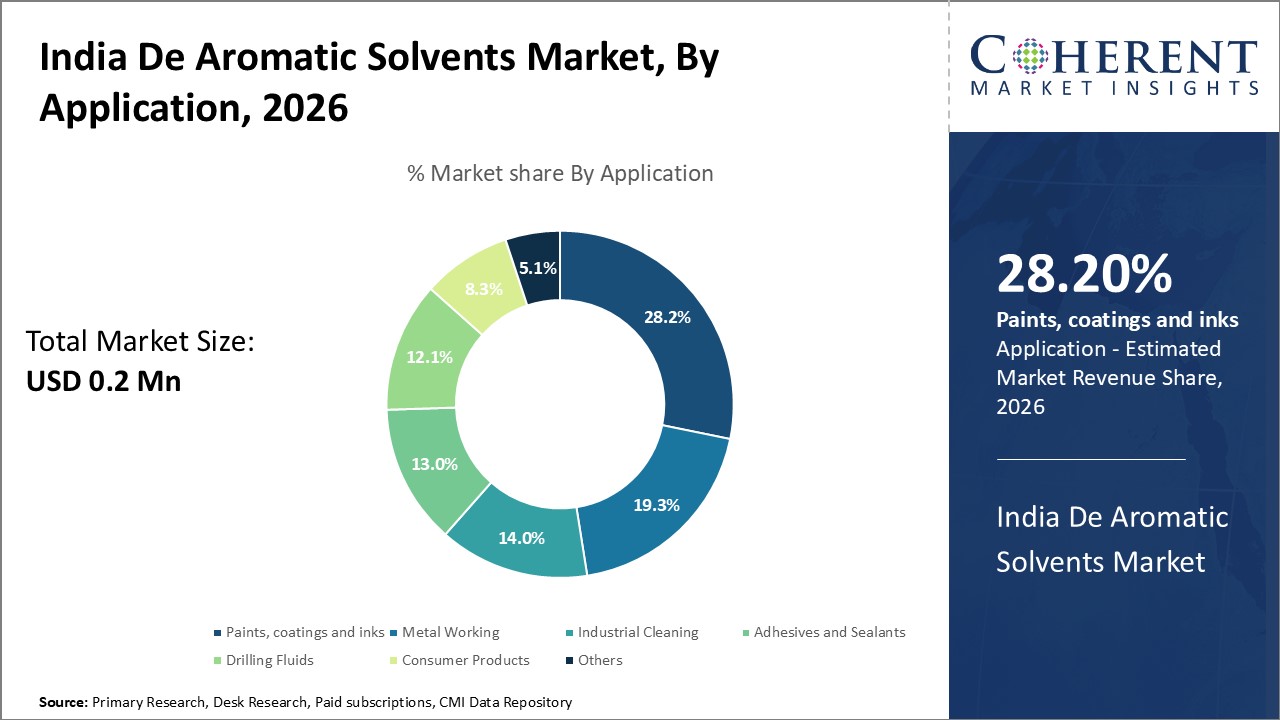
India De‑Aromatic Solvents Market Insights, By Application: Paints, Coatings, and Inks command the highest share of the market owing to escalating demand across multiple sectors and growing infrastructure development in India
Paints, Coatings, and Inks command the highest market share in 2026 and are projected to grow the fastest during the forecast period. This dominance is propelled by escalating demand from residential, commercial, automotive, marine, and railway sectors. For instance, the de-aromatic solvents segment utilized as thinners and diluents in paints, coatings, inks, and adhesives is being driven by significant demand, with the paints & coatings segment alone comprising over 30% of total consumption. The surge in demand has been directly influenced by the strong growth of infrastructure projects, construction, and automotive manufacturing in India.
India De‑Aromatic Solvents Market Insights, By Boiling Point: Type 2 (185°C – 240°C) solvents contribute the highest share of the market owing to their optimal volatility and versatility across applications
Type 2 (185 °C – 240 °C) solvents are the leading segment in 2022, offering optimal volatility and versatility across applications. For instance, in terms of boiling point, Type 2 (185 -240) de-aromatic solvents are assumed to remain considerably profitable to manufacturers in India.
Market Report Scope
India De Aromatic Solvents Market Report Coverage
| Report Coverage | Details | ||
|---|---|---|---|
| Base Year: | 2025 | Market Size in 2026: | USD 0.2 Mn |
| Historical Data for: | 2020 To 2024 | Forecast Period: | 2026 To 2033 |
| Forecast Period 2026 to 2033 CAGR: | 6.3% | 2033 Value Projection: | USD 0.3 Mn |
| Geographies covered: |
| ||
| Segments covered: |
| ||
| Companies covered: | Bharat Petroleum Corporation Limited, Exxon Mobil Corporation, Royal Dutch Shell Plc., TotalEnergies, Enilive S.p.A. | ||
| Growth Drivers: |
| ||
| Restraints & Challenges: |
| ||
Market Trends
- Growing steel industry in India
The growing steel industry in India is expected to foster the market growth of the de-aromatic solvents. According to the India Brand Equity Foundation, India ranks as the world's second-largest crude steel producer, having produced 137.96 million tonnes (MT) of crude steel and 132.57 MT of finished steel in FY25. The growth in the Indian steel sector has been driven by the domestic availability of raw materials such as iron ore and cost-effective labor. Hence, growth in the steel industry is expected to fuel the De Aromatic solvents market demand.
Market Opportunities
- Various manufacturers are focusing on increasing production capacity of de-aromatized
Various manufacturers are focusing on increasing production capacity of de-aromatized in order to expand their presence in India. This is expected to offer potential growth opportunities in the near future. For instance, Exxon Mobil expanded its production capacity by 250,000 tons for global hydrocarbon solvents. It produces a range of de-aromatic solvents in its facilities located in Singapore and Antwerp.
- Growth in the chemical and petrochemical industry in India
Growth in the chemical and petrochemical industry in India due to the increasing production of chemicals will favor the market growth of de-aromatized solvent over the forecast period. For instance, The revised PCPIR Policy 2020-35 targets investment inflows of ₹12.4 trillion in the petrochemicals sector by 2025, ₹18.6 trillion by 2030, and ₹24.8 trillion by 2035. Thus, growth in the chemical industry in India is expected to augment the market growth.
India De Aromatic Solvents Market - Growth Drivers
- Growth in the India paints and coatings industry in the country
Growth in the India paints and coatings industry in the country is expected to augment the market growth over the forecast period. Rising demand for paints and coatings from residential as well as commercial sectors is expected to fuel the market growth. Moreover, rising demand for paints from industries such as automotive, marine, and railways is further expected to propel the India de-aromatic solvents market growth.
India De Aromatic Solvents Market News
- In August 2025, Bengal's steel sector is expected to receive ₹8,000 crore of investment over the next five years, and new integrated steelmaking plants in Purulia that are expected to increase production, to reach the production targets set out in India's National Steel Policy. Increased steel production will usually increase demand in chemical uses, including cleaning solvents, degreasing solvents and similar solvent usage.
Analyst Opinion (Expert Opinion)
India's de-aromatic solvents market demonstrates robust momentum driven by stringent environmental regulations and growing health consciousness across industrial applications. The automotive and paints & coatings sectors are primary growth catalysts, as manufacturers increasingly prioritize worker safety and environmental compliance over traditional aromatic alternatives. Rising demand from pharmaceutical and agrochemical industries further strengthens market fundamentals, with companies seeking safer formulation ingredients.
However, the market faces notable restraints including higher production costs compared to conventional solvents and limited domestic manufacturing capabilities. Supply chain dependencies on imports create pricing volatility, while slower adoption rates among small-scale manufacturers present implementation challenges. Technical limitations in specific high-performance applications also constrain broader market penetration.
Significant opportunities emerge from expanding industrial infrastructure and increasing foreign direct investment in manufacturing sectors. The government's push toward sustainable industrial practices through policy frameworks creates favorable conditions for de-aromatic solvent adoption. Growing awareness about occupational health standards and corporate sustainability initiatives present additional growth avenues.
Speak to the analyst
Want personalized insights?
Take the findings above to one of our principal consultants, or have the report rebuilt around the segments, geographies and competitors you actually track.
Market Segmentation
- India De-aromatic Solvents Market, By Grade (Revenue, USD Mn, 2021 - 2033)
- Low Flash Point (<500C)
- Medium Flash Point (510C – 900C)
- High Flash Point (>900C)
- India De-aromatic Solvents Market, By Application (Revenue, USD Mn, 2021 - 2033)
- Paints, coatings, and Inks
- Metal Working
- Industrial Cleaning
- Adhesives and Sealants
- Drilling Fluids
- Consumer Products
- Others
- India De-aromatic Solvents Market, By Boiling Point (Revenue, USD Mn, 2021 - 2033)
- Type 1 (<1850C)
- Type 2(1850C – 2400C)
- Type 3(>2400C)
- India De-aromatic Solvents Market, By Sub-Region (Revenue, USD Mn, 2021 - 2033)
- India
- South Zone
- North Zone
- East Zone
- West Zone
- India
- Company Profiles
- Exxon Mobil Corporation
- Total S.A.
- Royal Dutch Shell plc
- Isu Exachem
- Mehta Petro Refineries
- Avani Petrocehm Pvt Ltd.
- Raj Petro Specialties P. Ltd.
- Eastern Petroleum Private Limited
Sources
Primary Research Interviews
- Chemical manufacturers and producers
- Distributive traders and suppliers
- End-user industries representatives
- Regulatory and compliance experts
- Others
Databases
- ChemAnalyst Database
- India Chemical Directory
- CRISIL Research Database
- Ministry of Chemicals and Fertilizers Database
- Others
Magazines
- Chemical Weekly
- Indian Chemical News
- Specialty Chemicals Magazine
- Chemical Industry Digest
- Others
Journals
- Journal of Chemical Sciences
- Indian Chemical Engineer
- Chemical Engineering World
- Others
Newspapers
- The Economic Times
- Business Standard
- Financial Express
- The Hindu Business Line
- Others
Associations
- Indian Chemical Council (ICC)
- Federation of Indian Chambers of Commerce (FICCI)
- Confederation of Indian Industry (CII)
- Indian Petrochemicals Corporation Limited (IPCL)
- Others
Public Domain Sources
- Ministry of Chemicals and Fertilizers, Government of India
- Central Pollution Control Board (CPCB)
- Export-Import Bank of India (EXIM)
- Indian Bureau of Mines
- Others
Proprietary Elements
- Proprietary CMI Existing Repository of information for last 8 years
Get access to 250+ pages report
Every segment, forecast, competitor profile and data table behind the analysis above — available for instant download.
- ESOMAR Member
- ISO 9001:2015 Certified
- D-U-N-S Registered
- GDPR & CCPA Compliant
Missing comfort of reading report in your local language? Find your preferred language:
Transform your Strategy with Exclusive Trending Reports
Frequently Asked Questions
The India De Aromatic Solvents Market is estimated to be valued at USD 0.2 Mn in 2026, and is expected to reach USD 0.3 Mn by 2033.
India De Aromatic Solvents market is estimated to reach 0.3 Mn by 2033.
Major players operating in the India De Aromatic Solvents market include Bharat Petroleum Corporation Limited, Exxon Mobil Corporation, Royal Dutch Shell Plc., TotalEnergies, Enilive S.p.A.
Rising demand for eco-friendly product bio-based raw materials and increasing Cost of raw Materials are the major factors that is expected to hamper growth of the market over the forecast period.
Increasing demand for de-aromatic solvents and growth in the India paints and coatings industry in the country are some of the major factors that are expected to propel growth of the market over the forecast period.
The CAGR of the India De Aromatic Solvents Market is projected to be 6.3% from 2026 to 2033.
Among region, West is expected to hold dominant position in the market over the forecast period.