

Global Floating Wind Turbines Market Size and Forecast – 2026 To 2033
The global floating wind turbines market is expected to grow from USD 3.70 Bn in 2026 to USD 36.00 Bn by 2033, registering a compound annual growth rate (CAGR) of 14.0% from 2026 to 2033. The global floating wind turbines market is driven by expansion of government initiatives toward net-zero emissions. On July 24, 2025, Salamander Offshore Wind Farm, one of the most advanced floating wind projects in the UK, was awarded Section 36 Consent and associated Marine Licences. A joint venture partnership between Ørsted, Simply Blue Group and Subsea7, Salamander’s floating array will be sited approximately 35 km off the coast of Peterhead and have a capacity of up to 100 MW.
Key Takeaways of the Global Floating Wind Turbines Market
- The Semi-Submersible Platforms segment is expected to account for 36.0% of the global floating wind turbines market share in 2026. Rising development of floating offshore wind projects is driving the growth of the segment. On July 3, 2026, Natural Resources Wales granted a Marine Licence to Llŷr Floating Wind Limited. The demonstration project will be located approximately 35 kilometers offshore Pembrokeshire.
- The Up To 5 MW segment is estimated to capture 41.0% of the market share in 2026. Technological improvements in floating platform designs is majorly driving the growth of the segment. On February 6, 2025, Kongsberg Maritime introduced new transportation and installation technologies for floating offshore wind turbines. The solutions include specialized installation vessels, integrated mooring tensioning, and improved cable pull-in systems.
- The Utility-Scale Power Generation segment is estimated to capture 39.0% of the market share in 2026. Increasing corporate investments in renewable electricity procurement is driving the growth of the segment. On June 19, 2026, Amazon and Skyborn Renewables announced a 600 MW Power Purchase Agreement for the Gennaker offshore wind farm in Germany. The deal accounts for almost 61% of the project’s planned capacity.
- North America is expected to dominate the floating wind turbines market in 2026 with a market share of 39.0%. Expansion of floating wind projects in deepwater locations in North America is driving the growth of the regional market. On July 21, 2025, Vineyard Offshore stated that it is developing California’s first floating offshore wind project. The proposed development is located approximately 20 miles offshore Humboldt County.
- Asia Pacific is expected to account for 28.0% share in 2026. Increasing investments in floating wind supply chains in Asia Pacific is driving the growth of the regional market. On September 24, 2026, Sumitomo Heavy Industries and Albatross Technology announced a collaboration agreement for floating wind technology. The partnership will create next-generation Floating Axis Wind Turbines and help local manufacturing capabilities.
Segmental Insight
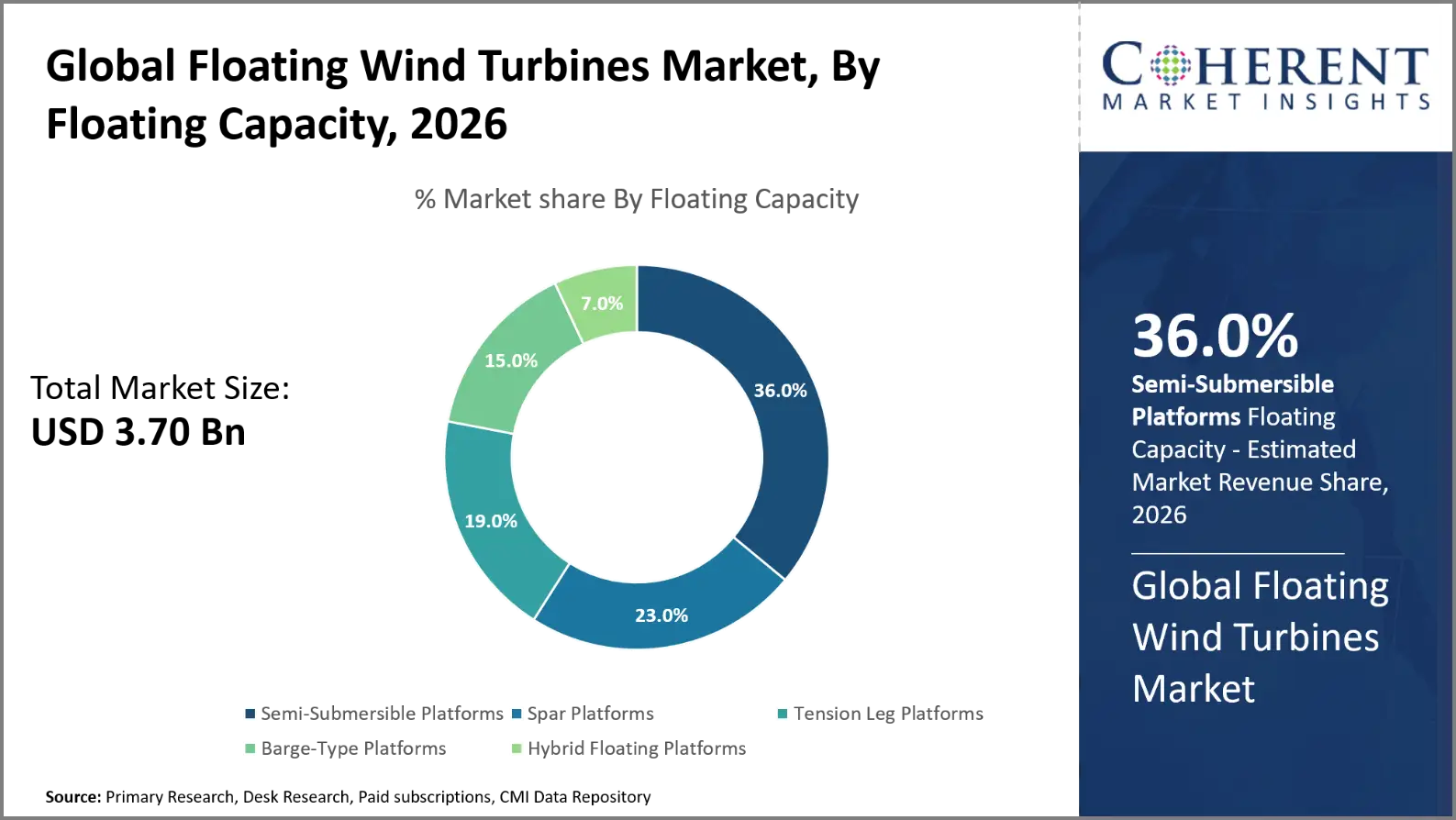
Why Does Semi-Submersible Platforms Dominate the Global Floating Wind Turbines Market?
The semi-submersible platforms segment is expected to account for 36.0% of the global floating wind turbines market share in 2026. Semi-submersible platforms dominate because they provide stability across varying offshore conditions. Their buoyancy elements disperse turbine loads over several columns and interconnecting pontoons. Platforms of this type have comparatively shallow drafts making for easier assembly at port and shipping offshore. Their modular designs can fit varied turbine sizes and project combinations. Semi-submersible foundations can also be supported by traditional fabrication methods and existing offshore engineering skills. They have several benefits which make them appropriate for commercial floating wind farms.
On July 29, 2025, Wison New Energies achieved a significant breakthrough in the core technologies of floating offshore wind. The company's independently developed w.TLP foundation (designed for 12MW turbines) and w.semi foundation, (designed for 15MW turbines) have respectively received Approval in Principle certifications from the American Bureau of Shipping (ABS) and Det Norske Veritas (DNV). These endorsements lay a solid foundation for the commercial deployment of large-scale offshore wind turbines globally.
- Current Industry Events of 2026
- Market Size Estimation
- Regional Breakdown
- Competitive Landscape
- Customer Intelligence
- Segmental Analysis
- Pricing Analysis
- Key Market Drivers, Challenges & Future Trends
- Customized Insights Section
Why is Up To 5 MW the Most Preferred Turbine Capacity?
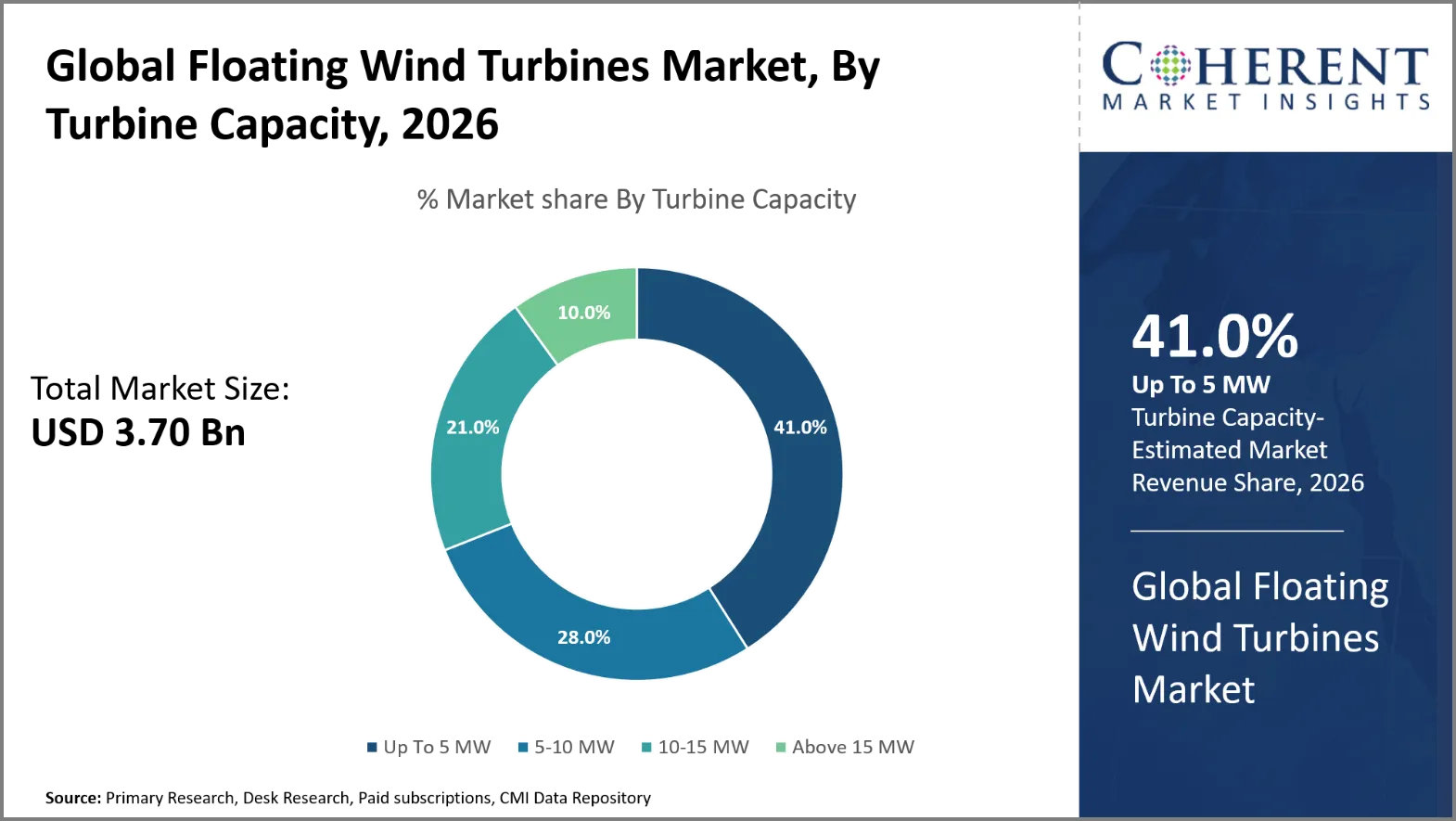
The up to 5 MW segment is expected to account for 41.0% of the global floating wind turbines market share in 2026. Turbines up to 5 MW are largely important because early floating wind projects are focused on proving the technology and maintaining manageable installation needs. Smaller turbines require less demanding foundation designs and mooring systems. They will lessen technical hazards in early offshore demonstrations. Existing manufacturing capabilities also enable component availability and maintenance planning. The turbines provide developers with a chance to test floating technology ahead of commercial-scale rollout. But as floating wind projects mature, higher capacity are getting more attention.
On October 3, 2025, Eolink secured European funding for its 5 MW floating demonstrator on October 3, 2025. The ATLANTIC project, led by Eolink and the VALOREM Group, received USD 16.6 million through the European Union’s Horizon Europe program. The project will demonstrate Eolink’s pyramidal floating turbine at the SEM-REV test site off Le Croisic.
Utility-Scale Power Generation Dominates the Global Floating Wind Turbines Market
The Utility-Scale Power Generation segment is expected to account for 39.0% of the global floating wind turbines market share in 2026. Floating wind technology has been largely developed for huge offshore electricity projects, therefore utility-scale power generation is the standard preference. Wind resources in deep water sites are stronger and more consistent. Floating foundations allow developers to place turbines in deeper water than traditional fixed-bottom technology. Offshore projects of a large size can feed electricity directly into national grids and coastal industrial hubs. Utility scale developments often attract infrastructure investors and long-term power purchase agreements. Demand for commercial floating wind systems is still being driven by higher renewable energy requirements.
On March 27, 2026, Stiesdal Offshore announced the planned decommissioning of its 3.6 MW TetraSpar demonstrator. The project had operated for nearly five years at Norway’s Marine Energy Test Centre. Its Siemens turbine generated almost 70 million kilowatt-hours, achieving 98% availability.
Current Events and their Impact
Current Events | Description and its Impact |
European Union - Renewable Energy Directive (EU) 2023/2413 |
|
U.S. - Renewable Energy Modernization Rule, 89 FR 42602 |
|
Floating Wind Turbines Market Dynamics
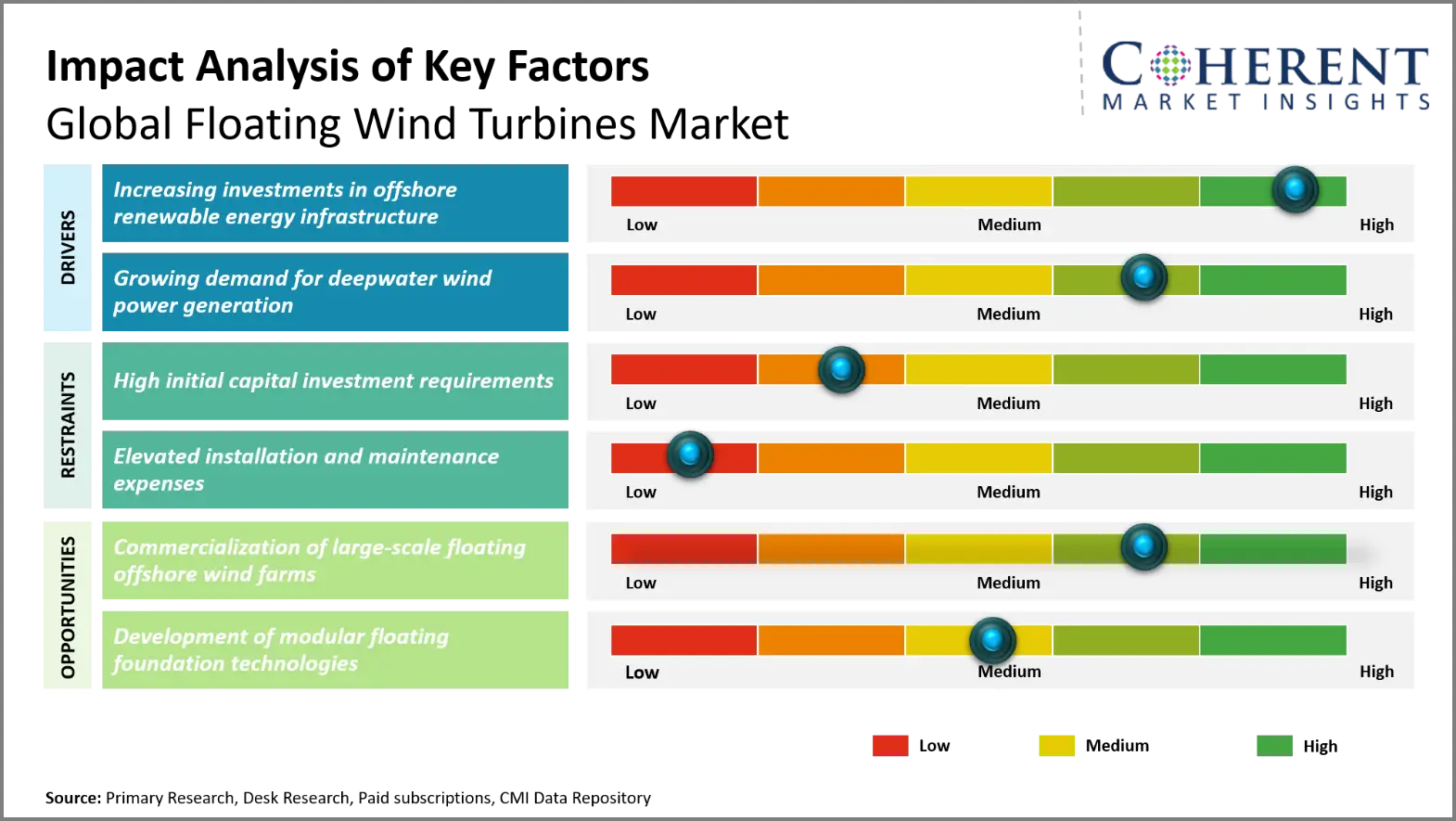
Market Drivers
- Increasing investments in offshore renewable energy infrastructure: Governments and commercial energy businesses spend more in offshore renewable energy infrastructure to expedite sustainable power generation. Money is pouring into offshore wind farms, floating foundations, underwater transmission cables and purpose-built installation vessels. European countries are pushing project pipelines offshore to meet renewable energy targets. The U.S. is supporting offshore wind infrastructure through federal leasing and port development efforts. “Asia Pacific nations are also bolstering their domestic manufacturing capabilities and offshore installation infrastructure. These investments are driving demand for floating wind turbines, innovative mooring systems and high-capacity offshore electrical equipment.
- On February 5, 2026, MacGregor announced that it has been selected to deliver a major 400-ton Active Heave Compensated (AHC) underwater crane for a new 127-metre Floating Wind Farm Construction Vessel (FWCV). The new vessel has been specifically designed for the growing floating offshore wind market and represents a major leap forward for the industry, requiring one of the largest subsea AHC cranes ordered in recent years.
- Growing demand for deepwater wind power generation: The increasing demand for deepwater wind power generation is driving the adoption of floating wind turbine technology. Technical and economic limits exist for conventional fixed-bottom foundations in deeper offshore sites. Floating platforms enables turbines to tap stronger wind resources in waters beyond the shallow coastal waters. Countries such as Japan, South Korea, France, Norway and the U.S. are studying deepwater offshore wind opportunities. Technological advances in semi-submersible and spar-buoy platforms are making deployment more feasible. Rising demand for large-scale renewable electricity is also driving companies to market floating offshore wind projects.
- On October 29, 2025, IX Renewables and Asia Cement Corporation announced a partnership agreement for the Rui Li 1 project in Taiwan. The proposed floating wind farm will be located in waters off Hsinchu, with depths ranging from 70 to 95 meters. Its planned capacity is 180 MW. Asia Cement’s participation brings domestic industrial capabilities into the project.
Emerging Trends
- Development of Larger-Capacity Floating Wind Turbines: Developers are targeting the construction of floating wind turbines larger than 15 MW to improve offshore power generation. Larger rotor diameters and cutting-edge floating foundations are increasing energy capture at deeper offshore sites.
- Impact: Higher turbine capabilities can minimize the number of foundations, mooring systems and electrical connections. Such enhancements can reduce installation complexity and increase project cost.
- Relevance to the market: Siemens Gamesa Renewable Energy and Mingyang Smart Energy are moving forward with larger offshore turbine technologies. Their improvements also spur floating-platform suppliers to create foundations that can handle bigger turbines.
- Advancement of Advanced Floating Foundation Technologies: Developers are developing semi-submersible, spar-buoy and tension-leg platforms to increase stability. Modular fabrication and new anchoring technologies are enabling deployment in demanding deepwater conditions.
- Impact: Improved foundation designs can lower structural loads, ease offshore installation, and increase turbine reliability. These improvements can enhance maintenance efficiency and enable more significant commercial initiatives.
- Relevance to the market: Principle Power’s WindFloat technology is an example of a commercial semi-submersible platform application. BW Ideol’s floating foundation technology shows alternate concepts for growing offshore wind deployment.
Regional Insights
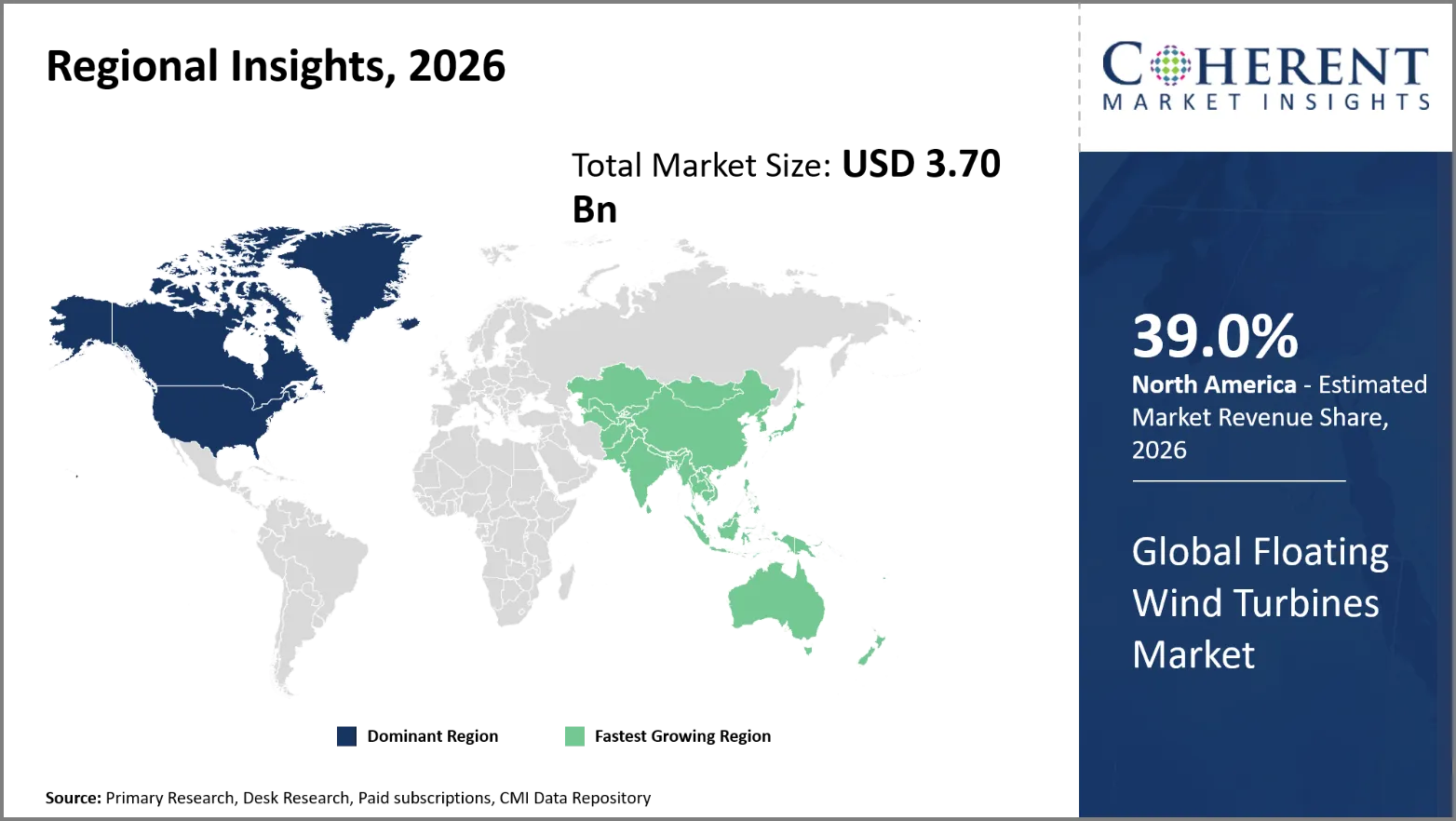
Why is North America a Strong Market for Floating Wind Turbines?
North America is expected to account for a market share of 39.0% in 2026. North America’s long Pacific coastlines and potential for offshore energy diversification are driving its floating wind development. California has potential deepwater sites where traditional fixed-bottom foundations are hard from a technical standpoint. Oregon’s projected Brookings and Coos Bay wind regions show the potential for regional development. Together, these sites might accommodate large floating wind farms. Maine’s research lease offers possibilities to study environmental compatibility, fishing activity and floating turbine performance. The lease covers approximately 15,000 acres offshore. Canadian Atlantic waters also offer opportunities for floating wind development, particularly around Nova Scotia.
Why Does Asia Pacific Floating Wind Turbines Market Exhibit High Growth?
Asia Pacific is expected to register the fastest growth with a CAGR of 14.7% over the forecast period and is projected to account for 28.0% of the global floating wind turbines market in 2026. Floating wind growth in Asia Pacific will be helped by deep coastal seas, home turbine manufacturing capabilities and offshore industrial demand. Goto City project in Japan started commercial operations in January 2026 showing floating wind’s potential for grid integration. South Korea’s offshore wind law tightens rules on government-led project planning and developer coordination. Taiwan’s offshore wind build-out also fosters local knowledge in subsea transmission and offshore installation. These advancements provide chances for floating foundations, complex mooring systems and specialist suppliers of marine engineering.
Global Floating Wind Turbines Market Outlook for Key Countries
Why is U.S. Emerging as a Major Hub in the Floating Wind Turbines Market?
The U.S. floating wind sector is shaped by Pacific offshore geography and local offshore engineering advances. There are places in California’s offshore leasing areas that are particularly well-suited for floating foundation technology. In 2023, the Bureau of Ocean Energy Management issued three commercial leases in California. In August 2024, Maine was awarded the nation’s first floating offshore wind research lease. It proposes a demonstration array that will allow environmental monitoring and involvement with the fishing industry. There are prospective development opportunities in the Brookings and Coos Bay areas of Oregon as well. But federal offshore wind policy constraints put in place in 2025 have caused uncertainty about projects.
Is China the Next Growth Engine for the Floating Wind Turbines Market?
Domestic offshore equipment manufacture and a demand for deep-sea energy infrastructure are underpinning China's floating wind expansion. The floating platform Haiyou Anlan was commissioned by China National Offshore Oil Corporation in August 2026. The 16 MW installation is situated some 136 kilometers offshore in the Pearl River Mouth Basin. Its tension-leg platform is built to endure typhoon conditions with sustained wind speeds of about 220 kilometers per hour. The project directly feeds renewable electricity into the Lufeng Oilfield grid. China's offshore industrial ecosystem also has specialized fabrication, marine transportation and subsea engineering skills.
U.K. Floating Wind Turbines Market Analysis and Trends
The U.K. draws advantage from Scotland's well-established offshore oil and gas technical capabilities and specialist maritime supply chains. The ScotWind and Innovation and Targeted Oil and Gas lease rounds have provided further prospects for floating wind generation. Green Volt is a flagship 560 MW floating wind project to power offshore industries. There are also other developments – Pentland and Salamander – that are moving through planning and commercial preparation. The current Hywind Scotland and Kincardine sites in Scotland offer operating expertise of floating foundations. The country has a strong undersea engineering staff that can support modern mooring, anchoring, inspection and maintenance activities.
France Floating Wind Turbines Market Analysis and Trends
Floating wind development in France is supported by demonstration projects in the Mediterranean and offshore development prospects in the Atlantic. In June 2025, EDF Renewables fully commissioned the 25 MW Provence Grand Large project. The facility has three floating turbines located around 17 kilometers from coast. EolMed started injecting its first electricity in April 2026 and reached full capacity in May. It is installed using three 10 MW turbines erected on floating foundations of BW Ideol’s Damping Pool. France is also involved in the Pennavel project in southern Brittany. These advances help build indigenous expertise in floating platform manufacturing and offshore grid integration.
Norway Floating Wind Turbines Market Analysis and Trends
Norway’s construction of floating wind farms relies on a long tradition of offshore oil and gas engineering and a well-developed maritime infrastructure. One example is Equinor’s Hywind Tampen project, which combines a floating wind farm with offshore oil and gas operations. The installation supplies renewable electricity to the Snorre and Gullfaks platforms. Norway is also advancing Utsira Nord, a designated floating wind development area offshore Rogaland. In December 2025, the Ministry of Energy announced two project area awards following competitive qualification procedures. These innovations foster offshore electricity, specialist floating foundation engineering, and integration with existing petroleum infrastructure. Norway’s maritime providers also have competence in dynamic cables, mooring systems and offshore installation.
Global Floating Wind Turbines Market - Expansion of Floating Foundation Manufacturing Facilities
Company / Partners | Facility / Location | Foundation Type | Development Status | Planned Annual Capacity |
BW Ideol | Fos3F, Fos-sur-Mer, France | Concrete Damping Pool | Public Funding Secured, Factory Development | 30 Foundations |
BW Ideol | Ardersier3F, Port of Ardersier, Scotland | Concrete Damping Pool | FEED Study Funded | 500 MW |
Nippon Steel Engineering | Wakamatsu Plant, Kitakyushu, Japan | Steel Floating Foundations | Manufacturing Capacity Development | 20–30 Foundations |
Sperra | Port of Los Angeles, U.S. | Modular 3D-Printed Concrete Floating Structures | Prototype Development and Testing | Not Disclosed |
BW Ideol and Holcim | Fos-sur-Mer and Northeast Scotland | Concrete Floating Foundations and Materials | Strategic Industrial Partnership | Two Planned Fabrication Lines |
How is Commercialization of Large-Scale Floating Offshore Wind Farms Creating New Growth Opportunities in the Floating Wind Turbines Market?
Large-scale floating offshore wind farms are being commercialized and specialist foundation makers, offshore engineering contractors and subsea cable vendors are all benefiting. Projects like Norway’s 88 MW Hywind Tampen illustrate floating wind integration with offshore oil and gas infrastructure. In France, the 250 MW EolMed and 250 MW Provence Grand Large pipeline developments are driving demand for industrial size floating platforms. Scotland’s 560 MW Green Volt project is a precursor to bigger turbines, dynamic export lines and sophisticated mooring systems. These advancements push vendors to increase fabrication capability and standardize floating foundation designs. Commercial deployment also attracts infrastructure financing and long-term maintenance contracts.
On May 22, 2025, independent renewable energy company Qair, and Italian energy company Plenitude, announced the formation of Eolbleu, a consortium to respond to France’s Offshore Wind Tender No. 9 (AO9). This ambitious tender includes the development of four offshore wind farms, a big step in speeding the country's energy transition.
Market Players, Key Development, and Competitive Landscape
Key Developments
- On November 2, 2026, BW Offshore announced that Fram Wind Solutions AS, a joint venture between BW Offshore, Grieg Kapital and Fram Green Technology, has received formal confirmation of a USD 202.7 million grant from Enova. The grant supports a project based on two 18.5 MW floating wind turbines, the largest in the world, with a combined capacity of 37 MW, using BW Ideol’s patented Damping Pool floating foundation.
- On August 10, 2026, Sumitomo Corporation announced the acquisition of a 33.3% equity interest in the Gwynt Glas Offshore Wind Farm being developed by EDF power solutions UK and Ireland and Electricity Supply Board in the Celtic Sea, thereby joining the Project as a strategic partner.
- On July 8, 2026, a consortium consisting of six companies: Electric Power Development Co., Ltd., Tokyo Electric Power Company Holdings, Inc., Chubu Electric Power Co., Inc., Kawasaki Kisen Kaisha, Ltd., Sumitomo Heavy Industries, Ltd., and Albatross Technology Inc. announced that it has installed a small-scale prototype of the Floating Axis Wind Turbine (FAWT), which is a low-cost, domestically produced, next-generation floating wind turbine, in the demonstration sea area off Iki City, Nagasaki Prefecture in Japan, and has begun offshore demonstrations.
Competitive Landscape
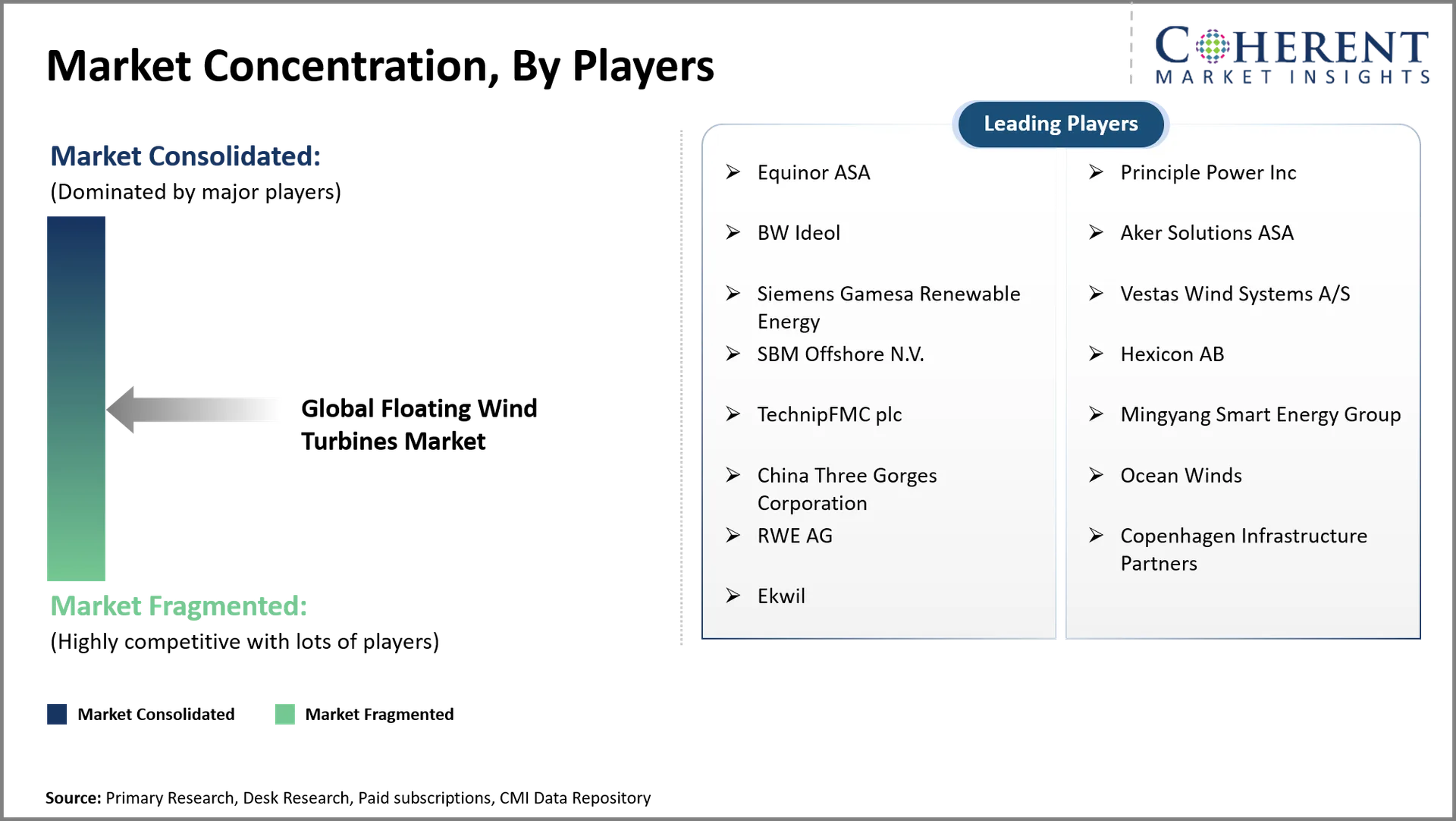
The global floating wind turbines market features established energy developers, turbine manufacturers, and floating foundation technology providers. Equinor remains leading the way in operating experience and the development of floating wind technology. Its 94.6 MW Hywind Tampen project provides renewable power to offshore oil and gas facilities. Principle Power specializes on semi-submersible WindFloat foundations and modular manufacturing approaches. Its WindFloat technology is supporting projects in Portugal, Scotland, and France. Ocean Winds’ focus is commercial floating wind projects, like the EFGL project in France. BW Ideol is a Damping Pool floating foundations and industrial partner specialist. Siemens Gamesa Renewable Energy focuses on larger offshore turbine technologies and turbine integration.
Top Manufacturers and Notable Products in the Floating Wind Turbines Market
Manufacturer | Notable Product | Key features |
Principle Power | WindFloat | Three-column buoyant structure, water ballast system, modular fabrication, proven offshore stability, compatibility with large offshore turbines |
Equinor | Hywind | Deep-draft cylindrical structure, low center of gravity, ballast-based stability, catenary mooring system, proven deepwater operation |
BW Ideol | Damping Pool | Central moonpool, wave-motion damping, shallow draft, concrete construction option, port-based turbine integration |
Stiesdal Offshore | TetraSub | Modular steel construction, standardized components, scalable manufacturing, optimized transportation, suitability for serial production |
Saitec Offshore Technologies | SATH | Twin-hull concrete structure, pendulum-based stabilization, low-draft configuration, modular construction, simplified port assembly |
Market Report Scope
Global Floating Wind Turbines Market Report Coverage | |||
Report Coverage | Details | ||
Base Year | 2025 | Market Size in 2026: | USD 3.70 Bn |
Historical Data For: | 2020 To 2024 | Forecast Period: | 2026 To 2033 |
Forecast Period 2026 To 2033 CAGR: | 14.00% | 2033 Value Projection: | USD 36.00 Bn |
Geographies covered: |
| ||
Segments covered: |
| ||
Companies covered: | Equinor ASA, Principle Power Inc, BW Ideol, Aker Solutions ASA, Siemens Gamesa Renewable Energy, Vestas Wind Systems A/S, SBM Offshore N.V., Hexicon AB, TechnipFMC plc, Mingyang Smart Energy Group, China Three Gorges Corporation, Ocean Winds, RWE AG, Copenhagen Infrastructure Partners, Ekwil | ||
Growth Drivers: |
| ||
Restraints & Challenges: |
| ||
Analyst Opinion (Expert Opinion)
- The floating wind turbines industry is expected to transition from demonstration installations toward larger commercial offshore developments. Semi-submersible foundations will remain important because of their adaptable designs and established operational experience. Larger turbines, standardized mooring arrangements, and improved dynamic cables will influence future project economics. Integration with offshore industrial facilities will create additional demand. Norway and Scotland will remain important development locations because of their offshore engineering capabilities and established project experience.
- The strongest opportunities will emerge in semi-submersible platforms, large-capacity turbines, and utility-scale electricity generation. South Korea and Japan have attractive potential due to their deep coastal waters and offshore energy needs. Norway has the opportunity to combine floating wind with petroleum infrastructure. France has possibilities for floating wind generation in the Mediterranean. Great Britain offers scope for commercial scale developments, especially near Scotland’s offshore development zones. Suppliers of floating foundations and offshore electrical infrastructure can capitalize on increased demand for projects.
- Market participants should focus on standardizing the platform, local manufacturing relationships and technological certification. The designs of foundation manufacturers should be suitable for turbines with a capacity of more than 15 MW. Developers should seek to engage with port operators and offshore installation contractors before the project is built. Companies also need to increase the reliability of dynamic cables and predictive maintenance. Partnerships with proven offshore engineering firms can help reduce technical execution risks. Suppliers should aim at markets with clearly defined licensing procedures, existing grid infrastructure and long-term project funding structures.
Speak to the analyst
Want personalized insights?
Take the findings above to one of our principal consultants, or have the report rebuilt around the segments, geographies and competitors you actually track.
Market Segmentation
- Floating Capacity Insights (Revenue, USD Billion, 2021 - 2033)
- Semi-Submersible Platforms
- Spar Platforms
- Tension Leg Platforms
- Barge-Type Platforms
- Hybrid Floating Platforms
- Turbine Capacity Insights (Revenue, USD Billion, 2021 - 2033)
- Up To 5 MW
- 5-10 MW
- 10-15 MW
- Above 15 MW
- Application Insights (Revenue, USD Billion, 2021 - 2033)
- Utility-Scale Power Generation
- Commercial Power Generation
- Industrial Power Generation
- Offshore Hydrogen Production
- Regional Insights (Revenue, USD Billion, 2021 - 2033)
- North America
- U.S.
- Canada
- Latin America
- Brazil
- Argentina
- Mexico
- Rest of Latin America
- Europe
- Germany
- U.K.
- Spain
- France
- Italy
- Russia
- Rest of Europe
- Asia Pacific
- China
- India
- Japan
- Australia
- South Korea
- ASEAN
- Rest of Asia Pacific
- Middle East
- GCC Countries
- Israel
- Rest of Middle East
- Africa
- South Africa
- North Africa
- Central Africa
- North America
- Key Players Insights
- Equinor ASA
- Principle Power Inc
- BW Ideol
- Aker Solutions ASA
- Siemens Gamesa Renewable Energy
- Vestas Wind Systems A/S
- SBM Offshore N.V.
- Hexicon AB
- TechnipFMC plc
- Mingyang Smart Energy Group
- China Three Gorges Corporation
- Ocean Winds
- RWE AG
- Copenhagen Infrastructure Partners
- Ekwil
Sources
Primary Research Interviews
- Floating Wind Turbine Manufacturers & OEMs
- Offshore Energy Project Developers
- Marine & Subsea Engineering Consultants
- Renewable Energy Policy & Regulatory Experts
Magazines
- Offshore Wind Journal
- Windpower Monthly
- Renewable Energy World
- Wind Systems Magazine
Journals
- Journal of Offshore Mechanics and Arctic Engineering
- Renewable and Sustainable Energy Reviews
- Ocean Engineering Journal
- Journal of Wind Engineering and Industrial Aerodynamics
Associations
- Global Wind Energy Council (GWEC)
- WindEurope Association
- American Clean Power Association (ACP)
- Floating Wind Joint Industry Project (FW JIP)
Public Domain Sources
- U.S. Department of Energy - Office of Energy Efficiency & Renewable Energy (EERE)
- European Commission - Energy Policy Reports
- International Renewable Energy Agency (IRENA) Publications
- National Renewable Energy Laboratory (NREL) Reports
Proprietary Elements
- CMI Data Analytics Tool
- Proprietary CMI Existing Repository of Information for Last 10 Years
Get access to 250+ pages report
Every segment, forecast, competitor profile and data table behind the analysis above — available for instant download.
- ESOMAR Member
- ISO 9001:2015 Certified
- D-U-N-S Registered
- GDPR & CCPA Compliant
Frequently Asked Questions
The global floating wind turbines market is expected to stand at USD 3.70 Bn in 2026 and is expected to reach USD 36.00 Bn by 2033.
The CAGR of the global floating wind turbines market is projected to be 14.0% from 2026 to 2033.
Increasing investments in offshore renewable energy infrastructure and Growing demand for deepwater wind power generation are the major factors driving the growth of the global floating wind turbines market.
High initial capital investment requirements and Elevated installation and maintenance expenses are the major factors hampering the growth of the global floating wind turbines market.
In terms of floating capacity, semi-submersible platforms segment is estimated to dominate the market revenue share in 2026.
Floating wind turbines are offshore wind energy systems installed on buoyant platforms anchored to the seabed.
Floating foundations maintain turbine stability and support offshore installations in water depths unsuitable for conventional foundations.