

Global Wind Turbine Blade Market Size and Forecast – 2026-2033
The global wind turbine blade market is estimated to be valued at USD 31.31 Bn in 2026 and is expected to reach USD 49.40 Bn by 2033, exhibiting a compound annual growth rate (CAGR) of 6.7% from 2026 to 2033.
Key Takeaways of the Wind Turbine Blade Market:
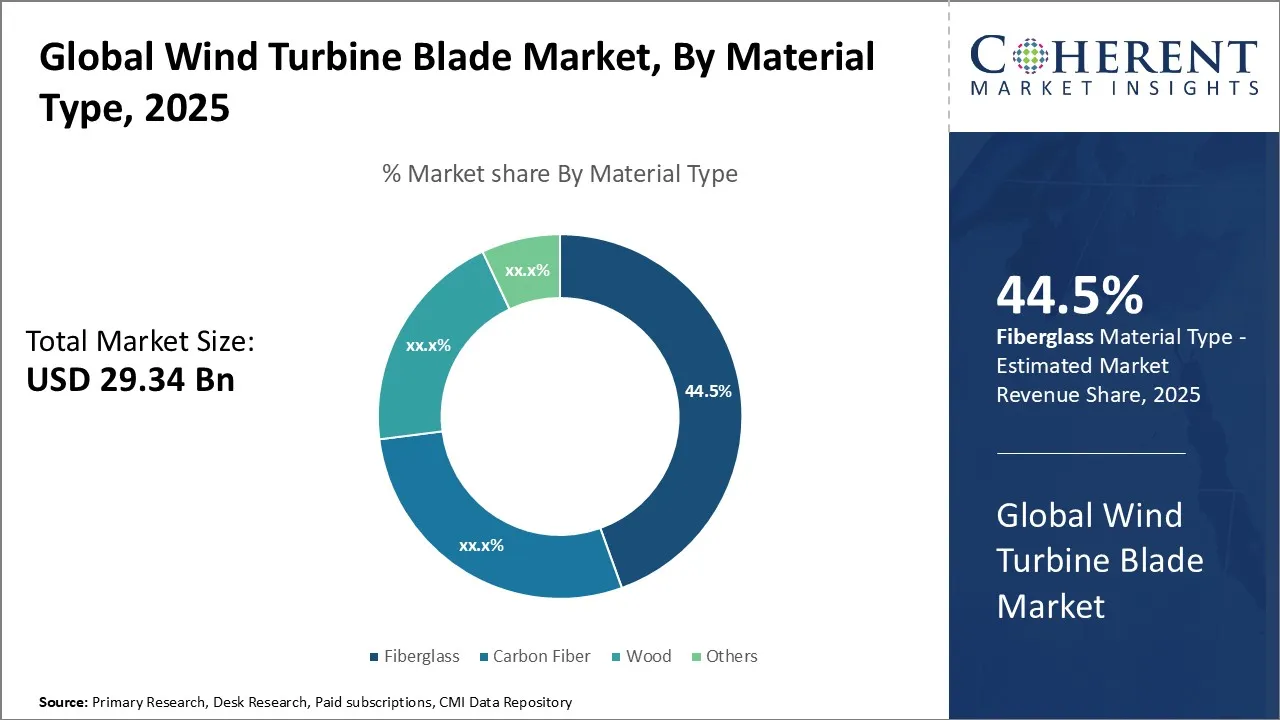
- The fiberglass segment is projected to account for 45.5% share in 2026.
- The up to 50 meter segment is expected to capture 67.2% share in 2026.
- The up to 10 MW segment is projected to hold a 53.8 % share in 2026.
- Asia Pacific is set to lead the global wind turbine blade market in 2026, capturing a projected share of 55.6 % in 2026 and it is projected to be the fastest-growing region.
Market Overview
Market trends indicate a strong shift towards the adoption of advanced materials like carbon fiber and hybrid composites to enhance blade durability and efficiency while reducing weight. Additionally, innovations in blade design and manufacturing processes, including automation and digitalization, are improving performance and reducing costs. Growing government initiatives and regulatory support to curb carbon emissions are accelerating the deployment of offshore wind energy, making wind turbine blades a crucial component in the global renewable energy landscape.
Current Events and Its Impact
Current Events | Description and its Impact |
India's Tax Reduction on Wind Equipment |
|
Britain's Partnership with Ming Yang Smart Energy |
|
Segmental Insights
- Current Industry Events of 2026
- Market Size Estimation
- Regional Breakdown
- Competitive Landscape
- Customer Intelligence
- Segmental Analysis
- Pricing Analysis
- Key Market Drivers, Challenges & Future Trends
- Customized Insights Section
Wind Turbine Blade Market Insights, by Material Type – Fiberglass Segment Dominates Due to its Cost-Effectiveness and Versatile Performance Characteristics
The fiberglass segment is projected to account for 45.5% share in 2026, driven by its balance of strength, weight, and economic feasibility. Being a composite material, fiberglass offers an ideal combination of tensile strength and flexibility, enabling wind turbine blades to withstand the intense mechanical stresses and variable wind conditions experienced during operation. This material’s well-established manufacturing processes and proven reliability have made it the preferred choice for a vast majority of blade producers globally.
For example, Siemens Gamesa's use of fiberglass in their SG 14-222 DD offshore wind turbine blades. These blades, which are among the largest in the industry, utilize advanced fiberglass composite materials to achieve optimal performance in harsh offshore conditions.
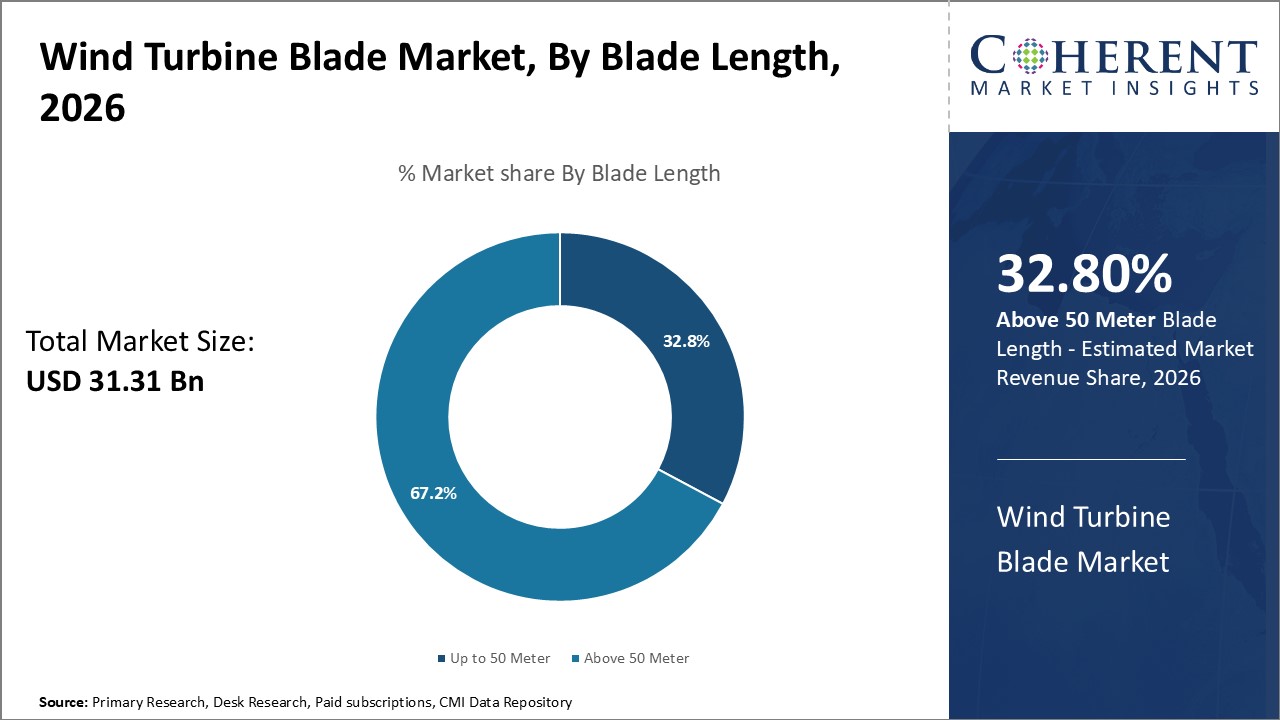
Wind Turbine Blade Market Insights, by Blade Length - Up to 50 Meter Segment Dominates Due to Applicability in Diverse Wind Conditions and Infrastructure Compatibility
The up to 50 meter segment is expected to hold 67.2% share in 2026, as they strike a practical balance between performance and logistics. This size range is particularly well-suited to onshore installations, which account for a significant portion of wind energy generation worldwide. The deployment of blades within this length bracket aligns with existing tower designs and grid capacities, allowing developers to optimize energy output without incurring prohibitive costs or requiring substantial infrastructure upgrades.
One of the main factors encouraging the sustained emphasis on blades up to 50 meters is their adaptability to a wide range of wind regimes. These blades offer sufficient surface area to capture wind energy efficiently in moderate wind speeds, which are common in many geographical regions where wind farm development is concentrated. Their relatively manageable weight and size facilitate transportation and installation, reducing overall project lead times and minimizing logistical challenges that increase with blade length.
Wind Turbine Blade Market Insights, by Capacity - Up to 10 MW Segment Hold the Largest Share Due to Broad Applicability and Established Technology Base
The Up to 10 MW segment is projected to account for 53.8% share in 2026, reflecting their versatility and broad acceptance across various project scales. Turbines in this capacity range cater to the majority of onshore wind installations and many nearshore applications, where they provide an effective solution that balances energy output, installation complexity, and operational maintenance.
A crucial factor underlying the dominance of up to 10 MW turbines lies in the maturity and reliability of technology at this scale. Manufacturers have honed designs and production techniques over decades, resulting in turbines that consistently deliver predictable performance. This reliability reduces perceived risks for developers and investors, encouraging widespread adoption. Moreover, the global supply chain supporting these turbines is well established, facilitating timely procurement, maintenance, and upgrades.
Regional Insights
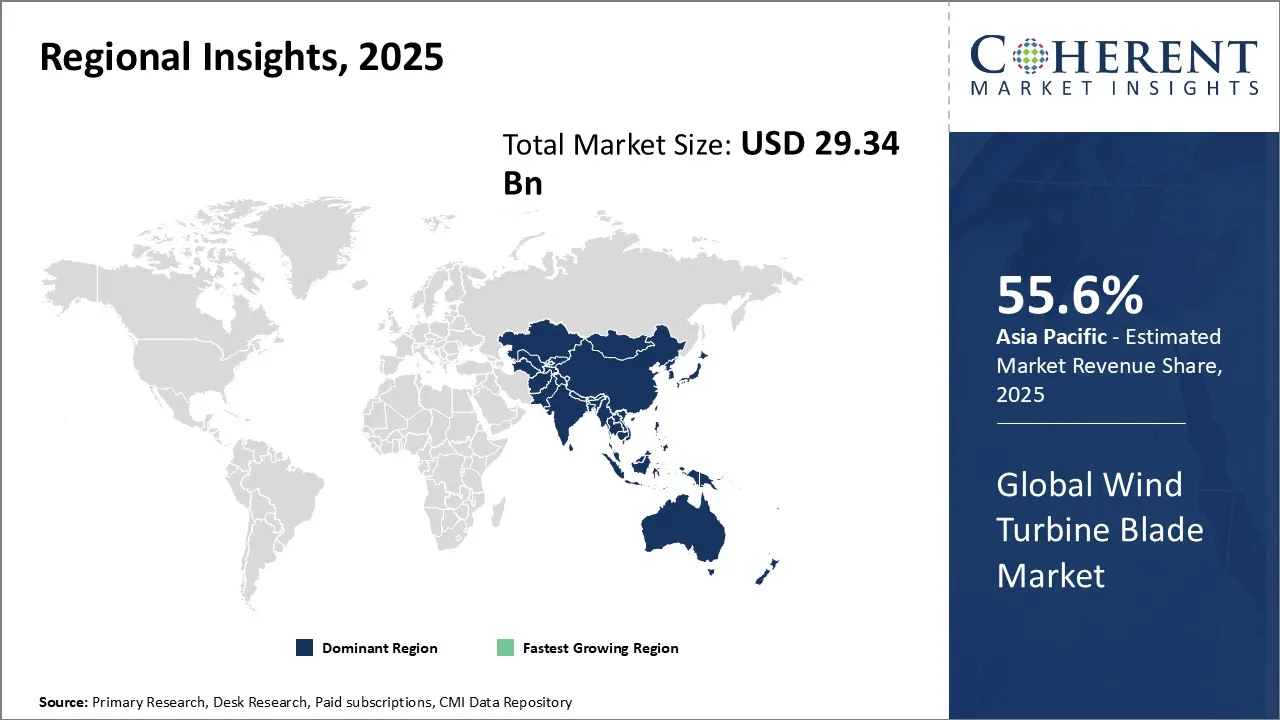
Asia Pacific Wind Turbine Blade Market Analysis and Trends
The Asia Pacific region dominates and exhibits the fastest growth in the wind turbine blade market, expected to capture 55.6% share in 2026. This growth is driven by escalating energy demand, coupled with a strong policy focus on clean energy, particularly in countries like China and India. Government initiatives in these nations prioritize rapidly expanding renewable capacity to reduce dependence on fossil fuels, leading to significant investments in wind energy projects.
The region benefits from competitive manufacturing capabilities, lower labor costs, and the attraction of both domestic and foreign companies establishing or expanding blade production facilities. Key players such as Goldwind (China), Envision Energy (China), and Suzlon Energy (India) play a crucial role in driving local market expansion. Additionally, regional trade partnerships and government subsidies further support local production and technology transfer, bolstering the region’s self-reliance and the market penetration.
Global Wind Turbine Blade Market Outlook for Key Countries
China Wind Turbine Blade Market Analysis and Trends
China wind turbine blade market is the largest globally due to comprehensive government support for wind power capacity expansion and strong domestic manufacturing capabilities. Companies like Goldwind and Envision Energy lead the market with integrated supply chains, including blade production, facilitating rapid deployment of both onshore and offshore wind farms. The Chinese government’s focus on localization and technological innovation drives continuous improvements in blade materials and design, making it a global manufacturing hub. Moreover, China leverages extensive infrastructure and logistics networks that support large-scale blade transportation and installation.
U.S. Wind Turbine Blade Market Analysis and Trends
The U.S. continues to lead in wind energy deployment, supported by federal and state-level incentives such as tax credits and renewable portfolio standards. The market is characterized by prominent players like GE Renewable Energy and TPI Composites, which specialize in cutting-edge composite blade manufacturing technology. The U.S. wind turbine blade market benefits from a vast and diverse wind resource base, enabling significant onshore and emerging offshore projects. Policy focus on clean energy transition and private sector investments have led to modernization of production facilities, driving sophisticated blade manufacturing to enhance turbine efficiency and durability.
Germany Wind Turbine Blade Market Analysis and Trends
Germany is a key player in Europe wind turbine blade market with strong government policies aligned with the Energiewende transition toward renewables. Siemens Gamesa and Nordex are prominent contributors, focusing heavily on innovation in blade aerodynamics and material strength. Germany’s established industrial base, combined with its focus on offshore wind projects in the North Sea and Baltic Sea, propels blade demand and technological advancements. Robust R&D frameworks supported by government and private sector collaboration strengthen technological leadership and export potential within Europe and beyond.
India Wind Turbine Blade Market Analysis and Trends
India wind turbine blade market is growing rapidly due to increasing energy needs and government schemes promoting renewable energy installation, such as the National Wind-Solar Hybrid Policy. Domestic manufacturers like Suzlon Energy and Vestas India play crucial roles in meeting rising the demand, alongside increasing investments in blade manufacturing facilities. The Indian government’s push towards Make in India has stimulated local production, reduced import dependence and fostering skill development. The evolving supply chain ecosystem and improved transport infrastructure are facilitating faster deployment of large-scale wind projects onshore, particularly in western and southern regions.
Denmark Wind Turbine Blade Market Analysis and Trends
Denmark remains an innovation leader in the global wind turbine blade market, due to its strong industrial tradition in wind energy and pioneering companies like Vestas and LM Wind Power. The country emphasizes R&D, focusing on lightweight materials and blade longevity to improve performance in challenging conditions. Denmark’s export-oriented industry benefits from excellent trade relations and robust support infrastructures, enabling the delivery of advanced blades worldwide. The government's long-term renewable strategies nurture a conducive environment for sustained technological advancements and maintain Denmark’s prominent position in the global supply chain.
Macro and Micro Economic Factors Impacting on Wind Turbine Blade Market Growth
Macroeconomic Factors
- Global Renewable Energy Push: Widespread investments in renewable energy infrastructure, driven by global climate commitments and the turn away from fossil fuels, have accelerated wind power blade market expansion.
- Government Policies & Incentives: Supportive regulatory frameworks, production tax credits, and clean energy targets in major economies stimulate wind turbine projects and blade adoption.
- Rising Electricity Demand: Population growth, rapid urbanization, and the need for rural electrification especially in Asia Pacific foster continuous development of wind power capacity.
- Climate Change & Sustainability Goals: Environmental urgency has led governments and corporations to prioritize wind energy over polluting alternatives, strengthening long-term market prospects.
Microeconomic Factors
- Technological Innovations: Adoption of carbon fiber composites and hybrid blade designs has improved blade efficiency and durability; this supports larger turbines optimized for diverse deployment scenarios.
- Manufacturing Efficiency: Advances in automated manufacturing and modular construction have lowered costs, boosted product reliability, and addressed logistics for large installations (especially offshore).
- Material Cost & Supply: Competitive sourcing and innovation in blade materials are reducing production costs and enabling lighter blades with enhanced performance.
- Industry Competition and Investment: Increased investment in wind farms has intensified competition among blade makers, encouraging superior quality and technological differentiation.
- Operational Efficiency: Improved blade aerodynamics and performance enable energy generation even in low-wind regions, expanding global market reach.
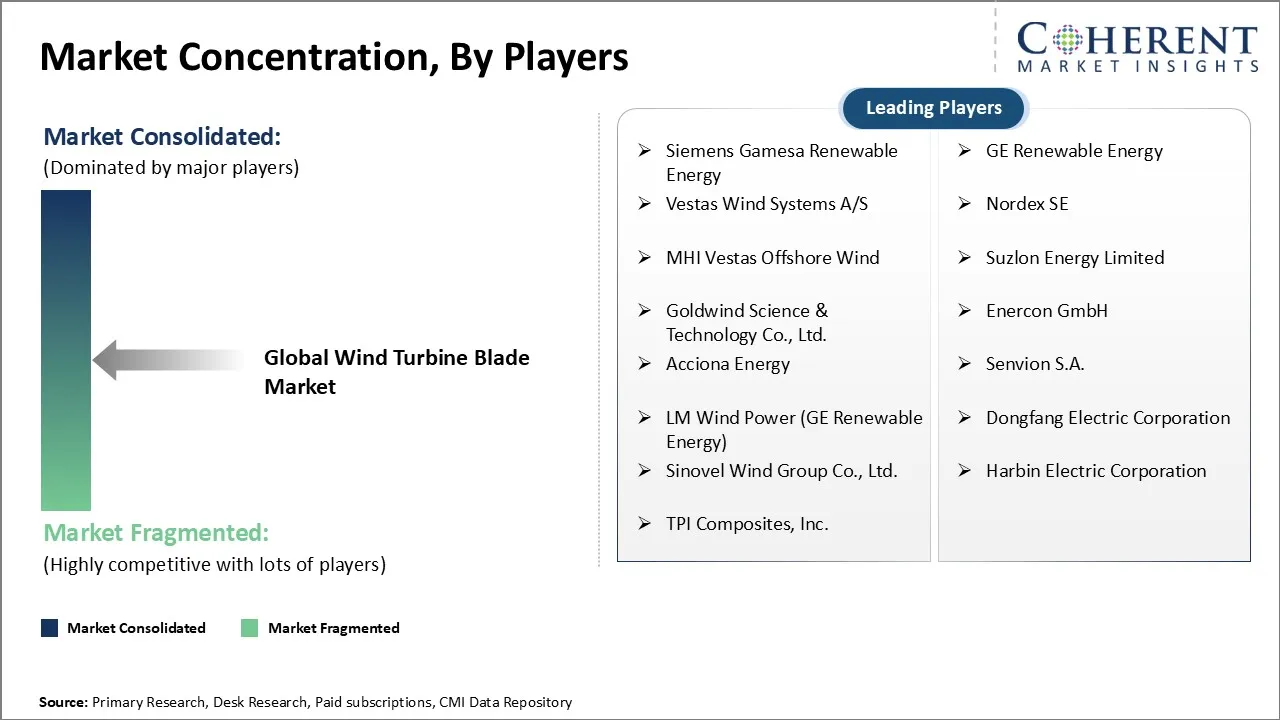
Market Players, Key Development, and Competitive Intelligence
Key Developments
- On September 08, 2025, ONYX Insight, backed by Macquarie Capital and a global leader in predictive analytics for the wind energy sector, has acquired ELEVEN I, a UK-based company specializing in wind turbine blade condition monitoring and advanced analytics.
- In June 2025, Sinoma Science & Technology, a leading Chinese producer of special fiber composite materials, announced plans to invest USD 25.2 million in establishing a wind turbine blade manufacturing facility in Uzbekistan. The new plant is aimed at accelerating the supply of blades to local customers, supporting Uzbekistan’s growing wind power development initiatives, and strengthening Sinoma’s international presence in the renewable energy sector.
- In December 2023, the ZEBRA (Zero waste Blade Research) Consortium announced the successful completion of certification tests for the first fully recyclable turbine blade. Additionally, the consortium developed a second blade with repeated insulation technology to further improve reliability in the gas sector and advance the industry toward a circular economy.
- In November 2022, Vestas entered a multi-year framework agreement with long-term partner TPI Composites Inc., a leading supplier of wind turbine blades and services. Through this partnership, TPI will expand its global assembly footprint to support both current and the next-generation wind turbine blade production.
Top Strategies Followed by Global Wind Turbine Blade Market Players
- Established Players: Leading players in this market typically invest heavily in research and development (R&D) to push the boundaries of blade performance and durability. Their R&D efforts focus on enhancing aerodynamic efficiency, reducing weight, increasing material longevity, and integrating new composites and smart technologies. By delivering high-performance products, these incumbents maintain a technological edge over competitors. To capitalize on global renewable energy growth, these established players continuously expand their distribution networks, tapping into emerging markets in Asia Pacific, Latin America, and Africa.
- For instance, Vestas, pioneered the development of 115-meter-long offshore blades designed to maximize energy capture, while Siemens Gamesa is working on recyclable blade technology under its Recyclable Blade project to support sustainability initiatives.
- Mid-level players in the wind turbine blade sector aim to carve out their competitive advantages by emphasizing cost-effective solutions that offer a prudent balance between quality and affordability. These companies primarily target price-sensitive customers such as smaller wind farm developers or emerging markets where budget constraints influence procurement choices. By focusing on streamlined manufacturing processes and material optimization, mid-level firms can reduce production costs without significantly compromising on product reliability or performance standards.
- For example, Nordex emphasizes modular blade designs that simplify logistics and assembly, reducing costs for developers. Suzlon Energy Limited designs and produces India's longest wind turbine blade of 63 meters.
- Small-scale players in the wind turbine blade market differentiate themselves through specialization and innovation. They tend to concentrate on niche product segments, such as lightweight blades for small turbines, modular designs, or blades equipped with advanced sensors for real-time condition monitoring. By adopting cutting-edge technologies like additive manufacturing, advanced composites, and digital design tools, these firms stay competitive despite limited resources. Their agility allows them to rapidly prototype and customize solutions tailored to specific client needs or regional industry requirements.
- For example, TPI Composites, although a larger player, has introduced advanced sensor integration in their blades for real-time condition monitoring. While they are known for large-scale projects, their initiative to integrate sensor technologies into their blades has set them apart in terms of predictive maintenance and operational efficiency—an approach that smaller companies in the sector are increasingly adopting to stay competitive.
Market Report Scope
Wind Turbine Blade Market Report Coverage
| Report Coverage | Details | ||
|---|---|---|---|
| Base Year: | 2025 | Market Size in 2026: | USD 31.31 Bn |
| Historical Data for: | 2020 To 2024 | Forecast Period: | 2026 To 2033 |
| Forecast Period 2026 to 2033 CAGR: | 6.7% | 2033 Value Projection: | USD 49.40 Bn |
| Geographies covered: |
| ||
| Segments covered: |
| ||
| Companies covered: | Siemens Gamesa Renewable Energy, GE Renewable Energy, Vestas Wind Systems A/S, Nordex SE, MHI Vestas Offshore Wind, Suzlon Energy Limited, Goldwind Science & Technology Co., Ltd., Enercon GmbH, Acciona Energy, Senvion S.A., LM Wind Power (GE Renewable Energy), Dongfang Electric Corporation, Sinovel Wind Group Co., Ltd., Harbin Electric Corporation, and TPI Composites, Inc. | ||
| Growth Drivers: |
| ||
| Restraints & Challenges: |
| ||
Wind Turbine Blade Market Dynamics
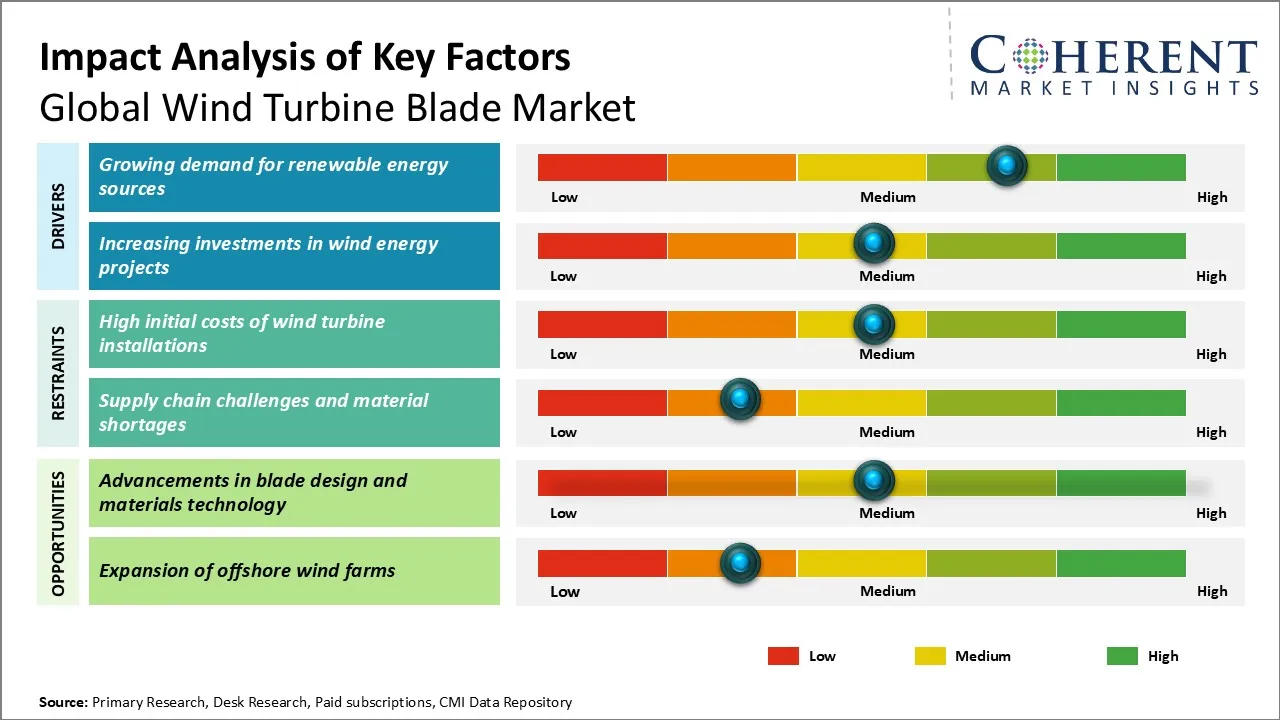
Wind Turbine Blade Market Driver - Growing Demand for Renewable Energy Sources
The increasing global emphasis on sustainable energy solutions is a significant driver propelling the wind turbine blade market. Governments and industries worldwide are progressively shifting focus towards renewable/green energy sources to combat climate change and reduce carbon footprints. Wind energy, being one of the most viable and mature renewable options, is gaining substantial traction, leading to heightened investments in wind power infrastructure. This shift encourages the production of more efficient and larger wind turbine blades, designed to maximize energy capture and improve overall turbine performance.
For instance, the International Energy Agency (IEA) reported that global wind power capacity additions reached 116 GW in 2023, marking a record-high increase, largely fueled by China, the U.S., and European Union initiatives. Projects such as the Hornsea 3 offshore wind farm in the U.K., which plans to use next-generation turbine blades exceeding 100 meters in length, exemplify how rising renewable energy demand directly accelerates innovations in the wind turbine blade design and production.
Wind Turbine Blade Market Opportunity - Advancements in Blade Design and Materials Technology
The global wind turbine blade market is witnessing significant opportunities driven by continuous advancements in blade design and materials technology. Innovations in aerodynamic blade shapes and optimized structural configurations are enabling higher efficiency and energy capture, thereby enhancing overall turbine performance. The integration of lightweight, durable composite materials such as carbon fiber-reinforced polymers is reducing blade weight while improving strength and fatigue resistance. These materials help turbines operate more reliably under diverse environmental conditions, extending blade lifespan and reducing maintenance costs.
For example, LM Wind Power (a GE Renewable Energy subsidiary) developed the world’s longest offshore wind turbine blade at 107 meters, designed for the GE Haliade-X platform. The blade’s advanced composite structure improves aerodynamic efficiency and withstands harsh offshore conditions while enabling turbines to generate up to 12–14 MW of power.
Analyst Opinion (Expert Opinion)
- The global wind turbine blade market is on an upward trajectory, propelled by the increasing push for renewable energy and advancements in technology. Insights from the Global Wind Energy Conference (2023) and the Wind Turbine Technology Summit (2022) highlighted significant innovations, with companies like Siemens Gamesa and GE Renewable Energy leading the development of larger, more efficient blade designs.
- Siemens Gamesa’s recent unveiling of a 108-meter blade demonstrates a strategic response to the demand for higher energy output and reduced costs per megawatt. Discussions at these conferences emphasized the critical importance of materials innovation, particularly in lightweight composites that enhance performance and longevity. However, challenges such as supply chain disruptions and the need for skilled labor in manufacturing were noted as potential barriers.
- Companies that invest in R&D to optimize blade aerodynamics and explore recyclable materials will likely gain a competitive edge. Additionally, partnerships with research institutions can foster advancements in blade technology. Ultimately, the wind turbine blade market’s growth will depend on its ability to innovate while addressing the urgent need for sustainable energy solutions amid global climate challenges.
Speak to the analyst
Want personalized insights?
Take the findings above to one of our principal consultants, or have the report rebuilt around the segments, geographies and competitors you actually track.
Market Segmentation
- Material Type Insights (Revenue, USD Bn, 2021 - 2033)
- Fiberglass
- Carbon Fiber
- Wood
- Others
- Blade Length Insights (Revenue, USD Bn, 2021 - 2033)
- Up to 50 Meter
- Above 50 Meter
- Capacity Insights (Revenue, USD Bn, 2021 - 2033)
- Up to 10 MW
- Greater than 10 MW
- Installation Type Insights (Revenue, USD Bn, 2021 - 2033)
- Onshore
- Offshore
- Regional Insights (Revenue, USD Bn, 2021 - 2033)
- North America
- U.S.
- Canada
- Latin America
- Brazil
- Argentina
- Mexico
- Rest of Latin America
- Europe
- Germany
- U.K.
- Spain
- France
- Italy
- Russia
- Rest of Europe
- Asia Pacific
- China
- India
- Japan
- Australia
- South Korea
- ASEAN
- Rest of Asia Pacific
- Middle East
- GCC Countries
- Israel
- Rest of Middle East
- Africa
- South Africa
- North Africa
- Central Africa
- North America
- Key Players Insights
- Siemens Gamesa Renewable Energy
- GE Renewable Energy
- Vestas Wind Systems A/S
- Nordex SE
- MHI Vestas Offshore Wind
- Suzlon Energy Limited
- Goldwind Science & Technology Co., Ltd.
- Enercon GmbH
- Acciona Energy
- Senvion S.A.
- LM Wind Power (GE Renewable Energy)
- Dongfang Electric Corporation
- Sinovel Wind Group Co., Ltd.
- Harbin Electric Corporation
- TPI Composites, Inc.
Sources
Primary Research Interviews
- Chief Technology Officer – Leading Wind Turbine Manufacturer
- Head of Procurement – Global Renewable Energy Developer
- Director of Operations – Offshore Wind Farm Operator
- Sustainability & Policy Manager – International Wind Energy Association
Stakeholders
- Manufacturers (turbine OEMs, composite material suppliers, blade recyclers)
- End Use Sectors:
- Onshore Wind Power Operators
- Offshore Wind Power Developers
- Utility Companies & Independent Power Producers (IPPs)
- Regulatory & Certification Bodies
- EPC Contractors & Service Providers
Databases
- UN Comtrade Database
- India Import Export (EXIM) Database
- International Renewable Energy Agency (IRENA) Data Portal
Magazines
- Windpower Monthly – Market developments and technology innovation in wind turbines
- Recharge News – Updates on global wind energy projects and financing
- Renewable Energy World – Insights on wind technology and sustainability
- Composites World – Innovations in blade materials and recycling
Journals
- Renewable Energy Journal – Blade performance and efficiency research
- Journal of Wind Engineering & Industrial Aerodynamics – Blade aerodynamics and structural studies
- Energy Policy – Wind energy policy, regulations, and investments
- Journal of Composite Materials – Materials innovation for wind turbine blades
- Applied Energy – Blade lifecycle assessments and sustainability
Newspapers
- The Financial Times – Global renewable energy investments and wind market growth
- The Guardian – Policy and sustainability aspects of wind energy adoption
- Nikkei Asia – Asia-Pacific wind turbine development and supply chain trends
- European Energy News – EU wind power regulation and market expansion
Associations
- American Wind Energy Association (AWEA) / now American Clean Power Association (ACP)
- International Electrotechnical Commission (IEC) – Standards for wind turbine blades
- Offshore Renewable Energy Catapult (UK)
- National Renewable Energy Laboratory (NREL, US)
Public Domain Sources
- International Energy Agency (IEA) – Global Wind Energy Reports
- European Commission – Offshore Wind Energy Strategy and Directives
- U.S. Department of Energy (DOE) – Wind Energy Technologies Office (WETO)
- Bureau of Ocean Energy Management (BOEM) – Offshore wind policies (US)
- World Bank – Offshore wind feasibility and financing programs
Proprietary Elements
- CMI Data Analytics Tool, Proprietary CMI Existing Repository of information for last 8 years.
Get access to 250+ pages report
Every segment, forecast, competitor profile and data table behind the analysis above — available for instant download.
- ESOMAR Member
- ISO 9001:2015 Certified
- D-U-N-S Registered
- GDPR & CCPA Compliant
Missing comfort of reading report in your local language? Find your preferred language:
Transform your Strategy with Exclusive Trending Reports
Frequently Asked Questions
The global wind turbine blade market is estimated to be valued at USD 31.31 Bn in 2026 and is expected to reach USD 49.40 Bn by 2033.
The CAGR of the global wind turbine blade market is projected to be 6.7% from 2026 to 2033.
Growing demand for renewable energy sources and increasing investments in wind energy projects are the major factors driving the growth of the global wind turbine blade market.
High initial costs of wind turbine installations and supply chain challenges and material shortages are the major factors hampering the growth of the global wind turbine blade market.
In terms of material type, the fiberglass segment is estimated to dominate the market revenue share in 2026.
Siemens Gamesa Renewable Energy, GE Renewable Energy, Vestas Wind Systems A/S, Nordex SE, MHI Vestas Offshore Wind, Suzlon Energy Limited, Goldwind Science & Technology Co., Ltd., Enercon GmbH, Acciona Energy, Senvion S.A., LM Wind Power (GE Renewable Energy), Dongfang Electric Corporation, Sinovel Wind Group Co., Ltd., Harbin Electric Corporation, and TPI Composites, Inc. are the major players.
Asia Pacific is expected to lead the global wind turbine blade market in 2026.