

Microbial Enhanced Oil Recovery Market Size and Share Analysis - 2026 To 2033
The Microbial Enhanced Oil Recovery Market size is anticipated to grow at a CAGR of 11.2% with USD 1,600 Mn in 2026 and is expected to reach USD 3,730 Mn in 2033. The primary drivers are defined by increasing demand for microbial-based techniques in mature and declining oil fields, enhanced oil recovery from onshore and offshore wells, and the need to improve recovery efficiency in high-salinity environments. Some of the other factors include the rising crude oil prices, technological innovations in biopolymers and nanoparticles, and environmental regulations promoting reduced chemical usage. Typically, after primary and secondary recovery, only about 30% of the oil is recovered, leaving 70% in the ground, which drives adoption of tertiary methods such as microbial enhanced oil recovery.
Key Takeaways
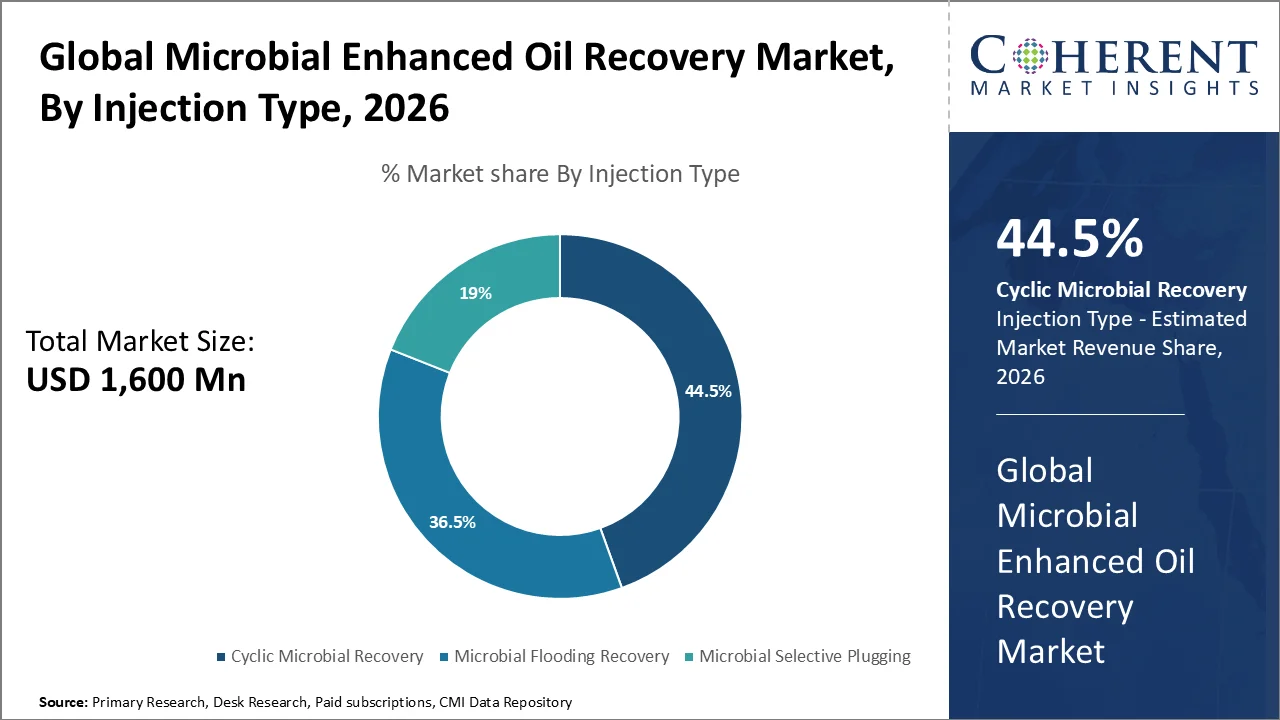
- The cyclic microbial recovery segment is likely to dominate the market with 44.5% in 2026. The segment’s growth is owing to its wide adoption in enhanced oil recovery projects, ease of microbial control, and consistent incremental oil production, which makes it a preferred choice for operators managing mature reservoirs. Cyclic MEOR is widely applied because large residual oil volumes of 30% remain trapped after primary and secondary recovery.
- The interfacial tension reduction segment is set to lead with 27.50% in 2026. The segment’s growth is owing to the efficiency of biosurfactant-producing microbes in mobilizing residual oil, improving sweep efficiency, and compatibility with a broad range of crude types.
- The onshore segment is set to lead with 69.50% in 2026. The segment’s growth is owing to the higher concentration of mature oilfields, logistical ease of microbial injection, and the majority of MEOR field trials being onshore, with 47 trials reported across 21 countries.
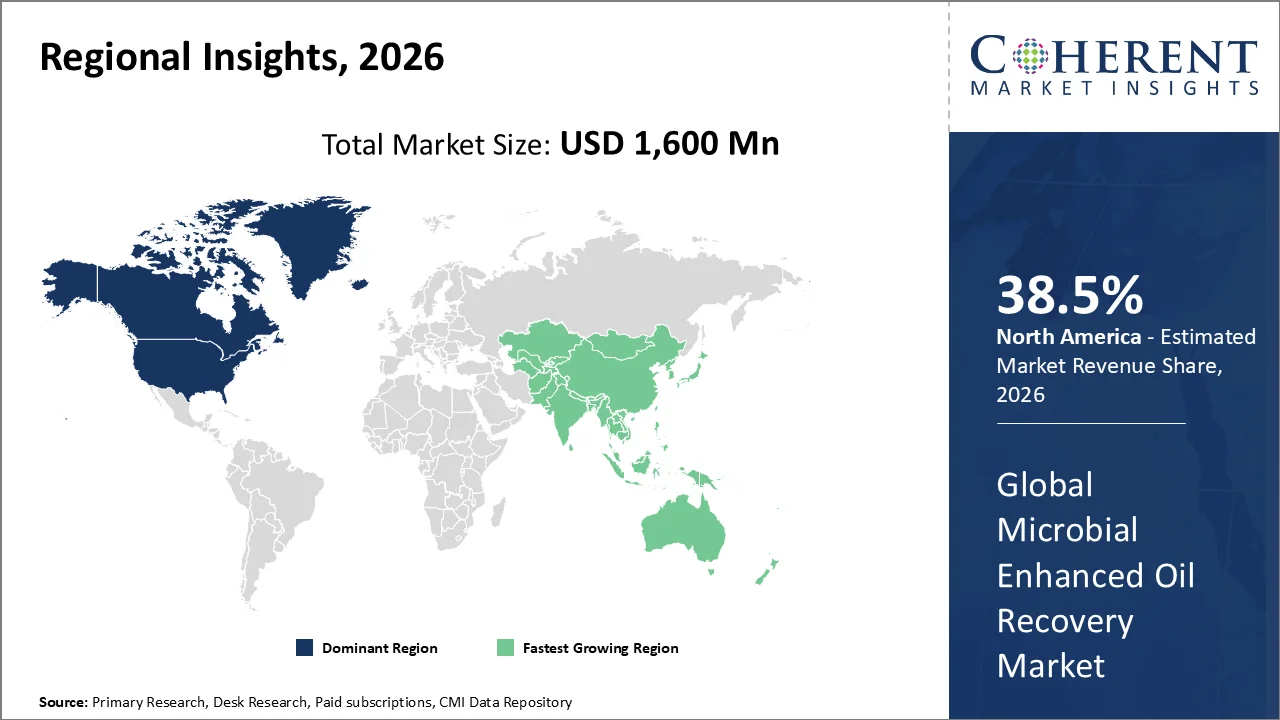
- North America is expected to acquire the prominent share of 38.50% in 2026. The region’s growth is owing to the favorable regulatory frameworks, technological readiness, strong R&D investment in microbial EOR technologies, and high demand for maximizing recovery from aging reservoirs. MEOR approaches have achieved success in approximately 80% of field trials, supporting further adoption.
Increasing Need to Maximize Recovery from Mature Reservoirs is Transforming the Microbial Enhanced Oil Recovery Market in the US
The U.S. microbial enhanced oil recovery market is gaining importance as operators seek low cost ways to recover bypassed oil from mature and waterflooded reservoirs. The DOE notes that only about 10% of oil in unconventional shale formations is typically recovered, thereby leaving large volumes technically stranded and creating the demand for methods that improve sweep efficiency without heavy chemical intensity.
MEOR fits this need because microbes, nutrients, and biosurfactants can alter permeability, reduce interfacial tension, and redirect flow toward unswept zones. NETL funded work showed engineered bacterial rhamnolipids recovered 42% of the remaining oil after waterflood at 250 ppm concentration, proving the technical relevance of biosurfactant driven recovery.
In May 2026, DOE selected the University of North Dakota’s Energy and Environmental Research Center for a USD 36 million Bakken EOR program to advance field-based recovery deployment across aging U.S. oilfields.
Genetically Engineered Microbes for Enhanced Performance (GEMEOR): A Major Breakthrough in the Microbial Enhanced Oil Recovery Market
Genetically Engineered Microbes for Enhanced Performance (GEMEOR) are a major breakthrough in the Microbial Enhanced Oil Recovery Market. This is owing to their ability to substantially improve oil extraction from mature reservoirs. The traditional microbial methods relied on wild strains, which were unpredictable and often left over 60% of crude oil trapped, as documented in the National Institutes of Health (NIH) PMC database.
The GEMEOR overcomes these limitations by employing engineered microbes with optimized metabolic pathways, thereby enabling precise in-situ stimulation and targeted biosurfactant production to reduce interfacial tension and enhance oil mobilization. The field tracking up to 2021 demonstrated an 80% technical success rate through controlled nutrient injection, thereby underscoring their reliability as well as efficiency.
By 2021, with the U.S. petroleum consumption at 19.78 million barrels per day, GEMEOR’s standardized approach became critical for maximizing well longevity, operational efficiency, and overall recovery, thereby establishing it as a transformative advancement in tertiary oil recovery.
- Current Industry Events of 2026
- Market Size Estimation
- Regional Breakdown
- Competitive Landscape
- Customer Intelligence
- Segmental Analysis
- Pricing Analysis
- Key Market Drivers, Challenges & Future Trends
- Customized Insights Section
Current Events and Their Impact on the Microbial Enhanced Oil Recovery Market
Current Event | Description and its Impact |
EPA UIC Regulatory Framework for Enhanced Oil Recovery |
|
Growing Government & Industry Focus on EOR Policy Frameworks (Global) |
|
Segmental Insights
Why is Cyclic Microbial Recovery Acquiring the Largest Share?
On the basis of injection type, the cyclic microbial recovery segment is projected to account for the largest Microbial Enhanced Oil Recovery Market share of 44.5% in 2026. The segment’s growth is owing to its strong ability to stimulate indigenous microbes and mobilize residual oil from mature reservoirs more effectively than continuous injection methods. The segment is growing as operators look for tertiary recovery techniques that can improve output from existing oilfields without depending only on conventional recovery approaches.
The field trials have shown that the microbial techniques can mobilize an additional 12% to 23% of residual oil in fractured porous media under optimized conditions, thereby demonstrating measurable recovery improvement. In addition, the MEOR applications have been successfully demonstrated in over 90% of documented trials, which strengthens the confidence in cyclic microbial recovery as a practical recovery method.
In June 2025, Gold H2 completed the world’s first subsurface bio stimulated hydrogen production field trial in a legacy oilfield in California’s San Joaquin Basin, with ChampionX providing advanced oilfield services. The trial used Gold H2’s proprietary biotechnology to generate clean hydrogen directly underground using depleted oil reservoirs and existing infrastructure.
Interfacial Tension Reduction hold the Largest Market Share
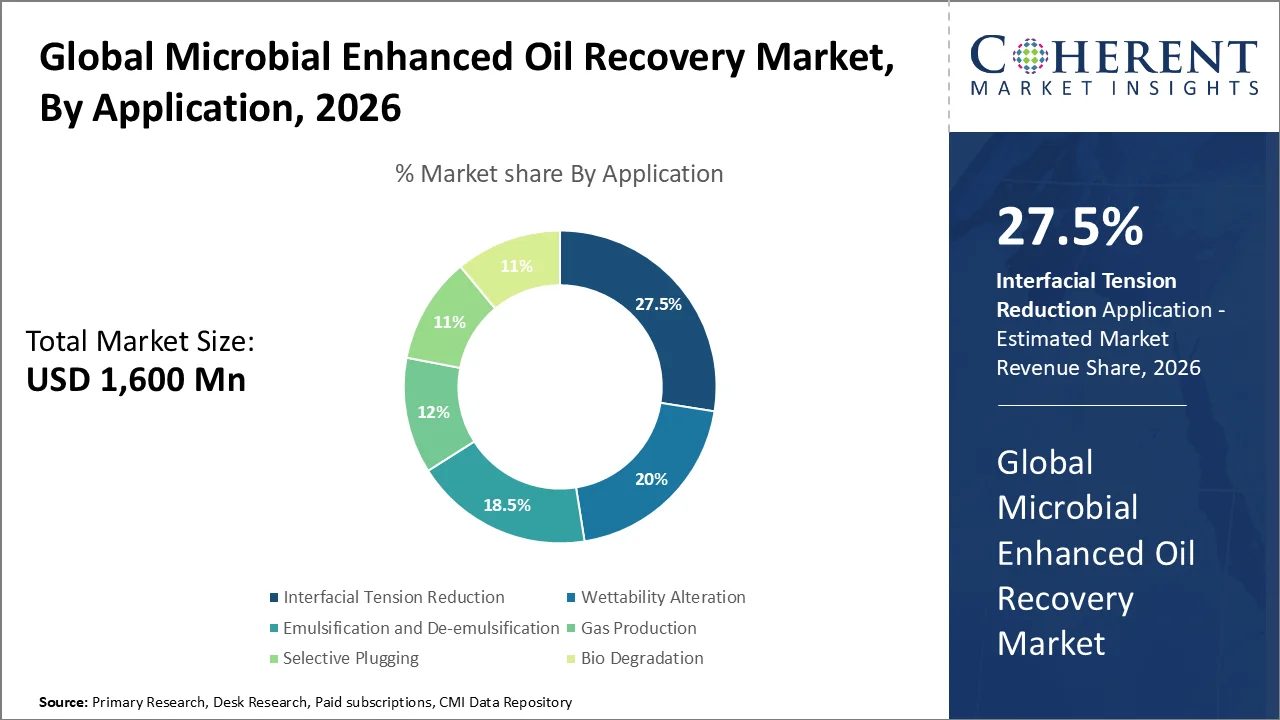
On the basis of basis of application, the interfacial tension reduction segment lead with a major 27.50% share in 2026. The growth is owing to the increasing adoption of microbial enhanced oil recovery (MEOR) as a tertiary EOR technology, which targets oil left behind after primary and secondary extraction methods. Conventional recovery methods typically recover only about 20% of the original oil in place, leaving a large volume of residual oil available for advanced recovery approaches.
Interfacial tension reduction plays a critical role in this process, as microbial activity produces biosurfactants and gases which alter interfacial properties, reduce oil trapping, as well as improve sweep efficiency. According to literature reviewed by the U.S. Department of Energy and allied petroleum microbiology analyses, the microbial processes can recover up to around 50% of residual oil under suitable reservoir conditions.
Microbial Enhanced Oil Recovery Market Trends
- The rising adoption of microbial-based recovery techniques in mature and declining oil fields is enhancing the extraction efficiency and minimizing the reliance on chemical EOR methods.
- The customized microbial consortia tailored to specific reservoir conditions improve oil recovery rates, lower operational costs, and reduce environmental impact across both onshore as well as offshore wells.
- Innovations in biopolymers and nanoparticle-assisted microbial EOR expand application capabilities, thereby offering more stable and efficient oil mobilization in high-salinity and high-temperature reservoirs.
- The increasing global crude oil demand and the pressure to optimize production from existing fields is propelling the MEOR deployment. Typically, after primary and secondary recovery stages, only around 30% of the oil in a reservoir is recovered, thereby leaving approximately 70% still in the ground, which encourages tertiary recovery adoption.
- The supportive regulatory frameworks and sustainability-focused policies are promoting environmentally friendly EOR methods. In the U.S., the initiatives to reduce chemical use in mature oil fields incentivize microbial-based recovery, while several Middle East and Asia Pacific operators integrate MEOR into enhanced oil recovery programs, thereby improving field recovery efficiency as well as operational sustainability.
Regional Insights
North America Dominates Owing to the Strong Mature Oilfields, Advanced Reservoir Research, and EOR Investment
The North America region accounts for 38.50% of the market share in 2026. The region’s growth is owing to the strong base of mature oilfields, advanced reservoir research, and continued investment in enhanced oil recovery methods.
The U.S. Department of Energy reports that the unconventional recovery factors reach only about 5%, thereby underscoring the opportunity for microbial techniques which enhance oil mobilization through biosurfactants, gases, and permeability adjustments.
In 2022, Nicoletti et al. studied the formation water from a high-temperature offshore oilfield in the Joan d’Arc basin, Canada. The nitrate treatment increased the nitrite production (2.45 mM), inhibiting sulfate reduction, thereby highlighting microbial corrosion risks and the importance of MEOR management in North America.
In April 2024, Metawells Oil & Gas Inc. and the Global Oil & Gas Recovery Corp. signed a Letter of Intent to commence a merger, aiming to implement Enhanced Oil Recovery (EOR) techniques across abandoned wells, maturing oil fields, and previously tapped reserves in the U.S. and Canada.
Asia Pacific Microbial Enhanced Oil Recovery Market Trends
Asia Pacific is expected to witness strong growth in Microbial Enhanced Oil Recovery Market over the forecast period. The region’s growth is owing to the increasing efforts to optimize oil recovery from mature reservoirs through cost-efficient, biologically based methods.
In China, extensive field trials have been conducted to validate microbial technologies, with more than 4,600 wells undergoing MEOR field tests and 47 microbial flooding experiments completed. These trials demonstrated up to 4.95% incremental recovery of original oil in place (OOIP) in suitable reservoirs, achieving input-output ratios as high as 1:6 according to Chinese research summaries.
In India, ONGC TERI Biotech Limited (OTBL) has implemented 50 MEOR jobs in five fields in the ONGC Ahmedabad Asset within the Cambay Basin. The projects achieved a commercial success rate of approximately 60% and technical success exceeding 80%, thereby highlighting the effectiveness of microbial interventions in enhancing oil mobilization and strengthening the adoption of MEOR in the Asia Pacific region.
In 2024, an enzyme-EOR study demonstrated a 33° wettability shift, fourfold reduction in interfacial tension, and 11.5 % additional recovery after waterflooding. These findings indicate the strong technical potential of biologically based recovery methods, particularly in complex and mature reservoirs.
Infrastructure Investment and Policy Support is Accelerating the Microbial Enhanced Oil Recovery Market in United States
The Microbial Enhanced Oil Recovery market in the United States is gaining traction. This is because the operators are seeking higher recovery from the mature reservoirs.
According to the U.S. Department of Energy, the conventional methods leave 60% of oil trapped, thereby highlighting the need for advanced EOR approaches like microbial techniques which can improve sweep efficiency and mobilize residual oil.
In addition, CO₂‑based recovery projects are tied to carbon sequestration potential measured in billions of tons, thereby signaling policy support for low‑carbon EOR. The investment in infrastructure is strengthening, with WestAir supplying industrial gas for EOR projects in California and Arizona, thereby accelerating the microbial EOR deployment nationwide.
China Microbial Enhanced Oil Recovery Market Trends
In China, maturing oilfields and national energy-security priorities are propelling growth in the Microbial Enhanced Oil Recovery Market.
The National Energy Administration reported that China’s crude oil production reached 213 million tonnes in 2024, indicating continued pressure to sustain domestic output from complex reservoirs. This is supported by the country’s rising focus on tertiary recovery technologies that improve residual oil mobilization without heavy chemical intensity.
In December 2024, Daqing Oilfield completed microbial based enhanced oil recovery field trials in the Punan No. 3 fault block and the Wei 21 block of Qingxin Oilfield Company. The trials achieved staged oil recovery increases of 4.61 and 3.03 percentage points respectively, with the final EOR expected to exceed waterflooding performance by more than six percentage points.
Who are the Major Companies in Microbial Enhanced Oil Recovery Industry
Some of the major key players in Microbial Enhanced Oil Recovery Market are National Energy Services Reunited Corp., Micro-Bac International Inc., RAM Biochemical, Inc., Titan Oil Recovery, Inc., Chemiphase Ltd., ConocoPhillips Company, and Microbial Energy Inc.
Key News
- In October 2025, International Industrial Partners (IIP) partnered with Nissan Chemical America to distribute nanoActiv technology, the world’s first brine resistant nanoparticle solution for Enhanced Oil Recovery (EOR), across the Middle East and North Africa (MENA). The technology maintains performance in high salinity reservoirs, enabling higher oil recovery rates, lower operational costs, and reduced environmental impact, representing a major advancement in nanotechnology for EOR.
- In May 2025, Sonoro Energy, Advanced BioCatalytics, and NexTier Energy launched a strategic collaboration to enhance heavy oil recovery from carbonate reservoirs in the Middle East. The partnership combines biotechnology innovation, reservoir engineering, and regional energy expertise.
- In March 2025, Hunting PLC acquired the Organic Oil Recovery (OOR) technology for $17.5 million, including over 25 patents, global distribution rights, and a laboratory in California, positioning the company to accelerate EOR commercialization across North America and worldwide.
Market Report Scope
Microbial Enhanced Oil Recovery Market Report Coverage
| Report Coverage | Details | ||
|---|---|---|---|
| Base Year: | 2025 | Market Size in 2026: | USD 1,600 Mn |
| Historical Data for: | 2020 To 2024 | Forecast Period: | 2026 To 2033 |
| Forecast Period 2026 to 2033 CAGR: | 11.2% | 2033 Value Projection: | USD 3,730 Mn |
| Geographies covered: |
| ||
| Segments covered: |
| ||
| Companies covered: | National Energy Services Reunited Corp., Micro-Bac International Inc., RAM Biochemical, Inc., Titan Oil Recovery, Inc., Chemiphase Ltd., ConocoPhillips Company, and Microbial Energy Inc. | ||
| Growth Drivers: |
| ||
| Restraints & Challenges: |
| ||
Analyst Opinion
- The MEOR market is driven by the pressing need to improve oil recovery from aging and mature reservoirs. Typically, after primary and secondary recovery stages, only around 30 percent of the oil in a reservoir is recovered, leaving the rest untapped, which means the market is not growing because of trends it is growing because operators still need effective solutions.
- Enhanced oil recovery using microbial techniques is one of the most widely applied tertiary recovery methods globally. Estimates show that microbial injection projects are being implemented across millions of barrels of oil each year, highlighting the critical role of microbes in reversing production decline.
- Advanced microbial solutions including biopolymers and nanoparticle assisted microbes are gaining significant traction, with field data showing that MEOR can improve oil recovery by five to fifteen percent of original oil in place. This proven efficiency and operational reliability are expected to further drive adoption, encouraging oil producers to deploy MEOR across both established and emerging markets.
Speak to the analyst
Want personalized insights?
Take the findings above to one of our principal consultants, or have the report rebuilt around the segments, geographies and competitors you actually track.
Market Segmentation
- By Injection Type (Revenue, USD Mn, 2021-2033)
- Cyclic Microbial Recovery
- Microbial Flooding Recovery
- Microbial Selective Plugging
- By Application (Revenue, USD Mn, 2021-2033)
- Interfacial Tension Reduction
- Emulsification and De-emulsification
- Selective Plugging
- Wettability Alteration
- Gas Production
- Bio Degradation
- By Well Location (Revenue, USD Mn, 2021-2033)
- Onshore
- Offshore
- By Region (Revenue, USD Mn, 2021-2033)
- North America
- U.S.
- Canada
- Latin America
- Brazil
- Mexico
- Argentina
- Rest of Latin America
- Europe
- Germany
- U.K.
- France
- Italy
- Spain
- Russia
- Rest of Europe
- Asia Pacific
- China
- India
- Japan
- Australia
- South Korea
- ASEAN
- Rest of Asia Pacific
- Middle East
- GCC
- Israel
- Rest of Middle East
- Africa
- South Africa
- Central Africa
- North Africa
- North America
Sources
Primary Research Interviews
- Microbial EOR Technology Developers
- Oilfield Services Companies
- Reservoir Engineers & Microbial EOR Specialists
- Petroleum Biotechnologists
- Chemical & Microbial Slug Design Engineers
- Operators of Mature Oil Fields
- Technical Consultants in Oil Recovery
Databases
- Bloomberg Terminal
- Thomson Reuters Eikon
- FactSet
- Wood Mackenzie
Magazines
- Oil & Gas Journal
- Petroleum Engineer International
- Journal of Petroleum Technology
- Chemical Engineering Magazine
- Oilfield Technology
Journals
- Journal of Petroleum Science and Engineering
- Fuel
- Energy & Fuels
- Bioresource Technology
- Applied Microbiology and Biotechnology
Newspapers
- Financial Times
- The Wall Street Journal
- Reuters
- Bloomberg News
- OilPrice
Associations
- Society of Petroleum Engineers (SPE)
- International Association of Oil & Gas Producers (IOGP)
- American Petroleum Institute (API)
- European Federation of Biotechnology – Oilfield Microbial Section
- International Microbial EOR Network
Public Domain Sources
- U.S. Department of Energy (DOE) – Office of Fossil Energy & Carbon Management
- International Energy Agency (IEA) – Oil Market Reports
- U.S. Geological Survey (USGS) – Oil & Gas Statistics
- Energy Information Administration (EIA) – Field & Production Data
- European Commission – Energy Directorate
Proprietary Elements
- CMI Data Analytics Tool
- Proprietary CMI Repository of Global EOR Insights (10+ Years)
Get access to 250+ pages report
Every segment, forecast, competitor profile and data table behind the analysis above — available for instant download.
- ESOMAR Member
- ISO 9001:2015 Certified
- D-U-N-S Registered
- GDPR & CCPA Compliant
Missing comfort of reading report in your local language? Find your preferred language:
Transform your Strategy with Exclusive Trending Reports
Frequently Asked Questions
The Microbial Enhanced Oil Recovery Market is expected to reach USD 3,730 Mn in 2033.
Major players operating in the global Microbial Enhanced Oil Recovery Market include National Energy Services Reunited Corp., Micro-Bac International Inc., RAM Biochemical, Inc., Titan Oil Recovery, Inc., Chemiphase Ltd., ConocoPhillips Company, and Microbial Energy Inc.
The strict environmental constraints, harsh reservoir conditions (high temperature, pressure, salinity), high upfront costs, and fluctuating crude oil prices are the key factors hampering growth of the market.
The need to maximize extraction from mature fields, rising global energy demand, and the cost-effectiveness of MEOR is driving growth of the microbial enhanced oil recovery market.
The Microbial Enhanced Oil Recovery Market is anticipated to grow at a CAGR of 11.2% between 2026 and 2033.
Among regions, North America is expected to account for a largest market share in the global Microbial Enhanced Oil Recovery Market over the forecast period.
MEOR uses microbes or microbial byproducts to enhance oil displacement and recovery from reservoirs, altering viscosity, wettability, and interfacial tension.