

Solar PV Module Market Size and Trends – 2026 to 2033
The global solar PV module market is estimated to be valued at USD 60.20 Bn in 2026 and is expected to reach USD 107.29 Bn by 2033, exhibiting a compound annual growth rate (CAGR) of 8.6% from 2026 to 2033.
Key Takeaways of the Solar PV Module Market
- The monocrystalline segment is expected to account for 38.4% of the market share in 2026, due to superior efficiency and reliability.
- The rooftop solar panels segment is projected to hold 57.8% of the market share by the end of 2026, driven by flexibility, space efficiency, and urban suitability.
- The residential segment is expected to represent 38.6% of the solar PV module market share by the end of 2026, driven by rooftop PV adoption, affordability, and sustainability goals.
- Asia Pacific is projected to lead the global market with a 39.6% share in 2026 followed by the North America region, which is expected to hold a 20.5% share in 2026.
Market Overview
The market has seen steady rise over last few years driven by supportive government policies and declining solar technology costs. Many countries have introduced renewable energy targets and policies supporting installations of solar panels on residential buildings and public infrastructure. This is positively impacting the market growth. This market is expected to witness significant growth during the forecast period supported by factors like growing concerns about the environment and initiative towards adopting clean energy. Many governments such as the U.S. are focusing on achieving a sustainable future by transitioning from fossil fuels to solar and other renewable sources of energy. There is a visible shift in consumption patterns as a greater number of commercial and industrial facilities are installing solar panels to meet their electricity needs.
Current Events and Its Impacts on the Solar PV Modules Market
Current Event | Description and its Impact |
Technology Disruption in Cell Efficiency and Manufacturing |
|
India's Manufacturing Localization Push and Market Protection |
|
Country-Wise Solar PV Installation Capacity
Rank | Country | Installed Capacity (MW) | Notes |
1 | China | ~609,921 MW | Largest global producer, >40% of world total |
2 | United States | ~139,205 MW | Strong utility-scale projects, IRA policy support |
3 | Japan | ~89,077 MW | Dense rooftop adoption, limited land availability |
4 | Germany | ~81,739 MW | Leader in Europe, strong rooftop and community solar |
5 | India | ~73,109 MW | Rapid growth, Rajasthan & Gujarat top states |
6 | Brazil | ~37,449 MW | Latin America’s leader, mix of utility and distributed |
7 | Australia | ~32,612 MW | High per-capita rooftop solar penetration |
8 | Spain | ~31,016 MW | Utility-scale solar farms dominate |
9 | Italy | ~29,795 MW | Rooftop and utility mix |
10 | Netherlands | ~23,904 MW | Dense rooftop installations, high urban adoption |
11 | South Korea | ~23,493 MW | Rooftop and industrial solar |
12 | France | ~20,551 MW | Utility-scale expansion |
13 | Vietnam | ~17,077 MW | Fast growth in Southeast Asia |
14 | UK | ~15,919 MW | Rooftop and community solar |
15 | Poland | ~15,809 MW | Emerging EU solar market |
- Current Industry Events of 2026
- Market Size Estimation
- Regional Breakdown
- Competitive Landscape
- Customer Intelligence
- Segmental Analysis
- Pricing Analysis
- Key Market Drivers, Challenges & Future Trends
- Customized Insights Section
Segmental Insights
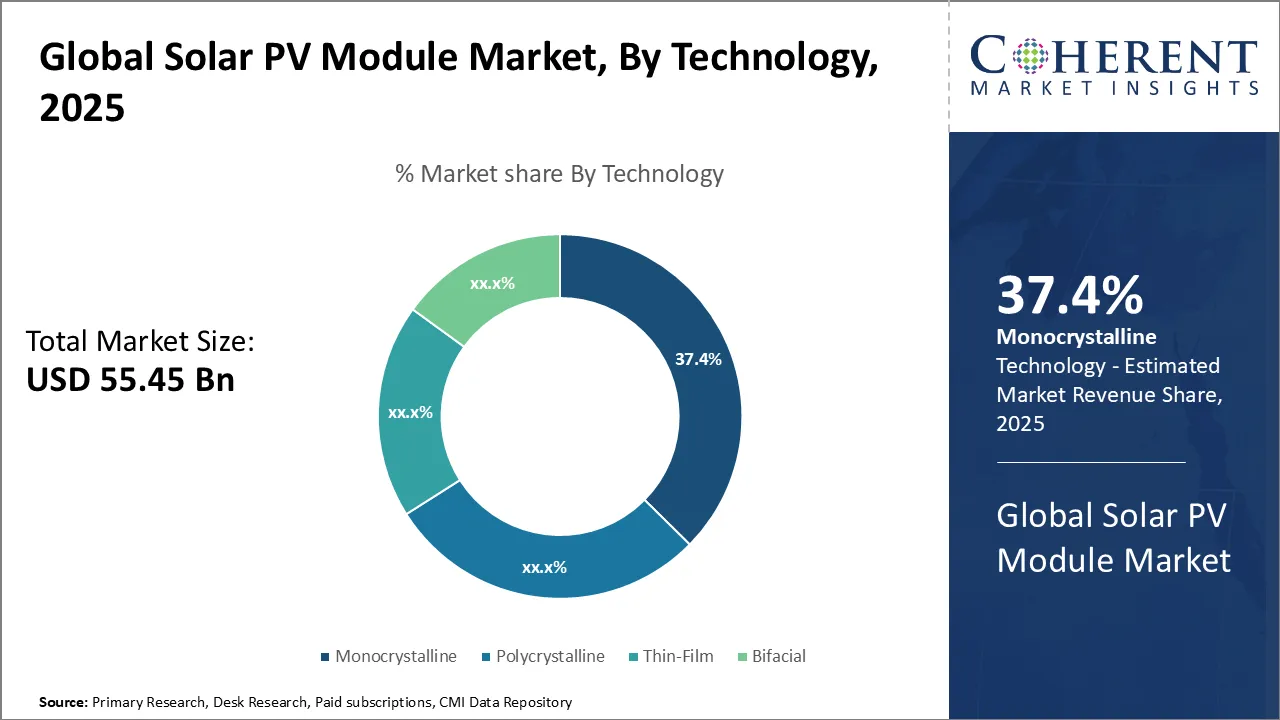
Solar PV Modules Market Insights, By Technology - Monocrystalline Segment Dominates Due to Superior Efficiency and Reliability
In terms of technology, the monocrystalline segment is expected to contribute 38.4% share of the market in 2026, owing to its high efficiency and reliability. Monocrystalline panels are made from a single silicon crystal growing stage that results in a very ordered and pure structure with minimum defects. This orderly structure enables monocrystalline panels to absorb sunlight very efficiently and convert it into electricity better than other wafer technologies. They typically have an efficiency rating of 15%-22%, which is the highest among all wafer types. This high conversion efficiency means monocrystalline panels can generate more power from the same amount of space compared to polycrystalline or thin-film equivalents.
For instance, in December 2025, Boviet Solar confirmed its status as a Tier 1 PV module manufacturer for BloombergNEF. Boviet's high-performance monocrystalline PERC and TOPCon solar panels continue to capture a great deal of attention around the world. This shows how reliable, financially strong, and innovative the company is in providing efficient, bankable solar solutions for utility-scale projects around the world.
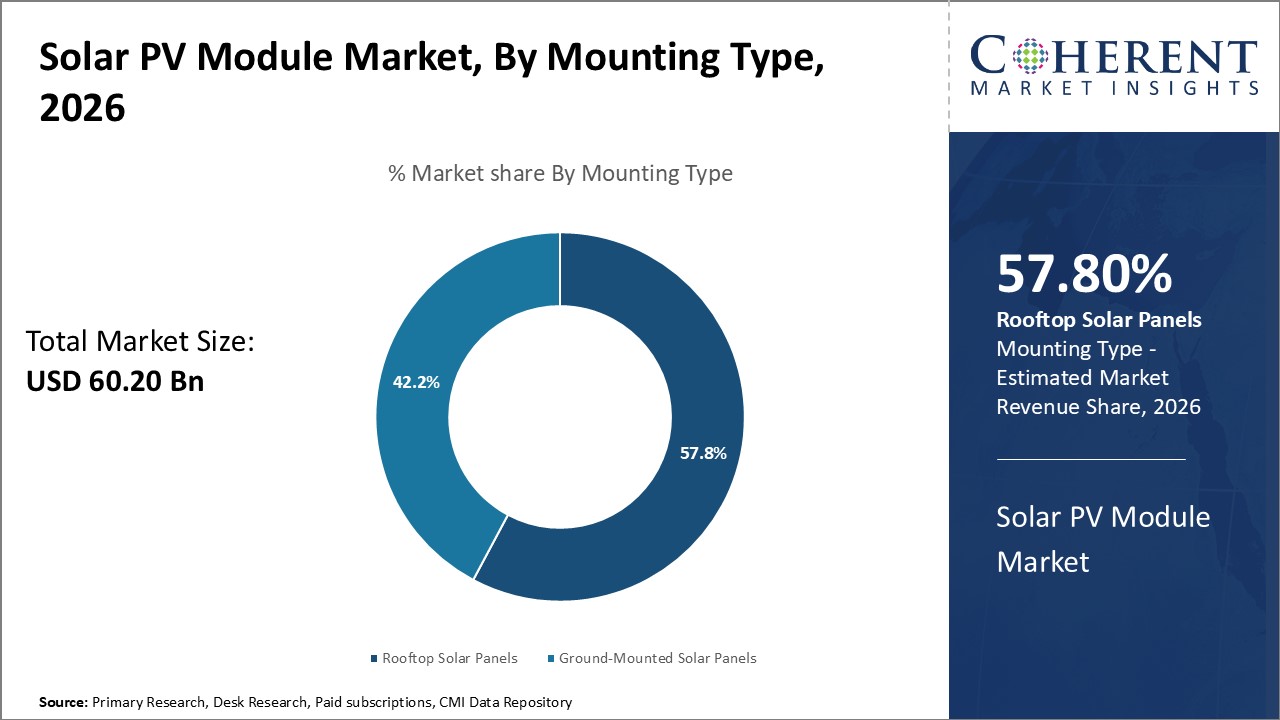
Solar PV Modules Market Insights, By Mounting Type - Convenience and Flexibility Drives Rooftop Silar Panel Demand
In terms of mounting type, the Rooftop Solar Panels segment is expected to account for 57.8% of the market share in 2026, driven by its flexibility and convenience for homeowners and businesses. Rooftop systems have become a preferred solar solution as they utilize existing rooftop spaces without the need for additional land. These systems can be easily installed on residential buildings, apartments, shopping centers, warehouses, and others, providing electricity without interfering with current infrastructure. This makes them especially suitable for urban areas with limited land availability while also reducing transmission losses typically associated with energy transfer from remote solar farms.
For instance, in December 2025, almost 24 lakh homes in India are expected to have installed rooftop solar panels as part of the PM Surya Ghar program. The program, which aims to promote clean energy and lower the cost of electricity, shows how serious India is about renewable energy and how popular solar PV modules are on residential rooftops.
Solar PV Modules Market Insights, By Application - Residential Sector Leads Solar Adoption
In terms of application, the residential segment is projected to hold a 38.6% share of the market in 2026, positioning it as a leading early adopter of solar energy solutions. Homeowners have increasingly turned to rooftop PV systems to mitigate rising electricity costs, benefit from savings and cash incentives, and support a more sustainable future. The significant decline in solar panel prices over the past decade has made these systems more affordable, while heightened environmental awareness has further fueled residential demand for clean energy alternatives.
For instance, in December 2025, India's PM Surya Ghar Yojana encourages more people to install solar panels on their roofs, which leads to more PV installations in homes across the country. Subsidies increase demand, but there are still difficulties with financing, delays in subsidies, and broken supply chains. There are still issues with equity, since poorer families have trouble getting access. India's plans for rooftop solar are being held back by systemic gaps, even though growth is strong.
Regional Insights
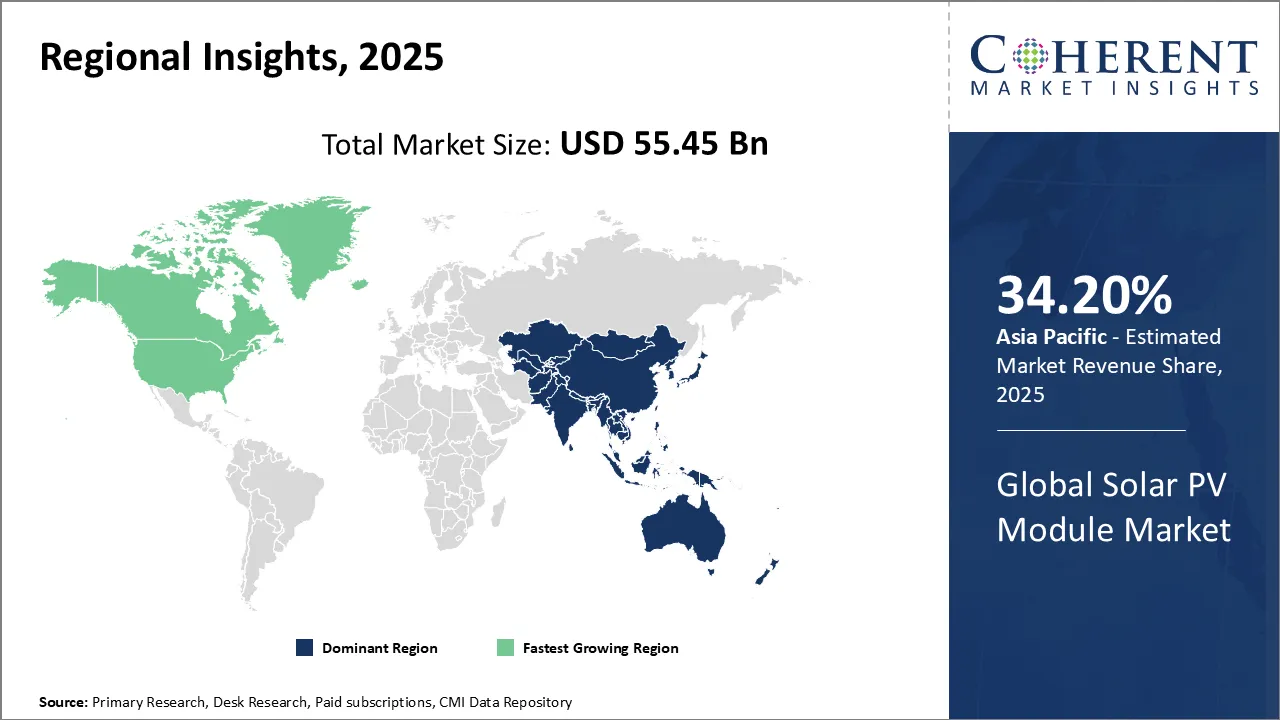
Asia Pacific Solar PV Module Market Trends
The Asia Pacific region is expected to lead the solar PV module market, capturing a 39.6% share by the end of 2026. This dominance is driven by robust government initiatives supporting renewable energy adoption and a strong manufacturing base. Countries such as China and India provide production-linked incentives and have set ambitious renewable energy targets to lower emissions. Additionally, the region is home to major global solar manufacturers such as LONGi Solar with large-scale production facilities, meeting both domestic and international demand.
For instance, in October 2026, At REI Expo 2026, Orient Solar launched their 650Wp N-type TOPCon PV modules, which have high efficiency and long life. These high-performance modules are meant for residential, commercial, and utility-scale projects. The launch demonstrates that India's solar industry is becoming more innovative, using cutting-edge technology to produce more energy and help the country reach its goals for expanding renewable energy.
North America Solar PV Module Market Trends
North America is expected to capture 20.5% of the solar PV module market share in 2026, with the region showing the highest growth rate. This growth is primarily driven by ongoing investments in renewable energy integration, where governments are providing long-term power purchase agreements and tax incentives to encourage private sector involvement.
For instance, in September 2026, Grew Solar released new PV modules that are made for the North American market, focusing on reliability and efficiency. The products are meant to meet the energy needs of the area and help the company grow around the world. This move demonstrates how solar technology is changing, which helps renewable energy use and makes the photovoltaic industry increasingly competitive across North America.
Solar PV Module Market Outlook for Key Countries
China Solar PV Module Market Trends
China holds its position as the largest market for solar PV modules, contributing nearly 60% of global installations, according to Statista data published in 2023. The nation’s strong focus on renewable energy stems from ambitious government policies aimed at reaching carbon neutrality by 2060. In 2023, China was projected to install more solar capacity than all other countries combined, supported by substantial investments in manufacturing capabilities and technological innovations.
For instance, in December 2026, PowerChina announced a huge 31 GW solar purchase, which suggests that China is still the leader in renewable energy. The project involves buying an extensive amount of PV modules, which increases demand for advanced technologies and changes global supply chains. This purchase reveals that China is serious about increasing its solar capacity and setting trends in the international photovoltaic industry through scale.
U.S. Solar PV Module Market Trends
The U.S. solar PV market is experiencing robust growth, primarily due to the Inflation Reduction Act, which incentivizes renewable energy investments. The market is projected to expand as residential and commercial sectors increasingly adopt solar solutions to reduce energy costs. Major companies such as First Solar are also ramping up production capabilities to meet rising demand.
For instance, in April 2026, Waaree started making solar panels at its U.S. assembly plant, which is advantageous for renewable manufacturing in the U.S. The project helps local supply chains, lowers the need for imports, and makes Waaree more well-known in North America. This milestone shows how dedicated the company is to improving solar PV technology and helping the region's clean energy growth.
India Solar PV Module Market Trends
India's solar PV module market is experiencing significant growth, driven by government initiatives, increasing domestic manufacturing capacity, and substantial investments in renewable energy projects.
For instance, in April 2026, Vikram Solar used advanced N-type technology to make the HyperSol G12R-132HC module, which is more efficient and reliable. The module is made for utility, commercial, and residential projects and improves energy yields and durability. This new product adds to Vikram Solar's portfolio and indicates that India's role in the growth of renewable energy and photovoltaic technology is growing.
Germany Solar PV Module Market Trends
Germany's solar PV module market has experienced significant developments, marked by substantial growth in installations, evolving market dynamics, and emerging challenges. In 2024, Germany added approximately 16.2 gigawatts (GW) of new solar capacity, reinforcing its position as a leader in renewable energy within Europe. German industries are increasingly investing in solar power to mitigate rising energy costs and reduce carbon footprints. For instance, Tridelta, a metal products factory in Thuringia, installed a solar power system capable of supplying energy to 900 households, highlighting the economic and environmental benefits for businesses.
For instance, in November 2026, Opes launched a vehicle solar panel factory in Germany, producing PV modules tailored for automotive integration. The facility supports clean mobility by reducing fossil fuel reliance and expanding solar applications beyond rooftops. This milestone highlights innovation in transport energy, strengthening Germany’s role in advancing sustainable photovoltaic manufacturing and renewable adoption.
Japan Solar PV Module Market Trends
Japan's solar PV market is undergoing a recovery following adjustments to the Feed-in Tariff (FIT) system, with a renewed emphasis on efficiency and innovation. This market is expected to expand as companies focus on advanced solar technologies and integrated energy storage solutions. Government policies supporting renewable energy adoption continue to play a pivotal role in driving growth.
For instance, in December 2026, Panasonic released HIT solar panels in Japan with a unique roof design that improved both efficiency and looks. The modules work well in high temperatures and are good for urban residential rooftops due to their use heterojunction technology. This new product adds to Panasonic's solar portfolio, helps Japan reach its renewable energy goals, and makes it easier to use solar panels in places with limited space.
Key Developments
- In December 2025, In Gujarat, InoxGFL opened huge solar and wind manufacturing plants, which increased India's ability to produce renewable energy. The facilities include making solar PV modules, which helps strengthen domestic supply chains and lower reliance on imports. This project helps India reach its clean energy goals, makes manufacturing more self-sufficient, and makes Gujarat a center for new ideas in sustainable energy.
- In December 2024, India's Tata Power inaugurated a 4.3 GW solar module and cell manufacturing facility in Tamil Nadu, primarily focused on serving the domestic market. The facility's output over the next 12 to 16 months is already committed to ongoing projects within India.
- In October 2024, Transition Equity Partners led an investment of up to US$ 54 million in Canadian solar-module manufacturer, Heliene, supporting the construction of a new factory in Minnesota, U.S. This investment was bolstered by government incentives and the Inflation Reduction Act, which provide tax credits and support for clean-energy manufacturing. Transition Equity Partners (TEP) is a private equity firm specializing in investments that facilitate the transition to cleaner, more efficient, and sustainable energy infrastructure across North America.
Market Report Scope
Solar PV Module Market Report Coverage
| Report Coverage | Details | ||
|---|---|---|---|
| Base Year: | 2025 | Market Size in 2026: | USD 60.20 Bn |
| Historical Data for: | 2020 To 2024 | Forecast Period: | 2026 To 2033 |
| Forecast Period 2026 to 2033 CAGR: | 8.6% | 2033 Value Projection: | USD 107.29 Bn |
| Geographies covered: |
| ||
| Segments covered: |
| ||
| Companies covered: | First Solar, Inc., Canadian Solar Inc., JinkoSolar Holding Co., Ltd., Trina Solar Limited, SunPower Corporation, LONGi Green Energy Technology Co., Ltd., Q CELLS (Hanwha Q CELLS), Silfab Solar Inc., JA Solar Technology Co., Ltd., Risen Energy Co., Ltd., REC Group, Yingli Green Energy Holding Company Limited, Adani Solar, GCL-Poly Energy Holdings Limited, and Solaria Energía y Medio Ambiente, S.A. | ||
| Growth Drivers: |
| ||
| Restraints & Challenges: |
| ||
Market Dynamics
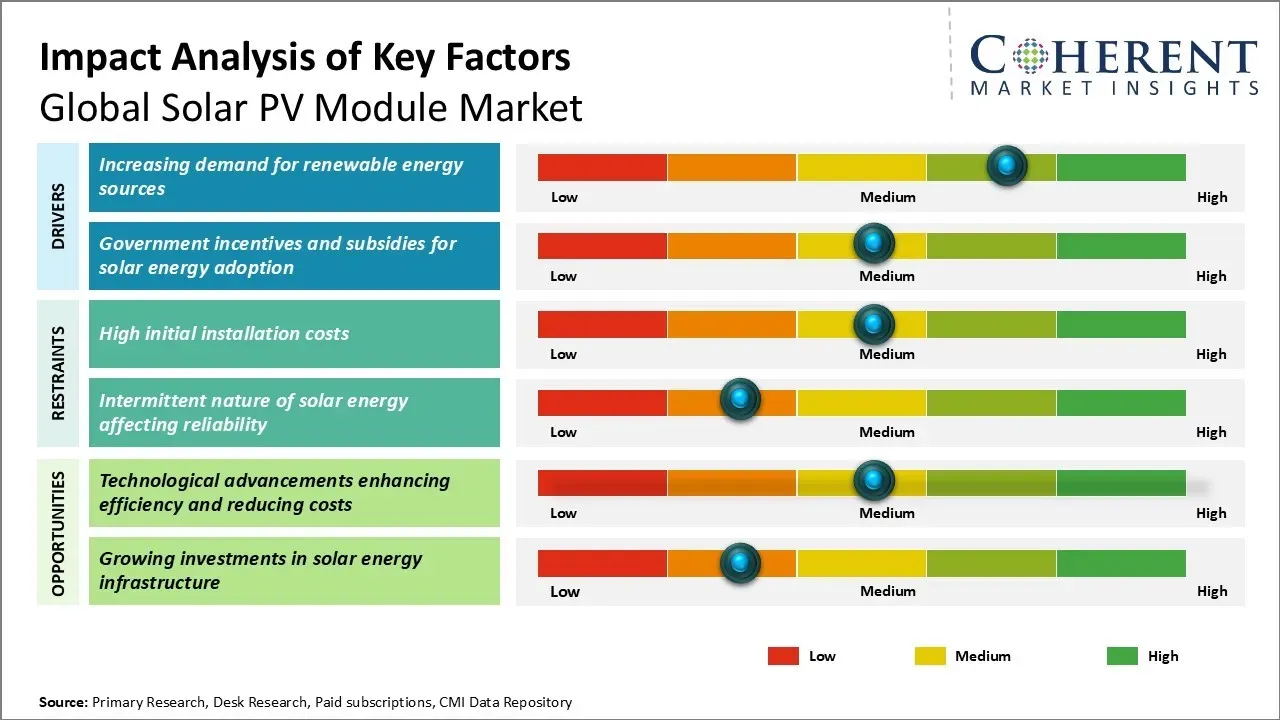
Solar PV Module Market Driver
How is Increasing demand for renewable energy sources transforming solar PV modules?
The global demand for clean energy has surged over the past decade due to the escalating impacts of climate change. Governments, organizations, and individuals are prioritizing greener alternatives, driving a significant shift towards renewable energy sources. Solar power, renowned for its sustainability and scalability, has emerged as a leading solution. Its adoption has grown rapidly, spanning large-scale utility projects and rooftop installations for residential and commercial use, highlighting its pivotal role in the global energy transition.
Solar PV Module Market Opportunity
How will technological advancements enhance efficiency and reducing costs?
One of the key opportunities for the global solar PV module market lies in the ongoing technological advancements that have the potential to enhance the efficiency of solar panels while lowering costs. Continuous research and development are helping drive significant improvements in solar cell technologies. For example, the emergence of newer thin-film technologies is making solar panels lighter and less expensive to produce. At the same time, advancements in nanotechnology applications are helping manufacturers boost the efficiency and performance of crystalline silicon solar cells. Such innovations are positively impacting the economics of solar energy generation. Additionally, larger-size wafers and modules are also enabling higher power outputs without a corresponding increase in costs.
What are the recent government incentives and subsidies for solar energy adoption?
Government incentives and subsidies greatly increase the solar PV module market demand by making them cheaper and easier to buy. Tax credits, feed-in tariffs, and cash rebates are examples of policies that encourage homeowners and businesses to use solar energy. These policies lead to more installations, more savings, and a faster shift to sustainable, renewable power solutions around the world.
Country/Region | Key Incentives & Subsidies | Impact on Solar PV Module Market |
India | PM Surya Ghar: Muft Bijli Yojana – Free 300 units/month, up to 60% rooftop subsidy; PLI Scheme – ₹24,000 crore for domestic manufacturing | Boosts rooftop adoption, strengthens local module supply chain, accelerates demand growth |
United States | Federal ITC (Investment Tax Credit) – 30% tax credit for residential & commercial solar; state rebates (CA, NY) | Reduces upfront costs, drives utility-scale and residential installations |
European Union | Feed-in tariffs, net metering, EU Green Deal funding for large-scale projects | Ensures guaranteed payments, accelerates rooftop and utility-scale adoption |
Germany | Strong feed-in tariffs, rooftop subsidies, community solar programs | Expands residential and community solar, stabilizes demand |
Japan | Residential rooftop solar subsidies, battery storage integration incentives | Encourages urban adoption, supports high-density rooftop installations |
Australia | Small-scale Technology Certificates (STCs), feed-in tariffs | High per-capita rooftop solar penetration, strong residential demand |
Brazil | Net metering, tax exemptions for distributed generation | Expands distributed solar, boosts Latin American demand |
Analyst Opinion (Expert Opinion)
- The solar PV module market is expected to grow significantly over the next decade driven by supportive government policies and regulations across major markets. Countries in Europe and Asia Pacific are providing subsidies and tax incentives to boost solar power generation among both commercial and residential sector. Additionally, with the declining cost of solar panels and the increasing need for clean and renewable sources of energy, the demand for solar modules is likely to rise steadily.
- A major restraint could be the limited lifespan of solar modules which causes additional costs for replacement and equipment maintenance over the project life. However, ongoing innovation leading to higher efficiencies and better performing panels may help address this challenge. The market is also hampered by inconsistent government policies and uncertainties around the reduction or removal of incentives in major regions.
- The Asia Pacific region, primarily China, is anticipated to continue dominating the global solar PV module space backed by strong domestic demand and significant manufacturing capabilities. North America rapidly increasing its market presence. These trends reflect the global shift towards sustainable energy solutions and the varying regional approaches to achieving renewable energy goals.
Speak to the analyst
Want personalized insights?
Take the findings above to one of our principal consultants, or have the report rebuilt around the segments, geographies and competitors you actually track.
Market Segmentation
- Technology Insights (Revenue, USD Bn, 2026 - 2033)
- Monocrystalline
- Polycrystalline
- Thin-Film
- Bifacial
- Mounting Type Insights (Revenue, USD Bn, 2026 - 2033)
- Rooftop Solar Panels
- Ground-Mounted Solar Panels
- Application Insights (Revenue, USD Bn, 2026 - 2033)
- Residential
- Commercial
- Utility-Scale
- Others
- Regional Insights (Revenue, USD Bn, 2026 - 2033)
- North America
- U.S.
- Canada
- Latin America
- Brazil
- Argentina
- Mexico
- Rest of Latin America
- Europe
- Germany
- U.K.
- Spain
- France
- Italy
- Russia
- Rest of Europe
- Asia Pacific
- China
- India
- Japan
- Australia
- South Korea
- ASEAN
- Rest of Asia Pacific
- Middle East
- GCC Countries
- Israel
- Rest of Middle East
- Africa
- South Africa
- North Africa
- Central Africa
- Key Players Insights (Revenue, USD Bn, 2021 - 2033)
- First Solar, Inc.
- Canadian Solar Inc.
- JinkoSolar Holding Co., Ltd.
- Trina Solar Limited
- SunPower Corporation
- LONGi Green Energy Technology Co., Ltd.
- Q CELLS (Hanwha Q CELLS)
- Silfab Solar Inc.
- JA Solar Technology Co., Ltd.
- Risen Energy Co., Ltd.
- REC Group
- Yingli Green Energy Holding Company Limited
- Adani Solar
- GCL-Poly Energy Holdings Limited
- Solaria Energía y Medio Ambiente, S.A.
Sources
Primary Research Interviews
- Solar PV Module Manufacturers (Crystalline Silicon & Thin Film)
- Solar Cell & Wafer Producers
- EPC Contractors & System Integrators
- Utility-Scale Solar Project Developers
- Rooftop & Distributed Solar Installers
- Inverter, Mounting Structure & BOS Suppliers
- Renewable Energy Consultants & Grid Integration Experts
- Others
Databases
- Bloomberg Terminal
- Thomson Reuters Eikon
- IHS Markit
- Euromonitor International
- S&P Global Market Intelligence
- Wood Mackenzie
- Others
Magazines
- PV Magazine
- Solar Power World
- Renewable Energy World
- Power Engineering Magazine
- Energy Storage News
- Others
Journals
- Progress in Photovoltaics: Research and Applications
- Solar Energy Materials & Solar Cells
- IEEE Journal of Photovoltaics
- Renewable & Sustainable Energy Reviews
- Applied Energy
- Others
Newspapers
- Financial Times
- The Wall Street Journal
- Reuters
- Bloomberg News
- The Economic Times
- Others
Associations
- International Solar Energy Society (ISES)
- Solar Energy Industries Association (SEIA)
- SolarPower Europe
- Global Solar Council (GSC)
- International Renewable Energy Agency (IRENA)
- Others
Public Domain Sources
- International Energy Agency (IEA)
- International Renewable Energy Agency (IRENA)
- U.S. Department of Energy (DOE) – Solar Energy Technologies Office
- National Renewable Energy Laboratory (NREL)
- European Commission – Directorate-General for Energy
- World Bank Open Data
- Others
Proprietary Elements
- CMI Data Analytics Tool
- Proprietary CMI Existing Repository of Information for the Last 8 Years
Get access to 250+ pages report
Every segment, forecast, competitor profile and data table behind the analysis above — available for instant download.
- ESOMAR Member
- ISO 9001:2015 Certified
- D-U-N-S Registered
- GDPR & CCPA Compliant
Missing comfort of reading report in your local language? Find your preferred language:
Transform your Strategy with Exclusive Trending Reports
Frequently Asked Questions
Global solar PV module market is estimated to be valued at USD 55.45 Bn in 2025 and is expected to reach USD 97.56 Bn by 2032.
The CAGR of the global solar PV module market is projected to be 8.4% from 2025 to 2032.
Increasing demand for renewable energy sources and government incentives and subsidies for solar energy adoption are the major factors driving the growth of the global solar PV module market.
High initial installation costs and intermittent nature of solar energy affecting reliability are the major factors hampering the growth of the global solar PV module market.
In terms of technology, the monocrystalline segment is estimated to dominate the market revenue share in 2025.
First Solar, Inc., Canadian Solar Inc., JinkoSolar Holding Co., Ltd., Trina Solar Limited, SunPower Corporation, LONGi Green Energy Technology Co., Ltd., Q CELLS (Hanwha Q CELLS), Silfab Solar Inc., JA Solar Technology Co., Ltd., Risen Energy Co., Ltd., REC Group, Yingli Green Energy Holding Company Limited, Adani Solar, GCL-Poly Energy Holdings Limited, and Solaria Energía y Medio Ambiente, S.A. are the major players.
Asia Pacific is expected to lead the global solar PV module market in 2025.