

Global Flow Battery Carbon Coatings Market Size and Forecast – 2026 To 2033
The global flow battery carbon coatings market is expected to grow from USD 675.0 Mn in 2026 to USD 930.0 Mn by 2033, registering a compound annual growth rate (CAGR) of 5.6% from 2026 to 2033. The global flow battery carbon coatings market is driven by expansion of renewable energy storage infrastructure. On March 31, 2025, Invinity Energy Systems announced that it has reached an agreement to proceed with the LoDES project. Invinity acquired the rights to develop, build, own and operate an up to 20.7 MWh vanadium flow battery system using the Company’s VS3 vanadium flow batteries on a site in the South East of England.
Key Takeaways of the Global Flow Battery Carbon Coatings Market
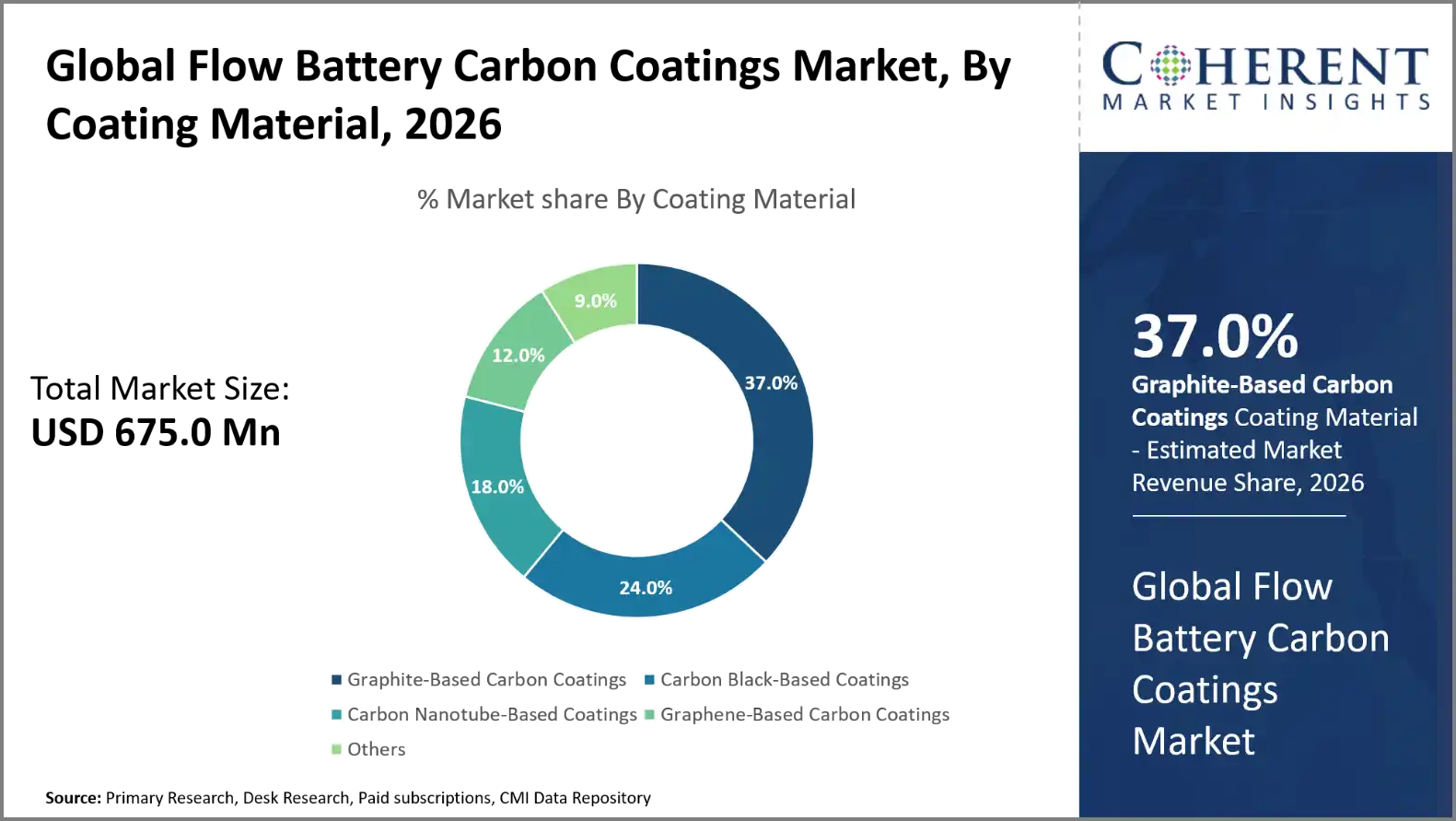
- The Graphite-Based Carbon Coatings segment is expected to account for 37.0% of the global flow battery carbon coatings market share in 2026. Increasing demand for corrosion-resistant electrode materials is driving the growth of the segment. On October 10, 2025, Chemetall launched Gardolene D, a chromium-free and fluoride-free copper-foil passivation solution. The treatment improves corrosion protection and supports battery performance.
- The Spray Coating segment is estimated to capture 46.0% of the market share in 2026. Growing investment in vanadium redox flow battery technology is majorly driving the growth of the segment. On May 21, 2026, FlexBase selected Invinity to design a vanadium flow battery for its Laufenburg technology campus. The proposed system could reach 1.5 GWh initially, with expansion potential reaching 2.1 GWh.
- The Metal Substrates segment is estimated to capture 37.0% of the market share in 2026. Rising demand for improved electrode electrical conductivity is majorly driving the growth of the segment. On July 20, 2026, JNTG showcased electrodes of graphite felt, carbon cloth and carbon paper at the International Flow Battery Forum. The increased portfolio meets diverse electrode requirements and enables industrial scale supply.
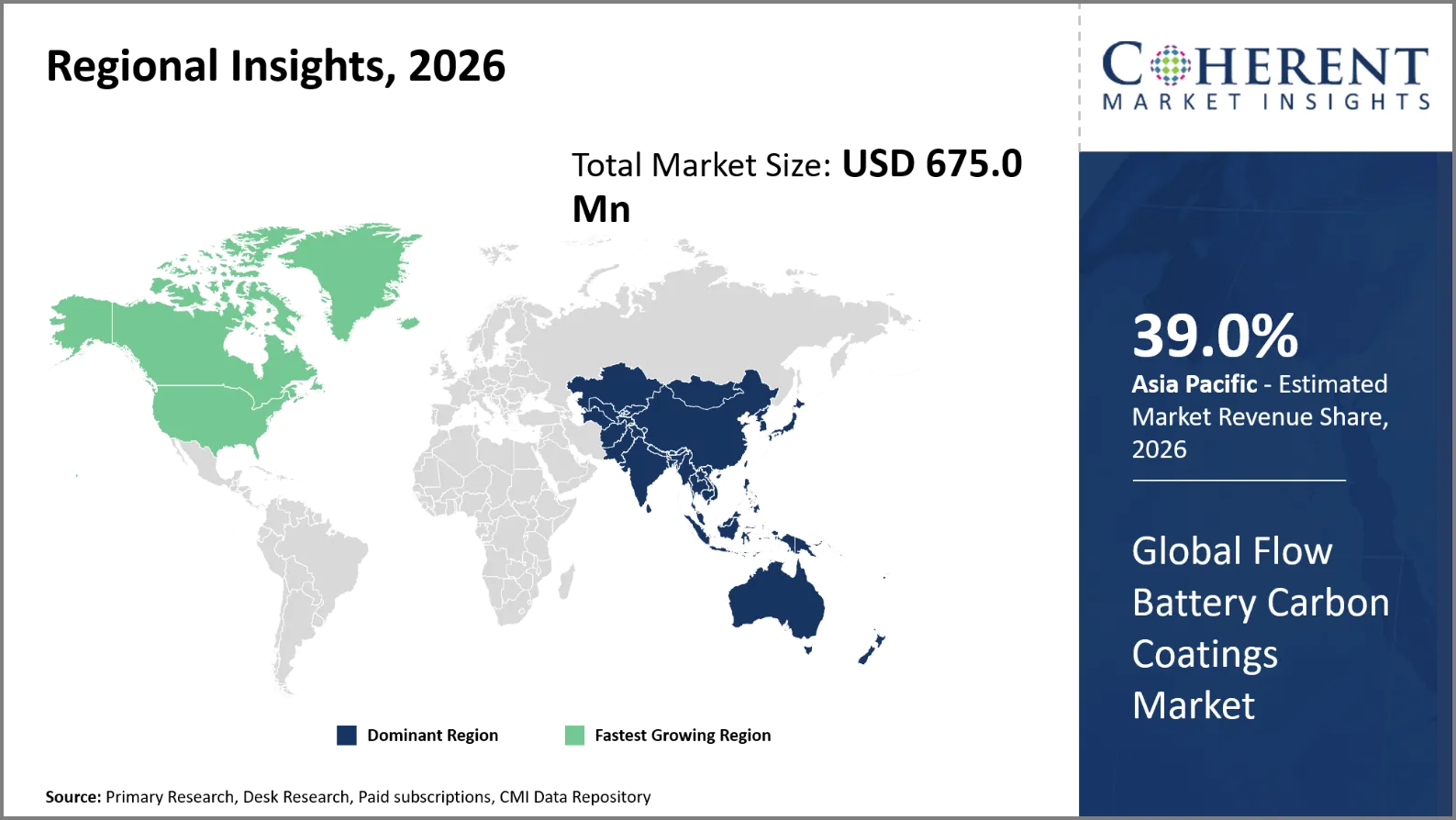
- Asia Pacific is expected to dominate the flow battery carbon coatings market in 2026 with a market share of 39.0%. Increasing emphasis on reducing flow battery manufacturing costs in Asia Pacific is driving the growth of the regional market. On January 22, 2025, H2, Inc. announced USD 16 million in bridge funding. The company allocated the investment toward its K2 manufacturing facility.
- North America is expected to account for 24.0% share in 2026 and is projected to record the fastest growth over the forecast period. Growing development of advanced carbon coating technologies in North America is driving the growth of the regional market. On January 8, 2026, TreadStone Technologies received funding through the New Jersey Economic Development Authority's Angel Match Program. The investment will expand production capacity for its corrosion-resistant, electrically conductive coatings.
Segmental Insights
Why Does graphite-based carbon coatings Dominate the Global Flow Battery Carbon Coatings Market?
The graphite-based carbon coatings segment is expected to account for 37.0% of the global flow battery carbon coatings market share in 2026. Graphite-based carbon coatings are preferred for their superior electrical conductivity and chemical resilience. They are resistant to corrosion and can be used reliably in acidic and alkaline electrolytes. Also, graphite has suitable electrochemical characteristics for charge-discharge cycles. It works with a variety of electrode materials, allowing for more extensive industrial applications. Manufacturers prefer graphite coatings for better electrode performance and lower electrical resistance. These advantages underpin graphite’s role in vanadium redox flow battery systems.
On June 24, 2025, SGL Carbon announced its expansion of the product portfolio with a new battery felt for redox flow batteries. The innovative electrode material, marketed under the name SIGRACELL GFX4.8 EA, is characterized by its low electrical resistance and therefore enables optimum electron exchange with an increased surface area.
- Current Industry Events of 2026
- Market Size Estimation
- Regional Breakdown
- Competitive Landscape
- Customer Intelligence
- Segmental Analysis
- Pricing Analysis
- Key Market Drivers, Challenges & Future Trends
- Customized Insights Section
Why is Spray Coating the Most Crucial Coating Technology?
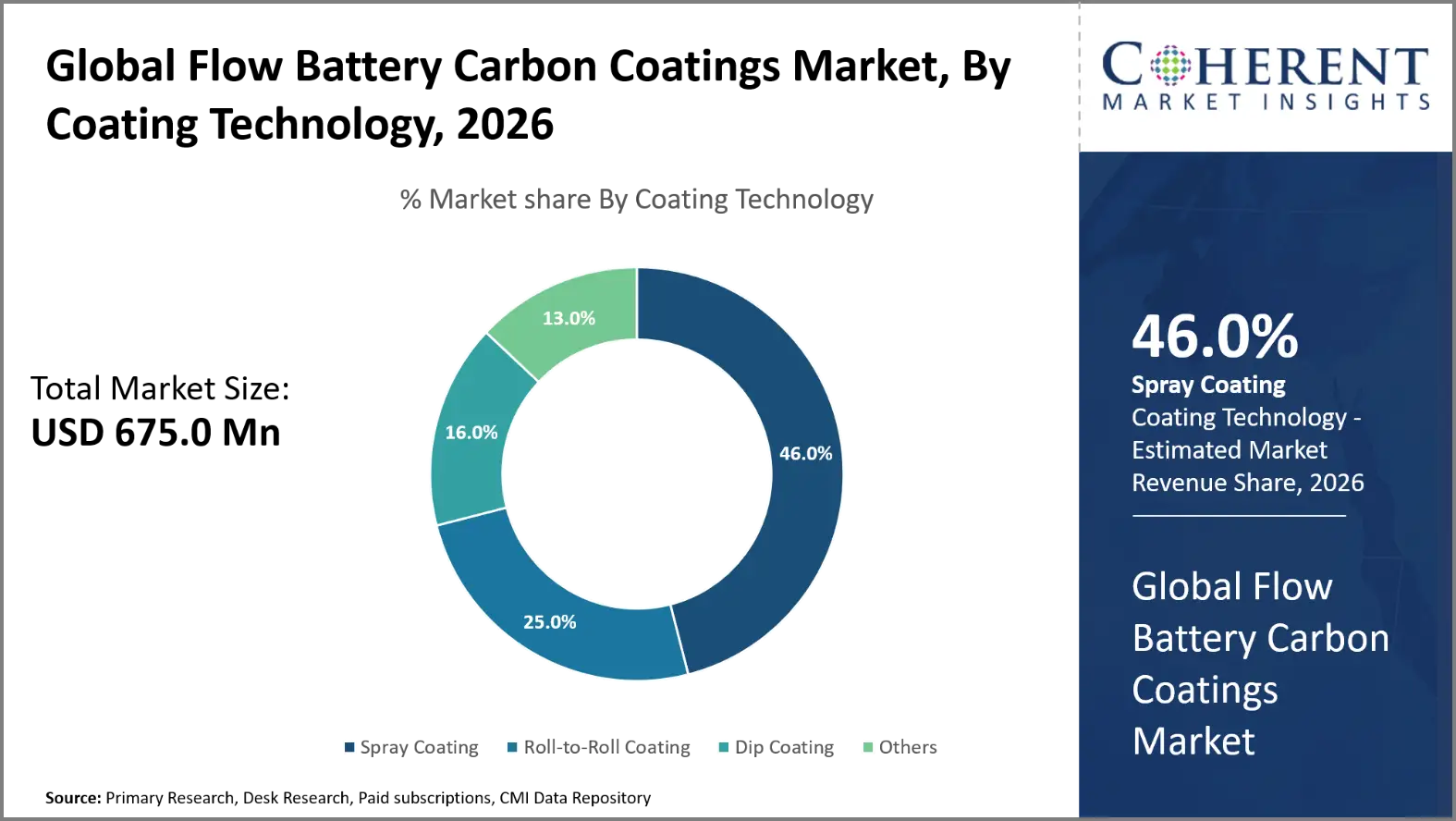
The spray coating segment is expected to account for 46.0% of the global flow battery carbon coatings market share in 2026. Spray coating is essential as it allows for homogeneous deposition of carbon material onto complicated substrate surfaces. The coating can be applied with variable thickness and gives uniform surface covering. Conductive carbon formulations can be used by manufacturers for varied electrode geometries. Spray coating also allows for continuous production and scale-up to industrial levels. It is possible to modify the electrode surface efficiently because it is compatible with graphite-based fluids. These properties make spray coating a useful technique to enhance coating uniformity and industrial throughput.
On September 1, 2026, TreadStone Technologies announced the start of Phase 3 commercialization testing of its DuraC carbon coating September 1, 2026. The coating can be applied to metal substrates by spray or roll-to-roll production processes. The U.S. Department of Energy-supported program targets lower costs for flow battery electrodes and bipolar plates.
Metal Substrates Dominates the Global Flow Battery Carbon Coatings Market
The metal substrates segment is expected to account for 37.0% of the global flow battery carbon coatings market share in 2026. Metal substrates are dominant as they provide mechanical strength, dimensional stability and structural durability. Their qualities are conducive to durable flow battery components under rigorous operating conditions. The carbon coatings raise the conductivity of the surface and protect the exposed metal surfaces from corrosion by the electrolyte. Stainless steel and titanium are good bases for specialized electrochemical applications. Metal substrates also enable precision manufacture and integration into bipolar plates. Such benefits place coated metal components at the center of durable and commercially scalable flow battery systems.
On February 18, 2025, Kobe Steel announced plans to increase its physical vapor deposition coating services. The company focused on fuel cell bipolar plates and water electrolyzer components. It features coating technology for enhanced durability of components and electrical qualities. Kobe Steel also projected inline coating capability for tens of thousands of cells a year starting in 2026.
Current Events and their Impact
Current Events | Description and its Impact |
European Union Battery Regulation (EU) 2023/1542 |
|
European Union Critical Raw Materials Act Regulation (EU) 2024/1252 |
|
Flow Battery Carbon Coatings Market Dynamics
Market Drivers
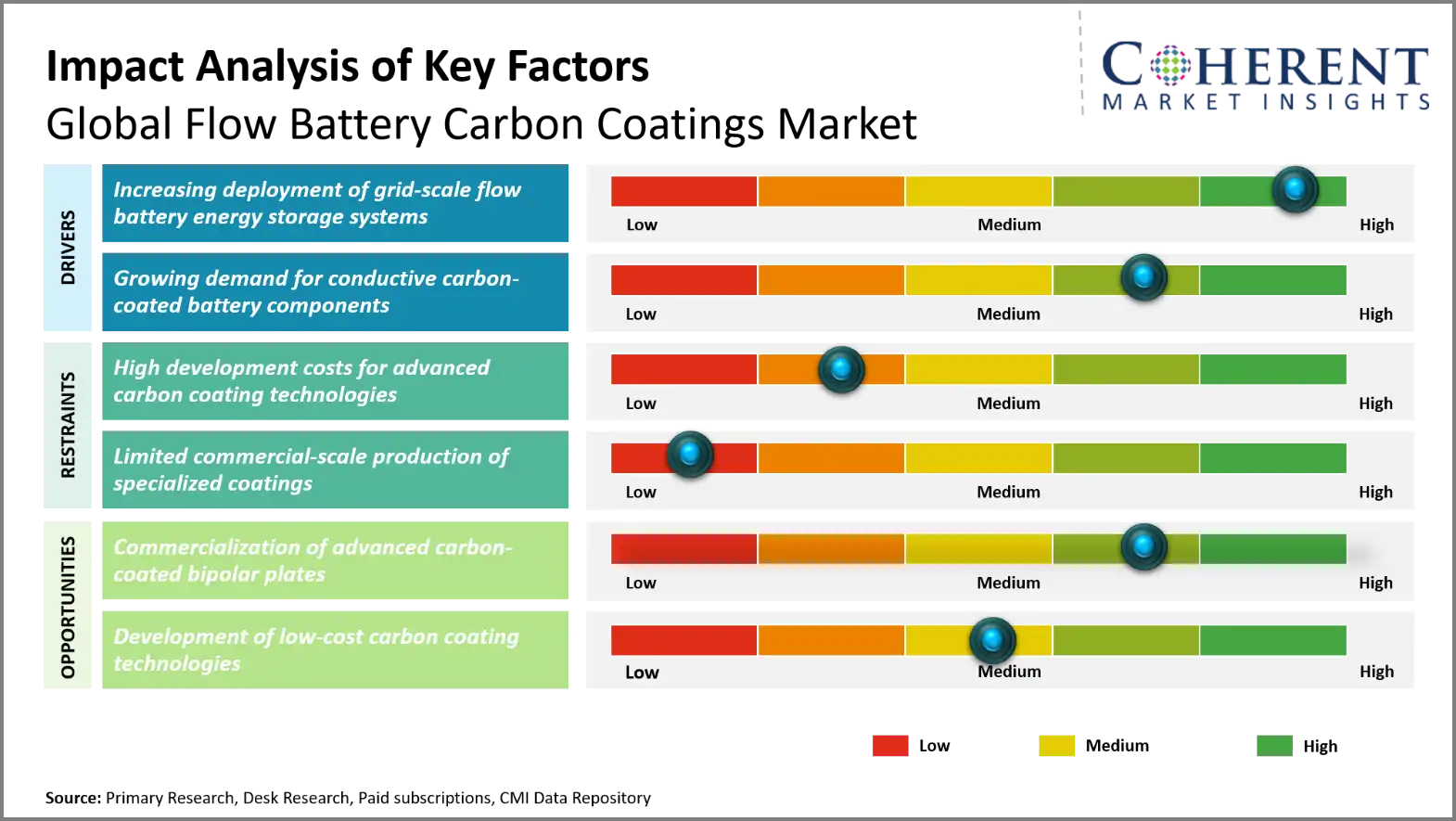
- Increasing deployment of grid-scale flow battery energy storage systems: Growing deployment of grid-scale flow battery energy storage systems generates need for enhanced carbon coating technologies. Renewable energy integration requires storage that can be depended on to address the intermittent nature of solar and wind power. Flow batteries provide lengthy discharge duration and decoupled scaling of power and energy capacity. These features lend themselves to use in utility-scale storage and renewables projects. As more and more projects are being deployed, the demand for robust electrodes and conductive bipolar plates is growing. The carbon coatings improve electrical conductivity and also protect the components against corrosion from the electrolyte. Thus, there is an opportunity for specialist carbon coating manufacturers in the form of expanded grid-scale installations.
- On October 9, 2025, Salt River Project and ESS announced an agreement to add Project New Horizon, a 5-megawatt (MW), 50 megawatt-hour (MWh) battery system, to the grid. The pilot project will be installed at SRP’s Copper Crossing Energy and Research Center in Florence, Arizona and sell capacity to SRP under a ten-year energy storage agreement.
- Growing demand for conductive carbon-coated battery components: The growing demand for conductive carbon-coated battery components fuels the growth of the flow battery materials market. These coatings lead to better electrical conductivity and boost electrochemical performance in the battery components. Formulations based on graphite aid to lower interfacial resistance and enhance charge transfer properties. Carbon coatings also protect the metal substrates against harsh electrolyte conditions. Battery makers are increasingly focusing on robust components that can survive numerous charge-discharge cycles without losing performance. Growing investments in vanadium redox flow batteries emphasize the need for sophisticated electrode treatments. Such advancements motivate producers to increase coating uniformity, adhesion and chemical stability.
- On April 1, 2026, Green Graphite Technologies and Rain Carbon Canada announced the successful completion of their coated spherical purified graphite project. The partnership handled natural graphite, recovered battery graphite and manufacturing debris.
Emerging Trends
- Development of Advanced Graphite-Based Conductive Coatings: Manufacturers are creating graphite-based carbon coatings with enhanced conductivity, chemical stability, adhesion and corrosion resistance for advanced flow battery electrodes and bipolar plates.
- Impact: These formulations lead to enhanced electrical performance, longer component lifespan, and less degradation after repetitive electrochemical cycling, enabling dependable long-duration energy storage.
- Relevance to the market: Vanadium redox flow battery developers demand stable electrode surfaces; therefore, suppliers are developing graphite coatings suitable with carbon felts and metallic bipolar plates.
- Adoption of Scalable Spray Coating Technologies: Battery component makers are developing automated spray coating technologies to ensure uniform carbon deposition, regulated thickness and consistent coverage across complex electrode geometries.
- Impact: Automated deposition enhances manufacturing consistency and minimizes material waste, and enables higher production throughput while preserving coating quality across industrial battery components.
- Relevance to the market: Growing flow battery manufacturing projects create opportunities for spray coating equipment suppliers and specialized formulators serving large electrode and bipolar plate production facilities.
Regional Insights
Why is Asia Pacific a Strong Market for Flow Battery Carbon Coatings?
Asia Pacific is expected to account for a market share of 39.0% in 2026. Asia Pacific enjoys large scale vanadium redox flow battery manufacturing and expanding indigenous electrode material development. China, Japan, India, South Korea, and Australia have different industry capacities. China’s 100 MW/400 MWh Jilin project began commercial operation in December 2024. In November 2025, India’s National Thermal Power Corporation has started up a 3-MWh vanadium flow battery in Greater Noida. Australia’s Yadlamalka project combines a 6MW solar plant with a 2MW/8MWh battery. These projects strengthen regional requirements for conductive graphite felts, corrosion-resistant components, and specialized carbon surface treatments.
Why Does North America Flow Battery Carbon Coatings Market Exhibit High Growth?
North America is expected to register the fastest growth with a CAGR of 5.4% over the forecast period and is projected to account for 24.0% of the global flow battery carbon coatings market in 2026. The region benefits from federal support for advanced battery manufacturing and industrial development of alternative storage chemistries. In December 2024, the U.S. Department of Energy announced roughly USD 25.54 million for eleven selections of battery manufacturing technologies. The program comprises flow batteries and advanced manufacturing; specifically. Canadian renewable energy projects are also a market for long-duration storage technology. Alberta has exhibited a 2 MW/8 MWh flow battery plant. In California, commercial flow battery deployments have supported microgrids and renewable energy integration. These advancements are driving regional suppliers to enhance their skills in carbon electrode fabrication, conductive coatings and component production.
Global Flow Battery Carbon Coatings Market Outlook for Key Countries
Why is China Emerging as a Major Hub in the Flow Battery Carbon Coatings Market?
China has abundant vanadium resources, mature graphite processing technology and large-scale domestic flow battery production. The 100 MW/400 MWh Jilin project was put into operation in December 2024, and it served 13 renewable energy generators. China Three Gorges Corporation commissioned the 200 MW/1,000 MWh Jimusaer project in Xinjiang in December 2025. Research at Qinghai University has also demonstrated carbon nanoparticle modification of porous graphite felt. This treatment improves the electron transport at the electrode contact. Such advances reinforce the demand for specific graphite coatings, conductive carbon compositions and high-performance electrode surface treatments.
Is U.S. the Next Growth Engine for the Flow Battery Carbon Coatings Market?
The U.S. market benefits from federal funding in flow battery manufacturing technology and the development of indigenous iron-based storage. In December 2024 the Department of Energy announced funding selections for manufacturing technology targeting flow batteries. In September 2024, Sumitomo Electric commissioned a 4-MWh vanadium flow battery project in California. Its earlier San Diego project demonstrated microgrid operation and participation in California electricity markets. Meanwhile, iron-based battery developers are advancing alternative electrode architectures for stationary storage. These improvements provide prospects for conductive coatings, treated carbon electrodes and enhanced electrical interfaces inside local battery manufacturing facilities.
Germany Flow Battery Carbon Coatings Market Analysis and Trends
Germany benefits from specialized electrochemical research and industrial development of automated flow battery manufacturing processes. The RedoxWind project from the Fraunhofer Institute for Chemical Technology is a 2 MW/20 MWh system directly coupled to wind generation. MultiFlow is headed by the Fraunhofer Institute for Laser Technology and lasts from October 2024 to September 2027. The project targets automated stack production below USD 100 per square meter of electrode area. Its roll-to-roll manufacturing approach targets approximately fivefold production capacity improvements. These innovations lead to reproducible treatments of carbon felt, homogenous conductive coatings, and scalable electrode manufacturing techniques.
Japan Flow Battery Carbon Coatings Market Analysis and Trends
Japan benefits from established vanadium flow battery engineering and extensive experience integrating storage with wind power infrastructure. Sumitomo Electric operates a 17 MW/51 MWh installation at Hokkaido's Minami-Hayakita Substation. The system supports integration of 162 MW wind capacity across fifteen wind farms. In April 2026, Hokkaido Electric Power Network selected Sumitomo Electric for another 11 MW/33 MWh installation. Completion is scheduled for May 2029. Japan's established stack manufacturing capabilities encourage demand for conductive graphite components, durable electrode surfaces, and precision-engineered carbon coatings.
South Korea Flow Battery Carbon Coatings Market Analysis and Trends
South Korea is also reaping benefits from industrial energy storage installations and increased interest in non-flammable battery technologies. Korea Southern Power has built a 1 MWh vanadium flow battery plant at the Myeongji-Noksan National Industrial Complex in Busan, which began operation in December 2025. The installation will help enhance power quality, reduce peak-load and provide industrial energy independence. The Korea Battery Industry Association also has performance and safety specifications for stationary flow battery systems. These developments encourage manufacturers to improve carbon electrode durability, conductive interfaces, and electrolyte-resistant coatings. Industrial facility requirements create opportunities for specialized coated battery components.
Global Flow Battery Carbon Coatings Market - Carbon-Coated Metal Bipolar Plate Versus Graphite Bipolar Plate Comparative Technical Metrics
Metric | Graphite bipolar plate | Carbon-coated metal bipolar plate |
Substrate material | Graphite or graphite composite | Stainless steel or titanium |
Coating requirement | Generally, no additional carbon coating | Requires conductive carbon coating |
Raw material cost drivers | Graphite grade, purity, resin and processing | Metal grade, thickness, carbon formulation and coating materials |
Manufacturing process | Compression molding, extrusion, machining | Metal forming, surface preparation, spray coating or roll-to-roll coating |
Manufacturing complexity | Moderate to high | High during coating development and qualification |
Material utilization | Depends on molding, machining and finishing losses | Depends on metal blanking, coating efficiency and rejection rates |
Equipment investment | Molding, extrusion and machining equipment | Metal forming and precision coating equipment |
Electrical conductivity | High, depending on graphite grade and composition | Depends on coating formulation, thickness and substrate contact |
How is Commercialization of Advanced Carbon-Coated Bipolar Plates Creating New Growth Opportunities in the Flow Battery Carbon Coatings Market?
Commercialization of advanced carbon-coated bipolar plates is creating new growth opportunities by enabling manufacturers to replace expensive graphite components with thinner, corrosion-resistant metal substrates. In September 2026, TreadStone Technologies pushed its DuraC coating to Phase 3 commercialization testing as part of a United States Department of Energy-funded program. The method is geared toward cost savings of as much as 53% for flow battery electrodes and bipolar plates. Its roll-to-roll and spray coating methods allow for scalable manufacture on metal substrates. Additionally, commercial development addresses issues with graphite plate brittleness, electrolyte permeability, and machining costs. These developments provide potential for coating formulators, suppliers of metal substrates, and makers of automated coating equipment.
On March 16, 2026, VON ARDENNE announced it will unveil two major innovations in metallic bipolar plate coating from March 17 to 19, 2026, at the leading International Hydrogen & Fuel Cell Expo in Tokyo, Japan. The German PVD technology pioneer and equipment company will introduce its revolutionary carbon coating, X-CONDUCT, along with the new coating system, VICA900.
Market Players, Key Development, and Competitive Intelligence
Key Developments
- On April 9, 2026, Focus Graphite Inc. announced that it has entered into a Joint Product Development Agreement with Forge Nano Inc. to evaluate Atomic Layer Deposition coating technology on natural graphite sourced from the Company’s Lac Knife project in Quebec, Canada.
- On September 8, 2025, Storion Energy LLC, a supplier with domestic production facilities for Vanadium Redox Flow Battery (VRFB) components, announced it has secured its first customer for vanadium electrolyte from its continuous production line established with support from the U.S. Department of Energy’s Manufacture of Advanced Key Energy Infrastructure Technologies Prize.
- On December 20, 2024, Quino Energy received a USD 2.6 million grant from the U.S. Department of Energy Advanced Materials and Manufacturing Technologies Office under the Platform Technologies for Transformative Battery Manufacturing program. This funding will support Quino’s efforts to demonstrate their innovative aqueous organic quinone redox flow battery technology in carbon steel tanks commonly used in existing oil and fuel storage infrastructure.
Competitive Landscape
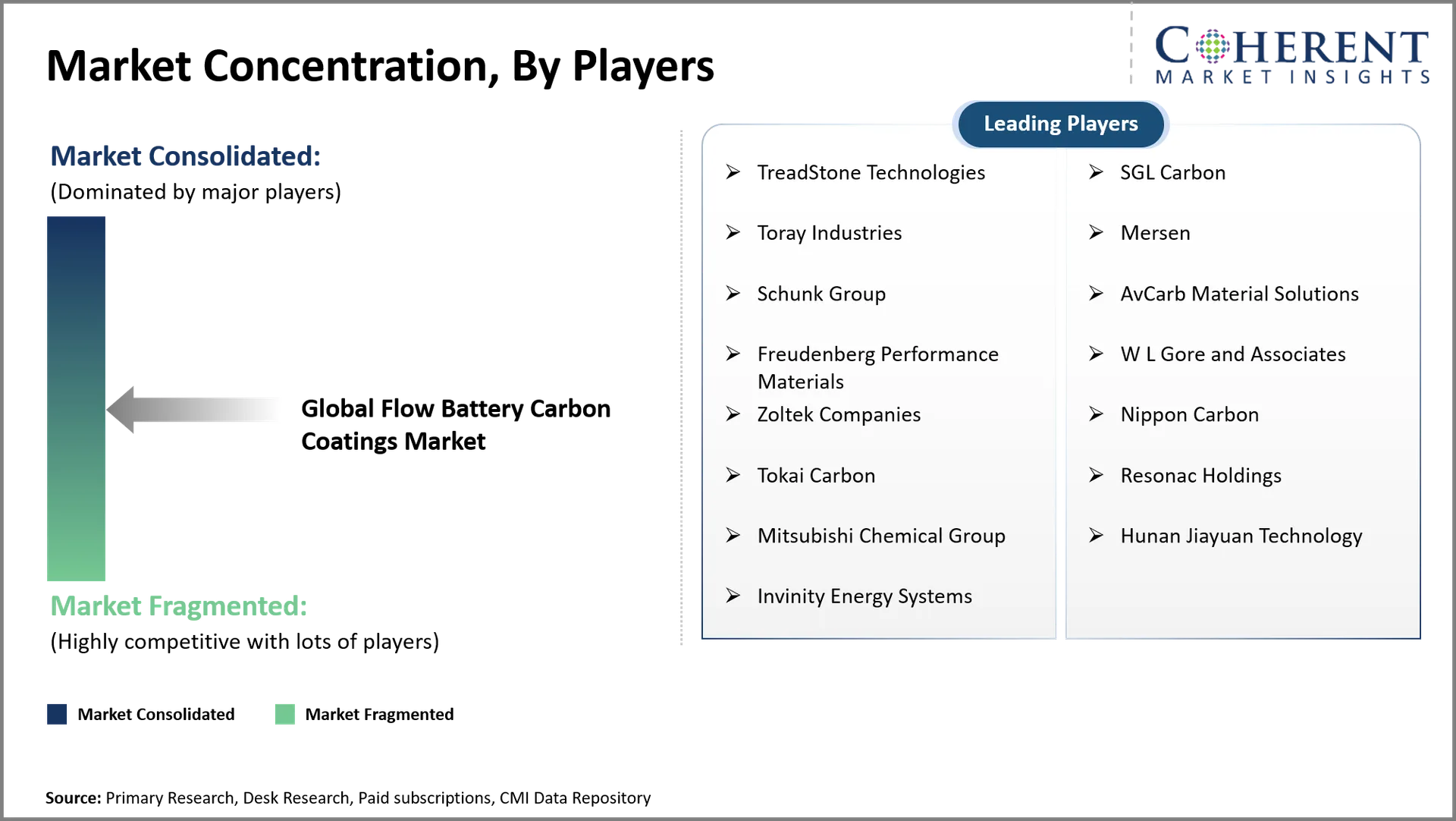
The global flow battery carbon coatings market features specialized carbon material suppliers and electrochemical coating technology developers. TreadStone Technologies is advancing its DuraC carbon coating for metal electrodes and bipolar plates. The company began Phase 3 commercialization testing in September 2026 under a program financed by the United States Department of Energy. It is pursuing a roll-to-roll manufacturing method, spray coating and compatibility with zinc-bromine, all-iron and aqueous organic batteries. With SIGRACELL battery felts and graphite bipolar plates, SGL Carbon strengthens its position. Schunk Carbon Technology is focused on extruded and compression-molded bipolar plates, surface optimization and automated production. AvCarb Material Solutions differentiates through proprietary carbon fabric surface activation. These companies compete through material performance, corrosion resistance, manufacturing scalability, and component durability.
Top Manufacturers and Notable Products in the Flow Battery Carbon Coatings Market
Manufacturer | Notable Product | Key features |
TreadStone Technologies | DuraC Carbon Coating | 20–50 μm carbon coating, bonds directly to metal substrates, low contact resistance, corrosion resistance, spray and roll-to-roll application, flow battery chemistry compatibility |
SGL Carbon | SIGRACELL Bipolar Plates | Expanded natural graphite, high electrical conductivity, chemical resistance, lightweight construction, thin high-density plate formats, flow battery compatibility |
Schunk Carbon Technology | Extruded Graphite Bipolar Plates | High graphite content, continuous extrusion, corrosion resistance, liquid tightness, mechanical strength, large-format production, flow-through and flow-by designs |
Ensinger | TECACOMP PP HTE PW black | Graphite-filled polypropylene, high electrical conductivity, chemical resistance, hot compression molding, suitable for redox flow battery separator plates |
Hongfeng Carbon Solutions | PolyPrime Graphite Composite Bipolar Plates | Graphite composite construction, precision machining, corrosion resistance, customized plate designs, flow battery compatibility, specialized material processing |
Market Report Scope
Global Flow Battery Carbon Coatings Market Report Coverage | |||
Report Coverage | Details | ||
Base Year | 2025 | Market Size in 2026: | USD 675.0 Mn |
Historical Data For: | 2020 To 2024 | Forecast Period: | 2026 To 2033 |
Forecast Period 2026 To 2033 CAGR: | 5.60% | 2033 Value Projection: | USD 930.0 Mn |
Geographies covered: |
| ||
Segments covered: |
| ||
Companies covered: | TreadStone Technologies, SGL Carbon, Toray Industries, Mersen, Schunk Group, AvCarb Material Solutions, Freudenberg Performance Materials, W L Gore and Associates, Zoltek Companies, Nippon Carbon, Tokai Carbon, Resonac Holdings, Mitsubishi Chemical Group, Hunan Jiayuan Technology, Invinity Energy Systems | ||
Growth Drivers: |
| ||
Restraints & Challenges: |
| ||
Analyst Opinion (Expert Opinion)
- The future of the flow battery carbon coatings industry will depend on commercially scalable electrode treatments and corrosion-resistant bipolar plate technologies. Metal-supported carbon coatings could gain importance as manufacturers seek alternatives to expensive graphite components. Roll-to-roll deposition and automated spray coating will be major manufacturing methods. Coating developers will increasingly focus on low contact resistance, electrolyte compatibility and long-term adherence. Zinc-bromine and vanadium redox flow battery technologies will offer separate development prospects. Suppliers capable of transferring laboratory formulations into repeatable industrial production will strengthen their competitive positions.
- The maximum opportunity will emerge in graphite-based conductive coatings applied to metal substrates. Carbon-coated bipolar plates represent an attractive application because manufacturers seek lower component costs and improved mechanical strength. The U.S. is creating prospects through local battery production initiatives and improved coating commercialization. China offers the opportunity for large-scale vanadium redox flow battery manufacture. Opportunities in Germany in specialist graphite engineering and automated electrode manufacture. Companies should concentrate on coatings that are compatible with a range of electrolyte chemistries and industrial electrode geometries.
- Market players should invest in proprietary carbon formulas, precise deposition equipment and durability testing relevant to electrolytes. Before bringing new coating products to market, manufacturers should partner with flow battery stack developers. Tests will be performed to determine resistance to contact, adherence of the coating, corrosion behavior and performance under extended cycle circumstances. Companies should also create continuous coating method to cut production cost and increase consistency of thickness. The company will increase manufacturing resilience by securing long-term graphite supplies and qualifying alternate metal substrates. By providing approved coating requirements and personalized technical assistance, suppliers can differentiate their offerings from standard graphite components.
Speak to the analyst
Want personalized insights?
Take the findings above to one of our principal consultants, or have the report rebuilt around the segments, geographies and competitors you actually track.
Market Segmentation
- Coating Material Insights (Revenue, USD Million, 2021 - 2033)
- Graphite-Based Carbon Coatings
- Carbon Black-Based Coatings
- Carbon Nanotube-Based Coatings
- Graphene-Based Carbon Coatings
- Others
- Coating Technology Insights (Revenue, USD Million, 2021 - 2033)
- Spray Coating
- Roll-to-Roll Coating
- Dip Coating
- Others
- Substrate Insights (Revenue, USD Million, 2021 - 2033)
- Metal Substrates
- Graphite Substrates
- Carbon Fiber Substrates
- Carbon Felt Substrates
- Carbon Paper Substrates
- Composite Substrates
- Application Insights (Revenue, USD Million, 2021 - 2033)
- Flow Battery Electrodes
- Bipolar Plates
- Current Collectors
- Conductive Components
- Electrochemical Interface Components
- End User Insights (Revenue, USD Million, 2021 - 2033)
- Utility-Scale Energy Storage
- Renewable Energy Integration
- Commercial and Industrial Energy Storage
- Microgrids
- Grid Stabilization
- Backup Power Systems
- Regional Insights (Revenue, USD Million, 2021 - 2033)
- North America
- U.S.
- Canada
- Latin America
- Brazil
- Argentina
- Mexico
- Rest of Latin America
- Europe
- Germany
- U.K.
- Spain
- France
- Italy
- Russia
- Rest of Europe
- Asia Pacific
- China
- India
- Japan
- Australia
- South Korea
- ASEAN
- Rest of Asia Pacific
- Middle East
- GCC Countries
- Israel
- Rest of Middle East
- Africa
- South Africa
- North Africa
- Central Africa
- North America
- Key Players Insights
- TreadStone Technologies
- SGL Carbon
- Toray Industries
- Mersen
- Schunk Group
- AvCarb Material Solutions
- Freudenberg Performance Materials
- W L Gore and Associates
- Zoltek Companies
- Nippon Carbon
- Tokai Carbon
- Resonac Holdings
- Mitsubishi Chemical Group
- Hunan Jiayuan Technology
- Invinity Energy Systems
Sources
Primary Research Interviews
- Flow Battery Manufacturers & Carbon Coating Specialists
- Energy Storage System Developers & Integrators
- Raw Material Suppliers (Graphene, Carbon Black, etc.)
- Renewable Energy Project Developers & Investors
Magazines
- Energy Storage Journal Magazine
- Advanced Materials & Processes Magazine
- Renewable Energy World Magazine
- Battery Technology Magazine
Journals
- Journal of Power Sources (Elsevier)
- Journal of The Electrochemical Society
- Journal of Energy Storage (Elsevier)
Associations
- Energy Storage Association (ESA)
- European Association for Storage of Energy (EASE)
- Flow Battery Europe (FBE)
- American Carbon Society (ACS)
Public Domain Sources
- U.S. Department of Energy (DOE) - Office of Electricity
- International Renewable Energy Agency (IRENA)
- U.S. Environmental Protection Agency (EPA) - Energy Reports
- European Commission - Energy Storage Research Publications
Proprietary Elements
- CMI Data Analytics Tool
- Proprietary CMI Existing Repository of Information for the Last 10 Years
Get access to 250+ pages report
Every segment, forecast, competitor profile and data table behind the analysis above — available for instant download.
- ESOMAR Member
- ISO 9001:2015 Certified
- D-U-N-S Registered
- GDPR & CCPA Compliant
Frequently Asked Questions
The global flow battery carbon coatings market is expected to stand at USD 675.0 Mn in 2026 and is expected to reach USD 930.0 Mn by 2033.
The CAGR of the global flow battery carbon coatings market is projected to be 5.6% from 2026 to 2033.
Increasing deployment of grid-scale flow battery energy storage systems and Growing demand for conductive carbon-coated battery components are the major factors driving the growth of the global flow battery carbon coatings market.
High development costs for advanced carbon coating technologies and Limited commercial-scale production of specialized coatings are the major factors hampering the growth of the global flow battery carbon coatings market.
In terms of coating material, graphite-based carbon coatings segment is estimated to dominate the market revenue share in 2026.
Flow battery carbon coatings are conductive surface treatments that improve electrical performance and corrosion resistance in battery components.
Carbon coatings improve electrical contact, facilitate electron transfer, and reduce interfacial resistance within battery components.