

Global Flufenacet Market Size and Forecast – 2026 To 2033
The Global Flufenacet Market is estimated to be valued at USD 610.3 Mn in 2026 and is expected to reach USD 847.4 Mn by 2033, growing at a compound annual growth rate (CAGR) of 4.8% from 2026 to 2033. Market growth is supported by the continued use of flufenacet as a residual herbicide for controlling annual grasses and selected broadleaf weeds across major cereal and row-crop systems.
Its pre-emergence and early-season positioning makes it particularly relevant where growers require weed suppression before crop competition becomes established. In August 2024, Bayer’s Axiom DF herbicide label identified a formulation containing 54.4% flufenacet and 13.6% metribuzin for weed control in winter wheat, field corn, soybeans, fall-seeded triticale, and selected forage grasses, demonstrating the active ingredient’s applicability across multiple commercial cropping systems.
Key Takeaways of the Global Flufenacet Market
- Suspension Concentrate, with an estimated CAGR of 5.1% during 2026–2033, is expected to command 48.6% of the global flufenacet market in 2026, supported by high active-load flexibility, uniform field dispersion, and suitability for pre-emergence residual programs. In November 2025, Certis Belchim listed SYSTEM 50 as a 500 g/L flufenacet suspension concentrate for winter cereals, reinforcing commercial preference for liquid SC delivery.
- Cereals are forecast to post an estimated CAGR of 4.9% during 2026–2033, accounting for 58.6% of the global flufenacet market in 2026, reflecting the herbicide’s established role against annual grass weeds in intensive wheat and barley rotations. In October 2024, Teagasc advised early flufenacet-based applications in winter cereals for annual meadow grass and brome management, highlighting continued agronomic reliance in cereal weed-control programs.
- Wheat should expand at an estimated CAGR of 5.0% during 2026–2033, with a 42.8% share of the global flufenacet market expected in 2026, as growers prioritize residual herbicides where black-grass and other difficult grass weeds threaten crop establishment. In April 2026, ADAMA updated its HEROLD guidance, confirming flufenacet-based use in winter wheat with pre- and post-emergence application positioning.
- Europe is projected to advance at an estimated CAGR of 4.2% during 2026–2033, while retaining 46.8% of the global flufenacet market in 2026, reflecting its deep cereal-herbicide installed base and broad historical use across wheat and barley systems. In August 2025, BCPC reported new Great Britain approvals for flufenacet combinations and extended selected flufenacet product approvals to April 2030, sustaining regional product availability despite tighter Northern Ireland timelines.
- North America, at an estimated CAGR of 6.1% during 2026–2033, is expected to be the fastest-growing region and represent 18.6% of the global flufenacet market in 2026, supported by residual weed-control needs in large field-corn and soybean systems. In January 2026, the U.S. Federal Register disclosed Bayer’s application for USH679SC470, combining flufenacet with icafolin-methyl for soybean and field corn, indicating continued product-development activity.
Segmental Insights
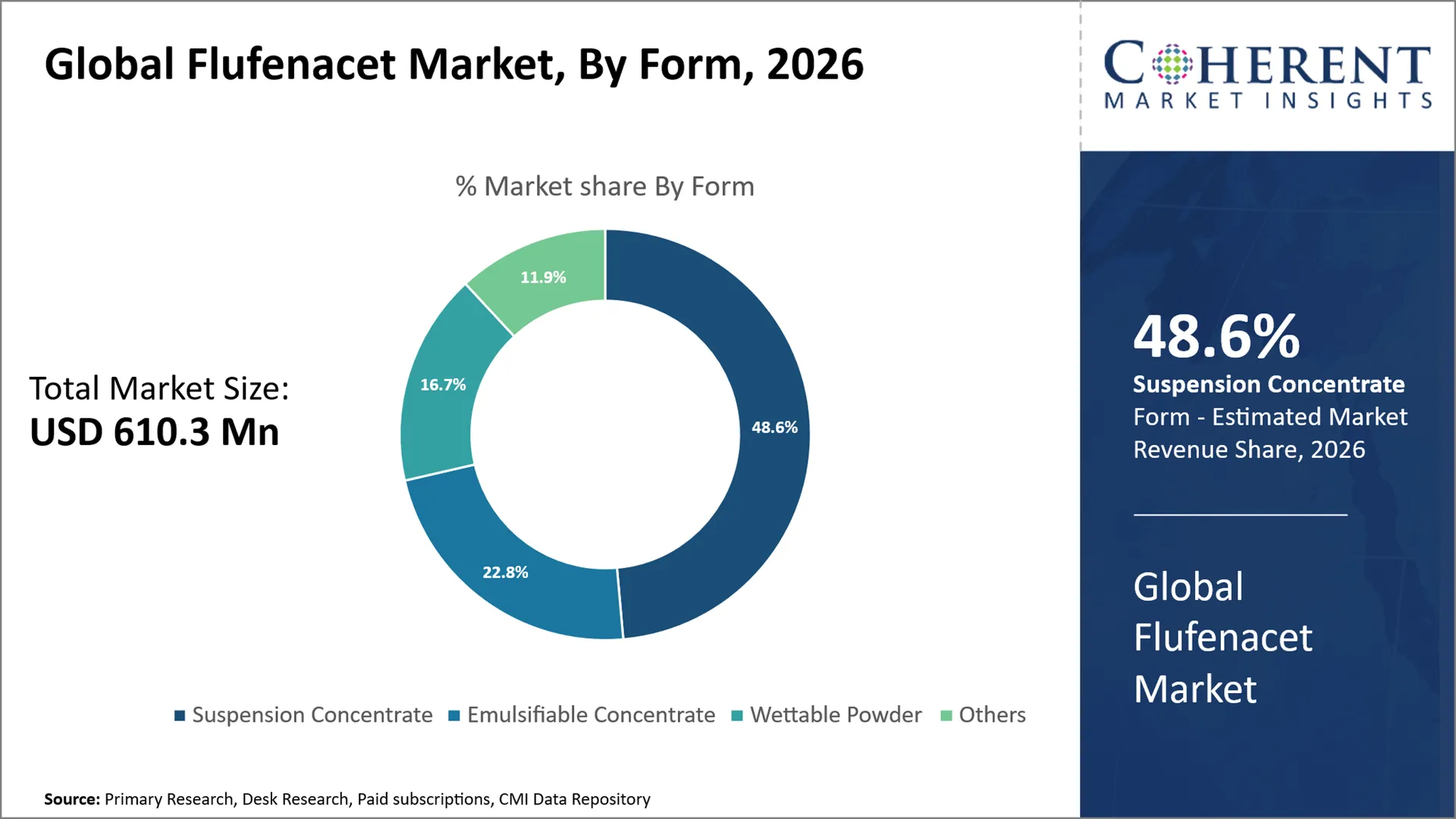
Why Does Suspension Concentrate Dominate the Global Flufenacet Market?
Suspension Concentrate is expected to account for 48.6% of the global flufenacet market in 2026, making it the leading formulation type. Its position reflects the practical advantage of delivering poorly water-soluble flufenacet as a stable liquid dispersion that can be measured accurately, mixed readily in spray tanks, and combined with complementary residual herbicides. SC products also minimize dust associated with dry formulations and suit high-throughput autumn spraying by commercial cereal farms and contractors. For manufacturers, the format supports concentrated multi-active products, standardized packaging, and distributor-friendly handling. In May 2025, FMC’s Battle Delta product sheet identified a modern suspension concentrate containing 400 g/L flufenacet and 200 g/L diflufenican for winter wheat, winter barley, winter rye, and winter triticale, demonstrating the format’s commercial fit with broad cereal weed-control programs.
- Current Industry Events of 2026
- Market Size Estimation
- Regional Breakdown
- Competitive Landscape
- Customer Intelligence
- Segmental Analysis
- Pricing Analysis
- Key Market Drivers, Challenges & Future Trends
- Customized Insights Section
Why Do Cereals Represent the Largest Application Segment in the Global Flufenacet Market?
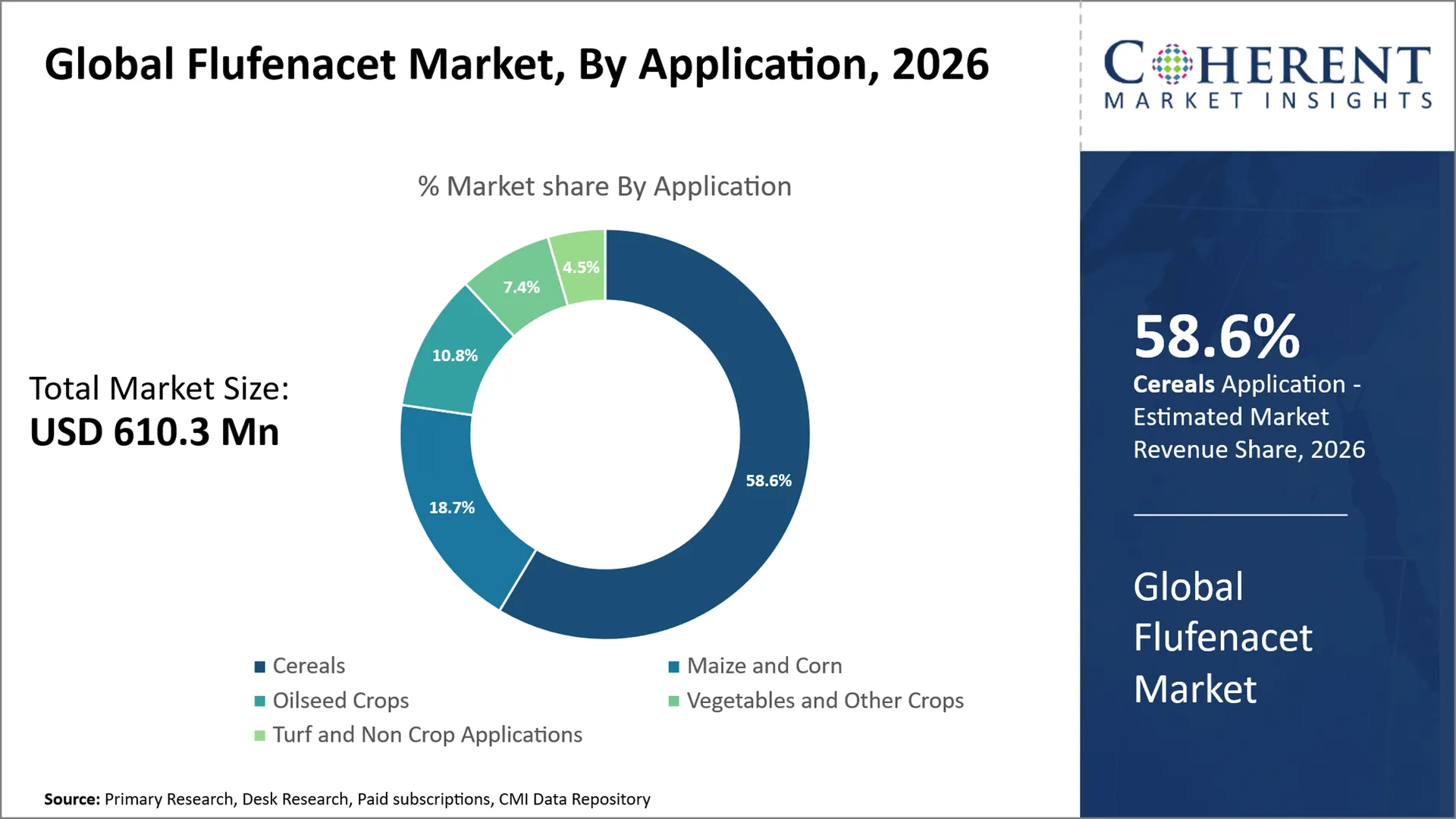
Cereals are expected to represent 58.6% of the global flufenacet market in 2026, the largest share within the application category. The segment benefits from recurring residual-herbicide use in autumn-sown cereal systems, where early grass-weed suppression is critical before weeds become established within dense crop stands. Wheat, barley, rye, and triticale provide extensive treatment acreage for pre-emergence and early post-emergence programs, allowing distributors and agronomists to build repeat seasonal programs around flufenacet. This generates dependable demand for formulated products, technical material, and crop-specific advisory support. In October 2024, the Czech Republic’s official pesticide control plan recorded total flufenacet usage of 51,849.51, with 46,600.61 attributed to cereals; the underlying table expresses active-substance usage in kilograms or litres as applicable. This directly demonstrates the concentration of practical flufenacet use in cereal cultivation.
Why Does Wheat Dominate the Crop Type Segment of the Global Flufenacet Market?
Wheat is expected to hold 42.8% of the global flufenacet market in 2026, leading the crop-type category because winter wheat combines extensive treated acreage with persistent annual grass-weed pressure and a strong requirement for residual control during crop establishment. Flufenacet fits this agronomic window because soil-active programs can be positioned before or shortly after emergence, when competitive grass weeds can compromise crop establishment. Wheat also benefits from established contractor, distributor, and agronomy networks that support timely herbicide procurement and application. For suppliers, this creates repeat-volume opportunities for wheat-specific co-formulations rather than standalone active-ingredient selling. In August 2025, Poland’s public procurement platform listed a tender for 210 litres of an SC herbicide containing flufenacet, diflufenican, and florasulam registered for winter wheat and winter triticale, providing direct evidence of institutional purchasing for wheat-focused weed-control programs.
Current Events and their Impact
Current Event | Description and Its Impact |
European Union Non-Renewal of Flufenacet – May 2025 |
|
Health Canada Cancellation of Flufenacet Registrations – November 2024 |
|
Global Flufenacet Market Dynamics
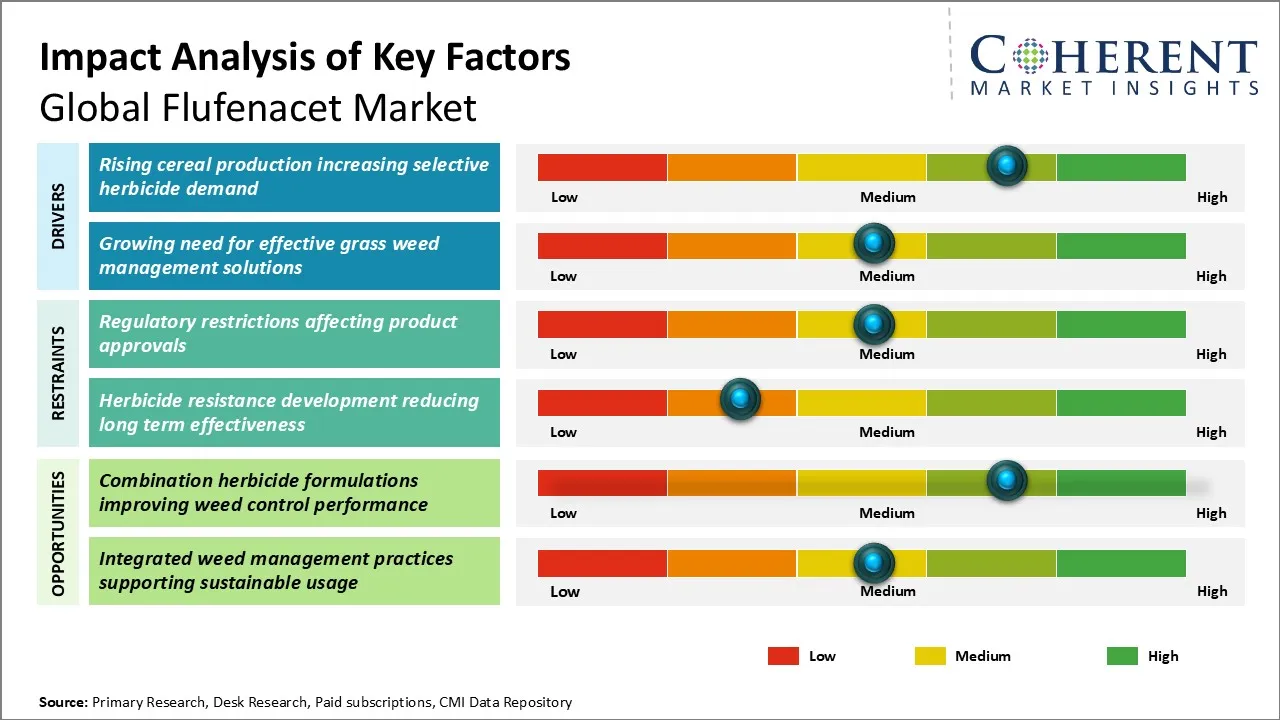
Key Market Drivers
- Rising cereal production increasing selective herbicide demand: Flufenacet demand is closely tied to cereal cultivation intensity because growers use residual selective herbicides to protect crop establishment before weeds compete for moisture, nutrients, and light. Larger cereal programs create recurring procurement for formulators, distributors, contractors, and commercial farms, particularly where wheat and barley rotations require autumn weed control. In August 2025, USDA NASS forecast U.S. winter wheat production at 1.36 billion bushels, slightly above 2024, illustrating the scale of cereal production that sustains selective-herbicide purchasing in major grain-producing markets.
- Growing need for effective grass weed management solutions: Grass-weed resistance is increasing the value of residual herbicides used within diversified weed-control programs, especially where post-emergence chemistry has lost reliability. Flufenacet remains commercially relevant because it inhibits very-long-chain fatty-acid synthesis and can be positioned before or shortly after crop emergence, supporting growers, agronomists, distributors, and formulation suppliers. In February 2026, AHDB reported widespread resistance in black-grass and Italian rye-grass to several post-emergence herbicide groups and increasing resistance pressure in pre-emergence groups, sharpening the need for carefully structured residual programs.
Emerging Market Trends
- Technical-Grade Commoditization Is Shifting Value Toward Registration and Formulation Execution: Technical-grade supply is becoming less of a standalone source of differentiation as more regional manufacturers compete on mature herbicide chemistry. Value is therefore migrating toward formulation know-how, dossier ownership, label breadth, and the ability to maintain registrations across multiple jurisdictions. For technical producers, this increases pressure on commodity margins; for formulators, it raises the importance of product stability, crop-specific labeling, and reliable sourcing. Over the forecast period, the market should increasingly separate low-cost molecule supply from higher-value registered formulations, making regulatory execution and downstream channel control more important to commercial returns.
- Field-Level Data Is Becoming a Stronger Input in Residual Herbicide Selection: Application decisions are becoming more data-led as growers use field history, weed mapping, weather windows, soil conditions, and crop-stage information to determine when residual herbicides should be applied. For flufenacet suppliers, this creates a shift from product selling toward application stewardship, because performance depends heavily on timing, seedbed condition, moisture, and integration with other control measures. Distributors, contractors, and agronomy platforms that can translate field data into precise treatment recommendations should become more influential in product choice and repeat purchasing during the forecast period.
- Regional Insights
Regional Insights
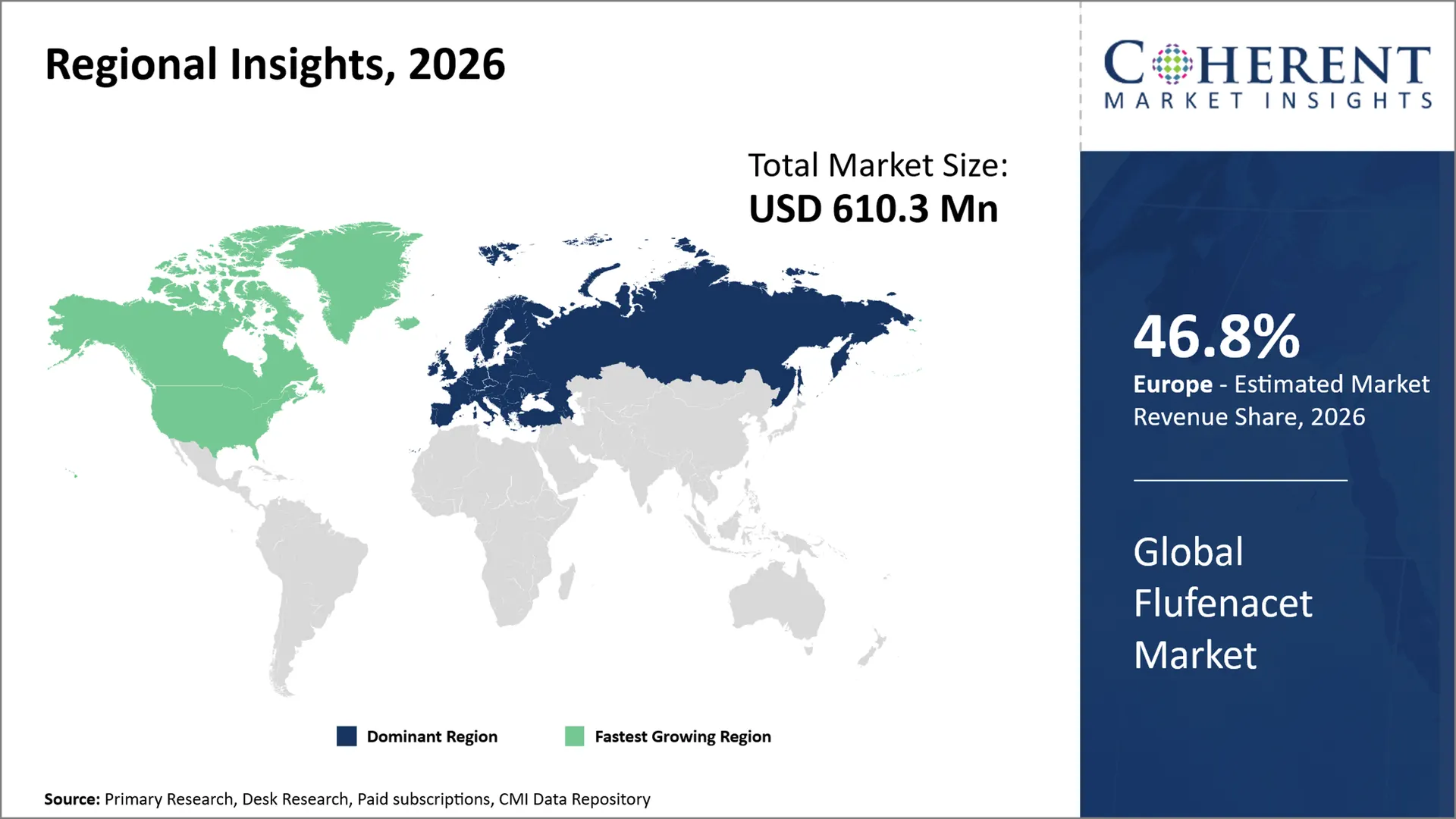
Why Does Europe Dominate the Global Flufenacet Market?
Europe is expected to account for 46.8% of the global flufenacet market in 2026, reflecting its historically deep use of residual herbicides in winter wheat and barley, dense agronomy networks, and high weed-control intensity across major cereal-producing countries. The region’s 2026 leadership is best viewed as a transition-year position: established product inventories, distributor relationships, and familiar pre-emergence programs continue to support demand even as regulatory withdrawal reshapes the medium-term outlook. Commercial value remains concentrated where growers manage black-grass, ryegrass, and other difficult annual grasses through layered residual programs. In December 2025, Eurostat reported that the EU produced about 258 million tons of cereals in 2024, illustrating the scale of the crop base that historically supported flufenacet use. This large agronomic footprint explains Europe’s outsized 2026 share despite tightening regulatory conditions.
Why Is North America Emerging as the Fastest-Growing Region in the Global Flufenacet Market?
North America is expected to represent 18.6% of the global flufenacet market in 2026 and emerge as the fastest-growing region, with expansion concentrated primarily in the U.S. rather than evenly across the region. Large corn and soybean acreages, extensive preplant and pre-emergence herbicide programs, large commercial farms, and broad retailer and crop-adviser networks create a strong addressable base for residual weed-control products. Flufenacet’s fit with soil-applied programs is commercially relevant where growers need early-season control of annual grasses and selected broadleaf weeds before crop canopy closure. In June 2026, USDA NASS estimated 95.3 million acres of corn and 85.4 million acres of soybeans planted in the U.S. The scale of these cropping systems supports continued product positioning, stewardship investment, and formulation opportunities for suppliers serving authorized uses.
Global Flufenacet Market Outlook for Key Countries
Why Is the U.S. a Key Market for the Global Flufenacet Market?
The U.S. is estimated to account for 16.4% of the global flufenacet market in 2026, making it the principal contributor to North American demand. Its importance stems from very large field-corn and soybean systems, widespread use of residual herbicide programs, commercially sophisticated crop-input distribution, and grower familiarity with pre-emergence weed control. Suppliers can address demand through formulations designed for soil application, tank mixing, and integrated resistance-management programs, particularly where early-season grass control is economically important. In March 2024, the U.S. EPA accepted a label amendment for Bayer’s EPIC DF Herbicide connected with registration-review mitigation for flufenacet and isoxaflutole. That regulatory action is commercially significant because it demonstrates continued U.S. product stewardship under revised risk-management conditions rather than an unrestricted expansion pathway.
Why Is India Important in the Global Flufenacet Market?
India is estimated to hold 4.6% of the global flufenacet market in 2026, supported by its large rice-growing base and the need for selective herbicides that control grassy weeds during early crop establishment. The country’s commercial opportunity differs from Europe because registered use is linked strongly to transplanted paddy rather than being centered only on winter cereals. Demand is supported by intensive weed pressure, fragmented but extensive farm acreage, distributor-led crop-protection sales, and the value of low-dose pre-emergence chemistry in labor-constrained production systems. As of March 2024, India’s Directorate of Plant Protection Quarantine and Storage listed Flufenacet 60% DF for transplanted paddy against Echinochloa crus-galli, Echinochloa colona, and Cyperus iria. This registered use gives suppliers a clearly defined crop-specific pathway for Indian demand.
Why Does China Support Growth in the Global Flufenacet Market?
China is estimated to represent 8.2% of the global flufenacet market in 2026, supported by domestic technical-grade manufacturing, multiple formulation registrations, broad crop applicability, and an extensive agrochemical distribution system. The country is strategically important not only as an end-use market but also as a supply base capable of producing technical material and formulated herbicides for domestic and export channels. Registered uses across wheat, rice, and maize widen the commercial addressable base beyond a single crop cycle. In February 2025, China’s Ministry of Commerce reported that, as of January 2025, flufenacet had six technical-material registrations and 21 formulation registrations in China. That registration depth indicates a competitive local supplier base and supports continued formulation, pricing, and channel activity.
Why Is Germany a Strategic Country in the Global Flufenacet Market?
Germany is estimated to account for 11.8% of the global flufenacet market in 2026, reflecting its historically intensive winter-cereal herbicide programs, large wheat acreage, professional crop-advisory structure, and strong distributor penetration. Its near-term relevance is concentrated in the transition from established flufenacet-based weed-control programs toward replacement chemistry, so 2026 demand should be interpreted as residual and time-sensitive rather than structurally expanding. Growers facing grass-weed pressure still require robust pre-emergence strategies, preserving commercial value during the changeover. In May 2026, Germany’s Federal Statistical Office estimated total cereal area at 6.03 million hectares, with winter wheat alone at 2.9 million hectares and approximately 48% of cereal area. That concentration explains why Germany remains strategically important to suppliers managing herbicide-portfolio transition.
Why Is Australia a Strategic Watch Market for the Global Flufenacet Market?
Australia remains strategically relevant because large no-till cereal systems and persistent grass-weed resistance create agronomic conditions in which a pre-emergence active such as flufenacet could be technically relevant if approval were obtained. Commercial growth, however, depends first on regulatory market access rather than agronomic need alone. In April 2025, New Zealand’s Environmental Protection Authority reviewed flufenacet’s international regulatory status and explicitly recorded that the active ingredient was not approved in Australia. This makes Australia a future watch market rather than a current revenue-generating country. Any forecast assigning material Australian sales in 2026 would require evidence of subsequent APVMA approval.
Flufenacet Formulation Application and Stewardship Innovation Landscape
Technology / Innovation | Adoption Position | Role in Flufenacet Use | Commercial Implication |
Suspension Concentrate Formulation Engineering | Mature | Maintains fine active-particle dispersion and supports accurate liquid dosing for pre-emergence and early post-emergence programs | Formulation stability, pourability, storage performance, and compatibility increasingly influence supplier differentiation |
Multi-Active Co-Formulation Systems | Established and evolving | Combines flufenacet with complementary residual or contact herbicide modes of action to broaden weed spectrum | Enables differentiated labels and simplifies spray programs while supporting resistance-management positioning |
Low-Drift Spray and Nozzle Technology | Growing | Improves placement and limits off-target movement during herbicide application | Strengthens stewardship credentials and supports compliance-oriented purchasing by professional farms and contractors |
GPS Auto-Section and Site-Specific Application | Growing | Reduces overlap and improves field-level application accuracy around headlands and irregular field boundaries | Can lower unnecessary chemical use per treated field and increase confidence in professionally managed herbicide programs |
Digital Weed Mapping and Resistance Diagnostics | Emerging | Uses field records and weed-pressure information to refine herbicide selection and application timing | Creates greater influence for agronomists and digital advisory providers in purchasing decisions |
Closed-Transfer and Operator-Exposure Reduction Systems | Developing | Reduces direct handling during product loading and transfer into spraying equipment | May become increasingly important where occupational-exposure requirements influence pesticide stewardship and procurement |
How Are Maize and Corn Residual-Weed Programs Creating New Growth Opportunities in the Global Flufenacet Market?
Maize and corn programs offer an underdeveloped route for flufenacet suppliers in countries where the active ingredient remains authorized and residual weed control is integral to crop establishment. Commercial capture depends on designing formulations and labels around preplant and pre-emergence use, difficult annual grasses, broadleaf partners, soil conditions, and local tank-mix practices rather than transferring cereal positioning unchanged. Target customers include commercial farms, agricultural contractors, crop advisers, and distributors serving maize systems in Latin America, Asia, and other markets. Suppliers need generated efficacy data, crop-safety evidence, resilient technical sourcing, and regulatory dossiers that support crop claims. Co-formulation capability can simplify field programs and create differentiation from commodity technical material. Established agrochemical companies benefit from registration infrastructure and channels, while specialist formulators can compete through localized labels and responsive technical service. The opportunity should be approached selectively, with investment concentrated where agronomic fit and authorization durability can support repeat seasonal purchasing.
Market Players, Key Development, and Competitive Landscape
Key Developments
- In October 2025, Albaugh updated its Czech portfolio listing for Fenix, confirming a 480 g/L flufenacet suspension concentrate for cereal crops. This is important for the global flufenacet market because it shows continued regional product positioning and localized registration support during a period of changing European authorization conditions.
- In April 2024, Finchimica published Sirionova Flufenacet 500 SC within a broader formulated-product and registration development plan for crop protection. This is important for the global flufenacet market because it illustrates how specialist formulators can build differentiated cereal herbicide portfolios around registered suspension-concentrate products.
Competitive Landscape
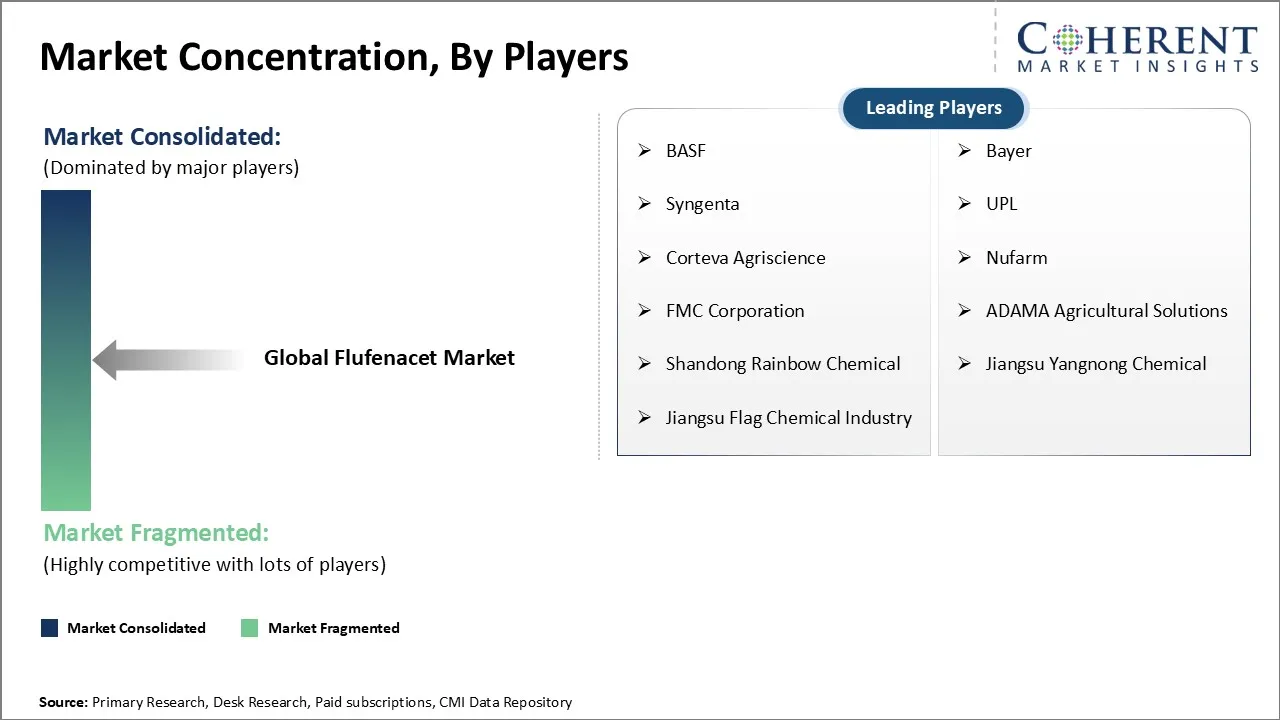
The global flufenacet market is moderately consolidated at the branded-registration level but more fragmented across technical supply, generic formulation, and regional distribution. Competition centers on herbicidal efficacy, formulation quality, registration continuity, price, supply reliability, and agronomic support. Regional formulators remain important where local labels, crop patterns, and distributor relationships determine access, while larger suppliers benefit from broader regulatory, manufacturing, and portfolio capabilities.
Key focus areas include
- Formulation quality: Storage stability, dispersion, tank compatibility, and field consistency differentiate finished products from commodity technical supply.
- Regulatory capability: Dossier quality, registration maintenance, technical equivalence, and label management increasingly determine sustainable market access.
- Supply reliability: Seasonal application windows make dependable technical-grade sourcing, inventory planning, and timely distributor supply commercially critical.
- Co-formulation flexibility: Combining complementary active ingredients enables broader weed-spectrum positioning and more convenient field programs where registrations permit.
- Pricing discipline: Generic alternatives intensify price-per-hectare competition and can compress margins for suppliers without formulation or service differentiation.
- Distribution access: Agricultural distributors, advisers, and contractors remain influential gatekeepers between manufacturers and commercial growers.
- Technical support: Local application guidance, resistance stewardship, and crop-specific label interpretation can strengthen customer retention beyond price competition.
Market Report Scope
Flufenacet Market Report Coverage | |||
Report Coverage | Details | ||
Base Year | 2025 | Market Size in 2026: | USD 610.3 Mn |
Historical Data For: | 2020 To 2024 | Forecast Period: | 2026 To 2033 |
Forecast Period 2026 To 2033 CAGR: | 4.8% | 2033 Value Projection: | USD 847.4 Mn |
Geographies covered: |
| ||
Segments covered: |
| ||
Companies covered: | BASF, Bayer, Syngenta, UPL, Corteva Agriscience, Nufarm, FMC Corporation, ADAMA Agricultural Solutions, Shandong Rainbow Chemical, Jiangsu Yangnong Chemical, Jiangsu Flag Chemical Industry | ||
Growth Drivers: |
| ||
Restraints & Challenges: |
| ||
Analyst Opinion (Expert Opinion)
- Commercial leadership is likely to shift from maximizing flufenacet volume toward managing herbicide portfolios across different product lifecycles and regulatory environments. Suppliers capable of retaining customer relationships while migrating growers among straight actives, co-formulations, and replacement residual programs should protect more commercial value. Coordinated regulatory, formulation, agronomy, and channel capabilities are therefore likely to matter more than molecule ownership alone.
- A faster transition away from flufenacet in historically important cereal systems could fundamentally alter the economics of technical manufacture and generic formulation. Dedicated molecule-based business models would face pressure as alternative residual modes of action and integrated weed-management practices mature. Flexible production, cross-active formulation expertise, rapid field validation, and the ability to redesign complete weed-control programs would become increasingly valuable competitive capabilities.
- Market participants should prioritize adaptable formulation assets, regulatory intelligence, resistance-management expertise, and distributor education while securing technical inputs through diversified supply arrangements. Commercial resources should concentrate on jurisdictions where authorization durability and agronomic need justify continued investment. Suppliers should avoid overcommitting capital to dedicated flufenacet capacity without clear regulatory visibility and should protect margins through technical service, formulation performance, and disciplined market selection rather than aggressive price competition.
Speak to the analyst
Want personalized insights?
Take the findings above to one of our principal consultants, or have the report rebuilt around the segments, geographies and competitors you actually track.
Market Segmentation
- Form Insights (Revenue, USD Mn, 2021 - 2033)
- Suspension Concentrate
- Emulsifiable Concentrate
- Wettable Powder
- Others
- Application Insights (Revenue, USD Mn, 2021 - 2033)
- Cereals
- Maize and Corn
- Oilseed Crops
- Vegetables and Other Crops
- Turf and Non Crop Applications
- Crop Type Insights (Revenue, USD Mn, 2021 - 2033)
- Wheat
- Barley
- Maize
- Other Crops
- End User Insights (Revenue, USD Mn, 2021 - 2033)
- Commercial Farmers
- Agricultural Contractors
- Research and Institutional Users
- Others
- Distribution Channel Insights (Revenue, USD Mn, 2021 - 2033)
- Agricultural Distributors
- Direct Sales
- Online Agricultural Platforms
- Others
- Regional Insights (Revenue, USD Mn, 2021 - 2033)
- North America
- U.S.
- Canada
- Latin America
- Brazil
- Argentina
- Mexico
- Rest of Latin America
- Europe
- Germany
- U.K.
- Spain
- France
- Italy
- Russia
- Rest of Europe
- Asia Pacific
- China
- India
- Japan
- Australia
- South Korea
- ASEAN
- Rest of Asia Pacific
- Middle East
- GCC Countries
- Israel
- Rest of Middle East
- Africa
- South Africa
- North Africa
- Central Africa
- North America
- Key Players Insights
- BASF
- Bayer
- Syngenta
- UPL
- Corteva Agriscience
- Nufarm
- FMC Corporation
- ADAMA Agricultural Solutions
- Shandong Rainbow Chemical
- Jiangsu Yangnong Chemical
- Jiangsu Flag Chemical Industry
Sources
Primary Research Interviews
- Herbicide manufacturers, agrochemical formulators, distributors, crop protection suppliers, and agricultural input retailers
- Agronomists, weed scientists, regulatory experts, procurement professionals, farmers, and crop protection consultants
Stakeholders
- Flufenacet manufacturers, pesticide formulators, agrochemical companies, distributors, and importers
- Raw material suppliers, contract manufacturers, agricultural cooperatives, commercial farms, and crop protection service providers
End-use Sectors
- Cereals and grains
- Oilseeds and pulses
- Commercial and field crop production
- Pre-emergence and early-season weed management
Regulatory and Industry Bodies
- U.S. Environmental Protection Agency EPA
- European Commission and European Food Safety Authority EFSA
- National pesticide registration authorities
- Agricultural and environmental protection agencies
Databases
- Company annual reports and regulatory filings
- Pesticide registration and approval databases
- Agricultural production and crop acreage databases
- Import-export and agrochemical trade databases
- Patent, product registration, and competitive intelligence databases
Magazines and Journals
- Weed science and crop protection journals
- Agricultural chemistry publications
- Agronomy and plant science journals
- Agrochemical and farming industry publications
Associations
- CropLife International
- Regional crop protection associations
- Agricultural chemical industry associations
- Farmer and grain producer organizations
Public Domain Sources
- Crop production and planted acreage trends
- Herbicide use and weed management developments
- Product registrations and regulatory updates
- Herbicide resistance research
- Agricultural input and crop protection developments
Key Standards and Regulations
- Pesticide registration and authorization requirements
- Maximum residue limit MRL regulations
- Environmental fate and ecotoxicity requirements
- Product labeling and application restrictions
- Chemical handling storage and transportation regulations
Proprietary Elements
- CMI Data Analytics Tool and proprietary CMI repository containing 10+ years of agrochemicals, herbicides, crop protection, and agricultural market intelligence
Get access to 250+ pages report
Every segment, forecast, competitor profile and data table behind the analysis above — available for instant download.
- ESOMAR Member
- ISO 9001:2015 Certified
- D-U-N-S Registered
- GDPR & CCPA Compliant
Missing comfort of reading report in your local language? Find your preferred language:
Frequently Asked Questions
The CAGR of global flufenacet market is projected to be 4.8% from 2026 to 2033.
The global flufenacet market is estimated to be valued at USD 610.3 million in 2026 and is expected to reach USD 847.4 million by 2033.
Flufenacet is primarily used as a selective herbicide for controlling annual grasses and certain broadleaf weeds in agricultural crops.
Flufenacet has been used in crops such as corn soybeans wheat potatoes sunflowers and other field crops depending on local product approvals.
Flufenacet controls weeds by interfering with seedling emergence and early weed development which helps suppress weeds before or during their initial growth stages.
Yes. Flufenacet is commonly applied before weed emergence including preplant and pre-emergence applications depending on the crop and approved product label.
Rising cereal production increasing selective herbicide demand and Growing need for effective grass weed management solutions are the major factors driving the growth of global flufenacet market.