

Global FPV Drone Goggles Market Size and Forecast – 2026 To 2033
The global FPV drone goggles market is expected to grow from USD 550 Mn in 2026 to USD 1,230 Mn by 2033, registering a compound annual growth rate (CAGR) of 9.4% from 2026 to 2033. The global FPV drone goggles market is driven by increasing demand for low latency video transmission. On January 9, 2025, DJI announced DJI O4 Air Unit Series, a digital video transmission solution offering impressive range, ultra-low latency, and crisp 4K/60fps video.
Key Takeaways of the Global FPV Drone Goggles Market
- The Digital FPV Goggles segment is expected to account for 58.0% of the global FPV drone goggles market share in 2026. Expansion of cinematic FPV drone applications is driving the growth of the segment. On May 26, 2026, DJI launched the Avata 360 for immersive aerial filmmaking. The drone captures 8K video at 60 frames per second and 120-megapixel photos.
- The OLED segment is estimated to capture 44.0% of the market share in 2026. Increasing consumer interest in immersive drone experiences is majorly driving the growth of the segment. On August 14, 2025, Antigravity opened global public testing for its A1 panoramic drone. The system combines 8K 360-degree video, VR goggles, and motion-based controls.
- The Drone Racing segment is estimated to capture 29.0% of the market share in 2026. Greater availability of compact lightweight goggles is majorly driving the growth of the segment. On June 19, 2025, CaddxFPV introduced Walksnail Avatar Goggles L as an entry-level digital FPV headset. The company positioned it as its first single-screen goggles supporting head tracking.
- Asia Pacific is expected to dominate the FPV drone goggles market in 2026 with a market share of 39.0%. Growth of FPV drone training platforms in Asia Pacific is driving the growth of the regional market. In May 2025, DroneAcharya expanded its dedicated FPV training offering in India for drone racers, aerial cinematographers and FPV enthusiasts.
- North America is expected to account for 27.0% share in 2026 and is projected to record the fastest growth over the forecast period. Expansion of commercial inspection applications in North America is driving the growth of the regional market. In July 2026, Skydio reported 1,070 deployed Skydio Docks across public safety, critical infrastructure, and defense programs.
Segmental Insights
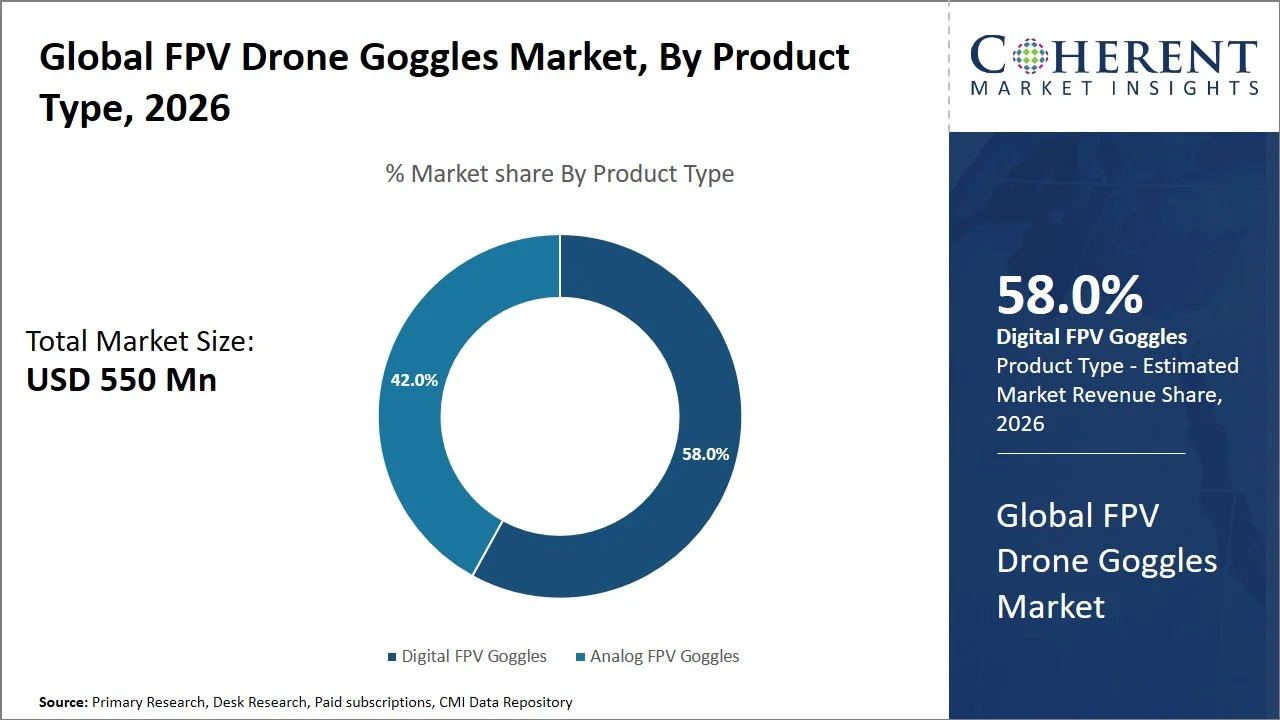
Why Does Digital FPV Goggles Dominate the Global FPV Drone Goggles Market?
The digital FPV goggles segment is expected to account for 58.0% of the global FPV drone goggles market share in 2026. Digital systems provide high-definition live video while maintaining sufficiently low latency for responsive FPV flight. DJI reports latency as low as 15 milliseconds with its O4 Pro system. Digital transmission also supports higher resolution and smoother imagery than traditional analog systems. DJI Goggles 3 supports up to 1080p/100fps transmission with O4 technology. These qualities make digital goggles desirable for racing, freestyle flying and cinematic FPV. Skyzone also still produces high-performance FPV goggles for the beginner and experienced pilot. The product line-up comprises digital compatible goggles and receiver solutions for high frame rate FPV viewing. The company also has conventional manufacturing capabilities for FPV equipment.
- Current Industry Events of 2026
- Market Size Estimation
- Regional Breakdown
- Competitive Landscape
- Customer Intelligence
- Segmental Analysis
- Pricing Analysis
- Key Market Drivers, Challenges & Future Trends
- Customized Insights Section
Why is OLED the Most Preferred Technology Type?
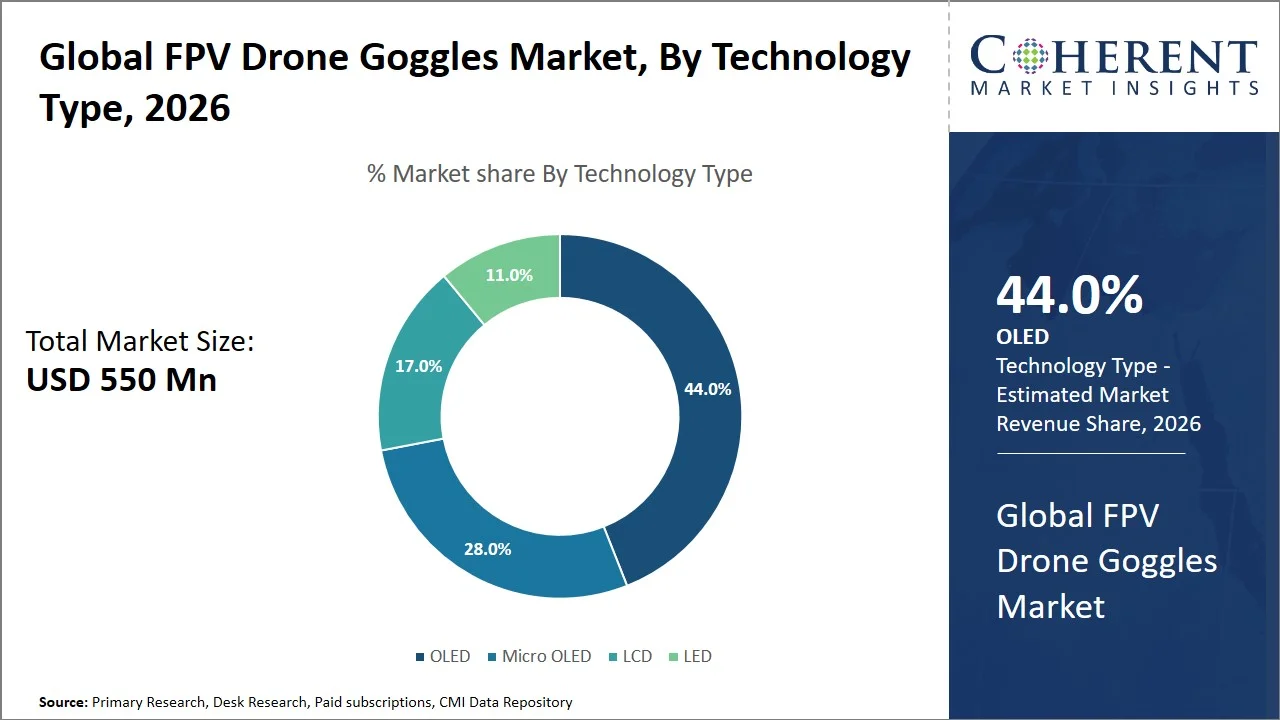
The OLED segment is expected to account for 44.0% of the global FPV drone goggles market share in 2026. OLED tech means high contrast, clear images for engaging first-person-view flight experiences. These benefits are highlighted in current products with small micro-OLED displays with high refresh rates. The DJI Goggles 3 are equipped with 1920 x 1080 micro-OLED panels with a refresh rate of up to 100 Hz. The technology also allows for rich images in quick drone motions and challenging flight maneuvers. These visual features make OLED the best choice for those looking for responsive and immersive FPV viewing experience. On September 3, 2025, HDZero documented its new Goggle 2 with 1080p 90Hz OLED micro-displays. The headset also combines digital, analog, and HDMI video inputs. This supports premium visual performance for competitive FPV pilots.
Drone Racing Dominates the Global FPV Drone Goggles Market
The drone racing segment is expected to account for 29.0% of the global FPV drone goggles market share in 2026. Drone racing requires pilots to receive live video with minimal delay during high-speed activities. MultiGP describes FPV goggles as the pilot’s cockpit for real-time racing visibility. Racing events also specify compatible video systems, including HDZero and analog systems. This leads to a constant need of eyewear engineered for low latency and steady video reception. The organized growth of competitive racing also creates a continuing demand from pilots and racing teams. On October 7, 2025, MultiGP kicked off the competitive racing calendar with its Kings of Tulsa championship event. The event demonstrates continuing demand for specialized FPV equipment among competitive pilots.
Current Events and their Impact
Current Events | Description and its Impact |
European Union - Regulation (EU) 2019/947 And 2026 Regulatory Framework |
|
European Union - Regulation (EU) 2024/1110 And Updated Airspace Framework |
|
FPV Drone Goggles Market Dynamics
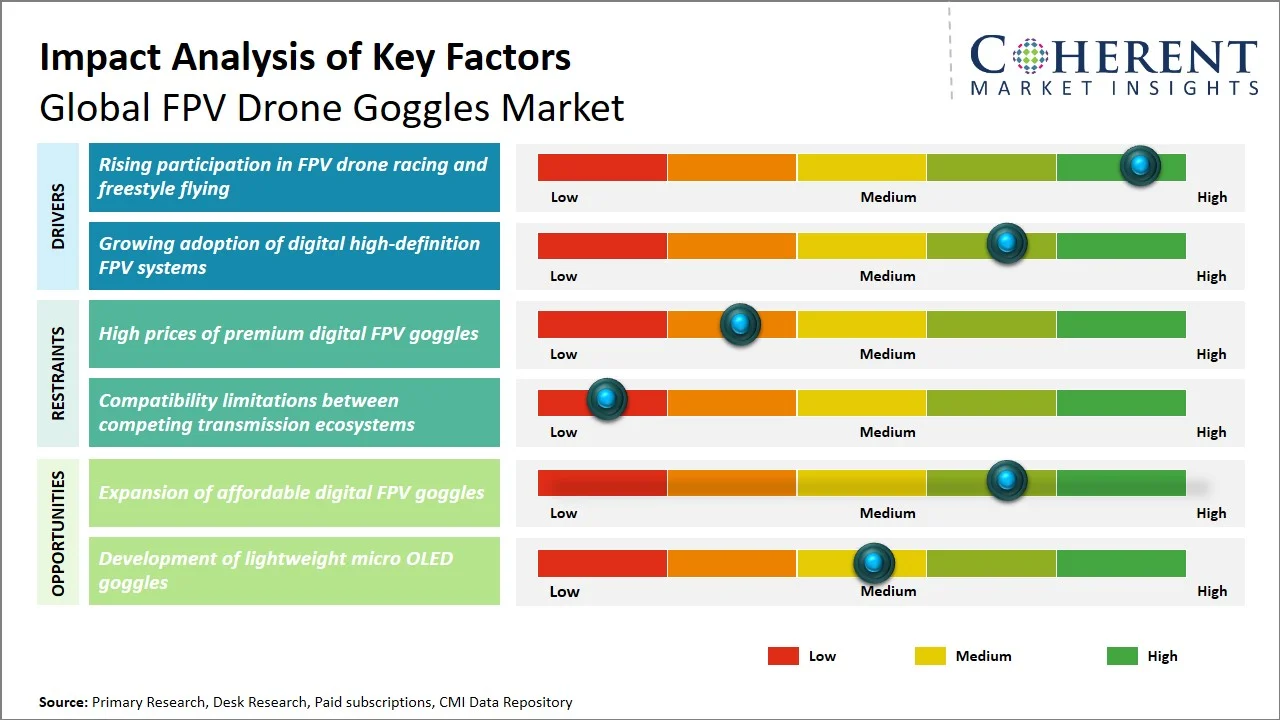
Market Drivers
Rising participation in FPV drone racing and freestyle flying
Organized involvement in and community engagement with FPV drone racing and freestyle flying is growing globally. MultiGP has over 30,000 registered pilots and 500 active chapters worldwide. Its International Open features high-speed racing and freestyle competitions for pilots of all ability levels. These require goggles that deliver live video that is fast and sensitive during rapid moves. This leads to an increasing participation that fuels the market for dedicated FPV goggles for recreational and competitive pilots. On June 10, 2026, MultiGP announced the International Open 2026, which is the world’s largest drone racing event. There will be competitive racing and community events for FPV pilots during the event.
Growing adoption of digital high-definition FPV systems
Digital FPV systems are being adopted owing to clear imagery and lesser transmission delay. DJI O4 supports 1080p at 100 frames per second during racing mode. The system can achieve transmission latency as low as 15 milliseconds with compatible goggles. Its O4 Air Unit also has 4K video capture and longer transmission ranges. These advancements will increase demand for digital goggles among users of racing, freestyle, and cinematic FPV. In May 2026, HDZero expanded its product ecosystem with more digital receiver and goggle alternatives. The company is focused on digital image quality and reliable latency for pilots. Its ecosystem continues to be especially relevant for competitive FPV racing.
Emerging Trends
Micro OLED Display Adoption
Manufacturers are progressively integrating micro-OLED display with high refresh rates and better image clarity. The HDZero Goggle 2 offers responsive FPV viewing experiences with 1080p 90Hz OLED tiny screens.
Low Latency Digital Transmission
Low latency is a rising target for digital transmission systems for racing and freestyle applications. HDZero boasts a glass-to-glass latency of three milliseconds, allowing pilots to react quickly during challenging maneuvers.
Real Time Situational Awareness
Goggles are increasingly being equipped with external camera systems and picture-in-picture capability to boost environmental awareness. The DJI Goggles 3 offers Real View Picture-in-Picture, which lets users see the live video feed from their drone while flying it.
Multisystem Compatibility
FPV goggles are now more often compatible with different video sources, including digital, analog and HDMI connectivity. HDZero Goggle 2 features digital and analog reception and HDMI inputs, adding more versatility to a wide range of FPV setups.
Regional Insights
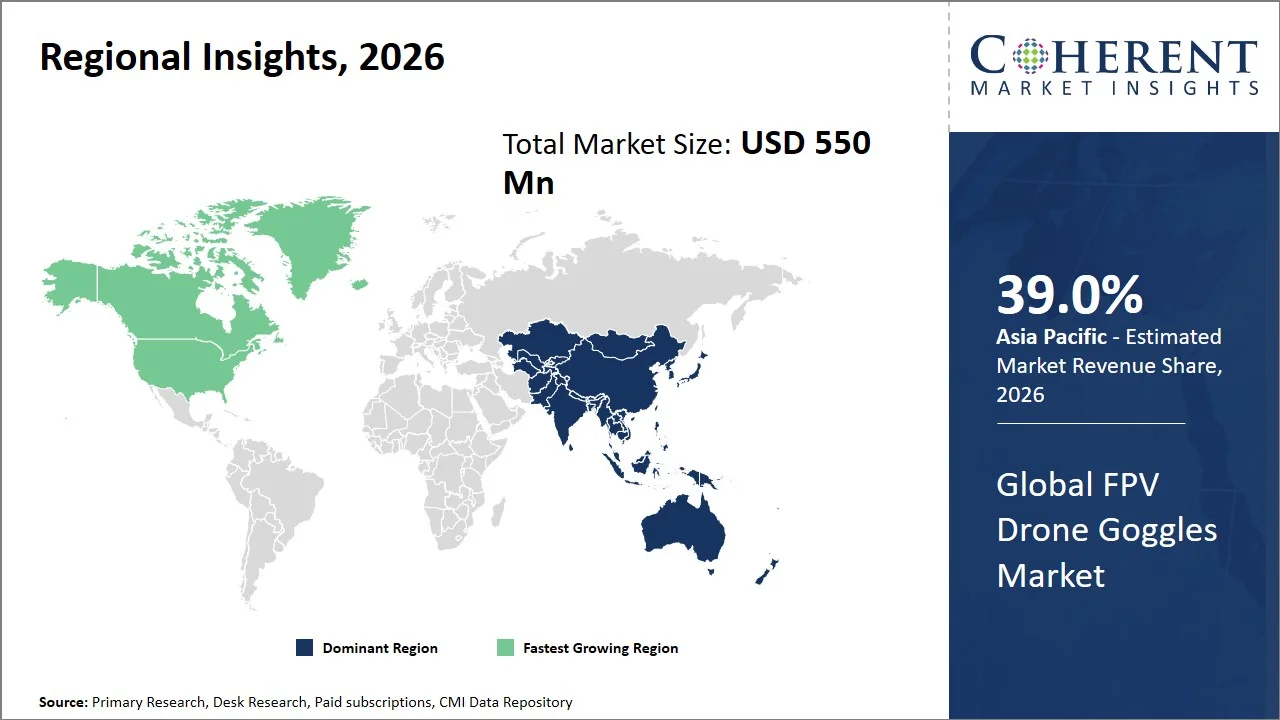
Why is Asia Pacific a Strong Market for FPV Drone Goggles?
Asia Pacific is expected to account for a market share of 39.0% in 2026. Asia Pacific benefits from concentrated drone manufacturing and expanding competitive FPV activities. China backs manufacturing of key components and R&D for digital transmission. South Korea sponsored Drone Show Korea 2025, with 306 businesses from 15 nations. The exhibition featured electronic drone racing and water drone racing. Commercial drone applications involving infrastructure inspection, multi drone operations are increasing in Japan. Australia and Southeast Asia also have active recreational drone communities. These improvements drive need for goggles that can reliably transmit and provide responsive flight visibility. The depth of manufacturing in the region also permits rapid adoption of new display and transmission technologies.
Why Does North America FPV Drone Goggles Market Exhibit High Growth?
North America is expected to register the fastest growth with a CAGR of 10.5% over the forecast period. The region is projected to account for 27.0% of the global FPV drone goggles market in 2026. North America benefits from established FPV racing infrastructure and strong participation from competitive pilots. MultiGP operates regional racing programs covering several major U.S. geographic divisions. It has a global network of more than 30,000 registered pilots and 500 active chapters. Special LED gate race track for the 2025 MultiGP Championship. Organized competitions require goggles delivering low latency and stable video reception. Commercial cinematography also creates demand for immersive FPV systems. These applications support continued equipment upgrades among professional pilots and racing enthusiasts.
Global FPV Drone Goggles Market Outlook for Key Countries
Why is China Emerging as a Major Hub in the FPV Drone Goggles Market?
China's large domestic FPV hardware manufacture and mature digital transmission development are advantages. DJI makes FPV hardware in the Chinese electronics manufacturing environment. Its O4 Air Unit supports 1080p transmission at 100 frames per second. Racing mode can achieve latency as low as 15 milliseconds with compatible equipment. The system also supports simultaneous operation alongside analog FPV equipment. Electronics manufacturing environment in Shenzhen gives access to cameras, CPUs, displays, batteries and transmission components. This specialization in the supply-chain increases product development speed and stimulates experimentation by Chinese FPV manufacturers.
Is U.S. the Next Growth Engine for the FPV Drone Goggles Market?
The U.S. has a lot of infrastructure for organized racing and established recreational drone groups. MultiGP operates regional competitions across the Pacific, Mountain, Central, Great Lakes, Southeast, and Northeast regions. Its championship events provide dedicated racing tracks and qualifying competitions. Federal Aviation Administration rules require pilots to maintain applicable visual line-of-sight requirements. In conforming operations visual observers can help pilots utilizing FPV goggles. These standards create an orderly flying environment for recreational and competitive pilots. The professional film-making industry also needs high-quality eyewear that allow for accurate control of planes.
Germany FPV Drone Goggles Market Analysis and Trends
Germany benefits from an established model aviation structure supporting dedicated FPV competition. The German Model Flying Association maintains a specialized Copter and FPV sports category. Its competitions include cockpit video transmission, slalom sections, and technically demanding racing courses. The association organized the 2025 FPV TeamRace in Hannover with six teams. The regulations of the competition allowed each team to have four pilots. These events are arranged to help sell specialist racing goggles and compatible video systems. There is also an infrastructure for regular FPV instruction and competition participation in the well-established model aviation clubs in Germany.
Japan FPV Drone Goggles Market Analysis and Trends
Japan is taking advantage of the expansion of commercial drone applications and the growing structuring of unmanned aircraft operations. The Ministry of Land, Infrastructure, Transport and Tourism has developed procedures for Category II drone operations. Japan also introduced guidelines supporting simultaneous operation of multiple unmanned aircraft. National registration statistics recorded more than 521,000 registered airplanes as of November 2025. The main commercial uses of Japanese drone operators are for infrastructure inspection and surveying. Such activities provide chances for goggles to assist dependable visual feedback and accurate control of the aircraft. Japan’s mature electronics industry also helps to develop small displays and advanced imaging components.
South Korea FPV Drone Goggles Market Analysis and Trends
The government-backed drone exhibits and fast increasing technology demonstration activities are a boon to South Korea. Korea AeroSpace Administration held Drone Show Korea 2025 with 306 enterprises from 15 nations. The expo featured displays of electronic drone racing and water drone racing. Other major issues included artificial intelligence, improved drone technology and commercialization. Such activities expose consumers and businesses to cutting-edge applications of unmanned aircraft. Competitive demonstrations can also boost the interest in immersive FPV equipment by technology enthusiasts. Expertise in consumer electronics also helps to include modern display and wireless communication technologies.
Global FPV Drone Goggles Market - Micro OLED Display Penetration by Country (2025)
Country | Estimated Micro OLED Penetration Of FPV Goggles |
China | 48% |
U.S. | 43% |
Japan | 39% |
Germany | 37% |
South Korea | 35% |
United Kingdom | 34% |
France | 32% |
Australia | 31% |
Canada | 30% |
India | 24% |
How is Expansion of Affordable Digital FPV Goggles Creating New Growth Opportunities in the FPV Drone Goggles Market?
Affordable digital goggles are making FPV flying accessible to newcomers who were previously put off by the exorbitant cost of gear. Skyzone offers basic goggles, as well as more complex ones, like its Cobra Lite V2, which sells for USD 99. This price segmentation allows novice pilots to enter into digital capable ecosystems without needing to buy premium equipment right once. HDZero also integrates digital and analog reception into one headset, removing the need for separate goggles. And so lower admission charges can increase the addressable user base among newcomers, racing groups, and training programs. This will then allow manufacturers to capture the upgrade demand when users opt for higher resolution displays and more powerful transmission capabilities. Skyzone has a few cheaper FPV goggles, as well as the more expensive OLED units. Its Cobra line offers pilots a lower cost option as they move toward more advanced display technologies. This tiered approach broadens access across various pilot experience levels.
Market Players, Key Development, and Competitive Intelligence
Key Developments
- On April 22, 2026, Kopin Corporation announced it has been awarded a USD 3.2 million initial order for an innovative optical module supporting a key partner’s next generation first person view (FPV) goggle system for drone pilots. The program includes the potential delivery of up to 40,000 goggles by the end of 2028.
- On December 24, 2025, Orqa, Europe’s leading developer of FPV and unmanned aerial systems, announced the launch of its Global Manufacturing Partnership Program. It is a strategic initiative that will expand Orqa’s production capacity to more than one million drones per year through collaborations with the US Army.
Competitive Landscape
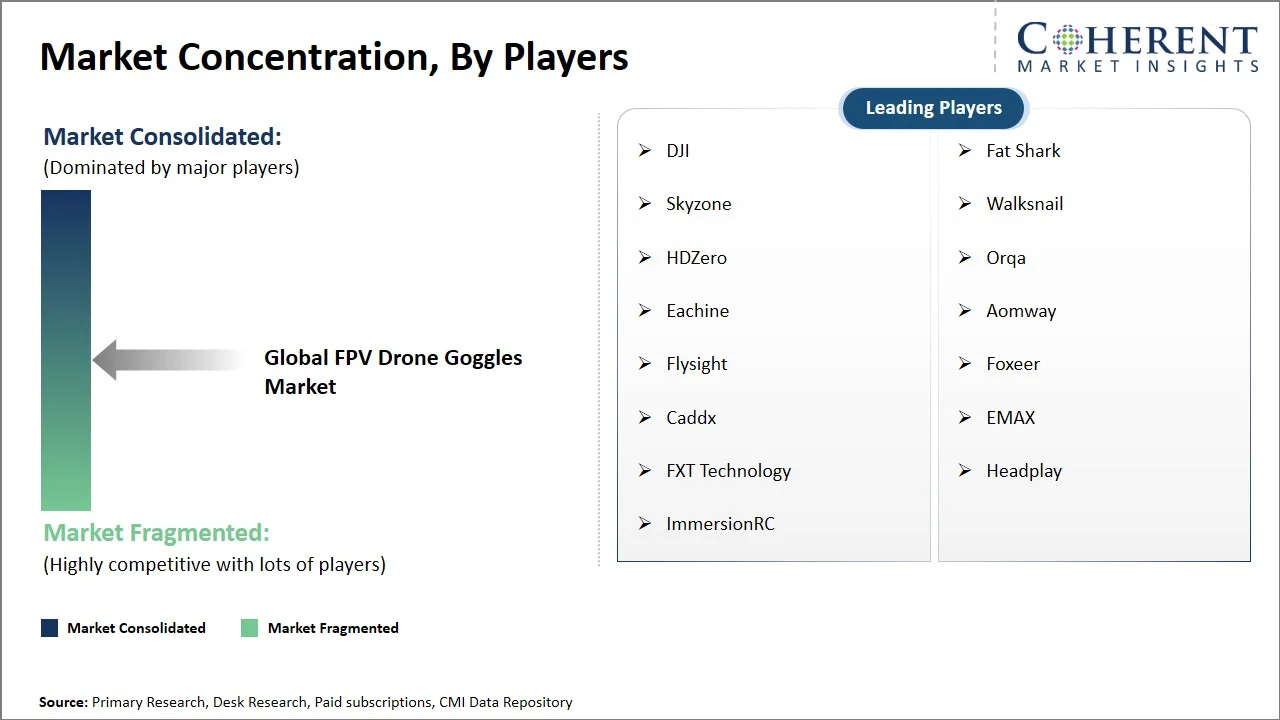
The competitive landscape is led by DJI, which emphasizes integrated digital transmission, low latency, and complete FPV ecosystems. Its O4 platform supports 1080p at 100 frames per second and latency as low as 15 milliseconds. DJI also positions the O4 Air Unit for beginners, racing, freestyle, and professional filming applications. Walksnail is committed to adaptable digital FPV equipment through its Avatar and Ascent product ranges. Avatar Goggles X, Avatar Goggles L, and Ascent HD Goggles are supported by CaddxFPV. The HDZero sets itself apart with fixed ultra-low latency, open-source software, and digital-analog compatibility. Its Goggle 2 provides 1080p OLED micro displays, HDMI connectivity, and 3 millisecond glass-to-glass latency. Skyzone targets multiple price tiers, ranging from the Cobra Lite V2 to premium SKY04X goggles.
Market Report Scope
FPV Drone Goggles Market Report Coverage
| Report Coverage | Details | ||
|---|---|---|---|
| Base Year: | 2025 | Market Size in 2026: | USD 550 Mn |
| Historical Data for: | 2020 To 2024 | Forecast Period: | 2026 To 2033 |
| Forecast Period 2026 to 2033 CAGR: | 9.40% | 2033 Value Projection: | USD 1,230 Mn |
| Geographies covered: |
| ||
| Segments covered: |
| ||
| Companies covered: | DJI, Fat Shark, Skyzone, Walksnail, HDZero, Orqa, Eachine, Aomway, Flysight, Foxeer, Caddx, EMAX, FXT Technology, Headplay, ImmersionRC | ||
| Growth Drivers: |
| ||
| Restraints & Challenges: |
| ||
Analyst Opinion (Expert Opinion)
- The future of the industry is expected to center on digital goggles combining low latency with higher image quality. DJI's O4 platform already demonstrates 1080p transmission at 100 frames per second for racing applications. HDZero demonstrates another direction through fixed 3 millisecond latency and 90Hz 1080p OLED displays. Competition will therefore increasingly shift from basic video reception toward complete transmission, display, and control ecosystems.
- The strongest opportunity is expected in digital goggles designed for racing and freestyle pilots. China should remain strategically important because major FPV hardware development is concentrated there. Affordable digital products can also attract beginners into established transmission ecosystems. Skyzone already demonstrates this strategy with its Cobra Lite V2 positioned at USD 99. Manufacturers should therefore develop clear product ladders connecting entry-level goggles with advanced systems.
- Players seeking an edge should prioritize interoperability, upgradeability, and differentiated latency performance. HDZero demonstrates the value of supporting digital, analog, and HDMI inputs within one headset. Walksnail demonstrates another strategy through continuing firmware development across its Avatar product ecosystem. Manufacturers should also optimize weight, thermal performance, optical clarity, and antenna flexibility. These improvements can strengthen retention among pilots who progressively upgrade their FPV equipment.
Speak to the analyst
Want personalized insights?
Take the findings above to one of our principal consultants, or have the report rebuilt around the segments, geographies and competitors you actually track.
Market Segmentation
- Product Type Insights (Revenue, USD Million, 2021 - 2033)
- Digital FPV Goggles
- Analog FPV Goggles
- Technology Type Insights (Revenue, USD Million, 2021 - 2033)
- OLED
- Micro OLED
- LCD
- LED
- Application Insights (Revenue, USD Million, 2021 - 2033)
- Drone Racing
- Freestyle FPV
- Cinematic FPV
- Recreational Flying
- Commercial Inspection
- Training
- Others
- Regional Insights (Revenue, USD Million, 2021 - 2033)
- North America
- U.S.
- Canada
- Latin America
- Brazil
- Argentina
- Mexico
- Rest of Latin America
- Europe
- Germany
- U.K.
- Spain
- France
- Italy
- Russia
- Rest of Europe
- Asia Pacific
- China
- India
- Japan
- Australia
- South Korea
- ASEAN
- Rest of Asia Pacific
- Middle East
- GCC Countries
- Israel
- Rest of Middle East
- Africa
- South Africa
- North Africa
- Central Africa
- North America
Sources
Primary Research Interviews
- FPV Drone Goggles Manufacturers & OEMs
- Drone Racing League Professionals & Hobbyist Pilots
- Consumer Electronics Retailers & Distributors
- Defense & Military Drone Technology Specialists
Magazines
- Drone Magazine
- Popular Mechanics
- Digital Trends Magazine
- RC Driver Magazine
Journals
- Journal of Unmanned Vehicle Systems
- IEEE Transactions on Aerospace and Electronic Systems
- International Journal of Micro Air Vehicles
Associations
- Association for Unmanned Vehicle Systems International (AUVSI)
- Drone Manufacturers Alliance Europe (DMAE)
- Federal Aviation Administration (FAA) – Drone Advisory Committee
- Small UAV Coalition
Public Domain Sources
- U.S. Federal Aviation Administration (FAA) Official Reports & Publications
- European Union Aviation Safety Agency (EASA) Data & Reports
- NASA Unmanned Aircraft Systems Traffic Management Publications
- World Trade Organization (WTO) Trade Statistics
Proprietary Elements
- CMI Data Analytics Tool
- Proprietary CMI Existing Repository of Information for Last 10 Years
Get access to 250+ pages report
Every segment, forecast, competitor profile and data table behind the analysis above — available for instant download.
- ESOMAR Member
- ISO 9001:2015 Certified
- D-U-N-S Registered
- GDPR & CCPA Compliant
Missing comfort of reading report in your local language? Find your preferred language:
Frequently Asked Questions
The global FPV drone goggles market is expected to stand at USD 550 Mn in 2026 and is expected to reach USD 1,230 Mn by 2033.
The CAGR of the global FPV drone goggles market is projected to be 9.4% from 2026 to 2033.
Rising participation in FPV drone racing and freestyle flying and growing adoption of digital high-definition FPV systems are the major factors driving the growth of the global FPV drone goggles market.
High prices of premium digital FPV goggles and Compatibility limitations between competing transmission ecosystems are the major factors hampering the growth of the global FPV drone goggles market.
In terms of product type, digital FPV goggles segment is estimated to dominate the market revenue share in 2026.
FPV drone goggles are wearable displays that provide pilots with real-time aerial video from cameras mounted on drones
They are not always better but are more cost-effective and faster to deploy in difficult terrains.