

Global FPV Drone Market Size and Forecast – 2026 To 2033
The global FPV drone market is expected to grow from USD 2.85 Bn in 2026 to USD 7.13 Bn by 2033, at a compound annual growth rate (CAGR) of 14% over 2026–2033. An FPV (first-person-view) drone is a small multirotor that the pilot flies through goggles, which show a live feed from the camera on the aircraft. Because the pilot sees what the drone sees, it can be steered through a window, along a trench line or through a race gate with a precision that an ordinary camera drone cannot match. The video link can be analog, digital high-definition or a fibre-optic cable that unspools from the drone as it flies. Armed forces use the type as a cheap strike weapon, while racing pilots, freestyle flyers and film crews use it for sport and imaging. Ukraine’s Ministry of Defence reported that 1 million FPV drones were delivered to its forces between January and July 2025, which gives a sense of the volumes involved. The market sits inside the wider Military Drone Market and buys many of the same motors, cameras, flight controllers and batteries as the broader Unmanned Aerial Vehicle Drones Market.
Growth rests on three things. A strike FPV drone costs a small fraction of a missile or an artillery shell, so defence ministries order them by the hundred thousand. Governments are also paying for FPV supply chains that do not depend on China, which creates demand for motors, cameras, radios and flight controllers made at home. And the drones keep getting better, with fibre-optic links that jammers cannot touch and onboard software that can finish an attack after the radio link drops.
Key Takeaways of the Global FPV Drone Market:
- Military and Defense is expected to account for 78.9% of the application segment in 2026. Armies treat FPV drones as consumable weapons, so every front-line unit needs a steady monthly supply. On December 24, 2025, Ukraine’s government reported that about 3 million FPV drones were produced in 2025, with 2.4 million of them bought through the Defence Procurement Agency.
- Analog is expected to account for 56.1% of the technology segment in 2026. Analog video links are light, cheap and easy to repair, which suits a drone that is expected to be used once. On January 23, 2026, Ukraine’s National Security and Defence Council reported that the country’s domestic capacity had passed 8 million FPV drones a year.
- Ready-to-Fly is expected to account for 87.1% of the product type segment in 2026. Military buyers want drones that arrive tested and can be flown by a trained soldier within minutes. On November 10, 2025, Neros announced its selection as one of the primary FPV manufacturers for the U.S. Army’s Purpose-Built Attritable Systems (PBAS) program, supplying Archer and Archer Strike platforms in 5-inch and 10-inch variants.
- Europe is expected to dominate the FPV drone market in 2026, with a share of 71.9%. The region holds the largest front-line demand and the largest base of drone makers. On November 24, 2025, Ukraine’s Ministry of Defence reported that its DOT-Chain Defence marketplace had delivered 100,000 FPV drones, nearly one-third of them fibre-optic, from more than 180 models offered by 40 companies.
- North America is expected to account for an 18.6% share in 2026 and to be the fastest-growing region over 2026–2033. U.S. programmes are moving FPV buying from small trials to volume orders. On November 3, 2025, Neros announced a multi-million-dollar delivery order from the U.S. Department of War in support of the Marine Corps for FPV drones, including kinetic-strike models, with operator training.
Segmental Insights
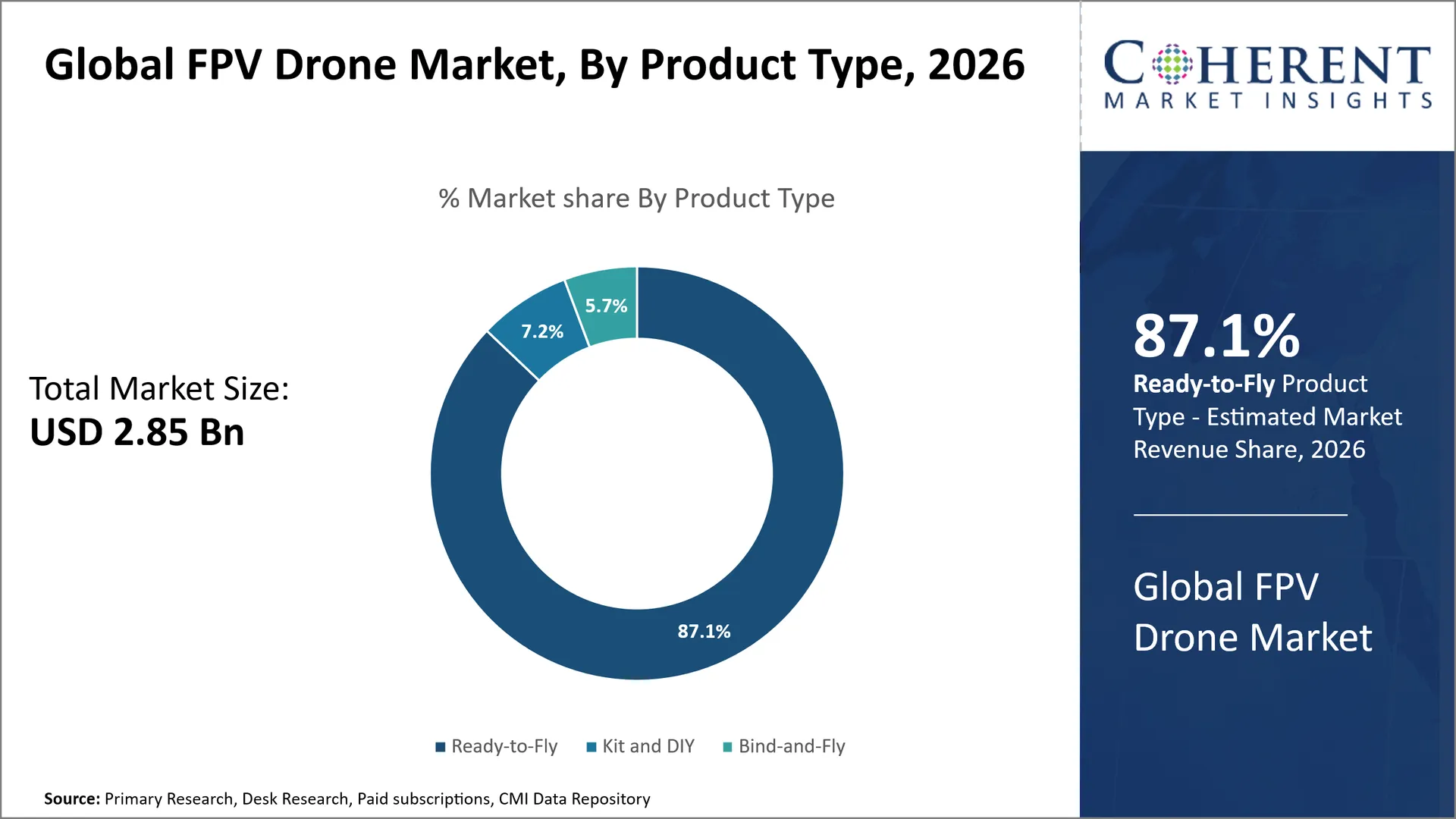
Why Does Ready-to-Fly Lead the Product Type Segment?
In terms of product type, ready-to-fly drones are expected to account for 87.1% of the global FPV drone market share in 2026. They leave the factory built, tuned and bound to their controller, so a new operator can fly after a short course instead of after weeks of soldering and tuning. Armed forces, police units and film crews all care about predictability, and procurement rules favour a finished system from one supplier that answers for quality and spare parts.
A ready-to-fly package normally includes
- Tested airframe: the frame, motors and electronics assembled and checked before shipment.
- Bound radio link: the drone is already paired with its controller, so it can fly on first power-up.
- Batteries and charger: flight packs and a charger sized for the aircraft.
- Goggles or ground station: supplied with the drone or specified by the buyer.
- Spares and training: replacement propellers and parts, plus operator instruction.
- Current Industry Events of 2026
- Market Size Estimation
- Regional Breakdown
- Competitive Landscape
- Customer Intelligence
- Segmental Analysis
- Pricing Analysis
- Key Market Drivers, Challenges & Future Trends
- Customized Insights Section
Why Does Analog Lead the Technology Segment?
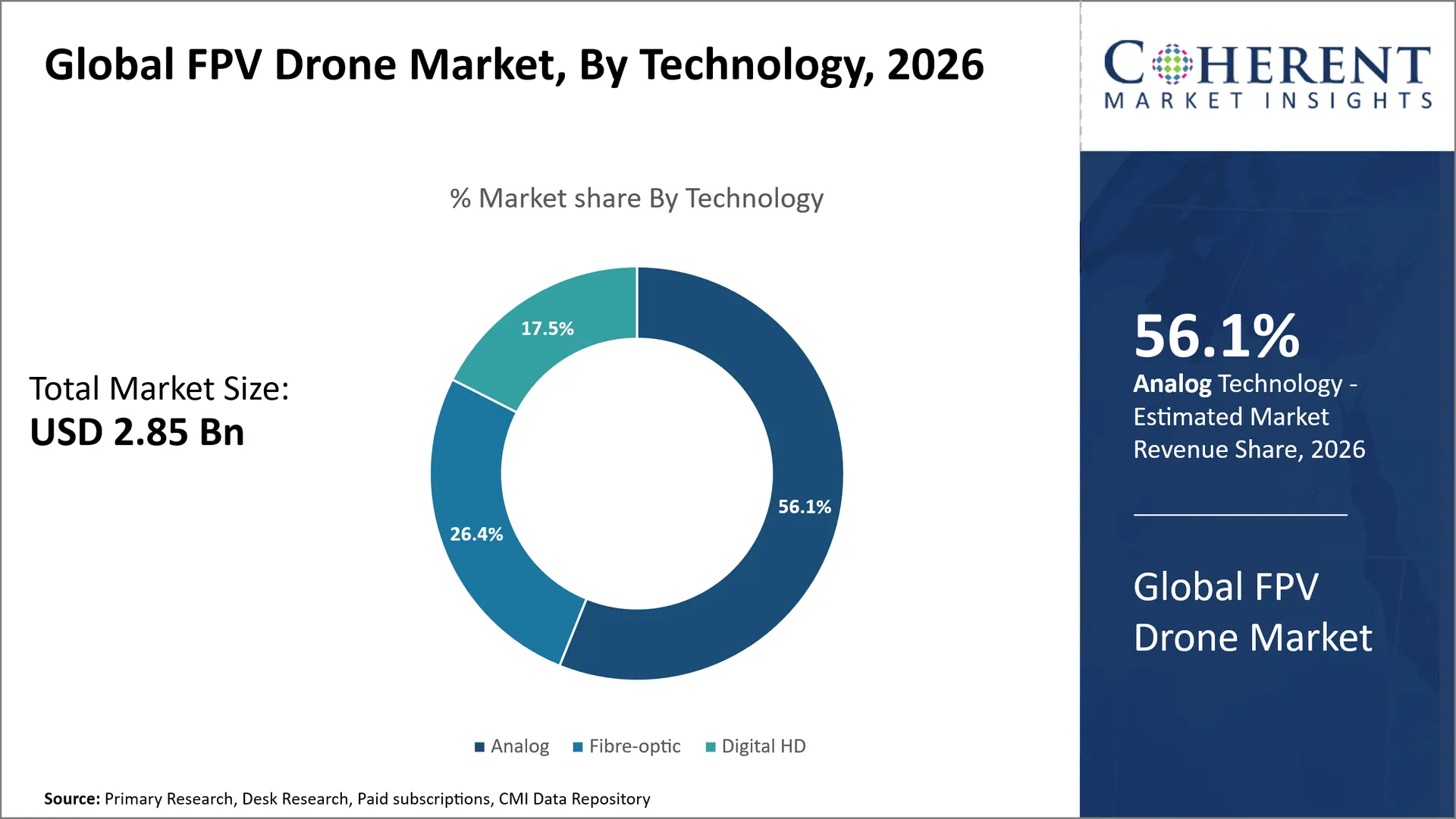
In terms of technology, analog is expected to account for 56.1% of the global FPV drone market share in 2026. An analog video link needs only a small transmitter on the drone and a cheap receiver in the goggles, so the whole aircraft can be built at a price that makes losing it acceptable. The parts are sold everywhere, most pilots learned to fly on analog, and a damaged unit can be repaired in a workshop or on a field table. Analog also suits mass production, since many small shops can assemble the same design from the same parts. TAF Industries, for example, reports production capacity of up to 80,000 FPV drones a month for its Kolibri model, which is priced at about USD 300.
An analog FPV video chain has four parts
- Analog camera: a small low-delay camera that sends a standard-definition picture.
- Video transmitter: the unit that broadcasts the picture on a radio band to the pilot.
- Antennas: the pair on the drone and in the goggles that decide how far and how cleanly the picture travels.
- Goggle receiver: the module that picks up the signal and shows it on the pilot’s screens.
Why Does Military and Defense Lead the Application Segment?
In terms of application, Military and Defense is expected to account for 78.9% of the global FPV drone market share in 2026. A strike FPV drone is built to be used once, so every front-line unit that adopts it creates a standing order that repeats month after month. Defence ministries have also changed how they buy. Instead of a few expensive weapons, they place recurring orders for large numbers of cheap drones, usually through central procurement agencies that give suppliers firm contracts and room to add production lines. On April 15, 2026, the UK Ministry of Defence announced its biggest drone package for Ukraine, delivering at least 120,000 drones during the year. On August 5, 2026, Ukraine’s Ministry of Defence reported that units had ordered USD 1 billion worth of equipment through the Brave1 Market in its first year, and that more than 400 units had received around 500,000 unmanned aerial vehicles, unmanned ground vehicles and electronic warfare systems.
A military FPV strike system usually has five parts, each of which is bought, replaced and upgraded on its own cycle:
- Airframe and motors: the carbon frame, propellers and brushless motors that set payload and range.
- Flight controller and navigation: the board that keeps the drone stable and, in newer builds, takes over terminal guidance when the link drops.
- Camera and video link: the analog, digital or fibre-optic channel that carries the pilot’s view.
- Warhead and initiation module: the payload and the safety electronics that decide when it can fire.
- Ground station and goggles: the controller, goggles and relay equipment the operator uses, together with the training that goes with them.
Current Events and their Impact
Current Events | Description and its Impact |
FCC adds foreign-produced drones and critical components to its Covered List: December 22, 2025 |
|
UK package to supply 150,000 drones to Ukraine: June 18, 2026 |
|
FPV Drone Market Dynamics
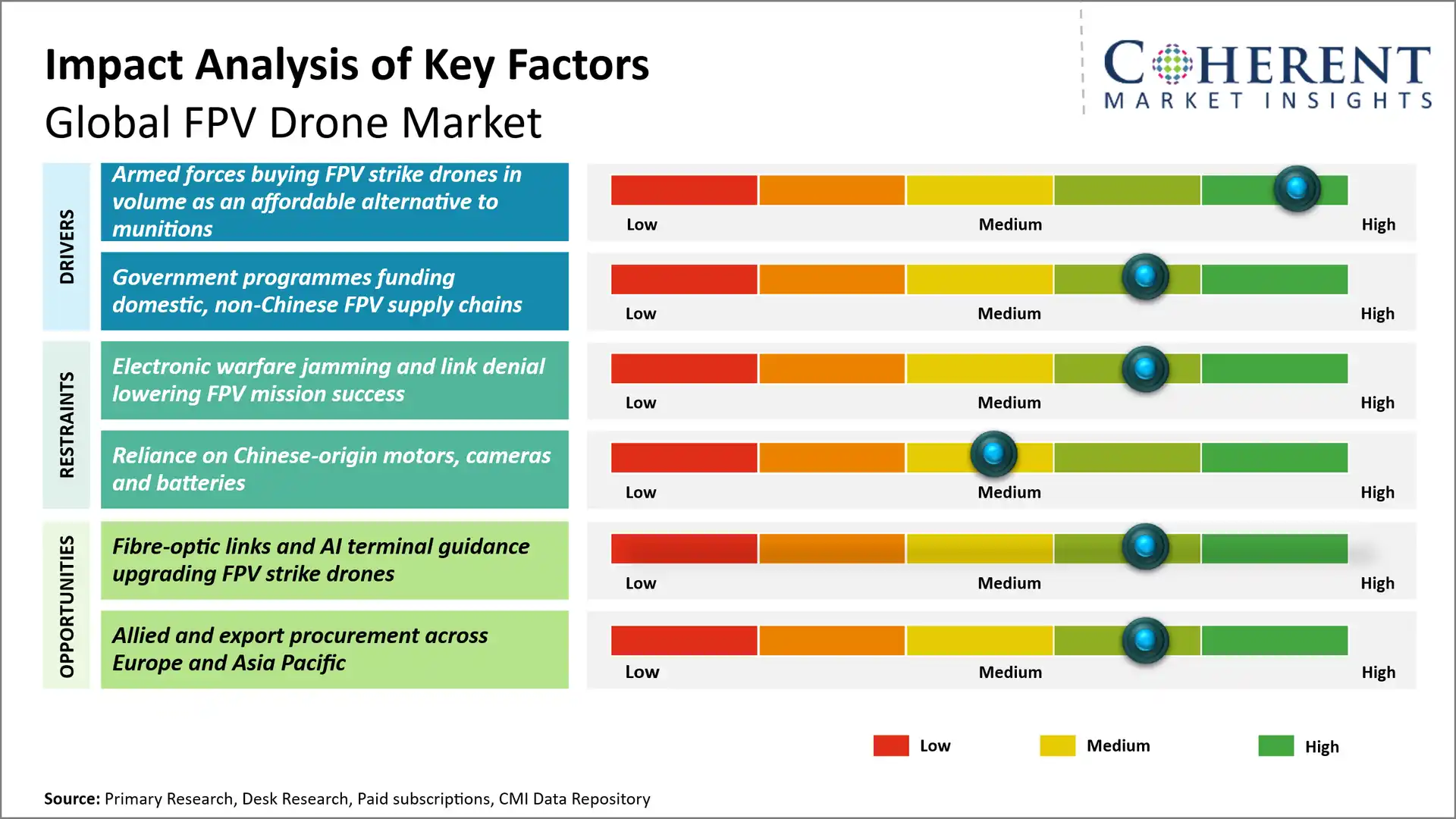
Market Drivers
- Armed forces buying FPV strike drones in volume as an affordable alternative to munitions: A strike FPV drone carries a small warhead to a point target at a fraction of the cost of a guided missile, and a trained pilot can use one against vehicles, trench lines and fortified positions. That cost gap has changed budgets. Ukraine’s Defence Procurement Agency reported that procurement of unmanned systems passed ammunition procurement for the first time last year and that the trend was continuing, and on June 22, 2026 it reported that 95% of the UAVs it procures are made in Ukraine. Orders on this scale keep factories busy and lift demand for airframes, motors, batteries and video links.
- Government programmes funding domestic, non-Chinese FPV supply chains: Defence and trade authorities now treat motors, cameras, flight controllers and batteries as security items. Funding lines, approved-parts lists and buying rules that favour compliant components give home-grown makers a protected customer and a reason to build factories for parts that used to arrive by the container load. The U.S. Department of War’s FY 2027 budget request includes USD 53.6 Bn for Drone Dominance, of which USD 39.2 Bn is for multi-year autonomous systems procurement, domestic production capacity and advanced capabilities.
Emerging Trends
- Troops are choosing their own drones through online marketplaces: On May 26, 2026, Ukraine’s Ministry of Defence reported that the military had received 485,000 UAVs and other equipment worth USD 0.71 Bn through the DOT-Chain Defence marketplace in 2026, with an average of nine days from order to delivery.
- Impact: Front-line units can compare models and prices and re-order within days, which rewards drones that work in the field and punishes those that do not.
- Relevance to the market: Makers need short design cycles and steady batch quality, because a poor delivery now loses orders within days instead of at the next tender.
- Autonomy is moving into low-cost FPV drones: On August 11, 2026, Neros announced a USD 250 Mn Series C at a USD 2.5 Bn valuation to scale programmes that include Archer AI, an FPV platform with autonomy features such as terminal guidance and GPS-denied position hold.
- Impact: A drone that can finish its approach or hold position without a link keeps working under jamming that would defeat a purely piloted one.
- Relevance to the market: Guidance modules and onboard computers become a priced line in the bill of materials, and software teams join airframe makers as core suppliers.
- Fibre-optic drones are getting bigger and flying farther: Vyriy Industries lists its Opto 15 fibre-optic strike platform with a payload of up to 8 kg and a range of 15 to 30 km, depending on the spool fitted.
- Impact: Heavier warheads and longer reach move fibre-optic drones from close-range work to targets at tactical depth.
- Relevance to the market: Cable spools and heavy-lift motors become a supply niche of their own, and makers that wind their own spools gain control over cost and quality.
- Drones are being fired from racks and tubes instead of being thrown by hand: Auterion introduced the Nemyx vertical launch system, whose electric elevator fits 30% more drones than launchers without one and which launches interceptors, 10-inch FPV drones and mid-range loitering munitions from the same unit.
- Impact: A crew can stage and fire many drones in quick succession from a vehicle or a fixed position.
- Relevance to the market: Launch hardware opens an accessory market and pushes makers to design drones that fit standard tubes and racks.
Regional Insights
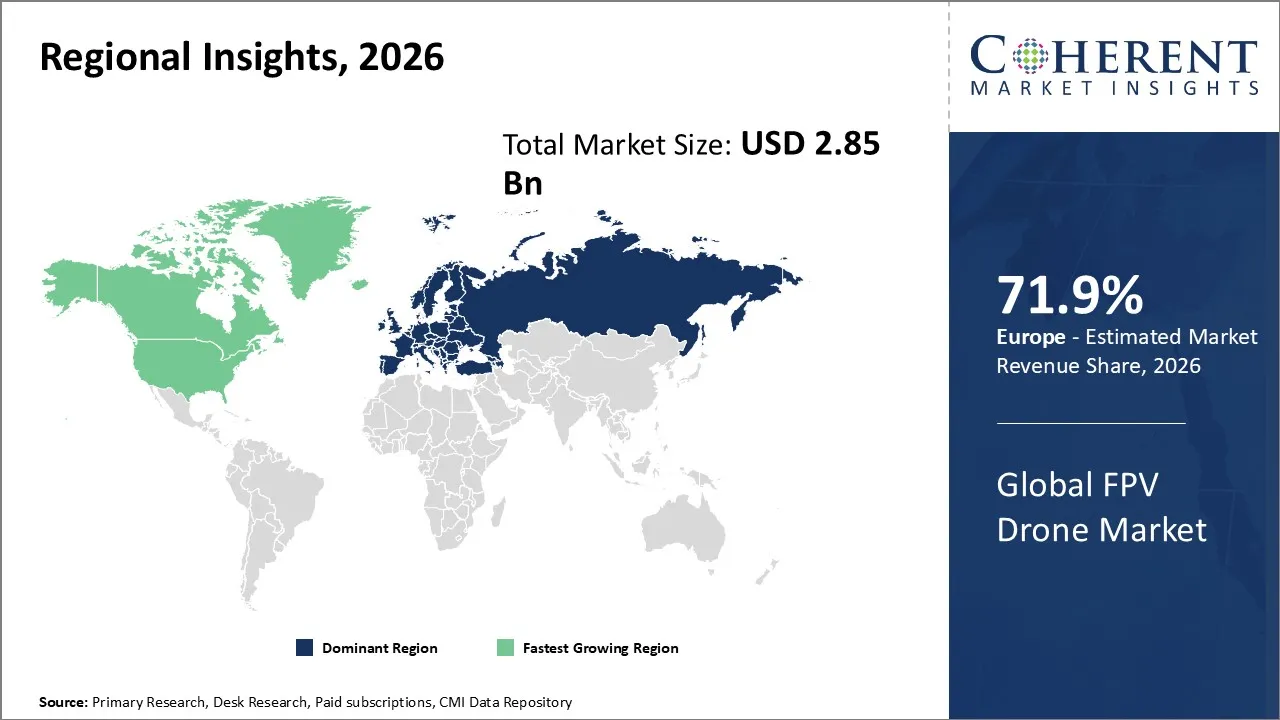
Why Does Europe Lead the Global FPV Drone Market?
Europe holds 71.9% of the global FPV drone market in 2026. The region hosts the largest sustained use of FPV drones in history, along the Ukrainian front, which creates monthly demand that no other region matches. Ukraine’s defence ministry, European governments and allied donors all buy from a dense base of local workshops and factories, and several European companies, including Orqa in Croatia, are expanding capacity for export and for European armed forces. Shorter shipping distances between makers and the front also let designs change within weeks.
Why Is North America the Fastest-Growing Region in the FPV Drone Market?
North America holds an 18.6% share in 2026, and is expected to grow fastest over 2026–2033. The region is starting from a small base of domestic FPV production and is now building it at speed. The Pentagon’s Drone Dominance Program, the Army’s PBAS programme and Marine Corps orders have moved FPV buying from experiments to funded volumes. U.S. start-ups such as Neros and Red Cat are adding factories, and rules that limit foreign-produced drones and parts are directing new spending to local suppliers.
Global FPV Drone Market Outlook for Key Countries:
Is Ukraine the Largest Market for FPV Drones?
Ukraine is the largest single country market in 2026, valued at USD 1.38 Bn, and it anchors the region’s leading position. The country uses FPV drones as a main weapon along the front, so its ministries buy, test and field new designs at a rate no other country match. Dozens of domestic makers supply the forces, which keeps unit prices low. Ukrainian officials reported that 374,000 fibre-optic FPV drones were delivered in 2025, showing how quickly new technology moves from workshop to battlefield.
Is the U.S. the Largest Market for FPV Drones in North America?
The U.S. is the largest market in North America in 2026, valued at USD 0.46 Bn. It leads because the Department of War has turned FPV buying into a funded programme. The Drone Dominance Program is a USD 1.1 Bn, two-year effort, and the department reported that its first batch of drones was accepted, with nearly 2,000 additional units shipped to the services and thousands more being prepared for delivery.
Is Germany the Leading Western European Market for FPV Drones?
Germany is the leading Western European market in 2026, valued at USD 0.13 Bn. Berlin has committed USD 11.5 Bn to a drone programme. A strong electronics and engineering base lets German firms and joint ventures move software-driven strike drones into series production.
Is the U.K. a Major Buyer of FPV Drones in Europe?
The U.K. ranks among the largest European buyers in 2026, with a market valued at USD 0.09 Bn. Its position comes from steady government funding. On June 29, 2026, the UK Ministry of Defence announced a drone transformation for its Armed Forces backed by more than USD 6.6 Bn over four years under the Defence Investment Plan, the largest drone investment in the history of the UK Armed Forces.
Is Croatia Emerging as a Hub for FPV Drone Manufacturing?
Croatia is a small but fast-rising market in 2026, valued at USD 0.05 Bn. It leads European manufacturing outside the front-line states because it is the home of Orqa, which designs and builds FPV drones, goggles and video links at its factory in Osijek. On March 12, 2026, Orqa announced a USD 14.7 Mn Series A funding round to expand its production.
Global FPV Drone Market – Published Price and Performance Benchmarks by FPV Class
FPV Class | Reference Product or Programme | Published Price | Published Performance or Scale | Source |
Consumer immersive flying | DJI Avata 2 Fly More Combo | USD 1,199 | One-push flips, rolls and 180-degree drifts; automatic return-to-home when the battery is low or the signal is lost | DJI |
Ukrainian strike FPV with terminal guidance | VYRIY PRO 10 with TFL-1 guidance module | USD 440 | Priced below the marketplace average for FPV drones without autonomy; units reported strike effectiveness rising two to four times over basic FPV drones | Vyriy Industries |
Fibre-optic strike FPV | VYRIY OPTO 10 | Not published | 10-inch carbon frame, payload up to 4 kg, range of 15 to 25 km depending on spool; four-layer protection on the initiation module | Vyriy Industries |
U.S. attritable FPV, Phase I | Drone Dominance Program, first gauntlet | USD 5,000 average per unit | 12 vendors to produce 30,000 drones, a USD 150 Mn order | U.S. Department of War |
U.S. attritable FPV, Phase II | Drone Dominance Program, second gauntlet | USD 5,000 per unit | Ten vendors in the buying round for about 60,000 units; about 40 Group 1 systems from 19 vendors were evaluated at Fort Carson from August 16 to September 5, 2026 | U.S. Department of War; U.S. Army |
Domestic component supply | Unusual Machines Orlando motor factory | Not published | Motor output scaled to about 15,000 motors per month, with production rising from roughly 700 to 1,500 parts per day (reported April 10, 2026) | Unusual Machines |
How Are Fibre-Optic Links and Allied Procurement Creating New Growth Opportunities in the FPV Drone Market?
The first opening is the upgrade of strike drones with fibre-optic links and AI terminal guidance. Jammers now cut radio links along much of the front, and a pilot who loses the signal loses the drone. A fibre-optic cable cannot be jammed, and guidance software can steer the last stretch of the flight without any link at all. A maker that sells both can charge more per drone and earn from software updates on top of the airframe.
The second is procurement by allies and export buyers across Europe and Asia Pacific. Countries that are not at war still want FPV drones for training and reserve stocks, and many prefer suppliers outside China. European donors already pay for Ukrainian production, and defence ministries in Asia Pacific are expected to add the drones for island and border defence. Companies that can certify their parts and set up local assembly are the ones most likely to win these orders.
Market Players, Key Development, and Competitive Landscape
Key Developments
- On July 13, 2026, Auterion and Skyfall announced a partnership to deliver 50,000 Skyfall Shrike drones equipped with Auterion Strike kits to Ukrainian forces. Deliveries began that week, are funded by a European NATO nation, and pair the Shrike with Auterion’s Skynode S and Strike software for terminal guidance and a software path to swarming.
- On March 26, 2026, DJI announced the Avata 360, an 8K 360° drone with 1-inch-equivalent sensors, 8K/60fps HDR video, the O4+ video transmission system and obstacle sensing, flown with DJI Goggles and Motion Controllers for immersive FPV flight.
- On March 2, 2026, Neros announced that it had completed its first delivery under the U.S. Army’s PBAS program ahead of the contract date and launched Archer Block 2, an FPV system designed for extended range, improved urban survivability and mission-configurable modularity with swappable sensors.
- On December 1, 2025, Orqa announced that it had expanded manufacturing at its headquarters in Osijek, Croatia, so that the facility can produce up to 280,000 NDAA-compliant drones per year using its own components.
- On October 8, 2025, Red Cat Holdings announced the launch of its FANG line of NDAA-compliant FPV drones, starting with the 7-inch retrievable FANG F7 for training and tactical use, with critical components listed on the DIU Blue UAS Framework.
Competitive Landscape
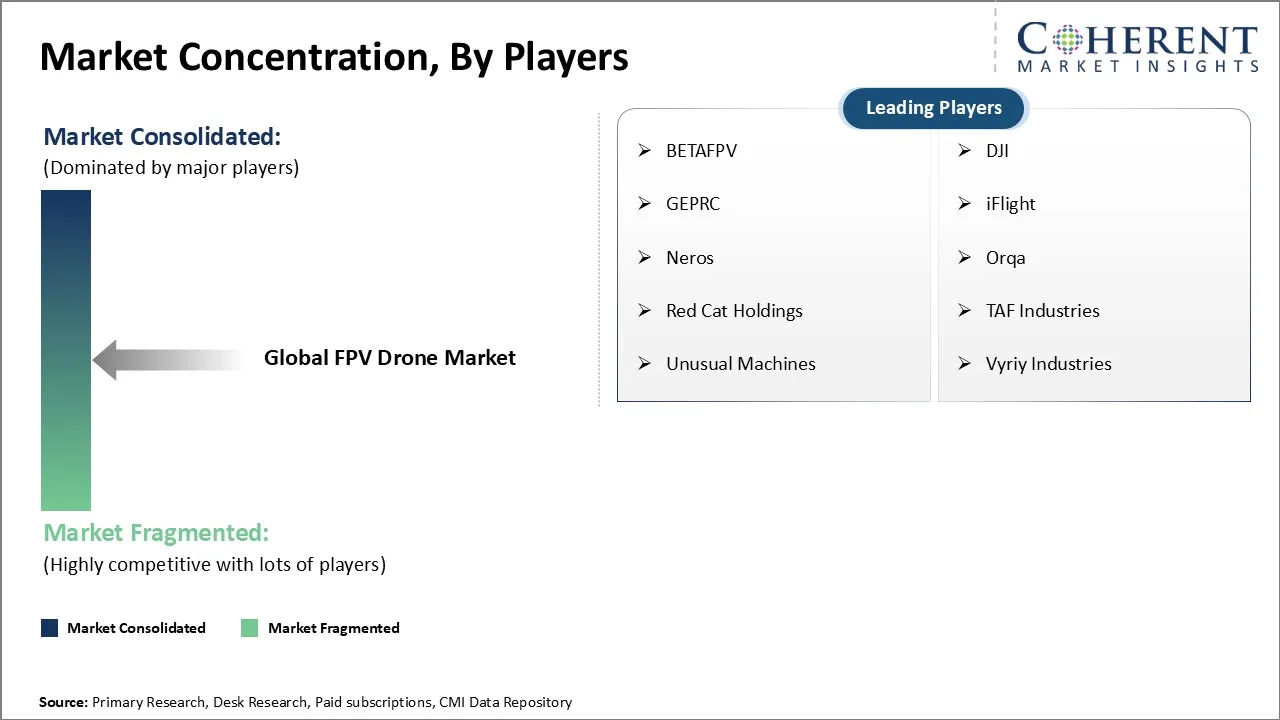
The market is fragmented. Defence-focused makers such as Neros, Red Cat Holdings, Orqa, TAF Industries and Vyriy Industries build strike and reconnaissance drones and compete on volume, compliance status and price per unit. DJI sells finished consumer and imaging drones with goggles to creators and hobbyists. BETAFPV, GEPRC and iFlight supply kits, frames and ready-to-fly drones to pilots who like to build and tune their own aircraft, and Unusual Machines sells components and consumer FPV brands to buyers in the United States. Software firms such as Auterion sit on top of this with the guidance and swarming layer that several makers now install. Buyers weigh price, where the parts come from, resistance to jamming and how fast the maker can deliver.
Top Companies and Notable Products in the FPV Drone Market
Company | Notable Product | Key Features |
BETAFPV | Cetus and Meteor series | Compact ready-to-fly and kit FPV drones for beginners and micro-drone racing pilots, sold with goggles and controllers |
DJI | Avata 2 and Avata 360 | Camera drones flown with goggles and a motion controller; Avata 360 adds 8K 360° video and O4+ video transmission |
GEPRC | Cinelog and Mark series | Freestyle and cinematic FPV drones, frames and kits for experienced pilots |
iFlight | Nazgul and Chimera series | FPV drones, frames, motors and flight electronics for freestyle, long-range and cinematic flying |
Neros | Archer, Archer Strike, Archer Block 2 and Archer Fiber | Strike FPV drones in 5-inch, 8-inch and 10-inch variants built without Chinese components, with swappable sensors in Block 2 and a fibre-optic version |
Market Report Scope
FPV Drone Market | |||
Report Coverage | Details | ||
Base Year | 2025 | Market Size in 2026: | USD 2.85 Bn |
Historical Data For: | 2020 To 2024 | Forecast Period: | 2026 To 2033 |
Forecast Period 2026 To 2033 CAGR: | 14% | 2033 Value Projection: | USD 7.13 Bn |
Geographies covered: |
| ||
Segments covered: |
| ||
Companies covered: | BETAFPV, DJI, GEPRC, iFlight, Neros, Orqa, Red Cat Holdings, TAF Industries, Unusual Machines, Vyriy Industries | ||
Growth Drivers: |
| ||
Restraints & Challenges: |
| ||
Analyst Opinion (Expert Opinion)
- Military volume sets the pace, and the cheapest drones carry it. Military and Defense holds 78.9% of the application segment in 2026, Analog holds 56.1% of the technology segment and Ready-to-Fly drones hold 87.1% of the product type segment. Buyers in these segments reward low unit cost, fast delivery and a supplier that can scale output within months, so contracts go to makers with working factories and dependable parts supply. Vendors that add tested guidance software and secure, compliant components will protect their margins as unit prices fall.
- Growth is strongest where programmes are new and funded. Europe holds 71.9% of the market in 2026 on front-line demand, while North America, at 18.6%, grows fastest as U.S. programmes move from trials to volume orders. The main risks are electronic warfare jamming and link denial that lowers mission success, and continued reliance on Chinese-origin motors, cameras and batteries. Makers that shift to fibre-optic links, onboard guidance and non-Chinese component sourcing are best placed to turn these risks into advantages.
Speak to the analyst
Want personalized insights?
Take the findings above to one of our principal consultants, or have the report rebuilt around the segments, geographies and competitors you actually track.
Market Segmentation
- Product Type Insights (Revenue, USD Billion, 2021 - 2033)
- Ready-to-Fly
- Kit and DIY
- Bind-and-Fly
- Technology Insights (Revenue, USD Billion, 2021 - 2033)
- Analog FPV
- Fibre-optic FPV
- Digital HD FPV
- Application Insights (Revenue, USD Billion, 2021 - 2033)
- Military & Defense
- Consumer & Racing
- Industrial & Commercial
- Media & Entertainment
- Regional Insights (Revenue, USD Billion, 2021 - 2033)
- North America
- U.S.
- Canada
- Latin America
- Brazil
- Argentina
- Mexico
- Rest of Latin America
- Europe
- Germany
- U.K.
- Spain
- France
- Italy
- Russia
- Rest of Europe
- Asia Pacific
- China
- India
- Japan
- Australia
- South Korea
- ASEAN
- Rest of Asia Pacific
- Middle East
- GCC Countries
- Israel
- Rest of Middle East
- Africa
- South Africa
- North Africa
- Central Africa
- North America
- Key Players Insights
- BETAFPV
- DJI
- GEPRC
- iFlight
- Neros
- Orqa
- Red Cat Holdings
- TAF Industries
- Unusual Machines
- Vyriy Industries
Sources
- Primary Research Interviews
- Armed Forces Procurement and Unmanned Systems Officers
- FPV Drone Manufacturers and Component Suppliers
- Defence Technology and Electronic Warfare Specialists
- Drone Racing, Freestyle and Cinematography Professionals
- Distributors, Integrators and Training Providers
- Magazines
- Defense News
- Breaking Defense
- The War Zone
- Unmanned Systems Technology
- DroneLife
- Army Recognition
- Journals
- Drones (MDPI)
- Defence Technology
- Journal of Unmanned Vehicle Systems
- IEEE Transactions on Aerospace and Electronic Systems
- Associations
- Association for Uncrewed Vehicle Systems International (AUVSI)
- Drone Manufacturers Alliance
- MultiGP Drone Racing
- Public Domain Sources
- Ministry of Defence of Ukraine: Press releases on FPV drone deliveries and the DOT-Chain Defence marketplace, 2025–2026
- Cabinet of Ministers of Ukraine: Statement on 2025 FPV drone production and Defence Procurement Agency purchases, December 24, 2025
- National Security and Defense Council of Ukraine: Statement on domestic FPV drone production capacity, January 23, 2026
- U.S. Federal Communications Commission: Public Notice and Fact Sheet on foreign-produced UAS and UAS critical components, December 22, 2025
- U.S. Department of War: Drone Dominance Program releases and news stories, 2026
- Ministry of Defence of Ukraine: Brave1 Market and DOT-Chain Defence releases of January 29, May 26, June 22 and August 5, 2026
- UK Government (Ministry of Defence): Releases of April 15, 2026, June 18, 2026 and June 29, 2026
- U.S. Department of War: FY 2027 Budget Request Overview and Drone Dominance program pages (dronedominance.mil)
- U.S. Army: Gauntlet 2 evaluation at Fort Carson, August 16 to September 5, 2026
- Company press releases and newsrooms (Auterion, DJI, Neros Technologies, Unusual Machines, Orqa, Red Cat Holdings, TAF Industries, Vyriy Industries)
- Proprietary Elements
- CMI Data Analytics Tool
- Proprietary CMI Existing Repository of information for last 10 years
Get access to 250+ pages report
Every segment, forecast, competitor profile and data table behind the analysis above — available for instant download.
- ESOMAR Member
- ISO 9001:2015 Certified
- D-U-N-S Registered
- GDPR & CCPA Compliant
Frequently Asked Questions
The global FPV drone market is expected to grow from USD 2.85 Bn in 2026 to USD 7.13 Bn by 2033.
The market is expected to grow at a CAGR of 14% over 2026–2033.
Growth is driven by armed forces buying FPV strike drones in volume as an affordable alternative to munitions and by government programmes funding domestic, non-Chinese FPV supply chains.
Electronic warfare jamming and link denial lowering FPV mission success, and reliance on Chinese-origin motors, cameras and batteries, hold back growth.
Military and Defense leads with 78.9% of the application segment in 2026.
An FPV drone is a small multirotor flown through a live camera feed shown in goggles worn by the pilot, so the pilot sees from the drone’s point of view.
A typical FPV drone has a frame, four brushless motors with propellers, an electronic speed controller, a flight controller, a battery, a camera, a video transmitter and a radio receiver. Strike versions add a payload and, in fibre-optic models, a cable spool.