

Global Functional Apparel Market Size and Forecast – 2026 To 2033
The global functional apparel market is expected to grow from USD 430.00 Bn in 2026 to USD 632.00 Bn by 2033, registering a compound annual growth rate (CAGR) of 7.3% from 2026 to 2033. The global functional apparel market is driven by increasing demand for moisture management fabrics. On June 4, 2025, Take One Sportswear introduced three innovative uniform fabrics: AeroDot, FlightKnit, and FlexForm, engineered specifically for practice apparel and game uniforms. All three fabrics combine performance and style to support athletes on and off the field or court.
Key Takeaways of the Global Functional Apparel Market
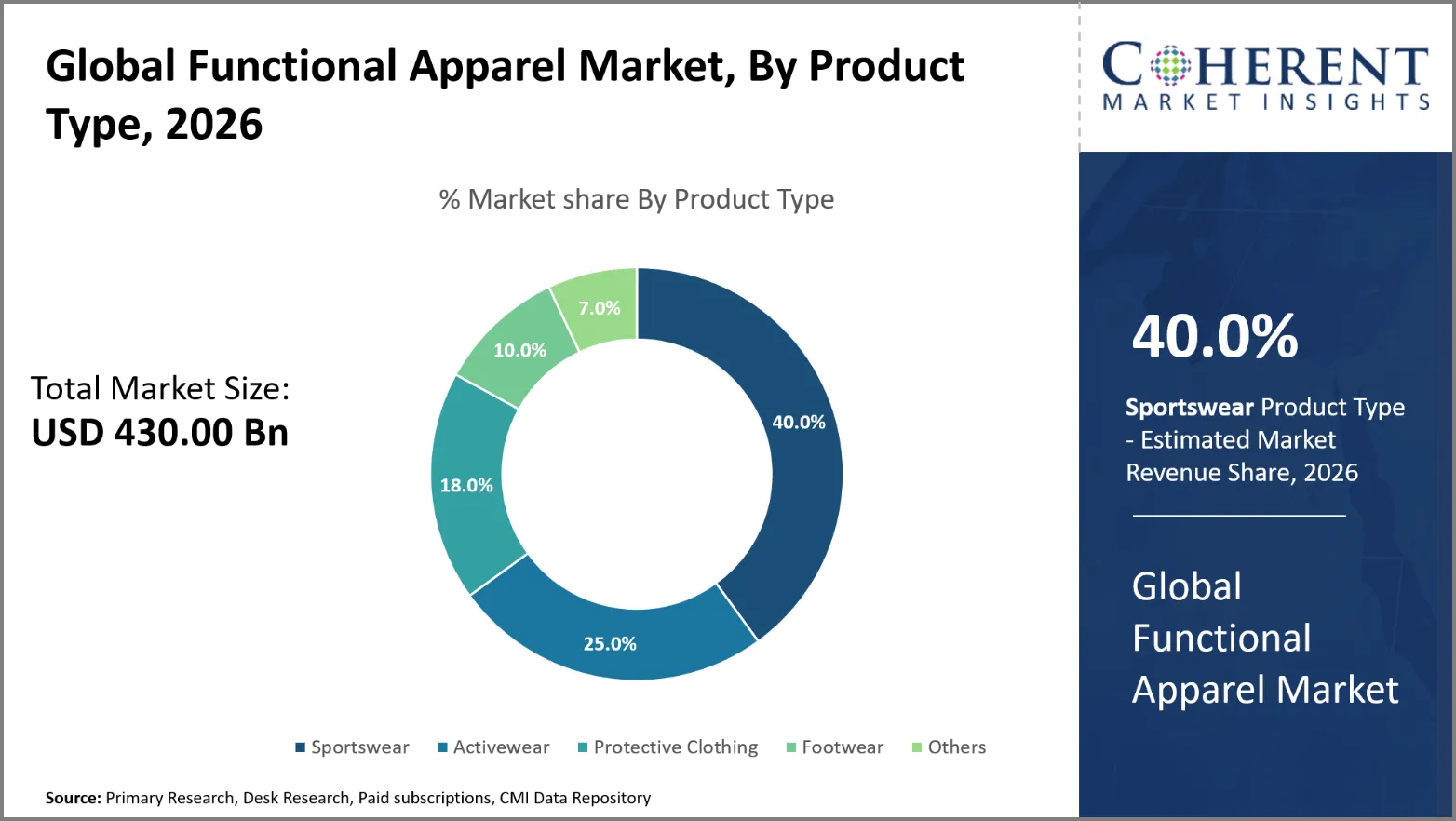
- The Sportswear segment is expected to account for 40.0% of the global functional apparel market share in 2026. Rising outdoor recreation participation is driving the growth of the segment. On February 2, 2026, Nike reintroduced All Conditions Gear as a dedicated outdoor-performance brand.
- The Professional Athletic segment is estimated to capture 45.0% of the market share in 2026. Increasing demand for lightweight performance fabrics is majorly driving the growth of the segment. On April 16, 2026, PEARL iZUMi introduced PI PRO/BLACK as its lightest advanced performance system. The cycling collection uses ultra-lightweight materials, compression, and aerodynamic construction.
- The Online segment is estimated to capture 50.0% of the market share in 2026. Growing consumer focus on health and wellness is driving the growth of the segment. On May 22, 2026, WHOOP launched WHOOP Body with Any-Wear technology for sensor-enhanced technical apparel. The garments allow users to position a WHOOP sensor across different body locations.
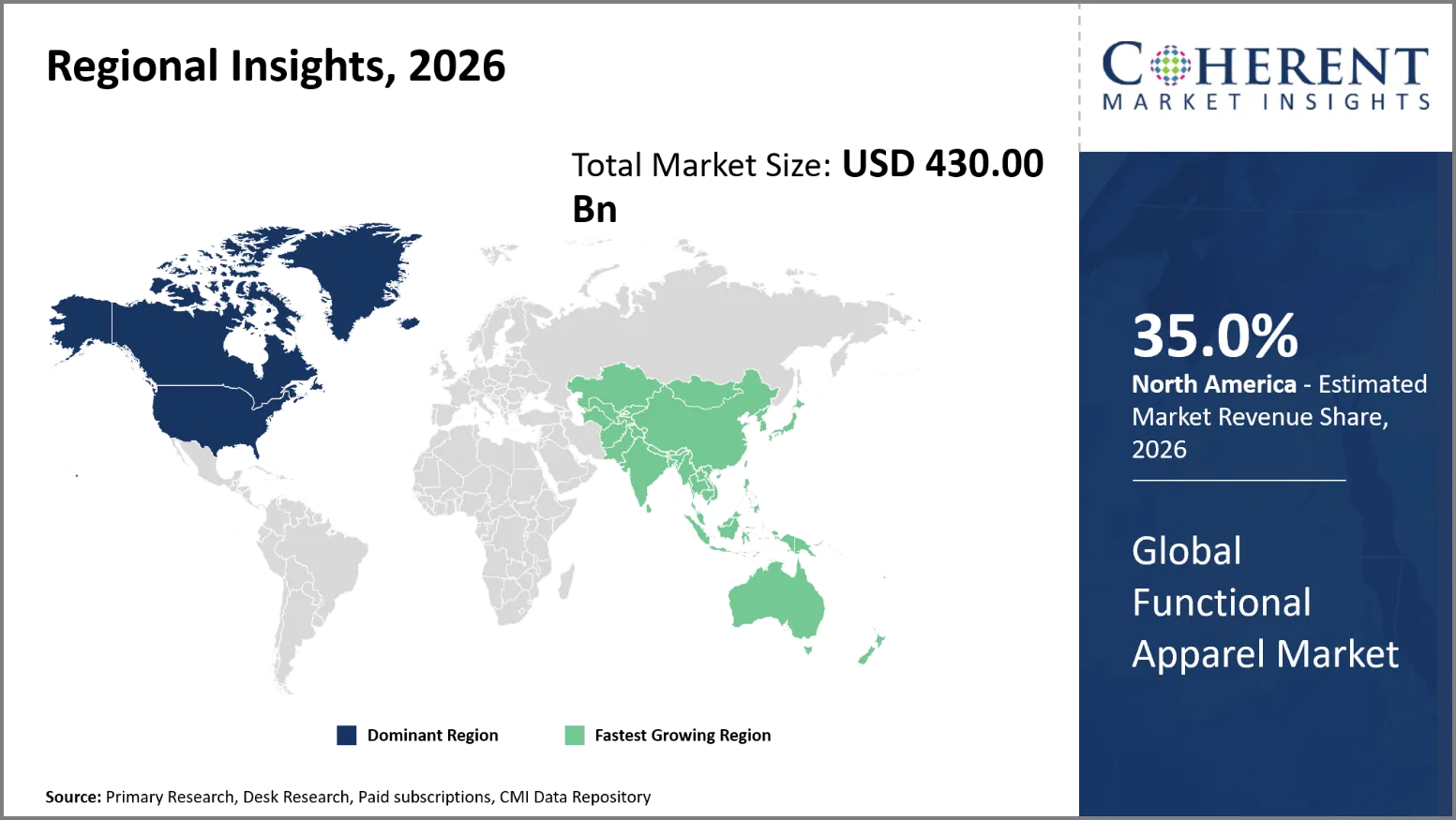
- North America is expected to dominate the functional apparel market in 2026 with a market share of 35.0%. Expansion of women’s sports participation in North America is driving the growth of the regional market. On August 20, 2026, Nike partnered with RAJ Sports to support the Portland Thorns and Portland Fire. The partnership includes a women-specific high-performance training facility in Portland, U.S.
- Asia Pacific is expected to account for 29.0% share in 2026. Growing demand for protective workwear in Asia Pacific is driving the growth of the regional market. On June 24, 2026, DuPont launched Tyvek APX in the ASEAN market at Thailand Safe Work 2026. The protective garment fabric improves breathability without sacrificing protection or durability.
Segmental Insights
Why Does Sportswear Dominate the Global Functional Apparel Market?
The sportswear segment is expected to account for 40.0% of the global functional apparel market share in 2026. Sportswear is gaining ground as people are seeking clothing that offers comfort, durability, flexibility and performance. Today’s sportswear blends moisture management, breathability, stretch, temperature regulation and odor control. These features enable jogging, training, cycling, yoga and recreation. Sportswear also benefits from increasing engagement in exercise and athleisure uptake across age groups. Brands are increasingly using performance materials in everyday apparel, taking sportswear out of conventional athletic venues. Product innovation around recycled fibers and lightweight constructions further strengthen consumer interest.
On March 3, 2026, lululemon announced the launch of its first-ever sweat-concealing technology designed for high-sweat activities. The new technology, which will live under lululemon’s ShowZero platform, conceals higher volumes of sweat, while ensuring enhanced breathability, moisture management, and an incredibly lightweight feel, to support the most demanding, high-sweat activities.
- Current Industry Events of 2026
- Market Size Estimation
- Regional Breakdown
- Competitive Landscape
- Customer Intelligence
- Segmental Analysis
- Pricing Analysis
- Key Market Drivers, Challenges & Future Trends
- Customized Insights Section
Why is Professional Athletic the Most Widespread Application?
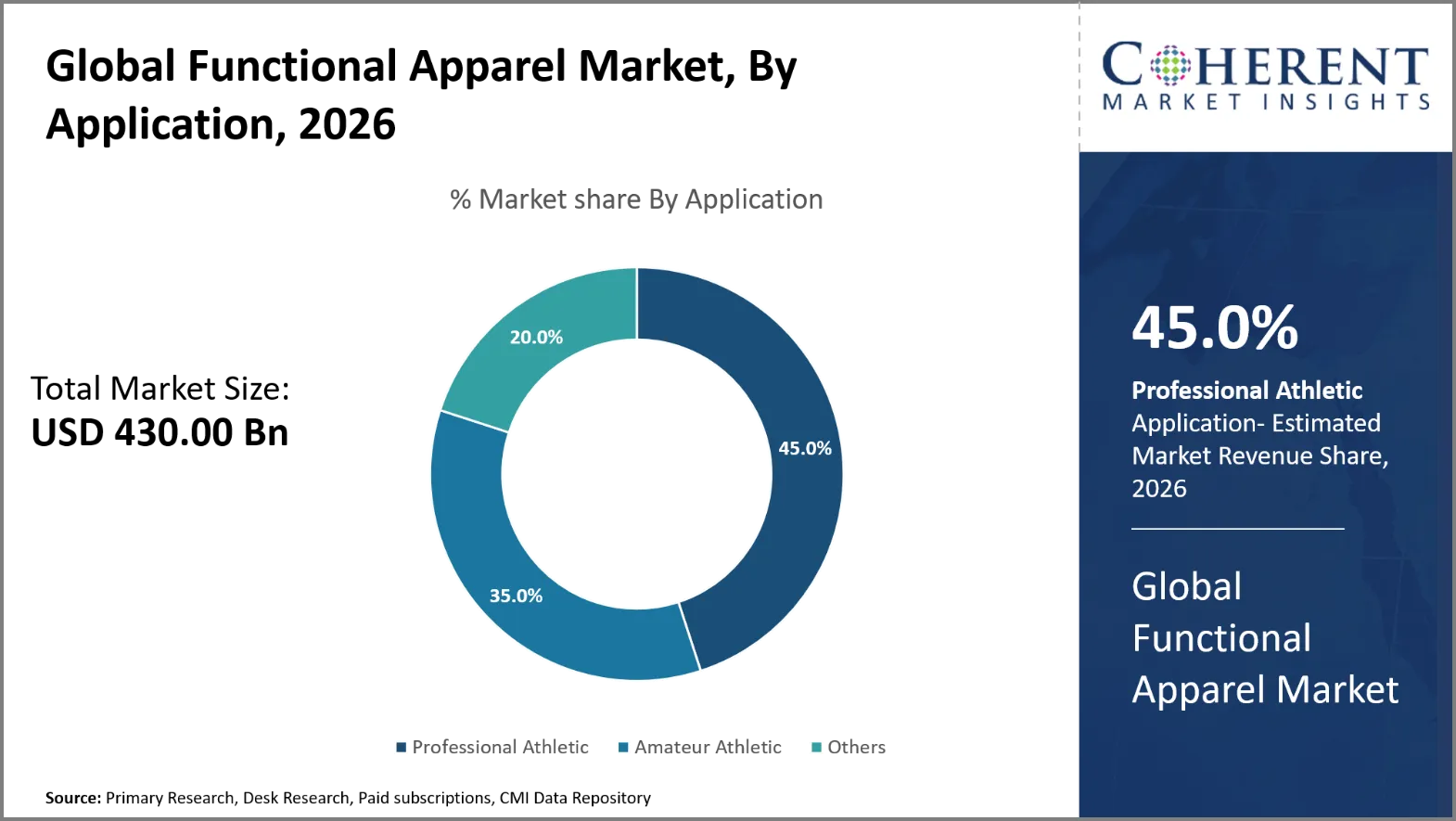
The professional athletic segment is expected to account for 45.0% of the global functional apparel market share in 2026. Professional athletic applications require advanced clothing performance under demanding physical conditions. Athletes need clothing to deal with sweat, body temperature, movement, friction and long-term activity. Functional materials can improve comfort during exercising or competing. Professional teams also increasingly adopt sport-specific clothing for various sports and climate. Sponsorships and athlete endorsements are helping to raise the profile of technical clothes with recreational consumers. Innovations developed for professional athletes often reach mainstream sportswear products afterward.
On March 25, 2026, Premier Padel and WHOOP announced a new global partnership that brings together the world’s fastest-growing sport and a leader in health and performance technology. Through the three-year agreement, WHOOP will become the Official Health and Performance Wearable Partner of Premier Padel, bringing its industry-leading wearable technology and performance insights to athletes competing on the global professional padel tour.
Online Dominates the Global Functional Apparel Market
The online segment is expected to account for 50.0% of the global functional apparel market share in 2026. Online distribution is dominant because buyers can compare technical specs, prices, reviews and product characteristics easily. Digital stores allow access to specialist practical clothes across regional marketplaces. Brands can also use their own direct channels to consumers, sidestepping traditional retail networks. While buying online, more precise sizing information and personalized recommendations can be helpful. Content from social media also impacts consumer behavior by highlighting the performance of the product in sports and outdoor activities.
On January 29, 2026, Adidas and Los Angeles-based fashion house Entire Studios announced their first collaboration, marked by the unveiling of a 26-piece collection. Designed to bridge sport and style, the drop adopts a fresh take on adidas Sportswear and Training’s best lines, Optimé, ADIDAS Z.N.E. and adidas D4T.
Current Events and their Impact
Current Events | Description and its Impact |
European Union Ecodesign for Sustainable Products Regulation |
|
European Union Revised Waste Framework Directive |
|
Functional Apparel Market Dynamics
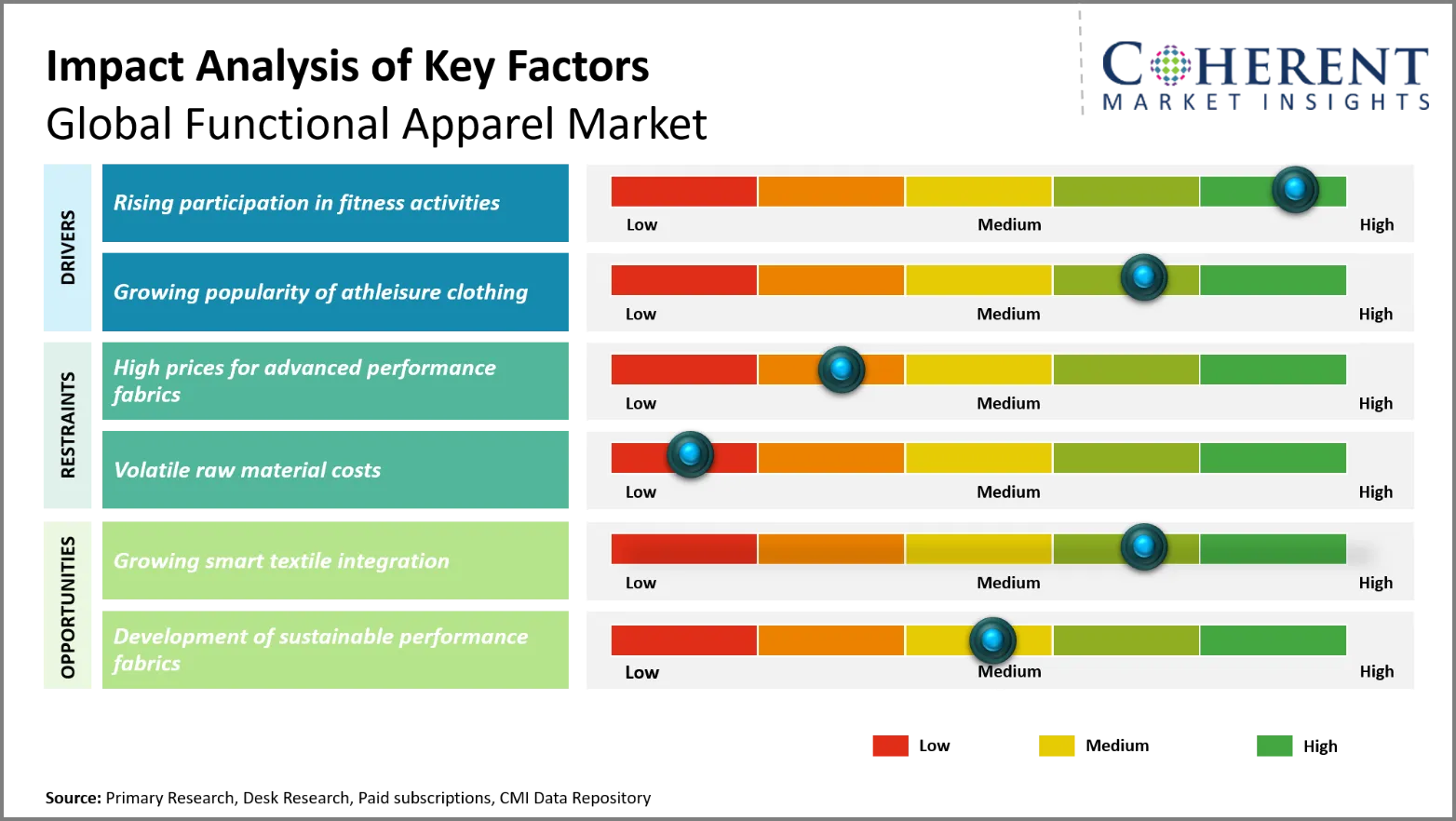
Market Drivers
Rising participation in fitness activities
Increasing participation in fitness activities is driving demand for functional gear spanning running, gym training, cycling, yoga and recreational sports. Consumers are demanding more breathable, moisture-wicking, flexible and temperature-regulating clothes they can wear during physical activity. Participation is increasing across a variety of age groups through fitness centers, community sports programs, outdoor recreation and digital exercise platforms. Manufacturers are responding with lightweight materials, compression technology, seamless construction and ergonomic designs. The growing involvement of women and older consumers further boosts demand for functional apparel with particular features. This tendency is conducive to repeat purchases, as consumers often demand different clothes for training, seasonal circumstances and specific activities.
On March 31, 2026, Planet Fitness, the largest and fastest-growing fitness center operator in the United States and the largest in the world, was named the highest-ranking gym in Entrepreneur’s 2026 Fastest-Growing Franchises list, published March 31, 2026, with more members than any other fitness brand. Planet Fitness ranked 25th overall out of 150 franchises.
Growing popularity of athleisure clothing
Athleisure adoption is on the rise, moving practical wear beyond typical sports and exercise settings. Consumers are increasingly wearing performance-oriented clothes for commuting, travel, shopping, social activities and casual workplaces. This transition has led to a growing need for clothes that offers technical performance alongside modern style and daily comfort. Brands are equipping lifestyle-oriented items with features like moisture management, stretch, wrinkle resistance and lightweight construction. Athletic-inspired apparel also gets exposure through social media and celebrity fashion. Athleisure also fuels regular product debuts as consumers hunt for new colors, styles and fabric technologies. The crossover of performance clothes into everyday wear is expanding the addressable consumer base of functional apparel.
On January 7, 2025, Primark unveiled their biggest performance collection to date on 7 January 2025. The new range features technical sports bras and sweat-wicking shirts, as well as premium buttery soft leggings and joggers, and incorporates the latest product advancements such as four-way stretch, sweat-wicking and breathable fabric to provide customers quality and value, without the high price tag.
Emerging Trends
- Smart and Connected Functional Apparel: Functional wear is progressively incorporating sensors, conductive fibers and connected components to track movement, temperature and physiological markers. These garments can enhance sports performance, occupational safety, rehabilitation and customized fitness, and eventually lead to data-driven clothing services.
- Advanced Temperature-Regulating Fabrics: Manufacturers are developing fabrics that actively control body temperature under varying environmental conditions. Phase-change materials, breathable membrane structures, adaptive insulation, and moisture-responsive structures could enhance comfort during rigorous exercise, outdoor activities, occupational demands, and lengthy durations of usage.
- Circular and Bio-Based Performance Materials: Apparel firms are developing more recycled, renewable and lower-impact materials for performance wear. The new fiber technologies aim to reduce reliance on traditional petroleum-based textile inputs, while retaining stretch, durability, moisture management and breathability.
- Multifunctional Protection and Comfort: Functional clothing increasingly integrates many performance attributes in separate garments. Products can also provide ultraviolet protection, antibacterial performance, water resistance, odor management, stretch and abrasion resistance, removing the need for separate specialty garments across sports, outdoor and occupational uses.
Regional Insights
Why is North America a Strong Market for Functional Apparel?
North America is expected to account for a market share of 35.0% in 2026. There is strong participation in running, basketball, football, cycling, skiing and outdoor recreation in North America. U.S. customers are increasingly turning to performance wear for regular use. Canada has a huge demand for skiing, snowboarding, hiking and cold weather clothing. Companies such as Lululemon, Nike, Under Armor and Columbia are constantly coming out with new technology for moisture management, compression, insulation and weather resistance. Professional sports also produce unique needs for breathable jerseys, lightweight training clothing, and protective equipment. The rise in popularity of outdoor fitness also helps grow the acceptance of technical wear. Direct-to-consumer launches and digital fitness communities encourage frequent purchases of leggings, training tops, performance shorts, and specialized outerwear across the region.
Why Does Asia Pacific Functional Apparel Market Exhibit High Growth?
Asia Pacific is expected to register the fastest growth with a CAGR of 8.3% over the forecast period. It is projected to account for 29.0% of the global functional apparel market in 2026. The region benefits from expanding fitness participation, outdoor recreation, and sophisticated textile manufacturing capabilities. By the end of 2025, the number of sports facilities in China reached 500.37 million. Hiking, running and outdoor performance apparel are in significant demand in Japan. South Korea encourages growth with technical training apparel and fashion-forward sportswear. India is building demand through events, gym participation, cricket and organized sport. Regional manufacturers are progressively producing moisture-control, cooling, stretch and lightweight performance fabrics. Homegrown brands are also working on specialty items for humid areas and strenuous activity. This combination provides unique growth prospects across the sports, outdoor recreation and lifestyle sectors.
Global Functional Apparel Market Outlook for Key Countries
Why is U.S. Emerging as a Major Hub in the Functional Apparel Market?
Running, gym training, collegiate sports and outdoor leisure all enjoy broad involvement, underpinning the U.S. functional apparel market. Each sport, whether it is basketball, American football, baseball, golf or tennis, has its own performance demands. And, consumers are wanting more athletic wear that is designed to take them from the gym to the office to informal settings. Brands like Nike, Under Armor, Lululemon and Patagonia are continuing to build out dedicated performance lines. Hiking, skiing, camping and trail running further increase demand for outdoor apparel. Moisture management, light weight, UV protection, insulation and waterproofing remain significant product qualities. Athlete alliances and sponsorships in professional sports further enhance the awareness of specialist functional garment technology.
Is China the Next Growth Engine for the Functional Apparel Market?
China has increasing fitness involvement, domestic sports brands and large-scale textile manufacturing to support it. In 2025, 38.52% of inhabitants exercised frequently, according to the General Administration of Sport. In 2025, the sales of sportswear on four key online platforms totaled USD 67.03 billion. Running, badminton, basketball, cycling and exercise brings different apparel needs. Also, by the end of 2025, China had 5.0037 million sporting facilities. Local producers are generating increasingly specialized materials and event-specific clothing. Quick experimentation with cooling fabrics, stretch materials, moisture control and lightweight structures is made possible by manufacturing know-how.
Germany Functional Apparel Market Analysis and Trends
Germany has significant demand for practical gear for cycling, football, hiking, jogging, skiing and occupational uses. Cycling culture involves breathable jerseys, water-resistant layers, padded apparel, and high-visibility garments. Consumers of outdoor products are increasingly demanding durability, repairability and technical excellence. Germany also has a strong manufacturing basis for specialist protective garments for tough work situations. European sustainability standards push for higher traceability of materials and longer product life. In Germany, people are increasingly judging the value of functional clothing by their durability and environmental friendliness. Such inclinations favor luxury products combining technical performance and responsible materials. Winter sports and mountain recreation also require clothing that insulates, waterproofs, regulates temperature, and resists abrasion.
Japan Functional Apparel Market Analysis and Trends
Japan demands highly engineered gear for hiking and running, cycling, skiing and outdoor pleasure. Consumers note the fabric quality, comfort, lightweight construction and durability. Japanese sportswear is still in high demand, especially outdoor gear, which continues to be a major contribution. Tourist expenditure, particularly in established outdoor and lifestyle areas, also promotes purchases of sportswear. Japanese firms have long experience in making technical textiles and performance garments. Products intended for coping with shifting weather conditions can provide substantial domestic hiking and outdoor recreation benefits. The market also values unobtrusive designs that combine technical features with everyday usage. This preference supports multifunctional apparel suitable for commuting, travel, exercise, and recreational activities.
India Functional Apparel Market Analysis and Trends
India is experiencing stronger functional apparel demand through running, gym participation, cricket, and outdoor activities. Running is becoming an increasingly important sportswear growth engine in Indian cities. Decathlon launched KIPRUN with more than 35 running products for Indian consumers. Puma and ASICS are emphasizing high-performance running products in the country. Adidas continues to use its cricket relationships, with Nike expanding its digital delivery. Tamil Nadu, Jalandhar and Meerut manufacturing clusters support indigenous production capacity. Increasing female participation and demand outside of metropolitan regions present new growth prospects.
Global Functional Apparel Market - Functional Fabric Technology Adoption by Region (2025)
Region | Functional Fabric Technology Adoption |
North America | 32% |
Asia Pacific | 29% |
Europe | 25% |
Latin America | 8% |
Middle East & Africa | 6% |
How is Growing Smart Textile Integration Creating New Growth Opportunities in the Functional Apparel Market?
The growing integration of smart textiles is opening new options by embedding sensing, heating, communication and responsive functionalities within a functional garment itself. Athletic activities can be monitored by movement, pressure, temperature, and physiological signs with the help of conductive yarns and flexible sensors. Heated apparel can give controlled temperature management for outdoor workers and winter activities. Companies are also developing textile-based interfaces that reduce dependence on rigid electronic components. Smart garments can therefore serve sports performance, rehabilitation, workplace safety, and defense applications simultaneously. Durability issues that have long hindered commercialization are being overcome by washable electronics and flexible power supplies. These advances enable producers to transition functional clothes from passive performance products to interactive, adaptable and data-enabled clothing.
On February 26, 2025, Massachusetts Institute of Technology researchers developed an autonomous programmable computer in the shape of an elastic fiber that could monitor health conditions and physical activity and warn the wearer to potential health problems in real time. Clothing containing the fiber computer are comfortable and machine washable, and the fibers are nearly imperceptible to the wearer.
Market Players, Key Development, and Competitive Landscape
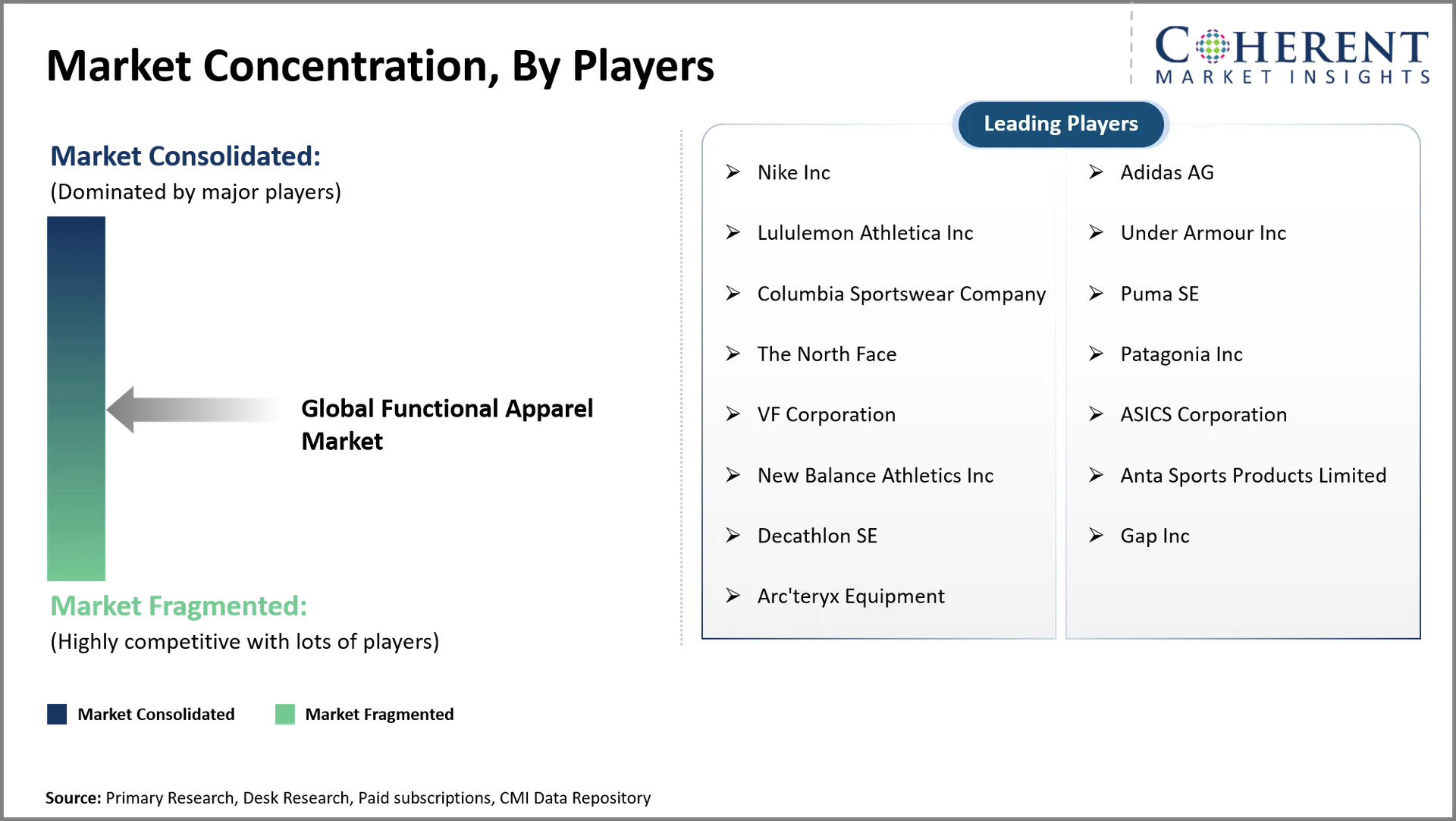
Key Developments
- On October 3, 2025, Georgia Tech athletics and Under Armour entered into an official partnership. Beginning on July 1, 2026, Under Armour will become the official uniform, apparel, footwear and accessories provider of the Yellow Jackets.
- On February 18, 2025, Nike and SKIMS announced NikeSKIMS, a new brand that will disrupt the global fitness and activewear industry with best-in-class innovation in service of all women athletes. The new brand merges NIKE, Inc.’s world-class approach to advanced innovation, sport science and athlete insights with SKIMS’ obsession for the female form and pioneering pursuit of solutions for everybody.
- On April 18, 2024, Adidas introduced adaptive training apparel for the Paris 2024 Olympic and Paralympic Games. Adidas announced that 81% of pieces of apparel worn on and off the field of play have been created using design principles that ensure they work for athletes with and without a disability.
Competitive Landscape
The competitive landscape is shifting toward material engineering, climate adaptation, and highly differentiated performance platforms. Nike is advancing Aero-FIT, which uses textile waste and channels more than double the airflow of legacy apparel. Nike also introduced FlyWeb, a three-dimensional printed TPU apparel material for targeted support and airflow. Lululemon is extending its technical expertise into outerwear using PrimaLoft insulation, water-resistant fabrics, and lightweight construction. Under Armour is commercializing NEOLAST technology through HeatGear Elite, targeting stretch, shape retention, durability, and improved recyclability. Nike is also establishing a Bengaluru campus to strengthen capabilities and regional responsiveness.
Top Manufacturers And Notable Products
Manufacturer | Notable Product | Key features |
Nike | Dri-FIT ADV Apparel | Advanced moisture management, breathability, stretch, lightweight construction, sweat-wicking performance |
Under Armour | UA Iso-Chill Apparel | Cooling fabric construction, sweat management, lightweight feel, training-focused performance |
lululemon | Nulu Apparel | Lightweight construction, soft hand feel, four-way stretch, sweat-wicking performance |
Adidas | CLIMACOOL Apparel | Ventilation, moisture management, airflow-focused construction, breathable performance |
ASICS | ACTIBREEZE Apparel | Breathability, cooling performance, lightweight construction, improved airflow |
Market Report Scope
Report Coverage | Details | ||
Base Year | 2025 | Market Size in 2026: | USD 430.00 Bn |
Historical Data For: | 2020 To 2024 | Forecast Period: | 2026 To 2033 |
Forecast Period 2026 To 2033 CAGR: | 7.3% | 2033 Value Projection: | USD 632.00 Bn |
Geographies covered: |
| ||
Segments covered: |
| ||
Companies covered: | Nike Inc, Adidas AG, Lululemon Athletica Inc, Under Armour Inc, Columbia Sportswear Company, Puma SE, The North Face, Patagonia Inc, VF Corporation, ASICS Corporation, New Balance Athletics Inc, Anta Sports Products Limited, Decathlon SE, Gap Inc, Arc'teryx Equipment | ||
Growth Drivers: |
| ||
Restraints & Challenges: |
| ||
Analyst Opinion (Expert Opinion)
- The future of functional apparel will move toward garments engineered around specific physiological and environmental conditions. Cooling systems will become particularly important as athletes face hotter training environments. Materials will increasingly combine breathability, stretch, durability, and recycled content within single constructions. Three-dimensional printing can also enable localized support and airflow without conventional seams. Nike's FlyWeb demonstrates how computational design can create differentiated garment structures. Smart clothing will develop selectively in areas where sensing has measurable value, e.g. rehabilitation and performance monitoring. The 2026 smart-jacket project of RWTH Aachen University exhibits integrated sensors for rehabilitation purposes that are washable.
- The best opportunities peak in performance running, climate-adaptive clothes and luxury women’s sports products. Running needs special consideration because clothing requirements might change a lot depending on the heat, humidity, distance and intensity. Climate-adaptive garments can provide cooling, moisture transfer, thermal insulation and weather protection in certain geographic markets. Women’s performance gear provides options for seamless support and airflow management, as well as body-specific fabrication. Lululemon's Align franchise is an example of how proprietary fabric engineering may develop an extendable product platform. There are significant differences in participation patterns among these markets and so from a geographical perspective, India, China and the US are intriguing options.
- Market players have to create defensible advantages on proprietary materials, not only styling. To reduce the development cycle, companies need to combine computational design, material science, athlete testing and automated manufacturing. Under Armour's NEOLAST platform shows the benefits of tackling both performance and material sustainability. Brands also need to make items specific to heat, humidity, cold and high intensity in different regions. Responsive production means faster product localization and supply-chain modernization should be equally prioritized. This emphasis on regional competencies and greater consumer alignment is also reflected in Nike’s proposed campus at Bengaluru.
Speak to the analyst
Want personalized insights?
Take the findings above to one of our principal consultants, or have the report rebuilt around the segments, geographies and competitors you actually track.
Market Segmentation
- Product Type Insights (Revenue, USD Billion, 2021 - 2033)
- Sportswear
- Activewear
- Protective Clothing
- Footwear
- Others
- Application Insights (Revenue, USD Billion, 2021 - 2033)
- Professional Athletic
- Amateur Athletic
- Others
- Distribution Channel Insights (Revenue, USD Billion, 2021 - 2033)
- Online
- Supermarkets and Hypermarkets
- Convenience Stores
- Regional Insights (Revenue, USD Billion, 2021 - 2033)
- North America
- U.S.
- Canada
- Latin America
- Brazil
- Argentina
- Mexico
- Rest of Latin America
- Europe
- Germany
- U.K.
- Spain
- France
- Italy
- Russia
- Rest of Europe
- Asia Pacific
- China
- India
- Japan
- Australia
- South Korea
- ASEAN
- Rest of Asia Pacific
- Middle East
- GCC Countries
- Israel
- Rest of Middle East
- Africa
- South Africa
- North Africa
- Central Africa
- North America
- Key Players Insights
- Nike Inc
- Adidas AG
- Lululemon Athletica Inc
- Under Armour Inc
- Columbia Sportswear Company
- Puma SE
- The North Face
- Patagonia Inc
- VF Corporation
- ASICS Corporation
- New Balance Athletics Inc
- Anta Sports Products Limited
- Decathlon SE
- Gap Inc
- Arc'teryx Equipment
Sources
Primary Research Interviews
- Functional Apparel Manufacturers & Brand Executives
- Sports & Athletic Wear Retailers and Distributors
- Textile & Fabric Technology Specialists
- E-commerce & Omnichannel Retail Representatives
Magazines
- Sportswear International
- Textile World
- Apparel Magazine
Journals
- Journal of Textile and Apparel Technology and Management
- International Journal of Fashion Design, Technology and Education
- Journal of Sports Sciences
Associations
- American Apparel & Footwear Association (AAFA)
- Outdoor Industry Association (OIA)
- International Textile Manufacturers Federation (ITMF)
- Sports & Fitness Industry Association (SFIA)
Public Domain Sources
- U.S. Census Bureau – Retail Trade Data
- World Trade Organization (WTO) – Textile & Apparel Trade Statistics
- United Nations Comtrade Database
- European Commission – Textile Industry Reports
Proprietary Elements
- CMI Data Analytics Tool
- Proprietary CMI Existing Repository of Information for Last 10 Years
Get access to 250+ pages report
Every segment, forecast, competitor profile and data table behind the analysis above — available for instant download.
- ESOMAR Member
- ISO 9001:2015 Certified
- D-U-N-S Registered
- GDPR & CCPA Compliant
Frequently Asked Questions
The global functional apparel market is expected to stand at USD 430.00 Bn in 2026 and is expected to reach USD 632.00 Bn by 2033.
The CAGR of the global functional apparel market is projected to be 7.3% from 2026 to 2033.
Rising participation in fitness activities and Growing popularity of athleisure clothing are the major factors driving the growth of the global functional apparel market.
High prices for advanced performance fabrics and Volatile raw material costs are the major factors hampering the growth of the global functional apparel market.
In terms of product type, sportswear segment is estimated to dominate the market revenue share in 2026.
Functional apparel uses specialized fabrics and construction methods to provide performance benefits beyond basic clothing.
Temperature-regulating garments manage heat using insulation, ventilation, phase-change materials, or engineered fabric structures.