

Global Garden Sheds Market Size and Forecast – 2026 To 2033
The Global Garden Sheds Market is estimated to be valued at USD 8.54 Bn in 2026 and is expected to reach USD 12.59 Bn by 2033, growing at a compound annual growth rate (CAGR) of 5.70% from 2026 to 2033. Market expansion is supported by continued household investment in gardens and outdoor living areas, stronger requirements for organized exterior storage, and product development focused on weather resistance, low-maintenance materials, modular configurations, and adaptable interior space.
Garden sheds are also evolving beyond basic tool storage toward hobby, workshop, and multifunctional backyard applications. In January 2026, the U.K. Horticultural Trades Association reported that garden-centre sales during 2025 were 9% higher than in 2024, indicating sustained consumer expenditure across the wider gardening and outdoor-living ecosystem and providing a supportive demand environment for garden structures and storage products.
Key Takeaways of the Global Garden Sheds Market
- Wood is expected to expand at an estimated CAGR of 5.3% during 2026–2033 and account for 42.6% of the global garden sheds market in 2026. Its lead reflects natural aesthetics, repairability, customization flexibility, and familiarity in residential gardens. In November 2025, Forest Garden highlighted pressure-treated timber log-store sheds and 4LIFE shed configurations designed for long-term outdoor storage, reinforcing timber’s premium functional positioning.
- Medium Size is projected to record an estimated CAGR of 5.9% through 2033 and hold 44.8% of the global garden sheds market in 2026. This format balances usable floor area, manageable installation, and compatibility with typical residential plots while supporting storage, hobbies, and compact workspaces. In March 2025, C & S Sheds promoted its 10×8-foot model as an approximately 80-square-foot multi-use garden solution.
- Storage is forecast to grow at an estimated CAGR of 5.6% from 2026 to 2033 and capture 48.7% of the global garden sheds market in 2026. The segment benefits from households needing secure space for lawn equipment, bicycles, tools, seasonal goods, and bulky outdoor items without sacrificing indoor space. In October 2025, Lowe’s recognized Suncast for multifunctional resin sheds and outdoor-storage innovation.
- North America is anticipated to post an estimated CAGR of 5.4% during 2026–2033 and represent 37.2% of the global garden sheds market in 2026. High owner-occupancy, large suburban housing stock, backyard usage, and established home-improvement retail networks sustain replacement and first-time shed purchases. In July 2026, the U.S. Census Bureau reported a 65.0% national homeownership rate for the second quarter.
- Europe is estimated to achieve a CAGR of 6.5% through 2033 and contribute 30.8% of the global garden sheds market in 2026, making it the fastest-growing region. Mature gardening cultures, compact-space optimization, strong DIY participation, and widening omnichannel access support faster category turnover and premiumization. In January 2025, OBI announced the takeover of 13 Swiss stores, expanding its home-and-garden retail reach across Switzerland.
Segmental Insights
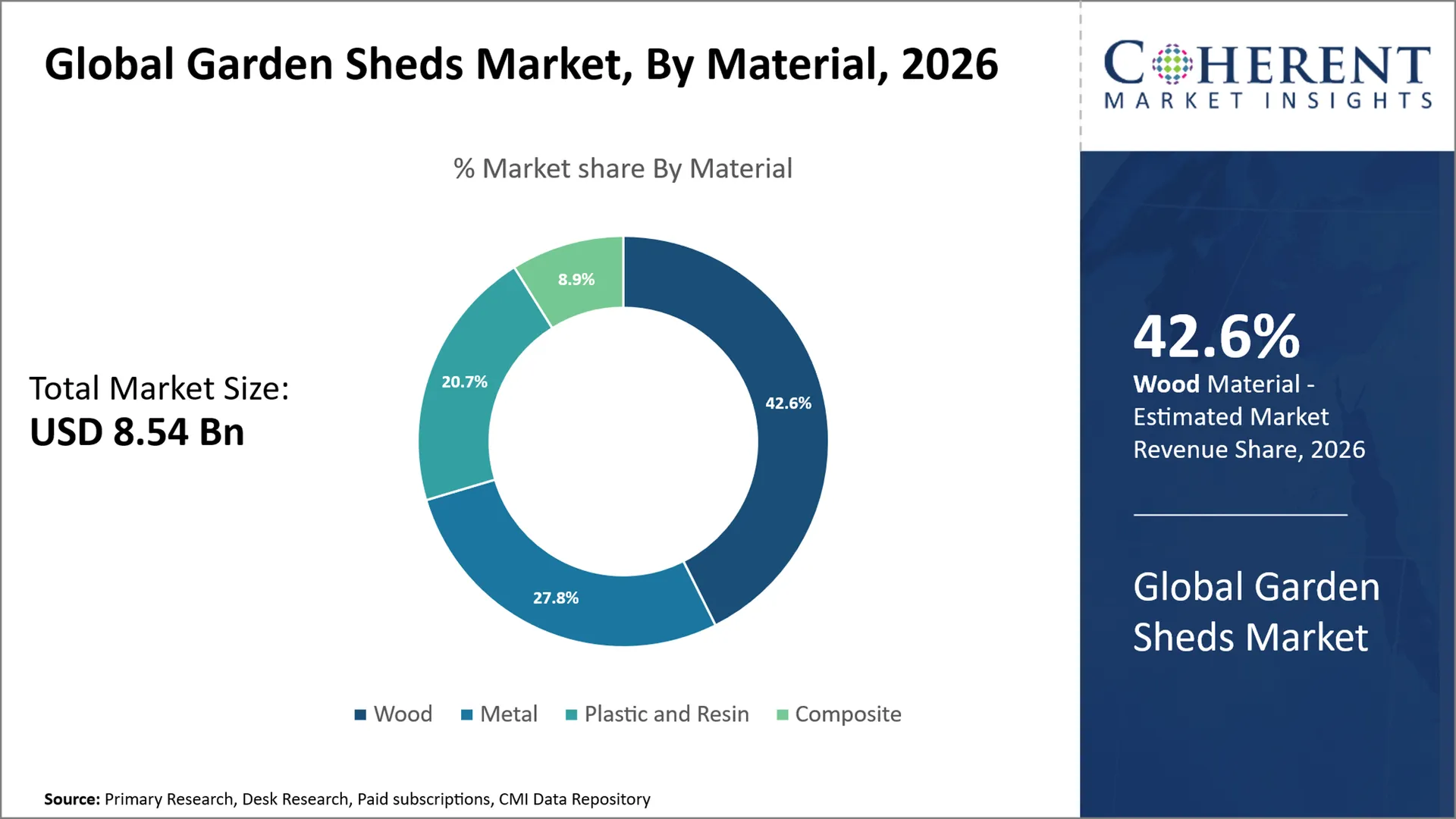
Why Does Wood Dominate the Material Segment of the Global Garden Sheds Market?
Wood is expected to account for 42.6% of the global garden sheds market in 2026, leading the material category because timber combines structural familiarity with broad design flexibility. Buyers can alter doors, windows, shelving, cladding finishes, and internal layouts without specialized fabrication, making wood suitable for standard storage and higher-value hobby uses. For manufacturers, established carpentry processes and modular panel production support wide SKU ranges, while retailers can create clear good-better-best positioning through treatment, framing, and cladding upgrades. Residential buyers also retain the option to repair, repaint, or modify timber structures over their service life. In December 2025, Tiger Sheds highlighted year-round garden buildings manufactured from high-quality timber, including pressure-treated options intended for harsher outdoor conditions, reinforcing timber’s adaptability across storage, work, hobby, and leisure requirements.
- Current Industry Events of 2026
- Market Size Estimation
- Regional Breakdown
- Competitive Landscape
- Customer Intelligence
- Segmental Analysis
- Pricing Analysis
- Key Market Drivers, Challenges & Future Trends
- Customized Insights Section
Why Does Medium Represent the Largest Size Segment in the Global Garden Sheds Market?
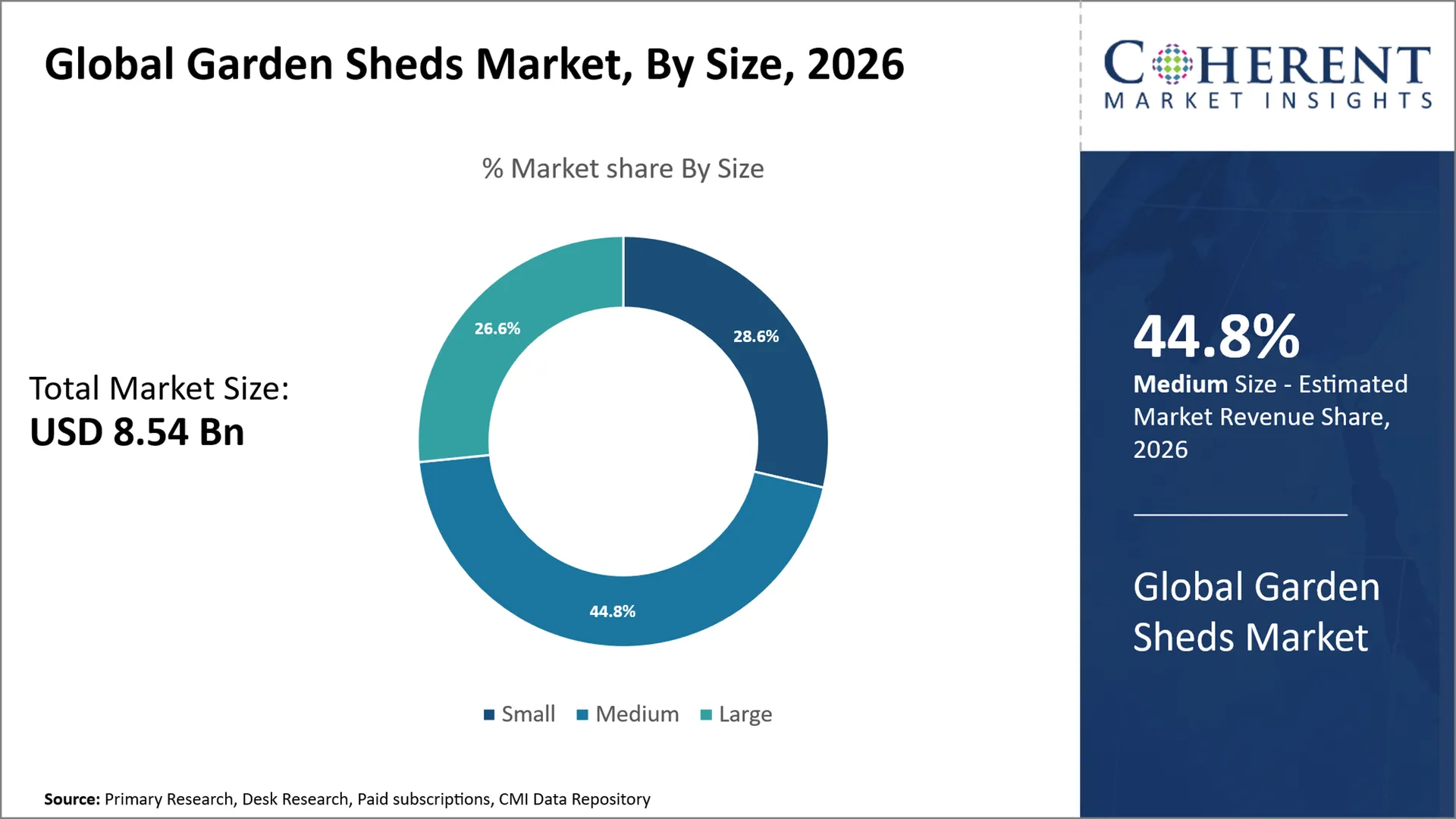
Medium is expected to hold 44.8% of the global garden sheds market in 2026, making it the largest size category because it provides meaningful usable capacity without requiring the site commitment of a large structure. These sheds can accommodate bicycles, lawn equipment, shelving, and workbenches while remaining compatible with many residential plots and standardized foundation layouts. Their dimensions also suit modular manufacturing and flat-pack logistics, enabling suppliers to address DIY, dealer-assisted, and professional-installation channels efficiently. Commercially, medium formats create scope for accessory upselling without moving households into substantially larger building projects. In April 2025, Keter scheduled availability of its Darwin Potting Shed; the 6x8-foot model sits within Keter’s medium-shed portfolio and combines storage capacity, shelving, plant-care functionality, and extensive natural-light features in a comparatively manageable footprint.
Why Does Storage Dominate the Application Segment of the Global Garden Sheds Market?
Storage is expected to capture 48.7% of the global garden sheds market in 2026, leading the application category because it addresses an immediate household space-management requirement with limited modification to the home itself. Garden tools, bicycles, lawn-care equipment, seasonal furniture, and outdoor accessories need secure, weather-protected space but rarely justify occupying indoor living areas. This creates demand across wood, metal, resin, and composite sheds and across multiple price tiers. Manufacturers gain a broad addressable customer base, while retailers can attach shelving, locks, hooks, ramps, and organization systems to the core purchase. In February 2025, Waltons published dedicated guidance on efficient tool sheds, emphasizing organized, weather-protected accommodation for gardening tools and larger equipment and illustrating how shelving and wall-mounted storage can maximize usable shed capacity.
Current Events and their Impact
Current Event | Description and Its Impact |
March 2025 – France confirms planning authorization requirements for garden sheds |
|
January 2026 – France updates development-tax values affecting garden structures |
|
July 2026 – European Commission updates EUDR product scope and implementation tools |
|
Global Garden Sheds Market Dynamics
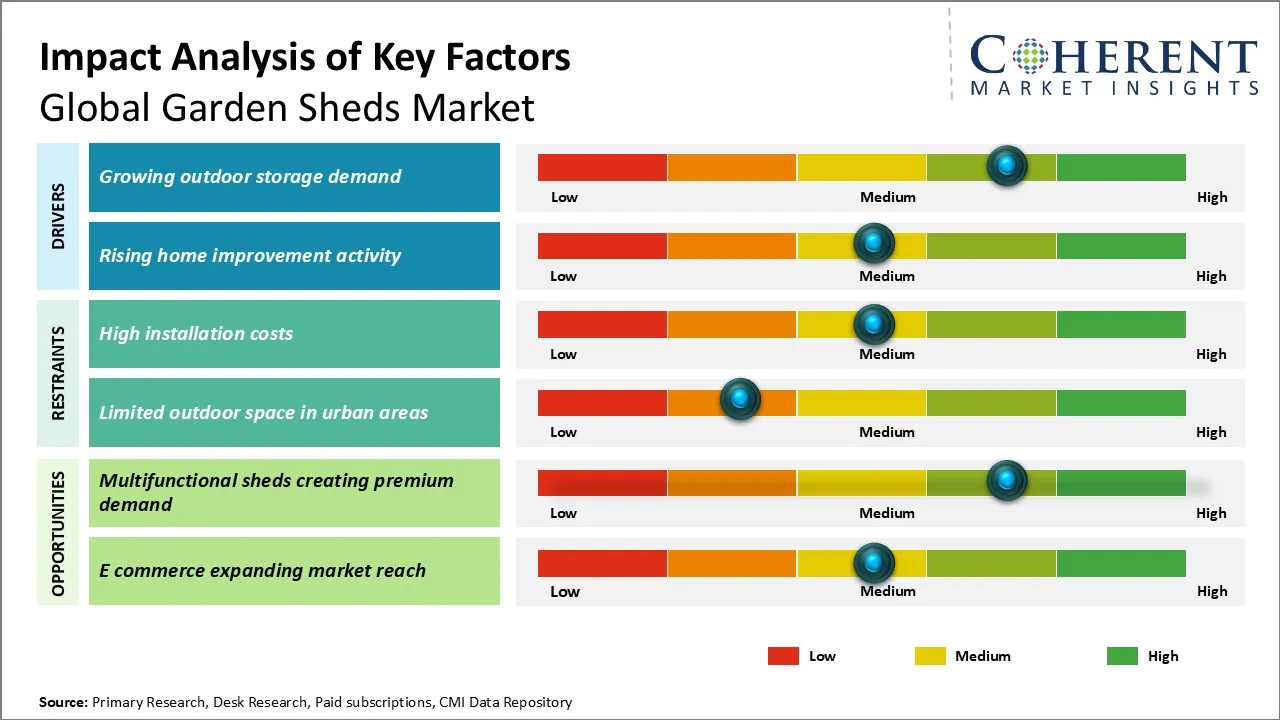
Key Market Drivers
- Growing outdoor storage demand: Outdoor equipment ownership, seasonal household goods and space-intensive recreation are pushing more items out of garages and into purpose-built backyard structures. Garden sheds convert unused yard area into protected capacity without the disruption of a home extension, benefiting shed manufacturers, installers, home-improvement retailers and storage-accessory suppliers. The commercial effect is broader basket value because buyers frequently add floors, shelving, ramps and security features. In November 2025, Tuff Shed reported that it built more than 70,000 buildings during the year, with uses spanning bike storage, garden gear and other household overflow, demonstrating the breadth of practical shed demand.
- Rising home improvement activity: Home improvement activity supports garden shed purchases because homeowners increasingly treat the yard as part of the usable residential asset rather than as leftover exterior space. A shed can add organized utility, workshop capacity or project space with a smaller construction commitment than a conventional addition, benefiting manufacturers, installers, timber and panel suppliers, and specialist retailers. In July 2026, the National Association of Home Builders reported a Remodeling Market Index reading of 61 for the second quarter, indicating that remodeler sentiment remained in positive territory and supporting continued spending around residential property upgrades.
Emerging Market Trends
- Weather-Resilience Becomes a Core Purchase Specification: Weather-resilience specifications are moving from secondary features to central product-selection criteria. Buyers are placing greater weight on roof-load capability, anchoring, corrosion resistance, UV stability, moisture control and reliable door sealing because outdoor structures remain exposed year-round. This shift favors manufacturers able to engineer performance into complete wall-roof-floor systems rather than compete only on appearance or headline price. Over the forecast period, suppliers with clearer performance documentation and climate-appropriate configurations should gain pricing flexibility, while poorly differentiated products may face higher warranty, return and reputation pressure.
- Accessory Ecosystems Extend Revenue Beyond the Initial Shed: Accessory ecosystems are turning the garden shed from a one-time structure purchase into a configurable ownership platform. Shelving, tool rails, ramps, skylights, vents, security kits, flooring upgrades, guttering and internal partitioning allow buyers to adapt the same shell as needs change. Manufacturers and specialist dealers can benefit through higher attachment revenue and longer customer relationships, while single-SKU sellers risk becoming more price-sensitive substitutes. The trend should deepen as product families adopt standardized mounting points and compatible modules, making future upgrades easier without requiring complete shed replacement.
Regional Insights
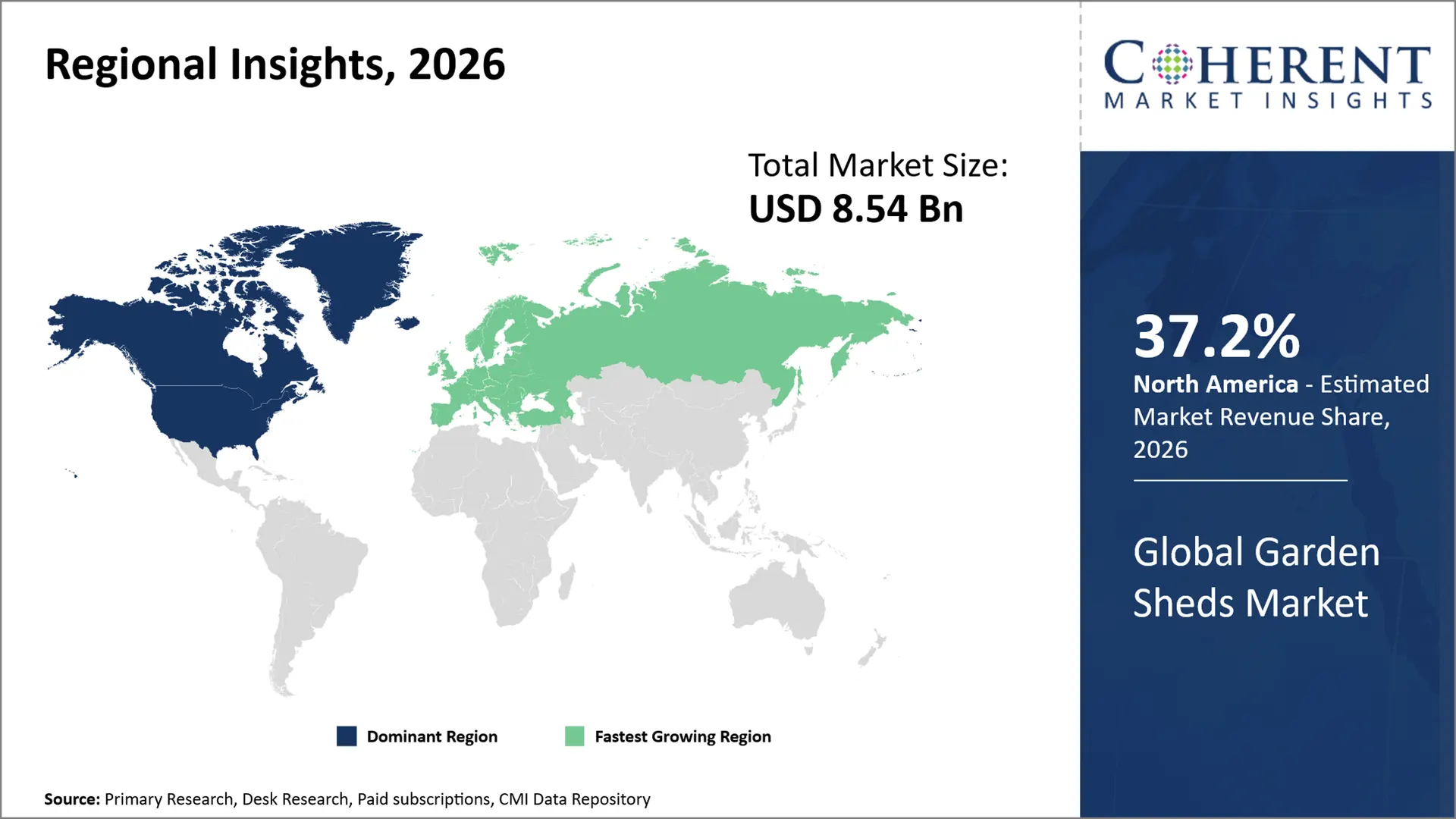
Why Does North America Dominate the Global Garden Sheds Market?
North America is expected to account for 37.2% of the global garden sheds market in 2026, reflecting suburban yard availability, extensive ownership of lawn and outdoor equipment, and mature retail infrastructure for bulky home-improvement products. Buyers can add secure exterior capacity without undertaking a garage extension, supporting purchases across wood, metal, and resin formats. The region’s commercial advantage is channel depth: large retailers combine physical product comparison with delivery, installation, financing, and digital ordering, reducing friction around higher-ticket structures. In March 2026, The Home Depot’s fiscal 2025 annual report stated that it operated 2,359 stores across the U.S., Canada, and Mexico, with an average of approximately 24,000 square feet of outside garden area per store, illustrating the scale of regional home-and-garden distribution.
Why Is Europe Emerging as the Fastest-Growing Region in the Global Garden Sheds Market?
Europe is expected to represent 30.8% of the global garden sheds market in 2026 and emerge as the fastest-growing region as buyers increasingly favor space-efficient and design-led outdoor buildings capable of serving multiple household functions. Variable plot configurations and mature renovation markets encourage suppliers to differentiate through modular layouts, stronger weather protection, architectural finishes, and installation support rather than basic storage volume alone. This creates room for premiumization and faster assortment renewal, particularly for retailers able to localize designs while retaining cross-border sourcing efficiencies. In May 2026, ADEO reported an ecosystem comprising more than 1,300 regional points of sale, supplemented by retail websites, marketplaces, and partner networks, highlighting the organized home-improvement infrastructure available to accelerate product discovery, configuration, and distribution across European markets.
Global Garden Sheds Market Outlook for Key Countries
Why Is the U.S. a Key Market for the Global Garden Sheds Market?
The U.S. is a key market for the global garden sheds market because garden spending is supported by a large household base actively investing in lawns, landscaping, tools, and outdoor-living assets. For shed suppliers, this creates demand beyond basic equipment storage, including higher-value configurations with shelving, ramps, windows, and adaptable workspace features. The country’s combination of big-box retail, specialist installers, direct-to-consumer platforms, and local builders also provides manufacturers with several routes to reach buyers across price and installation preferences. Purchasing intensity within the wider garden economy provides additional commercial support. In May 2026, National Gardening Association research reported that U.S. lawn-and-garden spending reached a record USD 79.0 billion in 2025, increasing 13.5% year over year, despite fewer participating households, indicating deeper expenditure among committed gardening consumers.
Why Is Germany a Strategic Country in the Global Garden Sheds Market?
Germany is strategically important in the global garden sheds market because buyers place substantial value on build quality, weather performance, orderly space utilization, and long service life. These preferences favor well-specified timber and metal structures, upgraded roofing, secure access, foundations, and complementary accessories rather than purely entry-level sheds. Germany also has a sophisticated DIY and garden retail environment where consumers can compare technical specifications, arrange delivery, and purchase associated landscaping or installation products within one buying journey. This allows suppliers to monetize durability and system compatibility. In May 2026, HORNBACH reported that its calendar-2025 market share in Germany increased to 15.7% from 15.2%, while German fiscal 2025/26 sales rose 2.3%, demonstrating continued activity within one of the country's major organized DIY and garden retail networks.
Why Does China Support Growth in the Global Garden Sheds Market?
China supports the global garden sheds market primarily through its manufacturing and sourcing ecosystem rather than the consumption profile associated with mature Western Garden markets. Dense capabilities in metalworking, plastics processing, fasteners, locks, coatings, packaging, and flat-pack manufacturing help suppliers integrate numerous shed components within export-oriented supply chains. This supports OEM and private-label programs for international retailers while allowing frequent specification changes and broad price-point coverage. The country is also important for procurement of garden hardware and assembly components. In June 2026, the China International Hardware Show announced that its Shanghai edition would span 120,000 square meters with more than 3,000 exhibitors, covering building hardware, fastening products, garden and outdoor tools, intelligent locks, and cross-border sourcing, illustrating the depth of China's adjacent supplier and procurement ecosystem.
Why Is the U.K. Important in the Global Garden Sheds Market?
The U.K. is important in the global garden sheds market because constrained residential plots and persistent exposure to rain place greater value on efficient footprints, moisture management, protected storage, and practical internal organization. Buyers consequently evaluate roof construction, treated materials, flooring, ventilation, and door access alongside overall dimensions. The country also has a developed garden-building ecosystem spanning national DIY chains, digital specialists, timber merchants, and installation providers, enabling comparison across standardized and customized structures. Retail expansion continues to strengthen physical and omnichannel access. In January 2025, B&Q agreed to acquire five Homebase stores in the U.K., adding more than 25,000 square meters of selling area following conversion and extending a proposition incorporating online assortment, click-and-collect, home delivery, and bulk delivery.
Why Is Australia an Important Growth Market for the Global Garden Sheds Market?
Australia is an important growth market for the global garden sheds market because outdoor storage products must perform under demanding climate and logistics conditions. High UV exposure, heat, coastal corrosion risk, storms, and long transport distances increase the commercial value of durable coatings, secure anchoring, ventilation, efficient packaging, and dependable replacement-component availability. Suppliers that engineer sheds for local exposure conditions while controlling bulky-product freight can differentiate beyond initial purchase price. Distribution infrastructure therefore becomes particularly important for inventory availability and delivered-cost management. In January 2026, Bunnings opened a 40,000-square-meter North Maclean distribution center in Queensland designed to handle full pallets, timber, bulk products, and seasonal items while supporting planned growth in import volumes, strengthening fulfillment capacity for large-format home-and-garden merchandise.
Product Innovation, Materials & Manufacturing Landscape
Innovation Area | Adoption Direction | Commercial Value | Strategic Implication |
Engineered Resin and Composite Wall Systems | Reinforced double-wall panels, UV-resistant polymers and wood-look finishes are improving structural and visual performance. | Lower maintenance requirements and consistent factory-built quality support convenience-oriented residential buyers. | Suppliers require molding expertise, formulation control and disciplined recycled-content sourcing without compromising panel strength. |
Corrosion-Protected Steel Construction | Galvanized and coated steel panels, improved fasteners and more precisely formed structural components are strengthening metal shed propositions. | Long service life and limited maintenance create differentiation against entry-level sheet-metal structures. | Coating quality, dent prevention, packaging engineering and freight economics become critical competitive capabilities. |
Pressure-Treated and Engineered Timber Packages | Treated cladding, improved floors, engineered panels and moisture barriers are being combined to address traditional wood-maintenance concerns. | Timber suppliers can preserve the appearance and customization advantages of wood while improving lifecycle performance. | Material traceability, treatment consistency and moisture management increasingly influence warranty economics and brand credibility. |
Modular Panel Architecture and Simplified Assembly | Standardized roof and wall modules, reduced part counts and interchangeable configurations are making assembly more predictable. | Lower installation complexity can reduce labor requirements, returns and missing-component complaints. | Design-for-manufacturing accuracy and intuitive assembly systems can create cost advantages across both DIY and professional-install channels. |
Integrated Daylight, Ventilation and Moisture Management | Skylights, operable windows, passive vents, membranes and improved roof drainage are becoming integrated rather than optional afterthoughts. | Better interior conditions expand shed usability for equipment protection and occasional human occupancy. | Suppliers can create differentiated product tiers while reducing condensation-related complaints and supporting higher-value configurations. |
Foundation, Anchoring and Site-Adaptation Systems | Adjustable bases, anchoring packages, levelling solutions and ground-interface systems are improving installation across varied terrain. | Better site preparation protects structural performance and creates additional installation and accessory revenue. | Manufacturers and dealers that integrate shed and foundation specifications can reduce field failures and improve total-project economics. |
How Are Standardized Commercial Micro-Storage Solutions Creating New Growth Opportunities in the Global Garden Sheds Market?
Commercial micro-storage offers an underdeveloped route for garden shed suppliers to move beyond discretionary household purchases and into repeatable, specification-led demand. Schools, community gardens, sports clubs, hospitality venues, property managers and small service businesses often need secure outdoor space for equipment but do not require permanent warehouse construction. Suppliers can capture this opportunity by developing standardized shed platforms with reinforced access, configurable shelving, durable flooring, anchoring packages, documented weather performance and professional installation. Commercial buyers also create scope for multi-site orders, replacement programs, maintenance agreements and standardized procurement specifications, improving revenue visibility compared with one-off residential sales. Participation requires stronger project quoting, installer coverage, spare-parts support, compliance documentation and dependable lead times. Established manufacturers with broad distribution are well positioned to scale this model, although regional specialists can compete effectively where local permitting knowledge, customization and rapid installation matter more than national brand recognition. This broadens lifetime value across accounts.
Market Players, Key Development, and Competitive Intelligence
Key Developments
- In April 2026, ShelterLogic Group launched Arrow Storage Products' Shirudo Series, a premium steel shed line developed with Japanese manufacturer Takubo. This is important for the global garden sheds market because it raises metal-shed performance expectations through precision engineering and commercial-grade construction.
- In December 2025, MCD Garden Buildings introduced its Lite Collection using pressure-treated timber, steel roofing, breathable membranes and acrylic windows. This is important for the global garden sheds market because it pairs affordability with enhanced durability specifications, targeting value-conscious buyers without relying on basic construction.
- In February 2025, Hormann UK partnered with Quality Garden Structures to distribute Berry steel sheds across the UK. This is important for the global garden sheds market because the agreement extends an established building-products brand into specialist garden retail and broadens access to galvanized-steel storage solutions.
Competitive Landscape
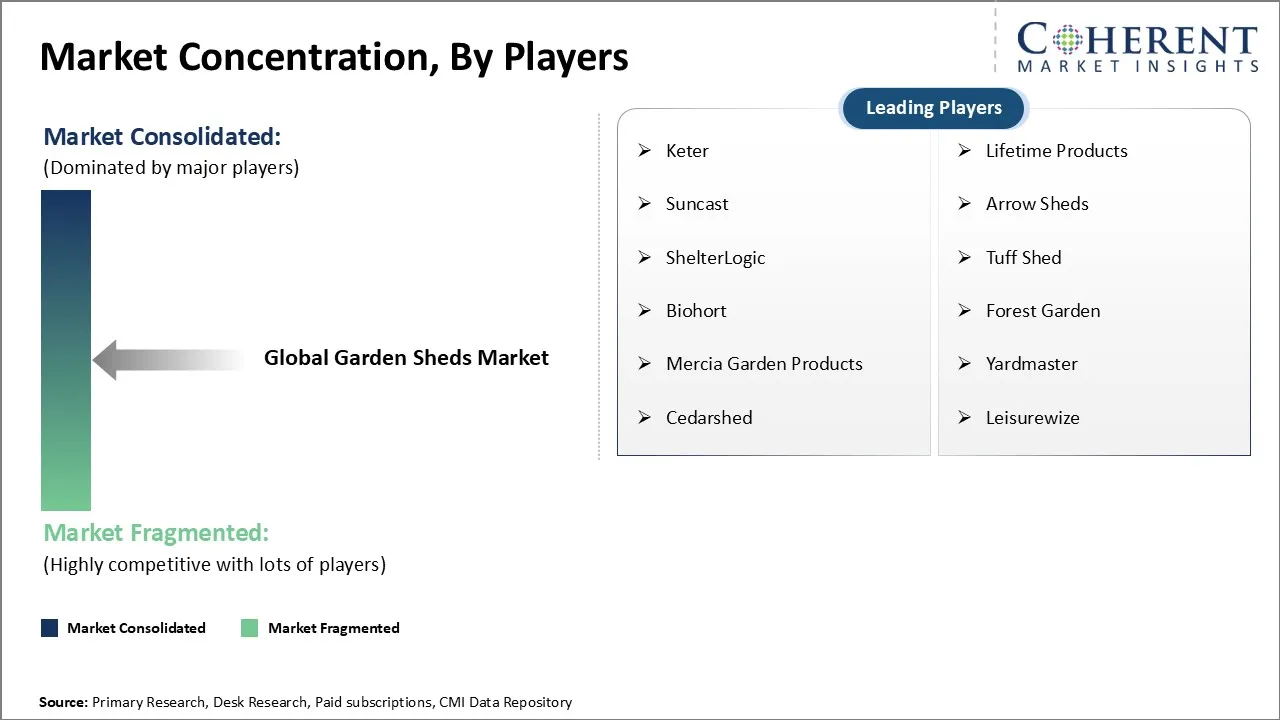
The global garden sheds market is fragmented, combining multinational resin and metal brands, large timber manufacturers, regional shed builders, home-improvement retailers and installation-led specialists. Competitive advantage depends less on scale alone than on delivered value: structural durability, design flexibility, assembly effort, fulfillment reliability, warranty execution and local installation capability. Regional firms remain influential where customization, permitting familiarity and short delivery distances shape purchase decisions.
Key focus areas include
- Durability and lifecycle performance: Weather protection, floor strength, roof integrity, corrosion or rot resistance and warranty credibility determine perceived long-term value.
- Installed-cost discipline: Product price, site preparation, delivery, foundations, installation and accessories increasingly need to be managed as one customer cost equation.
- Manufacturing and fulfillment reliability: Accurate kits, component availability, damage prevention, seasonal capacity and predictable lead times directly affect margins and customer satisfaction.
- Material positioning: Timber, steel, resin and composite suppliers must differentiate around maintenance burden, appearance, structural confidence, lifecycle performance and compliance.
- Configuration breadth: Door placement, windows, roof profiles, shelving, foundations and dimensional options allow suppliers to address varied sites without excessive bespoke-production costs.
- Distribution reach and purchase support: DIY retail, specialist dealers, direct-to-consumer channels, showrooms and installer networks create different customer-acquisition and service economics.
- Regional execution capability: Local manufacturers can defend share through site assessment, custom dimensions, planning familiarity, rapid delivery and responsive after-sales support.
Market Report Scope
Global Garden Sheds Market Report Coverage | |||
Report Coverage | Details | ||
Base Year | 2025 | Market Size in 2026: | USD 8.54 Bn |
Historical Data For: | 2020 To 2024 | Forecast Period: | 2026 To 2033 |
Forecast Period 2026 To 2033 CAGR: | 5.70% | 2033 Value Projection: | USD 12.59 Bn |
Geographies covered: |
| ||
Segments covered: |
| ||
Companies covered: | Keter, Lifetime Products, Suncast, Arrow Sheds, ShelterLogic, Tuff Shed, Biohort, Forest Garden, Mercia Garden Products, Yardmaster, Cedarshed, Leisurewize | ||
Growth Drivers: |
| ||
Restraints & Challenges: |
| ||
Analyst Opinion (Expert Opinion)
- Competition in garden sheds is likely to shift from selling a standalone structure toward controlling the complete shed-to-site journey. Manufacturers that integrate base preparation, foundation selection, delivery access assessment, assembly, anchoring, and after-sales replacement parts can capture more value than suppliers competing only on shed dimensions and material. This transition should particularly pressure catalogue-led brands whose responsibility effectively ends at delivery, as installation quality increasingly determines door alignment, water ingress, structural stability, and ultimately customer satisfaction.
- The next major disruption could come from factory-configurable garden buildings produced from standardized panel systems. Instead of maintaining numerous finished shed models, suppliers can use common wall, roof, door, and floor modules to create different footprints and layouts from a smaller component platform. This would allow faster customization while reducing manufacturing complexity and slow-moving finished inventory. Producers capable of combining modular engineering with made-to-order fulfillment could challenge traditional shed manufacturers that depend on fixed-size ranges and inventory-heavy dealer models.
- Garden shed manufacturers should prioritize dimensional standardization, foundation compatibility, flat-pack efficiency, replacement-component availability, and installation-network quality. Bulky panels make freight damage and last-mile handling important margin risks, while excessive customization can reduce production efficiency and complicate spare-parts support. Suppliers should therefore concentrate bespoke options around doors, windows, internal layouts, roof styles, and accessories while retaining standardized structural platforms. Investment in very large low-volume sheds should remain selective unless suppliers have local assembly capability and sufficient order density to absorb transportation and installation costs.
Speak to the analyst
Want personalized insights?
Take the findings above to one of our principal consultants, or have the report rebuilt around the segments, geographies and competitors you actually track.
Market Segmentation
- Material Insights (Revenue, USD Bn, 2021 - 2033)
- Wood
- Metal
- Plastic and Resin
- Composite
- Size Insights (Revenue, USD Bn, 2021 - 2033)
- Small
- Medium
- Large
- Application Insights (Revenue, USD Bn, 2021 - 2033)
- Storage
- Workshop and Hobby
- Garden Equipment Housing
- Garden Office and Studio
- Recreational Use
- End User Insights (Revenue, USD Bn, 2021 - 2033)
- Residential
- Commercial
- Distribution Channel Insights (Revenue, USD Bn, 2021 - 2033)
- Offline Retail
- Online Retail
- Regional Insights (Revenue, USD Bn, 2021 - 2033)
- North America
- U.S.
- Canada
- Latin America
- Brazil
- Argentina
- Mexico
- Rest of Latin America
- Europe
- Germany
- U.K.
- Spain
- France
- Italy
- Russia
- Rest of Europe
- Asia Pacific
- China
- India
- Japan
- Australia
- South Korea
- ASEAN
- Rest of Asia Pacific
- Middle East
- GCC Countries
- Israel
- Rest of Middle East
- Africa
- South Africa
- North Africa
- Central Africa
- North America
- Key Players Insights
- Keter
- Lifetime Products
- Suncast
- Arrow Sheds
- ShelterLogic
- Tuff Shed
- Biohort
- Forest Garden
- Mercia Garden Products
- Yardmaster
- Cedarshed
- Leisurewize
Sources
Primary Research Interviews
- Garden shed manufacturers, outdoor building suppliers, DIY retailers, distributors, installers, and garden product dealers
- Architects, landscape professionals, home improvement contractors, property managers, and outdoor living specialists
Stakeholders
- Garden shed manufacturers, modular outdoor structure companies, timber and metal shed producers, and private-label suppliers
- Raw material suppliers, component manufacturers, hardware suppliers, logistics providers, distributors, retail chains, and e-commerce platforms
- Residential homeowners, gardening enthusiasts, commercial property owners, schools, community gardens, and institutional users
End-use Sectors
- Residential outdoor storage and backyard organization
- Gardening, landscaping, and equipment storage applications
- Workshops, hobby spaces, and home-based work areas
- Commercial, institutional, and community outdoor storage requirements
Regulatory and Industry Bodies
- Building code authorities and local planning departments
- Forestry and timber certification organizations
- Construction material and product safety bodies
- Environmental and sustainability compliance organizations
- Home improvement and garden industry associations
Databases
- Company annual reports, investor presentations, and corporate filings
- Home improvement retail databases and product catalogues
- E-commerce listings, pricing databases, and consumer reviews
- Housing, renovation, gardening, and outdoor living datasets
- Trade statistics, timber databases, and import-export records
- Competitive intelligence and product portfolio databases
Magazines and Journals
- Home improvement and DIY industry publications
- Garden and outdoor living magazines
- Construction material and building product publications
- Retail and consumer lifestyle research journals
- Sustainability and timber industry publications
Associations
- National gardening and horticultural associations
- DIY and home improvement industry associations
- Timber and forestry product associations
- Construction and building material associations
- Outdoor living and landscape industry organizations
Public Domain Sources
- Home renovation and outdoor living trends
- Garden lifestyle and consumer preference developments
- DIY retail and e-commerce channel expansion
- Sustainable material adoption in outdoor structures
- Residential space optimization and backyard utilization trends
Key Standards and Regulations
- Local building permits and zoning requirements for outdoor structures
- Timber treatment and material safety standards
- Product labeling and consumer safety requirements
- Sustainable forestry and responsible sourcing certifications
- International trade regulations for garden buildings and components
Proprietary Elements
- CMI Data Analytics Tool
- proprietary CMI repository containing 10+ years of home improvement, construction materials, consumer goods, retail, and outdoor living market intelligence.
Get access to 250+ pages report
Every segment, forecast, competitor profile and data table behind the analysis above — available for instant download.
- ESOMAR Member
- ISO 9001:2015 Certified
- D-U-N-S Registered
- GDPR & CCPA Compliant
Missing comfort of reading report in your local language? Find your preferred language:
Frequently Asked Questions
The CAGR of global garden sheds market is projected to be 5.70% from 2026 to 2033.
The global garden sheds market is estimated to be valued at USD 8.54 Bn in 2026 and is expected to reach USD 12.59 Bn by 2033.
The global garden sheds market includes various types of sheds designed for storage, workshops, gardening activities, and multifunctional outdoor spaces, available across different materials, designs, and customization options.
Buyers typically evaluate factors such as material durability, weather resistance, available space, installation requirements, maintenance needs, security features, and compatibility with intended outdoor usage.
Manufacturers are focusing on improved materials, modular construction, better weather protection, easier installation systems, enhanced aesthetics, and flexible configurations to meet changing consumer preferences.
Companies can explore opportunities through product differentiation, customized shed solutions, improved distribution networks, sustainable materials, accessory integration, and enhanced installation and after-sales services.
The growth of the global garden sheds market is primarily supported by increasing demand for outdoor storage solutions and rising home improvement activities. Consumers are investing in garden sheds to organize tools, equipment, and seasonal items while enhancing the functionality of outdoor spaces.