

Global Gliders Market Size and Forecast – 2026 To 2033
The global gliders market is expected to grow from USD 300 Mn in 2026 to USD 485 Mn by 2033, registering a compound annual growth rate (CAGR) of 3.3% from 2026 to 2033. The market is driven by increasing preference for lightweight composite airframes. In April 2026, Jonker Sailplanes expanded its composite manufacturing capacity. The company planned a new 10,000-square-metre factory specifically for modern composite sailplane production.
Key Takeaways of the Global Gliders Market
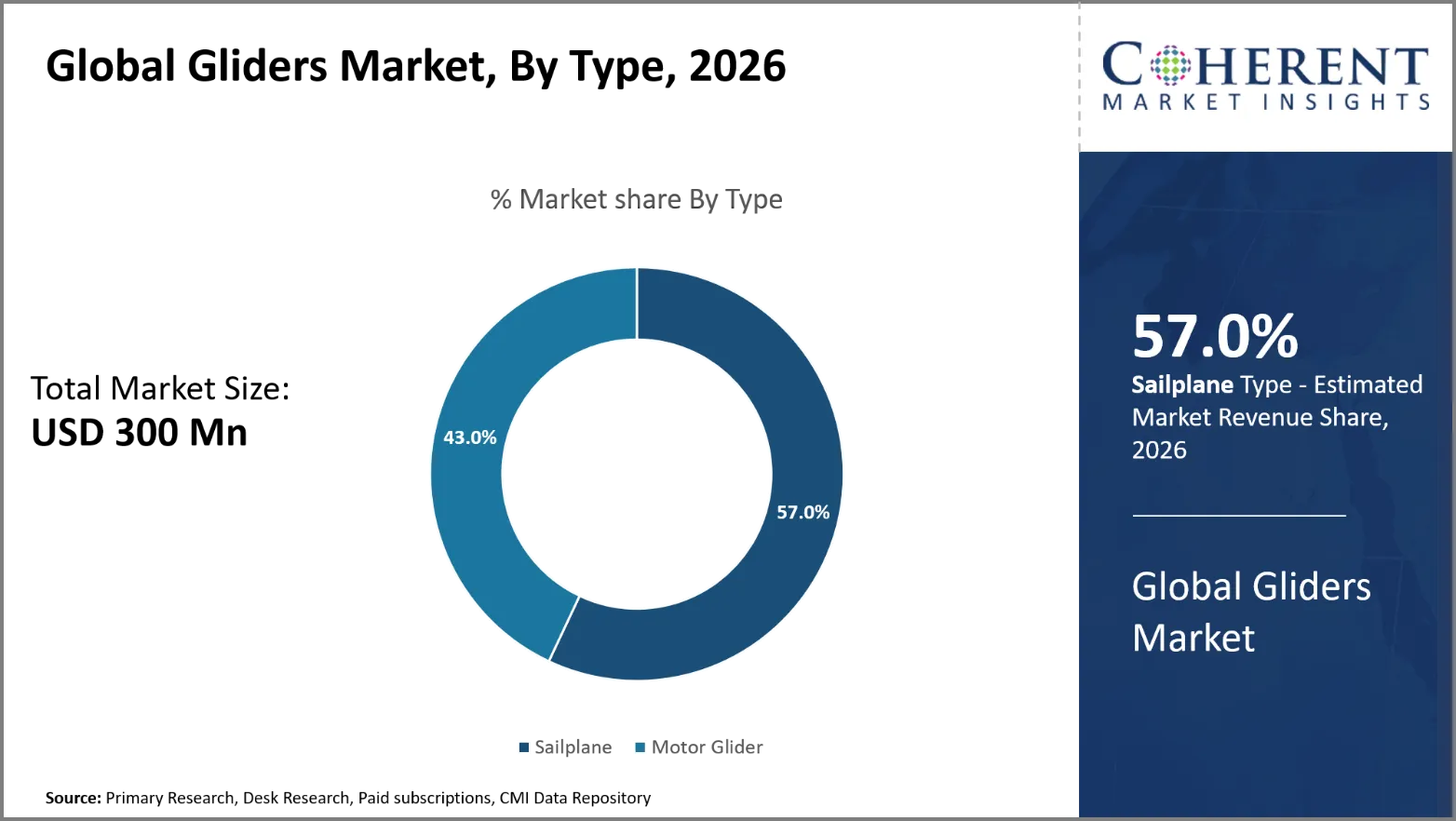
- The Sailplane segment is expected to account for 57.0% of the global gliders market share in 2026. Growing adoption of self-launching motor gliders is driving the growth of the segment. On April 18, 2025, Schempp-Hirth presented the Ventus E Performance at AERO 2025. The new fuselage provides additional battery space and approximately 30% greater battery power.
- The Commercial segment is estimated to capture 61.0% of the market share in 2026. Improvements in aerodynamic efficiency and flight performance is majorly driving the growth of the segment. In March 2026, Schempp-Hirth completed the first flight of an upgraded Discus-2b. The aircraft received new Generation 3 winglets and an electric Front Electric Sustainer system.
- The Private Owners segment is estimated to capture 41.0% of the market share in 2026. Rising interest in low-emission recreational aviation is driving the growth of the segment. In August 2026, Whisper Aero began flight testing its Whisper Powered Swift. The company installed two eQ250 electric ducted fans on an Aériane Swift 3 glider.
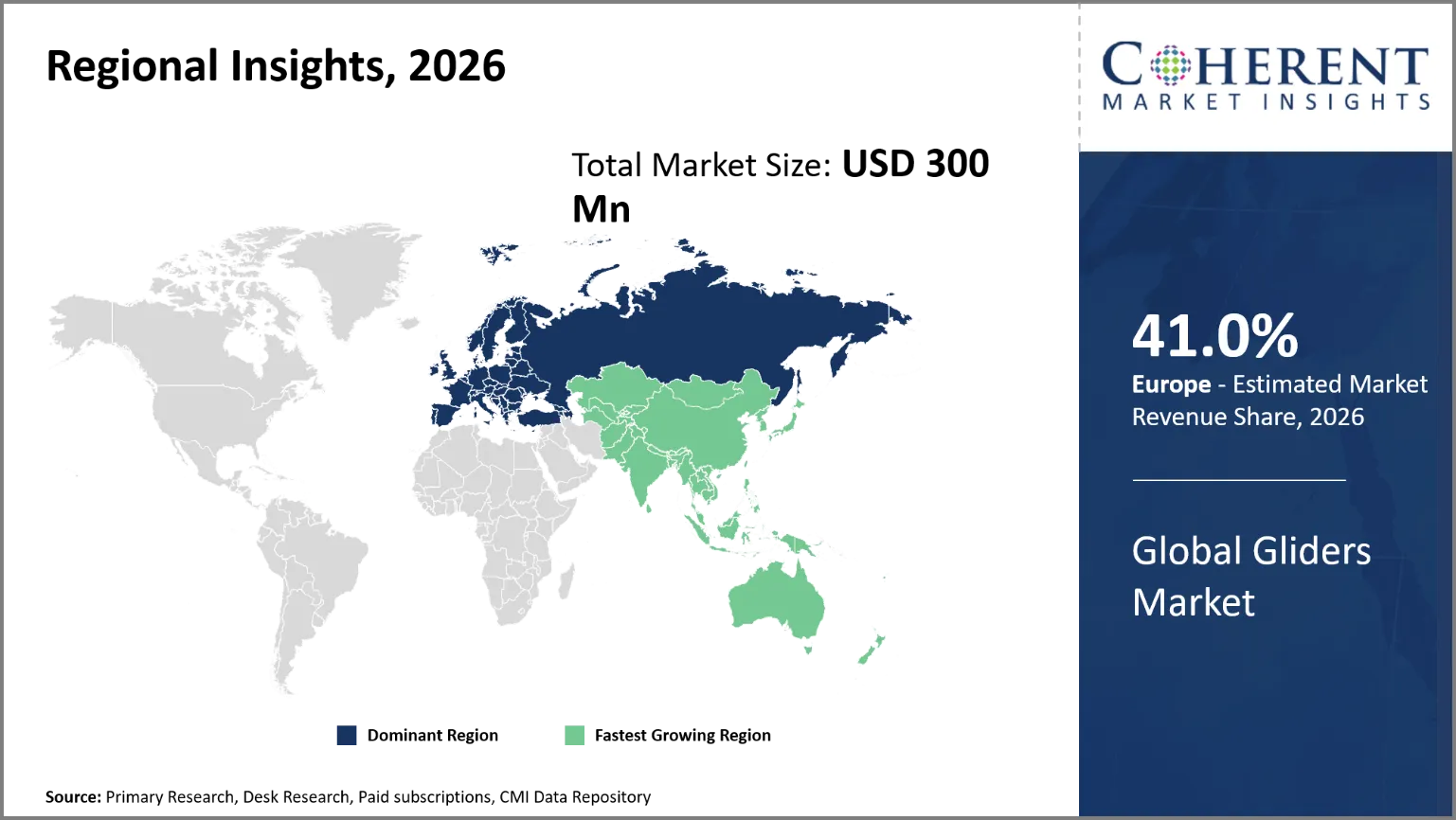
- Europe is expected to dominate the gliders market in 2026 with a market share of 41.0%. Increasing modernization of aging glider fleets in Europe is driving the growth of the regional market. For instance, The Slovenian specialist has renovated more than 1,700 sailplanes worldwide during the first quarter of 2026. Its services include composite refinishing, cockpit restoration, modifications, inspections, and airworthiness management.
- Asia Pacific is expected to account for 23.0% share in 2026. Growing applications in specialized training and aerial observation in Asia Pacific is driving the growth of the regional market. For example, The Royal New Zealand Air Force Base Auckland Aviation Sports Club continued structured glider training during 2025 and 2026. The club operates from Whenuapai and uses a Grob G103 Twin II Astir as its primary training aircraft.
Segmental Insights
Why Does Sailplane Dominate the Global Gliders Market?
The sailplane segment is expected to account for 57.0% of the global gliders market share in 2026. Sailplanes are dominant because they offer efficient long-duration soaring without the need for constant engine operation. Their aerodynamic shape allows pilots to fly in naturally occurring rising air currents. This makes sailplanes ideal for recreational flying, competitive soaring and pilot training. Modern composite structures result in further improvements in terms of gliding performance, durability and operational efficiency. The rising interest in sustainable recreational aviation is continuing to drive the demand for high-performance sailplanes. On February 14, 2026, Jonker Sailplanes introduced the SOLO 2625 02i NEO Silent engine. The new 50-horsepower engine targets improved reliability and reduced vibration in powered sailplanes. Jonker initially selected the engine for the JS2 and JS5 models. The development strengthens the performance of self-launching sailplanes while retaining efficient soaring capability.
- Current Industry Events of 2026
- Market Size Estimation
- Regional Breakdown
- Competitive Landscape
- Customer Intelligence
- Segmental Analysis
- Pricing Analysis
- Key Market Drivers, Challenges & Future Trends
- Customized Insights Section
Why is Commercial the Most Widespread Application?
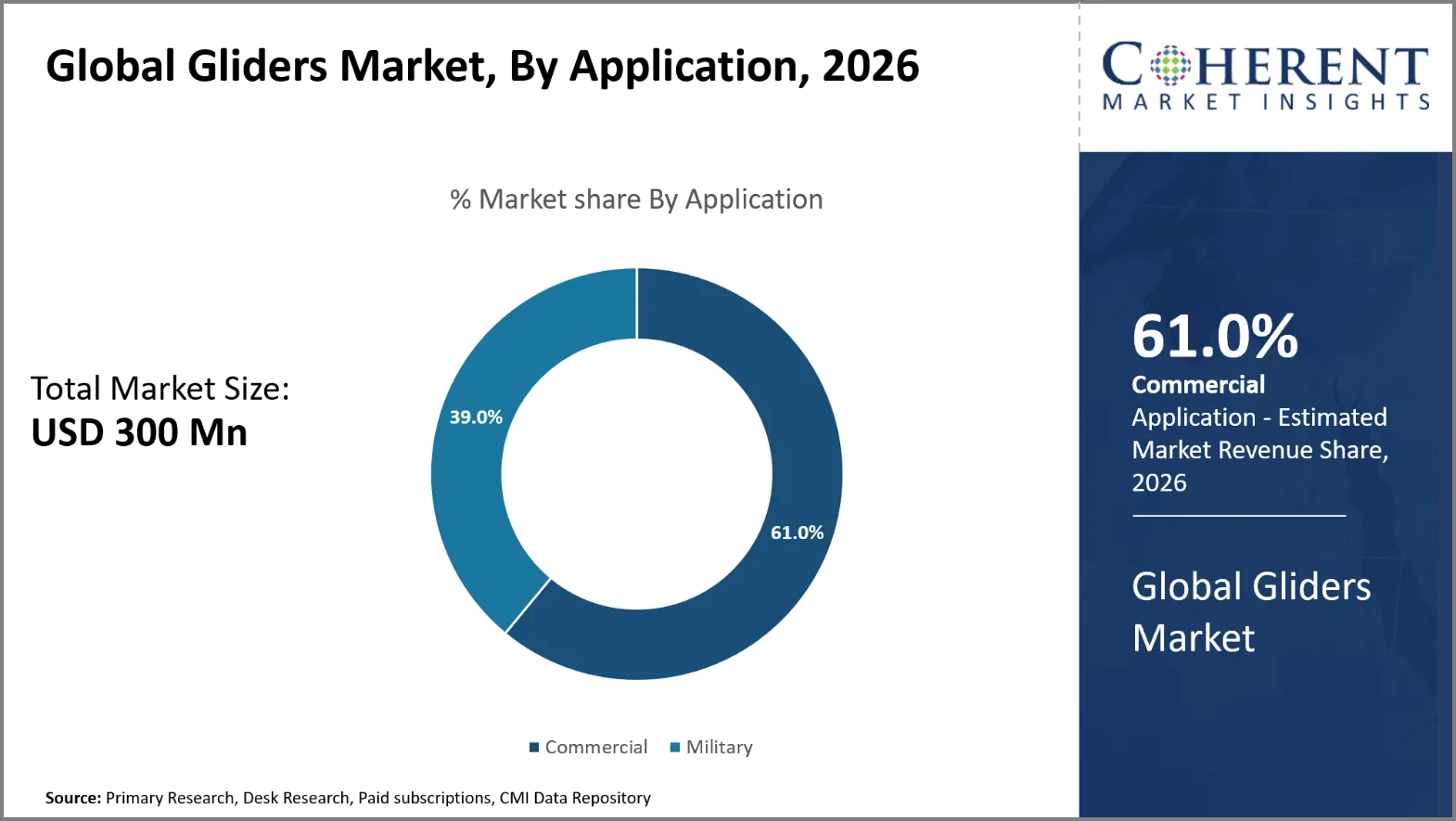
The commercial segment is expected to account for 61.0% of the global gliders market share in 2026. Gliders are practical for commercial purposes, helping with structured flight instruction and coordinated aviation programs. Flight schools employ gliders to teach basic skills before advanced training in powered aircraft. Commercial operators also promote tourism, sightseeing and specific aerial activities. Their comparatively modest operating requirements might help improve training accessibility for aviation groups. The increasing demand for cost-efficient pilot training is supporting the ongoing commercial glider applications. For instance, The Geelong Gliding Club increased their training support in 2026 with a new Eurofox tow plane. The Australian club operates from Bacchus Marsh and maintains a substantial training workload. The club normally has 10 to 15 pre-solo students among its membership.
Private Owners Dominates the Global Gliders Market
The private owners segment is expected to account for 41.0% of the global gliders market share in 2026. Private ownership benefits from the personal freedom to schedule flights according to individual preferences and availability. Owners can modify aircraft equipment to suit certain soaring and performance requirements. It also enables users to fly recreationally as often as they want without having to schedule around a club. Many enthusiasts also place a high value on having direct control over maintenance, storage and upgrades to their aircraft. These advantages create a demand for skilled pilots looking for customized gliding experiences. In April 2026, Jonker Sailplanes extended owner-oriented customization of the JS5 Rey. Several propulsion systems are available for the aircraft, including a 50-kilowatt SOLO self-launch system and jet sustainer option. The cockpit incorporates adjustable rudder pedals, seating, storage pockets and maintenance access features. The company also provides a configurator allowing customers to customize aircraft appearance and performance options.
Current Events and their Impact
Current Events | Description and its Impact |
European Union - EASA Airworthiness Directive 2025-0136-E |
|
Australia - Civil Aviation Safety Regulations Part 21 |
|
Gliders Market Dynamics
Market Drivers
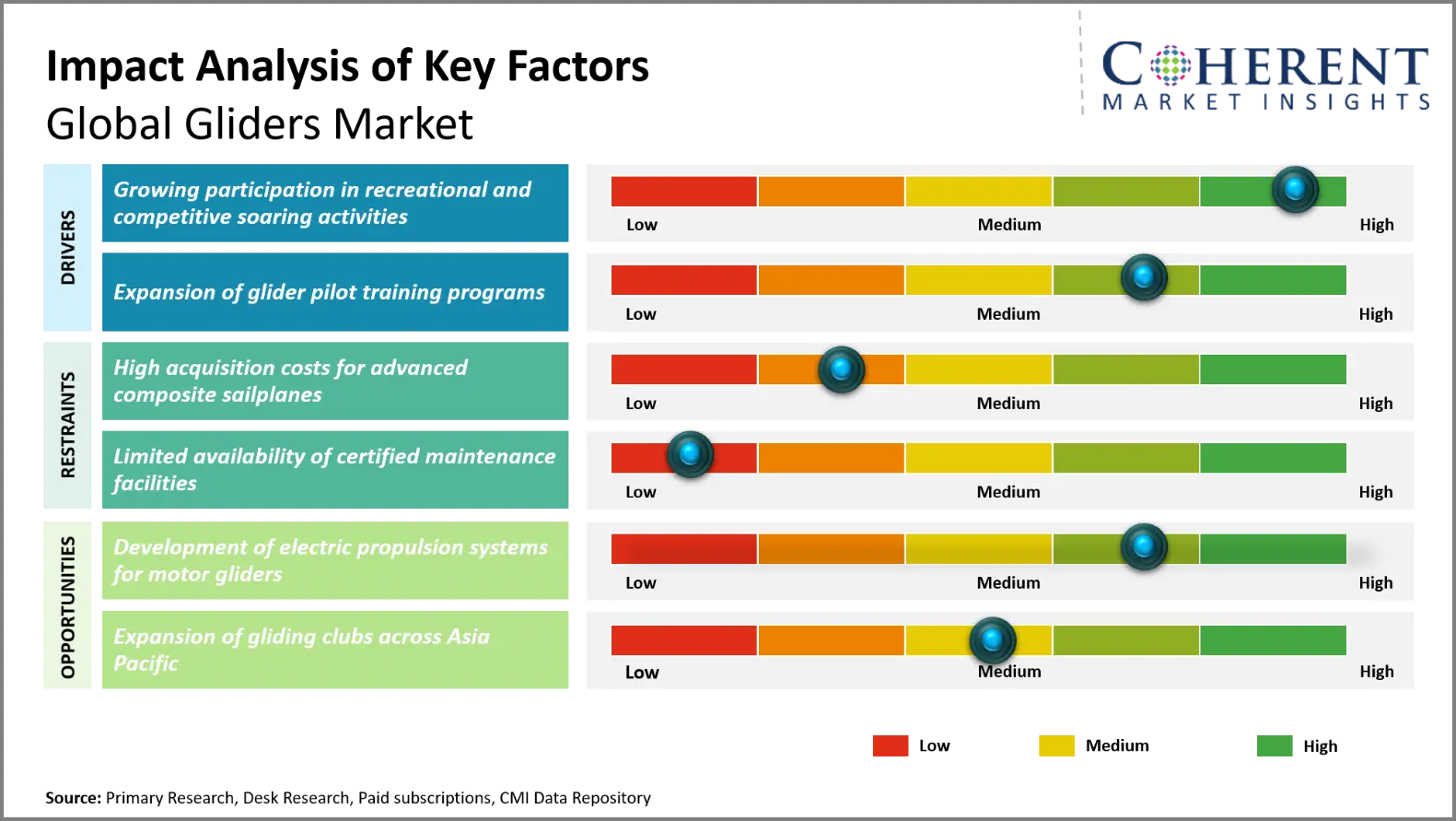
- Growing participation in recreational and competitive soaring activities: With more aviation enthusiasts in established gliding communities, recreational and competitive soaring activities are gaining popularity. With the improved aircraft performance, pilots can control and efficiently fly longer trips. Competitions stimulate pilots to develop sophisticated skills in soaring, navigation and flight-planning. The gliding clubs are also increasingly organizing competitions and recreational activities that increase participation and community engagement. The rise in participation is supporting demand for sailplanes, training aircraft, flight equipment and maintenance services. For example, 17 countries sent competitors to the 2025 Women’s World Gliding Championships. The event took place at Zbraslavice in the Czech Republic. British pilot Anne Soltow won the final-day race after leading much of the task. The competition included three classes and involved sustained participation despite nine cancelled flying days. The event also strengthened opportunities for women entering international competitive soaring.
- Expansion of glider pilot training programs: Aviation groups are extending glider pilot training programs as an accessible pathway to flying training. Gliders give students an opportunity to learn the basics of flying before they go on to powered aircraft. More and more training programs are teaching how to launch, how to soar, how to navigate, and how to handle emergencies. Flying clubs and aviation schools enhance pilot growth by providing supervised solo and advanced instruction. The expansion produces an ongoing demand for glider instruction, instructors, maintenance services and flight instrumentation. For instance, the 2026 Junior World Gliding Championships provided an intensive international training environment in Germany. The event brought 79 competitors representing 22 nations. Official training began before the championship competition.
Emerging Trends
- Electric Motor Glider Development: Manufacturers are developing more electric propulsion systems that reduce noise, operating emissions and fuel dependence, especially for training and recreational flights, while improving launch flexibility and extending operational capabilities for modern motor gliders.
- Advanced Composite Airframe Integration: Glider manufacturers are increasingly integrating advanced composite materials to enhance aerodynamic efficiency, structural integrity, and weight savings, leading to longer soaring times, improved handling characteristics, and greater performance in recreational and competitive flying.
- Digital Flight Instrumentation Adoption: Modern gliders are now equipped with digital flight computers, small satellite navigation, variometers, and advanced cockpit displays that allow pilots to optimize soaring routes, monitor atmospheric conditions, improve navigation accuracy, and enhance decision-making during longer cross-country flights.
- Expansion of Sustainable Gliding Technologies: The sector is exploring sustainable propulsion, lightweight materials and energy-efficient electric aircraft designs to reduce environmental impacts, support quieter operations and improve the long-term appeal of gliding in a changing recreational aviation ecosystem.
Regional Insights
Why is Europe a Strong Market for Gliders?
Europe is expected to account for a market share of 41.0% in 2026. Europe still is a key gliding hub due of dense competition networks and well-established soaring infrastructure. The 2026 European Gliding Championships in Poland will include the Club, Standard and 15-meter classes. The tournament draws some of the most competitive pilots in Europe. The Federation Aeronautique Internationale ranking also features strongly in the German, British, French, Belgian and Polish pilots. Frequent championship activity and cross-border involvement is good for European manufacturers and clubs. And the 2026 Junior World Gliding Championships in Germany further enhance youth involvement. Germany, France, the United Kingdom, Poland, and Belgium maintain active competitive ecosystems. These events continuously support demand for sailplanes, instruments, maintenance, training, and competition services.
Why Does Asia Pacific Gliders Market Exhibit High Growth?
Asia Pacific is expected to register the fastest growth with a CAGR of 3.8% over the forecast period. The region is projected to account for 23.0% of the global gliders market in 2026. Asia Pacific is gaining gliding activity through Australia, Japan, New Zealand, and emerging aviation communities. Australia has particularly strong competitive infrastructure and organized national training. Gliding Australia selected teams for the 2025 and 2026 World Gliding Championships across multiple classes. Its 2025 world championship team included James Nugent, Daniel Summers, Matthew Scutter, and David Jansen. Gliding Australia also maintains junior membership categories for pilots below 26 years. Japan contributes established Federation Aeronautique Internationale participation and international competition representation. Australia additionally operates structured national and state championship programs. These developments create opportunities for training fleets, competition sailplanes, flight instruments, and maintenance services.
Global Gliders Market Outlook for Key Countries
Why is Germany Emerging as a Major Hub in the Gliders Market?
Germany stands out through its large competitive base, strong youth pipeline, and sophisticated championship structure. The 2026 German Standard and 15-metre championships attracted 85 top pilots at Zwickau. More than one-third had national-team experience or international podium results. Germany also hosted the 2026 Junior World Gliding Championships at Aalen. German pilots won three individual medals and the Junior World Championship Team Cup. Germany secured that Team Cup for the fifth time in six junior world championships. The German Aero Club also runs an annual decentralized cross-country championship covering the entire flying season. This combination supports sustained demand for sailplanes, training, equipment, and competition services.
Is Australia the Next Growth Engine for the Gliders Market?
Australia has plenty of lofty geography and national development schemes. Gliding Australia provides structured training from initial instruction through to the Glider Pilot Certificate. Flying members shall be members of affiliated gliding clubs so as to encourage membership of clubs. Its strategy plan for 2025-2027 offers a specific foundation for growth in the company. Australia also maintains junior membership categories for pilots below 26 years. Its 2025 World Gliding Championship team included four pilots across Club and 15-metre classes. A dedicated Soaring Development Fund supported international team participation. As of 31 March 2025, the fund had USD 511,512 and strong competition development resources. These factors strengthen training, youth participation, competition, and aircraft utilization.
U.S. Gliders Market Analysis and Trends
The U.S. has a strong soaring ecosystem supported by the Soaring Society of America and organized national teams. The association selects U.S. teams annually for World Gliding Championships. The 2026 teams included Sarah Arnold, Sean Fidler, John Good, Tyler Byron, Patrick Cernuto, and Michael Hayter. The Soaring Society of America describes World Gliding Championships as the highest accolade for soaring racing pilots. U.S. pilots also participate across Open, 18-metre, Standard, Club, and multi-seat categories. Competitive racing creates recurring demand for high-performance sailplanes, avionics, trailers, instruments, and specialized maintenance. Youth world championship participation further supports future pilot development.
France Gliders Market Analysis and Trends
France benefits from an active club competition system that directly encourages frequent pilot participation. The Fédération Française de Vol en Planeur runs its national club championship across seventeen rounds. During 2025, the Association Aéronautique Verdon Alpilles won with 157 points. The Centre Vélivole du Val de l’Eure finished only one point behind. The 2026 championship again scheduled seventeen rounds between late April and mid-August. The competition uses the WeGlide platform for ongoing rankings and performance tracking. France also produces internationally competitive pilots, including Christophe Abadie in the Federation Aeronautique Internationale ranking. Club-level competition therefore remains a distinct demand driver for aircraft utilization and upgrades.
U.K. Gliders Market Analysis and Trends
The U.K. has a highly structured competition calendar spanning national, regional, junior, and international events. The 2026 national calendar includes competitions at Cotswold Gliding Club, Bristol and Gloucestershire Gliding Club, and The Gliding Centre. National championship entry limits reach 50 places for Club and 18-metre classes. The British Gliding Team fields pilots across World and European championship classes. The 2026 junior team includes Seb Van Der Stichele, Tom Chapman, Oliver Ramsay, and Oscar Butlin. British competitions also include dedicated junior nationals at Lasham Gliding Society. This extensive competition structure supports recurring training, aircraft rental, maintenance, and high-performance sailplane demand.
Global Gliders Market - Gliding Championship Participation by Country (2025)
Country | Estimated Championship Participants |
Germany | 18 |
France | 16 |
United Kingdom | 15 |
Czech Republic | 14 |
Poland | 13 |
Australia | 10 |
Austria | 9 |
Switzerland | 9 |
Netherlands | 8 |
Sweden | 7 |
How is Development of Electric Propulsion Systems for Motor Gliders Creating New Growth Opportunities in the Gliders Market?
Development of electric propulsion is creating new opportunities by enabling motor gliders to launch independently without conventional fuel engines. Pipistrel’s Taurus Electro uses a 40-kilowatt electric powertrain and retractable propulsion system. Its battery system can launch to over 2,500 meters. Battery health and component temperatures are monitored on board. The company has also supported quick charging since 2018, making it more operationally practical for frequent flying. A United States regulatory filing showed 23 Taurus Electro aircraft delivered by 2024, with an excellent operating record. Electric propulsion also allows for quieter operation in places near population centers and for less mechanical complexity. These properties offer potential for self-starting gliders, training fleets, club operations and green recreational flying.
On May 1, 2025, Allstar PZL Glider unveiled its PERKOZ-e-motion electric propulsion development. At AERO 2025, the Polish firm showed the SZD-54-3 PERKOZ-e-motion. The company developed the electric system specifically for the PERKOZ platform.
Market Players, Key Development, and Competitive Intelligence
Key Developments
- On August 24, 2026, DG Aviation introduced operational developments around its DG-1001 series. The company announced a retrofit program for the DG-1001 handicap system. The modification allows pilots with specific physical requirements to operate the aircraft.
- On August 3, 2026, the new HPH Shark 4 completed its maiden flight. HpH has developed a completely new 18-meter wing for the Shark. This brings yet another modern, self-launching 18-meter glider to the market. With a maximum wing loading of 60 kg/m², the Shark 4 is on par with today’s standard for modern 18-meter gliders.
- On May 6, 2026, Jonker Sailplanes announced the lifting of operational restrictions for its JS3 RES. The European Union Aviation Safety Agency lifted the Emergency Airworthiness Directive restrictions affecting the electric propulsion system.
Competitive Landscape
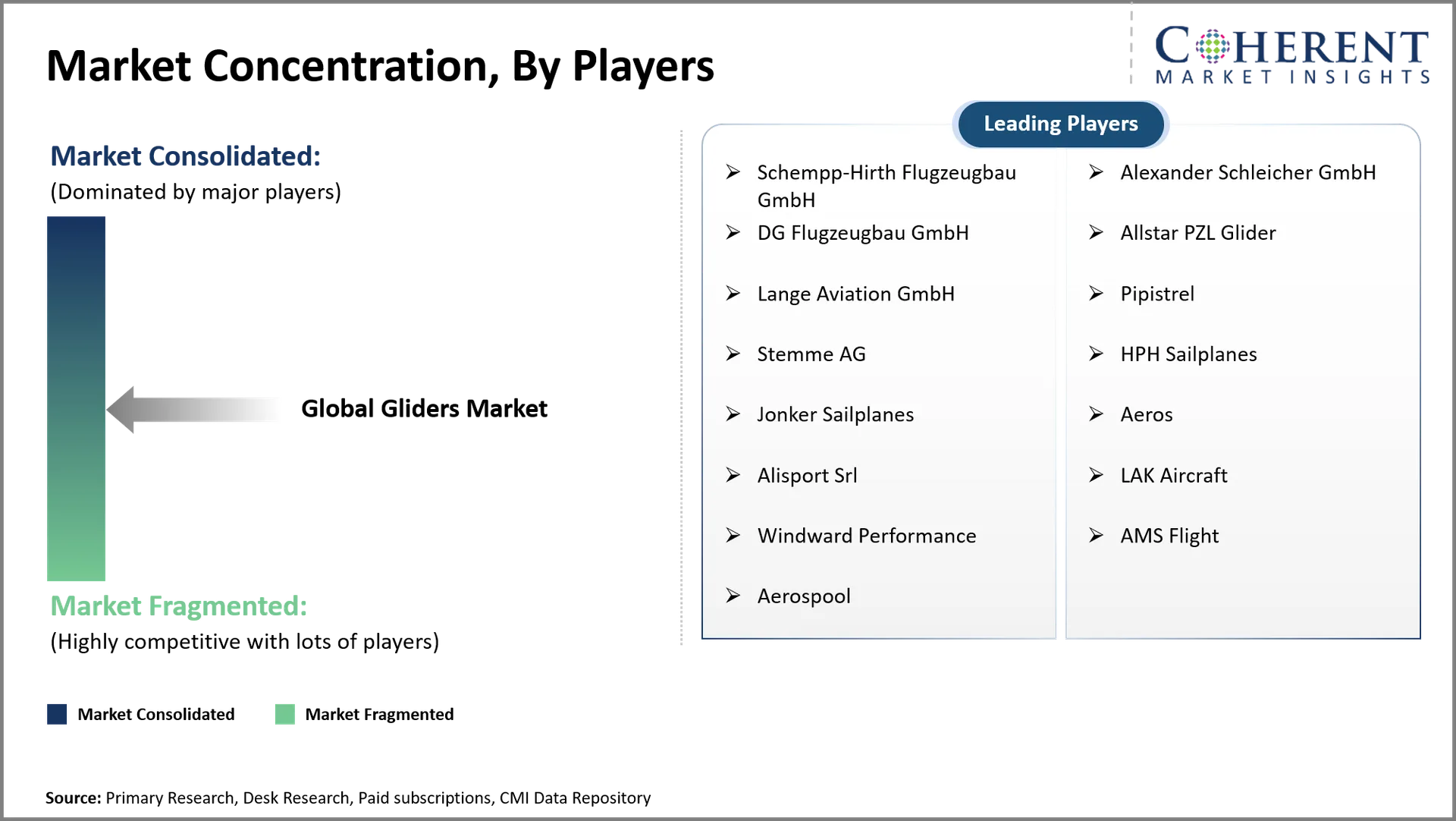
The gliders market is led by manufacturers combining high-performance sailplanes with electric and self-launch systems. Schempp-Hirth Flugzeugbau offers Ventus, Arcus, and Discus families across multiple propulsion configurations. Its Ventus E uses a 39-kilowatt electric motor for self-launching operations. Schempp-Hirth also focuses on retrofit demand, with Front Electric Sustainer systems installed in more than 100 gliders. Pipistrel focuses on electric motor gliders through the Taurus Electro G2.5. Its 40-kilowatt system uses removable lithium batteries and integrated battery monitoring. Lange Aviation concentrates on electric propulsion technology for self-launching sailplanes. Jonker Sailplanes emphasizes high-performance aircraft for competitive soaring and long-distance flying. Leading players therefore compete through propulsion innovation, aerodynamic efficiency, retrofit capability, and competition-grade performance.
Global Gliders Market Report Coverage | |||
Report Coverage | Details | ||
Base Year | 2025 | Market Size in 2026: | USD 300 Mn |
Historical Data For: | 2020 To 2024 | Forecast Period: | 2026 To 2033 |
Forecast Period 2026 To 2033 CAGR: | 3.30% | 2033 Value Projection: | USD 485 Mn |
Geographies covered: |
| ||
Segments covered: |
| ||
Companies covered: | Schempp-Hirth Flugzeugbau GmbH, Alexander Schleicher GmbH, DG Flugzeugbau GmbH, Allstar PZL Glider, Lange Aviation GmbH, Pipistrel, Stemme AG, HPH Sailplanes, Jonker Sailplanes, Aeros, Alisport Srl, LAK Aircraft, Windward Performance, AMS Flight, Aerospool | ||
Growth Drivers: |
| ||
Restraints & Challenges: |
| ||
Analyst Opinion (Expert Opinion)
- The industry should increasingly shift toward motor gliders combining electric propulsion with efficient sailplane aerodynamics. Electric systems already support self-launching and emergency energy management in commercially available aircraft. Schempp-Hirth's Ventus E demonstrates this transition with approximately 39 kilowatts of peak power. Battery improvements should gradually expand practical electric flight envelopes. The strongest future products will combine lightweight structures, efficient motors, advanced battery management, and simple cockpit controls.
- The largest opportunity should emerge in electric self-launching sailplanes and electric sustainer systems. Single-seat performance gliders can benefit from lighter propulsion architectures and reduced system complexity. Two-seat training aircraft also offer an attractive opportunity because electric systems can provide controlled launches and safer returns. Retrofit solutions represent another strong opportunity because many older gliders remain operational for decades. Schempp-Hirth already targets this segment with FES upgrades for several established aircraft families. Germany, France, and the wider European market should remain particularly important because manufacturers and competitive gliding communities are concentrated there.
- Players should gain an edge by improving battery energy density without compromising aircraft balance or payload. They should also build modular battery systems to facilitate replacement and future improvements. A good example is the Schempp-Hirth Generation 4 FES batteries, which increase capacity from about 4.2 to 5.6 kilowatt-hours. Manufacturers should focus on propulsion systems that are ready for certification and compatible charging devices. By collaborating with electric motor experts, propulsion development can be accelerated, and internal engineering workloads can be reduced.
Speak to the analyst
Want personalized insights?
Take the findings above to one of our principal consultants, or have the report rebuilt around the segments, geographies and competitors you actually track.
Market Segmentation
- Type Insights (Revenue, USD Mn, 2021 - 2033)
- Sailplane
- Motor Glider
- Application Insights (Revenue, USD Mn, 2021 - 2033)
- Commercial
- Military
- End User Insights (Revenue, USD Mn, 2021 - 2033)
- Private Owners
- Flying Clubs
- Flight Schools
- Government and Defense Organizations
- Regional Insights (Revenue, USD Mn, 2021 - 2033)
- North America
- U.S.
- Canada
- Latin America
- Brazil
- Argentina
- Mexico
- Rest of Latin America
- Europe
- Germany
- U.K.
- Spain
- France
- Italy
- Russia
- Rest of Europe
- Asia Pacific
- China
- India
- Japan
- Australia
- South Korea
- ASEAN
- Rest of Asia Pacific
- Middle East
- GCC Countries
- Israel
- Rest of Middle East
- Africa
- South Africa
- North Africa
- Central Africa
- North America
Sources
Primary Research Interviews
- Glider Manufacturers & OEMs
- Glider Pilots & Aviation Enthusiasts
- Aviation Training Institute Representatives
- Glider Component Suppliers & Distributors
Magazines
- Soaring Magazine (Soaring Society of America)
- Gliding International Magazine
- Aviation Week & Space Technology
Journals
- Journal of Aerospace Engineering
- Journal of Aircraft (AIAA)
- International Journal of Aviation, Aeronautics, and Aerospace
Associations
- Soaring Society of America (SSA)
- British Gliding Association (BGA)
- Fédération Aeronautique Internationale (FAI)
- European Gliding Union (EGU)
Public Domain Sources
- Federal Aviation Administration (FAA) Official Website
- European Union Aviation Safety Agency (EASA) Reports
- ICAO Annual Reports & Publications
- NASA Technical Reports Server (NTRS)
Proprietary Elements
- CMI Data Analytics Tool
- Proprietary CMI Existing Repository of Information for Last 10 Years
Get access to 250+ pages report
Every segment, forecast, competitor profile and data table behind the analysis above — available for instant download.
- ESOMAR Member
- ISO 9001:2015 Certified
- D-U-N-S Registered
- GDPR & CCPA Compliant
Missing comfort of reading report in your local language? Find your preferred language:
Frequently Asked Questions
The global gliders market is expected to stand at USD 300 Mn in 2026 and is expected to reach USD 485 Mn by 2033.
The CAGR of the global gliders market is projected to be 3.3% from 2026 to 2033.
Growing participation in recreational and competitive soaring activities and expansion of glider pilot training programs are the major factors driving the growth of the global gliders market.
High acquisition costs for advanced composite sailplanes and limited availability of certified maintenance facilities are the major factors hampering the growth of the global gliders market.
In terms of type, sailplane segment is estimated to dominate the market revenue share in 2026.
A motor glider combines sailplane characteristics with an engine or electric propulsion system.
Electric propulsion provides self-launch capability and can support powered returns during unsuitable soaring conditions.