

Global Go-Kart Market Size and Forecast – 2026 To 2033
The global go-kart market is expected to grow from USD 180 Mn in 2026 to USD 295 Mn by 2033, registering a compound annual growth rate (CAGR) of 5.3% from 2026 to 2033. The global go-kart market is driven by increasing family entertainment center development. On January 15, 2025, K1 Speed opened its Knoxville center. The venue added two indoor tracks and expanded family entertainment capacity.
Key Takeaways of the Global Go-Kart Market
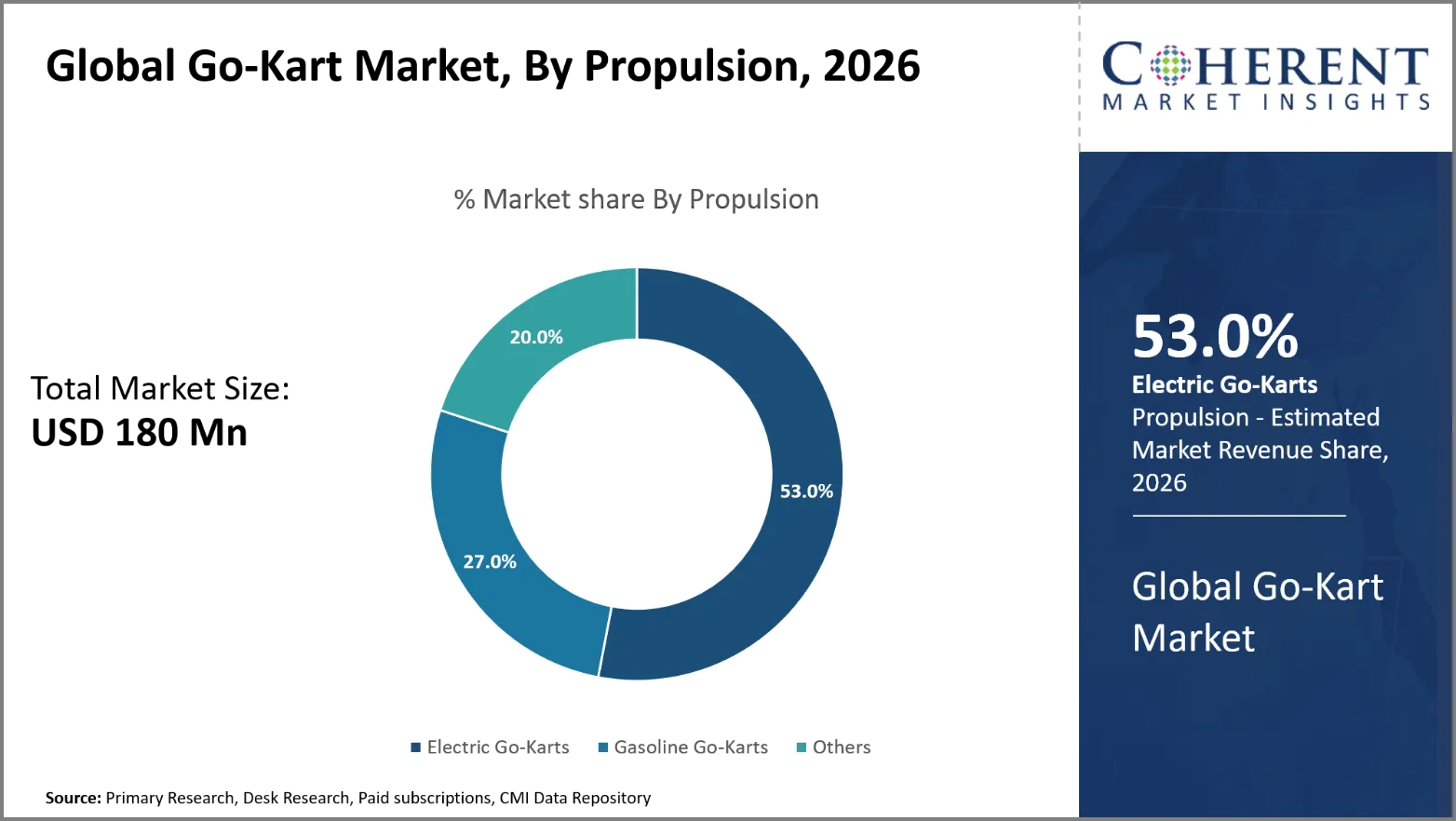
- The Electric Go-Karts segment is expected to account for 53.0% of the global go-kart market share in 2026. Growing adoption of electric go-karts in grassroots racing is driving the growth of the segment. On November 3, 2025, Blue Shock Race launched its Gen 2.5 electric karting system. The system targets racing and rental applications with upgraded battery and power delivery technology.
- The Indoor Karting segment is estimated to capture 61.0% of the market share in 2026. Increasing demand for premium entertainment experiences is majorly driving the growth of the segment. On January 30, 2026, Formula 1 reopened Grand Prix Plaza in Las Vegas, U.S. The venue includes F1 DRIVE karting, interactive attractions, and upgraded immersive experiences.
- The Leisure Go-Karts segment is estimated to capture 41.0% of the market share in 2026. Rising disposable income in emerging economies is driving the growth of the segment. For instance, Timezone announced plans to invest more than USD 10.4 million annually in India during 2025. The company targeted 100 Indian locations by 2026, including tier-two and tier-three cities.
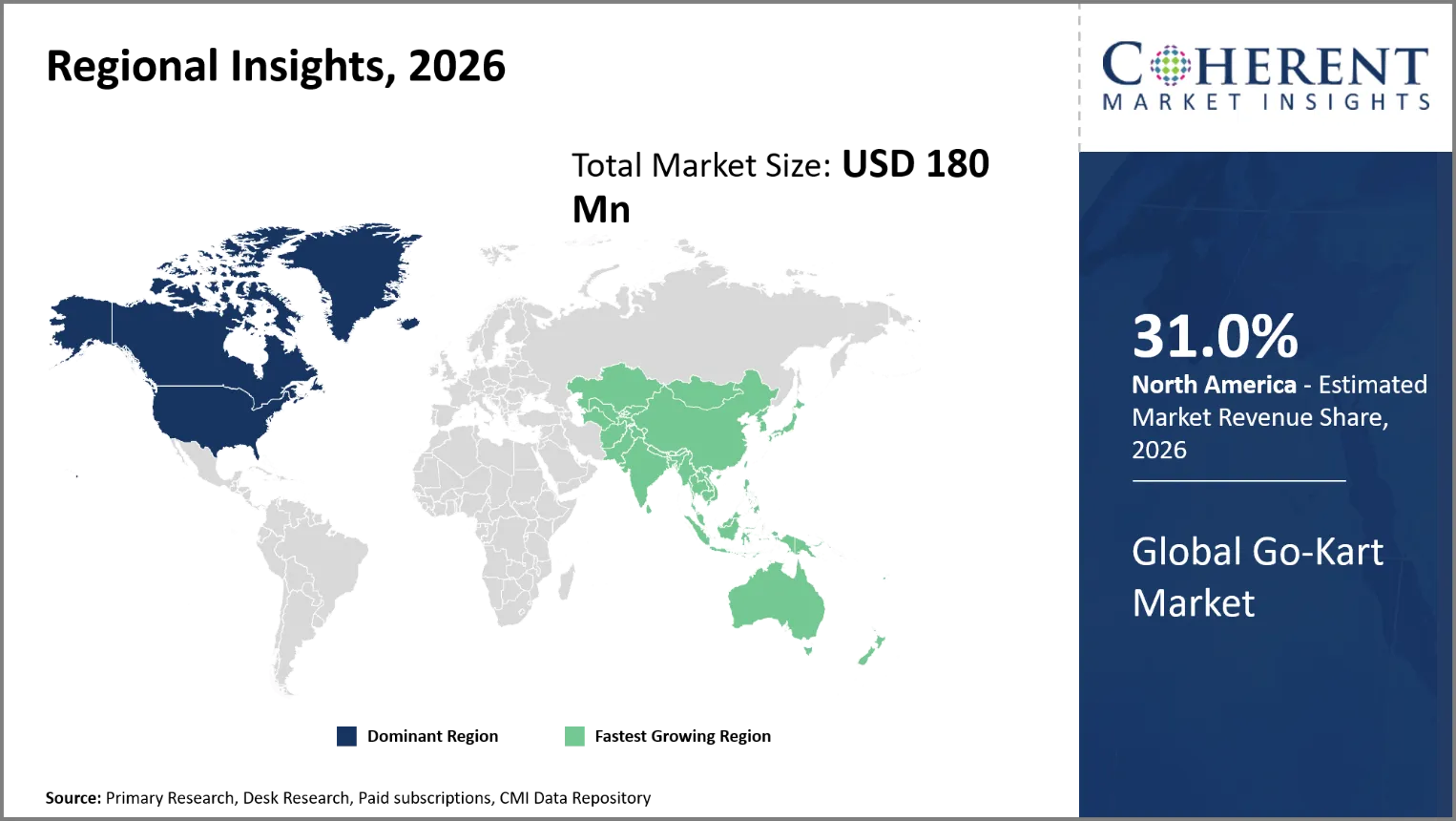
- North America is expected to dominate the go-kart market in 2026 with a market share of 31.0%. Growing corporate entertainment and team-building activities in North America is driving the growth of the regional market. On August 28, 2026, K1 Speed opened K1 Speed Cleveland. The 70,000-square-foot venue added corporate event packages and private facility rentals. The company specifically highlighted company events and team-building gatherings.
- Asia Pacific is expected to account for 26.0% share in 2026. Increasing integration of digital timing and telemetry systems in Asia Pacific is driving the growth of the regional market. On October 1, 2025, BRP-Rotax confirmed its 2026 International Trophy Asia for Macau in January 2026. The event supports competitors across seven Rotax categories.
Segmental Insights
Why Does Electric Go-Karts Dominate the Global Go-Kart Market?
The electric go-karts segment is expected to account for 53.0% of the global go-kart market share in 2026. Electric go-karts are being adopted because they are quieter and have lower local emissions. The rapid torque gives recreational users quick acceleration and a smoother driving experience. Less frequent routine maintenance equals less downtime for commercial karting operators. Battery-powered fleets also assist interior settings that are constrained by noise and air quality. Operators are also benefiting from increased investment in electric motorsport and sustainable entertainment. On February 13, 2026, K1 Speed opened its Totowa facility in New Jersey, U.S., with all-electric OTL Super leggero karts. The karts provide instant electric torque and acceleration reaching speeds of up to 45 miles per hour. The facility adds more than 2,000 feet of indoor racing space.
- Current Industry Events of 2026
- Market Size Estimation
- Regional Breakdown
- Competitive Landscape
- Customer Intelligence
- Segmental Analysis
- Pricing Analysis
- Key Market Drivers, Challenges & Future Trends
- Customized Insights Section
Why is Indoor Karting the Most Preferred Track Type?
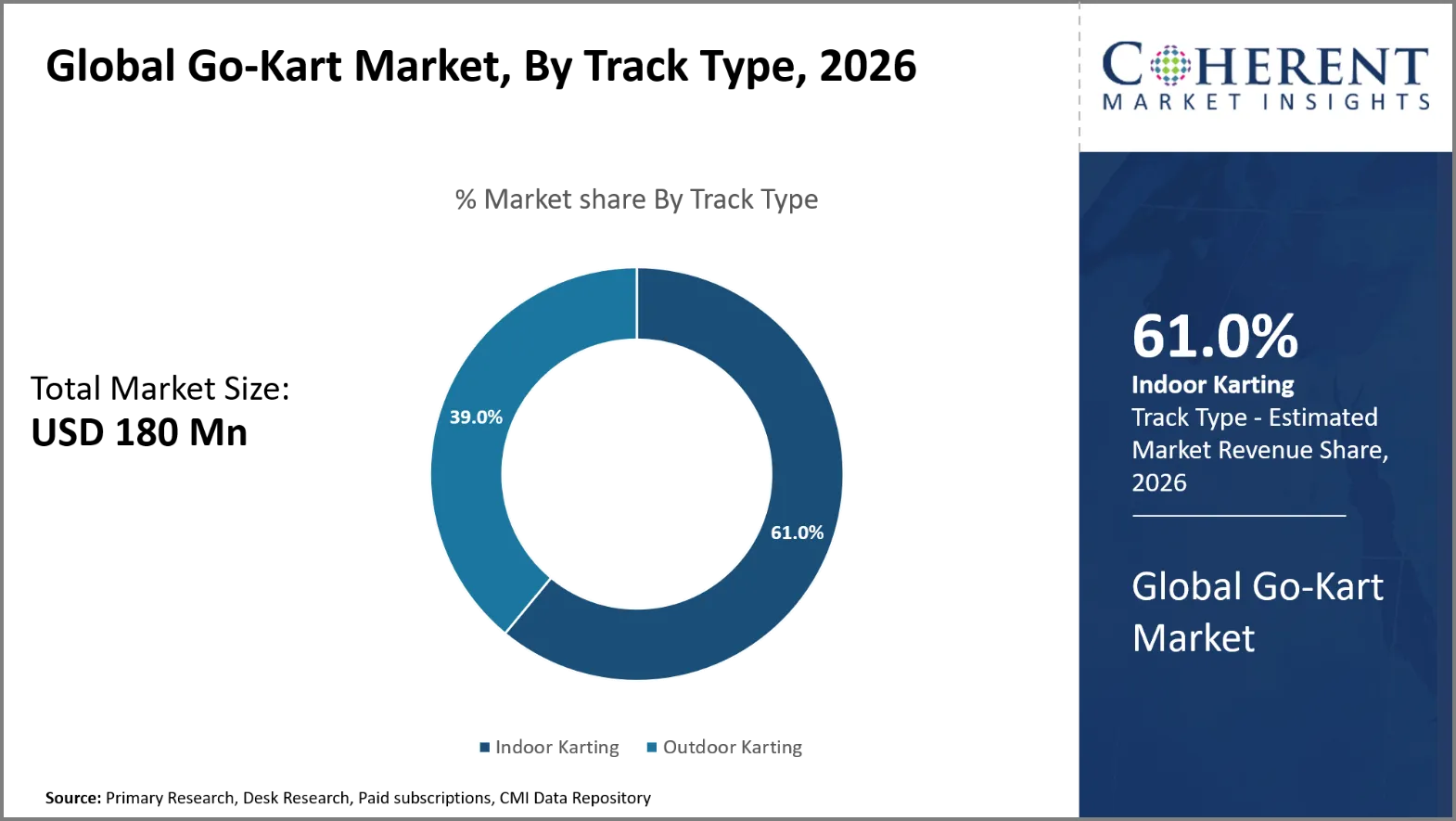
The indoor karting segment is expected to account for 61.0% of the global go-kart market share in 2026. Indoor karting offers stable operation conditions because it is less subject to weather and seasonal disruptions. Operators can follow consistent schedules in climate-controlled workplaces all year. Compact indoor tracks can be found in urban entertainment complexes and shopping centers. Electric karts also eliminate the noise and emissions issues of enclosed facilities. These advantages support frequent visits, family entertainment, corporate events, and organized recreational activities. On April 9, 2025, RPM Raceway announced the official re-opening of its Long Island location in U.S. The extensive, multi-million-dollar renovation introduced the world’s longest indoor multi-level go-kart racing track, a new fleet of high-performance go-karts and an all-new high-tech changing experience that blends the thrill of real-world racing with digital gamification.
Leisure Go-Karts Dominates the Global Go-Kart Market
The leisure go-karts segment is expected to account for 41.0% of the global go-kart market share in 2026. Leisure karting attracts broad participation as it provides accessible recreational experiences without requiring professional racing skills. Indoor karting offers stable operation conditions because it is less subject to weather and seasonal disruptions. Operators can follow consistent schedules in climate-controlled workplaces all year. Compact indoor tracks can be found in urban entertainment complexes and shopping centers. Electric karts also eliminate the noise and emissions issues of enclosed facilities. In December 2025, Cinergy opened its Tall City entertainment center. The 100,000-square-foot venue includes two planned three-level indoor electric karting tracks. The company positioned the attraction for families, group celebrations, and extended entertainment visits.
Current Events and their Impact
Current Events | Description and its Impact |
European Union Battery Regulation (EU) 2023/1542 |
|
European Union General Product Safety Regulation (EU) 2023/988 |
|
Go-Kart Market Dynamics
Market Drivers
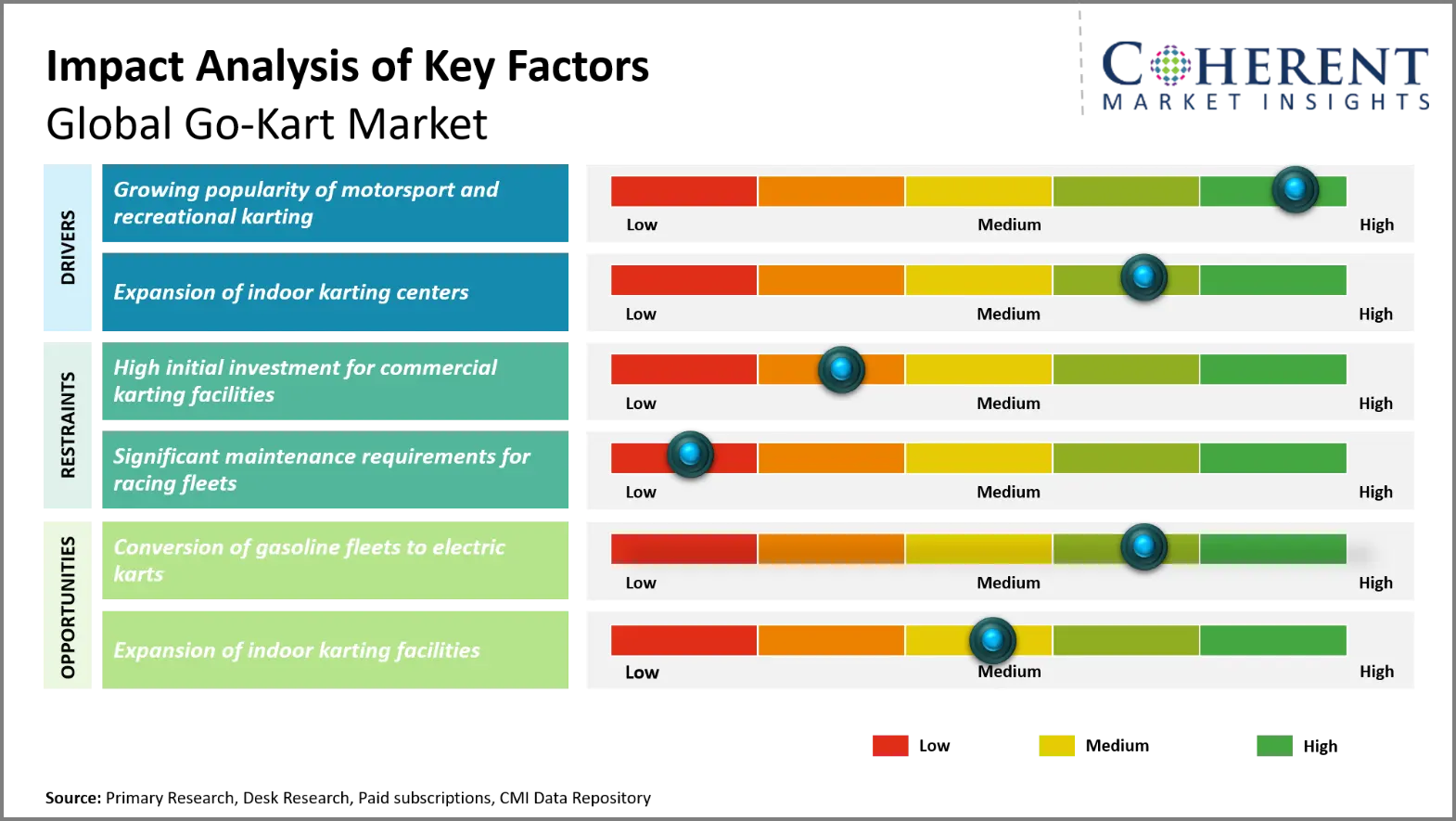
- Growing popularity of motorsport and recreational karting: The increasing popularity of racing is driving more people to join in karting activities globally. Those interested in experiencing accessible competitive driving can do so at the beginning level of karting. New people are getting into organized motorsports through youth programs and amateur tournaments. Recreational karting also appeals to families looking for engaging entertainment experiences. The larger participation drives demand for leisure and competitive go-karts in many areas. On March 5, 2026, BRP-Rotax debuted the E10 Mini category into Rotax MAX Challenge racing. The firm has included an electric category to the RMC racing and Grand Finals system. This breakthrough offers even another access point into the sport for younger players interested in motorsport.
- Expansion of indoor karting centers: Indoor karting centers are expanding, offering a controlled atmosphere for year-round recreational activities. These facilities are capable of operating irrespective of harsh weather conditions and seasonal disturbances. Operators can fit tracks into commercial sites and city entertainment complexes. Electric go-karts lend additional help to indoor operations in the reduction of exhaust pollutants and operational noise. Indoor karting centers are becoming more appealing as they become more integrated with food, gaming and entertainment services. On August 12, 2026, Kamin Science Center inaugurated its Science of Speed indoor karting complex. The 21,000-square-foot facility includes an 800-foot, three-level kart track. The attraction also features a Formula 1 simulator and racing exhibits.
Emerging Trends
- Electric Fleet Modernization: Karting operators are increasingly switching to electric over combustion fleets for their instant torque, quiet operation, regenerative braking and lower routine maintenance, especially in indoor entertainment venues that want cleaner operations and better customer experiences.
- Connected Karting Systems: Digital timing, telemetry, driver monitoring, and connected fleet-management systems are becoming more ubiquitous across modern karting facilities, allowing operators to track vehicle performance, improve maintenance schedules, manage sessions, and provide customers with detailed performance data.
- Immersive Entertainment Integration: Karting centers are integrating racing with simulated reality, augmented reality, interactive lighting, gaming and themed environments to create broader entertainment experiences that drive longer consumer engagement and support diversified sources of income for commercial operators.
- Youth Karting Development: Manufacturers and motorsport groups are developing junior karting programs with age-appropriate equipment, organized competition formats, electric propulsion classes, and enhanced safety technology to help introduce younger participants to organized motorsport, while also supporting future participation in all competitive karting classes.
Regional Insights
Why is North America a Strong Market for Go-Kart?
North America is expected to account for a market share of 31.0% in 2026. North America has an established karting infrastructure and a healthy grassroots motorsport scene. The Federation Internationale de l’Automobile’s outreach for the 2025 Global Karting Plan included North American organizations. The initiative targeted 59 national sporting authorities in regions around the world, including the Americas. Professional and recreational karting tracks have also been developed in the United States and Canada. Karting is a gateway to racing and a way to encourage young and amateur competitiveness. The growth of electric karting offers prospects for indoor entertainment locations as well. These factors support demand for rental fleets, competition equipment, safety products, and karting accessories across North American facilities.
Why Does Asia Pacific Go-Kart Market Exhibit High Growth?
Asia Pacific is expected to register the fastest growth with a CAGR of 6% over the forecast period. It is projected to account for 26.0% of the global go-kart market in 2026. Asia Pacific is benefiting from expanding grassroots karting programs and more accessible international competition formats. 66 kart racers competed at the 2024 Asia Pacific Karting Championship in Singapore. The Federation Internationale de l'Automobile had arranged activities in eight countries through its Karting Slalom Group. Malaysia is to host the first FIA Karting Arrive and Drive World Cup in 2025. The event united 50 countries and minimized technical and budgetary hurdles on the side of the participants. 91% of participating drivers reported improved accessibility through the Arrive and Drive format. These initiatives are broadening participation across emerging Asian karting markets.
Global Go-Kart Market Outlook for Key Countries
Why is U.S. Emerging as a Major Hub in the Go-Kart Market?
The go-kart market in the U.S. benefits from the wide recreational karting segment as well as a solid base of competitive motorsport activity. In 2025 the Federation Internationale de l’Automobile expanded its National Karting Ranking outreach throughout the Americas. The program was predicted to surpass 1,500 drivers registered worldwide in 2025. American participation also benefits from widespread indoor entertainment facilities and established karting circuits. Electric rental fleets are increasingly suitable for enclosed entertainment environments. Competition development programs provide another demand source for performance chassis, engines, tires, and safety equipment. These reasons fuel demand in recreational and organized karting applications.
Is Japan the Next Growth Engine for the Go-Kart Market?
Japan has a great infrastructure for karting, including the Japan Automobile Federation. The federation licensed 3,250 karting drivers in 2025. It also registered 225 entrants in karting and 1,141 accredited officials in karting. 128 sanctioned karting races were held in Japan in 2025. The purpose-built electric vehicle class is a sign of the increasing penetration of electric powertrains in organized Japanese karting. The Japan Automobile Federation also maintains regional karting participation across Kanto, Chubu, Kansai, Kyushu, and other areas.
U.K. Go-Kart Market Analysis and Trends
The U.K. benefits from a large motorsport community and extensive club-level participation. Motorsport UK reports approximately 5,000 motorsport events annually across national and club levels. Its network includes around 720 motor clubs and approximately 100,000 enthusiasts. This club structure and regular grassroots competition is an added advantage for karting. The country's deep ties with Formula 1 also serve as a conduit for the development of youthful driving talent. There were 969 Motorsport UK officials and marshals supporting the British Grand Prix in 2025. This extensive network of volunteer assistance allows for continuous involvement in competitive motorsport disciplines, such as go-karting.
France Go-Kart Market Analysis and Trends
France benefits from a highly structured national karting championship covering multiple age groups and competition formats. The French Federation of Motor Sport scheduled 15 karting meetings during its 2025 season. The program covered 12 categories ranging from seven-year-olds to competitors aged 45 and above. Fourteen circuits hosted the national championship activities. Sixteen French championship titles were contested across sprint, endurance, long-circuit, and Superkart formats. The Junior Karting Championship included five scheduled rounds across circuits including La Hague, Salbris, Mirecourt, Varennes, and Anneville. This extensive structure supports equipment demand across youth and senior karting.
Italy Go-Kart Market Analysis and Trends
Italy benefits from a deep domestic karting ecosystem supported by the Automobile Club d'Italia and ACI Sport. The 2025 Italian Karting Championship scheduled five rounds across Ugento, Viterbo, Sarno, Cremona, and Franciacorta. The championship included MINI Gr.3 Under 10, MINI Gr.3, OK-N Junior, OK-N, KZ2, and KZ2 Master categories. The opening Ugento round attracted 230 drivers from 35 countries. The OK-N and OK-N Junior categories together reached 120 drivers at that event. ACI Sport also reported record participation and growth across its 2025 karting activities.
Global Go-Kart Market - Family Entertainment Center Karting Adoption by Region (2025):
Region | Family Entertainment Centers Offering Karting Adoption |
North America | 42% |
Europe | 36% |
Asia Pacific | 31% |
Latin America | 22% |
Middle East & Africa | 19% |
How is Conversion of Gasoline Fleets to Electric Karts Creating New Growth Opportunities in the Go-Kart Market?
The transition from gasoline to electric karts is generating opportunities through fleet replacement plans at existing indoor racing venues. Electric drivetrains have no tailpipe exhaust, allowing operators to reduce ventilation needs in enclosed tracks. Electric karts also have programmable acceleration, regenerative braking and remote performance settings for different driver groups. For the commercial rental market, companies like as Sodikart and RiMO Germany provide electric karting platforms. The Federation Internationale de l’Automobile has also created Junior and Senior electric karting divisions for 2026. These trends force operators to replace their old combustion fleets while embracing standardized electric platforms for leisure and competitive uses.
On August 7, 2026, BIZ Karts supplied Hollywood Bowl with its first karting attraction. The installation introduced electric Baby Volt and Mini Volt karts for the venue. The deployment demonstrates how entertainment operators can introduce electric fleets into existing leisure facilities.
Market Players, Key Development, and Competitive Landscape
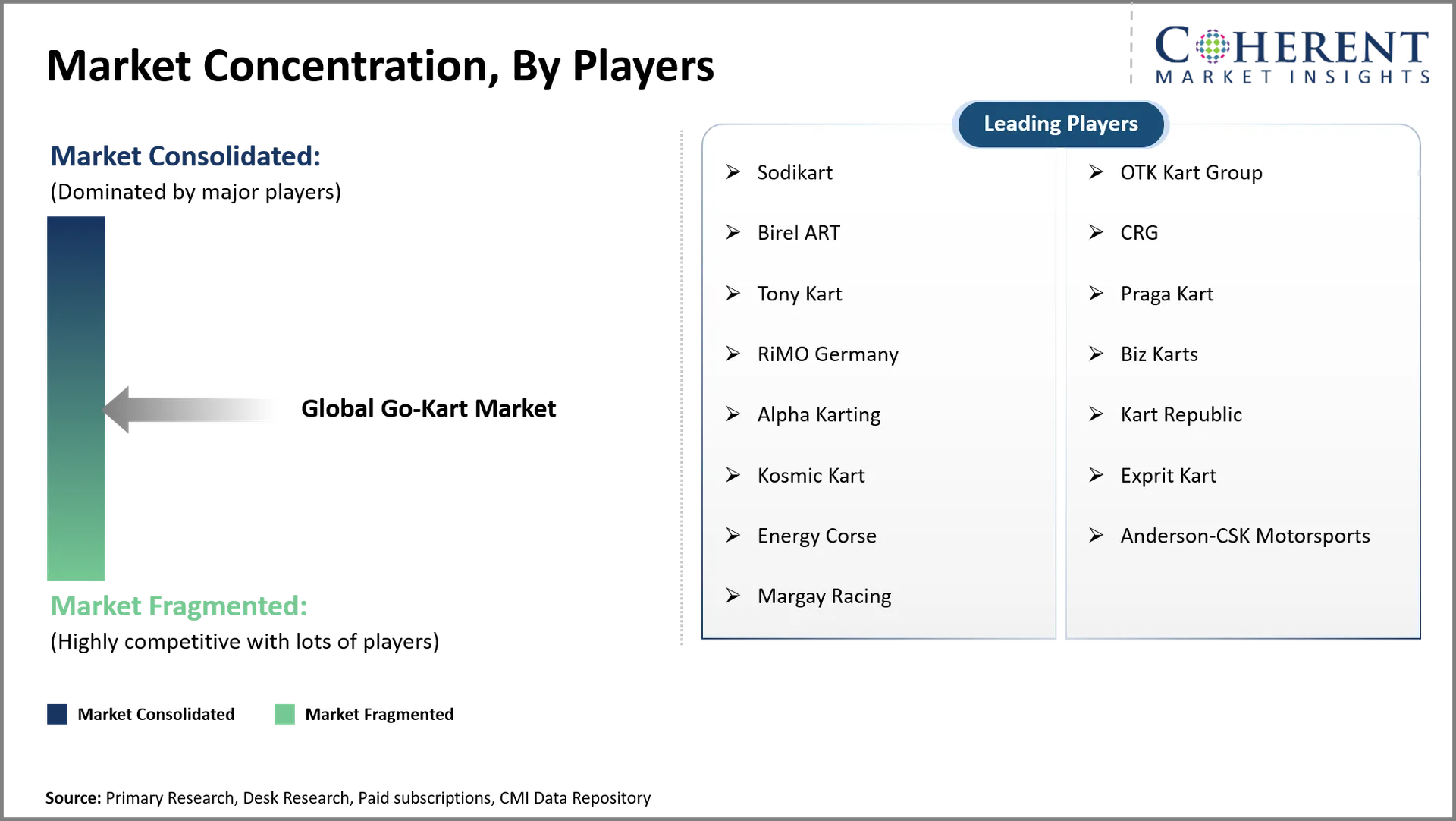
Key Developments
- On December 4, 2025, OTK Kart Group and the karting manufacturer’s Tony Kart Racing Team formalized its long-standing relationship with Hitech, by collaborating on the creation of an official Karts to Cars Program. The long-term partnership is aimed at identifying, providing opportunities for, and developing Tony Kart Racing Team drivers as they look to progress to single-seater racing.
- On January 24, 2025, BRP Rotax announced the launch of Rotax TRAX, a groundbreaking system designed to transform karting by empowering drivers of all levels with cutting-edge technology. This innovative solution combines a physical tracking device with an advanced app, providing a seamless way to analyze performance, compete locally and globally, and connect with the wider karting community.
- On October 4, 2024, Birelart unveiled the new S18 Chassis line for the 2025 season. Designed to redefine performance standards in karting, this kart combines innovation, cutting-edge technology, and an appealing design, tailored to meet the needs of both professional drivers and enthusiasts.
Competitive Landscape
SODIKART is specialized in commercial rental and competitive karting, with electric, junior, performance and two-seater versions. Its rental network covers more than 1,500 indoor and outdoor tracks globally. The company also introduced the RSX2 electric kart with lithium batteries and automotive-derived synchronous motor technology. Its X2Drive targets family-oriented two-person electric experiences. Birel ART is dedicated to racing performance, chassis development and international competition programs. The 2025 S18 chassis received new geometries, materials, accessories and aero components. Birel ART also strengthened national racing support through its Spinozzi Marino partnership.
Market Report Scope
Go-Kart Market Report Coverage | |||
Report Coverage | Details | ||
Base Year | 2025 | Market Size in 2026: | USD 180 Mn |
Historical Data For: | 2020 To 2024 | Forecast Period: | 2026 To 2033 |
Forecast Period 2026 To 2033 CAGR: | 5.3% | 2033 Value Projection: | USD 295 Mn |
Geographies covered: |
| ||
Segments covered: |
| ||
Companies covered: | Sodikart, OTK Kart Group, Birel ART, CRG, Tony Kart, Praga Kart, RiMO Germany, Biz Karts, Alpha Karting, Kart Republic, Kosmic Kart, Exprit Kart, Energy Corse, Anderson-CSK Motorsports, Margay Racing | ||
Growth Drivers: |
| ||
Restraints & Challenges: |
| ||
Analyst Opinion (Expert Opinion)
- The industry is likely to develop around electric rental fleets, connected driving systems, and differentiated entertainment formats. SODIKART's electric rental portfolio demonstrates how manufacturers are addressing commercial fleet requirements. Its SODI World Series also connects recreational karting with organized global competition. The electric racing regulations set to be introduced for 2026 could further stimulate technical progress across competitive karting.
- Electric rental karts for indoor facilities and family entertainment centers appear to be the best option. SODIKART’s RSX2 is aimed at commercial electric applications, while its X2Drive is for two-person use. Facilities serving children and mixed-age groups also have chances with youth-oriented electric models. Geographic potential includes markets that have growing indoor entertainment infrastructure and entrenched motorsport engagement.
- Combining sturdy chassis and customizable electric powertrains with speedier charging systems can provide market participants an advantage. Interchangeability of batteries could reduce fleet downtime during peak operation periods for operators. Adjustable ergonomics, telemetry, safety systems and fleet-management integration also allow manufacturers to improve distinction. Partnerships with entertainment operators can offer recurrent fleet replacement opportunities and expedite the use of electric platforms.
Speak to the analyst
Want personalized insights?
Take the findings above to one of our principal consultants, or have the report rebuilt around the segments, geographies and competitors you actually track.
Market Segmentation
- Propulsion Insights (Revenue, USD Million, 2021 - 2033)
- Electric Go-Karts
- Gasoline Go-Karts
- Others
- Track Type Insights (Revenue, USD Million, 2021 - 2033)
- Indoor Karting
- Outdoor Karting
- Product Type Insights (Revenue, USD Million, 2021 - 2033)
- Leisure Go-Karts
- Racing Go-Karts
- Junior or Kids Go-Karts
- Off-Road Go-Karts
- Application Insights (Revenue, USD Million, 2021 - 2033)
- Rental
- Racing
- Recreational
- Regional Insights (Revenue, USD Million, 2021 - 2033)
- North America
- U.S.
- Canada
- Latin America
- Brazil
- Argentina
- Mexico
- Rest of Latin America
- Europe
- Germany
- U.K.
- Spain
- France
- Italy
- Russia
- Rest of Europe
- Asia Pacific
- China
- India
- Japan
- Australia
- South Korea
- ASEAN
- Rest of Asia Pacific
- Middle East
- GCC Countries
- Israel
- Rest of Middle East
- Africa
- South Africa
- North Africa
- Central Africa
- North America
- Key Players Insights
- Sodikart
- OTK Kart Group
- Birel ART
- CRG
- Tony Kart
- Praga Kart
- RiMO Germany
- Biz Karts
- Alpha Karting
- Kart Republic
- Kosmic Kart
- Exprit Kart
- Energy Corse
- Anderson-CSK Motorsports
- Margay Racing
Sources
Primary Research Interviews
- Go-Kart Manufacturers & OEMs
- Racing Track Operators & Entertainment Park Owners
- Go-Kart Component Suppliers & Distributors
- Motorsport Training Academies & Clubs
Magazines
- Kart Magazine
- Motorsport News
- Racing & Recreation Industry Journal
- Powersports Business
Journals
- Journal of Motorsport Engineering
- International Journal of Automotive Technology
- Journal of Sport and Recreation Management
Associations
- Fédération Internationale de l'Automobile (FIA)
- Karting World Championship Association
- International Karting Commission (CIK)
- Specialty Vehicle Institute of America (SVIA)
Public Domain Sources
- U.S. Consumer Product Safety Commission (CPSC)
- European Automobile Manufacturers' Association (ACEA)
- United Nations Industrial Development Organization (UNIDO)
- World Trade Organization (WTO) Trade Statistics
Proprietary Elements
- CMI Data Analytics Tool
- Proprietary CMI Existing Repository of Information for the Last 10 Years
Get access to 250+ pages report
Every segment, forecast, competitor profile and data table behind the analysis above — available for instant download.
- ESOMAR Member
- ISO 9001:2015 Certified
- D-U-N-S Registered
- GDPR & CCPA Compliant
Missing comfort of reading report in your local language? Find your preferred language:
Frequently Asked Questions
The global go-kart market is expected to stand at USD 180 Mn in 2026 and is expected to reach USD 295 Mn by 2033.
The CAGR of the global go-kart market is projected to be 5.3% from 2026 to 2033.
Growing popularity of motorsport and recreational karting and expansion of indoor karting centers are the major factors driving the growth of the global go-kart market.
High initial investment for commercial karting facilities and Significant maintenance requirements for racing fleets ents are the major factors hampering the growth of the global go-kart market.
In terms of propulsion, electric go-karts segment is estimated to dominate the market revenue share in 2026.
A go-kart is a small four-wheeled vehicle designed for recreational driving or competitive racing.
Karting provides an accessible pathway for developing driving skills before progression into higher motorsport categories.