

Global Green Solvents Market Size and Forecast – 2026 To 2033
The Global Green Solvents Market is estimated to be valued at USD 51.84 Bn in 2026 and is expected to reach USD 86.57 Bn by 2033, growing at a compound annual growth rate (CAGR) of 7.60% from 2026 to 2033. This growth is supported by increasing adoption of sustainable chemical solutions across pharmaceuticals solvent, agriculture, coatings, adhesives, and industrial manufacturing applications. The transition from conventional solvent systems toward bio-based, water-based, and renewable-source alternatives is further accelerated by stricter VOC emission regulations and corporate sustainability targets.
The market is also benefiting from advancements in green chemistry, renewable feedstock availability, and improved solvent performance that enables sustainable alternatives to meet industrial requirements for efficiency and safety. In June 2024, the U.S. Department of Energy announced funding initiatives under its Industrial Efficiency and Decarbonization Office to support technologies that reduce emissions across energy-intensive industries, including chemical manufacturing processes. Such initiatives are expected to encourage manufacturers to invest in cleaner production pathways and accelerate the integration of sustainable solvent technologies across industrial value chains.
Key Takeaways of the Global Green Solvents Market
- Bio Based Solvents are expected to register an estimated CAGR of 8.1% from 2026 to 2033 and account for 42.8% of the global green solvents market in 2026. Their leadership reflects strong adoption of renewable feedstocks in coatings additives and specialty chemical formulations where companies seek lower carbon intensity without changing product performance. In June 2025, BASF transitioned its Rheovis range to bio-based Ethyl Acrylate with certified biogenic content.
- Renewable Source Based solvents are expected to achieve an estimated CAGR of 8.0% from 2026 to 2033 and hold 56.8% of the global green solvents market in 2026. This dominance is supported by chemical producers integrating biomass balance approaches and renewable raw materials into existing production systems. In May 2025, BASF expanded biomass-balanced coatings solutions across multiple regions to support lower-carbon formulations.
- Paints Coatings and Inks are projected to record an estimated CAGR of 7.4% from 2026 to 2033 and represent 32.8% of the global green solvents market in 2026. The segment benefits from coating manufacturers replacing conventional solvent systems with lower-emission alternatives while maintaining durability and application efficiency. In August 2025, Sherwin-Williams launched new water-based acrylic coating products for rail applications.
- Europe is expected to expand at an estimated CAGR of 7.1% from 2026 to 2033 and account for 32.7% of the global green solvents market in 2026. The region’s position is supported by strong sustainability frameworks and industrial transition toward renewable chemical inputs. In May 2025, BASF highlighted successful European launches of biomass-balanced products before expanding similar solutions into additional markets
- North America is estimated to achieve a CAGR of 8.3% from 2026 to 2033 while accounting for 28.6% of the global green solvents market in 2026. Growth opportunities are linked to domestic clean manufacturing investments and increasing use of sustainable solvent technologies in advanced applications. In March 2024, Dow announced plans for a U.S. carbonate solvents facility supporting domestic battery supply chains and lower-carbon manufacturing pathways.
Segmental Insights
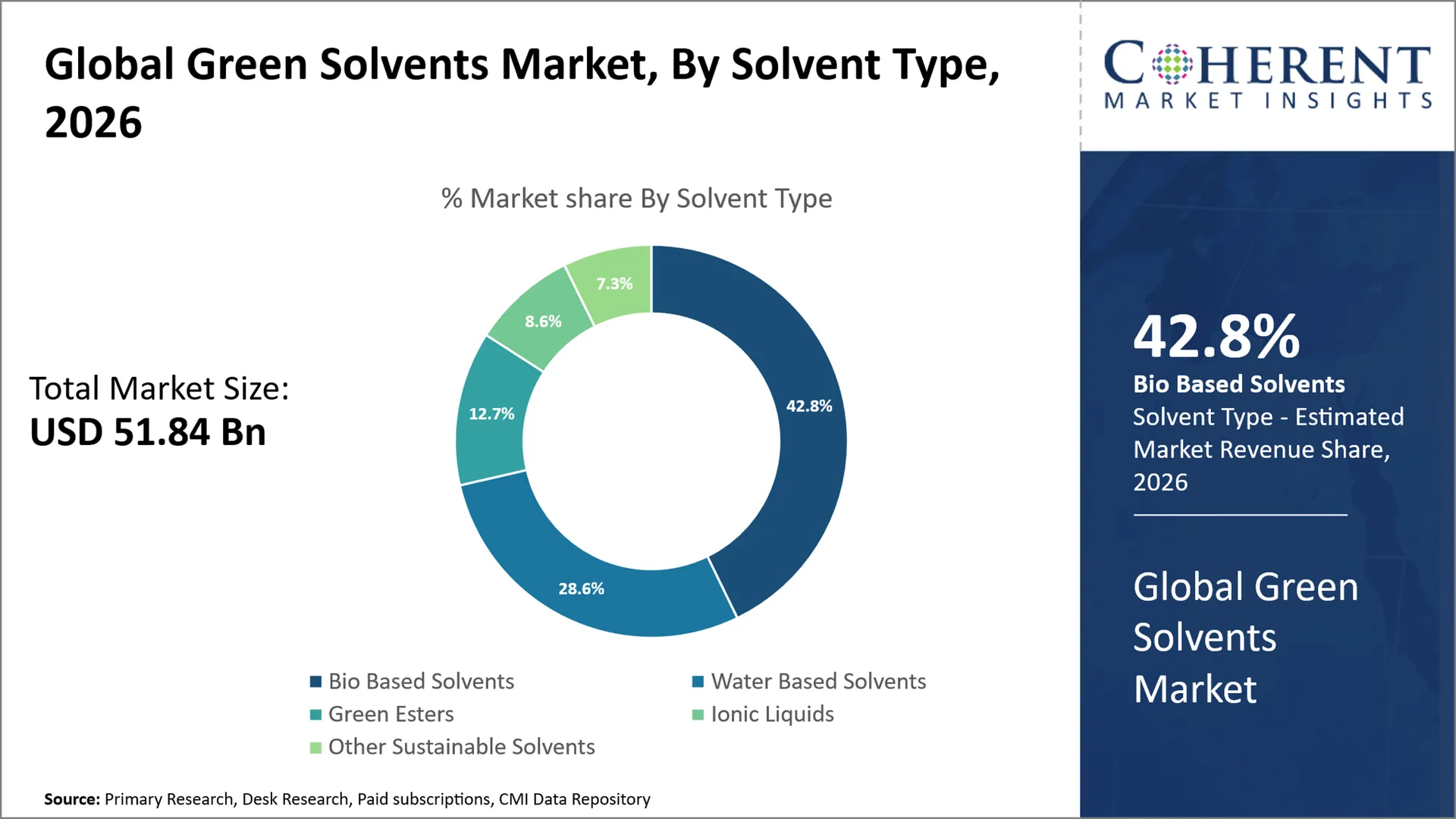
Why Do Bio Based Solvents Dominate the Global Green Solvents Market?
Bio Based Solvents are expected to account for 42.8% of the global green solvents market in 2026, supported by their ability to provide renewable alternatives for industries seeking lower environmental impact without compromising functional performance. These solvents are increasingly preferred in coatings, pharmaceuticals, adhesives, personal care, and industrial cleaning applications where manufacturers require improved sustainability profiles and reduced dependence on fossil-derived inputs. The segment benefits from expanding availability of biomass-derived raw materials, improved fermentation technologies, and investments in renewable chemical platforms. Solvent producers are also developing application-specific grades to meet performance requirements related to purity, solvency, and compatibility. In October 2024, Evonik introduced its sustainable TEGOCycle product line incorporating circular raw material approaches for specialty chemical applications, supporting broader adoption of sustainable solvent-related solutions.
- Current Industry Events of 2026
- Market Size Estimation
- Regional Breakdown
- Competitive Landscape
- Customer Intelligence
- Segmental Analysis
- Pricing Analysis
- Key Market Drivers, Challenges & Future Trends
- Customized Insights Section
Why Does Renewable Source Based Solvent Represent the Largest Source Category in the Global Green Solvents Market?
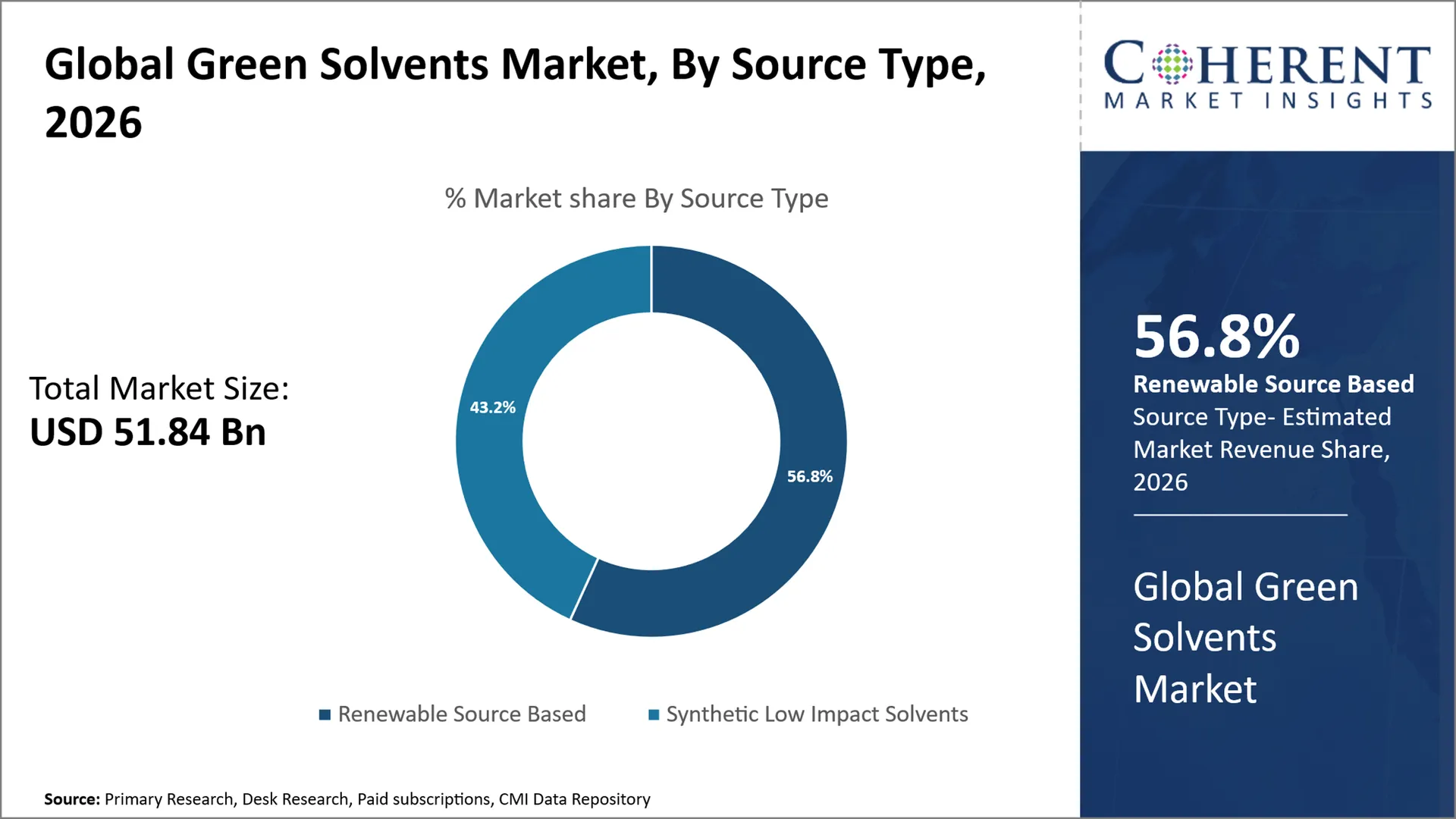
Renewable Source Based solvents are expected to represent 56.8% of the global green solvents market in 2026 due to increasing preference for raw materials derived from renewable carbon sources such as biomass, agricultural feedstocks, and bio-based intermediates. Unlike conventional petroleum-based solvent systems, renewable source-based solutions enable manufacturers to improve sustainability credentials while supporting circular chemical production models. Chemical companies, coatings producers, and pharmaceutical manufacturers are increasingly evaluating renewable sourcing strategies to meet internal environmental targets and customer sustainability requirements. Supply-side improvements in bio-refinery infrastructure and renewable chemical processing are strengthening commercial availability. In September 2024, the U.S. Department of Agriculture expanded recognition of certified biobased products under its BioPreferred Program, supporting wider market visibility and procurement opportunities for renewable-based chemicals.
Why Do Paints Coatings and Inks Dominate the Application Category of the Global Green Solvents Market?
Paints Coatings and Inks are expected to hold 32.8% of the global green solvents market in 2026 as coating manufacturers increasingly reformulate products to achieve lower emissions, improved worker safety, and compliance with environmental requirements. Green solvents play an important role in controlling formulation performance, drying characteristics, and application quality across architectural coatings, industrial finishes, automotive coatings, and printing inks. The segment benefits from strong demand from construction, transportation, packaging, and manufacturing industries where sustainable coating solutions are becoming an important purchasing consideration. Suppliers are focusing on solvent systems that provide comparable performance to conventional alternatives while reducing environmental concerns. In May 2025, PPG announced expansion of its sustainable coating solutions portfolio through new product initiatives focused on reducing environmental impact across industrial applications.
Current Events and their Impact
Current Event | Description and Its Impact |
European Union Chemicals Sustainability Initiatives and VOC Reduction Framework (2024–2025) |
|
U.S. Environmental Protection Agency VOC Emission Control Requirements for Industrial Sources (2024–2026) |
|
China Green Manufacturing and Industrial Sustainability Policies (2024–2026) |
|
Global Green Solvents Market Dynamics
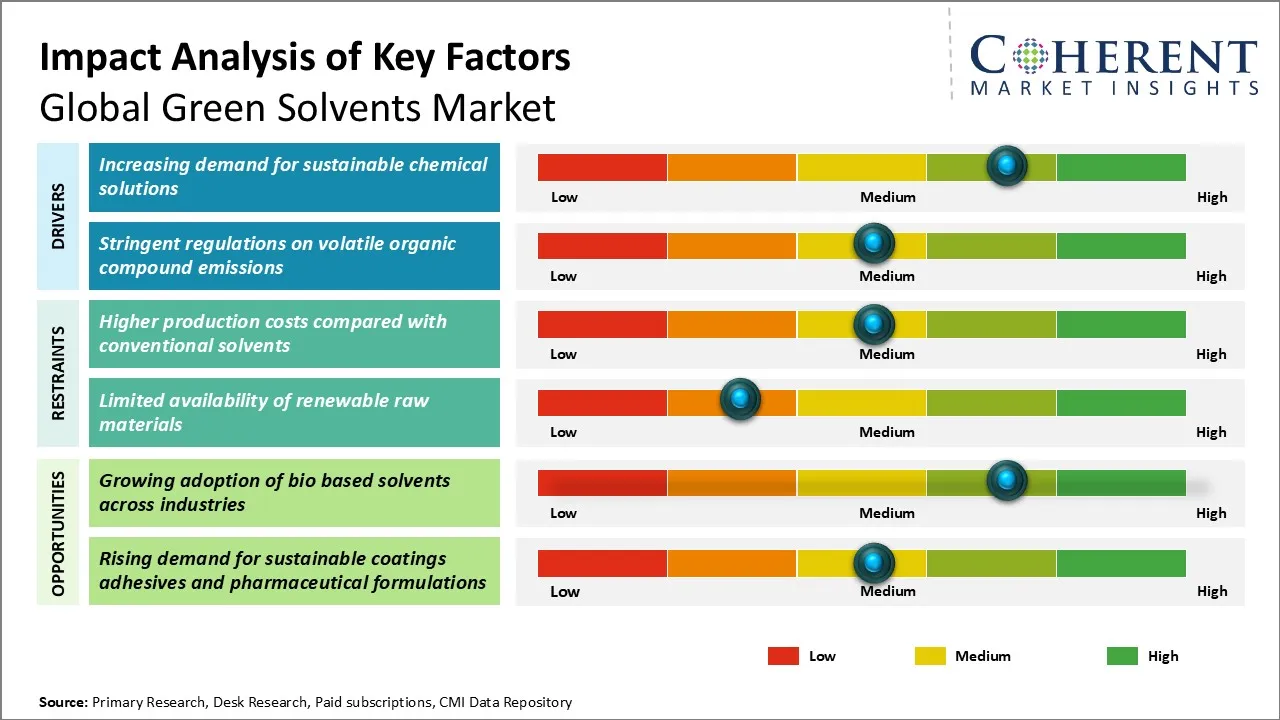
Key Market Drivers
- Increasing Demand for Sustainable Chemical Solutions: The shift toward sustainable chemical solutions is strengthening adoption of green solvents as manufacturers seek alternatives that reduce environmental impact while maintaining formulation efficiency. Chemical producers, coatings manufacturers, pharmaceutical companies, and industrial users are increasingly evaluating renewable feedstocks, improved biodegradability, and lower lifecycle emissions when selecting solvent systems. This transition supports suppliers developing bio-based solvents, renewable esters, and low-impact formulations with application-specific performance. In February 2025, the European Chemical Industry Council (CEFIC) highlighted the importance of renewable carbon solutions in advancing sustainable chemical production pathways.
- Stringent Regulations on Volatile Organic Compound Emissions: Increasing regulatory pressure on volatile organic compound emissions is accelerating replacement of conventional solvent systems across coatings, adhesives, industrial cleaning, and manufacturing applications. Governments and regulatory agencies are tightening emission standards, encouraging end users to adopt water-based, bio-derived, and low-VOC solvent alternatives. Paint manufacturers, chemical formulators, and industrial processors benefit from developing compliant solutions that support regulatory alignment while preserving product performance. In April 2025, the U.S. Environmental Protection Agency continued implementation activities under national air quality programs targeting industrial VOC emission reduction requirements.
Emerging Market Trends
- Development of Application-Specific Green Solvent Formulations: Green solvent development is moving beyond broad environmental positioning toward customized formulations designed for specific industrial requirements. Manufacturers are increasingly optimizing solvent properties such as evaporation rate, solvency power, compatibility, safety profile, and processing efficiency for specialized applications. This trend is encouraging collaboration between solvent producers and downstream users in pharmaceuticals, coatings, electronics, and specialty chemicals. Over the forecast period, competitive differentiation is expected to shift from simply offering sustainable alternatives toward delivering high-performance solvent systems tailored to individual manufacturing processes.
- Integration of Circular Carbon and Renewable Feedstock Strategies: The green solvents market is increasingly influenced by circular carbon approaches that focus on reducing dependence on fossil-based raw materials. Producers are exploring alternative carbon sources including biomass-derived inputs, recycled carbon streams, and renewable chemical intermediates to improve sustainability credentials. This trend may reshape supply chains by increasing the importance of feedstock traceability, lifecycle assessment capabilities, and sustainable sourcing partnerships. Companies with stronger renewable raw material access and transparent environmental measurement systems are expected to gain greater influence in future solvent procurement decisions.
Regional Insights
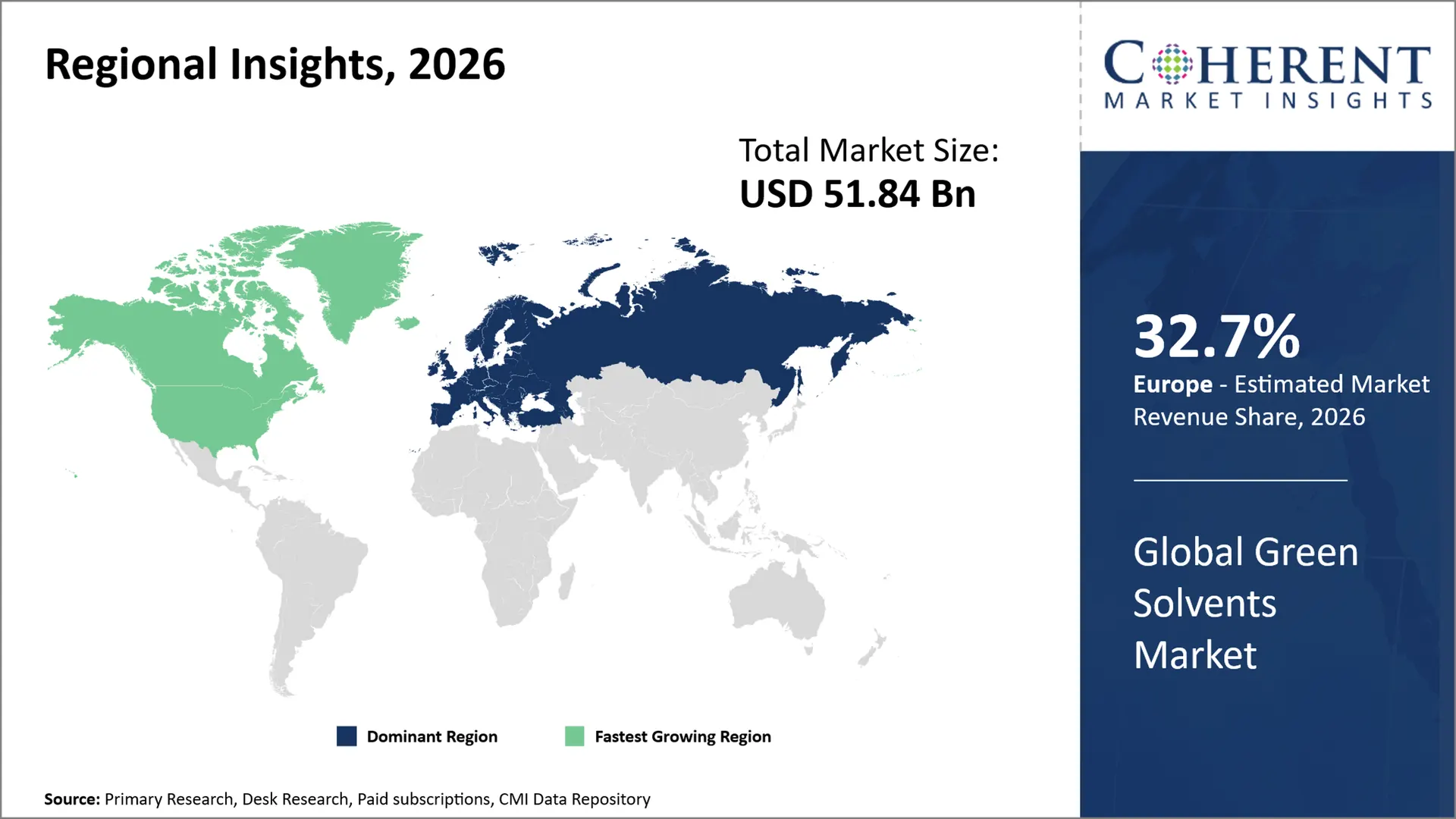
Why Does Europe Dominate the Global Green Solvents Market?
Europe is expected to account for 32.7% of the global green solvents market in 2026 due to strong sustainability regulations, advanced chemical manufacturing capabilities, and widespread adoption of low-emission alternatives across coatings, pharmaceuticals, automotive, and specialty chemical industries. The region’s chemical sector is increasingly shifting toward renewable feedstocks, circular chemistry models, and solvent solutions with improved environmental profiles. Strong regulatory frameworks such as REACH encourage manufacturers to reduce hazardous chemical usage and improve product safety standards, supporting green solvent adoption among industrial users. Germany, France, Italy, and the Netherlands remain important manufacturing hubs with established specialty chemical ecosystems. In July 2025, the European Commission introduced an Action Plan for the European chemical industry aimed at improving competitiveness, supporting innovation, and strengthening sustainable chemical production capabilities. This policy direction is expected to support the green solvents market by encouraging chemical manufacturers to adopt cleaner production processes and develop safer, lower-impact alternatives aligned with Europe’s sustainability objectives.
Why Is North America Emerging as the Fastest-Growing Region in the Global Green Solvents Market?
North America is projected to represent 28.6% of the global green solvents market in 2026 and is expected to witness strong expansion due to increasing adoption of sustainable manufacturing practices, industrial decarbonization initiatives, and demand for low-VOC formulations. The region benefits from a large coatings industry, advanced pharmaceutical manufacturing base, and increasing investments in cleaner chemical production technologies. The U.S. chemical sector is also supported by strong research capabilities and customer demand for high-performance sustainable alternatives. Growth opportunities are emerging in specialty applications where manufacturers require solvents with improved safety profiles and regulatory compatibility. In January 2025, the U.S. Department of Energy announced continued support for industrial decarbonization programs targeting cleaner chemical production pathways.
Global Green Solvents Market Outlook for Key Countries
Why Is the U.S. a Key Market for the Global Green Solvents Market?
The U.S. represents a key market for green solvents due to its large industrial base, advanced chemical manufacturing ecosystem, and strong presence of coatings, pharmaceuticals, electronics, and specialty chemical industries. Demand is supported by manufacturers seeking alternatives to conventional solvents to comply with emission requirements while maintaining product performance. The country has significant capabilities in renewable chemical development, bio-based material innovation, and specialty solvent production. Growing preference for sustainable procurement among industrial buyers is encouraging suppliers to expand application-specific solvent portfolios. The presence of major chemical producers, research institutions, and end-user industries strengthens domestic adoption. In June 2025, the U.S. Department of Agriculture continued supporting biobased product development through federal programs promoting renewable material utilization.
Why Is China Important in the Global Green Solvents Market?
China plays an important role in the global green solvents market due to its extensive chemical manufacturing infrastructure, large downstream processing industries, and position as a major producer of chemical intermediates. The country’s coatings, electronics, pharmaceutical, and industrial manufacturing sectors create substantial demand for solvent solutions with improved environmental characteristics. China’s established chemical clusters provide advantages in raw material availability, production scale, and export capabilities. Increasing environmental compliance requirements are encouraging domestic manufacturers to upgrade production processes and adopt cleaner solvent technologies. The country’s growing focus on green manufacturing is also influencing industrial purchasing decisions. In December 2024, China’s Ministry of Industry and Information Technology released guidance supporting green manufacturing development and cleaner industrial production practices.
Why Does India Support Growth in the Global Green Solvents Market?
India is becoming an important market for green solvents due to expanding pharmaceutical production, growing paints and coatings consumption, rising specialty chemical manufacturing, and increasing demand for sustainable industrial inputs. The country’s large chemical processing base creates opportunities for solvent suppliers serving formulation industries, including pharmaceuticals, adhesives, agricultural chemicals, and industrial cleaning applications. India’s cost-efficient manufacturing ecosystem and increasing focus on domestic chemical production support market development. Adoption is also influenced by export-oriented manufacturers seeking compliance with international sustainability expectations. The expansion of bio-based chemical production capabilities provides additional opportunities for renewable solvent adoption. In February 2025, India’s Department of Chemicals and Petrochemicals continued promoting chemical industry competitiveness through initiatives focused on sustainable and advanced chemical manufacturing.
Why Is Japan a Strategic Country in the Global Green Solvents Market?
Japan holds strategic importance in the green solvents market due to its advanced specialty chemical industry, precision manufacturing capabilities, and strong focus on environmental performance across industrial applications. The country has significant demand from electronics, automotive coatings, pharmaceuticals, and high-value chemical processing sectors where solvent purity, reliability, and performance characteristics are critical purchasing factors. Japanese manufacturers increasingly emphasize resource efficiency, safer chemical handling, and sustainable production processes, creating opportunities for advanced solvent technologies. The country’s strong research ecosystem supports development of innovative formulations suitable for specialized applications. In April 2025, Japan’s Ministry of Economy Trade and Industry continued implementing initiatives supporting carbon-neutral industrial transformation and sustainable manufacturing practices.
Why Is Germany a Strategic Country in the Global Green Solvents Market?
Germany is a strategically important market for green solvents because of its globally recognized chemical industry, advanced manufacturing capabilities, and strong focus on sustainable industrial transformation. The country hosts major chemical producers, automotive manufacturers, coatings companies, and specialty material suppliers that require high-performance solvent solutions. German industries increasingly prioritize renewable raw materials, circular economy principles, and compliance with strict environmental standards, creating opportunities for sustainable solvent technologies. The country’s engineering expertise and strong export-oriented industrial base also influence adoption trends across European markets. Germany’s research institutions and chemical innovation networks support development of next-generation solvent formulations. In January 2025, Germany’s Federal Ministry for Economic Affairs and Climate Action continued advancing industrial decarbonization initiatives supporting cleaner production technologies.
Sustainability and Circular Economy Landscape in the Global Green Solvents Market
Technology | Current Adoption Status | Commercial Application | Strategic Importance |
Bio-Based Solvent Production Technologies | Expanding adoption across chemical and industrial applications | Production of solvents from biomass-derived alcohols, esters, and renewable intermediates | Enables lower dependence on fossil feedstocks and supports sustainable sourcing strategies |
Water-Based Solvent Systems | Widely adopted in coatings, inks, adhesives, and cleaning applications | Low-VOC paints, industrial coatings, printing formulations, and surface treatment | Supports regulatory compliance while reducing solvent emissions during processing |
Green Ester Solvents | Increasing utilization in specialty formulations | Paints, coatings, pharmaceutical processing, and industrial cleaning | Provides high solvency performance with improved environmental profiles compared with conventional solvents |
Bio-Based Ionic Liquids | Emerging technology with selective industrial adoption | Advanced chemical processing, extraction, catalysis, and specialty applications | Offers potential for customized solvent properties with reduced volatility characteristics |
Solvent Recycling and Recovery Technologies | Growing implementation in industrial facilities | Recovery of solvents from manufacturing and processing operations | Improves resource efficiency and reduces raw material consumption and waste management costs |
Renewable Carbon Solvent Platforms | Early-stage commercial development | Sustainable chemical manufacturing using alternative carbon sources | May reshape future solvent supply chains by reducing reliance on petroleum-based inputs |
How Are Advanced Bio-Based Formulations and Circular Solvent Recovery Systems Creating New Growth Opportunities in the Global Green Solvents Market?
The expansion of advanced bio-based formulations and solvent recovery solutions is creating a new commercial pathway for companies seeking differentiation beyond conventional sustainable solvent offerings. While many industries have adopted low-emission alternatives, opportunities remain in high-performance applications where sustainability requirements must be balanced with strict technical specifications. Pharmaceutical manufacturers, specialty chemical producers, electronics companies, and industrial processors represent attractive customer groups requiring solvents with improved purity, recyclability, and process compatibility. Companies can capture this opportunity by developing application-specific solvent portfolios, investing in renewable feedstock capabilities, and integrating recovery technologies into customer operations. Suppliers with strong technical support capabilities, formulation expertise, and regional production networks are likely to benefit. However, successful participation requires investment in research capabilities, lifecycle assessment expertise, regulatory compliance systems, and supply-chain partnerships to ensure consistent raw material availability and commercial scalability.
Market Players, Key Development, and Competitive Intelligence
Key Developments
- In March 2025, LyondellBasell expanded its circular and renewable chemicals initiatives through the development of solutions based on alternative feedstocks and improved resource efficiency. This is relevant to the global green solvents market because renewable and circular raw material availability is becoming an important factor for solvent producers seeking to reduce fossil-based dependence. Such initiatives support downstream industries including coatings, specialty chemicals, and industrial formulations requiring more sustainable input materials.
- In January 2025, Eastman announced advancements in its sustainable solvent portfolio through continued expansion of its low-carbon and renewable-based specialty chemical solutions. This development is important for the global green solvents market because Eastman’s focus on circular chemistry and renewable feedstock integration strengthens the availability of sustainable solvent alternatives for coatings, adhesives, and industrial applications. The company’s material innovation strategy supports customer transition toward lower-impact formulations while maintaining performance requirements.
- In November 2024, Solvay introduced additional sustainable solutions within its specialty chemical portfolio focused on improving environmental performance across industrial applications. This development supports the global green solvents market by demonstrating continued supplier investment in chemistry solutions designed for reduced environmental impact, improved regulatory alignment, and enhanced performance in demanding applications. The company’s sustainability-oriented product development strengthens opportunities for advanced solvent systems in specialty manufacturing sectors.
Competitive Landscape
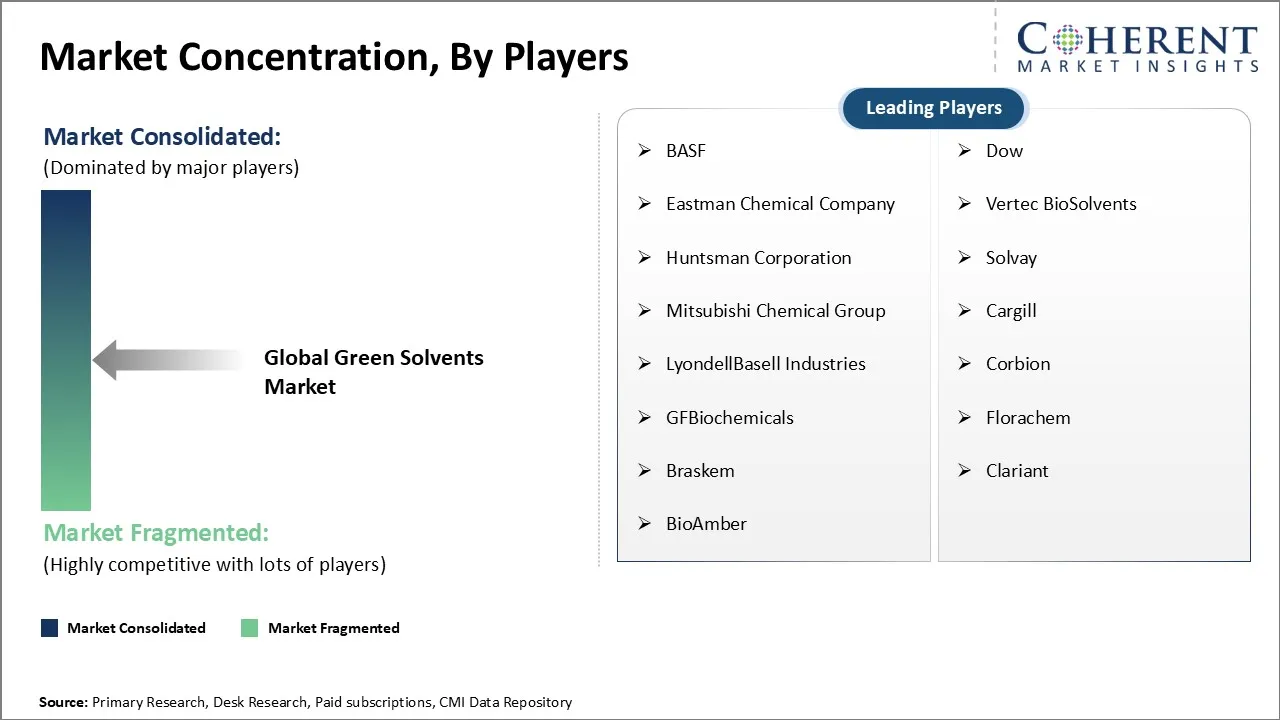
The global green solvents market is moderately fragmented, with participation from multinational chemical companies, specialty solvent manufacturers, renewable chemical producers, and regional suppliers. Competition is influenced by solvent performance, sustainability credentials, raw material availability, regulatory compliance, pricing competitiveness, and technical support capabilities. Large chemical companies benefit from integrated production networks, while specialized manufacturers compete through customized formulations and application expertise.
Key Focus Areas Includes
- Product performance differentiation through improved solvency, safety characteristics, and application compatibility
- Renewable feedstock sourcing capabilities and sustainable raw material management
- Manufacturing scale and supply reliability for industrial customers
- Compliance with VOC regulations and environmental standards across regions
- Customized solvent formulations for pharmaceutical, coatings, and specialty chemical applications
- Technical support capabilities for customer process optimization and solvent substitution
- Regional production presence to reduce logistics complexity and improve customer responsiveness
- Circular economy capabilities including solvent recycling and recovery solutions
Market Report Scope
Global Green Solvents Market Repoet Coverage | |||
Report Coverage | Details | ||
Base Year | 2025 | Market Size in 2026: | USD 51.84 Bn |
Historical Data For: | 2020 To 2024 | Forecast Period: | 2026 To 2033 |
Forecast Period 2026 To 2033 CAGR: | 7.60% | 2033 Value Projection: | USD 86.57 Bn |
Geographies covered: |
| ||
Segments covered: |
| ||
Companies covered: | BASF, Dow, Eastman Chemical Company, Vertec BioSolvents, Huntsman Corporation, Solvay, Mitsubishi Chemical Group, Cargill, LyondellBasell Industries, Corbion, GFBiochemicals, Florachem, Braskem, Clariant, BioAmber | ||
Growth Drivers: |
| ||
Restraints & Challenges: |
| ||
Analyst Opinion (Expert Opinion)
- The global green solvents market is likely to evolve from a replacement-oriented market into a performance-driven specialty chemical segment. Future competitive advantage will depend less on simply offering environmentally preferable solvents and more on delivering application-specific solutions that combine sustainability, technical efficiency, regulatory compliance, and supply reliability. Companies capable of supporting customers through formulation transition and process optimization may achieve stronger commercial positioning.
- The most significant market transformation could emerge from the integration of circular carbon strategies with solvent manufacturing. As industries increasingly evaluate lifecycle emissions and resource efficiency, solvent suppliers may need to redesign sourcing models, production processes, and customer engagement approaches. Companies lacking renewable feedstock access, traceability capabilities, or circular chemistry expertise may face increasing pressure as procurement priorities evolve.
- Market participants should prioritize investment in renewable raw material access, formulation expertise, and regional supply capabilities. Manufacturers should focus on high-value applications where customers require both sustainability and technical performance rather than competing only on volume. Key risks include raw material cost fluctuations, inconsistent renewable feedstock availability, and regulatory complexity across regions. Strategic partnerships across chemical value chains can help improve scalability and reduce supply vulnerabilities.
Speak to the analyst
Want personalized insights?
Take the findings above to one of our principal consultants, or have the report rebuilt around the segments, geographies and competitors you actually track.
Market Segmentation
- Solvent Type Insights (Revenue, USD Bn, 2021 - 2033)
- Bio Based Solvents
- Water Based Solvents
- Green Esters
- Ionic Liquids
- Other Sustainable Solvents
- Source Type Insights (Revenue, USD Bn, 2021 - 2033)
- Renewable Source Based
- Synthetic Low Impact Solvents
- Application Insights (Revenue, USD Bn, 2021 - 2033)
- Paints Coatings and Inks
- Pharmaceuticals
- Adhesives and Sealants
- Industrial Cleaning
- Chemical Processing
- Others
- End Use Industry Insights (Revenue, USD Bn, 2021 - 2033)
- Chemicals
- Paints and Coatings
- Pharmaceuticals
- Food and Beverage
- Personal Care
- Others
- Distribution Channel Insights (Revenue, USD Bn, 2021 - 2033)
- Direct Sales
- Indirect Sales
- Regional Insights (Revenue, USD Bn, 2021 - 2033)
- North America
- U.S.
- Canada
- Latin America
- Brazil
- Argentina
- Mexico
- Rest of Latin America
- Europe
- Germany
- U.K.
- Spain
- France
- Italy
- Russia
- Rest of Europe
- Asia Pacific
- China
- India
- Japan
- Australia
- South Korea
- ASEAN
- Rest of Asia Pacific
- Middle East
- GCC Countries
- Israel
- Rest of Middle East
- Africa
- South Africa
- North Africa
- Central Africa
- North America
Sources
Primary Research Interviews
- Green solvent manufacturers, specialty chemical producers, bio-based solvent suppliers, and renewable chemical companies
- Coatings, paints, inks, adhesives, pharmaceutical, electronics, and industrial cleaning manufacturers using sustainable solvent solutions
- Chemical formulators, process engineers, procurement professionals, sustainability managers, R&D specialists, and technical experts
- Distributors, chemical traders, specialty chemical suppliers, and industrial solvent channel partners
- Environmental consultants, chemical compliance experts, and sustainability professionals involved in solvent substitution strategies
Stakeholders
- Green solvent manufacturers, bio-based chemical producers, renewable feedstock suppliers, and specialty solvent companies
- Conventional solvent manufacturers transitioning toward sustainable solvent portfolios and low-VOC formulations
- Raw material suppliers, biomass processors, chemical intermediates producers, and bio-refinery operators
- Paints coatings and inks manufacturers, pharmaceutical companies, adhesives producers, industrial cleaning solution providers, and chemical processors
- Chemical distributors, industrial suppliers, formulation companies, and end-user procurement organizations
End-use Industries
- Paints coatings and inks applications including architectural coatings, industrial coatings, automotive coatings, and printing inks
- Pharmaceutical manufacturing including extraction, formulation, synthesis, and processing applications
- Adhesives and sealants production for industrial, construction, packaging, and consumer applications
- Industrial cleaning applications including equipment cleaning, surface treatment, and maintenance operations
- Chemical processing applications including specialty chemicals, intermediate production, and formulation activities
- Food and beverage processing, personal care, and other specialty applications requiring sustainable solvent systems
Regulatory and Industry Bodies
- Environmental Protection Agency (EPA)
- European Chemicals Agency (ECHA)
- European Commission chemical sustainability and environmental regulatory bodies
- Occupational safety and chemical management authorities
- Chemical industry associations and sustainability organizations
- Regional environmental protection agencies and VOC emission regulatory authorities
Databases
- Company annual reports, investor presentations, sustainability reports, and corporate filings
- Chemical industry databases and specialty chemical product intelligence platforms
- Trade statistics, import-export databases, and chemical shipment datasets
- Renewable chemical and bio-based product databases
- Solvent production capacity databases and supplier intelligence platforms
- Pricing databases, raw material cost databases, and supply chain intelligence sources
- Patent databases and chemical innovation repositories
Magazines and Journals
- Chemical industry publications
- Green chemistry and sustainable chemistry journals
- Coatings, paints, and inks industry publications
- Pharmaceutical manufacturing and process chemistry journals
- Specialty chemical and industrial manufacturing publications
- Environmental sustainability and circular economy research journals
- Polymer, materials science, and chemical engineering publications
Associations
- American Chemistry Council (ACC)
- European Chemical Industry Council (CEFIC)
- Society of Chemical Manufacturers & Affiliates (SOCMA)
- Green Chemistry & Commerce Council (GC3)
- International Council of Chemical Associations (ICCA)
- Regional chemical industry associations and specialty chemical organizations
- Coatings and ink industry associations
Public Domain Sources
- Sustainable chemistry development initiatives and green manufacturing programs
- VOC emission reduction policies and environmental compliance developments
- Renewable feedstock adoption and bio-based chemical production trends
- Industrial decarbonization initiatives affecting chemical manufacturing
- Solvent substitution trends across coatings, pharmaceuticals, adhesives, and industrial applications
- Circular economy developments including solvent recovery and recycling technologies
- Corporate sustainability strategies and chemical industry transition toward low-impact materials
Key Standards and Regulations
- Volatile organic compound (VOC) emission standards and air quality regulations
- Chemical safety and hazardous substance management requirements
- REACH chemical registration and restriction requirements
- OSHA chemical handling and workplace safety standards
- Sustainable chemical production and lifecycle assessment guidelines
- Environmental compliance standards for industrial solvent usage
- Green chemistry principles and renewable carbon evaluation frameworks
Proprietary Elements
- CMI Data Analytics Tool
- Proprietary CMI repository containing 10+ years of chemical, specialty materials, sustainability, industrial manufacturing, and environmental market intelligence
Get access to 250+ pages report
Every segment, forecast, competitor profile and data table behind the analysis above — available for instant download.
- ESOMAR Member
- ISO 9001:2015 Certified
- D-U-N-S Registered
- GDPR & CCPA Compliant
Frequently Asked Questions
The CAGR of global green solvents market is projected to be 7.60% from 2026 to 2033.
The global green solvents market is estimated to be valued at USD 51.84 Bn in 2026 and is expected to reach USD 86.57 Bn by 2033.
The global green solvents market includes bio based solvents, water based solvents, green esters, ionic liquids, and other sustainable solvent solutions used across industrial applications.
Paints coatings and inks, pharmaceuticals, adhesives and sealants, industrial cleaning, chemical processing, food and beverage, and personal care industries are major consumers of green solvents.
Companies adopting green solvents face challenges related to higher formulation costs, raw material availability, performance optimization, supply chain consistency, and compatibility with existing manufacturing processes.
Manufacturers are improving green solvent performance through renewable feedstock development, advanced formulation technologies, solvent recovery systems, and customized solutions designed for specific industrial applications.
Increasing demand for sustainable chemical solutions, coupled with stringent regulations on volatile organic compound emissions, is driving the growth of the global green solvents market.