

Global Grid Modernization Market Size and Forecast – 2026 To 2033
The Global Grid Modernization Market is estimated to be valued at USD 98.5 Bn in 2026 and is expected to reach USD 145.2 Bn by 2033, growing at a compound annual growth rate (CAGR) of 5.70% from 2026 to 2033. This growth is attributed to the increasing investments on the smart grid technologies, higher integration of renewable energy sources, and the need for reliable and efficient electricity distribution systems. Utilities are driving toward digital grid infrastructure, advanced monitoring systems and upgrades to the distribution network due to growing demand for electricity and an increasing share of decentralized power generation
In September 2025, the World Bank approved USD 500 million in financing for Indonesia's Electricity Network Transformation (I-ENET) Program to modernize electricity distribution networks across Java, Madura, and Bali. The program aims to strengthen grid reliability, accelerate digital transformation, and facilitate renewable energy integration. Such investments are expected to create opportunities for smart grid equipment manufacturers, automation technology providers, and electricity infrastructure developers.
Key Takeaways of the Global Grid Modernization Market
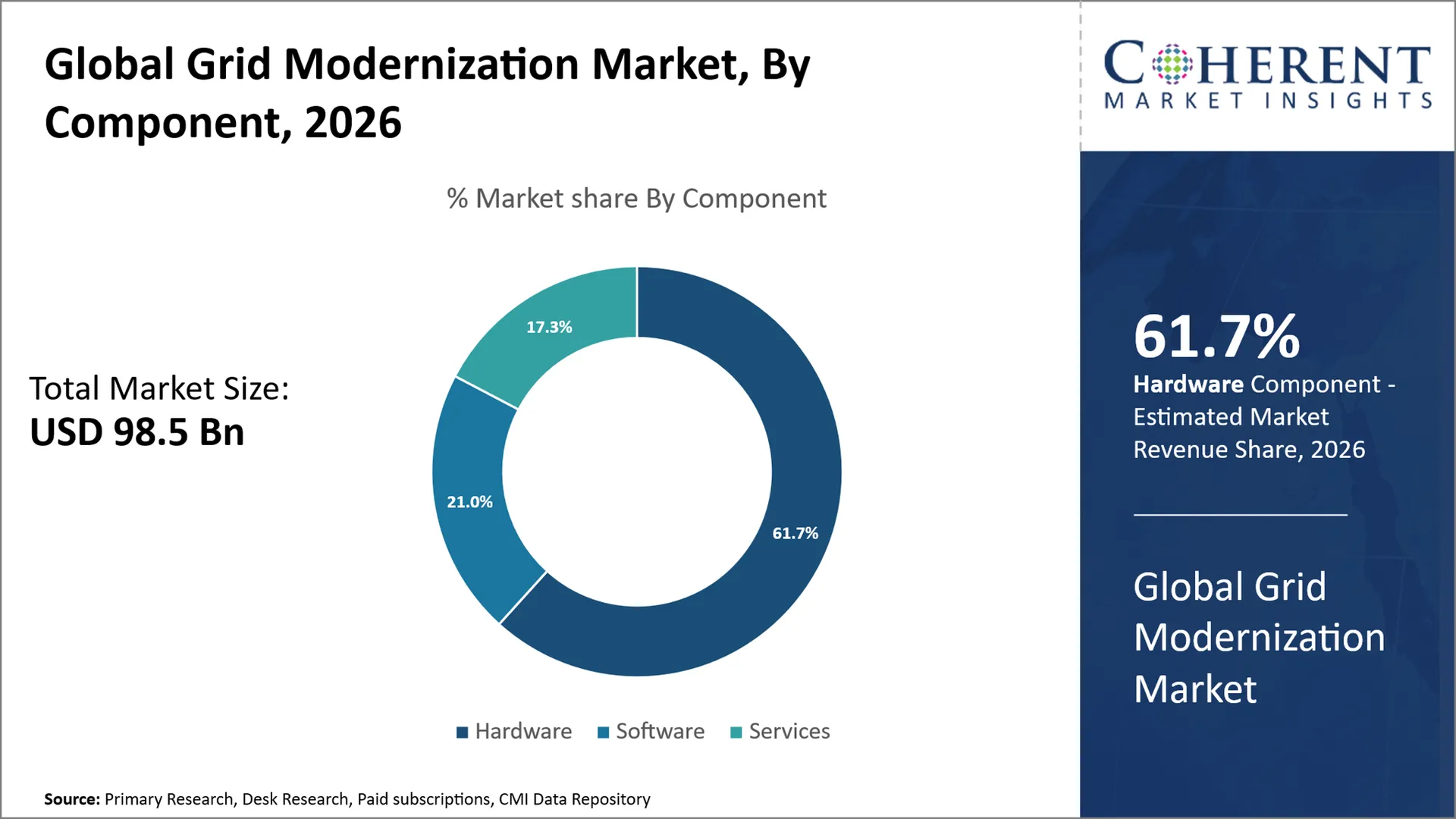
- Hardware is expected to post an indicative 5.4% CAGR during 2026–2033, with a 61.7% global grid modernization market share in 2026. Physical assets command substantial project budgets because transformer replacements and network reinforcement require specialized equipment. In September 2025, Siemens Energy announced a USD 246.82million expansion of its Nuremberg transformer factory to increase manufacturing capacity.
- Distribution Grid modernization could advance at an indicative 6.2% CAGR during 2026–2033, representing 55.6% of the global grid modernization market in 2026. Local networks require targeted reinforcement as electricity flows change across feeders serving homes and businesses. In April 2025, SSEN Distribution announced a USD 601.85 million programme to renew overhead lines, substations, and underground infrastructure in northern Scotland.
- Grid Automation and Control has an indicative 6.7% CAGR outlook for 2026–2033 and an expected 28.5% global grid modernization market share in 2026. Automated fault isolation and coordinated switching help operators restore supply without rebuilding entire circuits. In May 2025, ABB introduced its Relion REC615 relay, combining protection, fault indication, monitoring, and control for medium-voltage distribution networks.
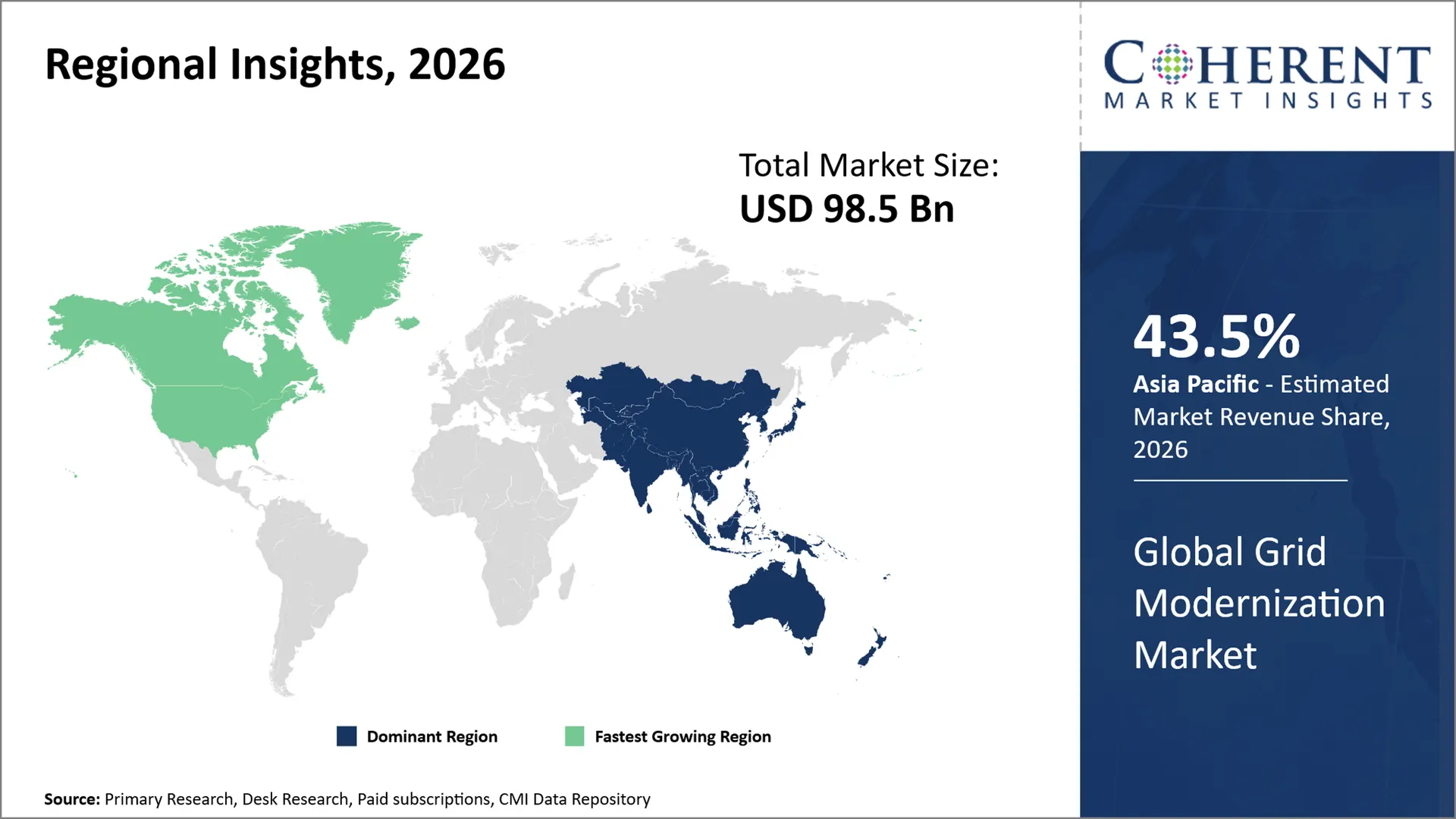
- Asia Pacific, forecast here at an indicative 5.0% CAGR during 2026–2033, is expected to account for 43.5% of global grid modernization market revenue in 2026. Large electricity systems require major investments in long-distance power transfer and high-capacity substations. In July 2026, India's Ministry of Power reported the addition of 35,172 circuit kilometres of transmission lines over the preceding three financial years.
- North America leads the regional growth outlook with an indicative 7.1% CAGR during 2026–2033, alongside a 24.2% share in global grid modernization market. Modernization priorities increasingly emphasize capacity gains within existing transmission corridors rather than relying solely on new routes. In March 2026, the U.S. Department of Energy announced an approximately USD 1.9 billion funding opportunity for reconductoring and advanced transmission upgrades.
Segmental Insights
Why Does Hardware Dominate the Global Grid Modernization Market?
Hardware is expected to be the largest segment of the global grid modernization market with 61.7% share in 2026. The magnitude of spending reflects a procurement reality: voltage-regulation and transformer upgrades depend on factory-built assets that must meet utility-specific electrical ratings, acceptance tests, and installation schedules. Unlike software, these units need significant production capability, special materials and timely delivery to substations and feeder sites. Demand for grid upgrades translates into increased equipment procurement, benefiting manufacturers capable of delivering qualified products within utility project timelines. In October 2025, Eaton completed a USD 100 million expansion of its Nacogdoches, Texas, plant, more than doubling U.S. production capacity for voltage regulators and three-phase transformers. That extra output improves the ability of suppliers to meet the requirements of utilities for procurement as electricity networks are upgraded.
- Current Industry Events of 2026
- Market Size Estimation
- Regional Breakdown
- Competitive Landscape
- Customer Intelligence
- Segmental Analysis
- Pricing Analysis
- Key Market Drivers, Challenges & Future Trends
- Customized Insights Section
Why Does Distribution Grid Represent a Major Grid-Level Segment in the Global Grid Modernization Market?
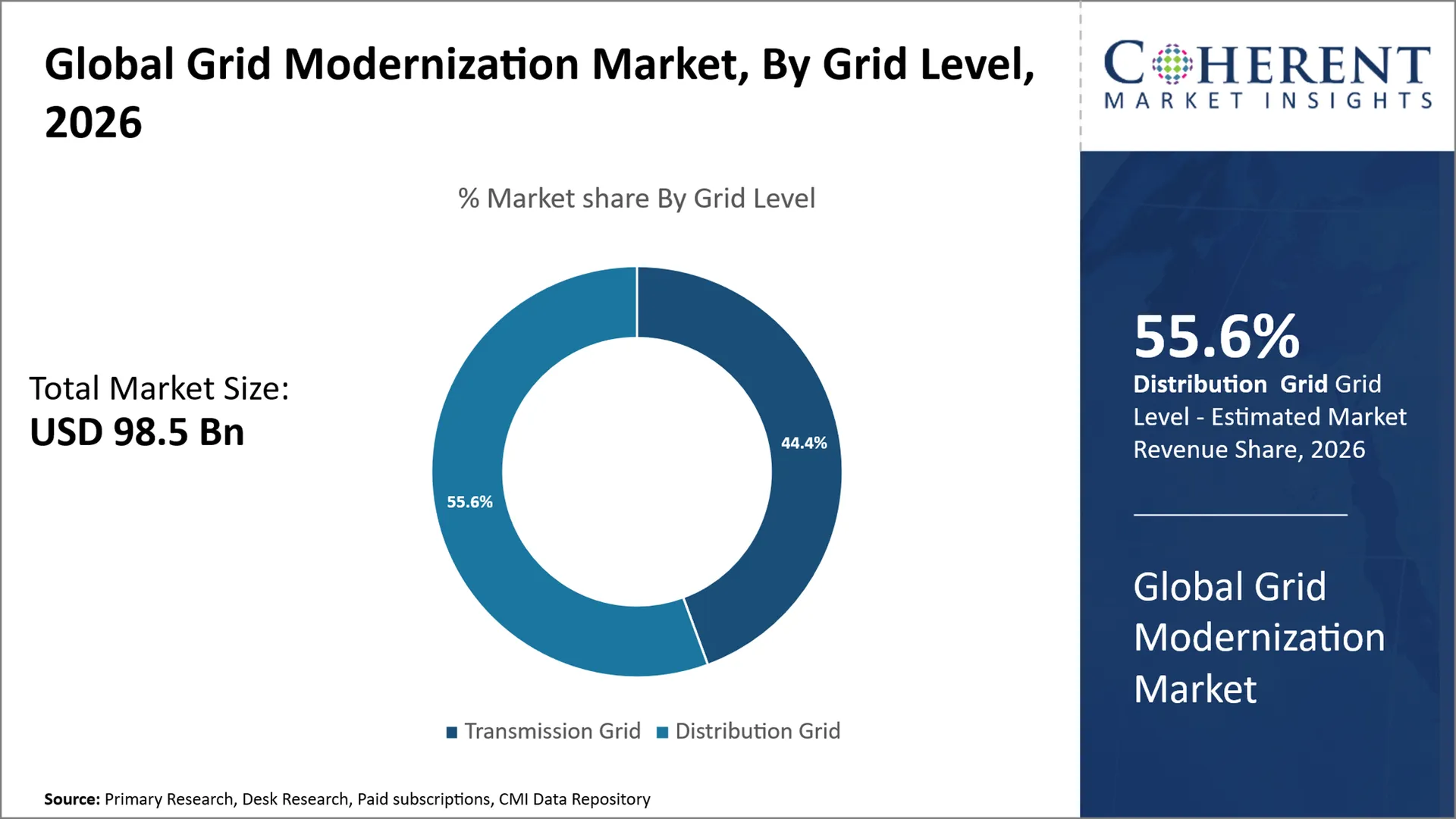
The Distribution Grid segment is expected to lead the global grid modernization market in 2026, accounting for 55.6% of the market share. This dominance is supported by the growing need to upgrade local electricity networks to meet the evolving power demands of residential, commercial, and industrial users. Utilities are investing in distribution transformers, feeder upgrades and substation reinforcement to support electric vehicle charging, rooftop solar and increased electricity usage. These investments create opportunities for electrical equipment manufacturers, distribution network operators, and infrastructure contractors. In April 2025, UK Power Networks announced a USD 4.28 million substation upgrade in Wimbledon, London, involving the installation of a 90 MVA transformer to strengthen electricity reliability for more than 250,000 residents. This project demonstrates the importance of distribution infrastructure in meeting local electricity needs and ensuring long-term network resilience.
Why Do Grid Automation and Control Dominate the Technology Category of the Global Grid Modernization Market?
Grid Automation and Control is estimated to hold 28.5% share in 2026. It provides a commercial advantage in that it enables an existing network to be better operated without replacing all the installed switching devices. Utilities operating a mix of relays, reclosers, and communication equipment increasingly prefer solutions that retain existing protection settings and operating practices. Compatibility with legacy assets can expand demand for retrofits and reduce resistance in tender evaluations for suppliers. In February 2026, S&C Electric Company announced it will collaborate with Schweitzer Engineering Laboratories to support its IntelliRupter fault interrupter with the soon-to-be-released SEL-651RD Advanced Digital Control. The availability of planned retrofits in late 2026 shows how interoperable control capabilities can extend the service life and automation capability of installed feeder equipment.
Current Events and their Impact
Current Event | Description and Its Impact |
European Commission's European Grids Package – December 2025 |
|
Ofgem's RIIO-3 Final Determinations – December 2025 |
|
FERC Order No. 1920-A – November 2024 |
|
Global Grid Modernization Market Dynamics
Key Market Drivers
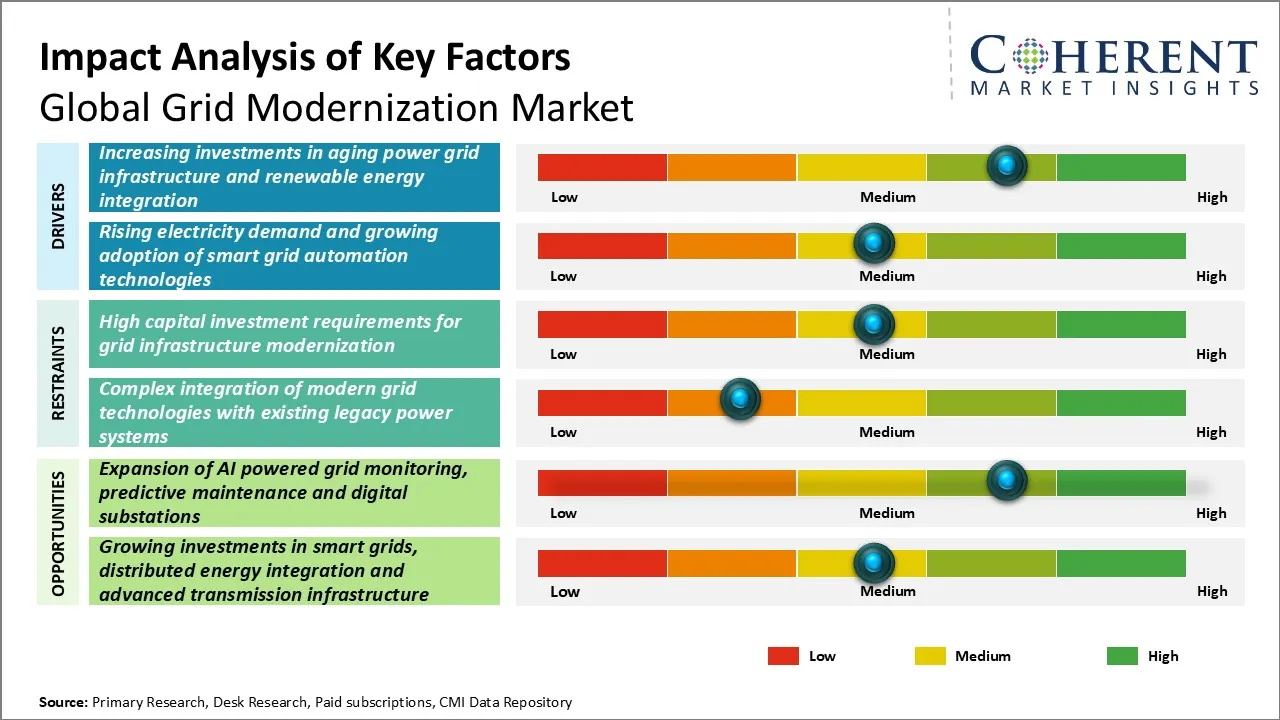
- Increasing investments in aging power grid infrastructure and renewable energy integration: Grid refurbishment and renewable integration are converging into a common capital-planning challenge as older transmission corridors were not designed for geographically dispersed renewable generation. Utilities are finding it necessary to build upgraded substations, more power-transfer infrastructure and higher-capacity conductors to accommodate changing electricity flows. That means procurement opportunities for transmission operators, engineering contractors and equipment makers. In April 2025, National Grid reported that construction had begun on Eastern Green Link 1 and 2 under its Great Grid Upgrade programme, supporting the integration of cleaner electricity into Britain's transmission network.
- Rising electricity demand and growing adoption of smart grid automation technologies: The electrification of industrial operations, the connection of data centers and the growing variability of local loads are putting increased pressure on existing electricity networks. Coordinated distribution controls, fault-location systems, and automated switching can be used by utilities to effectively deal with changing operating conditions, minimize the length of interruptions, and reduce restoration costs. That is fueling demand for automation specialists, communication equipment makers and grid-control suppliers. In July 2025, CenterPoint Energy announced it had deployed 5,150-plus self-healing automation devices across its Houston-area network, proving the real-world benefits of automated distribution infrastructure.
Emerging Market Trends
- Growing Preference for Interoperable and Vendor-Neutral Grid Systems: Open architecture requirements are beginning to influence utility purchasing well before equipment reaches the end of its operating life. Buyers want network models, meter information, operational technology telemetry, and asset records to move between platforms without expensive proprietary interfaces. This could shift margins away from closed software licenses and toward integration, configuration, and ongoing data-quality services. Over the forecast period, vendors offering documented APIs, portable network models, and disciplined migration tools should gain greater access to complex modernization programmes, while suppliers dependent on restrictive interfaces may face longer procurement scrutiny.
- Cybersecurity Requirements Are Reshaping Grid Equipment Procurement: Cyber resilience is becoming a design requirement of modern electricity networks rather than a security review after installation. Connected substations, remote engineering access and software-defined controls amplify the consequences of compromised credentials or poorly governed updates. Utilities will likely focus more attention on asset inventories, secure firmware maintenance, incident recovery procedures and proof of supplier security during the contract evaluation. The change could be good news for manufacturers that embed verifiable security controls and support long equipment lifecycles, but it could create additional compliance costs for smaller integrators and legacy system specialists.
Regional Insights
Why Does Asia Pacific Dominate the Global Grid Modernization Market?
Asia Pacific is expected to dominate the global grid modernization market with 43.5% revenue share by 2026. The increasing demand for electricity, the mixed electricity infrastructure of the region, and the varying levels of grid development. Southeast Asian countries are increasingly reliant on inter-connected transmission systems to enhance electricity security, address supply imbalances and increase power trading. However, for the project implementation, the obstacle of technical standards, investment frameworks and electricity market regulations. These challenges will be opportunities for international engineering companies, infrastructure financiers, and grid integration specialists. In October 2025, the ASEAN Centre for Energy launched the ASEAN Power Grid Financing Initiative to help develop subsea transmission, domestic grid upgrades, and cross-border interconnections. This initiative can boost the commercial viability of regional infrastructure projects and improve long-term investment opportunities.
Why Is North America Emerging as the Fastest-Growing Region in the Global Grid Modernization Market?
North America is expected to emerge as the fastest-growing region in the global grid modernization market, holding a 24.2% revenue share in 2026. Its growth outlook is based on increased investment in distribution flexibility, customer-owned energy resources and resilience in the electricity network. Utilities in the region are considering systems that enable batteries, distributed generation and controllable loads to participate more effectively in electricity operations. These applications demand sophisticated power conversion, distribution management software and safe communication infrastructure. In August 2025, Natural Resources Canada announced more than $9.28 million for five electricity grid modernization projects in Ontario, including distributed energy resource management and local electricity market demonstrations. Such investments could accelerate the commercialization of flexible distribution technologies and open up opportunities for software developers, equipment manufacturers and utility integration specialists.
Global Grid Modernization Market Outlook for Key Countries
Why Is the U.S. a Key Market for the Global Grid Modernization Market?
The United States represents an important region in global grid modernization market because transmission planning increasingly must balance large electricity loads with the cost of network congestion. New generation connections, electrified manufacturing and data centers are changing the regional capacity requirements. System operators are looking at conductor replacement, targeted reinforcement and engineering solutions that squeeze more capacity out of existing assets rather than building whole new transmission corridors. This creates opportunities for advanced conductor manufacturers, line engineering contractors and network planning specialists. The California Independent System Operator in May 2026 approved its 2025–2026 transmission plan, proposing 38 projects estimated to require an investment of USD 6.7 billion. The plan includes 12 reconductoring projects, three of which are using advanced conductors. These decisions illustrate the way in which traditional infrastructure investment and capacity-enhancing equipment can be used by U.S. utilities to economically control electricity demand.
Why Does China Support Growth in the Global Grid Modernization Market?
China occupies a strategic position in the global grid modernization market because its main electricity production centers are often distant from major industrial and urban consumers. The resulting power-transfer requirements favor ultra-high-voltage direct-current infrastructure capable of moving electricity over long distances. Such projects involve converter stations, specialized insulation, transmission towers, and sophisticated system protection, supporting a substantial domestic engineering and manufacturing ecosystem. In June 2025, the State Grid Corporation of China announced the start of operations on the ±800 kV Hami–Chongqing transmission project. The 2,260-kilometre connection is expected to deliver more than 36 billion kilowatt-hours annually to Chongqing. Beyond supplying additional electricity, large interregional corridors help buyers access geographically dispersed generation resources. Chinese equipment suppliers therefore benefit from technically demanding projects requiring high-voltage manufacturing capacity, converter expertise, and coordinated grid commissioning.
Why Is India Important in the Global Grid Modernization Market?
India is a key growth market in the global grid modernization industry, with investments in electricity network upgrades, distribution automation and advanced metering infrastructure. Distribution utilities are adopting smart meters to improve billing accuracy, reduce commercial losses and increase visibility into electricity consumption. In February 2026, Adani Energy Solutions said it had supplied 10 million smart electricity meters to Indian distribution companies. This milestone is indicative of the increasing demand for integrated metering solutions, communication infrastructure and grid management technologies.
Why Is Japan a Strategic Country in the Global Grid Modernization Market?
Japan is a strategically important market for grid modernization, with growing electricity demand, interregional transmission needs and the requirement for reliable and resilient power infrastructure. In March 2026, Japan’s Cabinet approved amendments to the Electricity Business Act to support the construction of large-scale transmission and diversify financing mechanisms. The legislation was subsequently passed in July 2026, strengthening the regulatory framework for investment in grid infrastructure and helping prospects for transmission equipment suppliers, engineering companies and grid developers.
Why Is Brazil an Important Growth Market for the Global Grid Modernization Market?
Brazil has unique growth opportunity in grid modernization, considering that its electricity network has to connect geographically dispersed generation areas with industrial and population centers. Long transmission distances, changing power flows and the need for voltage stability make substations, compensation equipment and network extensions the heart of infrastructure planning. Brazil represents an important growth market for grid modernization, supported by investments in long-distance electricity transmission, substation capacity, and network reliability. In September 2026, Brazil's electricity regulator, ANEEL, approved Transmission Auction No. 4/2026, involving estimated investments of BRL 8.9 billion across eight lots in seven states. The auction is scheduled for October 30, 2026, and includes new transmission lines, substation infrastructure, and additional transformation capacity. These investments are expected to create procurement opportunities for grid equipment manufacturers, EPC contractors, and infrastructure developers.
Technology Deployment and Infrastructure Landscape
Technology | Infrastructure Application | Adoption Landscape | Commercial Significance |
High-Temperature Low-Sag (HTLS) Conductors | Uprating existing transmission corridors | Commercial deployments; project-specific adoptions. | Increases capacity on existing rights-of-way, potentially avoiding more costly new corridors |
Dynamic Line Rating Systems | Real-time evaluation of transmission line capacity | Selective deployment on restricted networks | Uses weather and conductor data to determine available capacity, enabling sensors and analytics |
Synchrophasor Measurement Systems | Wide area monitoring of voltage angles and oscillations | Located in advanced transmission network | Improves visibility of dynamic system behavior Supports special analytical software |
Digital Substation Process Bus IEC 61850 | Digital communication among protection, measurement and control devices | Growth through new substations and selective retrofits | Can reduce conventional wiring Growing demand for interoperability testing and engineering expertise |
Grid-Forming Inverter Control | Voltage and frequency support in inverter dominated electric systems | Deployment emerging, depending on grid needs | Enables possibilities for advanced control design, system studies and testing of compliance with grid codes |
Voltage-Source Converter-Based HVDC Systems | High-capacity power transmission and grid interconnections | Commercially proven for selected transmission applications | Enables controllable power transfer over long distances and limited interconnection points |
How Are Flexible Grid Connections and Industrial Load Management Creating New Growth Opportunities in the Global Grid Modernization Market?
Flexible electricity connections represent an underdeveloped service opportunity for grid suppliers serving industrial campuses, logistics clusters, and other large new consumers. Where conventional network reinforcement would delay a connection, customers may accept agreements that adjust consumption during constrained periods, provided operational limits are transparent and commercially manageable.
This creates openings for control systems that coordinate on-site storage, backup generation, process loads, and verified network headroom. Technology providers could develop modular connection-management packages supported by forecasting, compliance reporting, and contractual performance guarantees.
Distribution operators gain a tool for sequencing investments, while commercial customers gain a potential route to earlier capacity access without assuming that uninterrupted maximum demand is always available.
Participation will require utility-grade cybersecurity, reliable control integration, robust metering, and agreement on the allocation of curtailment risk. Specialist software firms may lead initial deployments, but established integrators could scale adoption through existing utility procurement relationships and strong local engineering support.
Market Players, Key Development, and Competitive Landscape
Key Developments
- In November 2025, Schneider Electric launched its One Digital Grid Platform, a modular software platform that combines utility planning, operations and asset management capabilities. The development gives utilities a means for integrating grid applications over existing systems and creates opportunities for software licensing, systems integration and operational support services.
- In August 2025, Hitachi Energy announced a THB 455 million expansion of its Samutprakarn transformer manufacturing facility in Thailand, targeting higher production capacity and upgraded testing capabilities. The investment strengthens regional equipment availability, with potential commercial benefits tied to shorter procurement cycles and improved factory throughput.
- In May 2025, GE Vernova announced a contract to supply more than 70 extra-high-voltage transformers and shunt reactors to POWERGRID in India, with manufacturing in Vadodara. The order illustrates how local production, commissioning capability, and equipment qualification can strengthen supplier positions in complex transmission procurement.
Competitive Landscape
Competition requires the ability to deliver complex projects within the utility procurement windows, technical compatibility, manufacturing capacity and demonstrated network reliability. Installation, regulatory compliance, commissioning and long term customer support remain reliant on local engineering partners.
Key areas of emphasis are
- Supplier qualification is based on proven reliability, durability of equipment and compliance with utility operating specifications.
- Pricing and Ownership Costs: Buyers look at the acquisition price and operational efficiency, maintenance costs and replacement intervals.
- Manufacturing Availability Acquisition of major equipment is subject to production schedules, component availability and delivery schedules.
- Quality and Compliance Environmental demands, test documentation and international electrical standards are still indispensable qualification criteria.
- Product Customization: Specialized manufacturers differ from others in their network-specific configurations and compatibility with installed equipment.
- Regional Localization: Availability of local assembly, testing facilities and engineering expertise may improve the competitiveness of tenders.
- After-Sales Capabilities: Spare-parts availability, technical training, repair services, and warranty responsiveness support long-term utility relationships.
Market Report Scope
Grid Modernization Market Report Coverage | |||
Report Coverage | Details | ||
Base Year | 2025 | Market Size in 2026: | USD 98.5 Bn |
Historical Data For: | 2020 To 2024 | Forecast Period: | 2026 To 2033 |
Forecast Period 2026 To 2033 CAGR: | 5.70% | 2033 Value Projection: | USD 145.2 Bn |
Geographies covered: |
| ||
Segments covered: |
| ||
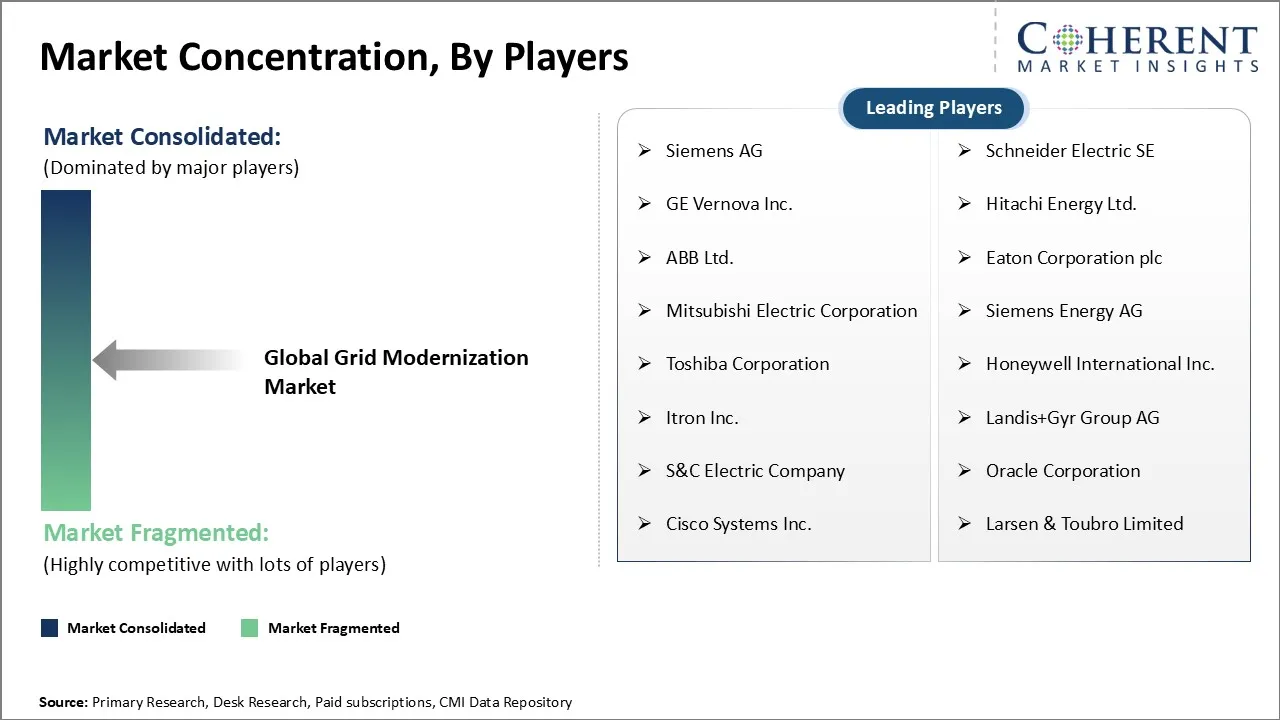
Companies covered: | Siemens AG, Schneider Electric SE, GE Vernova Inc., Hitachi Energy Ltd., ABB Ltd., Eaton Corporation plc, Mitsubishi Electric Corporation, Siemens Energy AG, Toshiba Corporation, Honeywell International Inc., Itron Inc., Landis+Gyr Group AG, S&C Electric Company, Oracle Corporation, Cisco Systems Inc., Larsen & Toubro Limited | ||
Growth Drivers: |
| ||
Restraints & Challenges: |
| ||
Analyst Opinion (Expert Opinion)
- Competitive leadership in the global grid modernization market will increasingly depend on suppliers' ability to deliver integrated solutions rather than standalone equipment. Utilities are expected to favor vendors offering design validation, commissioning, and post-installation support. Companies managing technical complexity and project execution effectively could secure higher-value contracts, while equipment-only suppliers may face greater pricing pressure.
- Digital commissioning and validation using simulations can change the way grid infrastructure is deployed by finding integration problems before physical installation. This move could mean shorter project delivery times, fewer site changes, and a challenge to current engineering standards. Suppliers that are accurate in their equipment models, possess specialized protection-engineering expertise, and have reliable simulation tools will be more advantageously positioned.
- Market participants should focus on building resilient supply chains, technical expertise, equipment reliability and regional testing capabilities. Diversified component sourcing and stronger utility partnerships can assist in managing material cost volatility and procurement delays. Manufacturers should not invest in unproven digital capabilities but rather focus on cost-effective solutions, long-term service opportunities and proven technologies.
Speak to the analyst
Want personalized insights?
Take the findings above to one of our principal consultants, or have the report rebuilt around the segments, geographies and competitors you actually track.
Market Segmentation
- Component Insights (Revenue, USD Bn, 2021 - 2033)
- Hardware
- Software
- Services
- Grid Level Insights (Revenue, USD Bn, 2021 - 2033)
- Transmission Grid
- Distribution Grid
- Technology Insights (Revenue, USD Bn, 2021 - 2033)
- Advanced Metering Infrastructure
- Grid Automation and Control
- Digital Substations and Smart Transformers
- Grid Monitoring and Analytics
- DER Integration and Management
- End User Insights (Revenue, USD Bn, 2021 - 2033)
- Electric Utilities
- Grid and System Operators
- Industrial and Commercial
- Other End Users
- Sales Channel Insights (Revenue, USD Bn, 2021 - 2033)
- Direct Manufacturer Sales
- EPC Contractors and System Integrators
- Distributors and Technology Partners
- Regional Insights (Revenue, USD Bn, 2021 - 2033)
- North America
- U.S.
- Canada
- Latin America
- Brazil
- Argentina
- Mexico
- Rest of Latin America
- Europe
- Germany
- U.K.
- Spain
- France
- Italy
- Russia
- Rest of Europe
- Asia Pacific
- China
- India
- Japan
- Australia
- South Korea
- ASEAN
- Rest of Asia Pacific
- Middle East
- GCC Countries
- Israel
- Rest of Middle East
- Africa
- South Africa
- North Africa
- Central Africa
- North America
- Key Players Insights
- Siemens AG
- Schneider Electric SE
- GE Vernova Inc.
- Hitachi Energy Ltd.
- ABB Ltd.
- Eaton Corporation plc
- Mitsubishi Electric Corporation
- Siemens Energy AG
- Toshiba Corporation
- Honeywell International Inc.
- Itron Inc.
- Landis+Gyr Group AG
- S&C Electric Company
- Oracle Corporation
- Cisco Systems Inc.
- Larsen & Toubro Limited
Sources
Primary Research Interviews
- Electricity utilities, transmission and distribution operators, smart grid technology providers, and EPC contractors
- Grid modernization consultants, equipment manufacturers, and energy infrastructure experts
Stakeholders
- Electric utilities, grid and system operators, transmission developers, and renewable energy companies
- Grid equipment manufacturers, software providers, system integrators, and infrastructure investors
End-use Sectors
- Electricity transmission and distribution utilities
- Industrial facilities, commercial buildings, data centers, renewable energy projects, and EV charging infrastructure
Regulatory and Industry Bodies
- International Energy Agency (IEA)
- U.S. Department of Energy (DOE) and Federal Energy Regulatory Commission (FERC)
- European Commission and North American Electric Reliability Corporation (NERC)
Databases
- IEA electricity and grid investment databases
- U.S. Energy Information Administration (EIA) and Eurostat
- World Bank infrastructure indicators and UN Comtrade
- Grid infrastructure investment, electricity consumption, and equipment pricing databases
Magazines and Journals
- T&D World and POWER Magazine
- IEEE Transactions on Power Delivery
- Electric Power Systems Research
Associations
- IEEE Power & Energy Society (IEEE PES)
- CIGRE (International Council on Large Electric Systems)
- Edison Electric Institute (EEI)
- Eurelectric
Public Domain Sources
- Transmission and distribution infrastructure investment data
- Smart grid deployment, electricity demand, and renewable integration statistics
- Utility capital expenditure, grid automation projects, and government funding initiatives
Key Standards and Regulations
- IEC 61850 – Power Utility Automation and Communication
- IEEE 1547 – Distributed Energy Resource Interconnection
- NERC Critical Infrastructure Protection (CIP) Standards
- EU Electricity Directive (EU) 2019/944 and applicable national grid codes
Proprietary Elements
- CMI Data Analytics Tool and proprietary research repository, supplemented by utility investment analysis, grid infrastructure assessments, primary interviews, equipment pricing, technology adoption studies, and competitive intelligence.
Get access to 250+ pages report
Every segment, forecast, competitor profile and data table behind the analysis above — available for instant download.
- ESOMAR Member
- ISO 9001:2015 Certified
- D-U-N-S Registered
- GDPR & CCPA Compliant
Frequently Asked Questions
The CAGR of global grid modernization market is projected to be 5.70% from 2026 to 2033.
The global grid modernization market is estimated to be valued at USD 98.5 billion in 2026 and is expected to reach USD 145.2 billion by 2033.
The major factors driving the growth of the global grid modernization market include increasing investments in aging power grid infrastructure, greater integration of renewable energy sources, rising electricity demand, and growing adoption of smart grid automation technologies.
High capital investment requirements for grid infrastructure modernization and Complex integration of modern grid technologies with existing legacy power systems are major factors restraining the growth of global grid modernization market.
In terms of component, hardware is estimated to dominate the market revenue share in 2026.
Siemens AG, Schneider Electric SE, GE Vernova Inc., Hitachi Energy Ltd., ABB Ltd., Eaton Corporation plc, Mitsubishi Electric Corporation, Siemens Energy AG, Toshiba Corporation, Honeywell International Inc., Itron Inc., Landis+Gyr Group AG, S&C Electric Company, Oracle Corporation, Cisco Systems Inc., Larsen & Toubro Limited are the major players.
Asia Pacific is expected to lead the global grid modernization market in 2026.