

Global Halal Empty Capsules Market Size and Forecast – 2026 To 2033
The global halal empty capsules market is expected to grow from USD 1,510.0 Mn in 2026 to USD 2,315.8 Mn by 2033, registering a compound annual growth rate (CAGR) of 6.3% from 2026 to 2033. The market for global halal empty capsules is poised for significant expansion, fueled by the expansion of halal-certified pharmaceutical and nutraceutical products, increasing demand for compliant empty-capsule inputs.
In November 2025, Indonesia’s Halal Product Assurance Organizing Agency (BPJPH) reported 10.3 million halal-certified products, demonstrating the expanding certification ecosystem. From October 2026, halal certification becomes mandatory for natural medicines, quasi-drugs, and health supplements in Indonesia, further supporting demand for compliant capsule formulations.
Key Takeaways of the Global Halal Empty Capsules Market
- Gelatin capsules are projected to hold 62.8% of the global halal empty capsules market share in 2026, making it dominant type segment across Europe where established pharmaceutical manufacturing and formal controls on animal-derived pharmaceutical ingredients support demand for compliant gelatin capsules. The UK Medicines and Healthcare products Regulatory Agency (MHRA) requires manufacturers to provide information on materials of animal origin used in medicinal products, supporting greater scrutiny of gelatin-based pharmaceutical inputs.
- Pharmaceuticals are projected to hold 47.6% of the global halal empty capsules market share in 2026, making it dominant application segment with Asia Pacific representing a key growth region due to expanding pharmaceutical production and formal halal-certification frameworks. For instance, Malaysia's JAKIM administers dedicated halal certification for pharmaceutical products under its pharmaceutical certification framework, covering raw-material sourcing and manufacturing processes.
- Pharmaceutical manufacturers are projected to hold 51.3% of the global halal empty capsules market share in 2026, making it dominant end user segment with North America representing an important manufacturing and export market for compliant capsule solutions. For instance, the U.S. FDA requires pharmaceutical manufacturers to identify and control relevant formulation ingredients and excipients, while halal certification can provide an additional compliance specification for products targeting halal-sensitive markets.
- North America market maintains dominance with an expected share of 36.4% in 2026, bolstered by its established pharmaceutical manufacturing and regulatory scrutiny of animal-derived capsule materials. For instance, Health Canada requires pharmaceutical submissions using gelatin to document the supplier, biological source, country of origin, and controls for BSE/TSE, reinforcing traceability of gelatin used in capsule shells
- Asia Pacific is expected to exhibit the fastest growth in the global halal empty capsules market, registering an estimated CAGR of 7.8% during 2026–2033, driven by expanding pharmaceutical production and strengthening quality requirements for pharmaceutical excipients. For instance, China’s National Medical Products Administration (NMPA) issued new GMP annexes for pharmaceutical excipients and packaging materials in 2025, establishing standardized requirements for their production and quality management.
Segmental Insights
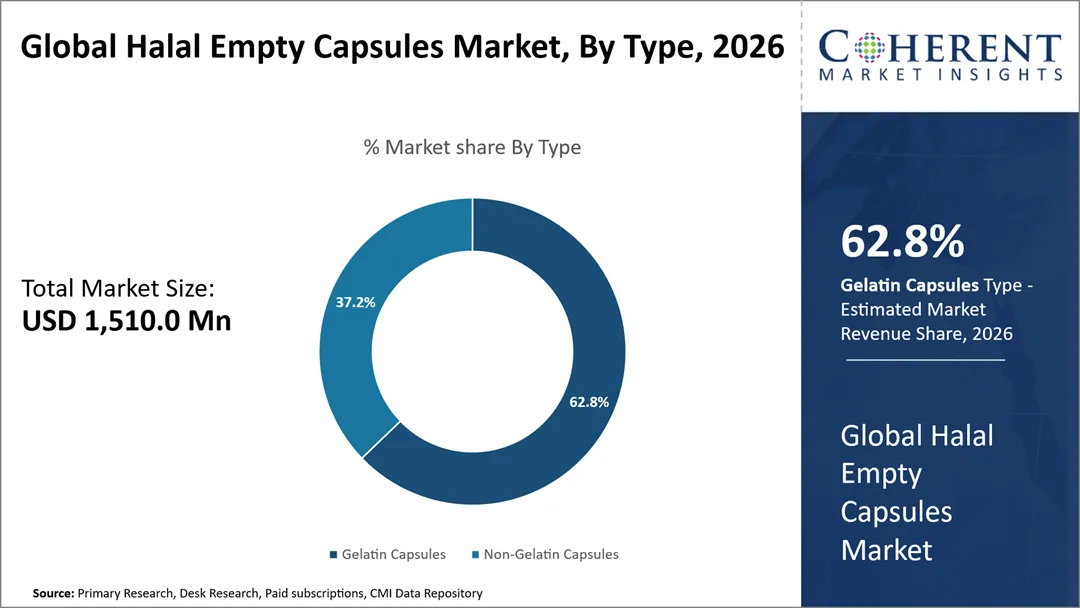
Why Do Gelatin Capsules Dominate the Global Halal Empty Capsules Market?
Gelatin capsules are projected to hold the market share of 62.8% in 2026, owing to better biocompatibility, disintegration time, mechanical properties, cheaper price and its widespread used in formulation of both drugs and nutraceuticals. Furthermore, availability of halal bovine gelatin and manufacturing technology favors it's widespread use. For instance, in October 2025, Saudi Food and Drug Authority (SFDA) published Saudi Pharmacopeia which includes specific section on Halal, strengthening the regulatory requirements of halal-compliant pharmaceutical preparations.
- Current Industry Events of 2026
- Market Size Estimation
- Regional Breakdown
- Competitive Landscape
- Customer Intelligence
- Segmental Analysis
- Pricing Analysis
- Key Market Drivers, Challenges & Future Trends
- Customized Insights Section
Why Does Pharmaceuticals Represent the Largest Application Segment in the Halal Empty Capsules Market?
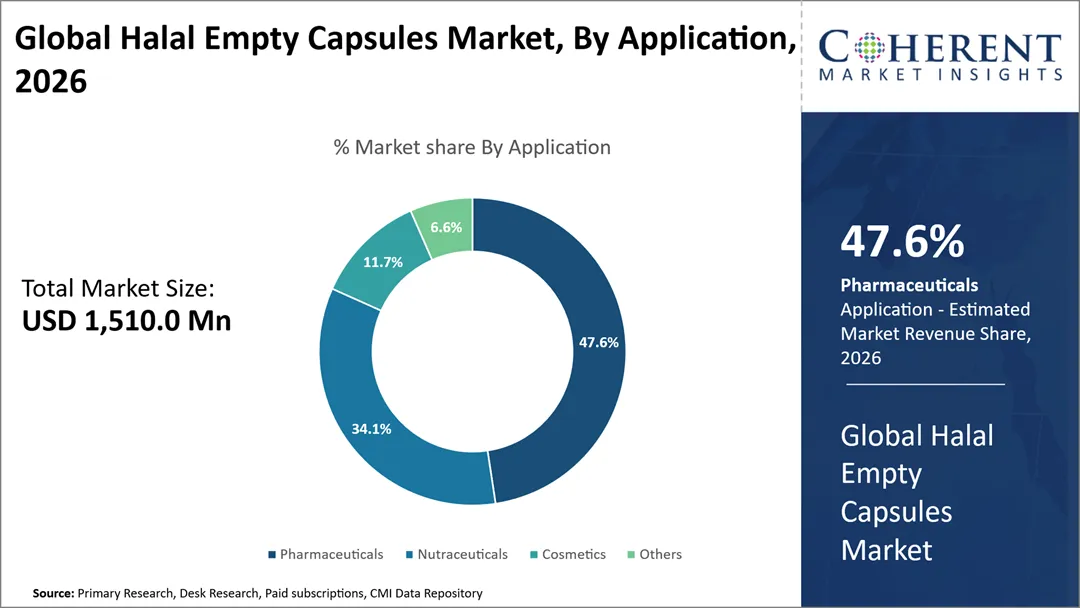
Pharmaceuticals are projected to hold a market share of 47.6% in 2026, due to the widespread usage of the empty capsules for oral drugs administration, flexibility of formulation, protection of dosage, and a readily acceptable and palatable dosage form. An increasing volume in the pharmaceutical manufacturing and increasingly stringent quality demands maintain the stability in demand of a strong capsule shells with or without halal specification. For instance, in May 2026, the Saudi Food and Drug Authority (SFDA) released revised Good Manufacturing Practice (GMP) guidance for drug manufacturing enhancing controls over quality and processes of drug manufacturing. These requirements foster continued demand of compatible, reliably manufactured capsule parts for formulated pharmaceuticals.
Pharmaceutical Manufacturers Segment Dominates the Global Halal Empty Capsules Market
The pharmaceutical manufacturers segment is projected to hold a market share of 51.3% in 2026, due to high volume production of oral solid dosage forms and a growing demand for quality-and regulatory as well as halal- compliant capsule shells. A broader drug pipeline, along with high demand for traceable raw materials also contribute to empty certified capsules. For instance, in July 2026, Malaysian National Pharmaceutical Regulatory Agency (NPRA) renewed its drug registration guidance document, outlining registration of manufacturers and several categories of pharmaceutical products.
Current Events and their Impact
Current Events | Description and its Impact |
Malaysia NPRA Strengthens Capsule-Shell Disclosure Requirements (September 2026) |
|
BPJPH Advances Halal Certification Readiness for Healthcare Products (August 2026) |
|
SASO Includes Empty Capsules in Halal Certification Scope (November 2025) |
|
Halal Empty Capsules Market Dynamics
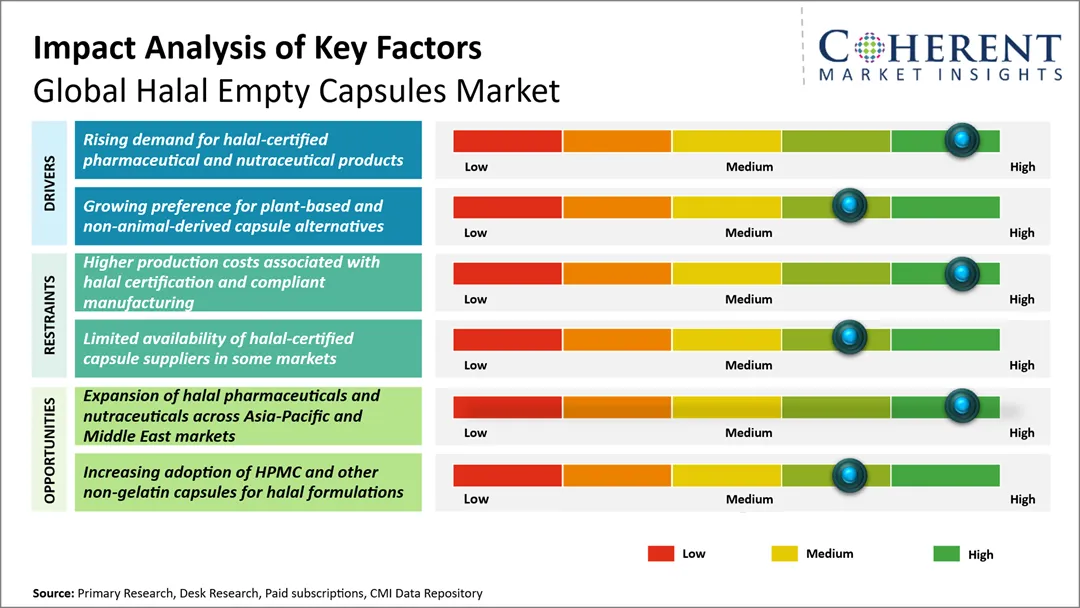
Market Drivers
- Rising demand for halal-certified pharmaceutical and nutraceutical products: Growing certification coverage across healthcare products is encouraging manufacturers to adopt compliant capsule materials and strengthen raw-material traceability. For instance, in 2025, the Gulf Cooperation Council (GCC) Standardization Organization (GSO) issued updated guidance covering halal requirements for pharmaceutical products, providing a more structured basis for conformity assessment across GCC markets. This supports wider adoption of compliant capsule components in regional pharmaceutical manufacturing
- Growing preference for plant-based and non-animal-derived capsule alternatives: Demand for HPMC-based capsules is increasing as manufacturers seek capsule shells that offer greater formulation flexibility and compatibility with sensitive pharmaceutical ingredients. For instance, in May 2026, the U.S. Food and Drug Administration (FDA) maintained regulatory recognition of hypromellose (HPMC) as a pharmaceutical ingredient, supporting its continued use in drug formulations. The established regulatory acceptance of HPMC strengthens opportunities for non-animal-derived capsule materials across pharmaceutical applications
- Expansion of pharmaceutical and nutraceutical manufacturing: The increasing production of pharmaceutical and nutraceutical products is creating greater demand for empty capsules as a flexible oral-dose delivery format. For instance, in February 2026, India’s Department of Pharmaceuticals reported continued implementation of the Production Linked Incentive (PLI) Scheme for Pharmaceuticals, supporting domestic manufacturing of pharmaceutical products and formulations. This expansion is expected to increase requirements for capsule-based dosage forms and related manufacturing inputs.
Emerging Trends
- Shift toward plant-based capsule materials: Growing adoption of HPMC and pullulan capsules is reducing reliance on animal-derived gelatin and expanding formulation flexibility. Manufacturers are increasingly developing capsules with improved stability and compatibility for nutraceutical and pharmaceutical formulations.
- Increasing demand for certified capsule supply chains: Capsule manufacturers are strengthening raw-material traceability, certification documentation, and supplier controls to meet increasingly stringent compliance requirements. This trend is encouraging greater integration of certification processes across capsule manufacturing and pharmaceutical supply chains.
- Expansion of halal-compliant pharmaceutical manufacturing: Pharmaceutical and nutraceutical manufacturers are expanding certified product portfolios to serve diverse international markets. This is creating opportunities for empty-capsule suppliers to offer certified gelatin and non-gelatin solutions with consistent quality and documentation.
Regional Insights
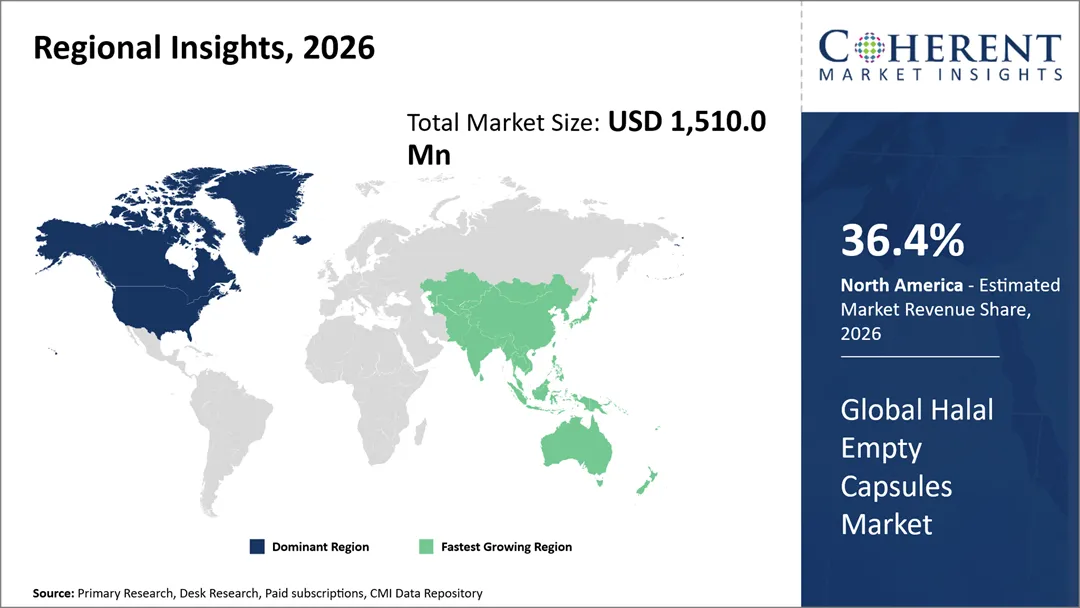
Why is North America a Strong Market for Halal Empty Capsules?
North America leads the global halal empty capsules market, accounting for an estimated 36.4% share in 2026, due to existing infrastructure and presence of pharmaceutical and nutraceutical products manufacturers and rapidly increasing demand. The robust manufacturing facilities of advanced capsule and strong regulations concerning product quality are key contributors to the market penetration of certified capsules. Furthermore, regulations in countries like U.S, Canada concerning the quality, security, trackability and safety of animal-based ingredients help increase the acceptance of gelatin capsule material. For instance, Health Canada's P.4.5 regulations require a listing of the animal source, country of origin, manufacturer, methods of manufacture and controls employed for ensuring the safety of excipients derived from animals such as gelatin.
Why Does Asia Pacific Halal Empty Capsules Market Exhibit High Growth?
Asia Pacific is expected to exhibit the fastest growth in the global halal empty capsules market, registering an estimated CAGR of 7.8% during 2026–2033. The region is projected to account for approximately 27.8% of the global market in 2026, because of the rising pharmaceuticals and nutraceuticals producing industry within the market as well as the increase need for halal capsule raw material compliance. Malaysia and Indonesia have been a leader in halal production due to policy support for halal standard and exports.
For instance, the Malaysian Halal Industry Master Plan 2030 (HIMP 2030) formulated by Ministry of Investment, Trade and Industry (MITI) and Halal Development Corporation (HDC) targets improvements on existing Halal Ecosystem, Certification, Supply Chain, and further enhancing the international Halal market development. (Source: Halal Development Corporation Berhad) In addition, the region has well-established system for certification, and investments for pharmaceutical production also enhance the domestic supply chain within the region, Furthermore, the trade agreements within Middle East will ensure further demand.
Global Halal Empty Capsules Market Outlook for Key Countries
Why is the U.S. Leading Innovation and Adoption in the Halal Empty Capsules Market?
The U.S. is one of the key markets in innovation and adoption because the country has robust capabilities in pharmaceutical manufacturing and development in specialty capsule technologies. Its existing capabilities in non-gelatin HPMC and other HPMC alternatives facilitate the variety of formulation beyond that achievable using gelatin capsules. The development of value-added oral dosage forms and halal-compliant product offerings further drives for wider range of capsule materials to producers.
Is Indonesia a Favorable Market for Halal Empty Capsules Market?
The market place for halal empty capsules is lucrative in Indonesia due to the increasing size of local pharmaceutical and nutraceutical manufacturers, combined with existing halal-product infrastructure. Local opportunities will likely exist for both gelatin and non-gelatin capsule suppliers in a space where manufacturers are moving to a larger compliant formula portfolio. Opportunities for a local supply chain for capsules will also be enhanced by local manufacturing processes and the continued streamline in certifications.
Is Malaysia Emerging as a Key Growth Hub for the Halal Empty Capsules Market?
Malaysia is expected to be a major growth region for halal-oriented product development driven by its mature pharmaceutical manufacturing system complemented by the strength of halal standards infrastructure. Halal product manufacturing within the pharmaceutical sector is already growing along with its supporting capabilities in certification, manufacturing and supply-chain processes. Moreover, the emphasis on halal product manufacturing targeting the global markets presents business prospects for producers of certified halal gelatin based and non-gelatin empty capsules.
Why Does Saudi Arabia Top the Middle East and Africa Halal Empty Capsules Market?
Saudi Arabia leads the Middle East and Africa halal empty capsules market owing to its growing number of pharmaceutical manufacturing facilities as well as increasing demand for acceptable pharmaceutical inputs. Increasing focus of the country on local drug manufacturing is paving opportunities for certified capsule-shell suppliers. Also, the established halal certification system in the country helps ensure traceability and acceptance of gelatin-based and non-gelatin based capsule shells. Furthermore, the country acts as the center of pharmaceutical as well as healthcare for surrounding Middle Eastern and African countries.
Is Halal Empty Capsules Market Developing in India?
India is emerging as a viable market for halal empty capsules due to the significant pharmaceutical manufacturing base along with the growing market size for generics and nutraceuticals. An already strong capsule manufacturing sector in India makes the market suitable to service both gelatin and non-gelatin capsules. Higher export focus for pharmaceutical products also indicates growth opportunity for manufacturers to produce capsules under specifications desired by foreign regulators.
Halal Certification Status of Pharmaceutical Products by Country
Country | Halal-Certification Framework | Pharmaceutical/Nutraceutical Relevance |
Indonesia | Mandatory halal product-assurance framework | High |
Malaysia | JAKIM halal pharmaceutical certification | High |
Saudi Arabia | SFDA halal certification framework | High |
United Arab Emirates | National halal-product conformity framework | High |
Pakistan | Halal certification and product-compliance framework | High |
Singapore | MUIS halal certification framework | Moderate |
How is the expansion of halal pharmaceuticals and nutraceuticals across Asia Pacific and Middle East markets creating new growth opportunities in the halal empty capsules market?
The growth in halal pharmaceutical and nutraceutical production in Asia Pacific and Middle East represents opportunities for empty-capsule suppliers due to expansion in compliant product portfolio of the manufacturers. Increasing healthcare spending, production of dietary supplements and pharmaceuticals, as well as importance of certificated raw materials are the key growth drivers. For instance, in February 2026, the Malaysian Investment Development Authority (MIDA) drew attention to prospects for investment in the pharmaceutical manufacturing sector which covered the halal pharmaceutical segment, complementing the expansion of capacity and building up of the regional supply-chain.
Market Players, Key Development, and Competitive Landscape
Key Developments
- In May 2026, Lonza Capsugel announced a long-term agreement to integrate locally generated wind power into its hard empty capsule manufacturing operations at its Bornem, Belgium facility. The wind project is expected to supply approximately 14% of the site’s annual electricity needs. The initiative supports more sustainable and resilient capsule manufacturing for the European pharmaceutical market.
- In March 2026, Lonza signed an agreement to divest its Capsules & Health Ingredients (CHI) business to Lone Star Funds for an enterprise value of USD 3 billion (CHF 2.3 billion). The transaction is expected to close in H2 2026, with Lonza retaining a 40% stake in CHI. The divestment marks the completion of Lonza’s transformation into a pure-play CDMO.
- In October 2025, ACG announced plans to invest USD 200 million in U.S. hard-shell capsule manufacturing. The investment will establish domestic production capabilities for empty capsules, including gelatin and HPMC capsules. The expansion is expected to strengthen ACG’s supply capacity and presence in the North American capsule market.
Competitive Landscape
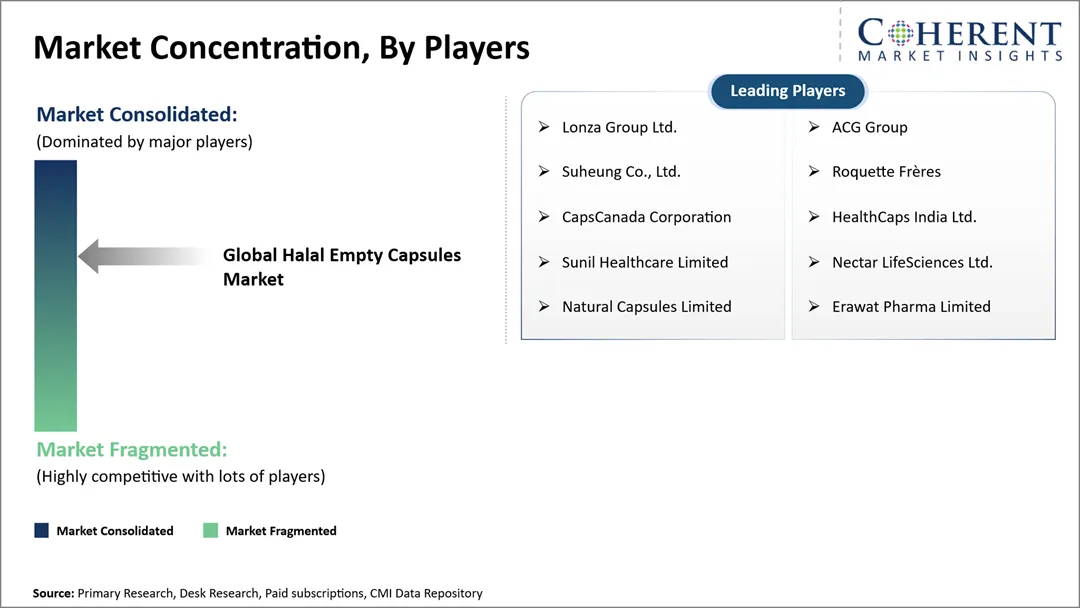
The global halal empty capsules market is moderately competitive, with market dynamics shaped by advancements in capsule-shell materials, halal-compliant manufacturing, raw-material traceability, and expanding pharmaceutical and nutraceutical applications. Market participants are increasingly focusing on improving capsule performance, certification compliance, and manufacturing scalability while strengthening supply-chain transparency. Key focus areas include:
- Development of halal-certified gelatin and non-gelatin capsule-shell technologies
- Expansion of HPMC, pullulan, and other plant-based capsule formulations
- Strengthening of halal certification, raw-material traceability, and supplier qualification
- Expansion of capsule manufacturing capacity across high-growth pharmaceutical markets
- Development of capsules with improved stability, dissolution, and compatibility with sensitive formulations
Market Report Scope
Halal Empty Capsules Market Report Coverage | |||
Report Coverage | Details | ||
Base Year | 2025 | Market Size in 2026: | USD 1,510.0 Mn |
Historical Data For: | 2020 To 2024 | Forecast Period: | 2026 To 2033 |
Forecast Period 2026 To 2033 CAGR: | 6.3% | 2033 Value Projection: | USD 2,315.8 Mn |
Geographies covered: |
| ||
Segments covered: |
| ||
Companies covered: | Lonza Group Ltd., ACG Group, Suheung Co., Ltd., Roquette Frères, CapsCanada Corporation, HealthCaps India Ltd., Sunil Healthcare Limited, Nectar LifeSciences Ltd., Natural Capsules Limited, Erawat Pharma Limited | ||
Growth Drivers: |
| ||
Restraints & Challenges: |
| ||
Analyst Opinion (Expert Opinion)
- In the coming years, global halal empty capsules market is expected to move toward higher-value, certified capsule solutions rather than conventional empty-capsule supply alone. Non-gelatin materials such as HPMC and pullulan are likely to gain importance alongside halal-certified gelatin, supported by demand for cleaner formulations, improved formulation flexibility, and broader international market access.
- The maximum opportunities are foreseen within non-gelatin capsules for nutraceutical applications in Indonesia, where expanding supplement consumption and increasing requirements for compliant formulations create a favorable environment. Players should prioritize HPMC-based capsules offering strong moisture protection, formulation compatibility, and scalable production.
- In order to gain a competitive advantage market players should differentiate through end-to-end certification and traceability, covering raw materials, capsule manufacturing, and documentation rather than competing primarily on price. Developing both gelatin and non-gelatin portfolios, improving capsule performance, and establishing regional supply capabilities can strengthen customer retention and market access.
Speak to the analyst
Want personalized insights?
Take the findings above to one of our principal consultants, or have the report rebuilt around the segments, geographies and competitors you actually track.
Market Segmentation
- Type Insights (Revenue, USD Mn, 2021 - 2033)
- Gelatin Capsules
- Non-Gelatin Capsules
- Application Insights (Revenue, USD Mn, 2021 - 2033)
- Pharmaceuticals
- Nutraceuticals
- Cosmetics
- Others
- End User Insights (Revenue, USD Mn, 2021 - 2033)
- Pharmaceutical Manufacturers
- Nutraceutical Manufacturers
- Contract Manufacturing Organizations (CMOs)
- Research and Development Organizations
- Others
- Distribution Channel Insights (Revenue, USD Mn, 2021 - 2033)
- Direct Sales
- Distributors and Wholesalers
- Online Channels
- Others
- Regional Insights (Revenue, USD Mn, 2021 - 2033)
- North America
- U.S.
- Canada
- Latin America
- Brazil
- Argentina
- Mexico
- Rest of Latin America
- Europe
- Germany
- U.K.
- Spain
- France
- Italy
- Russia
- Rest of Europe
- Asia Pacific
- China
- India
- Japan
- Australia
- South Korea
- ASEAN
- Rest of Asia Pacific
- Middle East
- GCC Countries
- Israel
- Rest of Middle East
- Africa
- South Africa
- North Africa
- Central Africa
- North America
- Key Players Insights
- Lonza Group Ltd.
- ACG Group
- Suheung Co., Ltd.
- Roquette Frères
- CapsCanada Corporation
- HealthCaps India Ltd.
- Sunil Healthcare Limited
- Nectar LifeSciences Ltd.
- Natural Capsules Limited
- Erawat Pharma Limited
Sources
Primary Research Interviews
- Empty-capsule manufacturers specializing in halal-certified gelatin and non-gelatin capsules
- Pharmaceutical formulation and manufacturing specialists using halal-compliant capsule shells
- Nutraceutical and dietary-supplement manufacturers sourcing certified empty capsules
- Halal certification and pharmaceutical-compliance specialists involved in capsule-material assessment
- Procurement and supply-chain managers responsible for capsule-shell sourcing and supplier qualification
Stakeholders
- Halal-certified empty-capsule manufacturers and capsule-shell technology providers
- Pharmaceutical and nutraceutical manufacturers
- Contract Manufacturing Organizations (CMOs) and Contract Development and Manufacturing Organizations (CDMOs)
- Halal certification bodies and conformity-assessment organizations
- Pharmaceutical excipient, gelatin, HPMC, and pullulan suppliers
- Distributors and specialty suppliers of empty capsules
- End-use Sectors
- Pharmaceutical Manufacturers
- Nutraceutical Manufacturers
- Contract Manufacturing Organizations (CMOs)
- Research & Development Organizations
- Regulatory & Health Bodies
- Halal Product Assurance Organizing Agency (BPJPH), Indonesia
- Department of Islamic Development Malaysia (JAKIM)
- Saudi Food and Drug Authority (SFDA), Saudi Arabia
- Gulf Cooperation Council Standardization Organization (GSO)
- Food and Drug Administration (FDA), U.S.
- National Pharmaceutical Regulatory Agency (NPRA), Malaysia
Databases
- BPJPH Halal Certification Database
- Malaysian Halal Directory (JAKIM)
- Saudi Halal Center certification resources
- U.S. FDA Drugs@FDA Database
- ClinicalTrials.gov
- WHO International Clinical Trials Registry Platform (WHO ICTRP)
Journals
- International Journal of Pharmaceutics
- Journal of Pharmaceutical Sciences
- AAPS PharmSciTech
- Pharmaceutics
- Journal of Pharmaceutical Innovation
- International Journal of Biological Macromolecules
Associations
- International Pharmaceutical Excipients Council (IPEC)
- International Society for Pharmaceutical Engineering (ISPE)
- International Halal Accreditation Forum (IHAF)
- World Halal Union (WHU)
- Halal Development Corporation (HDC), Malaysia
Public Domain Sources
- BPJPH – halal certification requirements, certification database, and healthcare-product guidance
- JAKIM – Malaysian halal standards, certification requirements, and halal directory
- SFDA – pharmaceutical and halal-product regulatory information
- GSO – GCC standards and conformity requirements
- U.S. FDA – pharmaceutical excipient and drug-product regulatory information
- NPRA Malaysia – pharmaceutical registration and product-quality requirements
Proprietary Elements
- CMI Data Analytics Tool, Proprietary CMI Existing Repository of information for last 10 years.
Get access to 250+ pages report
Every segment, forecast, competitor profile and data table behind the analysis above — available for instant download.
- ESOMAR Member
- ISO 9001:2015 Certified
- D-U-N-S Registered
- GDPR & CCPA Compliant
Missing comfort of reading report in your local language? Find your preferred language:
Frequently Asked Questions
The global halal empty capsules market is estimated to be valued at USD 1,510.0 Mn in 2026 and is expected to reach USD 2,315.8 Mn by 2033.
Gelatin capsules dominate due to their established pharmaceutical use, broad manufacturing availability, and cost-effective performance as capsule shells.
Halal empty capsules are capsule shells manufactured from halal-compliant materials, such as certified bovine gelatin, HPMC, or pullulan, for pharmaceutical and nutraceutical formulations.
The CAGR of global halal empty capsules market is projected to be 6.3% from 2026 to 2033.
Rising demand for halal-certified pharmaceutical and nutraceutical products, and growing preference for plant-based and non-animal-derived capsule alternatives are the major factors driving the growth of the global halal empty capsules market.
Higher production costs associated with halal certification and compliant manufacturing, and limited availability of halal-certified capsule suppliers in some markets are the major factors hampering the growth of the global halal empty capsules market.
In terms of end user, pharmaceutical manufacturers are estimated to dominate the market revenue share in 2026.