

Global High Performance Elastomers Market Size and Forecast – 2026 To 2033
The Global High Performance Elastomers Market is estimated to be valued at USD 26.34 Bn in 2026 and is expected to reach USD 37.81 Bn by 2033, growing at a compound annual growth rate (CAGR) of 5.30% from 2026 to 2033. Market expansion is supported by the increasing use of elastomers capable of maintaining sealing integrity, chemical resistance, thermal stability, and mechanical performance in automotive, semiconductor, energy, aerospace, and industrial equipment. These performance requirements are encouraging material suppliers to develop specialized formulations for increasingly severe operating environments.
In March 2025, Syensqo launched Tecnoflon FFKM NFS, a new range of high-performance perfluoroelastomers designed for semiconductor manufacturing and other demanding applications. The materials target sealing environments requiring high purity, chemical resistance, and dependable performance, illustrating continued commercial investment in next-generation specialty elastomers.
Key takeaways of the Global High Performance Elastomers Market
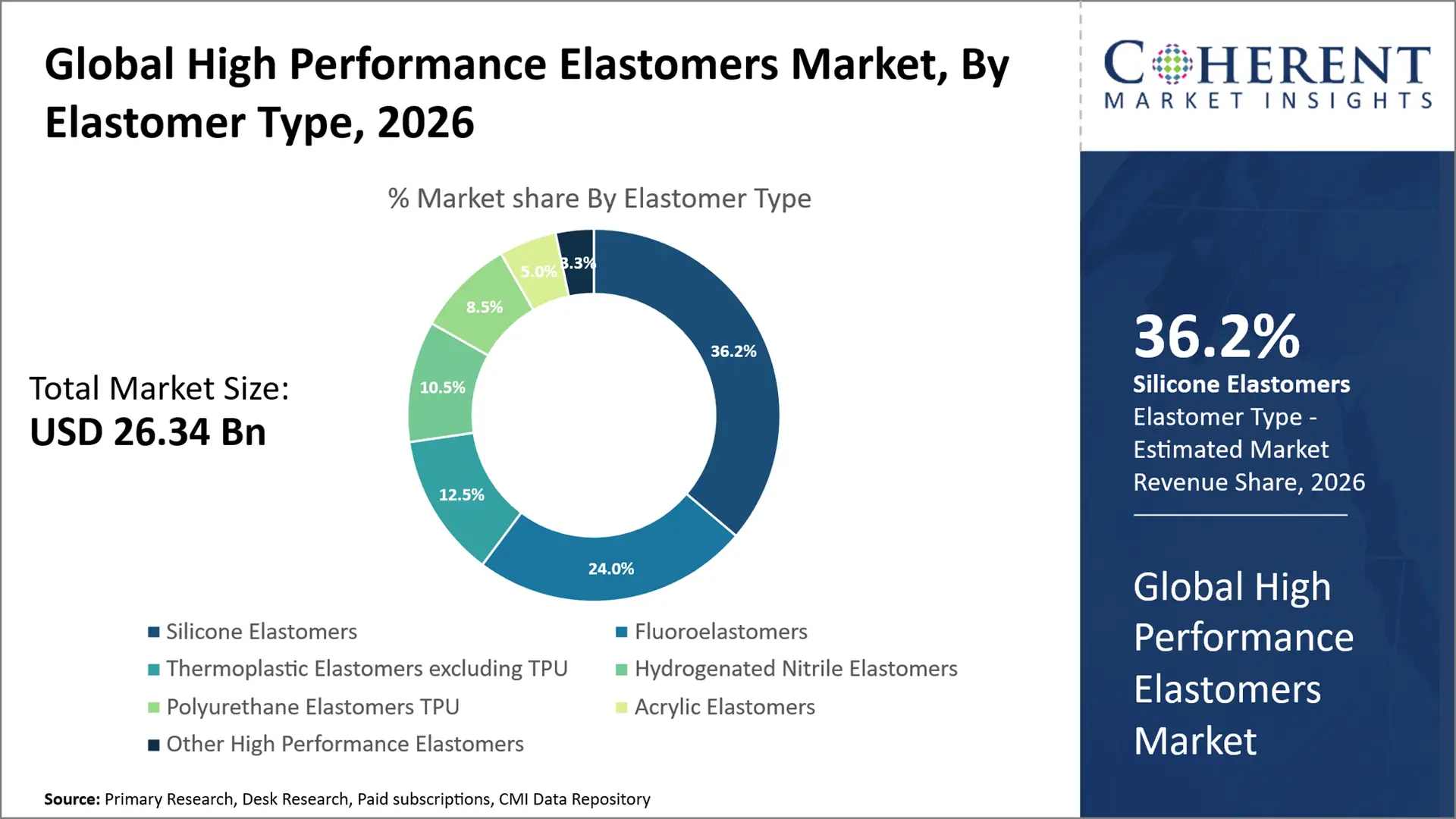
- Silicone Elastomers are projected to record an estimated 5.8% CAGR during 2026–2033 and are expected to hold 36.2% of the global high performance elastomers market in 2026. Their broad thermal window, electrical insulation, biocompatibility, and molding flexibility support use across mobility, electronics, and healthcare. In February 2025, WACKER highlighted ELASTOSIL and SILPURAN liquid and high-consistency silicone rubbers for medical wearables, tubing, valves, seals, and other devices.
- Seals and Gaskets are projected to expand at an estimated 5.3% CAGR during 2026–2033 and are expected to account for 38.6% of the global high performance elastomers market in 2026. High-performance elastomers are central to sealing systems because leakage prevention under heat, pressure, aggressive fluids, and cyclic motion directly affects equipment reliability and maintenance costs. In May 2024, Trelleborg announced a new Morocco facility dedicated to aerospace polymer sealing solutions.
- Automotive and Transportation is projected to grow at an estimated 4.8% CAGR during 2026–2033 and is expected to represent 42.3% of the global high performance elastomers market in 2026. Vehicle platforms consume elastomers across thermal management, powertrain, braking, battery, vibration-control, hose, and sealing assemblies, giving the sector unmatched component density. In March 2026, Freudenberg reported construction of a new elastomer mixing plant serving automotive and general industry applications.
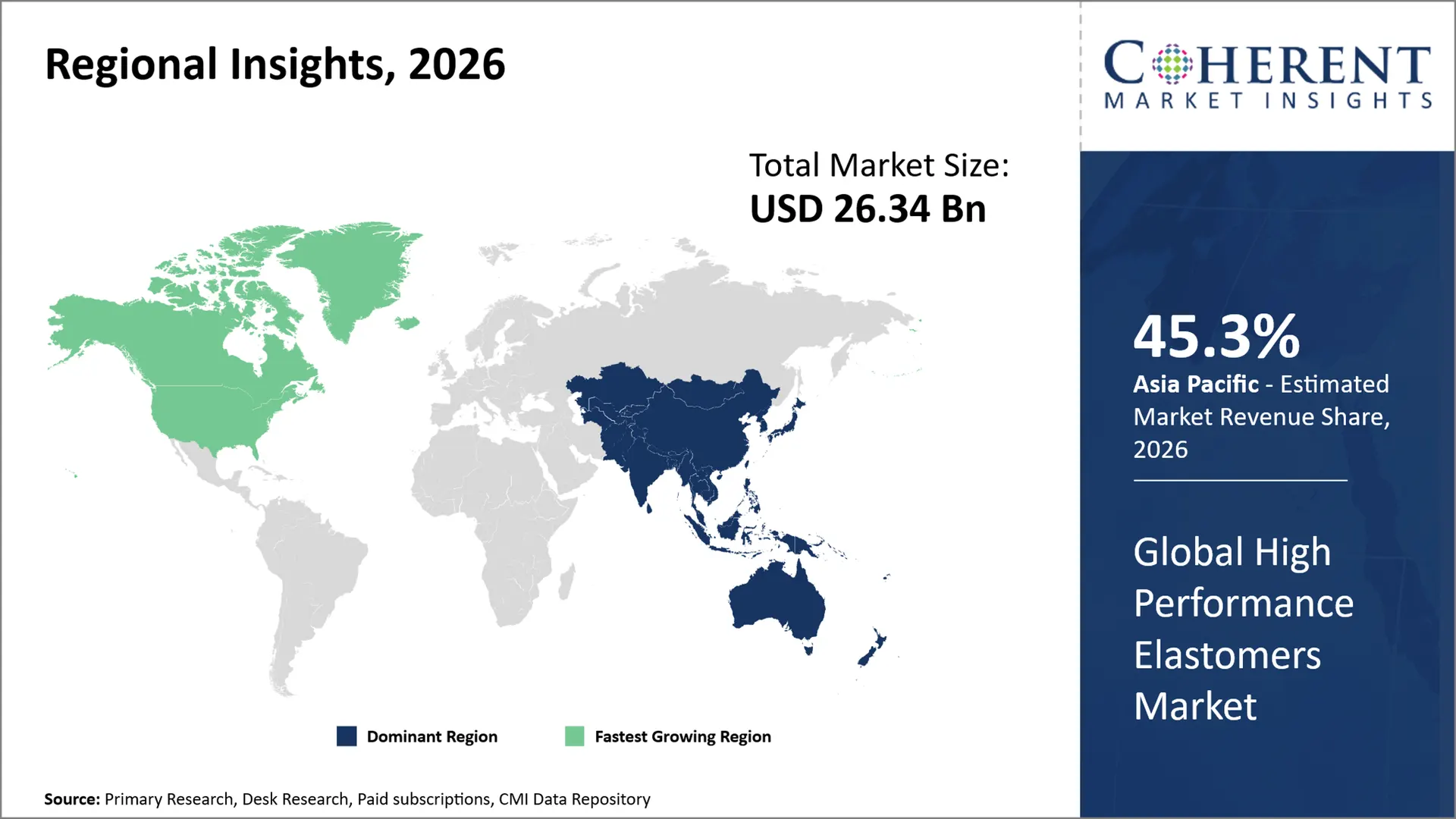
- Asia Pacific is projected to advance at an estimated 5.5% CAGR during 2026–2033 and is expected to command 45.3% of the global high performance elastomers market in 2026. Dense automotive, electronics, medical-device, and industrial manufacturing clusters create a large local conversion base for specialty elastomers and shorten qualification cycles. In June 2026, Dow announced specialty-silicones capacity expansions in China and Japan, including liquid silicone rubber and engineered silicone materials.
- North America is projected to post an estimated 6.1% CAGR during 2026–2033 and is expected to hold 23.4% of the global high performance elastomers market in 2026. Growth should outpace mature regions as suppliers deepen local availability of specialty compounds for automotive, healthcare, electronics, and regulated industrial applications. In February 2025, KRAIBURG TPE partnered with Vinmar Polymers America to expand customized high-performance TPE reach across the U.S. and Canada.
Segmental Insights
Why Do Silicone Elastomers Dominate the Global High Performance Elastomers Market?
Silicone Elastomers are expected to account for 36.2% of the global high performance elastomers market in 2026, establishing them as the leading segment by elastomer type because they combine thermal stability, electrical insulation, biocompatibility, chemical resistance, and processing flexibility across a wide range of demanding applications. Their availability in high-consistency rubber, liquid silicone rubber, and specialty formulations enables manufacturers to produce precision-molded, extruded, encapsulated, and medical-grade components. Healthcare and electronics manufacturers particularly value their purity, durability, and consistent performance under tightly controlled operating conditions. Suppliers can also customize hardness, curing characteristics, and mechanical properties to meet application-specific requirements, supporting long-term customer qualification and premium positioning. In July 2026, Avantor’s NuSil brand expanded its collaboration with the Population Council to support the development of a three-month dapivirine vaginal ring using high-purity medical-grade silicone. The development demonstrates the importance of silicone elastomers in highly regulated applications requiring reliable material performance.
- Current Industry Events of 2026
- Market Size Estimation
- Regional Breakdown
- Competitive Landscape
- Customer Intelligence
- Segmental Analysis
- Pricing Analysis
- Key Market Drivers, Challenges & Future Trends
- Customized Insights Section
Why Do Seals and Gaskets Represent the Largest Application Segment in the Global High Performance Elastomers Market?
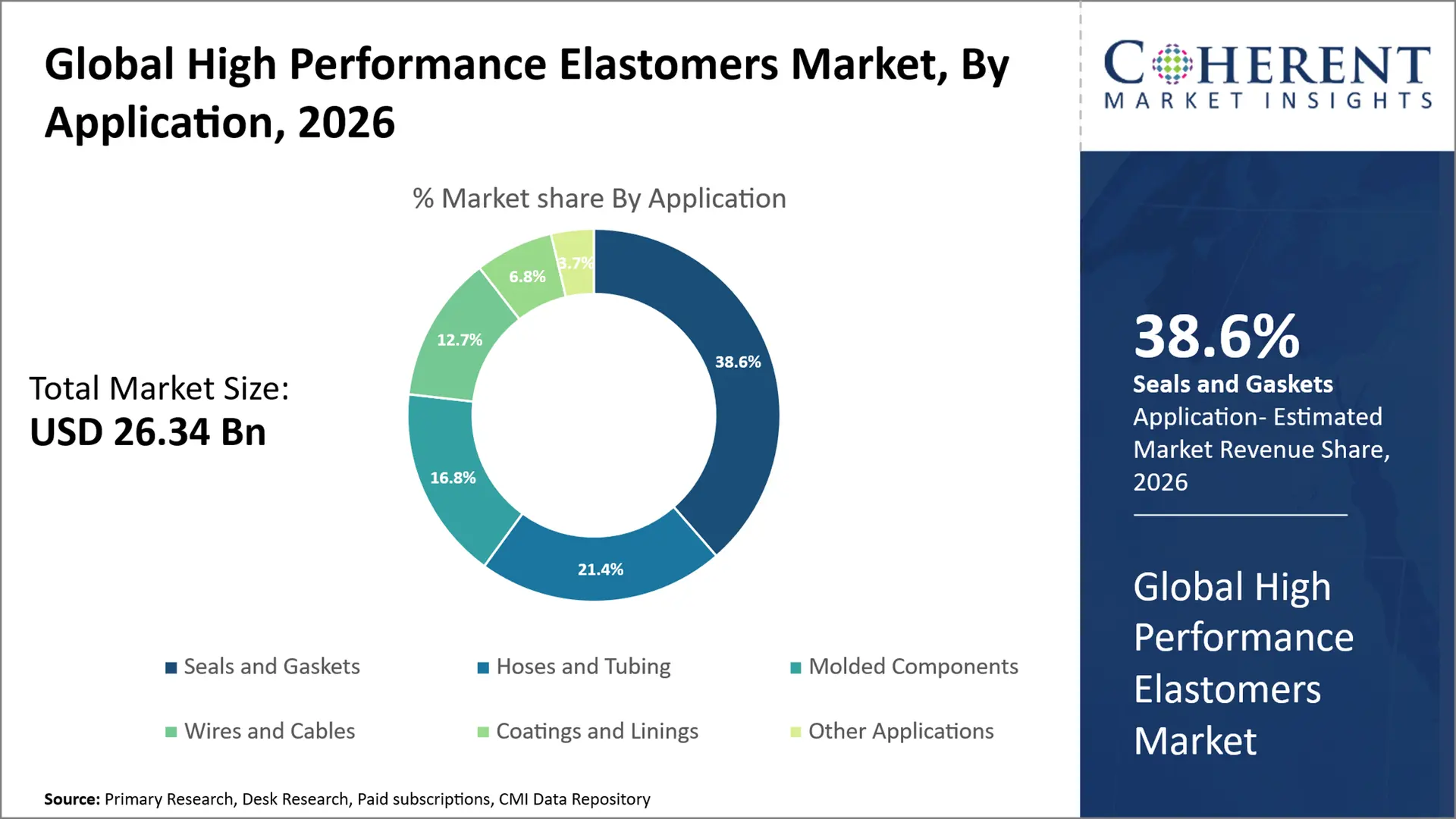
Seals and Gaskets are expected to account for 38.6% of the global high performance elastomers market in 2026, making them the largest segment by application because elastomer consumption is embedded in the reliability architecture of rotating equipment, fluid systems, compressors, pumps, valves, and energy assets, where leakage or contamination can cause downtime far exceeding the cost of the seal itself. Replacement demand also creates a recurring aftermarket stream, unlike many one-time molded components. Suppliers therefore compete on geometry, lip design, compound-media compatibility, retrofit speed, and validated operating life rather than material price alone. In August 2025, James Walker introduced the Walkersele X-Gen Helix grease-pumping lip seal for large wind-turbine main-shaft and slew bearings; the design actively returns grease toward the bearing, incorporates a contamination-exclusion lip, and was validated through full-size testing. The development demonstrates why engineered sealing remains a high-value consumption point for advanced elastomers.
Why Do Automotive and Transportation Dominate the End-use Industry Segment of the Global High Performance Elastomers Market?
Automotive and Transportation is expected to account for 42.3% of the global high performance elastomers market in 2026, positioning it as the leading end-use industry because each vehicle platform contains numerous elastomer-dependent interfaces, from media circuits and cooling lines to vibration management, connectors, boots, seals, and protected electrical assemblies. Transportation OEMs also impose long validation cycles and platform-specific specifications, which favor qualified materials that can be carried across production volumes and model generations. Electrification and alternative drivetrains are changing the performance envelope rather than removing elastomer content, creating new requirements around ion leaching, permeability, dielectric behavior, and fluid compatibility. In February 2025, Continental introduced a high-performance synthetic EPDM cooling line for hydrogen-powered commercial vehicles designed to reduce ion leaching into the media circuit and improve component service life. This demonstrates how next-generation mobility is adding technically demanding elastomer applications alongside conventional vehicle uses.
Current Events and Their Impact
Current Event | Description and Its Impact |
EU REACH restriction covering D4 D5 and D6 – May 2024 |
|
ECHA advances scientific evaluation of proposed EU-wide PFAS restriction – September 2025 |
|
U.S. FDA Quality Management System Regulation becomes effective – February 2026 |
|
Global High Performance Elastomers Market Dynamics
Key Market Drivers
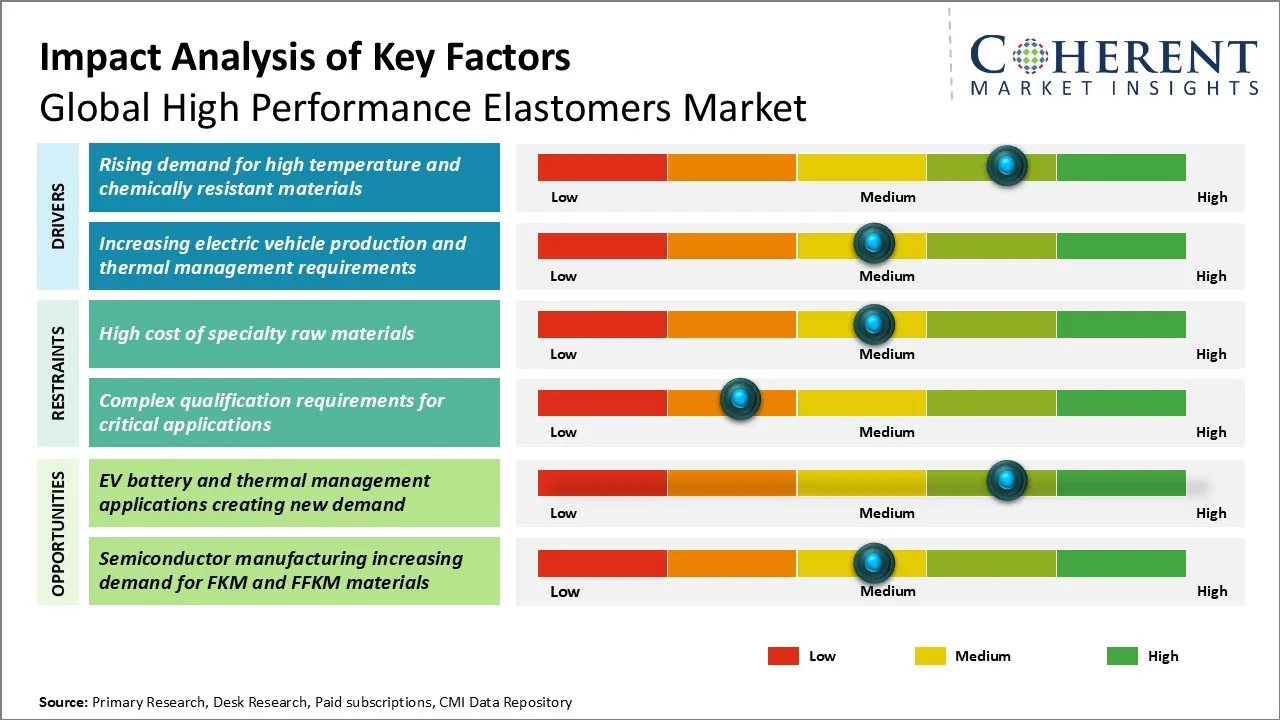
- Rising Demand for High Temperature and Chemically Resistant Materials: High-performance elastomers are increasingly specified where conventional rubber cannot maintain sealing integrity under aggressive chemicals, plasma exposure, elevated temperatures, pressure, or repeated operating cycles. This requirement is particularly important in semiconductor equipment, chemical processing, oil and gas systems, and advanced industrial machinery, supporting demand for FKM, FFKM, silicone, and HNBR compounds. In April 2026, Daikin Industries announced a new FFKM production facility at its Kashima Plant in Japan to address growing semiconductor demand, where exceptional heat resistance, chemical resistance, and purity are required.
- Increasing Electric Vehicle Production and Thermal Management Requirements: Vehicle electrification is creating additional performance requirements for elastomers used in battery packs, cooling systems, electrical insulation, sealing, cushioning, vibration management, and thermal-propagation protection. Battery cells and power electronics operate within tightly controlled temperature ranges, increasing the need for silicone and polyurethane-based elastomeric materials that combine flexibility, dielectric performance, compression control, and thermal stability. In August 2025, Saint-Gobain highlighted multifunctional materials for EV battery packs that provide mechanical cushioning, thermal management, and insulation to improve battery safety, longevity, and performance.
Emerging Market Trends
- Shift from Maximum-Property Selection Toward Application-Specific Service-Life Engineering: High-performance elastomer purchasing is moving from maximum-property selection toward service-life engineering for a defined operating environment. Buyers increasingly compare compression retention, fluid compatibility, permeation, electrical behavior, sterilization resistance, and aging under actual duty cycles rather than defaulting to the most expensive chemistry. This creates room for HNBR, silicone, and engineered TPE grades to replace over-specified fluorinated materials in selected uses, while FKM and FFKM remain protected where failure consequences justify premium performance. Suppliers with application laboratories and predictive-aging capabilities should gain influence.
- Regional Supply Redundancy Becoming Part of Material-Sourcing Strategy: Regional supply resilience is becoming part of material specifications rather than a separate procurement concern. OEMs and component converters increasingly prefer elastomer platforms that can be produced or compounded in more than one geography without changing validated performance. This pushes suppliers toward tighter recipe control, harmonized quality systems, shared test methods, and regional technical-service teams. The trend can pressure single-site specialists offering unique chemistry but limited redundancy, while benefiting suppliers that can replicate grades across plants and support dual sourcing without forcing customers through a complete component redesign.
Regional Insights
Why Does Asia Pacific Dominate the Global High Performance Elastomers Market?
Asia Pacific is expected to account for 45.3% of the global high performance elastomers market in 2026 because the region combines large automotive, semiconductor, electronics, industrial-equipment, and medical manufacturing bases with an established specialty-material supply chain. China, Japan, South Korea, and other regional production hubs create recurring requirements for silicone, FKM, FFKM, HNBR, and engineered thermoplastic elastomers in sealing, fluid-handling, insulation, and precision-processing applications. Local polymer producers and compounders also shorten technical qualification and supply lead times for OEMs. In July 2025, Japan-based AGC launched surfactant- and fluorinated-polymerization-solvent-free AFLAS FFKM grades for semiconductor-manufacturing equipment. The launch highlights Asia Pacific’s ability to pair advanced downstream manufacturing with the local development of extreme-service elastomer materials, reinforcing the region’s commercial leadership in specification-intensive applications.
Why Is North America Emerging as the Fastest-Growing Region in the Global High Performance Elastomers Market?
North America is expected to represent 23.4% of the global high performance elastomers market in 2026 and is expected to emerge as the fastest-growing region as semiconductor reshoring, aerospace investment, electric mobility, energy infrastructure, and advanced healthcare manufacturing increase demand for validated high-specification compounds. The regional opportunity is particularly attractive for FFKM, FKM, silicone, HNBR, and specialty TPE suppliers that can support customers with application engineering, clean manufacturing, short qualification cycles, and domestic supply continuity. In July 2024, DuPont announced that it would showcase new Kalrez perfluoroelastomer sealing solutions at SEMICON West in San Francisco, including bonded door seals and low-permeation designs for plasma etching, CVD, PVD, high-temperature, and high-vacuum environments. The development reflects the growing material intensity of North American semiconductor production and equipment investment.
Global High Performance Elastomers Market Outlook for Key Countries
Why Is the U.S. a Key Market for the Global High Performance Elastomers Market?
The U.S. is a key country in the global high performance elastomers market because it concentrates semiconductor fabrication, aerospace and defense manufacturing, oil and gas equipment, advanced medical-device production, and high-value automotive engineering. These industries purchase elastomers on lifetime performance, contamination control, traceability, and failure risk rather than on resin cost alone, supporting demand for FFKM, FKM, silicone, and engineered specialty compounds. Domestic investment in chip manufacturing is especially important because vacuum, plasma, wet-chemical, and thermal processing tools require chemically resistant seals and O-rings. This creates a direct materials opportunity alongside fabrication expansion. In June 2025, the U.S. Department of Commerce announced Micron Technology’s planned USD 200 billion semiconductor manufacturing and R&D investment across Idaho, New York, and Virginia, enlarging the future addressable base for high-purity elastomer sealing and fluid-handling materials.
Why Does China Support Growth in the Global High Performance Elastomers Market?
China supports growth in the global high performance elastomers market through the scale of its automotive, electronics, industrial machinery, battery, and chemical-processing sectors. Its advantage is not only end-use volume but also dense supplier clustering, which enables rapid component localization and repeated use of elastomeric seals, hoses, insulation, molded parts, and thermal-management components across mass-production platforms. Electric vehicles additionally raise requirements for coolant compatibility, electrical protection, battery sealing, and durable flexible materials. The manufacturing breadth is visible across both mobility and electronics. In February 2026, China’s National Bureau of Statistics reported that 2025 output reached 34.778 million motor vehicles, including 16.524 million new-energy vehicles, while integrated-circuit output also increased. This combination gives China unusually broad demand exposure across silicone, HNBR, FKM, TPU, and other high-performance elastomer systems.
Why Is Japan Important in the Global High Performance Elastomers Market?
Japan is important in the global high performance elastomers market because its demand is concentrated in technically demanding semiconductor equipment, precision machinery, automotive systems, electronics, and advanced-materials manufacturing. Japanese buyers typically require tight tolerances, long qualification histories, low contamination, and stable performance under heat, chemicals, vacuum, or repeated mechanical cycling. These requirements favor premium FFKM, FKM, silicone, and specialty molded elastomer solutions over commodity rubber. Semiconductor reinvestment provides an additional high-value demand route for specialist sealing materials. In April 2025, Rapidus began operating the pilot line at its IIM-1 advanced semiconductor facility in Chitose, Hokkaido, as part of its 2-nanometer manufacturing program. Leading-edge wafer processing requires high-purity seals, valve components, vacuum interfaces, and chemically resistant elastomers, creating opportunities for precision material and component suppliers supporting Japan’s advanced-node fabrication ecosystem.
Why Is India an Important Market for the Global High Performance Elastomers Market?
India is becoming increasingly relevant to the global high performance elastomers market as automotive production, electronics manufacturing, industrial machinery, and domestic component localization expand simultaneously. The automotive value chain is particularly important because high-performance elastomers are used repeatedly in cooling circuits, sealing assemblies, hoses, vibration-control parts, electrical protection, and under-hood systems. Localized vehicle and component production also encourages suppliers to establish domestic compounding, molding, and technical-support capabilities rather than relying solely on imports. India’s vehicle manufacturing scale provides a clear underlying demand base. In February 2026, the Ministry of Heavy Industries reported that 2025 production included 5.38 million passenger vehicles and 25.50 million two-wheelers, alongside commercial vehicles and three-wheelers. This supports wider consumption of HNBR, silicone, TPU, FKM, and other performance elastomers as component specifications become more demanding.
Why Is Germany a Strategic Country in the Global High Performance Elastomers Market?
Germany is a strategic country in the global high performance elastomers market because its industrial structure favors technically qualified materials for premium vehicles, industrial machinery, chemical processing, electrical systems, and export-oriented engineering equipment. German OEMs and Tier suppliers place strong emphasis on durability, material traceability, process repeatability, and compliance, supporting higher-value elastomer formulations that withstand heat, aggressive fluids, pressure cycling, and extended service intervals. Electrification further changes sealing, cooling, dielectric, and vibration-control requirements rather than eliminating elastomer use. Germany’s production profile therefore remains commercially relevant to specialty compounders. In January 2026, the German Association of the Automotive Industry reported that domestic passenger-car production reached 4.15 million units in 2025, while electric-car production during the first eleven months had already exceeded the previous full-year record.
Innovation Production and Manufacturing Landscape in the Global High Performance Elastomers Market
Technology / Manufacturing Approach | Primary Elastomer Relevance | Adoption Role | Commercial Implication |
Platinum-cured liquid silicone rubber micro-injection molding | Silicone elastomers | Enables precise thin-wall components with rapid automated molding and low contamination potential | Supports medical electronics and precision industrial parts where consistency and dimensional control command premium pricing |
Two-shot and multi-material overmolding | Silicone TPE and TPU | Integrates soft elastomeric functions directly with rigid thermoplastic or metal substrates | Reduces assembly stages and component count while increasing the value of adhesion-engineered grades |
High-purity FKM and FFKM compounding | Fluoroelastomers | Controls extractables particles metal contamination and chemical resistance for severe environments | Creates defensible positions in semiconductor chemical-processing and other failure-sensitive applications |
High-saturation HNBR formulation and peroxide curing | HNBR | Tunes heat oil fuel fatigue and mechanical performance while maintaining elastomeric durability | Allows compounders to address demanding applications below the cost envelope of premium perfluoroelastomers |
Precision continuous extrusion and dimensional-control systems | Silicone TPE TPU and HNBR | Improves wall-thickness consistency surface quality and throughput for hoses tubing and cable components | Lowers scrap rates and strengthens supplier competitiveness in high-volume specification-controlled applications |
Inline rheology spectroscopy and digital process monitoring | Multiple high-performance elastomers | Tracks mixing cure behavior contamination and batch variation during production | Reduces off-specification output and strengthens the reproducibility needed for customers operating controlled qualification systems |
How Are Hydrogen-Compatible Elastomer Platforms Creating New Growth Opportunities in the Global High Performance Elastomers Market?
Hydrogen handling creates an underdeveloped opportunity for high-performance elastomer suppliers because seals, hoses, valves, compressors, dispensers, storage interfaces, and balance-of-plant systems require materials that control permeation while resisting rapid gas decompression, pressure cycling, temperature swings, and aggressive operating media. The opportunity extends beyond a single elastomer family: advanced HNBR, FKM, FFKM, silicone, and selected thermoplastic elastomers can compete where their property profiles match the duty cycle. Suppliers can capture value by developing hydrogen-specific compounds, generating permeation and decompression data, supporting component qualification, and partnering early with equipment manufacturers. Entry requires specialized testing capability, robust compound traceability, consistent scale-up, and application engineers who can translate laboratory results into component performance. Established producers have an advantage in polymer know-how and qualification support, but specialist compounders can win in narrowly defined pressure, temperature, and media combinations where customization matters more than portfolio breadth. This favors suppliers able to commercialize validated material systems rather than undifferentiated polymer grades.
Market Players, Key Development, and Competitive Landscape
Key Developments
- In October 2025, Celanese announced advanced Santoprene TPV and Hytrel TPC solutions addressing dynamic weather seals, cable applications, boots, and bellows at K 2025. This strengthens high-performance thermoplastic-elastomer substitution where manufacturers require rubber-like durability together with melt processing, component redesign flexibility, and efficient high-volume production.
- In February 2025, Teknor Apex announced ISCC PLUS certification covering Sarlink TPV and Monprene TPE products at its Belgium and Germany sites. The development enables mass-balance bio circular and bio-circular attributed elastomers, giving customers a traceable pathway to modify feedstock sourcing while retaining established thermoplastic processing platforms.
- In October 2024, Elkem launched the AMSil 20503 series of liquid silicone rubber formulations developed for additive manufacturing together with a new support material. This is important for the global high performance elastomers market because printable silicones can expand complex-part production while reducing tooling dependence in customized and lower-volume applications.
Competitive Landscape
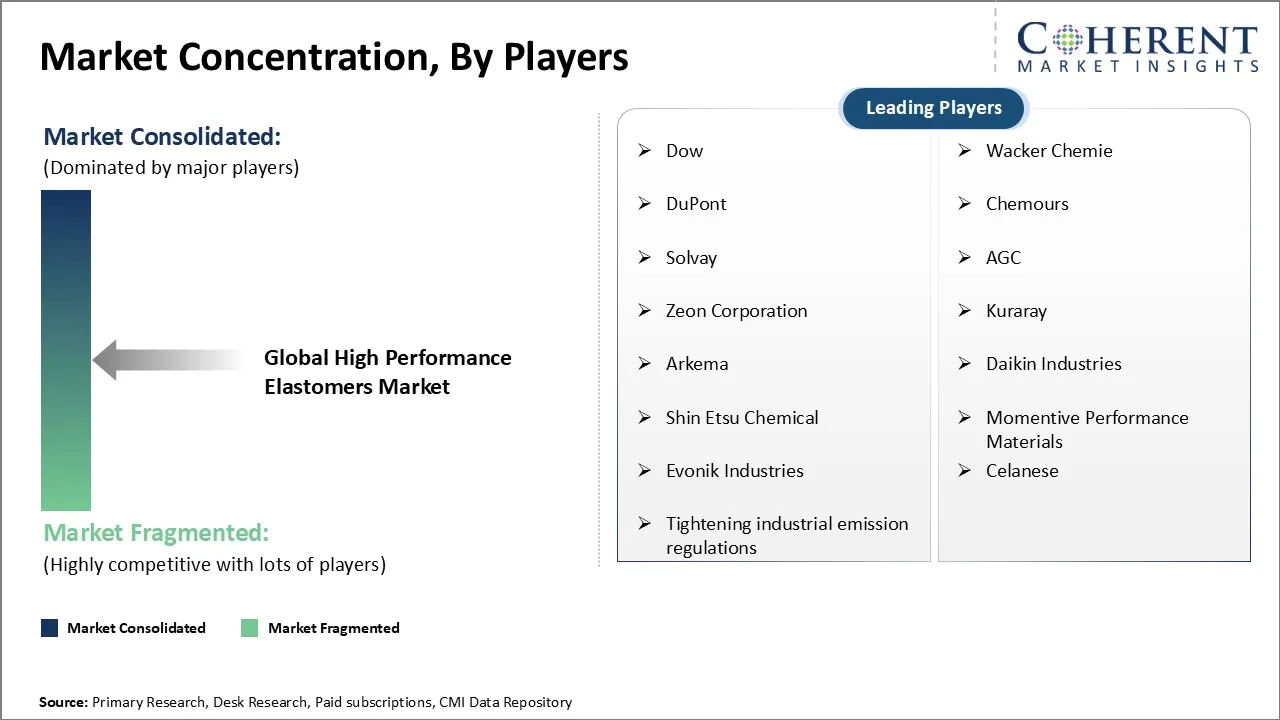
The global high performance elastomers market is moderately consolidated at the base-polymer level but more fragmented in compounding and conversion. chemical producers compete alongside specialty compounders and regional formulators. Winning positions depend on consistent extreme-service performance, qualification support, formulation customization, supply continuity, and technical responsiveness. Price matters, but lifecycle reliability and the cost of requalification often carry greater weight in critical applications.
Key focus areas include
- Performance differentiation: Heat stability, chemical compatibility, compression behavior, fatigue resistance, permeability, and aging performance determine suitability for demanding operating conditions.
- Application-specific customization: Tailored hardness, cure chemistry, reinforcement, additives, and processing behavior allow suppliers to address customer-specific specifications rather than competing solely on standard grades.
- Manufacturing consistency: Tight batch-to-batch control becomes particularly important when a formulation change could trigger component validation or customer requalification.
- Supply reliability: Multiple manufacturing locations, feedstock security, and inventory planning are increasingly important for OEM and Tier supplier sourcing decisions.
- Compliance capability: Strong material documentation, substance-management systems, quality certification, and change-control procedures reduce adoption friction in regulated applications.
- Technical support: Material-selection assistance, failure analysis, processing optimization, and application testing can materially strengthen long-term customer retention.
- Pricing discipline: Premium suppliers must demonstrate lower lifecycle failure risk or processing benefits to defend margins against lower-cost elastomers and regional compounders.
Market Report Scope
High Performance Elastomers Market Report Coverage | |||
Report Coverage | Details | ||
Base Year | 2025 | Market Size in 2026: | USD 26.34 Bn |
Historical Data For: | 2020 To 2024 | Forecast Period: | 2026 To 2033 |
Forecast Period 2026 To 2033 CAGR: | 5.30% | 2033 Value Projection: | USD 37.81 Bn |
Geographies covered: |
| ||
Segments covered: |
| ||
Companies covered: | Dow, Wacker Chemie, DuPont, Chemours, Solvay, AGC, Zeon Corporation, Kuraray, Arkema, Daikin Industries, Shin Etsu Chemical, Momentive Performance Materials, Evonik Industries, Celanese. | ||
Growth Drivers: |
| ||
Restraints & Challenges: |
| ||
Analyst Opinion (Expert Opinion)
- Leadership in the global high performance elastomers market should gradually shift toward suppliers capable of managing several elastomer chemistries rather than maximizing volume within a single polymer family. Customers increasingly need the most economical material that survives a defined duty cycle. Suppliers able to move an application intelligently between silicone, HNBR, FKM, TPU, and other TPE platforms can become strategic material partners rather than transactional resin vendors.
- AI-assisted formulation development and virtual material screening could materially shorten the traditional trial-compound-test cycle. If predictive models become sufficiently reliable, specialist compounders with strong historical test datasets may compete more effectively with larger polymer producers. Proprietary performance data could therefore become as strategically important as synthesis know-how, particularly when customers require faster optimization for unfamiliar fluids, temperatures, geometries, or processing conditions.
- Producers should prioritize flexible compounding assets, raw-material optionality, application testing, and commercially useful service-life datasets. Margin protection will require disciplined separation between applications that genuinely require premium chemistry and those that can migrate to lower-cost alternatives. Companies should avoid indiscriminate capacity additions and instead localize technically differentiated grades near customers, where qualification support, supply continuity, and rapid problem resolution create defensible value.
Speak to the analyst
Want personalized insights?
Take the findings above to one of our principal consultants, or have the report rebuilt around the segments, geographies and competitors you actually track.
Market Segmentation
- Elastomer Type Insights (Revenue, USD Bn, 2021 - 2033)
- Silicone Elastomers
- Fluoroelastomers
- Thermoplastic Elastomers excluding TPU
- Hydrogenated Nitrile Elastomers
- Polyurethane Elastomers TPU
- Acrylic Elastomers
- Other High Performance Elastomers
- Application Insights (Revenue, USD Bn, 2021 - 2033)
- Seals and Gaskets
- Hoses and Tubing
- Molded Components
- Wires and Cables
- Coatings and Linings
- Other Applications
- End Use Industry Insights (Revenue, USD Bn, 2021 - 2033)
- Automotive and Transportation
- Industrial Machinery
- Healthcare
- Electrical and Electronics
- Oil and Gas
- Building and Construction
- Other Industries
- Processing Method Insights (Revenue, USD Bn, 2021 - 2033)
- Injection Molding
- Compression Molding
- Extrusion
- Transfer Molding
- Other Processing Methods
- Distribution Channel Insights (Revenue, USD Bn, 2021 - 2033)
- Direct Sales
- Distributors and Specialty Suppliers
- Regional Insights (Revenue, USD Bn, 2021 - 2033)
- North America
- U.S.
- Canada
- Latin America
- Brazil
- Argentina
- Mexico
- Rest of Latin America
- Europe
- Germany
- U.K.
- Spain
- France
- Italy
- Russia
- Rest of Europe
- Asia Pacific
- China
- India
- Japan
- Australia
- South Korea
- ASEAN
- Rest of Asia Pacific
- Middle East
- GCC Countries
- Israel
- Rest of Middle East
- Africa
- South Africa
- North Africa
- Central Africa
- North America
- Key Players Insights
- Dow
- Wacker Chemie
- DuPont
- Chemours
- Solvay
- AGC
- Zeon Corporation
- Kuraray
- Arkema
- Daikin Industries
- Shin Etsu Chemical
- Momentive Performance Materials
- Evonik Industries
- Celanese
Sources
Primary Research Interviews
- High performance elastomer manufacturers and compounders
- Seals gaskets hoses and molded component manufacturers
- Automotive semiconductor healthcare and industrial equipment suppliers
- Material engineers procurement professionals and technical distributors
Stakeholders
- Silicone FKM FFKM HNBR TPU and specialty TPE manufacturers
- Compounders converters and precision molding companies
- Automotive OEMs and Tier suppliers
- Semiconductor equipment medical device and industrial machinery manufacturers
- Distributors specialty material suppliers and technical service providers
End-use Sectors
- Automotive and transportation
- Industrial machinery
- Healthcare
- Electrical and electronics
- Oil and gas
- Building and construction
Regulatory and Industry Bodies
- U.S. Environmental Protection Agency EPA
- U.S. Food and Drug Administration FDA
- European Chemicals Agency ECHA
- European Commission
- International Organization for Standardization ISO
- ASTM International
- Society of Automotive Engineers SAE
Databases
- Company annual reports and investor presentations
- UN Comtrade elastomer and polymer trade data
- Eurostat chemical and manufacturing databases
- U.S. Census Bureau and industrial production databases
- Automotive semiconductor and industrial production databases
- Polymer pricing capacity and specialty material supply databases
Magazines and Journals
- Rubber Chemistry and Technology
- Journal of Applied Polymer Science
- Polymer
- European Polymer Journal
- Journal of Elastomers and Plastics
- Polymer Testing
Associations
- Association for Rubber Products Manufacturers ARPM
- Rubber Division ACS
- European Tyre and Rubber Manufacturers Association ETRMA
- Plastics Industry Association
- Society of Plastics Engineers SPE
- Regional rubber polymer and elastomer industry associations
Public Domain Sources
- Automotive and EV production statistics
- Semiconductor manufacturing and investment data
- Specialty polymer production and capacity information
- Elastomer import and export data
- Material qualification and technical performance data
- Regulatory compliance and chemical restriction updates
- Manufacturing investment and capacity expansion announcements
Key Standards and Regulations
- EU REACH requirements
- EU PFAS restriction assessment framework
- U.S. FDA medical device quality requirements
- ISO 9001 quality management standards
- ISO 13485 medical device quality standards
- ASTM elastomer testing standards
- SAE automotive material and performance standards
Proprietary Elements
- CMI Data Analytics Tool and proprietary CMI repository containing 10+ years of high performance elastomer demand material adoption pricing capacity expansion application trends supplier developments end-use consumption regional deployment and competitive intelligence.
Get access to 250+ pages report
Every segment, forecast, competitor profile and data table behind the analysis above — available for instant download.
- ESOMAR Member
- ISO 9001:2015 Certified
- D-U-N-S Registered
- GDPR & CCPA Compliant
Frequently Asked Questions
The CAGR of the global high performance elastomers market is projected to be 5.30% from 2026 to 2033.
The global high performance elastomers market is estimated to be valued at USD 26.34 billion in 2026 and is expected to reach USD 37.81 billion by 2033.
The global high performance elastomers market is primarily supported by growing demand for materials that can withstand high temperatures and aggressive chemicals, along with increasing electric vehicle production and the need for advanced thermal-management solutions.
The high cost of specialty raw materials and complex qualification requirements for critical applications are the major factors hampering the growth of the global high performance elastomers market.
In terms of elastomer type, silicone elastomers are estimated to dominate the market by revenue share in 2026.
Dow, Wacker Chemie, DuPont, Chemours, Solvay, AGC, Zeon Corporation, Kuraray, Arkema, Daikin Industries, Shin-Etsu Chemical, Momentive Performance Materials, Evonik Industries, and Celanese are the major players operating in the market.
Asia Pacific is expected to lead the global high performance elastomers market in 2026.